Israel building separation wall to keep refugees out
Press TV – September 6, 2015
Amid what is being referred to as the worst refugee crisis since WWII, the Israeli regime has announced construction of a separation wall to keep them out.
During a weekly cabinet meeting on Sunday, Israeli Prime Minister Benjamin Netanyahu announced that a 30-kilometer fence is being constructed along Israel’s border with Jordan to stop “migrants,” he associated with terrorists, to enter Israel.
Israel finished the construction of a 230-kilometer wall along the Egyptian border in 2013; it also has set up fences along the border with Lebanon and along the line between Syria and Israeli-occupied Golan Heights. Most of the West Bank has also been split by a barrier.
According to Bibi, the wall would connect with the Egyptian barrier and that construction has started along Israel’s eastern border between the city of Eilat and near the site of a new airport in Timna Valley.
“We will continue the fence up to the Golan Heights,” said the Israeli premier. “We will not allow Israel to be submerged by a wave of illegal migrants and terrorist activists.”
Golan Heights has been under the Israeli occupation since the 1960s. The Tel Aviv regime captured 1,200 square kilometers of the Golan Heights during the Six-Day War of 1967 and annexed the region in 1981.
Netanyahu cited Israeli’s “very small” size and lack of “geographic depth or demographic depth” as the reasons behind the measures.
His comments came amid a refugee crisis in Europe due to influx of asylum seekers from conflict-ridden countries in Africa and the Middle East.
The United Nations estimates that 300,000 people have left the Middle East and North Africa for Europe this year, but 2,500 have died in their attempt, mainly through dangerous voyages across the Mediterranean in rickety boats. Media reports, however, say 350,000 have crossed into Europe this year.
Many of the world’s asylum seekers are ill-fated Syrians, fleeing the violence perpetrated by the Daesh Takfiri group.
According to documents from Israeli hospitals, the regime’s army has paid millions of dollars for the costs of treatment to the foreign-sponsored militants, injured during battles with Syrian government forces since 2011.
Labeling Israeli Settlement Products Not Good Enough
By Stephen Lendman | September 6, 2015
Last spring, 16 European foreign ministers urged EU foreign policy chief Federica Mogherini to require labeling of all Israeli settlement products – so consumers can buy or avoid them at their discretion.
Labeling is “an important step in the full implementation of EU longstanding policy,” they said. At best, it’s symbolic. At worst, a weak-kneed gesture with no meaningful effect on Israel’s economy.
By year-end or sooner, the EU is expected to decide up or down on labeling. Mogherini said “(t)he work is close to being finished but it is still ongoing.” If implemented, it’ll only be a guideline, not mandated policy. Individual EU states can do what they please – showing what’s being considered is a sham, an insult to long-suffering Palestinians.
Some EU nations already intend to require labeling – regardless of what the European Commission decides. “We have to make sure that consumers can distinguish products that come from the territories occupied by Israel,” Luxembourg Foreign Minister Jean Asselborn said.
Over 600,000 Israelis live on stolen Palestinian land – in the West Bank and East Jerusalem. Numbers keep increasing exponentially – Palestinians forcibly displaced from their land for exclusive Jewish development.
Palestinian human rights groups justifiably demand a total boycott of all Israeli settlement products. In 2013, Al Haq prepared a report titled “Feasting on the Occupation: Illegality of Settlement Produce and the Responsibility of EU Member States under International Law.”
“Given that trading in settlement goods amounts to a form of recognition and supports the sustainability of entities that violate peremptory norms of international law, a ban on settlement products… is to be considered amongst those actions that Third Party States should undertake to comply with their customary international law obligations,” it states.
Al Haq director Shawan Jabarin said products from settlements “help to sustain their very existence.”
“As things stand, the EU is doing little more than ticking a box by acknowledging that settlements are illegal. Until they support this rhetoric with action and ensure that no assistance or recognition are provided to settlements, even indirectly, any such criticism will continue to be meaningless.”
The EU is Israel’s largest trading partner. Settlement products represent a minuscule percent of Israeli exports. At the same time, they’re important “for the economic viability of many settlements,” the report said.
Economist Shir Hever said “(t)he significance of ending the import of colony products is much larger than the direct financial effect.”
“It (would be) a strong statement reminding Israel of the illegality of the colonization of the West Bank, and a blow to many Israeli and international companies who have turned the occupation into a source of profit.”
It would be a shot across the bow against all Israeli enterprises – a hopeful first step toward greater boycott and divestment from an apartheid state, aiming for total isolation.
Currently, nothing indicates business as usual changing. The 2000 EU/Israel Association Agreement governs relations between the Parties, including strengthening economic cooperation and trade.
Human rights groups blasted the enhanced partnership – showing EU officials say one thing and do another, effectively supporting Israeli high crimes.
After decades of mass slaughter and destruction, ethnic cleansing, illegal occupation and oppression, as well as international complicity with Israeli ruthlessness, mandated boycott, divestment and sanctions more than ever are essential – continued until Israel:
- recognizes Palestinian self-determination unconditionally;
- strictly observes international laws, norms and standards;
- ends its illegal occupation and Gaza blockade unconditionally;
- ends illegal aggression and all other hostile acts;
- dismantles its Separation Wall;
- frees all Palestinian political prisoners unconditionally;
- grants Israeli Arabs equal rights as Jews;
- ends apartheid racism;
- complies with UN resolution 194, affirming the right of diaspora Palestinians to return to their homes and property or be fully compensated for loss or damage if they prefer;
- recognizes East Jerusalem as Palestine’s exclusive capital within June 1967 borders; and
- gives Palestinians control over their land, borders, air space, coastal waters and resources.
Ending Israeli high crimes against defenseless Palestinians is long overdue. Nothing less than its full observance of international law is tolerable.
Hunger strikes continue: Protests across Palestine demand freedom, end of administrative detention
Palestinian Prisoner Solidarity Network | September 5, 2015
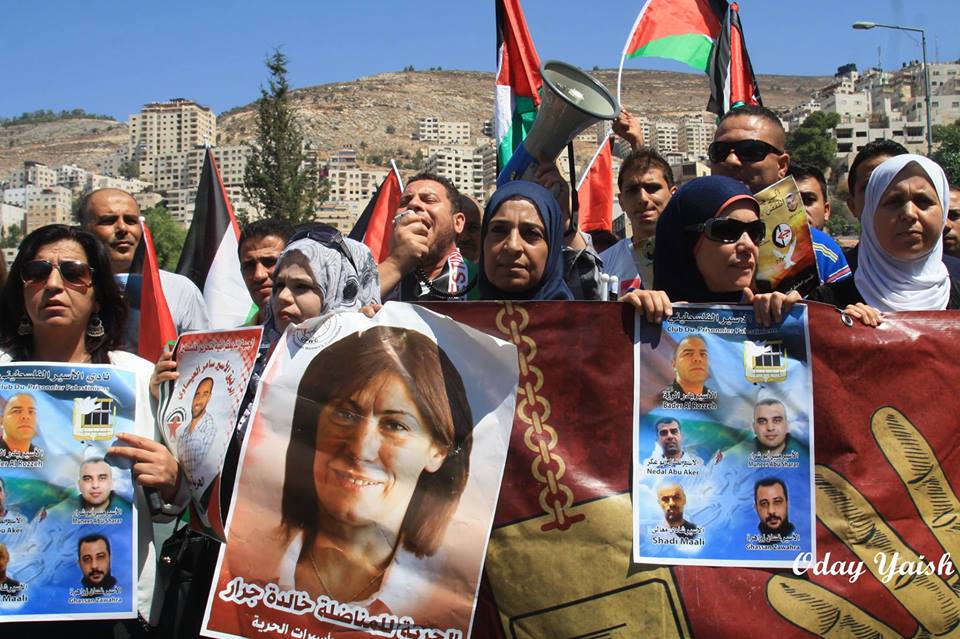
Nidal Abu Aker, Munir Abu Sharar, Badr al-Ruzza, Ghassan Zawahreh, and Shadi Ma’ali are engaged in the “Battle of Breaking the Chains” for the seventeenth day, continuing in their hunger strike to demand the end of administrative detention. All five are imprisoned by the Israeli military without charge or trial on the basis of “secret evidence” and have launched a hunger strike to demand not only their freedom personally, but an end to the policy that has been used against them.
Several more Palestinian prisoners have joined in the hunger strike and its demands: Bilal Daoud Saifi, who like Abu Aker, Zawahreh and Ma’ali is a Palestinian refugee who lives in Dheisheh refugee camp near Bethlehem, who started his strike on 30 August; Suleiman Eskafi of Al-Khalil, an administrative detainee on strike since 1 September; and Amir Shammas of Al-Khalil, an administrative detainee who previoulsy engaged in a hunger strike, had been promised that his detention would not be renewed, but since has had his detention renewed. In addition, Noor Shoukri Jaber, a Palestinian prisoner sentenced to life imprisonment, began a hunger strike on 2 September in protest of lack of medical care and his arbitrary transfer.

All of the striking prisoners have been thrown into isolation in an attempt to pressure them to end their strike and to stop other prisoners from joining the strike.
The “Battle of Breaking the Chains” is sparking actions of support in various cities in Palestine. A permanent tent of support has been set up at the main entrance of Dheisheh refugee camp, where four of the strikers – and three of its leaders – live, and demonstrations of support have been organized in Nablus, Al-Khalil, Bethlehem city, and Ramallah, among other cities.
Samidoun Palestinian Prisoner Solidarity Network expresses its strongest solidarity with the striking prisoners, and calls for international actions, mobilizations and events to demand their freedom. We cannot wait until these brave strugglers are facing death to act and demand not only their freedom as individuals, but the abolition of administrative detention – on the road to freeing every Palestinian prisoner held in Israeli occupation jails. It is not the case that Israeli military courts are any more legitimate, fair or acceptable than administrative detention – they are just as arbitrary, racist and illegitimate. But administrative detention is a weapon of mass terror used against the Palestinian people, and it is critical to bring this practice to an end. These Palestinian prisoners have put their bodies on the line in order to end administrative detention – and it is imperative that we act to support them. These prisoners’ struggle is not only about their individual freedom – it is part of their struggle for return and liberation for Palestine.
Take Action!
1. Sign on to this statement in support of the prisoners’ demand to End Administrative Detention. Organizational and individual endorsements are welcome – and organizational endorsements particularly critical – in support of the prisoners’ demands and their actions. Click here to sign or sign below:http://bit.ly/EndAdministrativeDetention
2. Send a solidarity statement. The support of people around the world helps to inform people about the struggle of Palestinian prisoners. It is a morale booster and helps to build political solidarity. Please send your solidarity statements to samidoun@samidoun.net. They will be published and sent directly to the prisoners.
3. Hold a solidarity one-day hunger strike in your area. Gather in a tent or central area, bring materials about Palestinian prisoners and hold a one-day solidarity strike to raise awareness and provide support for the struggle of the prisoners and the Palestinian cause. Please email us at samidoun@samidoun.net to inform us of your action – we will publicize and share news with the prisoners.
4. Protest at the Israeli consulate or embassy in your area. Bring posters and flyers about administrative detention and Palestinian hunger strikers and hold a protest, or join a protest with this important information. Hold a community event or discussion, or include this issue in your next event about Palestine and social justice. Please email us at samidoun@samidoun.net to inform us of your action – we will publicize and share news with the prisoners.
5. Contact political officials in your country – members of Parliament or Congress, or the Ministry/Department of Foreign Affairs or State – and demand that they cut aid and relations with Israel on the basis of its apartheid practices, its practice of colonialism, and its numerous violations of Palestinian rights including the systematic practice of administrative detention. Demand they pressure Israel to free the hunger strikers and end administrative detention.
6. Boycott, Divest and Sanction. Hold Israel accountable for its violations of international law. Don’t buy Israeli goods, and campaign to end investments in corporations that profit from the occupation. G4S, a global security corporation, is heavily involved in providing services to Israeli prisons that jail Palestinian political prisoners – there is a global call to boycott it. Palestinian political prisoners have issued a specific call urging action on G4S.
Over 100k sign UK online petition calling for Israeli PM’s arrest
Press TV – September 5, 2015
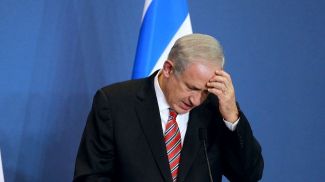 More than 100,000 people in the United Kingdom have now signed a petition demanding the arrest of Israeli Prime Minister Benjamin Netanyahu for war crimes against Palestinians when he visits London later this month.
The petition, which was published on the website of the British Parliament on August 7, calls upon the British government to apprehend the 65-year-old chairman of Israel’s Likud party upon arrival in London next Wednesday for the massacre of thousands of Palestinians during the Israeli military’s 50-day onslaught against the blockaded Gaza Strip last year.
The petition garnered 100,021 signatures as of Saturday morning.
“Under international law, he should be arrested for war crimes upon arrival in the UK for the massacre of over 2,000 civilians in 2014,” the petition says, referring to the Israeli prime minister’s scheduled September visit.
After 10,000 signatures, the British government must respond to the petition, and after 100,000 signatures, it will be considered for debate in the parliament.
The British government has, in return, stated that “under UK and international law, visiting heads of foreign governments, such as Prime Minister Netanyahu, have immunity from legal process, and cannot be arrested or detained.”
Israel started its military campaign against the impoverished Gaza Strip in early July 2014. The offensive ended on August 26, 2014. Nearly 2,200 Palestinians, including 577 children, lost their lives in Israel’s war. Over 11,100 others – including 3,374 children, 2,088 women and 410 elderly people – also sustained injuries.
Why Don’t Gulf Arab ‘Friends of Syria’ Take in Any Refugees?
Sputnik – 05.09.2015
As refugees from Syria stream into Europe, the Gulf Arab financial and diplomatic sponsors of Syria’s rebel groups have taken in zero refugees from the conflict.
Friends of Syria was a group of countries including Saudi Arabia, Qatar and the United Arab Emirates, which united to provide diplomatic and often financial support to facilitate “regime change” in Syria in 2012.
The group’s Arab country members have since then rejected refugees leaving the country as a result of its civil war and resulting massive humanitarian crisis. The same countries have also sponsored rebel organizations in Syria, often supporting them with financial and logistical aid.
At the same time, the Gulf Arab states largely rely on migrant labor for everyday work, something that could provide Syrian refugees with the opportunity to provide for themselves in a temporary new home.
Refugees Not Welcome
According to the BBC, in addition to having complex visa rules and not participating in conventions on refugees, the countries rely largely on migrant workers from Southeast Asia.
To make matters worse, Saudi Arabia has been deporting migrant workers, particularly those from neighboring Arab countries such as Yemen. According Human Rights Watch, the country deported an average of 2,000 migrants per day between November 2014 and March 2015.
In addition, Saudi Arabia’s kafala system only allows migrants to enter the country with sponsorship from their employment.
Planned Catastrophe
The Gulf countries also foresaw the refugee crisis after Syria’s conflict began in 2011, according to Alexander Sotnichenko, dean of the international relations department at Saint Petersburg State University.
“The Gulf countries foresaw the humanitarian catastrophe as a result of the civil war in Syria and in 2011 financed the construction and maintenance of large camps in Turkey and Jordan,” Sotnichenko wrote.
According to Sotnichenko, most refugees from Syria went to Turkey because of the country’s announcement that it is prepared to accept refugees. This allowed the Gulf countries to largely deflect the stream of refugees from Syria’s conflict, which they had taken part in sponsoring.
“From Turkey it is even more difficult to get to Gulf countries [than from Syria], while Europe is much closer,” Sotnichenko added.
As a result, refugees are able to get to Europe illegally from Turkey, while entering Gulf countries is much more difficult, according to Sotnichenko. In addition, Syrian refugees in Saudi Arabia’s neighbor Jordan are detained and sent to refugee camps.
Israeli helicopters transport terrorists injured in Syria battlefield: Report
Press TV – September 4, 2015
Israeli helicopters have transported for treatment to the occupied territories six injured members of terrorist groups operating against the government in Syria, a report says.
The official Syrian news agency, SANA, quoted Israeli media on Friday that the helicopters transported the wounded the day before.
One of the injured militants was taken to a hospital in the city of Safed and the other five were transported to a medical center in Haifa.
The news comes as no surprise given the fact that the Tel Aviv regime has a long history in supporting militant groups against the government of Syrian President Bashar al-Assad over the past more than four years of turmoil in the Arab country.
Reports say Israel has set up field hospitals near the border with Syria to treat the injured militants coming in from battlefield.
The Israeli-occupied Syrian territory of the Golan Heights has hosted the field hospitals for the treatment of the wounded militants. In June, locals in the Golan intercepted an Israeli vehicle transporting two members of the al-Nusra Front terrorist group on the road between al-Sheikh Mountain and the village of Majdal Shams.
Ehud Yaari, an Israeli political commentator, said in October 2014 that the Tel Aviv regime has provided medical treatment for over 1,400 militants wounded in the operations against the government in Syria.
The Neocon Foreign Policy Walmart

By Daniel McAdams | Ron Paul Institute | August 30, 2015
One of the most depressing things about watching — even from a distance — the quadrennial race for the White House is seeing what passes for debate on the one area where the president does have some Constitutional authority: foreign policy.
Candidates who have spent little or no time studying or traveling to the rest of the world, and, in the fashion of many Americans in the age of Empire, see the rest of the world as just a series of US colonial outposts, apparently consider foreign policy unworthy of serious consideration.
So little do Republican candidates care about foreign policy that most of them have “outsourced” their foreign policy to a single neocon-dominated foreign policy shop called the “John Hay Initiative.” If you wonder why most Republican candidates sound exactly the same on foreign policy, it’s because they are nearly all getting their advice from the same people.
When nearly all candidates look to someone like Eliot Cohen, a founding member of the Project for a New American Century (PNAC), to provide an off-the-shelf foreign policy, it should be no surprise that the “debate” in the Republican party is only over which country to attack first.
Any candidate who thinks so little about something so important as America’s place in the world should be automatically disqualified.
But the neocons love it! The “experts” who brought us the 2003 Iraq war and the Libya “liberation” are still in the driver’s seat when it comes to foreign policy.
“Jeb!” has John Hay Initiative members Michael Chertoff and Michael Hayden (remember those crooks?) on board as his advisors.
Marco Rubio reportedly draws from Hay Project member Roger Zakheim, the son of GW Bush administration “vulcan,” Dov Zakheim. Zakheim père, we remember, joined with his fellow neocons to lie the US into war with Iraq, enriching the military-industrial complex, before absconding to the “private sector” to make his millions from the same military-industrial complex. Zakheim quickly and quietly left his position as the Pentagon’s chief financial officer after a trillion dollars went missing and the Government Accountability Office was critical of his handling of matters.
Scott Walker, a soporific candidate who nevertheless still gives neocons like Bill Kristol the vapors, also shops the neocon Walmart of foreign policy, the John Hay Initiative. It should be no surprise, then, that at his big foreign policy coming out speech at the Citadel military college Friday, he unveiled an “aggressive” foreign policy — crying out “America will not be intimidated. And neither will I” — as he promised more war and vowed that “the retreat is over!”
Is this the retreat he is talking about?
Walker reportedly taps into the McCain Institute’s David Kramer, a John Hay member, for his foreign policy wisdom. Kramer is another PNAC alumni, also putting in time at the CIA-affiliated Freedom House and as director of the Bush State Department’s Office of Policy Planning. This must explain Walker’s obsession with taking out Iran. He vowed to “roll back the theocrats in Tehran,” but in fact unlike the US, Tehran has not invaded another country in hundreds of years. What’s to “roll back?”
If Walker actually paid any attention to the quality of advice he gets from his PNAC/John Hay gang he might call for his money back. Walker’s speech was peppered with macho language about “defeat[ing] the barbarians of ISIS,” while also vowing to destroy the two forces actually fighting ISIS — Syria and Iran! In fact, his vow to use the US military to overthrow the Syrian government would without question result in the greatest ISIS victory to date — control of Syria. One need not sympathize with Assad to recognize that he is literally the only thing keeping the whole of Syria out of the hands of ISIS.
John Hay Initiative “experts” also wrote the foreign policy speeches of candidates Carly Fiorina and Chris Christie. No doubt they were behind Fiorina’s astonishingly ignorant vow to make her first call as president to Israeli Prime Minister Netanyahu to “to reassure him that we stand with the state of Israel” and to make her second call to Iran to “to tell him that whatever the deal is that he signed with Obama, there’s a new deal and the new deal is this: Until you submit every facility [where] you have nuclear uranium enrichment to a full set of inspections, we’re going to make it as hard as possible for you to move money around the global financial system.”
Pure PNAC.
These neocons should be in jail, not still deeply ensconced in the Beltway foreign policy halls of power, dining in sumptuous splendor while the rest of America is impoverished by the destructive wars they push. Their lies have cost millions of innocent lives overseas as well. They are a cancer on the country. Any candidate who cares so little about the issues as to accept a “virtual staff” of foreign policy “experts” from those who have gotten every single major foreign policy issue of our time totally and catastrophically wrong has no business holding any elected office.
John Hay? I’d rather shop for a foreign policy expert at Walmart.
Syrian Suffering vs. Palestinian Suffering
By Robert Fantina | Aletho News | September 4, 2015
The tragic photo of the body of a three-year old Syrian boy, Aylan Kurdi, drowned in the sea when attempting to flee that war-torn nation with his family, is seared on the minds of all but the most heartless of people who have seen it. Still wearing his little sneakers, he would seem to be only asleep, where he not lying alone, face down, on a Turkish beach, having been washed ashore by the tide. The unspeakable horrors that his desperate family fled, at great and, as it turned out, tragic risk, can only be imagined by anyone who has not experienced them. The entire world is crying out for a resolution to the problems that led to the death of this child, his brother, mother and countless other desperate refugees.
But the Syrian refugee crisis is not the only one that is leaving children dead and dying. Such publicity was not granted to Palestinian children, bombed to bits by apartheid Israel, using United States-provided weaponry. Over 500 innocent children were killed in a 51-day period last summer; some of them asleep in their own beds, others huddled in United Nations refugee centers, both places where any child should feel, and should be, safe and secure. Their mangled and bloody bodies were shown on social media, but somehow the corporate-owned media did not find them worthy of reporting.
It is impossible to imagine the horror of Aylan’s family, in the water in the black of night, when Aylan and his brother slipped from their father’s desperate grasp. How the children must have suffered! The feelings of panic and desperation experienced by their parents is nothing Hollywood’s best actors could ever mimic.
Why, then, were not the stories of any Palestinian children told? Their parents too struggled desperately to save them, and the photographs of those parents holding the battered, mangled, bloody bodies of toddlers and infants are no less moving than pictures of Mr. Kurdi, as he speaks of his tragic loss.
In April of this year, a devastating earthquake struck Nepal, killing over 8,000 people, and causing millions of dollars of damage. In response, local stores requested that their customers donate to relief programs. Fundraisers were held, donations solicited, and the world did what it could to help these beleaguered people.
In the summer of 2014, more than 2,000 people were killed in the Gaza Strip, with tens of thousands left homeless. Today, most of them are still homeless, some of them living with friends or relatives fortunate enough to have something left to live in, others living in makeshift shelters, built from the ruins of their homes. Children are attending classes in bullet-ridden schools, with some classrooms having huge holes in the walls or ceilings, evidence of the cruel and barbaric bombing of last summer. Yet there has been little news of this. This writer is not familiar with any local relief activities, or any such activities at all. The only donation solicitations that he has seen have been by Palestinian relief agencies with which he is familiar because he has sought for them.
Relief donations increase when people around the world, especially those in First World nations, see the suffering that the relief is designed to alleviate. Why, one wonders, is the acute suffering of the Palestinian people ignored? Even the unspeakable burning alive of a Palestinian toddler, the killing of his mother and the extremely serious burns experienced by his brother had only a brief moment in the public media.
The corporate-owned media, unfortunately, determines what it wants the world to know, and what it would prefer not to reveal. Zionism dictates that Palestinian suffering is not worth showing to the world. After all, Zionists with prominent cabinet positions in the Israeli government have stated that Palestinians are ‘beasts’, and all of them should be destroyed. Having a fundraiser to assist them is not in the plan.
In May of 2014, two Palestinian teens were videotaped being shot in the back by Israeli Defense Force (IDF) terrorists. Is that not newsworthy? One can only imagine how newsworthy the corporate elite who control the media would consider it if two Israeli teens were shot in the back by Palestinians. Yet the reverse is not true.
It is an age-old truism in the U.S. that the ‘enemy’ is less than human. From ‘gooks’ in Vietnam to ‘sand jockeys’ in the various Gulf wars, the U.S. teaches its own terrorists to view their victims as less than human. Since Israeli lobbies own the U.S. Congress, seeing Palestinians as ‘beasts’, whose suffering is not worthy of cluttering up the vacant minds of the typical U.S. news audience, is completely acceptable. A three-year-old Syrian boy washing up on a beach is tragic; a three-year old Palestinian boy, whose body was destroyed beyond recognition by bombs dropped by Israel, isn’t worth anyone’s notice.
This writer wonders what goes through the mind of a Palestinian parent who has lost one or more children to Israeli bombs, as he or she reads about little Aylan, and sees those heart-rending pictures. Certainly, empathy and sympathy for Mr. Kurdi is foremost in their mind. But do they also wonder why the tragic death of their own child or children was ignored? As they see the world demanding help for Syrian refugees, do they wonder why no one seems to be demanding help for them?
It is long past time for the nation of Palestine to be internationally-recognized by the remaining countries, most notably the United States and, to its great shame, Canada, that thus far do not. It is also long past time for the world to rush in with aid to Gaza, and to demand that Israel adhere to international law, or suffer the sanctions and other consequences that any other nation, violating law and abusing human rights, would experience. The trend is moving in the direction of human rights for Palestinians; their suffering at the hands of Israel and the United States must end.
Six Palestinian Journalists Kidnapped in August
IMEMC News & Agencies | September 3, 2015
The Union of Palestinian Radio and Television documented about 20 Israeli violations regarding the rights of Palestinian journalists and media staff working in Palestine this August.
 The Union stated, in the monthly report issued on Thursday, that Israeli forces detained six Palestinian journalists and two photojournalists, including Hazem Obaid, who works for Al-Quds TV.
According to Al Ray, Obaid was detained while he was en route to travel via Al-Karama crossing. Authorities later extended his detention.
The number of journalists, writers and media activists detained in the Israeli jails was up to19 prisoners, by this time, to include Nidal Abu Aker, the director of Bethlehem’s Al-Wehda Radio and presenter of “In Their Cells” programs. Abu Aker has staged a continued hunger strike since August 20th, in protest against the administrative detention policy.
Palestinians, this past month, have witnessed an escalation in the organized attack against Jerusalemite journalists during their coverage of the continued incursions of Al-Aqsa Mosque and the daily events in the city, in general.
During Israel’s latest military offensive on the Gaza Strip, 17 journalists were reported killed by Israeli forces. According to the Palestinian Center for Development and Media Freedoms (MADA), over 80 percent of Palestinian journalists were engaged in self-censorship by late October of 2014. In a dangerous precedent, Israeli police recently fined Palestine TV photojournalists and crew members of Russia Today TV, under the pretext of “obstruction” caused during their coverage to prevent the entry of worshipers to the Al-Aqsa Mosque from Al-Silsila gate.
Featured Video

Genocide-linked firm handles Britons’ NHS data
or go to
Aletho News Archives – Video-Images
Book Review
Book review: Boiling Point, How America Brought War to Ukraine
By Tim Kirby | Strategic Culture Foundation | November 14, 2026
Did Vladimir Putin just wake up one day on the wrong side of the bed and decide to invade Ukraine in February of 2022 or is there a lot more to this single decision that has been reshaping the 21st century geopolitical landscape?
Obviously, from the way that I just posed the question you can see that I am on the side that views the causes for the war in Ukraine to be very deep, long-term, historical and consciously nefarious, and most importantly, not from within the halls of the Kremlin. So it was a pleasure to take a look at the book “Boiling Point, How America Brought War to Ukraine” by author Stephen Kinzer, who like myself, also believes that the real reasons behind military conflicts around the world are not what CNN and the BBC have been telling you. The main thesis of this book was stated clearly by its creator; the war “may have been illegal, but it was definitely not unprovoked.” … continue
Blog Roll
 Aletho News
- The 10 Disease Renamings That Rescued the Vaccine
- NATO cancels 2027 leaders’ summit
- IAEA’s politicized use of safeguards undermines its impartiality: Russian envoy
- UK must be ready to strike Russian Arctic – ex-PM
- Fico’s Two Red Lines: Russian Energy and the Next Ukraine Loan
- Thousands rally for banned NATO-skeptic presidential candidate
- Ukraine Settlement and New European Security Architecture Must Go Hand in Hand – Kremlin
- Book review: Boiling Point, How America Brought War to Ukraine
- Israel Revives The ‘Iranian Assassination Threat Against Trump’ Deception In A Desperate Bid To Restart The War
- US rewrites history to dodge blame for illegal war on Iran: Foreign Ministry spokesperson
- If Americans Knew
- An error has occurred; the feed is probably down. Try again later.
- No Tricks Zone
- New Study: Barents Sea Temperatures Were Warmer And Sea Ice Less Extensive In The 1700s Than Today
- German Authorities Start Initiative To Evaluate Public Register For Climate “Disinformation” Spreaders!
- Zonal Asymmetry of Temperature Change in the Antarctic Circumpolar Current
- New Study: The Net Fossil Fuel Contribution To Rising Atmospheric CO2 Has Been Zero For 500 Years
- Germany’s Green Energy Transition Becoming Increasingly Expensive…Another 6 Trillion Euros!
- Sudden Stratospheric Warming, Powerful El Niño Combination May Lead To Extreme Europe Cold, Energy Crisis!
- Two New Studies Find Thwaites Glacier Melt Cannot Be Driven By Human Activity Or A Warming Ocean
- E-Cars Reduce CO2 Emissions By Only 41% Compared To Internal Combustion Engine Vehicles
- Predictions Made By Renowned Climate Professor Over Past Decades Have Been Proven To Be Poor
- New Study Suggests Large Regions Of The Pacific Ocean Have Been Cooling For The Last 80 Years

