Israeli Supreme Court Releases Hunger-Striking Prisoner
By Richard Silverstein | Tikun Olam | August 19, 2015
The Israeli Supreme Court has ruled that hunger striking Palestinian prisoner, 31 year-old Mohammed Allan, will be released from administrative detention… but only if medical tests show that he’s suffered “irreversible” damage as a result of his 65-day hunger strike. Apparently, a healthy Allan was a grave national security threat. While a near-dead Allan poses no such threat. While the Court has done the decent, humane thing, it erased any good will it might’ve generated by compelling Allan had to prove that his ordeal had caused damage to his body and mind so severe that it supported freeing him.
If he recovers and shows no sign of permanent damage, he could be rearrested and forced to serve the remainder of his term under administrative detention. Further, he could be rearrested at any time by authorities under a new order. Such is the caprice of the Israeli legal system regarding security offenses. Under administrative detention, a victim need not be charged with a crime. And such detentions may be extended for six month periods indefinitely. That is why prisoners have begun to resort to hunger strikes. Killing themselves seems to be the only message that moves the hardened Pharaonic hearts of Israel’s security services.
Israel was placed in this “awkward” position by a ruling from the national medical association refusing to participate in force-feeding him, which had been the prison service’s plan. After no doctor would agree, it had to let the hunger strike run its course. It is a pleasant surprise that the Israeli security police couldn’t mange to find a professional willing to perform such a ghoulish procedure. Keep in mind, that a number of countries including the U.S. do permit force-feeding of hunger strikers.
This is a cold, brutal judicial decision in line with a string of such judgments offered by this Court since a hardline majority took over in the past several years. Lest any apologists continue prattling about the liberal views and support for human rights offered by the highest judicial body as a counter to the racism of the legislative branch, the days of Aharon Barak are long past. Nor are we likely to see such a person on the court in the future.
That doesn’t mean the extreme right in Israel is any less angry at this Court. In fact, one minister said last week the Court should be “bulldozed.” Apparently, having a court that is obeisant to the right-wing policies of the government as this one is, isn’t enough. They want a Court that opens its sessions with the Likud anthem and swears allegiance to Rabbis Ginsburgh and Lior.
The Kingmaker
By Gilad Atzmon | August 18, 2015
 Paul Eisen, until a week ago anonymous as far as most Brits were concerned, is now a kingmaker. The UK Jewish Lobby is convinced, for some reason, that the nature of Eisen’s relationship with Labour’s leading candidate Jeremy Corbyn will determine the future of this country.
As we witness the most important political debate in Britain for generations being hijacked by the Zionist media and ‘Jewish sensitivities’, the time is ripe to ask: who is Paul Eisen?
Eisen has been described by the Jewish press and its acolytes as an ‘anti Semite’ and a ‘holocaust denier’, but peculiarly, no one mentions that Eisen is actually a Jew who sometimes even speaks ‘as a Jew’.
Eisen’s ‘crime’ seems obvious – he doesn’t adhere to the Zionist orthodox Shoah narrative. But Eisen doesn’t dispute the fact that German National Socialism despised the Jewish race, he doesn’t dispute the mass deportation of Jews, he doesn’t condone German National Socialist racism against Jews and others. Eisen doesn’t dispute the fact that many Jews died under the Nazi regime in some horrid and unfortunate circumstances. However, Eisen is sceptical on issues to do with the homicidal nature of the Nazi operation. He is not convinced that the Germans used gas chambers as a death factory.
Eisen could be right or wrong (as he himself admits in his writing), but does such a belief mount to ‘anti Semitism,’ racism or ‘hate crime’? Can the questioning of the past be considered a hateful act under any circumstances?
It’s quite the opposite: the ability to revisit and revise the past is the kernel of ethical, humanist and universal thinking. It is the attempt to grasp ‘what really happened’ which helps us to form the prospect of a better future.
Eisen calls himself a ‘holocaust denier’ but did anyone within the (free) British press care to perform the minimal journalist duty and investigate what Eisen means by his ‘denial’? The answer is no.
Eisen is obviously an opponent of the Holocaust industry, Holocaust religion and Holocaust exploitation. Eisen was tormented (as a Jew) to find out that the Israeli Holocaust museum Yad Vashem was erected on the lands of Ayn Karim, a ethnically cleansed Palestinian village. Eisen was tortured when he realised that Yad Vashem was built in proximity to Deir Yassin, a Palestinian village that was erased along with its inhabitants in a colossal cold-blooded massacre by Jewish paramilitaries in 1948.
Just three years after the liberation of Auschwitz, the newly born Jewish state wiped out a civilization in Palestine in the name of a racist Jewish nationalist ideology. It is this vile cynicism that turned Eisen into a denier – a denier of the primacy of Jewish suffering. In his eyes, if the Jews could commit the massacre in Deir Yassin after Auschwitz, the holocaust must be denied because it failed to mature into a universal ethical message.
Again, you may agree with Eisen or you may not, but his humanist and critical approach qualifies him to be the Labour kingmaker. We can only thank British Jews and their forceful media to position Paul Eisen exactly where he belongs.
PA security: No proof Palestinians attempted stabbing attacks
Ma’an – August 18, 2015
RAMALLAH – The Palestinian Authority security forces on Tuesday said that there was no evidence that Palestinians shot by Israeli forces in recent days, in two cases fatally, had stabbed Israeli soldiers.
In the last week, Israeli forces have shot three Palestinians, killing two, who they claimed attempted to stab Israeli soldiers or Border Police officers.
However, the spokesperson for the PA security forces, Major-General Adnan Dmeiri, said in a statement that Israel had provided no evidence to support its allegations.
He questioned the fact that in each case the Israeli army or police force investigated its own soldiers or officers, “without the interference of any other party.”
He said that the investigations had portrayed the Israeli soldiers and officers as “heroes.”
Dmeiri criticized the fact that the army and police force were both the investigators and the “executors” of Palestinians.
Most recently, Israeli forces shot dead a young Palestinian man on Monday afternoon after they claimed he attempted to stab an Israeli Border Police officer.
An Israeli army spokeswoman alleged that the Palestinian man approached Israeli Border Police officers at Tappuah junction, known to Palestinians as Zaatara military checkpoint, asking for “medical assistance.”
The spokeswoman said that he then pulled out a knife and attempted to stab an Israeli officer before he was shot dead.
She said that the Israeli police officer was lightly injured.
Two days earlier, Border Police shot dead another Palestinian after the army said he stabbed an Israeli Border Police officer near Beita in southern Nablus.
Rafeeq Kamil Rafeeq al-Taj, 21, was shot five times, the Palestinian Red Crescent Society said.
On the same day, Israeli forces shot and lightly injured a Palestinian man after he allegedly stabbed a soldier west of Ramallah. He was taken into custody following the incident.
Israeli media recently reported that the Israeli army had implemented new rules of engagement, requiring soldiers in the occupied Palestinian territory to hold their fire unless there is a genuine threat to their lives.
Previous rules allowed Israeli soldiers to use fire “warning shots” when their lives were not at imminent risk, and subsequently aim for lower extremities when engaging with Palestinians on the ground.
Since the beginning of 2015 Israeli forces have injured an average of 37 Palestinians a week, and killed a total of at least 25 Palestinians, according to UN figures.
Europe’s Forgotten History: From Human Zoos to Human Trophies Displayed in Museums Today
By Garikai Chengu | CounterPunch | August 17, 2015
Global outrage was sparked when the Zimbabwean lion, Cecil was killed as a trophy; but to this day, Britain and America continue to display in museums human remains that are human trophies of their massacres and subjugation of indigenous populations.
Britain has recently revealed that it is currently negotiating with Zimbabwe over the repatriation of human remains, belonging to fighters from Zimbabwe’s struggle against British colonisers, currently displayed in the Natural History Museum of London.
On Tuesday, Zimbabwean president, Robert Mugabe, said in a speech that the Zimbabwean liberation war fighters, “whose heads were decapitated by the colonial occupying force, were then dispatched to England, to signify British victory over, and subjugation of, the local population.”
That Thursday night, the British Foreign Office confirmed that “remains of Zimbabwean origin” were on display in a museum in London.
President Mugabe also remarked that, “surely, keeping decapitated heads as war trophies, in this day and age, in a national history museum, must rank among the highest forms of racist moral decadence, sadism and human insensitivity.”
Prior to European and American colonialism, the first museums were founded in Africa and played an essential role in many African civilisations. In fact, museums have been a part of human history for more than 2,000 years.
The tradition of collecting and displaying intriguing items began in Black Ancient Egypt. Most rising Western cultures from the Roman Empire onwards then displayed exotic animals and flora in their museums. The word “museum” comes from the Greek mouseion, meaning “temple built for the muses and museums”, which were originally designed to promote art, science and ingenuity. After the European Dark Ages, the next step in the evolution of museums occurred as a result of the ingenuity of the Black African Moors who conquered and civilized parts of Europe. The study of the natural world was once again encouraged by the Black Moors establishing “curiosity cabinets” across Europe after a millennium of Western ignorance.
Prior to the 19th century, museums tended to be small and private, open only to the aristocracy of a given nation. During the 19th century, the modern museum as we know it began to take shape. With plunder streaming in from all corners of the British Empire, the modern museum was born.

The British Museum, London.
The British Museum was created largely as a repository for artifacts looted from Africa between the 17th and 19th centuries. Such plunder includes many artifacts from Ancient Egypt which prove that the Ancient Egyptians, who established the first museum, were themselves dark-skinned Afroancestrals.
Across the world, one of the consequences of British colonialism was the violent appropriation of cultural artifacts, sacred and precious objects; and one of the legacies is their ongoing display in British museums. For centuries, the museums of Great Britain have served to bolster national white pride and glorify British imperial culture, by displaying a wide array of artifacts looted and plundered during European slavery and colonialism.
One example of the rather grim history of colonial racial terrorism is the long European history of human zoos, which featured Africans and conquered indigenous peoples, displayed in the same way as animals. Men, women and children would be kidnapped, locked up in cages and exhibited in front of European large audiences. Many people died after short stints in captivity and they lived in tortuous conditions. Visitors to the human zoos would often poke the African children with sticks, throw food at them and audiences were permitted to subject the captives to various degrading acts for a fee.
The primitive practice of putting indigenous people on display began during the modern period when explorers like Columbus and Vespucci lured natives back to Europe to be flaunted and paraded like trophies.
In the late 1800’s, Europe had been filled with human zoos in cities like Paris, Hamburg, Antwerp, Barcelona, Warsaw, Milan, and London. Thirty-four million people visited the 1931 World Fair for human zoos in Paris. New York was not morally exempt from such racist and degrading practices. New York City saw these popular exhibits continue into the twentieth century, even after the ends of both World Wars. Millions of Americans attended these spectacles.
Prior to the Second World War, human Zoos in America were at their height and the New York Times reported at the time, “few expressed audible objection to the sight of a human being in a cage. The crowd loved it… It is absurd to make moan over the imagined humiliation and degradation that they suffer.” At a time when America and Britain accepted human zoos as perfectly normal, Adolf Hitler was the one to ban them.
By creating the first mass contact between Whites and Blacks, and by promoting the spectacularization of “The Other”, human zoos were a key factor in the progressive shift in the West from scientific to popular racism.
The primitive European and American practice of exhibiting Africans in zoos continued well into the 1950s. During the 1960s, the baton of state-sanctioned racism towards Africans was passed from Europe’s human zoos into its museums. In fact, historically, museums in Britain have held some of the most reprehensible images of Blacks as barbarians and savages, and the most degrading images of Black women.
A 20 year-old South African woman known as Sarah Baartman would be emblematic of the dark era that gave rise to the popularity of human zoos. She was taken by an exotic animal-dealer to London in 1810. Sarah had a genetic characteristic known as steatopygia; large buttocks and elongated labia. Thousands of British men, women and children would come to human zoos to gawk at her naked body. Sarah’s days were punctuated by rape and scientific examinations. In 1815, Sarah died in abject poverty and her skeleton, sexual organs and brain were put on display at the Museum of Mankind in Paris where they remained for almost a century until 1974. In 2002, President Nelson Mandela formally requested the repatriation of her remains.
If you add up the attendance for every English Premier league football, rugby, basketball and cricket game in Britain this year, the combined total will come to about 30 million people. That’s a big number, but 49 million people will visit British museums this year. Museums are important sites for contestation over grand narratives of history, especially nationalist and imperial history. For more people to see the British state openly flaunting stolen loot in a museum this year than those who will watch sport, shows that cultural imperialism and true primitive racial attitudes are deeply entrenched in British statehood.
During the “Great Scramble” for control over the continent in the late 19th century, art counted among the highest prizes of imperialist plunder. Britain still unashamedly displays thousands of stolen African artifacts worth hundreds of billions of pounds in the British Museum, Liverpool Museum and elsewhere. Many other invaluable stolen artifacts from Africa, Asia and South America are in private British hands. Notably the Benin bronzes, ivories and other ancient works looted by British colonialists, especially during the reprisal attacks launched by the Queen’s soldiers against natives trying to resist imperialism in 1897.
The British Museum has long presented an array of African objects throughout its rooms, and its new African Galleries are second to none. Its ancient Egyptian collection is stunning. And they should be: while African collections in Germany, France and Belgium hold several important pieces, no other nation could match the British when it came to plundering so many art objects of a conquered people over so long a time period.
The British Museum, controls a quarter of a million artifacts from Africa alone, and maintains that looting those artifacts “was legal at the time.” As ever when the West perpetrates a crime against other people, they have a perversely fantastic way of asserting that their actions are completely bona fide, entitled and legal. Arthur Torrington OBE of the British Museums and Libraries Archives Council candidly admits that museums do not “want to accept the objects were stolen because if they do it for one, they’ll have to do it for all.”
The modern British museum may literally have been built on the backs of oppressed indigenous populations and its rooms filled with plundered goods from Europe’s colonial conquests; but in this day and age, the ongoing display of stolen loot and human trophies is unjustifiable in a modern, civilized society.
Garikai Chengu is a scholar at Harvard University. Contact him on garikai.chengu@gmail.com.
Israeli forces punish Kafr Qaddum by damaging the water supply system
International Solidarity Movement | August 16, 2015
Kafr Qaddum, Occupied Palestine – On Saturday the 15th of August 2015, the villagers from Kafr Qaddum once again demonstrated against the blockage of the road leading to Nablus as well as the nearby Kedumin settlement. In solidarity with the local people there were a few international activists and journalists covering the demonstration.
The non-violent protest was immediately suppressed by the Israeli occupation forces shooting dozens of teargas canisters and live ammunition. Instead of the frequently used bad-smelling skunk water, the army drove a bulldozer into the village. This bulldozer destroyed the only water pipe in the village, leaving the people Kafr Qaddum without any connection to water until the pipe is repaired. Especially during the hot summer months, water is a scarce and essential good.
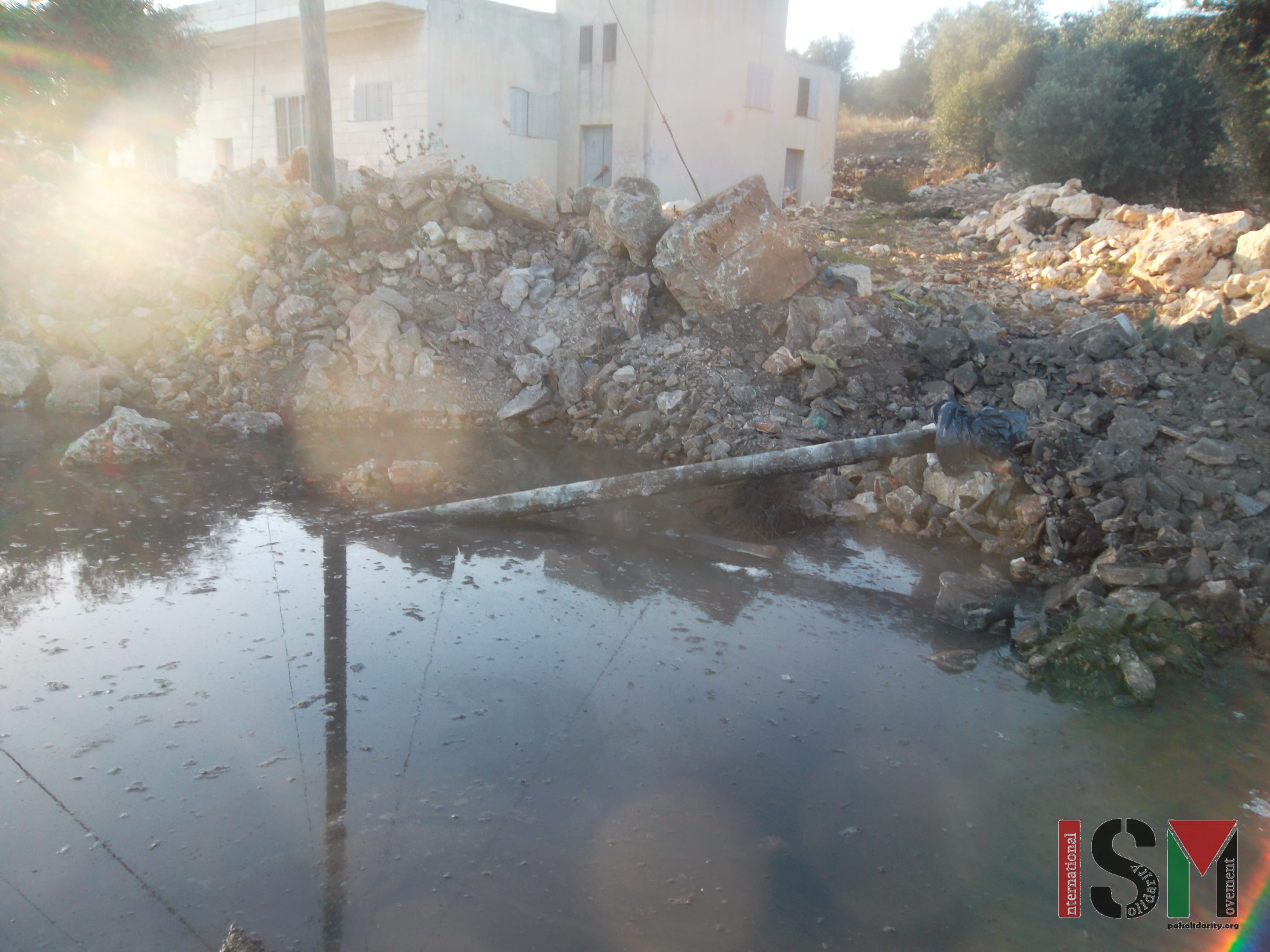
Murad Shtaiwi, one of the leaders of Kafr Qaddum Popular Committee, understands the damage to the water pipe as a way to collectively punish the village for its ongoing resistance. The costs of a new pipe have to be paid for by the municipality. As Murad explains, damaging the water pipe is a deliberate attempt by the Israeli army to suppress the support among the villagers to continue to protests and thus block future demonstrations.
The U.S.-Israel Conflict Is Finally Visible for All to See
By Sheldon Richman | Free Association | August 14, 2015
Thanks to the Iran nuclear deal, something remarkable is happening in American politics: the irreconcilable conflict of interest between most Americans on one side and Israel and its American supporters on the other is on full display and impossible to ignore. In the past the conflict could be papered over with grand empty rhetoric about the two sides being in “lock-step” and the absence of “daylight” between them. But no more. The conflict is out in the open where everyone can see it. Iran should be thanked for this valuable service.
War with Iran would be a catastrophe not only for the Iranians, including thousands of Jewish Iranians who openly practice their religion in their ancient community, and other people in the Middle East; it would also be a catastrophe for Americans — hence the conflict of interest between most Americans and the war party. Those, like Tom Cotton, Norman Podhoretz, Bill Kristol, and John Bolton, who think an attack on Iran would be a cakewalk, are either liars or fools. These are the same people, of course, who said the Iraq war would be easy and would usher in a new liberal Middle East. The result has been unspeakable sectarian violence throughout the region, culminating in the Islamic State and a reinvigorated al-Qaeda.
Despite the predictable catastrophe a war with Iran would bring, Israel and its staunchest, most prominent American supporters are conducting a well-financed campaign against the Iran nuclear deal that would surely lead to that war if a Republican wins the presidency next year. In fact, they want war because only war (followed by regime change) would give Israel and its American supporters what they want: unrivaled dominance in the Middle East, which among other things would relieve the pressure to make a just peace with the Palestinians at least by leaving the occupied territories.
Let’s acknowledge that most Jewish Americans favor the nuclear deal and do not want war with Iran; in fact, many Jews feel little or no connection to Israel at all. But that must not obscure the fact that the Israeli government, which was recently returned to power by the Israeli people, and the richest, best-organized Jewish American groups — AIPAC and the rest of the Israel/Jewish Lobby — lead the opposition to the deal and the neoconservative coalition in favor of war. (This is not to overlook the prominent non-Jewish members of the coalition.) They feign offense at being called warmongers, but they know that the kind of deal they favor would require Iran to fully capitulate to the United States and Israel, demands which go beyond nuclear questions, and surrender its sovereignty. Such a deal could never be reached, and the war hawks know it. They ought to be honest enough to admit that war is what they want. (Some neoconservatives, Jews and non-Jews, are honest enough, including Bolton, Podhoretz, Cotton, Kristol and Joshua Muravchik.)
What’s noteworthy is that both sides of the divide have taken the gloves off. We had Israeli Prime Minister Benjamin Netanyahu, whom former Meet the Press host David Gregory once called “the leader of the Jewish people,” invited to speak before Congress for the sole purpose of undercutting President Obama’s efforts to engage in diplomacy with Iran. We had senators doing the bidding of Israel and the Lobby by writing to the leader of Iran to tell him no agreement would be long-lasting. And most recently we had Netanyahu, in an unprecedented display, openly urging Jewish Americans to oppose the deal with Iran: “The days when the Jewish people could not or would not speak up for themselves, those days are over,” he said in a webcast to 10,000 Jewish American activists arranged by the Jewish Federations throughout North America and the Conference of Presidents of Major American Jewish Organizations.
Are Jewish Americans supposed to see Netanyahu as their leader? (Not that I think they should see Obama as their leader.) Netanyahu apparently thinks so, and prominent Jewish Americans seem to agree. Sen. Dianne Feinstein, who is Jewish, has courageously condemned this “arrogant” pretense. (Recall that Netanyahu has told Western Jews that they are welcome to “return” to Israel — even those who have never been there — to escape the dangers in their countries. Thus he embraces the pernicious Zionist doctrine, shared by anti-Semites, that Jews ultimately are aliens everywhere except in Israel.)
Obama, on the other hand, has finally been willing to openly identify the source of hawkish anti-Iranian pressure: Israel and its American supporters, especially prominent and well-organized Jewish Americans and non-Jews who kowtow to win their political and financial support.
“Because this is such a strong deal,” Obama said, “every nation in the world that has commented publicly, with the exception of the Israeli government, has expressed support.” He also said, “Between now and the congressional vote in September, you’re going to hear a lot of arguments against this deal, backed by tens of millions of dollars in advertising. And if the rhetoric in these ads, and the accompanying commentary, sounds familiar, it should — for many of the same people who argued for the war in Iraq are now making the case against the Iran nuclear deal.”
Everyone knows, first, that the major push for the war against Iraq came from Israel and the Lobby, supported by the neocon devotees of Israel’s agenda, and, second, that the multimillion-dollar ad campaign against the Iran deal is run by an AIPAC-related group, Citizens for Nuclear Free Iran, and United Against Nuclear Iran, led by former Sen. Joe Lieberman and financed by wealthy casino magnate Sheldon Adelson, who makes no secret of his Israel-first sentiment.
But we shouldn’t overstate Obama’s willingness to identify the malign influence on American foreign policy that emanates from Israel, its Lobby, and the neocons in general. He also said:
When the Israeli government is opposed to something, people in the United States take notice. And they should. No one can blame Israelis for having a deep skepticism about any dealings with a government like Iran’s — which includes leaders who have denied the Holocaust, embrace an ideology of anti-Semitism, facilitate the flow of rockets that are arrayed on Israel’s borders, are pointed at Tel Aviv. In such a dangerous neighborhood, Israel has to be vigilant, and it rightly insists that it cannot depend on any other country — even its great friend the United States — for its own security. So we have to take seriously concerns in Israel.
Note that he did not mention Israel’s large, invulnerable nuclear arsenal. Israel is the nuclear monopolist in the Middle East and has been since the 1960s, thanks to the connivance of its American supporters inside and outside of government. In the context of Iran’s potential for obtaining a nuclear weapon, wouldn’t you think that fact is relevant? Why do establishment politicians and the mainstream news media hardly ever mention it? Moreover, the rockets that threaten Israelis come from people whom Zionist militias drove off their land in 1948 in a far-reaching ethnic-cleansing campaign and who are now routinely threatened and oppressed: the Palestinians in the open-air prison known as the Gaza Strip, target of savage air wars and a years-long blockade, and the people of southern Lebanon, whom Israel has attacked repeatedly and occupied over the years.
Note also that Obama accepts the premise that Iran aspires to be a nuclear power, a proposition for which there is zero evidence and against which there is abundant evidence.
Nevertheless, to his credit, Obama did say,
As President of the United States, it would be an abrogation of my constitutional duty to act against my best judgment simply because it causes temporary friction with a dear friend and ally.
It’s not every day that an American president acknowledges that, whatever his job is, it is not to serve the interests of Israel’s racist ruling elite and population. That is indeed good to hear, but it would be news to the Weekly Standard and the Wall Street Journal editorial page, among others.
Israel’s American partisans have predictably accused their opponents of anti-Semitism for focusing on Jewish attempts to kill the Iran agreement, hoping Americans will believe that criticism of Israel and the Lobby in itself constitutes bigotry, if not Nazi sympathies. (Mike Huckabee’s claim that Obama is leading the Israelis to the ovens is only the most obnoxious example.) But taking offense at the focus on Jewish efforts is a cynical ploy void of legitimacy. Israel bills itself The Jewish State, representing Jewish interests worldwide. The Lobby embraces that designation. (Not all Jews regard Israel as The Jewish State, however. Jewish anti-Zionism, which dates back to before Theodor Herzl’s time, thrives today.) AIPAC boasts of its political clout and its command of vast resources that can make or break political careers. An AIPAC official, asked if the Lobby had lost influence after a scandal, once famously boasted to a journalist over dinner, “You see this napkin? In twenty-four hours, we could have the signatures of seventy senators on this napkin.”
In light of all this, it’s a little absurd to object to the identification of Israel with Jews or to rail against those who point out the obvious: that Israel and its Jewish American partisans have been at the forefront of the campaign for war against Muslim nations. As Chemi Shalev, writing in the Israeli daily Haaretz, put it:
Netanyahu is allowed to address 10,000 American Jewish leaders and activists from Jerusalem, but mentioning their faith is forbidden; he is allowed to be the sole foreign leader to openly campaign against the deal, but singling him out is verboten; AIPAC can raise emergency funds, cancel all vacations and send its lobbyists to canvass on Capitol Hill, but say the words “lobby” or “money” and you are quickly branded a bigot; [Sen. Chuck] Schumer can famously boast that he sees himself as a Shomer [guardian of] Israel but you won’t dare say that when he seems to live up to his promise.
Moreover, how absurd is it for Israel’s partisans to accuse critics of raising the dual-loyalty issue, which these days sounds rather antiquated? Did anti-Semites put Netanyahu up to his machinations? Did they sponsor the trip to Israel for over 50 members of Congress just as debate over the Iran deal was starting?
Do not misunderstand: Israelis and Israel’s Jewish American partisans are not promoting war with Iran because they embrace Judaism, the Torah, and the Prophets. Many of Israel’s Jewish American supporters are secular and even atheist, and many observant Jews oppose war with Iran, support the nuclear deal, and hate Israel’s mistreatment of the Palestinians. What motivates many Israelis and Israel’s Jewish American partisans has little if anything to do with Judaism. Rather, they are motivated by an essentially secular ideology and parochial identity politics — Gilad Atzmon calls it “Jewishness” to distinguish it from Judaism — that prioritizes the interests of the tribe. These Jews judge issues by the standard “Is it good for the Jews?” (as they see the good). This chosen-people framework is anti-liberal and anti-universal, featuring ubiquitous enemies and impending doom. One might think this attitude is understandable in light of the history of persecution of Jews, culminating in the Nazi Judeocide. But since this ideology fuels the persecution, oppression, and slaughter of innocent others, rather than extra sensitivity to injustice no matter who the victim, we cannot be so forgiving. Nothing in Jewish history can justify how self-identified Jews have treated the Palestinians, or American Jewish support for, or acquiescence in, that treatment. Israel faces no “existential threat” from Iran or anyone else. If that treatment is an application of Jewish values, then Americans should take note. If it is not, then in what sense is Israel The Jewish State?
Whether this ideology has roots in Judaic doctrine and tradition or whether it is a modern secular phenomenon is a complicated question. But people ought to see it for what it is — before we are dragged into another catastrophic war.
Finally, Israel’s Jewish American partisans warn that criticizing the campaign against the Iran deal risks reinforcing stereotypes and inflaming anti-Semitism (even if in itself it does not constitute anti-Semitism). Almost anything anyone says about anyone else could be exploited by bigots, so that is no reason to withhold valid criticism. But if Israel’s partisans genuinely fear an anti-Semitic backlash — which all decent people would condemn as bigoted collectivism — perhaps they should reconsider their campaign to provoke an American/Israeli war of aggression against Iran.
Can You Trust a Country That Has Violated 20 International Agreements?
By Michael S. Rozeff • Lew Rockwell • August 14, 2015
AIPAC formed a group called “Citizens for a Nuclear Free Iran”. The assumption is that Iran is “BAD” and should be treated as a pariah nation. AIPAC presumes that Iran should be held inferior to such heroes of human rights as Israel. It presumes that Iran shouldn’t be allowed to sign and support the Nuclear Non-Proliferation Treaty as it has. For AIPAC, it is kosher to assassinate Iran’s physicists and wreck its computers. As far as AIPAC is concerned, it is within Israel’s rights to launch a unilateral attack on anything nuclear within Iran if it so chooses. For AIPAC, Iran must be bad. After all, it resists Israel’s treatment of Palestinians. It calls for political change in Palestine, change that Israel resists, so it must be “BAD”. Iran has no nuclear weapons, but it still must be “BAD” according to AIPAC. It hasn’t slaughtered Palestinians, but it still must be “BAD” according to AIPAC.
On the other hand, it is AIPAC’s view that any killing that Israel does has been “GOOD” and must be “GOOD”. To say otherwise and accuse Israel is not simply to be supportive of human rights, or possibly anti-Zionist, but also possibly to be branded as that old enemy that went out of fashion in the 20th century with the Third Reich or at least has been thoroughly discredited and meets with not a fiber of serious intellectual support: anti-Semitic. If one is not to risk being accused of hating Jews or even hating oneself if one is Jewish, one must by this perforation and shredding of logic, by this muddling of distinct ideas, support Israel and all of its genocidal and expansionist policies in all important respects. One must regard nuclear weapons in Israel’s hands as inherently “GOOD” too.
APIAC has launched ads using this new group. One of these popped up on a web site I went to this morning. It asked whether a country (Iran) that has violated 20 international agreements can be trusted. The “documentation” is here. The so-called violations are accusations, not proven facts and not self-evident. The charges are way overdone, much exaggerated, and trumped up. It’s a phony indictment.
What meaning does it have to charge Iran with not having top-notch governance or not having eliminated human trafficking? Is Iran really out for genocide because its former president made some sort of quote that has been widely and wildly misinterpreted, mistranslated and repeated endlessly? What meaning does it have to accuse Iran of chemical weapons hanky-panky when Israel is not a signatory to the Chemical Weapons Convention and Iran is?
Even if they were not baloney, or not all baloney, or half-truths, or fractional-truths, or not mainly unproven accusations and exaggerations, one has to ask how long a list of similar charges one could bring against many other countries in similar social, political and economic situations.
What would an indictment against the U.S. look like? It would easily be as long, indeed much longer, and the charges would be far more tangible, serious and actually have happened. Shall we lead off with the unprovoked attack on Iraq? Shall we include the 14-year war that began by bringing down Afghanistan’s existing government? Dare we mention the U.S. support for attacking Libya under false pretexts and reducing the country to warring factions, sources of weapons and bases for terrorists; and that has destabilized neighboring countries to boot? Shall we mention genocidal sanctions against Saddam Hussein’s Iraq?
Who trusts the U.S. when an ally one day becomes an enemy the next day as Gaddafi found out?
In a one-on-one comparison, which state would look more trustworthy, the U.S. or Iran?
Key Venezuelan Indigenous Leader’s Killer Sentenced to 30 Years

Indigenous leader Sabino Romero of the Yukpa was murdered in 2013
teleSUR – August 15 2015
One of the accused murderers of the prominent Venezuelan indigenous leader Sabino Romero was sentenced to 30 years in prison for homicide on Friday in a landmark move to prosecute the killer of an indigenous person for the first time.
Angel Romero Bracho, known as “El Manguera,” was given the maximum sentence for his role in Sabino’s murder, according to a statement from the attorney General’s office. Another five suspects had already been sentenced to seven years in prison for their involvement in the crime.
Sabino, a leader of the Yukpa indigenous group in western Venezuela and famed national symbol of indigenous resistance, was killed in March 2013 after a heated land conflict between indigenous groups with legal title to the land and large ranchers who wanted to stake their claim to the farmland.
Although the trial in the case of Sabino’s death was lengthy, justice has finally been served in a historic ruling to punish the murderer of an indigenous leader. Violence against indigenous people has long been treated with impunity in Venezuela and elsewhere in Latin America. While the national government has taken many steps to support indigenous rights, ranchers are usually able to bribe judicial officials. In the trial of Romero Bracho, the public prosector received death threats.
Family members and supporters hope that the conviction against Romero Bracho will pave the way to further investigations to punish the other masterminds behind the murder.
“Sabino Romero has denouced threats and violence in the Sierra de Perija of the latifundistas against the Yukpa people.”
Sabino was the target of an assassination plot in the western Venezuelan state of Zulia for his role in the indigenous struggle against large ranchers who sought to monopolize landholdings, even though indigenous campesinos held legal title to the land under an agrarian reform law implemented by former President Hugo Chavez in 2001.
Sabino’s wife and fellow movement activist Lucia Martinez was also injured in the attack.
Sabino was a well-known and important leader among the Yukpa people, but also stood as a national icon of the broader indigenous movement and struggle for indigenous rights.
Palestinian photographer’s visa problem exposes British government’s double standards
MEMO | August 15, 2015
Palestinian Hamdi Abu Rahma is a gifted photographer whose work in Gaza has been highly acclaimed around the world. He is also now at the centre of a political storm after he was told that he could not travel to Britain in order to take part in the renowned Edinburgh International Festival. Scottish politicians and supporters have accused the British government of trying to damage the reputation of the festival by its “overly bureaucratic and insensitive decision” to refuse Abu Rahma a visa.
The row has erupted as Prime Minister David Cameron prepares to roll out the red carpet for Israeli leader Benjamin Netanyahu. The timing is particularly sensitive, as an online petition calling for Netanyahu to be arrested for war crimes when he arrives in London next month has already attracted more than half of the 100,000 needed to trigger a parliamentary debate.
Now that the decision to reject the young Palestinian’s visa application has been challenged by members of the Scottish Government, as well as festival organisers and pro-Palestinian activists, there are hopes that the UK Visa and Immigration agency will think again.
Already widely travelled to show his work at exhibitions around the globe, this is the first time that Abu Rahma has had a visa application rejected without warning. Some observers are particularly surprised since the focus of his photography is about the power of non-violent resistance in Palestine, which he has captured through his camera lens.
“The UK government refused to give me a visa today and the reason for refusal was that I didn’t show any bank statements or documentation to demonstrate my ability to support myself during my visit,” he said in a prepared statement. “Despite sending complete evidence of the sponsorship provided to fund my trip and all contact details of my sponsors, proving that all my travel and accommodation costs have been met, they still refused my application.”
Abu Rahma pointed out that he has travelled extensively in order to tell the Palestinian story through his photographs but Britain is the first country that has refused him entry. “We all know the real reason for this refusal,” he said. “Britain knows very well what my trip is about. I am not going there to claim asylum or beg in the streets. I am going there to educate the British people and pose some questions.” Such questions as: “Have you ever asked Israel why they kill and murder innocent men, women and children in Palestine? Do you know why Israel occupies Palestinian land illegally and destroys our homes, and why it allows colonial settlers to move into our homes illegally against international law?”
Expressing his “deep disappointment” at being unable to travel to Britain on this occasion, the young photographer thanked his friends across the country for their support and for being willing to host him in their homes.
Phil Chetwynd, one of the festival organisers who invited Abu Rahma said: “The Network of Photographers for Palestine raised the money through crowdfunding to finance Hamdi’s visit earlier this year.” All of his travel and subsistence expenses are covered by this, he explained. “I pledged to provide accommodation throughout the visit. Last month I tried to contact the visa office in Amman to back-up Hamdi’s application, but the process is so obscure that they didn’t seem to have a mechanism to add information to that already submitted by the applicant. It seems that the FCO has tendered out the whole process to another organisation.”
Despite the visa ban organisers have said that they will still exhibit Hamdi’s photographs and will ask a performer from another show to read out the speech that he has prepared. As news spread of the visa ban, an additional exhibition of his work may now also be shown at “Welcome to the Fringe: Palestine day at Out Of The Blue (OOTB)”. Other events organised for Hamdi to speak in Inverness, Dundee and Glasgow may still go ahead via a live link-up to his home in Gaza.
According to Sofiah MacLeod, the chair of the Scottish Palestine Solidarity Campaign, the visa rejection came as “no surprise”. She pointed out that the Cameron government is preparing to welcome the “war criminal” Benjamin Netanyahu to London in September. “As the petition calling on Netanyahu to be arrested for war crimes nears 55,000 signatories, the government’s visa denial to Abu Rahma will only strengthen our resolve to oppose its complicity in Israel’s ethnic cleansing project against the Palestinians.” MacLeod is adamant that Palestinian voices, including Abu Rahma’s, will be heard at this year’s Edinburgh Festival in “unprecedented” numbers. “We already know that the Israeli government has received our message loud and clear that it is not welcome during the festival, or at any other time.”
Scottish Parliamentarian Joan McAlpine of the SNP raised the issue with Sarah Rapson, the Director General of UK Visas and Immigration within hours of hearing about Abu Rahma’s visa being rejected. In a letter seen by MEMO, she told Rapson: “While I understand that immigration is a reserved matter, culture is not. I am the co-convenor of the Scottish Parliament’s Cross Party Group on Culture. I certainly feel that this decision is damaging to culture and the world’s greatest art festival in Edinburgh.”
McAlpine called for a rethink on what appeared to be “an overly bureaucratic and insensitive decision” adding: “I am particularly concerned that the decision means festival goers will miss the opportunity to hear this artist discuss his award-winning work, which of course has implications for freedom of expression.”
This is not the first time that Palestinian artistes have encountered difficulties at the hands of the UK Border Agency. Ali Abukhattab and Samah Al-Sheikh, a married couple also based in Gaza, were due to appear at the Institute for Contemporary Art in June 2013 as part of the Shubbak festival. They were to read from their own works and discuss how Palestinian writers in Gaza have responded to the ongoing Israeli siege and internal political situation.
Al-Sheikh, a short story writer and novelist, and Abukhattab, a poet and critic, are both established writers whose works have appeared in collections and anthologies. Both are also active in promoting the arts in Gaza, but that was not enough for the British government. In an increasingly familiar scenario for artists and writers seeking to visit this country, their visa applications were also rejected.
In April 2012, a tour by Palestinian Oud player Ahmad Al-Khatib and other musicians was delayed because of visa issues raised by the UK Border Agency. Discrimination by immigration officials has also hampered other Arab artists visiting the UK, including Iraqi poet Sabreen Kadhim, and even those only in transit through Britain’s airports, such as Syrian painter Tammam Azzam.
In an age when racial and religious discrimination is increasingly — and thankfully — more unacceptable, the fact that Arab artistes can still face what looks like systematic institutionalised discrimination is a huge concern. Instead of welcoming an alleged war criminal to London, perhaps David Cameron could look into this situation and start to treat all would-be visitors to Britain with fairness and justice.
Thomas Friedman’s Bizarre Moral Universe: Defending Israel in The NY Times
By Barbara Erickson | Times Warp | August 14, 2015
Thomas Friedman in The New York Times argues for approval of the Iran nuclear deal, and on the way to this conclusion he hauls readers through a morass of false narratives and murky ethics, all of them invoked on behalf of Israel.
The column, however, does more than reveal the contortions of Israeli propaganda. It also points up a defect in the Times op-ed pages: The section allows writers to assert almost any claim without having to supply evidence to the readers, and although the newspaper says that it fact-checks even its editors, plenty of misinformation appears in the op-ed pages.
Thus we have Friedman’s latest, “If I Were an Israeli Looking at the Iran Deal,” which lays out a series of bald statements about Iran, Mideast history and the Israeli military that point to one overriding premise: Israel is a lonely moral force in the midst of lunatic regimes.
Friedman asserts, among other things, that Iran “regularly cheated” in order to expand its nuclear capability and aided Lebanon in “an unprovoked war” against Israel in 2006. Israel, however, “tries to avoid hitting civilian targets,” follows “Western mores” and pursues “war without mercy” only “when it has to.”
We are told, in other words, that Iran is an existential threat to Israel, bent on its destruction. Oddly, just as Friedman’s column was appearing in the Times, the newspaper also published a rebuttal to his claim in a story titled “Reporting From Iran Jewish Paper Sees No Plot to Destroy Israel.”
Here we learn that many Iranians support a two-state solution in Palestine-Israel and that Jewish Iranians are “basically well-protected second-class citizens—a broadly prosperous, largely middle-class community whose members have no hesitation about walking down the streets of Tehran wearing yarmulkes.”
If readers took the time to check out some of Friedman’s specific claims, they would find that the “unprovoked war” of 2006 was something else again. Israel was actually planning to attack Lebanon and seized on one incident (among many skirmishes on both sides) to unleash its arsenal on the country.
They would discover that Iran has not “regularly cheated its way” in its nuclear program. Instead, as investigative journalist Gareth Porter notes, “The evidence adduced to prove that Iran secretly worked on nuclear weapons represents an even more serious falsification of intelligence than we saw in the run-up to the war in Iraq.”
As for Friedman’s claim that the “Israeli army tries to avoid hitting civilian targets,” many readers already know that rights groups have cast grave doubts on this particular bit of propaganda. Most recently, we have heard from Breaking the Silence and Amnesty International, as both groups have exposed the criminal policies and actions that left so many civilians dead last summer in Gaza.
This sloppy approach to the facts is appalling, but even worse in this particular piece is the moral quagmire he creates in justifying Israel’s war crimes. Israel is forced to kill civilians, he says, because it faces enemies that stop at nothing. Therefore, Israel will “play by local rules” because “for all its Western mores it will not be out-crazied.”
Friedman would have it both ways: Israel is a moral society and Israel is the toughest, meanest guy on the block. If Hezbollah or Hamas fire rockets, he writes, Israel “will not be deterred by the threat of civilian Arab casualties.” The threat that concerns him here is the damage to Israel’s reputation, not the deaths of innocent Arabs.
He finds Iran’s alleged nuclear cheating particularly egregious because the country had signed the Nuclear Nonproliferation Treaty. This observation, however, does not prevent him from threatening Iran with Israel’s nukes: “[Israel] not only possesses 100 to 200 nuclear weapons,” he writes, “it can deliver them to Iran by plane, submarine and long-range rocket.”
Israel, on the other hand, has never signed the NPT and has never allowed inspectors into its nuclear plant, but this is no matter to Friedman. Iran, which has signed the treaty and allows inspections of its facilities, finds this state of affairs used against it in his bizarre moral universe.
Friedman presents Iran as one of the “crazies” that force Israel to break from its “Western mores,” but he can maintain this stance only by ignoring a little-discussed fact: Iran has forbidden the production and use of weapons of mass destruction, including chemical warfare and nuclear arms.
Even when Iraq attacked Iranians with poison gas during the eight-year war, Iran refused to retaliate in kind. Two supreme leaders have pronounced a fatwa against such weapons, including nuclear arms, Ayatollah Ruhollah Khomeini and Ayatollah Ali Khameini. Iran’s nuclear program, they declared, can only be pursued for peaceful purposes, and under the Iranian system, their word is the law of the land.
No wonder we hear not a word of this from Friedman (or the Times): Iran’s fatwa contrasts starkly with the Israeli stance on its own nuclear program.
In Friedman’s piece, facts that would expose his fraudulent narratives are excluded, in spite of the newspaper’s claim to fact-check even opinion pieces and editorials. Readers are denied even the minimal links that appear in most news stories.
Friedman’s columns appear twice a week in the Times. He has won awards for reporting and commentary, and he is a member of the Pulitzer Prize board. Such is the state of mainstream American journalism today.
Drunken Ukrainian Troops Shoot Donbass Beachgoers… Just for Fun
Sputnik – 15.08.2015
The residents of Novgorodskoe in Donbass planned on spending a warm August day on the beach, but unfortunately fell target to Ukrainian troops, who were shooting locals for pleasure, local wire agency Novosti Donbassa reported.
“Troops attacked the security guard of the pond and broke his ribs. They were shooting the people from the opposite side of the pond with submachine guns! Beachgoers with children were running in all directions!” information agency Regnum quoted local residents as writing about the accident on the social networks.
The military command has detained three shooters, Regnum reported. They all appeared to be drunk while shooting and the main reason for opening fire was allegedly for their own pleasure.
No injuries or casualties were reported.
The authorities of Dzerzhinsk, the nearest city to Novgorodskoe settlement, along with local military command have held an urgent meeting over shooting incident. The members of the OSCE monitoring group also attended the meeting, Novosti Donbassa reported.
According to social media reports, the local residents are concerned over possible reopening of military operations in the area on the upcoming weekend. Officials recommended the citizens from Dzerzhinsk outskirts to leave their homes for the next couple of days.
This is not the first incident in Donbass, involving the Ukrainian troops. On the August, 9, a soldier, driving a truck struck and killed the boy from the village of Georgiyevka in the former Donetsk Region.
Featured Video

Genocide-linked firm handles Britons’ NHS data
or go to
Aletho News Archives – Video-Images
Book Review
Book review: Boiling Point, How America Brought War to Ukraine
By Tim Kirby | Strategic Culture Foundation | November 14, 2026
Did Vladimir Putin just wake up one day on the wrong side of the bed and decide to invade Ukraine in February of 2022 or is there a lot more to this single decision that has been reshaping the 21st century geopolitical landscape?
Obviously, from the way that I just posed the question you can see that I am on the side that views the causes for the war in Ukraine to be very deep, long-term, historical and consciously nefarious, and most importantly, not from within the halls of the Kremlin. So it was a pleasure to take a look at the book “Boiling Point, How America Brought War to Ukraine” by author Stephen Kinzer, who like myself, also believes that the real reasons behind military conflicts around the world are not what CNN and the BBC have been telling you. The main thesis of this book was stated clearly by its creator; the war “may have been illegal, but it was definitely not unprovoked.” … continue
Blog Roll
 Aletho News
- The 10 Disease Renamings That Rescued the Vaccine
- NATO cancels 2027 leaders’ summit
- IAEA’s politicized use of safeguards undermines its impartiality: Russian envoy
- UK must be ready to strike Russian Arctic – ex-PM
- Fico’s Two Red Lines: Russian Energy and the Next Ukraine Loan
- Thousands rally for banned NATO-skeptic presidential candidate
- Ukraine Settlement and New European Security Architecture Must Go Hand in Hand – Kremlin
- Book review: Boiling Point, How America Brought War to Ukraine
- Israel Revives The ‘Iranian Assassination Threat Against Trump’ Deception In A Desperate Bid To Restart The War
- US rewrites history to dodge blame for illegal war on Iran: Foreign Ministry spokesperson
- If Americans Knew
- An error has occurred; the feed is probably down. Try again later.
- No Tricks Zone
- New Study: Barents Sea Temperatures Were Warmer And Sea Ice Less Extensive In The 1700s Than Today
- German Authorities Start Initiative To Evaluate Public Register For Climate “Disinformation” Spreaders!
- Zonal Asymmetry of Temperature Change in the Antarctic Circumpolar Current
- New Study: The Net Fossil Fuel Contribution To Rising Atmospheric CO2 Has Been Zero For 500 Years
- Germany’s Green Energy Transition Becoming Increasingly Expensive…Another 6 Trillion Euros!
- Sudden Stratospheric Warming, Powerful El Niño Combination May Lead To Extreme Europe Cold, Energy Crisis!
- Two New Studies Find Thwaites Glacier Melt Cannot Be Driven By Human Activity Or A Warming Ocean
- E-Cars Reduce CO2 Emissions By Only 41% Compared To Internal Combustion Engine Vehicles
- Predictions Made By Renowned Climate Professor Over Past Decades Have Been Proven To Be Poor
- New Study Suggests Large Regions Of The Pacific Ocean Have Been Cooling For The Last 80 Years

