Church located on Christian holy site torched in Galilee
By Celine Hagbard | IMEMC News | June 18, 2015
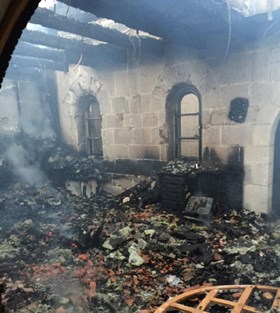 Unknown arsonists set fire to the Church of the Multiplication, where Christians believe that Jesus multiplied loaves and fishes, and wrote graffiti in Hebrew on the walls that read, “False idols will be smashed” and “Pagans”.
The fire was set at about 3 am in the early hours of Thursday morning, severely damaging church offices and storage rooms. The entire church was saturated with smoke damage.
The Church of the Multiplication is believed by Christians to be the site of Jesus’s miracle of multiplying two fish and five loaves to feed 5,000 people.
Several church volunteers suffered from smoke inhalation while trying to extinguish the fire before the firefighters arrived on the scene. The fire was put out several hours after it began.
The church, which is run by the Catholic Benedictine Order, is best known for its fifth-century mosaics, including one depicting two fish flanking a basket of loaves.
Christian churches have been targeted by right-wing Israeli Jewish attacks hundreds of times in recent years.
In May 2014, the Romanian Orthodox Church on Hahoma Hashlishit Street in Jerusalem was defaced in a suspected hate attack. That incident saw the words “price tag”, “Jesus is garbage” and “King David for the Jews” spray-painted on the site’s walls.
Two weeks earlier, ahead of a visit to the country by Pope Francis, suspected Jewish extremists daubed hate graffiti on Vatican-owned offices in Jerusalem.
The Hebrew-language graffiti, reading “Death to Arabs and Christians and those who hate Israel,” was sprayed on the walls of the offices of the Assembly of Bishops at the Notre Dame center, a complex just outside the Old City, the Roman Catholic Church said.
Dmitry Diliani, a member of the Fateh revolutionary council, as well as the Secretary-General of the national Christian Assembly in Palestine, issued a statement that the attack on the church represents a practical application of the stances taken by the Israeli government, which funds fanatic groups.
He noted that some of the leaders of those fanatic groups hold political positions in spite of their incitement. By refusing to list those groups as terrorist organizations, Diliani argued, the Israeli Knesset is effectively providing them with legal protection, and is not taking seriously the ongoing, multiple attacks by right-wing Israelis against Christian and Muslim holy sites.
Knesset Member Dr. Basil Khattas was quoted as saying, “Those terrorist groups attack both Christian and Muslim holy sites with impunity. The Israeli government must open a serious investigation into this and other incidents of violence against holy sites.”
Israeli authorities say they are investigating to see if the fire was an accident or was intentional. But Christians who live in the area say that the Israeli police are not taking the investigation seriously – adding that this was obviously an anti-Christian hate crime, given the graffiti that was written on the site of the fire.
No arrests have been made in connection with the arson.
Photo credit ‘Palestinian Christians’ Facebook group
Netanyahu Orders New Palestinian TV Shut, P.A Plans to Appeal Decision
IMEMC & Agencies | June 18, 2015
 Israeli Prime Minister Benjamin Netanyahu, who also serves as the Communication Minister, has instructed the head of the Communications Ministry, to begin shutting down a new Palestinian TV station, funded by the Palestinian Authority, in Israel.
The official launch of the new TV was scheduled for today, Thursday, and all official preparations were concluded Wednesday for the historic launch of the new Palestine 48 TV Station.
Following Netanyahu’s announcement, a press conference was held in Nazareth by the Chairman of the Palestinian Broadcasting Corporation’s Board of Trustees, Minister Riyad al-Hasan.
Al-Hasan said the Netanyahu decision to shut down the new TV station was illegal, and that the TV Channel will pursue all legal means to counter the move.
He added that the new Channel purchased all services from licensed corporations, and noted that legal advisors, in addition to human rights groups, are all participating in the efforts to appeal the Israeli government intention to shut it down.
Netanyahu gave the order to Director General Shlomo Filber, just a few hours after a press conference was held during the inauguration of the Palestine 48 Arabic-language Channel.
Al-Hasan stated during the conference that Netanyahu and his extremist right-wing government are trying to shut the new channel, to silence the Palestinian voice, and said the new TV would be an open forum that would even give Israel’s right-wing, including government ministers, a stage to express their opinions.
Netanyahu’s main argument was that the new TV “receives funding from the Palestinian Authority, which is considered a foreign entity in Israel”.
Al-Hasan also noted that the station has been under preparation for over a year, and was meant to begin broadcasting on Thursday, the first day of Ramadan for 2015.
The station would have been the first Palestinian Arabic-language station to be broadcasting inside what is now Israel. After Netanyahu’s announcement, the future of the station is unclear.
The official added that the Palestinian Authority has no intention to violate any Israeli laws, and that the idea of establishing the TV station received the approval of various Arab Members of Knesset, and several senior journalists in Israel.
He said the new station intends to highlight the lives of Arab citizens of Israel, while production companies would offer content produced in the Galilee, the Triangle Area, and the Negev.
Although the station would start airing from Nazareth, it is planning to open offices in the central West Bank city of Ramallah.
How Palestinians Die in The NY Times
By Barbara Erickson | TimesWarp | June 17, 2015
Abdullah Iyad Ghanayim, 22, died under an Israeli army jeep last Sunday in the West Bank village of Kafr Malik. The New York Times barely took notice. Other news media inform us that there is a story here and one that is in dispute.
Eyewitnesses in the village east of Ramallah say soldiers shot Ghanayim in the back and then ran him down with a jeep, crushing him against a wall, which collapsed on the vehicle and knocked it over. The soldiers got out, observers say, left the man pinned under the jeep and prevented medics from attending to him.
According to witnesses, Ghanayim was throwing stones when he was shot and bled to death after being left unattended for more than an hour. The mayor of Ramallah, Laila Ghannam, told reporters that soldiers killed Ghanayim “in cold blood.”
The Israeli army had a different story: Ghanayim was throwing a Molotov cocktail at the jeep, and this caused it to swerve and crash. After the vehicle turned over on the victim, the army claimed, “forces later entered the village to try and provide medical assistance,” but the man had already died.
In spite of the army’s failure to explain why “forces” had to enter the village to provide aid when soldiers were already present, The New York Times goes with the army account. This appears in the form of a three-paragraph Associated Press story, which made an obscure and fleeting appearance online and none at all in print. The article gives a brief nod to the eyewitness accounts, saying the mayor of the village claimed the man was shot first.
It’s possible the Times was unable to assign one of its three reporters in Israel to get a firsthand account, but the paper also omitted the story from its World Briefing section, where it frequently runs AP and Reuters news.
The Times had a choice. It could have run a Reuters story by Ali Sawafta and Dan Williams, which states in the lead that “military and locals gave conflicting accounts” and also quotes witnesses who said the man was “run down and then crushed.” Instead it chose the AP version, which relies almost entirely on the Israeli army.
We find fuller reports elsewhere, such as in The National, Agence France-Presse, and Maan, but the Times treatment falls short. It has chosen a biased wire service piece over a more complete and honest report. Thus it avoids revealing unsavory charges against the Israeli army and allows one more Palestinian death to pass unnoticed.
Journalists blast Israeli government cartoon mocking Gaza news coverage
RT | June 17, 2015
Israel’s Foreign Ministry has produced a 50-second cartoon mocking foreign reporting on Gaza, urging people to see that “terrorism rules” there. Apart from arguably lacking comedic value, the clip was slammed as being in poor taste by international media.
The animated short shows a blond, presumably American reporter in Gaza talking about how it’s a modern society where “ordinary people” are just trying to live their lives – “no terrorists here.” As the reporter’s praise for the locals continues, Hamas member can be seen in the back launching rockets.
The underground tunnels Hamas is building are seen by the reporter as “a fascinating attempt by Hamas to build a subway system… which will bring Gaza’s transportation system into the 21st century.”
This continues until a female reporter places a pair of glasses on the male reporter’s face so he could “see the reality of life under Hamas rule,” causing him to faint in shock.
The cartoon culminates with the woman’s upbeat, receptionist-like tone as she declares: “Open your eyes. Terrorism rules Gaza.”
The Foreign Press Association (FPA) has struck out at the decision to produce the cartoon in a statement, insisting that this is not what Israel needs if it wants to be taken seriously by the international community.
“The Foreign Press Association is surprised and alarmed by the Israeli Foreign Ministry’s decision to produce a cartoon mocking the foreign media’s coverage of last year’s war in Gaza,” the statement reads.
“At a time when Israel has serious issues to deal with in Iran and Syria, it is disconcerting that the ministry would spend its time producing a 50-second video that attempts to ridicule journalists reporting on a conflict in which 2,100 Palestinians and 72 Israelis were killed.
“Israel’s diplomatic corps wants to be taken seriously in the world. Posting misleading and poorly conceived videos on YouTube is inappropriate, unhelpful and undermines the ministry, which says it respects the foreign press and its freedom to work in Gaza,” the FPA said.
Israel’s Foreign Press Association is a nonprofit representing about 500 international journalists reporting from Israel, the West Bank and Gaza Strip.
Meanwhile, the Israeli government has denied UN human rights envoy Makarim Wibisono entry into Gaza for a second year in a row, just as a UN report on the war last year is about to be made public.
Israeli Foreign Ministry spokesman Emmanuel Nahshon believes Israel is within its rights to deny entry, as it “cooperates with all the international commissions and all rapporteurs, except when the mandate handed to them is anti-Israeli and Israel has no chance to make itself heard.”
Wibisono is attached to the UN Human Rights Council (UNHRC), which is about to release its findings from an investigation into alleged war crimes Israel may have committed during last year’s war in Gaza.
Palestinian cabinet to be dissolved, formed in several days
Ma’an – June 16, 2015
RAMALLAH – An attendee of the 15th Fatah Revolutionary Council conference led by President Mahmoud Abbas told Ma’an Tuesday that the council will form an entirely new unity cabinet rather than pursuing efforts to reform the existing government.
Abbas announced that the government would resign within the next 24 hours, several senior Fatah officials attending the conference told AFP, with the new government formation expected to be carried out in a matter of several days.
The announcement comes as Palestinian leadership in the West Bank and Gaza Strip have struggled to maintain a unity government pieced together in June 2014.
The move materialized after the Fatah-led PLO and Hamas announced a national unity deal a few months prior intended to end seven years of political division between the largest two Palestinian parties.
The division between Fatah and Hamas began in 2006, when Hamas won Palestinian legislative elections.
In the following year, clashes erupted between Fatah and Hamas, leaving Hamas in control of the Strip and Fatah in control of parts of the occupied West Bank.
While last year’s reconciliation aimed to pave the way for a general election by the end of 2014, an Israeli arrest campaign in the West Bank during early summer as well as a war between Israel and Hamas in the Gaza Strip in July-August derailed the timeline.
Hamas has since blasted the Fatah-led PA in the West Bank for failing to follow through on promises to Palestinians in the Gaza Strip.
Deputy head of Hamas Ismail Haniyeh said earlier this month that there had been no humanitarian or economic progress in the coastal enclave since the national consensus government was formed a year ago, referring to swathes of the strip that remain devastated from last summer’s war, as well the nearly one year that has passed since Gaza’s civil servants have received salaries.
Prime Minister Hamdallah pledged during a March visit to Gaza that Palestinian factions would “work fast” to find solutions to crises in Gaza, however the visit largely deteriorated into factional fighting.
The failure of the unity government to address the needs of Gazans was addressed by the Revolutionary Council’s secretary general who told AFP prior to Tuesday’s meeting that the government would step down within 24 hours over its inability to act in the Gaza Strip.
“The government will resign in the next 24 hours because this one is weak and there is no chance that Hamas will allow it to work in Gaza,” said secretary-general Amin Maqbul.
But Ihab Bseiso, spokesman for the consensus government, told AFP he was unaware of the matter.
“We had a meeting today and we didn’t discuss this issue,” he said
As elections haven’t been held in the Palestinian territories since 2006, Tuesday’s decision to dissolve and reform the government is the latest of Abbas’ attempts to create a functioning unity government, in light of a year of setbacks.
Cycles of Oppression, Cycles of Liberation: The Nasa People of Colombia Are Dispossessed Once Again

By Natalia Fajardo | Toward Freedom | June 8, 2015
An intense struggle for dignity and the right to land is being waged right now in the green mountains of south western Colombia, and chances are, you haven´t heard of it. While the scant mainstream media coverage of the country focuses on soccer or peace talks between government and armed guerrilla groups, it ignores that same government’s attacks against communities defending their territory.
On May 28th, one thousand riot police officers entered a sugar cane plantation called La Emperatriz in the municipality of Caloto, in the state of Cauca, to evict nearly 300 members of the Nasa indigenous people. The indigenous community members had peacefully replaced the sugar monocrop for beans and corn, as part of the process they call the Liberation of Mother Earth. This follows other recent evictions in the nearby town of Corinto, which left many civilians wounded, and clashes since February that resulted in the killing of Nasa youth Guillermo Pavi.
These confrontations occur in the midst of the community’s historic effort to defend their right to a dignified life by recovering land stolen from them – land which has been falsely promised to be returned.
Why Liberation? Why These Lands?
The Nasa people inhabited a large portion of southwestern Colombia long before the Spanish invasion. However, over decades of deceit and violence, the most fertile areas were taken over by wealthy landowners and the Nasa were displaced to higher elevations. Seferino Zapata, an elder from Caloto, explains, “We were taken to the mountain, but we fought. I took part in the struggles in the 80s, when we had to pay to work the land for food. We recovered this very land where I now sit.”
But these land takeovers have cost lives. According to Arcadio Mestizo, a leader of the indigenous reserve Huellas Caloto, on a night in 1991 the police and paramilitaries carried out the massacre known as El Nilo, killing 20 adults and children. While the slaughter occurred about 4 kilometers from the plantation, it was planned the night before at La Emperatriz.
The largehacienda of La Emperatriz, once used to raise livestock and grow rice, now hosts the exclusive cultivation of sugarcane by the transnational company Incauca, owned by the millionaire emporium Ardila Lule and currently under investigation for price fixing. Cane production has significant environmental impacts, such as biodiversity loss and toxic residues. La Emperatriz is just a sample of the economic reality of a region which has been transformed into a ‘green desert’ where sugarcane grown to produce biofuels replaced subsistence crops that fed thousands.
Following a ruling in 2000 by the Inter-American Commission on Human Rights, the Colombian state accepted its responsibility in the 1991 El Nilo massacre and agreed to transfer 15,600 hectares of land, including La Emperatriz, to the Huellas Caloto indigenous community. Trusting the agreement, the Nasa people suspended land takeovers. But time went by and the land promised by the government did not come through.
The Huellas Caloto indigenous leader Arcadio Mestizo explained, “In 2005, we re-started this struggle, now calling it Liberation of Mother Earth, and we began with La Emperatriz.”
Although in 2010 the government completed the transfer of the number of hectares of land promised, they are not the lands agreed upon, and much of it is not suitable for agriculture. So the Nasa vowed to “liberate” La Emperatriz hacienda.
The latest wave of liberation began in March, with the Nasa occupation of land, cultivation of maize, beans and cassava, and the construction of basic structures.
However, community leader Emer Pinzón said that in the morning this past May 28, the owner of La Emperatriz ordered their removal: “Riot police came in with their full war machinery ” and encountered 300 Nasa members armed with courage, shovels and stones to defend their efforts and dreams.
“The police brought, tanks, tractors and tear gas, and in four hours destroyed over two months of work,” Pinzón added. In addition to the constant threats by paramilitary groups, Pinzón reported that, during the eviction, riot police warned through megaphones, “this one will be worse than El Nilo.”
Mestizo added, “There is the 1991 precedent, and now we see us going in circles, but today the oppression happens in broad daylight, and fully institutionalized. [A massacre] can certainly happen again.”
This violence against civilians comes amid peace negotiations between the government and the FARC guerrillas.
Constanza Cuetia, a member of the Nasa community´s communications team, reflected, “The war is very much present in our communities. Targeted assassinations and recruitment of civilians continued during the ceasefire. In addition, the peace talks do not get to the heart of the conflict. The government’s delegate to the talks said that the [neoliberal] economic model will not be challenged in the negotiations.” Indeed, the government has justified the violent evictions defending the right to private property of a few, while ignoring the right of many for a dignified life.
However, resistance is strong. “These lands, as taught by our grandparents, belonged to our ancestors,” Pinzón said. “We will take it back for our youth, at any cost.”
Liberation as a Cure
The spokespeople of this community make it clear that the main reason for the liberations is not unfulfilled land agreements; this is only one ingredient in the recipe of reasons for why the Nasa struggle. “We do this to reclaim our land, but also to defend our social rights,” Mestizo explained.
Abel Coicué, a community leader, added, “we liberate these lands, both of the mountains and the lowlands, because they are ancestral and we have a right to them.”
‘’Everything done on the land sickens the earth further, and this disease is treated [by] liberating Mother Earth,” Paulina, a Nasa leader from nearby Corinto, noted. “It is about sowing spaces of freedom and life that allow us to live in balance and harmony.”
This strategy of liberation becomes even more urgent in light of the many “diseases” these territories face. “We have a major threat coming: mining, for which we must prepare,” Mestizo said. “Mining creeps in more quietly than sugarcane, and sometimes the community does not see it, but we have learned that mining companies, such as [South African] Anglogold Ashanti, have requested mining permits over our land, regardless if it is on a protected area or an indigenous reserve.’’
The Nasa people invite us to understand that their struggle is everyone’s struggle, and to take our part in it. ‘’This is not an issue for indigenous people in Cauca, Colombia, but it is a fundamental issue for all of humanity, whose main battlefield is here,” Mestizo explained. “We must understand and own this struggle, putting pressure on the capitalist who dispossess and abuses, and on the government that supports it.”
Click here to view a slideshow of this community and its struggle
Palestinian Poverty, Israeli Affluence: Deciphering The NY Times
By Barbara Erickson | TimesWarp | June 15, 2015
It takes some attention and a bit of math, but readers of The New York Times now have the means to discover just how great the chasm is between Israelis and Palestinians—not just in politics but in hard cash.
In an article and follow-up editorial concerning a report by the RAND Corporation, an establishment think tank, the Times informs us that if the adversaries negotiated a two-state peace deal, both Palestinians and Israelis would gain financially. Over 10 years, RAND says, Israel would gain $123 billion and Palestine $50 billion.
We learn that in terms of annual per capita income this breaks down to a 5 percent increase, or $2,200, for Israelis and a 36 percent increase, or $1,000, for Palestinians.
Readers are apt to take that in with little pause, but if we do the calculations, this tells us that current incomes average $44,000 for Israelis and $2,778 for Palestinians. This puts Israel far above the World Bank standard of $12,746 for high-income countries. It places Palestine barely over the low-income level.
This means Palestinians make less than their neighbors in Egypt, Jordan or Iraq. It places Palestine in the same World Bank grouping as Guatemala, South Sudan and others with per capita incomes from $1,046 to $4,125.
Israel rates with the economic stars, not only in the high-income category but in the elite of that group. On average, its citizens earn yearly incomes very near those in Germany, New Zealand and the United Kingdom. [The World Bank lists Israel’s per capita income as $32,030, but this includes occupied Palestine, which is given no separate economic status. The RAND report distinguishes between Israel and Palestine.]
The Times would have done its readers a favor by untangling the data and revealing the stark difference between Israeli and Palestinian earnings, but the story and editorial give a sense that the two sides are on an even playing field. A two-state solution, the Times editorial states, “makes both sides winners.”
The article, by Jodi Rudoren, puts emphasis on how much the occupation costs Israel in support for settlements and security. It is seen, she writes, as a “self-imposed economic burden.” There is no mention of the burden on the Palestinian side.
The think tank, however, does better than the Times by stating outright that “A singular feature of the Israeli-Palestinian relationship is the power imbalance between the two parties: Israel dominates the region both militarily and economically.”
The report makes clear that Israeli policy has harmed Palestinian commerce with regulations favoring Israeli companies, restrictions on movement and the confiscation of water and land. It also points up the devastating impact of Israel’s policy of demolishing housing and infrastructure in Gaza and the West Bank.
None of this appears in the Times, which sticks to the dry numbers of the RAND report, but this data has provided clues to a reality the Times obscures—the scandalous inequality between Israelis and Palestinians.
This disparity should inform the paper’s reporting on relations between the two sides, yet we read of the peace talks as if they involve two equal parties, both asked to make concessions. Likewise, in reports on Gaza, we read of the threat of rockets but learn almost nothing about the overwhelming military might of Israel’s arsenal and army.
Readers should not have to take to their calculators to discover the huge imbalance that underlies every aspect of Israeli-Palestinian relations. Our newspaper of record should have revealed that reality long before now and not in hidden ciphers.
Male and killed in Gaza – you’re a combatant
By Jonathon Cook | The Blog From Nazareth | June 16, 2015
Experience should have proved that one has to be credulous in the extreme – or brainwashed by Zionism – to take seriously “rebuttals” by the Israeli army of evidence of its abuses and war crimes. But for any who still harbour suspicions that claims by the Israeli army aren’t simply self-serving deceptions, take a look at its latest report into last year’s attack on Gaza.
The number of Palestinian civilians killed during Operation Protective Edge, says the Israeli army, was 761 – or 36 per cent of the total of 2,125 fatalities it registered. The UN has recorded 95 more Palestinian deaths and has twice as many civilians killed by Israel: 1,483, or 67 per cent of the total. Both can’t be right.
Let’s break down the Israeli numbers. According to the army, of those killed, 369 were children under the age of 15 (Israel’s redefinition of childhood for Palestinians) and 284 were women. That’s a total of 653.
That means of the 1,364 boys and men aged between 15 and 100 who were killed according to Israel’s estimates, only 108 are accorded the status of “civilian”. In other words, only 8 per cent of all males over the age of 15 who were killed in Israeli attacks were not suspected by Israel of being actively engaged in combat at the time of their death.
Comfortingly for Israelis, that means that, if you were Palestinian and male and a missile or bomb hit you, or a targeted building collapsed on you, you were almost certainly a combatant.
And if you believe that, I’ve got a bridge to sell you.
Israel’s Race to Economic (and Moral) Bankruptcy
By Jonathan Cook | Dissident Voice | June 16, 2015
Two recent reports suggest that Israel could face catastrophic consequences if it fails to end the mistreatment of Palestinians under its rule, whether in the occupied territories or in Israel itself.
The Rand Corporation’s research shows that Israel could lose $250 billion over the next decade if it fails to make peace with the Palestinians and violence escalates. Ending the occupation, on the other hand, could bring a dividend of more than $120 billion to the nation’s coffers.
Meanwhile, the Israeli finance ministry predicts an even more dismal future unless Israel reinvents itself. It is likely to be bankrupt within a few decades, the finance ministry report says, because of the rapid growth of two groups who are not productive.
By 2059, half the population will be either ultra-Orthodox Jews, who prefer prayer to work, or members of Israel’s Palestinian minority, most of whom are failed by their separate education system and then excluded from much of the economy.
Both reports should be generating a tidal wave of concern in Israel but have caused barely a ripple. The status quo – of occupation and endemic racism – still seems preferable to most Israelis.
The explanation requires a much deeper analysis than either the Rand Corporation or Israel’s finance ministry appears capable of.
The finance ministry report points out that with a growing population not properly prepared for a modern, global economy, the tax burden is falling increasingly heavily on a shrinking middle class.
The fear is that this will rapidly create a vicious cycle. Wealthier Israelis tend to have second passports. Overwhelmed by the need to make up the revenue shortfall, they will leave, plunging Israel into irreversible debt.
Despite this doomsday scenario, Israel seems far from ready to undertake the urgent restructuring needed to salvage its economy. Zionism, Israel’s official ideology, is predicated on core principles of ethnic separation, Judaisation of territory and Hebrew labour. It has always depended on the marginalisation at best, exclusion at worst, of non-Jews.
Any effort to dismantle the scaffolding of a Jewish state would create a political crisis. Reforms may happen, but they are likely to take place too slowly and incrementally to make much difference.
The Rand report also raises the alarm. It notes that both peoples would benefit from peace, though the incentive is stronger for Palestinians. Integration into the Middle East would see average wages rise by only 5 per cent for Israelis, compared to 36 per cent for Palestinians.
But, while its economists may have found it easy to quantify the benefits of ending the occupation, it is much harder to assess the costs in shekels and dollars.
Over the past six decades, an economic elite has emerged in Israel whose prestige, power and wealth depends on the occupation. Career military officers earn large salaries and retire in their early forties on generous pensions. Nowadays many of these officers live in the settlements.
The army top brass are the ultimate pressure group and will not release their grip on the occupied territories without a fight, one they are well placed to win.
Backing them will be those in the hi-tech sector who have become the engine of the Israeli economy. Many are former soldiers who realised the occupied territories were the ideal laboratory for developing and testing military hardware and software.
Israel’s excellence in weaponry, surveillance systems, containment strategies, biometric data collection, crowd control, and psychological warfare are all marketable. Israeli know-how has become indispensable to the global appetite for “homeland security”.
That expertise was on show this month at a Tel Aviv armaments expo that attracted thousands of security officials from around the world, drawn by the selling point that the systems on offer were “combat proven”.
To end the occupation would be to sacrifice all this and revert to the status of a tiny anonymous state with no resources or notable exports.
And finally the settlers are among the most ideologically committed and entitled sector of Israel’s population. Were they moved out, they would bring their group cohesion and profound resentments back into Israel.
No Israeli leader wants to unleash a civil war that could rip apart the already-fragile sense of unity among the Jewish population.
The reality is that most Israelis’ perception of their national interests, both as a Jewish state and as military superpower, are intimately tied to a permanent occupation and the exclusion of Israel’s Palestinian minority from true citizenship.
If there is a conclusion to be drawn from these two reports it may be a pessimistic one.
Israel’s internal economy is likely to grow gradually weaker, as the ultra-Orthodox and Palestinian labour forces are under-utilised. As a result, the focus of Israel’s economic interests and activity is likely to shift even more towards the occupied territories.
Far from Israelis rethinking their oppressive policies towards the Palestinians, the ideological blinkers imposed by Zionism could push them to pursue the benefits of the occupation even more aggressively.
If the watching world really wants peace, economic wishful thinking will not suffice. It is past the time simply for carrots. Sticks are needed too.
University of Illinois Slammed with Censure Over Salaita Firing
By Lauren McCauley | Common Dreams | June 14, 2015
In a decision that may have long-lasting repercussions for the university’s reputation, a leading university group on Saturday voted to censure the University of Illinois at Urbana-Champaign (UIUC) for firing Professor Steven Salaita after he made comments critical of Israel’s attack on Gaza last summer.
The university rescinded Salaita’s tenured faculty appointment at school’s the American Indian studies program after he issued a series of Tweets condemning those who defended Israel’s military actions against Palestinians in Gaza.
“If it’s ‘antisemitic’ to deplore colonization, land theft, and child murder, then what choice does any person of conscience have?” was among the comments made last July.
The school board’s dismissal of Salaita received widespread condemnation by groups accusing the university of having a pro-Israel bias.
After its own internal investigation, at the annual meeting on Saturday, the American Association of University Professors elected to censure the institution on the grounds that the dismissal “violated Professor Salaita’s academic freedom and cast a pall of uncertainty over the degree to which academic freedom is understood and respected at UIUC.”
Such a censure “informs the academic community that the administration of an institution has not adhered to generally recognized principles of academic freedom and tenure,” the group explains.
The AAUP currently has 56 institutions on its censure list.
In January, Salaita filed a lawsuit against the school charging that it violated his First Amendment rights. According to the Associated Press,
“The censure vote came one day after a judge ordered the university to turn over thousands of pages of documents sought by Salaita.”
Following the decision, Salaita’s attorneys issued a statement calling the censure “a serious blemish on the university’s record.”
The statement continued:
The association censured UIUC not only for its summary dismissal of Professor Salaita in violation of academic freedom, due process, and shared governance, but also for its continued refusal to rectify its actions. The university’s stubbornness continues in spite of academic boycotts, department votes of no confidence in the UIUC administration, student walk-outs, tens of thousands of petition signatures, a federal lawsuit, and the AAUP’s reprimand, suggesting that the UIUC administration is more beholden to donors than it is to due process, academic freedom, and the First Amendment.”
As war report looms, UN envoy blocked from Gaza
Press TV – June 15, 2015
As the prospect of a UN report on Israel’s 2014 bloodletting in Gaza draws nearer, the world body’s point man on human rights situation in the occupied territories is kept outside the Palestinian territory by Israel.
Tel Aviv once again prevented Makarim Wibisono from visiting the coastal enclave last week, with Israeli foreign ministry spokesman Emmanuel Nahshon saying outright on Monday, “We didn’t allow this visit.”
“Israel cooperates with all the international commissions and all (UN) rapporteurs, except when the mandate handed to them is anti-Israeli and Israel has no chance to make itself heard,” the official said, despite the age-old and unflinching US-led support for the Israeli regime on the international arena, most visibly at the United Nations.
Wibisono reports to the UN Human Rights Council. The council has been investigating the war and whose relevant report is expected to be published in the coming days.
Israel had also barred Wibisono from entering last year for a similar visit.
Nearly 2,200 Palestinians lost their lives and some 11,000 were injured in the July-August 2014 assaults. Gaza Health officials say the victims included 578 children and nearly 260 women with more than 3,100 children injured in the offensive.
The UN has said Israel was responsible for the deadly bombing of several UN institutions, including schools, in which displaced Palestinian civilians were sheltering.
In a report released Sunday, Israel defended its conduct in the war, calling it both “lawful” and “legitimate.”
The regime has been invariably justifying its incessant attacks on the impoverished sliver by alleging it has a duty to defend itself against the rockets fired from Gaza. The projectiles are seldom known to have caused injury or damage.
Featured Video

Piers Corbyn on religion of climate change
or go to
Aletho News Archives – Video-Images
New Documentary
“Inside Gaza” wins best documentary at Montreal’s Cinemania film festival
Palestine Information Center – November 16, 2026
MONTREAL – The documentary “Inside Gaza,” which chronicles the experiences of Palestinian journalists working with Agence France-Presse (AFP) while covering the Israeli war on the Gaza Strip, won the Best Documentary Award at the 32nd Cinemania International Francophone Film Festival held in Montreal, Canada.
Directed by Helene Lam Trong, the 72-minute film follows the daily lives of four AFP journalists who bear witness to the difficulties of reporting in a war-torn territory largely closed off to international media.
The film is compiled from material produced by the team on the ground, as well as from interviews conducted after they left.
The film also won the People’s Choice Award at the festival on Saturday. … continue
Blog Roll
 Aletho News
- “Inside Gaza” wins best documentary at Montreal’s Cinemania film festival
- Activists block German munitions plant over arms exports to ‘Israel’
- The Nasser Hospital attack and Israel’s relentless lies
- Could it be satan? No, Huckabee, just the Americans you work for
- AIPAC and more: Network of pro-Israel influence in US Congress
- Putin aide reveals Moscow’s stance on Europe at peace talks
- Imran Khan warns Pakistani judges he may die in prison
- IOF used Amazon facial recognition to track millions of Palestinians
- More EU Citizens Face Sanctions For Criticizing The Ukraine Proxy War
- In Mexico, the CIA Is Playing a Dangerous Game
- If Americans Knew
- An error has occurred; the feed is probably down. Try again later.
- No Tricks Zone
- New Study: Barents Sea Temperatures Were Warmer And Sea Ice Less Extensive In The 1700s Than Today
- German Authorities Start Initiative To Evaluate Public Register For Climate “Disinformation” Spreaders!
- Zonal Asymmetry of Temperature Change in the Antarctic Circumpolar Current
- New Study: The Net Fossil Fuel Contribution To Rising Atmospheric CO2 Has Been Zero For 500 Years
- Germany’s Green Energy Transition Becoming Increasingly Expensive…Another 6 Trillion Euros!
- Sudden Stratospheric Warming, Powerful El Niño Combination May Lead To Extreme Europe Cold, Energy Crisis!
- Two New Studies Find Thwaites Glacier Melt Cannot Be Driven By Human Activity Or A Warming Ocean
- E-Cars Reduce CO2 Emissions By Only 41% Compared To Internal Combustion Engine Vehicles
- Predictions Made By Renowned Climate Professor Over Past Decades Have Been Proven To Be Poor
- New Study Suggests Large Regions Of The Pacific Ocean Have Been Cooling For The Last 80 Years

