Ban suggests Israeli attack on UNIFIL post was deliberate
Press TV – February 28, 2015
UN Secretary General Ban Ki-moon has suggested that the Israeli regime deliberately targeted a base of UN peacekeeping forces along Lebanon’s southern border last month, in which a peacekeeper was killed.
“The incident happened at a UNIFIL base which is known perfectly by Israeli forces,” Ban said, using the acronym for the United Nations Interim Force in Lebanon.
According to Lebanon’s An-Nahar daily on Saturday, Ban also censured the killing of the Spanish peacekeeper who died in the Israeli shelling of the UNIFIL post in January.
During the Israeli raid on the Lebanese border, the observation tower of a Spanish UNIFIL position in Abbasieh, one kilometer east of Ghajar, was directly struck by an artillery shell, killing Cpl. Francisco Javier Soria Toledo.
A report submitted to the UN Security Council on Friday by the UN’s Special Coordinator for Lebanon Sigrid Kaag held the Israeli regime “fully liable for the death of the peacekeeper.”
Israel launched the attack after Lebanese resistance movement Hezbollah targeted an Israeli military convoy in the Israeli-occupied Shebaa Farms on January 28, killing two soldiers and wounding several others while destroying at least nine Israeli military vehicles.
The attack by Hezbollah was launched in response to an Israeli airstrike in the town of Qunaitra in Syria’s Golan Heights 10 days earlier, which killed several top members of the Lebanese resistance movement and an Iranian commander.
The Israeli attack on the UNIFIL post in January was not the first of its kind.
Four UN observers were killed in an Israeli airstrike on their post in Khiam, southern Lebanon, during the 2006 Israeli war on the Arab country. Then-UN chief Kofi Annan said at the time that the attack appeared to be “deliberate.”
A French UN observer was also killed in 2005 near the Shebaa Farms by Israeli tank shelling.
The most notorious Israeli attack, however, came in April 1996, when artillery shells fired by the regime’s forces struck the Fijian battalion headquarters in Qana, killing 107 civilians who had taken refuge at the compound.
Israel asks US for additional $300mn for missile defense – report
RT | March 1, 2015
Israel reportedly bypassed the White House and asked the US Congress for an extra $317 million to be added to President Barack Obama’s budget for the next fiscal year in order to fund Israeli missile defense programs, Bloomberg reported.
The requested funds would be in addition to the $158 million already proposed by the Pentagon for Israel’s security needs for the fiscal year that will begin on October 1. The new allocation will allegedly finance the ‘David’s Sling’ and ‘Arrow-3’ programs – designed to intercept medium- to long-range missiles – as well as provide an anti-ballistic missile system.
According to Bloomberg’s report on Friday, the director of Israel’s missile defense organization Yair Ramati “visited lawmakers and aides to the congressional defense committees on February 2 and 3 to outline the case for more money and thank them for past assistance.”
Ramati completely bypassed the White House and the Pentagon. The report links the move to the tense relationship between the Obama administration and the Israeli government ahead of Prime Minister Benjamin Netanyahu’s speech to Congress on March 3, which is likely to stress that the White House is pursuing a “bad deal” by negotiating to curb Iran’s nuclear program.
The report revealed that Ramati’s proposal included $250 million to start production of the David’s Sling system, in addition to Obama’s $37 million request for development. Another $35 million Ramati requested for the initial production of Arrow 3, in addition to the $55.7 million the US administration is seeking for development.
During his visit to Capitol Hill, Ramati “distributed one-page sheets naming US contractors that would benefit from production funds for each of the missile defense systems.” According to Bloomberg’s information, the list included Chicago-based Boeing Co.; Waltham, Massachusetts-based Raytheon Co.; Arlington, Virginia-based Orbital ATK Inc.; and Falls Church, Virginia-based Northrop Grumman Corp.
When contacted by Bloomberg, the Israeli embassy in the US declined to comment on the report.
The US already provides Israel with $3.1 billion a year as “foreign military financing,” which excludes other missile defense funds, according to the report.
For the current fiscal year, Congress has reportedly provided $620 million, including about $347 million for missile defense programs. US Congress has appropriated more than $1.2 billion since 2011 for the Iron Dome, which is designed to intercept and destroy rockets.
In light of the large amounts of distributed funds, US lawmakers have been insisting that Israel use American-based defense contractors when spending the received money.
Last year, the Israeli government agreed to spend more than half the funds provided by the Pentagon for the Iron Dome in the US by this year. Until recently, the missile system was been built solely in Israel by Rafael Advanced Defense Systems Ltd.
Iran nuclear talks have created a significant rift between Israel and the US. Last week, the White House and State Department stated that Israel inaccurately provided information and twisted the official US position in nuclear talks with Iran, and accused Tel Aviv of “selectively” leaking details of sensitive talks.
Washington has also voiced suspicion that Netanyahu’s office directly provided Israeli journalists with the leaked information, including an alleged offer to Iran to keep 6,500 centrifuges for uranium enrichment. A White House spokesman expressed frustration with the “cherry-picked” information released by the Israelis out of context.
Four Palestinians and one female German demonstrator shot with live ammunition at “Open Shuhada Street” protest

Israeli military sniper aiming up the road towards the Open Shuhada Street demonstrators
International Solidarity Movement | February 28, 2015
Hebron, Occupied Palestine – On February 27 in occupied Al-Khalil (Hebron), Israeli forces fired live ammunition towards nonviolent protesters participating in the annual Open Shuhada Street demonstration, injuring five including four Palestinian activists, one of them 17 years old, and one German citizen. More were also injured by rubber-coated steel bullets and stun grenades as soldiers and Border Police blocked the roads leading towards Shuhada Street and attacked the protesters.
Close to a thousand Palestinians, accompanied by Israeli and international supporters, marched towards one of the closed entrances to Shuhada Street carrying flags and signs and chanting. They called for the opening of Shuhada Street, whose closure to Palestinians has become a symbol of Israel’s Apartheid system, and for an end to the occupation. The march was turned back by stun grenades, rubber coated steel bullets and live ammunition fired by the Israeli military. Around twenty demonstrators were injured in total; Hebron Hospital reported that at least six were admitted and two required surgery. One Palestinian activist, Hijazi Ebedo, 25, was arrested at the demonstration; all he had been doing was chanting and holding a sign.
Issa Amro, coordinator and co-founder of Youth Against Settlements (YAS) stated: “The protest, which was joined by groups from all over Palestine, marked the twenty-first anniversary of the Ibrahimi Mosque Massacre. Israeli occupying forces shot live ammunition towards peaceful protesters, which is against international law. The Israeli military should be held accountable in international court for their actions.”
“Julia was standing and filming next to me when suddenly she fell to the ground,” stated Leigh, a Canadian activist who was standing next to Julia when she was shot.
Julia, the injured 22-year-old German activist from Berlin, was evacuated to Hebron Hospital where she is being treated for a live gunshot wound which entered and exited her leg. “The brutality of Israeli forces is unbelievable, it seems like they don’t have a limit,” she stated. “In Palestine I have seen Israeli forces shooting tear gas, stun grenades, rubber and live ammunition at any kind of demonstration that is against the occupation. It doesn’t matter for them if it is peaceful or if there are kids attending. Yesterday I saw the army attack children who had been dancing in the street. Two people were shot with live ammunition in Bil’in. They shot me as I was standing and filming. It seems the soldiers just shoot at any one.”
The Open Shuhada Street demonstration marks the anniversary of the 1994 Ibrahimi Mosque massacre, when right wing extremist settler Baruch Goldstein murdered 29 Palestinians while they worshipped in the mosque. Following the massacre, Israeli forces shut down Palestinian businesses on Shuhada Street–once a commercial center–and began to implement the policies which would lead to what is now a total closure of the vast majority of the street to Palestinians. Twenty one years after the massacre, settlers from illegal Israeli settlements use the street freely while Palestinians are assaulted, shot and arrested when they attempt to reach it en masse during the Open Shuhada Street demonstration every year.
Israel Secretly Arrests Golani Druze, Accusing Him of Exposing Syrian Rebel-Jewish State Collaboration
By Richard Silverstein | Tikun Olam | February 28, 2015
Israel’s Shin Bet rearrested Golani Druze Sedki al-Maket (age 48). Until his release in 2012 (Hebrew), he’d been the longest serving Israeli security prisoner, having spent 27 years detained. News of his arrest is under gag order by Israeli media. The gag is laughable since the arrest has been reported not only by Syrian media, but in a Hebrew Facebook post.
Though Israeli security services haven’t offered any reason for his arrest, it’s likely they’re angered because a week ago he followed Syrian rebels to a meeting inside Israeli-occupied territory. The rebels met with Israeli forces who’ve previously been shown to receive logistical and intelligence support from Israel in previous reports here and in Israel and foreign media. Al Maket filmed a video while the meeting was underway, in which he described what he saw and offered it to Syrian TV. It was aired to the entire nation and likely monitored by Israeli security.
The Shin Bet doesn’t want any further leaks about such collaboration because it allows the Syrian regime to paint the rebels as Israeli stooges. It also gives the lie to those Israeli intelligence figures and journalists who’ve spoken falsely about Israel remaining neutral regarding the two sides fighting in Syria. Despite numerous air attacks against Syrian government facilities, assassinations of Syrian, Hezbollah and Iranian military, and security cooperation with rebels, Israel continues to maintain the fiction it hasn’t chosen sides.
If anyone wonders why Islamists are beheading western journalists and occupying Iraq and Syria, while carefully avoiding Israeli targets, this will explain a lot. It will also explain Israel’s approach which is to weaken central power in Syria, so that the Golan region closest to the border will become a protectorate, as was southern Lebanon until Israel’s withdrawal in 2000. Having Syrian rebels under Israeli sponsorship ruling the Syrian Golan will be much more conducive to maintaining Israel control and occupation for years to come.
Meanwhile, the Israeli media is content to publish happy news about the Golani Druze village of Majd al-Shams (home to al-Maket), which apparently has become a playground for a certain hip Israeli scene which enjoys pub crawling in the midst of Israeli-occupied Golan. If the report is to be believed, you can hardly tell the difference between it and Berlin or New York!
Israeli troops ‘violently’ attack Palestinian teen at border crossing
Ma’an – 28/02/2015
JENIN – A teenage Palestinian boy from the northern West Bank says he was violently assaulted by Israeli soldiers at al-Jalama crossing north of Jenin while he was trying to cross into Israel.
Muhammad Asri Fayyad, 17, told Ma’an Saturday that on Thursday morning he arrived at the crossing along with a busload of young men and teenagers who had organized a trip to Israel and obtained the needed permits from Israeli authorities.
He says he entered the crossing and complied with the instructions Israeli officers were giving through loudspeakers. The instructions included “that we shove our mobile phones in one place and we cross from a different place which we did.”
“Everybody received back their mobile phones except me. The soldiers asked me to pass through a path under a bridge on top of which stood a number of soldiers pointing their guns at me.
“They then asked me to enter a room which has several doors and I obeyed the orders. All the doors were immediately locked before the officers started to shout through loudspeakers demanding that I take off my clothes and my shoes.”
He added that he took off his shoes first but the soldiers continued to shout “violently” repeating that he must take off all his clothes.
“When I took off my clothes, they turned on a huge ceiling fan which caused frigid coldness. I told them to turn off the fan because I was freezing, but they didn’t, and so I knocked on the fan in an attempt to cause it to stop. At that point the soldiers broke into the room and started to beat be with rifle butts until I fell to the ground.
“They then tied my hand to a steel bar behind my back and tied my foot to another bar. I remained in that position from 9 a.m. until 2 p.m. After that a number of soldiers arrived and a female soldier untied me after she took a silver necklace I was wearing. She ordered me to put on my clothes, then she handcuffed and blindfolded my eyes and escorted me outside the crossing and told me that I was denied entry to Israel. She gave me a small sack in which I found the remnants of my mobile phone which had been smashed.”
Muhammad says he has been suffering severe shoulder and foot pain ever since.
Terrorism, Palestine, the U.S. and Israel
By Robert Fantina | CounterPunch | February 27, 2015
A jury in Manhattan, New York, has found the Palestinian Authority and other groups guilty in a ‘terrorist’ attack that left some Americans dead. So we have yet another one of the countless examples of the double-standard that exists in U.S. jurisprudence.
In 2003, U.S. citizen Rachel Corrie, 23, was in Palestine, helping the oppressed people there, teaching children and attempting to prevent house demolitions that are illegal under international law, when she was run over by a massive bulldozer operated by an Israeli soldier. The soldier ran over her once, burying her in the dirt, and then backed up, crushing her a second time. She was uncovered, still alive, although just barely, but died shortly thereafter. Her heartbroken and devastated parents contacted their elected officials, requesting a formal inquiry; this was denied. After all, if Israeli soldiers want to bulldoze a U.S. citizen, apparently that is within their rights. Israel held one of its usual inquiries into the situation, but found no reason to bring any charges against anyone.
British Citizen Tom Hurndall was unarmed and wearing a bright orange coat identifying him as International Solidarity Movement activist when an IDF (Israel Defense Force. Read: terrorist) soldier shot him in the head in 2004. Less than a year later, the terrorist, who was not named publically, but referred to only as ‘Sgt. T’, was convicted of manslaughter and sentenced to eight years in prison. While one may wonder why his conviction was only for manslaughter, at least there was an investigation, indictment, trial, conviction and sentence. Obviously, the Israeli lobby is not quite as powerful in Britain as it is in the U.S.
Let us look for a moment at the Federal Bureau of Investigation’s (FBI) definition of terrorism.
“’International terrorism’ means activities with the following three characteristics:
* Involve violent acts or acts dangerous to human life that violate federal or state law;
*Appear to be intended (i) to intimidate or coerce a civilian population; (ii) to influence the policy of a government by intimidation or coercion; or (iii) to affect the conduct of a government by mass destruction, assassination, or kidnapping; and
*Occur primarily outside the territorial jurisdiction of the U.S., or transcend national boundaries in terms of the means by which they are accomplished, the persons they appear intended to intimidate or coerce, or the locale in which their perpetrators operate or seek asylum.”
Now, let us look at the U.S. role in the oppression of the Palestinians, in the context of this definition.
The U.S. provides Israel with $3.8 billion in aid every year, including the most advanced weaponry on the planet. Israel then uses this to bomb the Gaza Strip. Additionally, Israeli terrorists arbitrarily shoot peaceful protestors. These seem to be ‘violent acts’ that are ‘dangerous to human life’. Do they violate federal or state law? Wanton murder of unarmed civilians does, indeed, violate such laws.
With U.S. financing, Israel deprives Palestinians of their ability to go to school or work, through cruel and arbitrary checkpoints. It arrests men, women and children without charge, and holds them for months without granting them access to family or legal representation. It bombs private residences, schools, hospitals, mosques and United Nations refugee centers. All this is certainly intended ‘to intimidate or coerce a civilian population’.
Additionally, with full U.S. support, Israel is now withholding $100 million dollars per month that it collects in taxes for Palestine, as punishment for Palestine joining the International Criminal Court (ICC), and filing charges against Israel. This money is required by Palestine to pay salaries. Is this not intended ‘to influence the policy of a government by intimidation or coercion’?
Lastly, for this point, the U.S. provided all the funding for Israel’s carpet bombing of the Gaza Strip in the summer of 2014, and has done nothing to assist the people suffering there as a result. Over 2,500 Palestinians were killed, including over 500 children, some as young as newborns. Tens of thousands of people remain homeless. Prior to that, hundreds of Palestinians in the West Bank were arrested, many without charge. This certainly falls within the category of attempting ‘to affect the conduct of a government by mass destruction, assassination, or kidnapping’.
All of the unspeakable brutality referenced herein ‘occur(s) primarily outside the territorial jurisdiction of the U.S.’
So while a courtroom in New York decides that the PA is guilty of acts of terrorism, who is looking at the U.S.’s role as international terrorists? The ICC has begun its investigation into possible war crimes committed by Israel which, in the eyes of the U.S. is, like the U.S., above the law. As a result of this investigation, there is a possibility that Israel, at least in the court of international public opinion, will be held accountable for its crimes. Since it, also like the U.S., has refused to join the ICC, two examples of the few rogue nations that haven’t done so, the court cannot issue any consequences to it. But its refusal to participate will of itself be a damning indictment of Israel, and any findings will, of course, be widely distributed. All this will justifiably lead to Israel’s ever growing isolation as a global pariah, a situation even the mighty U.S. can’t resolve.
What does this verdict mean for Palestine? Probably not much. The verdict is meaningless, and the PA has no money to pay the fine anyway. It can’t even pay the salaries of its employees, thanks to Israel illegally withholding hundreds of millions of dollars belonging to Palestine. Internationally, the death of a few Americans is not seen as more tragic or meaningful than the death of thousands of Palestinians, much as the U.S. government might consider it to be so.
Judicial terrorism may have a slightly different definition than ‘terrorism’ as shown above. While not a violent act, and committed within the U.S.’s borders, its purpose is still ‘to intimidate or coerce a civilian population; (ii) to influence the policy of a government by intimidation or coercion; or (iii) to affect the conduct of a government’. So while not bloody like U.S. bombs, its goal is still the same.
Israel’s relations with much of the world are in disarray; more and more countries are preventing their businesses from trading with Israeli companies located on occupied territory. Universities around the world are voting to divest from Israel-owned companies. Entertainers and academics are refusing to appear in Israel. And even the U.S., the financier and puppet of Israel, has thrown an uncharacteristic hissy fit, not because of Israel’s abominable violation of human rights, but because Israeli Prime Murderer Benjamin Netanyahu accepted an invitation to speak to Congress without the approval and foreknowledge of President Barack Obama. While the reason may be trivial, the fact that the U.S. feels emboldened to criticize Israel, for the second time in less than a year (the first was a tepid criticism of Israel’s bombing of a known United Nations refugee center), does mark a significant change.
Where will it all lead? Eventually, to a free Palestine. This will not happen overnight, but all the signs are there: increasing loss of international patience with the occupation; global recognition of the futility of ‘negotiations’; resolutions throughout much of Europe, calling on governments to recognize Palestine; shock and horror at Israeli atrocities. The people are finally learning the reality of apartheid Israel, and are demanding that their governments respond. Their efforts must continue; too many lives are at stake to allow this to continue.
Robert Fantina’s latest book is Empire, Racism and Genocide: a History of US Foreign Policy (Red Pill Press).
Hamas asks the international community to put Jewish State on terror list
Palestine Information Center – February 26, 2015
GAZA – Islamic Resistance Movement, Hamas, asked the international community to put Israel and its leaders on the terror list. The request was voiced after state-backed Jewish settlers set fire to a mosque and a church in the West Bank over two consecutive days.
On Thursday, Hamas leader and former Minister of Awqaf and Religious Affairs, Dr. Ismail Radwan, condemned the arson attack on both sacred sites, saying, “Torching the holy sites and writing anti-Islamic and anti-Christian slogans by Israeli settlers demonstrate that the Israeli occupation constitutes a danger to humanity and to holy places”.
Dr. Radwan called on the international community along with human rights organizations to work on putting Israel on the terror list for its crimes that show hatred and hostility to humanity and holy sites.
The extremist Jewish groups started a fire at dawn Wednesday in a mosque in Jaba town to the west of Bethlehem and did the same thing early Thursday in the Church of Dormition on Mt. Zion in Occupied Jerusalem.
Greek Orthodox Church decries attacks by Jewish settlers
MEMO | February 26, 2015
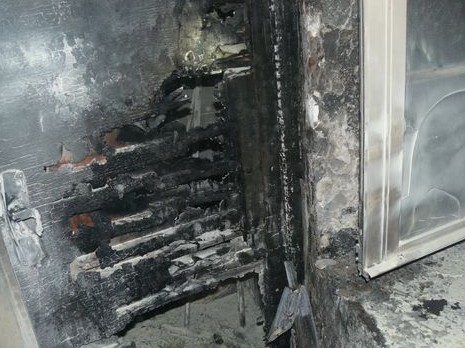
The Patriarch of the Holy City of Jerusalem and all Palestine, Theophilos III, denounced on Thursday what he called “repeated” attacks on Christian and Muslim places of worship in the Palestinian territories by extremist Jewish settlers.
“The targeting of churches and mosques is caused by pervasive racism and hatred,” he said in a statement.
Earlier Thursday, Jewish Settlers set fire to part of a religious school affiliated with Jerusalem’s Greek Orthodox Church, Which they sprayed with anti-Christian graffiti. On Wednesday, settlers torched and sprayed graffiti on a West Bank mosque.
Theophilos III said Christians represented an “integral part” of the Holy Land, its history and its future, going on to assert that the Greek Orthodox Church was one of the world’s most important churches.
“Criminals will not intimidate this church or its flock,” he declared.
He called on government agencies to address repeated settler attacks on places of worship.
Earlier Thursday, The Palestinian Foreign Ministry called on both the Vatican and the international community to protect Islamic and Christian places of worship from what it described as “Jewish extremism.”
“We strongly condemn these acts,” the ministry said in a statement. “Yesterday a mosque near Bethlehem was torched and today a church in Jerusalem [was attacked].”
Extremist Jews, the ministry asserted, continued to attack Muslim and Christian places of worship while the Israeli government did nothing to stop them.
The ministry went on to blame the Israeli government for the trend, calling on the Vatican, the international community and the UN to help protect local religious sites.
On Wednesday, Jewish Settlers set fire to a mosque near the southern West Bank city of Bethlehem, Which Also they covered with anti-Arab and anti-Muslim graffiti.
Several instances of settler attacks on Muslim places of worship have been reported recently, both in the Israeli-occupied West Bank and in the self-proclaimed Jewish state itself.
Israeli Forces Demolish Four Bedouin Homes in Negev
Al-Akhbar | February 25, 2015
Israeli forces demolished four Bedouin homes in the Negev desert in southern Occupied Palestine on Tuesday, Ma’an news agency reported, leaving dozens homeless.
Israeli forces, escorted by bulldozers, raided the Tel Shebaa area of Beersheba early Tuesday and demolished the properties on the pretext that they lacked building permits. Locals said the homes belonged to the al-Nabbari family.
One of the family members, Sufian al-Nabbari, 20, was arrested after attempting to prevent the demolition.
“We will not let go of our lands. More than 60 police officers arrived in the area and demolished our homes and livestock barns,” Mohammed al-Nabbari said. “They even chopped down our olive trees.”
The head of the regional council for Bedouin villages unrecognized by Israeli authorities, Attiya al-Asam, said that the “brutality” of demolitions has increased recently in Bedouin towns in Occupied Palestine.
On Sunday, Israeli authorities demolished four homes belonging to Palestinian Bedouins near the town of Hurah in the Negev desert.
In 2013, authorities said that the homes of the 1,500 residents of the village were to be demolished because the area had been converted into a closed military zone.
Palestinians with Israeli citizenship complain of routine discrimination, particularly in housing, land access and employment.
There are about 260,000 Bedouin in historical Palestine, mostly living in and around the Negev in the arid south.
The Israeli government classifies approximately 40 villages in the Negev desert as “unrecognized,” arguing that the roughly 53,000 Palestinian Bedouins living there cannot prove their ownership of the land and are hence living there “illegally.”
Claiming that most of the land in the Negev desert is Israeli “state property,” Israel has repeatedly demolished Bedouin homes in the area.
In November, the IOF razed the Bedouin village of al-Araqib in the Negev Desert for the 78th time in four years.
The village was demolished for the first time in July 2010, before being rebuilt with metal and wood.
Dozens of Palestinians with Israeli citizenship living in Araqib say that they have owned the land since before Israel came into being in 1948.
Israel has demolished 77 Palestinian homes and agricultural structures since the beginning of 2015, leaving 110 people homeless, the United Nations Office for the Coordination of Humanitarian Affairs said.
Meanwhile, Bedouins are regularly attacked by the IOF, who killed 22-year-old Sami al-Jaar in the southern Negev region on January 14. During Jaar’s funeral, a 45-year-old Bedouin man, Sami Ibrahim Zayadna, suffocated to death due to tear gas sprayed by Israeli forces. … Full article
Israel’s New Asian Allies
By Jonathan Cook | Dissident Voice | February 24, 2015
It was another difficult week for Israel.
In Britain, 700 artists, including many household names, pledged a cultural boycott of Israel, and a leader of the Board of Deputies, the representative body of UK Jews, quit, saying he could no longer abide by its ban on criticising Israel.
Across the Atlantic, the student body of one of the most prestigious US universities, Stanford, voted to withdraw investments from companies implicated in Israel’s occupation, giving a significant boost to the growing international boycott (BDS) movement.
Meanwhile, a CNN poll found that two-thirds of Americans, and three-quarters of those under 50, believed the US foreign policy should be neutral between Israel and Palestine.
This drip-drip of bad news, as American and European popular opinion shifts against Israel, is gradually changing the west’s political culture and forcing Israel to rethink its historic alliances.
The deterioration in relations between Israel and the White House is now impossible to dismiss, as Israeli prime minister Benjamin Netanyahu and President Barack Obama lock horns, this time over negotiations with Iran.
The US was reported last week to be refusing to share with Israel sensitive information on the talks, fearful it will be misused. A senior Israeli official described it as like being evicted from the “deluxe guest suite” in Washington. “Astonishing doesn’t begin to describe it,” he said.
The fall-out is spreading to the US Congress, where for the first time Israel is becoming a partisan issue. A growing number of Democrats have declared they will boycott Netanyahu’s address to the Congress next month, when he is expected to try to undermine the Iran talks.
Things are more precarious still in Europe. Several leading parliaments have called on their governments to recognise Palestinian statehood, and France rocked Israel by backing just such a resolution recently in the UN Security Council.
Europe has also begun punishing Israel for its intransigence towards the Palestinians. It is labelling settlement products and is expected to start demanding compensation for its projects in the occupied territories the Israeli army destroys.
This month 63 members of the European Parliament went further, urging the European Union to suspend its “association agreement”, which allows Israel unrestricted trade and access to special funding.
None of this has gone unnoticed in Israel. A classified report by the foreign ministry leaked last month paints a dark future. It concludes that western support for the Palestinians will increase, the threat of European sanctions will grow, and the US might even refuse to “protect Israel with its veto” at the UN.
Israel is particularly concerned about the economic impact, given that Europe is its largest trading partner. Serious sanctions could ravage the economy.
One might assume that, faced with these drastic calculations, Israel would reconsider its obstructive approach to peace negotiations and Palestinian statehood. Not a bit of it.
Netanyahu’s officials blame the crisis with Washington on Obama, implying that they will wait out his presidency for better times to return.
As for Europe, Netanyahu blames the shift there on what he calls “Islamisation”, suggesting that Europe’s growing Muslim population is holding the region’s politicians to ransom. On this view, the price paid for the recent terror attacks in Paris and Copenhagen is Europe’s support for Israel.
Instead, Netanyahu has begun looking elsewhere for economic – and ultimately political – patrons.
In doing so, he is returning to an early Israeli tradition. The state’s founders were inspired by the collectivist ideals of the Soviet Union, not US individualism. And in return for attacking Egypt in 1956, Israel was secretly helped by Britain and France to build nuclear weapons over stiff US opposition.
In response to recent developments, Netanyahu announced last month that he was courting trade with China, India and Japan – comprising nearly 40 per cent of the planet’s population.
Last year, for the first time, Israel did more trade with these Asian giants than with the US. Much of it focused on the burgeoning arms market, with Israel supplying nearly $4 billion worth of weapons in 2013. A region once implacably hostile to Israel is throwing open its doors.
India, plagued by border tensions with Pakistan and China, is now Israel’s largest arms purchaser – and such trade is expected to expand further following the election last year of Narendra Modi, known for his anti-Muslim views.
He has lifted the veil off India’s growing defence cooperation with Israel, one reason why Moshe Yaalon last week became the first Israeli defence minister to make an official visit.
Ties between Israel and China are deepening rapidly too. Beijing has become Israel’s third largest trading partner, while Israel is China’s second biggest supplier of military technology after Russia.
Last month the two signed a three-year cooperation plan, with China keen to exploit – in addition to Israel’s military hardware – its innovations on solar energy, irrigation and desalination.
Emmanuel Navon, an international relations expert at Tel Aviv University, claims that, despite its poor public image, Israel now enjoys a “global clout” unprecedented in its history.
Israel’s immediate goal is to future-proof itself economically against mounting popular pressure in Europe and the US to act in favour of the Palestinian cause.
But, longer term, Israel hopes to convert Chinese and Indian dependency on Israeli armaments – based on technology it tests and refines on a captive Palestinian population – into diplomatic cover. One day Israel may be relying on a Chinese veto at the UN, not a US one.
Gaza in Ruins After Receiving Only 5% of Pledged Reconstruction Funds
By Ken Klippenstein | Reader Supported News | February 23, 2015
Chris Gunness, spokesman for the United Nations Relief and Works Agency for Palestinian Refugees in the Near East (UNRWA), discusses the causes and consequences of the fact that only about 5% of pledged donations have reached Gaza.
Ken Klippenstein: What has been the impact of the failure of donor aid funds to reach Gaza?
Chris Gunness: Let me illustrate that with one simple vignette. I was in Gaza yesterday, and I met a grandfather living in the northern area, which is near the fence with Israel. The man is 62. Two of his grandchildren froze to death (i.e., died of hypothermia) during the storm known as Huda, which was in January.
They are living, 15 of them, in a shack, which I assumed when I saw it from the road was for animals. When I went there, it was a tiny, three-roomed wooden structure covered in leaky plastic. It was raining, so water was flowing in. And that is the very place where baby Salima died on the 21st of January at the age of just 40 days old.
The floor is sand, and on top of that they’ve put threadbare carpets. When you sit on them, they’re so wet and cold [that] it’s no protection whatsoever. Baby Salima basically got rained on all night. There was nowhere for them to go. Her body was blue and trembling. They took her to the hospital, and after one night the doctor phoned up and said that Salima was dead. Another grandchild, a boy, was 50 days old. He was in a UN shelter; it was freezing cold, and he died very suddenly of hypothermia.
There are about 110,000 homes which are either completely uninhabitable or very badly damaged. Assuming each home has between six and eight people, that’s 600,000-800,000 people, approximately. So in terms of both the depth of the suffering and the breadth of the humanitarian impact, it’s immense.
KK: Why haven’t the donor funds gone through? We heard so many different countries, from the Gulf states to the West, pledged aid – $5.4 billion, in fact.
CG: Your question is a very good one. Unfortunately, I don’t have the answer. It’s not from lack of appeals from us; it’s not from want of me telling stories like this; it’s not from lack of donors being given the figures, analysis, what the cost will be in human terms. All of this stuff they know, so there’s absolutely no shortage of information.
KK: What obligation does the West – particularly the United States, but also Europe – have to reconstruct Gaza, given that they are the ones who armed Israel? The West armed Israel with precisely the same weapons that were used to destroy Gaza in this last operation.
CG: And also, it’s those same donors who all met in Cairo [and agreed to rebuild Gaza] – without any security guarantees that it’s not going to be completely leveled again in another couple of years’ time, as has happened for the last six years. There have been three wars since 2009.
You should also ask what are the responsibilities of the belligerent parties, because in a conflict, the belligerent parties are responsible for the protection of civilians.
I think if you look at the Palestinian refugees in Gaza … we have a situation where Gaza is under blockade and the political pressures that need to come to bear to lift the blockade are not being effectively brought to bear. So the blockade continues.
Not only do huge swaths of Gaza look like an earthquake just hit, but it’s proven very difficult to reconstruct, because the funds simply are not there.
What is the point of reconstructing Gaza if the place is not allowed to have a functioning economy? Do you want gleaming white, new houses and totally impoverished people because the population can’t export?
What you need in an economy like Gaza is to be able to import raw materials to make things [like] garments and export them. If you can’t export them, then you can’t have a functioning economy. The people of Gaza are incredibly entrepreneurial. They’re very proud. They don’t want to suffer the indignities of aid dependency.
What are the obligations of the international community? One of their obligations is to put pressures to bear on the right place so that the blockade is lifted by Israel and the people of Gaza are allowed to trade. If you trade, you can have a disposable income; if you have a disposable income, you can buy things.
We don’t want to be going to the donor community with our begging bowl in hand and asking for money. It’s much better if people in Gaza can have their own economy. Of course they’ll need assistance reconstructing the place, but thereafter, they need to have a functioning economy. Otherwise they’re going to be condemned for decades more to this life-support system known as international aid.
KK: Israel has necessitated this aid by its blockade since Gaza doesn’t have a viable economy?
CG: Yeah. In the year 2000, there were 80,000 people in UNRWA’s food distribution. Fifteen years later, it’s 10 times that – 800,000. A lot of that aid dependency is due to the fact that there’s a blockade and Gaza cannot trade.
Unemployment is 44%. Food insecurity is rising. 90% of the water in Gaza is undrinkable. That’s the impact of the blockade. It’s devastating.
KK: As a UN official, could you comment on what obligations Israel has [under international law] as the occupying force in the Palestinian territories?
CG: In the UN, Israel is an occupying power, and has obligations to provide services, housing, water, electricity; all the things which protected populations need to have in situations of occupation. It’s all very clearly stipulated in the 4th Geneva Convention.
KK: What has been the effect of the destruction of the supply tunnels running from Egypt to Gaza?
CG: Make no mistake, the destruction of the tunnels has devastated a lifeline to the people of Gaza. I have absolutely no doubt whatsoever about that. But the majority of the crossings into Gaza are through Israel.
The Rafah crossing – I’ve been through it – is a single road in one direction. A very narrow road, actually. And a very narrow single road in the other direction. It is not a crossing through which you would want to mount a major import-export or aid operation to 1.8 million people.
KK: How does the failure of the aid to reach Gaza now compare with previous instances?
CG: This is as bad as it’s ever been, I think. After the Cairo conference where the donor community pledged $5.4 billion, we created a plan for $720 million [in aid]. That was for essentially two things: rental properties for people whose houses had been destroyed, and for repair and reconstruction. That $720 million plan has a deficit of $585 million.
I’ve never known it to be this bad and I’ve been here for 9 years.
KK: I imagine failing to reconstruct Gaza represents a security risk.
CG: Having 1.8 million desperate, isolated, destitute people at any country’s doorstep – especially given the history, and given that there’s a fence around it and a blockade – how can that ever be considered to be in anybody’s interest – not just Israel, but all of us?
The Palestinian cause is a source of anger and frustration in many places, including across the Middle East. So it’s in nobody’s interest anywhere in the world to have Gaza in the state that it’s in.
[This transcript has been lightly edited.]
“If you don’t open the door in 5 minutes, we will blow it up”
International Solidarity Movement | February 24, 2015
Hebron, Occupied Palestine – During the night of the February 22nd, Israeli occupation forces raided two homes belonging to the Edies family, in the Al-Khalil (Hebron) neighbourhood of Tel Rumeida. At least thirty soldiers invaded the homes of Yahya Edies and Saleh Edies at around 2:30 am on Sunday morning. Mhammad Edies, one of Yahya’s sons, reported to ISM volunteers that soldiers threatened his family, telling them “if you don’t open the door in 5 minutes, we will blow it up”.
Israeli soldiers ordered the family of twelve, including five children between 5 months and 12 years old, to gather in one room. One of the family’s sons was unable to follow the soldiers’ orders, since he is disabled and cannot move by himself; only after some discussion was he finally allowed to stay in the room he was in. The family was forced to stay inside that room for about an hour as the soldiers ransacked the house, upending furniture, strewing things all over the floor destroying the family’s belongings.
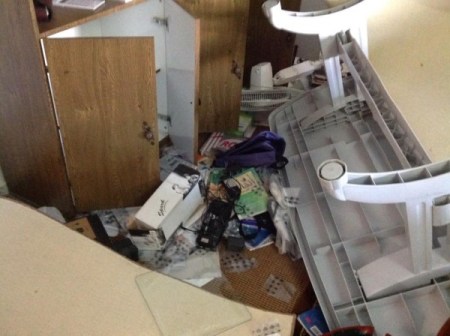
The soldiers upended furniture and destroyed belongings while the Palestinian family was trapped in one room – photo by Mhammad Edies
Israeli forces prevented ISM volunteers from documenting what was happening, pointing their guns and aiming lasers at them, yelling at and detaining those who attempted to leave their house to photograph the raid.
The following morning, a local a human rights activist reported that Israeli occupation forces had raided around 20 houses in Al-Khalil on that same night of the 21st to the 22nd of February alone.
Featured Video

Piers Corbyn on religion of climate change
or go to
Aletho News Archives – Video-Images
New Documentary
“Inside Gaza” wins best documentary at Montreal’s Cinemania film festival
Palestine Information Center – November 16, 2026
MONTREAL – The documentary “Inside Gaza,” which chronicles the experiences of Palestinian journalists working with Agence France-Presse (AFP) while covering the Israeli war on the Gaza Strip, won the Best Documentary Award at the 32nd Cinemania International Francophone Film Festival held in Montreal, Canada.
Directed by Helene Lam Trong, the 72-minute film follows the daily lives of four AFP journalists who bear witness to the difficulties of reporting in a war-torn territory largely closed off to international media.
The film is compiled from material produced by the team on the ground, as well as from interviews conducted after they left.
The film also won the People’s Choice Award at the festival on Saturday. … continue
Blog Roll
 Aletho News
- Austria seeks to strip former foreign minister of citizenship over Russia ties
- “Inside Gaza” wins best documentary at Montreal’s Cinemania film festival
- Activists block German munitions plant over arms exports to ‘Israel’
- The Nasser Hospital attack and Israel’s relentless lies
- Could it be satan? No, Huckabee, just the Americans you work for
- AIPAC and more: Network of pro-Israel influence in US Congress
- Putin aide reveals Moscow’s stance on Europe at peace talks
- Imran Khan warns Pakistani judges he may die in prison
- IOF used Amazon facial recognition to track millions of Palestinians
- More EU Citizens Face Sanctions For Criticizing The Ukraine Proxy War
- If Americans Knew
- An error has occurred; the feed is probably down. Try again later.
- No Tricks Zone
- Argentina’s Perito Moreno Glacier Joins Antarctica and Arctic In Defying Doomsday Melt Claims
- New Study: Barents Sea Temperatures Were Warmer And Sea Ice Less Extensive In The 1700s Than Today
- German Authorities Start Initiative To Evaluate Public Register For Climate “Disinformation” Spreaders!
- Zonal Asymmetry of Temperature Change in the Antarctic Circumpolar Current
- New Study: The Net Fossil Fuel Contribution To Rising Atmospheric CO2 Has Been Zero For 500 Years
- Germany’s Green Energy Transition Becoming Increasingly Expensive…Another 6 Trillion Euros!
- Sudden Stratospheric Warming, Powerful El Niño Combination May Lead To Extreme Europe Cold, Energy Crisis!
- Two New Studies Find Thwaites Glacier Melt Cannot Be Driven By Human Activity Or A Warming Ocean
- E-Cars Reduce CO2 Emissions By Only 41% Compared To Internal Combustion Engine Vehicles
- Predictions Made By Renowned Climate Professor Over Past Decades Have Been Proven To Be Poor

