Israeli Role in Syrian Conflict Brought Into the Open
By Nicola Nasser | The Peoples Voice | December 18, 2014
Overtly, the Israeli superpower of the Middle East has been keen to posture as having no role whatsoever in the four-year old devastating conflict in Syria, where all major regional and international powers are politically and militarily deeply involved and settling scores by Syrian blood.
In his geopolitical weekly analysis, entitled “The Islamic State Reshapes the Middle East,” on November 25 Stratfor’s George Friedman raised eyebrows when he reviewed the effects which the terrorist group had on all regional powers, but seemed unaware of the existence of the Israeli regional superpower.
It was an instructive omission that says a lot about the no more discreet role Israel is playing to maintain what the Israeli commentator Amos Harel described as the “stable instability” in Syria and the region, from the Israeli perspective of course.
Friedman in fact was reflecting a similar official omission by the US administration. When President Barak Obama appealed for a “broad international coalition” to fight the Islamic State (IS), Israel — the strongest military power in the region and the well – positioned logistically to fight it — was not asked to join. The Obama administration explained later that Israel’s contribution would reflect negatively on the Arab partners in the coalition.
“Highlighting Israel’s contributions could be problematic in terms of complicating efforts to enlist Muslim allies” in the coalition, said Michael Eisenstadt, a senior fellow at AIPAC’s arm, the Washington Institute for Near East Policy.
Covertly however Israel is a key player in prolonging the depleting war on Syria and the major beneficiary of neutralizing the military of the only immediate Arab neighbor that has so far eluded yielding to the terms dictated by the U.S. – backed Israeli regional force majeure for making peace with the Hebrew state.
Several recent developments however have brought the Israeli role into the open.
First the latest bombing of Syrian targets near the Damascus international civilian airport on December 7 was the seventh major unprovoked air strike of its kind since 2011 and the fifth in the past 18 months on Syrian defenses. Syrian Scientific research centers, missile depots, air defense sites, radar and electronic monitoring stations and the Republican Guards were targeted by Israel.
Facilitating the Israeli mission and complementing it, the terrorist organizations operating in the country tried several times to hit the same targets. They succeeded in killing several military pilots and experts whom Israeli intelligence services would have paid dearly to hunt down.
Foreign Policy on last June 14 quoted a report by the UN Secretary General Ban Ki – moon as saying that the “battle – hardened Syrian rebels … once in Israel, they receive medical treatment in a field clinic before being sent back to Syria,” describing the arrangement as a “gentleman’s agreement.”
Israeli Prime Minister Benyamin Netanyahu in February this year visited this “military field hospital” and shook hands with some of the more than 1000 rebels treated in Israeli hospitals, according to Lt. Col. Peter Lerner, a spokesman for the Israeli Occupation Forces (IOF).
Foreign Policy quoted also Ehud Yaari, an Israeli fellow at the Washington Institute for Near East Policy, as saying that Israel was supplying the rebel – controlled Syrian villages with medicines, heaters, and other humanitarian supplies. The assistance, he said, has benefited civilians and “insurgents.” Yaari ignored the reports about the Israeli intelligence services to those “insurgents.”
Israel facilitates war on UNDOF
Second, the latest quarterly report by the UN Disengagement Force (UNDOF) to the UN Security Council (UNSC) on December 1 confirmed what eight previous similar reports had stated about the “interaction … across the (Syrian – Israeli) ceasefire line” between the IOF and the “armed members of the (Syrian) opposition,” in the words of Ki-moon’s report to the Council on December 4.
Third, Ki-moon in his report confirmed that the UNDOF “was forced to relocate its troops” to the Israeli side of the ceasefire line, leaving the Syrian side a safe haven zone for the al-Qaeda affiliate al-Nusra Front, which the UNSC had designated a “terrorist group.”
UNDOF’s commander Lieutenant General Iqbal Singh Singha told the UNSC on October 9 that his troops were “under fire, been abducted, hijacked, had weapons snatched and offices vandalized.” Australia was the latest among the troop contributing countries to pull out its forces from UNDOF.
UNDOF and the United Nations Truce Supervision Organization (UNTSO) operate in the buffer zone of about 80 km long and between 0.5 to 10 km wide, forming an area of 235 km². The zone borders the Lebanon Blue Line to the north and forms a border of less than 1 km with Jordan to the south. It straddles the Purple Line which separates the Israeli – occupied Golan Heights from Syria. The west Israeli side of this line is known as “Alpha”, and the east Syrian side as “Bravo.”
Speaking at the U.S. military base Fort Dix on Monday, President Obama warned those who “threaten America” that they “will have no safe haven,” but that is exactly what Israel is providing them.
Israeli “interaction” has practically helped the UNDOF “to relocate” from Bravo to Alpha and to hand Bravo as a safe haven over to an al-Nusra Front – led coalition of terrorist groups.
Al-Nusra Front is officially the al – Qaeda affiliate in Syria. U.S. Secretary of State John Kerry told the Senate Committee on Foreign relations on this December 9 that his administration considers the IS to be a branch of al – Qaeda operating under a different name. Both terrorist groups were one under the name of the Islamic State in Iraq and Syria (ISIS) and only recently separated. Whoever accommodates either one is in fact courting the other.
“The 1,200-strong UN force is now mostly huddled inside Camp Ziouani, a drab base just inside the Israeli – controlled side of the Golan Heights. Its patrols along the de facto border have all but ceased,” the Associated Press reported on last September 18.
Israeli air force and artillery intervened several times to protect the al-Nusra Front’s “safe haven” against fire power from Syria, which is still committed to its ceasefire agreement of 1974 with Israel. Last September for example, Israel shot down a Syrian fighter jet that was bombing the Front’s positions, only three weeks after shooting down a Syrian drone over the area.
Israel is not violating the Syrian sovereignty only, but violating also the UN – sponsored ceasefire agreement and the UNSC anti-terror resolutions. More important, Israel is in fact undermining the UNDOF mandate on the Israeli – occupied Syrian Golan Heights.
This situation could only be interpreted as an Israeli premeditated war by proxy on the UN presence on the Golan Heights.
“Israel is the most interested in having (UN) peacekeepers evacuated from the occupied Golan so as to be left without international monitoring,” Syria’s permanent envoy to the UN, Bashar al- Jaafari, told reporters on September 17.
The UNSC seems helpless or uninterested in defending the UNDOF mandate on the Golan against Israeli violations, which risk the collapse of the 1974 ceasefire arrangements.
Syrian Foreign Ministry was on record to condemn these violations as a “declaration of war,” asserting that Syria reserves its right to retaliate “at the right moment and the right place.” Obviously a regional outbreak is at stake here without the UN presence as a buffer.
Upgrading unanimously Israel’s status from a “major non – NATO ally” to a “major strategic partner” of the United States by the U.S. Congress on December 3 could explain the UNSC inaction.
The undeclared understanding between the Syrian government and the U.S. – led coalition against the self – declared “Islamic State” (IS) not to target the latter’s forces seems to have left this mission to Israel who could not join the coalition publicly for subjective as well as objective reasons.
The AP on September 18 did not hesitate to announce that the “collapse of UN peacekeeping mission on Golan Heights marks new era on Israel – Syria front.” Aron Heller, the writer of the AP report, quoted the former Israeli military liaison officer with UNDOF, Stephane Cohen, as saying: “Their mandate is just not relevant anymore.” Heller concluded that this situation “endangers” the “status quo,” which indeed has become a status quo ante.
Israeli strategic gains
The emerging fait accompli seems very convenient to Israel, creating positive strategic benefits for the Hebrew state and arming it with a pretext not to withdraw the IOF from the occupied Syrian Golan Heights and Palestinian territories.
In an analysis paper published by The Saban Center at Brookings in November 2012, Itamar Rabinovich wrote that, “Clearly, the uncertainty in Syria has put the question of the Golan Heights on hold indefinitely. It may be a long time until Israel can readdress the prospect of giving the Golan back to Damascus.”
Moreover, according to Rabinovich, “the Syrian conflict has the potential to bring the damaged Israeli – Turkish relationship closer to normalcy … they can find common ground in seeking to foster a stable post – Assad government in Syria.”
The hostile Turkish insistence on toppling the Syrian government of President Bashar al-Assad, the concentration of the IS and other rebel forces in the north of the country and in central, eastern and southern Syria are diverting the potential and focus of the Syrian Arab Army northward and inward, away from the western front with the Israeli occupying power on the Golan Heights.
The protracted war on the Syrian government is depleting its army in manpower and materially. Rebuilding the Syrian army and the devastated Syrian infrastructure will preoccupy the country for a long time to come and defuse any military threat to Israel for an extended time span.
On the Palestinian front, the rise of the IS has made fighting it the top U.S. priority in the Middle East, which led Aaron David Miller, a former adviser to several U.S. administrations on Israeli-Palestinian negotiations, to warn in Foreign Policy early in September that the rise of the IS would pose “a serious setback to Palestinian hopes of statehood.”
The expected fallback internally of the post – war Syria would “hopefully” relieve Israel of the Syrian historical support for the Palestinian anti – Israeli occupation movements, at least temporarily.
Netanyahu on Sunday opened a cabinet meeting by explicitly using the IS as a pretext to evade the prerequisites of making peace. Israel “stands … as a solitary island against the waves of Islamic extremism washing over the entire Middle East,” he said, adding: “To force upon us” a timeframe for a withdrawal from the Israeli – occupied Palestinian territories, as proposed by Palestinian President Mahmoud Abbas to the UN Security Council, “will bring the radical Islamic elements to the suburbs of Tel Aviv and to the heart of Jerusalem. We will not allow this.”
Israel is also capitalising on the war on the IS to misleadingly portray it as identical with the Palestinian “Islamic” resistance movements because of their Islamic credentials. “When it comes to their ultimate goals, Hamas is ISIS and ISIS is Hamas,” Netanyahu told the UN General Assembly on September 29.
Nicola Nasser is a veteran Arab journalist based in Birzeit, West Bank of the Israeli-occupied Palestinian territories (nassernicola@ymail.com).
Pro-Palestine Parliaments
By JOHN V. WHITBECK | CounterPunch | December 18, 2014
The European Parliament, after a late compromise in pursuit of consensus, passed on December 17, by a vote of 498 to 88 with 111 abstentions, a resolution stating that it “supports in principle recognition of Palestinian statehood and the two-state solution and believes these should go hand in hand with the development of peace talks, which should be advanced.”
This compromise language bypasses the fundamental question of when the State of Palestine should be recognized, using vague words whose imprecision neither those who genuinely wish to achieve a decent “two-state solution” (and thus support recognizing Palestine now so as to finally make meaningful negotiations possible) nor those who support perpetual occupation (and thus argue that recognition should await prior Israeli consent) can strongly object to.
In doing so, the European Parliament has missed a rare opportunity to be relevant by joining the United Nations in recognizing Palestine’s “state status” or following the recent trend of European national parliaments urging their governments to join the 135 UN member states, representing the vast majority of mankind, which have already extended diplomatic recognition to the State of Palestine.
The overwhelming 274-12 vote in the British House of Commons on October 13 has been followed by favorable votes in France (339-151 in the National Assembly and 154-146 in the Senate), Ireland (unanimous in both houses), Portugal (203-9) and Spain (319-2).
On October 30, Sweden took the essential further step of actually extending diplomatic recognition to the State of Palestine, becoming the first European Union state to do so after becoming a member of the EU. However, it was not, as some media reported, the first European state to do so. It was the 20th.
The State of Palestine had already been recognized by eight other EU member states (Bulgaria, Cyprus, the Czech Republic, Hungary, Malta, Poland, Romania and Slovakia) and by 11 other states which are commonly considered to be “European” (Albania, Azerbaijan, Belarus, Bosnia & Herzegovina, Georgia, Iceland, Montenegro, Russia, Serbia, Turkey and Ukraine).
Since the British, French, Irish, Portuguese and Spanish parliamentary resolutions are not binding on the executive branches of their respective governments, they have commonly been dismissed as “symbolic”, even while those favoring perpetual occupation have expended major efforts to prevent the votes from taking place. It is also commonly asked whether they matter at all.
Whether they matter, at least in a constructive sense, depends entirely on what happens afterwards. European parliamentary resolutions urging their governments to recognize the State of Palestine would not only be purely symbolic but actually counterproductive and dangerous if they are not followed relatively rapidly by actual recognitions of the State of Palestine.
These resolutions offer hope, but if, even after the latest Israeli onslaught against the people of Gaza, the European governments which have not yet recognized the State of Palestine prefer to ignore the clear will of their own peoples, as expressed by their elected representatives, and to continue prioritizing the wishes of the American and Israeli governments, then the last hope of the Palestinian people for ending the occupation and obtaining their freedom by non-violent means would have been extinguished.
These resolutions are thus a double-edged sword, offering both immediate hope and the potential for definitive despair.
The hope for peace with some measure of justice which actual European recognitions would generate is based on the assumption that the occupation by a neighboring state of the entire territory of any state which one recognizes as such is not something which any state with the influence and capacity to take meaningful action to end that occupation could tolerate indefinitely – and that, by virtue of diplomatic recognition, meaningful action to end that occupation (including economic sanctions and travel restrictions) would become a moral, ethical, intellectual, diplomatic and political imperative for European states, which, alone, possess the requisite influence and capacity.
The occupation of Kuwait by Iraq was permitted to last seven months. The occupation of Palestine by Israel is in its 48th year, the entire lifetimes of the great majority of Palestinians in occupied Palestine.
European governments are conscious of Europe’s unparalleled leverage as Israel’s primary trading partner and cultural homeland, and their realization that diplomatic recognition of Palestine would make meaningful action to end the occupation imperative surely constitutes a primary reason (in addition to the fear of upsetting the American and Israeli governments) why even those European governments which do not support perpetual occupation and genuinely wish to see the achievement of a decent “two-state solution” are reticent, hesitant and nervous about extending diplomatic recognition to the State of Palestine now.
Yet if not now, when? It is now or never – if, indeed, it is not already too late.
European governments must seize their unprecedented opportunity to have a positive and potentially determinative impact on Israel’s March 17 election and the composition of the next Israeli government by writing indelibly on the wall a new reality which could convince a critical mass of Israelis, for the first time, that a fair peace agreement is preferable for them personally to perpetuation of the currently comfortable status quo.
Only then can a new and true “peace process”, under new management, based on international law and relevant UN resolutions and with both Israel and Palestine negotiating with a genuine desire and intention to reach an agreement, begin.
The Israeli electorate has been estimated to be divided roughly equally into three groups – those firmly on the right and extreme-right, those firmly on the center-left and those “swing voters” in between. Those in between will determine the composition of the next government. European governments have the influence and capacity to move them in a positive direction – in the best interests of Israelis, Palestinians, the region and the world.
It remains to be seen whether European governments have the wisdom, courage and political will to do so.
John V. Whitbeck is an international lawyer who has advised the Palestinian negotiating team in negotiations with Israel.
In Israel and the occupied territories, discrimination is enshrined in the law
By Amelia Smith | Open Democracy | December 18, 2014
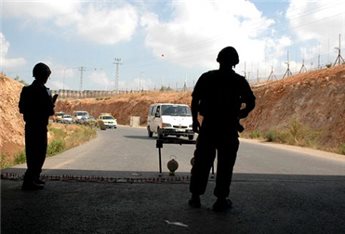
In November five Israelis were killed and eight wounded when two Palestinians attacked a synagogue in West Jerusalem. Israeli police shot the attackers dead at the scene and Benjamin Netanyahu ordered that the assailant’s houses be demolished.
The family of Mohammed Abu Khdeir, the young Palestinian teenager who was kidnapped and burnt to death in July, have also called for the homes of the Israelis who killed Mohammed to be demolished, though it is highly unlikely they will be. Such is the nature of Israel’s unequal application of the law.
News that Israel discriminates between Jewish Israelis and Palestinians is nothing new. Just last month the Israeli government voted to make all ratified Israeli civilian law passed through the Knesset apply to settlers. Most of the legislation on criminal law, tax law and military conscription already does, despite the international consensus that settlements are illegal. Around 350,000 settlers currently reside in the occupied West Bank yet for what it’s worth article 49 of the Fourth Geneva Convention states: “The Occupying Power shall not deport or transfer parts of its own civilian population into the territory it occupies.”
Knesset member Orit Struck, who drafted the bill, lives in one of these illegal settlements in the West Bank city of Hebron. Critics of Struck’s bill have said that applying civilian law to the West Bank would be a solid step towards the annexation of the occupied territories adding that it “legalises occupation”. Presumably, this is Struck’s intention.
In order to justify the bill, senior right-wing MKs have argued that the current split system – that Israelis in Israel are governed by different laws than Israelis in the West Bank – is “unacceptable from a democratic point of view” and have said it leads to discrimination against Israelis living in the occupied territories.
But what about Palestinians living in the West Bank? Article 66 of the Fourth Geneva Convention, which Israel has adopted, states that non-political military courts can be established for residents in the occupied territory. Palestinians in the West Bank are therefore subject to Israeli military law. Under the two legal systems, an Israeli settler and a Palestinian, accused of the same crime, will be treated, and sentenced, very differently.
Palestinian children, shackled and accused of throwing stones, have also been brought before these courts. The Palestinian Prisoners Center for Studies says that some 308,000 Palestinians have been detained within Israeli jails since the First Intifada in 1987.
Under military law Palestinians are threatened with arbitrary arrest, detention and are denied freedom of movement. As American-Israeli lawyer Emil Schaeffer points out, whilst an Israeli settler must be brought before a judge in less than 24 hours a Palestinian may be interrogated for up to eight days before he or she sees a judge.
In a military court Palestinians may be denied access to a lawyer for up to 90 days, yet within the Israeli legal system a meeting with a lawyer must be granted immediately. Within the military courts there is little internal supervision and consequently little public scrutiny.
The list continues, as does the system of legalised separation, discrimination and ultimately the guarantee of rights based on nationality. This segregated system goes far beyond the occupied territories of the West Bank.
On the other side of the concrete separation barrier that has sectioned off the West Bank, Palestinians living in Israel face a raft of laws that discriminate against them. According to Adalah, there are 50 laws in place that discriminate against Palestinians citizens of Israel from access to land to state budget resources.
Perhaps the most obvious of these is the Law of Return, which grants Jewish people across the world the right to live in Israel and gain citizenship. In the drive to bump up the numbers, free flights have been offered, as have financial benefits and tax breaks. On arrival accommodation is sometimes offered in annexed East Jerusalem.
Meanwhile, the seven million Palestinian refugees across the world are not only denied the right to return to their land, but also Palestinian citizens of Israel are not allowed to bring their husbands and wives from the occupied territories to live with them. So one group is actively encouraged, whilst the other is denied their basic rights.
In recent weeks a proposed law, which defines Israel as the nation-state of the Jewish people, has whipped up much controversy thanks to the controversial nature of the bill, part of which would mean the dropping of Arabic as a second language.
Like the bill that seeks to apply Israeli civilian law wholeheartedly to settlers in the West Bank, the Jewish nation-state bill is part of an ongoing system of discrimination against Palestinians, which has long rendered them second-class citizens. Little by little it is being enshrined in the law, which ultimately means discriminatory treatment towards Palestinians can continue.
Israel’s system of formal and informal discrimination reaches into all aspects of Palestinian’s lives, from separate housing in the West Bank to separate roads, schools and hospitals. It even infiltrates personal lives.
Whilst Israel regularly passes discriminatory laws, they clearly have little regard for international law – or at least, the parts of it that don’t suit them. As a signatory to some of the most important human rights and humanitarian law statutes, they should be held accountable for their discriminatory policies; which undoubtedly constitute grave breeches.
Geneva Convention meeting goes ahead, criticises Israeli violations
MEMO | December 18, 2014
The High Contracting Parties to the Fourth Geneva Convention urged an end to violations of international law in the Occupied Palestinian Territory (OPT) following a conference Wednesday.
The special Geneva meeting, hosted by the Swiss government, saw representatives from 126 state parties adopt a ten-point declaration that reaffirmed international humanitarian law and the applicability of the Fourth Geneva Convention in the OPT, something that Israel denies.
The declaration urges Israel “to fully and effectively respect the Fourth Geneva Convention in the Occupied Palestinian Territory, including East Jerusalem”, and stresses its “obligation” to administer the OPT “in a way which fully takes into account the needs of the civilian population.”
The parties went on to express “deep concern about the impact of the continued occupation”, specifically singling out Israel’s Wall and associated regime as “contrary to international humanitarian law”, along with “the closure of the Gaza Strip”.
The declaration also affirmed “the illegality of the settlements in the said territory and of the expansion thereof and of related unlawful seizure of property as well as of the transfer of prisoners into the territory of the Occupying Power.”
Speaking after the meeting, Swiss ambassador Paul Fivat hailed the declaration as “unprecedented”, and a “signal which is being sent to conflicting parties and especially to the civilian populations that there is a law, international, which is protecting their interests.”
Fivat clarified that “the declaration binds only the parties who were [present]”, with Israel, the U.S., and Canada, examples of “a small of number of High Contracting Parties” who “expressed their opposition and did not attend the Conference.”
In the lead up to Wednesday’s gathering, Israel tried to persuade the parties to the Convention to not convene the summit at all, even sending officials several times to Bern and Geneva.
In response to the conference yesterday, Israel’s UN mission claimed that “it confers legitimacy on terrorist organizations and dictatorial regimes wherever they are, while condemning a democratic country fighting terrorism in accordance with international law.”
Palestine’s Permanent Mission in Switzerland, meanwhile, praised the declaration, stating that “legal actions, including through universal jurisdiction and international criminal justice mechanisms” are necessary to hold Israel “accountable for its decades of violations of international law.”
Israeli human rights NGO B’Tselem described the declaration as a reflection of “the illegality of the ongoing occupation and its attendant human rights violations”, the “baselessness of Israel’s claims of compliance with the Fourth Geneva Convention”, and of “Israel’s ever deteriorating international status as the violations persist.”
Kerry: US will veto Palestinian bid for statehood
MEMO | December 17, 2014
 US Secretary of State John Kerry is reported to have informed the Palestinian delegation headed by Saeb Erekat that Washington will use its veto power at the UN Security Council against the Arab draft resolution which calls for an end to the Israeli occupation of the Palestine territories occupied in 1967; AFP quoted a senior Palestinian official as saying.
Kerry had earlier said that Washington has not decided on the Security Council draft resolution saying: “The time is not right for speculation about a UN draft resolution that has not been submitted yet.”
He told reporters before his meeting with Erekat that it was imperative to help lower tensions. “Many of us share a deep sense of urgency about this. But we’re also very mindful that we have to carefully calibrate any steps that are taken for this difficult moment in the region,” he said.
Al-Jazeera’s Bureau Chief in Ramallah Walid Al-Omari said the Palestinian leadership delayed a meeting scheduled yesterday and will wait for the outcome of a meeting between the Palestinian delegation and a delegation of Arab foreign ministers, headed by Nabil Elaraby, with the US secretary of state and European foreign ministers.
On Monday Israeli Prime Minister Benjamin Netanyahu met with Kerry in Rome. Israel’s Channel 10 said that Netanyahu attempted to push the US to use its veto against the Palestinian draft resolution.
Palestinian woman who stabbed Israeli settler was defending herself: official
Al-Akhbar | December 17, 2014
A Palestinian woman suspected of stabbing an Israeli settler on December 1 was defending herself after being harassed by the man, a Palestinian official claimed Tuesday.
Amal Jamal Taqatqa, 22, was shot and critically wounded by soldiers near Gush Etzion on December 1 after allegedly stabbing an Israeli settler.
The director of Bethlehem’s military liaison department told Ma’an news agency that officials requested an investigation into the shooting, but that it has been delayed due to the political atmosphere.
“Is it reasonable that 46 surveillance cameras in Gush Etzion settlement bloc have failed to document what really happened between Amal Taqatqa, 22, from Beit Fajjar and an Israeli settler who claimed that she attempted to stab him?” Khaled Qaddura said.
Taqatqa reportedly engaged in a hand-to-hand fight with the settler after he verbally abused her, causing a minor scratch to the settler’s neck, Qaddura said.
“At that point, the settlers asked an Israeli soldier who was in the area to shoot the girl, and the soldier immediately shot her in the chest. The girl fell to the ground then tried to get up and run away, but the soldier shot her again in the feet causing her to fall down again then he approached her and shot a last round,” the official added.
Taqatqa is still receiving medical treatment at Hadassah hospital and is in a stable condition.
Qaddura slammed Israel’s labeling of Taqarqa as a “terrorist”, noting that the term “terrorism” is used automatically when Israelis – whether civilians or soldiers – are injured.
He urged Palestinians who witness such incidents to film them or record the registration number of the military vehicles involved.
Unrest has gripped Jerusalem and the West Bank on an almost daily basis for the past five months, flaring up after a group of Zionist settlers kidnapped and burned a young Palestinian to death because of his ethnicity, and worsened by the deadly Israeli assault on the Gaza Strip in July and August.
(Ma’an, Al-Akhbar)
No donkeys allowed
International Solidarity Movement |December 17, 2014
Hebron, Occupied Palestine – Mohammad Saleh, a sixty-six-year-old Palestinian resident of Tel Rumeida, al-Khalil (Hebron), waited with his mule outside Shuhada checkpoint for nine hours over the course of two days. He spent four hours waiting before being allowed through on Monday (15/12/14) evening.
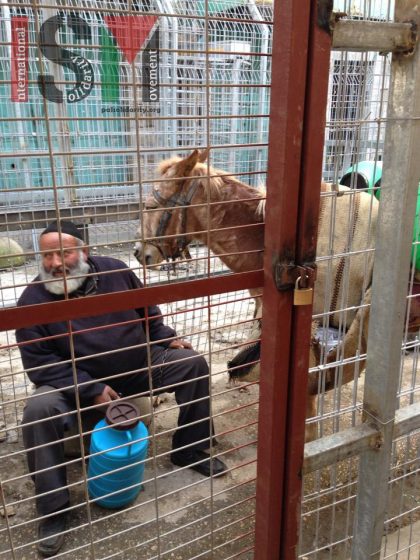
He then spent five hours Tuesday (16/12/14) attempting to cross in the opposite direction before eventually turning back, after being denied repeatedly by Israeli forces claiming that donkeys, mules, horses, and carts are not permitted to pass through the checkpoint.
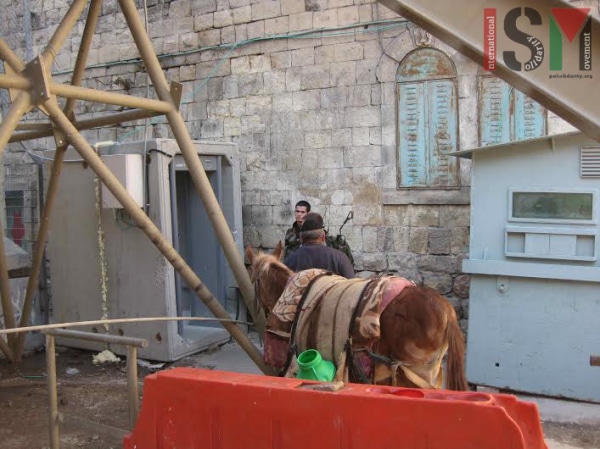
Shuhada checkpoint serves as the only clear passage between the H2 (Israeli-controlled) neighbourhood of Tel Rumeida and the H1 (Palestinian Authority-administered) neighbourhood of Bab Al-Zawiye, a route many Palestinians must traverse regularly in the course of their work and daily routines.
Mohammad arrived at the Bab Al-Zawiye side of the checkpoint at 13:40 on Mondayafternoon, his mule laden with empty milk jugs and saddlebags packed with various provisions. Israeli forces refused to let him through, claiming no animals were allowed past the checkpoint – a claim no one, including other international organisations at the scene as well as the Palestinian District Coordination Office for al-Khalil, had ever heard before.
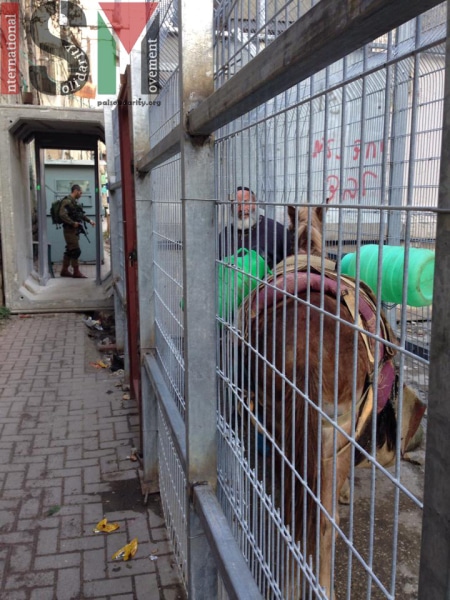
Mohammad explained that he had been allowed pass the checkpoint on Monday morning, with the promise that he would be let back through later in the day. When he returned, he found a new shift of soldiers and no one willing let him pass. The soldier manning the checkpoint claimed he needed permission from his commander to open the gate, which would allow Mohammad to pass with his mule.
An ISM volunteer at the scene later received a call explaining that the Israeli military’s new rule stated that horses, donkeys and mules were not permitted to pass through the checkpoint. No one, however, was able to explain why Mohammad had been allowed through that morning, but denied on his way home. “Look at my ID,” he told the soldier at one point, “I’m in your computer. I go through here all the time.”
He stayed waiting, sitting beside his mule on the cold concrete base of the fence, even as the afternoon turned into evening. The sky grew dark, though the lights from the checkpoint still illuminated the fences,
turnstiles, and barbed wire. Even the soldier seemed concerned, telling him to please go home, as it was cold and late and staying would not help him. But Mohammad had already made it clear he would not leave. About ten minutes later the soldier finally opened the gate, saying it was the “last time” that he would be allowed through. Although Mohammad heard the soldier’s message, it was clear he would not heed it. He intended to continue to resist, no matter what anyone told him.
Sure enough, the following morning he was once again standing outside the checkpoint, this time on the Tel Rumeida side, with full milk jugs tied to the back of his patient mule. The soldiers presented multiple reasons from denying him passage, from a prohibition on taking anything through the checkpoint too large to be carried through the turnstile, to the new rule against allowing donkeys, horses and mules through. ISM volunteers attempted to find a solution, offering to carry the milk jugs around the checkpoint and meet Mohammad and his mule on the other side. The Israeli soldiers manning the checkpoint rejected all suggestions.
“Is the donkey the problem or the milk the problem?” One ISM activist eventually inquired.
“The donkey’s the problem,” a soldier replied.
The animal could have easily passed through the metal detector; only last night ISM activists had witnessed the ludicrous sight of Mohammad’s mule strolling through the concrete structure, empty milk jugs banging against the corners of the gateway. The turnstile served as the only obstacle to the his passage – an obstacle the soldier could easily remove by opening the gate on the other side of the metal detector and letting the mule pass around the turnstile and into Bab Al-Zawiye.
After five hours of waiting, Mohammad’s comment seemed by far the most accurate. “The soldiers are the problem,” he had responded in Arabic.
Barring donkeys, mules, and horses and carts is only the latest in a string of frustrating, humiliating regulations imposed on the people living near the checkpoint, who must pass through to work, study, and shop for essentials such as fresh food. Just a few days earlier a group of elderly Palestinians, ill people, young children, and teachers at a local school had also been forced to wait, some for up to three hours, before being allowed through.
When Israeli forces shut down the checkpoint after it was burnt nearly a month ago , barring most people from passing through for over three weeks, the Palestinians were forced to adapt. Local people know ways around the checkpoint; several paths lead through local families’ yards and over the walls and rubble between Tel Rumeida and Bab Al-Zawiye. These “rabbit runs,” however, are entirely unsuited to traveling through with a mule – as well as for anyone sick, elderly, or carrying large heavy objects.
Since the attempted burning of the checkpoint, the Israeli military rebuilt it larger and with more obstacles for anyone traveling through. One side now has a metal detector, and both sides are equipped with vertical metal turnstiles which are a major impediment to anyone trying to move through with large baggage. Soldiers continue to use the burning of the checkpoint to justify collective punishment imposed on the entire Palestinian population – young and old, men and women, healthy and ill – who live or work near the Shuhada checkpoint.
Any Palestinian might be stopped while attempting pass through. Even with the checkpoint officially open, far too many are. Soldiers regularly search bags and make people remove their belts and empty their pockets before being allowed through. These everyday humiliations accompany frequent ID checks and detentions, serving as an inescapable reminder of the illegal Israeli occupation. Soldiers present at checkpoints routinely cite newly imposed rules and orders from superior officers as reasons for denying people passage, but whether someone passes easily through a checkpoint or must wait for hours often seems to be determined by nothing more than the soldiers’ caprice.
Many Palestinians must pass through Shuhada checkpoint multiple times in a day, carrying items as diverse as fresh vegetables, tubs of oil, and gas for cooking and heating their homes. During the hours ISM volunteers stood waiting with Mohammed, they witnessed multiple people struggle with the cumbersome design of the rebuilt checkpoint. One woman was carrying too many grocery bags to be able to fit into the turnstile. Someone on the other side of the turnstile had to reach a hand between the metal bars and move one bag through, returning it to the woman once she had passed. Another Palestinian, this time a young boy, needed the help of multiple passers-by over several minutes to figure out how to get two tubs of oil and a metal trolley through the turnstiles. Soldiers denied passage outright to boys who wanted to walk through the checkpoint with their bicycles.
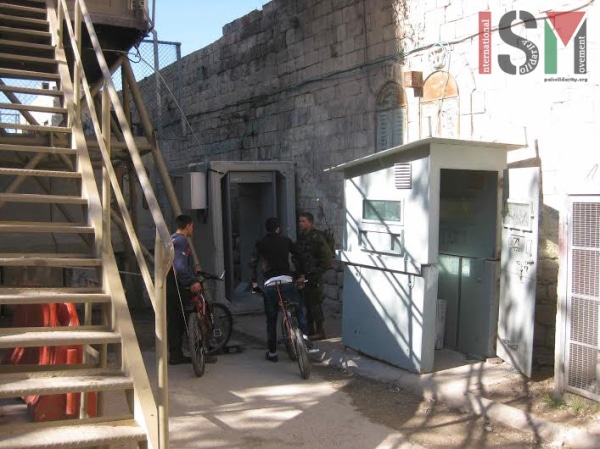
At one point on Monday night, a group of off-duty soldiers ran up Shuhada street and stopped near the checkpoint to rest, stretching and laughing, their easy freedom of movement a stark contrast to experiences of Palestinians struggling through Shuhada checkpoint. Almost all of Shuhada street has been closed off to Palestinians, reserved instead for the settlers and soldiers occupying H2. Even Palestinians who manage to get through the checkpoint must pursue long, circuitous routes between the surrounding areas of al-Khalil. Many, especially the elderly or disabled, are effectively barred from traveling to significant portions of the city their families have lived in for generations.
“I want to resist,” Mohammad told the ISM activists the first day they waited with him. He made sure the man translating said it twice, to make sure the ISM volunteers understood. “I want to resist,” he said, after over three long hours of waiting to be allowed through.
Iran Nuclear Talks à la Israeli-Palestinian Negotiations
By ISMAEL HOSSEIN-ZADEH | CounterPunch | December 16, 2014
Soon after the Iran nuclear talks were recently extended for another seven months (beyond the November 22, 2014 deadline), President Rouhani spoke with the Iranian people in a televised address in which he sought to portray the inconclusive negotiations as a diplomatic victory for Iran, as an indication that his team of negotiators “stood their ground” in the face of excessive demands by the US and its allies.
In reality, however, the extension meant the failure of the Iranian negotiators to achieve anything of substance (in terms of sanctions relief) in exchange for the significant unilateral concessions they had made a year earlier. To put it differently, it meant that the US and its allies refused to honor what they had promised Iran in return for its suspension and/or downgrading of its nuclear technology.
A year earlier, that is, in the first round of negotiations on 24 November 2013, Iran had agreed to the following significant concessions: limit its enrichment of uranium from the level of 20 percent to below 5 percent purity, render unusable its existing stockpile of 20 percent fuel for further enrichment, not activate its heavy-water reactor in Arak, not use its more advanced IR-M2 centrifuges for enrichment, and consent to extensive IAEA inspections of its nuclear industry/facilities.
This obviously means that Iranian negotiators had agreed to more than freezing Iran’s nuclear technology; more importantly, they had reversed and rolled back significant scientific achievements and technological breakthroughs of recent years.
In return, the US and its allies had agreed that following the “confidence building” implementation of these commitments by Iran, economic sanctions against that country would be lifted.
A year later, and despite the fact that IAEA has consistently confirmed Iran’s compliance with these commitments, major sanctions continue unabated. At a press conference on November 22, 2014, US Secretary of State John Kerry boasted that undiminished sanctions have forced Iran to either reverse or freeze much of its nuclear program. “Today,” Kerry stated, “Iran has no 20 percent enriched uranium. Zero. None. They have diluted and converted every ounce that they have… Today, IAEA inspectors have daily access to Iran’s enrichment activities and a far deeper understanding of Iran’s program.”
Instead of honoring what they had promised during the initial negotiations of year ago, the US and its allies now argue that Iran needs to make more concessions, and that therefore more time is needed for further negotiations—hence the seven-month extension of negotiations, to July 1, 2015.
And what are the new demands that are made of Iran? The new requirements, which the Iranian negotiators have now additionally agreed to, include the following:
* Expanded snap Inspections of Iran’s Centrifuge Production Facilities: under the seven-month extended negotiations, the IAEA will double its unannounced, snap inspections of Iran’s centrifuge production facilities.
* Conversion of more 20% Uranium Oxide to Reactor Fuel: Iran will convert 35 additional kg of its remaining 75 kg of 20% enriched uranium powder from oxide form into reactor fuel for the Tehran Research Reactor, thereby helping prevent the reversibility of a key concession Iran has made.
* Further Limitations on Research and Development (R&D) of Advanced Centrifuges and Enrichment Technology. The most important of these new limits are:
* Iran cannot pursue semi-industrial-scale operation of the IR-2M, a necessary prerequisite toward mass production of the model.
* Iran cannot feed IR-5 model centrifuges with uranium gas.
* Iran cannot pursue gas testing of the IR-6 centrifuge on a cascade level.
* Iran cannot install the IR-8 centrifuge at the Natanz Pilot Plant, preventing it from being tested with uranium gas.
* Iran is prohibited from using other/new forms of enrichment, including laser enrichment [source].
And what would Iran gain in return for these significant additional/new concessions? Not much. Under the extended interim agreement, as in the two previous interim agreements, dating back to November 2013, Iran will be permitted to repatriate only $700 million per month of its nearly $100 billion assets that are frozen overseas under the sanctions regime.
This explains why many critics have pointed out that Iranian negotiators have, once again, made significant one-sided concessions without much reciprocity in the way of sanctions relief. It also explains why President Rouhani’s (and his negotiating team’s) portrayal of the extension of negotiation as a diplomatic victory for Iran is far from warranted—it is, indeed, tantamount to self-deception, or more precisely, deception of the Iranian people.
Off-the-record briefings in Washington indicate that the US is projecting a long period of 15 to 20 years of protracted negotiations before restrictions on Iran’s civilian nuclear program are fully lifted. In light of the fact that the US and its allies have already achieved their goal of downgrading and freezing Iran’s nuclear program, while retaining crippling sanctions on that country, their policy of prolonging negotiations—as a tactic to avoid honoring what they have promised Iran—is understandable. As Keith Jones, a keen observer of the Iran nuclear talks, points out:
“Washington is determined to continue to subject Iran to crippling economic sanctions, with relief doled out incrementally and over a period of years. Moreover, during a lengthy initial period, the Western powers want only piecemeal suspension of the sanctions, not their repeal, so that they can be quickly reinstituted should they determine that Tehran has failed to fulfill its commitments” [source].
This means that President Rouhani’s (and Foreign Minister Javad Zarif’s) wishful thinking that a combination of generous concessions and a diplomatic charm offensive would suffice to have the US lift the economic sanctions against Iran has, effectively, placed his negotiators on a slippery slope, with no end to ever newer demands and additional conditions required of them by the US and its allies.
The perils of prolonged negotiations—increasingly resembling the Israeli-Palestinian negotiations—go beyond downgrading and/or freezing Iran’s nuclear technology. Equally devastating are the crippling effects of the continued sanctions on the Iranian economy/society.
Detrimental effects of sanctions on the Iranian economy have been further exacerbated by the Rouhani administration’s misguided policy of having tied the fate of Iran’s economy to the outcome of nuclear negotiations—effectively, making the future of the economy hostage to the unreliable and unpredictable consequences of the nuclear talks. This policy stems from the administration’s neoliberal economic outlook that seeks solutions to economic stagnation, poverty and under-development in unreserved integration into world capitalist system. The policy tends to hurt Iran in two major ways.
First, by tying the chances of economic recovery in Iran to the removal of the sanctions, that is, to the “successful” conclusion of the nuclear talks, the policy has undermined Iran’s bargaining position in the negotiations. Indeed, it can reasonably be argued that President Rouhani condemned Iran to a losing nuclear negotiation long before he was elected. He did so during his presidential campaign by pinning his chances for election on economic recovery through a nuclear deal. This was a huge mistake, as it automatically weakened Iran’s bargaining position and, by the same token, strengthened that of the United States and its allies. By exaggerating the culpability of his predecessor in the escalation of economic sanctions against Iran, he committed two blunders: (a) downplaying the culpability of the US and its allies, and (b) placing the onus of reaching a nuclear deal largely on Iran.
Second, the policy of linking the chances of an economic recovery to the outcome of nuclear negotiations and/or the lifting of sanctions has created an ominous atmosphere of business/market uncertainty among the Iranian investors and entrepreneurs. Uncertainty is perhaps the worst enemy of a market economy, which explains why long-term, productive investment is drying up in Iran, or why economic stagnation has deteriorated since President Rouhani took office in early 2013.
Iran could minimize the baleful effects of sanctions by trying to delink its economic policies from nuclear negotiations and the threat of further sanctions. This would be possible if the Rouhani administration’s economic outlook somehow tilted away from outward-looking to inward-looking strategies of economic development; that is, the development of a “resistance economy,” as Iran’s Supreme leader, Ayatollah Khamenei has put it. This requires an economic strategy that would view the sanctions as an opportunity to mobilize national resources and chart an industialization course toward import-substitution and economic self-reliance—something akin to a war economy, since Iran has effectively been subjected to a brutal economic war by the United States and its allies.
Such a path of development would be similar to the eight years (1980-88) of war with Iraq, when at the instigation and support of regional and global powers Saddam Hussein launched a surprise military attack against Iran. Not only did the Western powers and their allies in the region support the Iraqi dictator militarily but they also subjected Iran to severe economic sanctions. With its back against the wall, so to speak, Iran embarked on a revolutionary path of a war economy that successfully provided both for the war mobilization to defend its territorial integrity and for respectable living conditions of its population.
By taking control of the commanding heights of the national economy, and effectively utilizing the revolutionary energy and dedication of their people, Iranian policy makers further succeeded in bringing about significant economic developments. These included: extensive electrification of the countryside, expansion of transportation networks, construction of tens of thousands of schools and medical clinics all across the country, provision of foodstuffs and other basic needs for the indigent at affordable prices, and more.
Alas, despite its record of success, this option seems to be altogether alien to President Rouhani and his team of economic advisors who, following the neoliberal/neoclassical school of economic thought, maintain that the solution to Iran’s economic problems lies in an unrestrained integration into world capitalism, in a wholesale (and often fraudulent) privatization of the economy, and in an IMF-style of economic austerity.
Ismael Hossein-zadeh is Professor Emeritus of Economics (Drake University). He is the author of Beyond Mainstream Explanations of the Financial Crisis (Routledge 2014), The Political Economy of U.S. Militarism (Palgrave–Macmillan 2007), and the Soviet Non-capitalist Development: The Case of Nasser’s Egypt (Praeger Publishers 1989).
Israel seeks assurances of US veto ahead of Palestinian push for UN resolution
Al-Akhbar | December 16, 2014
 US Secretary of State John Kerry will meet chief Palestinian negotiator Saeb Erekat and a delegation from the Arab League in London Tuesday, hoping to avert a diplomatic crisis over a United Nation bid to force Israel to withdraw from West Bank and East Jerusalem.
Kerry will seek to persuade the Palestinians not to move ahead with a draft UN resolution seeking to set a two-year timetable for an end to the Israeli occupation of territories being considered for a Palestinian state as part of a two-state solution.
Israel has occupied East Jerusalem and the West Bank since the 1967 Middle East War. It later annexed Jerusalem in 1980, claiming it as the capital of the self-proclaimed Zionist state – a move never recognized by the international community.
Kerry has spent the past two days jetting across Europe meeting his counterparts as well as Israeli Prime Minister Benjamin Netanyahu to gauge support for the Palestinian effort at the UN Security Council.
Netanyahu said late on Monday that growing European backing for a two-state solution could harm Israel.
“I said that the attempts of the Palestinians and of several European countries to force conditions on Israel will only lead to a deterioration in the regional situation and will endanger Israel,” he said in a statement.
“Therefore, we will strongly oppose this,” he added.
There is growing European impatience with the current status quo in the Israeli-Palestinian conflict, as several European parliaments in recent weeks have called on their governments to symbolically recognize a state of Palestine.
Netanyahu sought assurances from Kerry that Washington would block efforts by Palestinians and Europeans on Palestinian statehood.
“Our expectation is that the United States will stand by its position for the past 47 years that a solution to the conflict will be achieved through negotiations, and I do not see a reason for this policy to change,” Netanyahu told reporters after a meeting in Rome that lasted some three hours.
The two men “had a long and thorough discussion about Israel’s security and developments at the United Nations,” a State Department official said.
Before the meeting, Israel put the US on notice that it expected Washington to exercise its UN Security Council veto against any resolutions setting a time frame.
Netanyahu declined to comment on whether he was given an assurance by Kerry that the US would exercise its veto.
A source with knowledge of the talks who spoke on condition of anonymity said the Israeli leader had indeed asked for such an assurance.
Meanwhile, a senior State Department official said Washington had made clear in discussions that it would oppose certain moves.
“We’ve made clear throughout these discussions with all of our interlocutors that there are certain things we could never support. (I’m) not going to outline those publicly,” the official said.
The US administration opposes moves, like a UN resolution, that it says would bind negotiators’ hands – particularly any attempt to set a deadline for the withdrawal of Israeli troops from the West Bank.
But a US veto risks running contrary to Washington’s avowed aim of a Palestinian state and would anger key Arab allies – many of whom are much-needed partners in the US-led coalition against Islamic State of Iraq and Syria (ISIS) militant group.
Arab countries, however, have long been silent on the Palestinian cause or merely used it as a rhetorical talking point.
US officials have indicated that Washington did not find the Palestinian draft acceptable, but said that with matters still fluid, it was premature to take a position now on any particular Security Council resolution.
“Whether we have the nine votes at the Security Council or we don’t, the decision has been taken to present the Palestinian-Arab resolution in the Security Council on Wednesday,” said Wassel Abu Yousef, an official of the Palestine Liberation Organization, one of the highest Palestinian decision-making body, led by Palestinian Authority President Mahmoud Abbas.
Palestinian UN Ambassador Riyad Mansour said that “on Wednesday, most likely a draft will be put in blue.” This means the draft resolution could be put to a vote as soon as 24 hours later, though it does not guarantee it will be put to a vote.
Jordanian UN Ambassador Dina Kawar said she had not received any requests regarding action on the Palestinian draft.
When asked if she was expecting any developments at the Security Council this week, Kawar told reporters: “No, no, because Mr. Kerry is having meetings in Europe with a number of ministers, so we’re waiting to see what happens.”
From Rome, Kerry traveled to Paris to meet with counterparts from Britain, Germany and France to discuss their efforts to draft a separate UN resolution to end the Israeli-Palestinian conflict.
US officials said there was no consensus among the European powers on the best way to proceed.
Diplomatic sources say Paris is hoping to persuade the divided Palestinians to back their compromise resolution, rather than risk a US veto of the more muscular Arab version presented by Jordan last month.
French Foreign Minister Laurent Fabius told AFP they were looking for “a resolution which everyone can get behind.”
“Even if the Palestinians have a text in their hand, the Americans have already said that they will veto it,” Fabius said.
UN Middle East peace process envoy Robert Serry briefed the Security Council on Monday and said any resolution outlining the parameters of an Israeli-Palestinian final status agreement would be important, but “not a substitute for a genuine peace process that will need to be negotiated between both parties.”
In November 1988, Palestinian leaders led by Yasser Arafat declared the existence of a state of Palestine inside the 1967 borders and the state’s belief “in the settlement of international and regional disputes by peaceful means in accordance with the charter and resolutions of the United Nations.”
Heralded as a “historic compromise,” the move implied that Palestinians would agree to accept only 22 percent of historic Palestine, in exchange for peace with Israel. It is now believed that only 17 percent of historic Palestine is under Palestinian control following the expansion of illegal Israeli settlements.
It is worth noting that numerous pro-Palestine activists support a one-state solution in which Israelis and Palestinians would be treated equally, arguing that the creation of a Palestinian state beside Israel would not be sustainable. They also believe that the two-state solution, which is the only option considered by international actors, won’t solve existing discrimination, nor erase economic and military tensions.
(AFP, Reuters, Al-Akhbar)
Featured Video

or go to
Aletho News Archives – Video-Images
New Documentary
“Inside Gaza” wins best documentary at Montreal’s Cinemania film festival
Palestine Information Center – November 16, 2026
MONTREAL – The documentary “Inside Gaza,” which chronicles the experiences of Palestinian journalists working with Agence France-Presse (AFP) while covering the Israeli war on the Gaza Strip, won the Best Documentary Award at the 32nd Cinemania International Francophone Film Festival held in Montreal, Canada.
Directed by Helene Lam Trong, the 72-minute film follows the daily lives of four AFP journalists who bear witness to the difficulties of reporting in a war-torn territory largely closed off to international media.
The film is compiled from material produced by the team on the ground, as well as from interviews conducted after they left.
The film also won the People’s Choice Award at the festival on Saturday. … continue
Blog Roll
 Aletho News
- How The Jensen Huang Chinese Spy Hoax Is Russiagate 2.0
- Austria seeks to strip former foreign minister of citizenship over Russia ties
- “Inside Gaza” wins best documentary at Montreal’s Cinemania film festival
- Activists block German munitions plant over arms exports to ‘Israel’
- The Nasser Hospital attack and Israel’s relentless lies
- Could it be satan? No, Huckabee, just the Americans you work for
- AIPAC and more: Network of pro-Israel influence in US Congress
- Putin aide reveals Moscow’s stance on Europe at peace talks
- Imran Khan warns Pakistani judges he may die in prison
- IOF used Amazon facial recognition to track millions of Palestinians
- If Americans Knew
- An error has occurred; the feed is probably down. Try again later.
- No Tricks Zone
- Argentina’s Perito Moreno Glacier Joins Antarctica and Arctic In Defying Doomsday Melt Claims
- New Study: Barents Sea Temperatures Were Warmer And Sea Ice Less Extensive In The 1700s Than Today
- German Authorities Start Initiative To Evaluate Public Register For Climate “Disinformation” Spreaders!
- Zonal Asymmetry of Temperature Change in the Antarctic Circumpolar Current
- New Study: The Net Fossil Fuel Contribution To Rising Atmospheric CO2 Has Been Zero For 500 Years
- Germany’s Green Energy Transition Becoming Increasingly Expensive…Another 6 Trillion Euros!
- Sudden Stratospheric Warming, Powerful El Niño Combination May Lead To Extreme Europe Cold, Energy Crisis!
- Two New Studies Find Thwaites Glacier Melt Cannot Be Driven By Human Activity Or A Warming Ocean
- E-Cars Reduce CO2 Emissions By Only 41% Compared To Internal Combustion Engine Vehicles
- Predictions Made By Renowned Climate Professor Over Past Decades Have Been Proven To Be Poor

