Why Hamas should not heed calls to amend charter
By Ibrahim Al-Madhoun | Al Resalah | December 15, 2014
The Hamas Charter is considered by the movement’s supporters as a key and stand-alone historical document pertaining to Hamas’s political and social ideology. In the event that this document is altered or amended, it would cause a state of undue and untimely confusion and tension within the ranks of the Hamas supporters. It would also be seen as a concession to international and Israeli pressures, even if the changes made to the charter were not substantial or even if the new charter was more extreme in crucial issues such as the recognition of Israel or dealing with international proposals. As long as such amendments form part of international demand or foreign advice, then any response to these demands will be seen as a concession and a weakness in the eyes of both Hamas’s supporters and the movement’s political opposition. It will also send a message to international forces that soft pressure on the movement actually works.
In addition to this, no amendment to the charter would sufficiently please the international community beyond altering the core of the Hamas’s political thought. No changes to the charter would satisfy Western forces unless they explicitly recognise the two-state solution and clearly accept the legitimacy of the continued existence of the Israeli state on Palestinian territories, while shunning the Palestinian national struggle in all its forms. From a strategic regional and international perspective, unless making concessions to these specific points there is no point in changing the charter, as such change may ultimately crack the intellectual infrastructure of Hamas and cause severe repercussions affecting its survival.
Palestinians still remember Fatah’s ill-fated political acquiescence, particularly the amendment of the organisation’s charter under the supervision of Yasser Arafat in 1996 to appease Bill Clinton. Although Fatah changed the PLO Charter under US pressure, it did not reap the fruits of this change and it ultimately did not serve the Palestinian cause. Instead, it caused disappointment and decline; a fate which may well befall Hamas if it makes the same mistake.
Although it may be true that some of Hamas’s positions need to be clarified, the best way to do this would not be to change the existing charter but to issue a new document explaining the movement’s strategic vision over a specified period of time. However, this document must be clear and understandable, devoid of any extra words and without any dense literary jargon. It must be focused on the clear political matters at hand and keep pace with social and political developments in the Palestinian arena, allowing for changes over the next five to ten years.
All political entities have their literatures and philosophies that serve to carry and propagate their core values and that cannot be altered; they must remain as a foundation stone and intellectual inheritance for all new recruits. Such entities can later be developed through practice, conflict, and building relationships, but their core values always remain the same. No one truly believes that changes to Hamas’s charter would bring respect, acceptance and understanding from the international community. This community only understands the language of power and force through the ability to raise some voices and silence others. And Hamas must not allow itself to be covertly silenced in such a way.
Translated by MEMO, 15 December, 2014
Israeli crimes continue in al-Quds
Israel continues its widespread crackdown on the Palestinian residents of East Jerusalem al-Quds. The rights groups have dubbed Israel’s crackdown an act of “collective punishment” against the Palestinian population.
More than 1,300 local residents have been arrested since summer, 40 percent of them children, according to the Palestinian Prisoners Club, an advocacy group.
Over the past weeks, the al-Aqsa Mosque has been the scene of clashes between Palestinian worshippers and Israeli settlers and troops.
Israel has tried over the past decades to change the demographic makeup of al-Quds by constructing illegal settlements, destroying historical sites and expelling the local Palestinian population.
Israel earmarks Palestinian land for natural reserve
Ma’an – December 14, 2014
NABLUS – In an indirect way to confiscate private Palestinian land, Israeli authorities have earmarked hundreds of acres in the western outskirts of the village of Kafr al-Dik near Salfit in the central West Bank as natural reserves, a researcher said Sunday.
Khalid Maali told Ma’an that Israeli forces have seized a bulldozer while trying to enlarge a dirt road in the area known locally as Banat Bar. The driver was told that he was unlawfully excavating in a natural reserve.
The soldiers seized the bulldozer without telling the driver when or how he can take it back.
The Banat Bar area is located near the Israeli settlements of Ale Zahav, Peduel and Leshem.
Maali said that earmarking Palestinian land as a natural reserve was part of preparation for confiscation so as to expand the three settlements.
AL-KHALIL (HEBRON): Israeli military arbitrarily change rules around Checkpoint 56 closure, detains elderly, sick people
CPTnet | December 12, 2014
On 10 December, Israeli soldiers prevented teachers from the Qurtuba School, elderly people, a disabled man, and both a doctor and an ill woman trying to reach the hospital from passing through Checkpoint 56 in Hebron. In some cases, they delayed people trying to pass through for one hour; in others, as much as three.
Checkpoint 56 has been subject to closure and restrictions by Israeli forces since it was burned from the inside nearly three weeks ago.
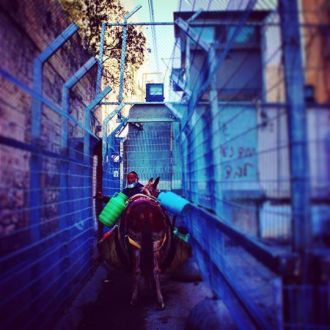 No one knows who is responsible for the burning of the checkpoint, and Israeli forces have not released footage.
Leading onto the small section of Shuhada Street on which Palestinians are allowed to walk, checkpoint 56 connects Bab iZaweyya, the commercial district in Palestinian Authority-governed H1, with the neighbourhood of Tel Rumeida in Israeli-controlled H2.
Checkpoint closure here demands that families living in Tel Rumeida and school children and teachers from the Qurtuba School walk an extra hour or that they walk a difficult route through the homes and gardens of other Palestinians to reach their homes. For the past week, Israeli soldiers and border police have permitted elderly people, teachers, children and ill people seeking medical treatment to pass the checkpoint.
When CPTers arrived at 11:00 a.m. on 12 December, one 60-year-old doctor told them that he had been at the checkpoint for two hours.
CPTers, ISMers, and those wishing to pass through the checkpoint, attempted to ascertain the reasoning behind this change, which was subjecting teachers leaving work, and older people of varying physical abilities to stand in the sun for hours. CPT and ISM stood in solidarity with the affected Palestinians and joined them in negotiating with soldiers to reopen the checkpoint.
At about 12:00 p.m., soldiers allowed individuals through the checkpoint one by one until approximately twenty minutes later when an elderly man arrived with a donkey, which initiated another arbitrary change in the ‘rules’ of occupation. The Israeli military again closed the checkpoint, and CPT was unable to gain an answer from the soldiers as to why this donkey appeared to necessitate another closure.
Justice for Eric Garner? From the Justice Department? Don’t Hold Your Breath
By Mark P. Fancher | Black Agenda Report | December 10, 2014
When news broke of the grand jury’s refusal to indict Eric Garner’s killer, Spike Lee told CNN interviewers that because the death was video recorded he remains hopeful that the U.S. Department of Justice investigation will produce the results thousands of protesters crave. Based on the Justice Department’s record, it is probably a vain hope.
The Garner killing is not the first one to be captured by cameras. The Justice Department had access to a video record of the police firing squad execution of Milton Hall in Saginaw, Michigan, but no charges were brought against the cops who shot 46 bullets at the 49-year-old homeless black man. The reason? In a statement, the Justice Department’s Civil Rights Division said: “…this tragic event does not present sufficient evidence of willful misconduct to give rise to a federal criminal prosecution of the police officers involved.”
Few who watch the police cruiser dashboard camera footage of the killing reach the same conclusion. That video is probably the best indication that if the Justice Department believes the evidence against Milton Hall’s killers is insufficient, then the bar is so high that there is no case that is likely to qualify for prosecution – including Eric Garner’s killing. While it is possible that public pressure might force Eric Holder to handle the Garner case differently, some legal analysts discount that possibility because they have bought into the Justice Department’s inaccurate and incomplete interpretation of the applicable federal law.
The law that authorizes federal criminal civil rights charges against police officers says that in a homicide case like Eric Garner’s or Milton Hall’s, a police officer can be guilty only if he not only violated the victim’s Fourth Amendment right to be free from excessive force, but the officer also “willfully” violated that right. In its explanation of why Milton Hall’s killers were not prosecuted, the Justice Department said: “Law enforcement actions based on fear, panic, misperception or even poor judgment do not constitute willful conduct prosecutable under the statute.” Implied in that statement is the belief that it would not be possible to get into the heads of the officers and extract private thoughts that might betray their intent to “willfully” violate a constitutional right.
To the great disappointment of those outraged by Milton Hall’s death, the Justice Department conveniently ignored what the courts have had to say about the “willfulness” requirement. Starting with the U.S. Supreme Court and ending with the Sixth Circuit Court of Appeals (which has jurisdiction over Milton Hall’s hometown) the courts have made it clear that the Justice Department is not required to engage in mind reading in order to hold the police accountable.
The Supreme Court said: “[t]he fact that the defendants may not have been thinking in constitutional terms is not material” to whether they satisfy the willfulness requirement. The Sixth Circuit explained that a jury: “need not, in order to convict, determine that [the accused] actually knew that it was a Constitutional right that they were violating…”
Not only is it unnecessary to prove that an officer was thinking specifically of trying to violate a victim’s Fourth Amendment rights, but the Supreme Court took the additional step of providing a much easier way to charge and convict police who kill. The court said: “[to] act willfully in the sense in which we use the word [is to] act in open defiance or reckless disregard of a constitutional requirement…”
It is therefore hard to imagine why charges cannot be brought when police officers fire dozens of bullets at a homeless man armed only with a pen knife; or when police use a choke hold to put a submissive man on the ground because he was alleged to be engaged in unauthorized cigarette sales. By almost anyone’s reckoning, such conduct should be regarded as “open defiance” or “reckless disregard” for the constitutional rights of the victims.
Will the Justice Department’s investigation result in the criminal prosecution of Eric Garner’s killers? It’s possible, but don’t hold your breath. With each new incident of unpunished police violence, it becomes more likely that concerned observers will conclude that African people born or living in America have no rights that the Justice Department is bound to respect.
Mark P. Fancher is the staff attorney for the ACLU of Michigan Racial Justice Project, which pursues justice for Milton Hall. He is also a member of the National Conference of Black Lawyers. He can be contacted at mfancher@comcast.net.
Israel resumes building museum on Muslim cemetery
Ma’an – 10/12/2014
JERUSALEM – Israeli authorities have resumed excavations in Mamilla graveyard in West Jerusalem as part of the “Museum of Tolerance” project, a local committee said Tuesday.
The head of the Islamic cemeteries preservation committee, Mustafa Abu Zahra, said large machinery was placed in the cemetery. It poured reinforced concrete in preparation for the building of the structure of the museum.
Abu Zahra added that the structure is scheduled to be built over the “remains of icons, martyrs, grandparents and parents,” and he said that the project is being implemented by a California-based center in cooperation with the Jerusalem municipality and other Israeli departments.
The project was started by the Simon Wiesenthal Center in 2001, and 12 dunams of the cemetery ground were seized including 70 percent which was transformed into “Independence Park,” he explained.
Abu Zahra said that the construction was a grave assault on Muslim heritage and history.
Journalist most recent victim of Israeli military violence at Kufr Qaddum
International Solidarity Movement | December 9, 2014
Kufr Qaddum, Occupied Palestine – Bashar, a journalist from Palestine TV, was shot in the left leg at Kufr Qaddum on Friday the 5th of December 2014.
The weekly demonstration aims to highlight the issue of the road that has been closed to Kafr Qaddum and demands for it to be reopened. The road is closed to Palestinians but connects several illegal Israeli settlements nearby. The road was once the Palestinians’ main route to the villages of Jit and Sarra, and to the city of Nablus. Residents of Kafr Qaddum and nearby villages must now use a 14 kilometer detour on badly paved roads through olive groves. This proves especially problematic in emergency situations when ambulances are trying to get patients to Nablus hospital. Kafr Qaddum villagers state that several people have died because of the longer ambulance trip.
Bashar has been going to the Kafr Qaddum demonstrations since they began four years ago. This particular one was a special demonstration in solidarity with Patrick, an Italian activist who was shot in the chest with a .22 caliber bullet the Friday before. The demonstration began peacefully with people holding Italian and Palestinian flags. A skunk water truck, a renowned demonstration repression technique, sprayed the people who were peacefully holding flags right at the beginning of the protest. Within ten minutes, Bashar had been shot in his left leg by an Israeli sniper.
The bullet used to shoot Bashar was an expanding bullet, often called a “dum-dum”. International law has declared their use illegal in war because they are so destructive. Bashar was shot by a sniper with a weapon that is only supposed to be used when soldiers are at mortal risk and skunk water, tear gas, rubber bullets, rubber coated steel bullets, and other nonlethal weapons have all proved ineffective. This is supposed to be the last weapon soldiers use before they shoot to kill with M16s. Witnesses say that Bashar was filming as he usually did when he was shot. He was no threat to the soldiers at all. Witnesses say that there were no people in front or behind him throwing stones.
Bashar was taken by ambulance to Nablus hospital. The X-ray showed that the dum-dum bullet did as it was designed to, breaking into many pieces when it entered his leg.

Bashar had an operation on the 6th of December, the day after he was shot, to take out most of the bullet fragments.
Doctors have decided to leavein some pieces for the time being because they are very close to veins and would be dangerous to remove. Bashar will be bed bound for two weeks until the decision is made, but his condition remains stable.
Within one week at Kufr Qaddum, three people were shot with lethal, live ammunition—two with .22 caliber bullets and one with a dum-dum. One was a journalist, another an international peace activist. None of them were any threat to the soldiers. So why, then, were they shot at? To create fear for all the people who are in solidarity with the Palestinians and who want to tell the world the story of what is happening here? To physically stop peaceful resistance using the most extreme repression techniques?
It will not work. Patrick and many other international, Palestinian and Israeli activists will continue to nonviolently resist the confiscation of their lands in Kufr Qaddum each week. Bashar will continue to report their stories to the world. The unnecessary use of violent repression techniques will only continue to delegitimize the illegal occupation of the Palestinian people.
Israeli settlers stab Palestinian youth on his family’s land
CPTnet | December 9, 2014
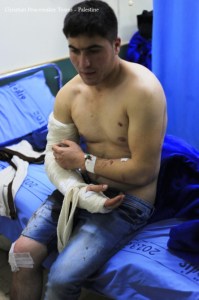 On 8 December 2014, Israeli settlers attacked seventeen-year-old Palestinian boy, Moad Al Rajabi on his family land in Bani Naim, on the outskirts of Al-Khalil/Hebron. He was sitting with his father, Noah Al Rajabi, and two of his cousins when settler cars stopped nearby. As seven settlers exited the cars and came towards them, Noah ran away with his two nephews, believing that his son was also with him. He soon realised his son was not there, and turned to see seventeen-year-old Moad encircled by the settlers.
The seven were stabbing Moad, but fled as Noah ran back in a bid to rescue his son from the assault. Moad required hospitalization to treat the stab wounds, one of which penetrated to the bones in the hand; the other was on his thigh. He is now stable, and the hospital hopes to discharge him later today.
The Al Rajabi family has also suffered the violence of home demolition and the destruction of their livelihood by the Israeli military. In May 2012, Israeli forces destroyed the family’s dairy farm and home, which was on the land where Moad was stabbed yesterday. Commenting on the destruction of the caravan (mobile home) in which the family lived, an iron barn stabling cows, milking machines and other equipment worth over 8000 USD, Noah explained that the Israeli army not “only destroy[ed] my livelihood but also the livelihoods of three other families; our farm is our bread and butter.” The Al Rajabi family has continued to have financial difficulties ever since the demolition.
More young men and teenagers arrested by the Israeli military
International Solidarity Movement | December 9, 2014
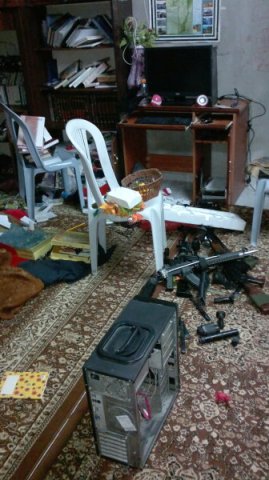 Nablus, Occupied Palestine – On December 8th in Nablus, the Israeli army broke into the homes of two families in Balata refugee camp and arrested two young Palestinians, 19-year-old Mujahed al Shekhalil and 17-year-old Yazan Hta.
In both cases, their homes were raised by the military in the middle of the night (3am and 3:30am) damaging doors and property inside the houses. At the time of the incursions, all family members were sleeping. The military forced all family members into one room whilst they arrested the teenagers. Both families state that between 15 and 20 soldiers broke into their homes, and they were given no reason for either the intrusions or the arrests.
In the village of Madama, on the same night, the Israeli army also entered the home of the Wajeihqut family and arrested 23-year-old Assad Allah. The army spent an hour inside the house between 2:20am and 3:20am, again forcing all family members inside one room. The family reported to ISM that the soldiers told Assad’s 9-year-old brother that if he did not stop speaking they would take him with his brother. Another brother was told that if he did not go into the room with the family then they would cut his head off.
The army confiscated every family members phone and stole the sim cards from them and the hard drive from the family computer. They also smashed the apartments heating system.
This was the fifth time Assad has been arrested and the family home has been raided by the army on numerous occasions.
In all cases, the families were not given a reason for the arrests or for the damage done to their homes, and do not have any information as to where their sons have been taken.
Photo by ISM
No Exit in Gaza
By Jen Marlowe | TomDispatch | December 7, 2014
Rubble. That’s been the one constant for the Awajah family for as long as I’ve known them.
Four months ago, their home was demolished by the Israeli military — and it wasn’t the first time that Kamal, Wafaa, and their children had been through this. For the last six years, the family has found itself trapped in a cycle of destruction and reconstruction; their home either a tangle of shattered concrete and twisted re-bar or about to become one.
I first met the Awajah family in August 2009, in the tent where they were living. I filmed them as they told me what had happened to them eight months earlier during the military invasion that Israel called Operation Cast Lead and said was a response to rocket fire from the Gaza Strip.
I had no intention of making a film when I went to Gaza, but after hearing the family’s story, I knew I had to. I returned again in 2012 and have continued to stay in touch in the years since, realizing that the plight of the Awajahs opened a window onto what an entire society was facing, onto what it’s like to live with an interminable war and constant fear. The Awajahs’ story shines a spotlight on what Palestinians in Gaza have endured for years on end.
What stuck with me most, however, was the demand of the Awajah children regarding the reconstruction of their new home in 2012: they insisted that the house have two doors.
What The Awajahs Saw
In separate interviews in 2009, Wafaa and Kamal Awajah told me the same story, each breaking down in tears as they offered me their memories of the traumatic events that had taken place eight months earlier — a night when they lost far more than a home. The next day, a still grief-stricken Wafaa walked me through her recollections of that night, pointing out the spot where each incident had taken place.
On January 4th, as Operation Cast Lead’s ground campaign began, the Awajah family was at home. Wafaa’s eldest daughter, 12-year-old Omsiyat, woke her up at around 2 am. “Mom,” said Omsiyat, “soldiers are at the door.” Wafaa jumped out of bed to look. “There are no soldiers at the door, honey,” she reassured her daughter. When Omsiyat insisted, Wafaa looked again, and this time she spotted the soldiers and tanks. She lit candles in the window so that the Israeli troops would know that a family was inside.
Suddenly, the ceiling began to crumble. Wafaa, Kamal, and their six children fled, as an Israeli military bulldozer razed their home. No sooner had they made it outside than the roof collapsed. As tank after tank rolled by, the family huddled under an olive tree next to the house. When dawn finally broke, they could examine the ruins of their house.
Just as the Awajahs were trying to absorb their loss, Wafaa heard nine-year-old Ibrahim scream. He had been shot in the side. As more gunfire rang out, Kamal scooped up the injured boy and ran for cover with the rest of the family. Wafaa was hit in both hips, but she and five of the children managed to take shelter behind a mud-brick wall. From there, she saw Kamal, also wounded, lying in the middle of the road, Ibrahim still in his arms.
Israeli soldiers approached her husband and son on foot, while Wafaa watched, and — according to what she and Kamal both told me — without warning, one of them shot Ibrahim at close range, killing him. He may have assumed that Kamal was already dead. Despite Wafaa and Kamal’s wounds, the family managed to get back to their wrecked home, where they hid under the collapsed roof for four days with no food or clean water, until a passing family with a donkey cart took them and Ibrahim’s body to a hospital in Gaza city.
As far as I know, the Israeli military never investigated the incident. In fact, only a handful of possible war crimes during Operation Cast Lead were ever investigated by Israel. Instead of an official inquiry, the Awajahs were left with a dead son, grievous physical wounds that eventually healed, psychological ones that never will, and a home reduced to pile of rubble.
One Family in Gaza, Jen Marlowe’s award-winning short documentary film featuring the Awajah family
(You may also click here to view the video on Vimeo if your browser is having trouble loading the video on this page.)
Life Goes On
When I met them eight months later, the Awajahs were struggling to rebuild their lives. “What’s hardest is how to offer safety and security for my children,” Kamal told me. “Their behaviors are not the same as before.”
Wafaa pointed to three-year-old Diyaa. “This boy is traumatized since the war,” she said. “He sleeps with a loaf of bread in his arms. If you try to take it from him, he wakes up, hugs it, and says, ‘It’s mine.’”
“What you can’t remove or change is the fear in the children’s eyes,” Kamal continued. “If Diyaa sees a bulldozer, he thinks it’s coming to destroy a house. If he sees a soldier, whether an Israeli or Arab soldier, he thinks the soldier wants to kill him. I try to keep them away from violence, but what he experienced forces him to release his fear with violence. When he kisses you, you can feel violence in his kiss. He kisses you and then pushes you away. He might punch or slap you. I am against violence and war in any form. I support peaceful ways. That’s how I live and raise my children. Of course, I try to keep my children from violence, and help them forget what happened to them, but I can’t erase it from their memory. The memories of fear are engraved in their blood.”
I thought about Kamal’s words as I filmed Diyaa and his five-year-old sister Hala scrambling onto the rubble of their destroyed home — their only playground — squealing with glee as they rolled bullet casings and shrapnel down the collapsed roof.
What moved me deeply was the determination of Kamal and Wafaa to create a future for their surviving children. “Yes, my home was destroyed, my life was destroyed, but this didn’t destroy what’s inside me,” Kamal said. “It didn’t kill me as Kamal. It didn’t kill us as a family. We’re living. After all, we must continue living. It’s not the life we wanted, or had, but I try to provide for my children what I can.”
The Fragility of Hope
In 2012, I returned to Gaza and to the tent in which the Awajah family was still living. It was evident that the trauma of their experience in 2009 — along with the daily deprivation and lack of security and freedom that characterize Gaza under siege — had taken a toll. “I had thought that those were the most difficult days of my life,” Kamal said, “but I discovered afterwards that the days which followed were even more difficult.”
In 2009, Kamal told me that the war hadn’t fundamentally changed him. Now, he simply said, “I lost myself. The Kamal before the war does not exist today.” He spoke of the screams of his children, waking regularly from nightmares. “The war is still chasing them in their dreams.”
Most painful for Kamal was his inability to help his children heal. His despair and feelings of helplessness had grown to the point where he had become paralyzed with severe depression. “I tried and I still try to get us out of the situation we are in — the social situation, the educational situation for the children, and the mental situation for me and my family.” But their situation, he added, kept getting worse.
My 2012 visit, however, came during a rare moment of hope. After nearly four years, the Awajah family was finally rebuilding their home. Trucks were delivering bags of cement; gravel-filled wheelbarrows were being pushed onto skids; wooden planks were being hammered down. In 2009, I had filmed Diyaa and Hala playing on the rubble of their destroyed house. In 2012, I filmed them climbing and jumping on the foundation of their new home.
“I am building a house. It is my right in life for my children to have a house,” Kamal said. “I call it my dream house, because I dream that my children will go back to being themselves. It will be the first step to shelter me and my children, away from the sun and the heat and tents, our homelessness. The biggest hope and the biggest happiness I have is when I see my children smiling and comfortable… when they sleep without nightmares.” Kamal added, “I can’t sleep because of my fear over them.”
For Wafaa, while the new home represented hope for their future, its construction also triggered flashbacks to that night of the bulldozer. As she told me, “Bulldozers and trucks bringing construction material came at night, and, at that moment, it was war again. When I saw the bulldozers and the trucks approaching with big lights, my heart fell between my feet. I was truly scared.”
Planning for the new house also provided Wafaa and Kamal with a poignant reminder of the fragility of hope in Gaza. “The children say to make two doors to the house,” Wafaa told me. “One [regular] door and the other door so when the Israelis demolish the house, we can use it to escape. We try to comfort them and tell them nothing like this will happen, but no, they insist on us making two doors. ‘Two doors, Daddy, one here and one there, so that we can run away.’”
The Gaza War of 2014
After my 2012 visit, I periodically contacted the Awajah family. Construction was proceeding in fits and starts, Kamal told me, due to shortages of materials in Gaza and their lack of financial resources. Finally, however, in the middle of 2013 the home was completed and as the final step, glass for the windows was installed in February 2014.
Five months later, in July, the most recent Israeli assault on Gaza began. I called the Awajah family right away.
“The children are frightened but okay,” Wafaa told me.
The Israeli army had warned their neighborhood to evacuate and they were now renting a small apartment in Gaza City. During a humanitarian ceasefire, Kamal was able to return to their house: it had been demolished along with the entire neighborhood.
When I spoke to the Awajah family at the end of September, Kamal told me that rent money had run out. Seeking shelter at a United Nations Relief and Works Agency (UNRWA) school wasn’t a viable option, he said, because there were already so many families packed into each room. The Awajahs were back in a tent next to the rubble of their twice-destroyed home.
Click here to see a larger version

2014: Kamal and his children on the rubble of their twice-destroyed home
The family’s situation is far bleaker than in 2009. Then they were able to tap into an electricity source and there was a communal outhouse for all the tent-dwelling families in the area. This time, Kamal said, the area near their house was entirely deserted: no water tank, electricity, outhouse, gas, or stove for cooking. Their only possessions were the few items of clothing they managed to take with them when they fled. They were sleeping on the ground, he said, no mattresses or blankets to ward off the cold, only the nylon of the tent beneath them. The children had been walking several kilometers to fill jugs with water until villagers who lived nearby made their wells available for a few hours a day.
Wafaa told me that she was cooking on an open fire, using scrap wood scavenged from the remnants of her house. For the first week, the children returned home from school every day and, surrounded by nothing but rubble, began to cry. Seventeen-year-old Omsiyat briefly took the phone. Her typically warm and open voice was completely flat, no affect whatsoever.
Worse yet, Kamal still owes $3,700 for the construction of their previous house. Though the home no longer exists, the debt does. “We are drowning,” Wafaa said.
The Awajah family today
(You may also click here to view the video on Vimeo if your browser is having trouble loading the video on this page.)
Drowning in Gaza
The Awajahs aren’t the only ones in Gaza who are drowning. The true horror of their repeated trauma lies in the extent to which it is widespread and shared. Nine-year-old Ibrahim Awajah was one of 872 children in Gaza killed in the 2009, 2012, and 2014 wars combined, according to statistics gathered by the United Nations Office for the Coordination of Humanitarian Affairs and B’tselem, an Israeli human rights organization. (There was also one Israeli child killed by mortar fire in that period.)
The flat affect in Omsiyat’s voice reflects the assessment of the United Nations Children’s Fund that nearly half of the children in Gaza are in urgent need of psychological help. And Kamal’s desire not to move into a communal shelter is understandable, given that 53,869 displaced people still remain crowded into 18 UNWRA schools. According to Shelter Cluster, an inter-agency committee that supports shelter needs for people affected by conflict and natural disaster, the Awajah family’s house is one of 18,080 homes in Gaza that were completely demolished or severely damaged in the 2014 war alone. A further 5,800 houses suffered significant damage, with 38,000 more sustaining some damage.
Shelter Cluster estimates that it will take 20 years for Gaza to be rebuilt — assuming that it does not face yet another devastating military operation. As the last six years indicate, however, unless there is meaningful political progress (namely, the ending of the Israeli siege and ongoing occupation), further hostilities are inevitable. It is not enough that people in Gaza be able to rebuild their houses yet again. They need the opportunity to rebuild their lives with dignity.
Kamal Awajah said as much. “I don’t ask anyone to build me a home for the sake of charity. That’s not the kind of help we want. We need the kind of help that raises our value as human beings. But how? That’s the question.”
There seem to be no serious efforts on the horizon to address Kamal’s question, which has at its core an insistence on recognizing the equal value of Palestinian humanity. As long as that question remains unanswered and the fundamental rights of Palestinians continue to be denied, the devastating impact of repeated war will continue for every family in Gaza and the terrifying threat of the next war will always loom. The Awajah children have every reason to insist that their future home be constructed with two doors.
Jen Marlowe is a human rights activist, author, documentary filmmaker, and founder of donkeysaddle projects. Her books include I Am Troy Davis and The Hour of Sunlight: One Palestinian’s Journey from Prisoner to Peacemaker. Her films include Witness Bahrain and One Family in Gaza. She blogs at View from the donkey’s saddle and tweets at @donkeysaddleorg.
Note: To help the Awajah family rebuild their home, Jen Marlowe set up an Indiegogo campaign on their behalf, which you can visit and share by clicking here.
Copyright 2014 Jen Marlowe
Another Witness in Michael Brown Shooting Found Dead
teleSUR | December 8, 2014
Another witness of the shooting of Michael Brown has been found dead in a dry channel near River Des Peres in Misssouri, local authorities confirmed.
The man has been identified as 23-year-old Shawn Gray, a black man who testified during the grand jury proceedings over the killing of Brown by former police officer Darren Wilson.
According to relatives and friends, Gray was last seen leaving a restaurant on Thanksgiving Day. The manner and cause of his death are pending autopsy results. However, his family is demanding answers and say the death could have been premeditated murder.
Another witness DeAndre Joshua, also a young black man, was found shot dead and his car was torched outside the same neighborhood where Brown was killed.
Two witnesses of the Brown shooting have now been found dead under suspicious circumstances, while local authorities have not announced any leads in either case, and the press has provided minimal coverage.
The police murders of black young men in recent months has provided a stark reminder to the world of the harsh reality faced by many black communities in the United States. Their deaths exposed the continued persecution of black people.
Mass protests against these injustices have taken place across the country. Protesters are demanding justice for black lives lost at the hands of state sanctioned violence, with over 100 days of peaceful protest ranging from #HandsUpWalkOut and solidarity days with Ferguson.
See a collection of teleSUR analysis, video, and news pieces on the issue of, and resistance to police racism in the United States.
Featured Video

or go to
Aletho News Archives – Video-Images
New Documentary
“Inside Gaza” wins best documentary at Montreal’s Cinemania film festival
Palestine Information Center – November 16, 2026
MONTREAL – The documentary “Inside Gaza,” which chronicles the experiences of Palestinian journalists working with Agence France-Presse (AFP) while covering the Israeli war on the Gaza Strip, won the Best Documentary Award at the 32nd Cinemania International Francophone Film Festival held in Montreal, Canada.
Directed by Helene Lam Trong, the 72-minute film follows the daily lives of four AFP journalists who bear witness to the difficulties of reporting in a war-torn territory largely closed off to international media.
The film is compiled from material produced by the team on the ground, as well as from interviews conducted after they left.
The film also won the People’s Choice Award at the festival on Saturday. … continue
Blog Roll
 Aletho News
- How The Jensen Huang Chinese Spy Hoax Is Russiagate 2.0
- Austria seeks to strip former foreign minister of citizenship over Russia ties
- “Inside Gaza” wins best documentary at Montreal’s Cinemania film festival
- Activists block German munitions plant over arms exports to ‘Israel’
- The Nasser Hospital attack and Israel’s relentless lies
- Could it be satan? No, Huckabee, just the Americans you work for
- AIPAC and more: Network of pro-Israel influence in US Congress
- Putin aide reveals Moscow’s stance on Europe at peace talks
- Imran Khan warns Pakistani judges he may die in prison
- IOF used Amazon facial recognition to track millions of Palestinians
- If Americans Knew
- An error has occurred; the feed is probably down. Try again later.
- No Tricks Zone
- Argentina’s Perito Moreno Glacier Joins Antarctica and Arctic In Defying Doomsday Melt Claims
- New Study: Barents Sea Temperatures Were Warmer And Sea Ice Less Extensive In The 1700s Than Today
- German Authorities Start Initiative To Evaluate Public Register For Climate “Disinformation” Spreaders!
- Zonal Asymmetry of Temperature Change in the Antarctic Circumpolar Current
- New Study: The Net Fossil Fuel Contribution To Rising Atmospheric CO2 Has Been Zero For 500 Years
- Germany’s Green Energy Transition Becoming Increasingly Expensive…Another 6 Trillion Euros!
- Sudden Stratospheric Warming, Powerful El Niño Combination May Lead To Extreme Europe Cold, Energy Crisis!
- Two New Studies Find Thwaites Glacier Melt Cannot Be Driven By Human Activity Or A Warming Ocean
- E-Cars Reduce CO2 Emissions By Only 41% Compared To Internal Combustion Engine Vehicles
- Predictions Made By Renowned Climate Professor Over Past Decades Have Been Proven To Be Poor

