The Silence of the Israelis on ISIS
By Stephen J. Sniegoski | Consortium News | November 5, 2014
In the war on the Islamic State, the alleged scourge of humanity, little is heard about the position of America’s much-ballyhooed greatest ally in the Middle East, if not the world, Israel. Now the Islamic State has been conquering territory in very close proximity to the border of Israel. But Israel does not seem to be fearful and it is not taking any action.
And the Obama administration and American media pundits do not seem to be the least bit disturbed. This is quite in contrast to the complaints about other Middle East countries such as Turkey that are being harshly criticized for their failure to become actively involved in fighting the Islamic State.
For example, a New York Times editorial, “Mr. Erdogan’s Dangerous Game,” begins, “Turkey’s president, Recep Tayyip Erdogan, once aspired to lead the Muslim world. At this time of regional crisis, he has been anything but a leader. Turkish troops and tanks have been standing passively behind a chicken-wire border fence while a mile away in Syria, Islamic extremists are besieging the town of Kobani and its Kurdish population.”
An article in the Boston Globe read “Turkey has failed Kobani, Kurds.” An editorial in the USA Today was titled “Turkey waits as ISIL crushes Kobani.”
Neocon Charles Krauthammer in “Erdogan’s Double Game” compared Turkey’s failure to come to the defense of the Kurds in the surrounded border town of Kobani to Stalin’s unwillingness to aid the uprising of Polish nationalist forces in Warsaw in 1944, thus allowing the latter’s destruction at the hands of the Nazis.
“For almost a month, Kobani Kurds have been trying to hold off Islamic State fighters,” Krauthammer wrote. “Outgunned, outmanned, and surrounded on three sides, the defending Kurds have begged Turkey to allow weapons and reinforcements through the border. Erdogan has refused even that, let alone intervening directly.”
Even the normally antiwar Noam Chomsky expressed support for protecting the Kurds. “With regard to Kobani, it is a shocking situation,” Chomsky opined. “This morning’s newspaper described Turkish military operation against Kurds in Turkey, not against ISIS, a couple of kilometers across the border where they are in danger of being slaughtered. I think something should be done at the UN in terms of a strong resolution to call for a ceasefire.”
“It is hard to impose the use of force,” Chomsky continued, “but to the extent that it can be done try and protect Kobani from destruction at the hands of ISIS, which could be a major massacre with enormous consequences.” Chomsky added that “the strategic significance of the town in the Kurdish region is pretty obvious, and the Turkish role is critical in this.”
Israel’s Reticence
Returning to the issue of Israel, the fact of the matter is that Israel acts to protect its own national interests. At the current time, the primary goal of the Islamic State is to purify Islam rather than attack non-Muslims.
In response to Internet queries as to why the militant group wasn’t fighting Israel instead of killing Muslims in Iraq and Syria, its representatives responded: “We haven’t given orders to kill the Israelis and the Jews. The war against the nearer enemy, those who rebel against the faith, is more important. Allah commands us in the Koran to fight the hypocrites, because they are much more dangerous than those who are fundamentally heretics.”
As justification for this stance, the group cited the position of the first caliph, Abu Bakr, who began his caliphate by fighting against those he deemed apostates who still professed to be followers of Islam. (Shiites hold a negative view of Abu Bakr and his policies). Also cited was Saladin, who fought the Shiites in Egypt before conquering Christian-controlled Jerusalem.
Considering the Islamic State is targeting Muslims, the Israeli government does not see it as a significant enemy at this time. And it is reasonable for Israeli leaders to believe that the Islamic State would never move on to attack their country because it will never be able to conquer its major Islamic foes, though American military involvement would further secure Israel from any possible threat from the Islamic State.
Moreover, the fact of the matter is that the Islamic State actually benefits Israel by causing problems for those very states that do actively oppose Israel and support the Palestinians, such as Syria. What the Islamic State is causing in the Middle East is perfectly attuned with the view of the Israeli Right — as best articulated by Oded Yinon in 1982 — which sought to have Israel’s Middle East enemies fragmented and fighting among themselves in order to weaken the external threat to Israel.
Currently, these divisions are not only plaguing Syria and Iraq, but also Turkey, where ethnic Kurds are rioting because of the government’s unwillingness to help their brethren in Syria, and Lebanon, where the Shiite group Hezbollah — allied with Iran, Israel’s foremost enemy — is being assailed by the radical jihadist Nusra Front, which has the support of many Lebanese Sunnis. [See Jonathan Spyer, “The Shia-Sunni War Reaches Lebanon,” Jerusalem Post, Middle East Forum, Oct. 17, 2014.]
More than this, the Netanyahu government is trying to take advantage of the Islamic State’s aggression by falsely claiming that Hamas is its equivalent. In an address to the UN General Assembly on Sept. 29, Netanyahu asserted that “Hamas’s immediate goal is to destroy Israel. But Hamas has a broader objective. They also want a caliphate. Hamas shares the global ambitions of its fellow militant Islamists.”
Thus, Netanyahu claimed that it is wrong for countries to criticize Israel’s brutal treatment of the Palestinians in its conflict with Hamas, pointing out that “the same countries that now support confronting ISIS, opposed Israel for confronting Hamas. They evidently don’t understand that ISIS and Hamas are branches of the same poisonous tree. ISIS and Hamas share a fanatical creed, which they both seek to impose well beyond the territory under their control.”
In short, Netanyahu maintained that the Islamic State and Hamas were essentially identical, “when it comes to their ultimate goals, Hamas is ISIS and ISIS is Hamas.”
National Interest
Now there is nothing strange about Israel’s position here. It is simply acting in its own national interest. There is no reason to fight a group that doesn’t threaten it. Furthermore, it is in Israel’s interest to try to make it appear that it is acting for the good of all humanity when attacking Hamas, and though these arguments are unlikely to sway any UN members, the prime minister did provide ammunition to the Israel lobby and its supporters that could be used to persuade some gullible Americans.
It can be argued that if Israel openly entered the fray as a member of the anti-Islamic State coalition, it would be counterproductive. Since many Arabs see Israel as their major enemy, Israel’s involvement in the war would turn them against fighting the Islamic State and maybe even cause some of them to support that militant jihadist group as an enemy of Israel.
So it might be understandable that the United States would not demand that Israel participate in the war against the Islamic State, just as it did not expect Israel to fight against Saddam Hussein. Although this might be understandable, if true it would mean that Israel could not really be an ally of the United States in the Middle East because it could not participate in America’s wars in the region, which is the very raison d’état of an ally.
Conceivably, Israel could covertly support the enemies of Islamic State. Israel has been doing just that in regard to Syria. During the past two years it has launched airstrikes against Assad’s forces which has helped the rebels. Israel takes the position that any attacks on its territory from Syria are the responsibility of the Assad government even if they are made by the rebels.
Moreover, just like the United States, Israel has provided training for Syrian rebels. For example, Abdul-Ilah al-Bashir al-Noeimi, currently the Chief of Staff of the Supreme Military Council (SMC) of the Free Syrian Army, secretly trained in Israel in 2013 after being admitted into the country for medical treatment. [See “Report: Commander of Syrian Rebels Trained in Israel, Jewish Press News Briefs,” Feb. 24, 2014. In regard to Israeli participation in training Syrian rebels, see: Jason Ditz, “Report Claims US, Israeli Trained Rebels Moving Toward Damascus,” Antiwar.com, Aug. 25, 2013,; Jinan Mantash, “Israeli analyst confirms link between Israel, ‘moderate’ Syrian rebels,” Alakbar English, Oct. 17, 2014.]
Staying Out of the Fray
Israel’s pro-rebel activities in the Syrian conflict have not been counterproductive in that they have not caused any of Assad’s many Arab enemies to abandon their effort to remove his regime. But it is not apparent that Israel is taking any steps like this regarding the Islamic State, and the United States does not seem to be pressuring it to do so.
What this means is that Israel is not really any type of ally of the United States. It does not bend its foreign policy to aid the United States but only acts in its own interest. It takes actions against the Assad regime because the latter is an ally of Iran and provides a conduit for weapons being sent to Israeli’s enemy Hezbollah.
Israel’s inaction toward the Islamic State, despite its close proximity, should actually provide a model for the United States to emulate. It shows that the Islamic State should not be regarded as a threat to the faraway United States. And this lesson is further confirmed by the fact that the nearby Islamic countries, which should be far more endangered than the United States, do not seem to be fighting hard against it. It would seem that the fundamental way for the United States to face significant attacks from the Islamic State is to attack it first, which is exactly what it is now doing.
Considering Israel’s inactivity, it is ironic that in the United States it is the supporters of Israel, such as the neoconservatives, who have taken the lead in pushing for a hard-line American military position against the Islamic State. [See Jim Lobe, “Project for a New American Imbroglio,” LobeLog Foreign Policy, Aug. 28, 2014.]
Neocon Max Boot, for example, wrote about the need for “a politico-military strategy to annihilate ISIS rather than simply chip around the edges of its burgeoning empire,” which would “require a commitment of some 10,000 U.S. advisors and Special Operators, along with enhanced air power, to work with moderate elements in both Iraq and Syria.”
Fred and Kimberly Kagan have developed a strategic plan involving up to 25,000 American ground troops to combat the Islamic State, which I have already discussed at length. Some of the other noted members of the neocon war-on-the-Islamic-State chorus include Bill Kristol, John Podhoretz, Dan Senor, David Brooks, John Bolton, Richard Perle, Danielle Pletka (vice president for foreign and defense policy studies at the American Enterprise Institute), and, as noted earlier, Charles Krauthammer.
Needless to say, neither the neocons, nor any other mainstream commentators for that matter, have uttered a word about Israel’s inaction. As Scott McConnell wrote in August in The American Conservative, “over the past two generations thousands of articles have been written proclaiming that Israel is a ‘vital strategic ally’ of the United States, our best and only friend in the ‘volatile’ Middle East. The claim is a commonplace among serving and aspiring Congressmen. I may have missed it, but has anyone seen a hint that our vital regional ally could be of any assistance at all in the supposedly civilizational battle against ISIS?”
However, it would be far wiser for the United States to follow the example of Israel here — and, in fact, always follow the example of Israel by adhering to national interest (that of the United States, of course, not Israel) — than to follow the advice of those American supporters of Israel who have, because of their influence on American Middle East policy, involved the United States in endless wars creating a regional environment beneficial to Israel from the perspective of the Israeli Right.
Al-Arabiya echoes Zionist rhetoric in reporting about al-Aqsa
By Zeinab Hawi | Al-Akhbar | November 6, 2014
It was rather normal for Al-Arabiya news channel to retract its story about the unprecedented closure of al-Aqsa Mosque on October 28. The channel may have thought that the terminology it used would go unnoticed. However, Al-Arabiya later deleted the story from its website after having caused an online backlash for echoing Zionist rhetoric.
In an act further promoting Zionist terminology, the Saudi news channel replaced al-Aqsa Mosque with the “the holy compound,” a term usually reserved for Zionists in their reference to the holy site.
In fact, Israel had closed the mosque following the shooting of hardline Rabbi Yehuda Glick [allegedly] by Palestinian Mutaz Hijazi, with Al-Arabiya reporting the news as, “A right-wing Israeli activist was shot and wounded last night as he left a conference promoting a campaign to permit both Jews and Muslims to pray at the holy compound.”
The channel, hence, adopted the terminology used by Zionists. This caused an angry backlash over social media websites, with activists accusing Al-Arabiya of committing “political and religious treason” by adhering to the “Zionist plan” to Judaize Palestine.
However, after thoroughly reading Al-Arabiya’s report, one would notice that the channel not only resorted to Zionist terms, but framed the story in a manner that reflected the channel’s policy that complies with Zionism. The term “occupation” did not appear, not even by chance, and the channel opted to use “Israeli police” instead. Moreover, the story depicted Jewish hardliners present at al-Aqsa on an equal footing with Palestinians.
The story was hence reported as follows, “the Israeli police closed the Noble Sanctuary… in a rare step aiming to prevent clashes between Muslims and Jews.”
The hardline rabbi who was calling to “open the doors of the Noble Sanctuary for Jews” and promoting “prayers that gather both Muslims and Jews” is for Al-Arabiya a simple “right- wing Israeli activist.”
The scandalous coverage did not stop there; it also “reassured” that the Palestinian shooter – “the sole suspect” in the incident – was shot and killed by a police special force unit at his house in Abu al-Thuri neighborhood in Jerusalem.
Al-Arabiya did not settle for such biased reporting, it also quoted the director of Shaare Zedek Medical Center as saying that the rabbi is in “critical but stable” condition and that he underwent surgery after being shot in the chest and abdomen.
The closure of the al-Aqsa Mosque apparently meant nothing for the Saudi channel. It was more interested in reassuring the public about the health of the injured Zionist and making sure that the shooter “got what he deserved.”
In the end, it is not merely about adopting the Zionist settlers’ policy to change the understanding of the issue and the terminology used to define it, but it is about adopting a process aimed at wiping out the cause of not just a people but an entire nation, which the Saudi channel and its affiliates are slowly paving the way for.
Israeli forces demolish three houses, and several water pipes and roads in village near Nablus
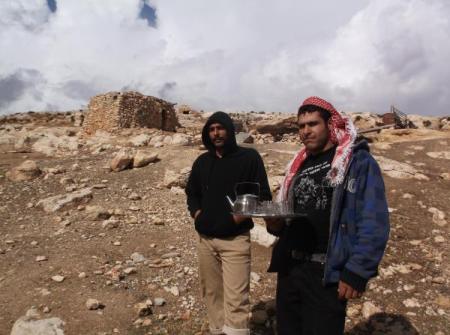
Sofian Maher and a local resident near their destroyed home near Khirbet Al-Tawil
International Solidarity Movement | November 4, 2014
Khirbet Al-Tawil, Occupied Palestine – Early on Monday morning, while the inhabitants of the village of Khirbet Al-Tawil, near Aqraba (Nablus), were sleeping, eight military vehicles, and 30-40 Israeli soldiers entered the village.
Within two hours the military had demolished three houses, and several water pipes and roads.
The water pipes destroyed were new and scheduled to be turned on Monday. The Aqraba community had funded these water pipes as part of the municipal water system.
Of their destruction, Sami Dariyah, stated: “They are trying to prevent people from living in this area. This is their clear policy.”
Due to the continuing demolition of houses, electricity lines, water lines and other living necessities, the farmers have fled to the city of Aqraba and departed their lands in Khirbet Al-Tawil. Sami Direyah grew up near Khirbet Al-Tawil and remembers the many houses and shops that used to be there.
Khirbet Al-Tawil is part of Area C (under full Israeli military civil and security control), which means the army can choose which buildings and activities are ‘allowed’. Sami wonders how their existing community, their farms and their 100-year-old houses, can suddenly become illegal.
Even though the three demolished houses were nearly 100 years old, dating back to the British occupation, they were all still active homes for families like the Mahers. The residents of the houses were not given any warning of the military’s planned visit. Sofian Maher, a former resident of one of these homes, spoke to ISM and explained that this is not the first time the military has paid a visit to Khirbet Al-Tawil. In May of this year the village’s Mosque was demolished, together with four houses, four cottages, and two barns. Less than one month ago the power line was cut by the military, leaving the village without electricity.
Sofian Maher explained to ISM that his family tried to rebuild their house after it was demolished in May. While rebuilding, Sofian’s family lived in a donated tent, which the army soon tore down. The family then moved into old stone huts that were built, long ago, to house animals while shepherding. Periodically the military returned and destroyed the newly rebuilt portions of their house.
The family is now trying to rebuild their home for the fourth time.
To further make the area uninhabitable, the military has destroyed large sections of the road leading to the remaining farms.
Gaza residents lose faith in international aid
MEMO | November 6, 2014
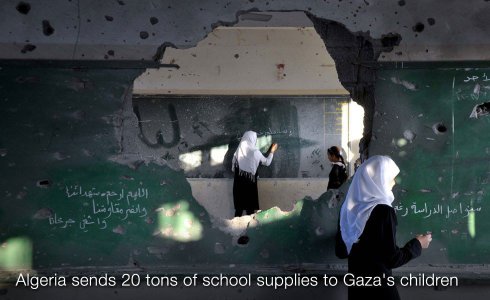
It has been more than three months since the end of the war on Gaza however Fadl Misbah, 41, is still living as others are, in a house which is covered in plastic sheets and which is not suitable for winter.
Fadl, whose family is made up of 13 members, said: “We are always subjected to extreme cold, and this is the case for most people whose homes were destroyed in the war. My children sit in this place and raindrops fall from the roof of the house which is made up of nylon sheets which do not protect us from the elements or the cold.”
“We have heard a lot about the donor conference to reconstruct Gaza, however they are working so slowly and we no longer believe what the international institutions are saying or what they are promising.”
“The occupation is the main problem; it allowed 440 tonnes of cement to enter Gaza 20 days ago during [UN Secretary-General] Ban Ki-moon’s visit to show a positive side to itself in front of the world, but after that it didn’t allow any more items into Gaza. Solving our problem will need contracts to be signed, and that’s if it is resolved at all,” Fadl said.
“International institutions have appealed to intervene and find a solution to this disaster, which hundreds of families whose homes were destroyed during the war on Gaza are now living through.
The West must be mobilise itself and not be satisfied by its silence. Those who call for human rights and advocate for it on behalf of those who are oppressed have exposed this world. It has no credibility.”
ICC: Israel Committed ‘War Crimes’ but It’s Not Our Problem
teleSUR | November 6, 2014
International Criminal Court (ICC) lawyers believe that Israel is guilty of “war crimes” for the raid on an aid ship bound for Gaza in 2010 that killed nine Turkish activists. However, they have also decided that the case does not meet their criteria for prosecution, according to court papers seen by Reuters on Wednesday.
On May 31, 2010, the Israeli military forcefully boarded six civilian ships from the “Gaza Freedom Flotilla” that were traveling from Turkey to deliver humanitarian aid and construction materials to the besieged region. The army boarded the ships in international waters in the Mediterranean Sea.
The activists on board say they did not put up a fight, however the Israeli army insists that they were met with resistance – which led to several activists being killed, including eight Turkish nationals and an American of Turkish origin on the Mavi Marmara boat.
The ICC does not have jurisdiction over crimes committed in either Turkey, where most the boats were registered, or Israel, since neither are members of the ICC. However, the Mavi Marmara was registered to the Comoros Islands, which is a member, making the crimes on board eligible for ICC investigation.
“The information available provides a reasonable basis to believe that war crimes under the Court’s jurisdiction have been committed in the context of interception and takeover of the Mavi Marmara by IDF (Israeli Defense Forces) soldiers on 31 May 2010,” read the papers.
But the papers also added that prosecutors had decided the crimes “were not of sufficient gravity to fall under the court’s jurisdiction,” reported Reuters. Their evidence and criteria for making this decision however, remained vague.
“Not having collected evidence itself, the Office’s analysis in this report must therefore not be considered to be the result of an investigation,” the paper read.
However, according to the ICC website, considering individuals guilty of war crimes does make them eligible to be tried under the ICC.
“The mandate of the Court is to try individuals rather than States, and to hold such persons accountable for the most serious crimes of concern to the international community as a whole, namely the crime of genocide, war crimes, crimes against humanity, and the crime of aggression…”
The Indian Ocean State, another ICC member, referred the raid to court, which obligated the ICC to begin preliminary examinations into the matter, according to their mandate.
“The Prosecutor’s decision marks the first time a State referral by an ICC States Party has ever been rejected by … Prosecutor without even initiating an investigation,” said lawyers Rodney Dixon and Geoffrey Nice in a statement.
“It confirms the view expressed by politicians, civil society organizations, NGOs and commentators from many quarters that Israel has a ‘special status,'” they added.
The report comes the same day that Bulent Yildirim, president of the Turkish NGO Humanitarian Relief Foundation (IHH) – one of the NGOs who organized the flotilla – praised the ICC, expecting that they would announce on Thursday that Israel is guilty of “war crimes.”
The ICC’s final decision is likely to anger other Turkish activists, but also Ankara who accused Israel of mass murder after the IDF attacked the flotilla.
An Overwhelming Majority of Lebanon’s Christians Believe Hizbullah Protects Their Country
By Anthony F. Shaker | Mittag’s Journal | October 26, 2014
A recent poll by the Beirut Center for Research and Information (BCRI) found that two thirds (62.6%) of Lebanese Christians feel that, contrary to its vilification by members of the NATO alliance, Hizbullah has in fact protected their country from its most determined enemies—Israel, IS (known locally as Da‘ash), and Wahhabi-style terrorist groups linked to the Syria-Iraq conflagration.
The poll revealed also that very few of the respondents prefer UNIFIL to Hizbullah on the front line with the terrorist groups, as some domestic and regional actors have insisted. Nor do they believe the claim that the foreign “coalition” presently targeting IS in Iraq and parts of Syria seeks to “destroy” IS, as President Obama and his allies have declared.
As many as 73.1% dismiss this view entirely, which comes in the wake of endless reports in the mainstream media worldwide and growing evidence regarding Saudi, Turkish, Qatari, Israeli and NATO collaboration with anti-Syrian terrorist fronts and organizations.
Although some have interpreted the survey results as indicative of a “significant increase” in favorable attitudes—at least compared to two similar surveys in June 2013 and February 2014—there is no history of enmity between the Christian and Muslims communities, much less with Shi‘i Muslims.
During a visit to France in 2011, Maronite Patriarch Beshara Boutros Rai defended the government of President Bashar al-Assad and criticized states that had begun supplying arms to the terrorists gathering in Syria. Again in 2013, he said, “There is a plan to destroy the Arab world for political and economic interests and boost interconfessional conflict between Sunnis and Shi’ites. Some Western and East powers are fomenting all these conflicts. We are seeing the total destruction of what Christians managed to build in 1,400 years,” referring to peaceful cohabitation and historically productive relationship with Muslims.
“I have written to the Holy Father twice to describe what is happening,“ he had added. “I appeal again to the Holy Father, who only talks about peace and reconciliation.”
Hizbullah, which solidified the resistance against the Israeli occupation of South Lebanon, began largely in the Shi’a community, but then quickly expanded ties with other communities and organizations across the country. Today, it identifies its primary interests with Lebanon and does not claim to act on behalf of Shi’a Muslims only.
Strictly speaking, Lebanon’s woes are not confessional, even if they fed on endless disputes over confessionally based electoral rules and representation.
That a Wahhabi terrorist claims to speak for “Sunnis” does not by itself make for a Sunni-Shi’a divide. Nor does it define the armed conflicts that have erupted since the West began to sponsor a massive armed campaign to destroy the Syrian government and state. Few people know that this sponsorship dates, not from 2011 (when the terrorist onslaught gained traction), but from the early 1990s, after Syria insisted that Israel declare its intention to return the Golan Heights during the ”peace“ negotiations phase, a demand Israel categorically refused at the time.
The “West” (essentially, the United States, United Kingdom and France) has blacklisted Hizbullah as a “terrorist” organization and for years fought hard to pin the Hariri assassination on it, which many now believe Israel carried out, possibly even at Saudi Arabia’s behest, nearly provoking another civil war.
Hizbullah officials have repeatedly warned that a “terrorist” listing is a “big mistake,” one that will further damage the West’s standing in the region. In fact, this is no longer in doubt, given NATO’s current desperate effort to insinuate itself back into Iraq and to intervene for the first time inside Syria itself. NATO now has no choice but to tolerate Iran’s determined assistance to Iraqi military and security forces. This tolerance naturally must now be extended to Syria, where Hizbullah aims to deal decisively with the terror emanating from the Gulf, Turkey and Israel before it overwhelms Lebanon too.
Clearly, the events surrounding the Syria conflict have thrown deep doubts on Western intentions—and competence—in the Middle East. For some time, these doubts have been seeping into Western policymaking circles, diplomatically around the world, and most tellingly, inside the intelligence communities themselves.
Years ago, under a previous government just before Canada put Hizbullah on the terrorism list, Canadian security analysts and some federal cabinet ministers had cautioned against such a blanket interdiction. The former Liberal government’s decision, it had transpired, was based in the ever-quaint Washington Times, which merely quoted a professor claiming that Hizbullah leader Hassan Nasrallah had issued a worldwide call for “a suicide bombing campaign”and “don’t be shy about it.”
The “professor’s” claim happens to be in keeping with the Mickey Mouse warnings that Israel has for years been dishing out to Western countries about the Lebanese resistance. Yet, suicide bombings then, as now, are the Wahhabi terrorists’ choicest method in asymmetric warfare, not Hizbullah’s.
Developments since then have shrunk Canada’s blacklisting of Hizbullah to insignificance as an issue. This is because Canada has lost most of its diplomatic influence thanks to the deeply ideological character and the arrogant style of Conservative Prime Minister Stephen Harper.
Many Canadians have questioned the wisdom of blacklisting a party with elected members in the Lebanese parliament and government cabinet. This year marks a new watershed: few either in Canada or in the West are sure any more which side they are on according to their government.
To the Christians of Lebanon, such hesitation would have been unthinkable for the fatal consequences it entailed for them and their country.
One can only recall with nostalgia Hillary Clinton’s shrill call with the Friends of Syria: “Mr. Putin, you are on the wrong side of history!”
Dr. Anthony F. Shaker is the editor-in-chief and founder of Mittags Journal and visiting scholar at McGill University; his published works and articles are in classical Islamic philosophy and history, as well as modern politics.
Dozens injured during Aqsa clashes, several detained
Ma’an – November 5, 2014
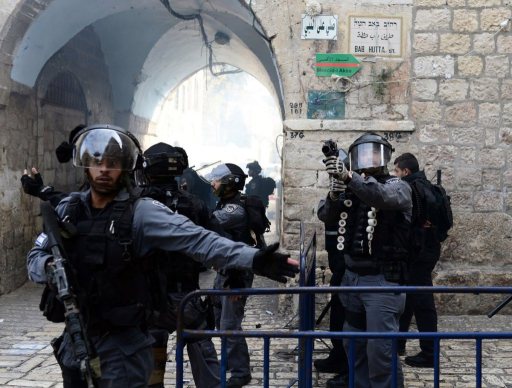
JERUSALEM – Dozens of Palestinians suffered tear-gas inhalation and several others were injured by stun grenades, shrapnel and rubber-coated steel bullets during clashes in the Al-Aqsa mosque compound area on Wednesday, an official said.
Palestinian Red Crescent official Amin Abu Ghazaleh told Ma’an that Red Crescent ambulances moved nine injured to the Al-Maqased Hospital where their injuries were reported as moderate.
Two were injured in the eye, and 32 with stun grenades, shrapnel and rubber-coated steel bullets in addition to many who suffered severe gas inhalation.
Three Palestinian members of Israel’s Knesset, Hanin Zoabi, Talab Abu Arrar and Ibrahim Sarsour, were able to enter the mosque during the closure and clashes.
Israeli soldiers neared the Al-Qabali mosque inside the compound as they fired stun grenades and tear-gas bombs inside, the director of the Al-Aqsa Mosque, Sheikh Omar al-Kiswani, said.
He said that a fire erupted inside the muezzin’s hall and cables and speakers were also burned and damaged.
Soldiers “deliberately” threw holy books on the floor, he alleged.
Israeli forces detained Tareq al-Hashlamon, an employee of the Islamic endowment department, after assaulting him inside Al-Aqsa, along with another endowment employee identified as Hussam Seder and three Palestinians.
Four Palestinians were also detained, one of them a minor. Two others were identified as Omar al-Kilani and Amin Qirsh.
Meanwhile, Jordan recalled its ambassador to Israel over the violence.
Jordanian Prime Minister Abdullah Nsur asked the foreign minister to “recall the Jordanian ambassador from Tel Aviv in protest at Israel’s escalation on the Al-Aqsa mosque compound,” the Petra news agency reported.
The clashes came amid continued tensions over right-wing Jewish demands to be able to pray inside the compound despite being off-limits in mainstream Judaism, in addition to the expansion of Israeli settlement building in Palestinian East Jerusalem.
Earlier, a police spokeswoman said that “Dozens of masked protesters threw stones and firecrackers at security forces who then entered the Temple Mount and pushed the demonstrators back inside the mosque.”
Israel guilty of war crimes over Turkish aid ship attack, ICC says
Al-Akhbar | November 5, 2014
Prosecutors of the International Criminal Court (ICC) at The Hague have told a Turkish organization that Israel is guilty of “war crimes” for attacking a Turkish aid ship for Gaza in 2010.
In May of that year, Israeli commandos killed nine peaceful activists, eight Turkish nationals and an American of Turkish origin, in international waters by using lethal force on the Mavi Marmara, a ship participating in a “Gaza Freedom Flotilla” carrying humanitarian aid and construction materials for Palestinians in the Gaza Strip, which was under a seven-year Israeli blockade at the time.
The Humanitarian Relief Foundation (IHH), a Turkish NGO, in a statement Tuesday said the prosecution team had finished its investigation in the Mavi Marmara case and concluded that Israel committed “war crimes.”
The aid ship Mavi Marmara belonged to the foundation, whose law committee had filed a petition at the court for a fair and speedy trial in the case. The court took up the petition in March 2014.
The 2010 incident caused international outrage and soured Turkish-Israeli ties.
In March 2014, Turkey received an apology from the Israeli government.
The two states are now looking to normalize their relations with a deal said to be involving compensation for the victims’ families.
The Palestinians have threatened to join the ICC to allow legal action to be taken against Israel.
Based in The Hague, the ICC opened its doors in 2003 and is the world’s first independent court set up to try the worst crimes, including genocide and war crimes.
In 2012, the Palestinians won the status of observer state in the United Nations, which gives them the ability to become a party to the ICC, where they could sue Israeli officials over alleged war crimes.
As neither Israel nor Palestine are ICC members, the court lacks jurisdiction over Gaza. This could be granted by a UN Security Council resolution, but Israel’s main ally, the United States, would probably veto any such proposal.
The overwhelming General Assembly vote recognizing the “non-member state” of Palestine was strongly opposed by the United States and Israel.
Membership of the ICC opens countries to investigations both on their behalf and against them. Several major powers, including the United States, as well as Israel, have declined to ratify the court’s founding treaty, the Rome Statute.
The Palestinians in 2009 and 2014 pushed the ICC’s prosecutor’s office to investigate alleged war crimes and crimes against humanity committed by the Israeli military in Gaza.
(Anadolu, Al-Akhbar)
A Brief History of US-Israel Relations
How Zionists Outmaneuvered and Replaced State Department Experts
By Amb. ANDREW I. KILLGORE | CounterPunch | November 4, 2014
Alison Weir writes at the beginning of her book, Against Our Better Judgment: The hidden history of how the U.S. was used to create Israel, that while many people are led to believe that U.S. support for Israel is driven by the American establishment and U.S. national interests, facts do not support that belief. The reality is that while for decades almost all U.S. experts opposed Israel and its founding, they were outmaneuvered and eventually replaced by Zionists.
Political Zionism started in the late 1800s as an international movement to establish a Jewish state somewhere in the world. By 1897 the movement was led by Austrian journalist Theodor Herzl, who convened the First Zionist World Congress in Basel, Switzerland the same year. U.S. Zionism began in the 1880s. The Board of Delegates of American Israelites was organized in 1861. The group was strong enough during the American Civil War to block an effort by the Union to declare America a Christian nation.
In 1887 President Grover Cleveland appointed a Jewish ambassador to Turkey, establishing a precedent for naming a Jew to that post for the next 30 years. This represented the growing power of the Zionist movement. But in 1912, when the Zionist Literary Society asked President William Taft for an endorsement, Secretary of State Philander Knox was able to thwart the effort. Knox argued that Zionism “related to the interests of countries other than our own.”
But after Knox, simply every American official has opposed Zionist efforts to involve the United States on the same grounds: the efforts are against the interests of the United States. The Zionists were and are aware of this, so they always resorted to secrecy to conceal their real aims.
In 1912 the prominent U.S. attorney Louis Brandeis became head of the Zionist Central office, which had moved from Berlin, Germany a little while before. Brandeis is better known as a Supreme Court Justice, but he played a sinister role in
 high Zionist affairs. He recruited young lawyers, particularly from Harvard, to work for the Zionist cause. He was a leader of a secret society called the Parushim to work for Zionism with all the outward appearance of simply a fraternal order. Each member took a practically blood oath to secretly work for Zionism.
When Brandeis was appointed to the Supreme Court by President Woodrow Wilson he officially resigned from all his clubs and affiliations. But this was only for show. Weir quotes historian/journalist Donald Neff: “Through his lieutenants he remained the power behind the throne. One of these lieutenants was the well-regarded Supreme Court Justice Felix Frankfurter, whose Zionist activities had largely gone unnoticed.”
Weir very astutely and brilliantly covers World War One and the Balfour Declaration (Britain promising to support a “national home” for Jews in Palestine). The Declaration was critical for Zionist success with the reason behind it, Zionism’s promise to work for the U.S. to enter the war on Britain’s side. Author Alison Weir writes that whether the Zionist role in getting America into the war was major, as the Zionists claim, and the British believed, is unclear.
In one of her quoted references Chaim Weizmann, who later became the first president of Israel, complains in his autobiography about the British/Zionist myth that he invented TNT, the reward for which was the Balfour Declaration. He said he did not invent the explosive. The origin of the TNT myth was an obvious attempt to cover up Britain’s real reason for issuing the declaration, which clearly was to get America into the war on Britain’s side, without which she would have lost the war.
Ms. Weir’s coverage of the 1919 Peace Conference in Paris is excellent. The Conference was rife with Zionists arguing for the Jewish state. The most prominent American opposing them was Dr. Howard Bliss, president of the Syrian Protestant College, later the American University of Beirut. President Wilson did send the King-Crane Commission to study what the Middle Easterners wanted. The two men found that the Arabs were utterly against the “national home” idea. It was clear that the Jewish representatives wanted a nearly complete dispossession of the Palestinians and that armed force would be required to carry out Zionist aims.
Throughout Judgment Alison Weir clearly documents the total lack of ethics and morality, as generally understood, on the part of the Zionists. For example, they fabricated stories of gross anti-Semitism in Poland to gain sympathy. When the American ambassador to Poland reported that they were false, Brandeis and Frankfurter claimed that the ambassador had undercut their mission. Frankfurter threatened that he would try to block his Senate confirmation.
The Zionists ran a gigantic public relations campaign targeting every sector of society, including particularly the Christians, who had little knowledge of the nature of Zionism or of its true goals. Thus the Zionists played on the “tragic plight of the refugees fleeing from persecution and finding no home.” As anti-Zionist Rabbi Elmer Berger says in his memoirs, there was a “ubiquitous propaganda campaign reaching just about every point of political leverage of American life.”
It is important to emphasize that essentially all official American personnel opposed the Zionists. Foreign Service Officer Evan Wilson, U.S. consul general in Jerusalem, opposed them on national interests grounds. Loy Henderson, director of the Office of Near Eastern and African Affairs, wrote that supporting partition of Palestine “would have a strongly adverse effect on American interests throughout the Near and Middle East.” When Henderson persisted in putting his views forward, the Zionists attacked him viciously, calling him an “anti-Semite,” demanding his resignation and threatening his family. Henderson was transferred by President Harry Truman as ambassador to Nepal/India. The transfer of Henderson reflects the reality of what happens to Foreign Service officers who criticize Israel, even today.
Others who spoke warning words about Zionism and its adverse effect on American national interests were George F. Kennan, head of the State Department’s Policy Planning staff. He wrote that the 1947 partition plan for Palestine had done enormous damage to the U.S. Under Secretary of State (later Secretary) Dean Acheson said that to transform Palestine into a Jewish state would imperil not only American but all Western interests in the Near East.
Judgment is prodigiously documented, with nearly 200 books and papers listed. Weir quotes two sources, one of them an Iraqi Jew, as writing that the Zionists terrorized Iraqi Jews into going to Israel by planting bombs in Baghdad synagogues, all to increase the population of Israel. Jews even killed Jews to force immigration to Israel.
In 1948 there was a battle between Secretary of State (General) George Marshall and Clark Clifford, political adviser to President Harry Truman, over Truman’s support for Zionism/Israel. Marshall argued for national interests, while Clifford argued for electoral politics. Marshall quit speaking to Clifford over their differences.
In April 1948, just before the State of Israel was established, Jewish terrorists attacked the Palestinian village of Deir Yassin, massacring 175 men, women and children. The facts spread quickly in Palestine and 750,000 refugees fled from their homes. The Zionists had anticipated the flight, leaving room for Jews in the evacuated homes and farms.
The ruthlessness of the Zionists is illustrated by the fate of Dorothy Thompson, “one of the most famous journalists of the 20th century,” according to the Britannica encyclopedia. Her columns were in newspapers all over the country, her radio program was heard by millions of people. She had been married to one of the most famous novelists (Babbitt), Sinclair Lewis.
Thompson had at first supported Zionism, but changed her mind when she saw Palestinian refugees. Then she was attacked as an anti-Semite, her columns were dropped from newspapers and her speaking engagements stopped. Today, Weir says, “She has been largely erased from history.”
Now that Israel has been around for more than 60 years and its virtues are sung in the American media, it is easy to forget, or not even to have heard, that the country is extremely adverse to American national interests and its policies enormously destructive and dangerous to America’s well-being. Thus Alison Weir must be highly commended for throwing such a brilliantly hard light on the relationship between the United States and Israel. I hope this marvelous book gets all the attention it deserves.
Ambassador Andrew I. Killgore is the publisher of the Washington Report on Middle East Affairs and a retired diplomat who served as a career foreign service officer in Frankfurt, London, Beirut, Jerusalem, Amman, Baghdad, Dacca, Tehran, Manama, and Wellington and as a desk officer in other Near East and South Asia regional bureau positions in the State Department in Washington before his assignment as U.S. Ambassador in Doha. Ambassador Killgore received the “Foreign Service Cup” in 1997, the citation stating: “For impressive contributions to increased awareness and understanding of the Middle East and the many dimensions of United States’ interests in the area.”
Israeli occupation authorities demolish two homes in East Jerusalem
MEMO | November 4, 2014
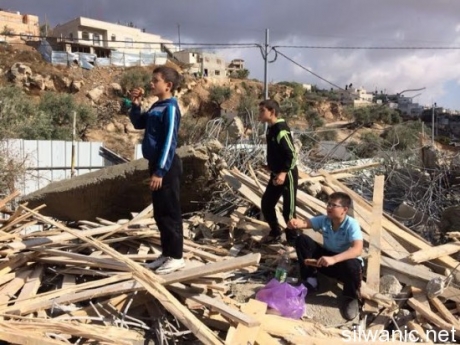
Israel demolished two homes in Silwan, south of Al-Aqsa Mosque in East Jerusalem, today claiming they were constructed without a license, eye witnesses said.
Eye witnesses reported that “a large bulldozer belonging to the Israeli municipality arrived this morning at Wadi Yasoul in Silwan accompanied by Israeli police and army forces.”
They added: “The Israeli forces surrounded the home of the released prisoner Khalil Abu Rajab and demolished it before demolishing Assem Abu Subaih’s home.”
Witnesses noted that the “demolition occurred without prior warning. There are concerns that more demolitions will take place in the area.”
“Abu Subaih’s home consists of three rooms and he lived in it with his five family members. As for Abu Rajab’s home, it was made up of two apartments he lived in with seven family members and his mother,” sources reported.
These demolitions occurred after Israeli media outlets reported a few days ago that the Israeli Mayor of Jerusalem Nir Barkat approved a series of sanctions against Palestinians in the city, including demolishing unlicensed homes “in order to stop the phenomenon of throwing rocks”.
Various clashes between the Palestinian youth and Israeli forces have continued in a number of neighbourhoods in East Jerusalem since last July.
Palestinian, Israeli and international human rights organisations noted that while the municipality has been increasingly giving building permits to Israelis in East Jerusalem, it is restricting construction work done by Palestinians, which forces many to build without permits.
The Israeli Information Centre for Human Rights in the Occupied Territories (B’tselem) said: “While large-scale constructing and major investments are being carried out in Jewish neighbourhoods, the Israeli authorities are working on stifling all development and construction for Palestinian residents, which make up about a third of the city’s population.”
The Planning and Building Committee of the Israeli Ministry of Interior approved the construction of 500 settlement units in Ramat Shlomo settlement in Shuafat in northern Jerusalem yesterday which provoked Palestinian and international criticism.
The Kagame-Power Lobby’s Dishonest Attack on the BBC 2’s Documentary on Rwanda
By Edward S. Herman and David Peterson | Monthly Review Zine | November 1, 2014
On October 1, 2014, a remarkable event occurred in Britain. The British Broadcasting Corporation’s BBC 2’s This World telecast Rwanda’s Untold Story, a documentary produced by Jane Corbin and John Conroy that offered a critical view of Rwandan President Paul Kagame and of his and the British and U.S. roles in the 1994 mass killings in Rwanda and beyond.1 Although the documentary adheres to some key longstanding falsehoods of the Anglo-American propaganda system’s treatment of the “Rwandan genocide,” above all the claim that in 1994 leaders of the country’s Hutu majority conspired to commit genocide against its Tutsi minority,2 nevertheless, we believe that the telecast of Rwanda’s Untold Story constituted a first of its kind in the reinterpretation of what really happened in Rwanda in 1994. And this is true not only for the BBC, but also for the rest of the establishment English-language television news media in Britain, the United States, Canada, and elsewhere.
The BBC 2’s reinterpretation works largely by providing airtime to well-informed figures conventionally marginalized within the establishment media. Accordingly, Rwanda’s Untold Story is the story that they tell and that they would have been telling for many years had they and their views not been systematically suppressed and even ridiculed and smeared by the establishment media, historians, and assorted political hacks from within the Kagame-Power Lobby.
Among these newly admitted storytellers are Theogene Rudasingwa and Kayumba Nyamwasa, former high-ranking Rwandan Patriotic Front (RPF) associates of Paul Kagame now forced to live in exile for opposing his rule and seeking his downfall. “The price of being able to express a view that is even mildly critical or dissenting in Rwanda, the price is very high,” Rudasingwa, Kagame’s former chief-of-staff, tells Corbin. “Those who tried, journalists, have been killed, and others imprisoned or simply banished into exile” (51:19). When Corbin asks Nyamwasa, a former top-ranking general under Kagame, whether he was “surprised there wasn’t more protests from the international community over what was happening in the Congo and Rwanda’s part in it,” Nyamwasa replies: “No. I wasn’t surprised. He’s got very powerful people who protect him” (45:50).
Another critic here given a voice is Aloys Ruyenzi, a former member of Kagame’s personal guard. Ruyenzi recounts what he heard at a meeting between Kagame and his closest staff during which Kagame gave the order to shoot down Rwandan President Juvénal Habyarimana’s Falcon 50 jet. Ruyenzi also states that he was in Kagame’s company when, on April 6, 1994, the news of the shoot-down arrived at the RPF’s headquarters in Mulindi, in the far north of the country. “Kagame was happy,” Ruyenzi tells Corbin. “The other commanders were happy too. From that moment, we started to move” (15:15).
Yet another critic is Carla Del Ponte, a former chief prosecutor at the International Criminal Tribunal for Rwanda (ICTR) as well as the International Criminal Tribunal for the Former Yugoslavia, who recounts how she was relieved of her job at the ICTR in 2003 for having opened investigations into RPF crimes and then rebuffed overtures from the United States and Britain to terminate them. “[T]he U.S. didn’t back me up,” she says, “the U.K. followed suit, as always, and my mandate was not renewed” (38:28).
Still another new voice is former FBI counter-terrorism agent James Lyons, who was Commander of Investigations at the ICTR. Lyons tells Corbin that in 1996-1997 his and the late Michael Hourigan’s National Team had found three solid sources claiming knowledge that Kagame was responsible for the Habyarimana assassination. When in early 1997 Hourigan and Lyons presented ICTR Chief Prosecutor Louise Arbour with a memorandum outlining what they had learned, Arbour ordered the investigation terminated and confiscated the memorandum. “Louise Arbour just did a 180-degrees turnaround,” Lyons says, referring to Arbour’s reaction when she learned that his group had evidence implicating Kagame. “Someone above her was telling her this was not a good idea to be investigating Paul Kagame” (39:30).
Among the other BBC 2 guests was the Belgian scholar Filip Reyntjens, a specialist in the history of the Great Lakes region of central Africa; Reyntjens states frankly on camera that he regards Kagame as the “most important war criminal in office today” (48:31). Also the Belgian Colonel Luc Marchal, a former high-ranking member of the United Nations Assistance Mission in Rwanda (UNAMIR) with responsibility for the capital city, Kigali. Marchal describes the overwhelming tension that pervaded Kigali during the months before Habyarimana’s assassination: “Every night in Kigali the background noise was of weapons and shooting and of grenades exploding” (10:16). “In my opinion,” Marchal adds, “the attack on the president’s plane was the trigger to begin the military operation and the armed takeover by the RPF” (15:53).
Perhaps most important of all, the BBC 2 devotes a substantial segment of its documentary to the work of two American professors now at the University of Michigan, Allan Stam and Christian Davenport, who from 1998 on carried out important field research in Rwanda, and who have gone on to develop many powerful and provocative interpretations about what really happened in Rwanda in 1994.3 “What the world believes, and what really happened, are quite different,” a clip from Corbin’s interview with Stam appears twice in the documentary (0:21 and 31:19). (We return to Davenport and Stam’s work below.)
In sum, although we take issue with the BBC 2 documentary’s very loose and inexact use of the term “genocide” when referring to the events in Rwanda in 1994, Jane Corbin and John Conroy’s Rwanda’s Untold Story marks an important, informative, and decisive break from the now-more-than 20 years of false and propagandistic storytelling in the Anglo-American world that has buried the real history of the period. Both the BBC 2’s This World and the documentary’s production staff deserve their audience’s gratitude — not condemnation.
How Dare the BBC 2’s This World Break Ranks with the Rest of the Respectable Media and Bring All of These Ugly, Unmentionable Truths to Light?
Just as it was a remarkable event for Rwanda’s Untold Story to be telecast over the BBC 2 on October 1, so it was entirely predictable that on October 12, a response in the form of an open letter signed by 38 “scholars, scientists, researchers, journalists and historians” was sent to the BBC’s Director-General Tony Hall, taking issue with the documentary in the strongest terms possible. And, as is the conventional practice among members of this group, their open letter features the smear that the documentary engages in “genocide denial,” a derogatory charge that in one form or another (e.g., “genocide deniers,” “deniers”) appears no fewer than 13 times in a letter only 1,266 words long.4
“Genocide denial” and the dissemination of “genocide ideology and sectarianism” are the preferred negative-attack weapons of the Kagame dictatorship, on the basis of which it has denounced, intimidated, imprisoned, driven into exile, and even assassinated many Rwandans as well as foreign nationals over the past 20 years.5 Kagame’s legal system used such charges to arrest the Hutu political figure and chair of the opposition Forces Democratiques Unifiées (FDU)-Inkingi coalition, Victoire Ingabire, in April 2010, removing her from competing against Kagame in the August presidential election, which Kagame won with an incredible 93 percent of the rigged vote. “[I]ngabire asked why there were no memorials to the Hutus who died,” Corbin reports in the documentary. “She got eight years in prison for ‘genocide ideology’” (51:09). To this day, Ingabire languishes in one of Kagame’s prisons, her sentence now bumped up to 15 years; recently her attorney filed a petition with the African Court on Human and Peoples’ Rights, asking it to demand a fair and open retrial for his client. 6 The 38 letter-signers claim to recognize the BBC’s right to “reflect on the contemporary political situation in Rwanda,” which the documentary does at length, but nowhere in their rebuttal do they themselves undertake such reflections. Doesn’t the 38’s silence on the totalitarian nature of Kagame Power, clearly a major political issue for Rwandans both at home and living in exile, make them dictatorship defenders?
When the 38 use the word “genocide” — a term they use no fewer than 27 times in their letter — they refer to one thing specifically: the alleged planned extermination and killing of Rwanda’s minority Tutsi population by its majority Hutu conspirators. But another, much larger area of massacres lies to the west of Rwanda in the neighboring Democratic Republic of Congo (DRC), where, from September 1996 on, many more people have been killed than in Rwanda in 1994. These killings were carried out as an almost immediate extension of the RPF’s 46-month war in Rwanda, and in the case of the DRC there is a wide consensus among specialists that Paul Kagame and forces allied with him (especially the Ugandan People’s Defense Force and locally organized militias) have been the principal killing agents. As Deogratias Bugera, at one time a soldier in Kagame’s RPF during its war in Rwanda, and one of the founders in October 1996 of the Alliance of Democratic Forces for the Liberation of Congo-Zaire (AFDL), a “rebel” front-organization for the RPF in its wars in Zaire-DRC, once told Jason Stearns: “As soon as the RPF conquered Rwanda, they set their sights on invading Zaire, much sooner than most people realize.” 7 As the 38 completely ignore Kagame’s 18-year-long wars and genocide in the DRC, doesn’t their exclusive focus on Rwanda 1994 and the alleged Hutu conspiracy to exterminate the Tutsi make them apologists for the larger follow-up genocide? To the BBC 2’s credit — and in stark contrast to the silence of the 38 who attacked the BBC — the documentary raises precisely this issue. In fact, in a voiceover, Corbin reports: “The UN surveyed 600 alleged massacre sites [in the DRC]. … The UN report concluded: The apparent systematic and widespread attacks on Hutu civilians, if proven, could be characterized as crimes of genocide” (44:48). 8 But the 38 aren’t interested.
Who Shot Down President Habyarimana’s Falcon 50 Jet?
Turning to the mass killings in Rwanda in 1994, the 38 cite three “untenable claims” made in the BBC 2 documentary. The first is a “lie about the true nature of the Hutu power militia.” The second is an “attempt to minimize the number of Tutsi murdered in the genocide.” And the third is an “effort to place the blame for shooting down President Habyarimana’s plane on April 6, 1994 on the Rwandan Patriotic Front.”
Taking this last item first: The 38 claim that a “detailed report published in January 2012 by a French magistrate Judge Marc Trévidic . . . contains evidence from French experts, including crash investigators, who proved scientifically that the missiles that shot down the plane came from the confines of the government-run barracks in Kanombe.”
This is a blatant case of the selective use of evidence, in addition to being misleading in its own narrow framework. First, two French investigative judges are involved in this inquiry, not one: Judge Nathalie Poux as well as Judge Trévidic. Second, no report, preliminary or final, has ever been issued by Trévidic and Poux. The January 2012 report to which the 38 refer, released by Trévidic and Poux, was not written by them but was compiled by five “experts” who had been hired by the investigating judges to analyze certain data from a ballistics and acoustics point of view. 9
Third, and most important, none of the contributors to this nearly 340 page report at any point claims to know the identities of who actually fired the missiles that brought down Habyarimana’s jet, and nowhere in this report does anyone conclude definitively that the “missiles that shot down the plane came from the confines of the government-run barracks in Kanombe,” or in any other government-controlled area. Instead, they calculate “probabilities” for the locus of origination of the missiles which in the aggregate covers such a large range of territory that, as of April 6, 1994, the missiles could have been fired from government-controlled territory on its western edge as well as from territory well outside of government control, in the vicinity of Masaka Hill, to the southeast of Kanombe camp and the airport’s runway, which is exactly where the former RPF figures who have testified on this matter in multiple venues over many years claim the missiles were fired from. 10 In short, the highly-touted findings of the January 2012 analysis are so inconclusive as to the sites from which the fatal missiles were fired and the identity of the shooters that they are surely not the last word on the matter. 11
Also interesting is the fact that the Trévidic-Poux investigation’s own records show that in June 2010 their investigation accepted the sworn testimony of Abdul Ruzibiza, a former lieutenant in the RPF then living in exile in Norway, and the author of the 2005 book Rwanda, L’histoire secrète. 12 Consistent with his earlier testimonies before the investigation led by the French Judge Jean-Louis Bruguière (Trévidic’s immediate predecessor in the same office, from which Bruguière retired in June 2008), his published writings, and his testimonies in trials argued before the ICTR, Ruzibiza shared with Trévidic-Poux’s representatives in Norway his knowledge of the RPF’s reconnaissance of the best site from which to fire the missiles (i.e., the aforementioned Masaka Hill, outside the government-controlled area); who comprised the assassination team and carried out the actual shooting (Deputy-Lieutenant Frank Nziza and Corporal Eric Hakizimana are named); where the missiles that were used that night had come from (they were smuggled from Uganda, through RPF-controlled territory in northern Rwanda, and then to Kigali); where the RPF stored the missiles prior to their use (in the RPF-occupied Conseil National de Développement [CND — National Assembly] complex in Kigali, in violation of the Arusha Accords’ prohibition that weapons in Kigali were to be secured by UNAMIR); and that he was a member of the RPF’s so-called “Network,” a covert team that carried out sabotage, false-flag operations, and assassinations of political figures on all sides so as to sow distrust and heighten tensions. 13 We believe that all of this is very important because, as noted above, Trévidic’s predecessor, Judge Bruguière, also heard the same sworn testimony of Ruzibiza, as had trial chambers of the ICTR; the crucial difference here is that whereas the 2006 Bruguière report made use of Ruzibiza’s testimony, at the time of this writing, Trévidic-Poux have taken no public position on Ruzibiza’s testimony, much less have they attempted to identify who they believe the shooters were. 14
It is also important to note that the Trévidic-Poux investigation exists within a political context unique to France that is ignored by the 38. In May 2007, the right-wing Atlanticist candidate Nicolas Sarkozy succeeded the right-wing Gaullist Jacques Chirac as the new president of France. Chirac had served for 12 years (1995-2007), having succeeded the Socialist Party’s François Mitterrand (1981-1995) to the office. Sarkozy immediately set out to heighten France’s Atlanticist profile among the Western capitals, particularly Washington and London. In early 2010, Sarkozy visited Rwanda’s President Paul Kagame in Kigali, the first visit by a French president to Kigali since the 1980s. Within days of Sarkozy’s return to Paris, French police arrested Agathe Habyarimana, the widow of Rwanda’s late President’s Habyarimana, then living in exile in Paris; she was arrested on the basis of an arrest warrant drawn up in Kigali over her role in the events of 1994. Within weeks of this, Trévidic and Poux named the five ballistics and acoustics “experts” who were to re-examine the evidence that ultimately found its way into Bruguière’s 2006 report and the nine indictments of RPF figures. In other words, the origins of the Trévidic-Poux investigation took place within the context of President Sarkozy’s decision to mend fences with Kagame’s regime and align French with U.S. policy on Rwanda, and this political decision required something official to offset Bruguière’s findings against the RPF. But even now as late as November 2014, Trévidic and Poux have yet to publish a definitive conclusion, in contrast to Hourigan, Bruguière, and the Spanish National Court Judge Fernando Andreu Merelles’ February 2008 indictment of 40 members of the RPF for their alleged murder of hundreds of thousands of Rwandans after the war. 15
The 38 ignore the fact that the long and serious investigation of the shoot-down by Bruguière, which included the sworn testimonies of a number of participants in the planning for the shoot-down, concluded that it was Kagame who had given the orders for it. 16 Bruguière also made the important point that the shoot-down and military conquest of Rwanda were politically necessary for Kagame, as he and his RPF could never have won the free election called for by the 1993 Arusha Peace Accords, given an ethnic Tutsi voting block of some 10 percent of Rwanda’s population, versus an ethnic Hutu voting block closer to 90 percent. Under these circumstances, it would have been impossible for Kagame’s RPF to take power through Rwanda’s legal political channels at any time and in any way — except by military conquest. 17 As Filip Reyntjens tells Jane Corbin in the BBC 2 documentary: “[The RPF] felt they were not going to be able to take power through the ballot, and I think by the end of 1993, the RPF had decided it was going to take power by the bullet” (9:35).
The 38 also bypass the fact that the ICTR sponsored the original investigation of the shoot-down in 1996-1997, carried out by a 20-person, multinational investigative team headed by the late Australian lawyer, Michael Hourigan. The BBC 2 documentary returns to a discussion of this evidence more than once, in the person of James Lyons, Hourigan’s superior at the ICTR. A memo prepared by Hourigan for delivery to ICTR Chief Prosecutor Louise Arbour, based on what his team regarded as three solid RPF sources with firsthand knowledge of the shoot-down, found Paul Kagame ultimately responsible for it. But as noted earlier, this memo was suppressed by Arbour, and no charges have ever been brought against Kagame by the ICTR. 18 Given that the ICTR has strictly observed the principle of “victor’s justice” throughout its 20 year existence, and has indicted, tried, and convicted Hutus alone with only one exception19, (the BBC 2 documentary reports 63 convictions to date [39:56]), this history of prosecutorial suppression at the ICTR strongly suggests that the evidence for a Kagame role in the shoot-down simply was too solid for the ICTR and its major U.S. and U.K. sponsors to permit any further investigation.
Here we should add that the lead signatory of the open letter to the BBC, Linda Melvern, has long claimed that there never was an investigation of the shoot-down by an international organization. Thus in one place, Melvern has referred to the “failure to conduct an international inquiry,” 20 and elsewhere she has alleged that “[t]he international court established by the Security Council . . . is silent on the assassination of Habyarimana.” 21 Although these are outright lies and suppress both actual investigations and the evidence they’ve accumulated, they are the kind of lies that conform well with the biases and deep-seated mendacity of Melvern and her 37 fellow “scholars” (etc).
Among the Many Untold Stories about Life in Paul Kagame’s Rwanda . . .
The list of former Kagame associates who eventually testified to Kagame’s responsibility for the shoot-down is impressively large; Peter Erlinder, the U.S. defense attorney and former lead defense counsel before the ICTR, estimates that the number “now exceeds eight,” 22 but we suspect the total is considerably higher. But any number is especially impressive, given that former members of Kagame’s inner circle who provide such testimony place themselves at great risk, as Kagame and some of his underlings have been regularly engaged in the permanent silencing of critics. (On this, see the treatment in Rwanda’s Untold Story of the December 31, 2013 assassination of Kagame’s former intelligence chief Patrick Karegeya, then living in exile in South Africa [51:40].) Estimates vary of the number of former allies who were later killed on orders from Kagame. Particularly vulnerable and at highest risk are figures who possess “knowledge of the regime’s darkest secrets and had themselves been involved in its crimes,” as Reyntjens puts it. Reyntjens quotes a former RPF member “exiled in Europe” who claims he was ordered to assassinate Kayumba Nyamwasa (who, in fact, has survived four assassination attempts) and could name 17 other former RPF officers “murdered on Kagame’s orders.” Anyone “considered a threat, Hutu and Tutsi alike, were physically eliminated.” Exiles from Kagame Power were eliminated either because they had knowledge of Kagame’s responsibility for the assassinations of the Rwandan and Burundian presidents in April 1994, or because Kagame suspected them of disloyalty and plotting against him, or of leaking sensitive information to the world outside his base of supporters. According to Reyntjens, Ruzibiza claimed the “physical elimination of over twenty military, in addition to several foreigners working in Rwanda who were suspected of having leaked information on RPF abuse. . . .” Kagame is also implicated in the January 2001 assassination of a third head of state, Laurent-Désiré Kabila, Kagame’s handpicked successor to Mobutu after Rwanda and Uganda drove Mobutu from power in May 1997. 23 In 2010, many of the most prominent surviving exiles from Kagame Power went on to found the Rwanda National Congress and called for the end of the Kagame dictatorship, once and for all. But the establishment U.S. and U.K. media have rarely given Kagame’s regime of terror and assassination the attention that it deserves, paralleling the United States’ and Britain’s longtime support of Kagame, and, of course, the 38 slavishly follow the same apologetic silence on this matter.
The 38 attempt to support their belief in “Hutu Power” responsibility for the shoot-down by claiming that this “carefully planned genocide” was followed immediately by “roadblocks . . . all over Kigali” and a rapid targeting of Rwanda’s political opposition, which was allegedly opposed to Habyarimana because they feared power sharing with the RPF under the Arusha Accords.24 This is what we might call streaming lies. As we feature in our recently published book, Enduring Lies: The Rwandan Genocide in the Propaganda System, 20 Years Later, even the U.S.- and U.K.-vetted ICTR uniformly rejects the charge that Hutu political and military figures engaged in a “conspiracy to commit genocide” against the country’s minority Tutsi population prior to the April 6, 1994 shoot-down of the Habyarimana jet. 25 But this has never prevented Linda Melvern and the open letter’s co-signers Roméo Dallaire, Gregory Stanton, Gerald Caplan, Frank Chalk, George Monbiot, Andrew Wallis, et al., from repeatedly asserting that such a conspiracy was fairly adjudicated and determined to be real by the ICTR’s trial and appeals chambers, and this repetition of the “conspiracy to commit genocide” fraud feeds into the lie stream here.
While Melvern and the other 37 claim a readiness to spring into action by the alleged “Hutu Power” conspirators as of April 6, the fact of the matter is that the Hutu military and political leadership was completely unprepared for the post-assassination crisis, the Armed Forces of Rwanda (FAR) were in immediate retreat from the advances of the vastly militarily superior RPF, and were unable to prevent Rwanda from being conquered by the RPF in less than 100 days — let alone putting a stop to localized killing sprees. By contrast, Kagame’s RPF — including armed RPF cells in hiding across the country — was ready to initiate a military offensive at the moment that the shoot-down of Habyarimana’s jet was confirmed. The further lie by the 38 is that the Hutu conspirators carried out their nefarious plans because they feared power-sharing with the RPF and the loss of privileges this would have entailed. But as Bruguière and many others have pointed out, it was Kagame and his RPF that was confronted with losing everything via the free and fair elections scheduled by the Arusha Accords, given the ethnic voting blocks that had prevailed in Rwanda for decades.
The 38 contest the finding of University of Michigan academics Christian Davenport and Allan Stam that more Hutus than Tutsi were killed in Rwanda in 1994, but they refute it solely by mentioning “eye-witness testimony” and by listing the names of alleged research reports by Amnesty International, UNICEF, and others, while failing to cite any specific findings of estimated numbers killed and the ethnic composition of the deaths. The 38 also resort to the conventional accusatory tactic of charging Davenport and Stam with “attempts to minimize the number of Tutsi murdered, a typical tactic of genocide deniers” — when the going gets tough, sling mud.
Davenport and Stam use an aggregating methodology that we find logical and plausible in dealing with a very confusing environment — working from data estimating total pre-April 6, 1994 Tutsi and Hutu members of the population, and post-July 1994 numbers of Tutsi survivors. We use a similar method in Enduring Lies, taking Rwanda census data breakdowns of Tutsi and Hutu numbers as of August 1991, and post-July 1994 estimates of Tutsi survivors ranging from 300,000 to 400,000. Without going into too many details here, we found that, for example, on the assumption of 800,000 total deaths for the period April through July, 1994, plausible estimates of Hutu and Tutsi deaths ranged from between 100,000 and 200,000 Tutsi deaths, and between 600,000 and 700,000 Hutu deaths. 26 We also show, again relying on the logic of Davenport and Stam’s method, the crucial lesson that (quoting from our book) “the greater the total number of deaths, the greater the number of Hutu deaths overall, and the greater the percentage comprised of Hutu.”27
Hence, the following crucial exchange between Corbin and Stam (30:31):
Allan Stam: If a million people died in Rwanda in 1994 — and that’s certainly possible — there is no way that the majority of them could be Tutsi.
Jane Corbin: How do you know that?
Allan Stam: Because there weren’t enough Tutsi in the country.
Jane Corbin: The academics calculated there had been 500,000 Tutsis before the conflict in Rwanda; 300,000 survived. This led them to their final controversial conclusion.
Allan Stam: If a million Rwandans died, and 200,000 of them were Tutsi, that means 800,000 of them were Hutu.
Jane Corbin: That’s completely the opposite of what the world believes happened in the Rwandan genocide.
Allan Stam: What the world believes, and what actually happened, are quite different.
Notice the conditional “if” with which Stam begins his explanation. He could have stated “If 500,000 people died,” or “If 2 million people died,” and their method would have generated different results. It is also notable that the 38 dismiss Davenport and Stam simply as academics who “worked for a team of lawyers defending the génocidaires at the ICTR.” In fact, Davenport and Stam started work in Rwanda under the auspices of the U.S. Agency for International Development, and at one time Stam served in the U.S. Army Special Forces. And the defense counsels before the ICTR often were defending clients eventually found to be innocent of all charges, but here the same clients are found guilty in advance by the 38, who call all of them “génocidaires” and would presumably deny them the right to defend themselves.
The 38 are also pained by the BBC 2’s raising doubts over whether Paul Kagame’s RPF stopped the genocide. They quote Lieut.-General Roméo Dallaire, the Canadian force commander of UNAMIR, as the “authority on this subject.” “Dallaire is categorical,” the 38 write. “‘The genocide was stopped because the RPF won and stopped it’, he says.” 28 This is actually a bit ambiguous because the mass killings could have stopped because the powerful army then conquering Rwanda — the RPF — had won its war and could itself stop doing the killing. We have elsewhere cited the report by Robert Gersony to the United Nations claiming that in several of Rwanda’s southern prefectures he found an “unmistakable pattern” of “systematic and sustained killing and persecution of their civilian Hutu populations by the RPF,” with between 5,000 and 10,000 Hutu killed per month. 29 We should also note that Dallaire is hardly a neutral observer on the recent history of Rwanda, and, in fact, is one of the 38 signatories to the letter to the BBC which, as we are showing throughout, is error-laden and biased. We may also point out that there are not one but two Dallaires — one in his term as force commander of UNAMIR (1993-1994), and the other subsequently acting as a spokesperson for the standard model of the “Rwandan genocide” and an apologist for Kagame Power (1995-). In the earlier role, while biased in favor of the RPF, he at least could recognize and acknowledge the relative weakness and demoralization of the Forces Armées Rwandaises (FAR, the then national army of Rwanda) and the military superiority and readiness of the RPF; about the RPF, Dallaire had reported to the United Nations as early as September 1993 that it “displayed the potential to easily defeat the [FAR].” 30
The 38 devote considerable space to charging the BBC 2 documentary’s producers and guests with “genocide denial,” which they describe as the “final stage” of genocide that “ensures that the crime continues. It incites new killing.” Recall that, after conquering Rwanda in 1994, Kagame invaded Zaire-DRC two years later, with estimated subsequent killings there running into the millions. This was not a result of any “genocide denial,” it was justified on the basis of the need to clean out the “génocidaires.” That is, the new killings were built on the claim of a Hutu genocide of Tutsis that required what turned out to be large-scale massacres of an allegedly genocidal Hutu population that had fled to Zaire-DRC. If the Hutus were the primary victims in 1994, and the April 6, 1994 assassination of President Habyarimana was attributable to Kagame, both of which we believe to be true, these extended killings in Zaire-DRC would be harder to rationalize. By misrepresenting the reality of that history, the 38 help justify this further and larger genocide.
Concluding Note: Many Untold Stories
So, in fact, the 38’s cry of the immorality of “genocide denial” provides a dishonest cover for Paul Kagame’s crimes in 1994 and for his even larger crimes in Zaire-DRC. The 38 thus belong to a sizable contingent of apologists for Kagame Power, who now and in years past have served as intellectual enforcers of an RPF and U.S.-U.K.-Canadian party line. We may note here the amazing claim by the 38 that the events of 1994 “should be treated by all concerned with the utmost intellectual honesty and rigour.” Their own violation of this appeal in their open letter is both systematic and comprehensive.
We have seen that the 38 have a penchant for slander as well as straightforward misrepresentation. It is for committing the grave intellectual and moral crime of providing an alternative but, we believe, entirely credible and evidence-based reinterpretations of what really happened in Rwanda in 1994 that the 38 would like Rwanda’s Untold Story expunged from the BBC archives and its production team sent to the woodshed.
- Jane Corbin and John Conroy, Rwanda’s Untold Story, BBC 2, October 1, 2014. Whenever we cite the time-stamp for something that we take from the documentary (e.g., 51:19), we are referring to the copy of the documentary as posted to the Vimeo website.
- In Rwanda’s Untold Story, the term “genocide” is used repeatedly but without hardly any definition or explanation as to what it means. By all appearances, however, the term refers to an alleged Hutu conspiracy to commit genocide against Rwanda’s Tutsi minority 2, as well as to the execution of this alleged conspiracy during the period from April through July 1994. Thus at one point Jane Corbin, the documentary’s presenter, describes “the genocide” as “the killing of a million people in three months” (13:59). And immediately thereafter, she adds that once the assassination of Habyarimana had occurred, “It quickly became part of the accepted story that extremist Hutus shot down the plane. They wanted to unleash a wave of ethnic killing and rid the country of its Tutsis” (14:09).
- For some of Christian Davenport and Allan Stam’s relevant work, see Rwandan Political Violence in Space and Time, unpublished manuscript, 2004, especially pp. 27-33. Also see their website, Understanding Rwandan Political Violence in 1994, GenoDynamics. And see their “What Really Happened in Rwanda?” Miller-McCune, October 6, 2009:
- Linda Melvern et al., “Rwanda’s Untold Story: Letter to the Director-General of the BBC October 12, 2014″
- Filip Reyntjens, Political Governance in Post-Genocide Rwanda (New York: Cambridge University Press, 2013), Ch. 5, “Dealing with the World and the Region,” pp. 124-162; especially the section “Dealing with Critical Voices,” pp. 127-134.
- “Jailed Rwanda Opposition Figure Lodges Complaint with African Court,” Agence France Presse, October 24, 2014. Also see Rwanda: Eight-Year Sentence for Opposition Leader, Human Rights Watch, October 30, 2012.
- Jason K. Stearns, Dancing in the Glory of Monsters: The Collapse of the Congo and the Great War of Africa (New York: Public Affairs, 2011), p. 77.
- Report of the Mapping Exercise documenting the most serious violations of human rights and international humanitarian law committed within the territory of the Democratic Republic of the Congo between March 1993 and June 2003, UN High Commissioner for Human Rights, August. 2010, esp. para. 500-522. Therein, we read that the RPF and its proxy forces had carried out “systematic and widespread … attacks, which targeted very large numbers of Rwandan Hutu refugees and members of the Hutu civilian population, resulting in their death.” Such attacks, the report continues, “reveal a number of damning elements that, if they were proven before a competent court, could be classified crimes of genocide” (para. 515).
- Claudine Oosterlinck et al, Rapport d’Expertise: Destruction en Vol du Falcon 50 — Kigali (Rwanda), Cour d’Appel de Paris, Tribunal de Grande Instance Paris, Instruction n. 2272/00/13&1314 — Parquet n. 9729523030, January 5, 2012.
- Google map of the Kilagi International Airport and the territory which surrounds it. Immediately south of the airport’s runway are the Kanombe military barracks; much farther to the southeast of the airport’s runway and the Kanombe barracks is the topographic representation of Masaka Hill. According to the analyses of the “experts” released by Trévidic and Poux in January, 2012, all of these locations fall within the range of possible firing sites for the missiles that shot-down the presidential jet on April 6, 1994.
- Barrie Collins, “Shooting Down the ‘Truth’ about Rwanda,” Spiked Online, April 16, 2012.
- Abdul Joshua Ruzibiza, Rwanda, L’histoire secrète (Paris: Editions du Panama, 2005).
- Audition sur Commission Rogatoire Internationale, Joshua Ruzibiza, Devant nous, le mardi 15 juin 2010. … Commissaire de Police Havard AALMO du Kripos, en exécution d’un demande d’entraide pénale de la France en date du 15 décembre 2009 (Numéro du dossier en Norvège: 8911179) a comparu: Joshua RUZIBIZA.
- See the statement titled “Testimony of Abdul Ruzibiza about How Mistakes by both the Rwandan Government and the RPF Led to the Rwandan Genocide of 1994,” as posted to the Hungry for Truth, Peace, and Justice blog on January 9, 2009, specifically the section titled “LAST PHASE: The Assassination of President Habyarimana on April 6, 1994,” para. 5.
- Al Goodman, “Spanish Judge Indicts 40 Rwandan Military Officers for Genocide,” CNN.com/Europe,February 6, 2008
- Judge Jean-Louis Bruguière, Request for the Issuance of International Arrest Warrants, Tribunal de Grande Instance, Paris, France, November 21, 2006, p. 11. The nine RPF figures indicted by Bruguière were: James Kabarebe, Kayumba Nyamwasa, Charles Kayonga, Jack Nziza, Samuel Kanyemere, Rose Kabuye, Jacob Tumwine, Frank Nziza, and Eric Hakizamana (pp. 46-48). Paul Kagame, notably absent from this list of indictees, “enjoys the immunity granted in France to incumbent Heads of State and therefore cannot be prosecuted within the framework of this proceeding” (p. 46).
- Ibid., p. 12. As the Bruguière report puts it: “[D]ue to the numerical inferiority of the Tutsi electorate, the political balance of power did not allow [Kagame] to win elections on the basis of the political process set forth by the Arusha Agreements without the support of the opposition parties. … [I]n Paul Kagame’s mind, the physical elimination of President Habyarimana became imperative as early as October 1993 as the sole way of achieving his political aims.”
- For copies of documents related to Michael Hourigan’s experience as the head of the National Investigative Team on behalf of the Office of the Prosecutor at the ICTR, see Annexe 49 : Le rapport de Michaël Hourigan, enquêteur du TPIR, à la procureure Louise Arbour sur l’attentat du 6 avril 1994 (janvier 1997). This PDF reproduces partially redacted copies of Hourigan’s original 1997 memorandum to Louise Arbour (pp. 2-5); an August 1, 1997 confidential note in which Hourigan assesses his experiences as the head of the National Team (pp. 6-8); a February 7, 2007 report about Michael Hourigan written by Nick McKenzie for The Age (Australia) (pp. 9-13); and the November 27, 2006 Affidavit of Michael Andrew Hourigan used by defense attorneys before the ICTR (pp. 14-20).
- The one exception to the Hutu-only rule at the ICTR was the December 1998 indictment of Georges Henri Yvon Joseph Ruggiu, a Belgian national who had moved to Rwanda, and later became one of Radio Télévision Libre des Mille Collines on-air personalities both before and during the RPF’s final offensive in 1994. Eventually, Ruggui pled guilty to “incitement” related charges. See Judge Navanethem Pillay et al., Judgment, The Prosecutor v. George Ruggui, Case No. ICTR-97-32-I, June 1, 2000
- Linda Melvern, “Expert Refutes Bruguiere Claims,” All Africa, November 27, 2006.
- Linda Melvern, “The Perfect Crime“, Prospect, January 31, 2008.
- Peter Erlinder, The Accidental . . . Genocide (St. Paul, MN: International Humanitarian Law Institute, 2013), n. 49, p. 25.
- Reyntjens, Political Governance in Post-Genocide Rwanda, “The RPF Challenged from Within,” pp. 85-96
- Here we are referring to the Peace Agreement between the Government of the Republic of Rwanda and the Rwandese Patriotic Front, signed at Arusha, Tanzania, on August 4, 1993, U.N. General Assembly (A/48/824-S/26915), December 23, 1993, specifically the two Protocols of Agreement between the Government of the Republic of Rwanda and the Rwandese Patriotic Front on Power-Sharing within the Framework of a Broad-Based Transitional Government, October 30, 1992, and January 9, 1993, pp. 22-58.
- See Herman and Peterson, Enduring Lies, Sect. 7, “The Alleged Hutu ‘Conspiracy to Commit Genocide’ That Never Was,” pp. 43-46; and Appendix I, pp. 78-82.
- Ibid., Sect. 4, “The ‘Rwandan Genocide’ by the Numbers,” pp. 32-35.
- Ibid., p. 34. [↩]
- Here we note that this quote attributed to Roméo Dallaire by the 38 does not derive from the documentary.
- Robert Gersony, “Summary of UNHCR Presentation Before Commission of Experts,” October 11, 1994, pp. 4-8. Gersony had been dispatched to Rwanda on behalf of the UN High Commissioner for Refugees’ Emergency Repatriation Team, and he reported to the UN Commission of Experts in October 1994.
- Report of the Secretary-General on Rwanda (S/26488), September 24, 1993. Dallaire’s Reconnaissance Mission Report was circulated among members of the UN Security Council as an appendix to S/26488, but since it was classified for “UN Eyes Only,” it was not made publicly available at the time. For a copy of Dallaire’s Report, see Peter Erlinder, ed., Report of the UN Reconnaissance Mission to Rwanda — August 1993 (Saint Paul, MN: International Humanitarian Law Institute, 2011), here para. 67, p. 40.
Edward S. Herman is professor emeritus of finance at the Wharton School, University of Pennsylvania, and has written extensively on economics, political economy, and the media. David Peterson is an independent journalist and researcher based in Chicago.
How does the Gates Foundation spend its money to feed the world?
GRAIN | November 4, 2014
“Listening to farmers and addressing their specific needs. We talk to farmers about the crops they want to grow and eat, as well as the unique challenges they face. We partner with organizations that understand and are equipped to address these challenges, and we invest in research to identify relevant and affordable solutions that farmers want and will use.” – First guiding principle of the Gates Foundation’s work on agriculture.1
At some point in June this year, the total amount given as grants to food and agriculture projects by the Bill and Melinda Gates Foundation surpassed the US$3 billion mark. It marked quite a milestone. From nowhere on the agricultural scene less than a decade ago, the Gates Foundation has emerged as one of the world’s major donors to agricultural research and development.
The Gates Foundation is arguably the biggest philanthropic venture ever. It currently holds a $40 billion endowment, made up mostly of contributions from Gates and his billionaire friend Warren Buffet. The foundation has over 1,200 staff, and has given over $30 billion in grants since its inception in 2000, $3.6 billion in 2013 alone.2 Most of the grants go to global health programmes and educational work in the US, traditionally the foundation’s priority areas. But in 2006-2007, the foundation massively expanded its funding for agriculture, with the launch of the Alliance for a Green Revolution in Africa (AGRA) and a series of large grants to the international agricultural research system (CGIAR). In 2007, it spent over half a billion dollars on agricultural projects and has maintained funding at around this level. The vast majority of the foundation’s agricultural grants focus on Africa.
Spending so much money gives the foundation significant influence over agricultural research and development agendas. As the weight of the foundation’s overall focus on technology and private sector partnerships has begun to be felt in the global agriculture arena, it has raised opposition and controversy, particularly around its work in Africa. Critics say that the Gates Foundation is promoting an imported model of industrial agriculture based on the high-tech seeds and chemicals sold by US corporations. They say the foundation is fixated on the work of scientists in centralised labs and that it chooses to ignore the knowledge and biodiversity that Africa’s small farmers have developed and maintained over generations. Some also charge that the Gates Foundation is using its money to impose a policy agenda on Africa, accusing the foundation of direct intervention on highly controversial issues like seed laws and GMOs.
GRAIN looked through the foundation’s publicly available financial records to see if the actual flows of money support these critiques. We combed through all the grants for agriculture that the Gates Foundation gave between 2003 and September 2014.3 We then organised the grant recipients into major groupings (see table 2) and constructed a database, which can be downloaded here.4
Here are some of the conclusions we were able to draw from the data.
1. The Gates Foundation fights hunger in the South by giving money to the North.
Click to enlarge – Graph 1: the Gates Foundation’s $3 billion pie (agriculture grants, by region).
Graph 1 and Table 1 give the overall picture. Roughly half of the foundation’s grants for agriculture went to four big groupings: the CGIAR’s global agriculture research network, international organisations (World Bank, UN agencies, etc.), AGRA (set up by Gates itself) and the African Agricultural Technology Foundation (AATF). The other half ended up with hundreds of different research, development and policy organisations across the world. Of this last group, over 80% of the grants were given to organisations in the US and Europe, 10% went to groups in Africa, and the remainder elsewhere. Table 2 lists the top 10 countries where Gates grantees are located and the amounts they received, highlighting some of the main grantees. By far the main recipient country is Gates’s own home country, the US, followed by the UK, Germany and the Netherlands.
When it comes to agricultural grants by the foundation to universities and national research centres across the world, 79% went to grantees in the US and Europe, and a meagre 12% to recipients in Africa.
The North-South divide is most shocking, however, when we look at the NGOs that the Gates Foundation supports. One would assume that a significant portion of the frontline work that the foundation funds in Africa would be carried out by organisations based there. But of the $669 million that the Gates Foundation has granted to non-governmental organisations for agricultural work, over three quarters has gone to organisations based in the US. Africa-based NGOs get a meagre 4% of the overall agriculture-related grants to NGOs.
2. The Gates Foundation gives to scientists, not farmers
As can be seen in Graph 2, the single biggest recipient of grants from the Gates Foundation is the CGIAR, a consortium of 15 international agricultural research centres. In the 1960s and 70s, these centres were responsible for the development and spread of a controversial Green Revolution model of agriculture in parts of Asia and Latin America which focused on the mass distribution of a few varieties of seeds that could produce high yields – with the generous application of chemical fertilisers and pesticides. Efforts to implement the same model in Africa failed and, globally, the CGIAR lost relevance as corporations like Syngenta and Monsanto took control over seed markets. Money from the Gates Foundation is providing CGIAR and its Green Revolution model a new lease on life, this time in direct partnership with seed and pesticide companies.5
Click to enlarge – Graph 2: the Gates Foundation’s $3 billion pie (agriculture grants, by type of organisation).
The CGIAR centres have received over $720 million from Gates since 2003. During the same period, another $678 million went to universities and national research centres across the world – over three-quarters of them in the US and Europe – for research and development of specific technologies, such as crop varieties and breeding techniques.
The Gates Foundation’s support for AGRA and the AATF is tightly linked to this research agenda. These organisations seek, in different ways, to facilitate research by the CGIAR and other research programmes supported by the Gates Foundation and to ensure that the technologies that come out of the labs get into farmers’ fields. AGRA trains farmers on how to use the technologies, and even organises them into groups to better access the technologies, but it does not support farmers in building up their own seed systems or in doing their own research.6
We could find no evidence of any support from the Gates Foundation for programmes of research or technology development carried out by farmers or based on farmers’ knowledge, despite the multitude of such initiatives that exist across the continent. (African farmers, after all, do continue to supply an estimated 90% of the seed used on the continent!) The foundation has consistently chosen to put its money into top down structures of knowledge generation and flow, where farmers’ are mere recipients of the technologies developed in labs and sold to them by companies.
3. The Gates Foundation buys political influence
Does the Gates Foundation use its money to tell African governments what to do? Not directly. The Gates Foundation set up the Alliance for a Green Revolution in Africa in 2006 and has supported it with $414 million since then. It holds two seats on the Alliance’s board and describes it as the “African face and voice for our work”.7
AGRA, like the Gates Foundation, provides grants to research programmes. It also funds initiatives and agribusiness companies operating in Africa to develop private markets for seeds and fertilisers through support to “agro-dealers” (see box on Malawi). An important component of its work, however, is shaping policy.
AGRA intervenes directly in the formulation and revision of agricultural policies and regulations in Africa on such issues as land and seeds. It does so through national “policy action nodes” of experts, selected by AGRA, that work to advance particular policy changes. For example, in Ghana, AGRA’s Seed Policy Action Node drafted revisions to the country’s national seed policy and submitted it to the government. The Ghana Food Sovereignty Network has been fiercely battling such policies since the government put them forward. In Mozambique, AGRA’s Seed Policy Action Node drafted plant variety protection regulations in 2013, and in Tanzania it reviewed national seed policies and presented a study on the demand for certified seeds. Also in Tanzania, its Land Policy Action Node is involved in revising the Village Land Act as well as “reviewing laws governing land titling at the district level and working closely with district officials to develop guidelines for formulation of by-laws.”8
The African Agricultural Technology Foundation (AATF) is another Gates Foundation supported organisation that straddles the technology and policy arenas. Since 2008, it has received $95 million from the Gates Foundation, which it used to to support the development and distribution of hybrid maize and rice varieties. But it also uses funds from the Gates Foundation to “positively change public perceptions” about GMOs and to lobby for regulatory changes that will increase the adoption of GM products in Africa.9
In a similar vein, the Gates Foundation provides Harvard University University with funds to promote discussion of biotechnology in Africa, Michigan University with a grant to set up a centre to help African policymakers decide on how best to use biotechnology, and Cornell University with funds to create a global “agricultural communications platform” so that people better understand science-based agricultural technologies, with AATF as a main partner.
Gates & AGRA in Malawi: organising the agro-dealers
One of AGRA’s core programmes in Africa is the establishment of “agro-dealer” networks: small, private stockists who sell chemicals and seeds to farmers. In Malawi, AGRA provided a $4.3 million grant for the Malawi Agro-dealer Strengthening Programme (MASP) to supply hybrid maize seeds and chemical pesticides, herbicides and fertilisers.
The main supplier to the agro-dealers in Malawi has been Monsanto, responsible for 67% of all inputs. A Monsanto country manager disclosed that all of Monsanto’s sales of seeds and herbicides in Malawi are made through AGRA’s agro-dealer network.
“Agro-dealers… act as vessels for promoting input suppliers’ products,” says one MASP project document. Another states: “supply companies have expressed their appreciation for field days because MASP trained agro-dealers are helping them promote their products in the very remotest areas of Malawi.” Training the agro-dealers on product knowledge is carried out by the corporate suppliers of the products themselves. In addition, these agro-dealers are increasingly the source of farming advice to small farmers, and an alternative to the government’s agricultural extension service.
A project evaluation report states that 44% of the agro-dealers in the programme were providing extension services. According to the World Bank: “The agro-dealers have… become the most important extension nodes for the rural poor… A new form of private sector driven extension system is emerging in these countries.” The agro-dealer project in Malawi has been implemented by CNFA, a US-based organisation funded by the Gates Foundation, USAID and DFID, and its local affiliate the Rural Market Development Trust (RUMARK), whose trustees include four seed and chemical suppliers: Monsanto, SeedCo, Farmers World and Farmers Association.
Listening to farmers?
“Listening to farmers and addressing their specific needs” is the first guiding principle of the Gates Foundation’s work on agriculture.10 But it is hard to listen to someone when you cannot hear them. Small farmers in Africa do not participate in the spaces where the agendas are set for the agricultural research institutions, NGOs or initiatives, like AGRA, that the Gates Foundation supports. These spaces are dominated by foundation reps, high-level politicians, business executives, and scientists.
Listening to someone, if it has any real significance, should also include the intent to learn. But nowhere in the programmes funded by the Gates Foundation is there any indication that it believes that Africa’s small farmers have anything to teach, that they have anything to contribute to research, development and policy agendas. The continent’s farmers are always cast as the recipients, the consumers of knowledge and technology from others. In practice, the foundation’s first guiding principle appears to be a marketing exercise to sell its technologies to farmers. In that, it looks, not surprisingly, a lot like Microsoft. … Full article with tables and notes
Featured Video

or go to
Aletho News Archives – Video-Images
New Documentary
“Inside Gaza” wins best documentary at Montreal’s Cinemania film festival
Palestine Information Center – November 16, 2026
MONTREAL – The documentary “Inside Gaza,” which chronicles the experiences of Palestinian journalists working with Agence France-Presse (AFP) while covering the Israeli war on the Gaza Strip, won the Best Documentary Award at the 32nd Cinemania International Francophone Film Festival held in Montreal, Canada.
Directed by Helene Lam Trong, the 72-minute film follows the daily lives of four AFP journalists who bear witness to the difficulties of reporting in a war-torn territory largely closed off to international media.
The film is compiled from material produced by the team on the ground, as well as from interviews conducted after they left.
The film also won the People’s Choice Award at the festival on Saturday. … continue
Blog Roll
 Aletho News
- Brand ‘rape’ case just doesn’t add up. Was he framed?
- How The Jensen Huang Chinese Spy Hoax Is Russiagate 2.0
- Austria seeks to strip former foreign minister of citizenship over Russia ties
- “Inside Gaza” wins best documentary at Montreal’s Cinemania film festival
- Activists block German munitions plant over arms exports to ‘Israel’
- The Nasser Hospital attack and Israel’s relentless lies
- Could it be satan? No, Huckabee, just the Americans you work for
- AIPAC and more: Network of pro-Israel influence in US Congress
- Putin aide reveals Moscow’s stance on Europe at peace talks
- Imran Khan warns Pakistani judges he may die in prison
- If Americans Knew
- Mossad abducted Iranian general in Turkey, tortured him for weeks before killing him: Report
- I Am a Palestinian-American. Israeli Soldiers Occupied My Home for Weeks and Trashed It
- Jeffries Accused of “Straight Up Lie” for Claiming AIPAC Is Ending Donations
- DAILY UPDATE: Latest essential news on Palestine, Israel, & region
- Mothers fear for their children as polio returns to Gaza amid Israel’s ongoing genocide
- Inside the Israel-backed ‘NAZA’ disinformation campaign
- US Restrictions Prevent Palestinian Clergy From Speaking in Washington
- Gazan medics detained on shift, tortured – and return to work
- AIPAC and more: Network of pro-Israel influence in US Congress
- Israel Pays “Conservative” Media to Propagandize Americans
- No Tricks Zone
- Argentina’s Perito Moreno Glacier Joins Antarctica and Arctic In Defying Doomsday Melt Claims
- New Study: Barents Sea Temperatures Were Warmer And Sea Ice Less Extensive In The 1700s Than Today
- German Authorities Start Initiative To Evaluate Public Register For Climate “Disinformation” Spreaders!
- Zonal Asymmetry of Temperature Change in the Antarctic Circumpolar Current
- New Study: The Net Fossil Fuel Contribution To Rising Atmospheric CO2 Has Been Zero For 500 Years
- Germany’s Green Energy Transition Becoming Increasingly Expensive…Another 6 Trillion Euros!
- Sudden Stratospheric Warming, Powerful El Niño Combination May Lead To Extreme Europe Cold, Energy Crisis!
- Two New Studies Find Thwaites Glacier Melt Cannot Be Driven By Human Activity Or A Warming Ocean
- E-Cars Reduce CO2 Emissions By Only 41% Compared To Internal Combustion Engine Vehicles
- Predictions Made By Renowned Climate Professor Over Past Decades Have Been Proven To Be Poor

