Abbas’ spurious charges
By Nicola Nasser | Al-Ahram | September 11, 2014
President Mahmoud Abbas and the Fatah movement, which he commands, have unleashed a media campaign against Hamas and the resistance. If pressure from the Palestinian public fails to stop the campaign, Abbas may achieve politically what Israel failed to achieve militarily: forcing the Palestinian presidency to choose “peace with Israel” over national reconciliation.
It appears that President Abbas has, indeed, prioritised “peace with Israel.” He has devised plans for resuming negotiations, and is still banking on American support for such talks. This is the only explanation for the current anti-Hamas media campaign.
Abbas sent his negotiators — Saeb Erekat, Majed Faraj and Maen Erekat — to Washington, where they met with US Secretary of State John Kerry a week ago last Wednesday. US State Department spokesperson Jen Psaki described the more than two-hour meeting as “constructive”. Abbas then prepared to obtain an Arab mandate, which seems guaranteed in advance, for his plans from the 142nd session of the Arab foreign ministers conference, held in Cairo this week.
However, US Ambassador to the UN Samantha Power poured cold water over the Palestinian Authority (PA) president’s bid to obtain US backing for his plan, which he intends to put before the UN Security Council and UN General Assembly. The proposal would end the Israeli occupation of the West Bank and Gaza within three years, during which period negotiations would resume within three months with the occupying power over its borders with the Palestinian state.
“We don’t think there are shortcuts or unilateral measures that can be taken at the United Nations or anyplace else that will bring about the outcome that the Palestinian people most seek,” Power said in a press conference last week. “To think that you can come to New York and secure what needs to be worked out on the ground is not realistic.”
This clearly translates into an unequivocal US “No.” The Palestinian president’s new plan has run up against the same American wall that Palestinian negotiators have faced since negotiations were adopted as a strategic approach. The Zionist route remains the only way these negotiators can access the White House and the UN Security Council.
There can be only one explanation for this plan. It is in fulfilment of a Palestinian promise not to resist the occupation and to offer the occupying power the opportunity to agree to yet another futile round of negotiations. Such negotiations will give Israel the time it needs to turn the Givaot colony into a major settler city on the 4,000 dunams of Palestinian land that it has just seized by declaring it “state land”.
The purpose of this appropriation is to separate the Hebron and South Bethlehem governorates in the West Bank. It is also a means to deflect international humanitarian pressure in reaction to Israeli war crimes in Gaza, to evade Israel’s obligations to the truce agreement with the resistance in Gaza, and to fuel internal Palestinian tensions until they reignite once more.
It was not Hamas or the resistance that described Abbas’s new plan as a “spurious process”. It was independent Palestinian figures who expressed their views in a statement read out by Mamdouh Al-Akr, general commissioner of the Independent Organisation of Human Rights, on 2 September in Ramallah. They called for an urgent meeting of the unified leadership of the Palestine Liberation Organisation (PLO), in accordance with the Cairo agreement of 2011, so that it can serve as a frame of reference for the Palestinian will and take critical national decisions.
Activating the unified leadership framework of the PLO will put President Abbas’s call for a “single Palestinian central authority”, uniquely empowered to “determine matters of war and peace”, into its concrete national context. Only this context can confer legitimacy on a Palestinian leadership that does not derive its authority from resisting the occupation in all forms.
Moreover, the currently missing “electoral legitimacy” is no longer sufficient in and of itself to allow Palestinian decisions on war and peace to remain in the hands of a leadership that is the product of elections that were held with the approval of the occupation power and in the framework of agreements signed with it.
The Palestinian presidency has dropped the available option of resistance from the lexicon of its negotiating strategy, let alone the option of war, which is not available. The PA, in coordination with the occupation’s security apparatus, has become “the security proxy for the occupying power, rather than an instrument to end the occupation and establish the state,” as Palestinian analyst Hani Al-Masri wrote on 26 August.
As a result, the occupying power, alone, holds the keys to the decision of war, which it continues to repeat, and to the decision of peace, which it still refuses to take.
It appears that President Abbas is working against the tide of Palestinian public opinion, as voiced in a recent survey conducted by the Palestinian Centre for Policy and Survey Research (PCPSR) in Ramallah. According to this poll, only 22 per cent of respondents supported a resumption of negotiations, while 53 per cent said they regarded resistance as “the more effective way” to realise the creation of a Palestinian state.
The results of the PCPSR poll contradict all the charges levelled by the president and Fatah against the resistance and Hamas. Of those polled, 79 per cent believe that the resistance emerged victorious from the recent war, while 86 per cent support the defensive use of rockets.
Respondents gave very low ratings to the performance of the Palestinian president, the PA, the national unity government and the PLO, while the approval rating for Hamas was 88 per cent.
What is the substance of this media campaign against Hamas? It ranges from blaming Hamas for prolonging the war and for the consequent loss of lives and material damage, to adopting the Israeli narrative regarding a Hamas-engineered “coup attempt” against the president in the West Bank and the existence of a “shadow government” in Gaza that prevents the national unity government from functioning.
Then there are the charges of keeping Fatah members under “house arrest”, of “opening fire on civilians”, and of “selling emergency relief on the black market.” On top of these come the accusation that Hamas has violated “the law that defines the colours and dimensions of the flag.”
President Abbas’s instructions to create a “committee to hold a dialogue” with Hamas to discuss the “fate of the national unity government,” as announced by Amin Maqboul, secretary of the Fatah Revolutionary Council, does little to encourage optimism. The national unity government, national reconciliation, the Cairo agreement of 2011, the unified leadership framework that it stipulated, and the reactivation of the PLO, all stand at a crossroads.
This is because of the confrontation stirred by the systematic smear campaign that President Abbas and the Fatah movement are waging against Hamas and the resistance. The campaign has created a media smokescreen behind which the occupation authority can conceal its foot-dragging in carrying out its obligations under the truce agreement, which will probably be echoed in Israeli procrastination on continuing with truce talks due to be held in Cairo.
It should also be stressed that to accuse the resistance and Hamas of prolonging the war is to exonerate the occupation power of responsibility. The Israeli media was quick to capitalise on this, further proof of the extensive coverage the campaign has received.
Indeed, Israeli government spokesman Mark Regev virtually reiterated it verbatim when he said that the Egyptian initiative was on the table from 15 July and that while the Arab League and Israel had approved the initiative, Hamas rejected it, only to turn around and agree to it a month later. “If [Hamas] had agreed then to what it agrees to now” it would have been possible “to avoid all that bloodshed,” he said.
The investigatory commission appointed by the UN Human Rights Council will most likely cite the president’s charges to strengthen the claims of the occupying power, as these charges would be regarded as “testimony of a witness from the other side.”
Abbas says that while the “final toll” from the most recent war in Gaza was 2,140 dead, “if added to the number of dead in previous wars, and those who died during the period of the Shalit problem, the number would be 10,000 dead and wounded, in addition to the 35,000 homes that were totally or partially destroyed.”
When Abbas says that “it would have been possible” to avert the human and material losses of the recent conflict he is effectively blaming the resistance, not the occupation, for the last war on Gaza and the two wars since 2008 that preceded it.
The spectre of discord once again hovers over Palestinian unity, with Palestinian opinion divided over a programme of negotiations versus a programme of resistance. This is the breach through which Arab and non-Arab “axes” penetrate into the Palestinian interior, deepening rather than mending Palestinian rifts.
Nicola Nasser is a veteran Arab journalist based in Birzeit, West Bank of the Israeli-occupied Palestinian territories
Poll: Only 10 percent of Gazans would vote for Abbas in presidential election
Al-Akhbar | September 16, 2014
Only 10 percent of Palestinians in the Gaza Strip would vote for current President Mahmoud Abbas if presidential elections were held today, according to a new poll released Tuesday.
The poll, conducted by the Gaza-based House of Wisdom Institute, indicates that 29.8 percent of Gazans would vote for senior Hamas official Ismail Haniyeh, while 28 percent would vote for jailed Fatah leader Marwan Barghouti.
Interestingly, 32.4 percent would choose a different candidate.
The majority of those surveyed thought the Israeli assault unified Palestinians, but expected Hamas-Fatah disputes to continue in the aftermath of the war.
Regarding the Israeli assault on Gaza, 73.6 percent were satisfied with the performance of the different resistance groups.
When it comes to the Egyptian-brokered ceasefire deal, the survey, which was conducted in 30 locations across Gaza, showed that 40 percent were dissatisfied with the deal and 60 percent said they expected Israel to violate the conditions of the deal.
The seven-week Israeli assault on the besieged Gaza Strip has killed more than 2,130 Palestinians, the overwhelming majority of them civilians, including 577 aged 18 or younger.
(Al-Akhbar, Ma’an)
Israeli settlers attack internationals and a Palestinian shepherd
Operation Dove | September 15, 2014
At Tuwani – On September 14th, two Israeli settlers attacked a Palestinian shepherd and two international near the Israeli outpost of Mitzpe Yair, in the South Hebron Hills area. During the aggression, the settlers stole video cameras from the internationals and broke one of their phones. Israeli police detained the Palestinian shepherd and one of the internationals for six hours. There were no consequences for the settlers.
At about 9:00 a.m. four Palestinian shepherds from the South Hebron Hills village of Qawawis were grazing their flocks accompanied by two internationals, on Palestinian owned land nearby the Israeli outpost. Two settlers from Mitzpe Yair crossed a closed area (where the access is forbidden to everyone else) in order to attack one Palestinian shepherd, starting to chase away his flock. The two internationals present taped the scene.
Afterwards the settlers assaulted the internationals: at first they grabbed one by the neck and knocked him down, they snatched his camera and broke his phone; subsequently the settlers attacked the other one twisting her arm and also seizing her camera. The settlers ran back to the outpost holding the stolen cameras, and the Palestinian and the internationals went to Qawawis village.
The Israeli police came to the Palestinian village and asked the shepherd and internationals to follow them to the Israeli Police station in Kiryat Arba settlement, due to one settler claiming that they threw stones at him. The Police officers detained both of them for six hours and questioned them about the incident. Israeli police released them at 5:00 p.m. without consequences.
The South Hebron hills area has suffered from the presence of Israeli settlers’ since the 70′s. Eight Israeli settlements and outposts (among which Mitzpe Yair is one) almost completely isolate 16 Palestinian villages from the rest of West Bank. The settlers’ violence includes overt violent attacks on Palestinians and their animals, damages to private properties, and limitations to freedom of movement with many consequences on their daily life. Since the beginning of 2014, Operation Dove registered the arrests of 15 Palestinians, including minors, because they were on lands near the settlements. During the same period there were no consequences for Israeli settlers involved in the incidents occurring in the area.
In spite of the violence suffered by the Palestinians from the South Hebron Hills area, they keep on grazing and farming on their lands, resisting in a non-violent way to the Israeli occupation.
Operation Dove has maintained an international presence in At-Tuwani and the South Hebron Hills since 2004.
[Note: According to the Fourth Geneva Convention, the Hague Regulations, the International Court of Justice, and several United Nations resolutions, all Israeli settlements and outposts in the Occupied Palestinian Territories are illegal. Most settlement outposts, including Havat Ma’on (Hill 833), are considered illegal also under Israeli law.]
Johannesburg university issues ban on Israeli students and academics
By Tarek Sarad | Falastin News | September 12, 2014
Palestinian ambassador to South Africa Abdul-Hafid Nofal said that Johannesburg university decided not to accept any student or deal with any academic or lecturer from Israel.
In a press release on Wednesday, Nofal said that the academic council of the university issued a decision prohibiting the admission of Israeli students to any of its collages and departments.
The decision also included a ban on hiring or hosting academics and lecturers who work for Israeli universities, according to the Palestinian ambassador.
He noted that Johannesburg university was the first one in South Africa to have taken a bold decision three years ago to boycott Israeli universities.
In a related context
What really winds up Israel is that this rejection comes from a famous scientist, and it is science that drives its economy, prestige and military strength.
Stephen Hawking‘s decision to boycott the Israeli president’s conference has gone viral. Over 100,000 Facebook shares of the Guardian report at last count. Whatever the subsequent fuss, Hawking’s letter is unequivocal. His refusal was made because of requests from Palestinian academics.
Witness the speed with which the pro-Israel lobby seized on Cambridge University’s initial false claim that he had withdrawn on health grounds to denounce the boycott movement, and their embarrassment when within a few hours the university shamefacedly corrected itself. Hawking also made it clear that if he had gone he would have used the occasion to criticise Israel’s policies towards the Palestinians.
While journalists named him “the poster boy of the academic boycott” and supporters of the boycott, divestment and sanctions (BDS) movement celebrated, Ha’aretz, the most progressive of the Israeli press, drew attention to the inflammatory language used by the conference organisers, who described themselves as “outraged” rather than that they “regretted” Hawking’s decision.
That the world’s most famous scientist had recognised the justice of the Palestinian cause is potentially a turning point for the BDS campaign. And that his stand was approved by a majority of two to one in the Guardian poll that followed his announcement shows just how far public opinion has turned against Israel’s relentless land-grabbing and oppression.
Read More: Stephen Hawking’s boycott hits Israel where it hurts: science
43 Israeli soldiers protest abuses, spying on Palestinians
Ma’an – 13/09/2014
JERUSALEM (AFP) — Forty-three reservists and former members of an elite Israeli army intelligence unit condemned alleged “abuses” of Palestinians in the occupied territories, in an open letter published on Friday.
The letter, addressed to Israel’s prime minister, armed forces chief and head of military intelligence and distributed to media, said information gathered by Unit 8200 was used by civilian intelligence agencies to coerce Palestinians uninvolved in militant activity.
The signatories of the letter said they would refuse to be party to such acts in future.
“There’s no distinction between Palestinians who are, and are not, involved in violence,” an English language copy of the letter says.
“Information that is collected and stored harms innocent people. It is used for political persecution and to create divisions within Palestinian society by recruiting collaborators and driving parts of Palestinian society against itself.”
The soldiers also said that they had spied on the sexual “preferences” of Palestinians in order to use them as blackmail against individuals they wanted to “turn into collaborators” for the Israeli occupation forces.
The admission verifies long-standing Palestinian claims that the Israeli military has pressured gay Palestinians into working with them by using their sexuality against them.
“We cannot continue to serve this system in good conscience, denying the rights of millions of people,” the 43 soldiers and officers wrote.
The signatories gave just their ranks and first names or first initials.
“Those among us who are reservists, refuse to take part in the state’s actions against Palestinians,” the letter, seen by AFP said.
“We call for all soldiers serving in the Intelligence Corps, present and future, along with all the citizens of Israel, to speak out against these injustices and to take action to bring them to an end.”
The letter, published less than three weeks after the Israeli military’s fierce military offensive against Palestinian militants in the Gaza Strip, slammed the “collective punishment of inhabitants” of the coastal territory.
Army questions their motive
It did not specifically mention the July-August war which took the lives of more than 2,100 Palestinians, most of them civilians, and 73 people on the Israeli side, 67 of them soldiers.
The army on Friday questioned the accuracy and motivation of the protesters’ accusations.
“The Intelligence Corps has no record that the … violations in the letter ever took place,” it said in a statement.
“Immediately turning to the press instead of their officers or relevant authorities is suspicious and raises doubts as to the seriousness of their claim.”
Members of Unit 8200, considered among Israel’s best and brightest, carry out electronic communications monitoring and surveillance, similar to work performed by the US National Security Agency and Britain’s GCHQ.
The unit is one component of the broader military intelligence corps and shares information with Israel’s civilian intelligence agencies.
A former commander of the unit, reserve Brigadier General Hanan Gefen, accused the letter’s authors of a grave breach of trust.
“If this is true and if I were the current unit commander, I would put them all on trial and would demand prison sentences for them, and I would remove them from the unit,” he was quoted as saying by Maariv newspaper on Friday.
“They are using information that reached them in the course of their duties to promote their political position.”
One of the signatories, speaking on condition of anonymity, told top-selling Yediot Aharonot newspaper: “I think that all of us who signed the letter did so because we understood that we are unable to sleep well at night.”
Most Israeli men perform three years of compulsory military service after school, and women two years, followed by regular spells of reserve duty for years afterwards.
~
Ma’an staff contributed to this report.
Neocons Revive Syria ‘Regime Change’ Plan
By Robert Parry | Consortium News | September 11, 2014
Official Washington’s ever-influential neoconservatives and their “liberal interventionist” allies see President Barack Obama’s decision to extend U.S. airstrikes against Islamic State terrorists into Syria as a new chance to achieve the long-treasured neocon goal of “regime change” in Damascus.
On the surface, Obama’s extraordinary plan to ignore Syrian sovereignty and attack across the border has been viewed as a unilateral U.S. action to strike at the terrorist Islamic State of Iraq and Syria (ISIS), but it could easily evolve into a renewed effort to overthrow Bashar al-Assad’s government, ironically one of ISIS’s principal goals.
ISIS began as part of the Sunni resistance to George W. Bush’s invasion of Iraq which had elevated Iraq’s Shiite majority to power. Then known as “al-Qaeda in Iraq,” the terrorist group stoked a sectarian war by slaughtering Shiites and bombing their mosques.
Changing its name to ISIS, the group shifted to Syria where it joined with U.S.-backed rebels seeking to overthrow Assad’s regime which was dominated by Alawites, a branch of Shiite Islam. Then, this summer, ISIS returned to Iraq where it routed Iraqi government forces in a series of battles and conducted public executions, including beheading two U.S. journalists.
In his national address Wednesday, Obama said he will order U.S. air attacks across Syria’s border without any coordination with the Syrian government, a proposition that Damascus has denounced as a violation of its sovereignty. Thus, the argument will surely soon be heard in Washington that Assad’s government must be removed as a military prerequisite so the attacks on ISIS can proceed. Otherwise, there could be a threat to U.S. aircraft from Syria’s air defenses.
That would get the neocons back on their original track of forcing “regime change” in countries seen as hostile to Israel. The first target was Iraq with Syria and Iran to follow. The goal was to deprive Israel’s close-in enemies, Lebanon’s Hezbollah and Palestine’s Hamas, of crucial support. The neocon vision got knocked off track when Bush’s Iraq War derailed and the American people balked at the idea of extending the conflict to Syria and Iran.
But the neocons never gave up on their vision. They simply kept at it, clinging to key positions inside Official Washington and recruiting “liberal interventionists” to the “regime change” cause. The neocons remained focused on Syria and Iran with hopes of getting U.S. bombing campaigns going against both countries. [See Consortiumnews.com’s “The Dangerous Neocon-R2P Alliance.”]
The neocons’ new hope has now arrived with the public outrage over ISIS’s atrocities. Yet, while pushing to get this new war going, the neocons have downplayed their “regime change” agenda, getting Obama to agree only to extend his anti-ISIS bombing campaign from Iraq into Syria. But “regime change” in Damascus has remained a top neocon priority.
In a New York Times op-ed on Aug. 29, neocon Senators John McCain and Lindsey Graham avoided the “r-c” phrase couching their words about Syria’s civil war in the vague language of resolving the conflict, but clearly meaning that Assad must go.
The hawkish pair wrote that thwarting ISIS “requires an end to the [civil] conflict in Syria, and a political transition there, because the regime of President Bashar al-Assad will never be a reliable partner against ISIS; in fact, it has abetted the rise of ISIS, just as it facilitated the terrorism of ISIS’ predecessor, Al Qaeda in Iraq.”
Though the McCain-Graham depiction of Assad’s relationship to ISIS and al-Qaeda is a distortion at best – in fact, Assad’s army has been the most effective force in pushing back against the Sunni terrorist groups that have come to dominate the Western-backed rebel movement – the op-ed’s underlying point is obvious: an initial step in the U.S. military operation against ISIS must be “regime change” in Damascus.
Neocon Sleight-of-Hand
The neocons are also back to their old sleight-of-hand conflating the terrorists fighting the Assad government with the Assad government. In the op-ed, McCain and Graham cite Secretary of Homeland Security Jeh Johnson supposedly calling “Syria ‘a matter of homeland security’” – when he actually said in the linked speech from last February:
“We are very focused on foreign fighters heading to Syria. Based on our work and the work of our international partners, we know individuals from the U.S., Canada and Europe are traveling to Syria to fight in the conflict. At the same time, extremists are actively trying to recruit Westerners, indoctrinate them, and see them return to their home countries with an extremist mission.”
In other words, “Syria” was not the problem cited by Johnson but rather the “foreign fighters heading to Syria” and the possibility that they might “return to their home countries with an extremist mission.” The distinction is important, but McCain and Graham want to blur the threat to confuse Americans into seeing “Syria” as the problem, not the extremists.
A similar approach was taken by Ambassador to the United Nations Samantha Power, one of the Obama administration’s top liberal war hawks. On Sept. 4, she sought to conflate recent allegations that Assad may not have surrendered all his chemical weapons with the possibility that any remaining weapons might fall into the hands of ISIS terrorists.
“Certainly if there are chemical weapons left in Syria, there will be a risk” that they could end up in the hands of ISIS, Power said. “And we can only imagine what a group like that would do if in possession of such a weapon.”
If any of these rhetorical tactics are ringing a bell, it’s because they are reminiscent of how the neocons frightened the American people into supporting the Iraq War in 2002-03. Back then, Bush administration officials blended unsubstantiated claims about Iraq’s WMDs with the prospect of them being shared with al-Qaeda.
In both cases – Iraq then and Syria now – the existence of those dangerous chemical weapons was in serious doubt and, even if they did exist, the two governments – of Saddam Hussein then and Bashar al-Assad now – were hostile to the Sunni fundamentalists in al-Qaeda and now its spinoff, ISIS.
Yet, this effort to confuse the American public – by manipulating their lack of knowledge about the power relationships in the Middle East – might work once more, by putting “black hats” on both Assad and ISIS and blurring the fact that they are bitter enemies.
In the weeks ahead, Assad also will surely be portrayed as obstructing the U.S. attacks on ISIS. He likely will be blamed for a lack of cooperation with the airstrikes even though it was the Obama administration that refused to coordinate with Assad’s government.
ISIL or ISIS?
Among anti-neocon “realists” inside the U.S. intelligence community, the concern about how these airstrikes into Syria might lead to dangerous mission creep is so great that I’m told that some senior analysts are even suspicious of President Obama’s repeated use of the acronym “ISIL” – for the Islamic State in Iraq and the Levant – instead of the more common “ISIS,” referring only to Iraq and Syria.
The concern is that “the Levant” suggests a larger area including all “Mediterranean lands east of Italy,” that theoretically could include everything from Turkey to Palestine and Jordan to parts of Egypt. One source said inclusion of the phrase “ISIL,” instead of “ISIS,” in any “use of force” resolution could be significant by creating a possibility of a much wider war.
In his speech to the nation on Wednesday, Obama continued to use the acronym “ISIL” but his references to U.S. military operations were limited to Iraq and Syria.
The most controversial part of Obama’s speech was his open declaration to conduct cross-border attacks into Syria in clear violation of international law. He also vowed to increase military support for rebels fighting to overthrow the Assad government.
Obama declared that “we have ramped up our military assistance to the Syrian opposition” and he requested additional resources from Congress. He added: “We must strengthen the opposition as the best counterweight to extremists like ISIL, while pursuing the political solution necessary to solve Syria’s crisis once and for all,” a further suggestion that “regime change” is again in play.
Exactly what Obama thinks he can get from the Syrian opposition is a mystery, since he himself stated in an interview just last month that the notion that arming the supposedly “moderate” rebels would have made a difference in Syria has “always been a fantasy.”
He told the New York Times’ Thomas L. Friedman: “This idea that we could provide some light arms or even more sophisticated arms to what was essentially an opposition made up of former doctors, farmers, pharmacists and so forth, and that they were going to be able to battle not only a well-armed state but also a well-armed state backed by Russia, backed by Iran, a battle-hardened Hezbollah, that was never in the cards.”
Nevertheless, Obama has now trotted out that old “fantasy” in connection with his plan to extend the war against ISIS into Syria. Obama also knows that many of the previous Syrian “moderates” who received U.S. weapons later unveiled themselves to be Islamists who repudiated the U.S.-backed opposition and allied themselves with al-Qaeda’s affiliate in Syria, al-Nusra Front. [See Consortiumnews.com’s “Syrian Rebels Embrace Al-Qaeda.”]
What’s Up?
Given that record – and Obama’s knowledge of it – what is one to make of the deceptive formulation that he presented to the American people on Wednesday night?
One explanation could be that Obama plans a more direct – albeit secretive – U.S. role in removing Assad and putting a new regime into power in Damascus. Or Obama might be simply pandering to the neocons and liberal hawks who would have gone berserk if he had acknowledged the obvious, that the smart play is to work quietly with Assad to defeat ISIS and al-Nusra Front.
The other smart play might be for Obama to resume his behind-the-scenes cooperation with Russian President Vladimir Putin who helped engineer Syria’s agreement to surrender its chemical weapons arsenal last year and who could presumably broker a quiet agreement between Obama and Assad to allow the U.S. airstrikes now.
Though the U.S. neocons and “liberal interventionists” exploited the Ukraine crisis to drive a wedge between the two leaders, Obama might want to reconsider that estrangement and accept the help of Russia – as well as Iran – in achieving a goal that they all agree on: defeating ISIS and other Sunni terrorist groups. [See Consortiumnews.com’s “What Neocons Want from Ukraine Crisis.”]
Yet, in Wednesday’s speech, Obama seemed to go out of his way to insult Putin by decrying “Russian aggression” in Ukraine where the U.S. government has accused Moscow of violating Ukraine’s sovereignty by crossing the border into eastern Ukraine and aiding ethnic Russian rebels. Obama claimed that Washington’s own intervention in Ukraine was “in support of the Ukrainian peoples’ right to determine their own destiny.”
Yet the realities in Kiev, whose government is backed by the U.S., and in Damascus, whose government is despised by Washington, have eerie parallels. In Syria, Assad, a longtime dictator, won a recent election that was truncated by civil strife. In Ukraine, the current government was established by a February coup d’etat that overthrew an elected president and is now headed by a president elected by only a portion of the population, excluding much of the rebellious east.
Yet, in one country – Ukraine – the United States says outside intervention even by a neighbor to protect a population under military assault is illegal “aggression,” while in the other country – Syria – it is entirely okay for the United States to send its military halfway around the world, cross Syria’s borders to carry out bombing raids while also arming militants to overthrow the internationally recognized government.
Typically, neither Obama nor the U.S. mainstream press made note of the hypocrisy. But the bigger question now is will the neocons hijack Obama’s bombing campaign against ISIS in Syria to achieve one of their most beloved goals, regime change in Damascus.
~
Investigative reporter Robert Parry broke many of the Iran-Contra stories for The Associated Press and Newsweek in the 1980s. You can buy his new book, America’s Stolen Narrative, either in print here or as an e-book (from Amazon and barnesandnoble.com).
Autopsy shows Palestinian prisoner died after being tortured
Ma’an – 12/09/2014
 HEBRON – Palestinian detainee Raed al-Jabari, 35, died after being tortured while in Israeli prison custody, a Palestinian official said Thursday.
Issa Qaraqe, former minister of prisoner affairs, said in a news conference that the results of an autopsy showed that internal bleeding and a concussion were the cause of death.
Israeli Prisons spokeswoman Sivan Weizman told AFP Tuesday that he had hanged himself in a bathroom at Eshel prison.
She said a medical team had tried to revive him but that he was pronounced dead on arrival at Soroka hospital in the city.
Qaraqe said the autopsy did not find any signs of bruising around al-Jabari’s neck and that the main cause of death was bleeding and concussion likely to have been caused by blows to the head.
The victim also had bruising on his face and lips.
Dr. Saber al-Alul took part in the autopsy on Thursday at the Israeli forensic science institute but was prevented from revealing the autopsy results.
Another committee then conducted an autopsy on the body at the Palestinian Institute of Forensic Medicine in Abu Dis.
The Personnel is Political
By Corey Robin | September 11, 2014
The University of Illinois Board of Trustees today voted 8-1 not to reinstate Steven Salaita.
Trustee James Montgomery, who last Friday publicly broached his misgivings about the university’s decision to hirefire Salaita, was the sole vote on behalf of Salaita. Though Montgomery had originally signed a statement supporting Chancellor Wise, he said, “I’m just someone who has the humility to be able to say that I think I made a mistake and I don’t mind saying it.” Here is his eloquent testimony.
Needless to say, the vote today sucks, and there is no use sugar-coating it. While it’s testament to the movement we’ve mounted that the Board was forced to publicly confront this issue, and that we managed to persuade one trustee to change his mind (from reports I’ve heard, other trustees did as well, but they are student trustees who have no voting power), our power and our principles proved in the end not to be enough to match the donors’ purse strings.
So it looks like a legal remedy will now be pursued. I’m using the passive voice because I have no idea what Salaita and his lawyers are planning, though the Center for Constitutional Rights, which is representing Salaita, did put out a statement after the Board vote. And the ever charming Chair of the Board of Trustees had this to say:
“I assume the attorneys will reach out and work something out or understand their position more clearly. We are not looking to be held up. We want to be fair but we don’t want to be pushovers,” board Chairman Christopher Kennedy said after the meeting. “Either they will sue or we will settle. It is hard to predict what another party will do. … Am I going to give you my playbook on a negotiating matter?”
The legal route is one path, an important path, but it’s not the only path, and more important, it’s not our path. That is, the path of all of us who have spoken out on this case.
Our path is not legal; it is political. It’s not about lawyers, it’s not about courtrooms. It’s about principles and movements, words on the web, bodies on the ground, and voices in the street. It is about power. How we deploy that power, I don’t know. That we will deploy that power, I am sure. Now is the time to think creatively and collectively.
In the meantime, I wanted to take note of a comment Chancellor Wise made in an interview to the Chronicle of Higher Education:
People are mixing up this individual personnel issue with the whole question of freedom of speech and academic freedom.
It’s a telling statement, revealing an archipelago of assumption that I’ve been tackling in all my work since my first book. In Wise’s world, freedom of speech stands on one side, employment on the other, and never the twain shall meet. It’s almost as if, to her mind, we’re making a category error when we speak of both in the same breath.
And it’s not just Wise who thinks this way. About two weeks ago on Twitter, I heard a similar remark from a young progressive journalist (I won’t link to the comment because I don’t want to draw negative attention or criticism to this person, who went on to express a willingness to rethink her position). Rights and repression are one thing, employment sanctions another. The philosopher Gerald Dworkin voiced an attenuated version of that argument, too.
Yet as I’ve argued on this and other blogs countless times, employment sanctions are in fact one of the most common methods of political repression in this country. Remember that anecdote Tocqueville reported in his journals, about how he asked a doctor in Baltimore why in a country that had so much formal religious freedom there was such a compulsion toward orthodoxy. Without hesitating, the doctor said it was all about the making and breaking of private careers.
If a minister, known for his piety, should declare that in his opinion a certain man was an unbeliever, the man’s career would almost certainly be broken. Another example: A doctor is skilful, but has no faith in the Christian religion. However, thanks to his abilities, he obtains a fine practice. No sooner is he introduced into the house than a zealous Christian, a minister or someone else, comes to see the father of the house and says: look out for this man. He will perhaps cure your children, but he will seduce your daughters, or your wife, he is an unbeliever. There, on the other hand, is Mr. So-and-So. As good a doctor as this man, he is at the same time religious. Believe me, trust the health of your family to him. Such counsel is almost always followed.
The state needn’t punish men and women for their heresies; the private sector will do it for them. That’s why during the McCarthy years so few people went to jail. Two hundred tops. Because it was in the workplace that Torquemada found his territory: some twenty to forty percent of employees, monitored, investigated, or otherwise subject to surveillance for their beliefs. The ruling elites in this country have always understood what Hamilton wrote in Federalist 79:
In the general course of human nature, a power over a man’s subsistence amounts to a power over his will.
Which brings us back to Steven Salaita. As I argued on Labor Day, it’s easy to see his case as simply one of academic freedom or the rights of tenured professors. It is that, but it’s more. It’s about the use of employment sanctions for political ends, the peculiarities and particularities of Fear, American Style, which do not apply only to Steven Salaita. They apply to all at-will employees, to that terra incognita of private governance that is the American workplace. Salaita is but the latest in a long line of victims.
While the pro-Israel forces show no compunction about using the weapons of state to enforce their orthodoxies, the sphere of employment, particularly in the academy, where one most often hears views critical of Israel, will become increasingly the scene of the censor. It already has: as I said the other day, my first battle over Israel/Palestine was to defend an adjunct in my department who had been fired for his (mistakenly construed) views on Israel/Palestine.
The issue is not simply Israel/Palestine; it’s the growing assault on fundamental rights and the increasing push toward precarity that has become the experience of workers everywhere.
If we’re going to fight this in the academy, we’re going to have to fight it the way every worker has ever had to fight: not only in courts of law, but also in the streets; not just with the help of lawyers, but also with help of each other; not simply with our smarts, but also with our feet. With unions, strikes, boycotts—the entire repertoire of collective action and militancy that gave this country whatever minimal (and ever fading) semblance of decency it has managed to achieve.
1,200 Academics and Teachers in Spain Call for Academic Boycott of Israel
Palestinian Students’ Campaign for the Academic Boycott of Israel | September 10, 2014
 The campaign, which started two years ago, asks for support from professionals from the academic and scientific field, and also from associations linked to this field, such as student’s and worker’s unions, research centres, professional associations, etc. From the 1,400 people who have signed the manifesto, 150 are professors, 850 are teachers and 200 are researchers. More than 52 associations linked to the academic field have also signed; among them there are research groups and University departments.
This initiative is part of an international campaign: Boycott, Divestments and Sanctions (BDS) to Israel. This international calling is a non-violent strategy driven by the Palestinian Society in 2005. It is growing as an effective pressure strategy towards Israel, so that it respects Human Rights and International Law. Last year, the physician Stephen Hawking, the Nobel Peace Prize Desmond Tutu and four American academic associations adhered to the boycott. It’s important to emphasize that this demand is at an institutional level and not at an individual one. On the same line, the European Union has established a de facto boycott to all collaboration with Israeli research centres and Universities placed in the Occupied Territories.
The campaign will keep collecting signatures and foresees to support specific campaigns which will develop in different Spanish universities, such as the University of Vic and the University of Malaga, where the aim is to break ties with the Haifa University and the Tel Aviv University, respectively.
In Catalonia, activists from the above mentioned campaign, occupied on May 15th the Secretary of Universities and Research asking for transparency in all of the agreements signed last November when a delegation of businessmen, councillors and directors of research centres lead by Artur Mar travelled to Israel to tighten economic and academic ties with Israeli institutions.
MEPs call for EU-Israel trade agreement to be suspended
MEMO | September 10, 2014
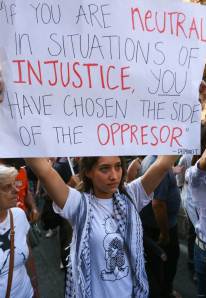 Members of the European Parliament (MEP) yesterday called to hold Israel accountable for its war in the Gaza Strip and to suspend the EU-Israel association agreement, the Anadolu news agency reported.
In a statement, the MEPs declared, “Israel’s direct targeting of civilians and its reckless cause of civilian deaths is a clear breach of international human rights law.”
Member of the Unitarian Left (GUE/NGL) parliamentary group, Martina Anderson said: “You cannot go on with an agreement after you have broken it.”
The European Union condemns the establishment of illegal settlements on the Palestinian territories occupied in 1967 and considers it a violation of international law, but the association agreement with Israel is still valid.
Anderson stressed the Palestinians’ right to sovereignty, freedom and to live with dignity and respect and that they, as parliamentarians, should take responsibility otherwise they will become “partners in crime”.
Portuguese MEP, Marisa Matias said that suspending the association agreement with Israel is not a sufficient step, stressing on the need to apply an arms embargo and start working on a full ban of Israeli products produced in the occupied territories.
Trades Union Congress slams Gaza attack, urges Israel arms embargo
MEMO | September 10, 2014
The Trades Union Congress (TUC) passed a statement on Gaza at its annual congress Wednesday, urging the UK government to impose an Israel arms embargo and calling for the suspension of the EU-Israel Association Agreement.
The statement, overwhelmingly endorsed, condemns the death toll in Gaza that included “many people going about their daily work”, and “deplores attacks on UN facilities”. The TUC recommends that those responsible for breaching international law “should be dealt with in the International Criminal Court”.
The TUC statement also calls for an end to the “blockade of Gaza” and welcomes “the creation of a unity government for the Palestinian Authority” involving both Fatah and Hamas, urging “the UK government and the European Union to support this development”.
In light of Israel’s attacks on Gaza and policies in the Occupied Territories, the TUC statement calls on the UK government and EU to “end immediately arms trading with Israel including all military-industrial collaboration”. The TUC itself, it adds, should work with relevant unions to “press those companies involved in supporting Israel’s military to cease to do so”.
Congress called for “the suspension of the EU-Israel Association Agreement until the rights of the Palestinians are established”, and committed to “rais[ing] the pressure on corporations complicit in arms trading, the settlements, occupation and the wall” through strategies that pressure “complicit companies” – a key part of the Palestinian-led Boycott Divestment Sanctions (BDS) campaign.
The Palestine Solidarity Campaign (PSC) noted that “the statement, and the goals contained within it, are now official TUC policy”, an important boost for Palestine solidarity and BDS activists. The TUC’s statement was condemned by anti-boycott umbrella group Fair Play, who complained that boycotts merely pull “Israeli and Palestinian workers further apart”.
Featured Video
Anthony Aguilar: The Point of No Return Has Been Reached
or go to
Aletho News Archives – Video-Images
Villains of Judea
David Wurmser
A shadowy neocon strategist spent 30 years maneuvering Washington toward war with Iran
José Niño Unfiltered | November 17, 2026
As American forces clash with Iran in 2026, a decades-long campaign orchestrated from the shadows of Washington has finally reached its climax. Earlier this year, foreign policy strategist David Wurmser openly called for Washington to let Israel start a war of aggression against Tehran, portraying the conflict as a historic reckoning akin to the Soviet collapse. For avid critics of American foreign policy, the current war represents the ultimate triumph of a shadowy Jewish operative who spent over 30 years advancing Israeli strategic priorities inside the highest echelons of the United States government.
Born in Switzerland, David Wurmser earned three degrees from Johns Hopkins University, including a doctorate. He spent 11 years in Navy Reserve intelligence and reached the rank of lieutenant commander. During that service, the Defense Intelligence Agency mobilized him for its Iraq Intelligence Task Force in 1994, 1996 and 1998.
Yet his defining partnership was personal as much as institutional. His Israeli born wife, Meyrav Wurmser, wrote her doctoral dissertation on Revisionist Zionism. In 1998, she cofounded the Middle East Media Research Institute, known as MEMRI, with Yigal Carmon, a former colonel in the Israeli military. Carmon served in Israel Defense Forces intelligence from 1968 to 1988. He later advised prime ministers Yitzhak Rabin and Yitzhak Shamir on counterterrorism.
During the mid-1990s, Wurmser moved seamlessly between Washington institutions and Jerusalem policy circles. … continue
Blog Roll
 Aletho News
- Lebanon on the Brink: How Washington and Tel Aviv Turned the “Peace Process” into an Instrument of Pressure
- Before Laundering The Iran Dirty Bomb Hoax, Jake Tapper Was Israel’s Chief Propagandist For Genocide.
- Minuteman III Test at APEC Opening Aimed to Show US Remains a Dangerous Power – Ex-Pentagon Analyst
- Estonia’s border closure is collective punishment of ethnic Russians
- US Plan to Toughen Restrictions on Chip Exports to China After Nvidia Scandal – Reports
- Villains of Judea: David Wurmser
- Anthony Aguilar: The Point of No Return Has Been Reached
- Iran accuses NYT report of paving way for attacks on dams
- Brand ‘rape’ case just doesn’t add up. Was he framed?
- How The Jensen Huang Chinese Spy Hoax Is Russiagate 2.0
- If Americans Knew
- An error has occurred; the feed is probably down. Try again later.
- No Tricks Zone
- Argentina’s Perito Moreno Glacier Joins Antarctica and Arctic In Defying Doomsday Melt Claims
- New Study: Barents Sea Temperatures Were Warmer And Sea Ice Less Extensive In The 1700s Than Today
- German Authorities Start Initiative To Evaluate Public Register For Climate “Disinformation” Spreaders!
- Zonal Asymmetry of Temperature Change in the Antarctic Circumpolar Current
- New Study: The Net Fossil Fuel Contribution To Rising Atmospheric CO2 Has Been Zero For 500 Years
- Germany’s Green Energy Transition Becoming Increasingly Expensive…Another 6 Trillion Euros!
- Sudden Stratospheric Warming, Powerful El Niño Combination May Lead To Extreme Europe Cold, Energy Crisis!
- Two New Studies Find Thwaites Glacier Melt Cannot Be Driven By Human Activity Or A Warming Ocean
- E-Cars Reduce CO2 Emissions By Only 41% Compared To Internal Combustion Engine Vehicles
- Predictions Made By Renowned Climate Professor Over Past Decades Have Been Proven To Be Poor

