Can the United States Come to Terms with an Independent, Technologically Sophisticated, and Truly Sovereign Iran?
By Flynt Leverett and Hillary Mann Leverett | Going to Tehran | May 16, 2014
As negotiations on a final nuclear deal between Iran and the P5+1 proceed, CCTV’s news talk program, The Heat, invited Hillary earlier this week to offer her perspective on the requirements for successful negotiations, click on the video above or see here. The program also included interview segments with Seyed Mohammad Marandi from the University of Tehran and with former Iranian diplomat and nuclear negotiator Seyed Hossein Mousavian. All three segments are worth watching. We want to highlight here some of Hillary’s more important points.
Hillary notes that, while the chances for diplomatic breakthrough between Washington and Tehran are “the best they have been for at least a decade,” gaps between the United States and Iran remain “wide” on key issues. Most importantly, “at this point, the United States doesn’t want Iran to have an industrial-scale nuclear program.”
In Hillary’s view, the “big picture” strategic challenge for the United States in pursuing a diplomatic opening with Iran is recognizing that the Islamic Republic “has sovereign rights, treaty rights, and can be treated like a normal state.” In the context of the nuclear talks, more specifically, the question is whether the United States “can countenance a country that will be strong, independent, and a real nuclear power—not a weapons power, but a real nuclear power.”
On this point, Seyed Mohammad Marandi says that, from an Iranian perspective, “the crux of the problem is the very notion that Western powers are in a position or they have the authority to determine what Iran is allowed to have and is not allowed to have. Iran is not going to accept anything less than its full rights within the framework of international law.”
Hillary describes how, to a considerable degree, Washington has been compelled to drop thirty-five years of rejecting the Islamic Republic’s very legitimacy and to consider cutting some sort of deal with it because of the erosion of U.S. military options vis-à-vis Iran and the strategic failure of American sanctions policy.
–With regard to military options, Hillary observes that “one of the things that has made these negotiations possible in a constructive manner is that, from August 2013, when President Obama declared that the United States would attack Syria after chemical weapons were used there, and then had to walk it back and say, “No, actually I can’t do that, Congress isn’t going to support me, no one around the world is going to support me’—with that, the United States’ ability to credibly threaten the effective use of force greatly diminished. So now you don’t hear President Obama say nearly as much, ‘all options are on the table’—not because the United States doesn’t want to have that [option], but because we don’t have it. We lost it over Syria, and over some of the other failed military interventions over the last decade.”
–While “the idea that sanctions have so crippled the Iranians, and especially the Iranian leadership, that they have come crawling to the table” is popular in American political discourse, this is a false assessment, “put out there to justify a policy that we have put in place for thirty-five years that has not brought down the Islamic Republic, has not overthrown its government, and has not weakened it. We’ve seen Iranian power rise and rise. And I think in some ways the Iranians are letting us have a bit of that narrative, to justify how sanctions have, in a way, let the United States come to the table…It’s a bit the reverse of what the American rhetoric is here, from Washington—it’s not so much that sanctions brought the Iranians to the table; they really brought the Americans to the table.”
Hillary explains that, because of these difficulties, the Obama administration has, over the last two years, determined that the United States might be able to “accept” the Islamic Republic—but “only if it can become part of a pro-American, U.S.-led security and political order in the Middle East.” To join such an order, “states in the region have to give up some elements of sovereign rights—to have a big, functioning military; to have full industrialization—and to have policies that support the United States. So I think what the U.S. team is really trying to test is whether the Islamic Republic of Iran can join this pro-American political and security order”—and, to show that the Islamic Republic could do this, whether Iran “would limit [its] ability to have a civilian nuclear program, according to American wishes.”
Hillary elaborates that, in broader perspective,
“The nuclear deal is almost like, when Nixon and Kissinger first went to China and the relationship opened, we had the Shanghai Communique. At the end of the day, it was just a piece of paper; it means nothing in the broader scheme of what has become a huge relationship between the United States and China. The nuclear deal between the U.S. and Iran would essentially serve that function; it would be the equivalent of the Shanghai Communique, to allow for this opening of a relationship between Iran and the United States.
Now the big difference is that the United States wants this relationship on terms that would shore up a pro-American political and security order throughout the region, throughout the Middle East. What Iran wants in that relationship is to maintain its independence, maintain its sovereignty, and to continue to have this ability to rise as an important power. Now it may be possible for those two goals to be met, but it’s going to be extremely difficult.”
This difference in fundamental goals is also manifested in U.S.-Iranian disagreements over sanctions, with the Iranians seeking to end sanctions while the Americans talk about suspending them, with specific triggers for re-imposing them. Hillary explains that the U.S. position grows out of Washington’s greater goal,
“which is to bring Iran into this pro-American political and security order in the region that allows the United States to punish states that don’t go along with U.S. policy preferences—including by the re-imposition or increasing of sanctions on them. So that is a big strategic goal for the United States.
For Iran, though, Iran has not had trade relations with the United States for thirty-five years. Their strategy is, if they can get all U.S. sanctions lifted, great. But the real goal is not this idea that the United States is somehow going to change overnight. But if the United States can at least get out of the way, stand to the side, not enforce those sanctions, waive those sanctions at least every six months, that would allow room for other states that Iran is very focused on—in Europe, in Asia, especially with China, and other countries—to allow them to trade and invest more freely (and without the constant threat of punishment from the United States), to allow them to invest in the Iranian economy. That’s the real economic prize; it’s not to open up U.S. trade or U.S. investment per se.”
Looking ahead to a prospective final agreement, Hillary cautions that negotiators “are going to try to have it as specific as possible, to really hold each side to account—not to build trust, but essentially to build in triggers to punish the other side if something goes wrong. That is not going to be a durable agreement.” Instead of this approach, Hillary argues that
“the most effective agreement that could come to fruition, whether its July 20 (the self-imposed deadline) or after that, will be something more vague. It will be something more along the lines of the Shanghai Communique between the United States and China, which essentially will say that Iran will be recognized as a sovereign state. There may be some interim period for confidence building, but that will be temporary, and after that interim period Iran will be recognized—especially by the United States, but by all of the P5+1—as a normal sovereign state exercising normal sovereign rights, including those for a civilian nuclear program…If they get bogged down in the details of exactly how many centrifuges Iran can run for exactly how much time, that’s a recipe for failure.”
The rest of Hillary’s interview is worth watching, as are the segments with Seyed Mohammad Marandi and Seyed Hossein Mousavian.
Zionist Canada bows to the holocaust religion
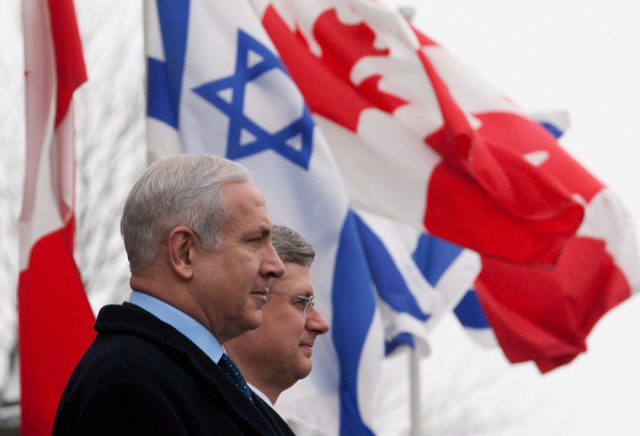
By Brandon Martinez | May 16, 2014
Officials of the Harper regime recently announced the construction of a new “holocaust” monument in Ottawa set to be completed in the fall of 2015.
“The monument features a large gathering space for ceremonies — with room for 1,000 visitors — enclosed by six triangular, concrete volumes to create the points of a star. … Monochromatic photographs by Burtynsky depicting Holocaust sites will be embedded upon concrete surfaces,” reported the Toronto Star.
It should come as no surprise that the Harper regime is backing this new holocaust monument project, considering that the ruling neo-conservatives in Ottawa have openly expressed their adherence to Jewish supremacist ideology on numerous occasions. Harper and his lackeys in Parliament have incessantly praised the apartheid state of Israel (a nation birthed through ethnic cleansing and mass terror) and have vehemently denounced those who challenge or criticize Israeli imperialism and state-terrorism.
At a May 14, 2014, speech before the American Jewish Committee’s Global Forum, Canada’s Foreign Minister John Baird told the room of Zionist fanatics that Israel is a “truly special nation” that is a “great example to the world.” A great example for what? Ethnic cleansing, mass murder and ruthless deception? Not shy to announce his belief in Jewish exceptionalism, the Zionist puppet foreign minister added that Israel is a “most extraordinary society.”
Many have argued that the holocaust promotion industry is an extortion racket designed to bolster Jewish privilege. By emphasizing Jewish victimhood above that of all other peoples, the Zionists aim to suffocate the public at large underneath a blanket of self-serving propaganda so that evidence of wrongdoing on the part of these tribal zealots will not see the light of day. Not only are Jews today not victims of any sort or underdogs in any sense of the term, they are in fact the most affluent and influential segment of every society in which they live. “Jewish families [are] among the wealthiest families in the United States. According to Forbes, 25 to 30 percent of U.S. multimillionaires and billionaires are Jewish,” noted James Petras in his book The Power of Israel in the United States.
A similar situation to the one described by Petras exists in Canada, Australia, Britain, Germany, France, etc.
The sages and holy men of holocaustianity have endeavored to promote this quasi-religion to the four corners of the earth. Hundreds of holocaust museums, memorials, monuments, research centers, etc., have been erected across Europe, Russia, North America, Latin America and even Asia. Hundreds of holocaust-themed films and television shows have been broadcasted throughout the Americas and Europe. Countless books, memoirs and other literature relating to the sacred Shoah have flooded the libraries and bookstores of all Western countries. Dozens of governments have created laws forbidding any revision of the rigid, one-sided narrative engineered by the winners of World War II.
In his book The Holocaust Industry, Jewish scholar Norman Finkelstein labeled these practitioners of professional victimhood “a repellent gang of plutocrats, hoodlums and hucksters.” One such charlatan was Herman Rosenblatt who appeared on the Oprah Winfrey Show multiple times and attained a movie deal based on his fallacious fibbing. After admitting that climactic portions of his memoir An Angel at the Fence were manufactured, he unapologetically told ABC News: “It was not a lie because in my imagination I believed it.”
Another holocaust faker, Misha Defonseca, was ordered by a judge to pay back her publisher $22.5 million after it was revealed that her best-selling 1997 memoir, Misha: A Mémoire of the Holocaust Years, was entirely fictional. Defonseca claimed that as a young girl she journeyed across Europe in search of her parents who were taken away to a German concentration camp during WW2, and that amid her search she was taken care of and raised by a pack of wolves who adopted her as one of their own. “It’s not the true reality, but it is my reality,” Defonseca told The Guardian. “There are times when I find it difficult to differentiate between reality and my inner world,” the mythomaniac explained.
Binjamin Wilkomirski’s 1994 holocaust memoir Fragments was exposed as a fraud. He was never interned in any camp and actually lived in neutral Switzerland during the war. Rudolf Vrba admitted on the stand at the Toronto trial of Ernst Zundel in 1985 that his memoir I Cannot Forgive was an “artistic picture” that contained embellishments and exaggerations. Elie Wiesel, the veritable pope of the holocaust religion, has long been suspected of at least partially fabricating his story of survival. In his memoir Night, he tells of how a doctor performed surgery on his infected foot while interned at the “death camp” Auschwitz. One might ask: what is the purpose of a doctor in a “death camp”? Then, reported Wiesel, he and his sick father chose to evacuate that camp in January of 1945 alongside the retreating German Army and SS-men instead of waiting for the Red Army to arrive. Miraculously he survived this supposedly “genocidal” ordeal.
Wiesel collects hundreds of thousands of dollars in speaking fees to preach “tolerance” to the world, while simultaneously advocating vicious hatred of German people. “Every Jew, somewhere in his being, should set apart a zone of hate -healthy virile hate- for what the German personifies and for what persists in the German,” wrote the man once described by the Chicago Tribune as a ‘beacon for human rights’ in his book Legends of Our Time. The unscrupulous pretender and money-getter has shown blatant disregard for Palestinian human rights because their oppressors are members of a master class of “chosen people” of which he is a Learned Elder.
Also not visible on Wiesel’s “human rights” radar are the tens of millions of Russians and Eastern Europeans, mostly Christians, who were starved, shot, tortured and enslaved by the Jewish-dominated Bolshevik regime in Russia. “Many Jews sold their soul to the devil of the Communist revolution and have blood on their hands for eternity,” wrote the Israeli journalist Sever Plocker in an op-ed for Ynet News. “Even if we deny it,” the Jewish writer concluded, “we cannot escape the Jewishness of ‘our hangmen,’ who served the Red Terror with loyalty and dedication from its establishment.”
Why have Stalin’s Jewish executioners and secret police torturers not received the same level of scrutiny that the Nazis have? Why have there been no Hollywood movie depictions of what happened in Stalinist Russia? When the subject has been broached, kosher commentators and careerist historians have been reluctant to note the fact that a large percentage of the top officials of the Soviet regime and the post-WW2 communist regimes of Eastern Europe were Jewish chauvinists.
When in 2009 the Ukrainian security service published a list of Soviet and Communist Party officials responsible for the Holodomor – the famine-genocide sponsored by Moscow in 1932 that took the lives of 6-7 million Ukrainians – Jewish groups cried foul, contending that publicizing such a list was a bad idea because most of the names on it were Jewish and would thus cause anti-Jewish sentiments, reported the Jewish Telegraphic Agency. Instead of learning about the true nature of this unspeakable crime and the culprits responsible, Ukrainians should just “forget history” — at least that is what the Israeli politician Shimon Peres implored them to do in a 2010 speech.
Ukrainians are commanded by the Zionists to forget their history; as are the Palestinians. But we, the ‘gullible goyim,’ must “never forget” what may or may not have happened to Jews during the Second World War. In this New World Order of Malthusian mayhem and Orwellian mind control, the Zionists hope to lock us in a mental dungeon where unwelcome thoughts are extirpated with ruthless efficiency and cold determination.
Unfortunately for them, the truth can only be hidden from public sight but never extinguished.
Destroying olives for spite
By Brian Cloughley | The News | May 12, 2014
Many people like olives because they are delicious and produce wonderful oil. They were originally cultivated in Syria, Palestine and Crete and there is evidence that some existing trees are 2,000 years old, which is amazing.
But there aren’t any 2,000 year-old olive trees in Palestine nowadays. Indeed there are very few left in the Palestinian lands that have been illegally occupied by Israel since 1967. Since then, the Israelis have destroyed 800,000 Palestinian olive trees and last week the Israeli army cut down another 52 next to a village whose farmers are being driven into poverty by yet another vicious act of Israeli malice. The destruction was ignored by western politicians who say they want a solution to what US Secretary of State Kerry calls a “puzzle.”
Yes, it’s a puzzle. But even Kerry, in an off-guard truthful moment, ventured to say that if there is no two-state solution to the Israeli-Palestinian conflict soon, Israel risks becoming “an apartheid state with second-class citizens.”
That was welcome acknowledgement of Israel’s arrogance (although of course he promptly withdrew it after shrieks of protest), but he ignored that Israel is already an apartheid state where Palestinians are non-citizens.
There is nowhere else in the world, apart from Britain’s mediaeval tribal areas of Northern Ireland, where twenty-foot high concrete barriers separate peoples of different religions. But the Israelis go further, because their barricades exemplify apartheid which is ‘a policy or system of segregation or discrimination on grounds of race.’
Israel has 400 miles of walls separating Jews from Arabs, and one of its latest extensions involves a village near Bethlehem which grows olives in “unique terraced hills built by hand over millennia.” Its irrigation system was built by the Romans and has lasted 2,000 years, but it’s going to be destroyed by the Israelis. And nobody will do anything about it.
There will not be a squeak of protest from any western country, least of all the United States whose entire legislative system is controlled by the Israeli lobby. AIPAC, the America Israel Public Affairs Committee, calls the shots in Washington and has given money to almost every senator and member of the House of Representatives. And why would it do that?
All decent people are in favour of donating to charities. But legislators of the US Congress are not charities. When they are given money by an organisation of any sort they are expected to produce results that are favourable to the donor – and in the case of AIPAC they certainly do that. President Obama isn’t a charity, either, and his speech to the 2011 AIPAC forum was grovelling and obsequious.
Obama declared that “I thought of all the centuries that the children of Israel had longed to return to their ancient homeland . . . [and] when an effort was made to insert the United Nations into matters that should be resolved through direct negotiations between Israelis and Palestinians, we vetoed it (applause)” in what was probably the most pathetically sycophantic speech ever made by a US president. But he needed AIPAC support for his re-election campaign the following year.
Two days after Obama’s rejection of the Palestinian people the prime minister of Israel, Benjamin Netanyahu, addressed both houses of Congress in a triumphant diatribe denying the rights of Palestinians. And for this he received adulation on a scale hitherto reserved for international figures of illustrious achievement.
Since the French hero of the Revolutionary War, the Marquis de Lafayette, gave the first speech by a foreigner in 1824, dignitaries from each of France and Britain have spoken at eight joint meetings of Congress, the most by any countries (and Churchill’s three orations were historic), but there haven’t been any French or British luminaries welcomed in recent years. Guess which country has been honoured by the next highest number of appearances in front of the legislators of the world’s greatest democracy.
Washington has laid out the Congress carpet seven times for Israeli politicians, and Netanyahu leads with two imperial appearances. After his last triumphant performance it was reported that “President Obama got 25 standing ovations from Congress during his 2011 State of the Union address. Israeli Prime Minister Benjamin Netanyahu got 29 today.”
It is barely credible that this brutally racist prime minister could receive such adulation from the massed representatives of a nation having a Declaration of Independence declaring that “unalienable Rights” include “Life, Liberty and the pursuit of Happiness.”
Life? – A letter in Britain’s medical journal The Lancet notes that “the life expectancy table ranks healthy life expectancy at birth for men in Israel at ninth worldwide, compared with 86th for men in the neighbouring Occupied Palestinian Territory. Corresponding ranks for women are 12th and 97th, respectively. This astonishing gap highlights yet again the apartheid-like regime that is in place in the Occupied Palestinian Territories.”
There is little liberty and no happiness for Palestinians in their own country, because almost all Arab lands have been seized by the Jews. Yet Israel’s persecution of Palestinians meets with the wholehearted support of America’s government whose taxpayers give Israel over three billion dollars a year.
The bankrolled legislators of America’s Congress contemptuously ignore UN Security Council Resolutions about Palestinian rights. In 1979, in spite of the US, the council declared that “the policy and practices of Israel in establishing settlements in the Palestinian and other Arab territories occupied since 1967 have no legal validity and constitute a serious obstruction to achieving a comprehensive, just and lasting peace in the Middle East.” But resolutions mean nothing to Congress if they are critical of Israel. Money is much more important. Since then, Washington has vetoed 42 council resolutions intended to curb or criticise Israeli excesses.
While the recent talks between Israel and Palestine were going on the Israelis approved the illegal building of another 13,851 new settlement houses on Palestinian land. So of course the talks collapsed. They were never meant to succeed by either Washington or Tel Aviv.
You would think that Israelis might want to come to some sort of equitable arrangement with the Palestinians. But they don’t and won’t. Washington’s unconditional support means Israel will carry on rejecting olive branches of peace and continue destroying the olive groves of Palestine.
2 Palestinians shot dead at Nakba rally

Ma’an – 15/05/2014
RAMALLAH – Israeli forces shot and killed a young Palestinian man and a teenage boy Thursday during a protest rally marking the 66th anniversary of the Nakba west of Ramallah in the central West Bank.
Witnesses and medical sources identified the victims as 22-year-old Muhammad Audah Abu al-Thahir from the Ramallah-area village of Abu Shukheidim and 17-year-old Nadim Siyam Nuwarah from al-Mazraa al-Qibliyya village in Ramallah district.
The victims, according to medical sources, were shot by live ammunition in the chest. Their bodies were evacuated to Ramallah Medical Complex.
Medics said three teenagers were also injured by live bullets. One was struck in the chest, one in the foot, and one in the leg. Doctors say they are in stable condition.
An Israeli military spokeswoman did not immediately return calls.
Participants in the rally near Ofer detention center said they also wanted to show solidarity with Palestinian prisoners held without trial who have been on hunger strike for 22 days.
Palestinians across the occupied territories and elsewhere were commemorating the Nakba, or catastrophe, of the founding of the State of Israel on Thursday.
During the Nakba, more than 760,000 Palestinians — estimated today to number more than 5 million with their descendants — fled or were driven from their homes in 1948.
‘Israel can’t erase the Nakba from history’
By Saeb Erekat | Ma’an | May 15, 2014
 Today is the anniversary of what we Palestinians refer to as the Nakba, our catastrophe – although a single word cannot begin to explain it, and a single day cannot begin to commemorate it.
More than ever before, Israel needs come to terms with the horrors it has caused since 1948, by ending its subjugation of millions rather than intensifying its denial and trying to legitimize its persecution. Peace can only come through justice and reconciliation.
This day, in 1948, marks the forced exile of over 750,000 Palestinians from their homes and lands. Some were subjected to brutal massacres, many fled for fear of their lives. A few managed to stay in what would become Israel. All suffered. Sixty-six years later, all continue to suffer.
The Nakba is a story of fear and intimidation, of denial and persecution, a cruel, unending reality.
Today in occupied East Jerusalem, Palestinian families are evicted from their homes due to claims that their property belonged to Jews before 1948, while being forbidden from returning to their pre-1948 homes in West Jerusalem.
In Gaza – one of the most densely populated areas in the world – 1.2 million refugees overlook the open areas of what is now southern Israel. In my own home town, Jericho, there are two refugee camps where thousands continue to live in miserable conditions. In 2014, Palestinian children died of starvation at the Yarmouk refugee camp in Syria.
Israel, which claims to be a democracy for all its citizens, continues to ban the villagers of Iqrit and Kufr Birem, two Christian villages in the Galilee, from returning to their lands, despite a ruling from the Israeli High Court of Justice on the matter.
This is not the only example of persecution within Israel. Prime Minister Benjamin Netanyahu’s promotion of the “nationality bill,” determining Israel as the Jewish nation-state, is one more in a long line of discriminatory laws against a fifth of Israel’s own population, the original inhabitants of the land.
A list of laws make it not only acceptable, but legally admissible, to discriminate against Israel’s own citizens for belonging to a different ethnic-religious group.
Meanwhile, in the land which Israel has illegally occupied since 1967, settlers and soldiers use similar methods of intimidation and fear to force Palestinians from their homes.
The reality in the West Bank is no less than apartheid, and, in Gaza, out and out siege. Both within occupied Palestine and further afield, those who have been waiting 66 years, with their keys in hand, continue to wait.
Palestine has recognized Israel’s right to exist since 1988. We are not asking for Hebrew not to be an official language or Jewish holidays not to be official holidays. The character of Israel is not for us to define.
But we will not allow any Palestinian to be portrayed as the immigrant or intruder in his or her own land. We were here in 1948: We were here for centuries before that – Muslims, Christians and Jews – all Palestinians. The concept of an exclusively Jewish state naturally entails the denial of the Nakba. It tells us: “This is our land. You were on it illegally, temporarily, by mistake.” It is a way of asking us to deny the existence of our people and the horrors that befell them in 1948. No people should be asked to do that.
We will not be complicit in the notion that any ethnic-religious group should have dominance over any other. We will not accept the denial of basic human rights to which all are entitled.
Rather than accepting historical responsibility, rather than acknowledging a painful truth about the birth of Israel and addressing it, as a step toward peace, the Israeli government attempts to wipe the event from history.
In Israel, it is forbidden by law to even commemorate the Nakba. If you can erase the narrative, it is much easier to erase the people. This Israeli government, in particular, is taking extraordinary measures to achieve this. Is it any wonder that we have not managed to reach an agreement at this time?
Today, we remember those who have lost their lives, at the hands of their oppressors, in their quest for freedom and dignity. Despite this, we are ready to live side by side in peace with our Israeli neighbors. We hope Israelis, if not their current government, will move in that direction.
At this point we do not know what the future will look like in terms of a solution, or when it will come. What we know for certain is that we will remain.
Saeb Erekat is chief negotiator for the PLO.
Danny Glover calls for cultural boycott of Israel
Ma’an – 14/05/2014
BETHLEHEM – Danny Glover and other actors featured in a US documentary on a prominent social justice activist protested the film’s screening at a Tel Aviv festival this week, announcing their support for the cultural boycott of Israel.
In a statement released on Monday, the group said they “stand in solidarity with the people of Palestine, and support their call for cultural and academic boycott of Israel” and were “shocked to find the film slated to be screened” at an Israeli festival.
“We immediately took action to have the film withdrawn from the festival,” the statement added, but highlighted that festival organizers say it was not “possible” to change the schedule that they would “move forward with the screening, over our objections.”
The film “American Revolutionary: the Evolution of Grace Lee Boggs,” is scheduled to be shown in Tel Aviv at DocAviv, a festival dedicated to documentary film which runs through May 17 and purports to be the largest film festival in Israel.
The group, however, stressed their support for the Palestinian call for Academic and Cultural Boycott, which was launched in 2004 as part of the global campaign to boycott, sanction, and divest from the state of Israel in order to pressure it to end its long-standing occupation of the Palestinian territories and history of human rights abuses against Palestinians.
Grace Lee Boggs, the subject of the documentary film, also added her name to the statement supporting the cultural boycott.
As a long-time advocate of social and racial justice in the United States, the statement highlighted that she said that screening the film in Israel “is in direct contradiction to her legacy and ongoing work as a revolutionary.”
“We will pursue opportunities for this film and the ideas within it to be made available in Palestine in a way that supports the movement,” the statement added.
The campaign has scored a number of notable successes in recent years, with leading US academic and cultural figures coming out in support despite widespread pro-Israel sentiment in North America.
Supporters of the boycott believe that after decades of occupation and ethnic cleansing, international pressure is one of the few ways left to force Israel to respect Palestinian rights.
UK grants Israel’s Livni diplomatic immunity ahead of diplomatic visit
Al-Akhbar | May 14, 2014
Israeli Justice Minister Tzipi Livni has been granted temporary diplomatic immunity for an upcoming visit to the United Kingdom, in order to protect her against arrest for her alleged war crimes, British media reported on Tuesday.
The British Foreign Office confirmed it had granted “special mission” status to Livni, The Guardian wrote, ahead of a planned meeting between the Israeli politician and Foreign Office ministers in London.
Livni’s office confirmed the news, Israeli newspaper Haaretz reported.
The Gaza-based NGO Palestinian Center for Human Rights (PCHR) and London law firm Hickman & Rose have been leading efforts to prosecute Israeli officials accused of breaching international law.
Livni had a key role in the 2008-2009 Israeli attack on Gaza, also known as Operation Cast Lead, in which more than 1,400 Palestinians were killed.
Raji Sourani, PCHR director, told The Guardian that he was very disappointed at the British government’s decision to grant immunity to Livni.
“The [British government’s] stated policy of ‘ending impunity for international crimes’ can only be properly pursued if the rule of law and due process is allowed to prevail, rather than Britain giving a safe haven to suspected war criminals, even for a few hours,” Sourani said.
He noted that a British judge had ruled in December 2009 that there was sufficient evidence to justify Livni’s arrest over her role in Operation Cast Lead.
The UK’s law on universal jurisdiction – which allows for foreign leaders to be arrested on British soil for breaches of international law – was changed in recent years to make approval from the Director of Public Prosecutions mandatory before an arrest warrant can be issued.
The change in legislation took place shortly after Livni canceled a visit in 2009 over fears of arrest. She has since been granted diplomatic immunity for an October 2011 visit to the UK.
In July 2013, Israel’s army chief, Lieutenant General Benny Gantz was also granted judicial immunity during a visit to the European country in order to discuss military cooperation. Gantz has been accused of involvement in the commission of war crimes, particularly in the November 2012 assault on the Gaza Strip, codenamed Operation Pillar of Defense.
Possible Iranian-Saudi rapprochement to impact region
By Elie Chalhoub | Al-Akhbar | May 14, 2014
Statements by Saudi Foreign Minister Saud al-Faisal on Tuesday point to a significant development in the relationship with Iran. Saudi’s so called “hawk” and Iran’s number one enemy in the kingdom is now welcoming a dialogue with the Islamic Republic. But the implications will not be felt in Tehran or Riyadh, but in Baghdad, Homs, Beirut, and Vienna.
Saudi Arabia’s call for a dialogue with Iran is no small matter, neither in its substance, “to settle differences and make the region safe and prosperous,” or in its timing, regionally, internationally, and in relation to the nuclear issue, or the fact that it was issued by one of the kingdom’s most hawkish members.
Information from Tehran maintains “the Iranian position did not change.” It indicated that, “ever since President Hassan Rouhani reached power, [Iran] declared its openness to dialogue with the Saudis and announced the issue publicly several times.” This included statements during the recent tour of Gulf countries by Iranian Foreign Minister Mohammed Javad Zarif, in which he kept hoping to visit Riyadh. However, “the rejection was also coming from the Saudis, despite all the openness to reconciliation expressed by Iran.”
According to the same sources, several mechanisms were proposed to start a constructive dialogue, following negotiations through Omani mediation. Muscat was later forced to suspend its role after its relations with Saudi Arabia began to falter. However, a few months ago, Kuwait took up the mantle and became the main mediator between the two sides. The sources revealed that one such mechanism was suggested by the Saudis and entailed parallel trust-building steps. They would begin with a meeting between representatives of both countries’ foreign ministers, then between the two actual foreign ministers, and then to ultimately have a visit by Rouhani to Saudi Arabia to meet with King Abdullah.”
The information, which was obtained from circles concerned with relations between Tehran and Riyadh, maintained that the Saudis recently proposed through the Kuwaitis a visit by assistant Iranian foreign minister, Amir Abdel-Lahian, to hold talks. However, “Iran was not satisfied with the suggestion. They believed the atmosphere in Saudi and that surrounding the proposal, its mechanisms, and the position and authority of negotiators from either side would not lead to a serious breakthrough.”
So why did the invitation come now, at this particular time? And what are the motives behind it?
The sources point to the wider picture. “The Iraqi elections show that [Prime Minister] Nouri al-Maliki will have a larger parliamentary bloc than in the previous parliament and it is certain that he will continue through a third term. This is in addition to the latest developments in Homs, which means that the axis supporting [Syrian] President [Bashar] al-Assad now has the upper hand on the ground. There is also the situation in Lebanon, which shows beyond doubt that there will be no presidential elections, without the consent of the axis of resistance. It seems all those factors, including pressure by the US and the push by Kuwait, led the Saudis to take such a step.”
US pressure was manifested in the visit by US Defense Minister Chuck Hagel to Saudi Arabia on Tuesday, meeting with the kingdom’s leadership to discuss the Syrian and Iranian files. Kuwait’s push, on the other hand, will be apparent during the visit by the Kuwaiti Emir to Tehran on June 1. He is expected to discuss bilateral relations, including disagreements concerning the continental shelf. But the essence of the meetings will be relations with the Gulf Cooperation Council (GCC) and the Saudis in particular, in addition to Syria and other matters.
The Saudi foreign minister had announced earlier that the kingdom sent out an invitation to Mohammed Javad Zarifi, “We want to meet with him. Iran is a neighbor with whom we have relations and we will conduct negotiations with Iran.”
Faisal was speaking at a press conference during the First Forum on Economy and Cooperation of Arab Countries with the Central Asian States and the Republic of Azerbaijan. “We will talk to them and if there are disagreements we will settle them in a manner that will satisfy both countries,” he explained. “We also hope that Iran would join the efforts to make the region safe and prosperous and not be part of the problem of a lack of security in the region.”
Saud al-Faisal also expressed the desire to resume contacts between the two countries as expressed by Iran’s president and foreign minister, “We sent out an invitation to the [Iranian] foreign minister to visit Saudi Arabia, but the will to make the visit has not become a reality yet. However, we will meet him anytime he wishes to come.”
Whether by coincidence or planning, Hagel’s visit and Faisal’s call coincided with the final phase of nuclear talks between Iran and the West. But it came at a time when Zarif had just arrived to Vienna to head the delegation to the nuclear talks.
What is certain, however, are the statements by Ali Khamenei on Tuesday and the several signals he gave, which aimed to provide an umbrella to the Vienna negotiations. He emphasized that the US is unable “to do anything rash, militarily or otherwise…We depend on our own powers, strengthening them and focusing our efforts on our own potential, which will defeat plans by the Americans and other powers to force the Iranian people to surrender through exerting pressures.”
Khamenei spoke in front of a large crowd of residents in the Ilam province on the anniversary of Imam Ali bin Abi Taleb’s birth. “The major powers ought to know that the Iranian people will not yield to their ambitions, because it is a living people and its youth are moving and acting in the right direction.”
These clear words are perhaps behind Zarif’s assertions from Vienna that “the difficult part” had only started and the desired deal might be aborted, even in the absence of a consensus on just “2 percent of the topics for discussion.” Iran’s negotiations with the P5+1 groups is entering a new highly sensitive phase, with the drafting of what has become known as the “final agreement.” Tuesday night, Zarif met with the EU Foreign Minister Catherine Ashton, on behalf of the P5+1 countries, over dinner. Actual negotiations will begin on May 14 and will continue until Friday.
Unlike previous sessions, Zarif and Ashton will be heading most of the meetings.
The most contentious issue in this round is the item related to the Arak heavy water reactor, which the West wants closed, and the ability to enrich uranium, which Iran hopes to keep.
The West’s belief that it could reach some kind of nuclear deal is probably due to both sides’ need for an agreement. In addition to building his foreign policy on reaching a settlement with Iran, US President Barack Obama has his hands tied in congressional midterm elections at the end of this year. It has become clear that he needs a foreign victory to ensure the victory of his party, especially after the collapse of his project for the Arab Spring and failing to reach a Palestinian-Israeli settlement or to topple Bashar al-Assad, not to mention his crisis in Ukraine.
Rouhani, on the other hand, seems to be betting on a nuclear deal that would lift the sanctions, and thus improve the economic situation inside Iran, which would give him leverage over his fundamentalist opponents. However, he realized, albeit late, that international sanctions are linked to four files, of which nuclear power is a minor issue. The other three are terrorism, human rights, and the rockets. The sanctions would only be lifted after closing all four files. And even if that happened, Obama has to solve his problems with the US Congress, which still rejects any lifting of sanctions against Iran.
Israeli Supreme Court to Hear Rachel Corrie Appeal on May 21
Rachel Corrie Foundation for Peace & Justice | May 12, 2014
Nine years after filing a civil suit against the State of Israel for the wrongful death of American peace activist Rachel Corrie, her family will have their appeal heard before the Israeli Supreme Court on May 21 at 11:30 a.m. in Jerusalem. The appeal, which will be argued by attorney Hussein Abu Hussein, challenges the Haifa District Court’s August 2012 ruling which concluded that the Israeli military was not responsible for Rachel’s death and that it conducted a credible investigation.
“During the past nine years, we have sought accountability in the Israeli courts for Rachel’s killing but were handed a verdict that showed blind indifference to the rights of the victim and little interest in seeking truth and justice,” said Craig Corrie, Rachel’s father.
The Corrie family appeal focuses on serious flaws in the lower court verdict which erred by ignoring and misinterpreting essential facts and misapplying legal norms. The appeal also challenges the lower court’s total disregard of international law obligations as well as procedural advantages that were regularly granted to the state during the proceedings. Lawyers for the Corries and the State of Israel have submitted their arguments in writing to the panel of three justices – Deputy-President of the Court Miriam Naor, Esther Hayut, and Zvi Zylbertal.
Speaking of his family’s hopes, Craig Corrie said, “It is a tragedy when the law is broken, but far, far worse when it is abandoned altogether. The Supreme Court now has a choice, to either show the world that the Israeli legal system honors the most basic principles of human rights and can hold its military accountable, or to add to mounting evidence that justice can not be found in Israel.”
Rachel, a 23-year-old human rights defender from Olympia, Washington, was crushed to death March 16, 2003, by an Israeli military bulldozer while nonviolently protesting demolition of Palestinian civilian homes in Rafah, Gaza. The following day, Israeli Prime Minister Ariel Sharon promised President George W. Bush a “thorough, credible, and transparent” investigation into Rachel’s killing. In 2004, Secretary of State Colin Powell’s Chief of Staff informed the Corrie family of the U.S. Government’s position that the Israeli investigation did not meet these standards and advised them to “use the Israeli court system.” The Corries filed suit in 2005, charging the State of Israel and its Ministry of Defense with responsibility for Rachel’s killing.
The civil trial before Haifa District Court Judge Oded Gershon began March 10, 2010, and 23 witnesses testified in 15 hearings, spread over 16 months. Each session was attended by the Corrie family, American Embassy officials, and numerous legal and human rights observers.
Testimony exposed serious chain-of-command failures in relation to civilian killings, as well as indiscriminate destruction of civilian property at the hands of the Israeli military in southern Gaza. Four eyewitnesses from the International Solidarity Movement (ISM) testified that Rachel was visible to soldiers in the bulldozer as it approached. Military witnesses testified that they saw ISM protesters in the area; and the on-site commander asked to stop operations due to their presence, but was ordered to continue working. An Israeli colonel testified that there are no civilians in war, and the lead military police investigator, himself, stated his belief that the Israeli military was at war with all in Gaza, including peace activists.
Testimony also revealed serious flaws in the military’s investigation into Rachel’s killing. Investigators failed to question key military witnesses, including those recording communications; failed to secure the military video, allowing it to be taken for nearly a week by senior commanders with only segments submitted to court; failed to address conflicting testimony given by soldiers; and ignored damning statements in the military log confirming a “shoot to kill” order and a command mentality to continue work in order to avoid setting a precedent with international activists.
On August 28, 2012, Judge Gershon ruled against the Corrie family, handing down a verdict stating the Israeli military was not to blame for Rachel’s death and that she alone was responsible for her demise. The Judge lauded the military police investigation and dismissed the case, adopting the Israeli Government’s position that the military should be fully absolved of civil liability, because soldiers were engaged in operational activities in a war zone.
The verdict was widely condemned by legal and human rights organizations monitoring the case, citing misrepresentation of facts and the fundamental principle of international humanitarian law – that in a time of war, military forces are obligated to take all measures to avoid harm to both civilians and their property. President Jimmy Carter stated that the court’s decision confirmed “a climate of impunity, which facilitates Israeli human rights violations against Palestinian civilians in the Occupied Territory.”
Seating in the courtroom is limited, and members of the press are advised to arrive early with press credentials. Proceedings will be in Hebrew. The family is seeking permission from the Court to provide simultaneous translation for court observers. However, pending the Court’s decision, journalists should make plans to bring their own translator. Cameras and audio recording equipment will not be permitted once proceedings begin. Photos may be taken before the judges enter the room.
A performance of My Name is Rachel Corrie, a play drawn from the diaries and e-mails of Rachel and staged around the world, will be presented in Hebrew on Monday, May 19 at 21:00 at the Arab-Hebrew Theatre in Jaffa. It will be followed by a panel discussion with the Corrie family, moderated by human rights lawyer Michael Sfard. For more information, visit The Coalition of Women for Peace, which is sponsoring the event.
For more information please visit http://rachelcorriefoundation.org/trial
Freedom Flotilla Update: “We Will Sail in the Fall!”
Statement from the Freedom Flotilla Coalition regarding the attack on Gaza’s Ark | May 12, 2014
The Freedom Flotilla Coalition met in London over the last two days to discuss future plans in the wake of the terrorist attack on Gaza’s Ark in the port of Gaza, as well as future plans to struggle against the blockade of Gaza
The attack, which occurred on April 29th, caused substantial damage to the hull of the boat. These hull damages and others caused by the explosion need a minimum of 2 months work to repair at a cost of approximately US $30,000.
In response to this attack we will increase our efforts to challenge the blockade through non-violent direct action. We now plan to sail Gaza’s Ark early in the fall of 2014.
The authorities have not yet concluded their investigations of the incident, so it is premature to blame anyone, but it is well known who enforces the blockade on Gaza and who doesn’t want it challenged.
Preliminary results of the investigation and inspection by our partners indicate that the materials which were used in the attack are not readily found in Gaza.
Freedom Flotilla boats have been sabotaged before in the ports of Cyprus, Greece and Turkey, over the last 5 years, as they were preparing to sail to Gaza to challenge the blockade.
Boats that sailed to Gaza have been attacked by the Israeli Navy in international water, in one case lethally, and in others with force which caused a boat to sink. Boats that were not sabotaged (over half a dozen) were hijacked and towed to Ashdod.
This attack on Gaza’s Ark took place as Israel is under increased legal pressure for its deadly attack on the first Freedom Flotilla in 2010 at the International Criminal Court (ICC) and in Turkish courts.
It also happens as Israel is increasing pressure against all Palestinians in retaliation against efforts at national reconciliation between the West Bank and Gaza.
The Freedom Flotilla Coalition commits to continue its work against the blockade of Gaza in all ways and by all non-violent means possible, including supporting the May 31st International Freedom Day for Gaza.
For further information:
Ehab Lotayef +44 (753) 877 0353 or +1 (514) 941 9792
Ann Ighe +46 (70) 974 0739
Zaher Birawi +44 (785) 089 6057
Nigeria accepts Israeli help in search for kidnapped school girls
MEMO | May 12, 2014
Nigeria’s President Goodluck Jonathan has accepted an Israeli offer to help search for 223 kidnapped school girls by the extremist Boko Haram group, Israel’s Prime Minister Benjamin Netanyahu’s office announced yesterday.
Netanyahu is reported to have told the Nigerian president: “Israel expresses deep shock at the crime against the girls. We are ready to help in finding the girls and fighting the cruel terrorism inflicted on you.”
The statement gave no further details on the nature of assistance provided.
A foreign ministry spokesman said he does not know of any cooperation efforts in the present time.
Israel and Nigeria have a defence agreement whereby Israel supplied Nigeria with drones in September and joined other countries to advise Kenya to confront Islamic militants who attacked a trading centre in Nairobi.
In a statement, the Nigerian president’s office said: “President Jonathan has accepted an Israeli offer by Prime Minister Netanyahu to send a team of Israeli counter-terrorism experts to contribute to the ongoing search operations. Nigeria would be pleased to have Israel’s globally acknowledged anti-terrorism expertise deployed to support its ongoing operations.”
A total of 276 girls were abducted by Boko Haram on April 14 from the northeast of the country, which has a sizeable Christian community. Some 223 are still missing.
~~~
See also:
- ‘Boko Haram’ doesn’t really mean ‘Western education is a sin’
- How Nigerian police also detained women and children as weapon of war
Featured Video
How Many More Gulf States Get Dragged Into Trump’s Iran War?
or go to
Aletho News Archives – Video-Images
Book Excerpt
How CIA used Ukraine as a platform for covert war against Russia
By Stephen KINZER | Responsible Statecraft | November 17, 2026
The following is an excerpt from Stephen Kinzer’s new book: Boiling Point: How America Brought War to Ukraine (Henry Holt and Company, November 2026)
Huddled beside an airstrip in southern Germany, a handful of anti-Communist warriors prepared to fire the first shots of the Cold War. A CIA officer from the Munich Operations Base was in charge. The Hungarian crewmen he had recruited stood nearby in flight suits. With them were two Ukrainian exiles who had volunteered to parachute into their homeland. They were code-named Apostle 1 and Apostle 2. Each carried forged identity papers, a miniature radio transmitter, a pistol, a machine gun, hand grenades, a purse full of gold coins, and a poison pill to be taken in case of capture. An unmarked C-47 transport plane was waiting.
The CIA officer overseeing this operation, a twenty-six-year-old Yale graduate named Stephen Tanner, watched the plane take off and disappear into the night. It flew over East Germany and Poland, then crossed into Soviet airspace. As it approached the Ukrainian city of Lviv, a cargo bay swung open. The two Ukrainians jumped into the darkness. Their mission was to link up with partisan fighters, seize territory, and establish a clandestine base through which the CIA could send them weapons.
That flight, on September 5, 1949, was the first American act of covert war in Ukraine. … continue
Blog Roll
 Aletho News
- Banning Palestine activists from the West will not save Israel’s image
- Iran rejects unlimited IAEA inspections amid continued military threats
- A Bridge Too Far
- David Barnea in the Bundestag – Mossad as a model for Germany’s Intelligence Services?
- Rome blasts Kiev after Italian lawmakers added to ‘kill list’
- Another €45 bn down the drain: Why the EU is desperate to waste more cash on Zelensky
- In Europe, Anxiety Is Mounting—EU Unity Is Cracking at Every Seam
- How CIA used Ukraine as a platform for covert war against Russia
- European Commission proposes new loan for Kiev
- How Many More Gulf States Get Dragged Into Trump’s Iran War? | Matt Bracken
- If Americans Knew
- An error has occurred; the feed is probably down. Try again later.
- No Tricks Zone
- Argentina’s Perito Moreno Glacier Joins Antarctica and Arctic In Defying Doomsday Melt Claims
- New Study: Barents Sea Temperatures Were Warmer And Sea Ice Less Extensive In The 1700s Than Today
- German Authorities Start Initiative To Evaluate Public Register For Climate “Disinformation” Spreaders!
- Zonal Asymmetry of Temperature Change in the Antarctic Circumpolar Current
- New Study: The Net Fossil Fuel Contribution To Rising Atmospheric CO2 Has Been Zero For 500 Years
- Germany’s Green Energy Transition Becoming Increasingly Expensive…Another 6 Trillion Euros!
- Sudden Stratospheric Warming, Powerful El Niño Combination May Lead To Extreme Europe Cold, Energy Crisis!
- Two New Studies Find Thwaites Glacier Melt Cannot Be Driven By Human Activity Or A Warming Ocean
- E-Cars Reduce CO2 Emissions By Only 41% Compared To Internal Combustion Engine Vehicles
- Predictions Made By Renowned Climate Professor Over Past Decades Have Been Proven To Be Poor

