Jewish Settlers Deface Mosque Near Hebron
By Saed Bannoura | IMEMC & Agencies | September 12, 2012
A group of extremist Israeli settlers defaced, on Tuesday at dawn, a mosque in Emresh village, south of Doura town, near the southern West Bank city of Hebron.
The settlers came from Etnael illegal settlement, built on privately-owned lands that belong to the residents in the area.
The settlers wrote racist graffiti that read “Death to Arabs”, “Price Tag”, and several other racist graffiti.
Extremist settlers are behind hundreds of attacks that not only target the residents and their lands, but also have targeted graveyards, mosques and churches in different parts of Palestine.
Last week, a group of extremist Israeli settlers attacked the Latrun Christian Monastery in occupied Jerusalem, and wrote racist graffiti describing Jesus as a “Monkey”, and other graffiti against the Christian religion in general.
Last month, several extremist Israeli settlers invaded the Awarta village, east of the northern West Bank city of Nablus, and wrote racist graffiti on the walls of several homes, and the deface the local mosque.
Earlier in February this year, extremist Israelis wrote “Death to Christians” on the walls of a Jerusalem church, and slashed the tires of vehicles parked in the area.
The attacks fall under the “Price Tag” attacks carried out by extremist Israeli settlers against the Palestinian people, their lands and property, such attacks have been carried out against several mosques, including some that were completely burnt, and several churches.
Related articles
- Soldiers Physically Attack Palestinian Youth In Hebron (alethonews.wordpress.com)
- Hebron man walks down street for first time in years (alethonews.wordpress.com)
- Jewish Settlers Empty Palestinian Well, Flood Farmlands (alethonews.wordpress.com)
Israel, The Day After
By Gilad Atzmon – September 12, 2012
Last week, an interesting article by Daniel Gordis appeared on Tablemag.com. Gordis, a committed Zionist intellectual, is concerned about the inevitable collapse of the Jewish state and its impact on world Jewry in general and American Jews in particular.
Although it’s reassuring that Zionist scholars are now realising that that the Jewish State is on its way out, even more importantly, Gordis’ article gives us a glimpse into contemporary Jewish identity politics, Jewish culture and Zionist collective psychosis. And interestingly, Gordis reaffirms each and every critical argument I myself raise in my latest book The Wandering Who.
Gordis is tormented by polls that suggest that the centrality of Israel within Jewish American life is declining. Apparently, a recent survey suggests that 50 percent of young Jewish Americans (35 years old and younger) would not see the destruction of Israel as a ‘personal tragedy’.
In his attempt to explain such a dramatic change in Jewish Diaspora Jewish attitude, Gordis refers to Peter Beinart’s take on the subject: that young American Jews feel safe, and unlike their parents, do not fear anti-Semitism. Beinart is correct. Western Jews are no longer anxious. On the contrary, contemporary Jewish political arrogance knows no limits. AIPAC and similar Western Jewish lobbies have been openly pushing for interventionist wars for more than a decade and some influential Jews have been open in exploring different forms and aspects of Judeocentric domination of the media, banking, culture and politics. In fact it seems that many Jews are not troubled at all by a possible rise of anti Semitism and are unconcerned with any possible consequences of their own actions.
To a certain extent this sense of Jewish omnipotence may be seen as a direct continuum of Israeli strength; when young American Jews witness their American elected politicians dancing shamelessly to AIPAC’s Klezmatic noise, naturally they are filled with a sense of invincible might and it is this that is the essence of contemporary Jewish collective power – a power that can only be realised in connection with Israeli strength.
Pre Traumatic Stress Again
Gordis is there to shake Jewish Diaspora confidence by reintroducing the old tribal collective fear. He writes: “Theodor Herzl did what he did and wrote what he wrote because Jewish life in the Diaspora had become, to use Hobbes’ phrase, ‘poor, nasty, brutish, and short.’” According to Gordis, contemporary Jews are too self-possessed and feel far too safe. “What happened back then, they assert, could not happen today.” But Gordis believes they are deluded. “American Jews’ confidence resembles that of the Jews of Cordoba—who were forcibly converted, burned alive at the stake, and summarily expelled in the Spanish Inquisition.” Similarly, he asserts that, “the Jews of Berlin in 1930 also believed they had found the ultimate enlightened home, that the dark days of Europe would never return. And in the space of but a few years, German Jewry was erased.” Here, Gordis conveys a clear message – in the light of a new potential Shoa “American Jewish life as it now exists would not survive the loss of Israel.”
In The Wandering Who I explore the impact of Pre-Traumatic Stress Disorder (Pre-TSD) and I refer in particular to that uniquely Jewish collective tendency to be culturally, spiritually and politically shaped by some phantasmic, imaginary, future, disastrous event. Jewish politics is always formed by future trauma. Accordingly, Gordis message to his fellow Jews is clear. It isn’t the Shoa of the past that should unite us, it is actually, the Shoa ahead that should reawaken our Zionist bond.
Gordis message to American Jews is clear. A strong Israel together with AIPAC’s control of American foreign policy is good for the Jews and any alternative is a recipe for disaster. “When some 400 mostly Orthodox rabbis marched on Washington in the October 1943, President Roosevelt simply refused to meet them and departed the White House via a rear door. There were no mass protests, no caravans of buses to Washington to demand help for their European kin.” Nowadays, the situation has changed dramatically. The presidency of the USA is a democratically elected position reserved for that candidate who has bought the trust of the Jewish Lobby.
“Jews today no longer think of themselves as a tiptoeing people,” says Gordis. And why should they? Thanks to Israel and its powerful lobby, they regard themselves as the most influential and powerful ethnic group on the planet. In America, AIPAC dominates foreign policy, in Britain 80% of leading party MPs are members of the powerful CFI (Conservative Friends of Israel) and in France CRIF runs the show. Take it from Gordis a Zionist official mouthpiece; “Israel has changed the existential condition of Jews everywhere, even in America. Without the State of Israel, the self-confidence and sense of belonging that American Jews now take for granted would quickly disappear.” In short, Jews can run the show – but only as long as Israel is unbeatable.
And he’s not wrong. Like so many Zionists, Gordis is both honest and consistent – a quality I rarely find within the Jewish anti-Zionist discourse. Gordis openly admits that we are dealing here with a clear paradox. The sense of belonging and security that leads many American Jews to believe that they do not need the state of Israel is itself a product of that very same state of Israel. That lethal arrogance that led Zionists such as Bernard Henri Levi, or Jewish Chronicle writer David Aaronovitch to advocate interventionist global wars should be seen as the outcome of a strong Jewish State – a state that quite literally gets away with murder.
Symbolic Identifier
In The Wandering Who I suggest that Israel operates as a key Jewish symbolic identifier so that Jews construct their identity in reference to their Jewish state. This is not only true for Zionist Jews but is also the case for those so-called ‘anti Zionist Jews’ whose identity is inherently tied to their opposition to Zionism and Israel. The disappearance of Israel would leave their political identity stark naked.
Gordis detects a similar pattern amongst American liberal Jews. “Though many American Jews, especially the younger among them, now believe the loss of Israel would not be tragic, Israel continues to energize them in ways that no other issue does.” Gordis continues “Israel is not just a homeland to Israelis. It is also a ‘state unto the Diaspora’; the state that, even from afar, secures the life and instils the passions of Jews all over the world.” This is true not only for Zionists, but also to those very few Jewish anti-Zionists who, by means of negation, ‘passionately’ cling to Israel.
Apocalypse Soon

Gordis seems to realise that, for Israel, the game is over, but he realises that this may also entail a collapse of Jewish power. “The loss of Israel would fundamentally alter American Jewry. It would arrest the revival of Jewish life now unfolding in parts of Europe. And Israeli Jewry would be no more. The end of Israel would, in short, end the Jewish people as we know it.”
The current ‘Jewish golden epoch’ is coming to its inevitable end. Yet, the question that remains is whether our Zionist and Israeli leaders would let our planet survive the collapse of their latest Jewish empire? Following Netanyahu, Barak and AIPAC’s relentless push for Armageddon, and bearing in mind that collective suicidal narratives such as Samson and Masada are so precious within the Zionist and Israeli discourses, we should stay on high alert. Sadly, turning our planet into dust is fully consistent with the Israeli and Zionist mission.
It is down to world leaders to dismantle Israel and its powerful Jewish lobbies wisely and carefully, accepting all the time that we are dealing with a very lethal entity. But it’s also down to each one of us to be fully attentive to Gordis’s exchange with his fellow Diaspora Jews. It’s down to us to oppose any form or symptom of Jewish power: Zionist, ‘anti’ Zionist and Sabbath Goyim alike. It is down to us to save ourselves and our universe, but also to save the Jews who are, unfortunately, once again, about to bring yet another disaster on themselves and on us all.
Related articles
- Chomsky: ‘I support Israel, but…’ (alethonews.wordpress.com)
Report: Israel urges US, EU to send funds to Ramallah
Ma’an – 11/09/2012
BETHLEHEM – The Israeli government has appealed to Washington and the EU to transfer hundreds of millions of dollars to rescue the collapsing Palestinian economy amid mass protests in the West Bank, Israeli media reported Tuesday.
Prime Minister Salam Fayyad has said the Palestinian Authority is unable to pay August salaries in full or on time because donor funds have not arrived. He said last week the PA was waiting for the US Congress to approve a request by President Barack Obama’s administration to pay $200 million to the Ramallah government.
The Hebrew-language newspaper Maariv said the European Union had reduced its financial aid to the PA due to economic crisis in Europe.
Protests against rising costs of living in cities across the West Bank have called for the resignation of Fayyad and President Mahmoud Abbas, and demanded the cancellation of the PA’s economic agreement with Israel, the Paris Protocol.
In Hebron and Nablus on Monday night, protesters threw rocks at PA security forces and dozens of security officers and demonstrators were injured.
Israel fears that demonstrations and strikes in cities across the West Bank against rising costs of living could weaken the PA and its security services, which coordinate with Israeli forces under agreements laid out in the Oslo Accords, Maariv reported.
Israeli officials fear protests could develop into a third intifada and the collapse of the PA, and protesters might attack Israel’s illegal settlements in the West Bank, the report added.
Related articles
Settlers destroy 18 olive trees Burin
September 11, 2012 | International Solidarity Movement, West Bank
Eighteen Palestinian-owned olive trees were destroyed by settlers in the village of Burin, near Nablus, when settlers attacked the Palestinian land Tuesday 4 September 2012. Burin, located in the northern West Bank, comes under frequent attack from the settlements of Yitzhar and Bracha that encircle the village.
Under the cover of dark, settlers from Yitzhar entered the olive grove of the Nasser Qadous family and began cutting the branches from his trees. This is not the first attack on his land. Two years ago the settlers burned his land, which consists of 5 dunums. The following morning Nasser Qadous arrived in the olive grove and found all his olive trees destroyed. After one hour the Israeli army, police, and The District Coordination Office (DCO) arrived at his land. They spoke with Nasser but he says that they have taken no action to find those responsible.
Background:
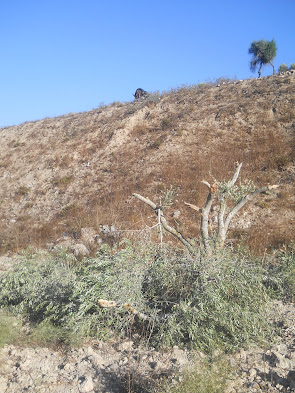 Located seven kilometers southwest of Nablus, Burin is the home to 3000 residents. From every position within the village you can see evidence of the Zionist occupation. Three of the most volatile settlements within the West Bank, Yitzhar, Bracha and Givat Arous reside on the hilltops of Burin. Yitzhar is the largest of the three settlements and was founded in 1984. Yitzhar consists of 1233 dunams and according to Peace Now, 35 per cent of the land is privately owned Palestinian land. The villagers in Burin are predominantly farmers and the fields that surround the village full of olives trees are testament to this. However, the land has been under threat since the start if the occupation in 1967.
Yitzhar settlement is notorious for its fanatically ideological residents, the violence they inflict on neighboring Palestinian communities, and the extremist doctrines they espouse. Settlers have frequently launched attacks with rocks, knives, guns and arson on Palestinian families and property in the area. In one of the most extreme act of terrorism students of the Yitzhar Od Yosef Hai yeshiva fired homemade rockets on Burin in 2008.
Despite West Banks settlements’ status as illegal under international law, Yitzhar was included in the Israeli governments’ recent “national priority map” as one of the settlements earmarked for financial support. Construction has continued unabated in both Yitzhar and Bracha. Yitzhar and Bracha also receives significant funding from American donations, tax-deductible under U.S. government tax breaks for ‘charitable’ institutions.
Related articles
- One year after killings: Iraq Burin continues its struggle (alethonews.wordpress.com)
- Sleepless nights in Burin (occupiedpalestine.wordpress.com)
- 8 injured as settlers stone bus carrying worshipers (alethonews.wordpress.com)
- Settlers of notorious illegal Yitzhar settlement destroy olive trees in Nablus village (occupiedpalestine.wordpress.com)
- Israeli Terrorist set fire to around 130 olive trees in a northern West Bank village (windowintopalestine.blogspot.com)
Hebron man walks down street for first time in years
September 10, 2012 | International Solidarity Movement, West Bank
 Hashem Azzeh in front of the graffiti on his door
Photos: EA Phelie Maguire
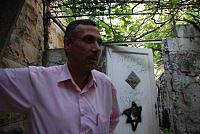
On Sunday 9th September, Hashem Azzeh walked down the street outside his house for the first time in years.
Hashem lives with his artist wife Nasreen and their four children (14, 9, 4 and 2 years old) on a hillside in the Tel Rumeida district of Hebron. The street outside Hashem’s house is barred to Palestinians and overseas visitors, with an army checkpoint at the end of the street to enforce the ban. To reach their house, the family have to go via a treacherous back route, clambering over walls and around other properties on the way.
Despite all the harassment and violence, Hashem remains determined to stay in his house, and today said he wanted ‘an adventure’. Hashem and five ISM volunteers from the UK, Italy and the USA clambered up from the house to the street, then walked the 200 or so metres to the checkpoint at the end of the street. The Israeli soldier at the checkpoint appeared astonished to see Hashem and international volunteers come along the street from the ‘wrong’ direction and immediately started radioing for back-up. When the soldier asked Hashem why he was walking on the street, Hashem replied, ‘I am walking to my house’.
Hashem’s family have faced years of harassment from residents of the illegal Israeli settlement on the hillside just above their house. The settlement happens to be home to some of the most fanatical settlers in Hebron, including American-born extremist Baruch Marzel.
Over the years, Hashem’s family have faced attacks on their property by settlers, with Israeli soldiers standing alongside doing nothing to intervene. Settlers have also poisoned his water supply, and killed his olive trees, fruit trees and vines. When Hashem installed his own water tank, the settlers shot it full of holes in yet another attack.
As well as attacks on their property, the family have faced regular physical violence. Hashem’s nephew had his teeth knocked out by rocks, and his brother was also smashed in the face with rock and suffered damage to his teeth and nose. Nasreen has had two miscarriages. An ISM activist, 77 year old Australian academic Mary Baxter, also faced violence in the past, when accompanying Hashem’s children to school in 2005. She and the children were attacked, and Mary had four bones in her back broken and is now disabled as a result.
Related articles
- Soldiers Physically Attack Palestinian Youth In Hebron (alethonews.wordpress.com)
- Hebron: Over 30 detained (alethonews.wordpress.com)
- Hebron: settler illegally enters Palestinian home (occupiedpalestine.wordpress.com)
- Hebron: Palestinian streets closed for Israeli settlers (alethonews.wordpress.com)
- French activist injured as Israeli troops attack Hebron (alethonews.wordpress.com)
- Jewish Settler’s Vehicle Rams Child in Hebron Hit and Run (alethonews.wordpress.com)
- Hebron: Settlers gas attack Palestinians, victim arrested and refused aid (occupiedpalestine.wordpress.com)
- Soldiers Kidnap Girl, Her 12-Year-Old Brother In Hebron (imemc.org)
Three injured from tear gas after settlers raid in Qusra
September 10, 2012 | International Solidarity Movement, West Bank
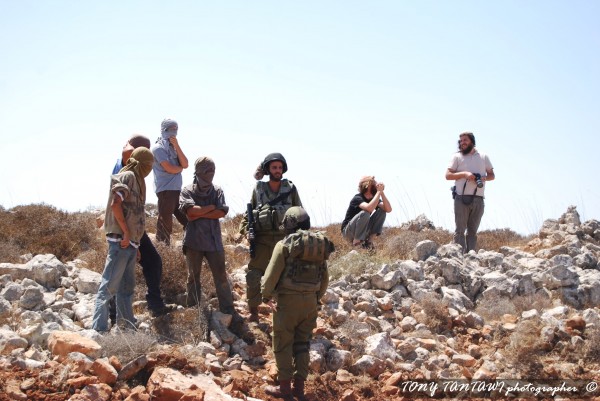
Settlers together with Israeli soldiers in Qusra. Picture from Tantawi Aljiniral
Three people were treated for injuries related to tear gas after an attack by illegal settlers in the village of Qusra near Nablus on Saturday night. The attack comes roughly a year after Qusra resident Issam Kamel Odeh, 33, died from Israeli gunfire after settlers invaded the village in September of 2011.
Shortly before six in the evening Saturday, five settlers came onto the land of Akram Taysir Daoud at the edge of Qusra village. Soon after, they began beating the man’s wife and yelling obscenities at his mother. Additional raiders arrived until there were a total of fourteen settlers on the land.
In an attempt to get help, Akram Taysir called the mayor of the town. The mayor alerted the people of the village to come to the farm, and then called both the local District Coordination Offices to report the attack.
The invading settlers sealed a well on the property with a large stone.
Israeli soldiers arrived at the village thirty minutes later. According to Abdel Ahrim, a resident who observed the event, soldiers began firing tear gas shortly after their arrival. Abdel Ahrim stated that soldiers fired 30 total tear gas bombs. Thirteen of these were fired directly into the house of Abdul Majid Towfeek, a resident of Qusra.
Abbdel Ahrim reported that the commanding officer told the mayor that if any of the villagers followed the soldiers over the hill, he would burn the village down.
Soldiers fired three times before leaving the immediate area of the conflagration.
According to Red Crescent workers, three people were treated for injuries related to tear gas, two for inhalation, and one for an injury he received when a canister hit him in the ankle.
This is the second invasion by settlers on the village of Qusra in as many days. Yesterday, settlers from the nearby illegal development of Aish Coddish came onto land belonging to the residents of Qusra village.
Photos of that incident show that they were armed with an M16 rifle.
At that time, officials from the occupation forces told the mayor of the town that the only recourse for the farmer involved was to go to the local Israeli-administered court and file a complaint against the settlers. This type of legal appeal requires the petitioner to either hold an Israeli identification card, or to hire a lawyer who holds an Israeli ID to file the complaint.
Related articles
- #PHOTOS | Settlers and soldiers attack village near Nablus, injuring 5. Torched trees. Killed sheep (occupiedpalestine.wordpress.com)
- Kufr Qaddoum: Israel fires at peaceful protest, man injured in head (alethonews.wordpress.com)
- With Protection from IDF Israeli Settlers Attack Unarmed Palestinians And Force Them Off their Land (windowintopalestine.blogspot.com)
American Democracy — The Funeral
alawson911 | September 8, 2012
Once again the interests of Israel take pride of place in American politics. This time at the Democratic Convention recently held in North Carolina, when the Mayor of Los Angeles decided to take it upon his ears, alone, to judge whether or not the delegates agreed with instating or reinstating a contentious piece of party policy which accepted Jerusalem as being the capital of Israel.
It really doesn’t matter who wins the upcoming Presidential Election. Either way the American people and the rest of the world will lose.
Related articles
- The Democrats’ Jerusalem Arithmetic (alethonews.wordpress.com)
The Democrats’ Jerusalem Arithmetic
By ALISON WEIR | CounterPunch | September 7, 2012
Not often is a political fix so public.
The Democratic committee that develops the party’s campaign platform recently failed to include the apparently obligatory “Jerusalem is and will remain the capital of Israel” pronouncement.
This statement, which is largely untrue and has a number of problems, had been part of previous platforms. Its omission caused an immense brouhaha, and party bigwigs decided that the ongoing Democratic National Convention needed to reinsert it.
The means was to be an amendment introduced on the convention floor, which required a two-thirds affirmative vote by delegates.
The bizarre sequence of events that followed was and remains in public view, thanks to C-span and YouTube videos (e.g. http://youtu.be/bjdj6K3yoR8 ). These clips are hilarious to view – if one likes tragicomedy.
The videos begin with Los Angeles Mayor Antonio Villaraigosa, the handpicked chairman of the convention, standing at the podium.
Villaraigosa calls on the Chair of the Platform Drafting Committee, former Ohio governor Ted Strickland. Strickland moves that the rules be suspended to permit an amendment to the platform.
This passes quickly, as many people clearly have no idea what’s going on. Strickland then introduces the required amendment, and it is immediately seconded.
Villaraigosa then says, in the normal Roberts Rules of Order rite: “Is there any further discussion. Hearing none, the matter requires a two-thirds vote in the affirmative. All those delegates in favor say “aye.”
There is a large “aye” vote.
He then says, “All those delegates opposed say no.”
There is a “no” vote that is at least as loud, perhaps a touch louder.
Villaraigosa then says, “In the opinion of the…” He suddenly stops, then says, “Let me do that again.”
Things are going wrong and Villaraigosa has no idea what to do. The motion has just been defeated, since it requires a two-thirds vote and it has clearly failed to get this. Nevertheless, Villaraigosa soldiers on.
“All of those delegates,” he begins, in the tones of a school master admonishing recalcitrant students, “in favor say ‘aye.”
There is a large “aye” vote.
Villaraigosa then says, “All those opposed say ‘no.’”
There is an equally large “no” vote.
Villaraigosa looks like a deer caught in the headlights. He gazes straight ahead and then from side to side, a foolish half smile fleetingly on his face. He starts to say, “I, um… I guess…” He gives his head a slight shake and looks behind him.
A woman official can be heard quietly telling him, “You’ve got to let them do what they’re gonna do.”
Villaraigosa announces, “I’ll do that one more time.”
Keep in mind that the amendment has already twice failed the two-thirds test. According to all rules of procedure the amendment has been rejected. Nevertheless, Villaraigosa says again, “All those delegates in favor say ‘aye.’”
There is a large “aye” vote.
Villaraigosa says: “All those delegates opposed say ‘no.’”
There is an equally large (in fact, it may be a slightly larger) “no” vote. The amendment has now been defeated three times. At minimum, half the delegates have rejected it.
Is Villaraigosa going to repeat this vote a fourth time… possibly all night until they finally get it right?
No. Perhaps someone has finally signaled to him to ignore the vote and simply read his lines. Or maybe he has figured this out for himself. By now, he has probably realized that his chances of being the next Obama have slipped through his fingers, thanks to uppity delegates who won’t get with the program.
He decrees: “In the opinion of the Chair, two thirds have voted in the affirmative [boos can be heard] and the platform has been amended as shown on the screen.” He thanks Strickland for his service.
Meanwhile, the boos increase in volume and begin to sweep the convention, while those in favor of the fix that just went through on national TV cheer loudly – apparently unconcerned that clear principles of fairness and proper procedure have just been flushed, in full public view, down the Democratic toilet, the alleged “people’s” party.
Some people might wonder why so many delegates went against their leaders’ wishes, creating what Republican spinmeisters are now casting as an “embarrassing” spectacle, suggesting that the Democratic Party contains numerous political extremists.
In point of fact, however, presidents from both parties, including George W. Bush, have sensibly opposed locating the U.S. embassy in Jerusalem, which Israel fanatics have long pushed.
There are a number of problems with the statement.
First of all, it’s inaccurate.
Despite the fact that Israel claims Jerusalem as its capital and has continued its decades-long expulsion of the Christians and Muslims who inhabited it for centuries, international law decrees that much of Jerusalem is occupied Palestinian land. (And many people, with substantial justification, consider that all of it is). Virtually all countries, including the U.S., locate their embassies in Tel Aviv.
Even the original 1947 UN partition recommendation, which Israel claims (fraudulently) as the legal foundation for its creation as a nation-state, called for Jerusalem to be an international city.
Second, it is widely understood that the wrong move concerning Jerusalem by the U.S. government would significantly reduce the chances of a peaceful settlement in the Israeli-Palestinian conflict, thus costing even more lives, while substantially increasing hostility toward the United States, causing considerable damage to both America’s security and economy.
Yet, all this seems to matter little to political operatives from both parties, who are either Israel partisans themselves or are focused on taking positions that will not alienate campaign donors.
Despite this omission on Jerusalem, many observers would have expected Israel partisans to have been extremely pleased with the Democratic platform. According to one of its Israel-partisan drafters, Robert Wexler, the platform was “100 percent pro-Israel.”
The platform writers, Wexler explained, simply wanted to especially focus on Israel’s (alleged) security needs concerning Iran.
In fact, a comparison with the Republican platform’s statements on Israel by the Washington Report on Middle East Affairs shows the Democratic platform to be for all intents and purposes identical. This is not surprising, given that Israelists dominate both parties.
This was not, however, good enough. According to the UK Guardian, there was “a mounting clamour from Jewish donors and pro-Israel groups [who] objected to the dropping of a line supporting Jerusalem as the capital of Israel from the Democratic policy platform.”
Accordingly, those who control the Democratic Party decided that an amendment would be added with the prescribed wording. They set about getting it, by hook or by crook. It turned out to be by the latter.
Is the Democratic convention debacle completely bad news?
It’s hard to say.
On the one hand, it’s deeply unpleasant to watch manipulation unfold, and obvious lies win the day. For anyone who believes that votes should be fair and processes honest, it’s disturbing to see the opposite take place in one of our country’s major institutions.
Considerably worse is the fact that it’s this kind of political corruption that contributes to the extraordinarily small voter turnout of our citizens.
A democracy requires its citizens to participate in the process. When people see there is no point, they stop. That, of course, leaves a vacuum that is eagerly filled by the ruthless and unprincipled, who caused the problem in the first place.
In 1787, following the Constitutional Convention, Benjamin Franklin said that the months-long, hard-fought convention had given us “a republic, if you can keep it.” Villaraigosa and those who tell him what to do – and the rest who go along – are grinding this under foot.
But it’s not all bad news.
The reality is that at least half the delegates at this extremely mainstream convention – full of party loyalists who usually toe the party line – did not go along with the Israel Lobby agenda.
And while videos of the event focused almost entirely on close-ups of dissenters of Arab ethnicity, suggesting that this was an ethnic position, the vast majority of those opposed to the amendment had no such ethnic connection and were from all over the United States.
While the media, both liberal and conservative, consistently give us Israel-centric coverage, and while party bosses make it clear that favoring Israel uber alles is the way to get ahead, at least half the delegates rebelled.
Of course, this was a small, ultimately unsuccessful uprising. Nevertheless, I think it is an indication that the tide has slowed and may start to turn.
In fact, I believe an uprising in the United States may be coming.
People are tired of wars and killing, and of being sold a pack of goods by both parties using lies, deception, and manipulation.
We’re tired of power brokers running roughshod over what we want.
We’re tired of “alternative” institutions such as MoveOn that enable the charade, and of candidate puppets of “change” who continue cruel policies while spouting high-minded words that they hope will hide their unconscionable actions.
We’re tired of scripted conventions, of bullying special interests, of lying politicians, of manipulative media, and of partisan politics that set us against one another, in which both sides push falsehoods about the other, and about themselves.
We’re tired of pretend democracy.
More and more of us are demanding real change, not computer generated simulations. Instead of responding by refusing to vote, and thus forfeiting this life-and-death game, many of us are going to cast votes that will displease those used to running things.
And if in this election we choose to “throw our votes away,” as party cheerleaders scornfully call it, on candidates who would end our serial, suicidal wars and stop the killing of children – thus saving the lives of our own as well – then I feel we will have a shot at a future election in which we aren’t once again expected to choose between a proven war criminal and a competitor who might, astonishingly enough, be even worse.
Instead of throwing our votes away, I believe we will have started the process of throwing the bums out – this time for real. And of keeping our republic, or our democracy, whichever you choose to call it.
Alison Weir is President of the Council for the National Interest and Executive Director of If Americans Knew.
Welcome to Nazareth
By Jonathan Cook | AMEU | September 2012
 Until a few years ago, the only road northwards from central Israel to Nazareth rose from the fertile fields of the Jezreel Valley to wend its way steeply up the craggy face of a hill in the Lower Galilee range, following what must have once been a goat-herders’ path.
The crawl upwards—often behind a tourist coach or a truck—provided plenty of time to admire a dramatic outcrop of rock known as Mount Precipice, the spot where, according to Christian tradition, the townsfolk of ancient Nazareth tried to hurl a young Jesus to his death after he proclaimed himself the son of God. Locals refer to the place in Arabic as “Jebel Kufze,” or “Jumping Hill,” alluding to what was possibly Jesus’ first miracle. He is said to have leapt to safety as he was pushed over the precipice.
For millenia, Jebel Kufze hid a secret. At its foot, close to where Jesus might have been dashed on the rocks had he not “jumped,” a cave was discovered by Franciscan monks in the 1960s. Excavations over the next decade identified human remains dating back possibly 100,000 years. At the time, so-called Kufze Man was our oldest ancestor ever unearthed.
But even Jebel Kufze, so rich in human and sacred significance, had no defense against the needs of a modern state, especially one whose officials have little or no sympathy with Christianity. Shortly after I moved to Nazareth in 2001, bulldozers and diggers moved in to tear out the lower southern flank of Mount Precipice, the deep scar eventually stopping just short of the Kufze Cave. A bridge on stilts was built up from the Jezreel Valley’s floor to what was left of the mount’s lower slope, and there engineers blasted a hole through the rock to create a tunnel.
The old “goat road” became a little-used scenic route to Nazareth. Meanwhile, the bridge and tunnel, which opened in 2008, needed a name. The list of candidates should have been long. It could have made reference to humankind’s forebears interred nearby; or to the miracle that averted the untimely death of a man in whose name a global religion was founded; or any of the subsequent Nazarenes who made a more limited mark on their city and the Galilee, such as Tawfik Ziyad, a mayor in the 1970s and 1980s whose “poetry of protest” still inspires Palestinians. But none were chosen.
Instead, government officials held discussions behind closed doors. The first we in Nazareth knew was when a sign appeared a short distance before the tunnel, naming the new route the “Rafael Eitan Bridge,” after a famous general. Nazarenes were not consulted for good reason; their vehement opposition was assured.
The tenuous justification for the road’s name was that Eitan had been born in the Jezreel Valley, in a kibbutz (farming cooperative) called Tel Adashim. But Eitan’s fame derived not from his connection to the Lower Galilee or Nazareth, today the largest Arab city in Israel and the effective capital of the 1.4 million Palestinians who have citizenship inside the state.
He made his name first as a hawkish military chief of staff and then as a politician who was always ready to voice his visceral hatred of Palestinians and Arabs. In the early 1980s, he established a far-right party, Tzomet—an ideological forerunner of current foreign minister Avigdor Lieberman’s Yisrael Beiteinu party—and enthusiastically advocated settlement building. He is best known for stating: “When we have settled the land, all the Arabs will be able to do about it will be to scurry around like drugged cockroaches in a bottle.”
Outside observers have assumed that Eitan was offering a policy prescription for the occupied territories. However, Palestinians inside Israel, much better and longer acquainted with Zionist politics, understood this declaration to refer to Palestinians wherever they were found, including in the Galilee. On another occasion, Eitan outlined his party’s platform: “We declare openly that the Arabs have no right to settle on even one centimeter of Eretz Israel. …Force is all they do, or ever will, understand. We shall use the ultimate force until the Palestinians come crawling to us on all fours.”
There could have hardly been a more succinct exposition of the logic of a central plank of Zionist policy known as “Judaization.” Long before Israel began building settlements in the West Bank, Gaza and East Jerusalem, its strategic planners were devising similar methods to contain, fragment and control the dozens of Palestinian communities whose inhabitants had not been chased out of the new state in 1948. The goal was to turn these towns and villages into figurative “bottles” and transform their Palestinian inhabitants—a fifth of the population—into “drugged cockroaches,” who would docilely accept their inferior status in a self-proclaimed Jewish state.
Judaizing Nazareth
One of the very first targets for Judaization was Nazareth. The city, unlike most other Palestinian communities, had emerged relatively unscathed from the year-long bloodshed of the 1948 war. The newly declared state of Israel, still awaiting recognition from the United Nations, worried about a potential backlash from the international community, and especially the Vatican, if Nazareth were seriously attacked. So the city was left largely in peace as Israel’s armed forces swept northwards towards the Lebanese and Syrian borders.
By the end of the war, hundreds of Palestinian villages—the overwhelming majority—had been destroyed, and their inhabitants, some 750,000, expelled. Only 150,000 Palestinians remained. Palestine’s once-great cities inside the new borders, such as Jaffa, Haifa and Lod, were almost emptied, later to be misleadingly termed “mixed cities”: cities of Jewish immigrants that accommodated an adjoining ghetto of Palestinian casual laborers to build homes for the waves of new arrivals.
Nazareth found itself transformed twice-over by the war. A town of 13,000 more than doubled in size over the course of a few months as 15,000 refugees from nearby villages poured in seeking sanctuary from the Israeli army. And, with other cities vanquished inside the new state of Israel, Nazareth unexpectedly found itself the only urban Palestinian space to have survived.
Swollen with refugees and in a position to become the political and cultural capital of the Palestinians inside Israel, the city attracted the sustained attention of Israel’s military and political leadership.
Like all Israel’s Palestinian citizens in the aftermath of 1948, Nazarenes lived for two decades under military rule. To leave the city for work, or to attend a wedding or funeral, or simply to reach their fields, Nazarenes had to apply for a permit from a military governor—much as Palestinians in the West Bank today find their lives controlled by Israeli military rulers known as the Civil Administration. As in the occupied territories, such permits were issued at a high price, requiring Palestinians to inform and collaborate in return for the privilege of free movement.
In these circumstances, it was easy for the government in 1953 to confiscate 1,900 dunams (a dunam is a quarter of an acre) of Nazareth’s farmland to the west of the city, which Nazarenes relied on both for income and as a land reserve for future development and expansion.
Such expropriations would become a staple of life over the next three decades as more than 70 per cent of the land belonging to Palestinian communities in Israel was nationalized by the state for the benefit not of its citizens but of Jewry worldwide. Today the state owns 93 per cent of the land, with 2 per cent left under the control of Arab municipalities.
Officially, Nazareth’s land was taken for “public purposes”—in this case, building new government offices for the Galilee. But the city’s inhabitants could not be persuaded that the authorities needed such a vast area for a few buildings. When rumors spread that the government was secretly planning to build a suburb of Jewish homes there, Nazareth petitioned the High Court for the land to be returned.
The judges issued a ruling in 1955, accepting the government’s claim. The following year work began not only on a government complex but also on a residential area. Initially these homes were characterised simply as a “Jewish neighborhood” of Nazareth. The neighborhood grew so fast that by 1960 the government was able to redraw the boundaries and declare it a new city called Nazareth Ilit. “Ilit” denotes in Hebrew both a physical elevation (upper) and a moral superiority (better).
The need for Upper Nazareth—as well as two other “Judaization” cities nearby, Karmiel and Migdal Haemek—had been decided upon by David Ben Gurion, the country’s first prime minister, following his travels around northern Israel in the early 1950s. Afterwards, he was reported saying anxiously: “Whoever tours the Galilee gets the feeling it is not part of Israel.”
The United Nations had assigned the Galilee to the Arab state under the 1947 Partition Plan, and Ben Gurion was disturbed at the continuing solid majority of Palestinians there. More specifically, he worried that Israel’s conquest of the northern region might yet be reversed through an alliance of subversive elements within the local Palestinian population and the neighboring Arab states.
According to Geremy Forman, a British historian, the army’s planning director, Yuval Ne’eman, believed that the new Jewish city would send a message generally to Palestinians in the north. It would “emphasize and safeguard the Jewish character of the Galilee as a whole and … demonstrate state sovereignty to the Arab population more than any other settlement operation.”
The northern military governor, Mikhael Mikhael, admitted that Upper Nazareth also had a more specific goal. It was designed to “swallow up” Nazareth through the “growth of the Jewish population around a hard-core group” and thereby ensure the “transfer of the center of gravity of life from Nazareth” to Upper Nazareth.
In other words, the vision of Israel’s leaders was to turn Arab Nazareth into a ghetto suburb of Jewish Upper Nazareth, along the lines of the mixed cities. How to achieve this has exercised both military and civilian planners ever since.
The first task was to de-develop Nazareth. During the British Mandate, the city had been the administrative capital of the Galilee, but Israeli officials worked swiftly and systematically to weaken Nazareth in relation to its small, upstart neighbour. They began by transferring the government office complex and a district courthouse to Upper Nazareth.
The fortress-like court building also served a symbolic purpose: poised on a bluff directly above Nazareth, it was visible from everywhere in the city, giving the appearance of a watch-tower to spy on the Arab population below. The effect was more menacing at night, when it was illuminated. (The observation and monitoring of Palestinian populations is central to the idea of Zionist settlement, both in the West Bank and the Galilee, where homes are located on the tops of hills. Many such communities in the Galilee are known as “mitzpim,”or look-outs.)
Next, officials used planning as a weapon to suffocate the city of land and income. Sixty-four years after Israel’s establishment, Nazareth has a development area no different from the one in 1948: 14,000 dunams. With a population that has grown to 80,000 in the meantime, the city has been starved of land for housing, industry and recreation. Upper Nazareth, by contrast, has been expanding its municipal boundaries relentlessly, always at the expense of Nazareth or surrounding Arab villages.
Amira Hass, an Israeli reporter, recently explained the character of Israel’s control over the occupied West Bank: “We dominate the expanse … we develop master plans for Jews and construction prohibitions for Palestinians. Colonies [Jewish settlements] combined with discrimination have created those scattered stains on the map, known as the Palestinian enclaves (bantustans, in another language). … For the Palestinians there is separation, isolation, concentration and a stranglehold.”
Upper Nazareth was the template for these later settlements. Aerial maps show the Jewish city’s borders twisting and turning as they carve out areas for homes, industrial areas, nature reserves and green belt. A series of tentacles have been produced that have engulfed Nazareth and the surrounding Arab villages, restricting their expansion and development and severing each Arab community from the other.
Had Upper Nazareth not been built, planning and demographic logic would have required that Nazareth become the heart of a conurbation that would have incorporated half a dozen adjacent villages—Yafa, Reine, Kana, Mashhad, Ein Mahel and Iksal—comprising in total nearly 200,000 Palestinian citizens.
That would have transformed Nazareth into the true capital of Israel’s Palestinian minority, a center for their political, intellectual, business and cultural life. Instead, Nazareth became, as one neighbour told me shortly after my arrival, “the largest Arab village in Israel,” disconnected from all the other, smaller villages nearby.
Upper Nazareth, meanwhile, grew relentlessly. Today, it has a population of 42,000, and a huge municipal area of 48,000 dunams. Or, in other words, Upper Nazareth has just over half of Nazareth’s population but nearly four times more land.
The extra land has been put to good use. Upper Nazareth has an extensive industrial area that provides not only jobs but also raises substantial business rates for the city. Nazareth, by contrast, has two tiny industrial zones: a dozen private carpentry workshops in the Old City and a “garage area” of car repair workshops.
That said, Nazareth has a few privileges not afforded to any other Arab community in Israel, mostly due to its historic importance. As a result, a Palestinian middle class has emerged that flaunts its wealth—not least in its choice of luxury cars that coast around the city center—often concealing from visitors the terrible poverty to be found in its suburbs.
For starters, it has the only hospitals—three of them—in an Arab locale, all founded privately by international church-based medical charities before Israel’s creation. Medical specialists and lawyers have also set up their offices in Nazareth, serving the Galilee’s Palestinian population.
The city is home too to the only major Arab company in Israel, Nazarene Tours, which, paradoxically, has benefited from the very racism that was intended to keep Jewish and Arab citizens apart. The transport company prospered after 1948 only because Israel needed a separate bus service to link Arab communities in the Galilee. The state-owned transport company, Egged, could then safely ignore these towns and villages as it restricted itself to connecting Jewish communities.
Over the past two decades, as Israel’s economy partially globalized, Nazarene Tours has launched new divisions, including in international travel agency, hotelry and the development of transport technology. It has also won tenders against international rivals as Israel outsourced some of Egged’s routes.
A recent, though minor, success, achieved over opposition from the state, has occurred in higher education. Nazareth has been lobbying unsuccessfully for decades to host a university. That there is demand for a university teaching in Arabic rather than Hebrew is undisputed. Arab students are heavily under-represented in higher education, and shocking recent figures show that a third of those who are at university now travel to Jordan to study, a reflection of the many obstacles Israel puts in their way.
Although Nazareth still lacks a university, a first hesitant step was taken in 2009 when Israel’s Higher Education Council reluctantly recognized a more limited “Academic Institute” in the city, which awards degrees in chemistry and communications to a handful of students each year.
The institute is a pale imitation of the university so long dreamt of by Nazareth. Its recognition has been dependent on its promoting itself as a “coexistence institution”: much of the coursework is in Hebrew; nearly half the staff are Israeli Jews, as are many on its board of directors; and students are required to attend a compulsory “peace studies” course. All of this is presumably designed to counter any nationalist impulse that might be encouraged by studying in an Arab city.
The Higher Education Council agreed to recognise the institute only if it committed itself to not seek public funds. Israel has so far refused to reverse that decision, despite pressure from the Organisation of Economic Cooperation and Development (OECD), a club of the world’s wealthiest nations that Israel acceded to in 2010. Following an OECD meeting at which the issue was raised, Raed Mualem, the institute’s vice-president, said: “The participants … couldn’t understand how come six colleges in the area [the Galilee] get state support, while the only institute that doesn’t get state support is the one located in the largest Arab city.”
Nazareth is also soon to benefit from a new private hi-tech industrial park, the brainchild of Stef Wertheimer, a billionaire industrialist. Wertheimer, who has established half a dozen such parks previously in Jewish communities, has apparently heeded the OECD officials who have been railing against Israel’s long-standing exclusion of qualified Palestinian citizens from most of the economy. A poll in 2010 found that 83 per cent of Israeli businesses in the main professions admitted being opposed to hiring Arab graduates. That explains why 15,000 are unemployed or in low-skilled jobs.
Wertheimer, it seems, is hoping to make use of this large pool of untapped talent. Yossi Cohen, director of a hi-tech training program in Nazareth, told the Israeli media recently that, of 84,000 jobs in Israel’s hi-tech industries, only 500 had been filled by Arabs. In familiar vein, Wertheimer has framed the venture as a coexistence initiative, bringing Jews and Arabs together. But the billionaire has struggled to conceal his own prejudices. Justifying the coexistence philosophy behind his park, he said: “When people work together, they have no time for nonsense. They’re too tired at night to commit terrorist acts.”
Despite these welcome private initiatives, the government’s influence has been consistently, and cynically, malign. Israeli officials no longer speak of “Judaization”—the term sounds too racist. Now they talk of “developing the Negev and the Galilee,” the two regions with heavy Palestinian populations. There is even a Minister for Development of the Negev and Galilee.
But in case there is any misunderstanding about what the ministry means by “development,” one need only look at its priorities. A study published in March 2012 found that, of an annual budget of $45 million, not a single cent was earmarked for the Arab population. Instead, most of the funds are directed at a program initiated by the government in 2009 to attract 600,000 Jews to the two regions by 2020. They will be offered tax breaks and heavily discounted land, while businesses are given incentives to relocate.
Each municipality in Israel has three potential sources of income: a local tax on residents, business and commercial taxes, and a balancing grant from the central government. No community can rely solely on income from its residents, least of all Arab towns and villages where poverty rates are three times higher than in Jewish areas.
A study in 2009 by Ben Gurion University in Beersheva revealed that, measured as a percentage of income, families in Arab communities paid a local tax rate 50 per cent higher than families in Jewish communities. The reason was both that Arab families were much poorer and that their municipalities had little other income to rely on because they lacked land for industrial and commercial zones.
None of this is remotely by accident. Several large state institutions have been built inside Nazareth, for example, and yet the income from them, which amounts to many hundreds of thousands of dollars each year, ends up in the coffers of Upper Nazareth. How is that possible?
It works this way. A complex of buildings located just inside Nazareth’s municipal borders that includes the local Interior Ministry office and the district courthouse was simply transferred by the government to Upper Nazareth. Similarly, a now-defunct military base, covering 100 dunams, sits as a Jewish enclave in the middle of a residential area of Nazareth, after it was assigned to Upper Nazareth in the 1970s on “security grounds.” The base closed several years ago but the site also includes a hotel, whose revenues accrue to Upper Nazareth. Nazareth’s demands for the return of the land so that it can develop housing and a commercial center there have been repeatedly ignored.
This is a pattern reflected across the country, according to a survey in 2010 by a Nazareth research center, Dirasat. It found that Arab local authorities received a minuscule 0.2 per cent of the local taxes paid by government institutions. Almost everything went to Jewish communities instead.
Upper Nazareth, despite benefiting from its own large industrial zone, was also assigned in the early 1990s an additional substantial industrial park—some distance outside its municipal borders—on 7,500 dunams confiscated from the Arab villages of Mashhad and Kana.
The Tzipporit industrial zone includes some of the country’s most polluting industries, close to the villages’ homes. In 2010, after years of campaigning, the residents finally managed to get an aluminum plant there closed. One resident of Mashhad, where cancer rates are reported to have risen dramatically, observed: “We get all the pollution while Upper Nazareth gets all the financial benefits.”
Another survey has found that an average Jewish municipality receives nearly five times more in city taxes than an Arab municipality. Such a stark imbalance should be addressed by the central government’s balancing grant, which is supposed to ensure that the poorest local authorities can still provide essential services. But research also shows that, despite Arab municipalities being much poorer than Jewish ones—in fact, two-thirds are effectively bankrupt—they typically get only a third of the grant received by Jewish municipalities.
Pilgrims Make Hasty Progress
In 2009 Nazareth hosted possibly the world’s most famous pilgrim. During his tour of the Holy Land, Pope Benedict XVI decided he would stage his main mass on Mount Precipice, with the proceedings broadcast live to a global audience. The venue was an open-air amphitheater that had been intended for the visit in Easter 2000 of his predecessor, Pope John Paul II, but was never completed.
The original plan had been to use the amphitheater not only for John Paul II but as the stage for famous rock bands to welcome in the millennium in the city of the Annunciation where—as Nazareth’s official slogan states—“it all began”: the Archangel Gabriel’s revelation to Mary that she was carrying the son of God launched 2,000 years of Christian history. Television deals, it was hoped, would ensure the world’s eyes were turned to Nazareth on the eve of the year 2000.
Prime Minister Yitzhak Rabin, riding a wave of international approbation surrounding the Oslo accords in the early 1990s, agreed to release massive funds to Nazareth for the first time in the country’s history. The “Nazareth 2000” project included money for the amphitheater; a makeover of the Old City, where several churches, including the Basilica of the Annunciation, are located; and the city’s upgrading to “Development Zone A,” priority status to encourage new investment, especially in hotels.
Nazareth’s tourism officials recall that this sudden about-turn in government policy was prompted mostly by a fear that sustained media coverage for the millennium and the Pope’s visit a few months later might highlight quite what a shambolic state the city was in.
People who have never visited Nazareth might assume that it ranks as one of the great tourism cities, and that it benefits from the revenues generated by so many visitors. They would be mistaken, however. Certainly, Nazareth attracts a large number of visitors each year, but very few of them spend any time or money in the city. The reason is that tourism to Nazareth, as well as the occupied Christian holy sites in East Jerusalem and Bethlehem, has been almost exclusively controlled by Israeli Jewish travel agents and tour operators for decades.
This control extends even to the tour guides themselves. The Israeli tourism ministry licenses all guides, and their permits can be revoked if they mention “political” issues. Which is why so many tourists and pilgrims leave the region without ever hearing the word “occupation” uttered.
A few years ago, the Israeli parliament tried to pass a law barring Palestinians from acting as tour guides in case they presented Israel in bad light. But in reality the law was entirely superfluous. Tour guides have been cowed into silence on “political” matters, fully aware that, should their comments be relayed back to the tour organizers, they will lose their jobs.
I have experienced this at first-hand on more than one occasion. For example, I remember joining a group of Danish students on their coach as they headed out of Nazareth to visit the destroyed Palestinian village of Saffuriya nearby, now a Jewish rural community renamed Tzippori. The Palestinian village’s thousands of inhabitants were forced out in 1948 as Israel used for the first time its fledgling air force to bomb Saffuriya’s homes. Today the ruins are covered by a forest planted by an international Zionist charity, the Jewish National Fund.
I asked the coach driver, an Israeli Jew, to take us through a neighbourhood of Nazareth known as Safafra, established in the 1950s by Saffuriyans who fled to Nazareth rather than Lebanon and Syria. Today it still looks much like a refugee camp. As I explained Safafra’s story over the microphone, the driver interrupted. “What’s your ID number?” he demanded angrily. Assuming I was a registered tour guide, he intended to get my permit revoked.
This suffocating grip on tourism to the Holy Land means that Nazareth has been almost entirely marginalized in the typical pilgrim’s schedule. Those arriving on an organized tour, as most do, are shepherded to Mizra, a Jewish community in the Jezreel Valley, where they have lunch in a canteen. Then they are dropped close to the Basilica in Nazareth and told to follow the guide directly to the church. From their often anxious expressions, it seems that they are warned not to talk to the natives. They then head back to the waiting coach and drive straight off to Tiberias. The vast majority stay in the city for less than an hour, and rarely buy even a bottle of water.
Why do almost all of them stay in Tiberias, on the Sea of Galilee, which unlike Nazareth suffers from uncomfortably high levels of humidity through much of the year? Because Israel awarded the Jewish city “Development Zone A” status back in the 1950s. Investors poured money into hotel-building, while Nazareth, which was denied such status, had to rely on a few established pilgrim hostels. Later in the 1970s, Upper Nazareth gained “Zone A” status. As a result, the Plaza, the first modern hotel serving tourists to Nazareth, was built not in the holy city but just inside Upper Nazareth.
Rabin, however, accepted that the neglect of Nazareth could not continue indefinitely. Work began on building the amphitheater; the Old City, which included Nazareth’s lively souq (market), was closed for renovations; and developers started to erect a handful of large hotels.
In the mid-1990s Nazarenes thought a corner was finally being turned in Jewish-Arab relations. That explains why in Ula Tabari’s “Private Investigation,” a documentary covering that period, some Nazarenes can be seen enthusiastically waving the Israeli flag—with the exclusionary Star of David symbol at its center—on what Israeli Jews call their Independence Day, and Palestinians refer to as the Nakba, or the “catastrophe” of their dispossession in 1948.
The mood of optimism would soon sour, however. Rabin was assassinated in 1995, and elections a year later brought the right-wing Benjamin Netanyahu to power. He immediately pulled the plug on the amphitheater, apparently concerned that Israel would be represented by a non-Jewish city for the millennium celebrations.
The renovations of the Old City continued, though on a reduced budget. All these years later, traders in the old market have not a good word to say about the project. Much of the Old City was turned into a no-go area for several years while the narrow alleys were paved, pipes were installed to stop the winter flooding that caused sewage to run down the streets, and shop fronts were torn out so that they could be replaced with standardized green shutters.
What old-world charm the market possessed was largely excised, but much of the ramshackle infrastructure of the Old City remained, including the eyesore of dozens of crisscrossing electricity and telephone cables strung across each alley.
But worst for the traders was the Old City’s extended closure. The market had attracted not only Nazarenes but shoppers from across the Galilee, including many Israeli Jews who came on the Sabbath, when Jewish communities shut down for the weekend. All were now redirected to a “temporary” market in Upper Nazareth, next to the ring road that marks the border between the two cities.
When the Old City reopened, its customers did not return. The temporary market continued to operate and Nazareth’s market never recovered. The municipality lost yet more of its already meagre income from the relocation of local businesses.
Christians vs. Muslims
Pope John Paul II’s impending visit had another negative consequence for Nazareth, one that is being felt to this day. As the city geared up for the celebrations, some inhabitants started to feel aggrieved.
It is often mistakenly assumed that Nazareth is a Christian-majority city; in fact, two-thirds of the population is Muslim. This is, in part, a legacy of the massive demographic dislocation of 1948, when refugees flooded into the city from nearby Arab villages. But Nazareth also has a long-standing Muslim community that has lived peacefully alongside Christian neighbors for hundreds of years.
The Nazareth 2000 project entirely ignored the city’s Muslims. The more that local Christians readied for their celebrations, and state funds were directed their way, the more it underscored to some Muslims the historic injustice that had been perpetrated against them by their state.
As already mentioned, Israel had been fearful of antagonizing world opinion by attacking Nazareth during the 1948 war. Afterwards, it left the churches and their extensive holdings in the city untouched. The Muslim community was treated very differently.
Before Israel’s creation, pious Muslims often bequeathed part of their property, land or wealth to an Islamic endowment called the Waqf. There it was used for the community’s benefit: to build and maintain mosques, schools, orphanages, cemeteries, community centers and so on. Although the Waqf was run locally, it had been nominally overseen by the Ottoman—and Islamic—rulers of the region for hundreds of years.
Assuming the Ottoman role, Israel assigned itself not only sovereignty over all the Waqf land and property but also the right to confiscate most of it for “public purposes”—meaning, as we have already seen, for the benefit of the Jewish community. Muslims were effectively left with little more than the mosques and cemeteries that were in use in 1948 in the towns and villages that survived the wave of destruction. Everything else was lost.
The wound of that assault on their rights is still to heal. And the Nazareth 2000 project felt to some like a blatant attempt to rub in yet more salt.
The response was not long coming. When in the mid-1990s the municipality demolished a disused school in front of the Basilica to create a tourist plaza, a small group of Muslims occupied the vacant lot and declared it Waqf land. They based their claim on the fact that a small tomb close by was dedicated to Shihab a-Din, a nephew of Salah a-Din, the nemesis of the Crusaders. They proposed building a huge mosque at the site, one that would overshadow the Basilica and serve as a symbolic challenge to the dominance of the Church and by extension local Christians.
Tempers quickly flared. Muslims pointed out that they were the majority but, unlike the Christians, lacked land in Nazareth to build holy places. The city’s leaders and the Christian community regarded the Shihab a-Din mosque, as it became known, as a thinly veiled effort to sabotage Nazareth 2000 and fuel sectarian divisions.
The Israeli government intervened by setting up two ministerial committees to investigate the rival claims. Strangely, the committees sided for the first time with the Muslim community and its claim to Waqf land. The government supported building the new mosque, although it required that the scale be reduced. In Easter 1999, clashes erupted between groups of Christians and Muslims.
The street fighting received plenty of coverage in the international media. A view shared by city leaders on both sides of the religious divide was that Israel was intentionally stirring the pot. One told me: “Israel has a vested interest in provoking a feud. That will suggest to the world that Christians and Muslims cannot live together and that only Israel can secure peace. If that message is accepted, then Israel bolsters its claim to being the guardian of the holy places, and most importantly those in Jerusalem. That’s what this is all about.”
I arrived in Nazareth a year after Pope John Paul II’s visit in spring 2000. Other events, which we shall turn to in a minute, had taken the edge off the Shihab a-Din dispute. A permanent contingent of Muslims had taken over the square, scattering prayer rugs across it. Christians had become largely resigned to the construction of a modest mosque at the site.
But, in a reversion to type, the Israeli government stalled on granting planning permission. The Muslim faithful who guarded the site became impatient and in early 2003 they started to build the mosque’s foundations without approval.
For several months nothing happened. But at sunrise one day in July, I was slowly roused from my sleep by an insistent drone that, in my half-dream state, I mistook at first for an annoying fly hovering close by. But gradually I became aware that the noise was in fact emanating from helicopters circling low overhead. I dressed and followed others out of the Old City and towards the Basilica.
There, I found hundreds of police, some heavily armed, stationed on the roads in every direction around the church. The city center was under siege. With no warning, bulldozers had moved into the square to demolish the beginnings of the mosque. It was an operation that lasted a few hours, though armed police cordoned off the area for days more.
Later, the Israeli media reported on the chain of events leading to the destruction. When the Pope learnt that the mosque’s foundations had been laid, he complained to the U.S. President, George W Bush, who in turn called Ariel Sharon to order the building razed.
The story did not end there, however. The square was fenced off with corrugated iron sheeting as the Housing Ministry worked to establish a public park inside. When its handiwork was unveiled in 2006, Nazarenes were astonished to see that at its center there was the metal skeleton of a small mosque, complete with a dome and painted in green – the colour of Islam.
Within days a group of Shihab a-Din activists congregated under the dome and placed prayer rugs on the floor. The police moved them off, but after a few weeks of cat-and-mouse an unofficial compromise was reached in which the group was allowed to use the square to stage the main sermon of the week, each Friday at noon.
The bitterness, however, grew for a core of activists. According to Nazareth officials, the Israeli security services, especially the notorious Shin Bet, which operates collaborators in both Israel and the occupied territories, had assiduously cultivated relations with the Shihab a-Din activists in the 1990s, when the mosque project had government backing. A degree of support seemed to continue. Muslims put up large provocative banners in the square, confronting tourists as they headed from their coaches to the Basilica. One warned: “And whoever seeks a religion other than Islam, it will never be accepted of him, and in the Hereafter he will be one of the losers.”
Three years later the signs are still there, even though erecting them in a public place is illegal without approval from the police.
The banners first appeared a few weeks before the arrival of Pope Benedict XVI in May 2009. His predecessor, John Paul II, had captured many Nazarenes’ hearts with a slow procession down the main street in his Popemobile shaking hands with locals as he made his way to the Basilica. The city assumed Benedict would do likewise. Thousands of residents, Christians and Muslims alike, lined the same route to greet him after his mass on Mount Precipice.
But after hours of waiting, the police finally urged the crowds to go home. The Pope had earlier been smuggled into the church in a Mercedes with blacked-out windows. He had been advised by the Shin Bet that it would not be safe for him to meet the local people.
For Nazarenes, that moment encapsulated the extent of Israel’s control over their city. Under Israeli guidance, the Pope had avoided meeting them, just as they were shunned by the hundeds of thousands of pilgrims who visit the city each year; and he had preferred to entrust his safety to Israel rather than his own flock in Nazareth. It felt like the ultimate betrayal.
Almost inevitably, Israel’s meddling over the Shihab a-Din affair resulted in what security experts like to term “blowback”. In 2010, a small cell of Muslims connected to the mosque were accused of murdering a Jewish taxi driver and evidence emerged that some had sought training at an al-Qaeda camp in Somalia. In April 2012, the mosque’s sheikh, Nazem Abu Salim, was convicted of “incitement to terrorism” and support for a terrorist organisation.
The ‘Enemy’ Next Door
The tunnel that cut a swath through the foot of Mount Precipice was built for a reason—and it had nothing to do with improving journey times to Nazareth, either for the city’s inhabitants or for the tourists.
The plan for the tunnel road had emerged in the immediate aftermath of what became known as the October 2000 events, in which 12 Palestinian citizens and a laborer from Gaza were shot dead by Israeli police in the Galilee at the start of the second intifada. Hundreds more were seriously wounded.
In Nazareth, where three people were killed over the course of events, the police initiated the violence by opening fire with rubber bullets on demonstrators staging a peaceful march from the Salam mosque down the main street. They were protesting the killing the day before of Mohammad al-Durra, a 12-year-old boy whose death under a hail of Israeli bullets in Gaza had been repeatedly shown on Arabic satellite channels.
Youths erected barricades in the center of Nazareth and threw stones at police. The police responded with live fire, killing a young man and wounding dozens more. In other areas, Palestinian youth burned tires on roads in anger at the mounting death toll. After two days of clashes, Palestinians in the Galilee were stunned into submission by the ferocity of the police onslaught.
One evening several days later, Nazarenes in the eastern neighborhood—on the slope below Upper Nazareth – heard a call over the local mosque’s loudspeaker to defend the city against an attack by residents from the neighboring Jewish city.
A large crowd from Upper Nazareth, which included armed off-duty policemen, had crossed over the ring road and was making its way into Nazareth. A tense stand-off ensued, as on-duty police held the line between the two sides. One participant noted: “It was clear where the police’s sympathies lay. We were under attack and yet the police faced off with us and had their backs to the invaders from Upper Nazareth.”
After lengthy negotiations, the crowd from Nazareth agreed to leave first. As they headed downhill, they were sprayed with automatic fire; two Nazarenes were killed with shots to the back of their heads. The police shooters, it later emerged, were stationed on the tall court building that overlooks Nazareth.
I moved to Nazareth from my journalist’s job in London a short time afterwards to investigate these events and write a book about them, which I completed in 2005 under the title “Blood and Religion.” It was clear to me that there had been a shoot-to-kill policy, a finding that was partially confirmed by a judicial commission of inquiry. It concluded that institutionally the police regarded the country’s Palestinian minority as “an enemy.”
Despite the commission’s disturbing findings, Israeli Jews, including politicians and the police, were wedded to their racist conception of their Palestinian compatriots. Officials drew a paranoid conclusion from the October 2000 events: Jewish communities in the Galilee like Upper Nazareth must never be as vulnerable again to the “internal Palestinian enemy.”
The tunnel road, points out Mohammad Zeidan, head of the Human Rights Association in Nazareth, was built primarily to bypass Nazareth in so far as was possible given the hilly terrain. The new road offered a more secure connection between the Jewish city and the Jezreel Valley and the rest of Israel. A similar logic underpinned a plan, reported in July 2012, to build a road especially for Upper Nazareth so that its residents could avoid driving through neighboring Arab villages. The Jewish city’s mayor, Shimon Gapso, described the need for the road as an “existential issue,” ensuring the city could not be “besieged,” as had occurred, he said, during October 2000. Meanwhile, Rassem Ghamaisi, a geographer at nearby Haifa University, described the plan as the creation of “apartheid roads.” Understood in this light, Rafael Eitan’s name could not have been more appropriate for the tunnel road.
But if the goal was to turn Palestinians into “drugged cockroaches”, trapped inside their “bottles,” the Judaization campaign against Nazareth could not be judged wholly a success.
As we have seen, Upper Nazareth managed to contain the expansion and development of Nazareth and the Arab villages around it through a series of land grabs. And the government successfully redirected the area’s wealth away from Arab communities towards the Jewish city. But officials found it much harder to “transfer the center of gravity of life” to Upper Nazareth. Part of this failure can be attributed to a long-term development apparently unforseen by Israeli planners. As Arab communities were progressively choked by Upper Nazareth, many of their inhabitants drew the obvious conclusion: they should move to the Jewish city.
In most of Israel that would have been impossible. More than 700 rural communities, controlling 80 per cent of Israel’s territory, enforce a strict form of housing apartheid. They bar Palestinian citizens through admissions committees that are designed to weed out “undesirable” applicants. Efforts by Palestinian families to petition the courts to force such communities to accept them were effectively stymied by a new law in 2011 upholding the legality of the admissions committees.
But access to homes in Israeli cities is governed by the free market. In cities in the country’s center, such as Tel Aviv, Palestinian citizens simply cannot find someone willing to sell to them. Demand from Jewish buyers is high and the social opprobrium of selling to a non-Jew is even higher.
But Upper Nazareth is different. During its history, most of those who were settled there by the authorities were new immigrants—today, mostly from Russia and Ethiopia. After their arrival, they quickly realised that they had been cheated of the Zionist dream, dumped in the peripheries close to “primitive” Palestinians.
As soon as these immigrants learn Hebrew and accumulate enough savings, they sell their homes in Upper Nazareth and head for a better life in the center of the country. But, with no new major sources of immigration since the collapse of the Soviet Union more than 20 years ago, there are few Jews to sell to. Instead Palestinian families from Nazareth, desperate for a place to live, are prepared to pay over the odds. Many Jewish families have sold to Palestinians, reversing the Judaization process.
Although Israeli officials are tight-lipped about the extent of this phenomenon, it is known that by 2005 the government had begun classifying Upper Nazareth as a mixed city. According to most estimates, at least a fifth of Upper Nazareth’s population is now Palestinian.
The backlash has not been long in coming. In the 2009 local elections an independent, Shimon Gapso, was elected mayor. Gapso is known to be close to Avigdor Lieberman.
Gapso soon made headlines, banning Christmas trees from public buildings, pledging to block any attempt to build a mosque or Arab school in Upper Nazareth, lobbying for a national ban on mosque loudspeakers (a policy taken up by Netanyahu in 2011) and averring repeatedly that the city was for “Jews only.”
In 2011 his municipality was found in contempt of court for ignoring a decade-old ruling that required the city to replace road signs so that they included Arabic as well as Hebrew. The council was found to have failed to implement the decision even on the new signs it erected.
Gapso is riding a popular racist wave, which is only too clear to Palestinian families in the city.
My wife, who is from Nazareth, has a relative in Upper Nazareth. A few years ago I attended a birthday party for her young daughter one Saturday afternoon. The children started playing the usual games in the garden, but after a few minutes there was pounding at the door. Three policemen stood there, looking grave. We were told the music must be turned off immediately or they would stop the party—and make arrests if necessary. The music was not loud, and Upper Nazareth is considered one of Israel’s most secular Jewish cities, so we had not offended religious sensitivities. The neighbors simply did not want to hear Arabic music, and the police were fully prepared to enforce their prejudices.
I got a sense of the mood in Upper Nazareth at around that time when I went to interview a councillor, Zeev Hartman, who in the 1980s belonged to the Tzomet party of Rafael Eitan. He had made headlines in the local papers by promoting a scheme to pay Palestinians living in Upper Nazareth to leave not only the city but the country. He boasted to one reporter that he had helped an Arab man to move his young family to Germany so that he could study.
Hartman became much coyer about his scheme when he realized I was planning to write a piece for the foreign media.
But he does not hide his views from local audiences. In 2009 he and other councillors from Upper Nazareth recorded a video message for Israel’s Independence Day, stating their wish for the coming year. His was for “all the Arabs to disappear.”
His ideas appear to be gaining ground fast. In June 2012, it was revealed that the Yisrael Beiteinu party in Upper Nazareth had devised a scheme to buy the homes of Palestinians in the city and pay them $10,000 in exchange for a promise never to return. Gapso praised the initiative, but added that he could not officially support it for “legal reasons.”
Gapso, however, has his own plans for pushing Palestinian families out of Upper Nazareth.
Shortly after his election, it was reported that he had reached an agreement with the Housing Minister, Ariel Attias, a member of the religious fundamentalist Shas party. The government would build an entire new neighborhood in Upper Nazareth for the Haredim, the black-coated ultra-religious Jews, on land confiscated from several Arab villages in the 1970s.
The advantage for Gapso is that the Haredim have huge families, often with nine or 10 children. If all goes to plan, and the first tenders for the houses were published in June 2012, the 3,000 homes will nearly double the city’s Jewish population in a generation.
Gapso is also planning to establish a hesder yeshiva, a religious seminary that combines Bible study with military service, to attract ultra-nationalist families, including some of the settlers forced out of Gaza during the disengagement of 2005. He has won support from Dov Lior, rabbi to the extremist—and often violent— settlers in Kiryat Arba next to Hebron, in the West Bank.
In 2009 Gapso observed: “As a man of Greater Israel, I think it is more important to settle in the Galilee than in Judea and Samaria [the West Bank], where natural growth is high and enough Jews already live. I urge the settlers there to come here.”
Gapso’s goal is not just about changing the demographic balance in Upper Nazareth through higher Jewish birth rates, but about making life so unbearable for its Palestinian residents that they will choose to leave. In Israel, the Haredim are known for their savage intolerance to those who do not strictly observe Judaism’s religious laws. In towns where the Haredim live alongside secular Jews, there are regular reports of assaults on “immodest women,”the stoning of cars driving on the Sabbath, and attacks on shops selling non-kosher items.
Mohammed Zeidan, of the Human Rights Association, says Gapso is so determined to rid his city of Palestinian families that he is prepared to risk clashes between the Haredim and the city’s secular Russian immigrants, his natural supporters. “Like all the other officials before him who made Judaization their holy grail, he is so blinded by his racism that, it seems, this end justifies any means.”
And there is no guarantee that, ultimately, such an upheaval will not engulf Nazareth too.
In the mixed city of Acre, where religious extremists and settlers began streaming in a decade ago, clashes erupted in 2008 over a Palestinian resident who drove through a Jewish neighbourhood on a holy day while playing music in his car. Jewish and Arab gangs fought on the streets for several days and Arab homes were torched.
A similar fate may be just around the corner for Nazareth and its Jewish twin. ■
3 More Palestinians Killed In Gaza, 6 Since Wednesday At Night
By Saed Bannoura | IMEMC & Agencies | September 06, 2012
Palestinian medical sources in the Gaza Strip reported that three Palestinians were killed, on Thursday morning, when the Israeli army bombarded Beit Hanoun, in the northern part of the Gaza Strip. Three Palestinians were killed, late on Wednesday at night, when the Israeli Air Force fired missiles into an area east of the Al-Boreij refugee camp, in central Gaza.
The sources stated that the army fired missiles at residents near the Agricultural College, east of Beit Hanoun, killing three residents and wounded at four others.
The army also opened fire at Palestinian medics and ambulances in an attempt to keep them away from the area as they attempted to evacuate the slain residents and the wounded to Kamal Adwan Hospital, in the area.
The three slain residents were identified as Ehab and Akram Az-Za’aneen, and Tareq Al-Kafarna.
The army also carried out a limited invasion into Beit Hanoun, and bulldozed farmlands while firing at random.
The Israeli army claimed that the shells were fired at a group of Palestinian fighters who tried to plant explosives near the electronic fence, in northern Gaza.
Meanwhile, the Abu Ali Mustafa Brigades, the armed wing of the Popular Front for the Liberation of Palestine (PFLP) said that its fighters fired shells and into a nearby military base in retaliation to the latest Israeli military escalation.
On Wednesday at night, three Palestinians were killed, and a fourth was seriously wounded, when the army bombarded a car transporting resistance fighters in Al-Maghazi refugee camp, in central Gaza.
Medical sources reported that the bodies of the slain fighters were severely mutated, while the wounded resident is in a serious condition. The slain fighters were identified as Khalil Al-Jarba, 27, Zakariyya Al-Jammal, 23, and Khaled Al-Qarm, 23.
The Maan News Agency reported that Al-Jarba got married only six months ago, and his wife is currently pregnant. He is also the brother of Marwan Al-Jarba, who was killed in an Israeli bombardment that took place in central Gaza on April, 13, 2010.
Eyewitnesses reported that six military bulldozers and three armored vehicles invaded Al-Fakhari area in Khan Younis, in the southern part of the Gaza Strip, and bulldozed farmlands while firing at random.
Related articles
- 13 Israeli attacks on Palestinian fishermen in past two months (alethonews.wordpress.com)
- Three Palestinians Killed By Israeli Missiles In Central Gaza (imemc.org)
Featured Video
Get ready for the big Israeli false flag cyber-attack
or go to
Aletho News Archives – Video-Images
From the Archives
Chocolate Gives Statins a $29 Billion Run For Their Money
By Sayer Ji · GreenMedInfo · April 17, 2012
With the blockbuster cholesterol-lowering class of drugs known as statins being widely promoted for the primary prevention of cardiovascular disease, despite their having over 300 documented adverse health effects (including heart failure!), how does chocolate sound as a viable, heart-friendly alternative?
We already connect amorously with chocolate (to the tune of 6 billion lbs of cocoa consumed annually worldwide), revealing in heart-felt expressions like “I love it,” and “this is to die for!” how comfortable we are with publicly declaring our affection. But did you know that while it makes our emotional hearts sing, it may actually keep our physical hearts happy, alive and ticking longer, as well?
Indeed, back in 2006, researchers found that for elderly men, eating cocoa was inversely associated with blood pressure and 15-year cardiovascular and all-cause mortality. … continue
Blog Roll
 Aletho News
- China warned Trump not to touch Iran’s oil tankers: Larry Johnson
- EU Central Banker Plans To Plant Barren AI Crops Across The Continent
- Macron’s Strategic Autonomy Paradox: France Rearms on Debt and Depends on Foreign Fuel
- Nigel Farage vs Tucker Carlson: Who is right about Hitler and Britain?
- Chocolate Gives Statins a $29 Billion Run For Their Money
- Hypotheses on the collapse of U.S. computer systems
- Discover Iran: North Khorasan’s medicinal plants, spices, and sustainable economic potential
- ‘Stop Putting Drugs in Our Food’: Scientists Link Folic Acid in Food to Rising Rates of Colorectal Cancer
- The 14 Things That Happen to Your Newborn in the First 48 Hours
- JFK’s Forgotten Confrontation with Israel
- If Americans Knew
- An error has occurred; the feed is probably down. Try again later.
- No Tricks Zone
- New Study: Modern Temps Are Among The Coldest Of The Last 10,000 Years In East Central Europe
- Germany’s Renewable Energies Lead to 1.4 Billion Euro Electric Power Trade Deficit
- Argentina’s Perito Moreno Glacier Joins Antarctica and Arctic In Defying Doomsday Melt Claims
- New Study: Barents Sea Temperatures Were Warmer And Sea Ice Less Extensive In The 1700s Than Today
- German Authorities Start Initiative To Evaluate Public Register For Climate “Disinformation” Spreaders!
- Zonal Asymmetry of Temperature Change in the Antarctic Circumpolar Current
- New Study: The Net Fossil Fuel Contribution To Rising Atmospheric CO2 Has Been Zero For 500 Years
- Germany’s Green Energy Transition Becoming Increasingly Expensive…Another 6 Trillion Euros!
- Sudden Stratospheric Warming, Powerful El Niño Combination May Lead To Extreme Europe Cold, Energy Crisis!
- Two New Studies Find Thwaites Glacier Melt Cannot Be Driven By Human Activity Or A Warming Ocean

