‘New Democratic Egypt’: A Plus for Palestinians?
By Franklin Lamb | Al-Manar | May 28, 2012
The official results of the first round of the historic Egyptian presidential elections, the first ever in Mother Egypt where the results were not known in advance, present an encouraging snapshot of ‘new democratic Egypt’ given that the choice of close to 50 per cent of Egypt’s approximately 50 million eligible voters, some standing in line to vote in scorching heat for hours, will not be officially announced until late May.
It appears, based on exit polls and information from the Muslim Brotherhood media office, that the two candidates who will face each other in the June 16-17 final round of voting will be the Muslim Brotherhood’s Mohammed Mursi (25 per cent) facing Mubarak-era Prime Minister Ahmed Shafiq (24 per cent).
Mr Mursi and Mr Shafiq represent very different strands of Egyptian society. Mr. Shafiq will continue to draw his support from people fearful of an Islamist takeover, and those exhausted by the upheavals of the past 16 months.
Both finalists will carry substantial political baggage into Round Two. While Mursi will have the vast and competent Muslim Brotherhood organization working during the next two weeks to get out the vote for him, as well as the support of most Islamist parties, his candidacy still faces pervasive voter doubt over having the long outlawed MB control both Egypt’s Parliament and its Presidency. Egyptian voters appear to be worrying that this kind of broad power effectively is too similar to the Mubarak era and also eliminates checks and balances needed to moderate MB’s pledge to enact Sharia law and to honor its commitment to scrap military rule.
The following statement by the MB’s Mohammad Mursi, delivered just last week at a Cairo University campaign rally is raising concern:
“The Quran in our Constitution, the Prophet is our leader, jihad is our path, and martyrdom in the service of God is our goal. We shall enforce Islamic Sharia, and shall accept no alternative to it.”
Israel and the US will back Mr. Shafiq in various ways and he will benefit from the view that he represents Egypt’s military, many of the country’s wealthy and powerful more conservative voting blocks, the business community, Coptic Christians, (roughly ten per cent of the voters) who understandably seek security above all else, and many others who will vote for what they calculate to be the lesser of two evils.
Yet barring surprises, such as ex-President Hosni Mubarak being found innocent of all charges on June 2 when the verdict is to be announced in his case, which many lawyers are predicting is exactly what will happen, Mohammad Mursi will very likely prevail in the mid-June run-off and become Egypt’s first democratically elected President.
Many Middle East analysts, including American University of Beirut political sociology professor Sari Hanafi, believe this result will be good for the more than five million Palestinian refugees in the diaspora, those still under Zionist occupation in their own country, and welcomed by all who advocate the Palestinians’ full Return to their still occupied country.
The Prime Minister of the Palestinian government in Gaza, Ismail Haniyeh, declared on Thursday that “The Egyptian presidential election results will have a very positive affect on the course and future of the Palestinian cause as well as the role and place of the Muslim people in the world.”
Haniyeh knows that the Muslim Brotherhood, from which Hamas evolved, is highly sophisticated politically and while it tries to avoid attracting condemnation, or worse, from Washington and Tel Aviv, the MB intentions regarding Camp David, giveaway gas and other deals with Israel, and even diplomatic relations with the occupiers of Palestine are clear. A majority of Egyptians believe all will eventually be discarded as will the single remaining 19th century colonial enterprise itself.
Hamas officials have also acknowledged that they are looking more to Egypt and the Brotherhood for support as they move away from Syria and a top Hamas official, Mousa Mohammed Abu Marzook, settled in Cairo after fleeing the unrest in Syria and maintains close ties with the Brotherhood.
Mursi has a long history of criticism of Israel’s treatment of the Palestinians. He has referred to Israel’s Foreign Minister Lieberman as a “vampire” and the settler movement as “Draculas.” Mr. Morsi has also criticized the Fatah leader Mahmoud Abbas for what he called gullible collaboration with Israel for believing they would voluntarily accept a Palestinian state, and he has praised Hamas for resisting the Israeli occupation.
Brotherhood leaders have said they intend to use their influence with both Fatah and Hamas to urge them to compromise with each other to press Israel to recognize a Palestinian state. “The Brotherhood will gently pressure Hamas to be more pragmatic, although that is a direction that Hamas is already moving,” according to Shadi Hamid of the Brookings Doha Center.
Speaking with MB representatives in Cairo and Beirut over the past several months, the party’s position expressed to this observer is that the common thread that stitches together all the continuing regional uprisings can be described as a fundamental quest for dignity and the casting off of humiliation either from western imposed despotic regimes or from their illegitimate and aggressive agent, Israel.
Even before the completion of Egypt’s first democratic elections, which long-time election monitor Jimmy Carter has just labeled “very encouraging “there is broad recognition in Egypt that basic dignity demands the return of Palestine and its holy places, not just to the 1.5 billion Muslims and nearly as many Christians worldwide, but to all people of good will.
While no official MB decisions have been published regarding relations with Gaza and occupied Palestine, signs are everywhere from non-enforcement of Mubarak-Israeli-American pressures on Rafa, Gaza, travel and trade prohibitions that full normalization of relations between Egyptians and Palestinians under occupation is imminent.
And Israel and its American lobby know it and are preparing.
On Capitol Hill, and among the more than 60 intensively active and well-funded pro-Zionist organizations in the US, a campaign has already begun to neuter the Egyptian voter’s choice next month as surely as was achieved during the three decades of Mubarak rule.
A couple of examples.
AIPAC has launched a campaign to have the Obama administration, during the run-up to the coming election, now barely six months away, demand three things from the Mursi government:
“that the Mother Brotherhood scrap key elements of its political program and disassociate itself for ‘Islamism’; that it publicly pledge to fight ‘terrorism’ i.e. the Palestinian and Lebanese resistance, and that the MB pledge in writing to fully abide by the Camp David accords.”
Washington, according to Israel must insist that Egypt not only maintain its peace treaty with Israel, but Obama must tell the Brotherhood that any referendum on the Camp David Accords will be interpreted by the US as an attempt to destroy that agreement.
According to Israeli government water carrier Dennis Ross, “In recent conversations, Brotherhood leaders have expressed their belief that they would not be blamed if the treaty were revoked by a nationwide vote, as seems likely. They need to be told otherwise.”
When measured against what the MB stands for and has struggled for since its founding in 1928 by the Islamic scholar and schoolteacher Hassan al-Banna as well as the growing demands of the Egyptian public coupled with regional pleas for Egypt’s new government to restore Arab and Muslim dignity, these Israeli-US demands are patently absurd.
Ever in the service of Israel, Elliot Abrams, writing in the Zionist Islamophobic Weekly Standard, is proposing an approach that appears as fanciful and misguided as his WMD 2002-3 schemes to get the US to attack Iraq on behalf of Israel or his continuing five year campaign to get the US to bomb Iran for Israel.
Abrams is arguing recently, apparently seriously, that since the MB will be Egypt’s new government, Israel can still prevail if his advice is followed. Obviously unhappy with the prospect of the Muslim Brotherhood governing Egypt, Abrams does what he is paid to do for Israel, i.e. he metaphorically paints Pigs hoping they will look like Princesses.
Eliot is publicly blaming the US for not “standing by the Mubarak regime like the Russians are with Syria’s.” He declared “Had Mubarak and the Army played their cards better; Shafik might have been Mubarak’s successor without the harmful uprising that Egypt has experienced. Egypt’s peace treaty with Israel with all its blessings would be secure. Now, unless Shafik wins, Camp David is finished but we [Israel?] still have some excellent options.”
Abrams and elements of the Zionist lobby are telling Congress that “Israel must support Egypt’s “liberals” meaning, people who believe in democracy, liberty, and the rule of law rather than Islam as the guiding principles of Egypt and that the predicate must be that the electorate believes the MB had a clear chance and failed them.” He continued,“ If Shafik were to win many Egyptians will believe the elections were stolen by the Army and the old regime’s machine, and in any event power will be divided between the MB on one side and the Army and president on the other. There will be no clear lesson to learn when conditions in the country then continue to deteriorate given that the previous annual 6.5 billion foreign infusion into Egypt’s economy has reversed to a current annual $500,00 outflow with foreign investors fleeing and tourism in down 40 per cent from when Mubarak was in charge.”
Interestingly, Abrams and other spokesmen for AIPAC and the Zionist lobby are arguing that Mubarak’s most recent Prime Minister, Ahmed Shafiq’s victory next month is not necessarily something Israel and the West should favor or work to arrange. Given that the MB is the leading party in parliament and with the Salafists having an Islamist majority there, Abrams claims that this is actually good for Israel since its lobby will organize Congress to push the idea that MB control of both parliament and the presidency is dangerous and, “we can hold them and all Islamists in Egypt absolutely responsible for what happens to Egypt with its myriad problems and thus 100 percent of the responsibility for Egypt’s fate will drop on the MB.”
Abrams continues, “If the MB’s Mursi wins and he will, the MB will be in charge–and be forced to deliver. And when they fail, as they will given Israel’s key friends in the international business community, it will be absolutely clear who was to blame and this is good for Israel. What is in Israel’s interest is to support Egypt’s military which it has worked closely with for years and encourage the army to fight with all its tools for its interests”.
Abrams summarizes his thesis in an AIPAC email to donors: “So as far as Israel is concerned, a Mursi victory should not be mourned; given the situation in Egypt, in this election we can assure that the loser will pity the winner. Two cheers for Mursi! Now let’s get to work.”
Related articles
- Egypt’s Muslim Brotherhood pushing for end to Gaza siege (alethonews.wordpress.com)
Attacked By Israeli Fundamentalists In Tel Aviv, Six Female Arab Students Injured
By Saed Bannoura | IMEMC & Agencies | May 29, 2012
Six teenage Arab students of the at-Tur School in Jerusalem were injured, on Thursday, at the Menachem Begin Public Park in the Yarkon area of Tel Aviv, after being attacked by extremist Israelis who hit them with sticks and hurled stones at them.
Member of the Parents Committee at the School, Hatem Khweis, stated that four fundamentalists attacked the students who were on a school field trip in the area, the Wattan News Agency reported.
Khweis added that the fundamentalists hurled stones at students, inflicting concussions and bruises, and that one of the students was moved to a nearby hospital.
He further stated that the school obtained a “security permit” that grants protection for school children during trips, but the protection was not granted due to what the Tel Aviv Municipality called “lack of funding”, Wattan added.
The school Parents Council held Israel responsible for the attack arguing that the assault was racially motivated.
Related articles
- African Immigrants in Tel Aviv Attacked by Racist Israeli Mobs (alethonews.wordpress.com)
- How mainstream Israeli politicians sparked the Tel Aviv race riot (windowintopalestine.blogspot.com)
Popular Commitee Leader Bassem Tamimi Sentenced
By Circarre Parrhesia | IMEMC & Agencies | May 29, 2012
Bassem Tamimi, a leading member of the grass roots movement against the Israeli Annexation Wall and settlement construction in the village of an-Nabi Saleh, has on Tuesday been sentenced at the Israeli Ofer Military Court in the West Bank.
Mr. Tamimi was sentenced to 13 months imprisonment and a further 17 months suspended sentence. Tamimi was released following the judgement, due to having already served 13 months imprisonment waiting for his case to come to trial.
The ruling means that if Tamimi participates in any of the village’s weekly non-violent protest activities he will be forced to serve out the remainder of the suspended sentence in prison.
Bassem Tamimi has been described as a human rights defender by Catherine Ashton, the High Representative for Foreign Affairs and Security Policy of the European Union. Ashton has been critical of the trial against Tamimi, as she was of the trial against Abdullah Abu Rahme, a similar figure in the non-violent protest movement in the village of Bil’in.
The trial of Bassem Tamimi came under fire following allegations of coerced testimony from children of Nabi Saleh who, contravening international law, were interrogated by the Israeli military with neither legal representation or a parent or guardian present.
Related articles
- Palestinian Activist, Bassem Tamimi, Convicted; Prosecution Criticized by Court (altahrir.wordpress.com)
London: Pro-Palestine protesters disrupt Israeli performance

Press TV – May 29, 2012
Pro-Palestine campaigners have disrupted a performance by the Israeli regime’s theatre company at London’s Globe Theatre by standing up during the performance with Palestinian flags and banners denouncing “The Israeli Apartheid regime.”
On May 28, when Israel’s Habima Company was performing Shakespeare’s ‘The Merchant Of Venice’ during the Globe to Globe festival, a group of 15 demonstrators started waving Palestinian flags.
The police also arrested a man on suspicion of assault on a security guard, with the Scotland Yard confirming his keeping in custody.
The Palestinian-led global movement for the boycott, divestment and sanctions (BDS) of Israel had made a call to boycott the Habima’s Hebrew-language performance as the Israeli company was working with the apartheid regime of Israel as a “cultural ambassador.”
“This campaign is not an attack on individual artists, we are not censoring the content of their work nor are we concerned about their ethnicity or the language they speak,” said Naomi Wimborne-Idrissi, coordinator with the Boycott Israel Network.
“As with South African sport in the apartheid era, this is about refusing to allow culture to be used to whitewash oppression.”
London theatre has vowed “enhanced security” for Israel by sending a letter to ticket holders, outlining extraordinary measures including extensive bag and “random body searches,” aiming to prevent protesters expected to disrupt the controversial performance on 28-29 May 2012.
However, the boycott Israel activist group London BDS accused the Globe of “turning the theater into an Israeli-style checkpoint.”
“We tried non-violently to convey the message that culture may not be used to give a civilized gloss to a state that perpetrates human rights abuses,” said protester Zoe Mars.
Related articles
Two Palestinians arrested as Israeli settlers forcefully enter their property
28 May 2012 | International Solidarity Movement, West Bank
On Friday, May 25, illegal Israeli settlers drove into the village Lubban ash-Sharqiya where they attempted to forcefully enter a family’s home. When Israeli soldiers and policemen arrived at the scene they joined the settlers, supporting’ them whilst they tried to enter the house.
Men of the Palestinian family, together with International Solidarity Movement (ISM) volunteers and other internationals, stood at the gate of the house to prevent the settlers from entering. The father of the household, Khaled Daraghmeh, and his son were then beaten and arrested.
Lubban ash-Sharqiya is a village located some 30 kilometres south of Nablus, adjacent to Route-60, the primary north-south road that runs through the occupied West Bank. The village is surrounded from all directions by 3 illegal settlements: Eli, Shilo, and Ma’le Levona. The illegality of these Israeli colonies has been confirmed by the International Court of Justice and the United Nations Security Council.
On the outskirts of Lubban ash-Sharqiya, near the colony Ma’le Levona, Khaled Daraghmeh lives with his family. Khaled, like many other Palestinian villagers, works as a farmer and is dependent on what the harvest provides him. Living next to Israeli settlements is not an easy fate for Palestinians and Khaled has suffered a lot.
“It began to get really bad about five years ago. That was when the Israeli Occupying Forces (IOF) demolished my first house.” says Khaled.
After his first house was demolished, Khaled moved to his father’s old house just across the road. The peace he sought there did not last long. Only a couple months later, settlers attacked and burned down the entire building. Khaled was then forced to move to a third house, an ancient Ottoman building that also belongs to his father. Here the family lived in one part of the house, using the remaining space as a poultry farm.
The settlers have made it clear, however, that they are determined to get rid of Palestinians in the area. Last Saturday, some 50 settlers forcefully entered the house, removed all the furniture, and burned it. They also poisoned the drinking water of the poultry farm, leading to the death of most of the animals inside.
Now Khaled is frightened of life in his own home. He welded the door to the living area and moved into a small, dark room, where he used to keep animals.
“In the past, I was able to repair or rebuild what the settlers destroyed, but now I have used up all my savings,” says Khaled.
The harassment continues til today. As Khaled worked his land, a settler car stopped at the road and began making phone calls. He feared a new attack and called the ISM, seeking their immediate presence. Upon their arrival, the settlers had already left and everything appeared calm. Later, while the group of Palestinians and internationals sat together having lunch, approximately 20 settlers of all ages arrived and started walking towards the Ottoman house.
Palestinians from the area, accompanied by the ISM, approached the settlers and asked them what they were doing here. They replied that the land was ‘community property’ and that they had the right to be there. Khaled, who owns the land and has all the needed documents to prove it, replied by saying that this is his land, and that he wanted them to leave.
While the discussion continued, an Israeli military jeep with 6 soldiers arrived and began to split up the crowd. A policeman told the settlers that they could not enter the house as it belongs to Khaled and his family. The settlers grew upset with the policeman and screamed that he was a coward and afraid of the internationals and their cameras.
A discussion in Hebrew took place between them and meanwhile another police car arrived and 2 other policemen joined the crowd. After a couple of minutes of heated dialogue, the 3 policemen, the 6 soldiers, and the illegal settlers walked towards the house while the settlers screamed, “you see, you see, now we can enter!”

Jamal Daraghmeh is peppersprayed and loses his shoe in the violent arrest | Katarina Reigo
The Palestinians together with the internationals formed a line at the gate of the house to prevent the approaching group from illegally entering the house. Khaled was wrestled to the ground and beaten by soldiers and police men, even after being handcuffed. When Jamal, Khaled’s 21 year old son, saw his father beaten and attacked, he ran over to try to help. When he reached, the soldiers and policemen attacked Jamal in the same way they did his father.
Khaled’s 17 year old son, Jalad, then tried to help them and was instead attacked by the settlers and pushed away by the soldiers.
As the policemen walked away with the handcuffed men, they struck Jamal in the head a couple of times. The youngest son, Mu’min, 14, was filming the attacks on his brother and father when the policemen tried to kick him in the head. The boot missed him only by a few centimetres. Then policeman pulled the camera out of the teenager’s hands and stole it.
Only moments later, Jamal was pepper sprayed in the face before they forced him into the police vehicle. Khaled was then pushed into the jeep with bleeding hands from the brutal handcuffing.
“This has become normal to us. My father has been arrested 4 times recently and my brothers is beaten up all the time. Mu’min can not even walk to school without the settlers attacking him,” says Jalad.
To survive as a Palestinian living adjacent to these illegal settlements, can, with the assistance of the Israeli Occupation Forces, feel like a losing game. Only last year, 250 to 270 of Khaled’s olive trees were uprooted by settlers. Last week, an entire field of cucumbers was destroyed along with the irrigation system of the family’s land.
These attacks have pushed the Daraghmeh family into the desperate situation they are now in. After being forced to start over again and again, they have no money left. They can not repair the things that are destroyed, leading to a bad harvest, and less income.
Simultaneously, the Israeli state has offered Khaled 5 million shekels (1 million Euros) for his land. But as many other Palestinians, he is rejecting the money, and the resulting ethnic cleansing, and will continue to live and work on his land even if it means sleeping in a small, dark room with no electricity or running water.
Related articles
- Bethlehem: 18 year old Palestinian stabbed (alethonews.wordpress.com)
- Israeli settlers injure three Palestinians, uproot dozens of olive trees in two separate incidents (alethonews.wordpress.com)
- Hebron teen ‘shot by Israeli settler’ (alethonews.wordpress.com)
- Impunity Under the Law: Settler attack in Jabari neighborhood (alethonews.wordpress.com)
Israeli Soldiers Invade Bil’in, Break Into Home Of Local Peace Activist
By Saed Bannoura | IMEMC | May 28, 2012
Late on Sunday night Israeli soldiers invaded the village of Bil’in, near the central West Bank city of Ramallah, and attempted to kidnap a local peace activist, one of the organizers of nonviolent peaceful protests against the illegal Israeli Annexation Wall and settlements in the area.
The Friends of Freedom and Justice Committee in Bil’in (FFJ) reported that resident Hosam Hamad, 33 years old, was not at home when soldiers invaded it. Instead, the soldiers handed his mother a warrant for his arrest.
The FFJ added that the army pushed journalists and cameramen away when they attempted to ask the soldiers why they were trying to take Hamad. They informed them that they were not allowed to document the invasion and did not provide any explanation for their actions.
Bil’in is known for its leading role in creative non-violent resistance against the Annexation Wall and settlements in the area. Peace activists from different parts of the world as well as Israeli activists participate in the weekly non-violent protests.
Israeli soldiers use excessive force against the protesters, and repeatedly kidnap local activists of the non-violent resistance. The army is responsible for hundreds of injuries and several deaths because of its use of force against the protesters.
In 2008, Ashraf Abu Rahma was detained during a nonviolent protest; he was cuffed and blindfolded before one soldier held him while another soldier shot him in the leg.
The shooting was caught on tape by a young Palestinian woman from Bil’in, and was handed to a number of human rights groups to expose the Israeli crime. The soldiers subsequently detained her father as an act of punishment.
Abu Rahma’s brother, Basem, and his sister, Jawaher, were killed by Israeli fire in different non-violent protests against the Wall and settlements.
A statement issued by the spokesperson of the EU’s High Representative, Catherine Ashton, said last Tuesday that the European Union defends the right of Palestinians to hold peaceful protests against illegal Israeli settlement construction on their land.
Related articles
- Al-Ma’sara Village Holds Its Weekly Nonviolent Protest (occupiedpalestine.wordpress.com)
- Undercover Israeli combatants threw stones at IDF soldiers in West Bank (theuglytruth.wordpress.com)
- Three Women Injured Near Bethlehem (altahrir.wordpress.com)
- Minnesota Battle Over Israeli Bonds (alethonews.wordpress.com)
African Immigrants in Tel Aviv Attacked by Racist Israeli Mobs
IMEMC | May 28, 2012
Beginning on Wednesday and continuing through Saturday night, mobs of right-wing Jewish Israelis have attacked the neighborhoods of African immigrants in the southern part of the city of Tel Aviv, throwing stones and bottles at residents and looting shops.
According to an eyewitness report by a volunteer with the Hotline for Migrant Workers in Israel, “[a]fter a dose of racial incitement from the Members of Knesset who addressed them, Miri Regev, Danny Danon, Yariv Levin and Michael Ben-Ari, a handful of the protesters went on to attack Africans and stores owned by them in the Hatikva neighborhood. I arrived in the neighborhood with a camera to document what had happened.”
The eyewitness, identified as Elisabeth Tsurkov, said, “I saw a policeman protecting a group of Eritrean refugees after one of the family members was attacked with a glass bottle while carrying his son, who as a result was dropped to the ground…I saw the blood of a Sudanese refugee on the pavement after he was stoned by a group of Israelis chasing him. I saw a shop owned by an Eritrean refugee, which was looted after its storefront was broken.”
The string of attacks comes in the midst of increasing incitement against the non-white Israeli population, including indigenous Palestinian citizens of Israel and African immigrants into the country, by Israeli politicians and party leaders. Israeli Prime Minister Binyamin Netanyahu recently stated that the African immigrants, many of whom are refugees from war-torn regions, “threaten Israel’s social fabric”, and called for the implementation of policies that would refuse them services, deny them entry, and force the deportation of many who are living in Israel already.
In Tsurkov’s account of the events of the last few days, she wrote, “Some [of the Israeli attackers] called the refugees ‘cockroaches’, a woman said they should be killed and exterminated because non-Jews should not exist in the land of Israel, another of the residents said the refugees’ heads need to be cut like chickens, others simply thought ‘they should be deported back to Sudan.’ The hatred was also directed at the ‘leftists’ whom the residents blamed for the encroachment of refugees in their neighborhood.”
The Hotline for Migrant Workers called on the Israeli government to take responsibility for the situation of migrant workers in Israel, and allow for a legal process for refugees to be allowed to seek asylum in the Jewish state – a status which is currently denied to non-Jews.
Related articles
- Right-wing Israeli MPs whipped up Tel Aviv race riots: reports (theuglytruth.wordpress.com)
- Israel: Race riots and double standards (jeff-goodall.com)
The United Jewish Kingdom
By Gilad Atzmon | May 28, 2012
The Telegraph reported yesterday that “ministers have criticised Britain’s biggest exam board after pupils were asked to explain ‘why some people are prejudiced against Jews’ as part of a GCSE (General Certificate of Secondary Education).
Apparently more than 1,000 teenagers are believed to have sat the religious studies test papers, which challenged pupils to assess the reasons behind anti-Semitism.
The Assessment and Qualifications Alliance, which set the exam, rightly said that the question acknowledged that “some people hold prejudices” – they probably expected the students to examine the reasons that lead to anti Jewish feelings rather than simply justifying them.
Michael Gove, the Education Secretary who is notorious for his pro Israeli stand and his intimate relationships with the Jewish lobby, has managed to produce a particularly lame statement that should disqualify him from any holding any position related to education.
To suggest that anti-Semitism can ever be explained, rather than condemned, is insensitive and, frankly, bizarre,
Gove told The Jewish Chronicle. The ‘education’ minister should actually accept that every social phenomenon or tendency should be subject to an academic scrutiny, scientific research and critical examination. The education minister should actually encourage critical thinking and freedom of thought, however, being one of the pillars of the CFI (conservative Friends of Israel) we shouldn’t really expect a drop of integrity from Minister Gove.
Jon Benjamin, chief executive of the infamous ultra Zionist Board of Deputies of British Jews (BOD), said:
Clearly this is unacceptable and has nothing whatsoever to do with Jews or Judaism.
Benjamin and the BOD have been pouring news about the ‘rise’ of anti-Semitism for years. One would wonder why are they now tormented by the attempt to question the reasoning behind the phenomenon that concerns them so much and for so long.
The exam board insisted that the question was part of a paper focusing on Judaism and the “relevant part of the syllabus covers prejudice and discrimination with reference to race, religion and the Jewish experience of persecution”.
But here comes the interesting bit. While the question is fully legitimate and deserves a thorough examination, one may wonder how would the exam board expect to mark some academically valid possible answers. For instance, how would a board’s examiner mark a young truth telling British student who may suggest that anti Jewish feelings could be realised as a direct reaction to the concerning facts that it was the Jewish Lobby led by Lord Levy that financed the Labour government that took us into an illegal War in Iraq? The student may argue that some people mistakenly identify Jews (as a collective) with the horrendous non-ethical acts of just a few Jews, this is where prejudice, plays its role. Bearing in mind it was also Jewish chronicle writers such as David Aaronovitch and Nick Cohen who were supporting this criminal act in the mainstream media, such an answer is coherent and consistent with the facts. Another honest student may suggest that with 80% of the Tory MPs (including education minister Michael Gove ) being CFI members there is a reason to believe that the British Government is under the control of a foreign power. Following the pressure of the CFI, the Tory government recently amended the British Universal Jurisdiction law just to allow Israel war criminal to visit the Kingdom. I guess that some students must be clever enough to notice that acts taken by British politicians who shamelessly attempt to appease their pro Israeli paymasters on the expense of British values and ethical consideration actually expose Jews in this country to some potential animosity. How would the exam board mark such a reasonable and critical young and innocent thinking?
It seems as if the exam board is not really prepared to tackle the issue seriously. Its representative told the Jewish Chronicle
we would expect [students to refer] to the Holocaust to illustrate prejudice based on irrational fear, ignorance and scapegoating.
In other words, the British education system admits here openly that it expects students to repeat textbook ready-made answers rather than thinking critically and thoroughly. Is it really ‘irrational’ to be tormented by the irritating idea that the vast majority of your leading party MPs are friends of a non-ethical, racist and expansionist foreign power? Is it reasonable to wonder why Jewish Chronicle writers were over represented in some pro war advocacy? Is it really unreasonable for a young British student to ask why the American Jewish Lobby AIPAC is pushing for a war against Iran that can escalate into a nuclear conflict? Shouldn’t British students try to examine the relationships between the Jewish Lobby and the Jewish community? Shouldn’t Religious students try to examine the complex relationship between Jews, Judaism and Jewishness? Shouldn’t they look into the relationship between The Old Testament and IDF’s crimes against humanity? For sure they need do, this is actually the real meaning of education. To educate is to teach how to learn said Martin Heidegger, but in Britain 2012 Education means to teach student how to answer the appropriate kosher answer.
As it happens the exam board reacted quickly and submissively to Jewish pressure. Its representative said
the board is obviously concerned that this question may have caused offence, as this was absolutely not our intention.
I guess that the exam board who were obviously subject to some relentless pressure may now be able to form their own answer to the question. They may grasp by now what is the root cause of ‘anti Jewish prejudice’ and it has nothing to do with the ‘holocaust’, ignorance’ or ‘irrationality’. It is actually the natural reaction to abuse of our most precious intellectual right, the freedom to think.
Another uniquely banal mind Rabbi David Meyer, the executive head of Hasmonean High School, told the Telegraph that the question had “no place” in an exam.
The role of education is to remove prejudices and not to justify them,” he said.
It is pretty amusing or actually sad to find out that a Rabbi and an executive head of a Jewish school doesn’t know the difference between ‘question’ and ‘justification’. However, Rabbi Meyer, surely knows that Rabbinical and Talmudic education encourages debate and critical thinking. I wonder why Rabbi Meyer doesn’t approve the idea that a Goyim teenager should also learn how to think critically and even learn how to debate?
Seemingly, the Telegraph found only one single voice of reason in the entire kingdom. Clive Lawton, formerly an A-level chief examiner for religious studies, said: “I do understand why people might react negatively to the question, but it is a legitimate one.”
If anyone including Michael Gove and the BOD want to prevent the rise of anti-Jewish feelings and prejudice in general they may want to look briefly in the mirror. It is their attitude that put Jews at a growing risk. As it happens, it is always Jewish power exercised by just a very few that introduces danger to the entire Jewish community and beyond.
Related articles
- Michael Gove criticises ‘bizarre’ Jewish exam question (guardian.co.uk)
Bethlehem: 18 year old Palestinian stabbed
27 May 2012 | International Solidarity Movement, West Bank
18 year old Saleh al-Zoghayer, who was recently stabbed by Israeli soldiers in Bethlehem, has been at the centre of the media recently. Several contradicting and false reports surfaced along with a shocking photograph of Saleh following the stabbing.
On Sunday, May 20, Saleh took a day off. Leaving his construction job in the town of Tobas, he travelled to Bethlehem to visit doctors there due to an illness. Upon arriving in Bethlehem, it is uncertain as to why, he was instructed by Israeli soldiers to exit the vehicle in which he was a passenger. Saleh found himself in the midst of a bike tour held by illegal Israeli settlers. The tour in question was held for Jerusalem day and was heavily guarded by Israeli Occupation Forces (IOF).
According to Israeli media sources such as Ynet and Hareetz, Saleh attempted to stab an IOF soldier and instead harmed himself. At first, both Palestinian and Israeli news sources suggested that Saleh had died from his injuries but this was not the case.
Saleh’s father, Nidal Mohamad al-Zoghayer, was interviewed by International Solidarity Movement (ISM) volunteers on May 23 and an entirely different story emerged. Nidal says his son is not the “Palestinian terrorist” that Itamar Fleishman of Ynet baselessly suggests. Saleh was on the receiving end of criminal violence, said Nidal, and not from IOF soldiers but from the illegal settlers.
Having been denied permission from Israeli authorities to go visit his son, Nidal relays to ISM what his lawyer said after seeing Saleh with his own eyes.
According to Nidal’s lawyer, Saleh is recovering and in stable condition. He suffered multiple stab wounds, with two perpendicular wounds across his abdomen and one near to his heart. Barely able to sit up in his hospital bed, his legs are tied together at the ankles with cuffs. Three IOF soldiers are positioned at his door at all times.
Nidal tells us the IOF are detaining his son and upon his recovery, Saleh will be charged with ‘assaulting a soldier.’ He finds the IOF’s version of events highly unlikely. If Saleh had indeed attacked a soldier in an area with a large military presence, says Nidal, he would have immediately been shot.
Saleh is not a political activist, said Nidal. “My son has no political affiliation, and has never been detained before this incident. He works 6 days a week, Saturday to Thursday, only to come to Hebron on Friday evening to spend time with his family and friends.”
Illegal settlers are known for their violent behaviour against Palestinian men and women of all ages. Just one day prior to Saleh’s stabbing, settlers attacked the town of Asira Al-Qibliya, shooting live ammunition and injuring several including one man who was shot in the head. Israeli soldiers were present but did not interfere with the settlers’ attack as has become routine in the occupied West Bank.
 Nidal showed photographs of wounds to Saleh’s neck that indicate a struggle as well as further photographs of his son covered in blood, with IOF soldiers standing on his hands.
Nidal says that if the IOF is able to stand by as illegal settlers fire live ammunition at unarmed villagers, then it should not be controversial for him to suggest they stood by and allowed an attack on his son. “There are many cameras in that area and soldiers are on hand 24 hours a day. I want to see the Closed Circuit Television (CCTV) footage of what really happened to my son.”
This would be the only hope for Saleh to prove his innocence as the Israeli military courts are notoriously unjust: 99.74% of cases heard by the military courts against Palestinians in the West Bank end in a conviction. In Israeli military courts, the word of a soldier is enough evidence to convict even a minor.
Saleh was in the midst of saving money for his wedding and the purchase of a home. He is one of 8 children, the eldest of which is currently held in an Israeli prison. Originally having been detained by the Palestinian Authority for his political views, Saleh’s eldest brother was re-incarcerated by the IOF upon his release, without a chance to see his family in between.
Saleh’s uncle, Ahmed al-Zoghayer, also sat down with the ISM. He reenforced Nidal’s belief that if his nephew had attempted to attack a soldier he would have been shot.
Ahmed clarified one of the reasons for Saleh’s presumed death. The ambulance carrying Saleh was late to arrive at the scene. When it arrived, his heart had stopped and he was believed to be dead. Defibrillators were used and his heart began beating again. Saleh was then successfully operated on.
An 18 year old has been accused of attacking an IOF soldier. His family contests this and their demand for CCTV footage has not yet been responded to. ISM supports the call for its obtainment.
Related articles
- Yitzhar settlers attack school children in Urif (alethonews.wordpress.com)
- Teen stabbed by soldiers in ‘stable condition’ (altahrir.wordpress.com)
- OCHA: 160 Palestinians wounded in IOF attacks in one week (windowintopalestine.blogspot.com)
- DFLP leader calls for settler watch groups (occupiedpalestine.wordpress.com)
Report: Israel issued 13,000 demolition orders against Palestinian real estate
Palestine Information Center – 26/05/2012
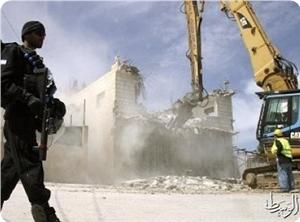 WEST BANK — Haaretz newspaper said the Israeli civil administration issued 13,000 demolition warnings against Palestinians accused of unlicensed construction in Area C of the West Bank.
The newspaper stated in a report that Israel intensified its construction restrictions on the Palestinian citizens in the villages and towns of the West Bank and seeks to prevent them from building through creating criminal files against them.
It said the civil administration increased the issuance of severe penalties against the Palestinians in all villages and towns located within Area C under Israel’s control.
Its report underlined that the civil administration was active recently in the demolition of many Palestinian homes and structures including schools in Al-Khalil city at the pretext of unlicensed construction.
The report pointed to the UN office for the coordination of humanitarian affairs’ recent report which condemned Israel’s restrictions on construction permits for Palestinians and its demolition of their homes while encouraging settlement construction.
Related articles
- Homes Destroyed, Lives Shattered: Criminal Displacement in Occupied Palestine (alethonews.wordpress.com)
- Israeli occupation authorities demolish well near Hebron (alethonews.wordpress.com)
- IDF closes Palestinian school to make way for West Bank training zone (theuglytruth.wordpress.com)
- Center: Israel orders demolition of electricity company (altahrir.wordpress.com)
Featured Video

Get ready for the big Israeli false flag cyber-attack
or go to
Aletho News Archives – Video-Images
From the Archives
Chocolate Gives Statins a $29 Billion Run For Their Money
By Sayer Ji · GreenMedInfo · April 17, 2012
With the blockbuster cholesterol-lowering class of drugs known as statins being widely promoted for the primary prevention of cardiovascular disease, despite their having over 300 documented adverse health effects (including heart failure!), how does chocolate sound as a viable, heart-friendly alternative?
We already connect amorously with chocolate (to the tune of 6 billion lbs of cocoa consumed annually worldwide), revealing in heart-felt expressions like “I love it,” and “this is to die for!” how comfortable we are with publicly declaring our affection. But did you know that while it makes our emotional hearts sing, it may actually keep our physical hearts happy, alive and ticking longer, as well?
Indeed, back in 2006, researchers found that for elderly men, eating cocoa was inversely associated with blood pressure and 15-year cardiovascular and all-cause mortality. … continue
Blog Roll
 Aletho News
- Striking Matches Near the Powder Keg
- Prominent Russia hawk: European leaders privately talk about war with Russia, first need ‘mass casualty event’
- China warned Trump not to touch Iran’s oil tankers: Larry Johnson
- EU Central Banker Plans To Plant Barren AI Crops Across The Continent
- Macron’s Strategic Autonomy Paradox: France Rearms on Debt and Depends on Foreign Fuel
- Nigel Farage vs Tucker Carlson: Who is right about Hitler and Britain?
- Chocolate Gives Statins a $29 Billion Run For Their Money
- Hypotheses on the collapse of U.S. computer systems
- Discover Iran: North Khorasan’s medicinal plants, spices, and sustainable economic potential
- ‘Stop Putting Drugs in Our Food’: Scientists Link Folic Acid in Food to Rising Rates of Colorectal Cancer
- If Americans Knew
- An error has occurred; the feed is probably down. Try again later.
- No Tricks Zone
- New Study: Modern Temps Are Among The Coldest Of The Last 10,000 Years In East Central Europe
- Germany’s Renewable Energies Lead to 1.4 Billion Euro Electric Power Trade Deficit
- Argentina’s Perito Moreno Glacier Joins Antarctica and Arctic In Defying Doomsday Melt Claims
- New Study: Barents Sea Temperatures Were Warmer And Sea Ice Less Extensive In The 1700s Than Today
- German Authorities Start Initiative To Evaluate Public Register For Climate “Disinformation” Spreaders!
- Zonal Asymmetry of Temperature Change in the Antarctic Circumpolar Current
- New Study: The Net Fossil Fuel Contribution To Rising Atmospheric CO2 Has Been Zero For 500 Years
- Germany’s Green Energy Transition Becoming Increasingly Expensive…Another 6 Trillion Euros!
- Sudden Stratospheric Warming, Powerful El Niño Combination May Lead To Extreme Europe Cold, Energy Crisis!
- Two New Studies Find Thwaites Glacier Melt Cannot Be Driven By Human Activity Or A Warming Ocean

