Hit-and-run injures young boy in Hebron
Ma’an – 23/09/2011
HEBRON — An eight-year-old boy sustained serious injuries after being struck by a vehicle in east Hebron on Friday morning, eyewitnesses said.
Taleb Jaber was left bleeding as the Israeli-plated car fled the scene by al-Baqaa village near the army-controlled H2 area in the West Bank city’s east, locals said.
Israeli forces summoned an ambulance and evacuated the child to a hospital inside the settlement Kiryat Arba, they said. An army spokeswoman said this report fit with her understanding of events.
But Jaber’s grandfather told Ma’an the incident was deliberate and not a car accident. He said the Israeli army had prevented the Palestinian Red Crescent from attending to the child.
Locals said that youths clashed with troops after the incident. The army spokeswoman said she did not have reports of clashes, but two Palestinians were detained for pushing a police officer following the incident.
Israeli occupation forces kill Palestinian in West Bank
Clashes erupted when settlers raided village
Ma’an – 23/09/2011
NABLUS — Israeli forces on Friday killed a Palestinian man and injured five others during clashes in Qusra village in the northern West Bank, medics said.
Issam Kamal Odeh, 33, died after he was shot by two bullets in the neck and shoulders during confrontations after morning prayers, medical officials said.
Mayor Hany Abu Murad named the dead person as Essam Kamal Badran, 35.
Witnesses said Israeli soldiers raided Qusra, near Nablus, after settlers entered the village.
Palestinian Authority settlement affairs official Ghassan Doughlas told Ma’an that clashes erupted when residents of Esh Kodesh settlement raided the village carrying Israeli flags.
Soldiers entered and opened fire, he said, adding that Sadeq Tayseer, 22, was shot in his neck and Jawad al-Shaer in his hand.
A military spokeswoman had no immediate comment, but said earlier that forces used “riot dispersal means” during clashes between Israeli civilians and Palestinians in Qusra.
Meanwhile, settlers attacked Jalud village south of Nablus leading to clashes with locals, residents said. No injuries were reported.
Witnesses said dozens of settlers were pelting rocks at Palestinian cars at Zatara checkpoint near Nablus. They said the checkpoint was briefly closed.
Knesset moves forward on bill granting Israel unchecked, draconian powers
By Jillian Kestler-D’Amours | The Electronic Intifada | 22 September 2011
Jerusalem – In early August, the Israeli parliament, the Knesset, quietly passed the first reading of a bill that would turn the country’s “state of emergency” regulations — which have been in use since the state was created in 1948 — into permanent legislation.
The move would cement the use of draconian measures, such as administrative detention orders and politically-motivated deportations, in an Israeli effort to combat an extremely broadly and vaguely defined “terrorist threat.”
According to a statement released by the Association for Civil Rights in Israel (ACRI) following the bill’s first reading, “the Counterterrorism Bill contains sweeping provisions, which broaden the scope of criminality and threaten to turn law-abiding citizens and organizations (with no connection whatsoever to violent acts) into ‘terrorists’” (“The counter-terrorism bill 2011, Position Paper – Executive Summary,” August 2011 [PDF]).
Under the proposed law, individuals who “express solidarity or identification with a terrorist group” either by publicly waving its flag, playing its anthem, or publishing praise or sympathy towards the group, can face up to three years in prison.
The law would also place the burden of proof on the suspect to prove that he or she is not a member of a terrorist organization, while membership in a terrorist organization would extend to anyone who “declares his consent to join a terrorist organization to another.”
“Because the accusation here applies specifically to what a person said to another person, ostensibly in private, there exists a real danger here of incrimination on the basis of a false accusation, against which it would be difficult or even impossible to mount a defense,” ACRI states. “How could a defendant bear the burden of proof in such a situation? Can anyone prove that they never said something to someone in private?”
Origins in the British Mandate period
Shortly after the establishment of the Israel state in 1948, the country adopted the “Defense (Emergency) Regulations,” which had been decreed in 1945 by the British authorities — known as the Mandate — then ruling Palestine. During the British Mandate, these regulations allowed for the establishment of military tribunals, sweeping searches and seizures of property, the demolition of houses and administrative detention for indefinite periods of time, among other measures.
In 1951, the Knesset decided that the Defense Regulations went against the basic principles of democracy and suggested that they be repealed. According to the Israeli human rights group B’Tselem, however, “the Regulations were not abolished [in 1951], apparently because they served as the legal basis for the military rule then imposed on Israel’s Arab citizens” (“Defense (emergency) regulations”).
In his book The Ethnic Cleansing of Palestine, historian Ilan Pappe finds that the Emergency Regulations, used to sustain military rule over Palestinian citizens of Israel, were “comparable to the 1935 ‘Nuremberg Laws,’” the set of anti-Jewish laws passed in Nazi Germany that deprived Jewish citizens of their basic rights.
“These regulations … virtually abolished basic rights of expression, movement, organization and equality before the law. They left [Palestinian citizens of Israel] the right to vote for and be elected to the Israeli parliament, but this too came with severe restrictions. This regime officially lasted until 1966, but, for all intents and purposes, the regulations are still in place,” Pappe explains.
Indeed, the outbreak of the 1967 War and the subsequent and ongoing Israeli occupation of the West Bank and Gaza Strip also sidelined the cancellation of the Emergency Regulations, which remain in effect to this day; the Israeli Knesset has renewed them annually since the early 1990s.
“Over the years, Israel used these regulations extensively in the Occupied Territories to punish and deter. The Regulations served as the authority for Israel to demolish and seal hundreds of houses, deport residents, administratively detain thousands of persons, and impose closures and curfews on towns and villages,” B’Tselem states in its report.
Targeting Palestinian institutions
The Nidal Center in Jerusalem’s Old City is one of over two dozen Palestinian institutions in the city that have been closed in recent years through the use of Israel’s Emergency Regulations.
Established in February 2000, the Nidal Center for Community Development is affiliated with Palestinian Health Work Committees, an umbrella organization mandated with providing Palestinians living in East Jerusalem, the West Bank and Gaza with a “comprehensive, culturally competent, community-based health care system that is committed to serving the needs of the individual and promoting community health.”
The Israeli authorities issued the Nidal Center its first closure notice in July 2009. According to Hazem Abu Seir, the director of the Nidal Center, the Israeli authorities argued that the Palestinian community center was promoting terror-related activities. They have furthermore informed Nidal Center employees that another closure notice will soon be issued, barring the Center from opening its doors until September 2012.
“[The Israeli authorities] said in the beginning that this center is related to terror activities and [to a] terror party,” Abu Seir told The Electronic Intifada. “But the reason [they closed the center] is that we work with youth. [Our activities are] related to our Palestinian culture and this is indirect resistance. When you develop your own identity, it’s something that makes them very worried.”
Abu Seir said that the Nidal Center has no links whatsoever to so-called “terrorist organizations,” and instead, its activities focus on developing cultural awareness and promoting education of Palestinian youth and children, and holding seminars, lectures and classes to empower Palestinian women. “For example, we established and started dabke [Palestinian dance] teams. It was a really good thing and the youth liked to participate in the group. After the closure, all of them and their families called us and asked, ‘Why? Why did you close?’ It was very good opportunity for youth and children to participate in the center in the Old City,” he said.
“I am always hopeful [that the center will re-open] but after they told us that they’re going to renew the closure, the decision disappoints us very much,” Abu Seir added.
Use of Regulations widespread
Israel’s use of administrative detention orders — which authorize the detention of a person without charge or trial, and which can be renewed indefinitely for six-month periods of time — is based on the Emergency Regulations of 1945. As of July 2011, B’Tselem estimated that Israel held 243 Palestinians in administrative detention in facilities run by the Israel Prison Service (IPS) (“Statistics on administrative detention,” July 2011).
According to Addameer, the Ramallah-based prisoner rights group, “administrative detention has been used as a form of collective punishment by the Israeli military against Palestinians, illegal in this form under international law” and “Israeli authorities do not hesitate to violate the standards of fair trial, and fail to take international law or humanitarian dimension into consideration while handling the issue of administrative detention” (“Administrative detention”).
Israel has also used the Emergency Regulations to expel Palestinian political leaders from Jerusalem. Adnan Gheith, a member of the al-Bustan popular committee in the East Jerusalem village of Silwan and the secretary of the Fatah movement in the neighborhood, for instance, was expelled from the city in early 2011 for a period of four months.
Gheith’s expulsion was based on the pretext that he was responsible for clashes between Palestinian youth and Israeli security forces in Silwan and thus constituted a security threat to the state. It was the first time that Israel had issued an assigned residence order against a resident of East Jerusalem. “The order against Adnan is not part of a legal process where suspicions, charges or evidence have any part. It is an administrative order that circumvents the rule of law, which forms the foundation of western democracy,” wrote the Popular Struggle Coordination Committee (PSCC) at the time Gheith’s deportation order was issued (“Help Silwan resident Adnan Gheith stay in Jerusalem,” 23 December 2010).
“In this harsh reality, a person’s rights are taken without due process, with no charges, based on secret evidence and with no possibility to truly defend oneself. It is the essence of a Kafkaesque, legal procedure in the taunting maze of the Occupation’s bureaucracy and power,” PSCC added.
“Unchecked, draconian powers”
Ultimately, ACRI concludes that if passed, the Counterterrorism Bill would not only cement the dangerous measures already practiced by the Israeli authorities, but would legalize their use at all times, not only during a “state of emergency.”
“The bill grants the executive branch unchecked, draconian powers to use harsh measures against individuals and organizations — all this without trial, on the basis of mere suspicion, and without establishing the minimal guarantees for the defense of the rights of the accused,” ACRI explains in its press release.
“The Counterterrorism Bill in its current formula … seeks to perpetuate the improper procedures currently in place, while abandoning human rights concerns. This is all the more grave given that the proposed bill would become a permanent, ‘normative’ law, and not limited to use in a state of emergency.”
Jillian Kestler-D’Amours is a reporter and documentary filmmaker based in Jerusalem. More of her work can be found at http://jkdamours.com.
Rick Perry embraces violent Jewish extremists
By Max Blumenthal | Al-Akhbar | 2011-09-21
Yesterday, I attended Rick Perry’s press conference at the W Hotel in New York City, where the Texas Governor and Republican presidential frontrunner denounced President Barack Obama for supposedly “appeasing” America’s enemies in the Middle East and failing to sufficiently support Israel. The Perry appearance was timed to pre-empt Obama’s speech at the UN in which the President would reject Palestinian demands for statehood.
The most remarkable aspect of Perry’s press conference was the cast of characters that assembled behind the Governor while he spoke. To Perry’s immediate right was Assemblyman Dov Hikind, the former leader of the Jewish Defense League, a terrorist group responsible for bombing attacks on numerous Arab-American targets and a conspiracy to murder Republican Rep. Darrell Issa. While Hikind’s collaborator Victor Vancier spent ten years in jail for firebomb attacks, Hikind was suspected by the FBI of numerous terror attacks of his own. After issuing numerous stentorian condemnations of terror, Perry handed the mic over to Hikind, who exclaimed, “I heard the Governor’s speeches and I said to myself, ‘He sounds like me!'” The two engaged in a sustained hug before a giant media gaggle.
To Perry’s left was Dr. Solomon “Joe” Frager, who was listed on official Perry press material as the organizer of the press conference. Frager is the Chairman of the Jerusalem Reclamation Project, a front group for the Ateret Cohanim organization that steals Palestinian property in East Jerusalem and hands it over to fanatically religious Jewish families. They are the spearhead of Israel’s slow motion ethnic cleansing of Silwan and the Old City. For a glimpse at the zealotry, racism and sheer sleaziness behind Ateret Cohanim’s operation, watch Louis Theroux’s excellent BBC documentary, “The Ultra-Zionists,” which follows Ateret Cohanim’s man-on-the-ground Daniel Luria as he personally orchestrates the theft of Palestinian homes.
Surrounding Perry was a sundry assortment of Jewish Israeli extremists, from Knesset Deputy Speaker Danny Danon, who advocates annexing the West Bank to punish the Palestinian Authority for pursuing statehood, to Member of Knesset Nissim Zeev, a settler from the Shas Party who has proposed “rehab centers” for homosexuals.
None of the reporters I talked to afterwards seemed to know who any of Perry’s “pro-Israel” supporters were, and very few even cared. And nothing I have read so far about the event in the mainstream American media noted that it was planned by a key orchestrator of Palestinian home seizures in occupied territory, or that Perry embraced the former leader of a group listed by the FBI as a terrorist organization. To get a sense of the kind of coverage Perry earned from the mainstream press, read Politico’s Ben Smith, who described Perry’s speech as “moderate” and “centrist.” Meanwhile, the liberal groups that howled in protest when Perry hosted a prayer rally in Houston with Christian right leaders have virtually ignored Perry’s embrace of the Jewish extreme right.
It goes without saying that if an American politician meets with any Muslim or Arab leader, they will invite vehement denunciations from their opponents and face intense scrutiny from the mainstream press. This is why Obama has not visited a single mosque during his entire term as President (former White House Press Secretary Ari Fleischer said Obama was avoiding Muslims “out of sensitivity to the Jewish vote”). When a politician like Perry who surrounds himself with violent Jewish extremists before the national press corps, however, he is lauded as a “centrist” and treated as a serious contender.
Palestinian UN Bid and Refugee Rights: Questions and Scenarios
By Mikaela Levin | Alternative Information Center | 21 September 2011
Politically it’s difficult, if not impossible, to find a Palestinian who is against the idea of having an independent and recognized state. Nevertheless, the picture becomes more complex when concrete and legal considerations are discussed.
“The real question here is why one announces the creation of a Palestinian state when most of its people are refugees that depend on foreign aid of UN agencies like UNRWA or of the European Union; when there are daily problems with the checkpoints, the settlements and their ongoing growth. Today there are 600,000 settlers living in the West Bank settlements and the number continues to growing“, noted Amjad, a legal adviser to the Bethlehem-based Badil Resource Center for Palestinian Residency and Refugee Rights.
The Alternative Information Center (AIC) spoke with Amjad about the Palestinian UN initiative and its possible impact on Palestinian refugees and their internationally recognized right to return.
Creating a state under a foreign military occupation is unsustainable?
“Not necessarily. There are independent states that were occupied by foreign powers. There could still be an independent entity while being occupied. These are two things that, eventually, could go hand in hand. But the question is what would be the benefit of declaring such a state. If we look at the daily life of the Palestinians, so far we can’t see any changes for them. When we look at the advantages and the disadvantages this move can have, on the side of disadvantages we could list a lot of fears, while on the side of advantages we really cannot find any.”
As many Palestinians, Amjad would have wanted more internal debate before going to the UN. Numerous issues are misunderstood and the Palestinian Authority (PA) misinforms about others. The most unfortunate misunderstanding, according to him, is the belief that the state of Palestine would be able to petition the International Criminal Court or similar UN organs if the majority of the General Assembly recognizes it. “In a strict legal level, this is not true”, he warned.
“Palestine could be recognized as a state within the UN, but could be denied entrance to the International Criminal Court because that tribunal could decide that Palestine is not really a state. To give an example, some years ago Palestine tried to become a member of the World Trade Organization and was denied membership because it lacks effective control over its territory…Today, even after recognition, the state of Palestine wouldn’t have effective control over its territory”, concluded the Palestinian lawyer.
With this argument in mind, he assured that if Palestine is recognized as a permanent observer in the UN General Assembly –“the most realist scenario today”-, this new Palestinian state will have, effectively, almost the same rights and obligation as the Palestine Liberation Organization today. “If we compare the Vatican (the only permanent observer state in the General Assembly today) with the PLO, they have basically the same rights”, he highlighted.
But even if there would be nothing to gain from the current UN bid, there could be something to lose. Amjad’s and Badil’s greatest fear is that the new Palestinian state will not have, as the PLO has, an internationally recognized mandate to represent all the Palestinian people, including the refugees scattered throughout the world and their right to return, as established in 1948 by UN Resolution 194.
“Legally speaking, the future Palestinian state could try to claim the right to return of the Palestinian refugees, but the question would be one of returning to which area. When we talk about the refugees from 1948 or from 1948 to 1967 within the area that is today the state of Israel, could the future Palestinian state claim the right to return to a foreign entity or would it be limited to claiming the right to return to its own entity, meaning a Palestinian state with the 1967 borders, in the best case scenario? If the second was the case, then a large majority of the Palestinian refugees would be excluded, since there were displaced from their homes in what today is Israel”, the legal advisor warned.
As Amjad pointed out repeatedly throughout the interview, nothing is certain at this point. “There’s no historical and legal precedent for this”, he explained. There are best case scenarios, worst case scenarios, realist scenarios and improbable scenarios, but in none of them, according to Badil’s research, there is a real victory for the Palestinians.”
International Day of Peace
By Mazin Qumsiyeh | Popular Resistance |September 21, 2011
In his first speech at the UN, President Obama stated that he prohibited torture and ordered Guantanamou prisons closed. He also said he will work to cut the nuclear arsenal of the US and Russia and move towards a world without nuclear weapons. He said that peace must be pursued by actions of all nations working together and that the era of unilateralism is finished. He said he will work aggressively to advance peace based on two states: Israel and Palestine. He said, “America does not accept the legitimacy of continued Israeli settlements”. All were big fat LIES. And now comes Obama with new lies in front of the UN and at this International day of peace. Here he shows Palestinian leaders did not give him any briefing on history. I hope any Palestinian leaders should object strongly and with facts and figures to these misstatements [my brief comments in brackets]:
“Let’s be honest: Israel is surrounded by neighbors that have waged repeated wars against it. [false] Israel’s citizens have been killed by rockets fired at their houses and suicide bombs on their buses. [correct but this should be balanced by explaining that 10 times more Palestinians were butchered] Israel’s children come of age knowing that throughout the region, other children are taught to hate them. [Israelis teach hate 100 more times than the other way around and hate of the colonizer to the colonized is not the same as the reverse]. Israel, a small country of less than eight million people, looks out at a world where leaders of much larger nations threaten to wipe it off of the map. [That is nonsense; Israel wiped Palestine including 530 villages and towns and now is the fourth strongest country plus having you Obama and Congress as its lackeys]. The Jewish people carry the burden of centuries of exile, persecution, and the fresh memory of knowing that six million people were killed simply because of who they were. [Irrelevant and highly emotional: just study the history of Nazi-Zionist collaboration to see how absurd to link Apartheid Israel with “The Jewish People”, itself a mistaken term no more valid than concepts of “The Christian People” or “The Muslim People”]. These facts cannot be denied [they are regurgitation of Zionist myths, irrelevant facts, and half truths]. The Jewish people have forged a successful state in their historic homeland [a racist apartheid state based on land theft and ethnic cleansing; is that your definition of success?]. Israel deserves recognition [no it does not, Israel deserves to be faced with the truth and pressured to transform just like Apartheid South Africa]…
All who meet with him to go back and read his first speech in the UN should level with Mr. Obama. Perhaps they should give him a gift: a copy of Prof. Naseer Aruri’s excellent book titled “Dishonest Broker” about the destructive role of the US.
Perhaps what might awaken some sense of shame in Obama is for him to be given his own words uttered less than 2 years ago:
“The choice is ours. We can be remembered as a generation that chose to drag the arguments of the 20th century into the 21st; that put off hard choices, refused to look ahead, and failed to keep pace because we defined ourselves by what we were against instead of what we were for. Or, we can be a generation that chooses to see the shoreline beyond the rough waters ahead; that comes together to serve the common interests of human beings, and finally gives meaning to the promise embedded in the name given to this institution: the United Nations.”
Hypocrisy and double standards are standing naked and exposed more than ever thanks to the Arab spring and the corruption of political leaders from Netanyahu to Obama to the Arab leaders that do not follow their conscience. In Palestine and the rest of the Arab world, the forces of status quo fight the forces of change tooth and nail. Human rights and democracy cannot be used as tools in some countries and violated in others. The US administration for example says the leadership in Syria lost its legitimacy and must step aside. In Yemen and Bahrain the same politicians merely mumble useless words like “different parties should resolve their differences”. The reason is obvious: the Israel lobby. The Arab people hate what the Zionists had done and continue to do to fellow Arabs (7 million of us Palestinians are now refugees or displaced people). Arabs are prevented by their own dictatorial governments from providing direct help to liberate Palestine. The US thus acts not in its own interests or in defense of any liberal or democratic ideals but largely in defense of apartheid and racism that is distilled in this state called Israel.
Hypocrisy will be more evident at the United Nations these coming few days. It is already evident in the use of bullying by the US administration to other countries to force them to not vote for a Palestinian state. This bullying will remind us of how they bullied in 1947 to get the unjust resolution recommending partition of Palestine against the wishes of its people (contrary to UN Charter and the right of self-determination). Hypocrisy will also be evident in Netanyahu’s speech in the UN that will say to the world: Israel wants peace and “why are we at the UN when Israel and the Palestinians can negotiate directly.” After decades of direct negotiations between slaves and heavily armed masters, excuse the world for not believing you. Mr. Abbas (whose term as president of the “Palestinian authority” long expired) will give a speech where he will again reiterate that Palestinians renounced violence and want their own state on the borders of 1967 under the US government parameters (which recognize demographic changes including that 500,000 colonial settlers sit on the best parts of the West Bank). Here in Palestine, the people want him to 1) consult with them and rebuild the PLO with direct elections to the PNC, 2) that if and when he then goes to the UN as a real representative to the Palestinian people that he tells them about our concerns and the historic and current injustice that we are subjected to. I am afraid neither will happen. In fact he explicitly stated that he does not want to “delegitimize Israel”; this means he accepts the racist Zionist project as legitimate. Netanyahu will present a false/concocted history that mixes a religion with nationality and claims rights while delegitimizing Arabs and Palestinians at every turn. Abbas’s speech will likely validate that narrative. Netanyahu will talk about security (for the colonial occupiers) while Abbas may not even touch on security for the native people but will again emphasize we are “peaceful in protesting/gatherings.” Indeed today there were hundreds of gatherings throughout the West Bank cities that organizers said would show support for Abbas.
Who will address the fact that the Palestinian people were subjected to the largest armed robbery in the last 100 years accompanied by massacres and ethnic cleansing? Who will mention that the value of hard assets alone stolen by the Zionist project exceed $30 trillion? Who will speak of the over 60,000 Palestinian civilians massacred or the hundreds of thousands who were injured or jailed? Who will explain to those gathered in New York that International law recognizes the right of such native people to resist including by armed means? Who will explain to world leaders that 99.99% of the people resisted by methods of popular unarmed resistance (see my book “Popular Resistance in Palestine: A history of hope and empowerment”, Pluto Press)?
Before 1991, Israel was largely ostracized around the world for committing these injustices against the native Palestinians. But unfortunately, acceptance of Israel mushroomed when Mr. Yasser Arafat listened to people like Mahmoud Abbas and went down the path of the disastrous Oslo accords. Dozens of countries then established diplomatic, business, scientific and even military cooperation with the apartheid state. Israel just also joined CERN, the European nuclear organization. Is it possible to abandon the trap of Oslo that legitimizes colonialism? Is it possible to stop begging for a statelet in parts of the West Bank and Gaza by going to the UN to marginally improve bargaining positions between a jailer and a jailed people? Is it possible to build-up boycotts, divestments, and sanctions and real popular resistance (not mere gatherings in Al-Manara square) to apply pressure that insists on the right of return for all refugees first and foremost? Politicians worry that admitting mistakes and changing course would bring them down or they lose privileged positions. But let me ask you how a position of a key Palestinian leader like Abbes would be if he gave a speech with total honesty telling his people something along these lines:
“We went into Oslo with good intentions, it was supposed to last for five years and give us a state in all of the West Bank and Gaza. For the past nearly 20 years it did not work, our refugees are still refugees and Israel doubled its settlement activities and killed the two-state solution. Now I recognize that we lapsed in our judgments not only about our colonizers but also about the US and some other Western Countries who have strong Zionist lobbies. Because of this, I am stepping down soon. My fate will be up to the Palestinian people and I will work hard to obey their just demands for change. In the coming few weeks we in Fatah will work together with all political factions to create a transition body to prepare and run elections for the Palestinian National Council to represent all Palestinians around the world (in diaspora and on both sides of the Green line). This PNC council will be bound by the original charter of the PLO that calls for a democratic pluralistic state in all of Palestine among other things unless the new representative PNC decides to change elements of such a charter. By going back top the people, we join the era of the Arab spring…”
Or imagine if Obama got the courage to go to the American people and say that he has demanded a settlement freeze and rollback based on International law to achieve real and just peace but that a strong lobby in Washington ensures that US foreign policy is held hostage to Israel. What will happen to the statute of such politicians? What happened when President Nasser admitted mistakes and took responsibility for the Naksa of 1967? What happened to president Eisenhower when he asked Israel to get out of Gaza and the Sinai in 1956 (and Israel complied)? While we are not the same it is also good to reflect on our own history. What happened between 1929 and 1939 to the 30+ Palestinian factions then in operation (some of them had tried and failed in their accommodationist/moderate stances with the British)? Decency can be done by political parties and by politicians but it seems to be absent at the UN this week. But history shows that peace is achieved in spite and not because of politicians. We will have to again rely on ourselves (the people) to change history. Starting a new chapter on this International day of peace may not be such a bad idea.
On failure of us Palestinians to challenge “leaders”
http://www.mediamonitors.net/edward33.html
When will the Arabs Resist? A panorama of desolation. By Prof. Edward Said
http://www.counterpunch.org/said01252003.html
As a reminder: the PLO charter
http://avalon.law.yale.edu/20th_century/plocov.asp
State of recognition: Whether the UN grants the PA status as a state or refuses to do so, either outcome will be in Israel’s interest
http://english.aljazeera.net/indepth/opinion/2011/09/20119158427939481.html
~
Professor Mazin Qumsiyeh teaches and does research at Bethlehem and Birzeit Universities in occupied Palestine. He serves as chairman of the board of the Palestinian Center for Rapprochement Between People and coordinator of the Popular Committee Against the Wall and Settlements in Beit Sahour He is author of “Sharing the Land of Canaan: Human rights and the Israeli/Palestinian Struggle” and “Popular Resistance in Palestine: A history of Hope and Empowerment”
Ashrawi and Tibi say Obama made it sound like Palestinians are occupying Israel
By Ira Glunts | Mondoweiss |September 21, 2011
Hanan Ashrawi, who is part of the Palestinian delegation at the UN, reacted angrily to President Obama’s UN address. Here are some quotes from a Ha’aretz interview in Hebrew that took place immediately after the speech (Barak Ravid, “Palestinian Anger Over Obama Speech at the UN” (original title), Ha’aretz (Hebrew))
I did not believe what I heard, it sounded as if the Palestinians were occupying Israel. There was no empathy for the Palestinians, he only spoke of the Israeli problems.
He told us that it isn’t easy to achieve peace, thanks, we know this. He spoke about universal rights – Good, those same rights apply to Palestinians.
[The Americans] are applying enormous pressure on everybody at the UN, they are using threats and coercion. I wish they would invest the same energy in an attempt to promote peace, not threats.
Ahmad Tibi, a Palestinian member of the Israeli parliament, who is in NYC with the Palestinian delegation, was also interviewed by the newspaper. He echoed Ashrawi when speaking about the Obama address:
It is possible to think after hearing the President’s speech today, that the Israelis were demanding a state from their Palestinian occupiers.
Avoiding [mentioning] the ’67 borders was biting and clear.
His message is continued suffering for the Palestinians, accompanied by long and perpetual negotiations with Netanyahu.
The fact that Tibi, who is an Israeli politician, traveled with the PA delegation to the UN is viewed by many as controversial in Israel. Many Israelis take a very dim view of cooperation between Palestinians from Israel, with officials in the territories; they see it as disloyalty to the state. I know it sounds crazy, but that’s the way they think.
Both Tibi and Ashrawi insisted that despite the pressure, the Palestinians will go forward with the UN resolution as planned. According to an AP report, Mahmoud Abbas says that he will not agree to a delay in voting for the statehood resolution despite pressure from the US and France.
Teen hurt as settlers storm Nablus village
Ma’an – 20/09/2011
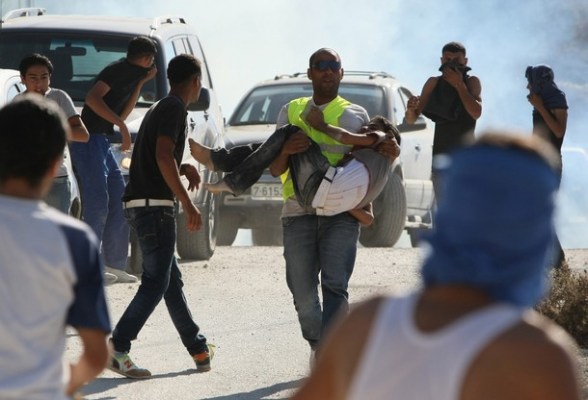
NABLUS — A 14-year-old Palestinian was hurt by Israeli forces on Tuesday during clashes with settlers in Asira Al-Qibliya village south of Nablus, witnesses and medics said.
Medics said Israeli forces shot Aref Aref in the back, during confrontations which erupted after dozens of settlers marched on the village. AFP said he was hurt by a tear-gas canister.
A journalist, Ayman An-Noubany, was also injured by a rock, medics said, adding that they were both taken to Rafedia Hospital in Nablus.
An Israeli military spokeswoman said forces used “riot dispersal means” to respond to clashes in the village. She was not aware that any teenagers were shot at, but said a Palestinian man was injured “probably by a rock hurled by an Israeli civilian.”
Palestinian fire fighters said they extinguished a blaze in the garden of a home in Asira Al-Qibiliya. The fire was believed to have been sparked by a tear gas grenade, a civil defense report said.
Volunteers from a watchdog committee set up to document settler attacks said around 40 settlers tried to raid Asira Al-Qibiliya, and that they were protected by Israeli forces.
~
HOUSE DEMCORATS SEND LETTER OPPOSING UNILATERAL PALESTINIAN UN EFFORT
Press Release – September 15, 2011
WASHINGTON, DC – House Democratic Whip Steny H. Hoyer Hoyer (MD) led a letter that was signed by 58 House Democrats including Democratic Leader Nancy Pelosi, Ranking Member on the House Foreign Affairs Committee Howard Berman, and Ranking Member on the Appropriations State and Foreign Operations Subcommittee Nita Lowey that is being sent to 40 key European heads of state today, urging them to stand with the United States in opposing unilateral action by the Palestinian Authority at the United Nations. In their letter, the members warn that there may be “devastating consequences for the peace process” should the Palestinians proceed unilaterally, and they make clear that direct negotiations are the only path forward to a just and lasting peace. The letter cites further risks of acting unilaterally, including the potential for violence on the ground and a reconsideration of U.S. assistance to the Palestinian Authority.
“We share with our friends and allies a determination to see this conflict ended peacefully,” Hoyer said. “Voting together to oppose unilateral steps that set peace back would strongly reaffirm our common commitment to this shared goal and to the longstanding principle enshrined in the Oslo Accords that both parties ought to reach a solution through direct negotiations. Quite fundamentally, it would be an expression of our common values.”
“Realizing the goal of two states, living side-by-side in peace and security, is only possible through direct talks – not in the halls of the UN General Assembly,” Pelosi said. “A vote for Palestinian statehood will not advance the peace process; it will impede it. The nations of the world must make it clear: a lasting peace cannot be imposed on Israel or the Palestinian people – it can only be negotiated between the parties themselves.”
“This is a historic moment in the Middle East. An inflammatory UN resolution, particularly one that unleashes international legal action against Israel, will put Middle East peace prospects on hold for years, if not decades,” Berman said. “We are counting on our friends and allies to stand with us at this critical time.”
Below is the full text of the letter:
Dear ___________________:
We write on a matter of great urgency, on the eve of the United Nations General Assembly meeting. It is our understanding that the leadership of the Palestinian Authority will pursue a resolution at the United Nations – in either or both the Security Council and the General Assembly – to grant the Palestinians the equivalent of statehood and/or prejudge final issues, including borders and the status of Jerusalem. One of the major goals of this effort is for the Palestinians to better position themselves to petition the International Criminal Court, very possibly bogging down the court for the foreseeable future.
It is our strong belief that such unilateral action would have devastating consequences for the peace process and the Palestinians themselves. Accordingly, we urge you in the strongest terms not to support this effort.
We believe that the only way to achieve a two-state solution is through direct negotiations leading to a peace treaty fully accepted by both governments and by both peoples. A just and lasting peace cannot and must not be imposed on the parties. If the Palestinians pursue such a unilateral approach, it violates the letter and spirit of the Oslo Accords and will deal a significant blow to future negotiations. Given the expectations gap among the Palestinian public, such action could lead to widespread violence on the ground, jeopardizing the West Bank’s impressive economic and security gains over recent years. There is also a substantial risk of more broadly inflaming the region and increasing violence at a time of already great instability. Finally, the United States will reconsider its assistance program for the Palestinian Authority and other aspects of U.S.-Palestinian relations if they choose to pursue such a unilateral effort.
We are confident that your government shares the United States’ commitment to a comprehensive resolution of the conflict between the Israelis and the Palestinians. That outcome can only be achieved through direct negotiations. A vote on a unilateral UN resolution will likely set prospects for peace back years.
Our bilateral relationship is based on certain fundamental values. We urge you to vote those values, and to stand with the United States in not supporting unilateral action at the UN that would impede the peace we all seek.
Thank you for your consideration of our views.
Steny H. Hoyer, Democratic Whip
Nancy Pelosi, Democratic Leader
Howard Berman, Ranking Member on the House Foreign Affairs Committee
Nita Lowey, Ranking Member on the Appropriations State and Foreign Operations Subcommittee
Henry Waxman, Ranking Member of the House Energy and Commerce Committee
Gary Ackerman
Joe Baca
Shelley Berkley
Madeleine Bordallo
Leonard Boswell
Dennis Cardoza
Russ Carnahan
David Cicilline
Emanuel Cleaver
Gerry Connolly
Jim Costa
Jerry Costello
Mark Critz
Joseph Crowley
Susan Davis
Rosa DeLauro
Ted Deutch
Eliot Engel
Charles Gonzalez
Gene Green
Janice Hahn
Kathy Hochul
Brian Higgins
Tim Holden
Steve Israel
William Keating
Larry Kissell
James Langevin
John Larson
Sander Levin
Dan Lipinski
Carolyn Maloney
James McGovern
Gregory Meeks
Michael Michaud
Chris Murphy
Jerrold Nadler
Eleanor Holmes Norton
Bill Owens
Gary Peters
Steven Rothman
C. A. Dutch Ruppersberger
John Sarbanes
Janice Schakowsky
Adam Schiff
Allyson Schwartz
David Scott
Brad Sherman
Heath Shuler
Albio Sires
Betty Sutton
John Tierney
Edolphus Towns
Debbie Wasserman Schultz
Repression and resistance sharpening in Beit Ommar
By David Warren | The Electronic Intifada | 19 September 2011
Beit Ommar – With a population of 17,000, Beit Ommar has grown into more of town than a village. But the tractors struggling up the main street and the herds of sheep wandering the alleys eating rubbish and causing mischief help it retain a certain rural charm.
Beit Ommar sits alongside Route 60, the main highway between Bethlehem and Hebron, which you can reach in about 30 minutes on a good day. Like much of the rural West Bank, the area depends on agriculture, with the village’s location in the West Bank’s central highlands particularly suitable for softer fruits such as grapes, peaches and plums.
That is where the normality ends, however. If you were to climb one of the nearby hills you would notice that Beit Ommar is encircled by no less than five illegal settlements: Karmei Tsur, Kfar Etzion, Migdal Oz, Bat Ayin and Allon Shevut. In Beit Ommar, water is regularly cut off and private wells are illegal. In the settlements, swimming pools and fountains are de rigeur.
Taking a stroll down to the entrance to the village, you could not fail to notice the tallest watchtower in the West Bank looming above you — a modern-day Panopticon from Foucault’s worst nightmares — cataloguing those who come and go. The sound of low-flying jets, helicopters and even drones is an ever-constant reminder of the destructive potential of the Israeli military, a continual source of fear. That’s the point.
This is the context in which Mohammed Shtayyeh, a senior member of Fatah’s central committee admits that, even if the United Nations approves the Palestinian Authority’s bid for statehood, it will not change daily life for Palestinians. “Things on the ground are not going to be different,” he said at a recent news conference (“PLO to seek full UN recognition,” Al Jazeera English, 14 September 2011).
Week of brutality
Bearing this in mind one should consider what has happened on the ground in Beit Ommar over one September week.
On 6 September, a group of 15 farmers selling fruit beside the main highway were attacked by Israeli soldiers, who proceeded to confiscate and destroy thousands of dollars worth of grapes, peaches and plums (“Israeli soldiers, police attack Beit Ommar fruit vendors,” Palestine Solidarity Project, 7 September).
Given its strategic location beside Route 60, Beit Ommar used to have the largest fruit market in the southern West Bank. Now however, the Israeli army has blocked the entrance to the market with boulders, dissuading shoppers. This is part of the ongoing campaign to destroy Beit Ommar’s economy, as local farmers are now reduced to attempting to sell what they can to passing traffic.
A few days later, on 10 September, a small sit-in protest of little more than ten persons beside the highway was savagely repressed. The group was sprayed with military-grade mace and two international activists were dragged away to be detained without charge (“Two arrested, pepper spray used as activists try to tear down fence in Beit Ommar,” Palestine Solidarity Project, 10 September) .
The next night at around 2am, the Israeli army invaded the village, abducting three young Palestinians while firing tear gas and concussion grenades into the streets and nearby houses before vanishing into the gloom (“Israeli army raid Beit Ommar, arrest three,” Palestine Solidarity Project, 12 September).
The arrest of young people towards the end of the school year is a common, vindictive practice in the West Bank, meaning that those detained will miss their final exams and therefore have to re-sit the year at great personal expense.
Early Monday morning on 12 September, settlers hacked down grape vines that were almost ready for harvesting on an area of almost 2,000 square meters. The owner of the land had a heart attack when he saw the destruction, according to the Palestine Solidarity Project (“Settlers destroy Beit Ommar farmer’s crops,” Palestine Solidarity Project, 12 September).
On Tuesday, at around 4am, soldiers came with bulldozers and destroyed two buildings in different parts of the town (“Israeli army demolish two buildings in Beit Ommar area,” Palestine Solidarity Project, 13 September).
Given that Beit Ommar found itself in Area C after the Oslo accords, it has remained under the total control of the Israeli military. Under the Oslo accords, which were signed by the Palestine Liberation Organization and Israel in the mid-1990s, the West Bank was carved up in to areas A, B and C, the latter of which covers 60 percent of the West Bank with a population of approximately 150,000. Large areas around the village have been arbitrarily closed to agriculture and building.
Waiting for Godot
Even these relatively minor events depict a scene of continual violence being perpetrated against the civilian population, a roll-call of yet another quiet horror repeated across the West Bank for decades. On occasions, there are discussions of the United Nations’ session on recognition of a Palestinian state and what might result from this.
Mousa Abu Maria, a leader of the Beit Ommar-based National Committee Against the Walls and Settlements and co-founder of the Palestine Solidarity Project, describes how in the past few years Beit Ommar has “returned to its roots,” a path of nonviolent resistance, reminiscent of the first Palestinian intifada.
Abu Maria has spent nearly seven of the past ten years in prison, most recently for 14 months under “administrative detention” without being charged with a crime or having evidence presented against him.
Now, each Saturday, Abu Maria, alongside other members of Beit Ommar’s popular committee, leads the demonstrations which place alongside the illegal settlement of Karmei Tsur. The number of protesters is currently in the dozens, but as they have grown, so too has the violence of the Israeli response.
After a recent demonstration had been dispersed, and soldiers were pursuing Abu Maria and two others, live ammunition was fired at them. The bullets sailed over their heads. At the same demonstration, Abu Maria’s brother, Yousef, was arrested and brutally beaten (“Yousef Abu Maria brutally beaten as live ammunition used at Beit Ommar demonstration,” Palestine Solidarity Project, 20 August 2011).
What happens on 21 September, and afterwards, is anyone’s guess. Whatever happens at the UN, recognition of a state or otherwise, it seems that the violence of Israel’s occupation will continue. But so too will the popular resistance.
David Warren is an activist currently working in Beit Ommar.
Is Tea Party Congressman Joe Walsh supporting a one-state solution for Palestine?
By Ali Abunimah – The Electronic Intifada – 09/19/2011
Illinois Republican Congressman Joe Walsh has introduced a resolution in the US House of Representatives that seems to support formal Israeli apartheid. Or does it in fact support a one-state solution with equal voting rights for Israelis and Palestinians alike?
Walsh was elected last year in Illinoi’s 8th Congressional District (north and west suburbs of Chicago) with strong Tea Party support.
Walsh has also introduced legislation to cut $600 million of funding the United States gives to the Palestinian Authority.
Walsh’s House Resolution 394 calls for:
Supporting Israel’s right to annex Judea and Samaria in the event that the Palestinian Authority continues to press for unilateral recognition of Palestinian statehood at the United Nations.
“Judea and Samaria” is the name Israel gives to the Israeli-occupied West Bank.
After a lengthy preamble setting out standard Israel lobby talking points, the draft bill declares:
Resolved, That the House of Representatives firmly supports Israel’s right to annex Judea and Samaria in the event that the Palestinian Authority continues to press for unilateral recognition of Palestinian statehood at the United Nations.
There’s just one tiny catch. What happens to the almost three million Palestinians who live in the Israeli-occupied West Bank if they are annexed by Israel?
Does Israel then have the “right” to expel them? Do they live under permanent second class status, as African Americans did before US Civil Rights legislation, or like blacks in South Africa under apartheid?
Or is Walsh actually proposing a one-state solution in which Palestinians get to vote in Israeli elections?
Walsh is mysteriously silent on this crucial point. I have put the question to him via Twitter (@RepJoeWalsh):
@avinunu
Ali Abunimah .@RepJoeWalsh If Israel annexes West Bank as you propose, should Palestinians living there get equal voting rights? Yes or no? cc @RJCHQ
Sep 19 via Twitter for MacFavoriteRetweetReply
He’s an avid and active Twitter user, so let’s see if he has an answer for this straightforward query.
Settlers shoot at homes in Burin village, Nablus
Ma’an – 19/09/2011
NABLUS — Settlers opened fired on Palestinian homes late Sunday in the village of Burin in southern Nablus, Palestinian Authority officials said.
PA settlement affairs official Ghassan Doughlas told Ma’an that armed settlers shot at the village after midnight on Sunday.
The home of Said Najjar was hit in the attack, Doughlas said
Local guard committees witnessed the attack and contacted Palestinian officials.
In a separate incident on Sunday, settlers tried to raid the village of Awarta in Nablus. Israeli forces prevented the settlers from entering the village in a stand off which lasted 3 hours, witnesses said.
The latest attacks come amid a recent surge in settler violence in the Nablus district.
Palestinian Authority spokesman Ghassan Khatib warned on Thursday that a serious increase in settler violence towards West Bank Palestinians threatened escalation of the situation ahead of the Palestinians’ bid for membership of the UN.
News reports said two weeks ago that Israeli forces were arming settlers with tear-gas canisters, stun grenades and even trained dogs to counter potential attacks by the Palestinians.
On Sept. 5 settlers broke into Qusra village mosque, smashing windows, burning tires inside the building, and spray-painting walls with offensive slogans.
Village council head Hani Ismail told Ma’an on Tuesday that young men volunteered to guard the entrances to the village after the attacks, and had blocked further groups of armed settlers from entering the village.
Featured Video

They Double Down on BLOOD PRESSURE Guidelines!
or go to
Aletho News Archives – Video-Images
From the Archives
Chocolate Gives Statins a $29 Billion Run For Their Money
By Sayer Ji · GreenMedInfo · April 17, 2012
With the blockbuster cholesterol-lowering class of drugs known as statins being widely promoted for the primary prevention of cardiovascular disease, despite their having over 300 documented adverse health effects (including heart failure!), how does chocolate sound as a viable, heart-friendly alternative?
We already connect amorously with chocolate (to the tune of 6 billion lbs of cocoa consumed annually worldwide), revealing in heart-felt expressions like “I love it,” and “this is to die for!” how comfortable we are with publicly declaring our affection. But did you know that while it makes our emotional hearts sing, it may actually keep our physical hearts happy, alive and ticking longer, as well?
Indeed, back in 2006, researchers found that for elderly men, eating cocoa was inversely associated with blood pressure and 15-year cardiovascular and all-cause mortality. … continue
Blog Roll
 Aletho News
- I’M SO BLOODY FURIOUS: They Double Down on BLOOD PRESSURE Guidelines!
- The Israeli Nuclear Doctrine and the Turning Point of the Kennedy Assassination
- Striking Matches Near the Powder Keg
- Prominent Russia hawk: European leaders privately talk about war with Russia, first need ‘mass casualty event’
- China warned Trump not to touch Iran’s oil tankers: Larry Johnson
- EU Central Banker Plans To Plant Barren AI Crops Across The Continent
- Macron’s Strategic Autonomy Paradox: France Rearms on Debt and Depends on Foreign Fuel
- Nigel Farage vs Tucker Carlson: Who is right about Hitler and Britain?
- Chocolate Gives Statins a $29 Billion Run For Their Money
- Hypotheses on the collapse of U.S. computer systems
- If Americans Knew
- An error has occurred; the feed is probably down. Try again later.
- No Tricks Zone
- New Study: Modern Temps Are Among The Coldest Of The Last 10,000 Years In East Central Europe
- Germany’s Renewable Energies Lead to 1.4 Billion Euro Electric Power Trade Deficit
- Argentina’s Perito Moreno Glacier Joins Antarctica and Arctic In Defying Doomsday Melt Claims
- New Study: Barents Sea Temperatures Were Warmer And Sea Ice Less Extensive In The 1700s Than Today
- German Authorities Start Initiative To Evaluate Public Register For Climate “Disinformation” Spreaders!
- Zonal Asymmetry of Temperature Change in the Antarctic Circumpolar Current
- New Study: The Net Fossil Fuel Contribution To Rising Atmospheric CO2 Has Been Zero For 500 Years
- Germany’s Green Energy Transition Becoming Increasingly Expensive…Another 6 Trillion Euros!
- Sudden Stratospheric Warming, Powerful El Niño Combination May Lead To Extreme Europe Cold, Energy Crisis!
- Two New Studies Find Thwaites Glacier Melt Cannot Be Driven By Human Activity Or A Warming Ocean

