Broken wrists and arrests by Israeli military as farmers cultivate Beit Ummar
10 September 2011 | International Solidarity Movement, West Bank
Supporting Palestinian farmers in Beit Ummar, international activists joined the weekly Saturday activities–clearing the land for cultivation despite the harassment of Israeli military and illegal settlers, which resulted in the injury of a Palestinian man and the arrest of a British national, Jude Wells.
At 9 AM the solidarity march to protect the farmland of Beit Ummar began from the local mosque to the main gate of the illegal Israeli settlement, Karmi Tzur. Dozens of citizens, Israeli and foreign activists participated in the march. Volunteers removed the brush and thorns as well as the irrigation networks that the settlers put in to desecrate the farmland. An Israeli flag was staked into the farmland to mark the creation of a settler outpost. Internationals removed the flag, and participants started chanting slogans in support of the creation of a Palestinian state.
Israeli soldiers arrived in the lane next to the field and began entering the field to prevent the farmers working. When work began again soldiers and border police briefly showed a military closure order to one of the Palestinian farmers. It was not possible to check the legality of the order and a request to photograph the order was refused.
But with the insistence of the participants in the march, a significant number of the participants were able to access the land intended to be controlled. Flags were held up and the Israeli army violently reacted by brutally beating activists. A large number of settlers were gathered and started screaming and insulting the Palestinians, offending Muslims, as the army stood by.

Photo by Nigel O’Connor
Two participants in the action were arrested including 27 year old Jude Wells of Britain, and 45 year old Ali Abad, a member of the local Popular Committee who sustained injuries to his right hand. For a video of the arrests, visit this link.
Abad who was originally handcuffed to be arrested was transported by the Red Crescent to Alya hospital to treat his broken wrist. Wells was released from detainment after ten hours.
Riyad Abuayyash, a farmer who was present and witnessed the aggression said, “I want to live in peace with my neighbors, with mutual respect, my dream is to have my own house here and grow grapes on my land.”
After the second Intifada farmers of Beit Ummar were driven from the land which borders the illegal Israeli settlement. Without support and presence of internationals, the risk of farming their own land would be potentially fatal.
Jewish Defence League in France Organising Militia to West Bank in September
By Sergio Yahni | Alternative Information Center | 12 September 2011
The Jewish Defence League in France published an ad on 3 September calling on activists with a military background to join a solidarity trip to “Judea and Samaria” between 19-25 September 2011.

According to the notice, published on the website of the Jewish Defence League (JDL), the trip “is intended for those with military experience in order to assist our brethren struggling with the attacks of the Palestinian occupiers and thus to contribute to the security of the Jewish communities in Judea and Samaria”.
The JDL is a radical right-wing movement founded in the United States by Rabbi Meir Kahane in 1968. Members of the JDL were involved in violent actions in the United States, including the 1985 murder of the regional director of the Arab American Committee against Discrimination, Alex Odeh. In 2001 the organization was defined as a terrorist group by the US federal authorities after a connection to the murder of Republican Congressman from California, Darrell Issa, was discovered.
The French branch of the JDL was founded in 2000 under the name “Liberty, Democracy and Judaism”. In 2002, Channel 2 France published a piece which exposed that members of the French group were undergoing military training.
After the immigration of Rabbi Kahane to Israel, and Israeli branch of the JDL was established under the name Kach (this is the way). The movement was banned in 1988 and in 1994, after the slaughter in Hebron’s Ibrahimi Mosque,the movement was defined as a terrorist organization.
The enlistment of activists with a military background to assist the settlers represents a serious escalation of the activities of radical settler groups.
Translated to English by the Alternative Information Center (AIC)
Israeli cabinet announces plan to forcibly displace tens of thousands of indigenous Bedouins
By Saed Bannoura | IMEMC News | September 12, 2011
In a cabinet meeting on Sunday, the Israeli ministers approved a plan based on the ‘Prawer Report’, which involves the forced removal of 30,000 Arab Bedouin villagers in southern Israel from their homes.
The Bedouin people have lived in southern Israel for hundreds, if not thousands of years, but when Israel was created in 1948, the Israeli government chose not to recognize the Bedouin as residents, and have destroyed their homes over and over again in the decades since.
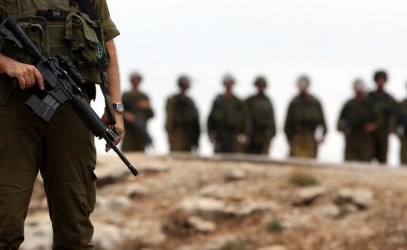
Israeli troops undertake the removal of a Bedouin community in Israel
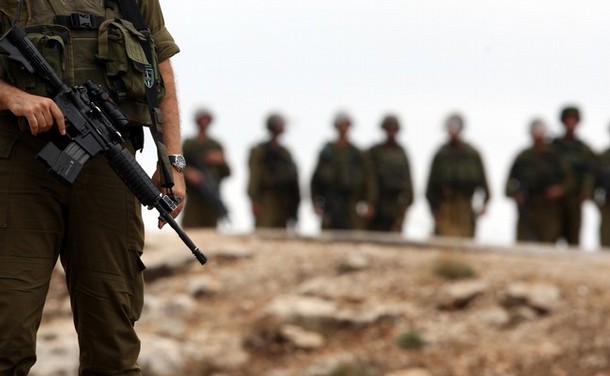
After Sunday’s decision was announced, around 150 Bedouins gathered outside the office of Israeli Prime Minister Binyamin Netanyahu to protest the plan. Some have termed it ‘ethnic cleansing’, and a Bedouin representative told Israeli reporters with Ha’aretz newspaper that the displacement plan represented a ‘declaration of war’ by the Israeli government against the Bedouin people.
Israel has created three ‘recognized’ areas for the Bedouins to settle in, near the municipal dump for the city of Jerusalem, and has repeatedly attempted to force the tens of thousands of ‘unrecognized’ Bedouins from their ancestral homes and into these areas, which many of the Bedouin view as ghettoes. The ‘recognized’ areas also do not include space for the animals of the Bedouin, many of whom are shepherds and require space for the sheep to graze.
When the ‘Prawer Report’, commissioned by the Israeli government to come up with a ‘solution’ to end the ‘Bedouin problem’, was released in June, the Association for Civil Rights in Israel filed numerous objections to the report.
The report says that the ‘unrecognized’ Bedouin villages must meet a number of criteria in order to be ‘recognized’, including economic sustainability and contiguity – criteria which many Bedouin people say involve the forced urbanization of their rural culture.
According to the Association for Civil Rights in Israel, “If the same criteria were applied to the Jewish population, whole settlements – including community settlements, observatories, kibbutzim and moshavim – would be doomed”.
Israel Targets Vittorio Arrigone School in Embattled Jordan Valley
By Matthew Eskin | Alternative Information Center | September 11, 2011
As schools around the world begin another year of instruction, one school, near to completion in one of the most grief-stricken and resilient areas of occupied Palestine, has suffered a massive set-back because the Israeli military has carried away its infrastructure- the Vittorio Arrigone school, in the small village of Ras Al Auja in the Jordan Valley.

Israeli soldiers confiscate and take away a donated caravan that was to serve as a classroom (Photo: Jordan Valley Solidarity Campaign)
The Arrigoni school, named after the Italian International Solidarity Movement activist killed in Gaza this April, began in February as a small tent school in the village of Ras Al Auja, and began evolving into a more permanent mud-brick and caravan structure in April. Built jointly by the Ras Al Auja community and the activist group Jordan Valley Solidarity, the school, once built, will educate young children up to the age of 13 in one of the areas of the West Bank hardest hit by the Israeli occupation. From the time that Israel seized control of the area in 1967 until the present, the resident Palestinian population has decreased from 320,000 residents to 56,000, as 36 primarily agricultural Israeli settlements, housing 6,400 settlers, have been constructed on 50% of the Jordan Valley’s land.
Ras Al Auja is a Bedouin community seven km west of the larger community of Al Auja. Both serve as paradigmatic examples of the devastating impact of Israeli occupation on Bedouin in the Jordan Valley. Until Israel’s occupation, Al Auja was for millennia an oasis, famous for its ever-flowing spring. As it says on the website of Jordan Valley Solidarity, “people would come to Al Auja from all over to swim, fish and sit among the banana groves that once grew there.” In 1972, the Israeli water company Mekorot, which has monopolized the West Bank water, dug two deep water wells in Al Auja, cutting off the flow of water before it reached the village. “These wells lowered the water table, drying out the spring. Today the area is a desert, crossed with dried-up canals that see water one or two weeks every year during the rainy season.”
As is commonplace for the larger West Bank Bedouin communities, families must use tractors and mobile water tanks to bring water to their homes and villages, at considerable personal expense. The estimated amount of water that one Palestinian in the Valley consumes per day, for drinking as well as all other activities, is some 70 litres. Jordan Valley settlers, on the other hand, enjoy free access to water and, from the comfort of their heavily subsidized, modern settlement homes, individually consume about 33 times as much water as their Palestinian neighbors in the Valley.
To make matters worse, the families of Al Auja and Ras Al Auja, who settled there after expulsion from Beer Sheva during the 1948 Nakba, used to have “over 100 sheep or goats each, which they grazed on the mountains and watered at the spring”. Now, the settlements of Yitav, Niran and ‘Omer’s Farm’ have colonized the surrounding mountains, an army military checkpoint borders Ras Al Auja to the south, and two enormous settler-only water towers cast a grim shade over the dry Al Auja spring. ‘Omer’s Farm’, in particular, has stolen half the land of Ras Al Auja in the five years of its existence. It consists of a single family, on a hilltop, surrounded by stolen farmland, heavily guarded by the Israeli military.
The men of Al Auja, according to Jordan Valley Solidarity, “are reduced to surviving by working in Israel’s illegal settlements, earning a pittance. The area feels like little more than a work camp, reminiscent of the townships of apartheid South Africa, with all the men away during the day in the settlements.” The Bedouin now work for settlers, to farm land that the latter stole from them. While they were previously self-sufficient farmers, the residents, now wage-laborers, making scarcely enough to get by.
In March 2011, Jordan Valley Solidarity joined with community members to construct a school for children of the 130+ families of Ras Al Auja. Over the course of two weeks, volunteers sewed sack cloths together to construct a makeshift tent school, where women from the community began to teach 30 children, mostly aged between 5 and 8, a basic curriculum of math, English, Arabic, geography and history. It was vitally important to establish a school in Ras Al Auja, says Jordan Valley Solidarity coordinator, volunteer and driving force ‘Jane’, who has been involved with this project since its inception, because “if you don’t have education when you’re a small child, that means that when you go to school you’re behind already. Education is a basic human right. These people have a right to education in their community.”
Before construction of this school, the children of Ras Al Auja were forced to walk 7 kilometres each morning to the school in al Auja. As the foot path trailed right next to two Israeli settlements, exposing children to regular physical and psychological settler harassment, many parents were wary of sending their young children to school. In addition, numerous fathers are off working in these very Israeli settlements, thus unavailable to assist their children in the mornings. Numerous children, therefore, were left without an education until later years.
Today, because the new school in Ras Al Auja only educates children aged 7 to 13, those children over 13 lucky enough to continue their education still need to take this daily trek to the Al Auja Secondary School, where they can study for the Tawjihi (matriculation exams). Mossem Zubaidat, a volunteer with Jordan Valley Solidarity who also works with the Palestinian Ministry of Education and Higher Education, relates how “there is no transport to take them to the village, so they use their legs to go to school in summer and winter. It is hard for them to put the bag on their back and walk all the distance… We need to build the school because in Ras Al Auja the people live in boxes, not in houses, they live in tents! We are certain to build a school there, it is our land and we can build a school anywhere!”
The Israeli army does not agree. The Area A, B and C zoning system was established for the West Bank after the 1993 Oslo Accords to designate areas of full Palestinian control, joint Palestinian civil and Israeli military control, and full Israeli control, respectively. Because 95% of the Jordan Valley, including al Auja and Ras al Auja, falls under Area C (50% because of Israeli settlements and 45% because of military training grounds and nature reserves), this means that almost nowhere in the Valley can the Bedouin build any permanent structure without requiring an Israeli permit, which is expensive to apply for and almost impossible to obtain. Between January 2000 and September 2007, Israel issued almost 5,000 demolition orders against Palestinian structures in the Jordan Valley. Of those, 1,663 demolitions were carried out – Israeli bulldozers tore down houses, schools, animal shelters and even entire villages.
The stated purpose of Israel’s vise-like grip on ownership and control of the Valley is to hold a security buffer space between Israel and Jordan, necessary to defend the country; in reality, however, Israel covets the Valley because (1) the West Bank, which could serve as a future Palestinian state, is thereby surrounded on all sides by Israel; (2) the West Bank is thereby cut off from economic interaction and communication with Jordan, and the rest of the Middle East; and (3) in the words of the soon to be published Jordan Valley Solidarity factbook To Exist Is To Resist, the Jordan Valley’s “abundance of water resources, fertile soil and natural minerals offer competitive economic advantages in agriculture, industry and tourism. It also constitutes a geographical “reservoir” of land where the Palestinians could establish housing projects and public facilities.”
Israel’s policy of constant settlement expansion, pervasive military checkpoints, destruction or closure of Palestinian roads (the last few years have seen 17 new roadblocks and 4 new checkpoints in the Jordan Valley), construction of Israeli-only bypass roads and physical intimidation, harassment, and outright demolition of Bedouin villages in Area C is evidence of a conscious attempt to gradually exterminate a Palestinian presence in the Jordan Valley, to cement Israeli control and solidify a long-term Israeli presence that remains illegal under international law. Jane explains the role of Jordan Valley Solidarity in resisting the Israeli occupation: “By supporting communities to construct infrastructure for basic services, we support them to stay in their communities, on their land- because the Israelis want them to leave the Jordan Valley, or to make them move into the 5% of the land which is in area A or B to create an Israeli state with Palestinian ghettoes.” The establishment of a school in Ras Al Auja, like countless other projects in the Valley, is not primarily a gesture of humanitarian aid, but rather a symbol of international solidarity. “The aim of lack of education is to drive people from their land. What that means is that the right to education for people is really important…as a basic human right, it’s not something that can be taken away from children… Therefore our motto is ‘to exist is to resist’, and the people in Ras Al Auja are existing and resisting just by being there, and being on their land is their resistance, so we support them in their resistance…together, [we are] using their own land that the people live on to create a fact on the ground to resist the Israeli occupation.”
It was in this spirit of resistance that, in April, it was decided that a tent school, though an important first step, was too small and impermanent to meet the community’s needs. Accordingly, over 100 international volunteers and community members began constructing two permanent mud-brick classroom buildings. After the death of Italian International Solidarity Movement activist Vittorio Arrigoni in Gaza that April, the Ras Al Auja community, which personally knows the vital role of international activism, requested to name the school Vittorio Arrigoni. From the Jordan Valley Solidarity website- “Vittorio was, and will remain, a great symbol of resistance. To give his name to one of our schools is an honour, and we will do our best to make this school another example of resistance against the occupation.” On 25 April 25t Luisa Morgantini, former Vice President of the European Parliament, Majed Al Fityani, Jericho Governor, 50 Italian volunteers, members of the local community, and Jordan Valley Solidarity volunteers laid the first brick of the Vittorio Solidarity school while singing ‘Bella Ciao’ and the Socialist International anthem.
It is this spirit of resistance that the Israeli army is acting to suppress. During the month of Ramadan, the Ras Al Auja school joyously received a donation of two large caravans, which would serve as classrooms. Yet at 10.30 a.m. on 7 September, in Jane’s words, “the Israeli occupation force arrived and removed the caravans on lorries, leaving paperwork… they made all the village stay back and declared it was a closed military zone while they removed the caravans”.
Jericho Governor Majed Al Fityani, who laid the first brick of the Vittorio Arrigoni school in April, said Wednesday afternoon that “we were surprised by the Israeli actions this morning, we were not expecting this from the Israelis. We are going to request an official answer from the Israelis for why they took the caravans… it is the duty of the government to provide education for the people. it is a question of providing services and facilities for the students, free of charge. It is very difficult to provide services because the school is in Area C, so it is impossible for us to build structures there.”
The start of classes will be postponed until further accommodations are arranged for the students. In addition, a celebration and official announcement ceremony for the school, planned for September 15, will now be postponed.
Nonetheless, the community of Ras Al Auja, along with Jordan Valley Solidarity, remains resilient in the face of this new obstacle. Explains Mossem Zubaidat, “its not the first school we built with Jordan Valley Solidarity. The first school was in Jiftlik, it started in tents, now it’s a building. The second school is in Fasayil. We built it from mud and soil and tents, and now it has become a building. So we have experience with the Israelis about these situations. We are sure that we are going to build that school again, and we must build that school for these people. We are going to talk to the media, we are going to talk to the Jericho Governorate, and we are going to talk to the community, to do something about it. The army says it is illegal, but we say it is legal, because it is Palestinian land!…We have to build the school because we need to stand with these people in their land, not to leave their land to the Israelis. We are going to fight to build that school again, we are not going to surrender!”
SOUTH HEBRON HILLS: Israeli military demolishes homes and bathroom in Umm al Kheer
CPTnet | 10 September 2011
The Israeli army demolished three dwellings and a bathroom in the Palestinian village of Umm al Kheer early in the morning of 8 September 2011. According to UN field workers at the sight, the demolitions left eight adults and sixteen children homeless.
The Israeli army and the District Coordinating Office arrived at the village of Umm al Kheer around 7:00 a.m. and declared it a closed military zone, preventing Palestinians and internationals from entering the area. The army then used a backhoe and a bulldozer to demolish the three homes and the bathroom. According to villagers, one of the destroyed homes was a tent donated by Oxfam. The other two were metal shacks purchased and built by the residents. The villagers said that this was the second time that the military demolished the homes of the families living in the metal shacks.
All of the destroyed structures had existing demolition orders, but according to people from the village, the military arrived with a demolition order that was not for the three homes and the toilet, but rather for a taboun oven in the village. The military originally wanted to destroy the taboun oven three days earlier, but a lawyer representing the village succeeded in getting a two-day stay on the demolition order. The military did not demolish the taboun oven.
Villagers said that in addition to the four structures demolished on 8 September, there are twelve additional structures with demolition orders, eight of which are homes.
“This [has been] done many times here in Umm al Kheer, and it’s catastrophic,” said a resident of the village who, due to fear of retribution from the Israeli government, wished to be referred to only as Suleiman. “The toilet, it doesn’t make problems for Israeli security, the tent does not make problems for Israeli security, and neither does this house, in which, inside, live twelve kids. How will these kids live? How will these kids sleep tonight? How can we explain the truth to these kids? Maybe these kids will grow up with fear. They must think about that.”
Umm Al Kheer is a Bedouin village in C area (under Israeli civil and military administration) built in the 1950s. It borders the Israeli settlement of Karmel (considered illegal under international law) established from the 1980s. The village routinely experiences harassment from the Israeli military and Israeli settlers.
The demolition is part of a clear strategy to push the Bedouins away from the area around the settlement. In October 2008, the Israeli army demolished ten house-tents in order to clear the area for expansion of the Karmel settlement. The demolitions left sixty people homeless. In July 2009, some toilets were destroyed too, because the Israeli Civil Administration considered them illegal.
Operation Dove and Christian Peacemaker Teams have maintained an international presence in At-Tuwani and South Hebron Hills since 2004.
Oakland Museum Shuts Down Palestinian Children’s Exhibit

Middle East Children’s Alliance – September 9, 2011
Berkeley, CA— The Museum of Children’s Art in Oakland (MOCHA) has decided to cancel an exhibit of art by Palestinian children in the Gaza Strip. The Middle East Children’s Alliance (MECA), which was partnering with MOCHA to present the exhibit, was informed of the decision by the Museum’s board president on Thursday, September 8, 2011. For several months, MECA and the museum had been working together on the exhibit, which is titled “A Child’s View of Gaza.”
MECA has learned that there was a concerted effort by pro-Israel organizations in the San Francisco Bay Area to pressure the museum to reverse its decision to display Palestinian children’s art.
Barbara Lubin, the Executive Director of MECA, expressed her dismay that the museum decided to censor this exhibit in contradiction of its mission “to ensure that the arts are a fundamental part of the lives of all children.”
“We understand all too well the enormous pressure that the museum came under. But who wins? The museum doesn’t win. MECA doesn’t win. The people of the Bay Area don’t win. Our basic constitutional freedom of speech loses. The children in Gaza lose,” she said.
“The only winners here are those who spend millions of dollars censoring any criticism of Israel and silencing the voices of children who live every day under military siege and occupation.”
Unfortunately, this disturbing incident is just one example of many across the nation in which certain groups have successfully silenced the Palestinian perspective, which includes artistic expression. In fact, some organizations have even earmarked funds for precisely these efforts. Last year, regrettably the Jewish Federation of North America and the Jewish Council for Public Affairs launched a $6 million initiative to effectively silence Palestinian voices even in “cultural institutions.”
The free exhibit, co-sponsored by nearly twenty local organizations, was scheduled to open on September 24, and featured special activities for children and families, including a cartooning workshop and poetry readings.
The Gaza Strip, which has a population of 1.6 million, has been under siege since Israel imposed a blockade against it in 2006. The United Nations and many human rights organizations across the world have condemned the blockade as an inhumane and cruel form of collective punishment.
“Even while the children in Gaza are living under Israeli policies that deprive them of every basic necessity, they managed through art, to express their realities and hopes. It’s really very sad that there are people in the U.S. silencing them and shredding their dreams,” said Ziad Abbas, MECA’s Associate Director.
MECA is disappointed in the museum’s decision to deny Bay Area residents the opportunity to view Palestinian children’s art, and is committed to seeking an alternative venue.
“We made a promise to the children that their art will be shown and we are going to keep that promise,” said Lubin.
Media please contact:
Leena Al-Arian
Communications Coordinator, MECA
Leena@mecaforpeace.org
The UN bid through the eyes of a Palestinian refugee
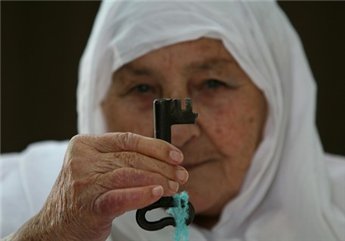
Palestinian refugee Mudalala Akel, 86, still holds the keys to her family’s home
in what is now Israel. [MaanImages/Wissam Nasser, File]
By Nizar El Laz – Ma’an – 08/09/2011
Palestinian refugees in Lebanon living in and outside the camps have always dreamt of being a part of the state of Palestine.
I have dreamed of participating in the first and the second intifada, in the peaceful protests against the apartheid wall, and in the daily struggle against the occupation in the West Bank, Jerusalem and Gaza as much as I have dreamed of being raised in my homeland and as much as I’ve continuously been hoping for a chance to visit Palestine.
I have also wished that President Abbas would visit some of the camps to see the drastic situation refugees are living in Lebanon instead of only looking to raise the Palestinian flag on the embassy of the state newly recognized by Lebanon. A major question is being raised amongst the refugees’ population in Lebanon: What will be our future?
The major and primary concern a refugee like myself has, faced with the formulation and declaration of the state of Palestine, is the drastic dilemma which will soon face the six million refugees around the world; leaving them with a state that shares the same name as their place of origin but to which they neither legally or physically belong to.
In 2009, Prime Minister Salam Fayyad declared the two-year plan for the establishment of the state of Palestine on the 1967 territories. Since then, as a Palestinian refugee in Lebanon, my doubts for being a part of the new order have increased. Lately, an additional reason for my concern was added to the Oslo Accords, Camp David, Road map, Geneva Accords, and many other leaks: the request of recognition of the state of Palestine in the UN.
Although strategies and plans have already been implemented by Fayyad on the Palestinian ground to prepare institutions to take over the occupied territories from a public governance perspective, little emphasis has been placed on the Palestinian refugees in Lebanon, Syria and Jordan.
Countries around the globe are recognizing the state of Palestine within the borders of the June 4, 1967, but where does this leave the 7.5 million Palestinian outside the 1967 territories including the approximate 1.4 million Arab Israelis? How will they be represented? Will they be naturalized in their hosting countries? How will their host countries treat them?
And how will the seven points of the final agreement be solved between the state of Palestine and the state of Israel?
Those are but a few of the questions that have remained unanswered, leaving Palestinians all over the world questioning their status quo, and wondering what will become of their current identity. Apart from the refugees in Gaza and the West Bank, the rest of the Palestinian refugees will not enjoy the right to citizenship in the future state of Palestine, and will therefore be deprived of all rights to their land and state protection which they used to legally enjoy under the PLO.
We as the Palestinian diaspora are certainly heading towards the unknown, approaching the strand of hope we had of claiming the rights the Palestinian National Movement had given us. Everything the movement has established over the history of the Palestinian struggle will most certainly be lost by demolishing the PLO which has long been the only representative of the whole Palestinian population.
Many other questions also arise in light of the current events. What will happen to the PLO? Although it is corrupt and requires urgent restructuring and organizational development, and does not actually protect the rights of the Palestinian refugees or Arab Israelis as it should, it still does hold legitimacy since it is an organization that has been recognized by the UN since 1974.
Why should this historical backbone be taken away from the Palestinians? How will my family in Akka be represented by the Palestinian state?
In return, what will their legal position and commitment be towards the state of Palestine knowing that they hold Israeli citizenship, which is not guaranteed because their citizenships can and might be revoked any day by the Israeli government which openly discriminates between Arab-Israelis and Jewish-Israelis.
What gave the Palestinian leadership the right to decide on behalf of all Palestinian refugees around the world what will be happening to us and to our futures? How will the people exert the right to self determination granted to the PLO if it is replaced by the State of Palestine?
As a Palestinian refugee, who has only ever been represented by the corrupt Palestine Liberation Organization, which has never given me as a refugee the chance to vote, audit or evaluate its governance or decision making strategies, I still prefer to be recognized by it rather than becoming naturalized in another country and losing the right to return to my land of origin.
We as refugees in Lebanon proved on May 15, when we marched to the Lebanon -historical Palestine borders, that nothing will stand between us and our rights in our homeland.
It took me a long time to reach a stand from the plans of a new Palestinian state, but by now I am sure it is a trap to dissolve the Palestinian people and the Palestinian cause.
As a refugee in Lebanon, I don’t want a state that does not associate me as a Palestinian refugee in its future plans. I don’t want a state that does not protect my right of presentation. I don’t want a diplomatic step that attempts to solve a complicated conflict from the shallow end of the conflict, ignoring the source and the main core of the problem.
I don’t accept to be driven to a deeper unknown and a deeper sense of isolation from my Palestinian roots.
From the Arab spring, the Palestinian leadership should learn the right lesson; the lesson that the will of the people and the right of the people should be respected and preserved or the continuity of their positions will not be guaranteed.
President Abbas, do you hold a fair, convincing and just answer for our worries?
Nizar El Laz is a human rights activist in the Palestinian community in Lebanon
Wasteland in al Walajeh: Israeli military destruction of farmland
7 September 2011 | International Solidarity Movement, West Bank
On Tuesday September 6th local Palestinians from the village of Al Walajeh gathered with international activists to protest the building of the illegal separation barrier as well as the destruction of ancient olive trees. The demonstrators succeeded in halting the razing of Palestinian land for approximately one hour before soldiers violently broke up the protest arresting one Palestinian and one Israeli activist.
On September 5th bulldozers protected by dozens of soldiers arrived at 4 AM and uprooted 50 olive trees that date back at least 100 years. The bulldozers also destroyed 18 almond trees, 27 pine trees, and 8 fruit trees. The destruction took place in an area of over 1 square mile and was declared a closed military zone, prohibiting media coverage of the devastating operation.
Mohammed Al-Atrash (Abu Wajih), the elderly farmer who owned the trees, will receive no compensation for his loss.
In the aftermath residents of Al Walajeh called for a presence of media and activists to highlight this illegal destruction carried out by the Israeli government. At approximately 10am on Tuesday several residents from the village, joined by ISM and other activists, walked down to the site of the olive grove, which is now a wasteland. Upon arriving they stood in front of the construction machines and forced them to halt their work.
Soldiers declared the area a closed military zone and disbanded the protest by force within an hour. Yousif Shakawi, a local resident in his 50’s was arrested along with one Israeli activist. The remaining protesters were held at distance so that the work could resume.
The trees were destroyed in preparation for the building of the illegal Israeli apartheid wall which is planned to run several hundred metres inside the 1967 green line, effectively seizing hundreds of dunnums of land from around Al Walajeh. If the Israeli government succeeds in completing the wall along the planned route the village will be surrounded on three sides with the army controlling entrance and exit to the village.
Sheerin Alaraj, who has lived in Al Walajeh all her life, explained to us that construction of the wall was continuing in spite of an on going appeal process in the Israeli high court with a ruling expected September 27th . However Sheerin has little confidence in the process as she explained to us “the court is just an extension of the military arm of Israel.”
In 2004 the International Court of Justice declared that the apartheid wall is illegal and Israel should tear it down immediately and compensate the victims. In spite of this ruling Israel has continued construction of the wall which annexes 8.5% of the entire West Bank territory. Since 2000 Israel has destroyed approximately 330,000 olive trees in the West Bank and Gaza. There is currently a campaign to boycott Caterpillar Inc. for its role in supplying the Israeli government with equipment used to enforce the occupation.
As the time for harvesting olives nears and Israeli military and settlers continue to destroy the main agricultural pillar of Palestinian culture and livelihood, International Solidarity Movement will be actively working throughout the harvesting season to safeguard Palestinians and assist in harvesting despite this and other events that have threatened security and access to Palestinian farmland. For more information on ISMs Olive Harvest Campaign, visit our website.
Featured Video

They Double Down on BLOOD PRESSURE Guidelines!
or go to
Aletho News Archives – Video-Images
From the Archives
Chocolate Gives Statins a $29 Billion Run For Their Money
By Sayer Ji · GreenMedInfo · April 17, 2012
With the blockbuster cholesterol-lowering class of drugs known as statins being widely promoted for the primary prevention of cardiovascular disease, despite their having over 300 documented adverse health effects (including heart failure!), how does chocolate sound as a viable, heart-friendly alternative?
We already connect amorously with chocolate (to the tune of 6 billion lbs of cocoa consumed annually worldwide), revealing in heart-felt expressions like “I love it,” and “this is to die for!” how comfortable we are with publicly declaring our affection. But did you know that while it makes our emotional hearts sing, it may actually keep our physical hearts happy, alive and ticking longer, as well?
Indeed, back in 2006, researchers found that for elderly men, eating cocoa was inversely associated with blood pressure and 15-year cardiovascular and all-cause mortality. … continue
Blog Roll
 Aletho News
- I’M SO BLOODY FURIOUS: They Double Down on BLOOD PRESSURE Guidelines!
- The Israeli Nuclear Doctrine and the Turning Point of the Kennedy Assassination
- Striking Matches Near the Powder Keg
- Prominent Russia hawk: European leaders privately talk about war with Russia, first need ‘mass casualty event’
- China warned Trump not to touch Iran’s oil tankers: Larry Johnson
- EU Central Banker Plans To Plant Barren AI Crops Across The Continent
- Macron’s Strategic Autonomy Paradox: France Rearms on Debt and Depends on Foreign Fuel
- Nigel Farage vs Tucker Carlson: Who is right about Hitler and Britain?
- Chocolate Gives Statins a $29 Billion Run For Their Money
- Hypotheses on the collapse of U.S. computer systems
- If Americans Knew
- An error has occurred; the feed is probably down. Try again later.
- No Tricks Zone
- New Study: Modern Temps Are Among The Coldest Of The Last 10,000 Years In East Central Europe
- Germany’s Renewable Energies Lead to 1.4 Billion Euro Electric Power Trade Deficit
- Argentina’s Perito Moreno Glacier Joins Antarctica and Arctic In Defying Doomsday Melt Claims
- New Study: Barents Sea Temperatures Were Warmer And Sea Ice Less Extensive In The 1700s Than Today
- German Authorities Start Initiative To Evaluate Public Register For Climate “Disinformation” Spreaders!
- Zonal Asymmetry of Temperature Change in the Antarctic Circumpolar Current
- New Study: The Net Fossil Fuel Contribution To Rising Atmospheric CO2 Has Been Zero For 500 Years
- Germany’s Green Energy Transition Becoming Increasingly Expensive…Another 6 Trillion Euros!
- Sudden Stratospheric Warming, Powerful El Niño Combination May Lead To Extreme Europe Cold, Energy Crisis!
- Two New Studies Find Thwaites Glacier Melt Cannot Be Driven By Human Activity Or A Warming Ocean

