What Congress Won’t See on Its Trip to Israel This Month
By Michael Berg | News Wire | August 20th, 2011
Congressman Russ Carnahan joined nearly 20 percent of the United States House of Representatives in a trip to Israel this month. Paid for by an affiliate of the American Israel Public Affairs Committee, these 81 representatives are supposed to represent our interests but are choosing to spend their recess in Israel — and briefly in the occupied West Bank — at a time when Americans are suffering and scared from high unemployment, a tanking stock market and a downgrade of our national bond rating.
I also recently traveled to the Holy Land, although I paid my own way. I was part of the “Welcome to Palestine” delegation. I was lucky. Most of my colleagues on the delegation were not allowed to join me. On July 8 over 120 people from Europe, North America and Australia were detained at Israel’s Ben Gurion airport. They were then imprisoned by the State of Israel, most for over a week. Their only crime was that when Israeli custom officials asked what they were doing in Israel, they responded that they were planning to visit Palestinian friends in the Aida Refugee camp in Bethlehem. Three hundred other delegates who planned to visit Bethlehem and other places in the occupied West Bank were forced off their flights in Europe due to Israeli pressure.
During my time in the Holy Land, I had an opportunity to meet and talk with many Palestinians and Israelis. I learned about a system in Israel that discriminates against Palestinians on the basis of their ethnicity. In the West Bank, things are far worse. I observed an explicit system of racial segregation and ethnic cleansing, where Palestinians are separated from their own lands and water by walls, barbed-wire fences and machine-gun-wielding soldiers and Jewish settlers.
I saw the remains of an entire demolished Bedouin village, destroyed in order to expand an illegal Jewish settlement in the Jordan Valley. The settlement uses what used to be the wells of the Bedouin village in order to provide water for its swimming pools.
I witnessed a Palestinian farmer coming under fire from projectiles merely for trying to farm his own land. The excuse? His land is too close to a Jewish-only settlement. A European with me did not leave the vicinity as quickly as Israeli soldiers wanted and had his face smashed into the ground. He was detained for approximately one week and then deported.
I observed how Bethlehem, the birthplace of Jesus, is being economically and socially stunted by a giant wall that separates it from Jerusalem. It is a wall that Israelis can cross freely to travel between settlements and the rest of Israel. For Palestinians living in the West Bank, it is quite difficult to get a pass to go to Jerusalem, and if they do they must go through a humiliating inspection procedure at the checkpoint.
Israel systematically abuses the human rights of Palestinians who live within the territory it controls. In fact, what I saw can most accurately be described as apartheid.
Israel is certainly not the only country in the world that discriminates on the basis of ethnicity. It is not the only country that abuses fundamental human rights.
But it is the only country of this nature that receives over $3 billion a year in American aid money. It is the only foreign nation to which American politicians routinely offer their “unwavering support,” as Rep. Carnahan’s sister Robin did in her recent campaign for United States Senate.
And it is the only foreign nation that is receiving 81 American congressional delegates in three delegations, split among 55 Republicans and 26 Democrats, during a time of great difficulty for our own country.
Unfortunately, members of these delegations did not see the same reality that I did. This is not the goal of AIPAC, which calls itself “America’s Pro-Israel Lobby,” or its affiliate leading the junkets. In an interview in Israel, Congressman and tour leader Steny Hoyer stated that the American economic crisis will have no impact on our financial assistance to Israel.
I hope that Rep. Carnahan sees something that Rep. Hoyer did not. Rep. Carnahan has an opportunity to promote human rights over repression and the economic well-being of the United States over that of an apartheid state.
Palestinian stabbed in Ashkelon
Ma’an – 20/08/2011

RAMALLAH — Palestinian Authority police said Saturday that unknown assailants in southern Israel stabbed and injured a Palestinian worker based in the coastal city of Ashdod.
Nassim Al-Barbarawi, 26, told police he was attacked by more than 20 Israeli men who said they were avenging Thursday’s attack near Eilat which left eight Israelis dead.
He managed to flee his attackers when a car stopped to rescue him and took him to hospital in Ashdod, he said.
The victim was transferred by ambulance to hospital in Hebron.
Palestinian youth in Gaza skeptical about PA’s UN bid
By Mohammed Rabah Suliman – The Electronic Intifada, Gaza Strip – 19 August 2011
Along with several other bloggers and activists in the Gaza Strip, I was recently invited to take part in a short video about young Palestinians’ reaction to the Palestinian Authority’s (PA) bid to have the United Nations admit a Palestinian “state” as a full member of the international body this September.
As each participant was being assigned a role in the video, an argument erupted among the four of us over who should speak in favor of the Palestinian Authority’s move. We discovered, to the producer’s amazement, we were all flatly against it.
This might have just been a coincidence. Only a few days earlier, however, I woke up to my new wild ringtone. As I answered my phone, I was asked by a journalist from Germany’s Deutsche Welle television to give an interview on the same issue. As I arrived at the arranged meeting place, another blogger was already giving her answers to the interviewer. She was unequivocally critical of the PA’s “disastrous history” and its “unending series of flops.” She argued that UN recognition of a Palestinian state would be just one more chapter in that sad history.
Of course it is hard to generalize from two incidents but they do offer some insight that a large segment of Palestinians believe they have been entirely and overtly marginalized by the PA’s unconcealed monopoly of Palestinian political decision-making.
Still, this does not mean that the PA’s move does not have any support in Gaza — there are Palestinians who support the PA and they are numerous.
Critics of the PA’s UN bid would say that none of these supporters is truly able to appreciate that their unrealized dreams of living in a long-awaited free and independent Palestinian state are not being advanced by the PA’s little-debated UN move. Some Palestinians may be convinced by the rhetoric of PA officials and believe that potential UN admission is a highly symbolic move and a step forward on the road toward independence. But some younger observers in Gaza are much more skeptical.
Fed up with ignored UN votes
Fidaa Abu Assi, a 22-year-old blogger and English literature graduate in Gaza, believes there is nothing symbolic in going to the UN and securing recognition of a Palestinian state on the 1967 lines. She is “fed up” with the unimplemented UN resolutions and symbolic moves taken by the PA on her behalf.
“Some Palestinians would rejoice at the thought of finally having a recognized Palestinian state,” she argues in a blog post. “In essence, however, the whole initiative seems pointless, or rather, insidiously dangerous.” Bewildered, she asks, “How could they [the UN] recognize a state that doesn’t even exist? And, wait, hadn’t the PLO already proclaimed a Palestinian state in 1988 on the basis of UN General Assembly Resolution 181?” (“‘No’ to UN Recognition, ‘Yes’ to US Veto,” 22 July 2011).
Abu Assi’s view reflects the sentiments of a generation that does not seek more UN resolutions and international declarations. Not even a declaration of a state. A state itself is rather what we desire. A state that we can touch, see and live in. We long for the reunification of the more than 11 million Palestinians living in the world. We want to see facts on the ground and tangible results. We crave for the land which has been relentlessly ripped apart in flagrant violation of dozens of resolutions already passed — and then promptly ignored — by the very same UN to which the PA now turns.
“We would forget, wouldn’t we?”
In an open letter to a refugee living in the Palestinian diaspora, Sameeha Elwan, a 23-year-old blogger and English teaching assistant at the Islamic University of Gaza, pours out her scorn on the PA, and any declaration of a Palestinian state on 1967 borders that excludes the right of Palestinian refugees to return (“To My Dear Stateless Palestinian,” 6 August 2011).
“My mother would no longer be a refugee,” Elwan writes. “She would have to give up every dream of going back to Aqer [a large Palestinian village nine kilometers to the south east of Ramla in present-day Israel]. My grandmother would stop telling us of her tales of the lost village near Gaza from which they fled in 1948. She would forget this history. It is no longer hers. She would have to stop telling the story every now and then. She’d eventually die; we would eventually forget, wouldn’t we?”
Some bloggers have displayed a deep understanding of the history of the Palestinian-Israeli conflict and of its implications for the future of the Palestinians not only in Gaza and the West Bank, but also those living inside Israel.
One state: the only real solution
Rana Baker, a 19-year-old blogger and student of business administration also at the Islamic University of Gaza, argues that to be able to comprehend the risk of the UN declaration of a Palestinian state, this issue should be placed in its rightful context: the debate over a two-state solution. “In fact, the Palestinian street is divided into two: those who are for one state and those for the UN September recognition of two states,” Baker writes, adding “I’m for one state” (“I Turn On the Fan and Sit to Write,” 8 August 2011).
Baker too warns that the PA “statehood” bid may be most threatening to Palestinians in the diaspora. “What about more than 5 million Palestinian refugees who dream to return to their lands?” she asks, “The Palestinian Authority does not have the right to take decisions on their behalf. If they were given the right to vote, they would have voted against this bid. This is definite.”
Behind these criticisms lie doubts that many Palestinians have about the upcoming move to declare a Palestinian state on the 1967 lines. Some tend to question the functionality of a state in the besieged Gaza Strip and the heavily colonized West Bank, a state totally dependent on foreign aid.
Others reasonably cast doubt on the credibility of the UN to secure the viability of this state, if recognized, and safeguard it against Israel’s expansionist policy. Some call it a blatant concession that terminates the right of return of Palestinian refugees all over the world. And some view it as yet one more act of treason by the PA — a move that would involve turning our backs on the 1.5 million Palestinians living in dire conditions and facing constant discrimination inside the apartheid State of Israel.
As varied as the reasons might be to oppose the PA bid, they all stem from a firm belief that universal rights, real liberation and return, not “statehood” at any price, must be at the heart of our demands and struggle. Any solution must fully restore the rights of all segments of the Palestinian people — those living under occupation in the West Bank and Gaza Strip, those inside Israel, and the refugees waiting to return.
And its also clear that increasingly, many young Palestinians believe that these rights can only be achieved in a one-state solution that puts an end to Israeli apartheid and guarantees equality and justice for all.
Mohammed Rabah Suliman is a 21 year old Palestinian student and blogger from Gaza. Mohammed is an English literature graduate and will undertake graduate studies at the London School of Economics this September. He blogs at Gaza Diaries of Peace and War, and can be followed on Twitter @imPalestine.
An interesting exchange with a Jewish anti Zionist
By Gilad Atzmon | August 17, 2011
“I have striven not to laugh at human actions, not to weep at them, nor to hate them, but to understand them.” – Baruch Spinoza
Daniel Cohen (fictitious name) is deeply admired by many. He is a humanist, an anti Zionist and he is also a man of great integrity. A week ago, Daniel decided to challenge my views, and launched a courageous debate. Being a gracious man he might have hoped to open my eyes to some ‘categorical mistakes’ he believed I was making. For my part, I was very open to his criticism and engaged in the dialogue.
Daniel was not happy with the way the exchange has evolved. Though he circulated his comments and my interventions to his close Jewish friends, he made it clear that he wanted to stop the exchange at a certain stage. Daniel was very angry with me. He also made it clear that he did not want me to publish the exchange of views. As I always do in such cases, I suggested that together, we should edit the debate, but he refused. Respecting Daniel’s request for anonymity, I have now re-edited the text myself, concealing Daniel’s real name, removing all sections and biographical references that could reveal Daniel’s identity. Occasionally, I have re-phrased Daniel’s comments for purpose of continuity and clarity, but I have faithfully retained his meaning.*
Unlike Daniel, I believe that issues to do with Jewish history and Jewish ideology must be discussed openly and without fear.
Questions You Should Never Raise
Daniel Cohen: Dear Gilad, we certainly share many ideas and thoughts. We both oppose Zionism and Israeli policies, however, rather, too often, you fail to be careful enough with your formulations, and this gives room for some misunderstandings. You seem to challenge some issues to do with the Holocaust, and history in general. It seems to me as if, often enough, you raise questions to which various sufficient answers already exist.
Gilad Atzmon: I can already tell you, at this stage, that I have a slight problem with your approach. To start with, as a philosopher, I am far more interested in the art of asking questions. I leave the ‘answers’ to politicians. Moreover, the relationship between questions and answers is paradigmatically oriented. A sufficient ‘answer’ within one paradigm (or discourse) may as well be totally inadequate or irrelevant within another – a certain ‘answer’ within Aristotelian physics may well be within the realm of the inexpressible within a ‘Newtonian’ paradigm.
Daniel: If you ask, for instance, why were the Jews repeatedly hated in so many places along their history, as you do in some of your texts, you create room for anti-Semites who may say it is because they are intrinsically evil.
Gilad: To start with, as a thinking being full of curiosity, I do not take instructions from anti Semites or Zionists or Jewish anti Zionist campaigners. I instead follow my instincts and go along with my sincere ethically driven truth-seeking adventure. Also, I believe that the answer you attributed to anti Semites can be easily addressed. Jews cannot be ‘intrinsically evil’ because Jews do not form a racial or ethnic continuum. Any racial attribution to Jews is clearly wrong and silly.
Daniel: I actually do not agree with your approach. The appropriate answer to the above question is that in the Middle Ages Jews were barred from many professions except money trade and peddling, two professions which could easily arouse disdain and hate.
Gilad: Dear Daniel, with all due respect, such an answer is far from being sufficient. In Europe at least, Jews have been emancipated since the French Revolution. By the end of the 19th century most European Jews enjoyed equal rights. And yet, something went horribly wrong in the 1920s-30’s. Our duty then, is to understand, what was it? Why did it happen? Why do Jews encounter resentment all too often and in many different places?
I don’t know whether you are aware of it, but the reasoning you suggest here is very similar to the Early Zionist mantra. Borchov, and Katznelson were also convinced that Diaspora conditions were responsible for ‘Jewish deformed cultural identity’. They believed that on a land of their own, Jews would be able to re-invent themselves and become ‘people like other peoples’.
As you and I agree, Zionism is a complete disaster. The Jews are hated in the Middle East. And as Shahid Alam suggests, Zionism did not really solve the Jewish question; it only re-located it in a new place (Zion).
The answer to the question is actually very simple; as long as Jews operate politically, culturally and socially within exclusive racially oriented cells, be it Israel, Zionism, Jewish ‘anti’ Zionist networks or even ‘Jews only’ football clubs , they will encounter problems.
But let us go back to issues of whether there are some ‘questions that should never be raised’. For me, to be in the world is to live through changes, to allow meaning to be in flux and to let ourselves be transformed accordingly. I could never accept the Idea that some questions have sufficient and firm answers. In fact, I oppose any form of dogmatism.
Daniel: But, in your text ‘Truth, History & Integrity’ you go as far as asking “why Auschwitz’s (Jewish) prisoners didn’t wait for the Red Army ?” Do you think that this is an appropriate question to ask?
Gilad: Sorry Daniel. I have to stop you there, I believe that in order to address this quote, I must first re-locate my words in the right order, and within the appropriate context. In my paper ‘Truth, History & Integrity’[1] I quote Israeli Holocaust historian Israel Gutman, who suggests that Auschwitz prisoners (or at least some of them) joined the Death March voluntarily (“I then decided to join [the march] with all the other inmates and to share their fate” )[2]. Following Gutman’s quote, I then presented the following inference:
“If the Nazis ran a death factory in Auschwitz-Birkenau, why would the Jewish prisoners join them at the end of the war? Why didn’t the Jews wait for their Red liberators?”
What we see above is a clear inference (rather than a mere question). It seems to me that it is there to suggest that further research is needed. As opposed to the historian who searches for a narrative, as a philosopher, I am there to question what the word ‘narrative’ actually stands for, or in Kantian terms — what are the conditions of the possibility of a historical narrative. In my relevant paper, I do not attempt to provide an answer — I am not an historian. My primary issue is concerned with the freedom to wander/wonder, and to raise possible dilemmas without being terrorised by the ‘Holocaust censorship police’ or any other form of thought dictatorship.
Daniel: But, can’t you see that with such a manner of behaviour you provide Holocaust deniers and anti-Semites with ammunition? They can so easily misuse your words.
Gilad: Dear Daniel, I do understand your concern, but with all due respect, I have been writing for some years now, and, as far as I am aware, anti-Semites or Holocaust deniers do not seem to misuse my words. I have been quoted by some so-called anti Semites, some of whom liked me, whilst others hated me, but they appear to quote my ideas within context and seem to be faithful to the original meaning and intention of my writing.
But — let me tell you, I have seen many Zionists and ‘anti’ Zionists systematically misquoting me, misrepresenting me, forging my statements, and taking my words out of context, all willfully done to create the most awful impression of my work.
Daniel: But let’s return to your earlier statement — can’t you see that the inference you are making here is that Auschwitz was not a death factory, which to me, comes near to denial.
Gilad: No, I do not agree with such an interpretation of my words. In my article, you will notice that I refrain from suggesting any answer. I would argue instead that raising the right questions is far more important than repeating the ‘right’ answers. The same applies to the 911 Truth Movement. Whether someone manages to come up with the right explanation of this peculiar chain of events is one issue, the fact that so many people suspect and challenge the official narrative is clearly a revelation or at least very positive sign. Furthermore, I also find the notion of ‘denial’ rather problematic. Instead of denial, I would prefer to emphasise the fundamental and ethically grounded right to revise, re-visit and re-view. I believe that to be tolerant is to agree not to agree, and also to respect others when we don’t agree.
Jews, Judaism & Jewishness
Daniel: I want to say that I am also troubled with your attitude towards Judaism and Jewish religion.
Gilad: Actually, you will notice when you read my work that I tend to avoid dealing with the Judaism (the religion), and I also avoid discussing Jewish people as an ethnic or racial group — instead, I prefer to elaborate on ‘Jewishness’, Jewish ideology and Jewish political identity.
Daniel: But for me, there is no such a thing as ‘Jewishness’ — there is only Zionist Ideology. I do not accept at all the notion of Jewish ideology or Jewish political identity. I am only willing to deal with the Zionist political identity.
Gilad: I am absolutely fine with that – I am familiar with, and respect your views, which are common amongst Jewish anti Zionists. Unfortunately, my way of ‘perceiving the universe’ is somewhat more complex and I am far from being proud of what I see. It seems to me that you are missing a crucial aspect of the whole debate – You do not seem to realise that Zionism is just part of the problem. The notion of Zionism no longer actually means very much to Israelis anymore. Hence it falls short of explaining Israeli collective barbarism. Once Israel was founded, the Zionist dream had fulfilled itself. Zionism is now largely a Jewish Diaspora discourse, and therefore, falls short of explaining Israeli politics and Israeli brutality in particular.
Israel defines itself as the ‘Jewish State’, and it drops bombs on innocent civilians from airplanes that are clearly and unambiguously decorated with Jewish symbols. Israel commits horrendous crimes—‘in the name of the Jewish people’. In ‘my universe’ then, I am more than entitled to ask what Jewishness stands for, and I repeat, that Zionism is just one manifestation of Jewishness.
The next stage is surely to define what Jewishness is all about.
I say again, that in my writing I differentiate between ‘Jews’ –the people, Judaism–the religion, and Jewishness the ideology. I avoid the first two categories almost entirely, and I focus on Jewish ideology. I admit that such an approach issue can lead occasionally to some misinterpretations – but as far as I am able, I do try to be clear about it, as much as I can.
I do not consider the Jews to be a race, and yet it is obvious that ‘Jewishness’ clearly involves an ethno-centric and racially supremacist, exclusivist point of view that is based on a sense of Jewish ‘chosen-ness’. Zionism too, is a clear manifestation of such an ideology. But, tragically enough, the Jewish Left happens to be of a very similar tendency. Like Zionists, the Jewish Left are also interested in notions of being ‘racially’ or ethnically exclusive. For instance, Hamed from Gaza would not be able to settle in Tel Aviv — but surprisingly enough, he may also find it very problematic to join IJV (independent Jewish voice) or ‘Jews for peace in Palestine’.
Daniel: But you have to bear in mind that in sharp contrast with the multifaceted religion of Judaism, Zionism is completely monolithic in that it can be defined as having just one single goal: maximum surface in Palestine (for the Jews) with the minimum number of Palestinians on it.
Gilad: I am sorry but here again, I find myself in a slight disagreement with you. Zionism and political Zionism are dynamic movements, and subject to constant metamorphic changes. They change their goal all the time. It is even very difficult to define what is the ‘exact’ role of Zionism after Israel has been founded. I think that your definition of Zionism is basically a very good description of Israeli policy (“maximum of surface in Palestine with the minimum number of Palestinians on it”). However, and I re-emphasise, Zionism should now be considered to be largely a Diaspora discourse. It means very little if anything at all to the Israelis.
Zionists cannot even decide whether they want to schlep world Jewry to Zion, or to leave them in the Galut (Diaspora) so they can campaign for Israel forever.
Daniel: But wouldn’t you agree that Zionism is chauvinistic, racist, expansionist and colonialist? It is imperative to be very careful in distinguishing between the words Judaism and Zionism.
Gilad: I largely agree with the above. However, in my work I never tie the two together. Yet, I do allow myself to argue that if Israel defines itself as the ‘Jewish State’ we must surely be entitled to wonder what Jewishness stands for.
Holocaust religion vs. Judaism.
Daniel: Gilad, you write about Holocaust religion. Yet again, in very sharp contrast to Holocaust religion, Judaism has taught the world how to differ in opinion and how to debate. Judaism is non-dogmatic and since the destruction of the second Temple everyone over 13 years of age is entitled to take part in debate and discussion, provided he has good arguments.
Gilad: I am not so sure that I agree with you here. In theory you may be right, that on the face of it, the Talmud is indeed part of an open debate and a search for conclusive and rational ruling. However, there is another aspect to Rabbinical thinking, and that is the notion of Herem (ex-communication) to give just one example. Rabbinical Judaism is very dogmatic and extremely intolerant towards dissidence. The cases of Spinoza ex communication and the brutality towards Uriel Da Costa seem to be to be crucial for an understanding of Judaism . I want to remind you that Israeli PM Rabin was assassinated following a Halacha ruling (Din Rodef).
Daniel: However, Holocaust religion is the opposite. It is very dogmatic and forbids practically any discussion.
Gilad: I obviously agree with you here, but given your opinion here, then I would expect you to support me asking all those earlier questions that to me, appear to be totally legitimate.
Daniel: But surely you agree that you cannot debate with people who deny the Holocaust as a historical fact. And why should one raise questions where answers are already known to all?
Gilad: Dear Daniel, I would prefer to engage in a preliminary discussion here. I think we should be careful in the way we use the word ‘fact’. A given Historical chapter is not solely a fact but a narrative composed of many ingredients such as: facts, personal testimonies, prose, culture, emotional contents and so on. The narrative is the mortar that bonds all the different ingredients by means of reasoning. It allocates events with meaning and direction. This applies to the Napoleonic wars as much as it does to the Holocaust, or indeed, any other historical chapter. The Holocaust should not be regarded solely as a rigid set of ‘facts’ but rather as a very complicated historical narrative, a compound of very many things including facts (of course). I believe that once we allow the Holocaust to be treated as a historical narrative rather than a religion or a ‘fact’, none of us would be under the impression that every doubt may endanger the entire historical narrative or even our existence[3]. For me, openness and integrity when we study historical events is far more important than any ideology or a given party line.
Daniel: I could not disagree more. History is indeed very complex but past historical research has given us quite a good picture and understanding of what actually happened in Europe between 1933-1945.
Gilad: Daniel, you are a very educated man, would you allow yourself to say the same thing about science? Would you dare saying “Chemistry has given us quite a good picture of what is happening in the world, so we may put an end to our research right here”? I don’t think so. And this is where integrity comes into the picture.
Daniel: But, surely you see that to reduce the Holocaust into a narrative or even a number of narratives is a personal insult to every Jew.
Gilad: OK I can see where the problem is here. In fact, I do not ‘reduce the holocaust into a narrative’, because every historical chapter is a narrative. The Nakba is a narrative, Zionism is a narrative, and the Napoleonic Wars is a narrative. Narrative is not a secondary quality. Narrative is the attempt to string (factual) events into a story with a direction and reason. The narrative furnishes the fact with sense. The Narrative is actually a dynamic notion. It allows us to shape and revise our vision of the past as we proceed in time. The Nakba, for instance, was hardly discussed in Western media until recently. Do you know why? Because we are now understanding the 1948 Zionist crime through our current notion of Israeli brutality. This is the true meaning of historical thinking; we move forward and backward. This is the deep meaning of the narrative and this is also the meaning of temporality-‘to be in time’. We are subject to constant changes.
The past becomes a meaningful event once it reflects on our present and future. The past becomes a vivid form of knowledge when it conveys a prospect of a better future, when it becomes as elastic as the now and ‘things to come’. In order to achieve such a goal we must allow ourselves to visit, re-visit and re-vise our visions of the past as we move along forward towards the unknown (future).
For me the meaning of temporality is the free bouncing between past and future, between the memory and the unknown. Any attempt to seal a chapter in our past, is for me, an attempt against humanity. I will never support such an approach and I understand that this is enough to make me a hate figure in the Jewish world. I can take it.
Daniel: I am very displeased with the result of our discussion. It has led nowhere, and I am saddened by it.
Gilad: I think that I understand your frustration. However, unlike you, I actually think that this was an amazing discussion especially because we do not agree. I myself have learned a lot.
 You can now pre-order Gilad Atzmon’s New Book: The Wandering Who?
on Amazon.com or Amazon.co.uk
* Ahead of publication, I sent the exchange to Daniel. This exchange is published with his consent.
[1] http://www.gilad.co.uk/writings/truth-history-and-integrity-by-gilad-atzmon.html
[2] “One of my friends and relatives in the camp came to me on the night of the evacuation and offered a common hiding place somewhere on the way from the camp to the factory. …The intention was to leave the camp with one of the convoys and to escape near the gate, using the darkness we thought to go a little far from the camp. The temptation was very strong. And yet, after I considered it all I then decided to join (the march) with all the other inmates and to share their fate ” (Israel Gutman [editor], People and Ashes: Book Auschwitz – Birkenau, Merhavia 1957).”
[3] Many of those who identify themselves politically as Jews happen to believe that any doubt concerning the Jewish historical narrative is nothing less than questioning Jews’ ‘right to exist’.
Invitation to olive picking [Palestine, October, 2011]
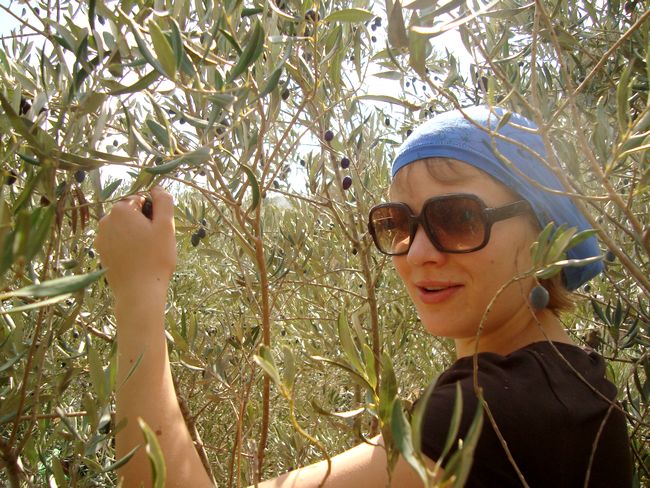
2011 will be the 8th year the annual JAI / ATG Olive Picking Program in Palestine from October 15th to 24th 2011. This event is of special significance to the Palestinian economy when all energies and efforts are mobilised.
Since the beginning of the second Intifada in 2000, the olive harvest has been overshadowed by the Israeli policies of repression, closure, blockage of streets, confiscation of agricultural lands, as well as repeated attacks against Palestinian farmers by Israeli settlers. Now with the construction the Apartheid Wall and the continuous expansion of Israeli settlements at the expense of agricultural land in the occupied Palestine , many farmers are separated from their trees, and help is most needed.
The objective of this program is to mobilise as many people as possible for olive picking, especially in areas that are situated in proximity to Israeli settlements and bypass roads, in order to help Palestinian farmers harvest their olive trees which they might be unable to do without international support. Also, the event has brought up awareness to hundreds of people from many countries around the world about real life under the Israeli Military Occupation, and the experience itself was referred to by several participants as a life changing one. You too are invited to join us for this event.
Besides picking olives, the program will feature introductory presentations about the organising institutions, the current situation in Palestine and the effect of the Apartheid Wall, tours in the old city of Jerusalem and the Church of the Nativity in Bethlehem , a tour of Hebron , cultural evenings and social gatherings.
There will be opportunities to visit the dead sea prior to and after the program and on the day off as well as visiting holy places of interest including historical sites such as the Al Aqsa and Ibrahimi mosques and Nativity.
Olive Picking 2011–
15th – 24th October ( Starting Saturday 15th October 2011 for 9 nights )
Click for Olive Picking 2011 – Proposed schedule
More Information:
- The cost of the program including accommodation in a double room, meals, guides, local transportation and other relevant expenses is $650 or the equivalent in your local currency. – please check the currency converter – http://www.xe.com/ucc/
- Accommodation can be arranged at a hotel or with a local family.
- Travel from and to the airport is not included in the cost but can be arranged for groups.
To learn more about previous seasons please go to the video and watch a 10 minutes film about the event here:
http://www.youtube.com/watch?v=9UYxAIxY2xA
Israeli police jeep kills Palestinian
Press TV – August 17, 2011
A Palestinian pedestrian has been killed after an Israeli border police vehicle hit him in East al-Quds (Jerusalem) suburb near an Israeli settlement neighborhood. The 38-year-old victim Amin Talab Dabash was hit by an Israeli police jeep in Har Homa in East al-Quds, AFP reported on Wednesday.
A spokesman for the Israeli border police, however, claimed that the victim died in a traffic accident.
“Last night in the area of Har Homa, there was an accident when one of our jeeps hit a pedestrian. As a result of the accident, he died,” the Israeli spokesman said.
“He was crossing the road in a dark area, an area without lighting and the jeep hit him,” he added.
The Dabash family accuses Israel’s border police of having intentionally killed him.
At least 1,000 Palestinians attended Dabash’s funeral chanting slogans against the Israeli regime.
Settlers torch farmland near Nablus
By Saed Bannoura | IMEMC & Agencies | August 16, 2011
Ma’an Images
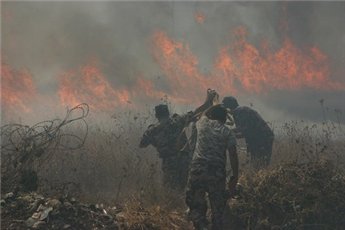
A group of armed extremist Israeli settlers torched dozens of dunams of farmland near the Homesh former settlement, north of Nablus city, in the northern part of the West Bank on Tuesday evening.
Ghassan Douglas, a Palestinian official in charge of settlements file in the northern part of the West Bank, stated that the settlers set ablaze all trees planted around the evacuated settlement and that the fire consumed hundreds of almond trees and evergreens.
He added that the trees belong to the local Palestinian residents, and that the attack was carried out just as the residents were preparing to break their fast as the Muslims are marking the holy month of Ramadan.
On Sunday evening, July 31, a group of fundamentalist Israeli settlers set ablaze, 150 Dunams of farmlands that belong to residents of Ein Jaloud village, near the northern West Bank city of Nablus.
On Friday July 15, settlers torched Palestinian olive orchards in Jabal Suleiman area, close to Burin village, south of Nablus.
The attack was carried out by a group of twenty heavily armed settlers who set ablaze at least 80 Dunams of farmlands, including dozens of olive trees.
Israeli soldiers arrived at the scene but failed to stop the settlers, but instead, obstructed the work of local firefighters.
The repeated attacks by the settlers are part of what they dub as “Price Tag” and include attacking and torching mosques in the West Bank, in addition to attacking farmers and their lands. The settlers hold the Palestinians responsible for the few random settlement outposts that were evacuated by the Israeli army in the West Bank.
Gaza: Soldiers shoot 75 year old woman along with ten goats
16 August 2011 | International Solidarity Movement
Selma Al Sawarka, or Um Ahmad, is an active woman, a mother of seven, and a grandmother of 35, who has never quit working. August 10, 2011 dawned like most days do for her; she went out to graze her family’s goats. She took her neighbor with her, 15 year old Keefa Al Bahabsa.
They went to the same land they usually go to. At 9:30 that morning they saw an Israeli tank and an Israeli jeep near the border. Not an uncommon sight. The tank and jeep left. About 30 minutes later, the jeep returned, three soldiers got out, and opened fire on Um Ahmed and Keefa. Um Ahmed was shot in the leg, Keefa fled to get help. The soldiers also shot ten of the family’s goats.
Um Ahmed is used to being shot at by the Israelis as her land is only 600 meters from the border. Usually, she says, the soldiers shoot around her, or into the air, trying to drive her from her land; she doesn’t know why today was different, why they shot directly at her, why they shot her in the leg. Her scarf also has bullet holes in it; only through the grace of God is she still here.
It took half an hour for Keefa to return with help, they loaded Um Ahmed onto a donkey cart, and went to the main road to meet a taxi to take her to the hospital. When I met Um Ahmed she was laying on a mat on the floor, recovering from being shot. A pale blue scarf covered her head. Bracelets adorned her wrists. Her daughter sat next to her. The room was simple, some mats on the floor, two chairs for the guests, a dresser, and small stand with a TV.
On the wall was a picture of her son Mustapha. He was killed by the Israeli’s on Dec, 15, 2004. Sometimes, the soldiers, or even the settlers themselves, would close the road near Netzarim settlement, the only way to go anywhere was to leave the road, and walk on the beach by the sea. Mustapha was shot and killed as he walked on the beach. The house we are in used to be Mustapha’s house. Beside the TV is another picture, another of her sons, this one has been in prison for the last ten years. He has eleven years left on his sentence. Um Ahmed, like all Gazan mothers, is not allowed to visit her son in prison, for four years this has been a blanket Israeli policy. Instead, she looks at this picture, she thinks about him in prison, while her leg heals.
Donors help keep Palestinians in cages
By Charlotte Silver | The Electronic Intifada | 16 August 2011
Ramallah – “Israel besieges us, puts us in cantons — in cages — and the international community is feeding us in these cages. It’s anything but developmental and it’s helping Israel’s colonization, ethnic cleansing and dispossession,” Dr. Samia Botmeh said, as she sat in her office in the Center for Development Studies (CDS) at Birzeit University near Ramallah in the occupied West Bank.
Despite the massive amounts of development aid that have been poured into the West Bank, the productive capacity of the Palestinian economy — measured by examining the agricultural and manufacturing sectors — is half that of 1994, and accounts for no more than 12 percent of employment. While the World Bank and Palestinian Authority boast an 8 percent growth in gross domestic product (GDP), real per capita income is still 8.4 percent lower than what it was in 1999, signifying that the GDP growth is not reflective of income growth for the average Palestinian.
Egypt provides an elucidative comparison. Two decades of serious neo-liberal reforms produced a GDP growth in Egypt that was similarly applauded by the International Monetary Fund (IMF): between 2006 and 2008, GDP grew 7 percent and there was a 4.6 percent spike in 2009 alone. However, as was made stunningly clear at the end of January, the country’s GDP growth had not trickled down to the majority of the people: unemployment had actually increased and 40 percent of the population lived on less than two dollars per day.
With former IMF representative Salam Fayyad at the helm since 2007, the PA has adopted the strategy of neo-liberal “good governance” as its framework for the state-building project. As post-colonial states have done in the past, the PA has sought to create an environment conducive for efficient and free-flowing markets by privatizing public services, emphasizing private property rights and reducing corruption. This agenda — state-building through neo-liberal policies — is most patently set forth in a PA program titled “Ending the Occupation, Establishing a State.”
As Mustaq H. Khan, an economics professor at London’s School of Oriental and Afrian Studies, pointed out in a lecture in Ramallah last winter, the injection of development aid into Palestine has deceptively flattered the PA’s good governance program, leading onlookers and promoters such as the IMF and World Bank to attribute the boost in GDP to a successful market economy (“Post-Oslo State-Building Strategies and their Limitation,” 1 December 2010 [PDF]).
There is still a stark contrast between the perceived improvement in the Palestinian economy and the actual standard of living for the majority of Palestinians. Development aid — which comprises roughly 40 percent of Palestine’s GDP — has been complicit in obscuring economic reality and in some cases truncating Palestine’s struggle for national liberation.
In June 2011, Birzeit University held a conference at which activists and academics spoke with donors and a representative from the PA on the failures of development, as well as the troubling role development aid plays in Palestine’s national movement.
“The framework of development is extremely unrealistic and problematic,” Dr. Samia Botmeh told The Electronic Intifada. The framework under scrutiny at Birzeit was the United Nations Development Programme’s Conflict-Related Development Analysis (CDA), which seeks to maximize the impact of development aid in conflict zones.
Botmeh added that the current international framework for assessing development aid in the West Bank treats the Israeli-occupied region either as a conflict zone or a post-colonial zone. “This is completely unrealistic because we are not in a conflict, we are in a colonization process,” she said.
The conference took place after the university’s Center for Development Studies concluded a project commissioned by the UNDP that examined how development funds could be better allocated in the occupied West Bank and Gaza Strip amid Israel’s continued occupation.
Because the CDA framework attempts to implement “development” projects while avoiding any political position, the study found that it implicitly assumes both parties have a reason to compromise. This fundamentally flawed approach refuses to acknowledge — and therefore address — the stark power imbalance that allows Israel to remain intransigent.
Realizing that reallocating funds would not address the fundamental hindrances to achieving economic self-determination through development in Palestine, the center articulated what development should look like in the context of an active colonization process. “Development should be about more than helping people survive; it should be about ending colonization,” Botmeh explained.
The Center for Development Studies’ critique shows how development fails to achieve much of anything tangible for Palestinians, and — even more ominously — serves to fortify Israel’s occupation and further annexation of land.
Development confined to “state-building”
After the implementation of policies dictated by the Oslo Accords, signed by Israel and the Palestine Liberation Organization in the mid-1990s, international aid to Palestine took a turn toward development. Previously, aid to Palestine was earmarked for “humanitarian” purposes such as UN operations and charity. With the establishment of the Palestinian Authority as a transitional government, development aid was ostensibly intended to promote an independent economy that would facilitate a smooth transition to a Palestinian state.
After 18 years of an ostensible peace process — of which the agency of the Palestinian national liberation struggle has been confined to a “state-building” project by the PA and Israel — Palestinians’ standards of living have decreased, while inequality has increased.
Botmeh believes that the underlying assumption of this development aid is that it is being funneled into a post-colonial state and that Israel has an intention to withdraw from the West Bank and Gaza Strip. These assumptions, blatantly oblivious to any political reality, have allowed development aid to reinforce Israel’s colonization through the continued degradation of Palestine’s territorial contiguity and the ongoing depopulation of Area C — more than 60 percent of the West Bank, including East Jerusalem, that is under full Israeli military control.
Under the Oslo accords, the occupied West Bank and Gaza Strip were carved up into areas A, B and C, the last of which is administered and controlled by the Israeli government and its military. Israel has declared three-quarters of the land as “closed military zones” or nature reserves, and therefore “off-limits” to Palestinians. Approximately 40,000 Palestinians live in Area C.
The 1999 deadline for the termination of the West Bank’s geographic stratification into Areas A, B and C has long passed. Far from assisting in the formation of a viable state, development aid has served to entrench the partitioning of the land.
Peter Lundberg, a representative of the Swedish International Development Cooperation Agency, confirms these faults in the current development paradigm in Palestine. Speaking from the perspective of an international donor, Lundberg excoriated the complicity of development aid in fragmenting Palestinians by only working in Area A due to Israeli restrictions in Area C.
“Donors and the PA have been too focused on state-building, which is important, but they are going to lose critical parts of the land,” Lundberg said. “Development should help Palestinians stay on their land; too many have left [their land in] Area C.”
Because implementing projects in Israeli-controlled Area C are logistically burdensome and in many cases impossible, donors are inclined to contribute to projects in Area A.
According to Lundberg’s statistics, there has been an exodus of Palestinians from Area C mostly due to the impossible living conditions Israel has created and the predatory nature of surrounding settlements. Israel does not allow communities to be connected to sources of water or electricity and refuses nearly every request for a building permit, thus leading to the destruction of water-collecting devices, schools and homes. In contrast, settlements sitting next to these Palestinian villages are afforded free-running water, electricity, roads and expanding infrastructure.
In 1967 there were approximately 200,000 Palestinians living in the Jordan Valley, which is designated Area C, except for the Palestinian city of Jericho. Today, there are only 56,000, 40,000 of whom live in Jericho (in Area A), according to statistics from the international aid agency Save the Children.
The devastating picture that these statistics reveal is that donors have been complicit in aiding Israel’s process of cantonizing the West Bank into the 18 percent that comprises Area A. By doing so they have helped to surrender the majority of the West Bank’s land and agriculture — which could form the basis of a genuine self-sustainable Palestinian economy and state — to Israel’s control.
Neo-liberalism undermining Palestinian rights for self-determination
Raja Khalidi, a senior economist with the United Nations Conference on Trade and Development (UNCTAD), has written that the development enterprise — representing $1.5 billion a year — is taking place inside territories that have been tagged by the World Bank, European Union, IMF and United States as a site for expanding a neo-liberal project (see “Neoliberalism as Liberation: The Statehood Program and the Remaking of the Palestinian National Movement,” Journal of Palestine Studies, Vol 40, no. 2, Winter 2011).
In the PA’s neo-liberal paradigm — as enshrined in the “Palestinian Reform and Development Plan” of 2008-10 and “Ending the Occupation, Establishing the State” — economic growth is promised as a consolation for occupation rather than a strategy to resist it.
Speaking at the conference, Khalidi remarked on the absurdity of such an agenda in the context of an occupation that ultimately determines Palestine’s economy. “For the last three years, the PA has been routing out internal obstacles to state-building, while the PA has no structure to tackle external obstacles,” he said.
Moreover, without sovereignty, genuine economic growth is out of reach. Khalidi explained that the PA is not only unable to counteract Israel’s aggressive policies of colonization but it also does not have the ability to exercise control over Palestine’s macro-economic policies — such as its own currency and control over interest or exchange rates.
Development aid has long been faulted for its inadvertent assistance in sustaining the occupation by reducing its humanitarian impact and thus making it more palatable. However, Omar Barghouti, a leading figure of the boycott, divestment and sanctions (BDS) movement, revealed the disingenuous nature of international development aid.
“Development exudes complicity in colonialism; it’s intentional and it’s complicit — ignorance is not an excuse,” he said at the conference.
Barghouti proffered several examples of countries throwing some money at the cause of development in Palestine while concurrently supporting projects or companies that actively undermine Palestinian sovereignty.
Veolia, a French transportation corporation that according to Barghouti is mostly owned by the state, is currently building Jerusalem’s new light rail system. The Jerusalem light rail connects West Jerusalem to illegal settlement blocs in occupied East Jerusalem. Despite targeted pressure on Veolia to withdraw from the light rail project — part of a global BDS campaign that has cost the company up to $10 billion, according to Barghouti — the company and by extension France have held onto their contract with Israel.
Restoring class struggle to the national liberation struggle
Adam Hanieh, a lecturer in development studies at the School of Oriental and African Studies, situates development aid in the longer arc of Israel’s colonization of the land through systematic fragmentation of the Palestinian people and nation. In his lecture at Birzeit, Hanieh restored the importance of class struggle to the goal of national liberation and exposed development aid as working against Palestinian unity undivided by wealth or class, against the occupation.
“Sixty-three years of colonization have seen the division, fragmentation and fracturing of the Palestinian people. Development must confront this fragmentation, not aid it,” Hanieh explained to the audience.
Illustrating how neo-liberalism has encouraged the notion that the solutions to problems are individual in nature rather than collective, Hanieh stressed that much of the “development” one sees arising in the West Bank benefits Israeli business. For example, consumption in Ramallah’s flourishing restaurant and café culture is mostly funded by this development aid — and in turn sustains the importation of Israeli products. Poignantly, this new consumer class — enabled by development aid — creates one more isolated stratum of Palestinian society.
All this continues against the backdrop of the regional popular uprisings against, among other things, neo-liberal policies. These uprisings showcase an exemplary shaking off of dictators and the present world order and the inspiring potential of class struggle.
If development aid programmes set freedom — rather than the introduction of a neo-liberal state — as their principal objective for Palestinians, then they may begin to counter the 63-year process of confiscation and colonization. Otherwise, they will be offering that process a helping hand.
Charlotte Silver is a journalist based in the West Bank. She can be reached at charlottesilver A T gmail D O T com.
Is Benny Morris (Professor, Ben-Gurion University) a Serious Historian or Plain Old Racist?
London BDS | 28 July 2011
London BDS is pleased to announce that a video about Benny Morris with footage of what really happened on his visit to London has now been released. People should draw their own conclusions about why Benny Morris referred in a press interview to ‘Brownshirts’, ‘Muslim mobs’ and ‘broken English’.
Benny Morris gave numerous interviews after his lecture at the London School of Economics in June 2011. Typical of these was his interview with The National Interest Magazine in which he claimed that he was accosted outside the lecture by a Muslim mob:
“As I walked down Kingsway, a major London thoroughfare, a small mob—I don’t think any other word is appropriate—of some dozen Muslims, Arabs and their supporters, both men and women, surrounded me and, walking alongside me for several hundred yards as I advanced towards the building where the lecture was to take place, raucously harangued and bated me with cries of “fascist,” “racist,” “England should never have allowed you in,” “you shouldn’t be allowed to speak.” Several spoke in broken, obviously newly acquired, English. Violence was thick in the air though none was actually used. Passersby looked on in astonishment, and perhaps shame, but it seemed the sight of angry bearded, caftaned Muslims was sufficient to deter any intervention. To me, it felt like Brownshirts in a street scene in 1920s Berlin—though on Kingsway no one, to the best of my recall, screamed the word ‘Jew’.”
Please take the time to watch the whole video – it’s a good guide to Benny Morris and what he stands for. The encounter with Benny Morris on London’s Kingsway is also included.
An article to accompany the highly-recommended 34 minute video can be found here.
If you don’t have time to spare, an abridged version commences at 30.00 min.
No level playing field for Palestinian athletes
By Samah Sabawi | Mondoweiss | August 15, 2011
With much fanfare, the Peace Team has come once again to Australia to compete in the Australian Football League International Cup. Indeed, what can be more appealing for those of us who are passionate about peace in Israel/Palestine than to welcome this team of Palestinian Israeli youth who have learned to play and interact together not as enemies but as teammates? The answer: the idea that when members of this team return to their homes, the Palestinian players would not have to go through dehumanizing checkpoints, around high barbed wire walls and into Bantustans surrounded and suffocated by a matrix of Jewish-only roads, settlements and security zones.
The AFL Peace Team was created in 2008 in order to compete in the AFL International Cup. It is made up of an equal number of Israeli and Palestinian players supported by the Israeli Peres Center – an Israeli organization that aims to promote “peace and reconciliation”. However, the team has come under heavy criticism from Palestinian and other human rights groups who insist that reconciliation is the process of bringing two people together and establishing friendly ties between them after an argument or a disagreement has ended. Reconciliation is the healing phase and as such, cannot be implemented while the environment that breeds the mistrust and the conflict continues to exist.
So far this year, Israel has announced the building of thousands more new Jewish-only homes on stolen Palestinian land in the West Bank. According to UN agencies and human rights groups, Palestinian homes have been demolished by Israel at record rates this year. Israel still maintains a crippling inhumane siege against Palestinians in Gaza while it continues to pursue a process of Judaization in East Jerusalem that is rapidly driving Palestinian residents out of their homes to be replaced by Jewish settlers. In such an environment, how can reconciliation even begin?
The Peres Center fails to understand that peace cannot be achieved by parading Palestinians in the Peace Team around the world in efforts to showcase Israel’s ‘fair play’ in sports without even once addressing the real challenges Palestinian athletes face as a result of Israel’s 43 years of occupation and the devastating impact Israel’s policies have had on Palestinian sports and sports infrastructure. The Peres Center would have met its goals of laying the foundations of ‘peace and reconciliation’ better had it issued a statement calling on its government Israel to lift its crippling blockade and siege of Palestinian sports’ events and athletes.
While the peace team promotes the illusion that Palestinian athletes have equal opportunities to compete and to excel in their fields, in reality, the effect of Israel’s policies tell a different story. The Palestinian National Football (soccer) Team, which was founded in 1952 but only became recognized by FIFA after the creation of the Palestinian Authorities in 1998, has faced insurmountable challenges imposed by Israel aiming to isolate Palestinians in all fields, sports as well as academic, medical and cultural. This year, Israeli policies of occupation have sabotaged the Palestinian team putting them at a great disadvantage as key members of the team were prevented from traveling into the West Bank from Gaza.
This is not news for those who follow this conflict. Many Palestinian athletes have in the past suffered Israel’s blanket boycott on Palestinian sports. Palestinian Olympic players and youth teams are frequently denied both exit and re-entry when traveling from Gaza to the West Bank. In the qualifying rounds for the 2006 World Cup, five key players were prevented exit from Gaza by the Israeli authorities and so as a result Palestine failed to qualify. A year later the Palestine National Team was prevented by Israel from traveling to play a World Cup Qualifier in Singapore and so it was eliminated. In May 2008 the same team was unable to attend the AFC Challenge Cup, which meant they were denied qualification for the 2011 Asia Cup.
This system of Israeli permits that restrict and confine Palestinians, denying them their right to travel, reminds us of the “pass laws” of Apartheid South Africa that were put in place to limit the movement of Black South Africans and keep them in their segregated communities. Such blanket confinement of an entire population is a form of collective punishment and is in violation of Article 33 of the Geneva Conventions.
Unfortunately, Israel’s assault on Palestinian sports and athletes is not limited to its system of permits. During Operation Cast Lead in 2008-09 Israel’s indiscriminate bombardment of Gaza, which destroyed huge areas of the city, flattening houses, schools, hospitals and mosques also destroyed the Rafah National Stadium. Over 1,400 people in Gaza were killed including football players Ayman Alkurd, Shadi Sbakhe and Wajeh Moshate.
So while Israel’s Peres Center parades its token ‘peace team’ of Palestinian and Israeli athletes in a clear effort to normalize the occupation and to reduce the criticism and pressure Israel faces from human rights groups and the international community over its oppression of Palestinians, let us take a moment to consider the harsh conditions that Palestinian athletes endure in their daily lives. Of course an Israeli Palestinian team is worth celebrating, but only if it comes from an Israeli Palestinian society that is free of discrimination, where Palestinians and Israelis live as equals both on and off the playing field.
Samah Sabawi is an Australian Palestinian writer and political analyst. She is Public Advocate for Australian for Palestine.
Featured Video

They Double Down on BLOOD PRESSURE Guidelines!
or go to
Aletho News Archives – Video-Images
From the Archives
Chocolate Gives Statins a $29 Billion Run For Their Money
By Sayer Ji · GreenMedInfo · April 17, 2012
With the blockbuster cholesterol-lowering class of drugs known as statins being widely promoted for the primary prevention of cardiovascular disease, despite their having over 300 documented adverse health effects (including heart failure!), how does chocolate sound as a viable, heart-friendly alternative?
We already connect amorously with chocolate (to the tune of 6 billion lbs of cocoa consumed annually worldwide), revealing in heart-felt expressions like “I love it,” and “this is to die for!” how comfortable we are with publicly declaring our affection. But did you know that while it makes our emotional hearts sing, it may actually keep our physical hearts happy, alive and ticking longer, as well?
Indeed, back in 2006, researchers found that for elderly men, eating cocoa was inversely associated with blood pressure and 15-year cardiovascular and all-cause mortality. … continue
Blog Roll
 Aletho News
- I’M SO BLOODY FURIOUS: They Double Down on BLOOD PRESSURE Guidelines!
- The Israeli Nuclear Doctrine and the Turning Point of the Kennedy Assassination
- Striking Matches Near the Powder Keg
- Prominent Russia hawk: European leaders privately talk about war with Russia, first need ‘mass casualty event’
- China warned Trump not to touch Iran’s oil tankers: Larry Johnson
- EU Central Banker Plans To Plant Barren AI Crops Across The Continent
- Macron’s Strategic Autonomy Paradox: France Rearms on Debt and Depends on Foreign Fuel
- Nigel Farage vs Tucker Carlson: Who is right about Hitler and Britain?
- Chocolate Gives Statins a $29 Billion Run For Their Money
- Hypotheses on the collapse of U.S. computer systems
- If Americans Knew
- An error has occurred; the feed is probably down. Try again later.
- No Tricks Zone
- New Study: Modern Temps Are Among The Coldest Of The Last 10,000 Years In East Central Europe
- Germany’s Renewable Energies Lead to 1.4 Billion Euro Electric Power Trade Deficit
- Argentina’s Perito Moreno Glacier Joins Antarctica and Arctic In Defying Doomsday Melt Claims
- New Study: Barents Sea Temperatures Were Warmer And Sea Ice Less Extensive In The 1700s Than Today
- German Authorities Start Initiative To Evaluate Public Register For Climate “Disinformation” Spreaders!
- Zonal Asymmetry of Temperature Change in the Antarctic Circumpolar Current
- New Study: The Net Fossil Fuel Contribution To Rising Atmospheric CO2 Has Been Zero For 500 Years
- Germany’s Green Energy Transition Becoming Increasingly Expensive…Another 6 Trillion Euros!
- Sudden Stratospheric Warming, Powerful El Niño Combination May Lead To Extreme Europe Cold, Energy Crisis!
- Two New Studies Find Thwaites Glacier Melt Cannot Be Driven By Human Activity Or A Warming Ocean

