Family takes stock after mass Lod demolition
By Anne Usher – Ma’an – 16/12/2010
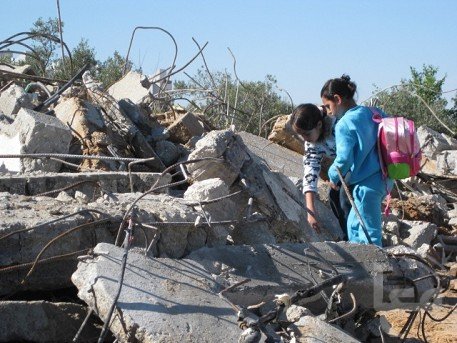 Made homeless in Lod, cited for lack of construction permits. [MaanImages/Anne Usher]
LOD, Israel — The 67 members of the extended Abu Eid family assessed the remains of their six concrete homes on Wednesday, two days after police in Lod demolished them amidst sheets of rain and blustery winds.
The six buildings were among more than 100 in the city under immediate demolition orders, following a fall Knesset decision to destroy an estimated 4,000 illegal housing structures in a plan said to cost millions of shekels.
A dozen other homes have been bulldozed in previous years, sparking periodic protests by hundreds of Arab residents. Yousef Asfour, coordinator with Amnesty International’s Israel branch, said an earlier incident in October saw two homes in the same neighborhood of the mixed Jewish-Arab city bulldozed.
The most high-profile demolition to date was Monday’s demolition of the entire Abu Eid family compound.
Most of the extended family members said they were home at around 8 a.m. when an estimated 500 police officers in tactical gear stormed the courtyard of the compound, broke through doors and quickly turned the men, women and children out into the season’s worst storm without shoes or jackets. Police made no arrests.
Eleven-year-old Odei was home alone with his 12-year-old sister when police broke through his door. “They pointed rifles at me and said ‘don’t move,’” he related. Once outside, he said, “I was wet and cold. They were like gangsters,” he added of the young police in face-concealing riot gear.
All that remained after the five-hour bulldozing operation was chewed-up grey concrete, bent fans, broken air-conditioners and furniture beneath rubble. A paddock containing goats was partially broken and nearly half of what the family said was 100 animals went missing.
Family members said they were not allowed to rescue of their possessions and watched as refrigerators were destroyed and food was thrown to the floor. Five allege that they were shoved or kicked, including Shareen, 27, who is three months pregnant and had re-entered her home to try to assist her mother.
Sinam, a mother of seven, claims that officers took gold jewelry she had in safekeeping to use as dowry for her two engaged daughters. A ring with precious stones was returned, she said, but a gold chain remains missing.
Thirteen-year-old Noor claims he watched as a soldier threw his puppy – tied up and barking – and then shoot it in the stomach. “I came over and it was dying,” he said quietly as other boys noted his tears that morning.
Lod’s police chief and mayor declined multiple requests for comment.
Contesting demolitions
The family claims the six houses and small office destroyed Monday were built more than 50 years ago. Each family said it had been paying rent for decades to a state-owned company to use the land, but was only allowed to build up to 100 square-meter homes since it was zoned as agricultural.
As the family grew, it requested but was declined approval to expand their houses. Expansions were nonetheless made and retroactive permits sought. After many court appeals, family members were told to expect the demolitions at the end of December.
Some 30 homeowners in same area have received notices that their houses will also be bulldozed at the end of the month.
Families whose homes are demolished are asked to pay the municipality for the steep cost of the action or be jailed; some Arab residents in Lod have taken to demolishing their own homes because it is cheaper.
Arab homes principal target in larger plan
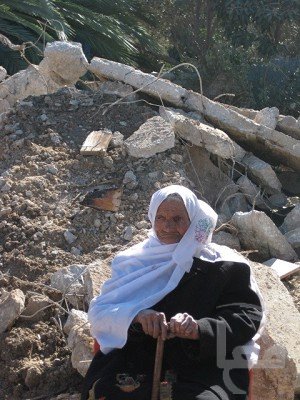 It is a scene being repeated across Israel with increasing frequency. Some 42,000 Arab homes built without required permits are threatened with demolition: 13,000 could be carried out at any time and 30,000 are at some stage in local courts, said Ameer Makhoul, director of Ittijah, a Palestinian civil society organization.
Last year, 165 of these homes were bulldozed, Amnesty International said.
“It’s the same story for all the mixed cities: destruction and construction,” said Busayna Dabit, a project coordinator with the New Israel Fund and a Ramle resident. These “mixed” cities also include Haifa, Yaffa and Acre.
More than two-thirds of Arabs in Ramle and nearby Lod are living in illegally built houses. Hundreds have demonstrated periodically in Lod, where, the roughly 27,000 Arabs represent a third of the population.
The phenomenon is pervasive across Israel, from targeting Arab homes in mixed cities to the homes of Bedouins in the NEGEV. //// A collection of some 40 small population centers THERE house an estimated 40 percent of the Bedouins in the Negev, have been settled locations for decades and in some cases used as seasonal encampments for centuries. The areas are not demarcated on maps, receive no water, electricity, road repair or other municipal services.
In Shameer, an unrecognized village of some 4,000 near Lod, virtually every home has been issued a demolition order. A portion of the houses, however, are being legalized under a master plan that involved negotiations between the city, the Israeli Land Authority and Shameer’s inhabitants, including amounts that the government will pay as compensation.
Next door, some 13 families in the neighboring village of Dahmash are awaiting a court order to determine not only the fate of their homes – which are also under demolition orders – but whether Lod or the adjacent city of Ramle will be forced to absorb them into their municipalities, or whether a plan it has drawn up to make its residences legal retroactively will be approved.
The roughly 600 residents of Dahmash say the government told its original families to move there after they were forced off their lands from 1951 through the mid-1980s. While some houses have stood for more than 60 years – and one pre-dates the war – no municipal services, such as water, electricity or sanitation, have been provided to its residents. After three Dahmash children were killed crossing the railroad tracks on foot, the village won a recent court fight to bus them to schools in Ramle.
The Dahmash residents facing expulsion have been told to seek housing Ramle’s Juarish neighborhood, where thousands of Arabs were concentrated after the 1948 War of Independence but have never been given residential building licenses because the city has not registered their names.
National and local officials are intentionally not granting Arab-Israelis planning rights to allow them to develop any land, charged Amnesty International’s executive director for Israel, Itay Epshtain. “It is a form of diminished citizenship because a lot of the services you depend on are at the municipal level.”
Emek Lod’s leader, Minache Mosche, denies that Dahmash exists.
“There is no settlement or village by the name of Dahmash and there never has been one,” he said. He claimed that, with the exception of one pre-war house, there was nothing on the land except for two farm storage buildings until illegal construction of homes began in 1990.
Asked where the villagers should move, Ramle mayor Yoel Lavi said: “It’s a free market. You can buy everywhere.” “They are poor in culture, poor in behavior. No ambition.”
The cost
A kilometer away from the Abu Eid family, the wreckage of the homes of nine other families whose homes were destroyed in 2008 remains visible, across some railroad tracks from where one of the sons of a former homeowner now sleeps in a lot with dozens of sheep and his car repair shop.
The Wihwah brothers and five of their neighbors paid 15,000 shekels altogether to wreck their own homes two years ago after receiving an initial demolition order in 2003. The owners of the other two homes “didn’t think they would come,” said Telal. One week later, each had to pay 90,000 shekels when the police carried out the demolitions.
Talal said his family had to pay 250,000 shekels ($69,624) in back city taxes, despite not having received municipal services. He and his brothers say they are afraid to open bank accounts, out of fear that the city would confiscate any deposits.
“It’s very painful to look at these stones,” said Ahmad, one of his two brothers. “My grandfather owned this land. Now, I suffer from claustrophobia.”
Anne Usher is a freelance journalist based in Tel Aviv. She has written for The Christian Science Monitor and Ynet since moving to Israel and is a former editor for Cox Newspapers. Her bio is at anneusher.com
US House passes anti-Palestine bill
Unless the US Congress takes a tougher line on lobbyists, Israel will continue building settlements on Palestinian land.
MJ Rosenberg | Al-Jazeera | 16 Dec 2010
At last the United States is responding to Israeli Prime Minister Binyamin Netanyahu’s refusal to freeze settlements and re-start negotiations with the Palestinians.
Congressman Howard Berman (D-CA), chair of the House Foreign Affairs Committee, rushed to the House floor with a resolution drafted by the American Israel Public Affairs Committee [AIPAC] condemning the Palestinians for publicly suggesting that, in the wake of Netanyahu’s refusal to freeze settlements and negotiate, they will consider a unilateral declaration of statehood.
Congress passed the Berman bill, drafted only this week, on Wednesday. When it comes to pleasing AIPAC, there are simply no limits.
This remains true even though AIPAC is embroiled in an espionage/sex scandal that has it scrambling to find $20m to pay off a former top employee who is threatening to produce documents exposing the lobby.
Washington lobbying
The Berman bill passed overwhelmingly because that is how things work in a city where policy is driven by campaign contributions — and not just on this issue.
The only difference between how AIPAC lobbyists dictate US Middle East policy and pretty much every other major lobby is that AIPAC works to advance the interests of a foreign country.
In other words, comparisons to the National Rifle Association [NRA] would only be applicable if the gun owners that the NRA claims to represent lived in, say, Greece. Oh, and NRA-backed bills usually take longer than a day to get to the House floor.
And here you have the root of the problem. And it is not just an American problem. It is just as much an Israeli problem, a Palestinian problem, and an international problem.
There is only one reason that Israeli-Palestinian negotiations collapsed. It is the power of the “pro-Israel lobby” (led by AIPAC) which prevents the United States from saying publicly what it says privately: that resolution of a conflict which is so damaging to US interests is consistently being blocked by the intransigence of the Netanyahu government and its determination to maintain the occupation.
Unequal power
This is not a situation where responsibility attaches equally to both sides. The Israelis hold all of the disputed territories. Yes, the Palestinians have administrative control of some parts of the West Bank but its authority — and it is very small — derives from the Israelis.
Gaza is controlled by Hamas but it is a reservation or ghetto, not a free entity. Its borders are entirely blocked by the Israelis (and the Egyptians who do whatever Israel demands on their border with Gaza).
It remains under Israeli blockade, lightened only a bit since Prime Minister Netanyahu admitted that the blockade was not necessary for Israel’s security. And then there is Arab East Jerusalem, where the Netanyahu government has expanded efforts to push Palestinians out of their homes and replace them with settlers.
The Palestinians have no power at all although they have done everything that Israel and the United States demanded.
The Palestinian Liberation Organisation (PLO) fully recognised Israel and pledged itself to fighting terrorism and resorting exclusively to negotiations to achieve a state. They agreed that their state would be limited to the 22 per cent of historic Palestine that is the West Bank, Gaza and East Jerusalem — recognising that Israel would have the other 78 per cent.
Even Hamas, which still insists that Israel has no right to be there, says that if the Palestinian Authority negotiates a deal with Israel that is accepted by the Palestinian people, it too will join in and end its war with Israel.
And what has Israel offered in exchange for these historic concessions? Absolutely nothing.
Yes, it has played at negotiations.
Losing Palestine
Israel’s advocates argue that, at Camp David in 2000, it offered the Palestinians 94 per cent of the 22 per cent or 98 per cent or whatever.
Netanyahu’s current offer is 60 per cent of the 22 per cent. But the supposed offer came with the standard conditions and caveats when there should be only one condition. In exchange for a Palestinian state in the West Bank, Gaza and East Jerusalem, the Palestinians must agree to absolute security for Israel with ironclad guarantees backed up with surveillance systems to ensure that there are no violations.
In fact, the Palestinians agreed to those terms as far back as the Yasser Arafat era, when, in the late nineties, Israelis and Palestinians adopted a security plan brokered by the CIA to combat terrorism.
President Arafat’s efforts were so thorough, fighting a virtual civil war with Hamas, that Prime Minister Netanyahu told Arafat both in person and by telephone how much he appreciated Arafat’s help.
But neither Arafat nor his successor, Mahmoud Abbas, got anything in return.
That nothing is easily defined. During the entire 17-year period since the historic Rabin-Arafat agreement — and the famed handshake on the White House lawn — the Israelis never ceased confiscating land and building settlements in the areas that are supposed to constitute the Palestinian state.
That was and is the clearest measure of Israel’s intentions. The Israeli government does not intend to give up territory it wants; it gave up Gaza because it decided that it better served Israeli interests to just blockade it.
Why would Palestinians believe that Israel is negotiating seriously when it keeps building inside the future Palestinian state?
All this is obvious to anyone paying attention — especially since Prime Minister Netanyahu absolutely refused to freeze settlements for even 90 days in exchange for the United States doubling the aid package. Really, if he won’t freeze for 90 days for $3.5bn, only a fool would believe that he would ever actually give up any land permanently.
Marching to Israel’s tune
And yet the United States government keeps playing this game. No matter what Israel does, it is fine by America.
It does not have to be that way. If the administration and Congress put US interests (and Israel’s too) over the craving for campaign contributions, the United States could tell the Israeli government that, from now on, our aid package comes with strings.
Like a loan from the International Monetary Fund (although aid to Israel is a gift, not a loan), the US could say that in exchange for our billions, our UN vetoes of resolutions criticising Israel, and our silence in the face of war crimes like Gaza, we want Israel to end the occupation within, say, 24 months. And Israel would have to comply because our military assistance is, as AIPAC likes to call it, “Israel’s lifeline”.
If we did that, many Israelis would be very angry (just as many would appreciate America forcing an end to the occupation).
But the lobby would be furious because, above all else, it needs to feel that it controls US policy in the Middle East. Not for America’s sake. Not for Israel’s. But for its own. As with most Washington lobbies, it is not in business to make the world a better place. It is not pro-Israel; it is pro-AIPAC.
When will all this change? Who knows?
The AIPAC scandals are weakening the group, although not enough to prevent Congress from passing its latest bill condemning Palestinians. And younger American Jews, especially progressives (which is most of them), simply don’t buy the AIPAC line. American Jews are, after all, Americans.
But, for now, the bottom line is money. The US government dances to Israel’s tune because it is afraid to risk campaign contributions from a few dozen fat cats. That is the whole story.
Meanwhile, as General David Petraeus has said, US interests — including the lives of our men and women in uniform — are threatened by the belief in the Middle East that United States is Israel’s puppet. Petraeus’ view is common throughout the military which, unaffected by politics, manages to actually see the obvious. When will the rest of our government allow itself to do the same?
MJ Rosenberg is a senior foreign policy fellow at Media Matters Action Network. The above article first appeared in Foreign Policy Matters, a part of the Media Matters Action Network.
Law to keep Jews and Arabs apart
Apartheid Israel-style
By Jonathan Cook | Palestine Note | December 15, 2010
The pretty two-storey home with a red-tiled roof built by Adel and Iman Kaadan looks no different from the rows of other houses in Katzir, a small hilltop community in northern Israel close to the West Bank.
But, unlike the other residents of Katzir, the Kaadans moved into their dream home this month only after a 12-year battle through the Israeli courts.
The small victory for the Kaadans, who belong to Israel’s Palestinian Arab minority, dealt a big blow to a state policy that for decades has reserved most of the country’s land for Jews.
Katzir is one of 695 so-called “co-operative associations”, communities mostly established since Israel’s creation in 1948, whose chief purpose is to bar non-Jews from residency.
In October, the Israeli parliament moved to enshrine in law the right of these associations, comprising nearly 70 per cent of all communities in Israel, to accept only Jews.
The Constitution, Law and Justice Committee approved a private members’ bill that will uphold the right of the communities’ admissions committees to continue excluding Arab citizens, who make up one-fifth of the population. The bill is expected to pass its final reading in the coming weeks.
Commentators have compared the legislation with South Africa’s notorious apartheid laws such as the Group Areas Act. A leading jurist, Mordechai Kremnitzer, of Hebrew University in Jerusalem, said the bill gave off the “foul odour of racism”.
The legislation, both its supporters and opponents are agreed, is a rearguard action to prevent the possibility that other Arab citizens might be inspired to follow the Kaadans’ example.
Israel Hasson, of the centrist Kadima party, who was among the bill’s formulators, said it reflected “the state’s commitment to the realisation of the Zionist vision” in Israel. That vision is embodied in a decades-old “Judaisation” programme to settle as many Jews as possible in the heavily Arab-populated north.
Suhad Bishara, a lawyer with the Adalah legal centre for the Arab minority, said that the long-standing practice of using admissions committees to weed out applications from Arab citizens was being given legal standing for the first time.
“This legislation makes clear in very blunt fashion that the thrust of policy in Israel is towards maintaining segregation in housing between Jewish and Arab citizens,” she said.
The question of control over land, Ms Bishara said, was felt especially keenly by the Arab minority, because the state had nationalised 93 per cent of all territory inside its recognised borders.
Co-operative associations, which are limited to no more than 500 families each, have jurisdiction over most of the country’s habitable land and are regarded by the authorities as a bulwark against an Arab takeover, she said.
Arab citizens, meanwhile, are largely restricted to living in 124 towns and villages, and control 2.5 per cent of Israel’s territory.
Planning and building laws confine the development and expansion of Arab communities, leading to overcrowding. Tens of thousands of Arab families, forced to build in non-zoned areas, live in homes under demolition orders.
Mr Kaadan, 54, a hospital nurse, said he had wanted to move to Katzir to improve his family’s quality of life. Baqa al Gharbiyya, an Arab town 10km from Katzir where they previously lived, was densely populated and lacked public services, while the local schools for his five children were underfunded and crumbling.
Typically, Arab municipalities receive only one third of the budget of Jewish communities.
Mr Kaadan said he had applied to Katzir when he learnt that plots of land there for house-building were heavily subsidised by the state, selling for a fifth of the price demanded in Baqa al Gharbiyya.
The family’s legal fight to win a place in Katzir has been arduous. It took five years for the Supreme Court to rule on the community’s decision in 1995 to reject the Kaadans on the grounds that they were Arab.
Making “one of the most difficult decisions in my life”, Aharon Barak, the court’s president, ordered Katzir’s admissions committee to consider the family’s application, warning that it could not reject them because of their ethnicity.
Katzir, therefore, imposed a new criterion for admission – “social suitability” – that the Kaadans also failed. It was clear to everyone, Mr Kaadan said, that “suitability” referred to the fact that they were not Jews.
When the Kaadans appealed to the court again, the Lands Authority, a state body that manages territory in Israel, relented and sold the family a plot in 2007.
However, the case has continued to reverberate.
Other exclusive Jewish communities in the Galilee sought their own solution to barring the entry of Arab families after Ahmed and Fatina Zbeidat, from the Arab town of Sakhnin, applied to the co-operative association of Rakafet in the Misgav region.
Rakafet’s admissions committee ruled in 2006 that the Zbeidats were unsuitable: Fatina was too “individualistic”, while her husband lacked “knowledge of sophisticated interpersonal relations”. Like the Kaadans, the Zbeidats have appealed to the Supreme Court.
Several Jewish communities near Rakafet hastily changed their bylaws last summer to include a loyalty oath. Typical was Manof’s, which requires applicants to share “the values of the Zionist movement, Jewish heritage, settlement of the Land of Israel … and observance of Jewish holidays”.
Ms Bishara, who represents the Zbeidats, said the couple was seeking a ruling against the use of admissions committees in the allocation of land and housing. The judges ordered the government to justify the practice at a hearing next month.
The new legislation, known as the Admissions Committee Bill, is designed to pre-empt any ruling by the court.
Gush Shalom, an Israeli peace group, said it would petition the Supreme Court to strike down the bill if, as expected, it becomes law in the next few weeks.
The liberal Haaretz newspaper called the bill an “outrageous” attempt to preserve “Jewish purity” in communities such as Katzir and Rakafet.
But the rightwing Jerusalem Post newspaper backed the legislation, saying Israeli Jews “should have the right to live in a community where they are not threatened by intermarriage or by becoming a cultural or religious minority”.
Defend Jennifer Peto, a Brave Canadian Critic of Zionism
By Jay Knott / Dissident Voice / December 14th, 2010
Canada is mostly a diluted version of the USA. But Canadians are justly proud of their country’s resistance to the abrasive style of American politics. In one respect, though, it is more extreme than the United States – it is the only country with a more fanatical Israel Lobby.
When the University of Toronto recently accepted a Master’s thesis critical of Jewish privilege, the Lobby, the media, and politicians, immediately condemned it as ‘hate’. Some of these legislators declared the University should not have awarded the M.A. to Sociology and Equity Studies student Jennifer Peto, an unprecedented interference of the government in academic freedom.
When a Jewish anti-Zionist like Peto is physically threatened by Zionists and denounced by politicians, the first thing is obviously to defend her and her freedom of speech. But there is a danger in giving extra credit to her argument because it has come under such vicious attack from the Lobby.
The extreme reaction of the Lobby to any criticism has the effect of encouraging narcissism in critics, especially Jewish ones – there is nothing like persecution to make people self-righteous, and Zionists know this better than anyone! To be a Jewish critic of Zionism in a Western country today is less risky than to have joined the white anti-apartheid activists in South Africa, who were on the receiving end of letter-bombs as well as abuse. Still, Peto is a brave woman, and her thesis honestly describes her difficult break with her Zionist upbringing.
Her thesis, ‘The Victimhood of the Powerful: White Jews, Zionism and the Racism of Hegemonic Holocaust Education’, is a development of the tradition of left-wing criticism of various kinds of ‘privilege’ – white, male, etc.1 She reviews How Jews Became White Folks.2 She thinks that race is socially constructed: “race, whiteness and ethnicity produce, and are produced by, nationalist discourses.” She uncritically repeats the idea that Israel is a US ‘client state’ but admits “the discourses that are used in defence of Israel are different than those used to excuse or deny American, Canadian and other Western imperial violence.” It’s not that complicated. Never mind ‘discourses.’ Is it in the interests of the other Western capitalist countries to give unconditional support to Israel, or not? In short, she has no critique of Jewish power.
Peto states, “My work is based in the understanding that Zionism – the belief that Jewish people have a right to a nation-state built on top of the ruins of Palestine – is a racist, imperialist ideology that can only effectively be challenged through anti-racist, anti-imperialist theory and activism.” I argue the exact opposite – I want to challenge her and the left in general to ask why this approach was so effective in the case of South Africa, and so ineffective against Israel. She has nothing to say about ‘the chosen people’ and the festivals which celebrate massacres of gentiles – she makes no attempt to answer the question “is Zionism an expression of Judaism”? She explicitly says, “Jews of European descent now enjoy white privilege,” which implies a) they didn’t used to enjoy privilege at all, and b) the privilege they now enjoy is not specifically Jewish. She compares Canada’s history of ethnic cleansing with Israel’s. This is not how to undermine Zionism.
A thesis is not a political manifesto, but obviously, Jennifer Peto is an activist, and her paper’s argument leads to certain conclusions, certain tactics, for the growing campaign to reduce uncritical support for the apartheid state in the rest of the world. Therefore, I think it is appropriate to criticize it from a tactical point of view.
My argument is, quite simply, that left-wing anti-oppression politics is inadequate for combating Zionism. Telling the white European majority of the Western countries that Jewish privilege is essentially a variant of their own is not only false, it leads logically to solidarity with Israel. Surely it would be more effective to point out that most Americans have no interest in supporting Jewish supremacy, rather than telling them they are ‘complicit’ in racism? Concern with the history of white European racism assisted the dismantling of apartheid in Africa, desegregation, affirmative action, busing and African-American studies, but it doesn’t lead to opposing the Jewish apartheid state.
The Palestine solidarity movement should be trying to drive a wedge between supporters of the Jewish state and everyone else. This involves emphasizing the differences between the former and the latter, putting forward the overwhelming case that a) Israel is morally worse than all the other Western countries, and b) most of their inhabitants, rich or poor, have no reason to support it. It implies showing, in complete contrast to the dogmas of modern leftism, how Western countries are the most egalitarian societies which have ever existed – except Israel. Trying to fit opposition to Zionism into the general framework of opposing oppression in general doesn’t work. For example, feminist and gay politics don’t aid opponents of Jewish apartheid; its defenders point out that Israel is by far the most liberal country in the Middle East. Analyses derived from Marxism are also unhelpful; Western support for Israel is not based on material interests, and the conflict in Palestine is about race, not class.
- Instead of trying to fit the square peg of opposition to Jewish ethnocentrism into the round hole of political correctness, we should list the ways in which Jewish power is more powerful than white supremacy:
- 1. The open advocacy of white power – in any country – is taboo – no politician in the world does it
2. The open advocacy of Jewish power – in Israel – is mandatory for all Western politicians
3. The Western countries boycotted, and caused the end of, white apartheid, thirty years ago
4. The Western countries support Jewish apartheid today, uncritically and very expensively
5. Desmond Tutu has stated that Israeli policies are at least as bad as apartheid
6. Apartheid South Africa fought for US interests against Soviet-backed forces
7. Apartheid Israel has never fought for US interests
8. There has been no violence against Jews in any Western country for sixty-five years – unless you count Palestinian resistance, which is the result of Jewish supremacy
9. When US colleges, co-operatives and other bodies initiated a boycott of South Africa over thirty years ago, no white supremacists tried to stop them
10. When, today, US colleges, co-operatives and other bodies tentatively discuss a boycott of Israel today, right-wing Jewish activists issue lawsuits and stage protests, and left-wing Jewish activists try to undermine their efforts from within, complaining of ‘oppression’ and ‘anti-Semitism’
Jewish power is so much more important than white privilege that I argue that concern with the latter works, consciously or otherwise, to the benefit of the former. Critics of white privilege, for example critical race theorist Stanley Fish, often claim that Zionism is not a form of racism, by emphasizing how Jews have suffered at the hands of white supremacists.3 Peto boldly challenges the use of the holocaust to reinforce Jewish self-righteousness. She describes The March of Remembrance, a Zionist project aimed at making gentiles aware of the holocaust, but, because of her perspective, she doesn’t go so far as to see it as part of the culture of ‘white guilt’. I would criticize it as such, and advocate, and organize, open discussion about the holocaust and the rest of the larger Holocaust of World War II. Canada’s laws against questioning aspects of the Shoah are a clear expression of Jewish privilege. Opposing that privilege by defending freedom of speech means trying to overturn those laws as much as defending Jennifer Peto and her comrades against Jewish power.
- Jennifer Peto (2010) “The Victimhood of the Powerful: White Jews, Zionism and the Racism of Hegemonic Holocaust Education,” Master of Arts thesis, University of Toronto.
- Karen Brodkin (1998). How Jews Became White Folks: and what that says about race in America. Rutgers University Press.
- Stanley Fish (1994). There’s No Such Thing As Free Speech: And It’s a Good Thing, Too. Oxford University Press.
Police Demolish Seven Homes In Lod
By Saed Bannoura – IMEMC & Agencies – December 14, 2010
The Israeli Police demolished on Tuesday seven Palestinian homes in Lod city after forcing the residents out. The police claimed the structures were built without obtaining the needed construction permits.
Seventy residents were rendered homeless and are currently living in tents. The demolished homes belong to members of Abu Eid family.
The furniture and belongings of the families were taken by the police to a location still unknown to the residents.
The residents demanded that authorities delay demolishing their homes so they can pursue legal action, but the so-called “The Lands Of Israel” Authority rejected their request, and claimed that the land was rented out to the family in 1950, and that the contract had expired.
Local sources reported that the Police prevented local residents from entering the area, and that one of the soldiers cocked this Kalashnikov rifle telling the locals that he is there “to perform his duty”.
“I can only deal with you using this!” the soldier said while pointing his rifle at the residents.
His provocation led to clashes between the soldiers and dozens of residents, no injuries were reported.
The Popular Committee in the area held a meeting with the locals and decided to install tents to temporarily house the residents.
Furthermore, the Committee prepared plans to rebuild the demolished structures.
Rescuing Zionism at Palestinian expense
By Ali Abunimah, The Electronic Intifada, 13 December 2010

Hillary Clinton speaks at the Saban Forum Gala Dinner in Washington, DC, 10 December. (US State Department)
Standing in front of a huge banner of an Israeli flag merging into the American Stars and Stripes last Friday, US Secretary of State Hillary Clinton gave yet another set-piece speech laying out how US “engagement” would help bring peace in our time.
Speaking at the Brookings Institution’s Saban Center in Washington, DC with Israeli Defense Minister Ehud Barak and key Israel lobby figures looking on — including Salam Fayyad, the puppet “prime minister” of the US- and Israeli-backed Palestinian Authority — Clinton asserted that “a Palestinian state achieved through negotiations is inevitable” (“Remarks at the Brookings Institution’s Saban Center for Middle East Policy Seventh Annual Forum,” 10 December 2010).
What Clinton laid out in diagnosis and prescriptions, however, ensures that a Palestinian state is anything but inevitable. It is vanishingly unlikely.
Clinton’s much-anticipated intervention followed the Obama administration’s latest capitulation to Israel on settlement construction in the West Bank. After almost two years of attempting to bribe Israel into “restraining” the expansion of its Jewish-only colonies on occupied, stolen land, and its violent Judaization of Jerusalem, the administration concluded that it could do nothing. Of course one thing the Obama administration never tried was real pressure using as leverage the billions in annual no-strings aid the fiscally-bankrupt United States provides to Israel.
Returning to a theme she first took up in her last major speech to the Israel lobby, at the American-Israel Public Affairs Committee (better known as AIPAC) in March, Clinton warned that the status quo is unsustainable:
“I know that improvements in security and growing prosperity have convinced some that this conflict can be waited out or largely ignored. This view is wrong and it is dangerous. The long-term population trends that result from the occupation are endangering the Zionist vision of a Jewish and democratic state in the historic homeland of the Jewish people. Israelis should not have to choose between preserving both elements of their dream. But that day is approaching.”
This is a polite way of putting it. Prominent Hebrew University demographer and Palestinian-birthrate-watcher Sergio DellaPergola recently told The Jerusalem Post that Jews already constitute just under 50 percent of the population in historic Palestine — Israel, the West Bank and Gaza Strip combined (“Jews now a minority between the River and the Sea,” 26 November 2010).
So while demographically, historic Palestine is no longer “Jewish” it has also never been a democracy, certainly not for its indigenous Palestinians. The Jewish majority within Israel’s pre-1967 boundaries — the basis for the claim that Israel is a “Jewish democracy” — was engineered through the most undemocratic means possible: the deliberate, carefully-planned ethnic cleansing of 90 percent of the Palestinians in that area between 1947-1950 and subsequent efforts to cover up the crime.
And, for the past 43 years — or more than two thirds of Israel’s existence — millions of Palestinians in the West Bank and Gaza Strip, occupied since 1967, have lived under brutal Israeli military tyranny with no control over their own lives, land and resources. This has not changed despite the ongoing and lavishly-funded fantasy of Salam Fayyad’s “state-building” initiative of recent years — in reality a repressive US-managed police state apparatus to crush any form of resistance.
Clinton made it clear that preserving this unjust situation — rescuing Zionism — remains the priority of US policy. For there can be no “Jewish democracy” without the liquidation of Palestinian rights, particularly of refugees and Palestinian citizens of Israel.
On refugees, all Clinton had to say was, “This is a difficult and emotional issue, but there must be a just and permanent solution that meets the needs of both sides.”
She did not spell out what those “needs” are. For Israel it is clear that the “need” is to continue to deny the rights of Palestinian refugees to return to lands from which they are excluded solely on the racist grounds that they are not Jews. Israel clearly “needs” this so it can continue to subordinate the rights of indigenous Palestinians to the ethnic privileges of Israeli Jews.
The needs of Palestinian refugees are that their rights be respected, especially the right enshrined in the Universal Declaration of Human Rights to return home — should they choose to do so — and for restitution and compensation. These basic human rights are recognized specifically and repeatedly in international law in the case of Palestinians.
These two sets of “needs” are irreconcilable. One can only stand on one side of the question: either one is for Israel’s “right” to remain a racist state, or one is for universal rights and international law and treating all human beings as equals regardless of their religion or ethnicity.
These are exactly the same rights that the United States and the European Union actively supported in Bosnia, in the 1995 US-brokered Dayton Agreement. Under the agreement more than half a million refugees have returned home, in a country with a total population of just 3.5 million, to areas dominated politically and demographically by antagonistic ethnic authorities. In Bosnia, the preference of ethnonational groups to live in areas cleansed of those they consider undesirable was not allowed to trump the actual rights of individual refugees. Nor should it in Palestine.
Perhaps because Clinton knows that the US position on refugees is wrong, immoral and illegal, she does not dare spell out the implications of her words in such clear terms. It is up to Israel, the ethnic cleanser and bully, and a subservient and neutered Palestinian “leadership” to “agree” on what their “needs” are — amid radical power imbalance that guarantees (or so the United States calculates and hopes) that the result will come down in Israel’s favor.
Don’t be fooled either by Clinton’s sophistry on settlements: “The position of the United States on settlements has not changed and will not change. Like every American administration for decades, we do not accept the legitimacy of continued settlement activity. We believe their continued expansion is corrosive not only to peace efforts and two-state solution, but to Israel’s future itself.”
In international law, all of Israel’s settlements beyond the line of 4 June 1967 are illegal. The United Nations Security Council, for example, determined that “all measures taken by Israel to change the physical character, demographic composition, institutional structure or status of the Palestinian and other Arab territories occupied since 1967, including Jerusalem, or any part thereof, have no legal validity and that Israel’s policy and practices of settling parts of its population and new immigrants in those territories constitute a flagrant violation of the Fourth Geneva Convention …” (UN Security Council Resolution 465 (1980)).
That resolution, like so many others, called “upon the Government and people of Israel to rescind those measures, to dismantle the existing settlements and in particular to cease, on an urgent basis, the establishment, construction and planning” of new ones.
The current US position, contrary to international law, questions only the “legitimacy” — not even the legality — of “continued” settlement activity. The US only asserts that there is a problem with new settlements. The Obama administration has endorsed former President George W. Bush’s 2004 written promise to Israel that the US will recognize Israeli sovereignty over virtually all settlements that have already been built since 1967.
Could there be a clearer inducement than this for Israel to continue to establish “facts on the ground”? Whatever lip service Clinton paid to opposing settlements, it is clear, based on the performance of the Obama administration to date, that for Israel there will be no negative consequences, and only rewards.
Nor did Clinton have any word of comfort for 1.4 million Palestinian (second-class) citizens of Israel who face a raft of new racist laws, policies and declarations by Israeli leaders and state-funded rabbis, dozens of whom recently issued a religious ruling calling for Jews to boycott any other Jew who sells or rents a home to a non-Jew. For the United States it is as if these Palestinians — who face increasing threats of expulsion by prominent Israeli politicians — simply don’t exist.
So what is left of Obama’s vaunted peace process “engagement”? For sure all the things that suit Israel: an “unwavering,” unconditional commitment to supply Israel with more of the weapons that have been so promiscuously used to commit war crimes in Lebanon, Gaza and across the West Bank; acquiescence to continued settlement construction; more sanctions and pressure on Iran — an Israel lobby priority; continued boycott of Hamas, siege of Gaza and support for the West Bank police state; calls on the Arab states to normalize ties with Israel; and of course putting Israel’s desire to remain a racist ethnocracy before the universal rights of human beings.
And the US prescription now is more of the same: urging Palestinians to “negotiate” with an Israel from which the US superpower itself could extract nothing, precisely because of unconditional American support!
For the discredited Palestinian Authority “leadership” which rushed to Washington as soon as Clinton beckoned, the secretary of state had these instructions: “To demonstrate their commitment to peace, Israeli and Palestinian leaders should stop trying to assign blame for the next failure, and focus instead on what they need to do to make these efforts succeed.” She warned Palestinians specifically, in reference to efforts to get more states to recognize Palestine: “Unilateral efforts at the United Nations are not helpful and undermine trust.” Recently, Brazil and Argentina joined more than a hundred countries that recognize the nonexistent “State of Palestine” declared by the Palestine Liberation Organization in November 1988.
In other words, Palestinians must continue to take it on the chin as Israel does what it pleases with American support. Only Palestinians intent on committing national suicide could go along with such a charade. Those who support genuine peace for Palestinians and Israeli Jews, based on universal rights, equality, restitution and the decolonization of the relationship between the populations, must escalate the real peace process: boycott, divestment and sanctions to force Israel to respect Palestinian rights and obey international law.
Ali Abunimah is co-founder of The Electronic Intifada and author of One Country: A Bold Proposal to End the Israeli-Palestinian Impasse.
Israel’s War on Children
1,500 Arrested in a Year
By JONATHAN COOK | CounterPunch | December 13, 2010
Israeli police have been criticised over their treatment of hundreds of Palestinian children, some as young as seven, arrested and interrogated on suspicion of stone-throwing in East Jerusalem.
In the past year, criminal investigations have been opened against more than 1,200 Palestinian minors in Jerusalem on stone-throwing charges, according to police statistics gathered by the Association of Civil Rights in Israel (ACRI). That was nearly twice the number of children arrested last year in the much larger Palestinian territory of the West Bank.
Most of the arrests have occurred in the Silwan district, close to Jerusalem’s Old City, where 350 extremist Jewish settlers have set up several heavily guarded illegal enclaves among 50,000 Palestinian residents.
Late last month, in a sign of growing anger at the arrests, a large crowd in Silwan was reported to have prevented police from arresting Adam Rishek, a seven-year-old accused of stone-throwing. His parents later filed a complaint claiming he had been beaten by the officers.
Tensions between residents and settlers have been rising steadily since the Jerusalem municipality unveiled a plan in February to demolish dozens of Palestinian homes in the Bustan neighbourhood to expand a Biblically-themed archeological park run by Elad, a settler organisation.
The plan is currently on hold following US pressure on Benjamin Netanyahu, the Israeli prime minister.
Fakhri Abu Diab, a local community leader, warned that the regular clashes between Silwan’s youths and the settlers, termed a “stone intifada” by some, could trigger a full-blown Palestinian uprising.
“Our children are being sacrificed for the sake of the settlers’ goal to take over our community,” he said.
In a recent report, entitled Unsafe Space, ACRI concluded that, in the purge on stone-throwing, the police were riding roughshod over children’s legal rights and leaving many minors with profound emotional traumas.
Testimonies collected by the rights groups reveal a pattern of children being arrested in late-night raids, handcuffed and interrogated for hours without either a parent or lawyer being present. In many cases, the children have reported physical violence or threats.
Last month 60 Israeli childcare and legal experts, including Yehudit Karp, a former deputy attorney-general, wrote to Mr Netanyahu condemning the police behaviour.
“Particularly troubling,” they wrote, “are testimonies of children under the age of 12, the minimal age set by the law for criminal liability, who were taken in for questioning, and who were not spared rough and abusive interrogation.”
Unlike in the West Bank, which is governed by military law, children in East Jerusalem suspected of stone-throwing are supposed to be dealt with according to Israeli criminal law.
Israel annexed East Jerusalem following the Six-Day war of 1967, in violation of international law, and its 250,000 Palestinian inhabitants are treated as permanent Israeli residents.
Minors, defined as anyone under 18, should be questioned by specially trained officers and only during daylight hours. The children must be able to consult with a lawyer and a parent should be present.
Ronit Sela, a spokeswoman for the Association of Civil Rights in Israel (ACRI), said her organisation had been “shocked” at the large number of children arrested in East Jerusalem in recent months, often by units of undercover policemen.
“We have heard many testimonies from children who describe terrifying experiences of violence during both their arrest and their later interrogation.”
Muslim, 10, lives in the Bustan neighbourhood and in a house that Israeli authorities have ordered demolished. His case was included in the ACRI report, and in an interview he said he had been arrested four times this year, even though he was under the age of criminal responsibility. On the last occasion, in October, he was grabbed from the street by three plain-clothes policemen who jumped out a van.
“One of the men grabbed me from behind and started choking me. The second grabbed my shirt and tore it from the back, and the third twisted my hands behind my back and tied them with plastic cords. ‘Who threw stones?’ one of them asked me. ‘I don’t know,’ I said. He started hitting me on the head and I shouted in pain.”
Muslim was taken into custody and released six hours later. A local doctor reported that the boy had bleeding wounds to his knees and swelling on several parts of his body.
Muslim’s father, who has two sons in prison, said the boy was waking with nightmares and could no longer concentrate on his school studies. “He has been devastated by this.”
Ms Sela said arrests had risen sharply in Silwan since September, when a private security guard at a settler compound shot dead a Palestinian man, Samer Sirhan, and injured two others.
Clashes between the settlers and Silwan youths came to prominence in October when David Beeri, director of settler organisation Elad, was shown on camera driving into two boys as they threw stones at his car.
One, Amran Mansour, 12, who was thrown over the bonnet of Mr Beeri’s car, was arrested shortly afterwards in a late-night raid on his family’s home.
Also in October, nine rightwing Israeli MPs complained after stones were thrown at their minibus as they paid a solidarity visit to Beit Yonatan, a large settler-controlled house in Silwan. Israel’s courts have ordered that the house be demolished, but Jerusalem’s mayor, Nir Barkat, has refused to enforce the order.
In the wake of the attack, Yitzhak Aharonovitch, the public security minister, warned: “We will stop the stone-throwing through the use of covert and overt force, and bring back quiet.”
Last month police announced that house arrests would be used against children more regularly and financial penalties of up to $1,400 would be imposed on parents.
B’Tselem, an Israeli human rights group, reported the case of “A.S.”, a 12-year-old taken for interrogation following an arrest at 3am.
“I sat on my knees facing the wall. Every time I moved, a man in civilian clothes hit me with his hand on my neck … The man asked me to prostrate myself on the floor and ask his forgiveness, but I refused and told him that I do not bow to anyone but Allah. All the while, I felt intense pain in my feet and legs. I felt intense fear and I started shaking.”
In a statement B’Tselem said: “It is hard to believe that the security forces would have acted similarly against Jewish minors.”
Micky Rosenfeld, a police spokesman, denied that the police had violated the children’s rights. He added: “It is the responsibility of parents to stop this criminal behaviour by their children.”
Jawad Siyam, a local community activist in Silwan, said the goal of the arrests and the increased settler activity was to “make life unbearable and push us out of the area”.
The 60 experts who wrote to Mr Netanyahu warned that the children’s abuse led to “post-traumatic stress disorders, such as nightmares, insomnia, bed-wetting, and constant fear of policemen and soldiers”. They also noted that children under extended house arrest were being denied the right to schooling.
Last year the United Nations Committee Against Torture expressed “deep concern” at Israel’s treatment of Palestinian minors, saying Israel was breaking the UN Convention on the Rights of Children, which it has signed.
Over the past 12 months, Defence for Children International has provided the UN with details of more than 100 children who claim they were physically or psychologically abused while in military custody.
Jonathan Cook is a writer and journalist based in Nazareth, Israel. His website is www.jkcook.net.
British parliament debates Palestinian children prisoners
By Renee Bowyer | Middle East Monitor | 12 December 2010
I visited the family of a twelve year old boy arrested on a Sunday morning. They lived in a small room on the outskirts of Balata refugee camp bordering the city of Nablus. The mother of Salim spoke to me first reminding me how the last time I had visited her, her son Salim had been there. Of course I remembered; he’d greatly enjoyed trying out his few English words with me and had very excitedly told me how he and his mother had been to Ramallah the week before. It was Sunday evening and as I sat with Um Salim she recounted to me how she had woken in the night as Balata camp was invaded. She listened to the sound of tanks and jeeps, of sound bombs detonating at random. But then Um Salim told me how the night-terror became her terror when her front door was pushed in and soldiers were everywhere. They were calling for Salim and Um Salim began to sob as she explained to me how a mother’s worst nightmare began.
Salim was twelve years old but in many ways he was older than his years. He had witnessed an uncle shot and killed by invading Israeli forces and he had not seen his father, a prisoner, for eight years. But this night Salim became the child again. When his name was shouted out Salim in terror rushed behind his mother and fell on the ground. He held the skirt of his mother and cried up to her ‘Mama; save me’. Um Salim told me how her son was ripped out of her arms as he cried for her to protect him. She was pushed to the ground and Salim was dragged from the house.
Six months later I visited Um Salim again. She had not seen Salim since the night he had been dragged from her arms. She still had no idea why he was taken, for how long he would be held or even when there would be a court hearing for him. She said she had learnt to live without him but would never learn to forget the words he had cried out to her when the soldiers had pushed in their door: ‘Mama; save me’. Um Salim looked at me and said ‘I couldn’t protect him. I couldn’t protect my son.’
Last week in Britain; a far cry from the poverty-stricken streets of Balata refugee camp and the occupied territories of the West Bank; Sandra Osborne, MP for Ayr, Carrick and Cumnock, secured a debate on the detention of Palestinian children by Israel in the British Parliament. Having worked with Addameer in the West Bank, (a Prisoners’ Support and Human Rights Association mentioned by Ms Osborne in her presentation) I can appreciate in full the horrifying account Ms Osborne gave of the plight of Palestinian children prisoners. Details of Hebrew confessions signed by children under physical or emotional torture, of solitary confinement, of beatings and threats and months without seeing or hearing from family are all realities that thousands of Palestinian children are facing now. One can only imagine the horror of families whose children have been taken and are being subject to these violations. While working with Addameer I spoke to mother after mother whose child had been imprisoned and every one of them spoke of the constant fear gripping their hearts knowing their child was unprotected in a hostile and violent place and how they knew that no law was governing the treatment of their child.
The taking of Palestinian children by Israeli forces and the terrorizing of them seems to be a calculated policy of Israel in their attempt to destroy the very fabric of Palestinian life. The Occupation of Palestine is much more than a military exercise and as constantly cited by Israeli officials ‘a necessary step to insure Israeli security’. Every aspect of the occupation, from the invasions and assassinations to the humiliating abuses of the soldiers standing at checkpoints is geared towards making Palestinian life unbearable. The strategically placed settlements and the free-reign given to settlers to attack, kill and steal land from the Palestinians, the invasions of villages and the constant curfews imposed on them, the house searches and indiscriminate shooting, the verbal inanities shouted at women and children by soldiers in roaming army jeeps are all focused on grinding down the will to survive and resist that the Palestinian people show.
I cannot recall how many times I asked the question ‘why are you doing this?’ When I was living in the Occupied Territories; watching some ridiculous flying checkpoint being set up on some small mountain path and three or four teenage soldiers smoking and forcing old women to empty their shopping bags on to the dusty road. ‘Why are you doing this?’ as I watched a tank roaming through a village and stopping in front of the village high school for boys and some sun-glassed soldier throwing a sound bomb over the wall. Acts that have no meaning to them except to terrorize and humiliate and make the lives of the Palestinian people harder than they already are.
‘It’s the Wild West’ an anonymous soldier states in Breaking the Silence; ‘serving in the West Bank is like being in the Wild West’.
And this is because the Israeli government has a goal beyond taking land; it seems increasingly obvious that the real agenda of the Israeli government is to ‘cleanse’ the land of Palestinians and the first step to do this is to make the Palestinian people stop resisting; not just with arms but in every other way. There is too much life still being lived under occupation; there is too much will to survive this occupation and siege. There are still festivals and marriages being celebrated in ruined houses alongside the burying of the dead; there are still lessons being taught to children in schools that have been bombed to rubble; there is still music in Palestine. And this is what Israel fears.
There are plenty of times when the reality of life under occupation and siege yields a sense of despair and helplessness among the people of Palestine, but it doesn’t stay; only in the cases of the mothers of child prisoners does it stay. There was a look of desperation and despondency on the face of Um Salim when she told me how Salim had cried to her to protect him that I had not seen before, and when I visited her months later and she had still not heard from her son that look was still there; etched now on her face.
By stealing the children of Palestine and trapping them inside a prison where they have no contact with family, Israel is attempting to systematically destroy the future of Palestine. They are breeding despondency inside Palestine that even invasions and killings did not produce. If this is not Israel’s aim, why else would they go to such lengths to violate every law set in place to protect children from this kind of soul-destroying treatment?
Ms Osborne last week made a plea to the British government to intervene because she was horrified by what she had witnessed in a military court hearing of Palestinian children. (And surely what she witnessed was a toned down version of what normally happens). The plea Ms Osborne made was supported by extensive detail and factual information and clearly exposed the policy of Israel in respect to Palestinian child prisoners and how it seems that the policy of Israel encourages these violations.
The Under-Secretary of State for Foreign and Commonwealth Affairs, Alistair Burt, responded to Ms Osborne in the sort of way that western governments are responding to Israeli violations every time they come to prominence: by stating that Israel may have gone too far in some respects but that their security issues necessitate certain actions and that Israel continues to have the full support of these governments. Alistair Burt agreed to raise the issue with Israel and to write to the members of Parliament who had attended the debate. And that is all.
A letter in a month or two explaining that the issue has been raised with Israel?
While Um Salim waits to hear what prison her twelve year old son has been dragged to, while another mother and another are woken in the night to the sound of their child’s name being shouted by soldiers who batter down their doors, and while children shiver alone in prison cells, are forced to sign confessions of guilt in Hebrew and are beaten and shackled; our Under-Secretary of State for Foreign and Commonwealth Affairs will raise the issue with Israel.
On the 21st November this year two Israeli soldiers were given suspended sentences and demoted for using a Palestinian child as a human shield during their attacks on Gaza on 2008/2009. They scarred the nine year old child for life when they forced him to search for booby traps in the ruins of his town and they were given two months probation and were not sent to prison. At the same time countless Palestinian children are serving sentences in Israeli prisons for throwing stones at tanks.
It is time that our secretaries of state do more than write letters about this. If they as representatives of our governments do not help protect these children than who will?
UN concerned over illegal exile of Jerusalem lawmakers
Palestine Information Center – 11/12/2010
OCCUPIED JERUSALEM– UN special coordinator for the Mideast peace process Robert Serry expressed concern on Saturday over illegal Israeli court rulings to exile Arab MP Mohammed Abu Tir and other public officials from the occupied city of Jerusalem.
The court has been unjustly holding Abu Tir in detention since March 6 on grounds of illegally residing in the city of Jerusalem according to Israeli regulations.
Serry, reporting Israeli violations in Jerusalem and occupied territories, defended the right of Arab lawmakers from Jerusalem to remain in the city they were born in, calling on the Israeli government to refrain from taking any proactive steps against them.
Jerusalem MPs and one former minister, who have been sitting in at the Red Cross headquarters in Jerusalem for the 163rd straight day to protest Israeli threats to exile them, received a delegation from the UN for the fourth time during their camp-out to discuss the UN’s instability in living up to its responsibilities towards the occupied lands and their inhabitants, a failure that has caused tensions in the city to flare and encouraged Israel to increasingly break international law.
Among the delegates were Deputy Special Coordinator Maxwell, Director of Political Affairs Samer Abu Jabara, and former Director of Regional Affairs Anwar Al-Darkazalli.
The UN delegation assigned liability to Palestine’s de facto government chaired by Mahmoud Abbas in demanding the immediate convening of a UN Security Council session in coordination with the Arab League to adopt a resolution forcing Israel to back down on the ruling to exile the group of Palestinian lawmakers from Jerusalem.
Israel’s Racist Rabbis: ‘Hate the Gentile’
By Jonathan Cook – Palestine Chronicle – December 9, 2010
Jews must not rent homes to ‘gentiles’. That was the religious decree issued this week by at least 50 of Israel’s leading rabbis, many of them employed by the state as municipal religious leaders. Jews should first warn, then “ostracise” fellow Jews who fail to heed the directive, the rabbis declared.
The decree is the latest in a wave of racist pronouncements from some of Israel’s most influential rabbis.
In October, Shmuel Eliyahu, the chief rabbi of Safed, delivered a ruling, signed by 17 other rabbis in the city, telling Jewish residents not to sell or rent property to members of the country’s Palestinian Arab minority, who make up a fifth of the population.
His followers turned words into deeds by attacking Arab students in the city and threatening to burn down the homes of Jewish landlords renting to the students.
Similar edicts have recently been backed by dozens of rabbis in Tel Aviv and nearby Bnei Brak, a suburb of 150,000 mostly ultra-Orthodox Jews. They have threatened to “expose” any Jews who rent to “foreigners” — in this case, a reference to migrant workers and African refugees who are crowded into neglected neighbourhoods in the centre of the country.
After many weeks of silence on these declarations, Prime Minister Benjamin Netanyahu was finally forced to issue a condemnation yesterday, describing the rabbis’ call as undemocratic and contradicting the bible, which, he said, called for Jews to “love the stranger”.
Nonetheless, racism in Israel is increasingly enjoying high-level sanction among the most influential sectors of the religious establishment.
The latest ruling was signed by Shlomo Aviner, a spiritual leader of Israel’s national-religious camp; Yosef Elyashiv, a senior ultra-Orthodox rabbi; and Avigdor Neventzal, rabbi of Jerusalem’s Old City.
Its sentiments have also been echoed by Ovadia Yosef, a former chief rabbi of Israel and the spiritual leader of Shas, an important political and religious party in Mr Netanyahu’s government. “Selling to [non-Jews], even for a lot of money, is not allowed. We won’t let them take control of us here,” Mr Yosef said recently.
Two months ago, Mr Yosef explained the logic behind his views and those of like-minded rabbis.
“Goyim [non-Jews] were born only to serve us.” Explaining why God allowed non-Jews long lives, he added: “Imagine that your donkey would die, you’d lose your income. [The donkey] is your servant. … That’s why he [the gentile] gets a long life, to work well for the Jew.”
Mr Yosef’s remarks against “gentiles” were greeted with respectful silence by Israeli officials and most of the media. It was left to the United States government and the New York-based Anti-Defamation League (ADL) to issue rebukes. Abraham Foxman, the ADL’s head, accused the rabbi of advancing “hateful and divisive ideas”.
The rabbis’ use of theology to support racial discrimination is being applied to more than just housing.
This summer, Yosef Elitzur and Yitzhak Shapira, who head an influential seminary in the West Bank settlement of Yitzhar, published The King’s Torah, a 230-page guide to how Jews should treat non-Jews.
The two rabbis concluded that Jews were obligated to kill anyone who posed a danger, immediate or potential, to the Jewish people, and implied that all Palestinians were to be considered a threat. On these grounds, the pair justified killing Palestinian civilians and even their babies.
Last month Mr Shapira also backed the use of Palestinians as human shields, a war crime under the Fourth Geneva Convention, and a practice that Israel’s supreme court has outlawed.
The King’s Torah, far from being condemned by moderate rabbis, has been greeted with a general silence and enthusiastic support from a number of notable religious leaders.
Arik Ascherman, head of Rabbis for Human Rights in Israel, said the growing extremism of the the Orthodox religious establishment in Israel reflected the increasingly right-wing atmosphere in Israel that made the expression of ultra-nationalist views permissible.
In the current climate, he said, moderate rabbis were reluctant to speak out against their colleagues. Many of these rabbis belong to the Conservative or Reform streams of Judaism, which are not officially recognised in Israel.
“The religious sanction being given to the political right by these rabbis is dangerous. It makes their opinions seem more acceptable,” he said.
That is being reflected in public surveys, in which many Israeli Jews express support for anti-Arab views. A poll by the Israeli Democracy Institute published last week showed that 46 per cent of the country’s Jews did not want to live near Arab citizens, and 39 per cent felt the same about foreign workers.
Even more, 53 per cent, wanted Arab citizens to be encouraged to leave Israel and half believed Arabs should not have equal rights with Jews. Among the religious public, racist sentiments were more popular.
Israeli prosecutors, meanwhile, have turned a blind eye to the refusal of several prominent endorsers of The King’s Torah to obey a summons calling them for investigation. “Our holy Torah is not a subject for investigation or trial by flesh and blood,” the rabbis said.
In all, the rabbinical establishment is growing increasingly bold in promoting its vision of a Jewish state run according to holy law, according to Zvi Barel, a commentator with the daily newspaper Haaretz.
“They and their supporters are transforming zealous fundamentalism and the shameful The King’s Torah into the mainstream,” Mr Barel wrote recently.
The general trend towards extremism has not happened by chance, said Sefi Rachelevsky, a prominent Israeli writer critical of the Orthodox rabbinate. Israel’s public coffers pay the salaries of some of the most extremist rabbis, and the education system regularly falls under the political control of religious parties like Shas.
Mr Shapira, who advocates killing non-Jewish babies, receives large sums from the education ministry for his yeshiva — a seminary where he spreads his message of hate. Religious students also receive extra subsidies unavailable to normal students to encourage their attendance at such yeshivas.
The rabbis exert their influence on the youngest and most impressionable too. When the new school year started in September, 52 per cent of Jewish children in first grade attended a strictly religious school.
Pupils in some of the most religious schools, Mr Rachlevsky pointed out, are taught that Jews sit above nature, which comprises four categories: “inanimate”, “vegetable”, “animal” and “speakers” — or non-Jews, who are considered no more than talking animals.
– Jonathan Cook is a writer and journalist based in Nazareth, Israel. His latest books are “Israel and the Clash of Civilisations: Iraq, Iran and the Plan to Remake the Middle East” (Pluto Press) and “Disappearing Palestine: Israel’s Experiments in Human Despair” (Zed Books). He contributed this article to PalestineChronicle.com. Visit: www.jkcook.net. (A version of this article originally appeared in The National – www.thenational.ae – published in Abu Dhabi.)
Israel to demolish electric infrastructure near Hebron
Ma’an – 09/12/2010
HEBRON — Israeli authorities delivered demolition orders Thursday for electric transformers and powerlines in a Palestinian community south of Hebron, a local official said.
Local Popular Committee chairman Azmi Ash-Sheiyukhi said Israeli officials handed the orders to Muhammad Al-Adrah, the head of the village council of Rifaya and Ad-Deirat.
The orders call for the demolition and removal of a transformer and power lines that provide electricity to 800 people in the two remote villages near Yatta.
He said Israeli officials had previously authorized the construction of electric infrastructure to provide power to 400 Rifaya residents, while residents of Ad-Deirat had paid out of pocket for the construction of the transformer.
He also said residents planned to mount a legal challenge to the demolition orders, which he called “illegitimate and illegal.”
Featured Video

They Double Down on BLOOD PRESSURE Guidelines!
or go to
Aletho News Archives – Video-Images
From the Archives
Chocolate Gives Statins a $29 Billion Run For Their Money
By Sayer Ji · GreenMedInfo · April 17, 2012
With the blockbuster cholesterol-lowering class of drugs known as statins being widely promoted for the primary prevention of cardiovascular disease, despite their having over 300 documented adverse health effects (including heart failure!), how does chocolate sound as a viable, heart-friendly alternative?
We already connect amorously with chocolate (to the tune of 6 billion lbs of cocoa consumed annually worldwide), revealing in heart-felt expressions like “I love it,” and “this is to die for!” how comfortable we are with publicly declaring our affection. But did you know that while it makes our emotional hearts sing, it may actually keep our physical hearts happy, alive and ticking longer, as well?
Indeed, back in 2006, researchers found that for elderly men, eating cocoa was inversely associated with blood pressure and 15-year cardiovascular and all-cause mortality. … continue
Blog Roll
 Aletho News
- I’M SO BLOODY FURIOUS: They Double Down on BLOOD PRESSURE Guidelines!
- The Israeli Nuclear Doctrine and the Turning Point of the Kennedy Assassination
- Striking Matches Near the Powder Keg
- Prominent Russia hawk: European leaders privately talk about war with Russia, first need ‘mass casualty event’
- China warned Trump not to touch Iran’s oil tankers: Larry Johnson
- EU Central Banker Plans To Plant Barren AI Crops Across The Continent
- Macron’s Strategic Autonomy Paradox: France Rearms on Debt and Depends on Foreign Fuel
- Nigel Farage vs Tucker Carlson: Who is right about Hitler and Britain?
- Chocolate Gives Statins a $29 Billion Run For Their Money
- Hypotheses on the collapse of U.S. computer systems
- If Americans Knew
- An error has occurred; the feed is probably down. Try again later.
- No Tricks Zone
- New Study: Modern Temps Are Among The Coldest Of The Last 10,000 Years In East Central Europe
- Germany’s Renewable Energies Lead to 1.4 Billion Euro Electric Power Trade Deficit
- Argentina’s Perito Moreno Glacier Joins Antarctica and Arctic In Defying Doomsday Melt Claims
- New Study: Barents Sea Temperatures Were Warmer And Sea Ice Less Extensive In The 1700s Than Today
- German Authorities Start Initiative To Evaluate Public Register For Climate “Disinformation” Spreaders!
- Zonal Asymmetry of Temperature Change in the Antarctic Circumpolar Current
- New Study: The Net Fossil Fuel Contribution To Rising Atmospheric CO2 Has Been Zero For 500 Years
- Germany’s Green Energy Transition Becoming Increasingly Expensive…Another 6 Trillion Euros!
- Sudden Stratospheric Warming, Powerful El Niño Combination May Lead To Extreme Europe Cold, Energy Crisis!
- Two New Studies Find Thwaites Glacier Melt Cannot Be Driven By Human Activity Or A Warming Ocean

