UK to launch anti-Russian propaganda war as ‘Fusion Doctrine’ defense plan unveiled
RT | March 28, 2018
Britain is preparing for a counter-propaganda war against Russia amid allegations that the Kremlin is spreading fake news regarding the poisoning of Sergei Skripal.
Intelligence services will now be tasked with identifying trolling social media platforms in a bid to clamp down on what is deemed by the UK government as ‘misinformation.’ The new instructions are included in the Fusion Doctrine, unveiled as part of the National Security Capability Review, to be published on Wednesday. It seeks to tackle the perceived threat from Islamic State (IS, formerly ISIS), Russia and North Korea.
Increased efforts to tackle fake news come amid security experts alleging, in the Telegraph, that Russia put out more than 20 stories “trying to confuse the picture and the charge sheet” over the poisoning of ex-double agent Sergei Skripal and his daughter, Yulia, in Salisbury earlier this month.
It follows reports of Britain sharing “unprecedented levels of intelligence” with countries in a bid to persuade them of Russia’s involvement in the Skripal attack. The material provided includes evidence from the chemical weapons facility at Porton Down, just outside the Wiltshire town. The information was cited as being key to 23 states and NATO expelling dozens of Russian diplomats. The UK usually only shares highly classified documents with fellow ‘Five Eyes’ countries, namely the US, Australia, New Zealand and Canada.
Labour leader Jeremy Corbyn received widespread criticism after failing to squarely point the finger at Russia over the Skripal case in the aftermath of the poisoning. He requested that more evidence be made available and that the channels of international law be utilized before people make allegations against the Kremlin.
While expelling three diplomats from the Czech Republic, President Milos Zeman echoed such calls, saying: “I want to see the facts. I will certainly welcome if the United Kingdom presents some evidence that the Russians wanted to kill the double agent Skripal,” Blesk news outlet reported on Tuesday. Zeman has also ordered the Czech counter-intelligence services to investigate whether the A-234 nerve agent, also known as Novichok, could have been produced in his country.
Russia has vehemently denied any wrongdoing and has hit out at the UK’s refusal to allow it to assess the agent. It has also criticized Britain for failing to disclose information relating to the case.
Russian Foreign Ministry spokeswoman Maria Zakharova responded to the diplomatic expulsions, saying: “An adequate response will be given to all steps of the United States and the European Union, which we see. This refers to the expulsion of Russian diplomats and the closure of the consulate-general [in Seattle].”
“We demand that the UK provide all available information on this case,” Zakharova added. “To date, Russia has received zero information on what happened. Perhaps this data is not being made public because it includes nothing but political slogans.”
Some Further Thoughts on the Skripal Affair
By James O’Neill | OffGuardian | March 28, 2018
Let the jury consider the verdict” the King said. “No, No” said the Queen: “sentence first, verdict afterwards”. “Stuff and nonsense” said Alice.
The furore surrounding the alleged nerve gas poisoning of Sergei Skripal and his daughter Yulia shows no signs of abating. It continuously puts one in mind of the quote from Lewis Carroll’s Alice in Wonderland at the head of this article.
For those of us with fond of memories of some of the traditional virtues of common-law justice, such as the presumption of innocence, the onus of proof upon the accuser, a verdict based upon evidence beyond reasonable doubt, and a prohibition on prejudicial pre-trial comment, it all seems like a very distant past.
The latest development has been a group of nations, largely in the European Union, but also including United States, Canada, Australia and European minnows like Albania and Macedonia, joining the collective hysteria and expelling, at the time of writing, more than 100 Russian diplomats.
That action will achieve nothing, other than to the poison the cold war atmosphere eagerly promoted by the intellectual lightweights so prominent in the governments from United Kingdom to the United States to Australia. The few sane voices in this cacophony of nonsense, such as those of the governments of Portugal, Greece and Austria, or Die Linke’s Andreas Maurer in Germany who noted in various ways that not jumping to conclusions and actually waiting for the results of the now extant OPCW’s Technical Committee investigation, might be preferable to rushing headlong to a possible nuclear confrontation with Russia, are scarcely heard.
British Labour leader Jeremy Corbyn made similar remarks, only to be savagely attacked by members of his own party, as well as Tory leaders such as May, Johnson and Williamson.
The careful and cautiously worded judgement of Mr Justice Williams released on 22 March 2018 has been largely ignored by the politicians and the mainstream media alike.
Justice Williams was delivering the judgement on an application by the Secretary of State for the Home Department for permission to be given for the taking of blood samples from the Skripals for analysis by the OPCW experts in accordance with the terms of the Convention on the Prevention of Chemical Weapons.
The Skripals were admitted to Salisbury Hospital on 4 March 2018 and it took until 14 March for the British government to invite the OPCW to assist in the technical evaluation of what had caused the Skripal’s illness.
The Judge did not comment on why it took 10 days for this invitation to issue, particularly as the Russian government had correctly pointed out that it should have been done much earlier in accordance with the article 9 of the Convention.
Indeed, May had issued peremptory demands for Russia to, in effect, prove its innocence within 36 hours. The application by the Home Department was necessary as the Skripals, because of their stated medical condition (in a coma, but stable) were unable to give an informed consent. The Judge presumed, probably correctly, if they were able to give consent they would do so. They have a greater interest than anyone else in determining who was responsible and holding them (or their government) to account.
The Russian government, which clearly was an interested party as among other reasons Ms Skripal was a Russian citizen, was not a party to the proceedings, nor, it seems, were they even advised that the application was being made. The Russian government have certainly stated that, and the British government has made no denial.
The absence of the Russians from the application would ordinarily have invited a query from the Judge. He may well have done so, but as the proceedings were held in camera, we cannot establish that. His Honour appears to have accepted a submission from Mr Sachdeva QC, acting for the Skripals, that the Russian authorities had made no attempt to seek access to the Skripals or their medical records.
This is prima facie highly improbable, particularly given the case’s high profile. The Russian government to the contrary has claimed that all their requests for access, medical details and related evidence were ignored or refused by the British government.
It is not possible to definitively resolve that conflict, but the weight of logic, common sense and the evidence we do have would tend to support the Russian position.
There is no reason at this point to question the integrity of the OCPW technical evaluation. It seems likely however, that they may well not be able to ascertain precisely what substance was used to affect the Skripals. Almost certainly, neither will they be able to specify its precise origins, much less who administered it. More than three weeks after the attack we still have no clear idea as to how the poison, if that is indeed what it is, was administered.
That qualified conclusion, which is surely known to the British government, may be a major reason why such a huge propaganda effort is currently being made before the likely inconclusive results are published. It may also account for the meaningless terminology used in statements by the UK government and others that the poison was “of a type developed by Russia.”
That statement in itself is inaccurate. It has zero evidential value, but is clearly seen as having a powerful propaganda effect. Most casual readers of the mainstream media or viewers of the BBC and their foreign equivalents will be unaware of any of the history of nerve agents, or their possession and use by multiple countries, not least the United Kingdom itself.
Perhaps the most depressing conclusion to be drawn from this saga is the one expressed by the commentator known as the Saker (What Happened to the West I was born in? 26 March 2018). He argues that during the previous Cold War, although the West was hardly a knight in shining armour, the rule of law did matter, as did some degree of critical thinking. Now, the West is ruled by an “ugly gang of ignorant, arrogant psychopaths”.
Their hubris will lead to making fatal miscalculations about the degree of Russian resolve, and the ability of Russia, (as was demonstrated so effectively by Putin in his address to the joint sitting of the Russian Parliament on 1 March 2018), that rather than “shutting up and going away”, as Williamson hoped, the simple fact is that Britain will be a heap of radioactive ashes long before Russia “goes away”.
It is significant that China’s Global Times, an official voice for the thinking of the Chinese government, sees the current attack on Russia as a prelude to a similar assault upon China as the crumbling Anglo-American Empire tries to maintain its hegemony. China has not joined the Western chorus of condemnation of Russia. Instead it sees what it describes as the “Russia China comprehensive strategic collaborative partnership” as the best safeguard against Western attack. It is for this reason that the Saker is probably too pessimistic. For the sake of our grandchildren one hopes that he was indeed wrong.
British accusations against Russia for Skripal poisoning not only unproven, but absurd!
By Tom Stanford | The Duran | March 24, 2018
The British government claims to have overwhelming evidence of Russia’s responsibility in the Salisbury poison attack on Sergei Skripal and his daughter. In his Washington Post article of March 14, Foreign Secretary Boris Johnson went so far as to claim that there was “only [one] plausible conclusion: that the Russian state attempted murder in a British city, employing a lethal nerve agent banned under the Chemical Weapons Convention”. He even connected this with Russia “covering up” the alleged use of “the nerve agent sarin against the town of Khan Sheikhoun in April 2017” by Syrian forces. In a separate statement, the Foreign Secretary tells us it is “overwhelmingly likely” that Vladimir Putin personally ordered the attack. What evidence is there to support such serious accusations?
According to the British government (see e.g. Boris Johnson’s article) and the mainstream media, the following elements are sufficient to incriminate the Russian state with near certainty: the weapon used, the motive, Russia’s past record, the lack of another explanation.
Use of novichok is no proof of Russian involvement
The nerve agent reportedly used in the attack, named novichok, was developed by the Soviet Union in the 1970s and 1980s. The fact that Russian stockpiles of novichok were destroyed under supervision of UN bodies after the collapse of the Soviet Union and that the OPCW (Organisation for the Prohibition of Chemical Weapons) has seen no reason for suspecting any country of continuing to store this deadly agent does not seem to bother the incriminators. Of course, it can be speculated that Russia may have kept the weapon secretly, as does Vil Mirzayanov, the Russian scientist who revealed the existence of the project in 1992 and has lived in the US since 1995.
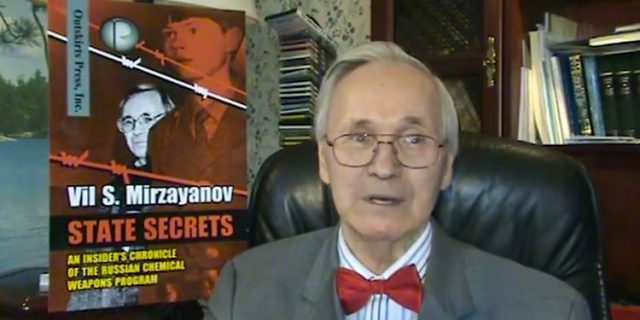
Russian ex-counter intelligence officer Vil Mirzayanov defected to the United States. Now 83 years old, he comments on the Skripal affair from Boston. (Photo credit: Business Insider)
Boris Johnson has announced that over the last ten year Britain has gathered evidence of Russia creating and storing novichok. We are given no detail of what kind of evidence this may be. It could turn out to be nothing more than isolated, unsubstantiated claims made by Mirzayanov and other opponents of the Russian government.
Not only Russia, but other former members of the Soviet Union, or the US, could have secretly stored or recreated the poison. In 1999 US defence officials helped Uzbekistan dismantle a former Soviet facility which had tested chemical weapons such as novichok. Samples, as well as the knowledge required to produce the nerve agent, are highly likely to have become available to countries other than Russia.
Did Russia have a motive?
Russia supposedly had an obvious motive. The argument goes as follows: Sergei Skripal, while still officially working for the Russian military intelligence service, the GRU, had been secretly recruited by the British MI6, and handed over to his new paymasters the names of all Russian agents he knew to be working in the West. Even after serving a few years in a Russian prison and being allowed to emigrate to the UK as part of a spy swap, he would have remained on an official Russian hit list for his act of treason. His murder would serve as a deterrent towards any other Russian agent who may consider switching sides. And to make things even clearer to would-be defectors, the attack would leave some kind of signature pointing to the Russian state as the perpetrator.
On the face of it, the argument sounds reasonable. However, it makes no sense to consider motives as evidence for doing something if we ignore counter-motives, i.e. reasons for refraining from doing it. Suppose you are in your doctor’s waiting room and have been sitting there for quite some time when suddenly an elderly lady, who arrived there just before you, collapses and is rushed to hospital. You had never seen her before. Now imagine the police later suspect some foul play and discover that the incident allowed you to have your own waiting time shortened by ten or fifteen minutes. You had a clear motive for harming the poor lady. Luckily for you, it then occurs to the investigators that your motive for doing so (saving a few minutes of your time) pales into insignificance compared with the reasons that would have held you back, such as the idea of spending years in jail, not to mention your moral conscience or feelings of human compassion.
In other words, motivation is the result of weighing out costs and benefits.
Putin had a clear motive… for NOT doing it
In the case of the Salisbury attack, the foreseeable costs to Russia, and more specifically to President Putin, are enormous. The Russian government spends considerable effort trying to convince the world that it firmly abides by the rule of law, especially international law and agreements between states. Its own statements, as well as the foreign-policy analyses appearing in the Russian state-owned media, all go towards highlighting Russia’s perceived superiority to the US in terms of respect for international law. Such efforts have greatly intensified in the context of the renewed tensions with the West over the last few years.
Russia’s current leaders believe in ending the current US-dominated unipolar world and are striving to recover some of the influence over world affairs that was lost with the collapse of the Soviet Union. This requires having allies, not only state allies, but also Russia-friendly organizations and individuals within states. Any damage to Russia’s international reputation does considerable harm to such prospects.
President Putin himself cultivates the image of a highly principled, responsible and law-abiding person – not that anyone would guess by reading the Western mainstream media! Whatever Russia’s state representatives and media may argue, the Salisbury attack has put many weapons in the hands of Putin’s detractors. In this light, it is absolutely inconceivable that Russia’s president ordered the attack himself. Boris Johnson’s personal accusation not only shows his total misunderstanding of the Russian leadership, but is also utterly irresponsible on the part of Britain’s top diplomat.
Russia had long been hoping that the EU may gradually put to an end its sanctions policy. It is still very dependent on trade with the block. It would be insane for Russia to do anything that could threaten the current Nord Stream 2 gas pipeline project, especially given that the US, with the support of a number of EU countries mainly from Eastern Europe, has been putting pressure on the EU to abandon the project. But Germany, determined to ensure its supply of cheap gas, has so far resisted such calls.
Predictably, the EU has sided with the UK and is officially demanding explanations from Russia concerning its novichok programme – which only makes any sense if Russia was in some way involved in the Salisbury attack, definitely not if it genuinely ceased the production and storage of the nerve agent in the 1990s, as documented by the OPCW!
Could other agents of the Russian state be responsible?
It is also entirely unrealistic to imagine that leading members of the Russian secret service agencies may have acted autonomously and ordered the Salisbury attack without consulting their superiors and not realizing how much damage it would have on Russia’s and Putin’s international reputation. They live in the world of the Russian state elite, continually exposed to its way of thinking, and not cocooned in some fantasy world of their own – unlike many Western politicians and journalists who apparently still live with the image of James Bond-like characters fighting against evil Russian agents!
Any significant agent of the Russian state would be fully aware of the displeasure that a Salisbury-type attack would trigger among the leadership. Supposing players within the Russian state did carry out the attack, it could only be construed as a hostile act towards President Putin and his team.
No sense for Russia to kill Skripal abroad rather than in Russia
This is not a simple case of a former spy-turned-traitor being “executed”. The attack leaves a deliberate Russian “signature” (there is no other reason for using novichok rather than a more discreet or classical weapon) and was carried out on the soil of a foreign country, the United Kingdom, which in spite of the Brexit process remains a highly significant player on the international stage. Whoever the perpetrators may be, they would have foreseen that any improvement in relations between Russia and its Western neighbours would be seriously jeopardized as a consequence.
But what makes Russian involvement even more absurd is the fact that Alexander Skripal was officially released and allowed to emigrate as part of a spy swap. Why would the Russians have waited another eight years before killing him in another country, with the terrible diplomatic consequences that would ensue, when he could have been much more easily liquidated while still in Russia, in a manner that would give would-be defectors an even clearer warning that there is “no way out for traitors”.
Would Russia give up the chance of other spy swaps?
Furthermore, a spy-swap deal implies that the parties involved agree to give up all claims pertaining to the released individuals. In other words they will not try to recapture or kill them, which would amount to a breach of the agreement. A country reneging on such a deal would no longer be trusted for any similar arrangements in the future. Is it reasonable to believe that the Russian government, or any top secret service official in Russia, would be prepared to sacrifice Russia’s chances of making any new spy-swap deals with its Western partners in the future? This is not just unlikely, it is the pinnacle of absurdity! Sadly, Western political leaders and mainstream media are quite happy to believe and propagate such nonsense.
Goal of attack: outrage against Russia
The attack itself does not seem to bear the mark of professional Russian agents. The daughter of the former double agent suffered the same fate as her father. It is only a matter of circumstances that many others were not seriously injured. It is like using a sledgehammer to crack a nut! And the main target, Sergei Skripal, is – weeks later – still reported to be alive! Either it was some very sloppy attack carried out by non-professionals, or the attack was deliberately not confined to Mr Skripal in order to provoke even greater outrage against Russia.
Boris Johnson has apparently recently adapted his interpretation of Russian intentions to take account of these facts. He now claims it was probably specially timed just before the presidential election, “to conjure up in the public imagination the notion of an enemy”. So the Russian president supposedly deliberately provoked British outrage to help him win the election! The Foreign Secretary seems to be completely out of touch with reality. It has long been common knowledge that Vladimir Putin would win with a landslide anyway. Would he wish to cause himself and his country enormous trouble for absolutely no gain at all?
What is Russia’s past record?
We are told there is “a pattern” of state-sponsored assassinations or deaths in unusual circumstances of political opponents, critical journalists and secret service defectors. Deaths attributed to President Putin have included the journalist Politskaya, the political opponent Nemtsov, the accountant and lawyer Magnitsky, the former agent Litvinenko and even the oligarch Berezovsky. In all these cases, the incrimination of the Russian state is based on rather flimsy evidence. The argumentation here is circular: in each case the belief in the Russian government’s responsibility is strengthened by the existence of the other stories. But if none of the stories are true, then the whole argument collapses.
The Litvinenko case does bear a similarity to the current one. Instead of the nerve agent novichok, Litvinenko was poisoned by radioactive polonium, a substance very difficult to obtain and produced only by a few countries – such as Russia – with a nuclear weapons industry. In both cases, it is highly unlikely that the Russian state would choose to leave a “made in Russia” signature on the poison used, with only one major outcome – the poisoning of Britain’s relationship with Russia.
If not Russia, then who did it?
Russia’s accusers claim there are no alternative explanations for the attack: nobody, apart from the Russian state, is understood to have had a motive for the attempted murder. This argument can only make sense to those who believe in the world of an evil, criminal Russia whose only opponents are pure, honest, angelic fighters for freedom and justice.
The main consequence of the Salisbury attack – undoubtedly one that would have been predicted by whoever planned it – is to further damage relations between Russia and the West, or at least prevent their improvement. A long list of countries (Ukraine, Poland, the US and many others) or organizations may believe they have an interest in this – at least they have been doing their best to spoil Western Europe’s relationship with Russia. Of course, the existence of a possible motive does not constitute sufficient ground to suspect anyone in particular. However, on the basis the motives involved, to quote British former Member of Parliament George Galloway, “Russia must be near the bottom of the list of suspects.”
How to get away with murder: blame Russia!
It can also not be excluded that the attack was the work of some rogue “ultra-patriotic” group within Russia (whether within or outside Russia’s state institutions) wishing to undermine Putin’s attempts to mend relations with the West by killing a “traitor” on British soil. In this case, the Salisbury attack would clearly be an act of aggression against the Russian government more than against the UK. And Britain’s refusal to cooperate with Russia would make the UK unwittingly guilty of helping the perpetrators avoid the course of justice.
Another aspect is that we do not know what personal enemies Aleksander Skripal may have had. There may be motives involved that nobody suspects. If, for whatever reason a person or organization with sufficient power wished to have him killed, there was a simple way to get away with the crime: a highly effective cover-up the crime would involve using a weapon that points towards Russia, with the knowledge the British authorities would be unlikely to seriously explore other avenues, especially in the current international climate. The same can be argued in the case of Litvinenko’s murder in 2006.
There is something particularly disturbing about the Western international community rushing to accuse Russia for any crime showing the slightest hint of a Russian connection: it provides criminal organizations and terrorists with assurances that they can avoid being held accountable. All they need to do is to leave some kind of “Russian signature”.
UK reckless attitude is dangerous
The words of Theresa May and Boris Johnson, accusing Russia for crimes it did not commit with astoundingly aggressive and hostile language, will naturally lead the Russian population and their decision makers to believe their country is the victim of an orchestrated attack. Hostility towards the West will increase dramatically as a result. British, European and North-American leaders may have convinced themselves of Russia’s guilt, but have they reflected on the possible consequences of their reckless attitude?
It is urgent to stop the escalation in the Russia blame game, which has taken a momentum of its own. It may be of benefit for the media, who can publish stories that make a good read, with an evil bogey man that everyone loves to hate, or for politicians who, when confronted with problems at home – such as the UK government with its current Brexit troubles – can take the opportunity to look strong in the face of an enemy. However, it is an extremely dangerous game which could have disastrous consequences for the entire world.
‘Against common sense and intl law’: Russia to retaliate over diplomats’ expulsion by UK allies
RT | March 26, 2018
Moscow won’t leave the provocative acts against Russian diplomats unanswered, the Foreign Ministry said, adding that several countries blindly copied the UK’s “hypocritical” stance on the Skripal case in the absence of evidence.
The decision of a number of NATO and other European countries to expel Russian diplomats over the poisoning of the former double-agent Sergei Skripal amounts to a “provocative act” and only harms international relations and the investigation of the incident, the Ministry said in a statement.
The countries which expelled Russian diplomats have only played into the hands of London, which “de-facto took a prejudiced, biased and hypocritical stance, producing indiscriminate accusations against the Russian Federation in the absence of explanations of what happened and refusing to engage in substantive cooperation,” the statement reads.
The “solidarity” expressed by the Western countries harmed the investigation of the Skripal incident and contradicted international law, the Ministry said. Russia is interested in finding the truth about the poisoning of Russian citizens on British soil, it stressed.
“The Russian side, despite our repeated requests to London, has no information over the case. There’s no objective and exhaustive data on it at the disposal of the Britain’s allies, who blindly follow the principles of the Euro-Atlantic unity harming common sense, principles of civilized dialogue between states and international law. Naturally, such a hostile move on part of this group of countries won’t go unanswered,” the Ministry said.
Moscow will expel at least 60 US diplomats in response to Washington’s move which it linked to double agent Skripal’s poisoning, Senator Vladimir Dzhabarov said. He called the move to expel 12 of the Russian UN staff illegal.
“It is clear that the measures will be tit-for-tat, they will affect the same number of employees, since the numbers of our diplomatic missions are equal,” Dzhabarov said. He also condemned the additional expulsion of 12 Russian UN staff as “contradicting international law.”
“The UN is an international organization, which does not fall under American jurisdiction,” the senator pointed out.
President Vladimir Putin will be the one to make a final decision on retaliatory measures against the US and European countries that are expelling Russian diplomats. For now, the Russian Foreign Ministry is studying the situation and drafting a list of possible actions, Kremlin spokesman Dmitry Peskov said. Moscow has nothing to do with the Skripal case, he added.
Washington’s actions will only serve to ruin the remaining US-Russian ties, Russian Ambassador to the US Anatoly Antonov said. The US understands nothing but force, the diplomat stated while commenting on the possible response measures.
Moscow expected such a move on part of the US, but still hoped that Washington would use common sense to help stop the UK’s hysteria, Antonov added.
On Monday, the US expelled 60 Russian diplomats over the double-agent Skripal’s poisoning in the UK. The move was coordinated with several European countries, which also expelled a number of Russian diplomats.
Trump orders expulsion of 60 Russian diplomats, closure of Seattle consulate
RT | March 26, 2018
President Donald Trump has ordered the expulsion of 60 Russian diplomats and the closure of the Russian consulate in Seattle. It comes in response to the poisoning of Sergei Skripal in Salisbury, which the UK has blamed on Russia.
The move follows major diplomatic pressure by the UK on its allies to follow their lead in expelling Russian diplomats. The Russian embassy in Washington had previously urged Trump not to heed the “fake news” on Skripal’s poisoning.
British Prime Minister Theresa May has accused Moscow of being behind the poisoning of the former spy Skripal and his daughter in the town of Salisbury in early March.
Of the 60 diplomats expelled, 12 formed part of the Russian mission to the United Nations. In a statement, US ambassador to the UN Nikki Haley said the 12 Russians in question had “abused their privilege of residence” in the US and had “engaged in espionage activities that are adverse to our national security.”
Haley said that the Russian diplomats had used the UN as “a safe haven for dangerous activities within our own borders.”
During a summit in Brussels last week, the 28 EU leaders agreed with Britain’s assertion that it is “highly likely” that Russia was responsible for the attack on Skripal.
Members of the EU numbering 14 have also decided to expel Russian diplomats following Britain’s lead.
Canada has also jumped on the bandwagon, announcing that it will expel four Russian diplomats “in solidarity” with the UK.
The timing of the expulsions by the US, EU and Canada appears to have been coordinated between Washington and Brussels. Eight EU countries confirmed within 15 minutes of each other on Monday afternoon that they would expel a number of Russian diplomats. Canada’s announcement followed shortly after.
Moscow has always denied playing any role in the attack, and offered to cooperate with the investigation into the incident. Britain has declined, however, to send samples of the chemical agent used on Skripal and his daughter to Moscow.
Trump’s Call to Putin… A Gesture Amid Ominous Signs
Strategic Culture Foundation | 23.03.2018
It is to be welcomed that US President Donald Trump got on the phone this week to congratulate Russian leader Vladimir Putin over the latter’s presidential election victory last weekend.
Trump said it was “a good call” and that both leaders discussed cooperation on a range of international issues, including avoiding an arms race, North Korea, and Syria. They have reportedly agreed to hold a bilateral meeting soon.
It is deplorable that the leaders of the two most powerful nuclear states have not yet held a full bilateral meeting either in Washington DC or in Moscow. The inertia stems from the American side, despite Trump’s avowed desire to restore friendly relations with Russia.
Trump and Putin have met only briefly on two occasions over the past 14 months since Trump’s inauguration in January 2016. But those meetings were rather passing encounters while both were attending multilateral forums. A summit-style meeting held over several days between the two leaders is long overdue.
But of course, the anti-Russia politics holding sway in the US and among certain American NATO allies have made any such proper meeting a toxic prospect.
Trump is accused of being somehow beholden to Putin due to far-fetched allegations of Russian electoral collusion or interference. Russia on the other hand is assailed for all sorts of imagined transgressions, including alleged aggression in Ukraine.
The polarized geopolitical situation is lamentable. Especially given the apparent willingness on the part of Trump and Putin to make progress towards normalizing relations. The leaders are being held hostage by an agenda of Russophobia pushed by certain political circles in Washington and other Western capitals.
Trump was immediately attacked this week by Republicans and Democrats following his phone call to Putin. He was rebuked for not challenging Putin over allegations of Russian meddling in US elections and over the apparent poisoning of a former British double agent in England earlier this month.
These charges against Russia, like so many others, are ridiculously overblown. Unsubstantiated and unproven, the charges are repeated and multiplied in a climate of hysteria. The British alleged poison case is but the latest classic example from the mold of presumption of Russian guilt without evidence.
Trump was right to make the call to Putin. It is customary diplomatic protocol for world leaders to exchange good wishes over elections. It is only the hyped-up anti-Russia claims over the past few years and in particular the latest episode regarding Britain that have instilled an unwarranted toxicity into what should be normal international relations.
But it is disturbing that the American president was obliged to defend himself from his political detractors over what should have been a normal courtesy call.
The furore over Trump’s call to Putin demonstrates how destructive the bilateral relation between the US and Russia has become.
Trump deserves credit for not caving into the irrational hostility towards Russia shown by too many in Washington and among the US news media.
Nevertheless one phone call and vague pledges of cooperation are far from satisfactory given the ominous geopolitical climate. President Trump may have a reasonable personal view towards Russia, but he appears to be surrounded by a milieu of inveterate hostility towards Moscow.
There are several ominous scenarios for potential catastrophic conflict. American threats to militarily strike Syria over contrived pretexts concerning chemical weapons; the US supplying lethal weapons to the fascistic Kiev regime in Ukraine; and Washington’s threats of sanctions disrupting Russia’s gas exports to Europe via the Nord Stream pipeline – are all urgent risks to global peace. Fears of a world war breaking out are not at all misplaced.
American animosity towards Russia, as well as towards China, is strategic and structural in nature. It has to do with American loss of hegemonic power in the context of an emerging multipolar world order. The epochal problem can hardly be resolved through the aegis of individual political leaders working in isolation from systemic causes.
Given the climate of tensions and ominous dangers of confrontation, the American and Russian leaderships must at the very least engage in earnest dialogue to try to transcend systemic contradictions.
The occasional cordial phone call from an American president to the Russian leader is far from satisfactory in the face of global challenges to world peace.
The Russian leadership under President Vladimir Putin has grasped the vital importance of an earnest engagement for world peace. Lamentably, there appears to be no reciprocal American leadership under Donald Trump. That is a foreboding failure of American politics.
Has Russia Had Enough?
By Paul Craig Roberts | Institute For Political Economy | March 21, 2018
This morning I watched a briefing the Russian Foreign Ministry provided for the diplomatic community where international toxic substances experts presented information concerning the alleged nerve agent used in the alleged attack on Skripal and his daughter. This information has been known for some time, and none of it has been reported in the Western presstitute media.
In the briefing the Russians once again relied on facts and existing agreements that govern the investigation of such events and asked why the British were demanding explanations from Russia when the British refuse to comply with established procedures and refuse to produce any evidence of what the British allege to have occurred.
The response from the US and French embassy representatives was simply to state that they needed no evidence to stand in solidarity with their British friends, that Russia was guilty by accusation alone, and that they would hold Russia accountable.
The benefit of this absurd response, which the Russians declared to be shameful, is to make clear to the Russian government that it is a waste of time to try, yet again, to confront unsupported accusations from the West with facts and appeals to follow the specified legal processes. The West simply does not care. The issue is not the facts of the case. The agenda is to add another layer to the ongoing demonization of Russia.
Sooner or later the Russian government will realize that its dream of “working with its Western partners” is not to be and that the hostile actions and false accusations from the West indicate that the West is set on a course of conflict with Russia and is preparing the insouciant Western peoples to accept the consequences.
The Russian official hosting the briefing compared the Skirpal accusation with the Malaysian Airliner accusation and the many others that resulted in instant accusations against Russia and refusal to cooperate in investigations.
The Russian official also drew the parallel of the accusations against Russia with the US and UK false accusations against Serbia, which led to the bombing of Serbia, and to the false accusations against Iraq, for which Colin Powell and Tony Blair had to apologize, that resulted in the destruction of Iraq and the death and displacement of millions of Iraqis.
The Russian official also said, pointedly, that the days were gone when no one challenged statements by the US government. The world, he said, is no longer unipolar. Russia, he said, does not respond to unsupported allegations. He also said that the way the Americans, British, and French are proceeding suggests that the Skirpal affair is an orchestration created for the purpose of accusing Russia.
This conclusion is supported by the history of US and UK interventions. In recent times we have seen the West’s orchestrated interventions based on obvious and blatant lies in Serbia, Iraq, Libya, Somalia, Syria, Ukraine, Yemen, and the attempts to destabilize Iran and Venezuela. History provides almost endless examples of the lies used by the US and UK to implement their agendas.
Nothing Washington and London say can ever be believed. Is it possible for Russia or any country to work with “partners” who are shameless, short on integrity and honesty, and have proven themselves unworthy of trust?
Moscow: UK is Either Unable to Protect From Attack or Staged Skripal Attack
Sputnik – 21.03.2018
The Russian Foreign Ministry and Russian Defense Ministry jointly delivered a statement after a meeting with foreign envoys amid the scandal surrounding the poisoning of ex-spy Sergei Skripal.
According to the official, “either the British authorities are unable to protect from a terrorist attack on its territory or staged the attack themselves.”
“Russia owes nothing and can bear no responsibility for the actions or lack of actions on the British soil,” Ermakov added.
Moscow is surprised that UK authorities deny consular access to Skripal’s daughter in violation of international norms, Vladimir Ermakov stressed.
The attack on the Skripals is a “gross folly,” which is not beneficial to Russia, he stated.
“Moscow’s list of questions for London regarding the Skripal case is growing,” Vladimir Ermakov added.
Russia isn’t satisfied by the UK’s answers about the Skripal case, and the British have left the most important questions unanswered.
“If the subject of the investigation has not been determined reliably, and all facts are being intentionally hidden, and real evidence may have already disappeared, which has happened in the United Kingdom many times, then it is not clear what issue the UK side has,” Ermakov told a briefing.
“We took one more step forward. We suggested that the British conduct a joint investigation to identify the perpetrators of the Salisbury incident. For this, naturally, we requested access to all the case materials being investigated by Scotland Yard. Without this, it is simply impossible to get a clear picture of what is really happening,” Vladimir Ermakov said.
Earlier, OPCW confirmed that Russia had preliminarily destroyed all chemical weapons in its arsenal, the official said.
“The West is ready to use any means it can to discredit Russia, incidents in Khan Sheikhoun show that,” Vladimir Ermakov said.
The closest UK ally is the only state having the biggest chemical weapons’ arsenal in the world, he added.
Russia is interested that there are no questions between Moscow and the West regarding Skripal; from the British side there is no such approach, Ermakov said, adding that Russia is “shocked by statements made by UK politicians.”
According to a British Embassy’s representative, London wants explanations whether Russia produced a substance dubbed ‘Novichok.’
In his turn, the Russian Foreign Ministry’s official has emphasized that Moscow had repeatedly asked for a joint probe into the Skripal case and access to its materials, including the poisonous substance.
“In conclusion I would like to stress that we are closely following the developments of the Skripal case… I am sure that in time the authors and the participants of this provocation will be punished… I would like to additionally stress that Russia does not accuse anyone of anything,” Ermakov told a briefing.
As Russia did not produce any unrepresented chemical substances under the OPCW convention, there are no such reserves in Russia.
Russia gave the Czech Republic evidence proving statements on the country’s possibility to develop poisoning substances.
When asked by deputy Slovak Ambassador to Moscow about the statement made by Russian Foreign Ministry spokeswoman Maria Zakharova, the ministry’s official stated that “Slovakia was mentioned as [former] part Czechoslovakia.”
Russian MoD Comments on Skripal Case
The Russian Defense Ministry has commented on allegations of Damascus’ use of chemical weapons.
According to a ministry’s official, the Syrian Foreign Ministry had informed Moscow that tons of poisonous substances had been found after liberation of territories from militants.
Busted chemical provocations in Syria ‘destroyed coalition’s plans to launch strike’ against Damascus, according to Russian Defense Ministry.
“It seems that Britain is afraid to conduct an unbiased investigation” into the Skripal case, Russian Defense Ministry representative added.
The UK presented no proof that gas allegedly used to poison Skripal was made in Russia, he added.
The United Kingdom first synthesized the VX nerve agent in 1962, according to the Russian Defense Ministry.
The formula of the substance dubbed ‘Novichok’ was published by the scientist Mirzayanov, who is working under the US government, according to Russian Defense Ministry.
The ministry has suggested that Mirzayanov under US influence could have written in his book the formula of the poisonous substance, allegedly used to poison Skripal.
“It is a gross violation of the Convention on the Prohibition of Chemical Weapons,” Russian official said.
According to the ministry, Britain “was and is one of the states that have been implementing a program on the development of new chemical weapons since 1970s.”
He added that the Porton Down lab in Britain is used to conduct experiments, involving use of chemical weapons.
The patent for the British-developed toxic substance was later sold the US, the Russian Defense Ministry representative stressed.
Russia has questions about the UK sending about 50mln pounds to Porton Down laboratory, and whether they are trying to destroy Novichok there, Russian Defense Ministry representative added.
Russian Foreign Ministry spokeswoman Maria Zakharova said that all foreign ambassadors to Russia have been invited to attend a meeting on Wednesday. While EU ambassadors, except Britain, have agreed to attend the meeting, the US envoy hasn’t taken part in the talks.
Earlier, UK Prime Minister Theresa May said that it was “highly likely” that Russia was responsible for the Salisbury incident.
Yesterday, Russian diplomats had to leave the UK as British Prime Minister Theresa May announced a batch of anti-Russia measures in the wake of the poisoning of the ex-Russian intelligence officer Sergei Skripal, the incident which was blamed on Moscow.
The Russian Foreign Ministry denied all the allegations and requested the UK to allow a joint investigation into the case.
D’un Type Développé par des Menteurs
By Craig Murray | March 20, 2018
Those who have so kindly followed my analysis of the Skripal case so far will not have been surprised by this formulation appearing yet again in today’s European Union statement:
The European Union strongly condemns the attack that took place against Sergei and Yulia Skripal in Salisbury, UK on 4 March 2018, that also left a police officer seriously ill. The lives of many citizens were threatened by this reckless and illegal act. The European Union takes extremely seriously the UK government’s assessment that it is highly likely that the Russian Federation is responsible.
The European Union is shocked at the offensive use of any military-grade nerve agent, of a type developed by Russia, for the first time on European soil in over 70 years. The use of chemical weapons by anyone under any circumstances is completely unacceptable and constitutes a security threat to us all. Any such use is a clear violation of the Chemical Weapons Convention, a breach of international law and undermines the rules-based international order. The EU welcomes the commitment of the UK to work closely with the Organisation for the Prohibition of Chemical Weapons (OPCW) in supporting the investigation into the attack. The union calls on Russia to address urgently the questions raised by the UK and the international community and to provide immediate, full and complete disclosure of its novichok programme to the OPCW.
The European Union expresses its unqualified solidarity with the UK and its support, including for the UK’s efforts to bring those responsible for this crime to justice.
The EU will remain closely focussed on this issue and its implications.
While Boris Johnson may spout off the cuff lies while giving TV interviews, when it comes to any formal document or statement – in parliament, the Security Council, NATO and now the EU – the British government always reverts to this precise formulation “of a type developed by Russia” which attempts to disguise the fact that they have no evidence the material is made in Russia. Many laboratories can produce “novichoks”.
The EU statement very obviously eschews the British government line that Russia is evidently to blame. “The European Union takes extremely seriously the UK government’s assessment” is a double edged statement. Of course such a profound accusation must be taken seriously – whether the accusation redounds eventually to the discredit of the accused and accuser is a different question. There is something patronising about the “takes extremely seriously” line.
As in “we take the views of our customers extremely seriously. Unfortunately none of our agents is available right now, please continue to hold…” followed by thirty minutes of jingle then cuts off. I am told the French text sounds still more disdainful.
Apparently the BBC’s Eddie Mair on the PM programme on BBC Radio 4 today did take up the subject of the peculiar wording “of a type developed by Russia”, though without reaching any conclusion. He mentioned me by name. Now both the UK’s main political radio programmes – PM and Today – have mentioned me by name and discussed my ideas, but neither has given me a chance to reply. Mair is interesting – he first interviewed me on Radio Tay in 1984. He was then a brilliant young school-leaver who looked 12 years old, and came from the Whitfield housing scheme in Dundee, then one of the most deprived and toughest estates in the entire UK. It is a shame that his talent and energy have been wasted in the BBC, but his background does perhaps lead him to go outside the Establishment consensus sometimes.
As it is, here I am on some “fringe” media outlets today, which there are increasing calls from MPs of all major parties to close down, so that non-Establishment views can be completely suppressed.
Russiagate Comes to England
Who poisoned the Russian spy?
By Philip Giraldi • Unz Review • March 20, 2018
I don’t know what happened in Salisbury England on March 4th, but it appears that the British government doesn’t know either. Prime Minister Theresa May’s speech before Parliament last Monday was essentially political, reflecting demands that she should “do something” in response to the mounting hysteria over the poisoning of former Russian double agent Sergei Skripal and his daughter Yulia. After May’s presentation there were demands from Parliamentarians for harsh measures against Russia, reminiscent of the calls for action emanating from the U.S. Congress over the allegations relating to what has been called Russiagate.
This demand to take action led to a second Parliamentary address by May on Wednesday in which she detailed the British response to the incident, which included cutting off all high-level contacts between Moscow and London and the “persona non grata” (PNG) expulsion of 23 “spies” and intelligence officers working out of the Russian Federation Embassy. The expulsions will no doubt produce a tit-for-tat PNG from Moscow, ironically crippling or even eliminating the MI-6 presence and considerably reducing Britain’s own ability to understand what it going on in the Kremlin.
May, who referred to a “Russian mafia state,” has blamed Moscow for the attack even though she made plain in her first speech that the investigation was still underway. In both her presentations, she addressed the issue of motive by citing her belief that the attempted assassination conforms with an established pattern of Russian behavior. She did not consider that Vladimir Putin’s government would have no good reason to carry out an assassination that surely would be attributed to it, particularly as it was on the verge of national elections and also, more important, because it will be hosting the World Cup later this year and will be highly sensitive to threats of boycott. And it must be observed that Skripal posed no active threat to the Russian government. He has been living quietly in Britain for eight years, leading to wild tabloid press speculation that the Kremlin’s motive must have been to warn potential traitors that there are always consequences, even years later and in a far-off land.
To provide additional buttressing of what is a questionable thesis, the case of the assassination of Alexander Litvinenko in London in 2006 has been repeatedly cited by the media on both sides of the Atlantic as evidence of Russian turpitude, but the backstory is not the same. Litvinenko was an FSB officer who fled to the United Kingdom to avoid prosecution in Russia. In Britain, he became a whistleblower and author, exposing numerous alleged Russian government misdeeds. Would the Kremlin have been motivated to kill him? He was seen as a traitor and a continuing threat through his books and speeches, so it is certainly possible. The story of Skripal was, however, completely different. He was a double agent working for Britain who was arrested and imprisoned in 2006. He was released and traveled to the UK after a 2010 spy swap was arranged by Washington and his daughter has been able to travel freely from Moscow to visit him. If the Russian government had wanted to kill him, they could have easily done so while he was in prison, or they could have punished him by taking steps against his daughter.
There are a number of problems with the accepted narrative as presented by May and the media. Merriam-Webster dictionary defines a nerve agent as “usually odorless organophosphate (such as sarin, tabun, or VX) that disrupts the transmission of nerve impulses by inhibiting cholinesterase and especially acetylcholinesterase and is used as a chemical weapon in gaseous or liquid form,” while Wikipedia explains that it is “a class of organic chemicals that disrupt the mechanisms by which nerves transfer messages to organs.” A little more research online reveals that most so-called nerve agents are chemically related. So when Theresa May says that the alleged agent used against the Skripals as being “of a type” associated with a reported Russian-developed chemical weapon called Novichok that was produced in the 1970s and 1980s, she is actually conceding that her own chemical weapons laboratories at Porton Down are, to a certain, extent, guessing at the provenance and characteristics of the actual agent that might or might not have been used in Salisbury.
Beyond that, a military strength nerve agent is, by definition, a highly concentrated and easily dispersed form of a chemical weapon. It is intended to kill or incapacitate hundreds or even thousands of soldiers. If it truly had been used in Salisbury, even in a small dose, it would have killed Skripal and his daughter as well as others nearby. First responders who showed up without protective clothing, clearly seen in the initial videos and photos taken near the site, would also be dead. After her first speech, May summoned the Russian Ambassador and demanded that he address the allegations, but Moscow reasonably enough demanded a sample of the alleged nerve agent for testing by relevant international bodies like the Organization for the Prohibition of Chemical Weapons before it could even respond to the British accusations. It was a valid point even supported in Parliament questioning by opposition Labour leader Jeremy Corbyn, but May and her government decided to act anyway.
May’s language also conveys uncertainty. She used “it appears” and also said it was “highly likely” that Moscow was behind the poisoning of Skripal but provided no actual evidence that that was the case, presumably only assuming that it had to be Russia. And her government has told the public that there is “little risk” remaining over the incident and that those who were possibly exposed merely have to wash themselves and their clothes, hardly likely if it were a military grade toxin, which gains its lethality from being persistent on and around a target. She made clear her lack of corroboration for her claim by offering an “either-or” analysis: either Russia’s government did it or it had “lost control” of its nerve agent.
As noted above, May’s argument is, to a certain extent, based on character assassination of Russians – she even offered up the alleged “annexation” of Crimea as corroboration of her view that Moscow is not inclined to play by the rules that others observe. It is a narrative that is based on the presumption that “this is the sort of thing the Russian government headed by Vladimir Putin does.” The British media has responded enthusiastically, running stories about numerous assassinations and poisonings that ought to be attributed to Russia, while ignoring the fact that the world leaders in political assassinations are actually the United States and Israel.
There are a number of other considerations that the May government has ignored in its rush to expand the crisis. She mentioned that Russia might be somewhat exonerated if it has lost control of its chemical weapons, but did not fully explain what that might mean. It could be plausible to consider that states hostile to Russia like Ukraine and Georgia that were once part of the Soviet Union could have had, and might still retain, stocks of the Novichok nerve agent. That in turn suggests a false flag, with someone having an interest in promoting a crisis between Russia and Britain. If that someone were a country having a sophisticated arms industry possessing its own chemical weapons capability, like the United States or Israel, it would be quite easy to copy the characteristics of the Russian nerve agent, particularly as its formula has been known since it was published in 1992. The agent could then be used to create an incident that would inevitably be blamed on Moscow. Why would Israel and the United States want to do that? To put pressure on Russia to embarrass it and put it on the defensive so I would be forced eventually to abandon its support for President Bashar al-Assad in Syria. Removing al-Assad is the often-expressed agenda of the Israeli and American governments, both of which have pledged to take “independent action” in Syria no matter what the United Nations or any other international body says. The redoubtable Nikki Haley is already using the incident to fearmonger over Moscow’s intentions at the U.N., warning that a Russian chemical attack on New York City could be coming.
And to throw out a really wild possibility, one might observe that no one in Britain had a stronger motive to generate a major confrontation with a well-defined enemy than Theresa May, who has been under fire by the media and pressured to resign by many in her own Conservative Party. Once upon a time suggesting that a democratically elected government might assassinate someone for political reasons would have been unthinkable, but the 2016 election in the United States has demonstrated that nothing is impossible, particularly if one is considering the possibility that a secret intelligence service might be collaborating with a government to help it stay in power. An incident in which no one was actually killed that can be used to spark an international crisis mandating “strong leadership” would be just the ticket.
Philip M. Giraldi, Ph.D., is Executive Director of the Council for the National Interest, a 501(c)3 tax deductible educational foundation that seeks a more interests-based U.S. foreign policy in the Middle East. Website is http://www.councilforthenationalinterest.org, address is P.O. Box 2157, Purcellville VA 20134 and its email is inform@cnionline.org.
Featured Video
BRITAIN’S WARNING: PREPARE FOR WAR
or go to
Aletho News Archives – Video-Images
From the Archive
How Ukraine Tortured and Slaughtered Donbass
By Kit Klarenberg | Al Mayadeen | July 11, 2024
Almost immediately after the proxy war erupted, ISIS-tier footage of the torture and murder of Russians in Ukrainian custody emerged.
On July 6th, the New York Times published an astonishing investigation: In Ukraine, Killings of Surrendering Russians Divide an American-Led Unit. The article documents in grim detail how Chosen Company, an international volunteer battalion for Kiev, routinely executes Russian prisoners of war. It is the very first mainstream admission that this practice – a brazen breach of the Geneva Conventions, and a grave war crime – is widespread among Ukraine’s fighters, both foreign and homegrown. … continue
Blog Roll
 Aletho News
- Pentagon designates Chinese cultural centers national security threat
- Israel Demolishes Home Of Lebanese Journalist Whose Viral Film Exposed Pager Attack
- Record Oil, Empty Tanks: The UAE’s Miracle Recovery
- Burnham tackles Britain’s poverty with aggression in Yemen
- Peace in Ukraine: the easy way – or the hard way
- Trump & the Rrrrussians
- US taxpayer money laundered back through Ukraine – Musk
- Before COVID, an NIH lab chief proposed making a SARS-like bat virus more infectious
- Gates, Bourla on Trial in Netherlands Accused of ‘Great Reset’ Scheme at Vaccine Injury Hearing
- BRITAIN’S WARNING: PREPARE FOR WAR
- If Americans Knew
- An error has occurred; the feed is probably down. Try again later.
- No Tricks Zone
- Two New Studies Find Thwaites Glacier Melt Cannot Be Driven By Human Activity Or A Warming Ocean
- E-Cars Reduce CO2 Emissions By Only 41% Compared To Internal Combustion Engine Vehicles
- Predictions Made By Renowned Climate Professor Over Past Decades Have Been Proven To Be Poor
- New Study Suggests Large Regions Of The Pacific Ocean Have Been Cooling For The Last 80 Years
- Germany’s Green Energy Debacle: High Energy Costs Force Kahla Porzellan to Close After 182 Years!
- New Study: 50 Years Of The Most Aggressive ‘Net Zero’ Policies Can Only Affect The Global Climate By 0.03°C
- US September “Heat” Was No Record…Many Records Set Decades Ago
- Latest European Green Energy Debacle; Portugal’s Largest Flagship Solar Park Insolvent!
- Green Energy Debacle: German Expert Professor Fritz Vahrenholt Warns Of Severe Economic And Social Consequences
- Two More Paleo Reconstructions Affirm Meters-Higher Sea Levels Across Ireland, Brazil 7000-6000 Years Ago

