The French Malaise: ”National security” but for which nation?
By Gearóid Ó Colmáin | American Herald tribune | March 31, 2016
Since the Belgian attacks on March 22nd, there has been much talk of Europe’s need to increase security and modernize methods of mass surveillance and control in all public transport, particularly airports and underground trains. One country in the world has received a considerable degree of publicity in this regard: Israel. The Jewish State is now being held up by the French media as a ‘model of security’ which should be emulated by the European Union.
Henceforth, Israeli security methods are to be employed in our Airports. Travelers parking their cars will be interrogated by police and secret service personnel; passengers will be questioned about their destination and further interrogations will ensue if they are perceived to be engaging in prevarication or showing signs of anxiety or stress. Passenger profiling is to become the norm rather than the exception. People’s travel records will be taken into consideration in assessing whether or not they pose a ‘threat’. This ultimately means that all citizens will be treated as though they were terrorists.
The French media have not been embarrassed about suggesting Israeli security methods be introduced throughout Europe, notwithstanding the fact that Israel is a racist and criminal entity which cruelly keeps over a million people locked up in an open air concentration camp, subjecting the native population of the occupied territory to constant state terror and torture. The pro-Israeli propaganda is being aggressively pushed through both national and regional newspapers throughout France.
An article appeared in Quest France on Sunday March 27 with the headline: L’aéroport de Tel-Aviv, modèlede sécurité- ‘Tel-Aviv Airport, model of security’.
The report describes the interrogation methods mentioned above which are routinely carried out in Tel -Aviv’s Ben Gourion airport. We are also informed that Israeli security experts from the EL AI airline visited Zaventem Airport in Bruxelles shortly after the terrorist attacks in order to assess the site’s security; they were apparently ‘outraged’ by the lax security at the airport. But the reader is not told who was in charge of surveillance at Zaventem Airport. Security at the airport is in fact provided by ICTS, an Israeli company which was set up by former operatives of Shin Bet, Israel’s domestic spy agency. So Israeli experts were ‘outraged’ by the lack of security provided by Israeli intelligence? http://www.ictseurope.com/global-locations/belgium
According to Sott.net :
‘ICTS uses the security system employed in Israel, whereby passengers are profiled to assess the degree to which they pose a potential threat on the basis of a number of indicators, including age, name, origin and behavior during questioning’.
ICTS provided security at Logan Airport in 2001 when the infamous ’19 hijackers’ allegedly boarded their flight to New York on their way to the World Trade Centre. A few months later in December 2001, Richard Reid, who had previously spent time in Israel, boarded a flight in Paris’ Charles De Gaulle airport heading for Miami. He was carrying explosives which he unsuccessfully attempted to detonate on the plane. ICTS, who were in charge of security at Charles De Gaulle airport, failed once again.
ICTS was in charge of London’s bus security system in 2005 during the terrorist attacks there and on Christmas Day 2009 at Schipol Airport, Amsterdam, the Israeli company failed to prevent ‘knicker-bomber, Nigerian ‘terrorist’ Umar Farouk Abdulmutallab, the wealthy son of a former Nigerian MP, who boarded a flight from to Detroit without a passport, while carrying explosives. According to US attorney Kurk Haskel who was an eye-witness, Abdulmutallab was escorted on board the plane by a ‘well-dressed’ man of ‘Indian’ origin who told ticket officials that “the man was from Sudan and that it was typical (to let him on the plane without a passport).”
This strongly suggests the terrorists had security clearances.
So now we have a barrage of media sound bites about the effectiveness of Israeli security and the necessity of introducing further police-state measures in Europe, in spite of the fact that Israeli companies are already providing ‘security’ here and doing a spectacularly dismal job at preventing terrorism!
After the March 22nd attacks in Brussels, a video circulated on the Internet drawing attention to the suspicious behavior of an ”eyewitness’ on France 24 news station after the bombs in Zaventum airport. The ”eye-witness” named Alexandre claims to be a Belgian living in America but his accent is unusual. Alexandre, who is supposed to be in shock and trauma after a brutal terrorist attack, suggests that perhaps European authorities will be forced to adopt security measures similar to those in Israel. Although this ”eye witness” experienced a terrorist attack, he admits that he has ‘ no idea’ what the other victims in the Brussels metro bombs went through. The statements are odd and suspicious but there is no way of proving whether the character is a Mossad agent as the video caption implies.
Nonetheless, it is particularly surreal to find the mass media in France promoting the ‘Israeli security model’ when it is Israeli security companies who are responsible for ‘failing to prevent’ so many terrorist attacks. Of course, the Zionist entity is the only real and long term beneficiary of the War on Terror. As Benjamin Netanyahu himself put it in 2007: ” We are benefiting from one thing, and that is the attack on the Twin Towers and the Pentagon, and the American struggle in Iraq.”
There is no reason to suppose that this recent wave of terrorist attacks in Europe is not also ”benefiting” the Zionist entity.
Promoting emigration and multiculturalism in Europe, propping up Zionist regimes such as Saudi Arabia and Turkey who are Wahhabising Europe’s youth, while at the same time fomenting Islamophobia among European citizens, all these policies serve Israel’s imperial ambitions to rule over all the Arabs and Muslims of the Middle East, while maintaining support in Europe and America by reminding its people every time there is an ‘Islamist’ terrorist attack that this is what Israel is fighting every day.
In his new book Palestine, le malaise Français Franco-Camerounian investigative Journalist Charles Onana shows how the Jewish Lobby in France harassed and demonised President Francois Mitterand for insisting on Yasser Arafat’s visit to France in 1989.
Onana’s study of French government archives prove that the influence of the Jewish Lobby on French foreign policy is deeper and more far-reaching than commonly understood.
Mitterand’s defiance of the Jewish Lobby was continued to a certain extent by President Chirac when he refused to participate in the Zionist-orchestrated war on Iraq in 2003. Since the accession of Nicolas Sarkozy to the French presidency in 2007 and the current regime of François Hollande, Zionism has become almost inseparable from French ruling class ideology. From arch-Zionist Bernard-Henri Lévy’s war on Libya to the war on Syria and a whole series of artificially engineered destabilizations in Africa involving Takfiri Muslims murdering Christians, France has become the bellicose avant-garde of Zionism, carrying out a strategy of chaos which is making the world dangerous for the many but safe for the ‘chosen ones’ and their ever expanding Zionist entity.
Mitterand and Chirac were certainly no friends of French workers nor of the African nations writhing under the yoke of French neo-colonialism, but both leaders had, on the contrary, the merit of setting some limits to Zionist omnipotence. Mitterand’s haughty refusal to ‘apologise’ to Israel on behalf of the French people for the crimes of the Vichy regime, and Chirac’s imperious reprimand of Israeli troops during his visit to Palestine.
[This] contrasts poignantly with the craven, sycophancy of President Hollande’s abasement of the French nation before Israel, when at Netanyahu’s Israeli residence in November 2013 the French president, like a court jester, nauseatingly offered to ” sing a song of love for Israel”.
None of the articles in the French press, published since the Paris and Belgium terrorist attacks mention the criminal ‘negligence’ of ICTS. Instead, we are being told Israeli security is a model we should follow when in fact, we are already living under ‘Israeli security’, the same security agencies who have boasted about committing false flag terrorism against the French public.
In 1979, Israel bombed a factory in France making parts for a nuclear reactor in Iraq. The attack was blamed on ecologists. The Israeli Secret Intelligence Service ( ISIS or Mossad) then proceeded to issue death threats to French engineers working on the project, threatening to kill them and their families if they returned to Iraq. The death threats were issued in the name of an ‘Islamist’ group. All of this was admitted by the Mossad agents themselves in a documentary aired on French television entitled: ‘Droit d’Inventaire: quand le Mossad frappe en France’.
Israel is the only foreign state to have bombed France since the German occupation of the Second World War, a terror campaign admitted by the Zionist entity’s government, yet Israeli companies are providing ‘security’ for French citizens.
Israel’s global role as a pariah state operating outside the norms of international law, flouting all international conventions on human rights, repeatedly committing heinous war crimes and waging wars of aggression, while functioning as a veritable shadow government within the corridors of Western imperial states, this is a problem no nation can continue to ignore. But the few who refuse to ignore it risk their lives.
On March 26 French senator Natalie Goulet received death threats on social media after she wrote a letter to the secretary of state in charge of the budget, requesting clarification for the French government’s policy of giving a 60 percent tax deduction to families who make donations to the Israeli Defense Forces. Although banned in Israel, Betar, the Zionist terrorist militia, regularly issue death threats to their enemies with total impunity from the French state.
But perhaps we should feel ‘safer’ now that the ‘Israeli security model’ is being reinforced as the metropolitan world, our world, slowly metamorphoses into a vast, sprawling Gaza-zone.
Gearóid Ó Colmáin, AHT Paris correspondent, is a journalist and political analyst. His work focuses on globalization, geopolitics and class struggle. His articles have been translated into many languages. He is a regular contributor to Global Research, Russia Today International, Press TV, Sputnik Radio France, Sputnik English, Al Etijah TV, Sahar TV Englis, Sahar French and has also appeared on Al Jazeera. He writes in English, Irish Gaelic and French.
International Injustice: the Conviction of Radovan Karadzic
By Diana Johnstone | CounterPunch | March 30, 2016
Last Thursday, news reports were largely devoted to the March 22 Brussels terror bombings and the US primary campaigns. And so little attention was paid to the verdict of the International Criminal Tribunal for (former) Yugoslavia (ICTY) finding Bosnian Serb leader Radovan Karadzic guilty of every crime it could come up with, including “genocide”. It was a “ho-hum” bit of news. Karadzic had already been convicted by the media of every possible crime, and nobody ever imagined that he would be declared innocent by the single-issue court set up in The Hague essentially to judge the Serb side in the 1990s civil wars that tore apart the once independent country of Yugoslavia.
Although it bears the UN stamp of approval, thanks to the influence of the Western powers, ICTY is essentially a NATO tribunal, with proceedings in English according to a jurisprudence invented as it goes along. Its international judges are vetted by Washington officials. The presiding judge in the Karadzic case was a South Korean, O-Gon Kwon, selected surely less for his grasp of ethnic subtleties in the Balkans than for the fact that he holds a degree from Harvard Law School. Of the other two judges on the panel, one was British and the other was a retired judge from Trinidad and Tobago.
As is the habit with the ICTY, the non-jury trial dragged on for years – seven and a half years to be precise. Horror stories heavily laced with hearsay, denials, more or less far fetched interpretations end up “drowning the fish” as the saying goes. A proper trial would narrow the charges to facts which can clearly be proved or not proved, but these sprawling proceedings defy any notion of relevance. Nobody who has not devoted a lifetime to following these proceedings can tell what real evidence supports the final judgment. The media stayed away from the marathon, and only showed up to report the inevitable “guilty” verdict condemning the bad guy. The verdict reads a bit like, “they said, he said, and we believe them not him.”
There was a civil war in Bosnia-Herzegovina from April 1992 to December 1995. Wars are terrible things, civil wars especially. Let us agree with David Swanson that “War is a crime”. But this was a civil war, with three armed parties to the conflict, plus outside interference. The “crime” was not one-sided.
Muslim False Flags
The most amazing passage in the rambling verdict by Judge O-Gon Kwan consists of these throw-away lines:
“With respect to the Accused’s argument that the Bosnian Muslim side targeted its own civilians, the Chamber accepts that the Bosnian Muslim side was intent on provoking the international community to act on its behalf and, as a result, at times, engaged in targeting UN personnel in the city or opening fire on territory under its control in order to lay blame on the Bosnian Serbs.”
This is quite extraordinary. The ICTY judges are actually acknowledging that the Bosnian Muslim side engaged in “false flag” operations, not only targeting UN personnel but actually “opening fire on territory under its control”. Except that that should read, “opening fire on  civilians under its control”. UN peace keeping officers have insisted for years that the notorious Sarajevo “marketplace massacres”, which were blamed on the Serbs and used to gain condemnation of the Serbs in the United Nations, were actually carried out by the Muslim side in order to gain international support.
This is extremely treacherous behavior. The Muslim side was, as stated, “intent on provoking the international community to act on its behalf”, and it succeeded! The ICTY is living proof of that success: a tribunal set up to punish Serbs. But there has been no move to expose and put on trial Muslim leaders responsible for their false flag operations.
The Judge quickly brushed this off: “However, the evidence indicates that the occasions on which this happened pale in significance when compared to the evidence relating to [Bosnian Serb] fire on the city” (Sarajevo).
How can such deceitful attacks “pale in significance” when they cast doubt precisely on the extent of Bosnian Serb “fire on the city”?
The “Joint Criminal Enterprise” Label
ICTY’s main judicial trick is to have imported from US criminal justice the concept of a “Joint Criminal Enterprise (JCE)”, used originally as a means to indict gangsters. The trick is to identify the side we are against as a JCE, which makes it possible to accuse anyone on that side of being a member of the JCE. The JCE institutionalizes guilt by association. Note that in Yugoslavia, there was never any law against Joint Criminal Enterprises, and so the application is purely retroactive.
Bosnia-Herzegovina was a state (called “republic”) within Yugoslavia based on joint rule by three official peoples: Muslims, Serbs and Croats. Any major decision was supposed to have the consent of all three. After Slovenia and Croatia broke away from Yugoslavia, the Muslims and Croats of Bosnia voted to secede from Yugoslavia, but this was opposed by Bosnian Serbs who claimed it was unconstitutional. The European Union devised a compromise that would allow each of the three people self-rule in its own territory. However, the Muslim leader, Alija Izetbegovic, was encouraged by the United States to renege on the compromise deal, in the hope that Muslims, as the largest group, could control the whole territory. War thus broke out in April 1992.
Now, if you asked the Bosnian Serbs what their war aims were, they would answer that they wanted to preserve the independence of Serb territory within Bosnia rather than become a minority in a State ruled by the Muslim majority. Psychiatrist Radovan Karadzic was the elected President of the Bosnian Serb territory, “Republika Srpska”. However, according to ICTY the objective of the Serbian mini-republic was to “permanently remove Bosnian Muslims and Bosnian Croats from Serb-claimed territory … through the crimes charged”, described as the “Overarching Joint Criminal Enterprise”, leading to several subsidiary JCEs. Certainly, such expulsions took place, but they were rather the means to the end of securing the Bosnian Serb State rather than its overarching objective. The problem here is not that such crimes did not take place – they did – but that they were part of an “overarching civil war” with crimes committed by the forces of all three sides.
If anything is a “joint criminal enterprise”, I should think that plotting and carrying out false flag operations should qualify. ICTY does not seem interested in that. The Muslims are the good guys, even though some of the Muslim fighters were quite ruthless foreign Islamists, with ties to Osama bin Laden.
One of the subsidiary JCEs attributed to Karadzic was the fact that between late May and mid-June of 1995, Bosnian Serb troops fended off threatened NATO air strikes by taking some 200 UN peacekeepers and military observers hostage. It is hard to see why this temporary defensive move, which caused no physical harm, is more of a “Joint Criminal Enterprise” than the fact of having “targeted UN personnel”, as the Muslim side did.
The final JCE in the Karadzic verdict was of course the July 1995 massacre of prisoners by Bosnian forces after capturing the town of Srebrenica. That is the basis of conviction for “genocide”. The Karadzic conviction rests essentially on two other ICTY trials: the currently ongoing ICTY trial of Bosnian Serb military commander General Ratko Mladic, who led the capture of Srebrenica, and the twelve-year-old judgment in the trial of Bosnian Serb General Radislav Krstic.
The Karadzic verdict pretty much summarizes the case against General Mladic, leaving little doubt where that trial is heading. Karadzic was a political, not a military leader, who persistently claims that he neither ordered nor approved the massacres and indeed knew nothing about them. Many well informed Western and Muslim witnesses testify to the fact that the Serb takeover was the unexpected result of finding the town undefended. This makes the claim that this was a well planned crime highly doubtful. The conclusion that Karadzic was aware of what was happening is inferred from telephone calls. In the final stages of the war, it seems unlikely that the Bosnian Serb political leader would compromise his cause by calling on his troops to massacre prisoners. One can only speculate as to what “a jury of peers” would have concluded. ICTY’s constant bias (it refused to investigate NATO bombing of civilian targets in Serbia in 1999, and acquitted notorious anti-Serb Bosnian and Kosovo Albanian killers) drastically reduces its credibility.
What exactly happened around Srebrenica in 1995 remains disputed. But the major remaining controversy does not concern the numbers of victims or who is responsible. The major remaining controversy is whether or not Srebrenica truly qualifies as “genocide”. That claim owes its legal basis solely to the 2004 ICTY judgment in the Krstic case, subsequently echoed (but never investigated) by the International Court of Justice.
“Procreative Implications”
That judgment was very strange. The conclusion of “genocide” depended solely on the “expert” opinion of a sociologist. It was echoed again in the Karadzic case. ICTY reiterated its earlier judgment that the “killings demonstrate a clear intent to kill every able-bodied Bosnian Muslim male from Srebrenica. Noting that killing every able-bodied male of a group results in severe procreative implications that may lead to the group’s extinction, the Chamber finds that the only reasonable inference is that members of the Bosnian Serb Forces orchestrating this operation intended to destroy the Bosnian Muslims in Srebrenica as such.”
In other words, even though women and children were spared, Srebrenica was a unique genocide, due to the “severe procreative implications” of a lack of men. The ICTY concluded that “the members of the Srebrenica JCE… intended to kill all the able-bodied Bosnian Muslim males, which intent in the circumstances is tantamount to the intent to destroy the Bosnian Muslims in Srebrenica.” Thus genocide in one small town.
This judgment is widely accepted without being critically examined. Since wars have traditionally involved deliberately killing men on the enemy side, with this definition, “genocide” comes close to being synonymous with war.
In fact, not all Srebrenica men were massacred; some have lived to be witnesses blaming the Bosnian Muslim leadership for luring the Serbs into a moral trap. Moreover, there were many Muslim soldiers temporarily stationed in Srebrenica who were not natives of the town, and thus their tragic fate had nothing to do with destroying the future of the town.
Never mind. ICTY did its job. Karadzic, aged 70, was sentenced to 40 years in prison. As if to make a point, the verdict was announced on the 17th anniversary of the start of NATO bombing of what was left of Yugoslavia, in order to detach Kosovo from Serbia. Just a reminder that it’s not enough for the Serbs to lose the war, they must be criminalized as well.
The verdict is political and its effects are political. First of all, it helps dim the prospects of future peace and reconciliation in the Balkans. Serbs readily admit that war crimes were committed when Bosnian Serb forces killed prisoners in Srebrenica. If Muslims had to face the fact that crimes were also committed by men fighting on their side, this could be a basis for the two peoples to deplore the past and seek a better future together. As it is, the Muslims are encouraged to see themselves as pure victims, while the Serbs feel resentment at the constant double standards. Muslim groups constantly stress that no verdict can possibly assuage their suffering – an attitude that actually feeds international anti-Western sentiment among Muslims, even though the immediate result is to maintain the Yugoslav successor states as mutually hostile satellites of NATO.
The other political result is to remind the world that if you get into a fight with the United States and NATO, you will not only lose, but will be treated as a common criminal. The US-led NATO war machine is always innocent, its adversaries are always guilty. The Roman Empire led the leaders it defeated into slavery. The United States Empire puts them in jail.
Diana Johnstone is the author of Fools’ Crusade: Yugoslavia, NATO, and Western Delusions. Her new book is Queen of Chaos: the Misadventures of Hillary Clinton. She can be reached at diana.johnstone@wanadoo.fr
‘9/11 was a gift to the NSA …’
globinfo freexchange – March 25, 2016
This was probably the most impressive revelation derived by the documentary A Good American watched by the blog at the 18th Documentary Festival of Thessaloniki.
The exceptional documentary by Friedrich Moser deconstructs completely the image of the National Security Agency, one of the most powerful intelligence agencies in the world. Through the revealing stories of former NSA employees who became whistleblowers – like William Binney, Diane Roark and Thomas Andrews Drake – the agency appears that it has become a field of personal ambitions and money hunting through huge funds from the central government.
Moreover, the experienced, top analyst, William Binney (who is the central figure of the documentary), deconstructs the myth of an organization that is supposed to be pioneer in new technologies. He presents NSA as an organization which had certain difficulties to follow the explosive progress of the computer technology during 1990s, in order to modernize its obsolete equipment as fast as possible.
But the most mind-blowing revelation comes from Binney’s NSA colleague Thomas Drake. At one point, Drake recalls how a Senior Military Officer dismissed Osama bin Laden as “a raghead spouting off about a fatwa in the desert” in response to their intelligence reports on Al Qaeda in the late 90s. After the events of 9/11, Drake quotes his former NSA boss Maureen Baginski who reportedly said “9/11 was a gift to the NSA, we’re gonna get all the money we need and then some.” [1]
Although one could claim that behind this story is hidden a conflict of interest concerning two rival projects proposed to the NSA, there is plenty of evidence that ThinThread, the project developed by a small group around Binney, was rejected against Trailblazer, only because Trailblazer was promoted by a powerful lobby inside the NSA.
Indeed, as also presented in the documentary: NSA whistleblowers J. Kirk Wiebe, William Binney, Ed Loomis, and House Permanent Select Committee on Intelligence staffer Diane Roark complained to the Department of Defense’s Inspector General (IG) about waste, fraud, and abuse in the program, and the fact that a successful operating prototype existed, but was ignored when the Trailblazer program was launched. The complaint was accepted by the IG and an investigation began that lasted until mid-2005 when the final results were issued. The results were largely hidden, as the report given to the public was heavily (90%) redacted, while the original report was heavily classified, thus restricting the ability of most people to see it. [2]
Additionally, in July 2007, armed FBI agents raided the homes of Roark, Binney, and Wiebe, the same people who had filed the complaint with the DoD Inspector General in 2002. Binney claims they pointed guns at his wife and himself. Wiebe said it reminded him of the Soviet Union. None of these people were charged with any crimes. In November 2007, there was a raid on Drake’s residence. His computers, documents, and books were confiscated. He was never charged with giving any sensitive information to anyone; the charge actually brought against him is for ‘retaining’ information. The FBI tried to get Roark to testify against Drake; she refused. [3]
The documentary also reveals that the project ThinThread not only was much cheaper, but had two additional advantages: it was much more effective and was designed to protect the personal data of millions of citizens who were not related with terrorist activity.
Although NSA leadership rejected ThinThread three weeks prior to 9/11, in a secret test-run of the program against the pre-9/11-NSA database in early 2002, the program immediately found the terrorists. [4]
No one should expect intelligence agencies to be composed by “angels” who follow strictly a moral code. The dirty role of US and other agencies around the world for many decades is well known.
Yet, this documentary uncovers something much worse. Nothing has left from the original mission that the NSA supposedly serves. The protection of citizens against terrorist attacks has become irrelevant in front of the big money targeted by the corrupted groups of interests inside the agency. It seems that nothing has been remained unaffected from the rotten culture of “money and power above all and by all means” that dominates in today’s societies.
[1] Greed, Corruption & Cover-Up At The NSA, http://artvoice.com/2016/03/04/greed-corruption-cover-up-at-the-nsa/#.VvQZ_Y_PHLc
[2] Trailblazer Project, https://en.wikipedia.org/wiki/Trailblazer_Project
[3] Thomas Andrews Drake, https://en.wikipedia.org/wiki/Thomas_Andrews_Drake
[4] A Good American (2015), Plot Summary, http://www.imdb.com/title/tt4065414/plotsummary?ref_=tt_ov_pl
“Suicide Bombers” Known to, Imprisoned by Security Agencies BEFORE Brussels Attack
By Tony Cartalucci | New Eastern Outlook | March 25, 2016
It is now revealed that not only were at least three bombers involved in the March 22 Brussels attack well-known to Western security agencies, two – brothers Brahim and Khalid El Bakraoui – were both arrested, charged, and imprisoned for violent crimes in 2010 and 2011, the elder brother for shooting at police with an AK-47s automatic rifle during a holdup, and the younger brother for carjacking and possession of several AK-47s, respectively.
It is also now confirmed that the elder brother, Brahim El Bakraoui, was arrested and deported from Turkey last year for suspected terrorist activity, but not before Ankara attempted to notify Brussels in order for El Bakraoui to be detained upon his arrival back in the EU. Brussels, however, failed categorically to act on the alert, allowing El Bakraoui to return home without consequence.
The third suspect, Najim Laachraoui, had traveled to Syria between 2012-2013 and has had an international warrant out for his arrest since 2014 for allegedly aiding in the recruitment of Europeans for the so-called “Islamic State” (ISIS).
Germany’s largest press agency, Deutsche Presse-Agentur, reported in their article, “Reports: Brothers known to police were among Brussels suicide bombers,” that:
Two Brussels brothers who were known to police are among the suicide bombers who carried out deadly terrorist attacks on the international airport and subway in the Belgian capital, local media reported Wednesday.
And that:
[Khalid El Bakraoui] had been sentenced in early 2011 to five years in prison for carjackings, after having been arrested in possession of Kalashnikov rifles, according to the Belga news agency.
His brother, 30-year-old Brahim, had been sentenced in 2010 to nine years in prison for having shot at police with a Kalashnikov rifle during a hold-up, Belga said.
The New York Times, in their article, “Brussels Attack Lapses Acknowledged by Belgian Officials,” would report regarding Brahim El Bakraoui’s arrest and deportation from Turkey that:
The Belgian justice and interior ministers acknowledged that their departments should have acted on a Turkish alert about a convicted Belgian criminal briefly arrested in Turkey last year on suspicion of terrorist activity, who turned out to be one of the suicide bombers. And the Belgian prosecutor’s office said that person’s brother — another suicide bomber — had been wanted since December in connection with the Paris attacks.
Apparently in Belgium, you can possess a small military arsenal, even use it against police, and still get out of jail early enough to travel to Syria to join a known terrorist organization before being deported without consequence, then join a terrorist network back home lined by equally known criminals to Belgium security agencies, before carrying out a deadly high profile terrorist attack.
And unlike most ISIS suicide attacks, featuring suicide belts or vests, the bombers involved in the Brussels attack appear to have been pushing carts that contained bombs. It is more than possible that the brothers were unaware of the “one-way” nature of their attack, as a third bomber – Laachraoui, the suspected “bomb maker” – managed to escape, and several reports indicate at least one of the brothers may have possibly dropped off a device at the airport which was remotely detonated before moving onward to the Brussels metro to carry out a second bombing.
Suspects “Escaped” Police Raid a Week Before the Attacks
 In addition to the El Bakraoui brothers’ previous arrests in 2010 and 2011, as well as the eldest brother’s arrest and deportation from Turkey last year for suspected terrorist activity, they were also allegedly involved in a police raid just one week before the Brussels attack. During the raid, at least one suspect was killed while two others escaped, the El Bakraoui brothers.
The London Telegraph in their article, “Brussels shootout: Four arrested as Islamic State flag found near the body of gunman,” reported that (emphasis added):
According to Dernière Heure, the two suspects at large are thought to be Khalid and Ibrahim El Bakraoui, respectively 26 and 30. Known for gangster-related crimes, the name of one has cropped up in anti-terror investigations, according to Le Monde.
After the standoff, police and special forces expanded their search and homed in on a neighbouring street, rue de l’Eau, after finding two gun cartridges and dark clothing in the area. During a raid on a house, they picked up another Kalashnikov.
The Belgium police and the Western media have categorically failed to foster understanding and help form a clear picture of the terrorists they are allegedly attempting to apprehend. At least four suspects were arrested after the raid, but then released without charges. The identity of the suspects and the circumstances of their release have not been reported.
Terrorists Under Security’s Noses, in their Clutches, Yet Still Carrying Out Attacks
Virtually every single terror suspect involved in the Charlie Hebo massacre and Paris attacks last year in France, and the Brussels attack this week, have been long-known to Western security agencies.
Many have even been detained, convicted, and even imprisoned for violent crimes, with at least one Charlie Hebo massacre suspect having had been previously arrested in 2005 specifically for terror-related charges.
Slate Magazine would report in their article, “The Details of Paris Suspect Cherif Kouachi’s 2008 Terrorism Conviction,” that:
Kouachi was arrested in January 2005, accused of planning to join jihadists in Iraq. He was said to have fallen under the sway of Farid Benyettou, a young “self-taught preacher” who advocated violence, but had not actually yet traveled to Iraq or committed any acts of terror. Lawyers at the time said he had not received weapons training and “had begun having second thoughts,” going so far as to express “relief” that he’d been apprehended.
Kouachi would be later released before travelling to the Middle East to train and fight alongside Al Qaeda. CNN would report in an article titled, “France tells U.S. Paris suspect trained with al Qaeda in Yemen,” that:
Western intelligence officials are scrambling to learn more about possible travel of the two Paris terror attack suspects, brothers Said and Cherif Kouachi, with new information suggesting one of the brothers recently spent time in Yemen associating with al Qaeda in that country, U.S. officials briefed on the matter told CNN. Additional information from a French source close to the French security services puts one of the brothers in Syria.
Many of the other suspects have also been on terror watch lists for their travels to Syria where they have fought alongside ISIS before inexplicably being allowed to return to Europe and rejoin society without consequence, including at least one of the suspects involved in the recent Brussels attack.
Considering that the US itself admitted in a 2012 US Defense Intelligence Agency (DIA) report that it and its allies, including “the West, Gulf countries, and Turkey,” sought the creation of a “Salafist” (Islamic) “principality” (State) in eastern Syria precisely where ISIS now resides, it should not be surprising to find what appears to be an intentionally ineffective security policy put in place, allowing known, violent criminals, with obvious ties to terrorist organizations to operate freely both overseas in open combat against the West’s enemies, and at home to carry out a constant procession of attacks that foster fear, hatred, hysteria, and above all obedience to Western special interests at home.
Just as with the Charlie Hebo massacre, where the backstories of the suspects raised questions as to why they were not already long-ago jailed, the multiplying indicators that Western security agencies knew about, but inexplicably failed to stop known terrorists before this week’s attack will likely conjure up familiar excuses of “incompetence” or “overtaxed” security organizations.
And just like the terrorists security agencies have repeatedly failed to stop despite tracking and even capturing and detaining them multiple times, those among Western security agencies and governments responsible for negligence ahead of this most recent attack are very likely never to see the inside of a jail cell.
All that’s left is for the public to reconcile the West’s alleged claims it is fighting ISIS versus its actions which appear to be aiding, abetting, and perpetuating this global menace, at home and abroad.
The Brussels Attacks: What is True, What is Fake? Three Daesh Suspects at Brussels Airport
By Michel Chossudovsky – Global Research – March 25, 2016
Two Fake CC surveillance Videos of the bomb attacks, Ibrahim’s Laptop Computer discovered in a Rubbish bin;
The alleged Will (Testament) of one of the Daesh suspects;
Foreknowledge of the Attacks by the Belgian police and security authorities;
An EU terror emergency drill simulating a Metro attack held three weeks earlier, …
Mystery, “Evidence” concerning the deceased suicide bombers?
The role and death of suicide bombers Khalif and Ibrahim el-Bakraoui respectively at the Maelbeek metro station and Brussels airport?
Where are the official surveillance video recordings? So far they have been suppressed?
The Mysterious Photo: Three Daesh Suspects at Brussels Airport Caught on the CC Surveillance Camera?
A review of official police statements suggests that the still photos allegedly from the Airport CC Surveillance Camera were not initially released by the Police, they were first published by Dernière Heure, DH.be, which is part of Belgium’s media giant Groupe Multimédia IPM S.A.
It is worth noting that DH.be together with La Libre (also part of Groupe IPM) (mistakenly) published the fake CC surveillance video of the Brussels airport bomb attacks by using the footage of the Moscow terror attack of January 2011.
The “real” video footage from the airport CC surveillance cameras has so far not been made public
Below is the picture of the three Daesh suspects walking in Brussels airport. There is no mention as to when (at what time) the still video picture was taken.
Apart from this still image, no official CC surveillance video footage was released. (See our analysis on the fake CC videos).
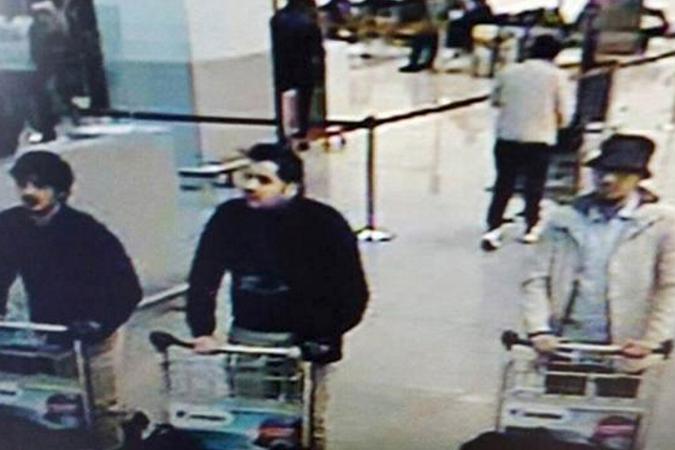
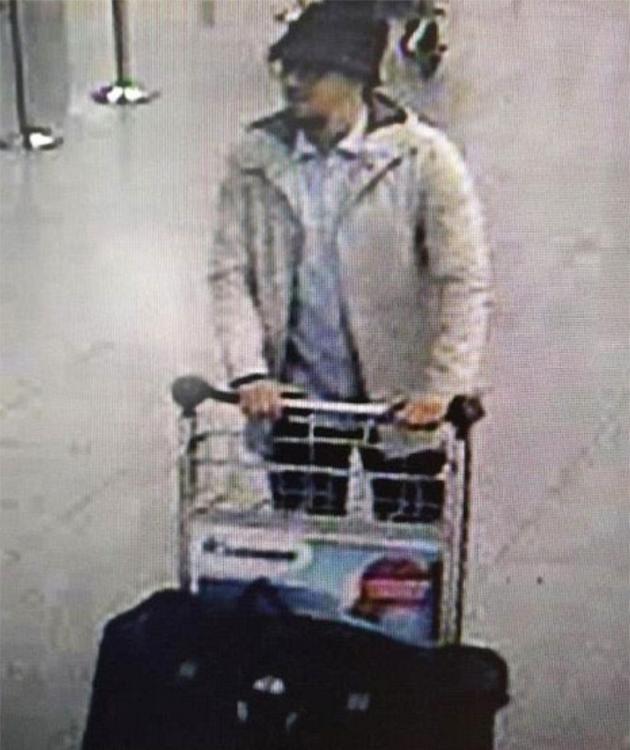
As mentioned above, there are contradictions regarding the time of release and the source of the above images.
Derniere Heure DH.net.be published the still photo from the CC camera at 10.27am, two and a half hours BEFORE its alleged official release by the Brussels police: at 12.58pm.
The airport was closed shortly after the 8am attack: there are three possible answers:
1) that the airport security authorities made the video images available to DH.be prior to releasing it to the police.
2) that the Brussels police authorities released the images to DH.be as an exclusive, prior to their official release. (Unlikely)
3) that the source of the still image did not emanate from the airport surveillance CC cameras, but from another source which was used by Derniere Heure DH.be
Most media reports acknowledged that the mysterious photo of the alleged suicide bombers was released by the Brussels police.
The Facebook entries below confirm the exact time at which the airport photos were released:
First Release by DH.be at 10.27am (entitled “Photo Exclusive” by DH.be)
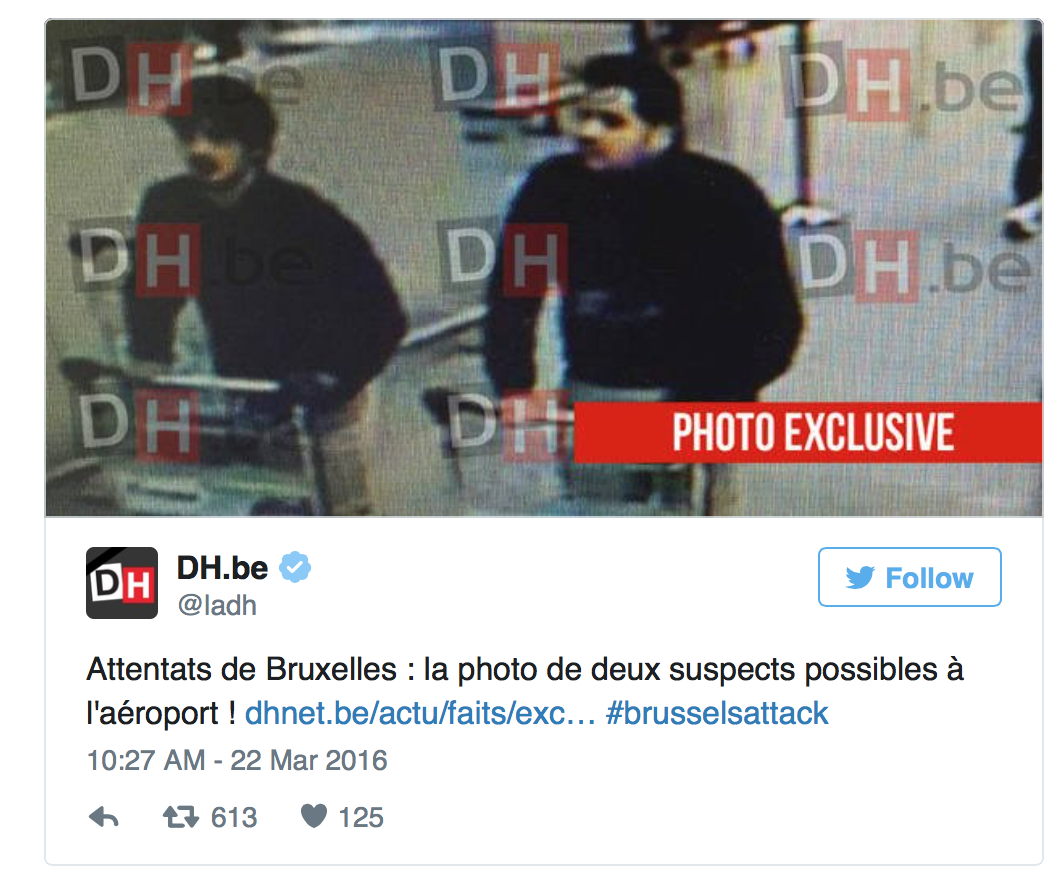
Second Release by Politie Brussel/Police de Bruxelles: 12.58pm
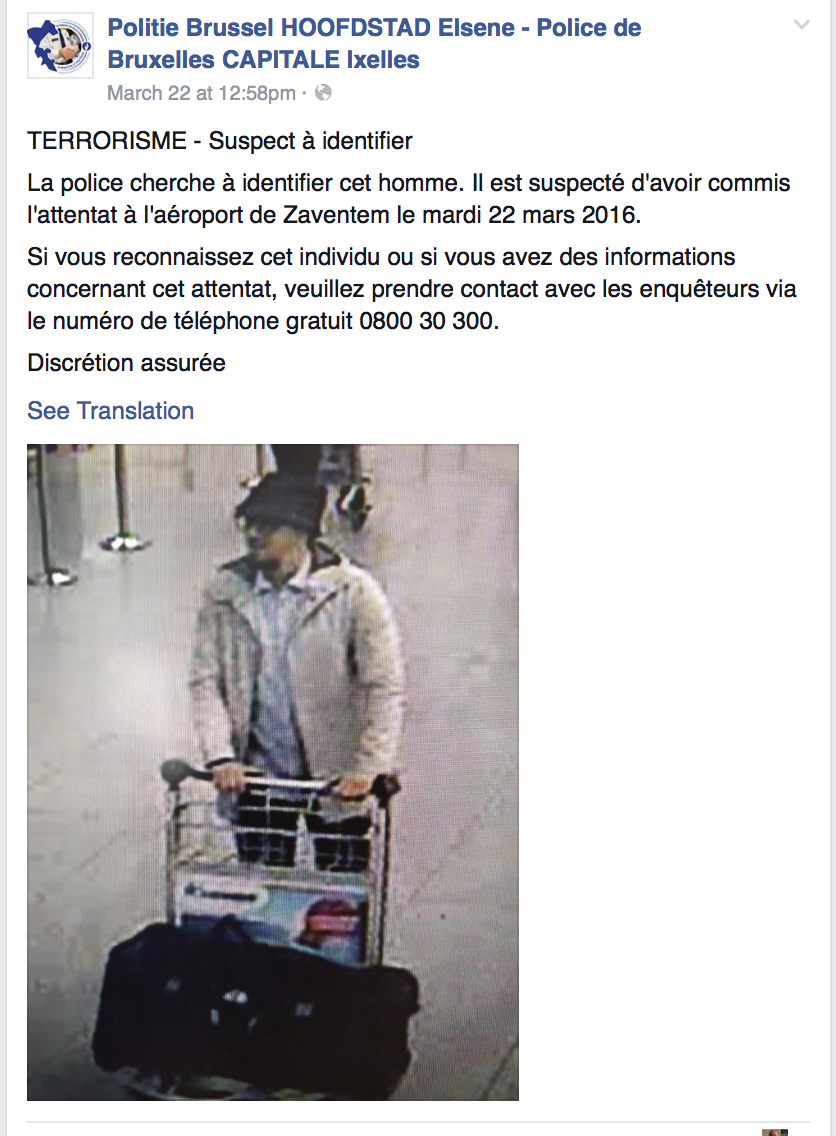
The press release of the federal prosecutor’s office on March 23d confirms the identity of one of the suspects, Ibrahim El Bakraoui and mentions the photo. The time of its release is not mentioned.

See also
Analysis: Are the airport images genuine?
In other words, can we trust DH.be which published a fake surveillance video of the bomb attack (using footage from Moscow January 2011) on March 22 at 09.07 (one hour after the bomb attack). (See our earlier report on this issue, see summary n the box below)
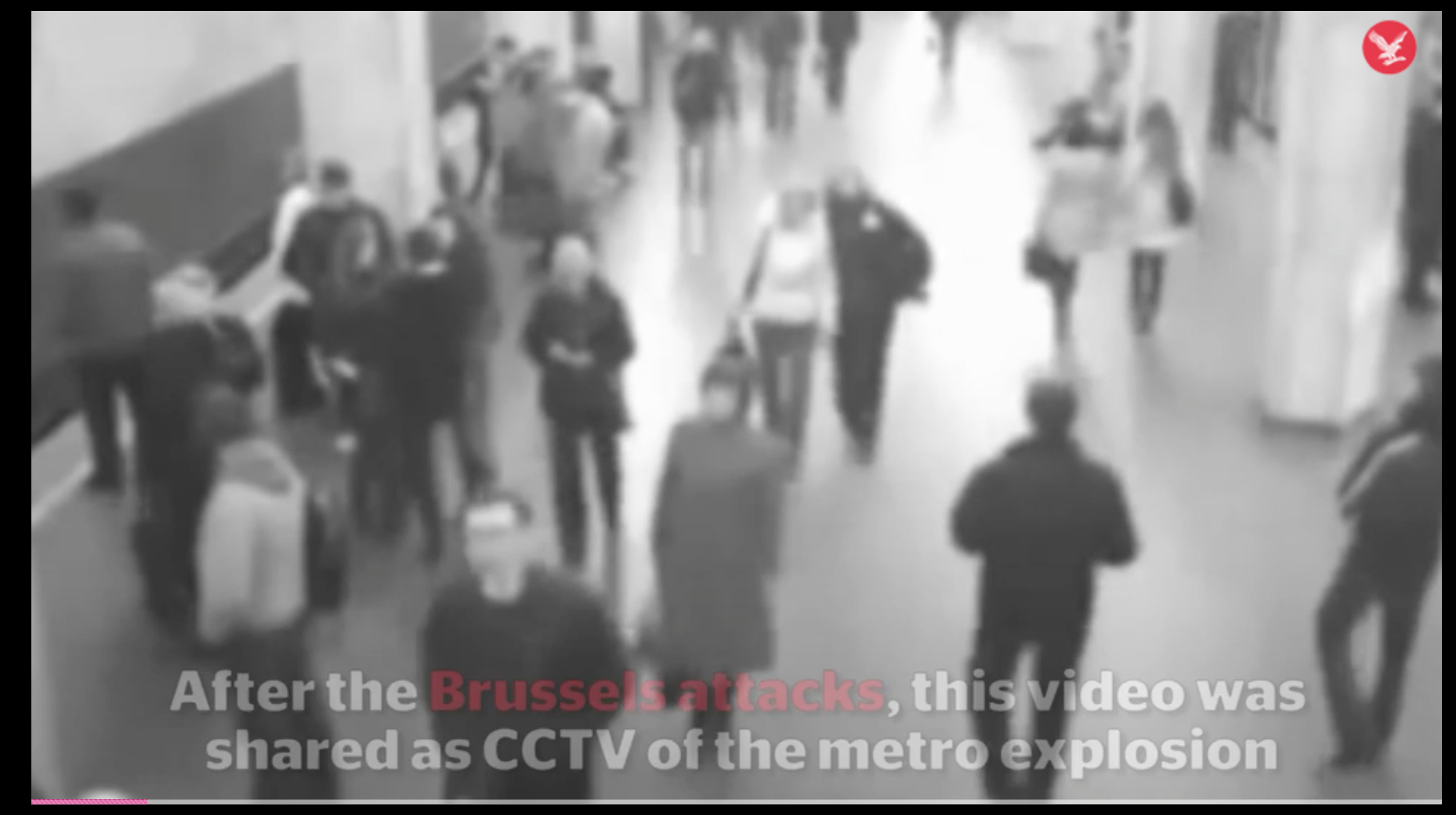
The CC surveillance videos of the attacks in real time published by Belgium’s media on March 22 at both the airport and the metro are fake.
This is confirmed by an earlier Global Research report. The Belgian corporate media published footage from the Moscow airport attacks (January 2011) and the Minsk Metro terror attack (April 2011).
Video 1 scan (Moscow airport, January 2011)
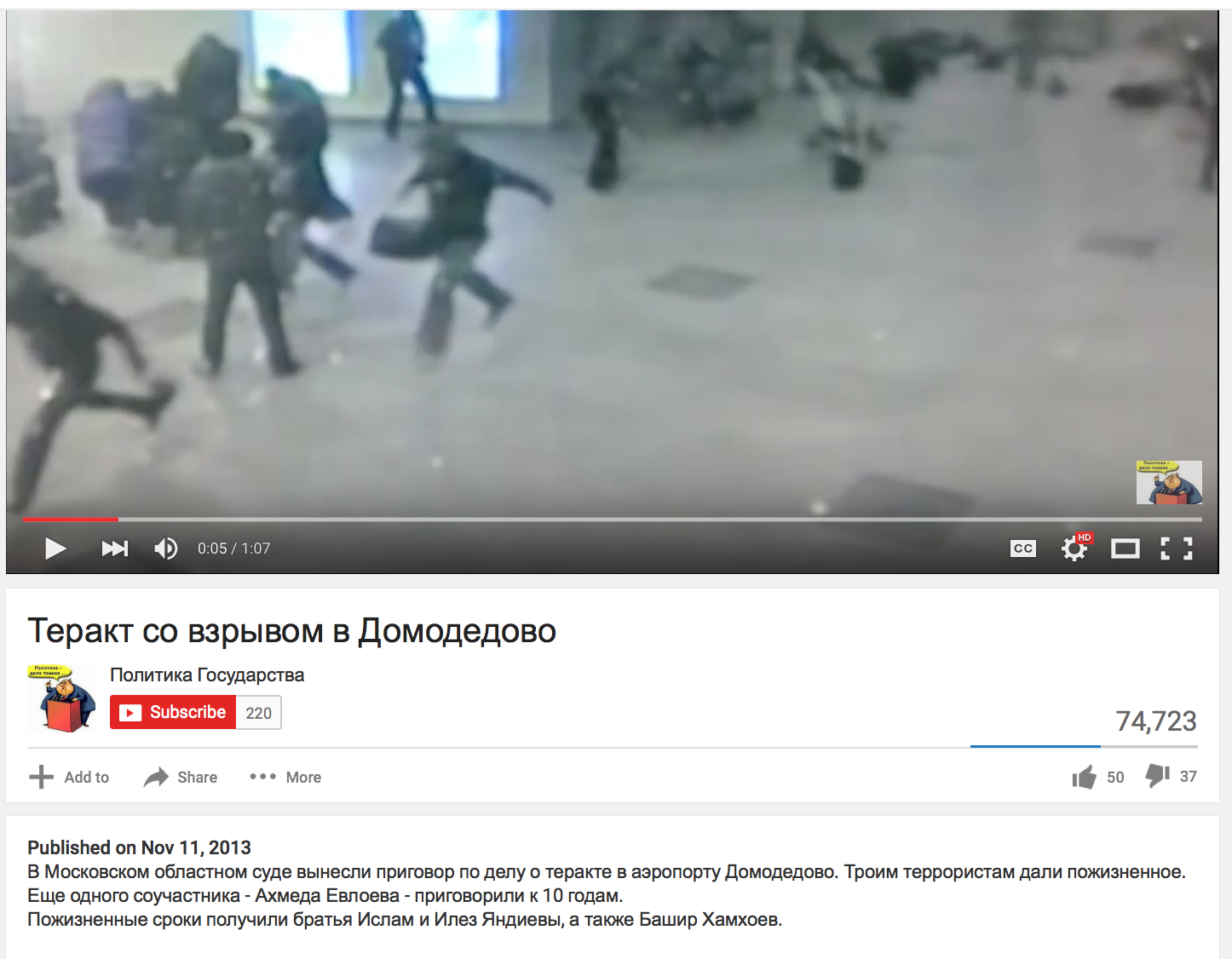
Video 2 scan (Minsk Airport, April 2011)
Here is a screenshot of the Minsk 2011 video footage broadcast on Belgian network TV and on the internet depicting the explosion in the Metro in Brussels, March 22, 2016
For full report see:

Fake Video Used in News Coverage of Brussels Terror Attacks by Prof Michel Chossudovsky, March 22, 2016

Media Manipulation: More Fake Video Reports of the Brussels Terror Attacks by Prof Michel Chossudovsky, March 23, 2016
Contradictions
In contradiction with the official press release, several media reports identified the three men as Khalif and Ibrahim el Bakraoui at Brussels airport together with Najim Laachraoui. The quoted source was the official surveillance camera.
Khalif allegedly committed the suicide attack at the metro station. So why was he walking together with his brother at the airport? The airport was closed down immediately after the bomb explosions. The Prosecutor’s press release (March 23) quoted above gives a superficial explanation.
In this regard, several media changed their stories, first Khalif died at the airport as the second kamikaze. The media subsequently clarified quoting The Belgian Federal Prosecutor “that one detonated at the airport and the other at the Maelbeek metro station.”
In a subsequent statement emanating from the Prosecutor’s office, Najim is confirmed as the second kamikaze at the airport. In turn, media reports then confirmed that Najim Laachraoui was the second attacker at the Zaventem Airport. Subsequent reports confirm the death of Ibrahim and Najim at the airport, without any substantiating evidence.
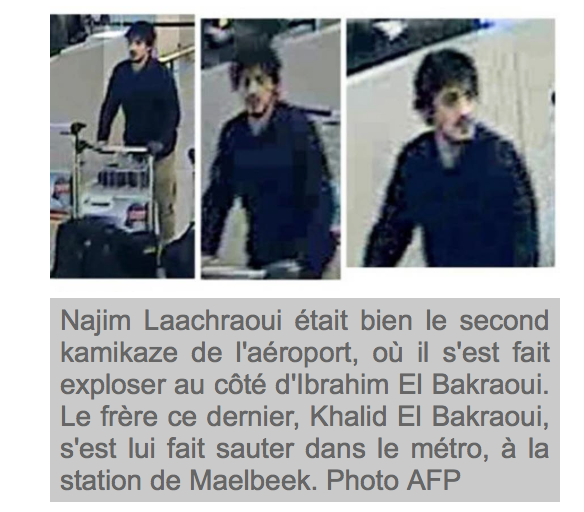
According to Le Monde “a second man, carrying a large bag, was seen on CCTV in the Brussels metro with Khalid el-Bakraoui” (quoted in the Guardian ).
News reports say that “authorities identified” brothers Khalid el-Bakraoui, 27, and Ibrahim el-Bakraoui, 30 as the suicide (Kamikaze) bombers.” Ibrahim el-Bakraoui died at Zaventem Airport while Khalid el-Bakraoui died at the Maelbeek Metro Station”
But where is the evidence, where are the bodies? Has a post mortem been conducted which confirms the identity of the kamikaze bombers.
Ibrahim’s Computer and Will Found in a Rubbish Bin
According to the Prosecutor’s press release, a computer was found abandoned in a rubbish bin contained the will of Ibrahim. This was discovered thanks to the testimony of the taxi driver who took Ibrahim to the airport. in addition to the explosives, a flag of the Islamic State was also found.
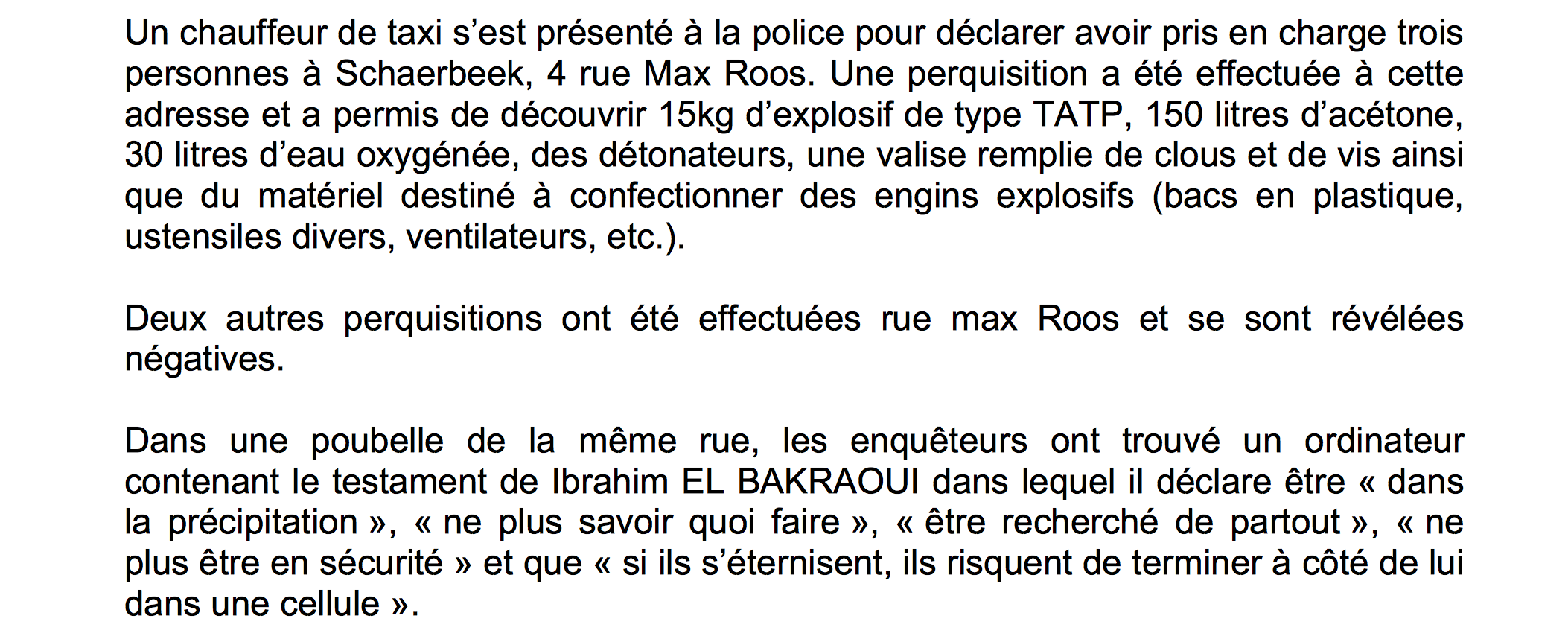
The text of the alleged will (testament) is not available.
Some media call it a “letter”. From what has been released to the media, the alleged will does not say anything. In fact it is not a will but a text focusing on Ibrahim’s personal fears. Daesh is not mentioned, neither is the planned bomb attack.
Suspects were Known to Police and Intelligence
What is of significance is that all the suspects were on the radar of police and intelligence.
The two el-Bakraoui brothers “were already being sought by police due to suspected links to the November terror attacks in Paris.”
Ironically, Brussels police categorizes Ibrahim as unknown suspect (suspect inconnu)
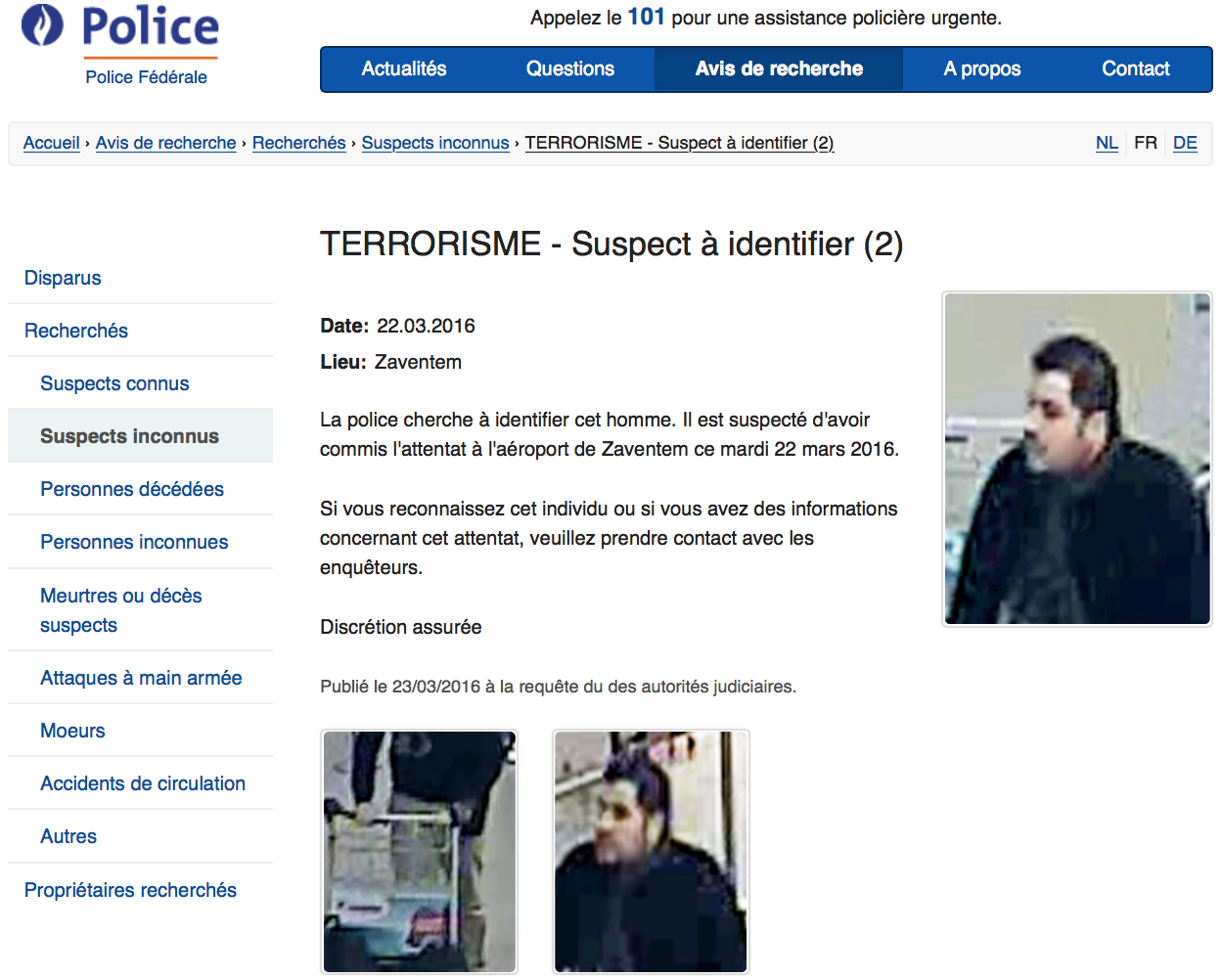
Unknown suspects at Zaventem airport?
Not only were the suspects known to police authorities, the government had advanced information, foreknowledge of a possible attack in Brussels:
“The Belgian security services, as well as other Western intelligence agencies, had advance and precise intelligence warnings regarding the terrorist attacks in Belgium on Tuesday, Ha’aretz has learned. The security services knew, with a high degree of certainty, that attacks were planned in the very near future for the airport and, apparently, for the subway as well.” (Haaretz, March 23, 2016)
EU Emergency Response Drill Simulating a Terror Attack in a Metro Station Held Three Weeks Before the Attacks
Three weeks before the Brussels attacks, an EU terror emergency drill was held in the UK, simulating an attack on the London underground tube. Seven countries including Belgium participated in the exercise.
Is it relevant?
“Exercise allows workers to practice skills they would need in the event of a major disaster such as terror attack”.

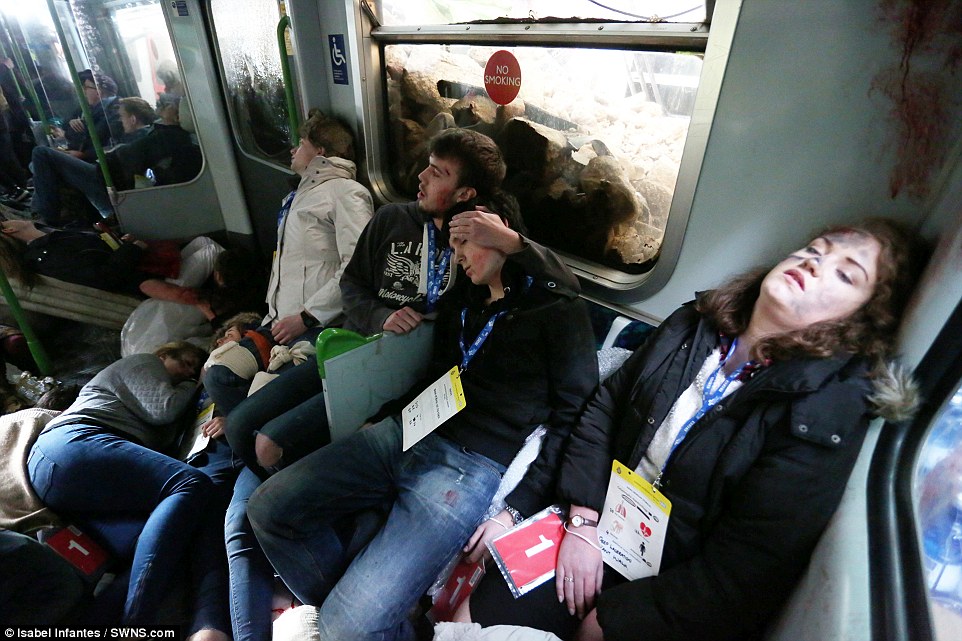

Source Daily Mail
Copyright © Prof Michel Chossudovsky, Global Research, 2016
Possible Signs Of False Flag In Brussels Now Emerging
By Brandon Turbeville – Activist Post – March 23, 2016
Yet another terrorist attack in Europe to be blamed on Islamic extremists and ISIS and yet another instance of the suspects in the attacks being previously known to security services and intelligence agencies in the years, months, weeks, and days leading up to the event. That is exactly what happened in Brussels, Belgium on March 22, 2016.
Lending credence to those who suggest that the Brussels attacks were false flags (meaning directed, orchestrated, or allowed by Western intelligence agencies), it is being reported that, yet again, the perpetrators were known to police and security services prior to the attack suggesting a number of possibilities in the false flag vein such as 1.) That the security services knew an attack was being planned and allowed it to continue 2.) That the intelligence agencies organized the attack from the very beginning.
Building a case for the false flag argument sees a number of points to be made that, while not conclusively proving that such is the case, they do provide a good reason to question the official narrative.
The identities, criminal history, and jihadist history of the assailants were already known to security services prior to the attacks.
Khalid and Brahim El Bakraoui, the two men suspected of being blowing themselves up during the attack on the airport, had been arrested for violent crimes in Belgium prior to the attacks but were both curiously released.
Brahim El Bakraoui was convicted in 2010 of shooting at police officers with a Kalashnikov during the process of committing an armed robbery. Brahim was sentenced to nine years but was curiously free and able to commit a terrorist attack only six years later.
Khalid was convicted for a number of carjackings in 2011 but only received probation and was thus also free to commit terrorist acts in 2016.
While records of violent crimes is not a direct connection to terrorism, both brothers were known to authorities prior to the attacks and were considered “wanted” by police. Indeed, an anti-terror raid at the brothers’ apartment complex took place in mid-March where an Algerian immigrant with ties to ISIS was killed.
Consider how the killers were represented in The Telegraph on March 23. The paper reports:
Khalid Bakraoui, 27, is suspected to have rented a house under a false name in the Forest suburb of Brussels which was raided by police last week in connection with the Paris attacks.
Mohamed Belkaid, a key member of the Paris plot who had accompanied Salah Abdeslam on a trip to Hungary and who transferred cash to the plot’s mastermind, was killed in the raid, and an Isil flag found next to him. Two men got away.
According to local media, both El Bakraoui brothers were known to the police.
In October 2010, Ibrahim was sentenced to nine years in prison for opening fire on police with a Kalashnikov rifle during an armed robbery on a stockbroker.
Khalid was sentenced to five years probation in February 2011 for car-jackings. He was found to have Kalashnikovs when arrested.
He is now one of Europe’s most wanted men who gave police the slip last year when he returned from Syria.
He was also in the car with Belkaid on the return trip from Hungary. [emphasis added]
The Incriminating Material Found After The Attacks
As any good pair of patsies would do, the suicide bombers were careful to leave a trail of bombs, ISIS flags, and suicide notes behind them ensuring that their connections to ISIS would be found and used to maximum effect.
According to the Associated Press, Belgian police found nail bombs, ISIS flags, and “chemical products” in an apartment where the brothers were picked up by a taxi.
Perhaps the most interesting “coincidence” is the discovery of the suicide note on the computer of Brahim el Bakroui which was allegedly found in a trash can by a cleaning crew . . . or by investigators. Media reports have actually been unclear as to who actually found the computer and the note.
Brussels suicide bomber Ibrahim El Bakraoui has left a note on a computer found in a trash can during an anti-terrorist raid, Belgium’s federal prosecutor said. The terrorist reportedly wrote that he felt increasingly unsafe, didn’t know what to do and feared going to prison.
. . . . .
Before the attacks Ibrahim left a note, where he wrote that he felt increasingly unsafe and feared landing up in prison. El Bakraoui said he was “in a hurry, doesn’t know what to do” and was “surrounded by all sides.”
The note was found on a computer in a trash can in Brussels’ Schaerbeek neighborhood.
Earlier reports in Belgian media emerged that a computer with messages allegedly related to Islamic State militants had been found in Brussels. The contents of the computer were described by police as “interesting.”
It is not yet clear whether the computer found by cleaning services was the same one mentioned by the prosecutor.
The trove was found by Bruxelles Propreté cleaning team, Dernier Heure newspaper reported. The company’s employees immediately contacted officers from the Montgomery area in Brussels.
While the information above is not evidence enough to conclusively demonstrate that the Brussels attacks were false flags, it is enough to suggest that the official narrative of the events be looked at through skeptical lenses, particularly when western intelligence agencies and governments have repeatedly sponsored false flag terror attacks in the past in order to justify wars or police state crack downs at home.
Brandon Turbeville – article archive here – is the author of seven books, Codex Alimentarius — The End of Health Freedom, 7 Real Conspiracies, Five Sense Solutions and Dispatches From a Dissident, volume 1 and volume 2, The Road to Damascus: The Anglo-American Assault on Syria, and The Difference it Makes: 36 Reasons Why Hillary Clinton Should Never Be President.
Israeli Minister Facebook Rant Blames Brussels Bombing on EU Labeling of Illegal Settlement Goods
21st Century Wire – March 23, 2016
Now here’s another interesting take on the Brussels Attacks.
There are three possible angles you could read this story from:
1. This Israeli minister is essentially saying that because the EU chose to worry about the Palestinian plight, it reaped the scourge of Islamist terror on its capital.
2. This Israeli minister is a few cards short of a full deck.
3. And finally there’s this option: by blaming the EU for accurately labeling its food products that come from from illegal settlements, is this Israeli minister somehow inferring that the Brussels bombing was a retaliation for that EU regulation?
It’s hard to know for sure, but at the very least, the Israeli minister’s off-hand comments are very revealing about the current schizophrenic political mindset in Tel Aviv…
Middle East Monitor – March 22, 2106
The EU’s labeling of goods from illegal Israeli settlements led to the bombing in Belgium, Brussels, today, The New Arab reported an Israeli minister saying.
Minister of Science, Technology and Space, Ofir Akunis, said Europeans lost sight of “terrorism of extremist Islam” by focusing on boycotting Israeli goods instead allowing the attacks to take place.
“Many in Europe have preferred to occupy themselves with the folly of condemning Israel, labeling products, and boycotts. In this time, underneath the nose of the continent’s citizens, thousands of extremist Islamic terror cells have grown,” Akunis wrote on Facebook.
“There were those who repressed and mocked whoever tried to give warning. There were those who underestimated. To our sorrow, the reality has struck the lives of dozens of innocent people.”
Turkey’s Erdogan Mentions Possible Brussels Bombing Just Days Before Attack
Sputnik -22.03.2016
Less than a week before the terrorist attacks in Brussels, Turkish President Recep Tayyip Erdogan warned of possible bombings in European cities, including Brussels.
“There is no reason why the bomb that exploded in Ankara could not explode in Brussels, or in any other European city,” Erdogan declared during a ceremony commemorating the 101st anniversary of the Battle of Gallipoli in the coastal town of Canakkale on March 18.
It should be noted that Erdogan’s statement followed the deadly terrorist act of March 13, when a car bomb exploded at a bus stop near Ankara’s central Kizilay Square, leaving 37 dead and over 120 injured. The Turkish head of state blamed Kurdish radicals for the attack and berated European leaders for their refusal to recognize certain Kurdish organizations as terrorist groups.
“The snakes you are sleeping with can bite you at any time,” Erdogan added.
On Tuesday, March 22, the city of Brussels – capital of Belgium and administrative center for both NATO and the EU – was hit by a series of explosions, including two blasts in Brussels Airport in Zaventem, Belgium that left 13 people dead and over 35 injured. An additional 15 people were killed in Tuesday’s explosion at the Maalbeek metro station in central Brussels, local media reported.
Featured Video
Elijah Magnier: Yemen’s strikes are shattering Saudi Arabia’s long-term strategy
or go to
Aletho News Archives – Video-Images
From the Archives
British weapons and personnel doing much of the killing in Yemen
Press TV – June 18, 2019
A detailed report published by the Guardian newspaper has shown how Britain is massively contributing to Saudi Arabia’s devastating war on Yemen as it suggests that London is not only supplying the bombs that fall on Yemenis, but it provides the personnel and expertise that keep the war going.
The comprehensive report by Arron Merat published on Tuesday showed that Britain was doing much of the killing in Yemen as the country continues to provide Saudi Arabia with everything it needs to turn its southern impoverished neighbor into a graveyard.
“Every day Yemen is hit by British bombs – dropped by British planes that are flown by British-trained pilots and maintained and prepared inside Saudi Arabia by thousands of British contractors,” said Merat in the report. … continue
Blog Roll
 Aletho News
- Racist Seinfeld Dances for Joy as Bibi Unveils His New Map
- A West Bank War for Netanyahu’s Election Campaign, Could It Backfire?
- Yemen denounces European Parliament’s ‘hypocritical’ push to blacklist Ansarullah
- Qalibaf: UAE’s UN bid aims to ‘clear the runway’ for ‘Greater Israel’, whitewash genocide
- Pakistan reopens Iran border after boosting security: Report
- Why are so many Brazilians voting for Flávio Bolsonaro?
- Democrats Put Anti-Russia Agenda Ahead of American Workers
- Elijah Magnier: Yemen’s Strikes Are Shattering Saudi Arabia’s Long-Term Strategy
- Pentagon designates Chinese cultural centers national security threat
- Israel Demolishes Home Of Lebanese Journalist Whose Viral Film Exposed Pager Attack
- If Americans Knew
- An error has occurred; the feed is probably down. Try again later.
- No Tricks Zone
- Sudden Stratospheric Warming, Powerful El Niño Combination May Lead To Extreme Europe Cold, Energy Crisis!
- Two New Studies Find Thwaites Glacier Melt Cannot Be Driven By Human Activity Or A Warming Ocean
- E-Cars Reduce CO2 Emissions By Only 41% Compared To Internal Combustion Engine Vehicles
- Predictions Made By Renowned Climate Professor Over Past Decades Have Been Proven To Be Poor
- New Study Suggests Large Regions Of The Pacific Ocean Have Been Cooling For The Last 80 Years
- Germany’s Green Energy Debacle: High Energy Costs Force Kahla Porzellan to Close After 182 Years!
- New Study: 50 Years Of The Most Aggressive ‘Net Zero’ Policies Can Only Affect The Global Climate By 0.03°C
- US September “Heat” Was No Record…Many Records Set Decades Ago
- Latest European Green Energy Debacle; Portugal’s Largest Flagship Solar Park Insolvent!
- Green Energy Debacle: German Expert Professor Fritz Vahrenholt Warns Of Severe Economic And Social Consequences

