The Jacinda Papers
By Guy Hatchard | February 15, 2022
A remarkable trove of documents has been created in New Zealand by an organisation called Te Punaha Matatini—Covid-19 Modelling Aotearoa hosted by the University of Auckland but funded directly by the Department of the Prime Minister and Cabinet.
Covid-19 Modelling Aotearoa is headed by the wildly inaccurate Covid modeller Dr Shaun Hendy who once predicted 80,000 imminent New Zealand deaths (currently at 53 in NZ) and includes the participation of academics from universities across New Zealand.
The documents are remarkable because they indicate the genesis of the unique and blinkered pandemic perspective of our Prime Minister Jacinda Ardern which has diverged from that followed among other countries and from that found in global science publishing.
The documents in some cases exhibit in their referenced material, a lack of awareness of the extensive content of global science publishing on the pandemic.
One paper of particular interest is entitled:
Evaluating the infodemic: assessing the prevalence and nature of COVID-19 unreliable and untrustworthy information in Aotearoa New Zealand’s social media, January-August 2020

https://cpb-ap-se2.wpmucdn.com/blogs.auckland.ac.nz/dist/d/75/files/2020/09/06092020-disinformation-formatted2.final_.pdf
It is hardly remarkable that the New Zealand government uses sophisticated computer systems to closely monitor the social media content of its citizens (what government doesn’t?), but the methods used and the starting point of evaluation are highly indicative of where the repressive and controlling New Zealand Labour government Covid policy began:
- The paper accepts a number of controversial ideas as true at face value such as the zoonotic origin of Covid-19. It describes discussion of a bioengineered origin of Covid in a Chinese lab as Xenophobia and a conspiracy trope, when it actually was, at the time the article was published, a matter of general scientific debate.
- Table 2 (excerpted above) designates some common types of scientific discussion around Covid-19 as ‘disinformation’, most of which were actually the subject of science publishing even in mid 2020. It dismisses them as fallacious without justification. Subsequent data analysis has upheld them in large part. Yet the rejection by Ardern of their moderating tone, was and is used to stoke fear in the whole population.
- Concepts of herd immunity since found to play a highly significant role in reducing Covid severity are dismissed as oversimplification and misrepresentation despite their verified and time-honoured role in developing human immunity.
- Assertions that Covid-19 disproportionately affects those already ill with comorbidities or the aged (a highly verified fact) are outrageously dismissed as the result of ableism.
- Table 3 in the paper asserts additionally that suggestions that the vaccine might have adverse effects or may alter DNA is a conspiracy theory. Subsequently there have been over 1000 papers published worldwide examining the deficiencies in mRNA vaccination safety and adverse effects reporting including evidence published late in 2020 that RNA vaccine genetic sequences can and do integrate into the human genome.
https://www.biorxiv.org/content/10.1101/2020.12.12.422516v1
- Mainstream scientists like Dr. Simon Thornley, media personalities like Mike Hosking, and politicians including Gerry Brownlee are described as using conspiracy theories to recruit NZers to right wing causes. All of whom should rightly have been described as high profile public figures stimulating discussion around political and scientific policies affecting a complex subject. The attempt to marginalise Ardern’s political opponents is obvious.
- The paper rejects health and wellbeing narratives, many of which are in fact grounded in mainstream medical advice, as misleading. Thus it specifically rejects self-care options. Yet prior and subsequent research has found many of these lifestyle and dietary options to be helpful if not critical to healthy Covid outcomes and avoidence of serious illness. These include adequate rest, exercise, a balanced diet, and nutritional supplements.
- This rejection of the value of wellbeing programmes has found its obvious conclusion in the formation of New Zealand government mandates. Yet the paper describes the suspicion that there are hidden government agendas to introduce ‘forced vaccination regimes’ as an ‘opportunistic conspiracy theory’. As we now know, these suspicions voiced early on social media are almost indistinguishable from the actual oppressive New Zealand vaccination mandates which Ardern eventually introduced denying employment and impoverishing those wishing to avoid risk and continue to make their own medical choices.
The push to introduce the censorship of scientific information and discussion that characterises the Ardern government is evident throughout the paper. Specific individual scientists tied to the government by both ideology, and in some cases by financial support, are picked out as people who should be the public’s sole sources of reliable information. These include: microbiologist Associate Professor Siouxsie Wiles, physicist Professor Shaun Hendy, and epidemiologist Professor Michael Baker.
The paper says the aim of government messaging should take the form of ‘branding’ designed to teach the public to trust the government alone. Something so close to propaganda as to be almost indistinguishable.
Emphasis in social media on ‘individual rights’ is described as an undesirable import from America. Ardern’s more recent rejection of protests as ‘imported ideas’ echoes Trudeau’s recent dismissal of protestors as ‘taking up space’, both of which hint at exclusionary agendas to come.
In conclusion the paper hints that ‘simply relying on the successful multi-faceted science and public health communication approaches of the government earlier in the pandemic will not be sufficient to debunk’ what it describes as ‘increasing prevalence of conspiracy theories about state control and individual rights’.
And continues:‘a wide-ranging response to the increasing discussion of unreliable sources, untrustworthy narrators, and conspiracy narratives in media, political, and civil society discourses is required’.
It further reports that a computational methodology and process for on-going monitoring of the prevalence of mis- and dis-information, and conspiracy narratives, within Aotearoa New Zealand’s social and mainstream media ecosystems has been established. It describes public access to a plethora of social media platforms, as a problem that needs to be addressed.
The very limited scientific outlook of Covid-19 Modelling Aotearoa is evident in the many other papers it has produced for the Department of the Prime Minister and Cabinet. In particular, their narrative has diverged in content from trends now well-understood through published data analysis around the world, including:
- The strident saturation advertising of Covid-19 mRNA vaccination referring to its absolute safety.
- The Ardern doctrine that the government should be the public’s only source of information.
- The confidence Ardern extends to tentative and often subsequently falsified science without feeling the need to update policy.
- The encouragement the government has offered to social media sites to censor content.
- The politicisation of NZ’s Covid-19 policy.
Obviously, the paper and others may have fuelled and validated Ardern’s limited understanding of science. Science is a global, rational, empirical endeavour to arrive at truth, not a process tailor-made to support ideology.
Perhaps its most frightening consequence is Ardern’s rejection of the notion of individual health rights which has obvious historical parallels.
Guy Hatchard PhD was formerly a senior manager at Genetic ID a food testing and certification company (now known as FoodChain ID)
Social Media Skewed Lockdown Debate According To Data Expert

By Richie Allen | February 16, 2022
Experts who spoke out against lockdowns were labelled as pseudo-scientists who possessed fringe ideas, because pro-lockdown scientists had more followers on social media, particularly Twitter.
Data Science expert Professor John Ioannidis of Stanford University, has compared the expertise of the experts who signed The Great Barrington Declaration (GBD) with those who signed The John Snow Memorandum.
The GBD argued that vulnerable people should be shielded and that everyone else be allowed to get on with their lives in order to build natural immunity against the virus. They warned lockdowns would be devastating for public health and the economy.
The signatories of the Snow Memorandum argued that it would be unethical to let the virus rip, therefore lockdown was essential.
According to The Telegraph :
In an article published in BMJ Open Research, he (Professor Ioannidis) found that both letters were authored by very influential experts, but that the John Snow Memorandum authors had a far greater reach on social media, which made it appear that their view had more support.
By November 2021, just four key signatories of the GBD had more than 50,000 Twitter followers, compared with 13 of the key authors of the JSM.
Prof Ioannidis concluded: “Both the Great Barrington Declaration and John Snow Memorandum include many stellar scientists, but JSM has far more powerful social media presence and this may have shaped the impression that it is the dominant narrative.
“GBD is clearly not a fringe minority report compared with JSM, as many social media and media allude.
“If knowledgeable scientists can have a strong social media presence, massively communicating accurate information to followers, the effect may be highly beneficial.
“Conversely, if scientists themselves are affected by the same problems (misinformation, animosity, loss of decorum and disinhibition, among others) when they communicate in social media, the consequences may be negative.”
Prof Ioannidis also said signatories of the JSM had contributed to the vilification of authors of the GBD through their tweets and op-eds.
John Ioannidis is right on when he says that social media skewed the debate in favour of the lockdown evangelicals, but he has missed one very important point. He seems to have overlooked shadow banning.
It shouldn’t have really mattered that pro-lockdown scientists had more followers on Twitter than their Great Barrington Declaration counterparts.
Twitter and Facebook worked in tandem from the outset of the scamdemic to amplify the posts of academics who supported lockdowns while at the same time limiting the reach of experts who opposed the tyrannical measures.
This meant that users were many times more likely to read pro-lockdown propaganda than they were to read the opinions of sceptics. The social media firms use not very sophisticated algorithms to ensure that their users read what they want them to read.
It’s happening today. The Welsh government has announced plans to give covid jabs to children over five years-old. England will announce later this week.
There are tens of thousands of doctors and scientists who are horrified at the prospect of jabbing young children with an unproven medicine that they do not need.
You and I know who they are, but the majority of people do not. This is because they will never see these experts in their news feeds. Free speech has no greater enemy than social media.
Russian, German leaders comment on RT DE feud
RT | February 15, 2022
Russian President Vladimir Putin and German Chancellor Olaf Scholz said on Tuesday they have agreed to think of a solution to the broadcasting dispute, after Berlin banned RT DE and Moscow responded by banning Deutsche Welle (DW).
Putin and Scholz made their comments at a joint press conference in Moscow after discussing the subject during their Tuesday talks.
“We agreed that we will think about how these problems can be resolved,” Putin said.
Scholz insisted that Germany is a state of laws and that RT DE never applied for a broadcasting license there, saying it was banned by the appropriate regulator using the applicable laws.
“In a state of law, there are procedures, and the requirements created by laws,” he said.
RT DE Productions GmbH has repeatedly told German authorities it was a production company based in Berlin and not a broadcaster. All the broadcasting was done from Moscow, via a satellite frequency licensed from Serbia, and operating under the European Convention on Transfrontier Television (ECTT), which both Serbia and Germany have signed.
Germany has not only refused to recognize the Serbian satellite license, but the Media Authority of Berlin-Brandenburg (MABB) declared that RT DE Productions was in fact a broadcaster and had to be shut down. The Commission on Licensing and Supervision (ZAK), the central organ of Germany’s Medienanstalten agency, agreed with MABB on February 2. RT is now appealing the decision.
It was unclear whether Scholz was aware that MABB had repeatedly told RT DE it was “not subject to approval” for broadcasting in Germany. The formal reason for that is that RT DE is a subsidiary of ANO TV-Novosti, which is financed from the state budget of the Russian Federation and therefore ineligible under existing German law.
This is why RT DE sought to obtain an ECTT license in Luxembourg in 2021, which was denied. German media reported that pressure from Berlin was a factor in the decision, though then-Chancellor Angela Merkel denied any such thing.
Following the ZAK decision to ban RT DE, Russia responded on February 3 by blocking Germany’s state broadcaster Deutsche Welle (DW) from broadcasting in Russia and stripping its Moscow staff of all press credentials. Moscow said further actions might be taken as well.
Europe considers regulating Spotify
By Dan Frieth | Reclaim The Net | February 13, 2022
National media regulators are hoping the upcoming speech laws will give them power to censor “misinformation” on Spotify.
Spotify has been attacked heavily in recent months, mostly for hosting the Joe Rogan Experience, which doesn’t always go along with the mainstream narrative.
“We should hold them accountable not as a publisher but just like any other online platform in the Digital Services Act,” Frédéric Bokobza, deputy director general of France’s media regulator, Arcom, told POLITICO.
The EU is finalizing the Digital Services Act (DSA), a law focused on content moderation on online platforms. The bill might also empower national media regulators to regulate a broader list of tech platforms, including Telegram and Spotify.
“As of now, we do not have regulatory tools in the French law which would enable us to oversee audio streaming companies, on top of the fact [Spotify] is not based on our territory,” said Roch-Olivier Maistre, president of France’s audiovisual regulator.
For long, Spotify escaped public scrutiny as it mostly hosted music. But in recent years it has become a popular podcast platform, with more than 400 million users globally and a new avenue for ideas that the establishment wants censored.
Despite the backlash, Spotify has refused to cut ties with Joe Rogan, whose show is the most popular podcast on the platform.
RIP Freedom of Speech
In lockstep in multiple countries
The Naked Emperor’s Newsletter | February 12, 2022
As with so many things that are happening at the moment, the attack on free speech is happening in multiple countries at the same time.
Firstly in the UK.
A draft Online Safety Bill was first presented to Parliament in May 2021 but has been strengthened in the last few weeks. Originally the draft Bill focussed on large web companies but the government has recently announced that more changes would be made and new criminal offences added.
One of these new offences would be spreading Covid-19 disinformation under a crime of sending a false communication. This offence would be committed if a person sends a communication they know to be false with the intention to cause non-trivial emotional, psychological or physical harm. The maximum sentence is 51 weeks.
The average person might think it is reasonable to imprison somebody for communicating something they know to be false with the intention to cause harm. However, what is “false” and what is “harm”? The last few years have shown us that these are now very subjective topics. Information that was true in 2019 became false in 2020 and is starting to be true again in 2022. A truth that is communicated to somebody who believes it to be false may cause them emotional or psychological harm. Intention is necessary for the crime to take place but if something is deemed to be false and deemed to cause harm then it could be argued that if the person who communicated the information, knew the information was on the “harmful list” then intention was there.
And who is deciding what information is false? The government? That almost sounds like a punchline to a joke. We’ll just end up with news articles such as the one below – Sponsored by the UK Government (see the text in blue).
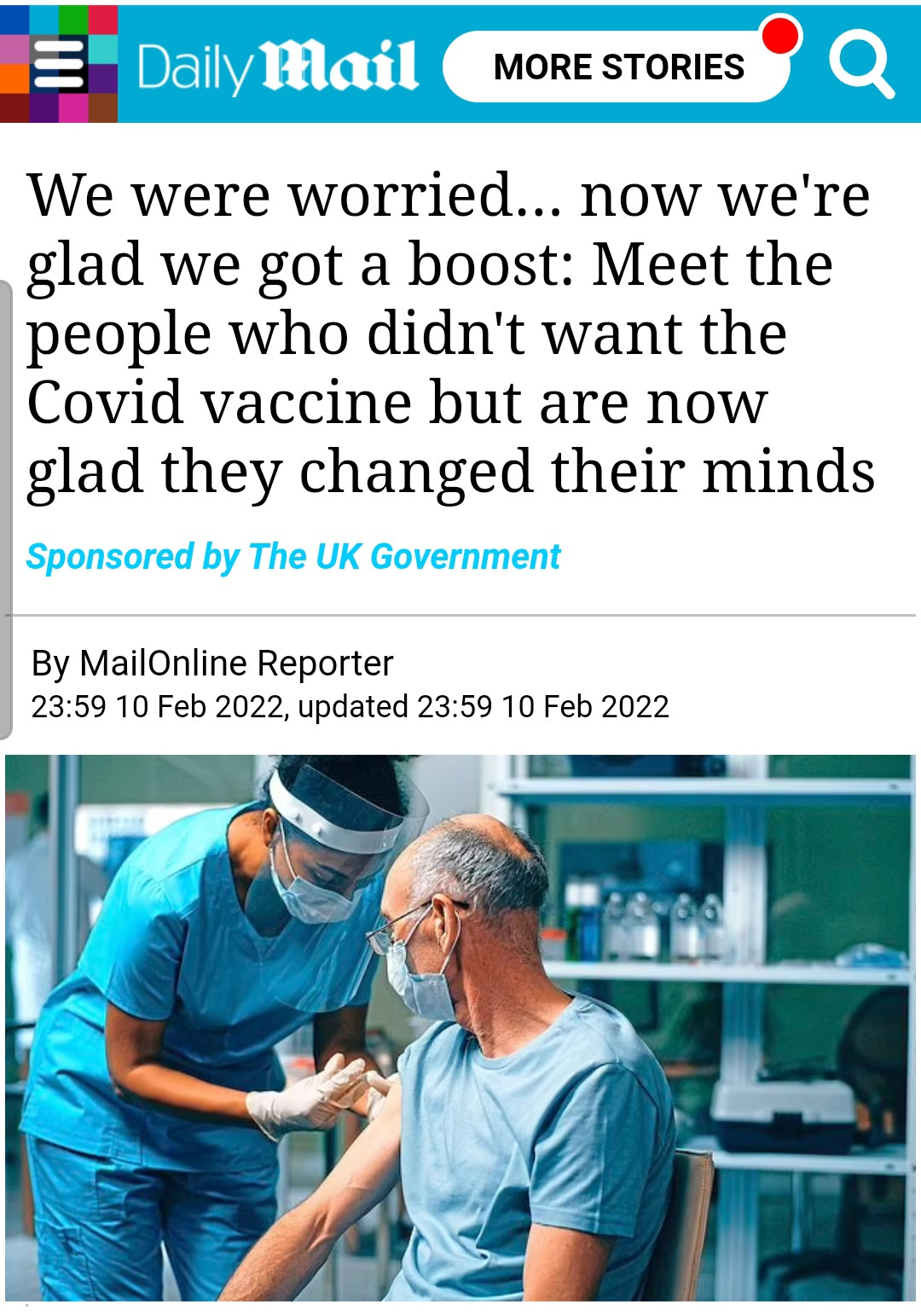
The Bill was already censorial enough, making online companies remove content which was deemed to be harmful but not illegal. As we have seen in recent times, corporations’ misinformation policies have been arbitrary enough, which will only worsen with governments deciding what is true and what is false. Now, in a step one-removed from pre-crime, these companies will be made to proactively “prevent people being exposed in the first place”.
The government press release on the strengthening of this bill says that “to proactively tackle the priority offences, firms will need to make sure the features, functionalities and algorithms of their services are designed to prevent their users encountering them and minimise the length of time this content is available. This could be achieved by automated or human content moderation, banning illegal search terms, spotting suspicious users and having effective systems in place to prevent banned users opening new accounts”.
In almost Orwellian double-speak the press release says the Bill “will better protect people’s right to free expression online”. What this means is, it will better protect people’s free expression of government approved material. It continues by saying “it will have to be proven in court that a defendant sent a communication without any reasonable excuse and did so intending to cause serious distress or worse, with exemptions for communication which contributes to a matter of public interest”. So the government says something is a matter of public interest (e.g. vaccines) and suddenly intention doesn’t have to be proven.
Please sign this online petition to remove requirements that specifically target lawful speech from the Bill.
Next to the US.
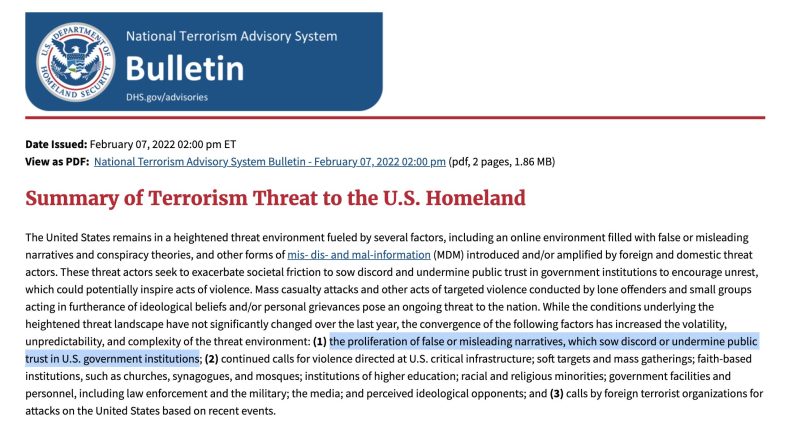
At almost the same time, the US sent out a bulletin “Summary of Terrorism Threat to the U.S. Homeland”.
This states that “the United States remains in a heightened threat environment fueled by several factors, including an online environment filled with false or misleading narratives and conspiracy theories, and other forms of mis- dis- and mal-information (MDM) introduced and/or amplified by foreign and domestic threat actors. These threat actors seek to exacerbate societal friction to sow discord and undermine public trust in government institutions to encourage unrest, which could potentially inspire acts of violence”.
According to the bulletin, “the proliferation of false or misleading narratives, which sow discord or undermine public trust in U.S. government institutions” has “increased the volatility, unpredictability, and complexity of the threat environment”.
Key factors contributing to the current heightened threat environment include “widespread online proliferation of false or misleading narratives regarding unsubstantiated widespread election fraud and COVID-19”.
Furthermore, “as COVID-19 restrictions continue to decrease nationwide, increased access to commercial and government facilities and the rising number of mass gatherings could provide increased opportunities for individuals looking to commit acts of violence to do so, often with little or no warning. Meanwhile, COVID-19 mitigation measures—particularly COVID-19 vaccine and mask mandates—have been used by domestic violent extremists to justify violence since 2020 and could continue to inspire these extremists to target government, healthcare, and academic institutions that they associate with those measures”.
So in a step up from the UK’s response, the US is labelling individuals who produce any MDM as terrorists. Obviously, any language that incites violence is unacceptable but to confuse people encouraging unrest with those discussing whether Ivermectin could help save lives is completely unacceptable.
And finally in Canada.
Again, as if in lockstep, Justin Trudeau is trying to revive his controversial Internet legislation bill. Once known as Bill C-10, to fool those unintelligent Covid deniers, it has been changed to Bill C-11.
There are concerns that the legislation could be used to censor social media. The government have denied this but experts hold the opposite view. Who to believe, hmmm? The Toronto Sun reports that Trudeau is using the current national tensions as a smokescreen to let them slip in unpopular pieces of legislation. Never let a good crisis go to waste!
When we remove freedom of speech and censorship of controversial topics becomes common place, we turn into a dangerous society. Not only can authors be imprisoned for airing their views but, just as importantly, debate becomes restricted resulting in truths being hidden and novel and radical ideas supressed.
But if they can’t censor you, maybe they’ll just give you a morality pill so you don’t produce the stuff in the first place!

Try as They Might, Facebook ‘Fact-Checkers’ Cannot Refute the Dire Scottish Vaccine Data
By Thorsteinn Siglaugsson | The Daily Sceptic | February 10, 2022
Ever since I realised the devastating effects lockdowns would have all over the world, I have actively fought them. My first task, in October 2020, was hosting an interview with world-renowned epidemologist Martin Kulldorff, one of the authors of the Great Barrington Declaration, which argues for focused protection instead of blanket lockdowns.
Incidentally, Kulldorff was involved also in my first really memorable encounter with the so-called fact-checkers. Last summer the Icelandic Chief Epidemiologist said in an interview he believed herd immunity would never be reached by vaccination, only through infections. I posted a link to the interview on LinkedIn. Kulldorff shared my post, and the next thing he knew his reshare had been removed. Clearly a fact-checker hadn‘t liked what our Chief Epidemiologist said, and decided the public shouldn‘t know.
Part of my activities as an active lockdown sceptic has been managing a large and fast-growing local Facebook group, dedicated to providing a broad view of the Covid situation, including negative effects of lockdowns, and later on, growing concerns with the effectiveness and safety of mass-vaccination. This is a difficult task as we must always be very careful not to accept posts that for some reason contain material that doesn‘t comply with the worldview of the fact-checkers. We get a few strange conspiracy theories of course, but mostly the material we have to reject is simply inconvenient facts or well-argued opinions, even by respected scientists, that just happen to go against the official narrative.
Fact-checking is nothing new, and until recently it was just that, checking for facts. But since very early in the pandemic, fact-checkers have become less concerned with facts, but more, and in some cases exclusively, with censoring anything that goes against their own opinions. Every day, hundreds of such articles are published and then used to justify censorship. The following example is a typical one.
Recently, official Scottish data has shown COVID-19 infections, hospitalisations and deaths are becoming more frequent among the double-vaccinated than the unvaccinated. The latest report shows the infection rate among the double-jabbed is now double the rate for the unjabbed, and 50% higher for the triple-jabbed. Hospitalisations are higher among the double-jabbed than the unjabbed and the death rate is double. This is a concerning development and has garnered some attention from those who follow such statistics. I wrote a short Facebook post on this the other day, quoting an article discussing this development. A few days later the familiar warning of ‘false information’ had been slapped on my post.
I decided to follow up on the ‘fact check’ referred to in the warning, an article by Mr. Dean Miller, managing editor at Lead Stories, one of the agencies that frequently publish articles used to justify censorship. Mr. Miller holds an undergraduate degree in English and seems to have no science training whatsoever.
Mr. Miller begins by claiming there is a consensus among health statisticians “working independently” that vaccination reduces the probability of hospitalisation and death, and that as the vaccinated tend to be older than the unvaccinated, “amateur statisticians” often reach false conclusions based on official data. Mr. Miller then quotes an epidemiologist who suggests various factors that “may” affect the numbers. First, that the vaccinated are more likely to get tested, quoting test and trace data but providing no reference. Second, that the vaccinated tend to be older than the unvaccinated and therefore more vulnerable in general. Third, that the vaccinated may behave differently from the unvaccinated when it comes to social interactions. Fourth, that the unvaccinated are more likely to have been previously infected by the virus.
None of this is necessarily untrue. But the article provides no references showing that vaccinated people behave differently from unvaccinated people, which would make them more likely to come into contact with infected persons. We also have no way of determining if the opposite is true. In other words, this is pure speculation, for which no evidence is provided. Whether vaccinated people are more likely to get tested is speculative also and there is no data provided to back up this claim. The same goes for the claim that the unvaccinated are more likely to have been previously infected. In fact, as numerous studies have already demonstrated that infection provides strong and lasting protection, this suggestion seems highly unlikely.
So, three of Mr. Miller‘s arguments are pure speculation, unquantified and not supported by any evidence. But what about the last argument, that the vaccinated tend to be older and therefore more likely to be hospitalised or to die? This certainly looks like a valid point, since we know it is primarily the elderly who become seriously ill with COVID-19. But how valid, or relevant is this really?
To start with, being vulnerable to serious illness or death if infected has nothing to do with the probability of infection. Rather than increasing it, it might rather decrease it, as a vulnerable person might be more likely to avoid situations where they are likely to get infected. As for hospitalisation and death, the data presented in the Public Health Scotland reports is in fact age-standardised. This means the age-related probability of death is already accounted for in the statistics. Mr. Miller‘s key argument, and the only one that isn‘t purely speculative, is therefore simply invalid. It seems he either failed to familiarise himself with the methodology used, or did not understand what it entails.
The weakness of Mr. Miller‘s argumentation does not however stop him from categorically denying that comparison of infection rates is a valid indicator of vaccine effectiveness. And of course it does not prevent the media and social media using his claim, based on speculation and lack of basic understanding of the data, to censor the discussion of a disturbing development that most certainly calls for thorough investigation.
When I showed the data to a Scottish friend recently, he suggested it was of no relevance for other nations, as the Scots were genetically different from other people due to a long-standing diet of nothing but chips, Marlboros and Irn-Bru. I can only say his explanation makes just as much sense as Mr. Miller‘s do.
But Scotland is not the only country experiencing this disturbing trend. A couple of weeks ago I published an article in the Daily Sceptic discussing a similar trend in Iceland: early January data showed the double-vaccinated to be twice as likely to get infected as the unvaccinated. This undermines the aforementioned dietary explanation, as in Iceland we boil our potatoes, smoke Camels rather than Marlboros and Irn-Bru has never been available. No ‘fact check’ has yet been published trying to invalidate this data. However the already published infection rate for the unvaccinated suddenly rose by 20%, without explanation, soon after this development was pointed out.
Unfortunately Mr. Miller‘s article is not the only example of a ‘fact check’ that ignores or distorts the facts, or counters hard data with pure speculation. This sloppy kind of reporting seems to be the fact-checkers’ standard way of working when it comes to the pandemic. Some have even admitted their fact-check labels are nothing but opinion. And the general press is no exception. For example, the Scottish Herald recently published an article on this subject, also failing to acknowledge the fact that the data is age-standardised.
It is a noble endeavour to try to make sure facts rather than fiction influence public opinion. But unfortunately, it looks as if the champions of ‘fact-checking’ have little respect for facts. Most of the material they produce consists of low quality, highly opinionated articles, lacking not only references, but more importantly the clarity of thinking that must be required of anyone who takes upon themselves the important and difficult task of deciding what is true and what isn‘t.
Thorsteinn Siglaugsson is an economist who lives in Iceland. Find him on his blog.
The UK wants to criminalize “misinformation” online as its own health service gets caught posting falsehoods
By Dan Frieth | Reclaim The Net | February 11, 2022
Less than a week after the UK proposed criminalizing the posting of some types of “knowingly false” information online, England’s National Health Service has taken down a social media video over inaccurate information.
Last week, NHS England posted a video on its Twitter account with more than half-a-million followers to promote vaccination in kids.
The video claimed that 1% of children will be hospitalized because of Covid, 136 kids in the UK had died because of Covid, and 117,000 children have “long Covid.”
The video went viral attracting comments and retweets from some of the most popular influencers in the health category.
But some, including Dr. Robert Hughes, a clinical research fellow at the London School of Hygiene & Tropical Medicine, questioned the accuracy of the data.
“As both a parent and scientist who has been involved in research on symptom duration and severity of covid in children, the cited statistics didn’t make sense to me,” Hughes wrote in an article in UnHerd. “The idea that 1% of children with Covid are hospitalized for it didn’t pass the ‘sniff test.’”
The video also shared the story of a kid aged 11 that was suffering from long Covid. According to Hughes, the story contradicted the vaccination guidance in the UK, as it does not even recommend vaccination for that age group.
Additionally, there is not yet any substantial evidence to support that the vaccine prevents long Covid.
Hughes also notes that NHS England was silent when he and others questioned the accuracy of the data.
“Several people agreed with me, sharing their working for why these numbers are at best long outdated, may be orders of magnitude out, and risk undermining confidence in vaccine communications and uptake.
“But others seemed to dig in, praising both the content and tone of the messaging when challenged, and directing the discussion into an important, but different, one about the merits of extending Covid vaccination to children rather than the need for accurate and honest communication about vaccination,” Dr. Hughes wrote for UnHerd.
Hughes contacted the Office of the Statistics Regulator about the numbers. The Statistics Regulator agreed that it was important that the NHS provides accurate figures.
“It is important that figures provided by NHSE&I are accurate and reliable,” the Office of the Statistics Regulator said. “In this case the claim made in the video fell short of these expectations – we contacted NHSE&I and it acknowledged that the data were historic and had methodological shortcomings. We are therefore glad that the content has now been removed from Twitter.”
Before its removal, the video had already been widely shared.
Why the Freedom Convoy is provoking unprecedented hysteria
By Rachel Marsden | RT | February 10, 2022
In the two weeks since the Freedom Convoy of Canadian truckers and their supporters began rallying in Ottawa to demand an end to all pandemic-related mandates and restrictions nationwide, it has become clear that this movement isn’t like other protest movements. And that’s a scary proposition for those in charge who thought that they’d manage and exploit this crisis on their own sweet time and schedule regardless of the actual science and reality on the ground.
There has long been an agenda to corral as many humans as possible unwittingly into a global dragnet through technological adoption. That’s what the revelations of National Security Agency whistleblower Edward Snowden were about back in 2013. A technological panopticon provides those in charge with the ability to monitor and ultimately control or sanction dissidents or outliers as the state pursues the self-serving agenda of a select few. Algorithms that exploit this massive online presence enable the state to accurately craft propaganda to be deployed to vilify them in the eyes of the general population, while portraying the state as the great protector — all while selling citizens out to the interests of a select few elites. Essentially, people are manipulated into arguing against their own good.
For those citizens who aren’t seduced by the mere convenience of technology or the narcissistic allure of social media, the fear of terrorism or of Covid-19 more actively encouraged onboarding to these dragnets. And that was before it was flat-out mandated with government-issued QR code health and vaccine passes that linked directly to your identity.
But then a bunch of truckers noticed that the threat of authoritarianism in Canada and elsewhere was closer than it may appear in their mirrors. And these essential workers decided to park their essential tools until officials stopped treating essential freedoms like they were negotiable.
Because Canadian mainstream media is so severely lacking in truly contradictory debate and diversity of thought, the protests risked sparking an unprecedented new awareness for those who had been force-fed government talking points while they may have already been starting to wonder why their entourage was triple-jabbed and still catching the virus. They were probably beginning to question the real value of the sacrifices that they were forced by government into making over the past two years under the illusion of safety.
Into this mix comes a group of people who aren’t paid activists or troublemakers, but rather everyday people with real jobs — and ‘essential’ ones at that, as previously hailed by the governments themselves. This makes the truckers a different breed of dissenters from Black Lives Matters, Antifa, or French Yellow Vest protesters. And that explains why the rhetorical big guns are now being deployed against them. The truckers, by demanding that life go back to exactly the way it was before governments started instrumentalizing the pandemic, could undermine any agenda to exploit the crisis for globalist advancement. This would especially be the case if the Freedom Convoy movement spread around the world, as it’s beginning to do. Here in France, for example, convoys departing from various cities are reportedly scheduled to arrive in Paris beginning on February 11.
Former Bank of Canada and Bank of England governor, Mark Carney, a dual citizen of Ottawa and Globalistan, wrote in a recent Globe and Mail newspaper opinion piece: “[B)y now anyone sending money to the convoy should be in no doubt: You are funding sedition. Foreign funders of an insurrection interfered in our domestic affairs from the start. Canadian authorities should take every step within the law to identify and thoroughly punish them. The involvement of foreign governments and any officials connected to them should be identified, exposed and addressed.”
Unlike previous environmental protests that have raged in Canada to the detriment of the country’s future energy independence, and been backed by US-based think-tanks funded by American business interests close to Washington elites — all of which have apparently escaped Carney’s attention or interest — truckers don’t actually require ‘foreign funding’. They have actual jobs that pay quite well.
You’d think he’d know that, given his illustrious background as an expert in money. But good luck trying to exploit the ‘foreign bogeyman’ trope and attempting to find the scapegoat that you’re looking for. Carney is concerned about the ‘occupation’ by protesters, who are merely fighting against the government blockade of citizens’ lives for the past two years. And a bonus L-O-L for his effort to portray protests to regain basic freedoms as some kind of attempt to overthrow the government of Canada. Perhaps someone could provide him with a paper bag before he passes out?
Here’s your ground truth in Ottawa: “More than 100 Highway Traffic Act and other ‘Provincial Offence Notices’ were issued for offenses including excessive honking, driving the wrong way, defective muffler, no seat belt, alcohol readily available and having the improper class of driving license,” according to a Fox News report.
Well, you know what they say. Every hardcore coup d’état starts with a seat belt offense, right?
Meanwhile, US Homeland Security, already apparently attempting to ward off any potential future pushback against its own unpopular agenda, issued an advisory on February 7 conflating terrorism with “the proliferation of false or misleading narratives, which sow discord or undermine public trust in U.S. government institutions.” Would that include dissent against any government-approved narrative around the pandemic and related liberticidal measures?
Restrictions, mandates, and ‘vaccine passports’ in two Canadian provinces — Alberta and Saskatchewan — are now ending, premiers of both jurisdictions announced on February 7.
The rest of the world now runs the risk of these trucker movements gaining momentum, before the restrictions and mandates can allow for the full implementation of a lasting solution of tracking and surveillance capable of monitoring populist blowback to government insanity.
The rally race between truckers and globalists is on! And with nothing less than democracy and freedom at stake.
Rachel Marsden is a columnist, political strategist and host of an independently produced French-language program that airs on Sputnik France.
DHS Issues Terrorism Bulletin Over “Conspiracy Theories” and “Misleading Narratives”
By Paul Joseph Watson | Summit News | February 9, 2022
The Department of Homeland Security has issued a new terrorism bulletin in response to concerns over “conspiracy theories” and “misleading narratives.”
Yes, really.
“The United States remains in a heightened threat environment fueled by several factors, including an online environment filled with false or misleading narratives and conspiracy theories, and other forms of mis- dis- and mal-information (MDM) introduced and/or amplified by foreign and domestic threat actors,” the DHS bulletin stated.
The advisory goes on to assert that the US is in a “heightened threat landscape” due to “the proliferation of false or misleading narratives, which sow discord or undermine public trust in U.S. government institutions.”
Apparently, lack of trust in the Biden administration and the legacy media represents a terrorist threat.
Under DHS chief Alejandro Mayorkas, who thinks “white extremists” are the biggest terror threat to America, five separate bulletins striking a similar tone have now been issued.
One of the bulletins even suggested that Americans who are angry at COVID lockdown rules or who express concerns about election integrity are potential extremist threats.
“It’s clear as day these bulletins are pure political propaganda to demonize all white people as “domestic terrorists” ready to carry out terrorist attacks at any moment and justify using terrorism laws against them as part of the new Domestic War on Terror,” writes Chris Menahan.
Since Biden took office, his administration has intensified efforts to demonize its political adversaries, tens of millions of ordinary Americans, as domestic extremists.
Following the January 6 Capitol riot, Democrats ludicrously compared the events to September 11 in an attempt to justify using federal resources that would normally be focused on actual terrorists against American conservatives.
Last month, the Justice Department created a new “specialized unit focused on domestic terrorism” in response to an “elevated” threat from violent extremists in the United States.
As we also reported in January, the US Army conducted a “guerrilla warfare exercise” in North Carolina where troops engaged in mock battle against “freedom fighters.”
In September last year, the National Association of School Boards (NASB) sent a letter to the Biden administration claiming parents were engaging in domestic terrorism by fighting against CRT and mask mandates.
Attorney General Merrick Garland subsequently announced the DOJ and FBI would establish a task force aimed at probing a “disturbing spike” in threats against school officials.
Featured Video
Death Spikes & Rising Cancer In Our Youth Explained
or go to
Aletho News Archives – Video-Images
From the Archives
Politicians lie
By Mazin Qumsiyeh | Popular Resistance | August 18, 2013
There is no way to say this truth nicely: Politicians lie. That includes Japanese, American, Egyptian, Israeli, and Palestinian politicians! Is there something more common sense than that? Yet, so many citizens around the world believe their own politicians or wistfully acknowledge lies but think it is part of the job needed to run things. They believe even when politicians contradict themselves blatantly. This phenomenon is rather remarkable. It is a dissonance and disconnect from reality that many seem oblivious to. It is very dangerous because it can lead to accepting rationales for going to war. These can be deadly wars that lead to millions of lives lost as happened in what was called World War 1 and WW2. Even when incredible and declassified evidence abound, politicians continue to lie and old mythologies refuse to die. Here are just a few of the countless lies told to us over the past few decades… continue
Blog Roll
 Aletho News
- RSF military group defects, joins Sudanese army: State media
- Ireland goalkeeper refuses to play ‘Israel’ as squad weighs boycott
- China pushes back against US on Cuba, Iran
- Ukrainian Soldiers, Potential Mercenaries: Have Gun, Will Travel!
- Burnham’s UN debut… A masterclass in British disinformation
- Iran flights continue despite US aviation sanctions
- Global Tipping Points Lead the World Into a State of Entropy
- The day-after at the White House: USA and Xi Jinping
- The Geopolitical Balance in the Red Sea: The UAE Being Displaced by New Players
- Iraqi resistance group vows to stage airport sit-ins over Iran aerial blockade
- If Americans Knew
- Deconstructing Netanyahu’s pants-on-fire UN rant – Daily Update
- Trump betrayed voters with his campaign lies and prioritized a foreign country once he took office
- Netanyahu calls Israel’s war in Gaza ‘opposite of genocide’ in UN speech to near-empty hall
- Settler Kidnappings: Torture, Sexual Abuse and Terrorisation of Palestinian Abductees as Israel Deepens Annexation of West Bank
- Gaza winter nears as 162,000 tents become unusable, raising fears of humanitarian crisis
- Netanyahu says, “It’s the opposite of genocide”; UN says Gaza economy is world’s ‘most severe crisis on record’ – Daily Update
- Israel’s US-Backed Assault on Gaza Has Created the ‘World’s Most Severe Economic Crisis on Record’: UN
- ‘Protecting U.S. Citizens’… From Israel
- ‘This is where I live now, the back of a truck’: a day in the life of a grandmother in Gaza
- In UN Speech, Iran’s President Displays Pictures of Children Killed by US, Brings Attention to Israel’s Nuclear Arsenal
- No Tricks Zone
- New Study: Earth And Venus Surface Warmth Largely Explained By Convection And Lapse Rate, Not CO2 Or Radiation
- 2025 Nature Paper Claiming Worsening Global Drought Gets RETRACTED …Heavily Flawed
- New Study: ‘Global Drought Shows No Detectable Recent Acceleration Under Climate Warming’
- Economic Masterminds: German Socialists Suggest Taxing Productivity Gains Stemming From Using AI
- The South China Sea Has Not Been Cooperating With The Climate Change Narrative
- Energy Crisis: Germany Enters Heating Season With Historically Low Gas Reserve Fill Levels
- New Study: The Antarctic Ice Sheet Gained Mass From 2020-2024 Due To Staggering Snow And Ice Accumulation
- Study: Ocean Heating Rates From Thousands Of Years Ago ‘Dwarf’ Modern Ocean Heating Rates
- Climate Extremists Target, Attack Large-Scale Power Grid Infrastructure In Germany!
- New Study: Antarctic Ice Melt Has Contributed Less Than 1 Centimeter To Sea Level Rise In The Last 30 Years

