Upon Israel’s request, Twitter closes Hamas, Hezbollah accounts
MEMO | July 3, 2018
Twitter has closed a number of accounts belonging to Hamas and Hezbollah officials, the Israeli Ministry of Public Security and Strategic Affairs said yesterday.
According to Haaretz the move comes two weeks after Israeli Minister of Public Security and Strategic Affairs Gilad Erdan sent a letter to Twitter’s CEO and executive chairman claiming the social media giant was “largely irresponsive to requests by the Israeli authorities to remove terrorist content and shut down terrorist accounts.”
He also said in his letter that “enabling terrorist organisations to operate freely and spread their messages via your platform may be a violation of existing Israeli laws regarding providing support to terrorist organisations.”
The letter supplied a list of 40 Twitter accounts which are affiliated with Hamas and Hezbollah and threatened legal action if they are not removed. Twitter, according to the Anadolu Agency, closed 35 of them.
Ecuador judge orders arrest of ex-president Rafael Correa
RT | July 3, 2018
The National Court of Justice of Ecuador has ordered the preventive detention of the country’s former president Rafael Correa and requested that Interpol apprehend him for extradition.
The request for Correa’s detention was filed by the country’s chief prosecutor on Tuesday. The prosecution is accusing Correa, who served as the president of Ecuador from 2007 to 2017, of being involved in the kidnapping of Fernando Balda, a former opposition lawmaker, in 2012 in Colombia – charges that Correa vehemently denies.
Balda himself was charged with orchestrating a foiled coup attempt in 2010. The charges were filed when the lawmaker was in Colombia, from where he was eventually deported to Ecuador in 2012 and served a year in prison for endangering state security.
Correa, who is living in Belgium with his family, is up in arms over the court’s ruling, arguing on Twitter that the request to put him in custody was made without “a single piece of evidence.” He believes the extradition does not stand a chance at the international level.
“How much success will this farce have at the international level? Don’t worry, everything is a matter of time. We will win!” he added.
In a string of tweets, Correa thanked his followers for the outpouring of support he received after the news on the international warrant for his extradition broke. “I thank everyone for their solidarity in the face of this new and serious abuse of justice and my rights,” he tweeted, adding that he doesn’t believe Belgium will comply with the request.
“They will seek to humiliate us and make us have a hard time, but such a monstrosity will NEVER prosper in a State of Law like Belgium,” he wrote.
One of the milestones of Correa’s foreign policy became granting asylum to WikiLeaks founder Julian Assange in 2012, who has since been holed up in the country’s embassy in London’s Knightsbridge. The move drew anger from the UK and the US, who sought the whistleblower’s arrest.
Correa was replaced in power by his former ally Lenin Moreno in April last year, after a close-call election. At the time, Correa welcomed Moreno’s victory as a “triumph of revolution.”
However, the two have since fallen out, with Correa branding Moreno a “traitor” and “a wolf in sheep’s clothing” after the latter proposed a constitutional referendum to limit the number of presidential terms, thus barring Correa from seeking re-election in 2021. The referendum held on February 4 ended in a victory for the Moreno government, with the majority of Ecuadorians voting to introduce the changes.
Moreno has signaled there will be a U-turn in the South American country’s foreign policy from Correa’s anti-American posture after he signed a security agreement with the US in April of this year.
The new president also took a tougher stance on Assange, calling him “more than a nuisance” and a “hacker,” which is more in line with the rhetoric coming from Washington. Although Moreno agreed to extend Assange’s asylum, the WikiLeaks founder’s Internet access and visitor rights were restricted over what the Ecuadorian government sees as his controversial online political activity.
Since February, Correa has been a host of his own show ‘A Conversation with Correa’ on RT Spanish, where he has interviewed prominent guests from Latin American political circles and beyond. Among those who sat down with the ex-president on the show were Brazilian ex-Presidents Dilma Rousseff and Luiz Inacio Lula da Silva, former Uruguayan President Jose Mujica, Argentina’s ex-leader Cristina Kirchner, American author Noam Chomsky and others.
Falter vs. Atzmon: Update
Gilad Atzmon | July 02, 2018
Dear friends and supporters,
As you know, three months ago I was sued in the High Court of England by the Campaign Against Anti-Semitism’s Chairman Gideon Falter regarding a paper that I published on my website. I asked for your support and was thrilled to find out how vast and kind your support was.
Before the trial could begin, the court held a preliminary hearing to do with the meaning of the words of my article. There was a dispute between the sides about how far my words went, and what the allegations I made were. This dispute had to be resolved by the court before the actual trial could take place.
The judge in the case, Mr Justice Nicklin, applied his own meaning to my article at the preliminary hearing, which included a ruling from him that my article claimed that the funds collected by Mr. Falter and the CAA were obtained by “fraud” on Mr. Falter’s part.
I did not (and do not) believe that Mr. Falter was motivated by fraud and I do not think that there is anything I said that suggested it. However, I have to accept the ruling that the court made.
Even taking the case to this point had been costly on both a financial and personal level, and after this ruling it was clear to me that I had no option but to apologise and settle the case.
The overall battle for free speech has been very expensive and it is probably far from over.
The case has re-confirmed to me the crucial importance of freedom of expression and the restrictions imposed on it by the libel courts in this country.
Despite what has been suggested earlier today by Mr Falter in a press release, the court didn’t make any finding that I myself am an anti-Semite.
Thank you again for your support.
Gilad
In case you want to support my legal fees
Javier Solana refused visa waiver to US because of Iran trip
Press TV – June 25, 2018
Javier Solana, a former secretary general of the NATO military alliance and foreign policy chief of the European Union, has been refused a visa waiver to enter the US because of his trip to Iran in 2013.
Solana, who played a central role in negotiations over Iran’s nuclear program when he was the EU’s foreign policy chief, said on Monday that his renewal application on the Electronic System for Travel Authorization (ESTA) had been rejected for the first time.
ESTA is an automated system that determines the eligibility of visitors to travel to the United States under the Visa Waiver Program.
The Spanish-born politician and physicist had been due to speak at an event at the Brookings Institution, a Washington-based think tank.
Solana, 75, said that he considered the issue “to be more bureaucratic than political.”
“It’s a bit of a mean decision,” Solana told Spain’s Antena 3 TV channel. “I don’t think it’s good because some people have to visit these countries to keep negotiations alive.”
“I’ll see what I can do to fix this. It’s a computer – an algorithm – and if you’ve been in Iran lately, they take you out of the system. It’s like you don’t exist visa-wise, because you can’t visit the country.”
Solana, who received his US doctorate in physics in 1971 from the University of Virginia, said he would apply for a US visa instead, a more cumbersome and expensive process. “I need to go because I need to work there and I’m a professor at various universities,” he said.
Solana, who has also served as Spain’s foreign minister, said he had been invited to Iran in 2013 to attend the inauguration ceremony of Iranian President Hassan Rouhani. Solana had no official government post at that time.
The US Visa Waiver Program allows people from 38 high-income countries, namely EU states, Australia, Japan and South Korea, to travel to the US without applying for a visa.
However, in 2015, the administration of former US President Barack Obama signed a law that would require foreign citizens eligible for the waiver program to obtain a US visa if they had traveled to Iran, Iraq, Syria, Libya, Sudan, Somalia and Yemen after March 1, 2011.
Such travelers are required to go through the full vetting process required to get a visa, including an in-person interview at a US Embassy or Consulate.
But visa waivers can also be granted on a case-by-case basis for those who have traveled to Iran as government representatives, journalists or aid workers.
The rule predates US President Donald Trump’s controversial travel ban on five Muslim-majority countries and North Korea. The Trump administration has been especially hostile to Iran. Trump announced in May that the US would withdraw from the 2015 Iran nuclear deal.
See also:
US visa waiver program violates JCPOA
December 20, 2015
… US President Barack Obama on Saturday signed a USD-1.1-trillion funding bill that aims to exclude from the VWP all dual nationals from Iran, Iraq, Syria and Sudan, and anyone else who has traveled to those countries in the past five years. Such foreign nationals are now required to obtain a visa through standard measures, including face-to-face interview at a US consulate.
Chairman of the Iranian Parliament’s Committee on National Security and Foreign Policy Alaeddin Boroujerdi told reporters on Sunday that the agreement, known as the Joint Comprehensive Plan of Action (JCPOA), stipulates that Washington should set no new restrictions on Iran. …
BBC presenter rapped for highlighting Israeli killings of Palestinian kids
Press TV – June 25, 2018
BBC has found its presenter Andrew Marr guilty of breaching editorial guidelines for commenting during his flagship Sunday morning program that Israel has killed “lots of Palestinian kids.”
The broadcaster issued the unprecedented ruling against one of its most senior personalities after a complaint was filed against Marr over his comment during a discussion about a suspected chemical weapons attack in Syria during the April 8 edition of The Andrew Marr Show.
“And the Middle East is aflame again. I mean there’s lots of Palestinian kids being killed further south as well by Israeli forces,” the veteran presenter said, referring to clashes between Israeli troops and Palestinians in the Gaza Strip.
Irked by Marr’s remark, anti-Semitism campaigner Jonathan Sacerdoti complained that Marr’s remarks were “incorrect” and “unrelated” to the topic of Syria.
“He stated there’s a lot of Palestinian kids being killed further south by Israeli forces,” Sacerdoti’s complaint said.
“This is completely incorrect and is made up. This was irrelevant to the conversation on Syria… and also actually completely false.”
The BBC producers had referred to the fact that five “younger people” had been killed between the beginning of the year and the date of the program and that several Palestinian children and younger people had been killed in the week following the broadcast, but the campaigner argued that later events could not be used to justify Marr’s remarks.
The BBC’s head of executive complaints, Fraser Steel, took the side of Sacerdoti in a letter.
“In the absence of any evidence to support the reference to ‘lots’ of children being killed at the time of transmission, it seems to us to have risked misleading audiences on a material point,” he said.
“We therefore propose to uphold this part of your complaint.”
At least 130 Palestinians, including 14 children, have been killed by Israeli forces since the “March of Return” rallies began in the Gaza Strip on March 30. About 13,300 Palestinians have sustained injuries, of them 300 are currently in critical condition.
‘Everyday Censorship’ Proposed That Should Enrage Us All
21st Century Wire | June 22, 2018
When one of the creators of the Internet as we know it today (not you Al Gore!) voices their discontent with the latest overstep of power towards full throttle censorship, you know it’s serious business.
Tim Berners-Lee, best known for his work helping to create the World Wide Web, along with other Internet pioneers, have penned an open letter opposing the Members of European Parliament (MEPs) who voted earlier this week in favor of a plan to force publishers to automatically remove any content that appears to violate copyright.
The Independent reports this means “memes, mixes, sampling, and even reuse of news and parliamentary footage, will get caught up and deleted without warning.”
Publishers will be expected to monitor all their content uploads and check for copyright material and remove it immediately, and ostensibly by doing so automatically, as outlined in Article 13 of the proposal.
In the open letter asking MEPs to remove Article 13, the letter’s 57 signatories write:
“Article 13 takes an unprecedented step towards the transformation of the internet, from an open platform for sharing and innovation, into a tool for the automated surveillance and control of its users.”
Read more about this latest Internet censorship plan at The Independent…
Facebook, Twitter Shut Hezbollah-Linked Accounts – Reports
Sputnik – 23.06.2018
Facebook and Twitter accounts of a Hezbollah-affiliated news service covering the Syrian war were shut down on Friday without explanation.
Central Military Media accused the US-based websites of running an “anti-media campaign,” in a post on the Telegram messaging app. It said both accounts were closed without warning.
The agency shared links to its new profiles on Facebook, Twitter and several other social media platforms. Sputnik was unable to obtain comments from the two networks.
Hezbollah was established in the 1980s as a paramilitary and political organization originating in Lebanon’s Shiite population. The group aims to end Israel’s occupation of Lebanese territory.
Israel, has repeatedly expressed its opposition to the presence of Iranian and pro-Iranian forces and the Hezbollah movement in Syria. Earlier this year, Israel several times attacked what it called the Iranian forces’ positions in Syria, citing aggressive actions on the part of the Iranian-backed militia in the Golan Heights, annexed by the country from Syria.
3 Shia Bahraini clerics sentenced to death, 8 others to life imprisonment
Press TV – June 17, 2018
Bahraini regime officials have handed down death sentences to three Shia clergymen and condemned eight others to life imprisonment as the ruling Al Khalifah regime continues with its repressive measures and heavy-handed crackdown on members of the religious community.
Bahrain’s dissolved main opposition group, the al-Wefaq National Islamic Society, announced in a statement that Shia religious figures are being systematically subjected to arbitrary arrests, torture, trials, revocation of citizenship as well as forced deportation.
The statement added that al-Wefaq has recorded more than 347 cases of arrests, summons and various security prosecutions of Shia clerics in Bahrain.
It added that Bahraini security authorities have summoned more than 156 Shia clergymen over their speeches, ideological tendencies or political views. They have also arrested 99 religious scholars arbitrarily.
Al-Wefaq further pointed out that “harsh and unfair verdicts” have targeted more than 50 clerics, ranging from hefty fines and abolition nationality to life imprisonment and death penalty.
The statement went on to say that three Shia scholars have been sentenced to death, eight to life imprisonment and a number of others been stripped of their citizenship. Among those whose nationality has been revoked are prominent Ayatollah Sheikh Isa Ahmed Qassim and Sheikh Hussein Najati.
Al-Wefaq then dismissed the Al Khalifah regime’s policy of persecution and discrimination, stressing that authorities have no meaningful reform initiatives at the level of human rights, especially concerning freedom of religion and belief.
Thousands of anti-regime protesters have held demonstrations in Bahrain on an almost daily basis ever since a popular uprising began in the country in mid-February 2011.
They are demanding that the Al Khalifah dynasty relinquish power and allow a just system representing all Bahrainis to be established.
Manama has gone to great lengths to clamp down on any sign of dissent. On March 14, 2011, troops from Saudi Arabia and the United Arab Emirates were deployed to assist Bahrain in its crackdown.
Scores of people have lost their lives and hundreds of others sustained injuries or got arrested as a result of the Al Khalifah regime’s crackdown.
On March 5, 2017, Bahrain’s parliament approved the trial of civilians at military tribunals in a measure blasted by human rights campaigners as being tantamount to imposition of an undeclared martial law countrywide. Bahraini monarch King Hamad bin Isa Al Khalifah ratified the constitutional amendment on April 3 last year.
Trouble Clef
By Gilad Atzmon | June 14, 2018
The Jewish Chronicle seems dismayed that the singer-songwriter Alison Chabloz has escaped jail time, at least for the time being. But the message conveyed by Ms. Chabloz’s conviction is devastating for Britain. This kingdom has, in just a short time, become a crude authoritarian state.
For posting so-called ‘grossly offensive songs’ on the internet, Chabloz was sentenced by District Judge John Zani to 20 weeks imprisonment suspended for two years. It seems that now music is deemed a major threat to Britain.
Chabloz was also banned from posting anything on social media for 12 months. I am perplexed. What kind of countries pre-vet social interaction and intellectual exchange? Israel imposes such prohibitions on its Palestinian citizens. Soviet Russia banned certain types of gatherings and publications and, of course, Nazi Germany saw itself qualified to decide what type of texts were healthy for the people and actively burned books. I guess that Britain is in good company.
Chabloz was further “ordered to complete 180 hours of unpaid work.” This amounts to something in the proximity of 90 Jazz gigs. And Chabloz is required to attend ‘a 20-day rehabilitation programme.’ In 21st century Britain, a singer songwriter has been sentenced to ‘re-education’ for singing a few tunes that offended some people. The initial objective of the Nazi Concentration camp was also to ‘re-educate the people.’ Dachau was built to re-educate cosmopolitans, dissenter communists and to make them into German patriots. I wonder what this particular rehab program will entail for the revisionist singer? Chabloz was guilty of introducing new lyrics to Ava Nagila, will she have now to learn to sing Ava Nagila in Yiddish, or maybe to try to fit her own original ‘subversive’ lyrics to the music of Richard Wagner? Who is going to take care of Chabloz’s education, and what happens if the singer insists on continuing to mock the primacy of Jewish suffering or far worse, compare Gaza to Auschwitz?
Satire aside, the Chabloz trial and other recent legal cases suggest to me that Britain is no longer the liberty-loving place I settled in more than two decades ago. If liberty can be defined as the right to offend, Britain has voluntarily removed itself from the free world. In contemporary Britain, exercise of the ‘right to offend’ evidently leads to conviction and possible imprisonment. And who defines what establishes ‘an offence’? British law fails to do so. Chabloz was disrespectful to some Jewish cult figures such as Elie Wiesel and Otto Frank (the father of Anne Frank). Would Chabloz be subject to similar legal proceeding if she offended the Queen, the royal family or Winston Churchill? What message is Judge Zani sending to British intellectuals and artists? Since every person, let alone Jews, can be offended by pretty much anything, Britain is now reduced to an Orwellian dystopia. We may have to accept that our big Zionist brother is constantly watching us. If we want to keep out of trouble, we better self-censor our thoughts and learn to accept the new boundaries of our expression.
Democracies are sustained by the belief that their members are qualified to make decisions regarding their own education: they decide what films to watch, what books to read and what clubs to join. Seemingly, this is no longer the case in Britain. Decisions regarding right and wrong thoughts are now taken by ‘the law’. According to the JC, Judge Zani told Chabloz that :“The right to freedom of speech is fundamental to a fully-functioning democratic society. But the law has clearly established that this right is a qualified right.”
While many of us believe that freedom of speech is an absolute right, Judge Zani made it clear today that this is not the case or at least not anymore. Freedom of speech in Britain is now a ‘qualified right.’ In other words Government and the Judicial system are allowed to interfere with such right at any time. Just two years ago, the Crown Prosecution Service didn’t think that Chabloz should stand trial. Presumably at the time the CPS didn’t believe that Chabloz’ rights should be qualified or quantified. Two years later there has been a clear change in speech that is prosecuted.
Article 19e of The Universal Declaration of Human Rights, signed by Great Britain and enacted in 1948 declares: “Everyone has the right to freedom of opinion and expression; this right includes freedom to hold opinions without interference and to seek, receive and impart information and ideas through any media and regardless of frontiers.”
This was the law in 1948. In 2018, freedom and democracy are rights we have to remember, we experience them no more.
Support Gilad’s Legal Defence Fund.
Give it up James Cook University – Even The Guardian Sympathises with Climate Skeptic Peter Ridd
By Eric Worrall | Watts Up With That? | June 11, 2018
Dr. Willie Soon – the opportunity for James Cook University to salvage what is left of its academic reputation is closing fast.
Peter Ridd’s academic union is backing him, senior Australian politicians have spoken out against James Cook’s heavy handed actions, and now The Guardian is concerned about what Peter Ridd’s dismissal means for academic freedom.
Peter Ridd’s sacking pushes the limit of academic freedom
James Cook University may have damaged its reputation with a heavy-handed approach to the academic with minority views on climate change and the reef.
Gay Alcorn
Tue 5 Jun 2018 11.59 AEST
I hate to say it, but the sacking of professor Peter Ridd by James Cook University does raise issues of academic freedom. Not simple issues, and ones that can be refuted as the university is doing, but ones that matter nonetheless.
…
His trouble started in April 2016 when he received a “formal censure” for “misconduct”. It was a curious incident: the university had got hold of an email that Ridd sent to a news.com.au journalist a few months before. In it, he urged the journalist to look into work Ridd had had done suggesting that photographs released by the Great Barrier Reef Marine Park Authority indicating a big decline in reef health over time were misleading.
Ridd couldn’t help a dig: The photographs are “a dramatic example of how scientific organisations are quite happy to spin a story for their own purposes”. The authority, and the ARC Centre of Excellence for Coral Reef Studies – based at James Cook University –“should check their facts before they spin their story … my guess is that they will both wiggle and squirm because they actually know that these pictures are likely to be telling a misleading story – and they will smell a trap.”
This was enough for the university to censure Ridd on the grounds that he breached the code of conduct by “going to the media in your professional capacity in a way that was not collegial and did not respect the rights of others or uphold professional standards”. It was a warning. Ridd could make public comments but they “must be in a collegial manner that upholds the university and individuals’ respect”.
As a journalist, I find this uncomfortable. He had strong opinions, strongly put, in an area which he had professional interest and expertise. Foolishly, the journalist forwarded the entire email to an unnamed professor, who complained to the university.
…
James Cook University, for all its worries about its reputation, seems to have diminished its own. As the national tertiary education union’s Queensland secretary, Michael McNally put it a few days ago: “All management have done is to feed a right-wing media narrative that universities are conformist and actively suppress heterodox views on topics such as climate change.”
…
For all the university’s sensitivity about its brand and reputation, you have to wonder if it has damaged its own standing with its strident calls for “collegiality” and its repeated insistence that Ridd stay mute.
The other way would be for academics not to complain about Ridd’s impolite turn of phrase, but to reject his arguments, loudly and with evidence. For Australia’s premier reef research institutions to keep doing good work, and keep explaining it to the public, and to treat Ridd as little more than a thorn in their side. And for the university to put up with their troublesome academic and to not be obsessed with process and its own self importance.
As this has dragged on, that was the way that was lost.
James Cook University IS feeding a narrative that universities actively suppress non-conformist views on climate change. The mistreatment of Peter Ridd adds evidence to concerns that other scientists have also been punished for politically inconvenient views.
Frightening scientists into silence by threatening their livelihood every time they say something inconvenient is an attack on science.
I can think of countless advances which only occurred because courageous scientists stood against mainstream thought.
Lives have been saved because of academic courage – one of my heroes Aussie medical scientist Barry Marshall risked his own life to overturn decades of misdiagnosis and misery, by deliberately infecting himself with Helicobacter Pylori to prove ulcers are caused by a bacterial infection.
Peter Ridd’s contribution is no less important.
Farmers in Queensland are threatened with increasingly costly draconian restrictions on farming practices, which are justified as vital to protect the endangered Great Barrier Reef. It is likely some farm businesses won’t survive if those restrictions are tightened further. It is also likely that some farmers in this predicament won’t survive the stress of seeing their businesses destroyed.
If Peter Ridd is right, if the problems with the reef have been exaggerated, then some or even most of these draconian restrictions on farming practices are unnecessary. There is no doubt in my mind that if Peter Ridd is right, his courage will save lives, will contribute to the happiness and wellbeing of countless rural families.
Peter Ridd deserves a fair hearing, not abuse, threat and censure.
French Thought Police and the Creeping Dictatorship of Virtue
By Jean Bricmont | Consortium News | June 11, 2018
The French government of Emmanuel Macron has introduced a new law to protect the French from “fake news” during election periods. This vaguely drafted amendment to existing press law seems to have been inspired by Macron’s resentment at rumors circulated against him during last year’s presidential election – which didn’t prevent him from winning. Widely opposed by opposition parties from left to right, and by most journalists, this amendment fits in all too well with the growing establishment campaign to censor dissident opinion by one means or another. The main pretext is the copycat Clintonite accusation of Russian “interference in Western elections.”
Applying initially only to election periods, to protect “our democracy”, this attempt to legislate the difference between true and false is a dangerous step in the door toward official censorship. Similar plans to ban “fake news” are brewing on the European level.
The law is superfluous to start with, since the existing 1881 French press law already sanctions insults, defamation and the artificial creation of panic, such as shouting fire in a crowded theater. But Macron’s government wants to go much farther, outlawing the spread of “false information”, obscurely defined as “alleging or lending credibility to a fact lacking verifiable elements of a nature to make it believable”. (…“une allégation ou imputation d’un fait dépourvue d’éléments vérifiables de nature à la rendre vraisemblable”.)
This definition is both unclear and potentially far-reaching.
To start with, a skeptic could ask what are the “verifiable elements” proving the existence of God, of life after death or of the effectiveness of prayer. There goes religion. How about the “verifiable elements” proving the effectiveness of astrology? There go some popular daily newspaper features. Numerous scientists have raised questions as to the “verifiable elements” justifying psychoanalysis without receiving satisfactory answers. Should psychobabble be banned in the name of combatting fake news?
And what should be done with post-modern French philosophy, whose most famous names take psychoanalysis very seriously and pride themselves on leaping to subjective conclusions? No one proliferates more fact-free assertions than Bernard-Henri Lévy, which so far has not interfered with his position on the board of major media from Le Monde to the cultural channel Arte.
But that’s only the beginning. What do we do with scientific theories that have been advanced without experimental confirmation? For example, string theory in physics and various hypotheses in cosmology.
In fact, many scientific discoveries begin with unproven hypotheses. Better not mention them!
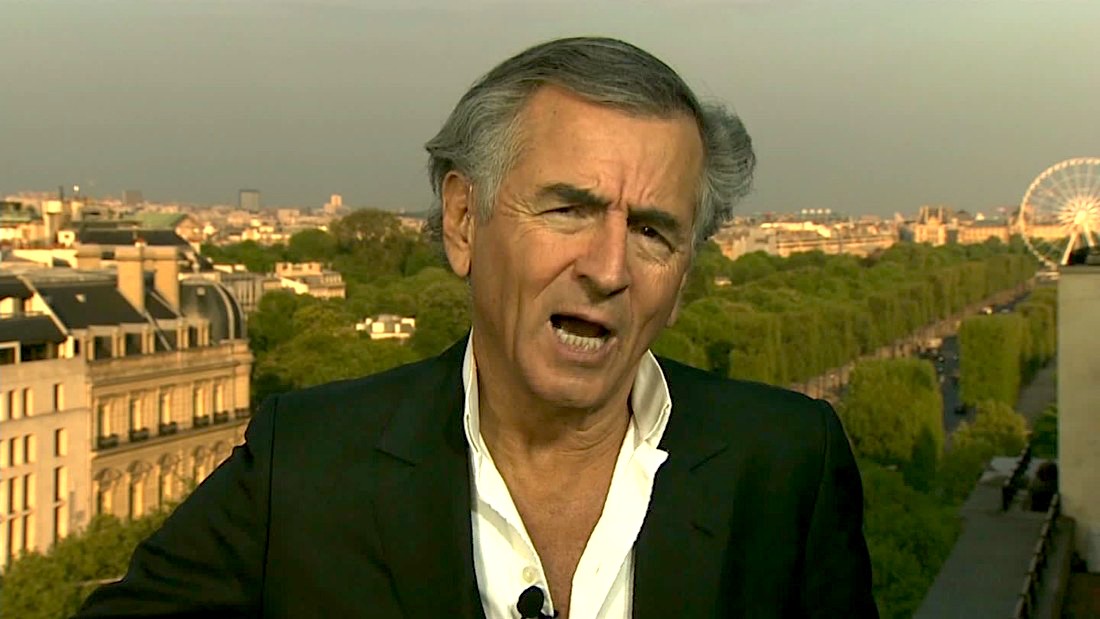
Bernard-Henri Lévy: No one proliferates more fact-free assertions. (CNN Screenshot.)
And what about mainstream media? In one recent news report after another (Skripal poisoning, chemical weapons attacks in Syria, the falsified murder in Ukraine of an anti-Putin journalist, not to mention the responsibility for firing a missile that shot down a Malaysian airliner in July 2014), there is a big difference between the Western version of the facts and that which prevails in Russia, Malaysia, Syria and much of the non-Western world.
A Mental Border with Russia
Instead of Pascal’s “truth on this side of the Pyrenees, and error on the other side”, we would be establishing “truth on one side of the Mediterranean, error on the other”. Or rather, truth exists up to the Eastern border of NATO, with error on the other side. This is no way to advance toward universal understanding. The only way to resolve our differences with the rest of the world is free discussion. Inasmuch as the law against fake news seems to be designed mainly to counter what Western governments describe as Russian propaganda, there is a strong likelihood that it can only enforce the mental border between us and the Russians.
When the independent journalist André Bercoff simply raised a couple of questions concerning anomalies in reports of the amazing rescue by Mamoudou Gassama of a child hanging from a Paris balcony, his own colleagues instantly condemned him for “provoking doubts” and engaging in “conspiracy theories”. The official regulatory agency, the Conseil Supérieur de l’Audiovisuel, hastened to open an investigation… of Bercoff. President Macron had invited Gassama to the Elysee Palace, offering him French citizenship and making the event an exemplary national legend. Thus sacred.
It is an odd sign of the times to reproach a journalist for asking questions. Leaving aside the rescue incident, raising questions used to be considered a primary function of journalism. If it is better to let ten guilty persons go free than to imprison one innocent man, in terms of rational scientific method, it is better to have ten extravagant doubts than one unchallengeable dogma.
It is true that what the dominant media call “conspiracy theories”, going everywhere from legitimate questioning of their own narratives and of official assertions to the wildest fantasies, do indeed proliferate on social media. But can anyone believe that describing Bercoff’s doubts as “conspiracy theorizing” will in any way stem that proliferation?
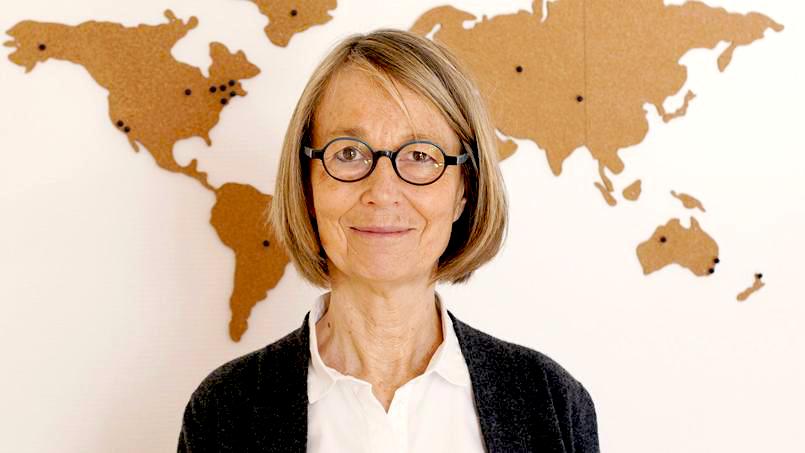
Françoise Nyssen: Public broadcasts must combat reactionary ideas.
The French Minister of culture, Françoise Nyssen, has decided that public radio and television, financed by taxpayers, should be devoted to combatting French people’s “highly reactionary” ideas, notably concerning “diversity”. Note that Macron’s ruling party, Republic in Movement, considers “reactionary” exactly what was considered progressive only a few decades ago: defense of public services and national sovereignty. Is it legitimate to oblige adults to pay for their own ideological re-education?
I by no means suggest that the current government is consciously intent on installing a totalitarian regime. The problem stems rather from the overwhelming subjectivism of contemporary culture in which talk of “values” leaves little space for concern for facts or objectivity. This is increasingly true even in discussions of scientific or technical progress. Of course, legislation cannot be fully objective, but since the Enlightenment reflection on freedom, the ideal has been to seek to establish reasonable rules to protect the individual from arbitrary power. This rule applies particularly to freedom of expression.
Those who speak endlessly of their values are merely trying to show off their own moral superiority. That is the basis of the corruption of the legal system in the matter of “fake news”, the reaction to Bercoff’s doubts, and the crusade of Madame Nyssen against what she considers “reactionary ideas”. Once a group of people convince themselves that they embody Virtue itself thanks to their “values”, they become unable to perceive any legitimate grounds for limiting their own power. That could be called the totalitarianism of the naïve.
This article originally appeared on RT’s French-language site. It was translated and adapted by Diana Johnstone.
Jean Bricmont is professor of theoretical physics at the Catholic University of Louvain (Belgium), and author of numerous articles and books, including Humanitarian Imperialism, La République des Censeurs,and Fashionable Nonsense (with Alan Sokal).
Featured Video
New positive ivermectin evidence
or go to
Aletho News Archives – Video-Images
From the Archives
Fanatical Followers of the Covid Regime: A Jim Jones-Style Cult?
By Professor Roger Watson and Dr. Niall McCrae | The Daily Sceptic | November 15, 2021
As scholars at leading British universities over recent decades, we witnessed the replacement of critical thinking and debate by narrative: facts are discrimination and scientific method is imperialism; truth, instead, is derived from ‘progressive’ values. This educational trend may be a major contributory factor to the ease in which society has been inculcated to the Covid ‘new normal’ of masking, testing, and repeated doses of vaccines for a disease of similar risk to severe influenza.
One doesn’t need much critical reasoning to observe the flawed logic of some vaccination enthusiasts, such as people who respond to experiencing any side effects, however debilitating, by saying “at least I know it’s working”, or, after contracting the disease despite their promised inoculation (over 90% effective, according to initial drug company claims), “I’d have been worse off without the jab.” … continue
Blog Roll
 Aletho News
- EU Council Advances Chat Control 2.0 Scanning Proposal
- Ex-Greek MEP files complaint against Israeli spyware firm over alleged Pegasus surveillance
- Troubling ideas throughout the Torah, Talmud, Mishneh Torah and Tanya
- ‘Grave, alarming’: Iran mission on Trump’s UNGA ‘annihilation’ threats
- Najaf airport to reopen to Iranian flights within 24 hours: Ambassador
- From ‘How Will This End For Iran’ to ‘When America Walks Away’: A tale of two Economist covers
- Tehran blasts ‘baseless’ speculation linking Iran to alleged bomb plot at UK air base
- The Rise And… Rise Of ‘Color Revolutions’
- The Coming GOP Bloodbath?
- Arctic Scare Stories Melt Away
- If Americans Knew
- Netanyahu Asked UAE Leader to Deny Report on Oct. 7 Warning in Secret Visit, Sources Say
- CNN Chief Int’l Correspondent Clarissa Ward on Journalists in Gaza
- Democratic Party Consultants Surround Troy Jackson with Pro-Israel Donors
- Christian Leader Responds To Netanyahu’s Claims Regarding Palestinian Christians
- In Gaza, ‘Whoever Survives the Bombing Won’t Survive the Rubble’
- Israel kills more Palestinians, amid push to resettle Gaza – Daily Update
- Israel forces Gazans to live in constant peril – Daily Update
- Deconstructing Netanyahu’s pants-on-fire UN rant – Daily Update
- Trump betrayed voters with his campaign lies and prioritized a foreign country once he took office
- Netanyahu calls Israel’s war in Gaza ‘opposite of genocide’ in UN speech to near-empty hall
- No Tricks Zone
- New Study: Earth And Venus Surface Warmth Largely Explained By Convection And Lapse Rate, Not CO2 Or Radiation
- 2025 Nature Paper Claiming Worsening Global Drought Gets RETRACTED …Heavily Flawed
- New Study: ‘Global Drought Shows No Detectable Recent Acceleration Under Climate Warming’
- Economic Masterminds: German Socialists Suggest Taxing Productivity Gains Stemming From Using AI
- The South China Sea Has Not Been Cooperating With The Climate Change Narrative
- Energy Crisis: Germany Enters Heating Season With Historically Low Gas Reserve Fill Levels
- New Study: The Antarctic Ice Sheet Gained Mass From 2020-2024 Due To Staggering Snow And Ice Accumulation
- Study: Ocean Heating Rates From Thousands Of Years Ago ‘Dwarf’ Modern Ocean Heating Rates
- Climate Extremists Target, Attack Large-Scale Power Grid Infrastructure In Germany!
- New Study: Antarctic Ice Melt Has Contributed Less Than 1 Centimeter To Sea Level Rise In The Last 30 Years

