Sputnik, RIA Novosti Ukraine Blocked in Ukraine According to New Sanctions List
Sputnik – May 24, 2018
Ukrainian authorities have added Sputnik and RIA Novosti-Ukraine to a sanctions list for three years, with the agencies’ resources and websites blocked in Ukraine.
“Blocking of assets — temporary restriction of the right of a person to use and dispose of his property; suspension of fulfillment of economic and financial obligations; restriction or termination of the provision of telecommunications services and the use of public telecommunications networks,” reads the document published on the website of the President of Ukraine.
Also included in the sanctions list is the RIA Novosti-Ukraine news portal, whose head Kirill Vyshinsk, was recently arrested. Ukraine has also blocked access to the sites россиясегодня.рф, Sputniknews.com, Ria.ru, Rsport.ria.ru, 1prime.ru, and realty.ria.ru, according to the site of the Ukrainian president.
The head of the Russian State Duma’s CIS Committee, Leonid Kalashnikov, called for an immediate halt to economic cooperation with Ukraine in response to the blocking of Sputnik and RIA Novosti-Ukraine.
“We need to draw conclusions for ourselves, including starting to take [measures] in economic cooperation with Ukraine, reducing it and stopping it,” Kalashnikov told Sputnik.
Commenting on the situation, Rossiya Segodnya director-general Dmitry Kiselev said that Ukraine’s decision shows the powerlessness of Kiev authorities which may be preparing to “cleanse” the media space ahead of next spring’s presidential elections.
“This shows the powerlessness of the regime which came to force as a result of a bloody coup and failed to establish normal life according to modern democratic canon. There is nothing left for it to do apart from persecuting its own citizens, persecuting journalists, persecuting freedom of speech, banning respected outlets, and, possibly preparing for a cleansing of the media space ahead of the so-called presidential elections,” Kiselev said.
Earlier this month, the Ukrainian Security Service (SBU) broke into the offices of RIA Novosti-Ukraine in Kiev. Agency head Kirill Vyshinsky was detained on charges of treason. The SBU accuses Vyshinsky of supporting the self-proclaimed Donetsk People’s Republic (DPR) and Lugansk People’s Republic (LPR) in Ukraine’s war-torn southeast. Later, a court in the Ukrainian city of Kherson ruled that Vyshinsky would be put under arrest.
On May 16, the International Federation of Journalists called on Ukrainian authorities to immediately release Vyshinsky, and condemned Kiev’s actions as inadmissible.
Freedom of Press Concerns in Ukraine
The block against RIA Novosti-Ukraine and Russian news resources including Sputnik is another step in a long list of measures affecting press freedoms in Ukraine since the 2014 Maidan coup d’etat. Before Vyshinsky, a number of other Ukrainian journalists have been arrested, killed under mysterious circumstances, or forced to flee their home country.
High profile cases include the 2015 murder of well-known opposition journalist Oles Buzina, the 2015 detention of journalist and peace campaigner Ruslan Kotsaba, who urged Ukrainians to resist mobilization for Kiev’s military operation in eastern Ukraine, and the arrests of other journalists, including Vasily Muravitsky, Dmitry Vasilets and Yevgeny Timonin, charged with “treason,” “supporting terrorist organizations” and other offenses for their opposition journalism or coverage of the civil war in the east.Over the last four years, Kiev has devoted considerable resources to blocking Russian television broadcasts in the country, and to impeding the work of foreign journalists in the country. The country’s authorities have also targeted Russian books, movies and television shows, going so far as to list Russian fairy tales as a threat to Ukraine’s national security. In late 2016, President Poroshenko signed a decree restricting access to so-called “anti-Ukrainian content” coming from Russia.
A May 2017 decree targeted Sputnik, Rossiya Segodnya, as well as Russian television channels Zvezda, TVC, NTV, RenTV, RBC and others. Last year, the Ukrainian government also banned Russian social media services Vkontakte and Odnoklassniki, a move which was met with discontent among many ordinary Ukrainians.
This week, on the eve of Saturday’s Champions League final between Real Madrid and Liverpool in Kiev, Russian sports journalists have issued an appeal to Ukrainian authorities to release Vyshinsky from his detention, saying his arrest is an infringement of journalists’ rights in Ukraine.
US considers further financial cuts to international bodies to silence Palestinians
By Ramona Wadi | MEMO | May 24, 2018
Under US President Donald Trump, international organisations have become targets for repression and vehicles by which Israeli oppression is maintained. Following the financial restrictions it imposed upon the United Nations Relief and Works Agency (UNRWA) last year, Washington has now set its sights on cuts in funding to another three organisations. The move follows the statement by UN Special Coordinator for the Middle East Nickolay Mladenov that Palestine has submitted applications to join the UN Conference on Trade and Development (UNCTAD), the UN Industrial Development Organisation (UNIDO) and the Organisation for the Prohibition of Chemical Weapons (OPCW).
Reports by various media, including Press TV and the Times of Israel, quote an unnamed US official saying that, “It has been the consistent position of the United States that efforts by the Palestinians to join international organisations are premature and counterproductive.” Since Trump’s election, the US-Israeli alliance has shed its veneer of restraint in terms of how much visible support should be flaunted internationally.
Financial dependence aside, it is clear that the US aims to leave Palestine with mere spectator status across the international community. It goes without saying that access to international organisations does not translate automatically into prominence for the Palestinians.
America’s move, therefore, is not only a punitive measure targeting and thus threatening the international organisations but also a means of increasing ways to deter Palestinians from pursuing their options in the international community. Nevertheless, whether or not Palestinians will utilise the international platform is still a contentious issue. Speaking about Palestinian accession to international organisations is still presented mainly from an angle that legitimises Israel’s purported anger, as in the case of the International Criminal Court (ICC). To eclipse Palestinian rights by Israel’s anger is a recipe for oblivion.
The same tactic was used when UNRWA faced an existential threat due to the US decision to slash funding. While UNRWA attempted to illustrate how such a decision would exacerbate the existing limitations on its work in support of Palestinian refugees, it was done from an organisational perspective, shifting the Palestinians in the process to a secondary and less visible position.
If international organisations worked independently of a political agenda, Palestine might have a chance to further its cause and development. UNCTAD has a special unit – the Assistance to the Palestinian People Unit (APPU) — which has the mandate to monitor the socio-economic impact of Israel’s military occupation. However, like other organisations, the Palestine issue is restricted to reports that state the obvious. UNCTAD’s April 2018 report, for example, said that Palestinians have been denied the human right to development; its conclusions and recommendations, like those of other organisations, are based upon legislation that Israel routinely and blatantly ignores.
The past seven decades have provided enough proof of the futility of the international community’s safeguarding of Palestinian rights; it is now ridiculed as the subject of mere rhetoric. It is more likely, therefore, that Trump, in coordination with Israel, is sending a message to Palestinians that their presence on international platforms will be hindered and obscured at all costs. One way to do this is to shift attention from Palestinians onto the organisations that might be affected.
This exposes the static structure of such international organisations which, due to their dependence upon financial aid from oppressive powers, prioritise their existence rather than use their position to safeguard Palestinian rights. If one thing is to be taken from the manipulation of financial aid and international institutions for political purposes, it is how the debate generated will also contribute towards marginalising and silencing Palestinians.
Anti-semitism: Israel’s get-out-of-jail-free card
By Jonathan Cook | Dissident Voice | May 22, 2018
The silencing of critics of Israel using anti-semitism as the pretext is far from restricted to the current wave of attacks on Jeremy Corbyn and his Labour party. It is now used to intimidate anyone who steps out of line on Israel. Once we raged against the conflation of anti-semitism and anti-Zionism. We have so lost that battle that it is now standard operating procedure for Israel’s apologists to conflate anti-semitism with simple criticisms of the current ultra-nationalist Israeli government.
Here is an illustration of our defeat, reported in the Israeli daily Haaretz. It concerns what would in other circumstances be a fairly standard satirical cartoon: this one published by the German newspaper Süddeutsche Zeitung about Israel winning the Eurovision song contest last week. Israeli prime minister Benjamin Netanyahu is shown on stage dressed as Israel’s winning singer, Netta, and proclaiming “Next year in Jerusalem!”.

After the usual outcry, the cartoonist, Dieter Hanitzsch, was sacked. No Charlie Hebdo-style concerns about free speech on this occasion, it seems.
As has become familiar in these cases, Wolfgang Krach, editor-in-chief of the Süddeutsche Zeitung, seemed unsure himself whether the cartoon was actually anti-semitic. But presumably he thought it better to fire the cartoonist just to be on the safe side. Let’s hope Hanitzsch can take Krach and his newspaper to the cleaners at a labour tribunal.
One critic, Jonas Mueller-Töwe, who sounds like Germany’s version of Jonathan Freedland, has claimed that “a Jewish star” – that would be Israel’s emblem of the Star of David – on a rocket held by Netanyahu suggests that “behind every war, Jewish interests are hiding”. Instead we could simply trust our eyes, which provide a different meaning: that Israel, a highly militarised state, won the Eurovision song contest at the same time as it was devastating Gaza – again – and will now be able to use its hosting of a popular cultural event in Jerusalem next year to whitewash its war crimes.
Before we get too exercised about the significance of every detail, we should remember that political cartoons, by their very nature, need to use symbols as shorthand for more complex ideas. We demand the impossible from a cartoonist if we expect them to offer us political satire while denying them the possibility of using symbols.
So what is anti-semitic about the cartoon? It’s not about Jews, it’s about the Israeli prime minister and his war agenda. And Netanyahu’s purportedly “oversized nose, ears and lips” are surely well within the normal bounds of a caricature. Do we really want to impose a unique demand on cartoonists when dealing with Israel’s leaders of drawing anatomically precise images?
The problem here, as with the anti-semitism “crisis” debate about the Labour party, is that it is totally divorced from any sense of proportion or reality. The question we ought to be asking in a case like this is: what kind of satirical cartoon lambasting Israel could ever satisfy the criteria being demanded by the current anti-semitism watchdogs?
And in consequence, what cartoonist is going to dare to deploy their satirical skills against Israel when the response is invariably going to lead to their being accused of anti-semitism and possibly losing their career and their reputation?
That is precisely what weaponising anti-semitism means. It hands Israel a get-out-of-jail-free card. It intimidates opinion formers – journalists, cartoonists, comedians, politicians, civil society leaders, human rights activists – by making the issue of Israel so toxic that none dare touch it. One need only look to the BBC to see the result: a mix of anaemic fence-sitting and outright censorship when covering Israel.
As Archbishop Desmond Tutu famously reminded us: “If you are neutral in situations of injustice, you have chosen the side of the oppressor.” A submission to those who abuse anti-semitism to make Israel unassailable entails terrifying consequences for the Palestinians. It requires that, after decades of betraying them, we in the west once again turn a blind to their suffering. And, as was highlighted last week in Israel’s slaughter of Gaza’s unarmed protesters, it clears the path to a future in which Israel can and will commit ever graver outrages against the Palestinians.
Wikipedia Is An Establishment Psyop
By Caitlin Johnstone | Medium | May 20, 2018
If you haven’t been living in a hole in a cave with both fingers plugged into your ears, you may have noticed that an awful lot of fuss gets made about Russian propaganda and disinformation these days. Mainstream media outlets are now speaking openly about the need for governments to fight an “information war” against Russia, with headlines containing that peculiar phrase now turning up on an almost daily basis.
Here’s one published today titled “Border guards detain Russian over ‘information war’ on Poland,” about a woman who is to be expelled from that country on the grounds that she “worked to consolidate pro-Russian groups in Poland in order to challenge Polish government policy on historical issues and replace it with a Russian narrative” in order to “destabilize Polish society and politics.”
Here’s one published yesterday titled “Marines get new information warfare leader,” about a US Major General’s appointment to a new leadership position created “to better compete in a 21st century world.”
Here’s one from the day before titled “Here’s how Sweden is preparing for an information war ahead of its general election,” about how the Swedish Security Service and Civil Contingencies Agency are “gearing up their efforts to prevent disinformation during the election campaigns.”
This notion that the US and its allies are fighting against Russian “hybrid warfare” (by which they typically mean hackers and disinformation campaigns) has taken such deep root among think tanks, DC elites and intelligence/defense circles that it often gets unquestioningly passed on as fact by mass media establishment stenographers who are immersed in and chummy with those groups. The notion that these things present a real threat to the public is taken for granted to such an extent that they seldom bother to even attempt to explain to their audiences why we’re meant to be so worried about this new threat and what makes it a threat in the first place.
Which is, to put it mildly, really weird. Normally when the establishment cooks up a new Official Bad Guy they spell out exactly why we’re meant to be afraid of them. Marijuana will give us reefer madness and ruin our communities. Terrorists will come to where we live and kill us because they hate our freedom. Saddam Hussein has Weapons of Mass Destruction which can be used to perpetrate another 9/11. Kim Jong Un might nuke Hawaii any second now.
With this new “Russian hybrid warfare” scare, we’re not getting any of that. This notion that Russians are scheming to give westerners the wrong kinds of political opinions is presented as though having those political opinions is an inherent, intrinsic threat all on its own. The closest they typically ever get to explaining to us what makes “Russian disinformation” so threatening is that it makes us “lose trust in our institutions,” as though distrusting the CIA or the US State Department is somehow harmful and not the most logical position anyone could possibly have toward historically untrustworthy institutions. Beyond that we’re never given a specific explanation as to why this “Russian disinformation” thing is so dangerous that we need our governments to rescue us from it.
The reason we are not given a straight answer as to why we’re meant to want our institutions fighting an information war on our behalf (instead of allowing us to sort out fact from fiction on our own like adults) is because the answer is ugly.
As we discussed last time, the only real power in this world is the ability to control the dominant narrative about what’s going on. The only reason government works the way it works, money operates the way it operates, and authority rests where it rests is because everyone has agreed to pretend that that’s how things are. In actuality, government, money and authority are all man-made conceptual constructs and the collective can choose to change them whenever it wants. The only reason this hasn’t happened in our deeply dysfunctional society yet is because the plutocrats who rule us have been successful in controlling the narrative.
Whoever controls the narrative controls the world. This has always been the case. In many societies throughout history a guy who made alliances with the biggest, baddest group of armed thugs could take control of the narrative by killing people until the dominant narrative was switched to “That guy is our leader now; whatever he says goes.” In modern western society, the real leaders are less obvious, and the narrative is controlled by propaganda.
Propaganda is what keeps Americans accepting things like the fake two-party system, growing wealth inequality, medicine money being spent on bombs to be dropped on strangers in stupid immoral wars, and a government which simultaneously creates steadily increasing secrecy privileges for itself and steadily decreasing privacy rights for its citizenry. It’s also what keeps people accepting that a dollar is worth what it’s worth, that personal property works the way it works, that the people on Capitol Hill write the rules, and that you need to behave a certain way around a police officer or he can legally kill you.
And therein lies the answer to the question. You are not being protected from “disinformation” by a compassionate government who is deeply troubled to see you believing erroneous beliefs, you are being herded back toward the official narrative by a power establishment which understands that losing control of the narrative means losing power. It has nothing to do with Russia, and it has nothing to do with truth. It’s about power, and the unexpected trouble that existing power structures are having dealing with the public’s newfound ability to network and share information about what is going on in the world.
Until recently I haven’t been closely following the controversy between Wikipedia and popular anti-imperialist activists like John Pilger, George Galloway, Craig Murray, Neil Clark, Media Lens, Tim Hayward and Piers Robinson. Wikipedia has always been biased in favor of mainstream CNN/CIA narratives, but until recently I hadn’t seen much evidence that this was due to anything other than the fact that Wikipedia is a crowdsourced project and most people believe establishment-friendly narratives. That all changed when I read this article by Craig Murray, which is primarily what I’m interested in directing people’s attention to here.
The article, and this one which prompted it by Five Filters, are definitely worth reading in their entirety, because their contents are jaw-dropping. In short there is an account which has been making edits to Wikipedia entries for many years called Philip Cross. In the last five years this account’s operator has not taken a single day off–no weekends, holidays, nothing–and according to their time log they work extremely long hours adhering to a very strict, clockwork schedule of edits throughout the day as an ostensibly unpaid volunteer.
This is bizarre enough, but the fact that this account is undeniably focusing with malicious intent on anti-imperialist activists who question establishment narratives and the fact that its behavior is being aggressively defended by Wikipedia founder Jimmy Wales means that there’s some serious fuckery afoot.
“Philip Cross”, whoever or whatever that is, is absolutely head-over-heels for depraved Blairite war whore Oliver Kamm, whom Cross mentioned as a voice of authority no fewer than twelve times in an entry about the media analysis duo known collectively as Media Lens. Cross harbors a special hatred for British politician and broadcaster George Galloway, who opposed the Iraq invasion as aggressively as Oliver Kamm cheered for it, and on whose Wikipedia entry Cross has made an astonishing 1,800 edits.
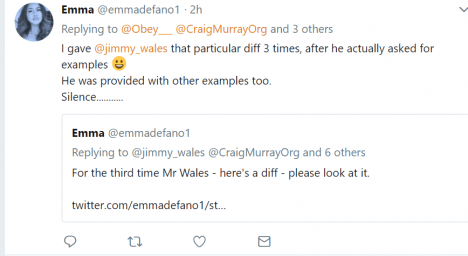
Despite the overwhelming evidence of constant malicious editing, as well as outright admissions of bias by the Twitter account linked to Philip Cross, Jimmy Wales has been extremely and conspicuously defensive of the account’s legitimacy while ignoring evidence provided to him.
“Or, just maybe, you’re wrong,” Wales said to a Twitter user inquiring about the controversy the other day. “Show me the diffs or any evidence of any kind. The whole claim appears so far to be completely ludicrous.”
“Riiiiight,” said the totally not-triggered Wales in another response. “You are really very very far from the facts of reality here. You might start with even one tiny shred of some kind of evidence, rather than just making up allegations out of thin air. But you won’t because… trolling.”
“You clearly have very very little idea how it works,” Wales tweeted in another response. “If your worldview is shaped by idiotic conspiracy sites, you will have a hard time grasping reality.”
As outlined in the articles by Murray and Five Filters, the evidence is there in abundance. Five Filters lays out “diffs” (editing changes) in black and white showing clear bias by the Philip Cross account, a very slanted perspective is clearly and undeniably documented, and yet Wales denies and aggressively ridicules any suggestion that something shady could be afoot. This likely means that Wales is in on whatever game the Philip Cross account is playing. Which means the entire site is likely involved in some sort of psyop by a party which stands to benefit from keeping the dominant narrative slanted in a pro-establishment direction.
A 2016 Pew Research Center report found that Wikipedia was getting some 18 billion page views per month. Billion with a ‘b’. Youtube recently announced that it’s going to be showing text from Wikipedia articles on videos about conspiracy theories to help “curb fake news”. Plainly the site is extremely important in the battle for control of the narrative about what’s going on in the world. Plainly its leadership fights on one side of that battle, which happens to be the side that favors western oligarchs and intelligence agencies.
How many other “Philip Cross”-like accounts are there on Wikipedia? Has the site always functioned as an establishment psyop designed to manipulate public perception of existing power structures, or did that start later? I don’t know. Right now all I know is that an agenda very beneficial to the intelligence agencies, war profiteers and plutocrats of the western empire is clearly and undeniably being advanced on the site, and its founder is telling us it’s nothing. He is lying. Watch him closely.
University Professor Sacked for Telling-the-Truth

Peter Ridd as a first year undergraduate science student at James Cook University back in 1978 – forty years ago.
By Jennifer Marohasy | May 19, 2018
BACK in 2016, when I asked Peter Ridd if he would write a chapter for the book I was editing I could not possibly have envisaged it could contribute to the end of his thirty-year career as a university professor.
Considering that Peter enrolled at James Cook University as an undergraduate back in 1978, he has been associated with that one university for forty years.
Since Peter was fired on 2 May 2018, the university has attempted to remove all trace of this association: scrubbing him completely from their website.
But facts don’t cease to exist because they are removed from a website. The university has never challenged the veracity of Peter’s legitimate claims about the quality of much of the reef science: science on which billions of dollars of taxpayer-funded research is being squandered. These issues are not going away.
Just yesterday (Friday 18 May), Peter lodged papers in the Federal Court. He is going to fight for his job back! […]
Peter deliberately choose to frame the book chapter about the replication crisis that is sweeping through science.
In this chapter – The Extraordinary Resilience of Great Barrier Reef Coral and Problems with Policy Science – Peter details the major problems with quality assurance when it comes to claims of the imminent demise of the reef.
Policy science concerning the Great Barrier Reef is almost never checked. Over the next few years, Australian governments will spend more than a billion dollars on the Great Barrier Reef; the costs to industry could far exceed this. Yet the keystone research papers have not been subject to proper scrutiny. Instead, there is a total reliance on the demonstrably inadequate peer-review process.
Ex-professor Peter Ridd has also published extensively in the scientific literature on the Great Barrier Reef, including issues with the methodology used to measure calcification rates. In the book he explains:
Like trees, which produce rings as they grow, corals set down a clearly identifiable layer of calcium carbonate skeleton each year, as they grow. The thicknesses and density of the layers can be used to infer calcification rates and are, effectively, a measure of the growth rate. Dr Glenn De’ath and colleagues from the Australian Institute of Marine Science used cores from more than 300 corals, some of which were hundreds of years old, to measure the changes in calcification during the last few hundred years. They claimed there was a precipitous decline in calcification since 1990, as shown in Figure 1.2.
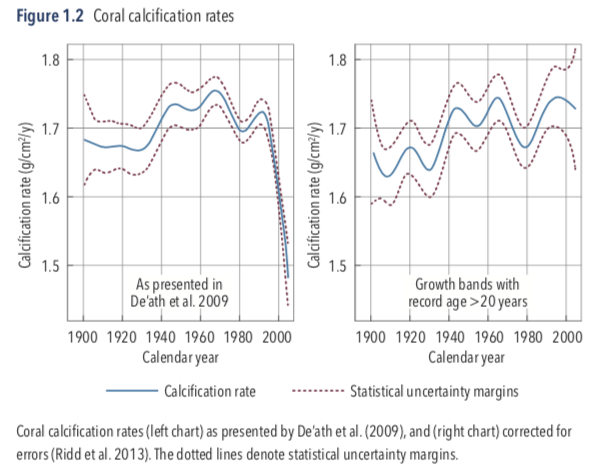
The LHS chart suggests a problem with coral growth rates – but the real problem is with the methodology. When corals of equivalent age are sampled, there has been no decline in growth rates at the Great Barrier Reef – as shown in the RHS chart.
However, I have two issues with their analysis. I published my concerns, and an alternative analysis, in the journal Marine Geology (Ridd et al. 2013). First, there were instrumental errors with the measurements of the coral layers. This was especially the case for the last layer at the surface of the coral, which was often measured as being much smaller than the reality. This forced an apparent drop in the average calcification for the corals that were collected in the early 2000s – falsely implying a recent calcification drop. Second, an ‘age effect’ was not acknowledged. When these two errors are accounted for, the drop in calcification rates disappear, as shown in Figure 1.2.
The problem with the ‘age effect’, mentioned above, arose because in the study De’ath and colleagues included data from corals sampled during two distinct periods and with a different focus; I will refer to these as two campaigns. The first campaign occurred mostly in the 1980s and focused on very large coral specimens, sometimes many metres across. The second campaign occurred in the early 2000s due to the increased interest in the effects of CO2. However, presumably due to cost cutting measures, instead of focusing on the original huge coral colonies, the second campaign measured smaller colonies, many just a few tens of centimetres in diameter.
In summary, the first campaign focused on large old corals, while, in contrast, the second campaign focused on small young corals. The two datasets were then spliced together, and wholly unjustifiable assumptions were implicitly made, but not stated – in particular that there is no age effect on coral growth…
Dr Juan D’Olivo Cordero from the University of Western Australia collected an entirely different dataset of coral cores from the Great Barrier Reef to determine calcification rates. This study determined that there has been a 10% increase in calcification rates since the 1940s for offshore and mid-shelf reefs, which is the location of about 99% of all the coral on the Great Barrier Reef. However, these researchers also measured a 5% decline in calcification rates of inshore corals – the approximately 1% of corals that live very close to the coast. Overall, there was an increase for most of the Great Barrier Reef, and a decrease for a small fraction of the Great Barrier Reef.
While it would seem reasonable to conclude that the results of the study by D’Olivo et al. would be reported as good news for the Great Barrier Reef, their article in the journal Coral Reefs concluded:
Our new findings nevertheless continue to raise concerns, with the inner-shelf reefs continuing to show long-term declines in calcification consistent with increased disturbance from land-based effects. In contrast, the more ‘pristine’ mid- and outer-shelf reefs appear to be undergoing a transition from increasing to decreasing rates of calcification, possibly reflecting the effects of CO2-driven climate change.
Imaginatively, this shift from ‘increasing’ to ‘decreasing’ seems to be based on an insignificant fall in the calcification rate in some of the mid-shelf reefs in the last two years of the 65-year dataset.
Why did the authors concentrate on this when their data shows that the reef is growing about 10% faster than it did in the 1940s?
James Cook university could have used the chapter as an opportunity to start a much-needed discussion about policy, funding and the critical importance of the scientific method. Instead, Peter was first censored by the University – and now he has been fired.
When I first blogged on this back in February, Peter needed to raise A$95,000 to fight the censure.
This was achieved through an extraordinary effort, backed by Anthony Watts, Joanne Nova, John Roskam and so many others.
To be clear, the university is not questioning the veracity of what ex-professor Ridd has written, but rather his right to say this publicly. In particular, the university is claiming that he has not been collegial and continues to speak-out even after he was told to desist.
New allegations have been built on the original misconduct charges that I detailed back in February. The core issue continues to be Peter’s right to keep talking – including so that he can defend himself.
In particular, the university objects to the original GoFundMe campaign (that Peter has just reopened) because it breaches claimed confidentiality provisions in Peter’s employment agreement. The university claims that Peter Ridd was not allowed to talk about their action against him. Peter disputes this.
Of course, if Peter had gone along with all of this, he would have been unable to raise funds to get legal advice – to defend himself! All of the documentation is now being made public – all of this information, and more can be found at Peter’s new website.
Award-winning photographer shot by Israel soldier in the West Bank

Internationally-acclaimed and award-winning photographer, Tanya Habjouqa [Happeningarts/Twitter]
MEMO | May 17, 2018
An internationally-acclaimed, award-winning photographer was shot by an Israeli soldier in the occupied West Bank on Tuesday, reports the Art Newspaper.
Tanya Habjouqa, who won the 2014 World Press photo award, was struck in the leg by a rubber-coated metal bullet fired by Israeli occupation forces during a protest near Bet El checkpoint.
Habjouqa told the paper that she was some 40 metres from Palestinian protesters “when Israeli soldiers in the distance started shooting rubber bullets and tear gas in several directions”.
“She also saw soldiers aim at a Palestinian gas station where there were no protesters, just people filling up their gas tanks,” the report added.
“I was on the side with my camera at the beginning of the protest with cameras around my neck, so I feel I was definitely targeted though thankfully they chose not to aim for my head,” Habjouqa tells us. “It hurts like hell and the bruise is spreading front and back.”
Habjouqa is a founder of Rawiya, the first all-female photo collective in the Middle East, as well as a member of the Noor Photography collective, a Magnum Foundation grantee, and the author of the photo book Occupied Pleasures that the Smithsonian named one of the best photo books of 2015.
Her work is in the permanent collections of the Carnegie Museum of Art, the Museum of Fine Arts in Boston and the Institut du Monde Art in Paris.
Read also:
Media freedom watchdog warns of more Israel attacks on journalists in Gaza
Rights group: Israel arrested 500 Palestinians over Facebook posts
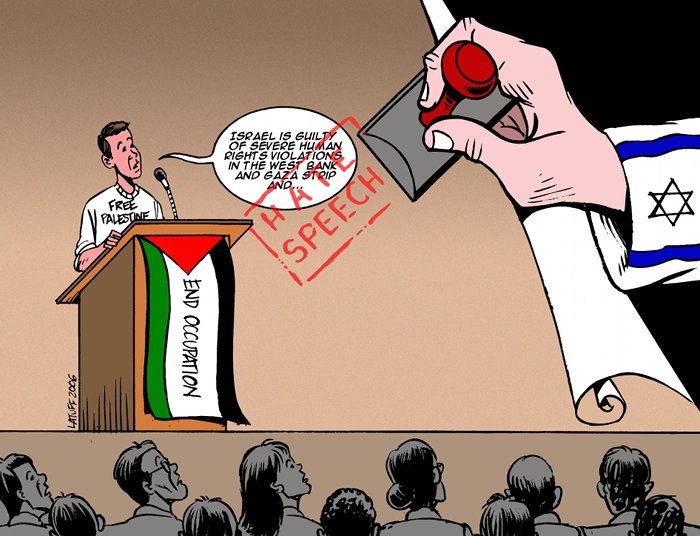
Reporting Israeli crimes against Palestinians is considered by Israeli judiciary incitement of terror.
Days of Palestine | May 9, 2018
Palestinian Prisoners’ Centre (PPC) said yesterday that Israel had arrested 500 Palestinians, including women and children, as a result of their social media posts, Al-Resalah newspaper reported.
PPC spokesman Riyadh Al-Ashqar said that the Israeli occupation began arresting Palestinians because of their social media posts following the start of the Jerusalem Intifada claiming such uploads incite terror against Israel.
Israel is using its recently formed “Cyber Unit” to monitor Palestinian social media posts, the centre said.
This unit, Al-Ashqar said, classifies any post that glorifies Palestinian martyrs, discloses Israeli crimes, supports resistance or mentions the words and phrases including “martyr” and “intifada” as “incitement of terror”.
In the recent years, Al-Ashqar said, Israeli occupation courts have issued hundreds of sentences against Palestinians on the ground of incitement on social media.
The sentences ranged between months and years in prison, house arrests or bans from using social media platforms and mobile phones. The terms were handed down to men, women and children.
Featured Video

New positive ivermectin evidence
or go to
Aletho News Archives – Video-Images
From the Archives
Fanatical Followers of the Covid Regime: A Jim Jones-Style Cult?
By Professor Roger Watson and Dr. Niall McCrae | The Daily Sceptic | November 15, 2021
As scholars at leading British universities over recent decades, we witnessed the replacement of critical thinking and debate by narrative: facts are discrimination and scientific method is imperialism; truth, instead, is derived from ‘progressive’ values. This educational trend may be a major contributory factor to the ease in which society has been inculcated to the Covid ‘new normal’ of masking, testing, and repeated doses of vaccines for a disease of similar risk to severe influenza.
One doesn’t need much critical reasoning to observe the flawed logic of some vaccination enthusiasts, such as people who respond to experiencing any side effects, however debilitating, by saying “at least I know it’s working”, or, after contracting the disease despite their promised inoculation (over 90% effective, according to initial drug company claims), “I’d have been worse off without the jab.” … continue
Blog Roll
 Aletho News
- EU Council Advances Chat Control 2.0 Scanning Proposal
- Ex-Greek MEP files complaint against Israeli spyware firm over alleged Pegasus surveillance
- Troubling ideas throughout the Torah, Talmud, Mishneh Torah and Tanya
- ‘Grave, alarming’: Iran mission on Trump’s UNGA ‘annihilation’ threats
- Najaf airport to reopen to Iranian flights within 24 hours: Ambassador
- From ‘How Will This End For Iran’ to ‘When America Walks Away’: A tale of two Economist covers
- Tehran blasts ‘baseless’ speculation linking Iran to alleged bomb plot at UK air base
- The Rise And… Rise Of ‘Color Revolutions’
- The Coming GOP Bloodbath?
- Arctic Scare Stories Melt Away
- If Americans Knew
- Netanyahu Asked UAE Leader to Deny Report on Oct. 7 Warning in Secret Visit, Sources Say
- CNN Chief Int’l Correspondent Clarissa Ward on Journalists in Gaza
- Democratic Party Consultants Surround Troy Jackson with Pro-Israel Donors
- Christian Leader Responds To Netanyahu’s Claims Regarding Palestinian Christians
- In Gaza, ‘Whoever Survives the Bombing Won’t Survive the Rubble’
- Israel kills more Palestinians, amid push to resettle Gaza – Daily Update
- Israel forces Gazans to live in constant peril – Daily Update
- Deconstructing Netanyahu’s pants-on-fire UN rant – Daily Update
- Trump betrayed voters with his campaign lies and prioritized a foreign country once he took office
- Netanyahu calls Israel’s war in Gaza ‘opposite of genocide’ in UN speech to near-empty hall
- No Tricks Zone
- New Study: Earth And Venus Surface Warmth Largely Explained By Convection And Lapse Rate, Not CO2 Or Radiation
- 2025 Nature Paper Claiming Worsening Global Drought Gets RETRACTED …Heavily Flawed
- New Study: ‘Global Drought Shows No Detectable Recent Acceleration Under Climate Warming’
- Economic Masterminds: German Socialists Suggest Taxing Productivity Gains Stemming From Using AI
- The South China Sea Has Not Been Cooperating With The Climate Change Narrative
- Energy Crisis: Germany Enters Heating Season With Historically Low Gas Reserve Fill Levels
- New Study: The Antarctic Ice Sheet Gained Mass From 2020-2024 Due To Staggering Snow And Ice Accumulation
- Study: Ocean Heating Rates From Thousands Of Years Ago ‘Dwarf’ Modern Ocean Heating Rates
- Climate Extremists Target, Attack Large-Scale Power Grid Infrastructure In Germany!
- New Study: Antarctic Ice Melt Has Contributed Less Than 1 Centimeter To Sea Level Rise In The Last 30 Years

