Diverse groups push for ‘Anti-Semitism Envoy’ who monitors criticism of Israel

Former Antisemitism Envoy Hannah Rosenthal promoting a “Walk for Israel” event in Milwaukee in 2017 (video below). As envoy, Rosenthal adopted a new, Israel-centric definition for antisemitism, and then used it to train U.S. diplomats. Now groups from the ADL to the Southern Poverty Law Center are disturbed that Trump isn’t filling the position.
By Alison Weir | If Americans Knew | July 6, 2017
The Trump administration has failed to appoint an antisemitism monitor or staff the State Department’s antisemitism monitoring office, drawing fire from diverse groups that range from the Anti-Defamation League (ADL) and Israel lobbying organizations to Think Progress and the Southern Poverty Law Center.
But the State Department Office to Monitor and Combat Anti-Semitism, and the “antisemitism envoy” who heads it, haven’t just been keeping tabs on anti-Jewish bigotry around the world. In reality, they have been monitoring international pro-Palestinian activism and promoting a crackdown on such activism in various countries.
Congress created the antisemitism monitoring office and envoy in 2004. Since then, the office has adopted a definition of antisemitism that includes many forms of criticism of Israel and it has pushed for that definition to be used worldwide to crack down on criticism of Israel. (Read more about who else has adopted the definition and how it is being used to curtail criticism of Israel and pro-Palestinian activism.)
Allan C. Brownfeld of the American Council for Judaism is disturbed by this trend, commenting: “The redefinition of antisemitism to mean criticism of Israel is clearly an effort to end freedom of speech and discussion when it comes to Israel and its policies. It has nothing to do with real antisemitism, which this effort trivializes and which, fortunately, is in retreat.”*
In 2015 Brownfeld wrote “What they seek to silence are criticisms of Israeli policies and efforts to call attention to them through such things as campaigns for academic boycotts or BDS. Whether one agrees with such campaigns or not, they are legitimate criticisms of a foreign government and of U.S. aid to that government. Only by changing the meaning of words entirely can this be called ‘antisemitism.’”
The organization Palestine Legal has similarly objected to the new definition, pointing out that the redefinition of antisemitism allows “virtually any criticism of Israel to be labeled as antisemitic.” It states: “The effect of blurring antisemitism with criticism of Israel is to censor speech. It aims to silence those who wish to criticize Israel’s well-documented human rights violations by making it unacceptable and taboo to do so. It silences the everyday observer of Israel’s actions who may wish to comment and draw parallels with other experiences, or do anything at all to oppose it.”
Meanwhile, the antisemitism envoy position has proved a revolving door to Israel lobbying organizations and activities.
State Department Antisemitism Office Monitors Criticism of Israel
The monitoring office’s 2016 report on global antisemitism included monitoring of pro-Palestinian activism. Below are a few quotes from the report:
♦ “50 Palestinian students protested and boycotted a conference presentation by an Israeli professor who was a guest speaker at the Eastern Mediterranean University (EMU). Approximately 50 Palestinian students opened banners during the conference reading, ‘Free Palestine,’ ‘Terrorist Israel,’ and held photos of suffering Palestinian children.”
♦ “Following the September 28 death of former Israeli president Shimon Peres, the FPDC [Palestinian Federation of Chile] labeled him a ‘war criminal’ on its official Twitter account.”
♦ “activists of the Boycott, Divestment, and Sanctions (BDS) movement against Israel, spilled red paint on the facade of the restaurant and posted signs reading: ‘Free Palestine,’ ‘Avillez collaborates with Zionist occupation,’ and ‘Entree: A dose of white phosphorus.’ The attack followed picketing opposite the restaurant by BDS activists…”
In addition, the report cited statements that connected Israeli actions to all Jewish people, reporting, for example, that some Kuwaiti columnists “often conflated Israeli government actions or views with those of Jews more broadly,” and “Swedish Jews were at times blamed for Israeli policies.” While it is incorrect and unfair to associate Israeli actions with all Jewish people, the report entirely omitted reference to the many Israeli leaders and pro-Israel organizations who promote this view, claiming that Israel represents all the world’s Jewish people.
There were additional questionable listings of alleged antisemitism related to Israel, for example: “the RT channel’s June 27 airing of Palestinian allegations [by Palestinian Authority head Mahmoud Abbas in an address to the European Parliament] that an Israeli rabbi approved the poisoning of Palestinian wells.” Reporting allegations made by national leaders is what news media do, particularly when there is a context supporting the allegations. There is a documented record of Israeli settlers and, longer ago, the early Israeli military contaminating Palestinian water supply, cisterns, and wells, and of some extremist Israeli rabbis approving – and even calling for – the killing of civilians of all ages.**
Antisemitism Office Promotes Crackdown on Palestine Activism
When Congress created the antisemitism monitoring office and envoy in 2004, the legislation included criticism of Israel among the “antisemitism” to monitor (although that inclusion was buried and not obvious in a quick read of the main legislation).
At that time, the State Department declared publicly that such an office was unnecessary and would be a “bureaucratic nuisance” that would actually hinder the Department’s ongoing work against antisemitism. A State Department press release opposing the new office described the many actions the department was already taking against antisemitism.
After the office was in place, the conflation of criticism of Israel with antisemitism grew incrementally, until it became part of the office’s official definition.
The first antisemitism envoy, Gregg Rickman, endorsed an Israel-centric definition originally proposed by an Israeli government minister and disseminated by Israel partisans in Europe. After his term of office, Rickman went to work for the pro-Israel lobbying organization AIPAC (the American Israel Public Affairs Committee).
The second antisemitism envoy, Hannah Rosenthal, officially adopted the new Israel-centric definition in 2010, making it “the State Department definition.” She then pushed through a training program about antisemitism for U.S. diplomats that used what she called the new “breakthrough definition.”
After she left the envoy position, Rosenthal headed up the Jewish Federation of Milwaukee, where she worked on numerous activities supporting Israel, including promoting a Stand with Israel event (see her promotional video for the event here and below).
The next envoy, Ira Foreman, also worked for AIPAC, and was instrumental in spreading the new Israel-centric definition to other nations. Indeed, Forman declared that “the United States pushed for a global definition of antisemitism” and that this “changed the global discourse on the issue” during an Anti-Defamation League press conference.
Pressure to Staff Antisemitism Monitoring Office
The administration has indicated it may not fill these positions as part of budget cutting; out of 13 Special Envoy positions in the State Department, 8 are currently vacant (there is no Special Envoy to monitor and combat other forms of racism, for example against African Americans)***. Trump’s failure to fill the antisemitism positions has provoked an escalating bipartisan outcry by Congressional representatives and advocacy groups, amplified by certain media coverage and commentary.
Among those pushing for Trump to fill the office are the Anti-Defamation League, the American Jewish Committee, various pro-Israel groups, diverse Congressional representatives supportive of Israel, and, more mildly, the liberal organizations Think Progress and the Southern Poverty Law Center.
♦ The Anti-Defamation League has long used an Israel-centric definition of antisemitism and is known for hardcore Israel advocacy that leans heavily towards blind promotion of the most extremist right-wing elements of Israel’s government. It has created a petition demanding that Trump fill the envoy position. Former ADL director Abe Foxman said: “The special Ambassador to combat antisemitism at the State Department is one of those things that ‘make America great.’”
♦ The American Jewish Committee says it engages in “pro-Israel advocacy at the highest levels.” It has also called for Trump to name an envoy and has created its own petition.
♦ Think Progress, a progressive organization close to the Democratic Party, featured an article critical of the failure to fill the post, announcing: “Attacks targeting Jews are at a record high at home, but the State Department doesn’t think special monitoring abroad is necessary.”
♦ The Southern Poverty Law Center then featured the Think Progress article about the State Department “abandoning the office” in its “Hate Watch Headlines.” The SPLC is often revered for its important work to oppose bigotry and hate, but it has praised Israel and been criticized for equating anti-zionism with antisemitism. Furthermore, its over $300 million operation has sometimes been brought into question as a cash cow that benefits from finding “hate” where it might not actually exist.
The various advocates, as well as the Think Progress article, have cited an Anti-Defamation League report that antisemitism is on the rise, and fast. On the face of it, this certainly should be disturbing to anyone who supports equality and human rights. However, a number of groups have questioned the ADL report, and an ADL official admits that it is “not a scientific study.” The ADL report does not include a spreadsheet of the incidents it has included for independent researchers to examine, and it is unknown how many of the incidents may have been actually pro-Palestinian activism, but we do know that the “rise” included 2,000 hoax threats made by a young Jewish Israeli reportedly suffering from mental problems.
♦ Members of the House of Representatives’ Bipartisan Task Force Against Anti-Semitism initiated a letter in March calling on Trump to fill the position, another bipartisan letter was sent in June, and Democratic Senator Ben Cardin implored Trump to fill the “critical” position. Legislation was introduced into both the Senate and the House that would elevate the envoy position to ambassadorial level and would require even more detailed reporting than it is already doing.
♦ Most recently, Katrina Lantos Swett, whose father Congressman Tom Lantos sponsored the legislation that created the position, sent a letter to Tillerson outraged that there hasn’t been “great eagerness to move swiftly to fill this post.” The Daily Caller reports her view that the special envoy is the “tip of the sword’ to focus on and combat antisemitism on a global scale.”
On June 26 the ADL organized a conference call with the media in which former envoys Hannah Rosenthal and Ira Forman called on Trump to fill the position, saying that “the envoy’s working definition of antisemitism helped U.S. personnel in foreign countries determine what is and is not antisemitism” — in other words, clarifying to them that they must consider various forms of criticism of Israel as antisemitism.
Rosenthal told NBC News: “This is another example of America losing its leadership role in the world.”
In arguing for the office, ADL head Jonathan Greenblatt pointed out: “These dedicated diplomats drove an exponential growth in U.S. reporting on antisemitism and mobilized a full arsenal of U.S. diplomatic tools and training.”
Prognosis
The next tactic may be for Congress to vote to fund the office. Since Israel lobby bills usually easily pass, often with overwhelmingly positive votes (most recently, 98-2), this will quite likely go through. The Religious Action Center of Reform Judaism already has a petition telling Congress to “Fully Fund State Department Office for Monitoring and Combating Anti-Semitism.”
Both Forman and Rosenthal say they expect Congress to fund the envoy’s office in the coming budget, and expect this will succeed in pushing Trump to appoint someone to the post.
Unfortunately, given Trump’s failure to failure to reign in bigotry and antisemitism among some of his supporters, it may be unlikely that the new envoy will turn a focused attention to real cases of anti-Jewish bigotry. In fact, given Middle East advisor and son-in-law Jared Kushner’s support for rightwing Israeli settlers, as well as the Islamophobia embraced by elements of the Trump circle, the Trump administration could well move the office even more in the direction of suppressing support for Palestinian rights and criticism of Israel.
Meanwhile, on July 3rd alone, Israeli authorities forced a Palestinian family to demolish its own home, Israeli forces rounded up 18 Palestinians in predawn raids, prisoners in Israel’s notorious Ktziot prison faced life-threatening conditions (40 percent of Palestinian males have cycled through Israeli prisons), and the Israeli military invaded and bulldozed land in Gaza. A typical day in Palestine. But don’t let the special envoy hear you say that.
Alison Weir is executive director of If Americans Knew, president of the Council for the National Interest, and author of Against Our Better Judgment: The Hidden History of How the U.S. Was Used to Create Israel. Additional citations and information on this topic are in her recent report and timeline: “International campaign is criminalizing criticism of Israel as ‘antisemitism’”.
* Allan C. Brownfeld, Publications Editor of the American Council for Judaism, provided the comment below for inclusion in discussing the expanded definition of antisemitism:
The meaning of the term “anti/Semitism” has undergone dramatic change in recent years. It used to refer to hostility to Jews and Judaism. It has been redefined by some to mean criticism of Israel. In recent days, establishment Jewish organizations from the Anti-Defamation League (ADL) to the Simon Wiesenthal Center have called the BDS movement “anti-Semitic”—despite the fact that it is supported by groups such as Jewish Voice for Peace and such international groups as Jews for Palestinian Right of Return and the Israeli activist organization Boycott from Within.
The effort to redefine anti-Semitism as criticism of Israel has been going on for more than four decades. In 1974, Benjamin Epstein, the national director of the ADL co-authored “The New Anti-Semitism,” a book whose argument was repeated in 1982 by his successor at ADL, Nathan Perlmutter, in a book entitled “The Real Anti-Semitism In America.” After World War II, Epstein argued, guilt over the Holocaust kept anti-Semitism at bay, but as memories of the Holocaust faded, anti-Semitism had returned—this time in the form of hostility to Israel. The reason: Israel represented Jewish power. Jews are tolerable, acceptable in their particularity, only as victims,” wrote Epstein and his ADL colleague Arnold Forster, “and when their situation changed so that they are either no longer victims, or appear not to be,the non-Jewish world finds this so hard to take that the effort is begun to render them victims anew.”
Jewish critics of Israel are as likely to be denounced as “anti-Semites” as non-Jews. For example, columnist Caroline Glick, writing in the International Jerusalem Post (Dec. 23-39, 2011) found New York Times columnist Thomas Friedman guilty of employing “traditional anti-Semitic slurs” and “of channeling long-standing anti-Semitic charges.” In a February 2012 Commentary article, Ben Cohen writes that, “The list of flagrant Jew-baiters is growing; those with Jewish names provide an additional frisson.” Among those he names are M.J. Rosenberg, a former employee of AIPAC. Mondoweiss editor Philip Weiss, New Yorker correspondent Seymour Hersh, and Time Magazine columnist Joe Klein.
The redefinition of anti-Semitism to mean criticism of Israel is clearly an effort to end freedom of speech and discussion when it comes to Israel and its policies. It has nothing to do with real anti-Semitism, which this effort trivializes and which, fortunately, is in retreat.
** Abbas later apologized for and retracted his allegation that the rabbi had approved contaminating wells, which numerous media had compared to Medieval “blood libels” of Jews. The Western media and the antisemitism report did not mention the extensive evidence that Israeli settlers have contaminated wells and that the state of Israel did the same during the conquest of Palestine. The suggestion that evidence of human rights violations cannot be discussed if similar accusations have been unfairly made against other people at another time in history enables current violations to continue.
*** State Department Special Envoys (as of June 30, 2017)
Climate Change (Special Envoy): Vacant
Closure of the Guantanamo Detention Facility (Special Envoy): Vacant
Energy Resources (Special Envoy and Coordinator): Mary Warlick (Acting)
Holocaust Issues (Special Envoy): Thomas K. Yazdgerdi
Israeli-Palestinian Negotiations (Special Envoy): Frank Lowenstein
Monitor and Combat Anti-Semitism (Special Envoy): Vacant
North Korean Human Rights Issues (Special Envoy): Vacant
Organization of Islamic Cooperation (Special Envoy): Vacant
Six-Party Talks (Special Envoy): Vacant
Special Envoy and Coordinator of the Global Engagement Center: Vacant
Special Envoy for Sudan and South Sudan: Vacant
Special Envoy for Syria: Michael Ratney
Special Envoy for the Human Rights of LGBT Persons: Randy Berry
Special Ambassadors (A similar but higher position)
Global Criminal Justice (Ambassador): Todd F. Buchwald
Global Women’s Issues (Ambassador-at-Large): Vacant
Office of International Religious Freedom (Ambassador-at-Large): Vacant
Office to Monitor and Combat Trafficking In Persons (Ambassador-at-Large): Susan Coppedge
Below is a promotional video that the second anti-Semitism envoy, Hannah Rosenthal, made to promote a “Walk for Israel” event in Millwaukee in May, 2017 . The event was to celebrate the creation of Israel, “the world’s first Jewish state in 2,000 years.”
Israel abducts Palestinian lawmaker on security allegations
Press TV – July 2, 2017
 Israeli military forces have abducted a Palestinian legislator and a senior member of the Popular Front for the Liberation of Palestine (PFLP) during separate raids across the occupied West Bank.
On Sunday morning, a large number of Israeli troopers raided the home of 55-year-old Khalida Jarrar in the central West Bank city of Ramallah, located 10 kilometers (six miles) north of Jerusalem al-Quds, and arrested her.
Her husband, Ghassan said Israeli forces seized computers during the raid.
Israel’s internal spy agency, Shin Bet, announced in a statement that Jarrar was arrested along with a Palestinian activist for “promoting terror activities,” without providing any further information.
Jarrar is one of the most outspoken critics of the Israeli occupation and has repeatedly slammed the Tel Aviv regime’s atrocities against Palestinians.
The Israeli regime has been denying the lawmaker the right to travel outside the occupied Palestinian territories since 1988. She campaigned for months in 2010 before receiving the permission to travel to Jordan for medical treatment.
In August 2014, Jarrar received a “special supervision order” from the Israeli military, instructing her to leave Ramallah to the West Bank city of Ariha (Jericho).
However, she set up a protest tent outside the Palestinian Legislative Council in Ramallah, where she lived and worked, until the controversial order was overturned later in September that year.
Israeli soldiers last arrested the Palestinian lawmaker on April 2, 2015 after storming her house in Ramallah. She was released from prison on June 3, 2016 on a suspended sentence of 12 months within a five-year period.
According to reports, a total of 13 Palestinian lawmakers are currently imprisoned in Israeli detention facilities.
Nine of them are being held without trial under the so-called administrative detention, which is a policy according to which Palestinian inmates are kept in Israeli detention facilities without trial or charge. Some Palestinian prisoners have been held in administrative detention for up to 11 years.
Palestinian MK enters prison with “pride”
Meanwhile, a Palestinian member of the Knesset (parliament) has headed to prison with “pride” as he began a two-year sentence on charges of giving cellphones and SIM cards to Palestinian prisoners in Israeli jails.
Basel Ghattas of the Joint List, a political alliance of four Arab-dominated parties in Israel, said he was entering prison with his “head held high” and with “support from my people.”

File photo shows Palestinian member of Knesset (Israel’s parliament) Basel Ghattas at his office at the Knesset in Jerusalem al-Quds
More than 6,500 Palestinians are reportedly held at Israeli jails. Hundreds of the inmates have apparently been incarcerated under the practice of administrative detention.
The Palestinian inmates regularly go on hunger strike in protest against the administrative detention policy and their harsh prison conditions.
Germany approves bill to fine social media up to €50mn over online hate speech, fake news
RT | June 30, 2017
The German parliament has voted to fine social media networks up to €50 million ($56 million) if they fail to remove hateful content or fake news. The networks will be given 24 hours to block or delete any inappropriate content.
“Freedom of speech ends where criminal law begins,” Justice Minister Heiko Maas said, adding that the measure “end[s] the internet law of the jungle.”
The law gives social media 24 hours to remove or block the illegal content. If a case is more complicated, the platform will be given a week to deal with it. The networks also obliged to report back to those who filed the complaint about the case details and how they dealt with it.
The measure won’t be imposed after only one violation, but only after a company systematically refuses to delete or block illegal content, the bill suggests.
The companies will have to publish a report every six months, describing in detail how they have dealt with complaints of hate speech on their platforms, the bill suggests.
According to Maas, who proposed the bill back in March, the number of hate crimes in Germany jumped by over 300 percent in the last two years.
“This law is the logical next step for effectively tackling hate speech since all voluntary agreements with the platform providers have been virtually unsuccessful,” the Central Council of Jews in Germany said, praising the measure, as cited by Reuters.
However, the companies affected, including Facebook, did not welcome the bill, saying it could crack down on free speech.
“This law as it stands now will not improve efforts to tackle this important social problem,” a Facebook statement said.
“We feel that the lack of scrutiny and consultation do not do justice to the importance of the subject. We will continue to do everything we can to ensure safety for the people on our platform.”
A Facebook spokesperson told RT in an emailed statement that the company has always viewed hate speech as a serious issue, but does not believe that the German law can “improve efforts to tackle this important societal problem.”
“We share the goal of the German government to fight hate speech. We have been working hard on this problem and have made substantial progress in removing illegal content,” the statement read.
Facebook said it was adding 3,000 people to its community operations team, on top of the 4,500 it already has, and was “building better tools to keep our community safe.”
“We believe the best solutions will be found when government, civil society and industry work together and that this law as it stands now will not improve efforts to tackle this important societal problem. We feel that the lack of scrutiny and consultation do not do justice to the importance of the subject,” it added.
In the “background points” provided with the statement, Facebook said that the law was criticized by legal experts for being rushed through parliament despite contradicting the German constitution and EU laws.
According to the company, the legislation would allow deleting “content that is not clearly illegal” and shift complex legal decision-making from the government to tech firms.
In May Reporters Without Borders said the group “fears censorship resulting from German law on online hate content.”
“RSF opposes this bill, which would just contribute to the trend to privatize censorship by delegating the duties of judges to commercial online platforms and making them decide where or not content should be deleted, as if the Internet giants can replace independent and impartial courts,” said Elodie Vialle, the head of RSF’s Journalism and Technology desk.
British government ‘content’ to let Palestine Expo proceed
MEMO | June 27, 2107
Despite the best efforts of Britain’s pro-Israel lobby, the organisers of the biggest-ever Palestine event in Europe have been told by the British government that it is “content to let the event proceed.” A spokesperson for the Department for Communities and Local Government (DCLG) advised the chairman of Friends of Al-Aqsa of the decision this morning.
Palestine Expo will be held at the Queen Elizabeth II Conference Centre in Westminster on 8 and 9 July. The organisers promise to provide a Palestinian social, cultural and entertainment event of a kind not seen before. Palestinians and their supporters from Jewish, Christian and Muslim faith backgrounds, as well as varied political perspectives, will be taking part.
The venue, which is on parliament’s doorstep in Westminster, comes under the remit of an agency within the DCLG. Pro-Israel lobbyists have been trying to have Palestine Expo 2017 cancelled, making what Ismail Patel of the organising group called “false and baseless allegations” against Friends of Al-Aqsa. The Secretary of State at the DCLG, Sajid Javid MP, had made it known to the organisers that he was “minded” to cancel the event, but representations by Friends of Al-Aqsa appear to have persuaded him otherwise.
Describing the government’s decision as “very good news indeed” for freedom of speech in Britain, Mr Patel said that this should enable people to book their tickets for the event with more confidence. “Advance ticket sales are already very healthy,” he explained, “but the DCLG decision will give them a welcome boost.”
Friends of Al-Aqsa’s chairman is confident that the British public will not be disappointed by the programme on offer. Speaking to MEMO, he emphasised the intention to foster good community relations and promote democratic means to end the occupation of Palestine. “We invite everyone who wishes to see peace in Palestine and champion freedom of speech to attend Palestine Expo,” he added.
The Age of No Privacy: The Surveillance State Shifts Into High Gear
By John W. Whitehead | The Rutherford Institute | June 26, 2017
“We are rapidly entering the age of no privacy, where everyone is open to surveillance at all times; where there are no secrets from government.” ― William O. Douglas, Supreme Court Justice, dissenting in Osborn v. United States, 385 U.S. 341 (1966)
The government has become an expert in finding ways to sidestep what it considers “inconvenient laws” aimed at ensuring accountability and thereby bringing about government transparency and protecting citizen privacy.
Indeed, it has mastered the art of stealth maneuvers and end-runs around the Constitution.
It knows all too well how to hide its nefarious, covert, clandestine activities behind the classified language of national security and terrorism. And when that doesn’t suffice, it obfuscates, complicates, stymies or just plain bamboozles the public into remaining in the dark.
Case in point: the National Security Agency (NSA) has been diverting “internet traffic, normally safeguarded by constitutional protections, overseas in order to conduct unrestrained data collection on Americans.”
It’s extraordinary rendition all over again, only this time it’s surveillance instead of torture being outsourced.
In much the same way that the government moved its torture programs overseas in order to bypass legal prohibitions against doing so on American soil, it is doing the same thing for its surveillance programs.
By shifting its data storage, collection and surveillance activities outside of the country—a tactic referred to as “traffic shaping” —the government is able to bypass constitutional protections against unwarranted searches of Americans’ emails, documents, social networking data, and other cloud-stored data.
The government, however, doesn’t even need to move its programs overseas. It just has to push the data over the border in order to “[circumvent] constitutional and statutory safeguards seeking to protect the privacy of Americans.”
Credit for this particular brainchild goes to the Obama administration, which issued Executive Order 12333 authorizing the collection of Americans’ data from surveillance conducted on foreign soil.
Using this rationale, the government has justified hacking into and collecting an estimated 180 million user records from Google and Yahoo data centers every month because the data travels over international fiber-optic cables. The NSA program, dubbed MUSCULAR, is carried out in concert with British intelligence.
No wonder the NSA appeared so unfazed about the USA Freedom Act, which was supposed to put an end to the NSA’s controversial collection of metadata from Americans’ phone calls.
The NSA had already figured out a way to accomplish the same results (illegally spying on Americans’ communications) without being shackled by the legislative or judicial branches of the government.
The USA Freedom Act was just a placebo pill intended to make the citizenry feel better and let the politicians take credit for reforming mass surveillance. In other words, it was a sham, a sleight-of-hand political gag pulled on a gullible public desperate to believe that we still live in a constitutional republic rather than a down-and-out, out-of-control, corporate-controlled, economically impoverished, corrupt, warring, militarized banana republic.
In fact, more than a year before politicians attempted to patch up our mortally wounded privacy rights with the legislative band-aid fix that is the USA Freedom Act, researchers at Harvard and Boston University documented secret loopholes that allow government agents to bypass Fourth Amendment protections to conduct massive domestic surveillance on U.S. citizens.
Mind you, this metadata collection now being carried out overseas is just a small piece of the surveillance pie.
The government and its corporate partners have a veritable arsenal of surveillance programs that will continue to operate largely in secret, carrying out warrantless mass surveillance on hundreds of millions of Americans’ phone calls, emails, text messages and the like, beyond the scrutiny of most of Congress and the taxpayers who are forced to fund its multi-billion dollar secret black ops budget.
In other words, the surveillance state is alive and well and kicking privacy to shreds in America.
On any given day, the average American going about his daily business is monitored, surveilled, spied on and tracked in more than 20 different ways by both government and corporate eyes and ears.
Whether you’re walking through a store, driving your car, checking email, or talking to friends and family on the phone, you can be sure that some government agency, whether the NSA or some other entity, is listening in and tracking your behavior. This doesn’t even begin to touch on the corporate trackers that monitor your purchases, web browsing, Facebook posts and other activities taking place in the cyber sphere.
We have now moved into a full-blown police state that is rapidly shifting into high-gear under the auspices of the surveillance state.
Not content to merely transform local police into extensions of the military, the Department of Homeland Security, the Justice Department and the FBI are working to turn the nation’s police officers into techno-warriors, complete with iris scanners, body scanners, thermal imaging Doppler radar devices, facial recognition programs, license plate readers, cell phone Stingray devices and so much more.
Add in the fusion centers, city-wide surveillance networks, data clouds conveniently hosted overseas by Amazon and Microsoft, drones equipped with thermal imaging cameras, and biometric databases, and you’ve got the makings of a world in which “privacy” is reserved exclusively for government agencies.
Thus, the NSA’s “technotyranny” is the least of our worries.
A government that lies, cheats, steals, sidesteps the law, and then absolves itself of wrongdoing cannot be reformed from the inside out.
Presidents, politicians, and court rulings have come and gone over the course of the NSA’s 60-year history, but none of them have managed to shut down the government’s secret surveillance of Americans’ phone calls, emails, text messages, transactions, communications and activities.
Even with restrictions on its ability to collect mass quantities of telephone metadata, the government and its various spy agencies, from the NSA to the FBI, can still employ an endless number of methods for carrying out warrantless surveillance on Americans, all of which are far more invasive than the bulk collection program.
Just about every branch of the government—from the Postal Service to the Treasury Department and every agency in between—now has its own surveillance sector, authorized to spy on the American people.
And of course that doesn’t even begin to touch on the complicity of the corporate sector, which buys and sells us from cradle to grave, until we have no more data left to mine. Indeed, Facebook, Amazon and Google are among the government’s closest competitors when it comes to carrying out surveillance on Americans, monitoring the content of your emails, tracking your purchases, exploiting your social media posts and turning that information over to the government.
“Few consumers understand what data are being shared, with whom, or how the information is being used,” reports the Los Angeles Times. “Most Americans emit a stream of personal digital exhaust — what they search for, what they buy, who they communicate with, where they are — that is captured and exploited in a largely unregulated fashion.”
It’s not just what we say, where we go and what we buy that is being tracked.
We’re being surveilled right down to our genes, thanks to a potent combination of hardware, software and data collection that scans our biometrics—our faces, irises, voices, genetics, even our gait—runs them through computer programs that can break the data down into unique “identifiers,” and then offers them up to the government and its corporate allies for their respective uses.
All of those internet-connected gadgets we just have to have (Forbes refers to them as “(data) pipelines to our intimate bodily processes”)—the smart watches that can monitor our blood pressure and the smart phones that let us pay for purchases with our fingerprints and iris scans—are setting us up for a brave new world where there is nowhere to run and nowhere to hide.
For instance, imagine what the NSA could do (and is likely already doing) with voiceprint technology, which has been likened to a fingerprint. Described as “the next frontline in the battle against overweening public surveillance,” the collection of voiceprints is a booming industry for governments and businesses alike.
As The Guardian reports, “voice biometrics could be used to pinpoint the location of individuals. There is already discussion about placing voice sensors in public spaces… multiple sensors could be triangulated to identify individuals and specify their location within very small areas.”
Suddenly the NSA’s telephone metadata program seems like child’s play compared to what’s coming down the pike.
That, of course, is the point.
The NSA is merely one small part of the shadowy Deep State comprised of unelected bureaucrats who march in lockstep with profit-driven corporations that actually runs Washington, DC, and works to keep us under surveillance and, thus, under control.
For example, Google openly works with the NSA, Amazon has built a massive $600 million intelligence database for CIA, and the telecommunications industry is making a fat profit by spying on us for the government.
In other words, Corporate America is making a hefty profit by aiding and abetting the government in its domestic surveillance efforts.
At every turn, we have been handicapped in our quest for transparency, accountability and a representative government by an establishment culture of secrecy: secret agencies, secret experiments, secret military bases, secret surveillance, secret budgets, and secret court rulings, all of which exist beyond our reach, operate outside our knowledge, and do not answer to “we the people.”
Incredibly, there are still individuals who insist that they have nothing to fear from the police state and nothing to hide from the surveillance state, because they have done nothing wrong.
To those sanctimonious few, secure in their delusions, let this be a warning.
There is no safe place and no watertight alibi.
The danger posed by the American police/surveillance state applies equally to all of us: lawbreaker and law-abider alike, black and white, rich and poor, liberal and conservative, blue collar and white collar, and any other distinction you’d care to trot out.
As I make clear in my book Battlefield America: The War on the American People, in an age of too many laws, too many prisons, too many government spies, and too many corporations eager to make a fast buck at the expense of the American taxpayer, we are all guilty of some transgression or other.
Eventually, we will all be made to suffer the same consequences in the electronic concentration camp that surrounds us.
Ukrainian regime arrests owner of Russian language news outlet
By Adam Garrie | The Duran | June 23, 2017
The Ukrainian regimes notorious Secret Service, the SBU has arrested the owner of a Russian language news outlet Strana.ua.
Igor Guzhva was arrested while his offices were raided. Authorities loyal to the Poroshenko regime have stated that the charges related to allegations of blackmail, although many see this is yet another attempt to forcibly shut-down domestically owned Russian language news media after a law was passed banning Russian owned media in the country.
The regime authorities are also cracking down on the large domestically owned and produced Russian language media and entertainment sectors.
Strana.ua was harassed by the SBU throughout 2014 and 2015.
This looks increasingly like another politically motivated arrest by a regime engaged in crimes against humanity in Donbass.
What Phillip Williamson Forgot To Tell You
By Paul Homewood | Not A Lot Of People Know That | June 17, 2017
The Spectator has published an article by Dr Phillip Williamson, who works at the University of East Anglia as a science coordinator for the Natural Environment Research Council.

Readers of The Spectator will be familiar with the argument that climate change, like Britpop, ended in 1998. Raised on a diet of Matt Ridley and James Delingpole, you may have convinced yourself that climate scientists, for their own selfish reasons, continue to peddle a theory that is unsupported by real-world evidence.
You may also have picked up the idea that the ‘green blob’, as it has been called in these pages, is somehow suppressing the news that global warming is a dead parrot. That was the case made by Dr David Whitehouse, science editor of Lord Lawson’s Global Warming Policy Forum in a Spectator blog in February last year. He accused the world’s media of ignoring a paper in Nature Climate Change which concluded that the rise in global surface temperature had stalled, contrary to the narrative of man-made climate change. In contrast, an earlier paper by the National Oceanic and Atmospheric Administration (NOAA) in Science magazine, which questioned the existence of that hiatus, had been given huge coverage.
Those of us who work in climate research do not, of course, ignore evidence. A study published in Nature Climate Change does not go unnoticed. But the particular paper to which Whitehouse referred does not counter the reality of man-made change. By the time he wrote his piece, the hiatus in global air temperatures had already come to a blistering halt. The years 2014, 2015 and 2016 were the three hottest years on record — an unprecedented run.
But this is only part of the story. Anyone who considers climate change to be all about air temperatures at the Earth’s land surface misses something rather important. The evidence is not just blowing in the wind; it is 500 fathoms deep.
As a land species, it’s hardly surprising that we’re more concerned about what’s going on in the atmosphere than with conditions under the sea — but in the context of global warming that’s a big mistake. Around 93 per cent of the extra heat gained by the Earth over the past 50 years has sunk into the ocean, while 3 per cent has made ice melt, and 3 per cent has warmed the land. Only around 1 per cent has stayed in the atmosphere. So if we just measure air temperatures, we’re looking in the wrong place for climate change. Recent analyses by the World Meteorological Organisation and independent researchers have looked at deep-ocean as well as sea-surface temperatures, and both groups found that significant increases in total ocean heat content began around 1980, continuing more rapidly after 1998.
Not all the heat which is absorbed by the ocean stays there. Changes in circulation in the Pacific involve warm water shifting towards South America, raising air temperatures as it does so. Such El Niño events have contributed to the sharp rise in global air temperatures over the past three years.
The apparent slowdown in global temperature rise in the early years of this century was nothing more than the Earth’s climate system expressing its natural variability. Like the weather in London, the Earth’s climate is fickle: what we see in the climate from year to year is much like what we see in the weather from day to day, or week to week. The years between 1998 and 2013 were the equivalent of a spell of cool weather following a heatwave. Yet all the while, taking air and ocean heat content combined, the Earth was warming. Now that the most recent El Niño event has ended, global air temperatures ought to be falling, but they aren’t. The world saw its third hottest January ever, followed by the second hottest February, March and April. The atmosphere and the ocean are warming in tandem, as predicted by climate models.
It is not easy to measure how much extra heat has entered the ocean as a result of human influences on the climate. Given that seawater is around 1,000 times as dense as air, small increases in water temperature represent a huge amount of heat being absorbed. It’s tough to demonstrate a whole-ocean average temperature increase of less than 0.1°C in about 1.4 billion cubic km of seawater. Tough, but not impossible — steadily, scientists have managed to complete the picture. Four years ago, the Intergovernmental Panel on Climate Change concluded that such ocean warming was ‘virtually certain’. Following new findings of recent weeks and months, the qualifier ‘virtually’ is now unnecessary, putting to bed any contention that global warming ended in 1998 — it is just that for a while the main effect was on water, not air, temperatures.
What happens in the ocean matters, because rising sea temperatures reinforce climate change in several ways. Warmer sea water can release methane trapped on the sea floor. Some of it finds its way to the surface and into the atmosphere, where it acts as a greenhouse gas, trapping heat — at least 30 times more effectively than carbon dioxide. Warmer water also means less sea ice. That matters, because ice reflects the sun’s rays. With less sea ice, the ocean will absorb even more heat. As the ocean warms, it expands, lifting coastal ice-shelves and making it easier for glaciers to slip into the sea. New analyses now suggest that sea levels could rise by up to a metre, and maybe more, in our children’s lifetimes.
Genuine scepticism can be constructive, since science responds to challenges by obtaining new evidence to test ideas. But those who summarily dismiss evidence when it has become overwhelming no longer deserve the name sceptics — it’s then out-and-out denial. There is no hoax; scientists like me gain nothing from exaggeration.
Yet the worst-case scenarios are not inevitable. They can be averted by action to reduce, and eventually end, greenhouse gas emissions. While Donald Trump and others might dismiss inconvenient truths, science is now in no doubt that the planet is warming, and that there is a need to take action on a worldwide basis. The Paris agreement will be the future, whereas the so-called global-warming hiatus is already history.
https://www.spectator.co.uk/2017/06/the-great-myth-of-the-global-warming-pause/
What could have been a constructive essay has depressingly ended up as a cheap propaganda piece.
He grossly misrepresents the position of David Whitehouse and Matt Ridley, to all intents dismissing them as “deniers”. Neither denies the greenhouse effect, but they believe there is a proper debate to be had about climate sensitivity and effects.
But to Williamson, there is only one gospel, and others shall not be heard.
He claims, by the time he [Whitehouse] wrote his piece, the hiatus in global air temperatures had already come to a blistering halt. The years 2014, 2015 and 2016 were the three hottest years on record — an unprecedented run.
This may be true for the widely discredited surface temperature record, but not according to satellite data for the atmosphere, which shows last year as only in a statistical tie with 1998.
It is, of course, Williamson’s prerogative to refer to surface data, but he needs to explain why he chooses to ignore the satellite data. To make no reference at all to data, which would undermine his argument, is not the behaviour one associates with a proper scientist.
He goes on to say, now that the most recent El Niño event has ended, global air temperatures ought to be falling, but they aren’t.
This is totally untrue, global temperatures have fallen back by half a degree and more since the El Nino peaked last year, and are back to levels seen in the years after 2001.
[Click on here for clearer image]
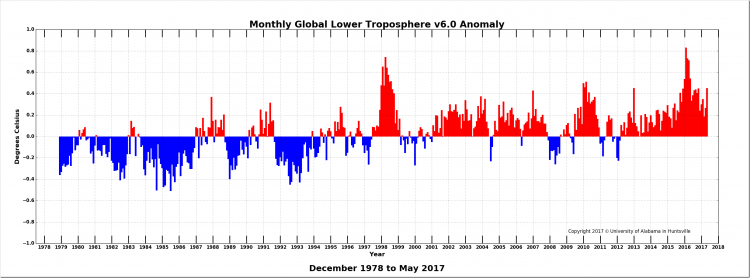
The heart of the Williamson article however concerns oceans and how they are somehow hiding the missing heat.
However, things are not quite as black and white as he makes out.
We only have ARGO data since 2004, which is far too short a period to be drawing conclusions from. Prior to that, we had very little idea what was happening to ocean heat content.
It is certainly debatable just how much we know now.
He states, it’s tough to demonstrate a whole-ocean average temperature increase of less than 0.1°C in about 1.4 billion cubic km of seawater. Tough, but not impossible — steadily, scientists have managed to complete the picture.
In fact, the temperature increase detected is much less than 0.1C, approximately 0.02C since 2004.
It is certainly questionable whether any statistical significance can be attached to such a small amount at all, or whether such a figure is genuinely detectable.
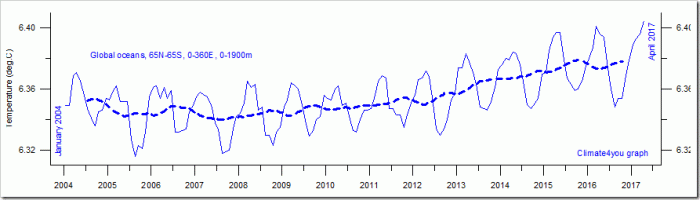
http://climate4you.com/
Then there is the question of just what is causing this increase in ocean temperatures, if it really exists.
He claims that around 93 per cent of the extra heat gained by the Earth over the past 50 years has sunk into the ocean. Unfortunately this is just mumbo jumbo. It is a physical fact that long wave radiation can only penetrate the top few millimeters of the ocean, where any warming would quickly lead to evaporation.
Even if there was a way for this extra heat to be mixed up with the deep ocean, the difference would be too small to detect.
This raises the question of whether other factors are at play in raising ocean temperatures, with the obvious one being the sun. After all, climate scientists have long known that ocean cycles can have major effects on the climate. Not only are they very powerful, but also very long lasting. The idea that man has caused sudden changes in the deep ocean is frankly scientific gibberish.
Williamson’s logic is that the pause in air temperatures, which he seems to accept existed until the 2015/16 El Nino, was because the world’s climate was going through a period of natural cooling, with the oceans holding back the heat (think La Nina).
But this ignores the AMO, which has been running through the warm phase since the mid 1990s. As even NOAA accept, when this happens, global air temperatures rise.
Meanwhile, the PDO has not really got into negative phase yet, partly because of the recent record El Nino.
Neither of these facts are consistent with his argument. Air temperatures have in fact plateaued despite the AMO and PDO.
But perhaps most importantly of all is the longer term trend. Williamson gives us a clue, when he says, “as the ocean warms, it expands”. In other words, sea levels rise.
But we know from tidal gauges all around the world that sea levels have been rising since the late 19thC, and for most of that time at a similar rate as now, and long before man made CO2 had any significant influence.
There is therefore no evidence that what we are seeing now is not just a continuation of that natural trend.
We in fact know very little about these ocean processes, and it is certainly a subject which deserves much greater attention.
Now that would be a good topic for the Spectator, but don’t expect Mr Williamson to be writing it!
FOOTNOTE
It was Phillip Williamson in his role as science coordinator (whatever that means!) who made a formal complaint about one of James Delingpole’s articles about ocean acidification to the UK press regulatory body IPSO last year.
Dellers has his usual forthright account of how IPSO threw out the complaint!
Sounds as if one of Williamson’s jobs is to shut down free speech.
Theresa May’s war on the internet

By Dan Glazebrook | RT | June 17, 2017
Last night, Theresa May was in France for a joint press conference with new French President Emmanuel Macron. As far as I could tell, it was only Al Jazeera that broadcast it live in Britain.
The only time it was mentioned during BBC radio 4’s flagship news show, the Today program, was during the five-minute religious slot Thought for the Day. It was not covered in the news section at all.
But this should be major, major news. This was Theresa May’s first policy announcement since last week’s election. And it wasn’t on Brexit, the reason she supposedly called the election. It wasn’t on austerity, which she apparently told her own MPs was over in a private session two days ago. No, her first major public policy announcement was – the end of internet freedom.
Specifically, what was announced was that both countries would be introducing heavy fines for internet companies that failed to remove what they, very loosely, defined as “extremist content.”
Now, taken at face value, this might seem to be referring to ISIS [Islamic State, formerly ISIL] recruitment videos or online suicide bombing training videos, or whatever. But the direct encouragement of violence is already illegal. So, what exactly is being proposed? Who exactly will be targeted?
It was former PM David Cameron who originally came up with the idea that “nonviolent extremism” should be criminalized alongside violent extremism. Intriguingly, as an example of what he meant, he included the idea that the “West is bad,” as well as elsewhere arguing that the promotion of “wild conspiracy theories” would also qualify.
Well, the collusion between, for example, British intelligence and Al-Qaeda might sound like a wild conspiracy theory. But, in the context of Britain and Al-Qaeda’s shared enemies in the form of Gaddafi and Assad, this collusion actually did take place. MI5 was facilitating the passage of fighters between Britain, Syria, and Libya, the SAS were training them, and MI6 was equipping them. Indeed, this collusion is not even secret: as late as 2016 the British government openly pledged to send more British troops to Syria to train rebel groups that even the BBC admitted were likely to be allied with Al-Qaeda.
So, is the publication of this information going to be barred now as extremist? Will YouTube and Facebook and Google and Twitter pull these revelations in fear of getting fined for promoting the “wild conspiracy theories” that, according to Cameron, qualify as extremism?
It is clear why the British state is so keen to clampdown on the internet once this kind of information starts going viral. But the election just gone has raised the stakes even further, demonstrating that, if the government does not reassert its authority over the internet, it may well have lost control of the political narrative for good. Let’s review what’s just happened:
A month ago, almost everybody was predicting a wipeout for the Labour party, a repeat of the disastrous 1983 election in which Margaret Thatcher really did win the landslide Theresa May had been predicting. Oh, how times have changed.
Back in 1983, pretty much everyone got their political information from either the newspapers or the BBC. In other words, between them, the big press barons – about 4 or 5 of them – and the British state had total monopoly control of political information.
This meant that when they portrayed Labour leader Michael Foot as a bumbling Oaf, that became the abiding image of him. A tiny handful of millionaire Tories effectively had total control over the public image of every politician in the land.
This time around, it’s a different story. The newspapers and the TV threw everything they could at Corbyn – ‘he’s a terror-supporting, magic money tree-mongering, Brexit-frustrating Remainiac’ – but people weren’t buying. And why weren’t they buying? Because they’re not reading the newspapers, and they’re not watching terrestrial TV. This time around, people, young people in particular, were increasingly getting their political information from social media – and on social media, the conservatives did not control the narrative.
For example, an RT interview I did about British collusion with terrorism shortly before the election got over one and half million views on Facebook – higher than the daily readership of the Daily Mail. Jonathan Pie’s fantastic piece tearing apart the Tory’s ‘strong and stable’ nonsense, got 11 million views. That is two and half million more than the combined circulation of the Daily Mail, Daily Express, Guardian, Sun, Daily Star, Times, Telegraph, Evening Standard, and the Mirror and Metro – the country’s ten leading newspapers. And hilariously, when I had just watched one of Theresa May’s speeches on YouTube during the campaign, immediately afterwards, YouTube automatically played Liar Liar, the anti-May anthem that reached number four in the UK pop charts last week. And I suspect YouTube auto played that video after anyone watched anything about Theresa May due to the algorithms that they employ.
So, you can see why the Tories are furious about the internet. They, and the British state more generally, have totally lost control of the narrative. And that’s what cost them this election.
So that’s what this new crackdown on the internet is really about; it’s about regaining control of that narrative. It’s about turning the CEOs of YouTube, Facebook, Twitter, and Google into the Rupert Murdochs of the 21st century – the political allies and mouthpieces of the British state and the capitalist class, and doing this by forging a new relationship that explicitly punishes them if they refuse to play ball.
Even the government’s own ‘reviewer of terrorism laws’, Max Hill, has come out against the move, explaining that “my view is that… we do have the appropriate laws in place, and that essentially the police and security services, and those whose job it is to keep us safe, do have the powers at their disposal.”
He noted that, in his experience, the police unit responsible for identifying online extremist material receive full co-operation from the tech companies already.
Similarly, The Open Rights Group has warned that “to push on with these extreme proposals for internet clampdowns would appear to be a distraction from the current political situation and from effective measures against terror.”
“The government already has extensive surveillance powers. Conservative proposals for automated censorship of the internet would see decisions about what British citizens can see online being placed in the hands of computer algorithms, with judgments ultimately made by private companies rather than courts. Home Office plans to force companies to weaken the security of their communications products could put all of us at a greater risk of crime.”
Those who are worried about extremism should be calling for an end to the British intelligence services’ collaboration and facilitation of terrorism and the extradition of those who have carried out or facilitated attacks abroad, as well as an international investigation and prosecutions of all those involved.
Theresa May’s new proposals do nothing to end the impunity of her own government in the grooming and facilitation of terrorism. Rather, they serve to extend this impunity. They must be resisted.
Dan Glazebrook is a freelance political writer who has written for RT, Counterpunch, Z magazine, the Morning Star, the Guardian, the New Statesman, the Independent and Middle East Eye, amongst others. His first book “Divide and Ruin: The West’s Imperial Strategy in an Age of Crisis” was published by Liberation Media in October 2013. It featured a collection of articles written from 2009 onwards examining the links between economic collapse, the rise of the BRICS, war on Libya and Syria and ‘austerity’. He is currently researching a book on US-British use of sectarian death squads against independent states and movements from Northern Ireland and Central America in the 1970s and 80s to the Middle East and Africa today.
Featured Video

The American Retreat from Vietnam
or go to
Aletho News Archives – Video-Images
From the Archives
Secret document reveals plans for civil war in Lebanon, Israeli false flags, and invasion
By Randi Nord | Geopolitics Alert | April 5, 2019
Beirut – During his visit with US Secretary of State, Mike Pompeo, Lebanese President Michael Aoun reportedly received a US-Israeli document detailing plans for creating a civil war in Lebanon with covert false flag operations and possible Israeli invasion.
Although the source of the document is Israeli and created in partnership with Washington, no one knows who presented it to Aoun. The Lebanese TV station, Al-Jadeed, initially reported the document on Lebanese TV and a video on its website. Geopolitics Alert translated the report for this article. … continue
Blog Roll
 Aletho News
- ‘Distance yourselves from Israel’: IRGC urges US population to question govt policies
- America’s Greenland deal has a radioactive backstory
- The RAF Fairford ‘terror plot’: Unpacking escalation in the UK echo-chamber
- EU Council Advances Chat Control 2.0 Scanning Proposal
- Ex-Greek MEP files complaint against Israeli spyware firm over alleged Pegasus surveillance
- Troubling ideas throughout the Torah, Talmud, Mishneh Torah and Tanya
- ‘Grave, alarming’: Iran mission on Trump’s UNGA ‘annihilation’ threats
- Najaf airport to reopen to Iranian flights within 24 hours: Ambassador
- From ‘How Will This End For Iran’ to ‘When America Walks Away’: A tale of two Economist covers
- Tehran blasts ‘baseless’ speculation linking Iran to alleged bomb plot at UK air base
- If Americans Knew
- Ex-Biden officials are desperate for a Gaza scapegoat
- Israeli “settlers” Invade Al-Aqsa; Pour Boiling Water on 75-Year-Old
- Israel Has Kidnapped Another American Teenager
- US arms sales to Israel worth $21.6 billion in 20 months
- Three Palestinians Killed in Israeli Attacks on Gaza
- Revealed: German “Anti-Semitism Expert” Driving Crackdown on Palestine Solidarity is Former Israeli Spy
- Egypt’s Warning to Israel Before Oct 7
- Israel’s siege signals another cruel winter for 1.8 million Gazans – Daily Update
- Netanyahu Asked UAE Leader to Deny Report on Oct. 7 Warning in Secret Visit, Sources Say
- CNN Chief Int’l Correspondent Clarissa Ward on Journalists in Gaza
- No Tricks Zone
- New Study: Earth And Venus Surface Warmth Largely Explained By Convection And Lapse Rate, Not CO2 Or Radiation
- 2025 Nature Paper Claiming Worsening Global Drought Gets RETRACTED …Heavily Flawed
- New Study: ‘Global Drought Shows No Detectable Recent Acceleration Under Climate Warming’
- Economic Masterminds: German Socialists Suggest Taxing Productivity Gains Stemming From Using AI
- The South China Sea Has Not Been Cooperating With The Climate Change Narrative
- Energy Crisis: Germany Enters Heating Season With Historically Low Gas Reserve Fill Levels
- New Study: The Antarctic Ice Sheet Gained Mass From 2020-2024 Due To Staggering Snow And Ice Accumulation
- Study: Ocean Heating Rates From Thousands Of Years Ago ‘Dwarf’ Modern Ocean Heating Rates
- Climate Extremists Target, Attack Large-Scale Power Grid Infrastructure In Germany!
- New Study: Antarctic Ice Melt Has Contributed Less Than 1 Centimeter To Sea Level Rise In The Last 30 Years

