Kinsella’s silence on JNF racism speaks loudly
By Yves Engler · July 26, 2017
What do you call someone who says they head an antiracist organization, but claims to be ignorant of an explicitly racist institution they’ve publicly defended? I have no idea, but I do know Warren Kinsella confirmed the central point of my recent article titled “The Left’s racism problem concerning Israel”.
In a series of threatening emails to the editor of Dissident Voice in response to my article the former advisor to Olivia Chow’s mayoral bid wrote: “These statements are wildly defamatory. They are false and malicious in their plain and ordinary meaning. They are calculated to damage my reputation in the eyes of the community. The fact is, I presently help lead an anti-racist organization and have received death threats as a result. I have ‘ties’ to no other. I have been involved in anti-racism work for more than three decades. I oppose hate against all people, in all of its myriad forms. To state that I support or condone ‘explicit racism’ is a disgusting, appalling lie.”
I responded by saying: “While I appreciate your anti-racism work in certain areas, the point being made in the article claimed to be libelous is that you, in fact, do not condemn all forms of racism, specifically anti-Palestinian racism as conceived and carried out by the Jewish National Fund. I can find no record of you condemning or even criticizing the Jewish National Fund’s structural racism. On the other hand, you have condemned and criticized those who do.
If you do oppose all forms of racism, specifically including that of the Jewish National Fund, please let me know and I will apologize unreservedly to you and correct the article in question. If, on the other hand, you do not believe the Jewish National Fund is racist, or you are simply unwilling to condemn or criticize it, then I must stand by my words in the article.”
And here is where things became interesting. Kinsella responded to my email by stating “I don’t even know what the JNF is. I have nothing to do with it. …”
Claiming to have been involved in antiracism work for three decades, Kinsella says he’s ignorant of the only (to my knowledge) explicitly racist institution sanctioned by the Canadian state to give tax write-offs. It is not like the JNF is some marginal group. The century-old organization’s eleven offices across Canada raised $75 million over the past three years and the sitting prime minister spoke to the organization in 2013.
While he now denies knowledge of the registered charity, last year Kinsella derided a resolution calling on the Canada Revenue Agency to rescind the JNF’s charitable status because of its “discrimination against non-Jews in Israel.” Additionally, in the late 2000s Kinsella sat on the board of directors of the Canada-Israel Committee, whose personnel were often close to the JNF.
Why would someone who claims to be an antiracist activist be unwilling to criticize an organization that practices discriminatory land-use policies outlawed in this country six decades ago?
AIPAC threat to free speech
By Ron Forthofer | Dissident Voice | July 26, 2017
There is a Senate bill, along with a companion bill in the House, working its way through Congress with strong bipartisan support, that poses a significant danger to free speech. One would think this bill would be a big deal but, surprisingly, the bill has not received much coverage in the mainstream media.
Fortunately the American Civil Liberties Union is alert to efforts undermining free speech. Thus, in a July 20th article on the ACLU website about S. 720/H.R. 1697, the Israel Anti-Boycott Act, Bryan Hauss, Staff Attorney, wrote:
The bill would amend existing law to prohibit people in the United States from supporting boycotts targeting Israel — making it a felony to choose not to engage in commerce with companies doing business in Israel and its settlements in the occupied Palestinian territories. Violations would be punishable by a civil penalty that could reach $250,000 and a maximum criminal penalty of $1 million and 20 years in prison.
Hauss continues:
The bill is aimed at advocates of boycotts targeting Israel, most notably the Boycott, Divestment, Sanctions (BDS) movement — a global campaign that seeks to apply economic and political pressure on Israel to comply with international law. Specifically, the bill sponsors intend the act as a response to the U.N. Human Rights Council’s 2016 resolution calling on companies to respect human rights, including in occupied Palestinian territories. No matter what you think about the Israeli-Palestinian conflict, one thing is clear: The First Amendment protects the right to engage in political boycotts.
Amazingly, supporters of this bill seem to have a problem with calling on companies to respect human rights! Who would draft such a problematic bill that stifles free speech and nonviolent political action?
The Intercept website carried a July 19th article by Glenn Greenwald and Ryan Grim that said:
The Jewish Telegraphic Agency reports that the bill “was drafted with the assistance of the American Israel Public Affairs Committee.” Indeed, AIPAC, in its 2017 lobbying agenda, identified passage of this bill as one of its top lobbying priorities for the year.
This AIPAC-influenced bill is consistent with AIPAC’s long-term pattern of advocating for the interests of a foreign nation, Israel. AIPAC is one of the most powerful lobbies in Washington, D.C. and many members of Congress seem to automatically toe its line. Thus it is not surprising that 46 senators and 245 representatives have already signed on to the bill originally introduced on March 23rd.
Greenwald and Grim added that cosponsors include liberal Senators Ron Wyden, Richard Blumenthal, Maria Cantwell as well as conservative Senators Ted Cruz, Marco Rubio and Ben Sasse. In the House, cosponsors include conservatives such as Jason Chaffetz, Liz Cheney, and Peter King as well as liberals Ted Lieu, Adam Schiff, and Eric Swalwell. Greenwald and Grim noted that these latter three members, who have built a wide public following by posturing as opponents of authoritarianism, are cosponsoring one of the most oppressive and authoritarian bills that has pended before Congress in quite some time.
Many of the cosponsors claim they were unaware of the penalties that could be applied in the bill whereas a few others state that they have a different reading of the bill, particularly related to the criminal penalties.
In addition to using AIPAC and other groups to lobby Congress, Israel previously directly inserted itself into our legislative process. For example, in 2015 Israeli Prime Minister Benjamin Netanyahu blatantly campaigned to derail the nuclear agreement with Iran. Also of concern, many U.S. and Israeli political experts thought Netanyahu clearly tried to sway the outcome in the 2012 U.S. Presidential election in favor of the Republican candidate Mitt Romney.
We must protect our free speech by opposing this highly questionable bill designed to benefit a foreign nation. In Colorado this means questioning Senator Bennet and Representatives Lamborn, Coffman and Buck, about their support for this appalling bill. We can also thank the other members of the Colorado delegation for not cosponsoring this terrible affront to free speech and the Constitution.
Ron Forthofer is a retired professor of biostatistics from the University of Texas School of Public Health in Houston and was a Green Party candidate for Congress and also for governor of Colorado.
Silenced stones mark hard path to Sri Lankan reconciliation
Security forces have erected numerous monuments celebrating their 2009 victory over Tamil Tiger rebels. No such privilege has been accorded to the Tamil insurgents or civilians who died in the fight
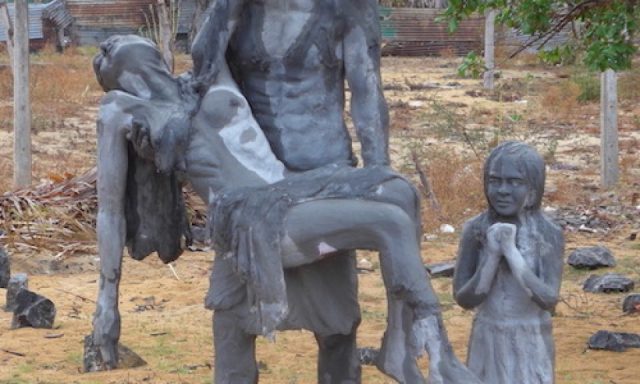
A monument to Sri Lanka’s civil war victims. Photo: Duncan McCargo
By Duncan McCargo | Asia Times | July 26, 2017
An eerie art installation near an idyllic Sri Lankan beach symbolizes many of the contradictions of this post-war society, comprising a sculpture of a man carrying his brutalized daughter, an old suitcase full of clothes and a small ‘graveyard’ punctuated by tiny stones.
The core sculpture was inaugurated on May 18, 2016 – the seventh anniversary of the end of the decades–long civil war, which the Sri Lankan government celebrates as a day of victory over the Tamil insurgent
One year later, police obtained a court order preventing Father Elil Rajendram, the Tamil Jesuit priest behind the project (and an activist and co-spokesperson for the Tamil Civil Society Forum), from presiding over a ceremony to add some stones bearing the names of people who had died during the war.
The following day, after a legal challenge mounted by Kumaravadivel Guruparan, head of the law department at Jaffna University, the court decreed that the ceremony could only take place within the premises of the nearby church. The name-bearing stones have since remained out of public view, while Father Elil was questioned by the authorities on four separate occasions.
The police claimed that some of those memorialized might be members of the banned Liberation Tigers of Tamil Eelam (LTTE) separatist group, better known as the Tamil Tigers, although Guruparan argued that commemorating the names of deceased LTTE members was not banned under any Sri Lankan law.
In the event, the police proved unable to confirm that any of the names were actually those of LTTE members: they were simply acting on suspicion.

A cemetery of stone markers inscribed with the names of victims of Sri Lanka’s civil war. Photo: Duncan McCargo
Mullivaaikaal, the beach in question, lies at the heart of ‘the cage’, a narrow isthmus where the remnants of the Tamil Tigers were slaughtered by the Sri Lankan army in the bloody culmination of a long-running civil war in May 2009. Tens of thousands of people were killed in what the government still refers to as a ‘humanitarian’ operation.
Sri Lankan security forces have erected numerous monuments to celebrate their victory and to recognize their war dead, but no such privilege has been accorded to those from the LTTE, nor to the Tamil civilians who perished during the fighting.
In refusing to allow ordinary families to honor or even to remember their dead, Sri Lankan authorities claim they are responding to pressure from hardline Buddhist groups who insist that brutal terrorists are not entitled to such decencies.
The outspoken Chief Minister of the Northern Province, former Supreme Court Justice Canagasabapathy Visuvalingam Vigneswaran, has been the one of the loudest elected voices for the Tamil cause in recent years.
This writer asked why he couldn’t erect a memorial to the Tamil war dead right in front of his office (there is a handy patch of waste ground right next to the gate), but he answered rather melodramatically that if he pushed too hard on this issue, even he could be taken into custody: the government has made holding meetings about memorials hard enough, let alone building them.
I later had chance to ask a senior military commander why the memorialization issue was so sensitive. While acknowledging that during many years of fighting the army had developed ‘a bit of an arrogant mindset’, he insisted that negative sentiments of people and politicians in the South were now the main obstacle to any memorial to Tamil victims or LTTE fighters, rather than military obstructionism.
Nevertheless, he personally believed such memorials should be possible in the future. Meanwhile, he noted, progress had been made – until recently, even private memorial ceremonies were banned, not just public commemorations.
The 30-year civil war in Sri Lanka remains a subject of intense controversy. But since the more compromising and pragmatic President Maithripala Sirisena assumed power in early 2015 with the support of the country’s Tamil minority, reconciliation has figured prominently in public discourse.
The incoming government established the Office for National Unity and Reconciliation (ONUR), chaired by the redoubtable former president Chandrika Bandaranaike Kumaratunga.
Numerous worthy unity and reconciliation projects have been initiated, focusing on areas such as youth exchanges, vocational training, agricultural livelihoods and the construction of new homes for those displaced during the conflict.
Yet in the Northern Province – an overwhelmingly Tamil region where much of the fighting took place – local people remain skeptical about development-oriented, top-down reconciliation projects that are largely conceived and implemented by the bureaucracy and security forces. Among recurrent local concerns are missing persons, military land occupation and memorialization.
Critical observers, such as human rights activist Ruki Fernando, argue that until these core issues are addressed, token projects will do little to assuage Tamil frustrations with the state. He argues that rather than exercising leadership, the Colombo government has become the captive of the military and Buddhist hardliners.
During the civil war, huge numbers of people were driven out of their homes in the North and East of the country. When they tried to return after 2009, many found their land occupied by the military. In the Jaffna peninsula alone, the military currently holds more than 10,000 acres of land, around half of it used for bases.
The military points to progress in releasing occupied land, but insists that for security reasons the process has to be incremental.
In recent months, there has been a mushrooming of protest encampments by villagers seeking the return of their property from security forces. These round-the-clock vigils illustrate a remarkable opening up of political space in Sri Lanka: they would have been unthinkable during the time of hardline former president Mahinda Rajapaksa.
Yet while they have attracted some attention from the media and Tamil political parties, and in a few cases have won concessions from the military, most of the protests are being quietly ignored. Similar vigils have been established in other locations to demand information about those who went missing during the war.
Since 1994, the government has received more than 65,000 complaints relating to missing persons: in the absence of death certificates, their surviving relatives face serious problems over access to bank accounts, inheritance and re-marriage.
A major government initiative is needed to resolve these issues, but so far efforts to address them have been piecemeal; the president only finally approved the establishment of a long–promised Office of Missing Persons on July 20.
Land, missing persons and monuments are important examples of reconciliation-related issues. All highlight the importance of granting agency and authority to victims in a post-war order like Sri Lanka’s. Similar challenges have dogged other post-conflict societies such as that of Northern Ireland: education and development projects can only go so far, if sensitive core concerns remain unaddressed.
While the international community is now pressing for large-scale transitional justice initiatives in Sri Lanka, neither a hybrid tribunal nor a truth commission will be easy to realize. In the meantime, displaying the names of some Tamil war victims near a Northern beach might be one small place to start.
Duncan McCargo is the author of Tearing Apart the Land (2008), a study of the Southern Thai conflict
Youtube Expands Censorship, Blocks SANA And Hezbollah Media Wing In Syria
South Front | July 18, 2017
Youtube has expanded its efforts to censor alternative sources of the information about the conflict in Syria. Last week, Youtube banned the channel of Syrian Arab News Agency (SANA), a Syrian state-run media supporting the Assad government. This week, Youtube banned the channel of the Syrian Military Media, a Hezbollah media wing in Syria.
This censorship campaign is likely a part of the wider attempt to counter the non-mainstream reporting about the conflict. The mainstream media and their corporate sponsors have repeatedly discredited themselves during the conflicts in Syria and Iraq. Thus, the corporations have likely decided that the total censorship is the only way to suppress alternative points of view.
Israel Once Again Reveals Its Disdain for Freedom of the Press
By Richard Hardigan | CounterPunch | July 14, 2017
When Akran Natsheh, a reporter for the Al Quds satellite channel, arrived at his office in Hebron in the morning of Thursday, July 13, he found that several of the doors had been pried open. Shards of wood were everywhere, and papers were strewn about on the floor. It certainly looked like an ordinary robbery, but then he found that several of his hard drives had been removed. His suspicions about the perpetrators were confirmed when one of his co-workers showed him the note he found posted on the front door by the Israeli army. It indicated that the offices had been stormed because “Al Quds serves an illegal organization.”
Natsheh looked at me with exasperation. “What does that even mean?” he complained. “When another news organization was raided, they were told it was because of incitement to violence.”
Israeli Prime Minister Benjamin Netanyahu regularly claims that Israel is the only true democracy in the Middle East, but its commitment to one of democracy’s fundamental tenets – freedom of an independent press – leaves a great deal to be desired.
Mada, the Palestinian Center for Media and Development Freedoms, is an organization that monitors violations in the Palestinian Territories by both the Israeli government and the Palestinian Authority. For example, it states in its annual 2017 report that while “2016 witnessed a relatively significant decrease in total number of violations monitored against media freedoms in Palestine compared to 2015,” there will still 383 violations, including “the murder of a media student at Al-Quds University … by Israeli Occupation Forces, [the] injuring and arresting of dozens of Palestinian journalists, [and the] raiding, confiscating and sabotaging [of] media outlets including the shutdown of 12 Palestinian media outlets and printing houses.”
When I asked Natsheh about the value of the items destroyed by the soldiers, he shrugged.
“Maybe $2000, but the money is not the important part. It is more about the psychological effect. I can buy new hard drives and new doors.” He paused to reflect.
This kind of attack causes self-censorship. Your work becomes something frightening. The challenge becomes bigger and bigger. They may storm this office next week and arrest me, or harass me in the field. Two years ago they shot at journalists during clashes, and so they became afraid to cover them.”
But Natsheh vowed to continue his work.
“We are journalists. We are not inciters. Our mission is to deliver the truth about what happens in Palestine to our audience. This is the mission of all journalists around the world. We all have the same mission, the same values, the same journalistic ethis. If they have anything against any organization, why don’t they go to court? They don’t. They go directly to destroy. If they had a strong narrative, they would not do that. But they don’t. We are just journalists. We just say what we see … You say something they don’t like, and they shut you down. This is the Occupation.”
Richard Hardigan is a university professor based in California. He is currently writing a book entitled “The Other Side of the Wall” based on his experience in the Occupied Territories.
How Russia-gate Met the Magnitsky Myth
By Robert Parry | Consortium News | July 13, 2107
Near the center of the current furor over Donald Trump Jr.’s meeting with a Russian lawyer in June 2016 is a documentary that almost no one in the West has been allowed to see, a film that flips the script on the story of the late Sergei Magnitsky and his employer, hedge-fund operator William Browder.
The Russian lawyer, Natalie Veselnitskaya, who met with Trump Jr. and other advisers to Donald Trump Sr.’s campaign, represented a company that had run afoul of a U.S. investigation into money-laundering allegedly connected to the Magnitsky case and his death in a Russian prison in 2009. His death sparked a campaign spearheaded by Browder, who used his wealth and clout to lobby the U.S. Congress in 2012 to enact the Magnitsky Act to punish alleged human rights abusers in Russia. The law became what might be called the first shot in the New Cold War.
According to Browder’s narrative, companies ostensibly under his control had been hijacked by corrupt Russian officials in furtherance of a $230 million tax-fraud scheme; he then dispatched his “lawyer” Magnitsky to investigate and – after supposedly uncovering evidence of the fraud – Magnitsky blew the whistle only to be arrested by the same corrupt officials who then had him locked up in prison where he died of heart failure from physical abuse.
Despite Russian denials – and the “dog ate my homework” quality of Browder’s self-serving narrative – the dramatic tale became a cause celebre in the West. The story eventually attracted the attention of Russian filmmaker Andrei Nekrasov, a known critic of President Vladimir Putin. Nekrasov decided to produce a docu-drama that would present Browder’s narrative to a wider public. Nekrasov even said he hoped that he might recruit Browder as the narrator of the tale.
However, the project took an unexpected turn when Nekrasov’s research kept turning up contradictions to Browder’s storyline, which began to look more and more like a corporate cover story. Nekrasov discovered that a woman working in Browder’s company was the actual whistleblower and that Magnitsky – rather than a crusading lawyer – was an accountant who was implicated in the scheme.
So, the planned docudrama suddenly was transformed into a documentary with a dramatic reversal as Nekrasov struggles with what he knows will be a dangerous decision to confront Browder with what appear to be deceptions. In the film, you see Browder go from a friendly collaborator into an angry adversary who tries to bully Nekrasov into backing down.
Blocked Premiere
Ultimately, Nekrasov completes his extraordinary film – entitled “The Magnitsky Act: Behind the Scenes” – and it was set for a premiere at the European Parliament in Brussels in April 2016. However, at the last moment – faced with Browder’s legal threats – the parliamentarians pulled the plug. Nekrasov encountered similar resistance in the United States, a situation that, in part, brought Natalie Veselnitskaya into this controversy.

Film director Andrei Nekrasov
As a lawyer defending Prevezon, a real-estate company registered in Cyprus, on a money-laundering charge, she was dealing with U.S. prosecutors in New York City and, in that role, became an advocate for lifting the U.S. sanctions, The Washington Post reported.
That was when she turned to promoter Rob Goldstone to set up a meeting at Trump Tower with Donald Trump Jr. To secure the sit-down on June 9, 2016, Goldstone dangled the prospect that Veselnitskaya had some derogatory financial information from the Russian government about Russians supporting the Democratic National Committee. Trump Jr. jumped at the possibility and brought senior Trump campaign advisers, Paul Manafort and Jared Kushner, along.
By all accounts, Veselnitskaya had little or nothing to offer about the DNC and turned the conversation instead to the Magnitsky Act and Putin’s retaliatory measure to the sanctions, canceling a program in which American parents adopted Russian children. One source told me that Veselnitskaya also wanted to enhance her stature in Russia with the boast that she had taken a meeting at Trump Tower with Trump’s son.
But another goal of Veselnitskaya’s U.S. trip was to participate in an effort to give Americans a chance to see Nekrasov’s blacklisted documentary. She traveled to Washington in the days after her Trump Tower meeting and attended a House Foreign Affairs Committee hearing, according to The Washington Post.
There were hopes to show the documentary to members of Congress but the offer was rebuffed. Instead a room was rented at the Newseum near Capitol Hill. Browder’s lawyers. who had successfully intimidated the European Parliament, also tried to strong arm the Newseum, but its officials responded that they were only renting out a room and that they had allowed other controversial presentations in the past.
Their stand wasn’t exactly a profile in courage. “We’re not going to allow them not to show the film,” said Scott Williams, the chief operating officer of the Newseum. “We often have people renting for events that other people would love not to have happen.”
In an article about the controversy in June 2016, The New York Times added that “A screening at the Newseum is especially controversial because it could attract lawmakers or their aides.” Heaven forbid!
One-Time Showing
So, Nekrasov’s documentary got a one-time showing with Veselnitskaya reportedly in attendance and with a follow-up discussion moderated by journalist Seymour Hersh. However, except for that audience, the public of the United States and Europe has been essentially shielded from the documentary’s discoveries, all the better for the Magnitsky myth to retain its power as a seminal propaganda moment of the New Cold War.
After the Newseum presentation, a Washington Post editorial branded Nekrasov’s documentary Russian “agit-prop” and sought to discredit Nekrasov without addressing his many documented examples of Browder’s misrepresenting both big and small facts in the case. Instead, the Post accused Nekrasov of using “facts highly selectively” and insinuated that he was merely a pawn in the Kremlin’s “campaign to discredit Mr. Browder and the Magnitsky Act.”
The Post also misrepresented the structure of the film by noting that it mixed fictional scenes with real-life interviews and action, a point that was technically true but willfully misleading because the fictional scenes were from Nekrasov’s original idea for a docu-drama that he shows as part of explaining his evolution from a believer in Browder’s self-exculpatory story to a skeptic. But the Post’s deception is something that almost no American would realize because almost no one got to see the film.
The Post concluded smugly: “The film won’t grab a wide audience, but it offers yet another example of the Kremlin’s increasingly sophisticated efforts to spread its illiberal values and mind-set abroad. In the European Parliament and on French and German television networks, showings were put off recently after questions were raised about the accuracy of the film, including by Magnitsky’s family.
“We don’t worry that Mr. Nekrasov’s film was screened here, in an open society. But it is important that such slick spin be fully exposed for its twisted story and sly deceptions.”
The Post’s gleeful editorial had the feel of something you might read in a totalitarian society where the public only hears about dissent when the Official Organs of the State denounce some almost unknown person for saying something that almost no one heard.
New Paradigm
The Post’s satisfaction that Nekrasov’s documentary would not draw a large audience represents what is becoming a new paradigm in U.S. mainstream journalism, the idea that it is the media’s duty to protect the American people from seeing divergent narratives on sensitive geopolitical issues.
Over the past year, we have seen a growing hysteria about “Russian propaganda” and “fake news” with The New York Times and other major news outlets eagerly awaiting algorithms that can be unleashed on the Internet to eradicate information that groups like Google’s First Draft Coalition deem “false.”
First Draft consists of the Times, the Post, other mainstream outlets, and establishment-approved online news sites, such as Bellingcat with links to the pro-NATO think tank, Atlantic Council. First Draft’s job will be to serve as a kind of Ministry of Truth and thus shield the public from information that is deemed propaganda or untrue.
In the meantime, there is the ad hoc approach that was applied to Nekrasov’s documentary. Having missed the Newseum showing, I was only able to view the film because I was given a special password to an online version.
From searches that I did on Wednesday, Nekrasov’s film was not available on Amazon although a pro-Magnitsky documentary was. I did find a streaming service that appeared to have the film available.
But the Post’s editors were right in their expectation that “The film won’t grab a wide audience.” Instead, it has become a good example of how political and legal pressure can effectively black out what we used to call “the other side of the story.” The film now, however, has unexpectedly become a factor in the larger drama of Russia-gate and the drive to remove Donald Trump Sr. from the White House.
Investigative reporter Robert Parry broke many of the Iran-Contra stories for The Associated Press and Newsweek in the 1980s.
Now see also: https://swprs.org/the-magnitsky-act/
Saudi’s Qatif in Mourning after Regime Killed Four Political Detainees
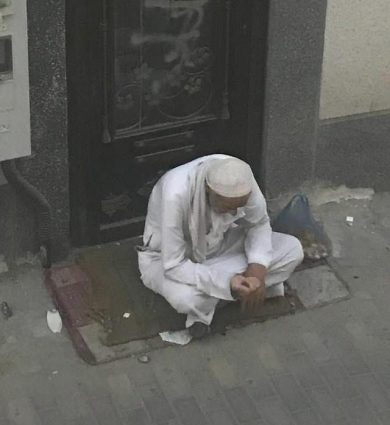
Father of Saudi martyr Yousef Ali Abdullah al-Mishaikhesh, after being informed of his son’s execution.
Al-Manar | July 12, 2017
Saudi Arabia’s Qatif region is in mourning on Wednesday after the ruling regime announced a day earlier it had executed four people over allegations of “conducting terror activities”.
The Saudi Interior Ministry claims that the four, who were executed in Qatif Governorate in Eastern Province, had attacked police stations and petrol officers.
The ministry identified the four men as Zaher Abdulraheem Hussein al-Basri, Yousef Ali Abdullah al-Mishaikhesh, Mahdi Mohammed Hasan al-Sayegh, and Amjad Naji Hasan Al Moaibed.
The Shia-dominated Eastern Province, particularly the Qatif region, has been the scene of peaceful demonstrations since February 2011. Protesters, complaining of marginalization in the Sunni-ruled kingdom, have been demanding reforms, freedom of expression, the release of political prisoners, and an end to economic and religious discrimination against the oil-rich region.
However, the government has responded to the protests with a heavy-handed crackdown, but the rallies have intensified since January 2016 when Saudi Arabia executed respected Shia cleric, Sheikh Nimr al-Nimr, an outspoken critic of the policies of the Riyadh regime.
Saudi Arabia has one of the world’s highest rates of execution. Rights groups last month expressed concern that 14 Saudi Shia individuals face execution for protest-related crimes.
Only the News That Fits: How American Media Erase Palestine – Even Alternative Media
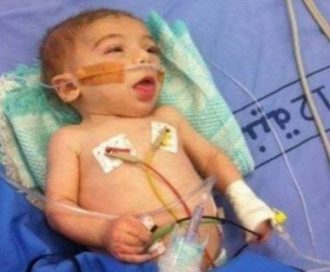
Abdul-Rahman Mahmoud Barghouthi, 18 months. Photo from IMEMC.
By Alison Weir | If Americans Knew | July 10, 2017
An 18-month-old died in Palestine Friday. The cause of death was teargas inhalation from an Israeli invasion of his village two months ago.
It wasn’t a major invasion; just another of the routine ones that happen almost every day in the West Bank. U.S. media call these “incursions,” when they bother to mention them. Which is rarely.
The toddler’s name was Abdul-Rahman Mahmoud Barghouthi, a name that feels incongruously long for his short life.
When he was injured, Israeli soldiers held up an ambulance rushing to him, forcing medics to go to his home on foot and carry him back to the ambulance in their arms – a 60 minute round trip.
In the past three months, Israelis have killed 18 Palestinians, including an eight-year-old and 10-year-old, and Palestinians have killed two Israeli soldiers.
So far, I don’t see any US mainstream news media mentioning the end of Abdul’s short life, the final two months likely infused with pain. If an 18-month-old Israeli child had been killed by Palestinians, I suspect there would be headlines, and the President would go on CNN [LOL] and condemn the killers.
Perhaps Palestinians are killed so often that to the media it’s just not newsworthy, a little like the old saying that ‘dog bites man’ is not news, while ‘man bites dog’ is news. Israelis killing Palestinian children is not news. However, it is literally news to most Americans, since they so rarely hear about it.
My personal experience in writing about this issue for more than a decade and a half illustrates the very American tale of media omission on Palestine. Just last week another episode showed that the saga continues.
I’ve written about this sort of thing before, on more than one occasion.
The first time I wrote about tiny dead Palestinian children was 15 years ago. I described small deaths and quoted the words of poet Shawqi Baghdadi:
I remember the children
As dead angels
And injured sparrows
God was sad
A few years later I wrote about Palestinian toddlers killed by Israeli drones, and a few years later about Palestinian children shot in the head. I wrote stories about dead Palestinian mothers, such as Anatomy Of A Cover-Up: When A Mother Gets Killed Does She Make A Sound? and “Just Another Mother Murdered.” The titles give you the gist.
I could write stories like this over and over, if I could bear it. Because the deaths keep coming, and the misery and the cruelty, and the media keep ignoring so much of it.
And that’s the point of this story. Americans need to know important facts that they aren’t learning in the very filtered reporting we get. We need to know what’s happening in Palestine, and we need to know what’s enabling this in the U.S. The latter stories are even more covered up.
Until we expose and break through the media bias and omission, the children will keep dying, and the tragedy and carnage and injustice will grow and spread.
In the past I’ve conducted media studies that document the disparity in reporting on Palestinian deaths compared to Israeli deaths, and have deconstructed news reporting. Through the years I’ve periodically written articles describing the flawed system of reporting on Palestine, including a chapter for a Project Censored book on the subject.
This time I’d like to give a few small, personal anecdotes – one from last week.
In 2001 a reporter for the Gannett news chain interviewed me at length about what I had just seen firsthand in Gaza and the West Bank at the height of the Second Intifada, and about the founding of If Americans Knew. Gannett is a major chain and this would have been a significant breakthrough for information on Palestine to get to the general public. The reporter sent a photographer to take pictures of me and told me his feature was about to come out.
But it never did. The reporter later told me a higher-up had killed the story, saying it was “missing something.” He hadn’t explained what.
Another time a journalist at the other end of the media scale, a reporter working for a small town newspaper, wrote a similar story about me. It, too, was killed by a higher-up. The reporter told me this was the first time that had ever happened to him.
Awhile later, a letter I had written about Palestine had gone through the usual editorial process and was slated to be published in the Washington Post. At the last minute it, too, was blocked by a superior.
Most recently, Truthout, a progressive website with a large readership that publishes much excellent work, accepted an article I had submitted about government monitoring of Palestine activism. My piece went through the standard editing and fact-checking, and the next day the article was published on the website. Briefly. It was quickly removed when higher-ups saw it and the staff then told me courteously and apologetically it wasn’t “the right fit for Truthout.”
I asked what this meant, exactly, but haven’t heard back. We’ve now published the article on our blog.
Naturally, news organizations can’t publish everything that’s submitted to them, and all have the right to decide what they will publish and what they won’t.
But it’s unusual for pieces that have gone through the usual channels and passed the standard hurdles to suddenly get killed for unidentified reasons. And it’s disturbing when this fits into a pattern of news filtering that has life and death consequences, and has gone on year after year after year.
Many news media are telling us more than they used to about Palestine, but they continue to leave out important aspects. Sometimes a half truth is a whole lie.
Meanwhile, Israel and its partisans have rewritten the governmental definition of “antisemitism” to include criticism of Israel and embedded this new Israel-centric definition in governments and law enforcement agencies around the world, so that eventually articles like this one may be banned as “hate speech.”
But you won’t learn that in Truthout.
Alison Weir is executive director of If Americans Knew, president of the Council for the National Interest, and author of Against Our Better Judgment: The Hidden History of How the U.S. Was Used to Create Israel.
North Carolina 22nd state to pass anti-BDS legislation promoted by Israel lobby groups

Still taken from JBSTV news report June 29, 2017
By Alison Weir | If Americans Knew | July 8, 2017
The pro-Israel campaign in state legislatures against boycotting Israel just scored another victory in North Carolina. Last month corresponding bills were passed in Nevada, Ohio, and Kansas.
Similar laws are also being passed in U.S. cities and at the federal level.
Members of the North Carolina House of Representatives voted 96 to 19 and state Senators voted 45 to 3 for legislation that prevents state institutions from doing business with companies that boycott Israeli companies and/or products made in Israel.
The original sponsors of the bill were Senators Tommy Tucker, Rick Gunn and Andrew Brock, and Representatives. John Szoka, Stephen Ross and Jon Hardister.
Israel’s Jerusalem Post newspaper reported: “Representatives from the various Jewish Federations across North Carolina praised the passage of the legislation.”
“This bill makes it clear that the State of North Carolina stands with Israel, which has long been an important trading partner of North Carolina,” said Carin Savel, CEO of the Jewish Federation of Raleigh-Cary. [The Federation’s mission includes helping “to meet the shared obligations of our local community to Israel and international Jewry.”]
“Charlotte Jewish Federation executive director Susan J. Worrel said the bill “will solidify the relationship between North Carolina and Israel, who share important values and a mutually beneficial business relationship.”
“Jill Madsen, CEO of the Jewish Federation of Durham-Chapel Hill, said the bill “is an important step in the right direction.”
She added, “It prevents companies which boycott Israel based on national origin from doing business with the state of North Carolina.”
Marilyn Forman Chandler, executive director of the Greensboro Jewish Federation, said, “This sends a significant message against hatred and discrimination and will outlaw and condemn discrimination against Israel and Israelis. We look forward to Governor Roy Cooper’s signature, making North Carolina the 22nd state to take such action.”
Some of the other groups promoting the legislation are The Israel Project, a national pro-Israel organization; United for Israel, an international organization; and the American Jewish Committee, which created a letter opposing BDS that all 50 US governors signed. The AJC called it “a big win for Jewish advocacy and Israel.” Some groups label the BDS movement “antisemitic.”
The North Carolina bills are Senate Bill 329 and House Bill 161 – short title: “Divestment from Companies That Boycott Israel,” full title: “An Act Requiring State Divestment from, and Prohibiting State 3 Agencies from Contracting with, Companies that Boycott Israel.
JTA reports that this is at least the 22nd state with anti-BDS laws or executive orders. Previous states include Alabama, Arizona, California, Colorado, Florida, Georgia, Illinois, Iowa, Indiana, Kansas, Michigan, Nevada, New Jersey, New York, Ohio, Pennsylvania, South Carolina, Tennessee and Virginia.

Jewish community representatives join Pennsylvania Governor Tom Wolf as he signs anti-boycott legislation. Photo from the Jewish Federation of Greater Pittsburgh
Featured Video
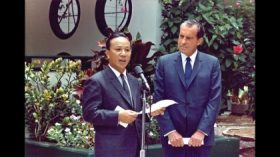
The American Retreat from Vietnam
or go to
Aletho News Archives – Video-Images
From the Archives
Secret document reveals plans for civil war in Lebanon, Israeli false flags, and invasion
By Randi Nord | Geopolitics Alert | April 5, 2019
Beirut – During his visit with US Secretary of State, Mike Pompeo, Lebanese President Michael Aoun reportedly received a US-Israeli document detailing plans for creating a civil war in Lebanon with covert false flag operations and possible Israeli invasion.
Although the source of the document is Israeli and created in partnership with Washington, no one knows who presented it to Aoun. The Lebanese TV station, Al-Jadeed, initially reported the document on Lebanese TV and a video on its website. Geopolitics Alert translated the report for this article. … continue
Blog Roll
 Aletho News
- ‘Distance yourselves from Israel’: IRGC urges US population to question govt policies
- America’s Greenland deal has a radioactive backstory
- The RAF Fairford ‘terror plot’: Unpacking escalation in the UK echo-chamber
- EU Council Advances Chat Control 2.0 Scanning Proposal
- Ex-Greek MEP files complaint against Israeli spyware firm over alleged Pegasus surveillance
- Troubling ideas throughout the Torah, Talmud, Mishneh Torah and Tanya
- ‘Grave, alarming’: Iran mission on Trump’s UNGA ‘annihilation’ threats
- Najaf airport to reopen to Iranian flights within 24 hours: Ambassador
- From ‘How Will This End For Iran’ to ‘When America Walks Away’: A tale of two Economist covers
- Tehran blasts ‘baseless’ speculation linking Iran to alleged bomb plot at UK air base
- If Americans Knew
- Israel Has Kidnapped Another American Teenager
- US arms sales to Israel worth $21.6 billion in 20 months
- Three Palestinians Killed in Israeli Attacks on Gaza
- Revealed: German “Anti-Semitism Expert” Driving Crackdown on Palestine Solidarity is Former Israeli Spy
- Egypt’s Warning to Israel Before Oct 7
- Israel’s siege signals another cruel winter for 1.8 million Gazans – Daily Update
- Netanyahu Asked UAE Leader to Deny Report on Oct. 7 Warning in Secret Visit, Sources Say
- CNN Chief Int’l Correspondent Clarissa Ward on Journalists in Gaza
- Democratic Party Consultants Surround Troy Jackson with Pro-Israel Donors
- Christian Leader Responds To Netanyahu’s Claims Regarding Palestinian Christians
- No Tricks Zone
- New Study: Earth And Venus Surface Warmth Largely Explained By Convection And Lapse Rate, Not CO2 Or Radiation
- 2025 Nature Paper Claiming Worsening Global Drought Gets RETRACTED …Heavily Flawed
- New Study: ‘Global Drought Shows No Detectable Recent Acceleration Under Climate Warming’
- Economic Masterminds: German Socialists Suggest Taxing Productivity Gains Stemming From Using AI
- The South China Sea Has Not Been Cooperating With The Climate Change Narrative
- Energy Crisis: Germany Enters Heating Season With Historically Low Gas Reserve Fill Levels
- New Study: The Antarctic Ice Sheet Gained Mass From 2020-2024 Due To Staggering Snow And Ice Accumulation
- Study: Ocean Heating Rates From Thousands Of Years Ago ‘Dwarf’ Modern Ocean Heating Rates
- Climate Extremists Target, Attack Large-Scale Power Grid Infrastructure In Germany!
- New Study: Antarctic Ice Melt Has Contributed Less Than 1 Centimeter To Sea Level Rise In The Last 30 Years

