THE OXFORD UNION FAWNS TO APARTHEID AMBASSADORS
By Hugh Jaeger · May 5, 2016
On 26 April Israel’s new Ambassador to the UK, Mark Regev, spoke at the Oxford Union. Three days later I sent a 300-word letter to The Oxford Times about his speech, and a street protest against him that was held outside the building.
Any newspaper has the right to edit letters. In addition The Oxford Times sets a limit of 300 words. I write lots of letters to the paper. Usually they are on other subjects, and nearly always The Oxford Times publishes them in full.
On 5 May the paper published some of my letter about Ambassador Regev. Unusually it had been edited to less than half its length. The choice of which sentences to delete robbed the letter of all of its evidence and much of its force.
Below is the full letter as I sent it. In [brackets and italics] are the sentences that The Oxford Times deleted. Draw your own conclusions!
MARK REGEV’S APPEARANCE AT THE OXFORD UNION WAS NOT BALANCED
Thank you everyone from Oxford University Palestine Society and Oxford Palestine Solidarity Campaign who, at scant notice, protested outside the Oxford Union on 26 April.
The Union had invited Mark Regev, Israel’s new London ambassador, to speak. Regev was spokesman for Israel’s defence ministry during its 2006 invasion of Lebanon. [He notoriously defended Israel’s massacres of thousands of Palestinians in Gaza in 2008–09, 2012 and 2014.
In 2008–09 Regev claimed Israel’s use of white phosphorus in the Gaza massacres didn’t break international law. He defended Israel bombarding hospitals, schools, homes, mosques, churches and a UNWRA aid store. He claimed Hamas kept weapons in mosques and carried them in ambulances. After the 2008–09 massacres the UN Goldstone report found no evidence for Israel’s claims, but accused both Israel and Hamas of war crimes.]
The Oxford Union holds debates between high-calibre speakers. It could have invited Regev and a seconder to debate against equal opponents. A Palestinian advocate such as Hanan Ashrawi or liberal Israeli such as historian Professor Ilan Pappé of Exeter University would have been suitable. Or Channel 4 newscaster Jon Snow, who knows the Middle East and lives in Oxford.
Instead the Union let Regev address an audience and then answer questions. [Few students, however bright, can match Regev’s experience, guile and cold cunning.] The Union treated previous Israeli ambassadors the same: Daniel Taub in 2014 and Ron Prosor in 2010. Each got off lightly.
[Regev told his audience only anarchists or Marxists distinguish between criticism of Zionism and prejudice against Jews. He claimed to support a two-state settlement! In fact his government keeps seizing Palestinian land and pouring illegal settlers into East Jerusalem and the West Bank.
Online the Union repeated Regev’s propaganda but no audience criticism. It betrayed the interests of Israelis, Palestinians and students.]
Syria, ISIS, and the US-UK Propaganda War
By Eric Draitser | New Eastern Outlook | May 6, 2016
With the war in Syria raging in its fifth year, and the Islamic State wreaking havoc throughout the Middle East and North Africa, it’s clear that the entire region has been made into one large theater of conflict. But the battlefield must not be understood solely as a physical place located on a map; it is equally a social and cultural space where the forces of the US-UK-NATO Empire employ a variety of tactics to influence the course of events and create an outcome amenable to their agenda. And none to greater effect than propaganda.
Indeed, if the ongoing war in Syria, and the conflicts of the post-Arab Spring period generally, have taught us anything, it is the power of propaganda and public relations to shape narratives which in turn impact political events. Given the awesome power of information in the postmodern political landscape, it should come as no surprise that both the US and UK have become world leaders in government-sponsored propaganda masquerading as legitimate, grassroots political and social expression.
London, Washington, and the Power of Manipulation
The Guardian recently revealed how the UK Government’s Research, Information, and Communications Unit (RICU) is involved in surveillance, information dissemination, and promotion of individuals and groups as part of what it describes as an attempt at “attitudinal and behavioral change” among its Muslim youth population. This sort of counter-messaging is nothing new, and has been much discussed for years. However, the Guardian piece actually exposed the much deeper connections between RICU and various grassroots organizations, online campaigns, and social media penetration.
The article outlined the relationship between the UK Government’s RICU and a London-based communications company called Breakthrough Media Network which “has produced dozens of websites, leaflets, videos, films, Facebook pages, Twitter feeds and online radio content, with titles such as The Truth about Isis and Help for Syria.” Considering the nature of social media, and the manner in which information (or disinformation) is spread online, it should come as no surprise that a number of the viral videos, popular twitter feeds, and other materials that seemingly align with the anti-Assad line of London and Washington are, in fact, the direct products of a government-sponsored propaganda campaign.
In fact, as the authors of the story noted:
One Ricu initiative, which advertises itself as a campaign providing advice on how to raise funds for Syrian refugees, has had face-to-face conversations with thousands of students at university freshers’ fairs without any students realising they were engaging with a government programme. That campaign, called Help for Syria, has distributed leaflets to 760,000 homes without the recipients realising they were government communications.
It’s not hard to see what the British Government is trying to do with such efforts; they are an attempt to control the messaging of the war on Syria, and to redirect grassroots anti-war activism to channels deemed acceptable to the political establishment. Imagine for a moment the impact on an 18-year-old college freshman just stepping into the political arena, and immediately encountering seasoned veteran activists who influence his/her thinking on the nature of the war, who the good guys and bad guys are, and what should be done. Now multiply that by thousands and thousands of students. The impact of such efforts is profound.
But it is much more than simply interactions with prospective activists and the creation of propaganda materials; it is also about surveillance and social media penetration. According to the article, “One of Ricu’s primary tasks is to monitor online conversations among what it describes as vulnerable communities. After products are released, Ricu staff monitor ‘key forums’ for online conversations to ‘track shifting narratives,’ one of the documents [obtained by The Guardian ] shows.” It is clear that such efforts are really about online penetration, especially via social media.
By monitoring and manipulating in this way, the British Government is able to influence, in a precise and highly targeted way, the narrative about the war on Syria, ISIS, and a host of issues relevant to both its domestic politics and the geopolitical and strategic interests of the British state. Herein lies the nexus between surveillance, propaganda, and politics.
But of course the UK is not alone in this effort, as the US has a similar program with its Center for Strategic Counterterrorism Communications (CSCC) which describes its mission as being:
…[to] coordinate, orient, and inform government-wide foreign communications activities targeted against terrorism and violent extremism… CSCC is comprised of three interactive components. The integrated analysis component leverages the Intelligence Community and other substantive experts to ensure CSCC communicators benefit from the best information and analysis available. The plans and operations component draws on this input to devise effective ways to counter the terrorist narrative. The Digital Outreach Team actively and openly engages in Arabic, Urdu, Punjabi, and Somali.
Notice that the CSCC is, in effect, an intelligence hub acting to coordinate propaganda for CIA, DIA, DHS, and NSA, among others. This mission, of course, is shrouded in terminology like “integrated analysis” and “plans and operations” – terms used to designate the various components of the overall CSCC mission. Like RICU, the CSCC is focused on shaping narratives online under the pretext of counter-radicalization.
It should be noted too that CSCC becomes a propaganda clearinghouse of sorts not just for the US Government, but also for its key foreign allies (think Israel, Saudi Arabia, Britain), as well as perhaps favored NGOs like Human Rights Watch, Amnesty International, or Doctors Without Borders (MSF). As the New York Times noted:
[The CSCC will] harness all the existing attempts at countermessaging by much larger federal departments, including the Pentagon, Homeland Security and intelligence agencies. The center would also coordinate and amplify similar messaging by foreign allies and nongovernment agencies, as well as by prominent Muslim academics, community leaders and religious scholars who oppose the Islamic State.
But taking this information one step further, it calls into question yet again the veracity of much of the dominant narrative about Syria, Libya, ISIS, and related topics. With social media and “citizen journalism” having become so influential in how ordinary people think about these issues, one is yet again forced to consider the degree of manipulation of these phenomena.
Manufacturing Social Media Narratives
It is by now well documented the myriad ways in which Western governments have been investing heavily in tools for manipulating social media in order to shape narratives. In fact, the US CIA alone has invested millions in literally dozens of social media-related startups via its investment arm known as In-Q-Tel. The CIA is spending the tens of millions of dollars providing seed money to these companies in order to have the ability to do everything from data mining to real-time surveillance.
The truth is that we’ve known about the government’s desire to manipulate social media for years. Back in February 2011, just as the wars on Libya and Syria were beginning, an interesting story was published by PC World under the title Army of Fake Social Media Friends to Promote Propaganda which explained in very mundane language that:
… the U.S. government contracted HBGary Federal for the development of software which could create multiple fake social media profiles to manipulate and sway public opinion on controversial issues by promoting propaganda. It could also be used as surveillance to find public opinions with points of view the powers-that-be didn’t like. It could then potentially have their “fake” people run smear campaigns against those “real” people.
Close observers of the US-NATO war on Libya will recall just how many twitter accounts miraculously surfaced, with tens of thousands of followers each, to “report” on the “atrocities” carried out by Muammar Gaddafi’s armed forces, and call for a No Fly Zone and regime change. Certainly one is left to wonder now, as many of us did at the time, whether those accounts weren’t simply fakes created by either a Pentagon computer program, or by paid trolls.
A recent example of the sort of social media disinformation that has been (and will continue to be) employed in the war on Syria/ISIS came in December 2014 when a prominent “ISIS twitter propagandist” known as Shami Witness (@ShamiWitness) was exposed as a man named “Mehdi,” (later confirmed as Mehdi Biswas) described as “an advertising executive” based in Bangalore, India. @ShamiWitness had been cited as an authoritative source – a veritable “wealth of information” – about ISIS and Syria by corporate media outfits, as well as ostensibly “reliable and independent” bloggers such as the ubiquitous Eliot Higgins (aka Brown Moses) who cited Shami repeatedly. This former “expert” on ISIS has now been charged in India with crimes including “supporting a terrorist organisation, waging war against the State, unlawful activities, conspiracy, sedition and promoting enmity.”
In another example of online media manipulation, in early 2011, as the war on Syria was just beginning, a blogger then known only as the “Gay Girl in Damascus” rose to prominence as a key source of information and analysis about the situation in Syria. The Guardian, among other media outlets, lauded her as “an unlikely hero of revolt” who “is capturing the imagination of the Syrian opposition with a blog that has shot to prominence as the protest movement struggles in the face of a brutal government crackdown.” However, by June of 2011, the “brutally honest Gay Girl” was exposed as a hoax, a complete fabrication concocted by one Tom MacMaster. Naturally, the same outlets that had been touting the “Gay Girl” as a legitimate source of information on Syria immediately backtracked and disavowed the blog. However, the one-sided narrative of brutal and criminal repression of peace-loving activists in Syria stuck. While the source was discredited, the narrative remained entrenched.
And this last point is perhaps the key: online manipulation is designed to control narratives. While the war may be fought on the battlefield, it is equally fought for the hearts and minds of activists, news consumers, and ordinary citizens in the West. The UK and US both have extensive information war capabilities, and they’re not afraid to use them. And so, we should not be afraid to expose them.
Gun attack on Turkish editor outside court during his trial for exposing Turkey-Syria weapons convoy

RT | May 6, 2016
An assailant has tried to shoot the editor-in-chief of Turkey’s Cumhuriyet newspaper Can Dündar , before the court was to announce the verdict on his case, Reuters reported, citing witnesses. The paper had published reports implicating the Turkish government in having links with extremists.
An assailant has tried to shoot the editor-in-chief of Turkey’s Cumhuriyet newspaper Can Dündar , before the court was to announce the verdict on his case, Reuters reported, citing witnesses. The paper had published reports implicating the Turkish government in having links with extremists.
The gunman shouted “traitor” before firing at least three shots at the journalist, an eyewitness told Reuters, adding that Dündar, who was unarmed, was not injured in the incident.
Reportedly at least one journalist who was covering Dündar’s trial was injured, however.
Dündar, 54, and his colleague, chief of Ankara bureau of Cumhuriyet, Erdem Gul, 49, stand accused of trying to topple the government, something they allegedly attempted to do in May 2015 by publishing a video purporting to reveal truckloads of arms shipments to Syria overseen by Turkish intelligence.
The Cumhuriyet report in May 2015 claimed that Turkey’s state intelligence agency was helping to transfer weapons to Syria by trucks.
Both Dündar and Erdem spent 92 days in jail, almost half of that time in solitary confinement, before the Constitutional Court ruled in February that their pre-trial detention was a violation of their rights.
President Recep Tayyip Erdogan repeatedly stated that the trucks really belonged to the MIT intelligence agency, but were carrying aid to Turkmens in Syria, who are fighting both Assad’s forces and Islamic State (IS, formerly ISIS/ISIL).
The journalists remain under judicial supervision and are banned from leaving the country, according to the state-run Anatolia news agency.
Their detention fuelled criticism from international human rights groups, as well as from the EU. US Vice President Joe Biden said that Turkey was setting a poor example for the region by intimidating the media.
The journalists’ arrests and trial prompted numerous protests across Turkey.
READ MORE:
‘Govt. trying to hide’: Turkey closes then postpones trials of two leading opposition journalists
Jailed Turkish journalists say arrests were aimed at sending ‘clear message’ to the press
Erdogan: ‘I don’t respect court ruling to free Cumhuriyet journalists’
The Labour Party witch hunt: Will the real fomenters of anti-Semitism please stand up?
By Michael Lesher | American Herald Tribune | May 6, 2016
The so-called “anti-Semitism row” embroiling the United Kingdom’s Labour Party under its new leader, Jeremy Corbyn, is a fraud – a cynical fraud at that. Despite the best efforts of the notoriously tireless Israel lobby, not to mention an abundance of circling media sharks eager to seize upon the lobby’s every lurid accusation, not one actual anti-Semitic statement from a Labour politician has emerged to date.
Indeed, if the campaign has any effect at all, it will not be to eject anti-Semitism from British politics. On the contrary, it is likely to foment anti-Semitism where, up to now, little or none has existed.
It’s hard to exaggerate how ridiculous the witch hunt around Jeremy Corbyn has become. But you don’t have to take my word for that. If Anshel Pfeffer’s tortuous attempt this week to rationalize the charges of “anti-Semitism” is any indication of the merits of the smear campaign, not even its purveyors actually believe their own accusations.
Pfeffer – who published his piece in Israel’s liberal daily, Ha’aretz on May 1 – is a veteran reporter with a number of genuine stories to his credit. It stands to reason that if there were anything real behind the so-called anti-Semitism scandal, Pfeffer would find it. But not even Pfeffer can locate a single anti-Semitic slur to latch onto.
Instead, he’s reduced to redefining anti-Semitism – redefining it so broadly that it includes all criticism of Israel’s government. Pfeffer’s argument is that condemning crimes committed by Israel’s leadership is, in effect, an accusation against all Israelis, and that, since most Israelis are Jews, this means an implicit attack on Jews everywhere. Pfeffer doesn’t spell out this approach too carefully, and no wonder – if it were true, it would mean that any statement critical of, say, Bashar al-Assad would make the speaker an Islamophobe. But without this bowdlerized definition of anti-Semitism (according to Pfeffer, a critic of Israel’s illegal occupation is simply “someone who only hates Jews living in Israel”), Pfeffer’s whole attack on the Labour left would collapse.
Not even neutering the meaning of anti-Semitism is enough for Pfeffer’s purposes. To demonize critics of Israel he has to coin the peculiar notion of “anti-Jewish theories” as well. That is, to mention the Zionist movement’s early efforts to cooperate with Hitler’s government – as former mayor of London Ken Livingstone did in an off-the-cuff way while defending his colleague Naz Shah – is more or less historically accurate; certainly it isn’t an expression of bigotry. But if Jews don’t like to hear about such facts, that makes the comment an “anti-Jewish theory,” and of course anyone who would espouse an anti-Jewish theory must be an anti-Semite. Pfeffer complains that Corbyn and his supporters “are incapable of comprehending” this logic. I wonder why.
Pfeffer has more to say, but not a word of it is factual – it’s a low-rent right-wing conspiracy theory about how all socialists secretly hate Jews because they’re, well, white. Pfeffer can’t for the life of him imagine any other reason why some politicians might object to mass murder, apartheid or ethnic cleansing of Palestinians – he calls this a “Marxist class-warfare perspective” and the product of “revised history” – but he does get good and sore over the fact that Labour MP John Mann, who had the “decency” (Pfeffer’s word) to smear Livingstone on television as a “Hitler apologist,” actually got a mild reprimand for the slander. Frankly, people with moral priorities like those give me the creeps.
But again, nobody has to take my word for any of this. The facts – which people like Pfeffer studiously ignore – speak for themselves. There is no anti-Semitism scandal in the U.K. A poll conducted by the highly respected Pew Research Center just last year found that only 7% of respondents in that country held an “unfavorable view” of Jews, as compared with 19% – nearly three times as many – who expressed such views about Muslims. And as for Labour, the hysterical rush to suspend Shah and Livingstone on the flimsiest of charges (not to mention Shah’s groveling apologies for some innocuous statements made long before she even ran for office) hardly bespeaks an anti-Jewish bias.
What’s more, for all Pfeffer’s posturing, neither Zionism’s past nor Israel’s present is above critical scrutiny. The Zionist movement, though certainly not allied with Nazism, did agree with Hitler on one important point: namely, that Jews are a nation – not a religious group – and consequently do not really belong in any European country. That’s why much of established British Jewry spoke out sharply against the Balfour Declaration in 1917: they recognized it as a blow to the hopes of British Jews who wanted equal rights in their own country. For Zionists, as for Nazis, such hopes were dangerous.
That’s a matter of history, but Israel’s crimes – including the wanton killing of civilians in Gaza less than two years ago – are urgent contemporary realities. The witch hunt for Labour Party “anti-Semites” is really a crude attempt to silence the critics of those crimes. And let’s not delude ourselves: the targets of that campaign understand this perfectly well.
That’s the ultimate irony about the “anti-Semitism” canard. The witch hunt isn’t uncovering any anti-Semitism. But it may go a long way toward creating it. As the redoubtable scholar Norman Finkelstein recently said, the attacks on left-Labour politicians, supported at every step by Israeli hasbara, are “fanning the embers of hate and creating new discord between Jews and Muslims by going after Naz Shah… [S]he’s being crucified, her career wrecked, her life ruined, her future in tatters, branded an ‘anti-Semite’ and a closet Nazi, and inflicted with these rituals of self-abasement. It’s not hard to imagine what her Muslim constituents must think now about Jews.”
Turkish govt shuts down Zaman newspaper following seizure
RT | May 5, 2016
The Turkish government is shutting down Zaman newspaper, previously a strong critic of President Erdogan, which it seized control of in March. A number of other media outlets are also being closed by Ankara, according to CNN Turk.
Zaman was taken over by Ankara in early March. Following the seizure, the government immediately appointed new trustees for Feza Media Group, which owned the paper.
Police also raided the newspaper’s offices to enforce a Turkish court order stating that the media outlet must be brought under government authority. The newspaper’s editor-in-chief, Abdulhamit Bilici, was fired soon after.
Once the state took over, the newspaper soon turned into a government mouthpiece. The first edition under the new ownership featured the image of President Recep Tayyip Erdogan.
Critics slammed the government for the move, with Zaman supporters taking to the streets of Istanbul in protest. Police deployed tear gas, water cannon, and rubber bullets on the demonstrators.
Along with Zaman, a number of other Feza Media Group outlets will be shut down, including Cihan News Agency. Küre.tv will also be closed.
Erdogan has been fiercely criticized for his crackdown on press freedom in recent months, including the pre-trial detention of two journalists who published a report which purportedly showed intelligence officials transporting arms to Syria.
In late April, Turkey barred foreign journalists from entering the country, without providing any explanation for the move.
News of the shutdown of the media publications comes as Turkish Prime Minister Ahmet Davutoglu effectively resigned following a rift with Erdogan, whose leadership has become increasingly authoritarian.
Read more:
The True Anti-semites, Past and Present
By Jonathan Cook | Dissident Voice | May 3, 2016
We are desperately in need of some sanity as the British political and media establishment seek to generate yet another “new anti-semitism” crisis, on this occasion to undermine a Jeremy Corbyn-led Labour party before the upcoming local elections.
Corbyn and his supporters want to revive Labour as a party of social justice, while Britain’s elites hope that – in a period of unpopular austerity – they can turn the Labour leadership’s support for the Palestinians into its Achilles’ heel. This is nothing more than a class war to pave the way for a return of the Blairites to lead Labour.
Israel and its supporters in the UK are only too willing to help fuel the hysteria, given their own fears that a Corbyn-led government would be bad news for an Israel committed to destroying any hope of justice for the Palestinians.
I have analysed earlier efforts to foment panic about a “new anti-semitism”, including during the early years of the second intifada, when Israel’s popularity plummeted. As now, Israel tried to deflect attention from its increasingly clear abuses of Palestinians – and its lack of interest in peace-making – by suggesting that the problem lay with critics rather than its policies. You can see my articles about this here, here and here.
Then, the chief targets of the “new anti-semitism” smear were supposedly leftist elements in the media who were concealing their true goal – vilification of Jews – behind criticism of Israel. The campaign, despite being patent nonsense, was successful enough that it cowed the few critical voices in the media – and terrorised senior editors at the BBC into supine compliance with Israel’s narrative.
That’s why we should take this current campaign seriously and worry that Corbyn, who is already on the back foot, is in real danger of conferring credibility on this whole confected narrative of an “anti-semitism problem” in Labour simply by giving it house room. The only suitable response is derision.
We should be particularly wary of the wolves in sheep’s clothing. The Guardian’s Jerusalem bureau chief Peter Beaumont, for example, was set the task of bolstering absurd claims against Ken Livingstone for being an anti-semite after he stated – admittedly clumsily – a historical truth that for a period of time Hitler and the Zionist movement shared enough common ground that they held negotiations about transferring Jews to Palestine.
Livingstone said the following on radio:
When Hitler won his election in 1932 his policy then was that Jews should be moved to Israel. He was supporting Zionism before he went mad and ended up killing six million Jews.
There’s a lot of information about this out there – Lenni Brenner even wrote a book on the subject. Livingstone’s mistake was both to express himself slackly in the heat of the moment and to refer to a history that was supposed to have been disappeared down the memory hole. But what he is saying is, in essence, true.
He could have gone further, in fact. A century ago, many European anti-Semites, including most members of the British government that formulated the Balfour Declaration in 1917 to create a “national home” for Jews in Palestine, upheld the same logic as the Zionist movement. They saw the Jews as a race apart. They thought in terms of a “Jewish question”, one that needed solving. And for many, the solution was to export that “problem” far away, out of Europe.
This was not surprising because Zionism emerged both in reaction to Europe’s ugly ethnic nationalisms – where it was normal to speak of “races” – and mirrored these nationalisms’ failings. The Zionists wanted to claim for themselves the same traits as other European “races”: nationhood and territory. And the European anti-Semites were only too happy to oblige – especially if the primary victims were going to be brown people in the colonies, whether in Uganda or Palestine.
Fortunately, there is an antidote to Beaumont’s kind of stenographic journalism, apparently written up after an afternoon at Israel’s Holocaust museum Yad Vashem, in the form of this interview with Norman Finkelstein. It is full of profound insights.
Finkelstein puts into perspective both Livingstone’s comments and the orginal “offending” Facebook post by Labour MP Naz Shah that triggered the latest hysteria. Finkelstein notes that the post (one dredged up from two years ago), which shows a map of the United States with Israel superimposed, and suggests resolving the Israel-Palestine conflict by relocating Israel to the US, was clearly intended to be humorous rather than anti-Semitic.
I would make a further point. It is also obvious that the true target of the post is the US, not Jews or even Israel – making the anti-Semitic claim even more ridiculous.

The post’s implicit argument is that, if the US government and ordinary Americans are really so committed to the creation of a safe haven for Israeli Jews, then would it not be far wiser to locate them inside the US rather than supporting at great expense a garrison state in the Middle East that will always be at war with its neighbours? This is classic satire, and the fact that almost no one in the British media and political establishment can see this – or, in the case of Corbyn and his allies, afford to admit it – is the real cause for concern.
In addition, Finkelstein concludes with a very powerful argument that the “new anti-Semitism” canard is likely – and possibly intended – to fuel the very anti-Semitism that it claims to be exposing and challenging.
Here is what Finkelstein says:
Our Corbyn is Bernie Sanders. In all the primaries in the US, Bernie has been sweeping the Arab and Muslim vote. It’s been a wondrous moment: the first Jewish presidential candidate in American history has forged a principled alliance with Arabs and Muslims. Meanwhile, what are the Blairite-Israel lobby creeps up to in the UK? They’re fanning the embers of hate and creating new discord between Jews and Muslims by going after Naz Shah, a Muslim woman who has attained public office. They’re making her pass through these rituals of public self-degradation, as she is forced to apologise once, twice, three times over for a tongue-in-cheek cartoon reposted from my website. And it’s not yet over! Because now they say she’s on a ‘journey’. Of course, what they mean is, ‘she’s on a journey of self-revelation, and epiphany, to understanding the inner antisemite at the core of her being’. But do you know on what journey she’s really on? She’s on a journey to becoming an antisemite. Because of these people; because they fill any sane, normal person with revulsion.
Here is this Muslim woman MP who is trying to integrate Muslims into British political life, and to set by her own person an example both to British society at large and to the Muslim community writ small. She is, by all accounts from her constituents, a respected and honourable person. You can only imagine how proud her parents, her siblings, must be. How proud the Muslim community must be. We’re always told how Muslim women are oppressed, repressed and depressed, and now you have this Muslim woman who has attained office. But now she’s being crucified, her career wrecked, her life ruined, her future in tatters, branded an ‘antisemite’ and a closet Nazi, and inflicted with these rituals of self-abasement. It’s not hard to imagine what her Muslim constituents must think now about Jews. These power hungry creeps are creating new hate by their petty machinations.
Honduran Journalist Survives 2 Murder Attempts in One Day

Honduran radio journalist Felix Molina | Photo: Facebook / Felix Molina
teleSUR | May 3, 2016
Prominent Honduran radio journalist and critic of the country’s 2009 military coup Felix Molina has been wounded after suffering an assassination attempt on the eve of World Press Freedom Day and the two-month anniversary of the murder of another renowned Honduran figure, Indigenous leader Berta Caceres.
“I declare myself a survivor of the insecurity that the majority of the country faces,” Molina said in a statement released by the local human rights organization Cofadeh on Tuesday from the University School Hospital in Tegucigalpa where he is being treated for injuries from the attack.
Molina was the victim of a double attempt on his life on Monday. In the second attack, he suffered four bullet wounds, two in each leg, while taking a taxi in the capital city.

Photo: Facebook / Cofadeh
Hours earlier, he had reported on his Facebook account that two youth had pulled a gun on him while he rode in a taxi, asking him to hand over his phone. One of the attackers shouting at the other to shoot, but the driver sped away before the trigger was pulled.
Medical professionals reported that after receiving treatment, Molina’s life was not in danger due to the non-fatal location of the gunshot wounds.
“It is not my intention to speculate on this act, but with the repeat of the attack on the same day I think this was not a simple telephone theft but rather a direct attack against me,” Molina continued in his statement to rights defenders from the hospital, adding that he awaited a thorough and fair investigation. “If it is that, I am the most interested to know because I want to continue practicing journalism without fear, and continue living without fear.”
Human rights defenders were quick to point out that the attempt on Molina’s life was not an isolated event but part of the systematic repression and intimidation against activists and journalists that has sharply increased since the U.S.-backed military coup that hurled the country into crisis.
The human rights defense network of the western Honduran department of Lempira released a statement through Cofadeh holding the Honduran government responsible for the attack on Molina.
Human rights defender and prominent resistance activist Gilberto Rios wrote on social media that it is urgent to spread the news of the attack nationally and internationally.
“It is important that the world knows that is happening in Honduras everyday,” Rios wrote. “Freedom of expression is a precious right and there are not many journalists that identify with popular causes. No more assassinations of journalists!”
In the immediate aftermath of the 2009 U.S.-backed coup in Honduras, Molina was a pivotal source of information amid a media blackout around the coup and repression against massive protests taking over the streets. Through his radio program Resistencias, aired on Honduras’ Radio Globo, and other alternative media, he has reported on pro-democracy and resistance movements from the front lines of struggle, despite receiving death threats.
The human rights situation in Honduras has drastically deteriorated since the 2009 coup, and the country has become one of the most dangerous countries in the region for media workers, second only to Mexico.
Since the 2009 coup that ousted President Manuel Zelaya, 59 journalists have been assassinated in Honduras. Four have been murdered since the beginning of 2016.
RELATED:
‘They Want to Silence Us:’ Honduran Journalist Handed 10 Years
59 Journalists Murdered in Honduras Since Clinton-Backed Coup
Climate Hustle, Are they trying to control the climate . . . or you?
By Judith Curry | Climate Etc. | May 2, 2016
Marc Morano has a new movie, Climate Hustle.
CLIMATE HUSTLE, hosted by award-winning investigative journalist Marc Morano, reveals the history of climate scares including global cooling; debunks outrageous claims about temperatures, extreme weather, and the so-called “consensus;” exposes the increasingly shrill calls to “act immediately before it’s too late,” and in perhaps the film’s most important section, profiles key scientists who used to believe in climate alarm but have since converted to skepticism.
The movie had a red carpet premiere last December in Paris, and was shown last week in a Congressional briefing.
The film will be aired in 500 theaters in the U.S. (and one in Canada) on May 2 in a one night theater event. Locations and showtimes can be found [here].
Video clips including trailers, interviews with Morano, and other clips are found on the Climate Hustle web page [link]. A list of scientists interviewed in film is found [here].
An interesting interview with Marc Morano about the film is found [here].
Let me start by discussing my take on Marc Morano, and why I agreed to be interviewed for his movie. I first heard of Marc Morano circa 2006, from Joe Romm. Romm’s take on Morano was basically that of the climate ‘anti-Christ.’ I then put ClimateDepot on my list of blogs to monitor, to check up on what the ‘evil’ side in the climate debate was up to. I slowly built up an understanding of what Morano was doing, and I didn’t regard all of it as negative.
At some point (probably around the time of Climategate) I found myself on the same email list as Marc Morano, and we exchanged a few emails on issues of common interest. Circa 2010 (if my memory serves) I referred to Marc Morano as a ‘demagogue’ (I can’t find this anywhere on the internet). Marc was offended, we discussed this on email, and I raised my concern about his attacks on individual climate scientists that included publishing their email addresses, etc. We declared sort of a truce on this, and we agreed to point out to each other if we spotted inappropriate behaviors.
Subsequently, I’ve met Marc several times, and I have to say I like the guy. He’s smart and he’s funny (he pokes fun at both sides), and as far as I can tell he is honest. When he asked to interview me for the movie, I agreed to do it. The interview itself was really fun. I have no complaints about how I was portrayed in the movie.
I saw an earlier version of the film in November, prior to the Paris premiere. I wasn’t quite sure what to expect, but my initial reaction was relief that there were no goofy or incredible statements about the science. I found the movie to be pretty entertaining and even interesting, especially the narratives developed around silly alarmist statements made by scientists and politicians.
I thought the selection of featured scientists was quite good. It included some new faces that were quite effective – Caleb Rossiter, Robert Giegengack, Richard Tol, Daniel Botkin were especially good.
The budget for this was shoestring, I think it was less than $500K (somewhere I recall seeing a $20M budget for Merchants of Doubt movie, this may not be correct). Financials for Merchants of Doubt movie: $192K at the box office, with an additional $114K from home video sales (JC note: Merchants of Doubt movie was discussed in this previous post). It will be interesting to see how Climate Hustle does at the box office (and in subsequent home video sales).
I’m sure people will criticize me for participating in this, but then these are the people that have pretty much already sent me to Coventry, so . . . so what.
The key issues surrounding the movie are reflected in these quotes from Randy Olson and Bill Nye:
“I also think [Morano]’s a danger to the efforts of the climate movement”
“I think it will expose your point of view as very much in the minority and very much not in our national interest and the world’s interest.”
Chip Knappenberger tweetrd re Nye’s ‘national interest’ statement: “Sounds like Nye should work for the State Department.”
Well, I will make no attempt to arbitrate what is in the national interest, but a reminder of minority rights in a constitutional democracy seems in order:
Thomas Jefferson, third President of the United States, expressed this concept of democracy in 1801 in his First Inaugural Address. He said,
All . . . will bear in mind this sacred principle, that though the will of the majority is in all cases to prevail, that will to be rightful must be reasonable; that the minority possess their equal rights, which equal law must protect and to violate would be oppression.
In every genuine democracy today, majority rule is both endorsed and limited by the supreme law of the constitution, which protects the rights of individuals. Tyranny by minority over the majority is barred, but so is tyranny of the majority against minorities.
The perspective in Climate Hustle is arguably a minority perspective, at least in terms of world governments and a select group of scientists. Randy Olson comments on this:
There is a need for opposition voices and questioning. If anyone feels threatened by this movie it would have to mean you’re conceding that the communication skills of the environmental side are really bad — which actually they are, so maybe there should be some cause for concern.
So, I hope some of you will be able to see the movie on May 2, I look forward to your reactions.
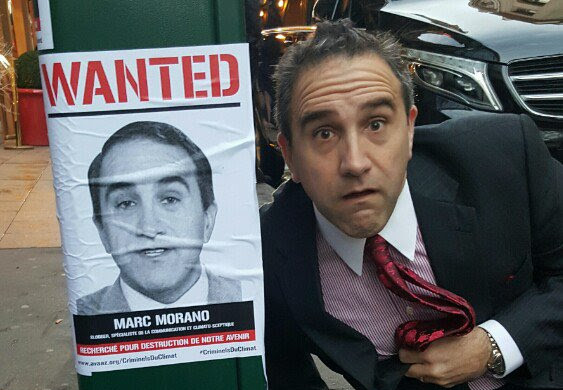
Marc Morano posing with his ‘Climate Criminal’ wanted poster in the streets of Paris
Ukraine Bans Eight Reporters From Covering Odessa Massacre Anniversary
Sputnik – 02.05.2016
ODESSA — Eight foreign reporters were prohibited from entering the southern Ukrainian city of Odessa to cover the events commemorating the second anniversary of the massacre in the city, a lawyer representing one of the people accused of involvement in the deadly events said Monday.
“About eight journalists were not allowed to enter [the city],” Kirill Shevchuk told RIA Novosti.
He added that the reporters, including those from Poland, France, the Netherlands and Germany, were turned back at passport control in Odessa’s airport.
On May 2, 2014, pro-Kiev radicals blocked anti-government protesters in Odessa’s House of Trade Unions and set the building on fire by hurling Molotov cocktails inside. According to the official data, 48 people died and more than 250 were injured in the fire. No perpetrators have been brought to justice.
The mourning rally was scheduled for 2 p.m. local time (11:00 GMT), but because of an alleged bomb threat local authorities blocked the access to the tragedy site for people who wanted to commemorate the victims of the massacre.
UK Labour leader refuses to denounce Hamas, Hezbollah
Press TV – May 2, 2016
Britain’s Labour Party Leader Jeremy Corbyn has refused to give in to calls from Israeli officials and British Jewish figures to denounce Islamic resistance movements Hamas and Hezbollah, vowing to continue talking to the two groups.
The leader of the opposition has come under pressure from a number of Labour lawmakers, Israeli Ambassador to London Mark Regev and Jewish leaders in the UK to distance himself from Labour politicians’ recent remarks condemning Israeli crimes against Palestinians, as well as groups fighting against the Tel Aviv regime’s occupation of the Palestinian lands.
Labour MP Naz Shah resigned as an aide to the party’s shadow chancellor last week after being forced to apologize for backing calls for Israel to “relocate” to the United States.
Also last week, the Labour Party suspended former London Mayor Ken Livingston after he defended Naz Shah in BBC interview and criticized the British media for ignoring Israeli war crimes against the Palestinian people. Livingston also said that Nazi leader Adolf Hitler had been a Zionist early in his political career.
Following these developments, Israeli figures accused the Labour Party leader of being soft on “anti-Semitism” in the party, which was forced to launch an inquiry into how to tackle the issue.
On Monday, Israel’s opposition leader Tzipi Livni said that Britain should condemn “anti-Semitism for the sake of its own core values.”
Israeli Ambassador Regev called on Corbyn to denounce Hamas and Hezbollah and pay a visit to Tel Aviv to build bridges.
Regev referred to Corbyn’s earlier support for the Islamic resistance movements, which were labeled as terrorist organizations by Britain.
A number of British Jews also urged Corbyn to display clarity about having relations with the two groups.
In response to the ongoing calls to reject Hamas and Hezbollah, Corbyn’s spokesman issued a statement on Sunday, saying, “Jeremy Corbyn has been a longstanding supporter of Palestinian rights and the pursuit of peace and justice in the Middle East through dialogue and negotiation.”
“He has met many people with whom he profoundly disagrees in order to promote peace and reconciliation processes, including in South Africa, Latin American, Ireland and the Middle East,” the statement added, noting that it is essential to talk to people “with whom he profoundly disagrees in order to promote peace and reconciliation processes, including in South Africa, Latin American, Ireland and the Middle East.”
“Simply talking to people who agree with you won’t help achieve justice or peace,” it added.
Corbyn has in the past called for the participation of Hamas and Hezbollah for a settlement of the conflict in the Middle East and highlighted the role of Iran in the regional issues. He has also referred to the two movements as “friends.”

UK Labour Party in Grip of Zionist Inquisition
By Stuart Littlewood | Dissident Voice | April 29, 2016
The orchestrated smear campaign against pro-Palestine sympathisers sent me reaching for my pen. But Gilad Atzmon too was eyeing the Labour Party’s crazed witch hunt for “antisemites” with misgiving and had already declared, in his usual robust way, that Labour under Jeremy Corbyn was not so much a party as a piece of Zionist-occupied territory.
Writing in his blog about Corbyn and McDonnell’s servile commitment to expel anyone whose remarks might be interpreted by Zionist mafioso as hateful or simply upsetting to Jews, Atzmon concludes: “Corbyn’s Labour is now unequivocally a spineless club of Sabbos Goyim” [which I take to mean non-Jewish dogsbodies who do menial jobs that Jews are forbidden to do for religious reasons].
“The Labour party’s policies,” says Atzmon, “are now compatible with Jewish culture: intolerant to the core and concerned primarily with the imaginary suffering of one people only. These people are not the working class, they are probably the most privileged ethnic group in Britain. Corbyn’s Labour is a Zionist Occupied Territory… It proves my theses that the Left is not a friend to Palestine, the oppressed or the workless people.
“I would have never believed that Jeremy Corbyn would engage in such colossally treacherous politics. I did not anticipate that Corbyn would become a Zionist lapdog. Corbyn was a great hope to many of us. I guess that the time has come to accept that The Left is a dead concept, it has nothing to offer.”
This writer too is shocked after signing up as a supporter (though not a member) of the Labour Party with the express purpose of voting in the leadership election for that beacon of common sense, that staunch champion of high ideals, that great white hope who would start a revolution in British politics and sweep away the crap and corruption left behind by Blair and Brown.
Boy, was I in for a disappointment!
And the latest casualty in this ugly Zionist power-play is former mayor of London Ken Livingstone. In a heated public spat with one of the party’s chief inquisitors, MP John Mann, he had the temerity to defend a female MP, Naz Shah, who had fallen foul of the party’s antisemitism police for comments made on Facebook before becoming an MP. She had suggested that Israel be transferred to the United States. She apologised profusely, but Labour’s Israel lobby went ballistic after raking up this old remark. Had they forgotten that their hero, David Ben-Gurion, himself, was mad-keen on population transfer… of Palestinian Arabs, that is? So what’s to get excited about? Mann happens to be chair of the All-Party Parliamentary Group on Antisemitism. One-sidedness is the name of his game.
What seems to have generated the greatest sound and fury is this observation by Livingstone: “When Hitler won his election in 1932 his policy then was that Jews should be moved to Israel. He was supporting Zionism before he went mad and ended up killing six million Jews.”
Joan Ryan MP, Chair of Labour Friends of Israel, said: “To speak of Zionism – the right of the Jewish people to self-determination – and Hitler in the same sentence is quite breathtaking. I am appalled that Ken Livingstone has chosen to do so…. He should be suspended from the Labour Party immediately.”
It scarcely needs saying that Zionism may mean self-determination for the Jewish people but it has cruelly denied the Palestinians their right to self-determination for decades. Nevertheless Livingstone is suspended from the party after 47 years.
President of the Board of Deputies of British Jews Jonathan Arkush can be relied on to put in his two-pennyworth on these occasions, and he didn’t disappoint: “Ken Livingston’s comments were abhorrent and beyond disgraceful. His latest comments combine Holocaust revisionism with antisemitism denial, when the evidence is there for all to see. He lacks any sense of decency. He must now be expelled from the Labour Party.”
And on the suspension of Naz Shah, Arkush was in overdrive: “If the Labour party is to re-establish its credibility on this issue, it needs to take four important steps forward:
First, there must be a credible inquiry into the entire Naz Shah episode. Secondly, the party has to take effective measures to eradicate antisemitism wherever it occurs within its membership. Thirdly, the leader must make it clear that allegations of antisemitism are not to be dismissed as arguments about Israel. Fourthly, Jeremy Corbyn must now respond to our repeated calls for him to accept that his meetings with rank antisemites before he became leader were not appropriate and will not be repeated.
Witch hunters’ balloon pricked
Whether Livingstone’s claim that Hitler was a Zionist is correct, I know not and care not. He presumably checked his facts and was itching to score with this mischievous titbit. Whether that was a wise thing to do is a matter for idle chatter, not expulsion. Meanwhile Zio hotheads inside and outside the party would do well to pay attention to the The Jewish Socialists’ Group, which has some sound advice for them and sticks a pin in their not-so-pretty balloon with this measured statement:
Antisemitism and anti-Zionism are not the same. Zionism is a political ideology which has always been contested within Jewish life since it emerged in 1897, and it is entirely legitimate for non-Jews as well as Jews to express opinions about it, whether positive or negative. Not all Jews are Zionists. Not all Zionists are Jews.
Criticism of Israeli government policy and Israeli state actions against the Palestinians is not antisemitism. Those who conflate criticism of Israeli policy with antisemitism, whether they are supporters or opponents of Israeli policy, are actually helping the antisemites. We reject any attempt, from whichever quarter, to place legitimate criticism of Israeli policy out of bounds.
Accusations of antisemitism are currently being weaponised to attack the Jeremy Corbyn-led Labour party with claims that Labour has a “problem” of antisemitism. This is despite Corbyn’s longstanding record of actively opposing fascism and all forms of racism, and being a firm supporter of the rights of refugees and of human rights globally.
A very small number of such cases seem to be real instances of antisemitism. Others represent genuine criticism of Israeli policy and support for Palestinian rights, but expressed in clumsy and ambiguous language, which may unknowingly cross a line into antisemitism. Further cases are simply forthright expressions of support for Palestinian rights, which condemn Israeli government policy and aspects of Zionist ideology, and have nothing whatsoever to do with antisemitism.
The JSG goes further and suggests that the attacks come from four main sources – the Conservative Party, Conservative-supporting media and pro-Zionist Israeli media sources, right-wing and pro-Zionist elements claiming to speak on behalf of the Jewish community, and opponents of Jeremy Corbyn within the Labour party. These groups make common cause to wreck the Corbyn leadership, divert attention from Israeli government crimes and discredit those who dare to criticise Israeli policy or the Zionist enterprise.
In short, the JSG says what needs to be said and puts the witchfinder-generals firmly in their place.
Of course, if Labour – or the Conservatives – truly wished to be squeaky-clean in matters of racism they would disband their Israel fan clubs (i.e. Friends of Israel) and suspend all who refuse to condemn Israel’s brutal acts of ethnic cleansing and other war crimes. If people holding public office put themselves in a position where they are influenced by a foreign military power, they flagrantly breach the Principles of Public Life. There are far too many Labour and Conservative MPs and MEPs who fall into that category.
The Labour Party announced today it is considering reviewing its rules to send a clear message of zero-tolerance on antisemitism. For balance, why not match this with zero-tolerance of those who use the party as a platform for promoting the criminal Israeli regime and its continuing territorial ambitions? Go on, Labour, prove Atzmon wrong… prove the party is not Zionist occupied territory.
Stuart Littlewood’s book Radio Free Palestine, with Foreword by Jeff Halper, can now be read on the internet by visiting radiofreepalestine.org.uk.
Featured Video
Dan Dicks with James Corbett on Solutions Watch
or go to
Aletho News Archives – Video-Images
From the Archives
MMR (Measles, Mumps and Rubella) – Vaccine Risk Statement
MMR Vaccine (Measles, Mumps, and Rubella) Is It Safer Than Measles, Mumps and Rubella?
Physicians for Informed Consent | December 2024
… It has not been proven that the MMR vaccine is safer than measles, mumps, and rubella. The vaccine package insert raises questions about safety testing for cancer, genetic mutations, and impaired fertility. Although VAERS tracks some adverse events, it is too inaccurate to measure against the risk of measles, mumps, and rubella. Clinical trials do not have the ability to detect less common adverse reactions, and epidemiological studies are limited by the effects of chance and possible confounders. Safety studies of the MMR vaccine are particularly lacking in statistical power. A review of more than 60 MMR vaccine studies conducted for the Cochrane Library states, “The design and reporting of safety outcomes in MMR vaccine studies, both pre- and post-marketing, are largely inadequate.”19 Because permanent sequelae (aftereffects) from measles, mumps, and rubella are so rare (especially in children with normal levels of vitamin A and infected after birth),6,15-17 the level of accuracy of the research studies available is insufficient to rule out the possibility that the MMR vaccine causes greater death or permanent disability than measles, mumps, and rubella. – Read full article
Blog Roll
 Aletho News
- The fallacy of US delusions about Iran’s economic collapse
- Hezbollah denies Syria cell link, warns of Israeli plan to sow discord
- The legacy of US sanctions, war, and occupation in Iraq
- Iraqi resistance group rejects disarmament, vows to maintain support for Lebanon
- Sheikh al-Asadi warns of Iraqi government compliance with US demands
- How to MAKE THE CONSPIRATORS PAY for their crimes! Dan Dicks with James Corbett on Solutions Watch
- There’s a drought in academia: A drought in honest research on the subject of drought and other weather extremes
- Department of War Awards $20.7 Billion Contract to Raytheon for Air-to-Air Missiles
- ‘Distance yourselves from Israel’: IRGC urges US population to question govt policies
- America’s Greenland deal has a radioactive backstory
- If Americans Knew
- New Report: “Scholasticide and Genocide in Gaza: Assessment, Testimonies and Legal Analysis”
- Ex-Biden officials are desperate for a Gaza scapegoat
- Israeli “settlers” Invade Al-Aqsa; Pour Boiling Water on 75-Year-Old
- Israel Has Kidnapped Another American Teenager
- US arms sales to Israel worth $21.6 billion in 20 months
- Three Palestinians Killed in Israeli Attacks on Gaza
- Revealed: German “Anti-Semitism Expert” Driving Crackdown on Palestine Solidarity is Former Israeli Spy
- Egypt’s Warning to Israel Before Oct 7
- Israel’s siege signals another cruel winter for 1.8 million Gazans – Daily Update
- Netanyahu Asked UAE Leader to Deny Report on Oct. 7 Warning in Secret Visit, Sources Say
- No Tricks Zone
- Two More Paleo Reconstructions Affirm Meters-Higher Sea Levels Across Ireland, Brazil 7000-6000 Years Ago
- New Study: Earth And Venus Surface Warmth Largely Explained By Convection And Lapse Rate, Not CO2 Or Radiation
- 2025 Nature Paper Claiming Worsening Global Drought Gets RETRACTED …Heavily Flawed
- New Study: ‘Global Drought Shows No Detectable Recent Acceleration Under Climate Warming’
- Economic Masterminds: German Socialists Suggest Taxing Productivity Gains Stemming From Using AI
- The South China Sea Has Not Been Cooperating With The Climate Change Narrative
- Energy Crisis: Germany Enters Heating Season With Historically Low Gas Reserve Fill Levels
- New Study: The Antarctic Ice Sheet Gained Mass From 2020-2024 Due To Staggering Snow And Ice Accumulation
- Study: Ocean Heating Rates From Thousands Of Years Ago ‘Dwarf’ Modern Ocean Heating Rates
- Climate Extremists Target, Attack Large-Scale Power Grid Infrastructure In Germany!

