Documents Reveal Anaheim, CA Has Surprisingly Robust Surveillance Arsenal For Small City
By Matthew Cagle | ACLU | January 27, 2016
Anaheim Police have spent almost a decade secretly building an inventory of powerful cell phone surveillance devices and making them available to neighboring cities in Orange County, documents obtained by the ACLU of California reveal.
This cell phone spying program—which potentially affects the privacy of everyone from Orange County’s 3 million residents to the 16 million people who visit Disneyland every year—shows the dangers of allowing law enforcement to secretly acquire surveillance technology. The devices include the suitcase-sized “Stingray” equipment, another hand-held and easy-to-hide cell phone spy tool, and—most surprisingly—a military-grade piece of equipment known as a “dirtbox” that until now was only thought to be used by the federal government and two major cities.
If a city of only a few hundred thousand people like Anaheim has purchased this wide array of devices, it raises the question of how widespread these tools really are.
Additionally, Anaheim has claimed in its secretive funding requests that “every city in Orange County has benefited” from its cellular surveillance equipment, raising further concerns about transparency, democracy, and accountability. It’s bad enough that Anaheim’s secretive acquisition of this surveillance technology deprived the city’s residents of the opportunity to participate in critical decisions affecting their own community. But by loaning out this technology well outside Anaheim’s borders, the police department has subjected people all over Orange County to surveillance decisions made by unelected leaders from other communities.
A cell site simulator, often referred to as “Stingray,” mimics a cell tower and tricks nearby cell phones into communicating with it. In order to function, these devices interact with all cell phones in radio range, which means they potentially retain data about the communications and locations of innocent people.
Although federal, state and local governments widely use cell cite simulators, governments have gone to great lengths to hide information about how those simulators work and are used. Anaheim’s secrecy here is not an accident. The city and its departments bought these devices in secret and initially refused the ACLU’s request for public records. Only after we filed a public records lawsuit and engaged in extensive discussions did Anaheim produce any documents, which were heavily redacted—an on-going point of contention in our lawsuit.
What the documents show
Anaheim has possessed at least three different forms of cell phone surveillance technology since at least 2009, the documents show. The police department used a federal grant that year to purchase a dirtbox from a Maryland-based company named Digital Receiver Technology, Inc., or DRT. A dirtbox can collect information about thousands of phones at once, and a predecessor version of Anaheim’s device is capable of intercepting and recording digital voice data, according to a classified catalog recently leaked to the media. Other dirtbox models are capable of breaking the encryption of cellphone communications, according to media reports. One of the unique features of a dirtbox is that it can be airborne, and as a consequence scoop up information from not just a few hundred phones in its vicinity, but from thousands of phones. Until now, the only reported domestic use of these powerful devices was by the federal government and the cities of Los Angeles and Chicago.
In 2011, two years after buying the dirtbox, Anaheim appears to have bought a Stingray from Florida-based Harris Corp using a combination of federal grant dollars and local funds. And in 2013, Anaheim’s Chief of Police approved an upgrade to the department’s Stingray the ACLU believes enabled it to monitor modern LTE cellular networks.
Finally, in late 2013 Anaheim also purchased a controversial hand-held cell phone surveillance device manufactured by a company called KEYW and marketed as a tool for covertly locating phones and LTE signals in hard-to-reach places, including the interiors of buildings. The documents turned over to the ACLU, when compared with publicly available price quotes, strongly suggest that Anaheim bought a device called a Jugular. With a lightweight Jugular in hand, individual officers can easily conduct cell phone surveillance around and inside of buildings, including private homes, without alerting bystanders.
Potential warrantless use
The documents obtained in the public records suit do not confirm whether Anaheim police investigators obtain a warrant before using these devices. The records state that Anaheim obtains a “court order” or “court approval” for use of the DRT, KEYW, and Harris devices, but a court order is not necessarily based on probable cause, as is required for a warrant. This is important because devices like the KEYW Jugular can be used to find devices in hard-to-access spaces, such as the interiors of homes where people have the right to be secure from unreasonable searches under the Fourth Amendment.
The ACLU documents predate CalECPA, the new California law requiring a warrant for these devices. We do not know what legal process Anaheim seeks for cell phone surveillance today.
The ever-expanding use of these devices appears to go beyond Anaheim’s city limits. Anaheim represented in funding requests that it makes its cell surveillance arsenal available to other police departments in Orange County and had written procedures for sharing the dirtbox. The secretive use of this equipment outside of Anaheim means the police department not only deprived its own residents of the opportunity to debate or choose whether to be subjected to cell phone surveillance, it also did the same for the residents and elected leaders in neighboring jurisdictions, undermining the democratic process in those places as well.
It’s time for reform
Law enforcement entities should never acquire surveillance technology without telling the public, let alone multiple generations of devices capable of spying on private communications, as these Anaheim documents show has happened there.
Anaheim’s slide towards more and more surveillance illustrates the risks of secret surveillance outside of the democratic process. But communities are fighting back. As federal and state policymakers pass new restrictions on cell surveillance devices, local communities are moving forward with surveillance reforms that range from robust use policies for Stingrays to civilian oversight communities to an ordinance that requires transparency, accountability, and oversight for all surveillance technologies.
The ACLU is hopeful these reforms will take hold in places like Anaheim too so that when police seek the next generation of surveillance technologies, it won’t take the public seven years and a lawsuit to find out about it.
Read the Anaheim cell phone surveillance documents the ACLU received.
This is a condensed version of a post originally published by the ACLU of Northern California.
Online Thought Crimes: Cops Visit Critics of Dutch Migration Policy
Sputnik – 28.01.2016
Police in the Netherlands now prefer not to think twice before visiting homes of those who criticize a government policy on migrants, including via social networks, media reports said.
Critiquing the Dutch government’s policy on migrants via social networking websites and elsewhere is now considered a criminal offense in Holland. Dutch police have raided critics’ homes, media outlets reported, citing a recent mass protest in the town of Kaatsheuvel and how some citizens of the town of Sliedrecht had been targeted by the authorities for voicing their criticism of mass migration online.
Earlier this month, hundreds of residents of Kaatsheuvel took to the streets to protest the local authorities’ plans to house at least 1,200 migrants in their town. They carried placards with slogans reading “You do not belong here” and “No to the refugees.”
The government retaliated by sending local police to the addresses of those who had participated in the protest and inspecting their social media accounts.
A police spokesperson admitted that visits to the protesters and requests to delete anti-government posts on social networking websites are “unusual” practices, but maintained that police will continue to monitor the protesters’ accounts in order to uncover the further intentions of their authors.
In an interview with RT, one of the protesters said that police had arrived at his door and asked him if he wanted to remove his Facebook post criticizing the authorities’ migrant asylum policy.
“But my message has already disappeared, and I think it was [removed] earlier by police or Facebook itself. A police officer told me that apart from me, he was due to visit five more protesters. They want us to keep mum and refrain from discussing the topic,” he said.
Robin Tilbrook, leader of the English Democrats Party condemned the activity of the Dutch police as illegal.
“Trying to shut people’s mouths is a totally undemocratic and possibly illegal approach. This is nothing but an attempt to bully people who simply expressed concern about the situation [with migrants],” Tilbrook said.
Meanwhile, the Dutch newspaper De Volkskrant has reported that in the past few months, more asylum seekers have voluntarily left the Netherlands, in what can be seen as a show of disappointment with the country’s system for granting refugees asylum.According to the newspaper, about 3,000 asylum seekers decided to leave the Netherlands in 2015. The newspaper said that the main reason for their disappointment was that obtaining refugee status had been too time consuming and left them with few guarantees that they would be reunited with their families.
Life Terms for Turkish Journalists who Reported Shipping Arms to Syria Militants
Al-Manar | January 27, 2016
Turkish prosecutors demanded life sentences for two top journalists who reported that President Recep Tayyip Erdogan’s government tried to ship arms to insurgents in Syria.
Prosecutors asked the Istanbul court to sentence Cumhuriyet newspaper’s editor-in-chief Can Dundar and Ankara bureau chief Erdem Gul each to one aggravated life sentence, one ordinary life sentence and 30 years in jail, the Dogan news agency reported, quoting the indictment.
The report said that both Erdogan and his hugely powerful but low-profile ally, the head of the National Intelligence Organization (MIT) Hakan Fidan, are named as plaintiffs in the indictment.
Dundar and Gul were both placed under arrest in late November over the report earlier in the year that claimed to show proof that a consignment of weapons seized at the border in January 2014 was bound for Takfiri militants in Syria.
Since then, they have both been held in the Silivri jail on the outskirts of Istanbul ahead of their trial, whose date has still yet to be announced.
In the indictment, they have been formally charged with obtaining and revealing state secrets “for espionage purposes” and seeking to “violently” overthrow the Turkish government as well as aiding an “armed terrorist organization”, it said.
The penalties demanded by the prosecutors are significantly higher than had previously been expected.
The case has amplified concerns about press freedom under the rule of Erdogan, who had personally warned Dundar he would “pay a price” over the front-page story.
Documents Uncover NYPD’s Vast License Plate Reader Database
By Mariko Hirose | NYCLU | January 25, 2016
Supporters of license plate readers are fond of saying that unless you’re a criminal, you needn’t fear the invasive technology. But those who adhere to that argument should consider just a few examples from around the country:
- A police officer in Washington D.C. pleaded guilty to extortion after looking up the plates of cars near a gay bar and blackmailing the car’s owners.
- The DEA contemplated using license plate readers to monitor people who were at a gun show. Since the devices can’t distinguish between those who are selling illegal guns and those who aren’t, a person’s presence at the gun show would have landed them in a DEA database.
- A SWAT team in Kansas raided a man’s house where his wife, 7-year-old daughter, and 13-year-old son lived based in part on the mass monitoring of cars parked at a gardening store. The man was held at gunpoint for two hours while cops combed through his home. The police were looking for a marijuana growing operation. They did not find that or any other evidence of criminal activity in the man’s house.
With these stories firmly in mind, the New York Civil Liberties Union’s latest license plate reader discovery is all the more chilling.
Last year, we learned that the NYPD was hoping to enter into a multi-year contract that would give it access to the nationwide database of license plate reader data owned by the company Vigilant Solutions. Now, through a Freedom of Information Law request, the NYCLU has obtained the final version of the $442,500 contract and the scope-of-work proposal that gives a peek into the ever-widening world of surveillance made possible by Vigilant.
Surveillance is about power. Vigilant gives the NYPD power to monitor our whereabouts and, by extension, our affiliations, interests, activities and beliefs.
The scope-of-work proposal explains how Vigilant vastly expands the NYPD’s surveillance capability beyond what was possible with its own license plate database. Known as the Domain Awareness System, it collects the license plate data scanned by the approximately 500 license plate readers operated by the NYPD and combines it with footage from cameras and other surveillance devices around the city. The NYPD holds on to the license plate data for at least five years regardless of whether a car triggers any suspicion.
The Vigilant database raises similar privacy concerns as the Domain Awareness System, but those concerns are greatly magnified because the Vigilant database is massive: It contains over 2.2 billion location data points, and it is growing by almost a million data points per day. The database also isn’t limited to New York City, which means the NYPD can now monitor your car whether you live in New York or Miami or Chicago or Los Angeles. (See Vigilant’s Nationwide Scan Density Map on page 64.) Even more worrisome, the data comes from private license plate readers that scan locations that the police are less likely to scan: residential areas, apartment complexes, retail areas, and business office complexes with large employee parking areas. And, as far as we can tell, there is no limit on how long Vigilant keeps all of this private location data. There is no incentive for Vigilant to delete any data because its business model is to profit off of selling people’s data.
The Vigilant database also boasts “full suite data analytics tools.” These tools allow police officers to track cars historically or in real time, conduct a virtual “stakeout,” figure out which cars are commonly seen in close proximity to each other, and predict likely locations to find a car.
With this volume of private data and these types of tools, Vigilant enables the NYPD to learn intimate details about people’s lives with a click of a mouse. Through the “stakeout” feature, the NYPD may learn who was at a political rally, at an abortion clinic, or at a gay bar. Through the predictive analysis, the NYPD may learn that a person is likely to be near a mosque at prayer time or at home during certain hours of the day. Through the “associate analysis,” the NYPD may come to suspect someone of being a “possible associate” of a criminal when the person is simply a family member, a friend, or a lover.
Until now, law enforcement agencies under contract with Vigilant, including the NYPD, have said very little in public about how they use the database and what privacy protections they implement. That needs to change. Fifty police officers at the NYPD’s Real Crime Center have access to the Vigilant database and tools every day. The public has the right to know what rules regulate their access and what oversight mechanisms, if any, are in place. They have the right to know when and how the police are using the database and what the consequences are.
Surveillance is about power. Vigilant gives the NYPD power to monitor our whereabouts and, by extension, our affiliations, interests, activities and beliefs. By demanding answers to critical questions about NYPD’s use of Vigilant and other surveillance tools, New Yorkers can begin to take back the power imbalance created by the new era of mass digital surveillance.
“No Cost” License Plate Readers Turn Texas Police into Mobile Debt Collectors and Data Miners
By Dave Maass | EFF | January 26, 2016
Vigilant Solutions, one of the country’s largest brokers of vehicle surveillance technology, is offering a hell of a deal to law enforcement agencies in Texas: a whole suite of automated license plate reader (ALPR) equipment and access to the company’s massive databases and analytical tools—and it won’t cost the agency a dime.
Even though the technology is marketed as budget neutral, that doesn’t mean no one has to pay. Instead, Texas police fund it by gouging people who have outstanding court fines and handing Vigilant all of the data they gather on drivers for nearly unlimited commercial use.
ALPR refers to high-speed camera networks that capture license plate images, convert the plate numbers into machine-readable text, geotag and time-stamp the information, and store it all in database systems. EFF has long been concerned with this technology, because ALPRs typically capture sensitive location information on all drivers—not just criminal suspects—and, in aggregate, the information can reveal personal information, such as where you go to church, what doctors you visit, and where you sleep at night.
Vigilant is leveraging H.B. 121, a new Texas law passed in 2015 that allows officers to install credit and debit card readers in their patrol vehicles to take payment on the spot for unpaid court fines, also known as capias warrants. When the law passed, Texas legislators argued that not only would it help local government with their budgets, it would also benefit the public and police. As the bill’s sponsor, Rep. Allen Fletcher, wrote in his official statement of intent:
[T]he option of making such a payment at the time of arrest could avoid contributing to already crowded jails, save time for arresting officers, and relieve minor offenders suddenly informed of an uncollected payment when pulled over for a routine moving violation from the burden of dealing with an impounded vehicle and the potential inconvenience of finding someone to supervise a child because of an unexpected arrest.
The bill was supported by the criminal justice reform groups such as the Texas Criminal Justice Coalition, but it also raised concerns by respected criminal justice blogger Scott Henson of Grits For Breakfast, who theorized that the law, combined with ALPR technology, could allow police officers to “cherry pick drivers with outstanding warrants instead of looking for current, real-time traffic violations.”
He further asked:
Are there enough departments deploying license plate readers to cause concern? Will they use them in such a fashion? How will anyone know? Is it possible to monitor—or better, measure—any shift in on-the-ground police priorities resulting from the new economic incentives created by the bill?
As it turns out, contracts between between Vigilant and Guadalupe County and the City of Kyle in Texas reveal that Henson was right to worry.
The “warrant redemption” program works like this. The agency gets no-cost license plate readers as well as free access to LEARN-NVLS, the ALPR data system Vigilant says contains more than 2.8-billion plate scans and is growing by more than 70 million scans a month. This also includes a wide variety of analytical and predictive software tools.
The government agency in turn gives Vigilant access to information about all its outstanding court fees, which the company then turns into a hot list to feed into the free ALPR systems. As police cars patrol the city, they ping on license plates associated with the fees. The officer then pulls the driver over and offers them a devil’s bargain: go to jail, or pay the original fine with an extra 25% processing fee tacked on, all of which goes to Vigilant.1 In other words, the driver is paying Vigilant to provide the local police with the technology used to identify and then detain the driver. If the ALPR pings on a parked car, the officer can get out and leave a note to visit Vigilant’s payment website.
But Vigilant isn’t just compensated with motorists’ cash. The law enforcement agencies are also using the privacy of everyday drivers as currency.

From Vigilant Solutions contract with City of Kyle
Buried in the fine print of the contract with Vigilant is a clause that says the company also get to keep a copy of all the license-plate data collected by the agency, even after the contract ends. According the company’s usage and privacy policy, Vigilant “retains LPR data as long as it has commercial value.” Vigilant can sell or license that information to other law enforcement bodies, and potentially private companies such as insurance firms and repossession agencies.
In early December 2015, Vigilant issued a press release bragging that Guadalupe County had used the systems to collect on more than 4,500 warrants between April and December 2015. In January 2016, the City of Kyle signed an identical deal with Vigilant. Soon after, Guadalupe County upgraded the contract to allow Vigilant to dispatch its own contractors to collect on capias warrants.
Alarmingly, in December, Vigilant also quietly issued an apology on its website for a major error:
During the second week of December, as part of its Warrant Redemption Program, Vigilant Solutions sent several warrant notices – on behalf of our law enforcement partners – in error to citizens across the state of Texas. A technical error caused us to send warrant notices to the wrong recipients.
These types of mistakes are not acceptable and we deeply apologize to those who received the warrant correspondence in error and to our law enforcement customers.
Vigilant is right: this is not acceptable. Yet, the company has not disclosed the extent of the error, how many people were affected, how much money was collected that shouldn’t have been, and what it’s doing to inform and make it up to the people affected. Instead, the company simply stated that it had “conducted a thorough review of the incident and have implemented several internal policies.”
We’re unlikely to get answers from the government agencies who signed these contracts. To access Vigilant’s powerful online data systems, agencies agree not to disparage the company or even to talk to the press without the company’s permission:

From Vigilant Solutions LEARN-NVLS User Agreement
You shall not create, publish, distribute, or permit any written, electronically transmitted or other form of publicity material that makes reference to the LEARN LPR Database Server or this Agreement without first submitting the material to Vigilant and receiving written consent from Vigilant thereto…
You agree not to use proprietary materials or information in any manner that is disparaging. This prohibition is specifically intended to preclude you from cooperating or otherwise agreeing to allow photographs or screenshots to be taken by any member of the media without the express consent of LEARN-NVLS. You also agree not to voluntarily provide ANY information, including interviews, related to LEARN products or its services to any member of the media without the express written consent of LEARN-NVLS.
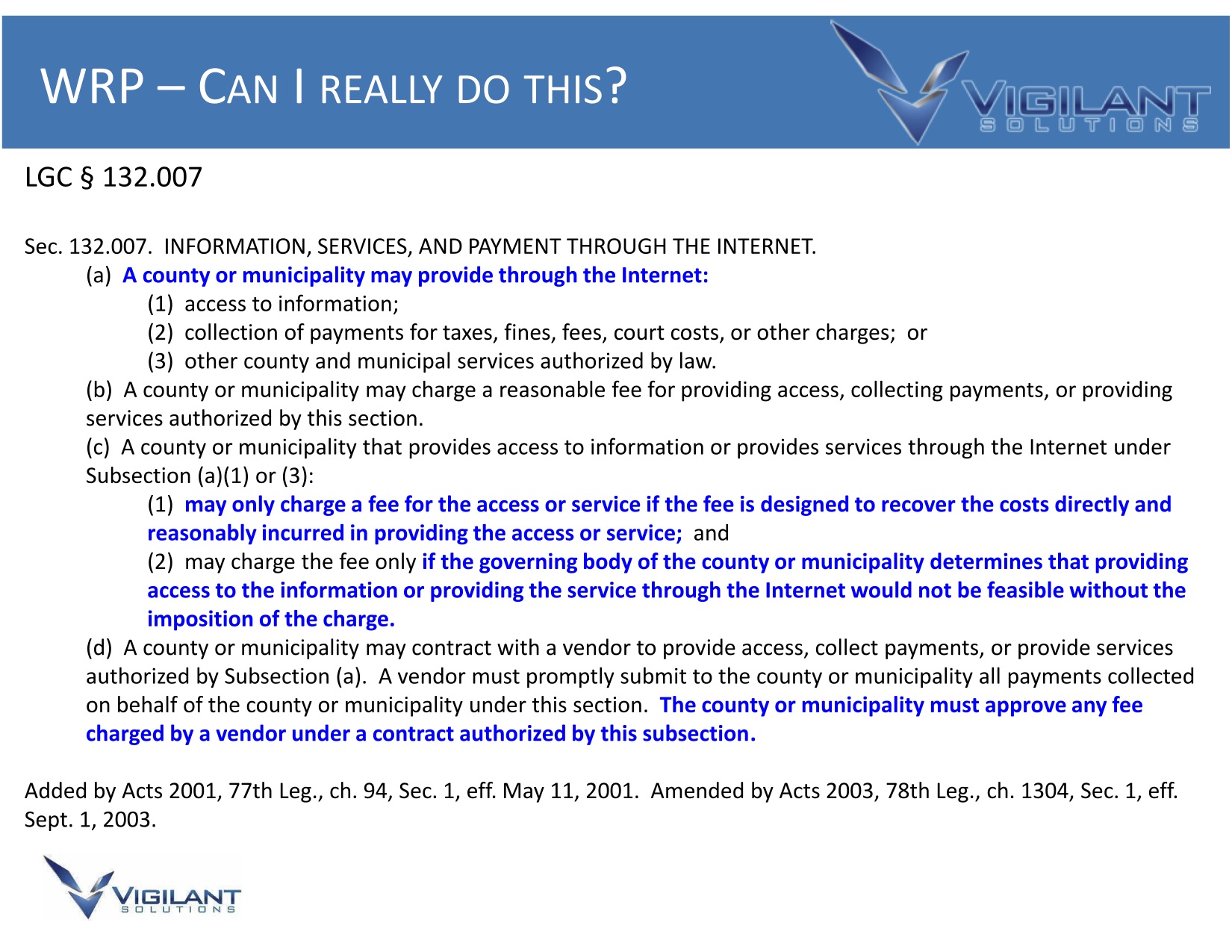
You might very well ask at this point about the legality of this scheme. Vigilant anticipated that and provided the City of Kyle with a slide titled “Can I Really Do This?” which cited a law that they believe allows for the 25% surcharge.
The law states that a county or municipality “may only charge a fee for the access or service if the fee is designed to recover the costs directly and reasonably incurred in providing the access or service.”
We believe that a 25% fee is not reasonable and doesn’t recover just the direct costs, since the fee is actually paying for the whole ALPR system, including surveillance capabilities unrelated to warrant redemption, such as access to the giant LEARN-NVLS database and software suite.
Beyond that, the system raises a whole host of problems:
- It turns police into debt collectors, who have to keep swiping credit cards to keep the free equipment.
- It turns police into data miners, who use the privacy of local drivers as currency.
- It not-so-subtly shifts police priorities from responding to calls and traffic violations to responding to a computer’s instructions.
- Policy makers and the public are unable to effectively evaluate the technology since the contract prohibits police from speaking honestly and openly about the program.
- The model relies on debt: there’s no incentive for criminal justice leaders to work with the community to reduce the number of capias warrants, since that could result in losing the equipment.
- People who have committed no crimes whatsoever have their driving patterns uploaded into a private system and no opportunity to control or watchdog how that data is disseminated.
There was a time where companies like Vigilant marketed ALPR technology as a way to save kidnapped children, recover stolen cars, and catch violent criminals. But as we’ve long warned, ALPRs in fact are being deployed for far more questionable practices.
The Texas public should be outraged at the terrible deals their representatives are signing with this particular surveillance contractor, and the legislature should reexamine the unintended consequences of the law they passed last year.
- 1. The contracts are inconsistent on how this fee breaks down. For example, the City of Kyle contract lists 5% of “credit card processing,” 5% for “credit card handling,” and 15% for a “vendor transaction fee.”
544 Egyptians arrested ahead of revolution anniversary
MEMO – January 25, 2016
Some 544 people have been arrested in Egypt since the start of the year, human rights activists have reported.
In exclusive comments to the Anadolu Agency, Ezzat Ghoneim, of the Egyptian Coordination for Rights and Freedoms, said: “Since the beginning of 2016, this association has flagged 544 detained people, including 34 cases of arrests that took place yesterday [Saturday] and 17 on Sunday, with all of the people involved in such cases still imprisoned.”
He pointed out that Saturday’s arrests were over “seven provinces: one in Cairo, two in Giza, 19 in Al-Gharbia, three in Al-Behairah, four in Aswan, four in Monoufia and one in Kafr El-Sheikh.”
Yesterday, “seven people were arrested in Alexandria and 10 in Ismailia,” Ghoneim said, adding that the organisation is monitoring all arrests.
“The charges range between issues related to demonstrations, incitement of violence, membership of an outlawed group, preparing to commemorate the January 25 Revolution of 2011, or taking part in the January revolution itself. However, we are not concerned with the detainees’ affiliations in our work,” Ghoneim added.
Israeli forces detain Palestinian lawmaker, former minister in Hebron
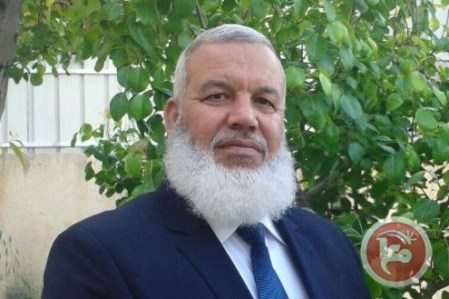
Palestinian security sources said Israeli forces detained Hatim Qafisha, a Hamas-affiliated member of the PLO’s Palestinian Legislative Council, from his home. (MaanImages)
Ma’an – January 24, 2016
HEBRON – Israeli forces detained at least six Palestinians, including a Palestinian lawmaker and a former Palestinian Authority minister, from their homes in the southern occupied West Bank district of Hebron overnight Sunday, Palestinian and Israeli sources told Ma’an.
Palestinian security sources said Israeli forces detained Hatim Qafisha, a Hamas-affiliated member of the PLO’s Palestinian Legislative Council, from his home in the Wadi al-Hariyya neighborhood of Hebron city.
Security sources added that unidentified assailants set fire to Qafisha’s private vehicle after he had been detained and Israeli forces had left the area.
Israeli forces also raided the Nimra neighborhood around dawn and detained Issa al-Jaabari, who served as the PA’s Minister of Local Governance in 2006.
Sources said Israeli forces blew the front doors off of al-Jaabari’s home before raiding the dwelling and detaining the former minister.
Furthermore, Israeli forces carried out a predawn raids in the al-Sheikh neighborhood of Hebron city and detained a former prisoner identified as Ibrahim Jamil Hassan after ransacking his home, along with several others in the neighborhood.
An Israeli army spokesperson did not confirm specific detentions, but said Israeli forces detained four Palestinians in Hebron city, all of which were reportedly detained for being “Hamas operatives.” The spokesperson added that two more Palestinians were detained in areas north and west of the city.
Israeli sniper shoots Canadian citizen in West Bank
American Herald Tribune | January 21, 2016
In describing what she calls a lack of symmetry in recent escalations in Israel and the West Bank, Canadian-Palestinian artist and PhD student Rehab Nazzal told The Real News, “You have the Israeli occupation forces armed with all forms of weapons, and you have the youth, mainly the youth in their 20s, mostly they were born during what’s called, between quotations, the peace process.”
Nazzal is describing Palestinians born during the Oslo Accord negotiations of the 1990s, who have been protesting across Israel, the occupied West Bank and Gaza since the summer–and suffering for it.
Since 1 October 2015, 155 Palestinians have been killed by Israeli forces. 24 Israelis have been also been killed, many in stabbing or car ramming attacks.
Nazzal was photographing an Israeli skunk truck in the West Bank–an armored crowd control vehicle that shoots putrid water–when an Israeli sniper shot and wounded her on 11 December, 2015. Medics were prevented from attending to her because rounds of teargas were shot consecutively at them by Israeli forces.
She is recovering still in the West Bank, and plans to continue her Canadian federal government research council-funded research into “non-lethal” and crowd-control weapons.
Nazal contextualizes her shooting among the countless other shootings across the West Bank. “I am one of over 16,000 Palestinians who were injured during the past three months. Among these, over 6,000 with live bullets. Just yesterday, here in my neighborhood where I am now, there were tens of Palestinians who were injured, one seriously with live bullets, and one was killed. He was shot in the chest and was killed yesterday. Today was his funeral. And the city is just buried with tear gas and all forms of aggression,” she said.
She continues to speak about the inequity of aggression between Palestinian youths throwing stones and Israeli forces quelling the demonstrations with live bullets and the inability of nations–even her own nation–to act. “It’s very difficult. And the worst part of it, that the world is silent.”
According to Nazzal’s lawyer Dimitri Lascaris, there is little legal recourse to take because of “something called a State Unity Pact, which effectively bars a lawsuit against the government of Israel or any other government for human rights violations,” Lascaris said, clarifying that he is referring to the Canadian courts. He adds that what is “appalling about this law is that it does not provide immunity for states when they engage in commercial activities. But they could commit crimes against humanity, war crimes, you know, some of the most heinous offenses under international human rights law, and they’re completely immune from suit in the domestic courts of our country.”
Nazzal and Lascaris do intend to painstakingly document the event of Nazzal’s shooting, and in particular the impediment of medics by Israeli forces. And using political power, Lascaris said, “we’re going to call upon the government of Justin Trudeau to fulfill its promise of a more principled foreign policy than the predecessor Harper government, which was absolutely and unequivocally committed to supporting the government of Israel, no matter what atrocities it committed.”
As yet, the new Canadian prime minister Justin Trudeau has not provided a statement of support for the Palestinian struggle and continues to remain a close ally of Israel.
Trudeau is also principally opposed to the Boycott, Divestment and Sanctions movement, a Palestinian civil society-led grassroots movement to call on companies to end their complicity with the Israeli occupation.
Nazzal describes her disappointment with the Canadian government’s lack of response–she is a Canadian citizen–as well as the lack of response from the Canadian ambassador to Israel.
“Not even a condemnation to what happened… If we suppose that the Israeli soldiers don’t know I am a researcher doing work, but I am an unarmed civilian and standing away, far from protesters, even this, we haven’t heard any word… from the Canadian ambassador in Israel or the foreign minister.
Which brings that hypocrisy to our human rights violations in other countries. Why, why Israel is not being questioned. I am, again, a Canadian citizen. I have my career, my children there. I have my life there. Yeah, I am just in disbelief, as well.”
Human Rights After Euromaidan
By Volodymyr Chemerys | CounterPunch | January 22, 2016
We have to admit: after winning ‘Euromaidan’, the human rights situation in Ukraine has deteriorated significantly.
This trend became apparent already in 2014, evidenced by a number of laws approved during the post-Maidan wave. In particular, we are talking about the law allowing preventive detention of citizens for thirty days, despite the fact that under the Constitution a person may be detained only for 72 hours. Also, changes have been made to the Criminal Code to enable cases to open against a Ukrainian citizen for making critical comments about the military draft of citizens in the “Anti-Terrorist Operation zone”.
In 2015, this trend continued. A law was passed on “de-communization” which is in conflict with a number of fundamental rights and freedoms guaranteed by the European Convention for the Protection of Human Rights and Fundamental Freedoms. These include freedom of assembly and association (Article 11 of the Convention), freedom of expression (Article 10) and freedom of speech.
As a consequence, in Ukraine there are a large number of political prisoners. In this regard, it should be emphasized that the people usually referred to as “political prisoners” in our media are typically representatives of right-wing organizations, arrested for the murder of a renowned journalist or involved in the grenade explosion near the Verkhovna Rada last August–in other words, people who are accused of committing serious criminal offenses.
The real political prisoners are journalists such as Ruslan Kotsaba, arrested and charged in early 2015 for expressing his views on the Internet, or communists such as Alexander Bondarchuk, who was distributing newspapers and leaflets containing oppositional texts. These are just two examples of many more that could be cited.
The situation of the right of peaceful assembly in Ukraine has also seriously deteriorated. On the one hand, courts in Ukraine do not make many decisions prohibiting public meetings. In some regions, including Kiev, local authorities generally do not make requests to the courts to restrict the freedom of peaceful assembly.
But on the other hand, the holding of peaceful assemblies on certain issues is today extremely dangerous. This is due to the threat of attack from the far right. Organizers often abandon planned assemblies due to the threats that they receive.
For these reasons, rallies against rising social service tariffs, the military draft or fascism, or rallies in favour of establishing civil peace, etc have been cancelled. On March 17, 2015 in Odessa, there was an attempt to organize a rally against tariff hikes in public transport, but the people who came out for it were surrounded by members of the right-wing groups, such as ‘Automaidan’ and ‘Oberig’ and only miraculously managed to avoid a serious clash.
And on January 19, the ultra-right disrupted a rally in Kyiv aimed to commemorate two Russian antifascists, the lawyers Stanislav Markelov and Anastasia Baburova who were killed in Russia in 2009.
It can be said that today in Ukraine, carrying out public actions advocating for social, political or economic rights is almost impossible. Actions in support of civil peace are immediately declared “separatist”. At the beginning of 2015 in Ukraine, there were large and frequent spontaneous demonstrations against military draft mobilizations. These were broad, grassroots initiatives by a dissatisfied population. But their organizers and participants have been hit with administrative penalties or, worse, have been tried in courts.
In general, it seems that the Parliament, the government and the president are able to offer the population nothing but usurious tariff increases, unemployment, anti-social reforms and further impoverishment. Dissatisfaction is increasingly punished by persecution. We are repeatedly told that that there is a war in our country, and the opposition should be imprisoned while “patriots” should be forgiven even for acts of murder because they kill so-called separatists. Never mind that members of the ‘Tornado’ and ‘Aidar’ battalions have tortured people – you must understand that they wanted to defend the rights and freedoms of Ukrainians!
Alas, this patriotic propaganda that dominates today in the Ukrainian society is, in fact, no different from the Russian variant. We have returned to the realities of the Soviet era, when it was impossible to freely express a point of view or watch this or that film. Ukraine has proscribed the Russian film ‘Irony of Fate’ and many other films. And the Institute of National Remembrance, a kind of ‘Ministry of Truth’, refused to give permission to register a newspaper called ‘Left March’ because the name is the same as the title of the well-known poem by the communist poet Vladimir Mayakovski.
So the human rights situation in Ukraine has deteriorated significantly and it is a real challenge for human rights activists to do their work. If similar things had happened during the regimes of Yanukovych (2010-14), Yushchenko (2005-09) and Kuchma (1994-2005), all human rights activists would unanimously have said that systemic violations of civil rights are taking place. If during the time of President Yanukovych, a journalist were placed on trial, an opposition political party were banned– as today the Communist Party is banned, or opposition parties were prevented from participating in local election, it would certainly have provoked a huge outcry among Ukrainian human rights activists.
Unfortunately, today, the powerful voices of human rights defenders are practically silent. This is due, first of all, to the fact that talking about such things is potentially dangerous. Critical voices run the risk of being labeled “agents of the Kremlin” or “separatists” by both the authorities and the members of ultra-right organizations.
Despite all this, there are human rights activists in Ukraine who are speaking out in favour of human rights, even if they face threats and harassment for doing so. Of note among such people is Tatiana Montyan.[1]
As a rule in such a situation, the loudest voices of human rights defenders are international human rights organizations, most notably, Human Rights Watch and Amnesty International. But in the case of the latter, its statements criticizing the Ukrainian government are coming mostly from the organization’s headquarters in London while its Ukrainian division maintains a certain politesse.
The Helsinki Union and Amnesty International in Ukraine issued statements in support of the aforementioned Ruslan Kotsaba. However, in comments to the published texts of the group, one reads many allegations that human rights defenders have “sold themselves to Putin” and so on, while in fact the same organizations – from Human Rights Watch and Amnesty International to the Organisation for Security and Cooperation in Europe –constantly report on systematic violations of civil rights in Russia, just the same as in Ukraine.
One cannot remain silent about what is going on now in our country.
Translator’s notes:
[1] See a July 2015 interview with Tatiana Montyan translated and published here on Fort Russ.
[2] All Ukrainian passports list names in their Ukrainian and Russian literations. Hence, ‘ Volodymyr (Vladimir) Chemerys’.
From Wikipedia:
Volodymyr Chemerys, b 1962, is a founding member of the Ukrainian Helsinki Union, one of the first perestroika organizations in Ukraine advocating renaissance of national culture and independence. The Union is now a human rights advocacy group. Chemerys was a member of the Verkhovna Rada (parliament) of the second convocation (1994–1998), but he is mostly known as one of the informal leaders of the ‘Ukraine without Kuchma’ mass protest campaign of 2000-2001. He also took part in the legendary 1991 student protests in Kiev.
Beginning from a conservative outlook, Chemerys has moved to the political left since the disappointment of the Yushchenko presidency.
Original text in Ukrainian here, translated to English by Liva.com, Jan 21, 2016
Paris state of emergency to remain till Daesh defeat: French PM
Press TV – January 22, 2016
France says the state of emergency put in place in Paris after last November’s deadly terror attacks by Daesh will be extended until the world could totally get rid of the Takfiri terror group.
Prime Minister Manuel Valls said in an interview with BBC Europe that France would seek to keep the state of emergency in place until the end of what he called the “global war” against Daesh terrorists.
“As long as the threat is there, we must use all the means,” he said, adding the state of emergency should stay in place “until we can get rid of Daesh.”
The French premier also called for a “total, global and ruthless” war against Daesh, which has swathes of land under control in Iraq and Syria since June 2014.
The state of emergency was imposed assailants struck at least six different venues in and around Paris on November 13, 2015. The terrorist attacks, claimed by Daesh, left 130 people dead and over 350 others wounded.
The exceptional measures adopted under the state of emergency empower the French police to keep people in their homes without trial, searching houses without judicial approval and blocking suspicious websites.
The new measures also include a ban on public demonstrations and allow authorities to dissolve groups inciting any acts that seriously affect public order in France.
UN rights specialists have called on the French government not to extend the state of emergency beyond February 2016 and instead ensure protection against any abuse of power while combating terror.
A number of French nationals are fighting alongside terror groups in Syria.
Refugee crisis in Europe
Valls warned that the European Union faces a grave danger from the ongoing refugee crisis.
He said the EU could not take all refugees fleeing the “terrible wars in Iraq or Syria. otherwise,” he added, “our societies will be totally destabilized.”
Europe has been facing an unprecedented inflow of refugees fleeing wars and violence in Africa and the Middle East, particularly Syria.
According to Valls, Europe needed to take urgent action to control its external borders, emphasizing that “if Europe is not capable of protecting its own borders, it’s the very idea of Europe that will be questioned.”
“We cannot say or accept that all refugees … can be welcomed in Europe, “ Valls noted, criticizing German Chancellor Angela Merkel, who called for her European partners to take on quotas of refugees.
He also said the EU needs to say in the strongest terms “that we will not welcome all the refugees in Europe.”
Last year, more than one million asylum seekers – the most since World War II – arrived in the European continent after making dangerous journeys by land and sea.
Everyday, about 2,000 refugees arrive in the European Union, according to official numbers.
Prominent Chavista Journalist Assassinated in Caracas
By Z.C. Dutka – Venezuelanalysis – January 20, 2016
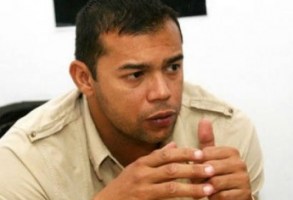 Santa Elena – Journalist Ricardo Duran, official Press Secretary for Venezuela’s socialist government, was shot dead in the early hours of Wednesday morning while arriving at his Caracas home.
Upon leaving his vehicle in the residential neighborhood of Caricuao, Duran was shot with a single bullet by an assailant evidently trained to kill, authorities say.
“They didn’t take anything from him; not his wallet nor cash, not his cell phone or regulatory weapon, he had a gun permit, and much less his car,” said Caracas Chief of Government Daniel Aponte, indicating that the crime is being treated by investigators as an assassination.
“We are simply dismayed,” said Aponte, calling Duran an “example of revolutionary journalism.”
The slain journalist was well-known as a former anchorman of VTV state television, and has been described as one of the key figures in authentically reporting the 2002 coup d’état against Hugo Chavez, which many private media outlets presented as a resignation.
Duran received a National Prize for Journalism in 2009 in recognition of his work in radio, and previously held the post of Director of Communications for the National Assembly.
A Drone Protestor Heads to Jail
Reporting by Gail Ablow and John Light | Moyers & company | January 20, 2016

(Video still from Mary Anne Grady Flores’ press conference before reporting to jail. Via YouTube.)
Mary Anne Grady Flores is in jail today and American citizens everywhere can surely breathe a sigh of relief that we are safe from her criminal behavior at least for the next six months.
That’s the length of the sentence this 59-year-old peace activist in upstate New York began on Tuesday — one day after the United States honored Dr. Martin Luther King, Jr., for his commitment to nonviolent civil disobedience. If he were here today, the martyred Dr. King would surely be shaking his head that America still has a problem with peaceful dissenters of conscience.
And what exactly did Grady Flores do to warrant spending the next six months in jail? She photographed a peaceful protest outside Hancock Field Air National Guard Base near Syracuse, New York. The base is where the US trains pilots to launch drone strikes in the Middle East, particularly in Afghanistan, Pakistan and Yemen. It wasn’t a crime for her to be taking pictures of the demonstration, but when she briefly and unintentionally — yes, unintentionally — stepped onto a road that belongs to the base, she violated what authorities called “an order of protection,” which had been issued in 2012 to forbid protesters from approaching the home or workplace of Col. Earl Evans, a commander of the 174th Attack Wing of the Air National Guard. She had never met Evans, never threatened him, never showed any intention of harming him.
Nonetheless, a town justice, David Gideon, issued the order to “protect” the Colonel from the activists. That’s right — the commander of a major military operation, piloting drones on lethal missions half-way around the world, requested a court order of protection against a group of mostly gray-haired demonstrators whom he had never met. In stepping briefly on the roadway at the base, Grady Flores violated that order, despite the fact that, as she says, “We weren’t at the security gate. We were out at the roadway.”
Now get this: The order issued by Judge Gideon was of the sort commonly used against victims of sexual or domestic abuse. “The legal terms ‘victim’ and ‘witness’ have been expanded in this case in a way that’s new and unique in the state of New York,” said attorney Lance Salisbury at a press conference yesterday before Grady Flores was hauled off to jail.
Grady Flores had protested outside the base before. She belongs to The Upstate Coalition to Ground the Drones and End the Wars, which has criticized the drone program since 2010, calling for a change in policy to uphold life and law.
President Obama and the Pentagon insist that using drones in pursuit of terrorists causes minimal civilian casualties and protects American troops, but Grady Flores takes issue with that justification. She told us she had been moved, in particular, by reports of the staggering numbers of civilians killed by US drones, and she says her fears were confirmed by documents recently leaked to journalists at The Intercept revealing that during one five-month stretch, 90 percent of those killed in one part of Northeastern Afghanistan were not the intended target.
Grady Flores says she was also shaken by the 2013 testimony before Congress of a family from Pakistan that had suffered a drone strike in North Waziristan. A grandmother of three herself, Grady Flores listened as Rafiq ur Rehman recounted his mother’s death in the presence of her grandchildren. “She was out in the fields picking okra with the kids around and a drone strike happened, and she was sent to four winds… now the kids live in terror,” Grady Flores recalls.
“That’s why citizens are at the gates of Hancock,” says Grady Flores. “That’s why we’re there.”
Grady Flores was arrested in 2012, when she and 16 others blocked the entrance to the base, prompting the request from the military for the order of protection. When she was arrested again a year later — not for protesting herself but for stepping on the road outside the base and taking pictures of others who were protesting — she was found to be in violation of that protection order. And the protestors she was photographing? They were acquitted.
Justice David Gideon threw the book at her. He sentenced her to a year, claiming in his five-page ruling that he didn’t buy her First Amendment argument. Instead, he thought she “was willing to ‘break the law’ to seek publicity for her cause.” After an appeal, her sentence was shortened to six months.
Before she went to jail yesterday she told us: “I asked my grandchildren, ‘Do you know where I’m going?’ and they said, ‘yeah, you’re going to jail, Nana.’” She told us that it is difficult to leave her 88-year-old mother who is ailing, but that her mother appreciates her carrying on in the tradition of Dr. Martin Luther King and the iconic Catholic activist Dorothy Day, with whom her mother once worked. Day famously said, “No one has a right to sit down and feel hopeless. There is too much work to do.”
Grady Flores says her mother’s good-bye shared that sentiment, “Mom said to me, ‘I’ll pray for you, I’ll be with you in that cell.’ She said it in a whisper, but she’s grateful that I’m continuing the work.”
Featured Video

Dan Dicks with James Corbett on Solutions Watch
or go to
Aletho News Archives – Video-Images
From the Archives
$1.5bn up in smoke: US THAAD missile stockpile dries up defending Israel against Iran
By Ivan Kesic | Press TV | July 2, 2025
According to American media, defense news outlets, and independent analysts, the 12-day Israeli military aggression against Iran significantly depleted the US stockpile of THAAD (Terminal High Altitude Area Defense) interceptor missiles.
Citing official sources, American magazine Newsweek reported on Friday that the US transferred a substantial portion of its advanced missile defense capabilities to support the Israeli regime, an effort with questionable results and a critical impact on US strategic reserves.
THAAD, developed by Lockheed Martin arms manufacturing company, is a key component of Israel’s multi-layered air defense architecture. It is designed to intercept medium-range ballistic missiles, including those launched from Iran and Yemen.
The US-made system is capable of targeting short-, medium-, and intermediate-range ballistic missiles during their terminal phase, whether inside or outside Earth’s atmosphere.
THAAD uses a “hit-to-kill” method, relying on kinetic energy rather than explosive warheads to destroy incoming threats, intercepting at altitudes of up to 150 km and ranges between 150-200 km.
Operated exclusively by American personnel, the US military maintains eight THAAD batteries with an estimated 350–400 interceptors in total. The eighth battery was activated during the June 20 Israeli aggression against Iran and is capable of intercepting hypersonic missiles. … continue
Blog Roll
 Aletho News
- While Gaza dominates the UN, these are the people keeping it alive
- New Report: “Scholasticide and Genocide in Gaza: Assessment, Testimonies and Legal Analysis”
- ‘THAAD Delusion’: Iran war exposes US missile shield limits – The Atlantic
- Moscow issues warning to NATO over Russian exclave
- Yes, the Iran war has destroyed Trump’s presidency
- The fallacy of US delusions about Iran’s economic collapse
- Hezbollah denies Syria cell link, warns of Israeli plan to sow discord
- The legacy of US sanctions, war, and occupation in Iraq
- Iraqi resistance group rejects disarmament, vows to maintain support for Lebanon
- Sheikh al-Asadi warns of Iraqi government compliance with US demands
- If Americans Knew
- Mamdani releases plan to combat antisemitism and hate crimes in New York City
- Iran’s Revolutionary Guards Publish Letter to the American People
- DMFI launches $1 million ad campaign supporting Virginia’s Elaine Luria
- US Senate blocks resolution seeking report on Americans killed by Israel
- Israeli Attacks Kill Ten Palestinians in Gaza
- Massacre at Minab: The School That Became a Grave
- Israeli media: The IDF Shows It Doesn’t Turn a Blind Eye; It Actively Emboldens Settler Havoc
- As settlers ravage West Bank, Israeli forces kill 10 in Gaza – Daily Update
- New Report: “Scholasticide and Genocide in Gaza: Assessment, Testimonies and Legal Analysis”
- Ex-Biden officials are desperate for a Gaza scapegoat
- No Tricks Zone
- Green Energy Debacle: German Expert Professor Fritz Vahrenholt Warns Of Severe Economic And Social Consequences
- Two More Paleo Reconstructions Affirm Meters-Higher Sea Levels Across Ireland, Brazil 7000-6000 Years Ago
- New Study: Earth And Venus Surface Warmth Largely Explained By Convection And Lapse Rate, Not CO2 Or Radiation
- 2025 Nature Paper Claiming Worsening Global Drought Gets RETRACTED …Heavily Flawed
- New Study: ‘Global Drought Shows No Detectable Recent Acceleration Under Climate Warming’
- Economic Masterminds: German Socialists Suggest Taxing Productivity Gains Stemming From Using AI
- The South China Sea Has Not Been Cooperating With The Climate Change Narrative
- Energy Crisis: Germany Enters Heating Season With Historically Low Gas Reserve Fill Levels
- New Study: The Antarctic Ice Sheet Gained Mass From 2020-2024 Due To Staggering Snow And Ice Accumulation
- Study: Ocean Heating Rates From Thousands Of Years Ago ‘Dwarf’ Modern Ocean Heating Rates

