Marines hold eight days of drills with militants in southern Syria
Press TV – September 14, 2018
US marines have held eight days of unprecedented military exercises with US-backed militants in southern Syria in an attempt to send a “strong message” to Iran and Russia, a senior military official said.
Colonel Sean Ryan, a US military spokesman, described the drills as “a show of force,” saying that the Pentagon had notified Russia through “deconfliction” channels to prevent “miscommunication or escalate tension”.
“The exercise was conducted to reinforce our capabilities and ensure we are ready to respond to any threat to our forces within our area of operations,’” he noted.
The eight days of drills ended this week at the US military outpost in Tanf, located 24 km to the west from the al-Tanf border crossing between Syria and Iraq in Homs Governorate, said Colonel Muhanad al Talaa, the commander of the US-backed Maghawir al Thawra militant group.
He told Reuters the war games were the first such exercises with live-fire air and ground assault, involving hundreds of US troops and militants operating against the government of President Bashar al-Assad.
Thawra claimed the drills were meant to send what he described as “a strong message to Russia and Iran” that the Americans and the militants intended to stay and confront any threats to their presence.
The US presence in Tanf military base is illegal and lacks the permission of the Syrian government. Damascus, Moscow, and Tehran have repeatedly denounced the American military presence in Syria and called on the US to withdraw its marines from the base. However, the US has so far refused to pull its forces out, and even moved to deploy hundreds of more marines in Tanf earlier this month.
The new forces have reportedly joined “special operations troops already based in the garrison” and are going to participate in the drills amid an escalation of US-Russian tensions in Syria and Russia’s military exercises in the Mediterranean.
Meanwhile, CNN cited several US military officials as saying last Friday that Russia had warned the Pentagon twice in the past weeks that its forces, together with Syrian troops, were prepared to wage an attack on terrorists in the area where dozens of US troops are stationed – including those in Tanf garrison.
Reacting to Moscow’s warnings, US military officials “bluntly warned Russia and Syria not to go forward with an attack within a 35-mile-wide security zone that the US maintains around Tanf,” Task & Purpose further reported.
The US illegally built the military outpost in early 2016 under the pretext of fighting Daesh terrorists, but it has declared a 55 km-radius “deconfliction zone” off-limits to others, providing a safe haven for at least 50,000 militants and their families in the Rukban camp that lies within it.
This is while US President Donald Trump had previously stated that he wanted American troops out of Syria as soon as possible and has also called for redirecting millions of dollars meant to help rebuild Syria to other military projects.
Russian and Iranian military forces are in Syria at the official request of the Syrian government. This is while the US has involved itself in the Syrian conflict through an overt campaign meant to train and support anti-Damascus terrorists. The government of President Bashar al-Assad has repeatedly denounced the American military presence in the country and called on Washington to end what it has described as an “uninvited aggression” against Syria.
Saudi-led airstrikes kill 15 civilians in Yemen’s Hudaydah
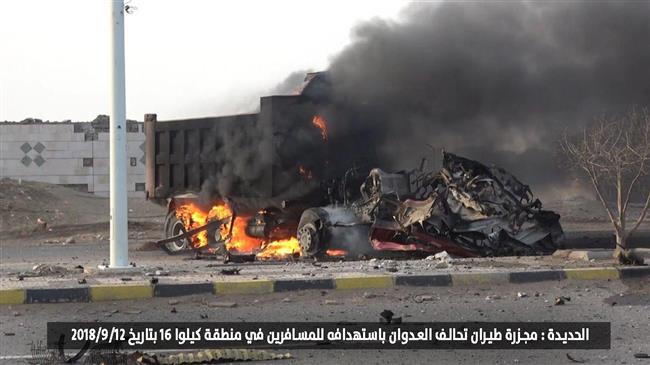
Yemeni truck targeted by a Saudi fighter jet on the outskirts of the port city of Hudaydah on September 12, 2018. (Photo by al-Masirah)
Press TV – September 12, 2018
At least 15 civilians, including one child, have been killed as the Saudi-led coalition resumed its airstrikes on the outskirts of Yemen’s port city of Hudaydah despite widespread international criticism over the war’s impact on civilians.
According to reports by Yemen’s Arabic-language al-Masirah television, about 20 civilians were also injured during Wednesday’s bombings that were launched after a brief truce since July.
The Saudi-backed forces also captured a number of towns as well as two main supply routes linking Hudaydah to the capital Sana’a and Ta’izz province, the report added.
The bombings resumed after UN-brokered peace efforts failed in Geneva last week. The talks were aborted after the UN failed to meet conditions set by Yemen’s Ansarullah movement, including transfer of wounded people to hospital for proper treatment and guarantees on the safety of the Yemeni delegation. Ansarullah also accused Saudi Arabia of planning to strand the delegation in Djibouti, where their plane was to make a stop en route to Geneva.
Delegates from Yemen’s former government and representatives of the Houthi movement held their last UN-sponsored negotiations in Kuwait in 2016 in a bid to hammer out a “power-sharing” deal, but they fell apart after the Saudi-backed side left the venue.
Saudi Arabia and a number of its regional allies launched a devastating military campaign against Yemen in March 2015, with the aim of bringing the government of former president, Abd Rabbuh Mansur Hadi, back to power and crushing Ansarullah.
Some 15,000 Yemenis have been killed and thousands more injured since the onset of the Saudi-led aggression.
More than 2,200 others have died of cholera, and the crisis has triggered what the United Nations has described as the world’s worst humanitarian disaster.
Fighting Starts in Syria’s Idlib: US Military Considers Military Options
By Peter KORZUN | Strategic Culture Foundation | 11.09.2018
Syrian UN Ambassador Bashar Ja’afari declared on Sept. 7 that his government was determined to wipe out the rebels from the Idlib province. The next day, the Idlib Dawn Operation began, encircling a town 59 km. southwest of the Syrian city of Aleppo. As of Sept. 9, Russian aircraft have attacked the rebel positions in western Idlib, the mountains of the Latakia province, and the Sahl al-Ghab plain, with the goal of softening up peripheral targets and preventing a breakthrough or counterattack. Syria’s forces are ready to move.
The Russian military warned that a false-flag chemical attack staged by the rebels could occur at any time and be used as a pretext for Western missile strikes. A massive Turkish military convoy, consisting of more than 300 vehicles, including tanks, armored vehicles, and MLRS launchers, has entered Idlib from the province of Hatay.
Syria needs Idlib — the last stronghold of the jihadists and the shortest route from Latakia to Aleppo. The M5 international highway crosses Idlib, linking Turkey and Jordan through Aleppo and Damascus. Control of the province would greatly facilitate the negotiations with the Kurds and strengthen Syria’s position at the UN-brokered Geneva talks. If the negotiation process succeeds, the only territories left to liberate would be the zone controlled by the US, such as the al-Tanf military base and the surrounding area, the northern parts of the country under Turkish control, and small chunks of land still held by ISIS [let’s not forget the Golan Heights].
Turkey opposes the idea of an Idlib offensive. It wants assurances for the groups in Idlib under its control and it doesn’t want an influx of refugees. These controversial issues can be tackled with Russia as a mediator. Turkey, Iran, and Russia did not agree on everything at the recent summit in Tehran, but the West’s hopes that they would go their separate ways, or even clash in Idlib, have been dashed.
President Erdogan has just said that he wants to meet the Russian president again after his Sept 28-29 visit to Germany. This means that the Turkish leader has ideas and proposals to discuss and Moscow can play a role in reaching a compromise, such as a more narrowly tailored counter-terrorism operation in Idlib. There is a divide, but it can be bridged. The parties have the will to get it done.
Ankara plans to organize a Turkey-Russia-Germany-France summit. The Russian presidential aide, Yury Ushakov, has confirmed that such a meeting is in the works. Moscow has just invited the Turkish military to take part in its largest-ever military exercise, Vostok 2018, which will be held in the Far East. China and Mongolia have also been invited. Obviously, Russia and Turkey are prepared to solve their differences over Idlib peacefully through negotiations.
In any event, the province cannot remain under the terrorists’ control forever. They must either surrender or be routed. Now that the operation to free Idlib has begun, many of them will lay down their arms. They know their resistance is futile.
Actually, victories over terrorists that pave the way to a negotiated solution of the conflict should be welcomed, but the US sees these things in a different light. Washington seems to be shifting gears on Syria again, despite the statements President Trump made earlier about the plans to pull out. Now the president has reportedly agreed to new objectives that will keep US troops on the ground in Syria indefinitely in order to ensure that the Iranian forces are driven out. The US military has just sent reinforcements to al-Tanf to demonstrate its resolve to stay in that country. The Marines are holding a multi-day exercise there, using live ammunition.
Secretary of State Mike Pompeo, said on Sept. 7 that the administration viewed any government assault on Idlib as an escalation of Syria’s warning that Washington would respond to any chemical attack by Damascus. Ambassador James Jeffrey, who served as a deputy national security adviser to President George W. Bush, has recently been appointed US Special Representative for Syria Engagement, and Joel Rayburn, the former senior director for Iran, Iraq, Syria, and Lebanon, is now Special Envoy for Syria. The two appointments confirm the fact that the US has changed its mind and decided to remain in Syria, as both these officials had supported this policy before.

Rayburn, Joel (15 August 2014). “The coming disintegration of Iraq” Washington Post
America’s top military brass are studying the options for military involvement in Syria. But the real reason may not be Idlib or any other events in that country, but rather the situation creep in Iraq, where anti-Iranian and anti-government Shia protests in the south have turned violent and the prime minister may be compelled to step down. The protesters are armed and violent. They have attacked the Iranian consulate and the headquarters of Iranian-backed militias in the city.
Fighting has also been reported between Iranian forces and Kurds in Iraq’s Kurdish region. Details have been provided of mortar fire in Baghdad, where protests took place in July. Something’s cooking in Iraq. There is too little information available to obtain any deep insights into what’s going on, but the situation is unpredictable and volatile. Iraq could soon implode. The US will not leave the region, and it needs every outpost it has there. A lot depends on how events develop in Iraq.
Idlib will ultimately be liberated. The status of the US-led coalition forces in Syria will become a hot-button topic and be seen as the main stumbling block on the path to peace and reconstruction.
Moscow Has Upped the Ante in Syria
Consortium News | September 9, 2018
As Syrian forces backed by Russian launch the final showdown in Syria against jihadist extremists, the potential for a U.S.-Russia confrontation has never been greater, as VIPS warns in this memo to the president.
MEMORANDUM FOR: The President
FROM: Veteran Intelligence Professionals for Sanity
SUBJECT: Moscow Has Upped the Ante in Syria
Mr. President:
We are concerned that you may not have been adequately briefed on the upsurge of hostilities in northwestern Syria, where Syrian armed forces with Russian support have launched a full-out campaign to take back the al-Nusra/al-Qaeda/ISIS-infested province of Idlib. The Syrians will almost certainly succeed, as they did in late 2016 in Aleppo. As in Aleppo, it will mean unspeakable carnage, unless someone finally tells the insurgents theirs is a lost cause.
That someone is you. The Israelis, Saudis, and others who want unrest to endure are egging on the insurgents, assuring them that you, Mr. President, will use US forces to protect the insurgents in Idlib, and perhaps also rain hell down on Damascus. We believe that your senior advisers are encouraging the insurgents to think in those terms, and that your most senior aides are taking credit for your recent policy shift from troop withdrawal from Syria to indefinite war.
Big Difference This Time
Russian missile-armed naval and air units are now deployed in unprecedented numbers to engage those tempted to interfere with Syrian and Russian forces trying to clean out the terrorists from Idlib. We assume you have been briefed on that — at least to some extent. More important, we know that your advisers tend to be dangerously dismissive of Russian capabilities and intentions.
We do not want you to be surprised when the Russians start firing their missiles. The prospect of direct Russian-U.S. hostilities in Syria is at an all-time high. We are not sure you realize that.
The situation is even more volatile because Kremlin leaders are not sure who is calling the shots in Washington. This is not the first time that President Putin has encountered such uncertainty (see brief Appendix below). This is, however, the first time that Russian forces have deployed in such numbers into the area, ready to do battle. The stakes are very high.
We hope that John Bolton has given you an accurate description of his acerbic talks with his Russian counterpart in Geneva a few weeks ago. In our view, it is a safe bet that the Kremlin is uncertain whether Bolton faithfully speaks in your stead, or speaks INSTEAD of you.
The best way to assure Mr. Putin that you are in control of U.S. policy toward Syria would be for you to seek an early opportunity to speak out publicly, spelling out your intentions. If you wish wider war, Bolton has put you on the right path.
If you wish to cool things down, you may wish to consider what might be called a pre-emptive ceasefire. By that we mean a public commitment by the Presidents of the U.S. and Russia to strengthen procedures to preclude an open clash between U.S. and Russian armed forces. We believe that, in present circumstances, this kind of extraordinary step is now required to head off wider war.
For the VIPS Steering Group, signed:
Philip Giraldi, CIA Operations Officer (retired)
James George Jatras, former U.S. diplomat and former foreign policy adviser to Senate Republican leadership (Associate VIPS)
Michael S. Kearns, Captain, U.S. Air Force, Intelligence Officer, and former Master SERE Instructor (retired)
John Kiriakou, Former CIA Counterterrorism Officer and Former Senior Investigator, Senate Foreign Relations Committee
Edward Loomis, NSA Cryptologic Computer Scientist (ret.)
Ray McGovern, Army/Infantry Intelligence Officer and CIA Presidential Briefer (retired)
Elizabeth Murray, Deputy National Intelligence Officer for the Near East, National Intelligence Council (retired)
Todd E. Pierce, MAJ, US Army Judge Advocate (ret.)
Ann Wright, retired U.S. Army reserve colonel and former U.S. diplomat who resigned in 2003 in opposition to the Iraq War
Appendix:
Sept 12, 2016: The limited ceasefire goes into effect; provisions include separating the “moderate” rebels from the others. Secretary John Kerry had earlier claimed that he had “refined” ways to accomplish the separation, but it did not happen; provisions also included safe access for relief for Aleppo.
Sept 17, 2016: U.S. Air Force bombs fixed Syrian Army positions killing between 64 and 84 Syrian army troops; about 100 others wounded — evidence enough to convince the Russians that the Pentagon was intent on scuttling meaningful cooperation with Russia.
Sept 26, 2016: We can assume that what Lavrov has told his boss in private is close to his uncharacteristically blunt words on Russian NTV on Sept. 26. (In public remarks bordering on the insubordinate, senior Pentagon officials a few days earlier had showed unusually open skepticism regarding key aspects of the Kerry-Lavrov agreement – like sharing intelligence with the Russians (a key provision of the deal approved by both Obama and Putin). Here’s what Lavrov said on Sept 26:
“My good friend John Kerry … is under fierce criticism from the US military machine. Despite the fact that, as always, [they] made assurances that the US Commander in Chief, President Barack Obama, supported him in his contacts with Russia (he confirmed that during his meeting with President Vladimir Putin), apparently the military does not really listen to the Commander in Chief.”
Lavrov’s went beyond mere rhetoric. He also specifically criticized JCS Chairman Joseph Dunford for telling Congress that he opposed sharing intelligence with Russia, “after the agreements concluded on direct orders of Russian President Vladimir Putin and US President Barack Obama stipulated that they would share intelligence. … It is difficult to work with such partners. …”
Oct 27, 2016: Putin speaks at the Valdai International Discussion Club
At Valdai Russian President Putin spoke of the “feverish” state of international relations and lamented: “My personal agreements with the President of the United States have not produced results.” He complained about “people in Washington ready to do everything possible to prevent these agreements from being implemented in practice” and, referring to Syria, decried the lack of a “common front against terrorism after such lengthy negotiations, enormous effort, and difficult compromises.”
Veteran Intelligence Professionals for Sanity (VIPS) is made up of former intelligence officers, diplomats, military officers and congressional staffers. The organization, founded in 2002, was among the first critics of Washington’s justifications for launching a war against Iraq. VIPS advocates a US foreign and national security policy based on genuine national interests rather than contrived threats promoted for largely political reasons. An archive of VIPS memoranda is available at Consortiumnews.com.
Pentagon to present its own plan of ‘effective war on terror’ in Syria – without Russia
RT | September 8, 2018
Washington has its own plan on how to “effectively” combat terrorism in Syria, the Pentagon has said, adding that the US is not planning to cooperate with Moscow on the issue.
The US military strategists have found what they call a “better, more focused way” to do counterterrorism operations in Idlib, the US Department of Defense said in statement on Saturday. The US military revealed almost no details of its plan as the statement said only that it would involve “using the US capabilities to spot the terrorists – even in an urban environment – and take them out with a minimum of civilian casualties.”
Washington also apparently plans to go at it alone, without working with other actors present in the area as the head of the US Joint Chiefs of Staff, Marine Corps General Joseph Dunford, “was not talking about cooperating,” the statement added. He also said that he had not spoken with his Russian counterpart, Army General Valery Gerasimov, since the tensions around the Syrian northern militant-held Idlib province began to rise, adding that the two military officials are also “not scheduled” to talk in the near future.
Instead, the US military once again warned against a government offensive on the province, which is largely controlled by extremists, including the Al Qaeda affiliate known as Tahrir al-Sham (former Al Nusra Front), which it claimed would lead to a “humanitarian disaster.”
“The consequences of a major offensive operation in Idlib will almost certainly be the suffering of a large number of innocent civilians,” Dunford told journalists.
The head of the US Joint Chiefs of Staff also slammed the results of the summit between the leaders of Russia, Turkey and Iran on Syria, which was recently held in Tehran, by saying that the “meeting … failed” without going into further details.
Turkey’s Recep Tayyip Erdogan, Russia’s Vladimir Putin and Iran’s Hassan Rouhani discussed the situation in Syria and in the Idlib province in particular as part of the Astana peace process on Friday. All three nations agree that the threat of radical Islamists in Syria must be eliminated, but differed as to how this should be achieved.
While Iran advocated a strong-arm approach, Turkey objected to such an idea as it feared that a large-scale military operation could provoke a mass exodus of refugees to the neighboring Turkish regions. Eventually, a call for all armed groups in Idlib to lay down arms and seek a political transition was included in the final communique of the meeting. Both Turkey and Iran were, however, critical of the US presence in Syria.
Ankara was also persistent in its opposition to any potential offensive against extremists in Idlib. Turkey plans to stop any “anticipated attacks” on the militant-held province, Foreign Minister Mevlut Cavusoglu said on Saturday, warning that any operation in Idlib could possibly lead to a “serious humanitarian tragedy.”
“Our aim is to stop airstrikes [in Syria’s Idlib]. We were anticipating attacks, which could have happened,” Cavusoglu said, adding that the clashes in the province “should stop” and the whole issue should be “resolved in line with the agreement and the spirit of Astana.”
Paraguay cancels embassy move to Jerusalem, Israel responds by closing its embassy in Paraguay
RT | September 5, 2018
Paraguay will return its embassy in Israel to Tel Aviv, after the country’s previous government relocated it to Jerusalem in May. In a tit-for-tat response, Israel announced it would close its embassy in Paraguay.
National chancellor Luis Alberto Castiglioni announced the move on Wednesday, calling the decision by former President Horacio Cartes “visceral and without justification.” Cartes, a right-winger, made the decision to move the embassy to Jerusalem in May, and was present for its inauguration.
It was one of the last decisions Cartes made before President Mario Abdo Benitez took office last month, and followed the controversial decisions of the US and Guatemala to move their embassies to Jerusalem.
Benitez, the grandson of a Lebanese immigrant, said that he was not consulted about the move.
“Paraguay wants to contribute to an intensification of regional diplomatic efforts to achieve a broad, fair and lasting peace in the Middle East,” said Castiglioni on Wednesday.
The recognition of Jerusalem as Israel’s capital is a controversial one. East Jerusalem has been claimed as the capital of the Palestinian state, and Palestinian President Mahmoud Abbas described the US embassy there as “an American settlement outpost in East Jerusalem.”
Palestinian foreign minister Riyad al-Maliki claimed on Wednesday that he pushed President Benitez to reverse the move to Jerusalem.
Israel responded to Paraguay’s decision by recalling its ambassador to Paraguay and closing its embassy in the Latin American country’s capital, Asuncion. Before the diplomatic spat erupted, the Israeli ambassador, Zeev Harel, had been meeting with the Paraguayan minister for education, discussing cooperation between the two countries.
Family of 9 homeless as Israel demolishes Hebron home at behest of settlers
MEMO | September 4, 2018
At approximately 4am yesterday, Israeli forces entered the Palestinian village of Khirbet Qawasis and demolished the home of Yousef Abu ‘Aram following protests by settlers from the nearby illegal Israeli settlement of Mitzpe Yaier.
The soldiers then stormed the village of Zuwaidin and destroyed several community bathrooms legally built on the side of a main road to the village. Soldiers prevented local activists from leaving their vehicles to film the demolition.
“We are sad and upset about what happened today,” says Yousef. “The Israeli authorities want to move us from our land and take it, but we will not move.”
Yousef had completed construction of the house on his land in the southern West Bank governorate of Hebron only a fortnight ago; a house he had hoped would protect his seven children from the coming winter.
“The situation is really bad,” says Yousef, who had intended to plough the land and nurture his trees in the South Hebron Hills, just a few metres from the settlers’ road to Mitzpe Yaier.
“They have left a family of seven children and their parents with no shelter, and now we sit under the trees and will be sleeping on the ground and covering ourselves with the sky.”
Israeli settlers routinely harassed Yousef during the construction of his concrete house and the Israeli Civil Administration, under pressure from the settlers, confiscated some of his building materials. The fate of the house was due to be determined at a court hearing scheduled for yesterday, however the Israeli Civil Administration unlawfully demolished the home ahead of the hearing.

Tariq Hathaleen, human rights activist in the occupied West Bank [File]
“It’s a new thing for settlers to go out to Palestinian houses to protest against the buildings,” says human rights activist, Tariq Hathaleen, who lives in the nearby village of Umm Al-Khair. “The military want to satisfy the settlers, so if there are building materials they confiscate them. If there’s a tent, they will dismantle it and take it away. If it’s a building, the Civil Administration will work very hard to demolish it.”
Hathaleen says that the rate of demolitions is increasing in the South Hebron Hills, where some 30 Palestinian villages can expect as many demolitions to occur in a month as they once did in a year.
“The number is increasing because of the settlers’ pressure. Not just them, but also because of settler NGOs, like Regavim, that works in the South Hebron Hills and across Palestine. They have people who drive cars around Palestinian villages and they also fly drones. Once they catch a Palestinian building a house, they inform the Civil Administration and the military.”
Regavim, a pro-settler not-for-profit that has received millions of shekels of public funds, is leading the legal battle to demolish the Palestinian village of Susiya.
According to B’Tselem, Israel demolished at least 1,342 Palestinian residential units in the West Bank between 2006 and 30 June 2018, displacing 6,024 people including at least 3,040 children. Israel has aggressively pursued a policy of demolishing Palestinian homes, schools, health facilities and other essential infrastructure since it began occupying the West Bank and East Jerusalem in 1967. These demolitions are a violation of The Hague and Fourth Geneva Conventions.
Israeli authorities deny most Palestinian applications for the necessary building permits in Israeli-controlled “Area C”, which accounts for around 60 per cent of the West Bank, forcing Palestinians to build without permission and live under constant threat of demolition.
Meanwhile, Jewish-only settlements like Mitzpe Yaier continue to expand on Palestinian land with the backing of the Israeli government. Around 600,000 Israelis live in over 250 settlements and outposts in the West Bank and East Jerusalem, a violation of the Fourth Geneva Convention, which forbids occupying powers from transferring their civilians to occupied territory. Settlements are usually built on stolen Palestinian land in “Area C”, where Khirbet Qawasis is located.
Israel has demarcated approximately 70 per cent of Area C for unlawful settlement expansion, as well as outposts, firing zones, state lands and national parks. This policy has fractured Palestinian land and created a hostile environment for Palestinians living nearby.
“Every day we hear of a new incident of settler violence happening,” says Hathaleen. “Two people from the South Hebron Hills were attacked this year. These people were attacked in less than one week.”
According to Hathaleen, both incidents involved settlers from the illegal Israeli outpost Havat Maon. His friend Sami was injured in one incident after settlers drove their motorcycle down a Palestinian road directly at him, running him over and breaking his leg in three places. The other incident involved a shepherd, who was walking with his flock when settlers attacked him with wooden sticks, leaving him with a broken leg and injuries to his head and hand. One of the settlers tried to shoot the shepherd several times but the gun did not fire. “This man was lucky to survive,” says Hathaleen, who adds that Palestinian shepherds are routinely attacked by Israeli settlers and soldiers if they aren’t accompanied by international volunteers. “Settlers don’t attack Palestinians in front of cameras.”
Many settlers carry government-issued weapons with them outside their homes. Settlers usually attack Palestinians in groups, and attacks often involve throwing stones at people and their property; firing live ammunition at or near Palestinians, homes and schools; the burning of trees and agricultural land; and vandalising vehicles and other property.
According to UN OCHA, an average of seven incidents of settler violence a month led to Palestinian casualties in the first four months of 2018. An average of 14 incidents a month caused property damage. Israeli human rights group Yesh Din reports that only 8.1 per cent of investigations into ideologically motivated offenses against Palestinians have led to an indictment since 2005, and 82 per cent of investigations were closed due to police failures.
READ ALSO:
Israel demolishes Palestinian school near Hebron
Report by Sawsan Bastawy, @SawsanHefny
Mauritius’ takes UK to court over Chagos Islands
RT | September 3, 2018
The UK claim over an archipelago in the Indian Ocean is being challenged by Mauritius in the International Court of Justice. The largest island hosts a US airbase, the construction of which saw mass deportations of the islanders.
Despite the UK’s attempts to go through official channels in the UN to block Mauritius’ claim to the Chagos Islands, the case is set to be heard in The Hague.
Judges at the International Court of Justice (ICJ) will take four days hearing testimonies from the representatives of 22 countries arguing over colonialism and the rights of the deported Chagos Islanders to return. The ICJ’s judgement will be only advisory and have no legal binding.
Of the 22 states, only the representatives of the US, Israel and Australia are expected to support Britain’s claim to sovereignty to the Islands, which they name the British Indian Ocean Territory (BIOT) and are some 5,799 miles from London.
The US support in part stems from the strategic value of their airbase, commonly referred to as Camp Justice, which is situated on the largest of the Chagos Islands, Diego Garcia. The airbase has played a crucial role in US operations in the Middle East, including during the Iranian Revolution and both Iraq Wars.
Last year Britain suffered a heavy defeat at the UN General Assembly, when 94 nations supported a Mauritian-backed resolution to take the matter before the ICJ. Only 15 countries supported the UK’s claim.
The ICJ is set to consider both whether the decolonisation of Mauritius from the British was completed lawfully, and secondly the ability of Mauritius to resettle deported Chagossians back onto the islands.
The UK decided to separate the Chago Islands from the remainder of its Indian Ocean colony three years before Mauritius gained independence in 1968. Mauritius is claiming that Britain was in breach of a UN resolution that banned the breakup of colonies before independence.
Britain deported some 1,500 islanders in order to lease the largest island, Diego Garcia, to the US which set up an airbase there in 1971. Chagossians have never been allowed to return.
Mauritius has been promised the return of the Islands by London but only when they are no longer needed for defense purposes. No date has been set for when that is.
The hearing’s outcome is expected to be a signal of the UK’s power, or lack thereof, in the international sphere. Last November, London failed to secure the re-election of Sir Christopher Greenwood to the ICJ. Britain will now be without a judge in the court for the first time since its inception.
A Foreign Office spokeswoman, quoted in the Guardian, said: “We are disappointed that Mauritius have taken this bilateral dispute to the international court of justice.
“This is an inappropriate use of the ICJ advisory opinion mechanism and sets a dangerous precedent for other bilateral disputes. We will robustly defend our position.
“While we do not recognise the Republic of Mauritius’s claim to sovereignty of the archipelago, we have repeatedly undertaken to cede it to Mauritius when no longer required for defence purposes, and we maintain that commitment.”
US Threats to Strike Syria Won’t Stop Damascus From Idlib Op – Syrian FM
Sputnik – 02.09.2018
Following the liberation of Daraa in the south, Idlib remains the “world’s largest open prison” for some three million people and the last terrorist stronghold in Syria.
“Anything that is actively promoted by the US will not affect the determination of the Syrian people and Syrian army’s plans to clear Idlib and finally put an end to terrorism in Syria,” Syrian Foreign minister Walid Muallem said in an interview.
According to him, the US accusations about alleged plans regarding chemical attacks have become questionable in the eyes of public opinion and are just an excuse for a possible attack on Syria.
“We, the people and leadership of Syria, would like to end the conflict today, but the intervention of Western countries headed by the US makes it difficult,” Muallem said.
Muallem emphasized that the US presence in Syria is illegal and Washington can in no way justify it.
“The US presence has claimed the lives of thousands of Syrian and every time terrorists were besieged by the Syrian Arab Army, Washington provided them with protection. It became clear that Washington’s main objective was to prolong the crisis in Syria in the interests of Israel,” the minister said.
On August 22, US National Security Adviser John Bolton stated that Washington and its partners would respond in a “swift and appropriate manner” to any verified chemical weapons use in Idlib or elsewhere in Syria.
Separately, US State Department spokeswoman Heather Nauert said that the United States “will respond to any verified chemical weapons use in Idlib or elsewhere in Syria… in a swift and appropriate manner.”
The Russian Defense Ministry, when commenting on the situation, accused the US and its allies of attempting to use a chemical weapons provocation planned by militants in Idlib as a pretext to launch an attack on Syrian government forces.
In August, Russian officials warned of a conspiracy by terrorists to launch an alleged chemical attack in order to provoke Western retaliation against the Syrian government.
According to Russian Defense Ministry’s spokesman Maj. Gen. Igor Konashenkov, a group of militants, who had been prepared by the Olive Group, had conspired to stage the rescue of victims of a chemical weapons attack in Idlib.
After media reports alleging a chemical attack had been carried out in the Syrian city of Douma in April, Western countries immediately accused the Syrian government of being behind the attack.
Following the accusations, the US, the UK, and France launched over 100 missiles on multiple targets in the country in response to the alleged use of chemical weapons.
Damascus denied the accusations and said that the Jaish al-Islam terror group had staged the attack to encourage foreign intervention in Syria.
Featured Video

“Historic Russia”: The Land Putin Will Not Give Back
or go to
Aletho News Archives – Video-Images
From the Archive
How Ukraine Tortured and Slaughtered Donbass
By Kit Klarenberg | Al Mayadeen | July 11, 2024
Almost immediately after the proxy war erupted, ISIS-tier footage of the torture and murder of Russians in Ukrainian custody emerged.
On July 6th, the New York Times published an astonishing investigation: In Ukraine, Killings of Surrendering Russians Divide an American-Led Unit. The article documents in grim detail how Chosen Company, an international volunteer battalion for Kiev, routinely executes Russian prisoners of war. It is the very first mainstream admission that this practice – a brazen breach of the Geneva Conventions, and a grave war crime – is widespread among Ukraine’s fighters, both foreign and homegrown. … continue
Blog Roll
 Aletho News
- Peace in Ukraine: the easy way – or the hard way
- Trump & the Rrrrussians
- US taxpayer money laundered back through Ukraine – Musk
- Before COVID, an NIH lab chief proposed making a SARS-like bat virus more infectious
- Gates, Bourla on Trial in Netherlands Accused of ‘Great Reset’ Scheme at Vaccine Injury Hearing
- BRITAIN’S WARNING: PREPARE FOR WAR
- “Historic Russia”: The Land Putin Will Not Give Back
- How the Cambridge Analytica scandal still haunts Mark Zuckerberg
- The Ongoing Cancellation Campaign Against a Dissenting Academic in Norway
- Yemen and ‘the Houthis’: Challenging Sami Hamdi’s Narrative
- If Americans Knew
- DAILY UPDATE: Latest essential news on Palestine, Israel, & region
- Damning report shows the media must confront its failures on Gaza
- BBC senior broadcaster speaks out on Gaza coverage
- Netanyahu vows vast West Bank invasion in response to 20-minute skirmish that left 2 Israeli soldiers and 2 Palestinian fighters dead
- Tied up and tortured: Israel using US-made electroshock weapons on Palestinian detainees
- The outsourced risk: how newsrooms rely on Gaza’s freelancers without protecting them
- Gaza bakeries forced to shut as Israel blocks flour shipments
- Gaza’s breast cancer patients face a deadly wait for treatment amid Israel’s genocide
- DAILY UPDATE: Latest essential news on Palestine, Israel, & region
- The Israel Lobby’s Changing Fortunes
- No Tricks Zone
- Two New Studies Find Thwaites Glacier Melt Cannot Be Driven By Human Activity Or A Warming Ocean
- E-Cars Reduce CO2 Emissions By Only 41% Compared To Internal Combustion Engine Vehicles
- Predictions Made By Renowned Climate Professor Over Past Decades Have Been Proven To Be Poor
- New Study Suggests Large Regions Of The Pacific Ocean Have Been Cooling For The Last 80 Years
- Germany’s Green Energy Debacle: High Energy Costs Force Kahla Porzellan to Close After 182 Years!
- New Study: 50 Years Of The Most Aggressive ‘Net Zero’ Policies Can Only Affect The Global Climate By 0.03°C
- US September “Heat” Was No Record…Many Records Set Decades Ago
- Latest European Green Energy Debacle; Portugal’s Largest Flagship Solar Park Insolvent!
- Green Energy Debacle: German Expert Professor Fritz Vahrenholt Warns Of Severe Economic And Social Consequences
- Two More Paleo Reconstructions Affirm Meters-Higher Sea Levels Across Ireland, Brazil 7000-6000 Years Ago

