South African agricultural company cuts ties to Hadiklaim
BDS South Africa | January 31, 2013
Karsten Farms, a leading South African agricultural company backed by one of South Africa’s primary finance bodies, the Industrial Development Corporation (IDC), has severed its relations with the Israeli cooperative, Hadiklaim, and has also undertaken not to enter into any future relations with any Israeli entity complicit in the illegal Israeli Occupation of Palestine.
South African human rights organizations, lead by the Palestine Solidarity Alliance (PSA) and BDS South Africa, launched a consumer campaign against Karsten Farms due to its trade relations (in violation of the boycott of Israel) with Israel’s Hadiklaim – an Israeli company operating, against international law, in the illegal Israeli settlements.
This week, after almost 3 years of campaigning, in a letter to BDS South Africa via their lawyers, Werksmans Attorneys, Karsten Farms undertook: “Not to enter into any trade relations with Hadiklaim for the current harvest year of 2013 and not have any business relations with them [Hadiklaim] in the future.” In addition, and in a precedent-setting move, Karsten Farms also undertook: “Not to enter into any trade relations with any Israeli company and/or entity within the occupied/illegal settlement areas of Israel”.
Siphiwe Thusi of the Palestine Solidarity Alliance welcomed the news: “This is the first time that a South African company has taken the legally as well as ethically correct decision not to trade with Israeli companies complicit in the illegal Israeli Occupation of Palestine. Karsten Farms has indeed set a precedent for other South African businesses and companies to follow. This is a breakthrough not only for the boycott of Israel but also for ethical and good business practice.” Thusi added that “the call for the consumer boycott of Karstens products has now been called off by virtue of their legal undertakings” however he also cautioned that “the Palestine Solidarity Alliance and BDS South Africa will be monitoring the situation and if any new Israeli relations, even if via third parties, were to be formed, the boycott campaign against Karsten Farms would be re-launched, and intensified.”
Find the full statement here: http://tinyurl.com/avlzt7n
Related articles
- BDS Gaining Momentum (councillorpadraigmcshane.wordpress.com)
- The 9th Annual Israeli Apartheid Week 2013 (alethonews.wordpress.com)
- South Africa’s ruling ANC officially endorses Palestine’s boycott movement (alethonews.wordpress.com)
- South Lebanon: Israel Admits to Stealing Land in Adaisseh (alethonews.wordpress.com)
- Israel plans boycott of UN human rights review (alethonews.wordpress.com)
- Farming Injustice: End all Trade with Israeli Agricultural Companies (bdsmovement.net)
South Lebanon: Israel Admits to Stealing Land in Adaisseh
By Amal Khalil | Al-Akhbar | January 30, 2013
A week ago, Israeli newspaper Maariv published an article titled “Kibbutz Lands Over Lebanese Border.” The story indicated that the management of the Misgav-Am kibbutz, a settlement located across from the Lebanese town of Adaisseh, “was informed by the Israeli interior ministry that a part of [the colony] falls on sovereign Lebanese territory.”
The ministry’s statement came in response to the kibbutz’s request to re-zone certain plots of land from agricultural to residential. The ministry said that the request would be considered following “the withdrawal towards Israeli borders and amending the Blue Line.”
It seems the enemy admitted that Adaisseh was confiscated by the occupation – with the collusion of the UN – when the Blue Line was demarcated following the liberation of South Lebanon in 2000.
This is the land where Israeli bulldozers uprooted what became known as the “Adaisseh tree.” That incident in the summer of 2010 led to a battle between the Lebanese army and its Israeli counterpart where soldiers Abdullah Tufaili and Robert al-Ashi, and Al-Akhbar’s correspondent Assaf Abu Rahhal were killed by Israeli fire.
The Lebanese state should raise the issue of occupied lands and reiterate the points of reservation during the drawing of the Blue Line, especially following this latest Israeli admission. This the least of what is expected of the state.
All the while, Israel, which today admits that the land where its soldiers are deployed belongs to Lebanon, recently protested at the UN a plot of flowers adjacent to the army point where the Adaisseh operation was launched, claiming it falls inside the Blue Line.
Adaisseh mayor Khalil Rammal took us on a long tour of occupied lands and the Blue Line. From the borders at Hounin and Markaba in the south, to Kfar Kila northwards, the enemy has stolen around 2,500 dunams (1 dunam = 1,000 square meters) of property since before the 1948 nakba in Palestine.
The mayor says that every time a demarcation was made, the town lost more of its land, beginning with the demarcation based on the the Sykes-Picot agreement in 1920, to the international demarcation of the borders between Lebanon and Occupied Palestine in the armistice agreement in 1949, and finally during the drawing of the Blue Line in 2000.
Rammal recounts the history of settlements since 1908, when the wooden settlement of Kfar Giladi was set up at the Adaisseh borders near the point now occupied by the Indonesian contingency of the UNIFIL.
Misgav-Am was set up in 1945 on a hill called al-Tayyara. Later, a military road was built and more land appropriated between al-Thughra and Abl al-Qamh and into Khalleh, Arabsalim, Dabsh al-Awjeh, al-Marj al-Faouqani, and Mussaisah, up until the 1978 Israeli invasion.
Rammal mentions that his father, who was mayor then, went to the governor of South Lebanon, Halim Fayyad, to complain about Israeli violations of Adaisseh, including tens of dunams with title deeds.
Fayyad relayed the message to the Lebanese government, which sent a complaint against Israel in Adaisseh’s name to the UN Security Council. He says his father told him that the Israeli ambassador in the Security Council claimed that “the appropriation of land is a precautionary measure. When Palestinian fighters withdraw, we will leave the land.”
Rammal says that the occupied territories amount to 2,000 dunams taken in 1948 and a further 1,200 in 1948. As for the Blue Line, Rammal maintains that the demarcation committee ignored Adaisseh and did not ask for the statement of the mayor or the inhabitants.
In this respect, a security source indicates that the borders at Adaisseh and Shebaa Farms are under reservation by the Lebanese government, which rejected the demarcation proposed by the enemy and UN Envoy Terje Roed-Larsen. He maintained that they were sovereign Lebanese territories.
What can owners of lands that Israel admitted to be Lebanese do?
Rammal says that the mission of the Lebanese government today should be to ask the UN to return the land, especially since the foreign ministry had requested from landowners, following liberation, to provide it with the deeds to send to the UN.
But the owners were never informed officially of the status of the dossier. One of them is Salim Hassoun, who inherited 15,000 dunams of land from his father, Abdul-Rahman Hassoun, who had in turn inherited it from his own father.
The grandfather had bought the land from Shaker Said through a deed registered at the Marjayoun Department in 1953. Hassoun says that the barbed wire and the Blue Line cut off his land, whose deed indicates the borders with Palestine.
Based on this, he will be using the Israeli admission to file a complaint against Israel to return his land, either to the UN or to Israeli courts.
However, informed sources say that Israel would never abandon the Misgav-Am hill. It’s one of the tallest along the southern border and Israel has installed long-range surveillance cameras looking into Lebanon and five military posts.
It should be noted that many of the lands liberated in 2000 are still not free of UNIFIL and Lebanese army roadblocks. These are agricultural lands whose owners have been prohibited from visiting since 1968 due to security concerns and the presence of mines – even though demining operations were completed three years ago.
Israeli Foreign Ministry Produces A Film Replacing Al-Aqsa Mosque With Jewish Temple
By Saed Bannoura | IMEMC & Agencies | January 30, 2013
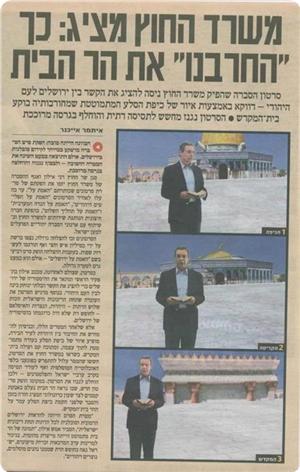 In a film that was produced by the Israeli Foreign Ministry, and was banned from being officially published, Israeli Deputy Foreign Minister, Danny Ayalon, is seen standing and speaking in various areas of Jerusalem, including in front of the Dome Of The Rock, where in the film, it disappears and is replaced by Jewish temple.
The film, “The Fact About Jerusalem”, is meant, from an Israeli point view, to encourage tourism and portray harmony, but at the same time is meant to show the sole Jewish history of the holy city, while Ayalon also claims that the film “is about freedom of religion of the three faiths – Judaism, Christianity and Islam.
The Israeli source, Yedioth Aharonoth, said that the film includes provocative content and was not published due to fear of causing anger among the Muslims, not only in Palestine, but around the world.
Ayalon “stars” in the movie by appearing at different areas of occupied Jerusalem, showing its history, advanced technology, public transportation systems, and also appears standing in front of the Dome of the Rock before it disappears and is digitally transformed into a temple.
Yet, he talks about “diversity” and “harmony” in the Holy City, “in a Jerusalem that is shared not divided”.
The Foreign Ministry said that the film is about “facts”, different “facts” from its point of view about Jerusalem, the West Bank and the peace process.
The film was also translated to various languages attracting attention of millions of viewers around the world.
Despite the fact that the film was banned from being officially published, Ayalon uploaded it onto his own YouTube Channel.
Ayalon said that the film is about history and about what he called religious freedom, describing it as being produced to show what he described as the “freedom of religion to followers of the three faiths in the region”.
Palestinians denounced the film dubbing it as part of the ongoing Israeli attempts to void the Arab and Islamic history, culture and archeology.
Despite his claims of diversity and sharing the city of “the united not divided” Jerusalem, Israel prevents millions of Arab Muslims and Christians, from entering the city to pray at their holy sites or to tour the city.
Related article
- Knesset candidate calls for bombing Aqsa Mosque’s Dome of the Rock (alethonews.wordpress.com)
Israel boycotts UN forum, first state in history to ignore human rights review
RT | January, 2013
Israel has boycotted the UN human rights forum over fears of scrutiny of its treatment of residents of the occupied territories. Israel is now the first state in history to win a deferment of the periodical review of its human rights record.
Tel Aviv has refused to send a delegation on Tuesday to the United Nations Human Rights Council in Geneva for the Universal Periodic Review procedure where UN member states have their human rights record evaluated every four years.
Israel’s cooperation with the council stopped last March after the UN set up a committee to inspect the effects of the Israeli settlements on Palestinians.
Israel which earlier accused the United Nations of anti-Israel bias reiterated its stance, recalling that the council has passed more resolutions against Israel than all other countries combined.
“After a series of votes and statements and incidents we have decided to suspend our working relations with that body,” Yigal Palmor, Israeli foreign ministry spokesman, told the Financial Times. “I can confirm that there is no change in that policy.”
“There have been more resolutions condemning Israel than the rest of the world put together,” an Israeli government official said on Tuesday. “It’s not a fair game – it’s not even a game.”
Following the Israeli decision, the council has decided to postpone its review until no later than November.
The Council president has also called on the body to adopt a draft response to an unprecedented move by Israel.
Egypt’s representative meanwhile has warned that a “soft” approach would create a dangerous precedent and leave “a wide-open door for more cases of non-cooperation,” the AFP quoted.
Activist groups have lashed out against Israel’s disregard for international law.
“By not participating in its own review, Israel is setting a dangerous precedent,” Eilis Ni Chaithnia, an advocacy officer with al-Haq, a human rights organisation based in Ramallah has told the FT. “This is the first time any country has made a determined effort not to attend.”
Others thought that the council’s decision to delay gives Tel Aviv the opportunity to make amends. Eight Israeli human rights organizations issued a statement saying, “Israel now has a golden opportunity to reverse its decision not to participate,” adding “it is legitimate for Israel to express criticism of the work of the Council and its recommendations, but Israel should do so through engagement with the Universal Periodic Review, as it has done in previous sessions,” JTA quotes.
The investigation into Israel’s Human Rights record began in 2007, but last year the UN started to pay particular attention to Israel’s activities in the West Bank.
The probe at the time prompted an angry response from the country’s leader.
“This is a hypocritical council with an automatic majority against Israel,” Prime Minister Benjamin Netanyahu said.
Senior Israeli officials announced last month that Israel does not intend to cancel plans to accelerate settlement construction.
Netanyahu himself said in an interview with Israeli Channel 2 last month that the … area “is not occupied territory” and that he “does not care” what the UN thinks about it.
Around 500,000 Israelis and 2.4 million Palestinians live in the West Bank and in East Jerusalem, areas that, along with Gaza, the Palestinians want for a future state.
The United Nations regards all Israeli settlements in the West Bank as illegal. Tel Aviv last attended the human rights review in 2008. Israel is not a member of the Council, which is comprised of 47 UN member states.
Related article
- Israel plans boycott of UN human rights review (alethonews.wordpress.com)
Israel plans boycott of UN human rights review
Al-Akhbar | January 29, 2013
Israel planned on boycotting a routine review of its human rights situation by the United Nations Tuesday, despite threats of “unspecified action” by the UN Human Rights Council if it did not cooperate.
According to Israeli media, Israel would be the only UN member state to ever boycott the yearly UNHRC Universal Periodic Review since the process’ inception in 2006.
Israel unilaterally severed ties with UNHRC in March 2012 over a planned fact-finding mission over illegal West Bank settlements.
According to news website The Times of Israel, Israel has participated in the first round of reviews in October 2011, before asking the council to postpone Israel’s review with no justification.
Israel later accused the Human Rights Council of “anti-Israel moves.”
“We are under an ongoing policy of suspension of all our contacts with the Human Rights Council in Geneva and all its branches after their sequence of systematically anti-Israel moves, which have come to contradict the mission statement of the organizations and sheer common sense” Foreign Ministry spokesman Yigal Palmor told The Times of Israel Sunday.
Israel’s review is still scheduled to take place Tuesday afternoon, and it remains unclear as to whether a representative of the Jewish state will actually attend the meeting.
If Israel follows through with its boycott, it could set a negative precedent for other countries unwilling to respond to accusations of human rights violations.
The website for the UPR specifies that in case of “persistent non-cooperation,” “the Human Rights Council will decide on the measures it would need to take” against the offending state.
UNHRC spokesman Rolando Gomez warned that “if a delegation from the country was not to attend then action, as yet unspecified, would be taken.”
The UNHRC review of Israel is overseen by the Maldives, Sierra Leone and Venezuela.
Israel has fought back and criticized many investigations into its treatment of Palestinians, including on illegal settlements and the use of drones.
Its relationship with the Human Rights Council has been tense for years, most notably since 2007, when the council made Israel’s actions in Occupied Palestine a permanent item on the agenda.
The most violent settlement in the West Bank encroaches on Asira al Qibliya
International Solidarity Movement | January 27, 2013
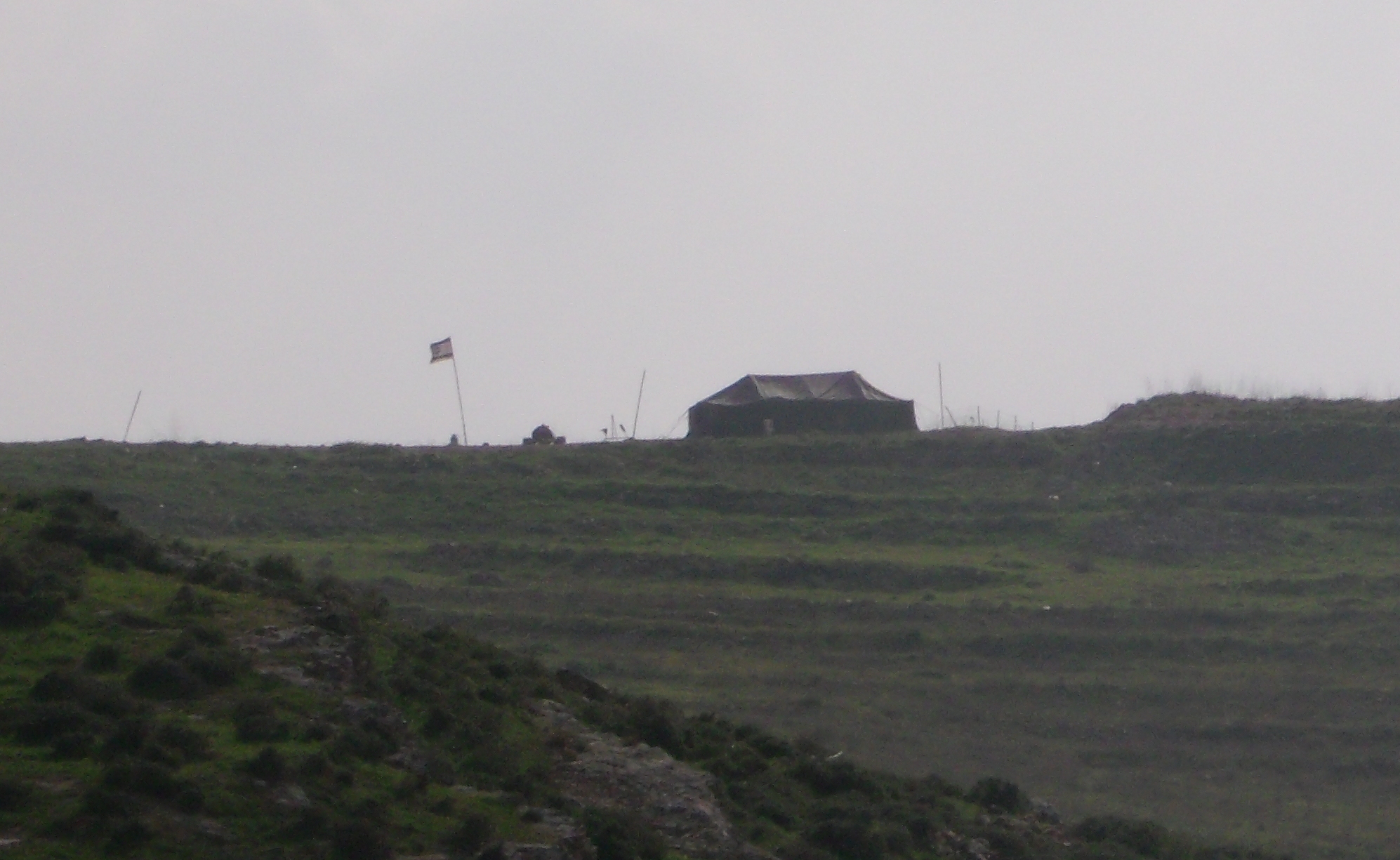
Asira al Qibliya, Occupied Palestine – According to OCHA statistics Yizhar is the most violent settlement in the whole of the West Bank with 70 recorded incidents in 2011 alone. Every week there is at least one attack by Yizhar settlers in the six affected villages.
Four months ago, settlers from Yizhar built a temporary outpost on top of a hill belonging to villagers from Urif. This continued until earlier in the week when Israeli authorities delivered maps to the village which showed that Yizhar had laid claim to 2 dunums of land. This was a massive understatement; they had in-fact seized the entire hill.
The land grab of this hillside seems to be all but complete; a shepherd who was working the land around the Yizhar outpost was recently beaten whilst tending to his sheep: the injuries he sustained were serious but not critical. In another incident, as the Palestinian owners of the land were walking along the road towards the hill this week, they were fired on by Israeli soldiers. Villagers want to challenge this latest land grab, however the law in this country is anything but just. The villagers are all too aware that if they resist they have only stones in the face of tear gas, stun grenades and the very real threat of being fired upon with live ammunition.
Harassment of the residents has also been on the rise. Currently at least once a week soldiers have been invading Asira in the middle of the night. They have been banging on villagers doors with the butts of their assault rifles, making sure people are disturbed in much the same way as has been reported in Urif as well as in Burin.
Yizhar a relatively small but very aggressive settlement in the north of the occupied West Bank. It is situated on a hill surrounded by six Palestinian villages which are all made to live in a state of constant fear.
Related articles
- Continued harrassment of the Nasser family in Madama (palsolidarity.org)
- Israeli Soldiers Attack, Evict, Bab Al-Shams, Arrest Dozens (alethonews.wordpress.com)
- PHOTOS | Settlers attack Urif and Qusra with guns, knives and stones (occupiedpalestine.wordpress.com)
Continued harrassment of the Nasser family in Madama
International Solidarity Movement | January 27, 2013

Madama, Occupied Palestine – A month after unprovoked settler and army attacks, the victim of severe violence Mamun Nasser remains in Israeli prison. The arrest of yet another member of the Nasser family shows Israeli army’s continued harassment in Madama.
On December 18th the notorious security guard charged with the protection of the illegal settlement of Yizhar, Jacob, attacked Mamun Nasser while he was tending to his flock of sheep in a hill outside the settlement. Mamun was handcuffed and beaten in front of his entire family, who desperately tried to intervene.
The Israeli army arrived on the scene, who responded by firing live ammunition on the Nasser family and others who tried to help, quickly ending their attempt to stop the vicious assault. One round passed through Mamun’s sisters clothing narrowly missing her while another one hit his brother, Amir, in the leg. His mother told us “They wanted to kill him [Amir]. I heard the officer giving that order. He was lucky that he was only shot in his leg.” Severely beaten, Mamun was then arrested and taken away by the Israeli military into custody. One month later he remains detained in Majdou Prison.
On January 23rd at 4 pm, the Israeli army followed up the harassment by raiding the Nasser family home in Madama, arresting Mamun’s brother Amir who was still recovering from the gunshot wound he received only a month prior. This is another episode in the continued harassment of villagers surrounding Yizhar which is described as the West Bank’s most violent settlement by the United Nations.
Video taken by settlers during the incident on December 18th
Related articles
- Palestinian facing charges after settler violence in Madama (palsolidarity.org)
- Madama attack – Harrowing account from the Nassar family (palsolidarity.org)
- Qusra settler attack, two hospitalised (alethonews.wordpress.com)
- Jewish settlers commit vehicular assaults with impunity at peaceful roadblock protests in the West Bank (alethonews.wordpress.com)
- This Week in Palestine, January 25th, 2013 (indybay.org)
Mayoral Candidates Take Sides over St. Louis Veolia Contract
Saint Louis Palestine Solidarity Committee | January 22, 2013
On January 16, 2013 at City Hall in St. Louis, Missouri, a diverse group of 60 Palestinian rights organizers; environmental activists; workers; civil rights leaders; veterans; local business owners; students; members of the local Muslim, Christian, and Jewish communities; and other concerned citizens packed a meeting of the St. Louis Board of Estimate & Apportionment (E&A) to show opposition to a proposed city contract with Veolia Water. Two mayoral candidates on the 3-person board, which considers public contracts, took opposite sides over the contract, prompting the third member to call for a public hearing for testimonies from local citizens regarding Veolia.
Contract opponents lined the halls leading to the mayor’s office, citing Veolia’s abysmal record of poor environmental standards, labor abuses and involvement in human rights abuses in Palestine. Each held a sign stating “Say No to Veolia” followed by their personal reasons, which included: “I can’t ride their buses because I am Palestinian,” “I think all people deserve equal treatment,” “My tax dollars are not for corporate profit,” “They don’t have to drink our water,” “I love coffee.” The mayor’s office had to change the meeting venue at the last minute to accommodate the large public turnout.
The St. Louis Palestine Solidarity Committee (PSC) learned of the proposed $250,000 Veolia contract for a four-month consultation for the St. Louis Water Division in December 2012 after the story was leaked to the Riverfront Times. When the contract came up for approval, PSC organized in less than 24 hours a grassroots effort to tell the E&A Board, which is comprised of St. Louis City Mayor Francis Slay, Comptroller Darlene Green and President of the Board of Aldermen Lewis Reed (running for mayor against Slay), not to approve the contract without investigating Veolia’s record. At the December 19, 2012 meeting of the Board, the Board agreed they could not in good conscience vote to approve a contract with so many allegations outstanding.
Immediately, the PSC reached out to diverse communities to join the fight against Veolia, all under the coalition St. Louis Dump Veolia.
The contract was reintroduced last-minute to the January agenda by Mayor Slay, the contract’s chief proponent. Slay had received a trophy and award check for $15,000 from the President of Veolia Water in 2007, on behalf of the City. Following mass mobilization by the coalition, Mayor Slay decided one day before the January meeting to remove the contract from the agenda, delaying the vote for a second month.
In the presence of an uncharacteristically large audience and media presence, the two mayoral candidates Slay and Reed came head-to-head in tense disputes regarding agenda items, transforming the meeting into what some coined an “ad-hoc mayoral debate.” President Reed ended by praising the public showing and affirming his opposition to the Veolia contract, while Slay stressed that the public had misconceptions about the company.
Comptroller Green, who holds the deciding vote, said she hoped the public’s voices could be heard and asked for a public hearing. The PSC delivered and posted letters to Comptroller Green asking her to reject Veolia from the Palestinian Freedom Riders, Boycott from Within and the Civic Coalition for Palestinian Rights in Jerusalem.
Veolia has been a major focus of the global Boycott, Divestment and Sanctions (BDS) movement for Palestinian freedom and equality. The St. Louis campaign against Veolia may be the first time that a BDS campaign has entered mainstream political discourse and, perhaps, a mayoral race. Media coverage in the St. Louis Post-Dispatch, the Riverfront Times and St. Louis Public Radio acknowledge that Veolia’s contracts in Israel/Palestine have been instrumental in bringing the controversy out in the open.
The nationwide We Divest campaign targets Veolia for divestment from the holdings of financial services giant, TIAA-CREF. St. Louis-area resident and PSC member, Steve Tamari, is the lead filer for a nationwide, broad-based shareholders’ resolution calling for divestment from Veolia and other companies that profit from Israel’s human rights abuses. Individuals holding a CREF account are encouraged to sign on to the shareholders’ resolution and to vote in support of the resolution before or at the July 2013 annual meeting.
St. Louis Dump Veolia is committed to keeping up the pressure on City Hall until the Veolia contract is rejected once and for all. The PSC will be mobilizing residents to testify at the hearing, putting the Israeli occupation, and its corporate enablers, on trial for all to see.
The next E&A meeting will occur on Wednesday, February 20 at 2pm in St. Louis City Hall.
To follow developments and action items on the campaign, join the St. Louis Dump Veolia and Palestine Solidarity Committee Facebook pages, and follow@stlpsc on Twitter
Veolia Fact Sheet
December 18th, 2012 | Published in Latest News and Action Alerts, STL-PSC Blog
What is Veolia?
According to a story broken by the Riverfront Times, St. Louis city lawyers have been negotiating a contract with Veolia Water North America to guide cost-cutting. Veolia Water is a major subsidiary of Veolia Environnement, a Paris-based multinational corporation and the largest water privatization business in the world. Veolia is infamous for:
- Failure to make good on promised improvements
- Anti-labor practices
- Privatizing public resources
- Irresponsible to disastrous environmental practices
- Mismanagement
- Corruption, bribery, embezzlement, and fraud
- Supporting and profiting from segregation and discrimination in Palestine
Worldwide, consumers report that Veolia consistently charges high rates, provides poor service, causes staff turnover, discourages water conservation, and fails to implement promised improvements. Its history reveals consistent prioritization of private profit at the expense of the environment and public welfare.
Unless otherwise indicated, the following is based on extensive research and documentation on Veolia’s practices by Water for All, Polaris Institute, Global Exchange, Novato Friends of Locally Operated Wastewater, Public Citizen, Public Water Works, and Food & Water Watch (here, here, here, here, here).
What happened in Indianapolis?
In its proposal to the St. Louis Water Division, Veolia extensively references its work in Indianapolis as a successful model that could inform Veolia’s guidance in St. Louis. If Indianapolis is any indication of Veolia’s practices, then our city would do well to steer clear. Veolia claims that the contract was completed and “focused on building a collaborative environment with all of the project stakeholders (union, government and the community).” In fact the company’s 20-year contract with Indianapolis was terminated by the city less than halfway through, by which time the following had ensued:
- Non-union employees claimed that the company cut retirement plans, health care and other benefits, costing the workers more than $50 million over 25 years. Hundreds of employees, many organized under a strong union, found themselves in a pitched battle with the company to preserve benefits and hold Veolia to its promises.
- Veolia was sued for breaking state contract law, and for overcharging 250,000 residents.
- Because the company lacked proper safeguards, a typo by an employee caused a boil-water alert for more than a million people, closing local businesses and canceling school for 40,000 students.
- An independent review uncovered lax oversight of the city’s contract with Veolia.
- Consumer complaints more than doubled in the first 10 months of the contract.
- In a study of 100 large U.S. cities, Environmental Working Group ranked Indianapolis drinking water quality #90 (i.e. 11th-worst overall). St. Louis ranks #9 — among the best in the country.
In 2005, a federal grand jury subpoenaed four Veolia Indianapolis employees as part of an investigation into allegations that the utility falsified water quality reports. The probe began amid accusations by Indianapolis council members that the company had cut back on staffing, water testing, treatment chemicals and maintenance. Though Veolia was never charged, the corporation sustained multimillion-dollar losses and dug its way out of this hole by finagling concessions, including a 2007 contract amendment shifting at least $144 million in costs from Veolia to the city. Ignoring public outcry from consumers and state officials, the city then tried to raise rates by 35% to pay for these additional expenses and more expensive capital improvement projects.
In 2010, with infrastructure needs mounting and Veolia demanding more than the city could afford, Indianapolis canceled the contract more than 10 years early, for which they were forced to pay Veolia an additional $29 million. The nonprofit Citizens Energy Group took over, positioned to save the city more money than multinational Veolia was ever able to.
If Veolia gives Indianapolis as an example of a success story, what could a failure possibly look like?
New Orleans — an Environmental Disaster, and Other Cities
In 2001 in New Orleans, an electrical fire at a sewer treatment plant operated by Veolia caused operators to divert raw sewage into the Mississippi River for two hours. In 2001 and 2002, the plant released sewage into the river a total of 50 times, often violating water quality standards and resulting in more than $107,000 in fines. The city’s Sewerage and Water Board Director and staff made numerous, repeated and documented complaints about Veolia reducing staff to inadequate levels, neglecting preventive maintenance, failing to notify city officials of environmental violations, and other problems. Veolia has a long track record of failing to communicate with New Orleans in connection with the contract. In 2002, the board rejected Veolia’s bid for a new water/wastewater contract following public outrage.
In Richmond, CA in 2006, the city and Veolia were sued for dumping more than 17 million gallons of sewage into tributaries that empty into the San Francisco Bay. The Baykeeper watchdog group said Richmond had one of the highest spill rates in the state. The city had given a 20-year, $70 million contract to Veolia, which promised to cut costs and develop and implement an improvement plan for the sewer and storm water systems. By the time of the lawsuit four years later, the company had not even finished designing the plan, much less begun the renovations. Richmond settled the lawsuit out of court by agreeing to pay for multimillion-dollar improvements to reduce sewer spills. In addition, Richmond taxpayers had to shell out $500,000 annually for years to compensate residents and businesses for property damaged. Even after the lawsuits, the problem continues: Veolia’s Richmond plant had 22 spills dumping more than 2 million gallons of sewage during the first two months of 2008.
Lynn, MA ended a wastewater overflow plant contract with Veolia because the company failed to stay adequately bonded for the project. While company officials lauded the continuing contracts with water and wastewater treatment plants in the community, the town rapped the company for cutting costs by refusing to properly treat wastewater with chemicals. As a result, the town was blanketed in a stench.
Angleton, TX terminated a Veolia contract for non-performance and took the company to court, charging that it breached its contract by failing to maintain adequate staffing levels, not submitting capital project reports and charging improper expenses to the maintenance and repair tab picked up by the city.
In Atlanta, Veolia tried to maximize revenue simply by slashing the work force in half, contributing to boil-water orders, maintenance backlogs and other issue that ultimately led to dissolution of the contract.
In Sauget, IL, right across the river, a related Veolia subsidiary operated a hazardous waste incinerator for over 10 years without a clean air permit. In 2005, “the owners agreed to pay $150,000 for alleged air pollution violations.” As of 2008, the facility had been fined more than $3 million,” mostly related to small explosions and releasing toxic chemicals, including carcinogenic dioxins, into the air.
For more examples, see: Burlingame, CA; Wilmington, DE; Port Arthur, TX; Cranston, RI; and others.
Bribery, Corruption, Embezzlement, Fraud
Corruption, bribery, embezzlement, and fraud appear to part of Veolia’s corporate culture. The president of a Veolia subsidiary was convicted of bribing a New Orleans sewer board member to support renewal of its contract (see background above) in 2002. The same year, the mayor of Bridgeport, CT was convicted on 16 counts including taking kickbacks, bribes and extortion along with 8 other defendants a contract proposal from Veolia (then called Vivendi). A forensic audit in Rockland, MA led to contract termination amid embezzlement charges involving a sewer department official and a local company executive charged with embezzling more than US$300,000. Veolia disclosed accounting fraud in the U.S. from 2007-2010 amounting to $120 million. The scandal took place in their Gulf of Mexico Marine Services unit. These are small examples of a pattern of Veolia replicated around the country and world.
Would this contract privatize the city’s water? No — not yet. But the contract would position Veolia — which specializes in water privatization — as a “brain-trust” of management expertise in reducing costs. Many view Veolia and focusing on privatizing services through long-term monopoly contracts rather than through outright ownership. These types of “advisory” roles can serve as a backdoor avenue toward eventually privatizing municipal operations.
Supporting Apartheid and Segregation in Israel/Palestine
Veolia is involved in Israel’s systematic ethnic discrimination against the Palestinians in many ways:
An Israeli subsidiary, Veolia Water – Israel, operates a wastewater treatment plant located in an illegal Jewish-only settlement called Modiin Ilit, built on Palestinian land in the West Bank. The owners of the land on which this settlement was built have been violently driven out. Two unarmed Palestinians from the Palestinian village on which Modiin Ilit was built, have been killed as they protested nonviolently against the ongoing confiscation of their land and resources. Veolia continues to service the settlement.
An Israeli subsidiary of Veolia Transdev, Connex – Israel, operates buses on segregated roads through the occupied West Bank, including two bus lines that use road 443, which is built partially on confiscated land with portions closed entirely to Palestinians. A separate but unequal Palestinian road system is made up of low grade roads cut by checkpoints and physical barriers restricting Palestinian freedom of movement. Last year, Palestinian Freedom Riders attempted to board buses operating on their own land and were violently removed and arrested. Veolia is profiting from segregation and discrimination.
Another Israeli subsidiary, Veolia Environmental Services – Israel, supervises, consults for, and operates the Tovlan Landfill in the occupied Jordan Valley, collecting refuse from illegal settlements. Israel renders it almost impossible for Palestinians in the Jordan Valley to gain permits to build homes, toilets, wells, animal pens, or other vital infrastructure for local communities, which has forced almost all Palestinian families out, with those remaining living in dire conditions. Some are left with no alternative but to work on settlements that have taken their families’ land, for pay far below the minimum wage, unable to take bathroom breaks, and denied any rights to unionize. Veolia takes captured Palestinian land and natural resources to service the settlements exploiting or driving out Palestinians.
UN Special Rapporteur Richard Falk recently recommended that Veolia “should be boycotted, until they bring their operations into line with international human rights and humanitarian law and standards.” Veolia’s extensive profiting from Israel’s illegal practices have provoked global outcry, costing Veolia more than $12.5 billion in lost contracts to date. Recently, the Friends Fiduciary Corporation, which handles investments for hundreds of U.S. Quaker institutions, also divested from Veolia.
Veolia already in Financial Trouble
With public opinion shifting negatively around the world, Veolia is paying a price. After a 25-year contract, Veolia’s home city of Paris declined to renew its contract in 2009. Cities around the world have done the same. Veolia’s profit margin has plummeted since 2008 and the company lost more than half its market value in 2011. Veolia’s CEO pledged to sell $1.8 billion of assets and to stop operations in at least 37 countries. In September 2012, Veolia’s debt stood at more than $19.7 billion.
Now, Veolia is trying to bring its risky and immoral business to our backyard.
Related articles
- St. Louis Palestine Solidarity Committee Statement on Pending City Contract with Veolia Water (alethonews.wordpress.com)
- Veolia to end sponsorship of major UK photography exhibition (bdsmovement.net)
Featured Video

Weaponized Journalism: 2021 Sayer Ji Interview with NPR
or go to
Aletho News Archives – Video-Images
From the Archives
How Rothschild Banking Clan Uses Its Vast Wealth to Influence World Events and Control Governments

By Ilya Tsukanov – Sputnik – 15.09.2024
How powerful is the Rothschild banking family? How did they amass their fortune? Just how rich are they? Do they secretly control the world? Sputnik explores. … continue
Blog Roll
 Aletho News
- London tourism expo promotes Israeli agency linked to theft of Palestinian land
- Dockworkers launch global strike against Israeli and US military shipments
- Europe facing gas price shock – Gazprom chief
- Ukraine continues recruiting people with disabilities
- Weaponized Journalism: 2021 Sayer Ji Interview with NPR
- Beyond Netanyahu: what Israel’s election means for Palestinians
- Lithuania plans universal conscription
- Lies, Damn Lies, and Ukraine News
- Financial Times rejects Nordic demands to correct Putin call story – media
- The Case for Less Unity in Europe
- If Americans Knew
- An error has occurred; the feed is probably down. Try again later.
- No Tricks Zone
- Germany’s Green Energy Transition Becoming Increasingly Expensive…Another 6 Trillion Euros!
- Sudden Stratospheric Warming, Powerful El Niño Combination May Lead To Extreme Europe Cold, Energy Crisis!
- Two New Studies Find Thwaites Glacier Melt Cannot Be Driven By Human Activity Or A Warming Ocean
- E-Cars Reduce CO2 Emissions By Only 41% Compared To Internal Combustion Engine Vehicles
- Predictions Made By Renowned Climate Professor Over Past Decades Have Been Proven To Be Poor
- New Study Suggests Large Regions Of The Pacific Ocean Have Been Cooling For The Last 80 Years
- Germany’s Green Energy Debacle: High Energy Costs Force Kahla Porzellan to Close After 182 Years!
- New Study: 50 Years Of The Most Aggressive ‘Net Zero’ Policies Can Only Affect The Global Climate By 0.03°C
- US September “Heat” Was No Record…Many Records Set Decades Ago
- Latest European Green Energy Debacle; Portugal’s Largest Flagship Solar Park Insolvent!

