Beyond Vietnam: A Time to Break Silence
By Reverend Martin Luther King | April 4, 1967
Speech delivered by Dr. Martin Luther King, Jr., on April 4, 1967, at a meeting of Clergy and Laity Concerned at Riverside Church in NYC
I come to this magnificent house of worship tonight because my conscience leaves me no other choice. I join with you in this meeting because I am in deepest agreement with the aims and work of the organization which has brought us together: Clergy and Laymen Concerned about Vietnam. The recent statement of your executive committee are the sentiments of my own heart and I found myself in full accord when I read its opening lines: “A time comes when silence is betrayal.” That time has come for us in relation to Vietnam.
The truth of these words is beyond doubt but the mission to which they call us is a most difficult one. Even when pressed by the demands of inner truth, men do not easily assume the task of opposing their government’s policy, especially in time of war. Nor does the human spirit move without great difficulty against all the apathy of conformist thought within one’s own bosom and in the surrounding world. Moreover when the issues at hand seem as perplexed as they often do in the case of this dreadful conflict we are always on the verge of being mesmerized by uncertainty; but we must move on.
Some of us who have already begun to break the silence of the night have found that the calling to speak is often a vocation of agony, but we must speak. We must speak with all the humility that is appropriate to our limited vision, but we must speak. And we must rejoice as well, for surely this is the first time in our nation’s history that a significant number of its religious leaders have chosen to move beyond the prophesying of smooth patriotism to the high grounds of a firm dissent based upon the mandates of conscience and the reading of history. Perhaps a new spirit is rising among us. If it is, let us trace its movement well and pray that our own inner being may be sensitive to its guidance, for we are deeply in need of a new way beyond the darkness that seems so close around us.
Over the past two years, as I have moved to break the betrayal of my own silences and to speak from the burnings of my own heart, as I have called for radical departures from the destruction of Vietnam, many persons have questioned me about the wisdom of my path. At the heart of their concerns this query has often loomed large and loud: Why are you speaking about war, Dr. King? Why are you joining the voices of dissent? Peace and civil rights don’t mix, they say. Aren’t you hurting the cause of your people, they ask? And when I hear them, though I often understand the source of their concern, I am nevertheless greatly saddened, for such questions mean that the inquirers have not really known me, my commitment or my calling. Indeed, their questions suggest that they do not know the world in which they live.
In the light of such tragic misunderstandings, I deem it of signal importance to try to state clearly, and I trust concisely, why I believe that the path from Dexter Avenue Baptist Church — the church in Montgomery, Alabama, where I began my pastorate — leads clearly to this sanctuary tonight.
I come to this platform tonight to make a passionate plea to my beloved nation. This speech is not addressed to Hanoi or to the National Liberation Front. It is not addressed to China or to Russia.
Nor is it an attempt to overlook the ambiguity of the total situation and the need for a collective solution to the tragedy of Vietnam. Neither is it an attempt to make North Vietnam or the National Liberation Front paragons of virtue, nor to overlook the role they can play in a successful resolution of the problem. While they both may have justifiable reason to be suspicious of the good faith of the United States, life and history give eloquent testimony to the fact that conflicts are never resolved without trustful give and take on both sides.
Tonight, however, I wish not to speak with Hanoi and the NLF, but rather to my fellow Americans, who, with me, bear the greatest responsibility in ending a conflict that has exacted a heavy price on both continents.
The Importance of Vietnam
Since I am a preacher by trade, I suppose it is not surprising that I have seven major reasons for bringing Vietnam into the field of my moral vision. There is at the outset a very obvious and almost facile connection between the war in Vietnam and the struggle I, and others, have been waging in America. A few years ago there was a shining moment in that struggle. It seemed as if there was a real promise of hope for the poor — both black and white — through the poverty program. There were experiments, hopes, new beginnings. Then came the buildup in Vietnam and I watched the program broken and eviscerated as if it were some idle political plaything of a society gone mad on war, and I knew that America would never invest the necessary funds or energies in rehabilitation of its poor so long as adventures like Vietnam continued to draw men and skills and money like some demonic destructive suction tube. So I was increasingly compelled to see the war as an enemy of the poor and to attack it as such.
Perhaps the more tragic recognition of reality took place when it became clear to me that the war was doing far more than devastating the hopes of the poor at home. It was sending their sons and their brothers and their husbands to fight and to die in extraordinarily high proportions relative to the rest of the population. We were taking the black young men who had been crippled by our society and sending them eight thousand miles away to guarantee liberties in Southeast Asia which they had not found in southwest Georgia and East Harlem. So we have been repeatedly faced with the cruel irony of watching Negro and white boys on TV screens as they kill and die together for a nation that has been unable to seat them together in the same schools. So we watch them in brutal solidarity burning the huts of a poor village, but we realize that they would never live on the same block in Detroit. I could not be silent in the face of such cruel manipulation of the poor.
My third reason moves to an even deeper level of awareness, for it grows out of my experience in the ghettoes of the North over the last three years — especially the last three summers. As I have walked among the desperate, rejected and angry young men I have told them that Molotov cocktails and rifles would not solve their problems. I have tried to offer them my deepest compassion while maintaining my conviction that social change comes most meaningfully through nonviolent action. But they asked — and rightly so — what about Vietnam? They asked if our own nation wasn’t using massive doses of violence to solve its problems, to bring about the changes it wanted. Their questions hit home, and I knew that I could never again raise my voice against the violence of the oppressed in the ghettos without having first spoken clearly to the greatest purveyor of violence in the world today — my own government. For the sake of those boys, for the sake of this government, for the sake of hundreds of thousands trembling under our violence, I cannot be silent.
For those who ask the question, “Aren’t you a civil rights leader?” and thereby mean to exclude me from the movement for peace, I have this further answer. In 1957 when a group of us formed the Southern Christian Leadership Conference, we chose as our motto: “To save the soul of America.” We were convinced that we could not limit our vision to certain rights for black people, but instead affirmed the conviction that America would never be free or saved from itself unless the descendants of its slaves were loosed completely from the shackles they still wear. In a way we were agreeing with Langston Hughes, that black bard of Harlem, who had written earlier:
O, yes,
I say it plain,
America never was America to me,
And yet I swear this oath–
America will be!
Now, it should be incandescently clear that no one who has any concern for the integrity and life of America today can ignore the present war. If America’s soul becomes totally poisoned, part of the autopsy must read Vietnam. It can never be saved so long as it destroys the deepest hopes of men the world over. So it is that those of us who are yet determined that America will be are led down the path of protest and dissent, working for the health of our land.
As if the weight of such a commitment to the life and health of America were not enough, another burden of responsibility was placed upon me in 1964; and I cannot forget that the Nobel Prize for Peace was also a commission — a commission to work harder than I had ever worked before for “the brotherhood of man.” This is a calling that takes me beyond national allegiances, but even if it were not present I would yet have to live with the meaning of my commitment to the ministry of Jesus Christ. To me the relationship of this ministry to the making of peace is so obvious that I sometimes marvel at those who ask me why I am speaking against the war. Could it be that they do not know that the good news was meant for all men — for Communist and capitalist, for their children and ours, for black and for white, for revolutionary and conservative? Have they forgotten that my ministry is in obedience to the one who loved his enemies so fully that he died for them? What then can I say to the “Vietcong” or to Castro or to Mao as a faithful minister of this one? Can I threaten them with death or must I not share with them my life?
Finally, as I try to delineate for you and for myself the road that leads from Montgomery to this place I would have offered all that was most valid if I simply said that I must be true to my conviction that I share with all men the calling to be a son of the living God. Beyond the calling of race or nation or creed is this vocation of sonship and brotherhood, and because I believe that the Father is deeply concerned especially for his suffering and helpless and outcast children, I come tonight to speak for them.
This I believe to be the privilege and the burden of all of us who deem ourselves bound by allegiances and loyalties which are broader and deeper than nationalism and which go beyond our nation’s self-defined goals and positions. We are called to speak for the weak, for the voiceless, for victims of our nation and for those it calls enemy, for no document from human hands can make these humans any less our brothers.
Strange Liberators
And as I ponder the madness of Vietnam and search within myself for ways to understand and respond to compassion my mind goes constantly to the people of that peninsula. I speak now not of the soldiers of each side, not of the junta in Saigon, but simply of the people who have been living under the curse of war for almost three continuous decades now. I think of them too because it is clear to me that there will be no meaningful solution there until some attempt is made to know them and hear their broken cries.
They must see Americans as strange liberators. The Vietnamese people proclaimed their own independence in 1945 after a combined French and Japanese occupation, and before the Communist revolution in China. They were led by Ho Chi Minh. Even though they quoted the American Declaration of Independence in their own document of freedom, we refused to recognize them. Instead, we decided to support France in its reconquest of her former colony.
Our government felt then that the Vietnamese people were not “ready” for independence, and we again fell victim to the deadly Western arrogance that has poisoned the international atmosphere for so long. With that tragic decision we rejected a revolutionary government seeking self-determination, and a government that had been established not by China (for whom the Vietnamese have no great love) but by clearly indigenous forces that included some Communists. For the peasants this new government meant real land reform, one of the most important needs in their lives.
For nine years following 1945 we denied the people of Vietnam the right of independence. For nine years we vigorously supported the French in their abortive effort to recolonize Vietnam.
Before the end of the war we were meeting eighty percent of the French war costs. Even before the French were defeated at Dien Bien Phu, they began to despair of the reckless action, but we did not. We encouraged them with our huge financial and military supplies to continue the war even after they had lost the will. Soon we would be paying almost the full costs of this tragic attempt at recolonization.
After the French were defeated it looked as if independence and land reform would come again through the Geneva agreements. But instead there came the United States, determined that Ho should not unify the temporarily divided nation, and the peasants watched again as we supported one of the most vicious modern dictators — our chosen man, Premier Diem. The peasants watched and cringed as Diem ruthlessly routed out all opposition, supported their extortionist landlords and refused even to discuss reunification with the north. The peasants watched as all this was presided over by U.S. influence and then by increasing numbers of U.S. troops who came to help quell the insurgency that Diem’s methods had aroused. When Diem was overthrown they may have been happy, but the long line of military dictatorships seemed to offer no real change — especially in terms of their need for land and peace.
The only change came from America as we increased our troop commitments in support of governments which were singularly corrupt, inept and without popular support. All the while the people read our leaflets and received regular promises of peace and democracy — and land reform. Now they languish under our bombs and consider us — not their fellow Vietnamese –the real enemy. They move sadly and apathetically as we herd them off the land of their fathers into concentration camps where minimal social needs are rarely met. They know they must move or be destroyed by our bombs. So they go — primarily women and children and the aged.
They watch as we poison their water, as we kill a million acres of their crops. They must weep as the bulldozers roar through their areas preparing to destroy the precious trees. They wander into the hospitals, with at least twenty casualties from American firepower for one “Vietcong”-inflicted injury. So far we may have killed a million of them — mostly children. They wander into the towns and see thousands of the children, homeless, without clothes, running in packs on the streets like animals. They see the children, degraded by our soldiers as they beg for food. They see the children selling their sisters to our soldiers, soliciting for their mothers.
What do the peasants think as we ally ourselves with the landlords and as we refuse to put any action into our many words concerning land reform? What do they think as we test our latest weapons on them, just as the Germans tested out new medicine and new tortures in the concentration camps of Europe? Where are the roots of the independent Vietnam we claim to be building? Is it among these voiceless ones?
We have destroyed their two most cherished institutions: the family and the village. We have destroyed their land and their crops. We have cooperated in the crushing of the nation’s only non-Communist revolutionary political force — the unified Buddhist church. We have supported the enemies of the peasants of Saigon. We have corrupted their women and children and killed their men. What liberators?
Now there is little left to build on — save bitterness. Soon the only solid physical foundations remaining will be found at our military bases and in the concrete of the concentration camps we call fortified hamlets. The peasants may well wonder if we plan to build our new Vietnam on such grounds as these? Could we blame them for such thoughts? We must speak for them and raise the questions they cannot raise. These too are our brothers.
Perhaps the more difficult but no less necessary task is to speak for those who have been designated as our enemies. What of the National Liberation Front — that strangely anonymous group we call VC or Communists? What must they think of us in America when they realize that we permitted the repression and cruelty of Diem which helped to bring them into being as a resistance group in the south? What do they think of our condoning the violence which led to their own taking up of arms? How can they believe in our integrity when now we speak of “aggression from the north” as if there were nothing more essential to the war? How can they trust us when now we charge them with violence after the murderous reign of Diem and charge them with violence while we pour every new weapon of death into their land? Surely we must understand their feelings even if we do not condone their actions. Surely we must see that the men we supported pressed them to their violence. Surely we must see that our own computerized plans of destruction simply dwarf their greatest acts.
How do they judge us when our officials know that their membership is less than twenty-five percent Communist and yet insist on giving them the blanket name? What must they be thinking when they know that we are aware of their control of major sections of Vietnam and yet we appear ready to allow national elections in which this highly organized political parallel government will have no part? They ask how we can speak of free elections when the Saigon press is censored and controlled by the military junta. And they are surely right to wonder what kind of new government we plan to help form without them — the only party in real touch with the peasants. They question our political goals and they deny the reality of a peace settlement from which they will be excluded. Their questions are frighteningly relevant. Is our nation planning to build on political myth again and then shore it up with the power of new violence?
Here is the true meaning and value of compassion and nonviolence when it helps us to see the enemy’s point of view, to hear his questions, to know his assessment of ourselves. For from his view we may indeed see the basic weaknesses of our own condition, and if we are mature, we may learn and grow and profit from the wisdom of the brothers who are called the opposition.
So, too, with Hanoi. In the north, where our bombs now pummel the land, and our mines endanger the waterways, we are met by a deep but understandable mistrust. To speak for them is to explain this lack of confidence in Western words, and especially their distrust of American intentions now. In Hanoi are the men who led the nation to independence against the Japanese and the French, the men who sought membership in the French commonwealth and were betrayed by the weakness of Paris and the willfulness of the colonial armies. It was they who led a second struggle against French domination at tremendous costs, and then were persuaded to give up the land they controlled between the thirteenth and seventeenth parallel as a temporary measure at Geneva. After 1954 they watched us conspire with Diem to prevent elections which would have surely brought Ho Chi Minh to power over a united Vietnam, and they realized they had been betrayed again.
When we ask why they do not leap to negotiate, these things must be remembered. Also it must be clear that the leaders of Hanoi considered the presence of American troops in support of the Diem regime to have been the initial military breach of the Geneva agreements concerning foreign troops, and they remind us that they did not begin to send in any large number of supplies or men until American forces had moved into the tens of thousands.
Hanoi remembers how our leaders refused to tell us the truth about the earlier North Vietnamese overtures for peace, how the president claimed that none existed when they had clearly been made. Ho Chi Minh has watched as America has spoken of peace and built up its forces, and now he has surely heard of the increasing international rumors of American plans for an invasion of the north. He knows the bombing and shelling and mining we are doing are part of traditional pre-invasion strategy. Perhaps only his sense of humor and of irony can save him when he hears the most powerful nation of the world speaking of aggression as it drops thousands of bombs on a poor weak nation more than eight thousand miles away from its shores.
At this point I should make it clear that while I have tried in these last few minutes to give a voice to the voiceless on Vietnam and to understand the arguments of those who are called enemy, I am as deeply concerned about our troops there as anything else. For it occurs to me that what we are submitting them to in Vietnam is not simply the brutalizing process that goes on in any war where armies face each other and seek to destroy. We are adding cynicism to the process of death, for they must know after a short period there that none of the things we claim to be fighting for are really involved. Before long they must know that their government has sent them into a struggle among Vietnamese, and the more sophisticated surely realize that we are on the side of the wealthy and the secure while we create hell for the poor.
This Madness Must Cease
Somehow this madness must cease. We must stop now. I speak as a child of God and brother to the suffering poor of Vietnam. I speak for those whose land is being laid waste, whose homes are being destroyed, whose culture is being subverted. I speak for the poor of America who are paying the double price of smashed hopes at home and death and corruption in Vietnam. I speak as a citizen of the world, for the world as it stands aghast at the path we have taken. I speak as an American to the leaders of my own nation. The great initiative in this war is ours. The initiative to stop it must be ours.
This is the message of the great Buddhist leaders of Vietnam. Recently one of them wrote these words:
“Each day the war goes on the hatred increases in the heart of the Vietnamese and in the hearts of those of humanitarian instinct. The Americans are forcing even their friends into becoming their enemies. It is curious that the Americans, who calculate so carefully on the possibilities of military victory, do not realize that in the process they are incurring deep psychological and political defeat. The image of America will never again be the image of revolution, freedom and democracy, but the image of violence and militarism.”
If we continue, there will be no doubt in my mind and in the mind of the world that we have no honorable intentions in Vietnam. It will become clear that our minimal expectation is to occupy it as an American colony and men will not refrain from thinking that our maximum hope is to goad China into a war so that we may bomb her nuclear installations. If we do not stop our war against the people of Vietnam immediately the world will be left with no other alternative than to see this as some horribly clumsy and deadly game we have decided to play.
The world now demands a maturity of America that we may not be able to achieve. It demands that we admit that we have been wrong from the beginning of our adventure in Vietnam, that we have been detrimental to the life of the Vietnamese people. The situation is one in which we must be ready to turn sharply from our present ways.
In order to atone for our sins and errors in Vietnam, we should take the initiative in bringing a halt to this tragic war. I would like to suggest five concrete things that our government should do immediately to begin the long and difficult process of extricating ourselves from this nightmarish conflict:
End all bombing in North and South Vietnam.
Declare a unilateral cease-fire in the hope that such action will create the atmosphere for negotiation.
Take immediate steps to prevent other battlegrounds in Southeast Asia by curtailing our military buildup in Thailand and our interference in Laos.
Realistically accept the fact that the National Liberation Front has substantial support in South Vietnam and must thereby play a role in any meaningful negotiations and in any future Vietnam government.
Set a date that we will remove all foreign troops from Vietnam in accordance with the 1954 Geneva agreement.
Part of our ongoing commitment might well express itself in an offer to grant asylum to any Vietnamese who fears for his life under a new regime which included the Liberation Front. Then we must make what reparations we can for the damage we have done. We most provide the medical aid that is badly needed, making it available in this country if necessary.
Protesting The War
Meanwhile we in the churches and synagogues have a continuing task while we urge our government to disengage itself from a disgraceful commitment. We must continue to raise our voices if our nation persists in its perverse ways in Vietnam. We must be prepared to match actions with words by seeking out every creative means of protest possible.
As we counsel young men concerning military service we must clarify for them our nation’s role in Vietnam and challenge them with the alternative of conscientious objection. I am pleased to say that this is the path now being chosen by more than seventy students at my own alma mater, Morehouse College, and I recommend it to all who find the American course in Vietnam a dishonorable and unjust one. Moreover I would encourage all ministers of draft age to give up their ministerial exemptions and seek status as conscientious objectors. These are the times for real choices and not false ones. We are at the moment when our lives must be placed on the line if our nation is to survive its own folly. Every man of humane convictions must decide on the protest that best suits his convictions, but we must all protest.
There is something seductively tempting about stopping there and sending us all off on what in some circles has become a popular crusade against the war in Vietnam. I say we must enter the struggle, but I wish to go on now to say something even more disturbing. The war in Vietnam is but a symptom of a far deeper malady within the American spirit, and if we ignore this sobering reality we will find ourselves organizing clergy- and laymen-concerned committees for the next generation. They will be concerned about Guatemala and Peru. They will be concerned about Thailand and Cambodia. They will be concerned about Mozambique and South Africa. We will be marching for these and a dozen other names and attending rallies without end unless there is a significant and profound change in American life and policy. Such thoughts take us beyond Vietnam, but not beyond our calling as sons of the living God.
In 1957 a sensitive American official overseas said that it seemed to him that our nation was on the wrong side of a world revolution. During the past ten years we have seen emerge a pattern of suppression which now has justified the presence of U.S. military “advisors” in Venezuela. This need to maintain social stability for our investments accounts for the counter-revolutionary action of American forces in Guatemala. It tells why American helicopters are being used against guerrillas in Colombia and why American napalm and green beret forces have already been active against rebels in Peru. It is with such activity in mind that the words of the late John F. Kennedy come back to haunt us. Five years ago he said, “Those who make peaceful revolution impossible will make violent revolution inevitable.”
Increasingly, by choice or by accident, this is the role our nation has taken — the role of those who make peaceful revolution impossible by refusing to give up the privileges and the pleasures that come from the immense profits of overseas investment.
I am convinced that if we are to get on the right side of the world revolution, we as a nation must undergo a radical revolution of values. We must rapidly begin the shift from a “thing-oriented” society to a “person-oriented” society. When machines and computers, profit motives and property rights are considered more important than people, the giant triplets of racism, materialism, and militarism are incapable of being conquered.
A true revolution of values will soon cause us to question the fairness and justice of many of our past and present policies. n the one hand we are called to play the good Samaritan on life’s roadside; but that will be only an initial act. One day we must come to see that the whole Jericho road must be transformed so that men and women will not be constantly beaten and robbed as they make their journey on life’s highway. True compassion is more than flinging a coin to a beggar; it is not haphazard and superficial. It comes to see that an edifice which produces beggars needs restructuring. A true revolution of values will soon look uneasily on the glaring contrast of poverty and wealth. With righteous indignation, it will look across the seas and see individual capitalists of the West investing huge sums of money in Asia, Africa and South America, only to take the profits out with no concern for the social betterment of the countries, and say: “This is not just.” It will look at our alliance with the landed gentry of Latin America and say: “This is not just.” The Western arrogance of feeling that it has everything to teach others and nothing to learn from them is not just. A true revolution of values will lay hands on the world order and say of war: “This way of settling differences is not just.” This business of burning human beings with napalm, of filling our nation’s homes with orphans and widows, of injecting poisonous drugs of hate into veins of people normally humane, of sending men home from dark and bloody battlefields physically handicapped and psychologically deranged, cannot be reconciled with wisdom, justice and love. A nation that continues year after year to spend more money on military defense than on programs of social uplift is approaching spiritual death.
America, the richest and most powerful nation in the world, can well lead the way in this revolution of values. There is nothing, except a tragic death wish, to prevent us from reordering our priorities, so that the pursuit of peace will take precedence over the pursuit of war. There is nothing to keep us from molding a recalcitrant status quo with bruised hands until we have fashioned it into a brotherhood.
This kind of positive revolution of values is our best defense against communism. War is not the answer. Communism will never be defeated by the use of atomic bombs or nuclear weapons. Let us not join those who shout war and through their misguided passions urge the United States to relinquish its participation in the United Nations. These are days which demand wise restraint and calm reasonableness. We must not call everyone a Communist or an appeaser who advocates the seating of Red China in the United Nations and who recognizes that hate and hysteria are not the final answers to the problem of these turbulent days. We must not engage in a negative anti-communism, but rather in a positive thrust for democracy, realizing that our greatest defense against communism is to take offensive action in behalf of justice. We must with positive action seek to remove thosse conditions of poverty, insecurity and injustice which are the fertile soil in which the seed of communism grows and develops.
The People Are Important
These are revolutionary times. All over the globe men are revolting against old systems of exploitation and oppression and out of the wombs of a frail world new systems of justice and equality are being born. The shirtless and barefoot people of the land are rising up as never before. “The people who sat in darkness have seen a great light.” We in the West must support these revolutions. It is a sad fact that, because of comfort, complacency, a morbid fear of communism, and our proneness to adjust to injustice, the Western nations that initiated so much of the revolutionary spirit of the modern world have now become the arch anti-revolutionaries. This has driven many to feel that only Marxism has the revolutionary spirit. Therefore, communism is a judgement against our failure to make democracy real and follow through on the revolutions we initiated. Our only hope today lies in our ability to recapture the revolutionary spirit and go out into a sometimes hostile world declaring eternal hostility to poverty, racism, and militarism. With this powerful commitment we shall boldly challenge the status quo and unjust mores and thereby speed the day when “every valley shall be exalted, and every moutain and hill shall be made low, and the crooked shall be made straight and the rough places plain.”
A genuine revolution of values means in the final analysis that our loyalties must become ecumenical rather than sectional. Every nation must now develop an overriding loyalty to mankind as a whole in order to preserve the best in their individual societies.
This call for a world-wide fellowship that lifts neighborly concern beyond one’s tribe, race, class and nation is in reality a call for an all-embracing and unconditional love for all men. This oft misunderstood and misinterpreted concept — so readily dismissed by the Nietzsches of the world as a weak and cowardly force — has now become an absolute necessity for the survival of man. When I speak of love I am not speaking of some sentimental and weak response. I am speaking of that force which all of the great religions have seen as the supreme unifying principle of life. Love is somehow the key that unlocks the door which leads to ultimate reality. This Hindu-Moslem-Christian-Jewish-Buddhist belief about ultimate reality is beautifully summed up in the first epistle of Saint John:
Let us love one another; for love is God and everyone that loveth is born of God and knoweth God. He that loveth not knoweth not God; for God is love. If we love one another God dwelleth in us, and his love is perfected in us.
Let us hope that this spirit will become the order of the day. We can no longer afford to worship the god of hate or bow before the altar of retaliation. The oceans of history are made turbulent by the ever-rising tides of hate. History is cluttered with the wreckage of nations and individuals that pursued this self-defeating path of hate. As Arnold Toynbee says : “Love is the ultimate force that makes for the saving choice of life and good against the damning choice of death and evil. Therefore the first hope in our inventory must be the hope that love is going to have the last word.”
We are now faced with the fact that tomorrow is today. We are confronted with the fierce urgency of now. In this unfolding conundrum of life and history there is such a thing as being too late. Procrastination is still the thief of time. Life often leaves us standing bare, naked and dejected with a lost opportunity. The “tide in the affairs of men” does not remain at the flood; it ebbs. We may cry out deperately for time to pause in her passage, but time is deaf to every plea and rushes on. Over the bleached bones and jumbled residue of numerous civilizations are written the pathetic words: “Too late.” There is an invisible book of life that faithfully records our vigilance or our neglect. “The moving finger writes, and having writ moves on…” We still have a choice today; nonviolent coexistence or violent co-annihilation.
We must move past indecision to action. We must find new ways to speak for peace in Vietnam and justice throughout the developing world — a world that borders on our doors. If we do not act we shall surely be dragged down the long dark and shameful corridors of time reserved for those who possess power without compassion, might without morality, and strength without sight.
Now let us begin. Now let us rededicate ourselves to the long and bitter — but beautiful — struggle for a new world. This is the calling of the sons of God, and our brothers wait eagerly for our response. Shall we say the odds are too great? Shall we tell them the struggle is too hard? Will our message be that the forces of American life militate against their arrival as full men, and we send our deepest regrets? Or will there be another message, of longing, of hope, of solidarity with their yearnings, of commitment to their cause, whatever the cost? The choice is ours, and though we might prefer it otherwise we must choose in this crucial moment of human history.
As that noble bard of yesterday, James Russell Lowell, eloquently stated:
Once to every man and nation
Comes the moment to decide,
In the strife of truth and falsehood,
For the good or evil side;
Some great cause, God’s new Messiah,
Off’ring each the bloom or blight,
And the choice goes by forever
Twixt that darkness and that light.Though the cause of evil prosper,
Yet ’tis truth alone is strong;
Though her portion be the scaffold,
And upon the throne be wrong:
Yet that scaffold sways the future,
And behind the dim unknown,
Standeth God within the shadow
Keeping watch above his own.
~
Source – BRC NEWS
Israeli Authorities Change Route Of Wall To Fully Annex Jerusalem For Israel
By Saed Bannoura | IMEMC & Agencies | January 21, 2013
The Israeli Defense Ministry announced on Sunday that they will re-route a section of the Wall east of Jerusalem in order to close off an existing gap and fully annex the city of Jerusalem into Israel. The new route means the complete encirclement of the Palestinian village of Al-Zaim, with the Wall to the West and a security fence to the east.
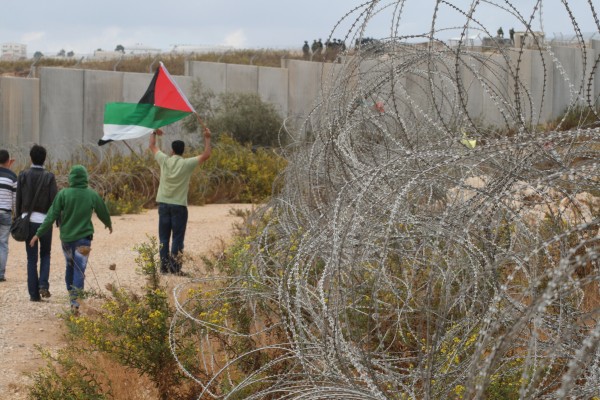 Other Palestinian towns are also completely isolated and encircled into ghettoes, including the town of Sheikh Sa’ed and the city of Qalqilya. Israeli authorities isolated these towns in order to create Palestinian-free zones and routes throughout the West Bank to allow Israeli settlers to travel unencumbered without either having to stop at checkpoints or to drive on the same roads as Palestinians. But in order to do that, Israeli forces have had to maintain over 600 checkpoints throughout the West Bank, and to force Palestinians off their own roads and onto dirt roads or trails.
The new route of the Wall will put the settlement of Ma’ale Adumim on the Palestinian side of the Wall, along with dozens of other Israeli settlements constructed in violation of international law all over the West Bank. But Israeli officials have assured the residents of these settlements that they will construct other Walls and fences to allow them to access Jerusalem without having to go through Palestinian areas.
These additional fences and barriers will, like the Annexation Wall itself, be constructed on land seized from Palestinian owners by Israeli authorities who claim that they have the right to take the land ‘for security reasons’. All Israeli settlements on Palestinian land are considered illegal under international law and the Fourth Geneva Convention, which forbids an occupying military power from settling its civilian population on land occupied by military force.
The announcement is seen as a response to the Palestinian encampment Bab Al Shams, which was established on the land in question, known to Israeli officials as ‘E1’, last weekend, then demolished by Israeli forces. The Palestinian non-violent activists who established the encampment entered the area through the village of Al-Zaim.
Israeli Prime Minister Binyamin Netanyahu has openly declared his intention to build a settlement on the ‘E1’ land, and completely enclose the eastern edge of Jerusalem, thus effectively annexing the city of Jerusalem to the state of Israel. This renders any peace agreement with the Palestinian Authority impossible, since one of the Palestinian Authority’s base demands is sharing the city of Jerusalem. The base demands, which Palestinians have asked Israel to recognize time and again to no avail, are: the recognition of a Palestinian state with east Jerusalem as its capital, the right of return of Palestinian refugees and the release of the thousands of Palestinian political prisoners being held in Israeli prison camps.
Related articles
- The long road to Bab al-Karama (alethonews.wordpress.com)
- Israeli politician: Palestinian ghettos were always the plan (sott.net)
The long road to Bab al-Karama
International Solidarity Movement | January 20, 2013
Bab al-Karama, Occupied Palestine – The road to Bab al-Karama, the new tent neighborhood created by Palestinians on land that will be separated from the village of Beit Iksa by the Apartheid wall, exposes a landscape of Apartheid.
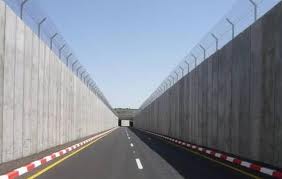 To reach Bab al-Karama from Occupied Ramallah one needs to take the “Palestinian only” road that runs under the “Israeli only” 443 Highway between Ramallah and Beir Naballah.
Beir Naballah used to be a suburb of Jerusalem. Affluent Jerusalemites built their homes in Beir Naballah to escape from the housing crisis imposed on Palestinians by Jerusalem’s municipality housing polices. It sits on a road that connected the villages in the area with Jerusalem and continued on to Latrun. Now Beir Naballah is completely surrounded by an Israeli wall. The old road was widened and transformed into an Israeli highway called 443. The highway now connects Jerusalem to Tel Aviv and the Palestinian residents of the area are barred form using it. The Jerusalemite residents were forced to abandon their homes and many businesses dependent on clientele from Jerusalem have closed.
We exit Beir Naballah through a second tunnel that connects the Beir Naballah enclave to another enclave where 8 Palestinian villages are also isolated by Israeli walls. This tunnel is even more surreal than the first. Not only does it run under two Israeli only roads but as well as under the Apartheid wall and through the Givaat Zeev settlement bloc. High cement walls with razor wire on top of them hug the sides of the road.
We drive in Biddu and drive through the villages that had been since their creation connected to Al Quds but are now cut off from it and artificially connected to Ramallah. True to the Orwellian tradition of Israel’s military language they call the Palestinian network of roads they have built under their highways “fabric of life roads”. The landscape is beautiful and almost idyllic. Goats grazing on green hills, old stone houses…, but this ideal setting is surrounded by walls, gates and settlements.
The last village we reach, the one closest to Jerusalem is Beit Iksa. But to enter it we need to pass a military checkpoint. At the edge of the village we finally reach Bab al-Karama overlooking a network of Israeli highways and the city of Jerusalem. In the valley right below Bab al-Karama one can see two tunnels that will be connected by a bridge on which a fast track train connecting Jerusalem to Tel Aviv will run. The train will run on the village’s land but not only will the villagers be barred from accessing it, Israel’s Apartheid wall will be built between the village and the train separating the villagers from over 4500 dunams (60%) of their agricultural land. More than 1300 dunams had already been taken in the 70s for the construction of Ramot Allon settlement.
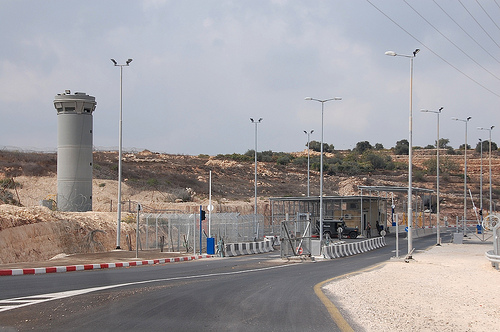
Checkpoint at the entrance of Beit Iksa
Related articles
- ‘Gate of Dignity’ built on lands of Beit Iksa north of Jerusalem (alethonews.wordpress.com)
- Army Invades Bab Al-Karama (imemc.org)
- Palestinians Establish a new Village, Bab Alshams, in Area E1 (alethonews.wordpress.com)
Former mayor put in administrative detention
Ma’an – 20/01/2013
 NABLUS – A former Palestinian mayor detained by Israeli forces this week will be held in administrative detention for six months, a prisoners group said Sunday.
Sheikh Jamal Tawil, who had held the mayoral post in al-Bireh, a neighborhood of Ramallah in the central West Bank, was detained on Tuesday.
The Solidarity Foundation for Human Rights said Ofer military court gave the former mayor six months in detention without charge.
Tawil was arrested by Israeli forces during the first intifada and held for several months under administrative detention at the time.
As of December, 178 Palestinians were being held without charge in Israeli jails, including seven elected members of the Palestinian parliament, according to prisoners rights group Addameer.
Related articles
- Prisoner Omar Barghouti: A Story of a Life Behind Bars (occupiedpalestine.wordpress.com)
- Detainees In Eshil Go On Hunger Strike (altahrir.wordpress.com)
‘Gate of Dignity’ built on lands of Beit Iksa north of Jerusalem
IMEMC News | January 18, 2013
The Palestinian village of Beit Iksa overlooking Jerusalem just built a new village they called Bab Al-Karama (Gate of Dignity) on their land behind the apartheid wall that Israel has built on their land and call on Palestinians and Internationals to join them in their popular struggle to hold on to their lands.
The wall Israel is building on the village land would leave 96% of the village land inaccessible and behind the segregation wall.
Over the past 24 hours, the villagers built a mosque and set up 5 tents for dwelling on their land behind the wall.
 The head of the Beit Iksa village council Mr. Kamal Hababa stated that idea of building this village extension is to protect their legally owned lands and to be the second such village built to protect from growing efforts at transforming Arab Jerusalem.
Already the threatened village land behind the wall is 7,411 dunums which amounts to half the total threatened lands of the eight Palestinian villages northwest of Jerusalem and 96% of the village land of Beit Iksa. Colonial Jewish only settlements built on Palestinian lands beyond the Green line in this area include Ramot, Neve Shmuel, Har Shmuel, and Givat Ze’ev.
The erection of Bab Al-Karama village comes shortly after Palestinian activists erected a village they called Bab Ashams to counter Israeli settlement construction in the area known as E1, located between Jerusalem and Jericho, which signals a new model in popular struggle against the ongoing expansion of the Israeli settlements in the West Bank.
Veolia Withdraws from California Water Contract Bidding
End the Occupation | January 11, 2013
Davis, California – The Davis Committee of Palestinian Rights (DCPR) is happy to report that Veolia Water North America has withdrawn as a prospective bidder on a $325 million dollar project that would provide treated water from the Sacramento River to residents of Woodland and Davis in Yolo County, California. The announcement came at the December 20, 2012 meeting of the Woodland-Davis Clean Water Agency (Water Agency), a joint powers authority between the University of California – Davis and the cities of Woodland and Davis. Veolia’s withdrawal followed efforts by citizens of Yolo County to prevent Veolia’s bidding due to the company’s involvement in the violation of Palestinian human rights.
Members of DCPR first contested the participation of Veolia Water as a prospective bidder in June 2011. Appearing before meetings of the Water Agency Board of Directors, DCPR provided substantial documentation of Veolia’s history of profiting from Israel’s illegal occupation and apartheid policies in Palestine, as well as the dissatisfaction of public agencies throughout the U.S. for Veolia’s mismanaged operations and poor performance, environmental permit violations and fines, and failure to make good on promised improvements.
On April 19th, 2012, DCPR testified before the Board charging that Veolia did not meet the Water Agency’s ethical criteria. Veolia’s involvement in the Jerusalem Light Rail Transit system, its operation of settler-only buses on segregated roads in the occupied West Bank for inhabitants of illegal Israeli settlements, and its operation of a landfill on land confiscated from Palestinians have been contested by Palestinians and international human rights activists throughout the last decade. Veolia has suffered the loss of more than $20 billion in contracts to date following this global outcry.
Within the U.S., the Friends Fiduciary Corporation, which handles investments for hundreds of U.S. Quaker institutions, recently divested from Veolia following requests by Quakers concerned about the violation of Palestinian rights. In December 2012 the City of St. Louis voted to suspend approval of a contract with Veolia Water until it completed an investigation of Veolia’s controversial labor, environmental, and human rights practices. There are ongoing campaigns protesting Veolia Transportation public contracts in Sonoma County and Los Angeles, CA; Baltimore, MD; Boston, MA; and beyond. The state-wide California Israel Divestment Campaign calls on CalPERS public pension system to divest from Veolia Environnement, Caterpillar and Elbit Systems.
Bids were initially due in December 2012, but following outcry from citizenry regarding the large impact of the project’s capital cost upon resident’s water bills, the City Council decided to postpone the due date and appoint a citizens’ advisory committee to investigate rate alternatives, revisit the water supply need-assessment, and consider other water procurement options. Veolia was the only company to withdraw from bidding.
CONTACT: Mikos Fabersunne, Davis Committee for Palestinian Rights, fabersunne@sbcglobal.net
Veolia Fact Sheet
December 18th, 2012 | Published in Latest News and Action Alerts, STL-PSC Blog
What is Veolia?
According to a story broken by the Riverfront Times, St. Louis city lawyers have been negotiating a contract with Veolia Water North America to guide cost-cutting. Veolia Water is a major subsidiary of Veolia Environnement, a Paris-based multinational corporation and the largest water privatization business in the world. Veolia is infamous for:
- Failure to make good on promised improvements
- Anti-labor practices
- Privatizing public resources
- Irresponsible to disastrous environmental practices
- Mismanagement
- Corruption, bribery, embezzlement, and fraud
- Supporting and profiting from segregation and discrimination in Palestine
Worldwide, consumers report that Veolia consistently charges high rates, provides poor service, causes staff turnover, discourages water conservation, and fails to implement promised improvements. Its history reveals consistent prioritization of private profit at the expense of the environment and public welfare.
Unless otherwise indicated, the following is based on extensive research and documentation on Veolia’s practices by Water for All, Polaris Institute, Global Exchange, Novato Friends of Locally Operated Wastewater, Public Citizen, Public Water Works, and Food & Water Watch (here, here, here, here, here).
What happened in Indianapolis?
In its proposal to the St. Louis Water Division, Veolia extensively references its work in Indianapolis as a successful model that could inform Veolia’s guidance in St. Louis. If Indianapolis is any indication of Veolia’s practices, then our city would do well to steer clear. Veolia claims that the contract was completed and “focused on building a collaborative environment with all of the project stakeholders (union, government and the community).” In fact the company’s 20-year contract with Indianapolis was terminated by the city less than halfway through, by which time the following had ensued:
- Non-union employees claimed that the company cut retirement plans, health care and other benefits, costing the workers more than $50 million over 25 years. Hundreds of employees, many organized under a strong union, found themselves in a pitched battle with the company to preserve benefits and hold Veolia to its promises.
- Veolia was sued for breaking state contract law, and for overcharging 250,000 residents.
- Because the company lacked proper safeguards, a typo by an employee caused a boil-water alert for more than a million people, closing local businesses and canceling school for 40,000 students.
- An independent review uncovered lax oversight of the city’s contract with Veolia.
- Consumer complaints more than doubled in the first 10 months of the contract.
- In a study of 100 large U.S. cities, Environmental Working Group ranked Indianapolis drinking water quality #90 (i.e. 11th-worst overall). St. Louis ranks #9 — among the best in the country.
In 2005, a federal grand jury subpoenaed four Veolia Indianapolis employees as part of an investigation into allegations that the utility falsified water quality reports. The probe began amid accusations by Indianapolis council members that the company had cut back on staffing, water testing, treatment chemicals and maintenance. Though Veolia was never charged, the corporation sustained multimillion-dollar losses and dug its way out of this hole by finagling concessions, including a 2007 contract amendment shifting at least $144 million in costs from Veolia to the city. Ignoring public outcry from consumers and state officials, the city then tried to raise rates by 35% to pay for these additional expenses and more expensive capital improvement projects.
In 2010, with infrastructure needs mounting and Veolia demanding more than the city could afford, Indianapolis canceled the contract more than 10 years early, for which they were forced to pay Veolia an additional $29 million. The nonprofit Citizens Energy Group took over, positioned to save the city more money than multinational Veolia was ever able to.
If Veolia gives Indianapolis as an example of a success story, what could a failure possibly look like?
New Orleans — an Environmental Disaster, and Other Cities
In 2001 in New Orleans, an electrical fire at a sewer treatment plant operated by Veolia caused operators to divert raw sewage into the Mississippi River for two hours. In 2001 and 2002, the plant released sewage into the river a total of 50 times, often violating water quality standards and resulting in more than $107,000 in fines. The city’s Sewerage and Water Board Director and staff made numerous, repeated and documented complaints about Veolia reducing staff to inadequate levels, neglecting preventive maintenance, failing to notify city officials of environmental violations, and other problems. Veolia has a long track record of failing to communicate with New Orleans in connection with the contract. In 2002, the board rejected Veolia’s bid for a new water/wastewater contract following public outrage.
In Richmond, CA in 2006, the city and Veolia were sued for dumping more than 17 million gallons of sewage into tributaries that empty into the San Francisco Bay. The Baykeeper watchdog group said Richmond had one of the highest spill rates in the state. The city had given a 20-year, $70 million contract to Veolia, which promised to cut costs and develop and implement an improvement plan for the sewer and storm water systems. By the time of the lawsuit four years later, the company had not even finished designing the plan, much less begun the renovations. Richmond settled the lawsuit out of court by agreeing to pay for multimillion-dollar improvements to reduce sewer spills. In addition, Richmond taxpayers had to shell out $500,000 annually for years to compensate residents and businesses for property damaged. Even after the lawsuits, the problem continues: Veolia’s Richmond plant had 22 spills dumping more than 2 million gallons of sewage during the first two months of 2008.
Lynn, MA ended a wastewater overflow plant contract with Veolia because the company failed to stay adequately bonded for the project. While company officials lauded the continuing contracts with water and wastewater treatment plants in the community, the town rapped the company for cutting costs by refusing to properly treat wastewater with chemicals. As a result, the town was blanketed in a stench.
Angleton, TX terminated a Veolia contract for non-performance and took the company to court, charging that it breached its contract by failing to maintain adequate staffing levels, not submitting capital project reports and charging improper expenses to the maintenance and repair tab picked up by the city.
In Atlanta, Veolia tried to maximize revenue simply by slashing the work force in half, contributing to boil-water orders, maintenance backlogs and other issue that ultimately led to dissolution of the contract.
In Sauget, IL, right across the river, a related Veolia subsidiary operated a hazardous waste incinerator for over 10 years without a clean air permit. In 2005, “the owners agreed to pay $150,000 for alleged air pollution violations.” As of 2008, the facility had been fined more than $3 million,” mostly related to small explosions and releasing toxic chemicals, including carcinogenic dioxins, into the air.
For more examples, see: Burlingame, CA; Wilmington, DE; Port Arthur, TX; Cranston, RI; and others.
Bribery, Corruption, Embezzlement, Fraud
Corruption, bribery, embezzlement, and fraud appear to part of Veolia’s corporate culture. The president of a Veolia subsidiary was convicted of bribing a New Orleans sewer board member to support renewal of its contract (see background above) in 2002. The same year, the mayor of Bridgeport, CT was convicted on 16 counts including taking kickbacks, bribes and extortion along with 8 other defendants a contract proposal from Veolia (then called Vivendi). A forensic audit in Rockland, MA led to contract termination amid embezzlement charges involving a sewer department official and a local company executive charged with embezzling more than US$300,000. Veolia disclosed accounting fraud in the U.S. from 2007-2010 amounting to $120 million. The scandal took place in their Gulf of Mexico Marine Services unit. These are small examples of a pattern of Veolia replicated around the country and world.
Would this contract privatize the city’s water? No — not yet. But the contract would position Veolia — which specializes in water privatization — as a “brain-trust” of management expertise in reducing costs. Many view Veolia and focusing on privatizing services through long-term monopoly contracts rather than through outright ownership. These types of “advisory” roles can serve as a backdoor avenue toward eventually privatizing municipal operations.
Supporting Apartheid and Segregation in Israel/Palestine
Veolia is involved in Israel’s systematic ethnic discrimination against the Palestinians in many ways:
An Israeli subsidiary, Veolia Water – Israel, operates a wastewater treatment plant located in an illegal Jewish-only settlement called Modiin Ilit, built on Palestinian land in the West Bank. The owners of the land on which this settlement was built have been violently driven out. Two unarmed Palestinians from the Palestinian village on which Modiin Ilit was built, have been killed as they protested nonviolently against the ongoing confiscation of their land and resources. Veolia continues to service the settlement.
An Israeli subsidiary of Veolia Transdev, Connex – Israel, operates buses on segregated roads through the occupied West Bank, including two bus lines that use road 443, which is built partially on confiscated land with portions closed entirely to Palestinians. A separate but unequal Palestinian road system is made up of low grade roads cut by checkpoints and physical barriers restricting Palestinian freedom of movement. Last year, Palestinian Freedom Riders attempted to board buses operating on their own land and were violently removed and arrested. Veolia is profiting from segregation and discrimination.
Another Israeli subsidiary, Veolia Environmental Services – Israel, supervises, consults for, and operates the Tovlan Landfill in the occupied Jordan Valley, collecting refuse from illegal settlements. Israel renders it almost impossible for Palestinians in the Jordan Valley to gain permits to build homes, toilets, wells, animal pens, or other vital infrastructure for local communities, which has forced almost all Palestinian families out, with those remaining living in dire conditions. Some are left with no alternative but to work on settlements that have taken their families’ land, for pay far below the minimum wage, unable to take bathroom breaks, and denied any rights to unionize. Veolia takes captured Palestinian land and natural resources to service the settlements exploiting or driving out Palestinians.
UN Special Rapporteur Richard Falk recently recommended that Veolia “should be boycotted, until they bring their operations into line with international human rights and humanitarian law and standards.” Veolia’s extensive profiting from Israel’s illegal practices have provoked global outcry, costing Veolia more than $12.5 billion in lost contracts to date. Recently, the Friends Fiduciary Corporation, which handles investments for hundreds of U.S. Quaker institutions, also divested from Veolia.
Veolia already in Financial Trouble
With public opinion shifting negatively around the world, Veolia is paying a price. After a 25-year contract, Veolia’s home city of Paris declined to renew its contract in 2009. Cities around the world have done the same. Veolia’s profit margin has plummeted since 2008 and the company lost more than half its market value in 2011. Veolia’s CEO pledged to sell $1.8 billion of assets and to stop operations in at least 37 countries. In September 2012, Veolia’s debt stood at more than $19.7 billion.
Now, Veolia is trying to bring its risky and immoral business to our backyard.
Related articles
- St. Louis Palestine Solidarity Committee Statement on Pending City Contract with Veolia Water (alethonews.wordpress.com)
- Veolia to end sponsorship of major UK photography exhibition (bdsmovement.net)
Israeli Soldiers Attack, Evict, Bab Al-Shams, Arrest Dozens
By Saed Bannoura | IMEMC News | January 13, 2013
On Saturday at dawn thousands of Israeli soldiers and policemen attacked the Bab Al-Shams Palestinian village, installed east of in occupied East Jerusalem, and forcibly removed dozens of activists loading them into buses.
The soldiers dragged several activists onto the ground, attacked reporters and journalists and declared the area a closed military zone, several injuries were reported.
The Israeli decision to evacuate the village came, on Saturday, through a direct order issued by Israeli Prime Minister, Benjamin Netanyahu, and his right-wing fundamentalist cabinet.
Israeli daily, Haaretz, reported that by midnight Saturday, the order was signed by Osnat Mandel, head of the Israeli High Court division of the Justice Ministry, under the claim that “the people and the tents must be removed due to security considerations”.
The Israeli Police said that the eviction order, issued by the court, prohibits the army from removing the tents, but orders the removal of the people staying there.
Also, the so-called Israeli Civil Administration Office, run by the occupation in the West bank, claimed that the Palestinian tent village “was installed on state land”.
But four Bedouin families living in the area confirmed that they own the land, and even showed deeds proving ownership.
Dr. Mustafa Barghouthi, secretary-general of the Palestinian National Initiative, who was also at the Palestinian village, stated that hundreds of Israeli soldiers invaded the village after surrounding it, and attacked the nonviolent activists camped there, and started kidnapping them.
The soldiers violently attacked the residents, including journalists, elderly and women, and dragged several residents onto the ground.
The soldiers repeatedly interrupted the work of local reporters, flashing their lights onto the camera, and pushing the reporters away, and dragged dozens of activists into buses that were brought by the army to the area.
On Saturday evening, Israeli Prime Minister, Benjamin Netanyahu, ordered the army “to remove the Palestinians and their supporters from the Palestinian outpost” that was installed on privately-owned Palestinian lands to send a message to Israel and the entire world that this land is the land of Palestine, and the Palestinian people have the right to inhabit it.
The army installed dozens of roadblocks around the area to prevent Palestinian traffic and surrounded the Bab Al-Shams camp where around 200 activists installed around 20 tents declaring the Bab Al-Shams Palestinian village, in the area where Israel illegally declared it intends to build thousands of homes for Jewish settlers, east of occupied east Jerusalem.
The Israeli decision to build the illegal settlements in the occupied state of Palestine came after the Palestinians managed to obtain an observer state status at the UN – General Assembly.
The Israeli decision was met with international condemnation, but the settler-led government of Benjamin Netanyahu, approved the illegal settlement project.
The so-called E1 settlement project aims at linking the Maale Adumim illegal settlement, where 35,000 reside, with occupied East Jerusalem, thus illegally confiscating Palestinian lands and blocking geographical continuity in the occupied West Bank.
This illegal Israeli project would divide the West Bank into two parts, and would completely isolate it from occupied East Jerusalem, an issue that would prevent the establishment of a viable Palestinian state.
Abdullah Abu Rahma, a Palestinian nonviolent activist from the West Bank village on Bil’in, who was also detained when the army attacked and evicted Bab Al-Shams, stated that this village is on private Palestinian land, and that the Palestinians are not invading anybody’s property, as they are establishing a village in the land of Palestine.
“We tied our hands, chained ourselves with each other to prevent the soldiers from removing us”, Abu Rahma said, “The Soldiers violently attacked us, beat us, and injured at least 10”
He added that there will be more nonviolent activities, and that the struggle for Bab Al-Shams, the nonviolent struggle for the liberation of Palestine will continue as the Palestinians are practicing their internationally-guaranteed right.
It is worth mentioning that the Palestine TV was live streaming from Bab Al-Shams, and the army repeatedly tried to interrupt the stream, pushing the reporters, and using large flashlight, pointing them against the camera to disrupt the images.

Wounded Journalist Hafeth Ibrahim
Related articles
- Palestinians Establish a new Village, Bab Alshams, in Area E1 (alethonews.wordpress.com)
Time For Justice – A call from Palestine to EU citizens
International Solidarity Movement | January 11, 2013
Ask your governments and EMPs to suspend EU-Israel Association Agreement and stand up for human rights in 2013!

A call urging citizens of the European Union to tell their representatives to suspend the EU’s trade agreements with Israel, until Israel complies with international law, has been issued by grassroots networks and organizations from across Palestine.
The call has been endorsed by numerous European solidarity networks and organizations.
Join the action. Send letters to your representatives now by clicking on your country below:
AUSTRIA
BELGIUM (DUTCH / FRENCH)
BULGARIA
CYPRUS
CZECH REPUBLIC
DENMARK
ESTONIA
FINLAND
FRANCE
GERMANY
GREECE
HUNGARY
IRELAND
ITALY
LATVIA
LITHUANIA
LUXEMBOURG
MALTA
NETHERLANDS
POLAND
PORTUGAL
ROMANIA
SLOVAKIA
SLOVENIA
SPAIN (CASTILIAN / CATALAN)
SWEDEN
UNITED KINGDOM
For the full text click here.
Related
Educating Stanley Jordan: Facebook Showdown Produces BDS Victory
By Rima Merriman | Palestine Chronicle | January 6, 2013
On January 5th, to everyone’s surprise, noted American jazz/jazz fusion guitarist and pianist Stanley Jordan posted this news that was music to the ears of BDS activists everywhere: “My performance at the Red Sea Jazz Festival has been cancelled. I apologize for any inconvenience to anyone.” Those who had been tracking the debacle will know that this is a reversal of his earlier decision, one in which he had announced he would go forward with his gig. Although he did not say why, or even attribute his own agency in his new announcement, the backlog on Facebook is telling.
On Dec. 24th, Jordan posted this update on his Facebook page explaining that he had “received several messages from people requesting that I cancel my performance at the Red Sea Jazz Festival in Israel,” for which he was billed as the headlining artist for the Israeli festival (his image was used to create publicity posters in Hebrew for the state-funded event). In that initial post, he wrote:
“I’ve received several messages from people requesting that I cancel my performance at the Red Sea Jazz Festival in Israel. I promised a detailed response, so here it is. I would like to start a dialog right here to discuss this topic. Next to global warming the Middle East conflict is the biggest issue of our time, and it’s too important for black-and-white responses that ignore the nuances. And we truly need an open dialog with a spirit of mutual compassion for everyone involved. For my part, I want to use my talents and energies in the best possible way for the cause of peace. This purpose is deeply ingrained in my soul’s code, and I’ve known it since childhood. So the only remaining question is: How can I best accomplish this goal? I invite you all to weigh in. I’d like to start the discussion by recommending a wonderful book called, “Embracing Israel/Palestine: A Strategy to Heal and Transform the Middle East,” by Rabbi Michael Lerner. I’ve been reading a lot on this topic but this book stands out for me because it resonates with my own feelings. I encourage everyone to read it as background for our discussion. And please keep your comments clean and respectful. Let’s model the type of dialog that will eventually lead to a solution.”
His invitation came on the heels of an unsuccessful attempt to secure the compliance of the academic and cultural boycott by another jazz musician, Native American poet Joy Harjo who rejected the call and went ahead with her performance at Tel Aviv University. In that case, the “dialogue” was derailed from the get go by both her obvious disingenuous claims to solidarity with the Palestinian people and the persistent efforts of Zionist trolls that ended up colonizing her Facebook timeline. As such, Jordan’s announcement posed a challenge for all BDS supporters, especially those who work in concert with the Campaign for the Academic and Cultural Boycott of Israel (PACBI). Like Harjo, Jordan – as his subsequent Facebook comments revealed – had cited the spirit of his art and higher consciousness as a major reason for not honoring the international boycott.
The ensuing discussion on Jordan’s Facebook page was a remarkable drama for two reasons. For one thing, the hasbara trolls, who had plagued the discussion with Harjo, were nowhere to be found until after (indeed, immediately after) Jordan announced his decision to cross the picket line. That announcement came on January 1st in a status update that read:
“Our discussion revealed a crisis whose depth was even far greater than I had known, and I felt compelled to help. Like many others, I am deeply dedicated to the cause of world peace, and this situation goes against everything anyone with a heart could ever condone. However, after much consideration I concluded that the best way I could serve the cause would be to do my performance as scheduled, but separately organize an event in a major city in the United States to raise funds and awareness of the plight of the Palestinian people.”
Only after close to 600 comments (out of over 800 on that one thread) were posted by activists seeking to educate Jordan on all aspects of the plight of the Palestinians and the nature and objectives of the BDS appeal did the artist reveal that individuals from the Zionist contingent were in fact pressing their case with Jordan via private messages, out of the sight of the BDS activists.
Second, the absence of (overt) trolling allowed for an exemplary demonstration of what well-informed, dedicated BDS advocates can do with a thread if they are not constantly fending off accounts spouting Israeli Ministry of Foreign Affairs talking points. The result was passionate well-reasoned and forceful advocacy for the Palestinian cause from a diverse group of people on several continents, many of whom were unconnected with one another or had just become Facebook friends as a result of the virtual encounter. Palestinians, Jews, Arabs, Christians, Muslims, Israelis, European-American settlers, Australians, Native Americans, and many others took part in the discussion which continued throughout New Year ’s Eve across various time zones on the globe.
It is worth asking why Jordan, who once publicly endorsed the cultural boycott of apartheid South Africa, was ultimately not convinced by the extensive discussion in which he actively participated, and what, if anything, it tells us about the efforts of PACBI supporters. One also wonders what it was that made Jordan reconsider. It would be really useful if he were to make a full clear statement of support for BDS in the future.
The ebb and flow of the discussion, in what eventually turned out to be a long thread of over 800 posts, shows how well the activists’ comments elaborated on and complemented one another. One person would drop an idea out there, and someone else would pick up on it. Great care was taken to remain respectful, as people tried to understand Jordan’s frame of reference and engage him meaningfully within it without patronizing him. One turning point in the discussion was an explanation of what constitutes being “in solidarity” in the human and civil rights movements. “Being in solidarity,” wrote Adrian Boutureira Sansberro, “entails being able to take direction from those one claims to be in solidarity with. Learning how to take direction, as to what is it that those we are in solidarity with wish us to do, is a huge aspect of shifting the relationships of power between the oppressed and the oppressor. It is also a way to really come face to face with our own true commitment and power issues.”
One of the many things on which Jordan was called up is the claim that he had no prior political involvement as a musician. It became apparent, however, that he had, in fact, made very clear, public, and political statements on the subject of playing Sun City with fellow artists in 1987. At the time, Jordan had supported the spirit of the boycott but was never put to the test. But in the discussion thread, he waived off the contradiction between the principled stand he took then (and his position in support of various other human rights causes) on the one hand, and his reluctance to take a comparable stand on the boycott calls on the other. At that point in time, he appeared to want to have it both ways.
After Jordan made his January 1st decision not to support the boycott, some suggested that the entire dialogue was intended to provide cover to a decision Jordan never intended reconsidering. Others have pointed to the difficulty of responding to arguments one cannot see. I believed that, although he did come to see the justice of the Palestinian cause and even to sympathize with it, Jordan simply did not wish to let go of his gig for financial reasons (what he described as “the reality of my situation”). At one point in the discussion Jordan asked Israeli boycott supporters, “why should we outsiders bare [sic] the economic brunt of the boycotts? You want me to quit my job, so then shouldn’t you be quitting yours too? After all, any economic activity aids Israel and can be seen as de facto normalization.” In answer to that, people, of course, pointed out that being asked to cancel a gig is not the same as quitting a job.
Anyone who studies the thread can easily see that, throughout the discussion, Jordan and his publicist (who eventually jumped into the discussion in his stead) were searching for a line that would validate his strong desire to keep the gig but that would also allow Jordan to sympathize or “ally” himself (as opposed to being in solidarity) with the Palestinian people (hence, the charity concert that would follow in the United States). At that time, Jordan kept insisting that, as a musician he had no political role to play (even as it was made crystal clear to him that he himself was, in fact, being played by Israel’s politicians). He was just a guitar player. He felt his music went “to the heart of the subjective, interior dimension, and the world of all things spiritual” and had the power to “influence humans to be more humane”, so he just wanted to perform and to leave it up to his Israeli audience to “decide for themselves how to use the inspiration”.
Once his first frame of reference as represented by Lerner’s book was summarily critiqued, Jordan kept introducing into the discussion therapeutic frameworks, such as Neuro-Linguistic Programming, the study of the structure of subjective experience. He ultimately turned away from Ali Abunimah’s vision in One Country: A Bold Proposal to End the Israeli-Palestinian Impasse, which posits that a principled and sustained campaign to impose a cost for Israeli government abuses of Palestinians would, in fact, ease tensions. As Abunimah puts it, once “freed from the hardships of occupation, discrimination, and exile, and engaged by Israeli counterparts genuinely interested in building a tolerant, multicultural, multireligious society, the Palestinian majority would gladly, forgivingly, and open-mindedly choose the same course.” To Jordan, it seemed that would never happen, unless people were “getting along first” – a catch 22.
Jordan’s initial inability to grasp even rudimentary facts about the campaign turned his statement, “You’re also educating me so that I can hopefully someday speak intelligently on this matter” into a farcical proposition. The Palestine Chronicle published an article I wrote after the January 1st announcement he would play, “Stanley Jordan: You Don’t Get to Peace without Real Solidarity”, in which this point was made: “Jordan is now trying to justify his decision by expressing inchoate beliefs about the power of his art to achieve “world peace” by “changing consciousness” while propounding the notion that the boycott undermines the freedom of the artist and limits the transformative power he possesses over his audience.”
Now, in light of Jordan’s January 5th announcement that he will not play, he has demonstrated his decision to stand on the right side of history. Still, it would be ideal if he would issue a statement that explains what finally lead him to respect the boycott. But regardless, BDS activists who worked tirelessly to educate Jordan can claim this a victory – and we can all surmise that it was his conscience that prompted him to do the right thing.
– Rima Merriman is a faculty member in the English department, Al Quds University in the occupied West Bank.
Related articles
- South Africa’s ruling ANC officially endorses Palestine’s boycott movement (alethonews.wordpress.com)
- BDS activists call on Joy Harjo to cancel Israel performance (bikyamasr.com)
Qusra settler attack, two hospitalised
International Solidarity Movement | January 7, 2013
 Qusra, Occupied Palestine – At around 2 p.m. seven settlers attacked a farm on the outskirts of Qusra. The farm belongs to Abu Nasser and his wife Nedda who are both in their sixties.
Nedda confronted the settlers after seeing them on their property cutting olive trees, warning them off with a solid wooden walking stick and a firm voice. At around 4 p.m. twelve settlers returned accompanied by around 12 jeeps and 60 Israeli Occupation Soldiers.
A small group from the local village confronted the settlers and soldiers to defend the farm and a conflict erupted. Consecutive rounds of tear gas were then shot onto the farm land and the settlers and the local youth (shabab) confronted each other. During the skirmish two shabab were shot at close range with rubber bullets: one in the shin and the other in the upper thigh. Both required hospital treatment, with the shabab who was shot in the upper thigh remaining in hospital for further treatment as the rubber coated bullet passed into the front of his thigh and out the side. One of the stones thrown by a shabab hit a settler in the head. In addition to this the Israeli Army fired several rounds of live ammunition. The village Mayor rang the DCO to report the incident and the DCO warned him that the settlers would return for ‘‘revenge’’.
As four volunteers from the ISM, we arrived at the village around 7p.m. and were welcomed to stay overnight at the small farm house of Abu Nasser and Nedda. The following day the settlers were seen gathering across the valley with Israeli soldiers. We were driven to the hilltop across from them and made our presence known, shortly after which they left. During our time in the village we learnt of other attacks on the village that occurred as frequently as 3-4 times a week. We were shown several olive fields where the olive trees had either been broken or cut. The villages estimate that in the previous 3-4 days around 400 olive trees had been killed in their surroundings by settlers from the illegal settlements Esh Kodish and Kida.
During a similar settler attack on the village on the 23/09/2011, the local villages went to stop settlers from cutting the trees and the Israeli Army arrived and shot dead a 32-years old father of 5, Islam Badram.
Related articles
- Red Crescent attacked during settler raids in Qusra (palsolidarity.org)
- Israeli army dogs attack elderly Palestinian, two-year-old child injured in the head in Jewish settlers’ attack (alethonews.wordpress.com)
- Settlers raid Nablus village homes and a tractor. Uproot 190 olive trees and burn Hebron car (occupiedpalestine.wordpress.com)
- Settlers raid Nablus village, fire live ammo (altahrir.wordpress.com)
US general offers plans for post-2014 Afghanistan overstay
Press TV – January 3, 2013

Commander of US-led forces in Afghanistan General John R. Allen (file photo)
Commander of the US-led forces in Afghanistan General John R. Allen has offered plans that would keep thousands of American troops in the war-torn country after Washington’s planned 2014 withdrawal.
Allen has submitted three plans to Defense Secretary Leon Panetta with troop levels ranging between 6,000 and 20,000, the New York Times cited a senior Pentagon official as saying on Wednesday.
General Allen’s options reportedly offer US involvement in security issues in Afghanistan and advising Afghan military forces.
With 6,000 troops, it is expected that the US mission in Afghanistan would largely rely on Special Operations commandos who would engage in targeted killings and assassination missions, with limited logistical support and training for Afghan forces.
The 10,000-strong mission is expected to engage in training Afghan security personnel; while with 20,000 troops Washington would add some conventional army forces to patrol in certain areas.
US President Barack Obama is supposed to discuss the options with his Afghan counterpart, Hamid Karzai, during his visit to the White House next week.
The United States, which currently has about 66,000 troops stationed in Afghanistan, led the invasion of the country in 2001, under the pretext of eradicating Taliban forces and bringing stability to the country.
However, torn apart by a war that has lasted over a decade, Afghanistan is still dealing with untamed violence, as well as rising insecurity topped by social problems.
Meanwhile, the Pentagon, the White House and US generals based in Afghanistan keep providing contradictory information on the composition, tasks and the size of the contingent that would remain in Afghanistan beyond the 2014 deadline.
Related articles
- ‘US will maintain military presence in Afghanistan beyond 2014′ (alethonews.wordpress.com)
- Prince Harry ‘kills innocent afghans’, according to former Afghanistan prime minister (dailyrecord.co.uk)
Featured Video
Weaponized Journalism: 2021 Sayer Ji Interview with NPR
or go to
Aletho News Archives – Video-Images
From the Archives
How Rothschild Banking Clan Uses Its Vast Wealth to Influence World Events and Control Governments

By Ilya Tsukanov – Sputnik – 15.09.2024
How powerful is the Rothschild banking family? How did they amass their fortune? Just how rich are they? Do they secretly control the world? Sputnik explores. … continue
Blog Roll
 Aletho News
- London tourism expo promotes Israeli agency linked to theft of Palestinian land
- Dockworkers launch global strike against Israeli and US military shipments
- Europe facing gas price shock – Gazprom chief
- Ukraine continues recruiting people with disabilities
- Weaponized Journalism: 2021 Sayer Ji Interview with NPR
- Beyond Netanyahu: what Israel’s election means for Palestinians
- Lithuania plans universal conscription
- Lies, Damn Lies, and Ukraine News
- Financial Times rejects Nordic demands to correct Putin call story – media
- The Case for Less Unity in Europe
- If Americans Knew
- An error has occurred; the feed is probably down. Try again later.
- No Tricks Zone
- Germany’s Green Energy Transition Becoming Increasingly Expensive…Another 6 Trillion Euros!
- Sudden Stratospheric Warming, Powerful El Niño Combination May Lead To Extreme Europe Cold, Energy Crisis!
- Two New Studies Find Thwaites Glacier Melt Cannot Be Driven By Human Activity Or A Warming Ocean
- E-Cars Reduce CO2 Emissions By Only 41% Compared To Internal Combustion Engine Vehicles
- Predictions Made By Renowned Climate Professor Over Past Decades Have Been Proven To Be Poor
- New Study Suggests Large Regions Of The Pacific Ocean Have Been Cooling For The Last 80 Years
- Germany’s Green Energy Debacle: High Energy Costs Force Kahla Porzellan to Close After 182 Years!
- New Study: 50 Years Of The Most Aggressive ‘Net Zero’ Policies Can Only Affect The Global Climate By 0.03°C
- US September “Heat” Was No Record…Many Records Set Decades Ago
- Latest European Green Energy Debacle; Portugal’s Largest Flagship Solar Park Insolvent!

