US now openly admits its goal in Syria is to make it ‘difficult’ for Moscow and Damascus to defeat terrorists
By Nebojsa Malic | RT | March 10, 2020
The State Department’s special envoy for Syria has just admitted that the US aims to defend jihadist militants in Idlib against ‘Russian aggression,’ proving once again that the swamp in Foggy Bottom is alive and well.
Russia and the Syrian government “are out to get a military victory in all of Syria,” Ambassador James Jeffrey told reporters on a conference call out of Brussels on Tuesday. “Our goal is to make it very difficult for them to do that by a variety of diplomatic, military, and other actions.”
To illustrate these methods, Jeffrey cited the US threat to respond “in a very savage military way” against any chemical attacks, which he described as “a favorite tactic of the Syrian regime in making advances.” This is factually untrue, since the alleged attacks always happen after Syrian Army victories, as a pretext for US intervention.
Jeffrey also noted that there are US and coalition troops in parts of Syria – officially there to fight Islamic State (IS, formerly ISIS), but in actuality “guarding” the oil fields. He tellingly described their presence as “a complication” for the Syrian government.
Jeffrey and US ambassador to Turkey David Satterfield were in Brussels after Turkish President Recep Tayyip Erdogan’s visit, to discuss ways the US and NATO can help Ankara protect its pet militants in their last remaining redoubt – Syria’s Idlib province.
But while Satterfield described Idlib as containing “three million-plus innocent civilians, the majority of whom are women and children,” and accused “Russian aggression” of seeking to displace them, listen to how Jeffrey chose to describe the situation, when asked by a CNN reporter if NATO was considering sending in ground troops:
“I think you can forget ground troops. Turkey has demonstrated ably that it and its opposition forces are more than capable of holding ground on their own.”
This is either appallingly ignorant or downright delusional, as the Syrian army had successfully rolled up the Turkish-backed militants and the ceasefire Ankara agreed to in Moscow last week confirmed that.
The real revelation here is that the militants are described as Turkey’s “opposition.” Contrast this with the words of Colonel Myles Caggins, spokesman for the anti-ISIS coalition’s military arm, just three weeks ago: “Idlib province seems to be a magnet for terrorist groups, especially because it is an ungoverned space in many ways,” Caggins told Sky News. “There are [a] variety of groups there — all of them are a nuisance, a menace and a threat to… hundreds of thousands of civilians who are just trying to make it through the winter.”
Bear in mind that Jeffrey doubles as Washington’s special envoy to the coalition against IS, that infamous Schroedinger entity that either doesn’t exist any more – when US President Donald Trump seeks to claim victory against the self-proclaimed caliphate – or is about to make a resurgence big time and requires US military presence in perpetuity to prevent that, as the State Department and the Pentagon prefer to see it.
Needless to say, this entrenched insistence on legacy policies doesn’t do much for Trump’s promise to pull out US troops from “endless wars” in the Middle East.
Neither Jeffrey nor Satterfield, nor any of the reporters asking them questions, mentioned even once the existence of Hayat Tahrir al-Sham – the latest incarnation of the notorious Al-Nusra, an Al-Qaeda affiliate whose fighters dominate the ranks of the militants in Idlib. Listening to them, one might think it doesn’t exist!
Jeffrey and Satterfield openly admit that an outright Syrian victory over these terrorists would deny the “international community” – as they style the US and its allies – the leverage to insist on regime change in Damascus. Which is incredibly rich in irony given that the sole legal pretext on which the US has any troops in Syria, in open violation of international law, is a congressional authorization to use force against… Al-Qaeda.
US marines arrive on Yemen’s Socotra to support UAE forces
MEMO | March 9, 2020
A new batch of US Marines arrived on the Yemeni island of Socotra on Saturday, according to local sources, installing Patriot defence systems.
Sanaa Post reported that the American soldiers were received by the “occupying” UAE forces at their headquarters on the island.
There is speculation that the US intends to establish its own military base amid reports that America had sent military experts to equip observation points to deploy radars and air defence points on the strategically located island overlooking the Arabian Sea and the Indian Ocean.
US forces had previously arrived on Socotra in December of last year and reportedly started installing a Patriot missile system in order to protect the Saudi and Emirati forces on the island at the time.
According to the sources, on 21 December of last year, Saudi Crown Prince Mohammed Bin Salman ordered the UN-recognised, exiled Yemeni government of President Abd Rabbuh Mansur Hadi to lease the entire island to the UAE for a period of about 95 years. Saudi and Emirati forces began to arrive on the island in April 2018, the Saudi deployment was reportedly coordinated with the Yemeni government, whilst the UAE arrived without prior coordination with the Saudi-backed Yemeni authorities.
Mounting concern over SAS operations in southern Syria
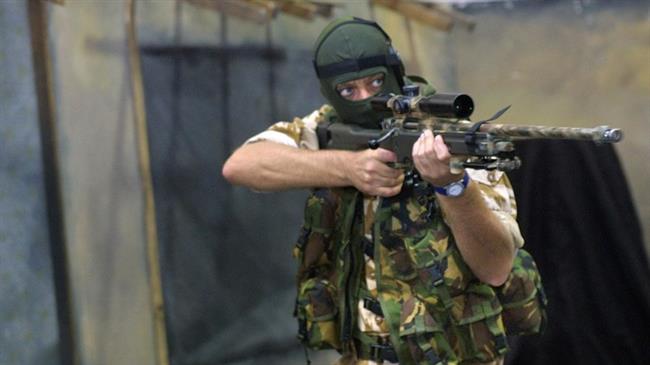
British SAS or SBS soldier in action in Syria
Press TV – March 8, 2020
There is mounting concern in the region about the nature and scale of British Special Forces deployment to southern Syria.
The concern comes in the wake of an exclusive report by the Daily Mirror (March 05) that two RAF Chinook helicopters “packed with special forces” troops and medics had “swooped” into southern Syria to rescue a wounded Special Air Service (SAS) operative.
According to the Mirror, the casualty was airlifted from “deep inside the warzone” to a medical facility in Erbil, northern Iraq.
Whilst the Mirror doesn’t say exactly where in southern Syria the SAS soldier was operating, the reference to “warzone” would suggest Deraa province, in the southwest of the country.
There have been clashes in recent days between Syrian government forces and terrorist groups controlling parts of the town of Al-Sanamayn, situated 50 kilometers south of the capital, Damascus.
Based on the realities on the ground, there is mounting speculation that Britain’s elite SAS could be lending a helping hand to anti-government forces in and around Al-Sanamayn.
British Special Forces, both in the form of the SAS and its allied unit, the Special Boat Service (SBS), have been operating in Syria for seven years.
According to the Mirror, more than 30 British special operatives have been injured in Syria. There has been at least one combat fatality, that of Sergeant Matt Tonroe, who was killed in a joint US/UK operation in March 2018.
Late last year it was reported that British Special Forces in Syria were beating a hasty retreat following US President, Donald Trump’s decision to pull out of Syria.
The latest incident appears to indicate that the SAS and SBS continue to operate in Syria based on the needs of allied Syrian rebel and terrorist groups.
The exfiltration of the injured SAS soldier will cause huge concern as the rescue operation involved RAF choppers taking off from RAF Akrotiri in Cyprus before flying through Israeli airspace to northern Jordan and onto southwestern Syria.
This brazen violation of Syrian sovereignty is likely to aggravate Britain’s outlaw status in Damascus, where both the Syrian government and people take a dim view of Britain’s hostile interference in their internal affairs.
Syria Debacles Epitomize Perpetual Perfidy of U.S. Foreign Policy
By James Bovard | Future of Freedom Foundation | March 6, 2020
Turkey is ratcheting up its invasion of Syria and trying to drag NATO into Erdogan’s personal rehabilitation scheme. Threats and counter-threats are flying as thickly as the bombs and bullets. It remains to be seen whether U.S. policymakers will blunder deeper into this quagmire.
Last October, the Washington establishment was aghast when President Trump appeared to approve a Turkish invasion of northern Syria. The U.S. was seen as abandoning the Kurds, some of whom had allied with the U.S. in the fight against ISIS and other terrorist groups. But the indignation over the latest U.S. policy shift in the Middle East is farcical considering the long record of U.S. double-crosses. Rather than the triumph of American idealism, recent U.S. policy has been perpetual perfidy leavened with frequent doses of idiocy.
Almost none of the media coverage of the Turkish invasion and flight of Kurdish refugees mentioned that President George H. W. Bush had urged the Kurds and other Iraqis to “take matters into their own hands and force Saddam Hussein, the dictator, to step aside” during the U.S. bombing campaign in 1991 in the first Gulf War. After it became clear that the U.S. military could not protect the Kurds from Saddam’s backlash, U.S. policymakers basically shrugged and moseyed along. As a CNN analysis noted in 2003, “Bush refrained from aiding Kurdish rebels in the north, although he finally sent troops and relief supplies to protect hundreds of thousands of fleeing Kurds who were in danger of freezing or starving to death. Bush has never regretted his decision not to intervene.” George H.W. Bush’s abandonment and betrayal of the Kurds did nothing to deter the media and political establishment from posthumously sainting him after he died in late 2018.
U.S. meddling in the Middle East multiplied after the 9/11 attacks. Even though most of the hijackers were Saudis who received plenty of assistance from the Saudi government, the George W. Bush administration seized the chance to demonize and assault Saddam Hussein’s Iraqi regime. President Bush portrayed his invasion of Iraq as American idealism at his best. In his May 1, 2003 “Mission Accomplished” speech abroad the USS Abraham Lincoln, Bush hailed “the character of our military through history” for showing “the decency and idealism that turned enemies into allies.” Speaking three weeks later at a Republican fundraiser, Bush bragged, “The world has seen the strength and the idealism of the United States military.” Washington Post columnist David Ignatius declared in late 2003 that “this may be the most idealistic war fought in modern times.” The torture scandal at Abu Ghraib and elsewhere in Iraq has not been permitted to deter the recent semi-canonization of George W. Bush by the establishment media.
The Bush administration and their media allies produced one smokescreen after another to sanctify the war. Almost all the pre-invasion broadcast news stories on Iraq originated with the federal government. PBS’s Bill Moyers noted that “of the 414 Iraq stories broadcast on NBC, ABC and CBS nightly news, from September 2002 until February 2003, almost all the stories could be traced back to sources from the White House, the Pentagon, and the State Department.” A 2008 report by the Center for Public Integrity found that “in speeches, briefings, interviews and other venues, Bush and administration officials stated unequivocally on at least 532 occasions that Iraq had weapons of mass destruction or was trying to produce or obtain them or had links to al-Qaida or both.” The report concluded that the “false statements – amplified by thousands of news stories and broadcasts” created “an almost impenetrable din for several critical months in the run-up to war.” Bush’s falsehoods on Iraq proved far more toxic than anything in Saddam’s arsenal. But the exposure of the official lies did not deter Defense Secretary Donald Rumsfeld from equating criticizing the Iraq war with appeasing Adolph Hitler in 2006.
The chaos from the 2003 invasion of Iraq was still spiraling out of control when the Bush administration began seeking pretexts to attack Iran, which Bush had designated part of the “Axis of Evil” in his 2002 State of the Union address. Bush officials and subsequent administration chose to champion the Iranian terrorist group, Mujahideen-e-Khalq (MEK). That organization sprang up in the 1960s and proceeded to kill Americans in the 1970s and to kill large numbers of Iranians in the subsequent decades. A 2004 FBI report noted that MEK continued to be “actively involved in planning and executing acts of terrorism.” NBC News reported in early 2012 that MEK carried out killings of Iranian nuclear scientists and that it “financed, trained and armed by Israel’s secret service.”
That was the same year that a stampede of Washington hustlers took huge payoffs to publicly champion de-listing the MEK as a terrorist organization. As Trita Parsi noted in the New York Review of Books, MEK “rented office space in Washington, held fundraisers with lawmakers, or offered US officials speaking fees to appear at their gatherings. But the MEK did this openly for years, despite being on the US government’s terrorist list.” Federal law prohibited taking money from or advocating on behalf of any designated terrorist group. But, as a 2011 Huffpost headline reported, “Former U.S. Officials Make Millions Advocating For Terrorist Organization.” Former FBI boss Louis Freeh, former CIA boss Porter Goss, co-chair of the 9/11 Commission Lee Hamilton, former attorney general Michael B. Mukasey, former Homeland Security Secretary Tom Ridge pocketing $30,000 or more for brief speeches to pro-MEK events. Glenn Greenwald rightly scoffed that the advocacy for MEK “reveals the impunity with which political elites commit the most egregious crimes, as well as the special privileges to which they explicitly believe they — and they alone — are entitled.” Greenwald pointed that average people were scourged by the same law the pooh-bahs brazenly trampled: “A Staten Island satellite TV salesman in 2009 was sentenced to five years in federal prison merely for including a Hezbollah TV channel as part of the satellite package he sold to customers.”
Thanks in part to the torrent of insider endorsements, the Obama administration canceled the MEK’s terrorist designation in 2012. While Washington poohbahs continue portraying the group as idealistic freedom fighters devoted to democracy, a simple online search shows that the Farsi translation of the group’s name is “holy warriors of the people,” as Ted Carpenter noted in his new book, Gullible Superpower. Trump administration officials have gurgled about MEK’s possible role in ruling Iran after the current government is toppled. But MEK remains odious to the Iranian people regardless of the group’s PR successes inside the Beltway.
The prior pratfalls of U.S. Middle East policy did nothing to stymie the outrage over Trump asserted that he was withdrawing U.S. troops from eastern Syria. Congress showed more indignation about a troop pullback than it had shown the loss of all the American soldiers’ lives in pointless conflicts over the past 18 years. The House of Representatives condemned Trump by a 354 to 60 vote, and Rep. Eliot Engel (D-NY), chairman of the House Foreign Affairs Committee, proclaimed, “At President Trump’s hands, American leadership has been laid low, and American foreign policy has become nothing more than a tool to advance his own interests.” Sen. Richard Blumenthal (D-Conn.) said he felt “horror and shame” over Trump’s action. Boston Globe columnist Stephen Kinzer aptly described Congress’s protest as “a classic example of ‘buffet outrage,’ in which one picks and chooses which horrors to condemn.”
President Barack Obama had promised 16 times that there would be no “U.S. boots on the ground” in Syria; when Obama betrayed that promise, Congress did nothing. Trump’s plans to have fewer U.S. boots on the ground in Syria — or at least in part of it — somehow became the moral equivalent of giving Alaska back to Russia. Pundits attacked politicians who supported the troop pullback as “Russian assets” – i.e., traitors.
Syria offers another reminder that “material support of terrorism” is a federal crime unless you work for the CIA, State Department, Pentagon, or White House. After President Barack Obama, former Secretary of State Hillary Clinton, and former Secretary of State John Kerry all publicly declared that Syrian president Assad must exit power, the U.S. armed terrorist groups to topple Assad. The Obama administration’s beloved, non-existent “moderate Syrian rebels” achieved nothing. The Kurdistan Workers’ Party, the PKK, a prime beneficiary of the U.S. occupation, has been considered a terrorist group by the U.S. government since 1997. Evan McMullin, a 2016 presidential candidate, admitted on Twitter: “My role in the CIA was to go out & convince Al Qaeda operatives to instead work with us.” Such absurdities spurred Rep. Tulsi Gabbard, D-Hawaii, to introduce The Stop Arming Terrorists Act in 2017 to prohibit any U.S. funding of terrorist groups. Gabbard’s bill was mostly ignored and never enacted though her outspoken criticism of U.S. policy did spur Hillary Clinton and others to vilify her.
Prominent politicians and much of the media blamed Trump for the attacks on civilians that followed the Turkish invasion, carried out mainly by groups allied with the Turkish government. U.S.-armed terrorist groups involved in the Turkish invasion have freed Islamic State prisoners. A Turkish think tank analyzed the violent groups committing atrocities in Syria after the start of the Turkish invasion; “Out of the 28 factions, 21 were previously supported by the United States, three of them via the Pentagon’s program to combat DAESH. Eighteen of these factions were supplied by the CIA.” A prominent Turkish journalist observed after his government invaded Syria: “The groups that were educated and equipped by the United States west of the Euphrates are now fighting against the groups east of the Euphrates that have been also educated and equipped by the United States.” This is nothing new: in 2016, Pentagon-backed Syrian rebels have openly battled CIA-backed rebels in Syria. A prominent Assad opponent who organized a conference of anti-Assad groups financed by the CIA was denied political asylum in 2017 because he provided “material support” to the Free Syrian Army, which meant he had “engaged in terrorist activity,” according to the Department of Homeland Security. A press backlash spurred a reversal on that decision but the media mostly ignored the other contradictions in U.S. policy in Syria.
Members of Congress were indignant that Syrian civilians suffered as the result of Trump’s troop pullback. But both Congress and most of the American media ignored the Syrian women, children, and men who died as a result of U.S. policies that intensified and prolonged that nation’s civil war. This is typical inside the Beltway scoring: the only fatalities worthy of recognizing are those that are politically useful.
Despite Trump’s sporadic declarations on Syria, the U.S. continues to have more than 50,000 troops deployed in the Middle East. The sooner those troops come home, the less likely that our nation will be dragged into another quagmire. The perennial follies and frauds of Middle East policy provide one of the strongest arguments for the United States to mind its own business.
Erdogan Smells a US Rat
By Finian Cunningham | Strategic Culture Foundation | March 7, 2020
Well, it takes one to know one. The foul scheming and intrigues over the past nine years of war in Syria by the foreign aggressors and their terror proxies will have proven one thing to all the criminal accomplices – none of them can be trusted, even when they claim to be “partners”.
Turkish leader Recep Tayyip Erdogan, who went to Moscow this week, wanted a deeper withdrawal of the Syrian army in Idlib province and he didn’t get it. The upshot is that more Syrian territory has been retaken by Syria’s state forces – despite all the bluster from Erdogan vowing victory and rollback.
What happened is that the Turkish president no doubt smelled a rat from Washington’s lack of military support. Erdogan knew if a military escalation occurred, his forces would be left out to hang and dry by its supposed NATO partner. All the American talk about “fully backing” Turkey failed to materialize beyond hot air.
Recall that when violence flared last month between Turkish and Syrian forces, US Secretary of State Mike Pompeo pledged on February 11 that Washington “would stand by its NATO ally”. As the violence increased along with the body count of Turkish troops, the US did not deliver – despite Ankara’s earnest requests two weeks ago for Patriot missiles. Requests that went unanswered.
Washington knew that Syria and its Russian ally were not backing down from the principle of defeating terror groups on Syrian soil regardless of whether the militants are being given cover by Turkish artillery. Syria has impeccable sovereign right to take back control over every square inch of its territory. Russia has stood full square behind its Syrian ally for that objective.
On March 5 when Erdogan flew to Moscow, he must have had that sinking feeling, knowing that Washington was firing rhetorical blanks. On the same day, Pompeo demanded that the Turkish leader should negotiate a withdrawal of Syrian army back to the Sochi ceasefire lines of 2018. But after six hours of negotiations with Putin, Erdogan settled for a lot less – a truce based on current territorial positions, including gains made in recent weeks by the Syrian army.
On his way to Moscow all that Erdogan was getting from Washington were more vague hints that the US was still “considering” supplying military ammunition to Turkey.
Probably the ominous sign for Erdogan that Washington was going soft was the PR stunt on March 3 when two relatively minor US envoys visited the White Helmets terrorist propaganda unit in Idlib offering “humanitarian aid”. That kind of media support doesn’t quite fit the bill for Patriot missiles and American warplanes that Ankara was really after.
Moreover one of the envoys, James Jeffrey, told a conference in Istanbul on March 5 that the US was “pressuring European NATO allies to give more support to Turkey”.
As Hurriyet Daily News reported, the US envoy was responding to a question regarding Washington’s views about concrete military support to Turkey.
“We are pressuring our European allies to make contribution to this issue,” said Jeffrey. “There’s a Spanish Patriot missile defense unit right now deployed in Turkey at the Incirlik airbase, that’s an example of things that NATO is actually doing, and we want to see more actions like that.”
This was being said as Erdogan flew to Moscow for his “face off” with Putin. In other words, the Turkish president knew that the US was all talk and no action.
Damascus and Moscow have called Erdogan and Washington’s bluff. There will be no escalation in Syria to an international conflict because Erdogan and his master in Washington don’t have the cojones.
Syria has every right to rid its land of terrorists and their NATO patrons. And Syria has Russia’s back. While Ankara knows all it can count on is a Washington rat.
Putin & Erdogan’s New Agreement on Ceasefire in Syria’s Idlib: What is Known So Far in 5 Points
Sputnik – March 5, 2020
Turkish President Recep Tayyip Erdogan has come to Moscow on Thursday to hold talks with his Russian counterpart Vladimir Putin over recent escalations in Syria’s Idlib province. The tensions in the area have recently led to the deaths of over 30 Turkish soldiers, prompting Ankara to target Syrian troops in response.
Russian President Vladimir Putin and his Turkish counterpart Recep Tayyip Erdogan announced after six hours of bilateral talks on 5 March that they have negotiated a preliminary agreement to resolve the ongoing conflict in northwestern Syria. Here is the list of main points which the two major regional players have agreed upon:
- A ceasefire in Syria’s Idlib province will start at 00:01 on 6 March.
- Russia and Turkey will start joint patrols on the M4 highway in Syria. The patrolling will take place from the settlement of Tronba, located 2km west of the strategic town of Saraqib, to the settlement of Ain al Havr.
- A 12-km security corridor for Syria’s Idlib province will be established to the north and to the south of the highway. “The specific parameters of the functioning of the security corridor will be agreed upon by the Ministry of Defense of the Russian Federation and the Turkish Republic within seven days”, Russian Foreign Minister Sergei Lavrov said.
- Both countries agreed on efforts to prevent further aggravation of the humanitarian situation in Syria.
- All additional protocols to the document will come into force from the moment of its signature on 5 March.
The situation in Syria’s Idlib province has recently escalated, descending into fighting between Syrian government forces and militants, resulting in the deaths of over 30 Turkish troops last week. Ankara responded by launching “Operation Spring Shield” and hitting Syrian forces and equipment.
According to the Russian military, the Turkish troops were not supposed to be present in the area fired upon by Syrian forces. Russian President Vladimir Putin also later said that nobody, including the Syrian army, knew about the Turkish troops’ whereabouts.
Thousands of shekels stolen from Palestinian homes in occupied West Bank
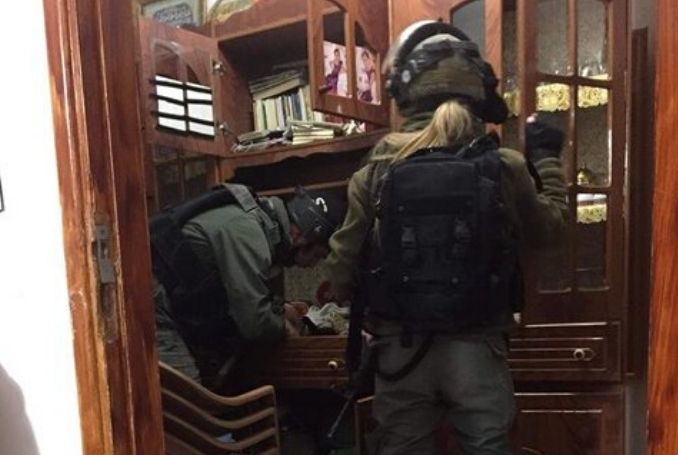
Israeli forces steal money during raids into houses of Palestinian citizens in the West Bank. (Photo: via Twitter)
MEMO | March 4, 2020
Israel security forces stole thousands of shekels from Palestinians in Al-Zawiya in the Salfit district of the occupied West Bank last night.
According to the Palestinian news agency WAFA, around 50,000 shekels ($14,500) were seized during raids that were carried out overnight in the houses of Palestinian citizens and former prisoners.
The Israeli authorities often claim that money has been “confiscated” because the Palestinians “supported acts of terror” and received the money from unknown sources. As a result, soldiers are rarely charged with such thefts.
This is not the first time that Israel has taken money from Palestinian homes during night raids condemned by the Palestinian Authority and international rights bodies.
Such accusations have been made on hundreds of occasions, with soldiers pocketing Palestinians’ cash and valuables during the raids that take place nightly across the West Bank.
A similar raid was carried out in December, for example, when Israeli soldiers used dogs to ransack the family home of Mohammed Rayhan in the town of Yabod, south-west of Jenin.
After the soldiers had left without making any arrests, the family realised that money and gold jewellery were missing, he told Wafa. The family accused the soldiers of stealing the money and valuables.
Heavily armed Israeli soldiers, often with large dogs, regularly raid Palestinian homes, wake the children and arrest one or more family members.
The occupation state’s policy of night raids against the people of occupied Palestine has been condemned repeatedly by international rights bodies as it leaves victims feeling unsafe in their own homes.
The West Ignores Turkey’s Illegal Deployment of Troops to Syria’s Idlib – Russian Military
Sputnik – March 4, 2020
MOSCOW – The West continues to ignore the deployment of troops by Turkey to Syria’s Idlib in violation of international law, spokesman for the Russian Defence Ministry Maj. Gen. Igor Konashenkov said.
“No one in the West notices the actions of the Turkish side, which, in violation of international law, has deployed a strike force the size of a mechanised division to Syria’s Idlib in order to ‘enforce the Sochi agreements at any cost'”, Konashenkov said in a statement.
The spokesman stressed that public threats to destroy all units of the Syrian government forces and return the M5 highway to terrorist control are viewed by the United States and Europe as “Ankara’s legitimate right to defence”.
Meanwhile, Damascus has been unfairly accused by the West of alleged “war crimes”, “humanitarian catastrophe”, and “flows of millions of refugees” in Idlib, Konashenkov added.
The Russian Defence Ministry’s spokesman also slammed Western nations’ claims about their concerns over the humanitarian situation in the Syrian province of Idlib as “total cynicism”, adding that the Russian military is providing all the necessary assistance to Syrians.
“Amid the total cynicism and the West’s fake concerns over the humanitarian situation in the Idlib de-escalation zone, only the Russian centre for reconciliation of the opposing sides and the legitimate Syrian government deliver to the liberated areas all the needed assistance for local residents daily”, Konashenkov said.
“Syrians, tormented by terrorists, were not even aware of the existence of numerous pseudo-protectors in Europe and the United States, and of the prodigal humanitarian assistance, which was allegedly delivered over the past years”, the Defence Ministry’s spokesman went on to say.
Under the 2018 agreements, also known as the Sochi accords, the Turkish military was given the right to establish a dozen observation posts in the militant-controlled Idlib region and obliged to separate jihadist militias from other armed anti-government groups willing to engage in peace talks with Damascus. The agreements also stipulated the need for Turkey to take “effective measures” to ensure a lasting ceasefire in the region. Russia has recently accused Turkey of failing to live up to these commitments.
Presidents Putin and Erdogan are expected to meet in Moscow on Thursday to discuss the Idlib crisis.
Spike in suicides amongst veterans of British military campaigns in Afghanistan
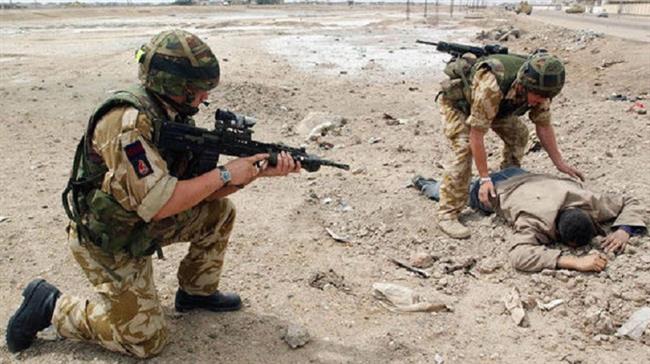
British forces in Afghanistan committed countless abuses against the local population
Press TV – March 2, 2020
Veterans of Britain’s recent costly military campaigns in Afghanistan are killing themselves in record numbers.
According to the Times newspaper, some 14 former and serving army personnel have killed themselves in the past two months alone.
This unusually high number is compounded by the fact that all the deceased are from a “particular grouping” involved in Operation Herrick, which guided all avowed British military actions in Afghanistan from 2002 to 2014.
The government’s response to this apparent emergency has been muted, with John Mercer, the minister for veterans, merely expressing “concern” at the spike in deaths.
The latest spike comes against the backdrop of repeated warnings by British military chiefs of the deteriorating mental health of serving military personnel and veterans alike.
Last November, the former head of the army, General Lord Dannatt, warned that suicide among veterans has become an “epidemic of our time”.
Whilst the precise reasons for the latest spike in suicides is largely unknown, disillusionment with the British military in general, and the UK’s pointless military intervention in Afghanistan in particular, are believed to be major factors.
The widespread disillusionment in the British army is likely to be compounded by the recent announcement of a so-called peace deal between the United States and the Afghan Taliban.
The deal is likely to intensify widespread feelings amongst British veterans of Afghan military campaigns that the entire effort had been in vain.
That feeling is likely to be compounded by the British government’s mixed messaging on the so-called peace deal.
The Defence Secretary, Ben Wallace, played down the significance of the so-called peace deal by describing it in reductive terms as a “small but important step”.
By contrast, Foreign Secretary, Dominic Raab, glorified the deal as a “significant moment in the pursuit of peace”.
Mr President! Pompeo wants a US War in Syria!
Sic Semper Tyrannis | February 29, 2020
“This was and remains a bad idea,” said one of the people familiar with the discussions. Turkey and the U.S. have a history when it comes to the Patriot. Over Washington’s objections, Ankara last year received an advanced Russian S-400 missile-defense system that the U.S. considers a threat to the F-35 fighter jet and NATO air defenses. The U.S. had offered the Patriot as an alternative, but Turkey has committed to the Russian system. As a result, Washington kicked Turkey out of the F-35 program, for which it was both a customer and manufacturing partner. A DoD spokesperson declined to comment. A spokesperson for Jeffrey referred POLITICO to a statement from Secretary of State Mike Pompeo, who on Friday condemned the attack and called on the Syrian government and its Russian and Iranian backers to cease their assault on Idlib. He noted that the U.S. is “reviewing options to assist Turkey against this aggression.” – Politico
Idlib Governorate is Syrian territory. The Syrian government is a member state of the UN. The Russians are assisting the Syrian government at the request of that government. “Fatih” Sultan Erdogan has introduced thousands of Turkish Army troops into northern Syria in what amounts to a neo-Ottoman land grab.
He has a major problem in that so far, neither the Turkish Army (TSK) nor their Sunni jihadi allies are fighting very well. They have managed to re-capture the town of Saraqib on the four lane highway between Damascus and Aleppo, but for how long? The SAA and their militia allies are massing to re-take the town.
To the west nearly all of Idlib Governorate south of the M-4 east-west highway is within artillery fire of the advancing SAA and at the northern end of the al-Ghaab Plain the spearheads are apparently within 6 miles of the M-4. Assuming that the M-4 is the Turkish Main Supply Route (MSR) out of Hatay Province to the west, an SAA interdiction of that major road will imperil the Turkish led force around Saraqib. The Turks will then either withdraw from Saraqib or attack any SAA blockage of the M-4 or both. In classic militaryspeak, the Turks would be said to have been “turned out” of their position at Saraqib by the SAA move onto the M-4 to the west. The resulting engagement would be a desperate fight. In the midst of this situation the Russian Aerospace expeditionary force would be heavily engaged.
Mike Pompeo, Jeffrey, his henchman, and all the neocons in and out of the Borg (foreign policy establishment) want the US to become directly involved in this battle by providing Turkish forces in Syria air defense from US manned Patriot missile batteries. The Turks could not man the systems themselves if we provided them. They also want the US to declare a “no-fly zone” over Idlib Governorate. Such a zone would be a declaration that the US and little friends would shoot down any military aircraft flying over this piece of Syrian territory without US permission. This would be an act of war by the United States and would cause a de facto state of war to exist between the US and Russia.
The US Department of Defense thinks that such engagement on our part is a stupid neocon conception that has it roots in Israeli desire to destroy the Syrian Government, preferring to have a zone of warring factions where Syria once was, a Hobbesian scene of desolation and a war of all against all, The Israeli idea is as stupid as that of the neocons.
President Trump, the Commander in Chief of the US armed forces, holds the sole power to decide. Let us hope that he decides well.
https://www.politico.com/news/2020/02/28/turkey-patriot-missiles-pentagon-118256
Iraq’s parliament fails to approve cabinet, Prime Minister-designate resigns, rockets hit Green Zone
Press TV – March 1, 2020
Iraq’s Prime Minister-designate Mohammad Tawfiq Allawi has withdrawn his candidacy after the parliament failed to approve his new government.
Allawi asked the Iraqi presidency to excuse him from forming a new government in a speech on Sunday.
He added that he made the decision after seeing that “certain political factions are not yet ready reform” and that continuing his tenure under such circumstances would run contrary to his promises to the Iraqi people.
Allawi’s withdrawal comes a few hours after Iraq’s parliament failed to reach a quorum necessary to hold a vote-of-confidence session for Allawi’s new government for a third time in a week.
Allawi was tasked early February with forming a new government after former Prime Minister Adel Abdul Mahdi resigned in the wake of unprecedented anti-government protests which accused the former government of corruption and mismanagement.
The demonstrations, which started in early October last year, have since regularly turned violent amid reports of foreign intervention.
Several hundred people, including security forces, have lost their lives in the violence.
Rockets hit Green Zone
A few hours after the resignation was announced in the early hours of Monday, media reports claimed that two blasts were heard from rockets targeting “US assets” in the Iraqi capital’s “Green Zone”.
The Green Zone is home to several Western embassies and government offices including the parliament, the prime minister’s office, and the presidency.
In recent months the fortified zone has been repeatedly targeted by Katyusha rockets by unknown parties.
Iran and Hezbollah warn Turkey: all your forces are in our line of fire
Iranian Advisory Center in Syria: we call on Turkish forces to act rationally for the benefit of the Syrian and Turkish peoples
Al-Manar, February 29, 2020
The Iranian Advisory Center in Syria, which takes part in the fighting in northern Syria, issued a press release through the news agency U-News in reaction to the recent confrontation between the Syrian army and the Turkish army. It should be noted that the Iranian Advisory Center is made up of the group of Iranian experts who advise the Syrian State and its armed forces, and that this is the first statement it has issued since the beginning of the war in Syria.
Full text of the statement
In reaction to the latest confrontation between the Syrian Arab Army and the Turkish Army, it is important for us to inform the public of the following:
First: We fought alongside the Syrian Arab army and supported it, at the request of the Syrian State, to open the M5 highway, with a Syrian force led by elements of the Iranian Revolutionary Guards and of Hezbollah, and with the participation of factions of the Resistance within the force; and we have helped civilians and residents of the liberated villages.
Second: Protected by the Turkish army, the armed (terrorist) groups attacked the positions of the Syrian army, and so we participated in the fighting aimed at preventing the M5 highway to fall again in their hands.
Third: Since the beginning of the presence of our forces, the Turkish positions located in the Syrian territories have been in the sight of our forces, whether they comply with the Astana Agreements or violate them, but the elements of the Resistance did not strike these Turkish forces out of deference to the decision of their (respective) leaders, and this decision remains in effect until now.
Fourth: Four days ago, foreign elements, Tajiks from the Turkestan Party, elements from the Al-Nusra Front, as well as other terrorist factions, carried out a large-scale attack on the positions of the Syrian army. Our forces directly supported the Syrian Army to prevent the liberated areas from falling into their hands.
Fifth: Despite the defensive nature of the action of our forces, the Turkish army targeted our elements and our forces from the air, with precision missiles and artillery support, which prompted us to send mediators to the Turkish army to end its attacks and renounce this approach
Sixth: Our mediators announced to the Turkish army that the terrorists attacked our positions with their support, that our forces are there to confront the terrorists, and that we are on the side of the Syrian army for this mission; but unfortunately, the Turkish military ignored this request and continued its bombing, and a number of our fighters (Iranian & Hezbollah’s) were martyred.
Seventh: Syrian army artillery responded by striking the source of the fire; for our part, we did not retaliate directly, and once again, we announced to the Turkish army through mediators that we have no objective or decision to confront the Turkish army and that our leadership is determined to reach a political solution between Syria and Turkey.
Eighth: We have informed our forces since morning not to target Turkish forces inside Idlib in order to spare the lives of their soldiers, and our forces have not opened fire, but the Turkish army continues to shell the points and locations of the Syrian army (where we are also located) with artillery fire.
Ninth: The Iranian Advisory Center and the fighters of the Resistance front call on the Turkish forces to act rationally in the interest of the Syrian and Turkish peoples, reminding the Turkish people that their sons (soldiers) have been in our sights for one month and that we could have targeted them in revenge, but we did not do so in accordance with the orders of our leaders; we call on them to pressure the Turkish leadership to rectify its decisions and avoid spilling the blood of Turkish soldiers.
Tenth: Despite the current difficult circumstances, we reaffirm our continuing position alongside the people, the State and the army in Syria in their fight to defeat terrorism and preserve their full sovereignty over the Syrian territories, and we all call on actors to be rational and aware of the great risks of continuing the aggression against Syria.
Iranian Advisory Center in Syria
Translation: resistancenews.org
Featured Video
Trita Parsi: Israel Set a Trap for Total War in the Region
or go to
Aletho News Archives – Video-Images
From the Archive
Zionism’s Violent Legacy
By Donald Neff | Washington Report On Middle East Affairs | January 1996
On January 4, 1948, Jewish terrorists drove a truck loaded with explosives into the center of the all Arab city of Jaffa and detonated it, killing 26 and wounding around 100 Palestinian men, women and children.[1] The attack was the work of the Irgun Zvai Leumi – the “National Military Organization,” also known by the Hebrew letters Etzel – the largest Jewish terrorist group in Palestine. The Irgun was headed by Revisionist Zionist Menachem Begin and had been killing and maiming Arabs, Britons and even Jews for the previous ten years in its efforts to establish a Jewish state.
This terror campaign meant that at the core of Revisionist Zionism there existed a philosophical embrace of violence. … continue
Blog Roll
 Aletho News
- Trita Parsi: Israel Set a Trap for Total War in the Region
- Trump’s Iran war is on an Israeli leash
- Saudi oil boss issues global supply warning
- Riyadh Says Its Oil System Is Intact. The Numbers Say Otherwise.
- Trump and Netanyahu Want to “Finish the Job” on Iran
- US ‘one-sided dictation’ not Iran’s beliefs makes rational talks impossible: Baghaei
- Iran’s Next Strike May Not Explode. It Could Shut You Down /Col Doug Macgregor
- Iran: US political targets legitimate if assassinations return
- Iraq shuts key border crossing with Iran under US pressure: Report
- Undersea Internet cables could be targeted in retaliation for attacks on Iran: IRGC deputy chief
- If Americans Knew
- The Israel Lobby’s Changing Fortunes
- AIPAC has become such a political liability that it’s shifting to a more “nimble” approach to buying politicians
- At least 160 Israeli settler attacks in 2 weeks
- Will Gaza’s Ancient Christian Community Disappear Forever?
- Israel’s vision of regional security rests on keeping Arab states weak
- Heidi Levine recounts how Palestinian youths helped save her in settler attack
- DAILY UPDATE: Latest essential news on Palestine, Israel, & region
- Trump’s Intensifying Sabotage of the ICC, for Israel’s Sake
- Israeli military detain US and UK volunteers in West Bank including Democratic NY politician Brad Lander
- Americans at National Conservatism Conference held in Israel this year criticize Israel
- No Tricks Zone
- E-Cars Reduce CO2 Emissions By Only 41% Compared To Internal Combustion Engine Vehicles
- Predictions Made By Renowned Climate Professor Over Past Decades Have Been Proven To Be Poor
- New Study Suggests Large Regions Of The Pacific Ocean Have Been Cooling For The Last 80 Years
- Germany’s Green Energy Debacle: High Energy Costs Force Kahla Porzellan to Close After 182 Years!
- New Study: 50 Years Of The Most Aggressive ‘Net Zero’ Policies Can Only Affect The Global Climate By 0.03°C
- US September “Heat” Was No Record…Many Records Set Decades Ago
- Latest European Green Energy Debacle; Portugal’s Largest Flagship Solar Park Insolvent!
- Green Energy Debacle: German Expert Professor Fritz Vahrenholt Warns Of Severe Economic And Social Consequences
- Two More Paleo Reconstructions Affirm Meters-Higher Sea Levels Across Ireland, Brazil 7000-6000 Years Ago
- New Study: Earth And Venus Surface Warmth Largely Explained By Convection And Lapse Rate, Not CO2 Or Radiation

