The AngloZionist Empire vs Iran: a discussion of the recent events
The Saker | January 9, 2020
First, since we now have more reliable data about what happened, let me recap a few key points:
- It is has now become pretty clear that Iran took several steps to make sure that the US would know when and where the strikes would happen. Specifically, Iran warned the Iraqi government and the Swiss diplomats who represent US interests in Iran.
- Yet, at the same time, Iran issued the strongest threat it could possibly issue: it told the US that *any* counter-strike aimed at Iran would result in a strong Iranian attack on Israel.
- The US quite clearly took the decision not to retaliate and to “forget” Trump’s promise to strike at 54 Iranian targets. I want to stress here that this was the correct decision under these circumstances.
- It also appears that the Iranians were able to somehow retrofit some kind of terminal guidance capability on missiles which originally lacked it.
- The level or precision of the strikes was absolutely superb and quite amazing.
- Trump declared that Iran decided to stand down and that the US had prevailed. This notion is, of course, prima facie ridiculous, but not for folks getting their news from the corporate media.
- The Iranians declared that this specific strike was now over, but immediately added that this was only a first measure and that others would follow.
Next, I want to share a few interesting photos with you.
First, here is a photo of the base following the strikes sent to me by a friend:
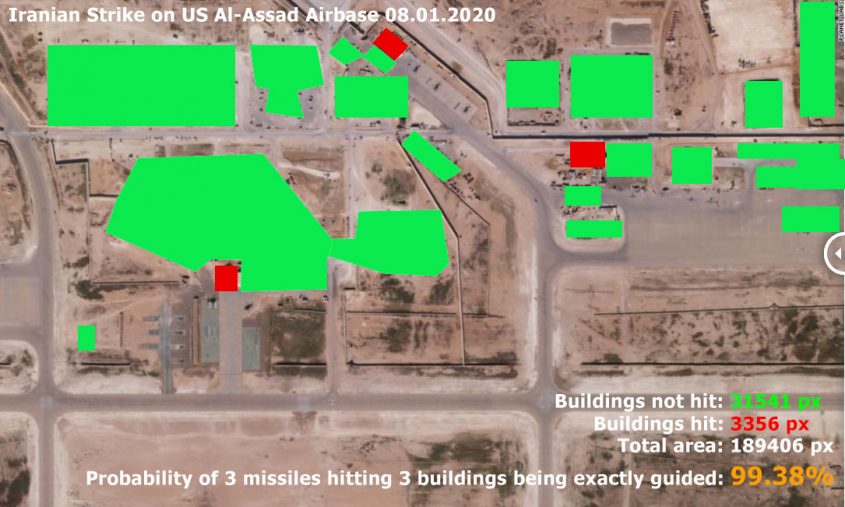
Here is what my friend added:
The key idea is really simple and understandable for anybody who has thought about statistics (even in an everyday context). In number terms, it’s almost like rolling dice and getting a 6 three times in a row, because the probability of rolling a 6 with an ideal dice is 16.67% (and the probability to roll 3 sixes in a row is less than 1%) as opposed to roughly 18% probability for a hit on a building within the map area in the CNN screenshot (if we assume the missiles to be unguided within this area). To be even more precise, the probability for hitting 3 *different* buildings 3 times in a row is actually even slightly lower than 0.62%, as one would have to substract the area being hit from the total area covered by buildings (I ignored that for simplicity). A less than 1% probability for a one-off event like this means that it is really highly UNlikely – to use the British Skripal case expression in its inverted state – to have happened randomly, as we assumed in our hypothesis. Which means that the missiles were, indeed, guided, and guided very accurately, striking targets of less than ~50m size with a high degree of reliability (in this particular area 3/3, in others probably 1/1 as in the runway case, etc). Perhaps, some of them, not covered by the satellite images, missed the target, but it does not substantially change the high degree of accuracy that potential Iranian opponents within reach of these missiles will have to assume from now on. The people most interested in this were probably the Israelis, as they are probably the main potential target for this type of missile in the case of a future escalation.
Please note that neither my friend nor I are professional imagery analysts and that this is just something my friend shared with me in a private email and which I now want to share with you.
If any professional imagery analyst could either confirm/refute my friend’s conclusions, I would be most grateful.
Next, I want to share with you the following image which shows Iranian IRGC General Ali Amir Hajizadeh reviewing results of recent Iranian missile strikes on Ain al-Assad airbase in Iraq during a press conference:
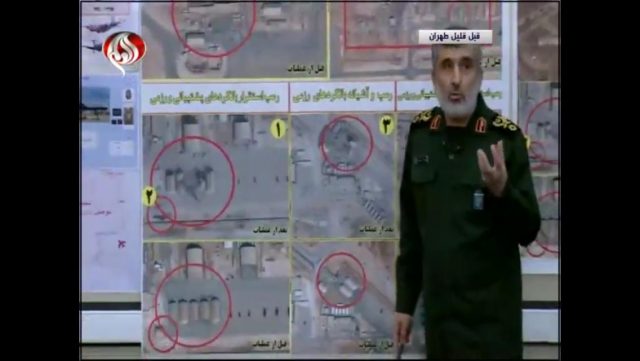
Clearly, the Iranians are very proud of their capability to conduct true precision strikes with an accuracy every bit as good as any Russian and/or US missile.
Finally, check out this image of the Iranian general making a press conference in front of a very interesting row of flags:
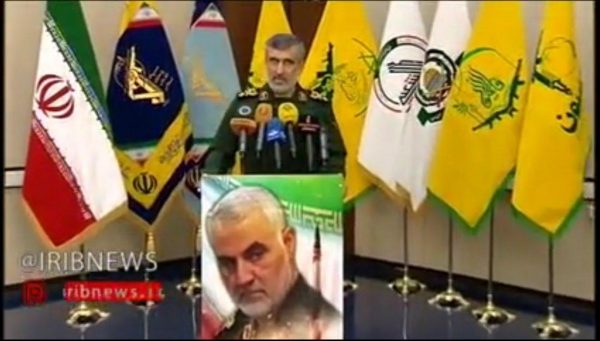
These flags include the following: The Iranian flag, the IRGC flag, the flag of IRGC’s Aerospace Force, the flag of the Lebanese Hezbollah, the Yemeni Houthi Ansarullah flag, the flag of the Iraqi Popular Mobilization Units (PMU), the Palestinian Hamas, the Afghan Liwa Fatemiyoun and the Pakistani Liwa Zainebiyoun
I find this very interesting: when Trump (or any other US politician) makes a solemn pronouncement, he typically has a number of aides, advisors, generals, Congressmen or Senators, etc. This is supposed the show the determination, resolve and unity of Uncle Shmuel, especially when Uncle Shmuel does something illegal or immoral.
The Iranian show of unity does not show more Iranians, they show the unity of all the forces in the Middle-East who have now officially united and whose goal is clear and very official: kick Uncle Shmuel out of the Middle-East.
You tell me which you find more impressive!
Next, the issue of casualties. Frankly, and while this is only my best guess, I do not believe the Iranian official casualty figures. Why? Well, first the Iranians did not try to maximize casualties (more about that option below), and they informed the US by several back-channels. But even if they had not, while the performance of the Patriot missile is pretty awful, the US does have a lot of top of the line technical intelligence means which would allow them to first detect the launch of the missiles from Iran and then to calculate their ballistic trajectory. As far as I know, now I might be wrong here, Iranian missiles do not have terminal maneuvering capability (which is different from terminal guidance). I can’t image why US commanders could not announce a incoming missile alert and then get all the local personnel into shelters. Again, I might be missing something, so if any reader can correct me, I would be grateful.
So what happened, really?
Here are a few of my current working hypotheses:
1) BOTH the USA and Iran don’t want a full-scale war. But for VERY different reasons:
- The US probably understands that it cannot win a war against Iran.
- The Iranians definitely understand that while the US cannot “win”, it most definitely can kill Iranians by the thousands and inflict immense damage upon the Iranian society.
2) What just took place was the single most dangerous moment since 14 April 2018 when Russia and the US came very, very close to a full-scale war. In the current situation, the US and Iran also came very, very close to a full scale war. The only reason I rank this latest crisis lower than the April 14th is that in one case we risked a planetary nuclear war whereas in this case we “only” risked a regional war which, by the way, could have seen nukes used by the US and Israel.
3) There STILL is a risk of full-scale war between the US and Iran, however, and barring a major unforeseen event, I will lower it now down from 80% to a much more tolerable 50%. Why 50%? Because Israel and the Israel Lobby will continue to push for a US attack on Iran and because while I trust the Iranians to keep their anti-US operations right below the threshold of “plausible deniability”, I cannot be sure that all Iranian allies will show similar restraint. Finally, the chances of an Israeli false flag as still sky high.
4) I expect anti-US operations to continue and even expand throughout the Middle-East. I don’t expect that these operations will be executed from Iran and I don’t expect Iranian forces to be involved, at least not officially. The Iranians know that the US has lost every single counter-insurgency war it was involved in and they know that their best chance is now to engage in all forms of asymmetrical operations.
Finally, I want to spell out what we could call the new Iranian threat.
We have to assume that Iran now has terminal guidance capability on many (most?) of its ballistic and cruise missiles and that they can destroy one specific building among many more buildings. Now, remember the Iranian reply that it had 35 US bases within missile range? Now imagine this first one:
- Iran fires 10-12 missile on each and every one of the 35 US bases listed and targets barracks, fuel and ammo dumps, key command posts, etc. How many casualties do you think that such a strike would result in?
Next, let’s try the same thing with Israel:
- Iran fires 2-3 missiles but carefully aims them as Israeli air force bases, personnel barracks, industrial sites (including chemical and nuclear sites, not even necessarily military ones! Dimona anybody?), the Knesset or even Bibi’s personal residence. Can you imagine the panic in Israel?
How about the KSA?
- Iran fires a large amount of missiles aimed at *truly* crippling the Saudi oil installations, National Guard barracks, airfields, etc. We already know what the Houthis could do with their very limited resources. Just imagine what Iran could do to the KSA (or the UAE and Kuwait) if it wanted to!
I think that the bottom line is clear: Iran can inflict unacceptable damage upon any party attacking it. Furthermore, and unlike having “a few” nukes, Iran has hundreds (or even thousands) of cruise missile and ballistic missiles, and you can bet that they are well distributed and well protected, as shown by this short video released by the IRGC and posted by the FARS news agency:
and that means that a disarming first strike against Iran is not possible.
There are two basic ways to respond to an attack: denial and punishment. In the first case, you have the means to deny your enemy his attack, this is what happened when the Syrians intercepted almost all the cruise missiles fired by the US. Punishment is when you cannot prevent an enemy attack, but you do have the means to inflict unacceptable damage in retaliation.
The key notion here is “unacceptable damage”.
What do you think constitutes “unacceptable damage” to the (terminally hedonistic) Israelis?
What do you think would be “unacceptable damage” to the KSA, or the world markets (especially oil)?
What about “unacceptable damage” in terms of losses for CENTCOM?
And, finally, what do you think “unacceptable damage” means to the Iranians?
There is such a huge asymmetry in how the parties to this conflict see “unacceptable damage” that it largely compensates for the asymmetry in force. Yes, sure, the US+Israel are more powerful than Iran (well, not Israel really, but Israel hiding behind the back of the US forces) but Iran is far more capable of absorbing devastating attacks than either the US or Israel.
Finally, in my last post I offered a definition of what constitutes success or failure for Iran: “anything which makes it easier for the US to remain in the Middle-East is a victory for the Empire and anything which makes it harder for the US to remain in the Middle-East is a victory for the rest of the planet.”
At this point my personal opinion is that the way the Iranians conducted their first anti-Empire operation is nothing short of brilliant: they achieved a truly phenomenal result with very little means and, most importantly, without forcing the Empire to counter-attack.
Has the US-Iran war really begun? Yes, I think so. In fact, it began in 1979, but now it has reached a qualitatively new level. The outcome of that war is absolutely evident to me. The cost, however, is not.
This war has relatively cooled down, but that is an illusion and we should most definitely not take our eyes off the situation in the Middle-East: expect the initiation of asymmetrical anti-US operations very soon.
IRGC Aerospace Force Commander: Iran Missile Strike Eradicated US Horror Formula Imposed since WWII
Al-Manar | January 9, 2020
IRGC Aerospace Force Commander Brig. Gen. Amir Ali Hajizadeh Thursday briefed the media outlets on the Iranian missile strike on US military base in Iraq, stressing that it managed to undermine US awe.
General Hajizadeh stressed that since WWII there has not been any attack on a US target that keeps unanswered, adding that Iran managed to eradicate this horror formula.
General Hajizadeh pointed out that the Iranian forces fired 13 missiles at Ain Al-Asad base and had been able to fire hundreds of others had the US forces responded.
The Iranian missiles hit the command chamber and positions used to prepare the combat helicopters at the US base, according to General Hajizadeh, who added that Iran decided to strike the US base in Iraq that is the largest and the farthest from the Iranian border.
“Unlike the Americans, we are not criminals; we could have struck the dormitory areas of the US troops at Ain Al-Asad base and killed 500 of them had we decided that.”
General Hajizadeh stressed that the missile strike left US human losses, adding that nine jets moved the injured US soldiers to the Zionist entity.
General Hajizadeh emphasized that the US existence in the region is in danger, calling on Washington to learn from what happened and start a voluntarily withdrawal.
General Hajizadeh addressed the Gulf countries, reiterating that the US forces may never protect them.
“The Iranian forces planned to strike the US bases in the Gulf countries.”
General Hajizadeh stressed that the assassination of General Suleimani will cause a tsunami that will expel the US forces from the region.
On January 3, a US drone attack targeted a vehicular convoy for the head of the IRGC Al-Quds Force General Qassem Suleimani and the deputy chief of Hasd Shaabi Committee Abu Mahdi Al-Muhandis, claiming both of them in addition to a number of their companions.
On January 8, the Iranian rocketry forces responded by firing 13 ballistic missiles at the US military base of Ain Al-Asad in Iraq’s Anbar, causing heavy losses upon it.
Iraqi Foreign Minister stresses need for withdrawal of foreign troops
Press TV – January 9, 2020
Iraqi Foreign Minister Mohammad Ali al-Hakim has stressed the need for US and other foreign troops to leave Iraq as a backlash grows over the recent American assassination of a top Iranian general in Baghdad.
The top Iraqi diplomat made the appeal during a joint press briefing with his Turkish counterpart Mevlut Cavusoglu in Baghdad on Thursday.
Hakim and Cavusoglu strongly condemned the US assassination of Iran’s Lt. Gen. Qassem Soleimani and senior Iraqi commander of the Popular Mobilization Units Abu Mahdi al-Muhandis, both key figures in the fight against Daesh and other Takfiri terrorists in the Middle East.
“Iraq insists on maintaining its sovereignty and territorial integrity and the complete withdrawal of foreign forces,” the top Iraqi diplomat said.
He added that talks with his Turkish counterpart focused on the need to respect Iraq’s sovereignty from all sides.
“Iraq condemns the attacks on Iraqi land, which harms the sovereignty of our country as well the security of Iraqi people. They are against the international law,” the Iraqi minister said.
Hakim added, “”We have discussed with the minister that Iraq wants all foreign forces are removed out of the country through dialogue. We also discussed with the minister on cooperation areas. We have agreed to alleviate the Iran-US tension in the region.”
The two sides also discussed bilateral relations at all levels, including cooperation on fighting terrorism, al-Hakim said.
The top Iraqi diplomat said any escalation of tensions in the region could result in the re-emergence of Takiri terrorist groups.
The Turkish foreign minister, for his part, said Ankara does not want Iraq to become a battleground for foreign forces.
Cavusoglu added that Iraq was not alone and Turkey was there to overcome difficult days together.
Turkish foreign minister also spoke with his Iranian counterpart Mohammad Javad Zarif Wednesday after Tehran fired dozens of missiles at two military bases hosting US troops in Iraq. The missiles were fired at the Ain al-Asad base in Anbar province and another base in Erbil.
PMU leader denies role in rocket attacks
In another development, Qais al-Khazali, the leader of Asa’ib Ahl al-Haq movement, a subdivision of Iraq’s Popular Mobilization Units, known by its Arabic name as Hashd al-Sha’abi, denied any involvement in the recent firing of rockets at Baghdad’s Green Zone where the US embassy is located.
Two Katyusha rockets struck Baghdad’s heavily fortified Green Zone on Wednesday, landing near the US embassy but causing no casualties, according to the Iraqi military.
Al-Khazali also said it was time for an Iraqi response to the recent US assassination, adding the reaction will be “no less in size” than Tehran’s missile strikes on two American bases in Iraq.
On Sunday, Iraqi Prime Minister Adel Abdul Mahdi called the US airstrike “a political assassination”. He also underlined the need for a timetable to withdraw all foreign troops “for the sake of our national sovereignty.”
How Was Pentagon ‘Withdrawal Letter” Leaked To Iraq? Anatomy Of A Propaganda Coup
By Tyler Durden – ZeroHedge – 01/07/2020
The inside account of how the now infamous “phony” letter announcing complete US troop withdrawal from Iraq after seventeen years details astoundingly how the “posting of the letter online unleashed a mad, behind-the-scenes scramble at the Pentagon, the White House, and on Capitol Hill, as elected officials, policymakers, military advisers and journalists sought to understand whether the letter intended to communicate what its plain language suggested.”
As different departments and levels within the Pentagon bureaucracy attempted to account for it, the story changed multiple times. In a matter of a couple hours it went from “authentic” to “phony” to part of an effort to sow “active disinformation” — and finally according to a confused press briefing by Gen. Milley and Defense Secretary Mark Esper an “unauthorized draft” and “an honest mistake”.
This after The Washington Post and a host of other major outlets “confirmed” it as “authentic” — in the words of WaPo’s Beirut Bureau chief Liz Sly.
At Monday’s Pentagon briefing itself which attempted to assess the origins of the mysterious draft letter, The Dispatch summarized the atmosphere: “Was the United States really moving to remove its remaining troops from Iraq? Nobody seemed to know.”
And ultimately no definitive answers came, other than the Pentagon and administration denying than an Iraq pullout is happening, as to just how a “draft letter” which had been making the rounds at CENTCOM came to be in the hands of the Iraqis, after which it was posted online.
As The Dispatch notes, the letter wasn’t merely announced by some Iraqi politician in Baghdad, but was released via America’s enemies:
The news was a propaganda coup for the Iranians and those in Iraq who support them. The story broke on the television channel of an Iran-backed Iraqi militia, Asaib Ahl al-Haq (AAH), after it was leaked by the Iraqi prime minister’s office, according to Liz Sly, Beirut bureau chief for the Washington Post, who noted that the leader of AAH is a U.S.-designated terrorist and his militia is responsible for the deaths of dozens of Americans.
The letter soon made its way into the American media.
Initially, there was this statement out of the Pentagon policy office in conjunction with Operation Inherent Resolve: “OIR has confirmed with us at the working level that this is active disinformation.” The Pentagon was “fairly certain that this is a fake” according to that early media statement.
But then this later at the Pentagon press briefing:
They didn’t declare the letter a fake but they couldn’t offer much of an explanation of its provenance or meaning, either. Esper pleaded ignorance. “I don’t know what that letter is,” he said. “We’re trying to find out where that’s coming from, what that is. But there has been no decision made to leave Iraq, period.” He declined to confirm its authenticity. “No, I can’t.”
Gen. Milley couldn’t verify that the letter was real, either. “I do know that it’s not signed,” he said. “But I just looked at it right there; it’s not signed.”
So even the attempts to account for what may or may not be a “draft” letter which originated within the Pentagon itself and then leaked to the Iraqis remain contradictory.
The final word from the Defense Department seems to be a shoulder shrug and that it was “an honest mistake”.
What remains is that the whole embarrassing and bizarre episode does indeed appear a “propaganda coup for the Iranians and those in Iraq who support them.”
Imam Khamenei: Only a Slap Was Delivered, US Withdrawal from Region Inevitable
Al-Manar | January 8, 2020
Leader of the Islamic Revolution in Iran Imam Sayyed Ali Khamenei said the missiles on US bases in Iraq are only a slap in the face of Washington, stressing that the real retaliation to the assassination of IRGC’s Quds Force General Qassem Suleimani is the US withdrawal from the region.
“Last night, a slap in the face was delivered,” Imam Khamenei said, in a speech broadcast live on state television, referring to the IRGC missiles which were launched at US bases in Iraq, including Ain al-Assad base in Anbar.
“One important issue is what is our duty now?” following Suleimani’s assassination, said the Leader.
“An important incident has happened. The question of revenge is another issue. Military actions in this form are not sufficient for that issue,” he said, referring to the assassination.
“What is important is that America’s corrupt presence must come to an end in this region,” his eminence said, stressing that the US withdrawal from region is “inevitable.”
Elsewhere in his speech, Imam Khamenei praised Suleimani as courageous and devoted.
“Martyr Suleimani challenged Zionists and managed to offer support to Palestinians in Gaza,” he said, adding that the top commander played major role with Hezbollah in defending Lebanon and foiled enemies’ conspiracies in Iraq, Syria.
“Martyrdom of Suelimani revived revolution spirit in Iran.”
” As long as our enemies’ allies don’t target us we won’t hit them,” Imam Khamenei said likely referring to Gulf Arab states.
Iraqi cleric Moqtada al-Sadr says crisis over, after Trump & Iran speak
© Reuters / Alaa al-Marjani
RT | January 8, 2020
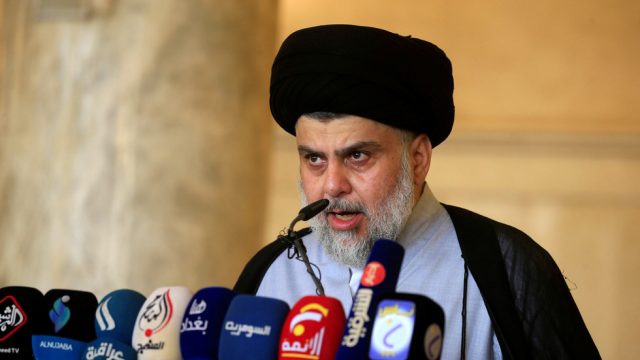
Influential Iraqi cleric Moqtada al-Sadr has declared the “crisis” between the US and Iran over, following statements from the two countries’ leaders in the wake of Tuesday’s Iranian strikes on US bases in Iraq.
Al-Sadr made his pronouncement on Wednesday after US President Donald Trump gave a relatively subdued speech praising Iran’s restraint. Rather than call for retaliation against Iran over a strike that didn’t kill any Americans, Trump merely vowed to impose even more sanctions on the Islamic Republic “until Iran changes its behavior.”
Iran’s President Hassan Rouhani in turn vowed to eventually kick all US troops “out of the region” as the “final answer” to the assassination of General Qassem Soleimani, killed in a US airstrike last week.
Shia religious leader al-Sadr also called on Iraqi militias to be “patient” and not begin any military actions, claiming that a new “strong” government capable of protecting Iraq’s sovereignty would be formed in 15 days and hold early elections. However, Iraq should still evict the foreign troops inside its borders, he said.
The Iraqi foreign ministry condemned Iran’s missile attack on the coalition bases, declaring it a “violation of Iraqi sovereignty” in a statement on Wednesday and emphasizing Iraq was an “independent state.”
“We will not allow it to become a battlefield,” the ministry added.
Iraqi PM Adel Abdul Mahdi stepped down last month after months of massive protests calling for electoral reforms. He has remained in a “caretaker” role while Iraq’s political leaders attempt to move forward. Another prominent Shia cleric, Grand Ayatollah Ali al-Sistani, warned last month that “foreign interference” in the process would not be tolerated.
Zarif: Iran informed Iraqi govt. of missile attack on US bases
Press TV – January 8, 2020
Iranian Foreign Minister says Iran informed the Iraqi government of its retaliatory attack on US bases, reaffirming Tehran’s respect for the sovereignty and territorial integrity of the Arab country.
This measure was carried out with the information passed to the Iraqi government and armed forces as confirmed by the Baghdad government, Zarif said Wednesday.
“We attach high significance to Iraq’s territorial integrity and sovereignty, and we believe security should be [provided] based on mutual respect and [safeguarding] territorial integrity of all regional countries by all,” he added.
The remarks came hours after Iran responded to the US assassination of prominent anti-terror Iranian commander Lieutenant General Qassem Soleimani and his companions, including Iraqi commander Abu Mahdi al-Muhandis, with a barrage of missiles that hit two US bases in Iraq.
In the early hours of Wednesday, Iran launched tens of missiles at two bases housing US troops in Iraq’s western Anbar Province and Kurdistan regional capital, Erbil, in revenge for the assassination of General Soleimani.
Zarif’s remarks came after Iraq’s President Barham Saleh and the speaker of the Iraqi parliament, Mohammed al-Halbusi, said the attack violated the sovereignty of the Arab country.
However, earlier on Wednesday, the spokesman for Iraqi Prime Minister Adel Abdul-Mahdi said the premier had received word from Iran that its response to the US assassination of its top general was either imminent or under way.
“Shortly after midnight on Wednesday we received a verbal message from the Islamic Republic of Iran that the Iranian response to the assassination of martyr Qassem Soleimani had started or was about to start,” Reuters quoted the spokesman as saying.
Elsewhere in his remarks, Zarif said Iran’s missile attack was a military revenge for the top commander, stressing, however, that there is no retaliation proportionate to the assassination of General Soleimani other than the expulsion of US forces from the region.
As declared by Leader of the Islamic Revolution Ayatollah Seyyed Ali Khamenei, Zarif said, the true revenge for General Soleimani’s blood is that the US folly has marked the end of its presence in the region.
“The end of the US presence in the region, which will definitely happen, will herald glad tidings for the region and the generations to come, because the US presence in the region has brought about nothing but destruction and mischief,” he noted.
Iran strikes US bases in Iraq to avenge Soleimani, vows to target Israel and all US bases in the region
Al-Manar | January 8, 2020
The Islamic Republic of Iran began its revenge for the assassination of the martyr Soleimani by launching dozens of ballistic missiles at the US base of Al-Asad in Iraq.
The Islamic Revolutionary Guards announced that the process of revenge for the assassination of the martyr Soleimani had started with the launch of dozens of ballistic missiles against the American base at Al-Asad in Iraq. In a statement, they assert that “At dawn today, in response to the terrorist operation by American forces and in retaliation for the assassination and martyrdom of Quds Force Commander of the Islamic Revolutionary Guards, Qassem Soleimani, and his companions, the aerospace forces of the the Islamic Revolutionary Guards carried out a successful operation bearing the name of the martyr Soleimani by launching dozens of ground-to-ground ballistic missiles against the air base of Ain al-Assad occupied by the US terrorist army. We will later inform the noble Iranian people and all free men of the world of the details of this process.
The Islamic Revolutionary Guards warned “The Great Satan, namely the US regime, that any wicked act, aggression or other hostile movement would face an even more painful and harsh response. […] We warn America’s allies who host US terrorist bases that any territory that is the source of hostile action against the Islamic Republic of Iran will be targeted.” The statement from the Islamic Revolutionary Guards added that “we do not in any way regard the Zionist entity as distinct from the criminal US regime.”
“We recommend that the American people recall their soldiers from the region to avoid further casualties and not to leave the lives of American soldiers threatened because of our peoples’ growing hatred of America,” the statement said.
Public relations within the Revolutionary Guards warned the United States that any response to the strikes “would light the fuse of a widespread and very painful response against the United States in the region.”
The Iranian news agency Mehr reported that “dozens of missiles from the aerospace force of the Islamic Revolutionary Guards targeted the base of Ain al-Assad”, and said that “the attack comes in reprisal for the assassination of the martyred commander Qassem Soleimani, and consisted in the launching of a certain number of ground-to-ground missiles”.
After the news was announced, the sounds of Takbir (Allahu Akbar!) rose from the top of the buildings of the capital, Tehran, expressing popular jubilation at this operation.
A security source told Agence France-Presse that on the night from Tuesday to Wednesday, at least nine rockets landed at the Ein Al-Assad Air base in western Iraq, where American soldiers are stationed. The source said the attack took place in 3 stages.
Use of Fateh missiles in a process of severe revenge
Given the distance between the base of Ain al-Assad and the place from which the Islamic Revolutionary Guard missiles were launched, Fateh ballistic missiles were used in these strikes (range up to 500 kilometers).
U.S. forces and their advisers are stationed at Ain al-Assad Air Base, which is the second largest Air Base in Iraq, after Balad base in Salah al-Din, north of Baghdad. For years, American forces have been present at several Iraqi military and Air Bases in the provinces of Anbar, Salah-al-Din, Nineveh and the capital Baghdad.
Pentagon admits strikes
The Pentagon has announced that Iran fired “more than 12 missiles” at dawn on Wednesday at the Ain al-Assad and Erbil bases used by US forces in Iraq on Wednesday, indicating that it is in currently assessing the damage and studying ways to “respond” to this strike.
Assistant to the Secretary of War for Public Affairs Jonathan Hoffman said in a statement that the department was conducting a “preliminary damage assessment” and was considering a “response” to the attack. He added that on Tuesday evening, “around 5.30pm (10.30pm GMT) on January 7, Iran fired more than 12 ballistic missiles at US and coalition forces in Iraq.” This time corresponds to the exact time martyr Soleimani was killed.
The statement added that it is clear that these missiles were launched from Iran and were aimed at at least two Iraqi military bases used by American and coalition forces in Ain al-Assad and Erbil.
The White House, for its part, said that President Trump is monitoring the situation closely and holding consultations with the National Security Council to discuss developments. White House spokesperson Stéphanie Gresham said, “We are aware of reports of attacks on US facilities in Iraq. The President has been informed and is following the situation closely and is consulting his national security team. ”
Oil prices go up and Nikkei goes down
The oil price per barrel jumped more than 4.5% on Wednesday after Iran launched ballistic missiles at two air bases used by US and coalition forces in Iraq. West Texas Intermediate barrel rose 4.53% to $ 65.54 before declining slightly.
The main Nikkei index of the Tokyo Stock Exchange lost more than 2.4% Wednesday morning. Half an hour after opening, the losses of the Nikkei index on the 225 largest companies listed on the Japanese Stock Exchange reached 2.44%, or 576.26 points, to fall to 22,999.46 points, while the losses of the Topix index, the most important, were slightly lower, reaching 2.20% or 37.90 points to reach 1687.15 points.
Sources: Al-Manar & Iranian sources.
Translation: resistancenews.org
FM Zarif: Iran’s Reprisal Attack in Compliance with UN Charter
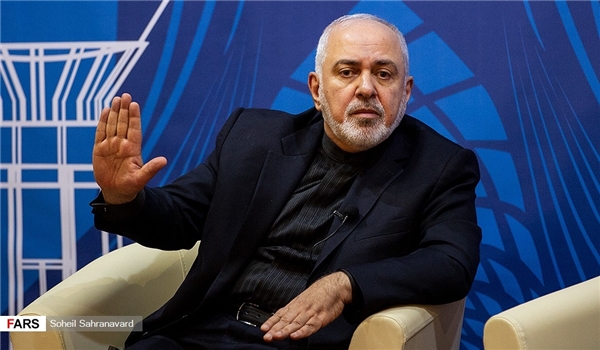
Fars News Agency | January 8, 2020
TEHRAN – Iran’s Foreign Minister Mohammad Javad Zarif said his country’s Wednesday missile attacks on Ein Al-Assad falls under the rules of the UN Charter, reminding that Iran has hit the airbase that has been used as the launchpad for assassinating Lieutenant General Qassem Soleimani.
“Iran took and concluded proportionate measures in self-defense under Article 51 of UN Charter targeting [the] base from which cowardly armed attack against our citizens and senior officials were launched,” Zarif wrote on his tweeter page on Wednesday morning.
The top diplomat said his nation “does not seek escalation or war, but will defend ourselves against any aggression”.
The IRGC Aerospace Force started heavy ballistic missile attacks on US Ein Al-Assad airbase in Southwestern Iraq near the border with Syria and a US operated airbase in Erbil in retaliation for the assassination of IRGC Qods Force Commander Lieutenant General Qassem Soleimani.
Ein Al-Assad is an airbase with a 4km runway at 188m altitude from sea levels, which is the main and the largest US airbase in Iraq.
The second IRGC reprisal attack targeted a US military base near Erbil airport in Iraqi Kurdistan Region in the second leg of “Martyr Soleimani” reprisal operation.
All flights have been cancelled at Erbil airport.
The IRGC issued a statement immediately after the attacks, declaring that it has fired tens of ground-to-ground missiles at “the airbase occupied by the terrorist and aggressive army of the United States known as Ein Al-Assad” in reprisal for the martyrdom of IRGC Qods Force Commaner Lieutenant General Qassem Soleimani.
The IRGC warned the US to avoid retaliating the Wednesday attack or else “it will face a more painful and crushing response”.
The IRGC Statement also warned “all the US allied states where the terrorist army has a base, any territory that becomes the origin of any hostile and aggressive action against the Islamic Republic of Iran in any way will be targeted”.
“We believe that the Zionist regime by no means stands aside from the criminal US regime in these crimes.”
The IRGC also called on the American nation to pressure the White House to pull their troops out of the region to avoid further damage and not allow the US rulers to endanger the lives of their military men through increasing hatred.
All Iranian underground missile towns are on alert.
The missile attack came hours before the body of General Soleimani was buried.
Lieutenant General Soleimani was martyred in a targeted assassination attack by the US drones at Baghdad International Airport early on Friday morning.
The airstrike also martyred Abu Mahdi al-Muhandis, deputy commander of Iraq’s Popular Mobilization Forces (PMF), or Hashad al-Shaabi. The two were martyred in an American airstrike that targeted their vehicle on the road to the airport.
Five Iranian and five Iraqi military personnel were martyred by missiles fired by the US drone at Baghdad International Airport.
The attack came amid tensions that started with a US attack on PMF units that killed 28 Iraqi popular forces. A day later, Iraqi people attacked the US embassy in Baghdad.
The targeted assassination attack represents a dramatic escalation by the US toward Iran after months of tensions. The tensions are rooted in Trump’s decision in May 2018 to withdraw the US from Iran’s nuclear deal with world powers, struck under his predecessor.
Canada says some troops in Iraq to be moved temporarily to Kuwait for safety
MEMO | January 7, 2020
Some of Canada’s 500 military personnel based in Iraq will be temporarily moved to Kuwait for safety reasons, the country’s top military official said on Tuesday, due to fears of possible retaliation thereafter a US drone strike on Iran’s top military commander, reports Reuters.
General Jonathan Vance, chief of the defense staff, said in a letter to military families that “the news coming out of the Middle East is alarming for many of you.”
“Some of our people will be moved temporarily from Iraq to Kuwait,” he added. Simply put, we are doing this to ensure their safety and security.”
Some of the Canadian troops are taking part in a NATO mission while others are running Operation Impact, a Canadian initiative to train soldiers in Iraq, Jordan, Lebanon, and Kuwait. In all, some 800 Canadian troops are in the Middle East.
Earlier in the day, NATO said it was moving some of its trainers out of Iraq, without giving details.
Canadian Prime Minister Justin Trudeau spoke to NATO Secretary-General Jens Stoltenberg on Monday and the two men “emphasized the importance of de-escalating tensions and the need to support security and stability in Iraq,” Trudeau’s office said in a statement.
READ ALSO:
NATO suspends training activities in Iraq after Soleimani killing
Iraq PM confirms receiving ‘signed’ US pullout letter
Press TV – January 7, 2020
Amid confusion over a reported US letter to Iraq announcing the steps its military would take to move out of Iraq, Prime Minister Adel Abdul Mahdi confirms that Baghdad has actually received “signed and translated” copies from the US Army concerning the withdrawal.
In a televised cabinet meeting on Tuesday, Abdul Mahdi clearly refuted all US claims that the letter had been sent by mistake or it had been inauthentic.
On Sunday, the Iraqi Parliament voted unanimously in favor of a bill demanding the withdrawal of all foreign military forces led by the United States from the country.
The vote came only two days after US airstrikes assassinated senior Iranian commander Lt. Gen. Qassem Soleimani, and the second-in-command of Iraq’s Popular Mobilization Units (PMU) anti-terror group, Abu Mahdi al-Muhandis in the Iraqi capital.
Earlier, various news agencies reported that Brigadier General William Seely, who oversees US Task Force Iraq, had sent a letter to the head of Iraq’s Joint Operations Command on Monday, suggesting potential withdrawal of the forces belonging to a US-led coalition, which has been operating in Iraq since 2014 under the pretext of fighting Daesh.
‘Signed and translated’
US Defense Secretary Mark Esper later denied that the US military had announced preparation for “movement out of Iraq,” and the Pentagon claimed that an unsigned draft version of the letter had been sent by mistake.
Abdel Mahdi, however, said he had received signed and translated copies at 8:00 p.m. local time (1700 GMT) on Monday.
The letter discussed “redeploying with an aim to withdraw from the country. The expressions were very clear,” he said. “It was an official letter written in such a manner,” the premier told ministers.
“It’s not a piece of paper that fell off the printer or reached us by coincidence,” he added. The letters only contained a translation mistake that the US military corrected and provided Baghdad with new versions, Abdul Mahdi noted.
The AFP said it had received a copy of the letter late Monday and verified its authenticity with both US and Iraqi officials, the agency added.
In it, Seely informed his Iraqi counterparts that American troops were preparing to leave Iraq. Seely wrote the US-led coalition would “be re-positioning forces in the coming days and weeks to prepare for onward movement.”
“In order to conduct this task, Coalition Forces are required to take certain measures to ensure that the movement out of Iraq is conducted in a safe and efficient manner,” said the letter.
It said helicopters would be travelling in and around Baghdad’s heavily-fortified Green Zone, where the US Embassy is located as part of the preparations.
The AFP, meanwhile, said its reporters could hear helicopters flying low over Baghdad throughout the night on Monday as well as Tuesday.
General Soleimani ‘martyr of Quds’: Hamas chief Haniyeh
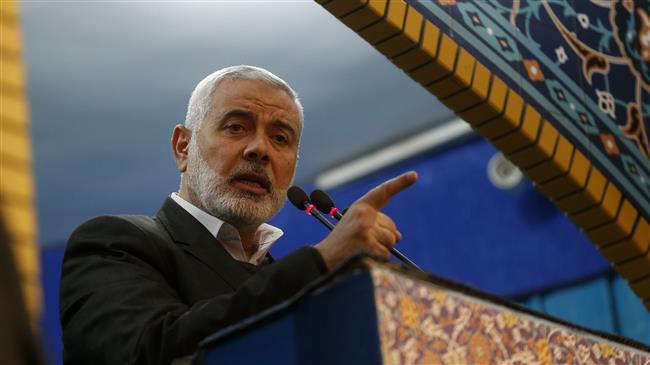
Hamas leader Ismail Haniyeh addresses a massive crowd of mourners during a funeral procession for General Qassem Soleimani in Tehran January 6, 2020. (Photo by Leader.ir)
Press TV – January 6, 2020
General Qassem Soleimani is a “martyr of Quds” for he devoted his life to supporting the Palestinian people’s struggle against Israel and his assassination by the United States is in many ways similar to crimes committed by the Israeli regime, says Hamas chief Ismail Haniyeh.
General Soleimani, commander of the Quds Force of Iran’s Islamic Revolution Guards Corps (IRGC), was assassinated in a US strike in Baghdad on Friday, alongside Abu Mahdi al-Muhandis, the deputy commander of Iraq’s pro-government Hashd al-Sha’abi forces.
A huge sea of mourners, streaming from all the adjoining streets, descended on the iconic Engelab Square in central Tehran early Monday morning and rallied to Azadi Tower in the capital’s west as they chanted “Death to America” and “Death to Israel.”
Leader of the Islamic Revolution Ayatollah Seyyed Ali Khamenei led the prayers over the general’s coffin and the remains of his companions at Tehran University, his voice cracking several times with emotion which caused the massive crowd to weep.
Speaking at the funeral procession in Tehran on Monday, Haniyeh condemned the US strike, which was personally authorized by President Donald Trump.
“We have come to Iran to condole with Leader of the Islamic Revolution Ayatollah Khamenei, the Iranian government and nation,” Haniyeh said.
“He [Gen. Soleimani] was the commander of the IRGC Quds Force and he is a martyr of Quds,” the Hamas official said.
Haniyeh also sent condolences to General Soleimani’s family and described him as one of the “flag-bearers of resistance against Zionist and American plots.”
Haniyeh said he was in Iran “to express our true and sincere feelings about a dear brother and a martyred commander – a commander who made many sacrifices for Palestine and the resistance until he achieved the position he has today.”
‘A crime similar to Zionist atrocities in Palestine’
Haniyeh said this “brutal crime” by the Americans is representative of the “criminal mentality” that is at work in the occupied Palestinian lands.
“The criminal mentality that led to Commander Soleimani’s assassination and martyrdom is the same mentality that drives the minds of the Zionist regime’s thugs, the same mentality and policy that assassinates and kills Palestinians every day,” he said.
He said Hamas owes its current prowess to General Soleimani’s wisdom. The Palestinian resistance, he said, won’t back away from combating Israel and the fight will continue “until we purge all enemies from the noble Quds.”
New Quds Force chief pledges vengeance
Brigadier General Esmail Qaani, who was named the new Quds commander by the Leader on Friday, said in a statement that Iran will no doubt avenge the assassination.
“Steps will be definitely taken” to avenge General Soleimani’s blood, which Qaani said has set in motion a series of steps that will lead to America’s expulsion from the region.
US ‘elimination’ from region only acceptable retribution
Brigadier General Amir Ali Hajizadeh, the commander of the IRGC’s Aerospace Division, echoed the remarks and said the only possible revenge for General Soleimani’s blood would be the total “elimination” of America from the region.
Launching a few missiles, destroying a base or even Trump’s death will not sufficiently avenge the blood of such a martyr, General Hajizadeh asserted, adding “the oppressed nations of the region will have to be rid of America’s evil.”
Featured Video
Trita Parsi: Israel Set a Trap for Total War in the Region
or go to
Aletho News Archives – Video-Images
From the Archive
Zionism’s Violent Legacy
By Donald Neff | Washington Report On Middle East Affairs | January 1996
On January 4, 1948, Jewish terrorists drove a truck loaded with explosives into the center of the all Arab city of Jaffa and detonated it, killing 26 and wounding around 100 Palestinian men, women and children.[1] The attack was the work of the Irgun Zvai Leumi – the “National Military Organization,” also known by the Hebrew letters Etzel – the largest Jewish terrorist group in Palestine. The Irgun was headed by Revisionist Zionist Menachem Begin and had been killing and maiming Arabs, Britons and even Jews for the previous ten years in its efforts to establish a Jewish state.
This terror campaign meant that at the core of Revisionist Zionism there existed a philosophical embrace of violence. … continue
Blog Roll
 Aletho News
- Trita Parsi: Israel Set a Trap for Total War in the Region
- Trump’s Iran war is on an Israeli leash
- Saudi oil boss issues global supply warning
- Riyadh Says Its Oil System Is Intact. The Numbers Say Otherwise.
- Trump and Netanyahu Want to “Finish the Job” on Iran
- US ‘one-sided dictation’ not Iran’s beliefs makes rational talks impossible: Baghaei
- Iran’s Next Strike May Not Explode. It Could Shut You Down /Col Doug Macgregor
- Iran: US political targets legitimate if assassinations return
- Iraq shuts key border crossing with Iran under US pressure: Report
- Undersea Internet cables could be targeted in retaliation for attacks on Iran: IRGC deputy chief
- If Americans Knew
- The Israel Lobby’s Changing Fortunes
- AIPAC has become such a political liability that it’s shifting to a more “nimble” approach to buying politicians
- At least 160 Israeli settler attacks in 2 weeks
- Will Gaza’s Ancient Christian Community Disappear Forever?
- Israel’s vision of regional security rests on keeping Arab states weak
- Heidi Levine recounts how Palestinian youths helped save her in settler attack
- DAILY UPDATE: Latest essential news on Palestine, Israel, & region
- Trump’s Intensifying Sabotage of the ICC, for Israel’s Sake
- Israeli military detain US and UK volunteers in West Bank including Democratic NY politician Brad Lander
- Americans at National Conservatism Conference held in Israel this year criticize Israel
- No Tricks Zone
- E-Cars Reduce CO2 Emissions By Only 41% Compared To Internal Combustion Engine Vehicles
- Predictions Made By Renowned Climate Professor Over Past Decades Have Been Proven To Be Poor
- New Study Suggests Large Regions Of The Pacific Ocean Have Been Cooling For The Last 80 Years
- Germany’s Green Energy Debacle: High Energy Costs Force Kahla Porzellan to Close After 182 Years!
- New Study: 50 Years Of The Most Aggressive ‘Net Zero’ Policies Can Only Affect The Global Climate By 0.03°C
- US September “Heat” Was No Record…Many Records Set Decades Ago
- Latest European Green Energy Debacle; Portugal’s Largest Flagship Solar Park Insolvent!
- Green Energy Debacle: German Expert Professor Fritz Vahrenholt Warns Of Severe Economic And Social Consequences
- Two More Paleo Reconstructions Affirm Meters-Higher Sea Levels Across Ireland, Brazil 7000-6000 Years Ago
- New Study: Earth And Venus Surface Warmth Largely Explained By Convection And Lapse Rate, Not CO2 Or Radiation

