Iraq PM confirms receiving ‘signed’ US pullout letter
Press TV – January 7, 2020
Amid confusion over a reported US letter to Iraq announcing the steps its military would take to move out of Iraq, Prime Minister Adel Abdul Mahdi confirms that Baghdad has actually received “signed and translated” copies from the US Army concerning the withdrawal.
In a televised cabinet meeting on Tuesday, Abdul Mahdi clearly refuted all US claims that the letter had been sent by mistake or it had been inauthentic.
On Sunday, the Iraqi Parliament voted unanimously in favor of a bill demanding the withdrawal of all foreign military forces led by the United States from the country.
The vote came only two days after US airstrikes assassinated senior Iranian commander Lt. Gen. Qassem Soleimani, and the second-in-command of Iraq’s Popular Mobilization Units (PMU) anti-terror group, Abu Mahdi al-Muhandis in the Iraqi capital.
Earlier, various news agencies reported that Brigadier General William Seely, who oversees US Task Force Iraq, had sent a letter to the head of Iraq’s Joint Operations Command on Monday, suggesting potential withdrawal of the forces belonging to a US-led coalition, which has been operating in Iraq since 2014 under the pretext of fighting Daesh.
‘Signed and translated’
US Defense Secretary Mark Esper later denied that the US military had announced preparation for “movement out of Iraq,” and the Pentagon claimed that an unsigned draft version of the letter had been sent by mistake.
Abdel Mahdi, however, said he had received signed and translated copies at 8:00 p.m. local time (1700 GMT) on Monday.
The letter discussed “redeploying with an aim to withdraw from the country. The expressions were very clear,” he said. “It was an official letter written in such a manner,” the premier told ministers.
“It’s not a piece of paper that fell off the printer or reached us by coincidence,” he added. The letters only contained a translation mistake that the US military corrected and provided Baghdad with new versions, Abdul Mahdi noted.
The AFP said it had received a copy of the letter late Monday and verified its authenticity with both US and Iraqi officials, the agency added.
In it, Seely informed his Iraqi counterparts that American troops were preparing to leave Iraq. Seely wrote the US-led coalition would “be re-positioning forces in the coming days and weeks to prepare for onward movement.”
“In order to conduct this task, Coalition Forces are required to take certain measures to ensure that the movement out of Iraq is conducted in a safe and efficient manner,” said the letter.
It said helicopters would be travelling in and around Baghdad’s heavily-fortified Green Zone, where the US Embassy is located as part of the preparations.
The AFP, meanwhile, said its reporters could hear helicopters flying low over Baghdad throughout the night on Monday as well as Tuesday.
General Soleimani ‘martyr of Quds’: Hamas chief Haniyeh
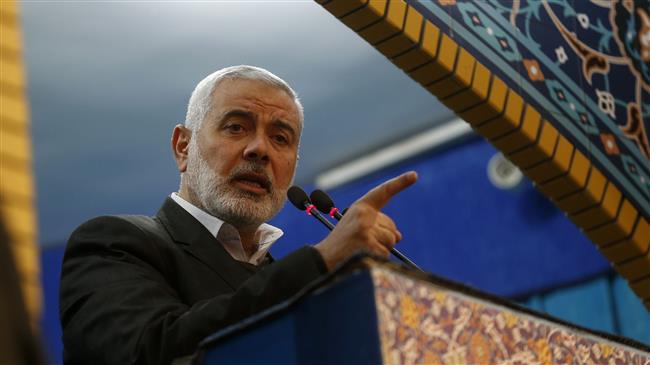
Hamas leader Ismail Haniyeh addresses a massive crowd of mourners during a funeral procession for General Qassem Soleimani in Tehran January 6, 2020. (Photo by Leader.ir)
Press TV – January 6, 2020
General Qassem Soleimani is a “martyr of Quds” for he devoted his life to supporting the Palestinian people’s struggle against Israel and his assassination by the United States is in many ways similar to crimes committed by the Israeli regime, says Hamas chief Ismail Haniyeh.
General Soleimani, commander of the Quds Force of Iran’s Islamic Revolution Guards Corps (IRGC), was assassinated in a US strike in Baghdad on Friday, alongside Abu Mahdi al-Muhandis, the deputy commander of Iraq’s pro-government Hashd al-Sha’abi forces.
A huge sea of mourners, streaming from all the adjoining streets, descended on the iconic Engelab Square in central Tehran early Monday morning and rallied to Azadi Tower in the capital’s west as they chanted “Death to America” and “Death to Israel.”
Leader of the Islamic Revolution Ayatollah Seyyed Ali Khamenei led the prayers over the general’s coffin and the remains of his companions at Tehran University, his voice cracking several times with emotion which caused the massive crowd to weep.
Speaking at the funeral procession in Tehran on Monday, Haniyeh condemned the US strike, which was personally authorized by President Donald Trump.
“We have come to Iran to condole with Leader of the Islamic Revolution Ayatollah Khamenei, the Iranian government and nation,” Haniyeh said.
“He [Gen. Soleimani] was the commander of the IRGC Quds Force and he is a martyr of Quds,” the Hamas official said.
Haniyeh also sent condolences to General Soleimani’s family and described him as one of the “flag-bearers of resistance against Zionist and American plots.”
Haniyeh said he was in Iran “to express our true and sincere feelings about a dear brother and a martyred commander – a commander who made many sacrifices for Palestine and the resistance until he achieved the position he has today.”
‘A crime similar to Zionist atrocities in Palestine’
Haniyeh said this “brutal crime” by the Americans is representative of the “criminal mentality” that is at work in the occupied Palestinian lands.
“The criminal mentality that led to Commander Soleimani’s assassination and martyrdom is the same mentality that drives the minds of the Zionist regime’s thugs, the same mentality and policy that assassinates and kills Palestinians every day,” he said.
He said Hamas owes its current prowess to General Soleimani’s wisdom. The Palestinian resistance, he said, won’t back away from combating Israel and the fight will continue “until we purge all enemies from the noble Quds.”
New Quds Force chief pledges vengeance
Brigadier General Esmail Qaani, who was named the new Quds commander by the Leader on Friday, said in a statement that Iran will no doubt avenge the assassination.
“Steps will be definitely taken” to avenge General Soleimani’s blood, which Qaani said has set in motion a series of steps that will lead to America’s expulsion from the region.
US ‘elimination’ from region only acceptable retribution
Brigadier General Amir Ali Hajizadeh, the commander of the IRGC’s Aerospace Division, echoed the remarks and said the only possible revenge for General Soleimani’s blood would be the total “elimination” of America from the region.
Launching a few missiles, destroying a base or even Trump’s death will not sufficiently avenge the blood of such a martyr, General Hajizadeh asserted, adding “the oppressed nations of the region will have to be rid of America’s evil.”
US-Led Coalition Tells Baghdad It Will ‘Move Out’ of Iraq – Official Letter
Sputnik – 06.01.2020
In a Monday letter to Iraqi military leaders, the US-led coalition in Iraq announced it was preparing to “move out” of the country out of respect for Iraqi sovereignty.
Following approval of a non-binding resolution by Iraq’s parliament calling for US forces to leave the country, US military commanders announced they were drawing up preparatory plans for their departure. A Pentagon spokesperson could not immediately confirm the authenticity of the letter to Reuters.
“We respect your sovereign decision to order our departure,” the letter says, according to Reuters. US forces will re-position themselves over the coming days and weeks in preparation for the move, the letter states.
“In due deference to the sovereignty of the Republic of Iraq, and as requested by the Iraqi Parliament and the Prime Minister, CJTF-OIR [Combined Joint Task Force – Operation Inherent Resolve] will be repositioning forces over the course of the coming days and weeks to prepare for onward movement,” states the letter, addressed to Iraqi Lt. Gen. Abdul Amir and signed by US Marine Corps Brig. Gen. William H. Seely III.
The lawmakers’ request comes on the heels of a January 3 drone strike at Baghdad International Airport in which US forces killed Iranian Quds Force commander Qassem Soleimani as well as the leader of Iraq’s Popular Mobilization Forces, Abu Mahdi al-Muhandis. The two commanders helped lead the fight against Daesh in the 2014-17 Iraqi Civil War that saw the terrorist group expelled from the country. At its height, Daesh controlled significant amounts of northern Iraq, including its third-largest city of Mosul, and was advancing on Baghdad.
“In order to conduct this task, coalition forces are required to take certain measures to ensure that the movement out of Iraq is conducted in a safe and efficient manner,” the letter continues. “During this time, there will be an increase in helicopter travel in and around the International Zone (IZ) of Baghdad. This increased traffic will include CH-47, UH-60 and AH-64 security escort helicopters. Coalition forces will take appropriate measures to minimize and mitigate the disturbance to the public. In addition, we will conduct these operations during house of darkness to help alleviate any perception that we may be bringing more Coalition forces into the IZ.”
“As we begin implementing this next phase of operations, I want to reiterate the value of our friendship and partnership. We respect your sovereign decision to order our departure.”
Contradictory Statements
The news comes after US President Donald Trump and Secretary of State Mike Pompeo snubbed the idea of leaving Iraq, where US forces have been stationed since the March 2003 invasion that overthrew Iraqi President Saddam Hussein.
“We have a very extraordinarily expensive airbase that’s there. It cost billions of dollars to build. Long before my time We’re not leaving unless they pay us back for it,” Trump said on Sunday. “We will charge them sanctions like they’ve never seen before ever. It’ll make Iranian sanctions look somewhat tame.”
“The prime minister is the acting prime minister,” Pompeo said on Fox News on Sunday, speaking of Iraqi Prime Minister Adil Abdul-Mahdi. “He’s under enormous threats from the very Iranian leadership that it is that we are pushing back against. We are confident that the Iraqi people want the United States to continue to be there.”
Supreme Leader Khamenei’s Adviser Says Iran Will Target US ‘Military Sites’ – Report
Sputnik – January 5, 2020
The world waits in anticipation after Iran pledged to respond with a “vengeance” to the killing of top ranking General Qasem Soleimani in a US airstrike on Friday. The killing came after the US claimed that the Iranian commander was going to put US lives at risk in a series of planned attacks.
Iran will respond to the killing of General Qasem Soleimani in a US drone strike by targeting “military sites”, an advisor to Iranian Supreme Leader Ayatollah Khamenei’s said on Sunday.
While speaking to CNN former Iranian defence minister Hossein Dehghan said: “The response for sure will be military and against military sites”.
Dehghan reiterated the position that Iran “will not be seeking war”.
“It was America that has started the war. Therefore, they should accept appropriate reactions to their actions. The only thing that can end this period of war is for the Americans to receive a blow that is equal to the blow they have inflicted,” he told the network. “Afterward they should not seek a new cycle.”
Dehghan also used the opportunity to respond to a threat by US President Donald Trump on Saturday night that any Iranian retaliation would be met by the targeting of 52 unspecified Iranian sites, describing them as “ridiculous and absurd.”
Many of the areas which the US plans to target may be culturally important or UNESCO protected sights.
“Trump doesn’t know international law. He doesn’t recognize U.N. resolutions either. Basically, he is a veritable gangster and a gambler. He is no politician he has no mental stability,” Dehghan told CNN, citing United Nations Resolution 2347, which makes illegal the unlawful destruction of cultural heritage under international, which the US itself is a signatory to since 2017.
Dehghan warned that if Trump were to carry out his threat: “for sure no American military staff, no American political center, no American military base, no American vessel will be safe. And they are accessible to us.”
While speaking to ABC on Sunday, Secretary of State Mike Pompeo softened the presidents remarks claiming that the US would “act lawfully”.
The attack which killed Soleimani in Baghdad was approved by Trump in Mar-a-Lago last Thursday.
The operation took place in Baghdad in the early hours of Friday as Soleimani and as well as Iraqi officials of Iranian-backed militias were leaving Baghdad airport.
Several missiles were launched from a drone killing at least seven people including Soleimani and his comrades.
Iran has pledged to respond to the attack, vowing “harsh vengeance” against the US for the liquidation of one of their top commanders and beloved officials.
“Harsh vengeance awaits the criminals that got his and other martyrs’ blood on their evil hands in last night’s incident”, said Iran’s supreme leader in a statement following the event on Friday.
US officials claim that it was a preemptive strike in response to planned attacks by Soleimani on American targets but have yet to provide any details.
The strike followed a storming of the UN embassy in Iraqi after US airstrikes were launched against Iranian-backed militia groups in Iran which killed 25 people.
Iraqi parliament passes resolution asking government to cancel request for assistance from US-led coalition
RT | January 5, 2020
Iraqi parliament has voted to have foreign troops removed from the country, heeding a call from its caretaker prime minister. The move comes after US assassination of a top Iranian general and a commander of Iraqi militia.
The resolution, which was passed anonymously, instructs the government to cancel a request for military assistance to the US-led coalition, which was issued in response to the rise of Islamic State (IS, formerly ISIS). With IS supposedly defeated, Iraq will not need foreign troops to fight the jihadists and can close its airspace to coalition aircraft.
“The Iraqi government must work to end the presence of any foreign troops on Iraqi soil and prohibit them from using its land, airspace or water for any reason.”
According to Press TV, some Western military presence may remain for training purposes. The resolution says Iraqi military leadership has to report the number of foreign instructors that are necessary for Iraqi national security.
At the same time, the Iraqi Foreign Ministry said that Baghdad had turned to the UN Security Council with complaints about US violations of its sovereignty.
Speaking at an emergency parliament session on Sunday, Iraq’s caretaker PM said the American side notified the Iraqi military about the planned airstrike minutes before it was carried out. He stressed that his government denied Washington permission to continue with the operation.
“Despite the internal and external difficulties that we might face, it remains best for Iraq on principle and practically.”
Qassem Soleimani, the commander of Iran’s Quds Force, and Abu Mahdi al-Muhandis, the deputy commander of Iraq’s Popular Mobilization Force, were killed by a drone strike as their convoy was leaving Baghdad International Airport on Friday morning.
The interim prime minister said after the incident that it was clear it was in the interest of both the US and Iraq to end the presence of foreign forces on Iraqi soil.
Mahdi said Soleimani was on his way to meet him when the US airstrike killed the Iranian general.
Influential Iraqi cleric Muqtada al-Sadr stated in a letter that Iraq should go further and shut down the US embassy.
Washington claims the assassination of Soleimani was an act of self-defense justified by his planning of attacks on American citizens. Tehran called it international terrorism and vowed to avenge the popular military officer.
In the wake of the attack the US advised all American civilians to leave Iraq. The US-led coalition troops in Iraq have also suspended all training operations and hunkered down at fortified bases, bracing for retaliatory strikes.
170 Iraqi lawmakers sign draft bill to expel US military forces from country
Press TV – January 5, 2020
A total of 170 Iraqi lawmakers have signed a draft bill, demanding the withdrawal of US military forces from the country following the assassination of Iran’s top military commander, Lt. Gen. Qassem Soleimani, and the second-in-command of Iraq’s Popular Mobilization Units (PMU), Abu Mahdi al-Muhandis.
On Sunday, the legislators used an extraordinary parliamentary session to push for a vote on a resolution requiring the government to press Washington to withdraw US troops from Iraq.
The lawmakers, citing Articles 59 and 109 of the Constitution and in line with their national and regulatory responsibilities as representatives to safeguard the security and sovereignty of Iraq, singed a four-point draft bill as follows:
Firstly, the central government in Baghdad is obliged to cancel its request to the US-led military coalition, which was purportedly fighting the Daesh Takfiri terrorist on the grounds, now that military operations have ended in the country, and victory over Daesh has been achieved. The Iraqi government should therefore put an end to the presence of any foreign troops and prevent the use of the Iraqi airspace.
Secondly, the government and the commander-in-chief of the armed forces must announce the number of foreign trainers they need, along with their locations, responsibilities, and duration of their contracts.
Thirdly, the Iraqi foreign minister, on behalf of the government, must turn to the United Nations and the Security Council to file a complaint against the United States for violations of the Iraqi sovereignty and security.
Finally, the plan comes into force once it obtains the parliamentary approval.
On Saturday, the leader of a powerful political coalition in Iraq’s parliament said US forces will be driven out of the Iraqi territory following the vicious, cowardly US operation.
“We offer our condolences to the adherents of Hashd al-Sha’abi and all Iraqis over the martyrdom of Abu Mahdi al-Muhandis, General Soleimani and a number of young valiant men. This is the path of martyrdom, and we hereby declare that we will continue to tread it. We have no reservations whatsoever in this regard,” Hadi al-Ameri, who is the head of the Fatah (Conquest) Alliance, told reporters as he participated in the funeral ceremony for the fallen heroes in the Iraqi capital, Baghdad, on Saturday.
“We will defeat Americans and drive them out, as we did earlier in the face of Daesh. We will expel Americans right before Iraqis’ eyes as they will be frustrated and humiliated.”
“We will press ahead with this struggle. We don’t have any option but to fully restore Iraq’s sovereignty,” added Ameri, who is also the secretary general of the Badr Organization.
Back on August 27 last year, the Fatah Alliance called for the withdrawal of US troops from Iraq, following a series of airstrikes targeting Hashd al-Sha’abi forces in the country that have been blamed on Israel.
The parliamentary bloc said it held the United States fully responsible for the Israeli act of aggression, “which we consider to be a declaration of war on Iraq and its people.”
The US, backed by the United Kingdom, invaded Iraq in 2003 claiming that the former regime of Saddam Hussein possessed weapons of mass destruction.
No such weapons, however, were ever found.
The invaders withdrew from Iraq, after nearly nine years of a military campaign that cost tens of thousands of Iraqi lives.
Leading a new coalition of its allies, the United States returned to Iraq in 2014, when Daesh unleashed a campaign of destruction in the Arab country. Widespread reports, however, said the Washington-led operations largely spared the terrorists and led, instead, to civilian deaths and inflicted damage on the Iraqi infrastructure.
Iraq’s army troops, backed by volunteer Hashd al-Sha’abi forces, managed to liberate all Daesh-held areas thanks to military advisory assistance from neighboring Iran.
Baghdad declared the end of the anti-Daesh campaign in late 2017.
Iran slams US ‘audacity’ to blame it for Baghdad embassy storming
RT | December 31, 2019
Iran has flatly rejected US accusations that it is behind violent protests which broke out at the American embassy in Baghdad in response to US airstrikes on militia groups in Iraq.
In a tweet on Tuesday, US President Donald Trump accused Iran of “orchestrating an attack on the US Embassy in Iraq,” and said Tehran will be held “fully responsible.” Trump also called on “millions” of Iraqis to resist Iran.
Iran hit back at the “audacity” of Washington to blame Tehran for the attacks in a statement posted by the Foreign Ministry.
“America has the surprising audacity of attributing to Iran the protests of the Iraqi people against (Washington’s) savage killing of at least 25 Iraqis…,” it said.
The US hit five Kataib Hezbollah targets in Iraq and Syria last week in retaliation for an attack on a US coalition base near Kirkuk, which no group took responsibility for, but which Washington blamed on the Iranian-backed militia.
Iraqi Prime Minister Adel Abdul Mahdi condemned the airstrikes, calling them a violation of Iraq’s sovereignty and said there could be “grave consequences.” Protesters then stormed the US embassy compound on Tuesday, shouting “death to America” and waving Hezbollah flags.
Washington announced earlier Tuesday that it was sending reinforcements to the Baghdad embassy, in what Defense Secretary Mark Esper said were measures “to ensure our right of self-defense.”
Also on rt.com:
‘This is your time’: Trump calls for Iraqis to rise up against Iran
Iraq’s Sadr ready to work with Iran-backed PMF to oust US
MEMO | December 31, 2019
Iraq’s Shia cleric Muqtada Al-Sadr has declared that he is willing to work with the Iranian-supported Popular Mobilisation Forces (Hashd Al-Shaabi) paramilitary forces – his political rivals – to end the American military presence in Iraq.
He made the comments yesterday after the US targeted five sites in Iraq and Syria and killed 30 in in retaliation for the death of an American “contractor” at an Iraqi military base in Kirkuk in a rocket attack, which Washington blamed on PMF member Kataib Hezbollah (KH).
Sadr believes in ousting the US troops from Iraq through political and legal means, however will “take other actions” with his rivals should these not work. The cleric has portrayed himself as a nationalist against both Iranian and American interference in Iraq. He also called on Iraqis to “avoid irresponsible actions” that can be used to justify further attacks on the country.
Sadr’s loyalist militia, the Mahdi Army, was notable in its fierce resistance against US occupation forces in the Shia dominated south, following the unilateral American invasion in 2003.
Outgoing Iraqi Prime Minister, who is serving as caretaker, Adil Abdel-Mahdi condemned the actions as a violation of Iraqi sovereignty, especially as the PMF are integrated into the country’s armed forces under his direct command and were established to combat Daesh.
Iraq’s top Shia cleric, Ayatollah Sayyid Ali Sistani, whose fatwa against Daesh led to the establishment of the PMF, also condemned the air strikes as a “criminal aggression” against “official Iraqi forces”. Sistani added that the Iraqi authorities are “entitled” to deal with the attacks and to take action to prevent them from re-occurring.
Earlier today, protestors stormed outside the US Embassy in the Green Zone, some carrying flags of the KH and PMF. Some observers have noted how anti-government protestors have been unsuccessful for weeks in entering the Green Zone after being prevented by Iraqi security forces, but there have been no attempts to hold back those protesting against the latest American attack on the PMF, representing a possible dangerous situation for Western diplomats.
US envoy reportedly evacuated as Baghdad protesters attempt to storm embassy amid fury over air strikes
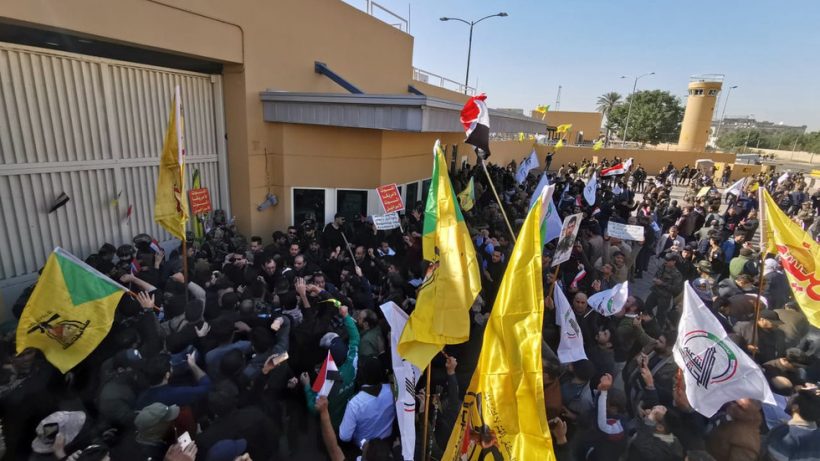
Protesters condemn air strikes on bases belonging to Hashd al-Shaabi paramilitary forces, outside of the U.S. Embassy in Baghdad, Iraq December 31, 2019. © REUTERS/Thaier al-Sudani
RT | December 31, 2019
Thousands of protesters, angry over recent airstrikes targeting Hezbollah, have marched on the US embassy in Baghdad, reportedly forcing the US envoy to flee the diplomatic compound.
Protesters were seen waving Hezbollah flags and chanting anti-US slogans in the Iraqi capital on Tuesday. According to reports, demonstrators were able to gain access to parts of the heavily fortified Green Zone, and attempted to break into the US Embassy. Security guards were said to have retreated into the US government building. A correspondent for the BBC noted that it appeared that the protesters were able to pass several checkpoints without being resisted by security personnel.
The US ambassador to Iraq, Matthew H. Tueller, was evacuated due to the unrest, Reuters reported, citing two Iraqi Foreign Ministry officials.
One video shows parts of the US compound being set on fire.
Earlier, protesters were filmed burning US and Israeli flags.
The unrest comes after US fighter jets struck three Kataib Hezbollah targets in Qaim, Iraq, and two in Syria. The Iran-allied Shiite militia group said that at least 25 of their fighters were killed and nearly three dozen injured in the strikes. The Pentagon accused the group of carrying out attacks on Iraqi bases that host US-led coalition forces stationed in the country.
Iraqi Prime Minister Adel Abdul Mahdi strongly condemned the airstrikes, warning that the attacks would have “grave consequences.” Tehran also condemned the strikes and denied any involvement in attacks on US forces in Iraq.
Bolivian Vassals Are Merely Aping Their Imperial Masters
By Stephen Karganovic | Strategic Culture Foundation | December 30, 2019
A serious diplomatic row with significant international law implications has erupted between the government of Mexico and the Bolivian coup regime installed by foreign interests in November 2019. Readers will recall that the legal President of Bolivia, Evo Morales, notwithstanding his overwhelming electoral victory in October 2019, was made to resign shortly thereafter under the duress of traitorous elements of the police and military apparatus who were bribed by the ruling imperial power in the Western hemisphere and directed to remove him. The coup was, as usual in these situations, justified by alleged electoral fraud. Morales was replaced by a racist and quasi-fascist de facto regime. The President initially received political asylum in Mexico and since then has moved to Argentina, where he also was granted refuge. Several of his cabinet officials and parliamentarians of his party, Movement Toward Socialism (MAS), took refuge in the Mexican embassy in La Paz, where they still remain.
The coup regime, fearing a groundswell of popular support for Morales and his party, and seeking to detain potential candidates from the MAS leadership who might run in the new elections promised to take place a few months from now, demanded that Mexico hand over the officials (about 20 at the end of November) who had taken refuge in its embassy. They are being pursued on specious charges of “terrorism and corruption,” also fully consistent with the color revolution playbook. The intentions of the usurpers toward the officials of the legitimate government are rather plainly reflected in the ominous terminology they used to denounce Argentina for granting refuge to Morales and Mexico for doing the same for officials who were left behind in Bolivia. According to Roxana Lizarraga, the regime “minister of communication,” both countries “have become a refuge for criminals.” When the Mexican government refused to comply, coup regime forces proceeded to encircle the Mexican diplomatic compound in La Paz and to interfere with its normal operation, brazenly disregarding clear prescriptions of the Vienna Convention, which enshrines the absolute inviolability of diplomatic premises. Mexican President Lopez Obrador very pointedly condemned the conduct of the lawless Bolivian coup authorities as “something that it would not have occurred even to Pinochet to do.”
In Latin American terms, it should be pointed out, the terminology to which the Mexican President resorted is anything but hyperbole. Latin American countries have a long history of coups and revolutions and, quite apart from the prescriptions of the relatively recently adopted (1969) Vienna Convention, they have a lengthy tradition of respecting each other’s diplomatic premises as places of refuge where today’s rulers may end up seeking shelter tomorrow. The siege of Mexico’s diplomatic mission in La Paz is therefore doubly obnoxious. It is a crude infringement of a positive norm of international law, but at the same time also violates a deeply ingrained Latin American tradition.
At a press conference on December 26, Mexican Foreign Minister Marcelo Ebrard disclosed that at least 29 countries, most from Latin America but also member states of the European Union, have contacted the Mexican diplomatic mission in La Paz to express their concern for its safety and support for its inviolability. What followed was a truly bombshell announcement of the Mexican Foreign Minister that in response to the abuse and illegal conduct of Bolivian coup regime forces Mexico will file suit at the International Court of Justice to seek a cease and desist order against the Bolivian authorities (also here). To which the coup regime “interior minister” Arturo Murillo laconically responded: “See you in court.”
But it so happens that Murillo’s insolence is not entirely baseless. He is an official of an illegally installed puppet regime, and he is also a sharp student and very mindful of the atrocious example disseminated by his puppet-masters. He is following their obnoxious model to the smallest detail.
Murrillo’s nonchalance is quite understandable, for instance, in light of the 1986 ICJ case where tiny Nicaragua squared off against Murillo’s imperial puppet masters, who were charged with supporting a seditious proxy army and mining Nicaragua’s harbors. Amazingly, the Court ruled in Nicaragua’s favor and even awarded it damages. But the imperial cowboys simply brushed it off on the pretext that they had no obligation to abide by judgments that were “contrary to [their] national interest.” That was effectively the end of the matter, and who can blame Murillo today for being unconvinced that the breach of international law complained of by Mexico will ever be punished, regardless of the way the International Court of Justice might rule in the Mexican lawsuit?
Is there any particular need to recall a more recent outrage in London? Independent journalist Julian Assange was unceremoniously seized by the British police within the premises of the Ecuadorian embassy, with the full connivance of the Ecuadorian puppet regime, and in complete disregard of not just the fact that Assange was a political refugee fully protected by the Vienna Convention, but also of his status as an Ecuadorian citizen?
But for the ultimate model of these lawless operations, we need go no further than the sarcastically named “Operation Nifty Package,” by which Panamanian leader Manuel Noriega was extracted from the Vatican Nunciature in Panama City, where he had taken refuge following the armed invasion of his country by Murillo’s scofflaw imperial mentors. Just like their Bolivian acolytes, the invaders surrounded the Vatican diplomatic mission, resolving to “smoke out” their prey by making life inside it unbearable both for him and the diplomatic staff: “The plan involved music, mostly heavy metal and rock, with a few ballads thrown in. It was blasted on loudspeakers, at deafening volumes, around the clock.” A “nifty package,” indeed, and so in keeping with the dignity of a hyperpower, which impressionable Bolivian janissaries have now updated with dozens of drones intimidatingly overflying the Mexican compound in La Paz and armed goons harassing Mexican diplomatic personnel, including the ambassador, who venture outside.
The emerging pattern of lawlessness in virtually every segment of international affairs is acutely exemplified in this truly postmodern diplomatic row.
NATO: General Delawarde assesses final London Declaration

By Alexandra Kamyshanova | December 30, 2019
General Dominique Delawarde, the former head of the “Situation – Intelligence – Electronic Warfare 19” section at the joint operational planning staff and a cyberwarfare expert, provides insight into the nine articles of the final London Declaration, published on the NATO website.
Question: Can members of the Alliance really “reaffirm their adherence to the purposes and principles of the United Nations Charter”, as stated in Article 1?
Answer: A simple observation of how history has unfolded after the Cold War demonstrates that two important elements of Article 1 are erroneous, if not flat-out false. Since 1991, NATO actions have been aimed not at preventing conflicts and maintaining peace, but exactly the opposite. They do cause them themselves by their never-ending destructive interference in the affairs of sovereign countries. Over a quarter-century (1995-2019), its member states dropped more than a million bombs on our planet, which entailed, whether overtly or covertly, the death of several million people. The only objective was to establish hegemony over the “international community”. Alliance members cannot “reaffirm their adherence to the purposes and principles of the United Nations Charter” by violating or ignoring international rules established by the United Nations. The illegal occupation of part of the Syrian territory serves as evidence of this.
Q: Can we say that the funding efforts outlined in Article 2 fail to reflect the true situation?
A: This statement about efforts to increase funding for NATO members’ defense capabilities is virtually misleading. It loses sight of the fact that defense spending has halved since 1991 (peace dividends) and does not specify any deadline for reaching the 2% target. Finally, this statement is unfeasible and won’t be implemented in the short or medium term, given the economic and social complexities faced by all the key NATO member states. So this is mere verbiage.
Besides, NATO will not be able to compete with the SCO (Shanghai Cooperation Organization), because defense spending parity in PPP (purchasing power parity) dollars has almost been reached between NATO and the SCO; the cumulative defense budget of NATO member states accounts for 1000 billion dollars (PPP), and that of SCO member states is going to reach parity with the NATO budget in 2020 already. To date, the annual growth rate of defense spending in SCO countries is two to three times higher as compared to NATO countries. The SCO has a much wider scope for expansion (major countries like Iran and perhaps Turkey, why not) than NATO (North Macedonia, Georgia, Bosnia). Speaking of Turkey, an untrained eye should know that the SCO-NATO dual membership is not prohibited, since in 2005, the United States itself applied to join the SCO as nonmember state (the application was unanimously rejected by SCO members, guess why).
Q: Should we consider Russia as a threat, as stated in Article 3?
A: This list of universal threats and perpetual accusations against Russia, which is presented as a source of aggression and threat, are familiar pretexts to justify the very existence of NATO. As for anti-Russian statements, NATO is clearly resorting to an accusatory inversion. It is NATO members, not Russia, who have dropped over a million bombs and caused the death of several million people since 1995, and it is them who violate UN rules by continuing the military occupation of part of the Syrian territory. This is also the case of the coup organized in Ukraine, the division of the former Yugoslavia, and the constant advancing to the borders of Russia, which is in total disregard of the promises made to Gorbachev.
As for terrorism and instability observed beyond our borders, the Alliance forgets to remind that both arise from their omnidirectional interference in the affairs of sovereign states at the slightest pretext. They arise from their unlawful bombings, humiliations at Abu Ghraib and Guantanamo, the replacement of strong secular leaders with the chaos we observe today, and the wars waged under false pretexts (Serbia, Iraq, Libya, Syria). Migration is a blowback.
It should be recognized that state and non-state actors shattering the international order are mostly representatives of the West and NATO. The April 14, 2018 joint strike on Syria by the United States, France and the United Kingdom is yet another proof of this. Anglo-Saxon non-governmental NGOs, ostensibly independent but actually used by government agencies and / or their American sponsors (Soros), are wreaking havoc by promoting North Atlantic strategies. They use various useful idiots for their own purposes, who may inherently have good intentions. Finally, the main and only known cyber threat uncovered by Snowden, Assange and Manning is America, not Russia or China. The United States has installed wiretaps of all the political and economic Western leaders (NSA) and has pretty reliable bargaining chips to blackmail our heads of state and seize our businesses.
Q: Do you agree with the statement of Article 4: “NATO is a defensive alliance and poses no threat to any country”?
A: You need to ask the countries that have been bombed for 25 years.
The Alliance does not act “prudently and responsibly” in relation to Russia: the expansion to the East which runs counter to NATO promises of 1990, the coup in Ukraine, the unilateral withdrawal of the United States from the INF and other treaties, including the Iranian nuclear program. They pretend to be combating terrorism, even though many of its elements are funded by the West itself or some of its Arab allies – this is simply ridiculous. NATO members take us for perfect fools.
Q: What do you think about the phrasing of Article 5 that NATO seeks to “work to increase security for all, deepen political dialogue and cooperation with the United Nations”?
A: NATO provokes chaos, migration crisis, surge of terrorism and anti-Western hatred that have now pummelled Europe. You cannot drop a million bombs over 25 years on the countries that have never attacked a single member of the Alliance. Think about the five thousand soldiers from 11 NATO member states who died for nothing in Iraq, in a deceitful war unleashed in 2003. It is worth paying tribute to the memory of those who fell victim to American aggression supported by 10 European NATO member states that agreed to take part.
Q: What does NATO mean in Article 6 when mentioning “the resilience of our societies”, “our energy security” and “the need to rely on secure and resilient systems”?
A: This reflects the current US obsession: “to increase the resilience of our energy security” means ” NATO’s opposition to the construction of the Nord Stream 2 gas pipeline, to spite the vicious Russians and to the benefit of the goodу American gas market.” “Security of our telecommunications, including 5G” means “the rejection of the Chinese Huawei technology, to the detriment of the Chinese and in favor of American technologies.” The US has long been spying on our political and economic leaders’ telecommunications, while accusing China of “intending” to spy on the alliance members by means of its 5G system.
China poses “challenges that we need to address together”. So, NATO is embarking on a path of confronting China, which is beneficial to the United States alone.
Q: What is meant by “strengthening NATO’s political dimension” referred to in Article 7?
A: NATO’s ten-year strategy is now being updated, and the “relevant expertise” will be that of American and European neoconservatives. The essence of Article 7 is discernable: “strengthening NATO’s political dimension”. Since the end of the Cold War, the 1949 “military-defensive” alliance has been increasingly turning into a political and offensive one, often to accommodate certain economic interests.
Q: What do you think Article 8 is remarkable for?
A: For postponing the revision of the strategic concept from the year 2020 to 2021. Trump’s unpredictability scares Europe, with its people hopeful that he won’t be re-elected and that another President will bring the crisis-stricken Alliance back into the ranks.
Q: Is it serious that Article 9 stresses NATO’s greater protection for the peoples of its member states?
A: NATO has been sowing too much hatred and chaos on the planet since 1991 to be a security factor in Europe, and it has been so since the end of the Cold War. The North Atlantic Charter does not present NATO as an instrument of American hegemony. Therefore, the dissolution of NATO, or at least the withdrawal of France would be the best decision at the moment, unless NATO returns to the original principles of a defensive alliance with its activities covering only the territories of its member states, and ceases to invent new threats to serve as false pretexts to justify wars and intervention aimed at maintaining Western hegemony on the planet.
Q: What conclusion would you draw?
A: It is not just about a “brain death” in NATO. Can their solidarity survive the global economic crisis that experts predict, and the inevitable subsequent upheaval in the hierarchy of forces? Hardly probable. The prosperity of the West and the financing of its armed forces rest today on a whole ocean of debts.
The future will belong to those who keep ahead of the game. A long-term vision is needed to pursue foreign policy. Russia, China and India have long ago grasped this.
Featured Video

Benoit Paré: OSCE Whistleblower: The Ukraine War – Narratives vs. Reality
or go to
Aletho News Archives – Video-Images
Book Excerpt
How CIA used Ukraine as a platform for covert war against Russia
By Stephen KINZER | Responsible Statecraft | November 17, 2026
The following is an excerpt from Stephen Kinzer’s new book: Boiling Point: How America Brought War to Ukraine (Henry Holt and Company, November 2026)
Huddled beside an airstrip in southern Germany, a handful of anti-Communist warriors prepared to fire the first shots of the Cold War. A CIA officer from the Munich Operations Base was in charge. The Hungarian crewmen he had recruited stood nearby in flight suits. With them were two Ukrainian exiles who had volunteered to parachute into their homeland. They were code-named Apostle 1 and Apostle 2. Each carried forged identity papers, a miniature radio transmitter, a pistol, a machine gun, hand grenades, a purse full of gold coins, and a poison pill to be taken in case of capture. An unmarked C-47 transport plane was waiting.
The CIA officer overseeing this operation, a twenty-six-year-old Yale graduate named Stephen Tanner, watched the plane take off and disappear into the night. It flew over East Germany and Poland, then crossed into Soviet airspace. As it approached the Ukrainian city of Lviv, a cargo bay swung open. The two Ukrainians jumped into the darkness. Their mission was to link up with partisan fighters, seize territory, and establish a clandestine base through which the CIA could send them weapons.
That flight, on September 5, 1949, was the first American act of covert war in Ukraine. … continue
Blog Roll
 Aletho News
- The Food Book — First Edition, 2026, Paperback
- Benoit Paré: OSCE Whistleblower: The Ukraine War — Narratives vs. Reality
- UK forced to admit ordering backdoor access to Apple users’ data
- It’s not about China or national security. It’s about which foreign entity is allowed to spy on Americans
- Banning Palestine activists from the West will not save Israel’s image
- Iran rejects unlimited IAEA inspections amid continued military threats
- A Bridge Too Far
- David Barnea in the Bundestag – Mossad as a model for Germany’s Intelligence Services?
- Rome blasts Kiev after Italian lawmakers added to ‘kill list’
- Another €45 bn down the drain: Why the EU is desperate to waste more cash on Zelensky
- If Americans Knew
- An error has occurred; the feed is probably down. Try again later.
- No Tricks Zone
- Argentina’s Perito Moreno Glacier Joins Antarctica and Arctic In Defying Doomsday Melt Claims
- New Study: Barents Sea Temperatures Were Warmer And Sea Ice Less Extensive In The 1700s Than Today
- German Authorities Start Initiative To Evaluate Public Register For Climate “Disinformation” Spreaders!
- Zonal Asymmetry of Temperature Change in the Antarctic Circumpolar Current
- New Study: The Net Fossil Fuel Contribution To Rising Atmospheric CO2 Has Been Zero For 500 Years
- Germany’s Green Energy Transition Becoming Increasingly Expensive…Another 6 Trillion Euros!
- Sudden Stratospheric Warming, Powerful El Niño Combination May Lead To Extreme Europe Cold, Energy Crisis!
- Two New Studies Find Thwaites Glacier Melt Cannot Be Driven By Human Activity Or A Warming Ocean
- E-Cars Reduce CO2 Emissions By Only 41% Compared To Internal Combustion Engine Vehicles
- Predictions Made By Renowned Climate Professor Over Past Decades Have Been Proven To Be Poor

