Iraqi resistance groups decry Salih’s resignation as submission to US interests
Press TV – December 28, 2019
Iraqi resistance groups have denounced President Barham Salih’s resignation as a violation of the constitution and have accused him of caving in to pressure from the United States.
The groups said the president, by resigning, had effectively refused to carry out his legal duty of designating the candidate nominated by the parliament’s largest bloc to act as prime minister, as required by the constitution.
Salih announced his resignation on Thursday, explaining that he made the move since the constitution did not allow him to reject the premiership of Assad al-Eidani, who was nominated by the Fatah parliamentary bloc.
“It is better for me to resign rather than assign an individual that is objected by the protesters to form a government,” he said, referring to months-long protests which have swept the capital and southern areas of the country.
The Iraqi resistance group Kata’ib Hezbollah, which is part of Iraq’s anti-terror Popular Mobilization Units (PMU) and is affiliated with the Fatah bloc, however, described the move as “suspicious”.
“We know that he is carrying out an American will that aims to pull the country toward chaos,” it said.
The statement added that by bowing to pressure from Washington and other forces trying to exploit the anti-government protests, Salih is pushing the country towards crisis and is setting the stage for US intervention in the country.
The group also called for a speedy election that can prevent certain parties from imposing weak leaders and elements favored by the US or those which harbor corrupt partisan interests.
Iraqi parliamentarian Odai Awad, which is a member of the Asaib Ahl al-Haq resistance group affiliated with Fatah and the PMU, also vehemently rejected the president’s resignation.
He described Salih as a coward who should be discarded by “every Iraqi”.
Salih’s refusal to appoint the parliament’s nominated premier comes after Prime Minister Adel Abdul Mahdi stepped down last month amid ongoing anti-government rallies.
Abdul Mahdi currently retains the position of a caretaker premier.
The protests, which began on October 1, have been pressing the government to bring in reforms that would root out corruption and alleviate the country’s economic woes.
The rallies, however, soon turned violent — amid reports of foreign interference – killing hundreds of people, including members of the security forces, the Parliament’s Human Rights Commission says.
According to reports, Iraqi security sources have claimed that a US-backed plan seeks to install a pro-Washington government in Baghdad by provoking internal strife and instability in the country.
Survivors tell of France’s ‘dirty war’ for Cameroon independence
Press TV – December 28, 2019
The Cameroonian war of independence was a “dirty war” waged by French colonial troops but it never made headlines and even today goes untold in school history books.
The brutal conflict unfolded in Cameroon, which on January 1 marks its 60th anniversary of independence — the first of 17 African countries that became free from their colonial masters in 1960.
Many decades on, those who witnessed the violence recall events which shaped countless lives in the central African country yet remain unchronicled today.
“My life was overturned,” Odile Mbouma, 72, said in the southwestern town of Ekite.
On the night of December 30, 1956, French troops arrived in the town and slaughtered dozens of people, perhaps as many as a hundred, she recalls.
“We were sitting under a tree when we suddenly heard the crackle of gunfire,” she said. “It was everyone for themselves.”
Taking to her heels, the seven-year-old found herself jumping over bodies. “They were everywhere.”
The troops were looking for independence fighters — members of the Union of the Peoples of Cameroon (UPC), a nationalist movement established in 1948 that faced repression first by the French and later by Cameroonian soldiers.
French authorities labeled the UPC “communist” and cracked down on them from 1955, driving the movement underground, though its charismatic founder Ruben Um Nyobe preached non-violence.
Buried in cement
In September 1958, Um Nyobe — nicknamed Mpodol (for “he who brings the word” in the Bassa language) — was killed by French troops.
“His body was dragged around and displayed so that everybody (saw the corpse) of a man who was considered immortal,” said Louis Marie Mang, UPC activist in Eseka, where Um Nyobe is buried in a Protestant graveyard.
“To prevent traditional rites from being held, he was put in a block of cement and buried (without) a coffin.”
The conflict continued long beyond independence, for repression of the nationalists continued under Cameroon’s first president, Ahmadou Ahidjo, who also banned public references to the UPC and to Um Nyobe.
The violence “passed unnoticed, wiped from memories,” according to Thomas Deltombe, Manuel Domergue and Jacob Tatsitsa, authors of “La guerre du Cameroun” (“Cameroon’s War”), published in 2016.
They estimate that between 1955 and 1964, tens of thousands of people, including civilians as well as UPC members, were killed.
In Ekite, a wreath of flowers lies on the soil of a scrubland field at the end of a dirt track. “The Nation will remember your sacrifice,” says a memorial notice.
“This is one of the mass graves where the nationalists were buried,” said Jean-Louis Kell, a UPC militant.
A second ditch was apparent a dozen meters away, and “a third was discovered not long ago,” said Benoit Bassemel. He was seven during the French massacre and has tears in his eyes when he tells how his father was murdered.
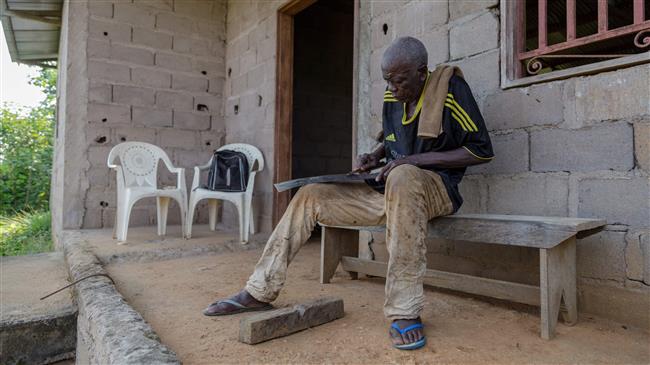
Benoit Bassemel, who’s father was killed during the massacre on the night of December 31 1956, files his machete at his home in Edéa, on December 11, 2019. (Photo by AFP)
‘Free like the others’
UPC nationalists believe that the independence granted on January 1, 1960, was not what they fought for.
They view the country’s two post-independence presidents, Ahidjo and Paul Biya, who has been in office since 1982, as working hand-in-hand with France.
“We wanted to be free like the other countries. We no longer wanted white people to subjugate us,” said 80-year-old Mathieu Njassep, in his tiny family apartment in Petit Paris, a poor district of Douala, the economic capital.
In 1960, aged 21, Njassep joined the Cameroon National Liberation Army (ALNK), the UPC’s armed wing.
After two years of fighting, he was appointed secretary to Ernest Ouandie, a leading figure in the movement. He was sentenced to death but escaped the firing squad, unlike Ouandie, who was executed in 1971.
“We had almost nothing to wage a war with,” Njassep said. “We carried out ambushes with machetes, sticks and homemade guns. If we had had enough weapons, we would have beaten them.”
At the time, the ALNK had established its headquarters in the village of Bandenkop, on the land of the main western tribal group, the Bamileke. Fighting was fierce between the nationalists and the French army.
In the rugged valley from which ALNK commanders led operations, there is no sign of human life today and the only sound is that of a bubbling stream.
“This whole zone was regularly bombed” by the French air force, said Michel Eclador Pekoua, a former UPC official.
Pekoua and other nationalists say French planes dropped napalm. France has neither confirmed nor denied the use of the notorious incendiary weapon.
Decapitations
On a road 30 kilometers to the north, in Bafoussam, a roundabout is known as the “crossroads of the guerrillas,” for it was where the decapitated heads of nationalists were placed on show, said Theophile Nono, head of a historical association, Memoire 60.
The regime’s methods “ranged from the arrest and arbitrary imprisonment of any Cameroonian suspected of ‘rebellion’ to systematic torture, with extrajudicial summary executions,” Nono said.
For many years the conflict mostly remained taboo in Cameroon. It was in the 1990s, when the authorities came under mounting pressure for democratic change, that people began to consider the historic past.
Biya, in a speech in 2010, paid tribute to “people who dreamed of (independence), fought to obtain it and sacrificed their lives for it… Our people should be eternally grateful to them.”
After years of French silence, then president Francois Hollande in 2015 became his country’s first head of state to speak of “a repression” of Cameroonian nationalists leading to “tragic episodes”.
For many survivors, this is not enough.
“France must accept its responsibility,” Nono said. “It must undertake to compensate victims of the dirty war, which has been carefully concealed by both the French side and the Cameroonian side.”
US uses ISIS as ‘scarecrow’ to intimidate others, while secretly backing them, Syrian FM tells RT
RT | December 25, 2019
Despite claiming to fight jihadists in Syria, the Americans are gladly using them to further anti-Damascus policies and occasionally giving them a helping hand, the Syrian foreign minister told RT.
“The Americans are using ISIS as a scarecrow,” Minister Walid Muallem said in an interview with RT Arabic. “At the same time they are feeding ISIS, [they] encourage them, protect ISIS leaders and help them move from one area to another.”
“The US policy is aimed at investing into terrorism.”
The Syrian government has long accused the US of fueling groups of foreign Islamist fighters, even those bragging of committing atrocities in Syria, as long as they were willing to fight against the forces loyal to Damascus. Washington claimed its illegal deployment of troops in Syria was aimed at destroying IS, but even after the group was declared defeated the American boots remain on the ground.
The latest public justification coming from the US is that oil in northeastern Syria needs to be “secured” from the defeated jihadists. In practice, the US denies the internationally recognized government of Syria of using the country’s national resources.
Muallem also said the US continues its attempts to topple the government he serves with various measures, including by targeting Damascus with economic sanctions. A new round of those is expected after the passage of the National Defense Authorization Act (NDAA) earlier this month.
Part of the NDAA orders punishment of companies who would help the Syrian government in rebuilding infrastructure and the energy sector – which presumably should not be allowed to happen while President Bashar Assad remains in power.
“All nations that were victimized by this system need to join forces and resist those sanctions,” the Syrian official said.
The Mysterious Frank Taylor Report: The 9/11 Document that Launched US-NATO’s “War on Terrorism” in the Middle East
By Prof. Niels Harrit – Global Research – March 21, 2018
We call them ‘the 9/11 wars’ – the seemingly unending destruction of the Middle East and North Africa which has been going on for the last seventeen years. As revealed by Gen. Wesley Clark,[1] these wars were already anticipated in September 2001.
The legal foundation for the invasion of Iraq in 2003 has been challenged in several countries. The best known is the Chilcot Inquiry in the UK, which began in 2009 and concluded in a report in 2016. The inquiry was not about the legality of military action, but the British government was strongly criticised for not having provided a legal basis for the attack.
Even though the invasion of Iraq was planned[2] prior to 9/11, most observers note that the attack on Afghanistan in 2001 was a required precursor.
However, the legal basis for attacking Afghanistan has attracted almost no attention. One obstacle in addressing this has been the assumption that the key document was still classified.[3][4]
But as demonstrated below, this document was apparently declassified in 2008.
On the morning of 12 September 2001, NATO’s North Atlantic Council was summoned in Brussels. This was less than 24 hours after the events in USA. The council usually consists of the permanent ambassadors of the member states, but in an unprecedented move, the EU foreign ministers participated as well.[5]
Lord Robertson, Secretary General of NATO, wrote a draft resolution invoking Article 5 in the Washington treaty – the famous ‘musketeer clause’ – as a consequence of the terror attacks. The decision to do so had to be unanimously approved by the governments in all 19 NATO countries. This general agreement was obtained at 9.20 pm and Lord Robertson could read out the endorsements at a packed press conference:[6]
“The Council agreed that if it is determined that this attack was directed from abroad against the United States, it shall be regarded as an action covered by Article 5 of the Washington Treaty, which states that an armed attack against one or more of the Allies in Europe or North America shall be considered an attack against them all.”
There was a reservation. Article 5 would not be formally activated before “it is determined that this attack was directed from abroad”.
Apparently NATO had a suspect. But the forensic evidence was still pending, and hence also the formal invocation of Article 5.
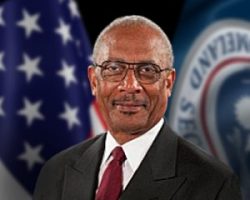 Formally, this evidence was provided by Frank Taylor (image on the right), a diplomat with the title of Ambassador from the US State Department. On 2 October he presented a brief to the North Atlantic Council, and Lord Robertson could subsequently conclude:[7]
“On the basis of this briefing, it has now been determined that the attack against the United States on 11 September was directed from abroad and shall therefore be regarded as an action covered by Article 5 of the Washington Treaty, which states that an armed attack on one or more of the Allies in Europe or North America shall be considered an attack against them all.”
“Today’s was classified briefing and so I cannot give you all the details. Briefings are also being given directly by the United States to the Allies in their capitals.”
Since the invocation of Article 5 had to be unanimous, Frank Taylor’s report would have been integral in the briefings announced to take place.
In Denmark – the country of the present author – there was a meeting in the Foreign Affairs Committee on 3 October 2001, where parliamentarians were briefed by the government about the proceedings in Brussels.
Parallel briefings must have been given in the 17 other NATO capitals. In each city, the resolution must have been approved, since Lord Robertson could announce NATO’s unanimous adoption of Article 5 and the launch of the war on terror on 4 October.[8] The first bombs fell in Kabul on 7 October.
Article 5 of the Washington Treaty says:[9]
“The Parties agree that an armed attack against one or more of them in Europe or North America shall be considered an attack against them all and consequently they agree that, if such an armed attack occurs, each of them, in exercise of the right of individual or collective self-defence recognised by Article 51 of the Charter of the United Nations,…..”
That is, any military action taken by NATO is confined by the restrictions in Article 51, which emphasises the right to self-defence and reads:
“Nothing in the present Charter shall impair the inherent right of individual or collective self-defence if an armed attack occurs against a Member of the United Nations,….”.[10]
That is, military action is forbidden in the absence of an armed provocation, and the legality of the attack on Afghanistan depends exclusively on the evidence presented in Frank Taylor’s report. But it was classified together with the minutes from the pertinent meetings.
However, on 19 May 2008, the US State Department declassified the dispatch which was sent in 2001 to all US representations world-wide, including the ambassadors to NATO headquarters, regarding what to think and say about the 9/11 events.
It is titled: “September 11: Working together to fight the plague of global terrorism and the case against al-qa’ida”.
The text is freely accessible here.
The document is dated 01 October 2001. But as hinted by the URL, it seems to have been distributed on 2 October five days before the invasion of Afghanistan on October 7, 20101. That is, the day Frank Taylor gave his presentation for the North Atlantic Council and the EU foreign ministers, and the day before the US ambassadors were briefing the governments in the respective NATO capitals.
The text of the dispatch begins by requesting “all addressees to brief senior host government officials on the information linking the Al-Qa’ida terrorist network, Osama bin Ladin and the Taliban regime to the September 11 terrorist attack on the World Trade Center and Pentagon and the crash of United Airlines Flight 93.”
The document appears to be a set of ‘talking points’. The recipients are instructed to use the information provided in oral presentations only and to never leave the hard copy document as a non-paper. Specifically, there is reference to “THE oral presentation”.
These instructions are followed by 28 pages of the specific text.
Tellingly, a section of this dispatch is copy-pasted into Lord Robertson’s statement on 2 October:7
“The facts are clear and compelling[…] We know that the individuals who carried out these attacks were part of the world-wide terrorist network of Al-Qaida, headed by Osama bin Laden and his key lieutenants and protected by the Taliban.”
The conclusion is inescapable – this dispatch IS the Frank Taylor report. It is the manuscript that served not only as the basis for Frank Taylor’s presentation, but also for the briefings given by US ambassadors to the various national governments. Identical presentations were given in all 18 capitals on 3 October, four days before the US-NATO invasion of Afghanistan
Is there any forensic evidence provided in this document to serve as a legal basis for the invocation of Article 5?
Nothing. There is absolutely no forensic evidence in support of the claim that the 9/11 attacks were orchestrated from Afghanistan.
Only a small part of the introductory text deals with 9/11, in the form of summary claims like the citation in Lord Robertson’s press release. The main body of the text deals with the alleged actions of Al-Qaeda and the Taliban in the nineties.
On 4 October, NATO officially went to war based on a document that provided only ‘talking points’ and no evidence to support the key claim.
We are still at war seventeen years later. Five countries have been destroyed, hundreds of thousands of people killed and millions displaced. Refugees are swarming the roads of Europe, trillions of dollars have been spent on weapons and mercenaries and our grandchildren have been shackled with endless debt.
At the opening ceremony for the new NATO headquarters on 25 May 2017, all the leaders from NATO’s member states attended the inauguration of a ‘9/11 and Article 5 Memorial’.[11]
*
Prof. Niels Harrit is a retired Associate Professor at the University of Copenhagen, Denmark.
Notes
[1] The Plan — according to U.S. General Wesley Clark (Ret.) https://www.youtube.com/watch?v=SXS3vW47mOE
[2] Bush decided to remove Saddam ‘on day one’. https://www.theguardian.com/world/2004/jan/12/usa.books
[3] The Unanswered Questions of 9/11. http://www.globalresearch.ca/the-unanswered-questions-of-911/5304061?print=1
[4] Was America Attacked by Afghanistan on September 11, 2001? https://www.globalresearch.ca/was-america-attacked-by-afghanistan-on-september-11-2001/5307151
[5] Being NATO’s Secretary General on 9/11. https://www.nato.int/docu/review/2011/11-september/Lord_Robertson/EN/ (from which you can deduce that the NATO-ambassadors eat lunch at 3 pm).
[6] Statement by the North Atlantic Council, https://www.nato.int/docu/pr/2001/p01-124e.htm
[7] Statement by NATO Secretary General, Lord Robertson. https://www.nato.int/docu/speech/2001/s011002a.htm
[8] Statement to the Press by NATO Secretary General, Lord Robertson, on the North Atlantic Council Decision On Implementation Of Article 5 of the Washington Treaty following the 11 September Attacks against the United States. https://www.nato.int/docu/speech/2001/s011004b.htm
[9] The North Atlantic Treaty. https://www.nato.int/cps/ic/natohq/official_texts_17120.htm
[10] Article 51, UN charter. http://www.un.org/en/sections/un-charter/chapter-vii/
[11] Dedication of the 9/11 and Article 5 Memorial at the new NATO Headquarters, 25 May 2017 https://www.youtube.com/watch?time_continue=3&v=augh1WqTqFs
Israel halts Jordan Valley annexation ahead of ICC probe
MEMO | December 24, 2019
Israel’s plans to annex the occupied Jordan Valley have been frozen following the International Criminal Court’s (ICC) decision to launch a full investigation into alleged war crimes in the Palestinian territories, reports Ynet News.
The first Israeli ministerial team meeting to discuss the plans for annexing the Jordan Valley, scheduled to take place last week, was cancelled last minute due to concerns that it could intensify confrontation with the ICC.
“Because of the prosecutor’s decision in the Hague, the issue of the Jordan Valley annexation will be put on a long hold,” an Israeli government source told Yedioth Ahronoth.
Israeli Prime Minister Benjamin Netanyahu said the ICC has no jurisdiction to investigate in the Palestinian Territories and yesterday branded it anti-Semitic.
On Friday, ICC Chief Prosecutor Fatou Bensouda said the preliminary examination into alleged war crimes, opened in 2015, had rendered enough information to meet all criteria for opening an investigation.
Bensouda also included in her recommendation that Israel has not only failed to stop settlement construction in the West Bank, the Jewish State also intends to annex some parts of the territory.
Before the ICC announcement, Netanyahu on Thursday pledged to secure support from the US for the annexation of the Jordan Valley and illegal settlements built in the occupied West Bank and East Jerusalem.
Approximately 70,000 Palestinians, along with some 9,500 Jewish settlers, currently live in the Jordan Valley, a large, fertile strip of land that accounts for roughly one-quarter of the West Bank’s overall territory.
Palestinians call for the Israeli occupation authorities to completely withdraw from the occupied West Bank, including the Jordan Valley, to make way for a future Palestinian state.
Israel is considering preventing the entry of officials from the ICC to the Palestinian territories, similar to steps taken by the US administration which refuses to grant entry visas for ICC employees investigating American soldiers who participated in the war in Afghanistan.
The Trudeau Government Joins the Global Majority on Israel-Palestinian Relations
By Anthony James Hall | American Herald Tribune | December 22, 2019
The Chief Executive of B’nai Brith Canada has condemned as anti-democratic a vote in late 2019 by Canada’s Trudeau government. In one of its first major international acts, Trudeau’s minority government sided with 166 other member states of the United Nations’ General Assembly. The Jewish organization expressed “outrage” at Canada’s position on a resolution dealing critically with the subject of Israel-Palestinian relations. “This vote reflects poorly on Canada’s record as a defender of democracy and justice. It stains Canada’s reputation,” said B’nai Brith’s CEO, Michael Mostyn.
Apparently Mr. Mostyn thinks nothing of invoking the principles of democracy and justice as justification for discounting as wrong and misguided the dramatic outcome of a free and fair vote by the world’s governments. In Mr. Mostyn’s view, all that is just and democratic adheres to the position of the five dissident governments that voted against the UN Resolution. The naysayers are Israel, the USA, Australia, Micronesia and Marshall Islands.
Mr. Mostyn and many other representatives of the Israel lobby have chastised the Trudeau government for taking a step that pulls Canada into the mainstream of global opinion especially when it comes to conditions in Gaza and the Occupied Territories. The Trudeau government has planted Canada’s flag among those of 167 national delegations. The governments of all these countries agreed to place an international spotlight on the many illegal acts that violate “the permanent sovereignty of the Palestinian people.”
In giving explicit reasons for its condemnation of the now-adopted UN Resolution, B’nai Brith Canada stated that it “rejects the contention that the [Jewish] settlements [in the Occupied Territories including East Jerusalem] are the core issue of the Israel-Palestine conflict.” The UN Resolution details many of the consequences for indigenous Palestinians of the influx of 700,000 Jewish settlers into territories illegally seized through armed conquest by the Israeli Armed Forces in 1967.
The Resolution sanctioned by the government of Canada and most of the world’s other governments “deplores the detrimental impact of the Israeli settlements on Palestinian and Arab natural resources, including the destruction of orchards and crops and the seizure of water wells by Israel Settlers.” It expresses “grave concern about the widespread destruction, caused by Israel, the occupying Power, to vital infrastructure, including water pipelines, sewage networks, and electricity networks in the Occupied Palestinian Territory.”
The Resolution also lists some of the public health abominations forced on “the Gaza strip during the military operations of July and August of 2014, which, inter alia, has polluted the environment and which negatively affects the functioning of sanitation systems and water supply.” There is reference to “unexploded ordinance” as well as a “chronic energy shortage” in Gaza where “only 5% of the ground water remains potable.”
The Resolution makes specific reference to “the detrimental impact on Palestinian natural resources being caused by the unlawful construction of the wall by Israel, the Occupying power, in the Occupied Palestinian Territory, including in and around East Jerusalem, and in its grave affect as well on the economic and social conditions of the Palestinian people.”
B’nai Brith’s criticism of the Trudeau government ignores most of the explicit content outlined in the now-adopted UN Resolution. Instead of facing the facts, B’nai Brith radically misrepresents as “anti-terror measures” the broad set of changes the Israel government has imposed on the lands at issue.
The Resolution clearly identifies the actions of a government whose goal it is to favor one group by dispossessing and disempowering another. The situation on the ground in the area occupied and controlled by the Israeli government makes it absolutely clear that the real goal is to replace the indigenous Palestinian population. The international emblem of Israel’s replacement project has become the 131 illegal Jewish settlements plus the 110 illegal outposts created to prevent Palestinians from enjoying any security of habitation.
B’nai Brith Canada sometimes represents itself as a “human rights” organization engaged in benevolent philanthropy. It has exploited this image to gain federal recognition as a registered charity capable of granting tax deductions for donations. Perhaps the time has come for an objective federal assessment to see if B’nai Brith Canada has lived up to its side of the bargain. Has B’nai Brith Canada acted like a genuine charity devoted to the ideal of universal human rights or has it acted more as a partisan political lobby?
B’nai Brith Canada announced in its press release that it “remains opposed to Palestinian attempts to internationalize the issue.” How ironic. As I see it, the track record of B’nai Brith Canada is one part of a much larger body of evidence demonstrating the scale of an elaborate Israel lobby based in many countries? Doesn’t the multinational reach of this very active political lobby effectively internationalize the core issues of Israel-Palestinian relations on a 24/7 basis?
The instability of relations between Israel and the Palestinians has significant implications for the domestic and international polices of many countries. For instance, how will the Trudeau government and the Trump government deal with the contentions that have put them on different sides of the recent UN vote? Will the Trudeau government continue to move away from the legacy of ther Harper government when it comes to correcting the gross inequities permeating almost every aspect of Israel-Palestinian relations?
Anthony James Hall has been Editor In Chief of the American Herald Tribune since its inception. Between 1990 and 2018 Dr. Hall was Professor of Globalization Studies and Liberal Education at the University of Lethbridge where he is now Professor Emeritus. The focus of Dr. Hall’s teaching, research, and community service came to highlight the conditions of the colonization of Indigenous peoples in imperial globalization since 1492.
Panama: A Grieving People Recalls 30 Years of the US Invasion
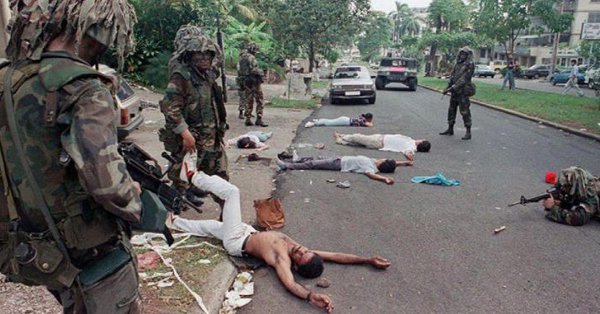
teleSUR | December 20, 2019
For the first time over the last 30 years, Panamanian authorities agreed to declare “National Day of Mourning” on December 20, which is the date on which the United States invaded Panama in 1989.
“The government acknowledges declaring December 20 as a day of national mourning to honor Panamanians and all the innocents who lost their lives and defended our territory’s integrity,” President Laurentino Cortizo tweeted on Wednesday.
On Dec. 20, 1989, President George H.W. Bush ordered “Operation Just Cause” and deployed some 26,000 soldiers to overthrow General Manuel Antonio Noriega.
Until then, he had been one of the most faithful collaborators of the Central Intelligence Agency (CIA) and the Drug Enforcement Administration (DEA).
Noriega fueled the Bush administration’s hostility when he requested the closure of “The School of the Americas,” where the U.S. had trained thousands of Latin American military since 1946. Upon losing Washington’s support, however, the U.S. Department of Justice accused him of drug trafficking.
Official declassified documents, which were published by Panama Files for the first time this week, indicate that 202 civilians and 314 militaries were killed during Operation Just Cause.
In an unofficially recognized manner, historians, activists, and families argue that the U.S. invasion killed up to 4,000 civilians.
“El Chorillo neighborhood, where the Panamanian Defense Forces central headquarters were located, was razed during the battle,” local outlet El Siglo recalls.
Mirta Guevara, who was a Public Prosecutor at the time, remembers that nobody imagined what the U.S. was planning to do. She was studying court records on the night of December 19 when her husband came in and told her, “Close those files. They are going to invade us.”
“I was shocked because, although one sees such things at the movies, I had never imagined it. I think that no Panamanian imagined that they were going to invade us,” Guevara recalls and now says that such an action had no justification. “Many people died.”
Of what happened in Panama not only oral accounts remained. A year after the invasion, a documentary showed a woman who asked the U.S.-imposed government to recognize whether what happened was “war, invasion or liberation.” They replied to her that it was a “government of democracy and justice.”
“Democracy for whom? Justice for whom? For those who are in the mass graves or for those who are in the government? For those of us who go hungry or for those who have everything?” the woman said without fear of the repression that was lived in the country.
In another documentary called “Unjust Cause,” which was made by the Panamanian filmmaker Rafael Vergara, scenes of brutal aggression are reported, one of which happened when U.S. troops bombarded a civil building because their inhabitants did not want to leave.
To resist the invasion, the Panamanians organized themselves in the “Battalions of Dignity”, which were groups of guerrilla fighters who were persecuted by the invasion-born government, which was led by Guillermo Endara, to whom a judge gave the presidency secretly the night before the invasion.
“Those who seized power mounted on the invading tanks remain silent,” a witness told Prensa Latina.
“After 30 years, the curtains, which hid the worst massacre experienced by Panama and the largest U.S. military deployment after Vietnam, begin to fall.”
In his chronicle “The Panama Invasion: A Heroine of the Little Hiroshima,” Colombian journalist Hernando Calvo described what happened in El Chorrillo neighborhood through the testimony of Ana.
She recalled a Dantesque scenario in which invading troops prevented helping injured family members, tanks hit dead or alive people lying on the street, and flamethrowers burned dead bodies at the beach.
The Afghanistan Fiasco and the Decline and Fall of the American Military
By Philip Giraldi | Strategic Culture Foundation | December 19, 2019
A devastating investigative report was published in the Washington Post on December 9th. Dubbed the “Afghanistan Papers” in a nod to the Vietnam War’s famous “Pentagon Papers,” the report relied on thousands of documents to similarly expose how the US government at the presidential level across three administrations, acting in collaboration with the military brass and civilian bureaucracy, deliberately and systematically lied repeatedly to the public and media about the situation in Afghanistan. Officials from the Bush, Obama and Trump administrations have all surged additional troops into Afghanistan while also regularly overstating the “success” that the United States was attaining in stabilizing and democratizing the country. While they were lying, the senior officers and government officials understood clearly that the war was, in fact, unwinnable.
The story should have been featured all across the US as Afghanistan continues to kill Americans and much larger numbers of Afghans while also draining billions of dollars from the United States Treasury, but the mainstream media was largely unresponsive, preferring to cover the impeachment saga. Rather more responsive were the families of Army Chief Warrant Officer Second Class David C. Knadle, 33, of Tarrant, Texas, and Chief Warrant Officer Second Class Kirk T. Fuchigami Jr., 25, of Keaau, Hawaii. Both were killed in a helicopter crash on November 20th in Afghanistan’s Logar province while assisting troops on the ground, according to a Pentagon press release. They were participating in what was characteristically dubbed Operation Freedom’s Sentinel. Both men were assigned to the 1st Battalion, 227th Aviation Regiment, 1st Air Cavalry Brigade, 1st Cavalry Division in Fort Hood, Texas. The Taliban took credit for the downing of the chopper, but the Army is still investigating the cause.
Knadle and Fuchigami are only the most recent of the more than 2,400 American service members who have been killed in Afghanistan since October 2001, together with 20,589 wounded and an estimated 110,000 Afghan dead. In the wake of the Post’s report, Daniel Ellsberg, who leaked the Pentagon Papers in 1974, told a CNN reporter that the Pentagon and Afghanistan Papers exposed the same governmental dysfunction: “The presidents and the generals had a pretty realistic view of what they were up against, which they did not want to admit to the American people.”
The New Republic observes how “The documents are an indictment not only of one aspect of American foreign policy, but also of the US’s entire policymaking apparatus. They reveal a bipartisan consensus to lie about what was actually happening in Afghanistan: chronic waste and chronic corruption, one ill-conceived development scheme after another, resulting in a near-unmitigated failure to bring peace and prosperity to the country. Both parties had reason to engage in the cover-up. For the Bush administration, Afghanistan was a key component in the war on terror. For the Obama administration, Afghanistan was the ‘good war’ that stood in contrast to the nightmare in Iraq.”
The Afghan War’s true costs have never been precisely calculated, though they certainly exceed $1 trillion and counting. The documents relied upon for the Post report include more than 2,000 pages of confidential interviews with people who played a direct role in the war, including soldiers and diplomats, as well as civilian aid workers and Afghan officials. Many of the interviews were initially carried out by the Special Inspector General for Afghanistan Reconstruction (SIGAR). The Post divided the interviews and supporting documentation into subject categories that demonstrate how the situation in Afghanistan began to deteriorate as soon as the United States followed up on its rapid invasion with a plan for nation building. Resorting to the usual American expedient, the occupiers flooded the country with money, which meant that the only thing blooming on the thin soil was corruption, apart from the poppies that have made Afghanistan the world’s leading supplier of opium.
One contractor who was involved in nation building described how he was required to spend $3 million daily for projects in an Afghan district roughly the size of a US county. He asked a visiting congressman if he could be authorized to spend that much money in the US “[The lawmaker] said hell no. ‘Well, sir, that’s what you just obligated us to spend and I’m doing it for communities that live in mud huts with no windows.’”
In another interview the report cites Lieutenant General Douglas Lute, the White House Afghan war czar during the Bush and Obama administrations, who told the interviewers in 2015. “We were devoid of a fundamental understanding of Afghanistan — we didn’t know what we were doing,” later adding “What are we trying to do here? We didn’t have the foggiest notion of what we were undertaking.”
Army Colonel Bob Crowley, who served in Kabul in 2013-4, described how at headquarters “Every data point was altered to present the best picture possible,” adding also how “Surveys, for instance, were totally unreliable but reinforced that everything we were doing was right and we became a self-licking ice cream cone.”
Part of the problem with Afghanistan was the rotation of American soldiers in and then out after one year or less, just as they were learning about the country and the problems they faced. It has led to the joke that the United States has not fought an eighteen-year war in Afghanistan: it has fought a one-year war eighteen times.
The Post investigative report coincides with an interesting deconstruction of the US military and how it operates. David Swanson of World BEYOND War provides a lengthy review of West Point Professor Tim Bakken’s new book The Cost of Loyalty: Dishonesty, Hubris, and Failure in the US Military. Per Swanson, the book “traces a path of corruption, barbarism, violence, and unaccountability that makes its way from the United States’ military academies (West Point, Annapolis, Colorado Springs) to the top ranks of the US military and US governmental policy, and from there into a broader US culture that, in turn, supports the subculture of the military and its leaders. The US Congress and presidents have ceded tremendous power to generals. The State Department and even the US Institute of Peace are subservient to the military. The corporate media and the public help maintain this arrangement with their eagerness to denounce anyone who opposes the generals. Even opposing giving free weapons to Ukraine is now quasi-treasonous.”
Bakken even disputes the widely held view that the military academies have high academic standards. He describes how the “system” pays to get potential athletes and accepts students nominated by congressmen commensurate with donations made to fund re-election campaigns. Swanson sums it up by observing how the academies offer “a community college-level education only with more hazing, violence, and tamping down of curiosity. West Point takes soldiers and declares them to be professors, which works roughly as well as declaring them to be relief workers or nation builders or peace keepers. The school parks ambulances nearby in preparation for violent rituals. Boxing is a required subject. Women are five times more likely to be sexually assaulted at the three military academies than at other US universities.”
Bakken concludes that appreciating the fundamental structural flaws in the US armed forces “leads to a clearer understanding of the deficiencies in the military and how America can lose wars.” In fact, he does not even seek to identify a war that the United States has won since World War 2 in spite of the country being nearly constantly engaged in conflict.
Together the Bakken book and the Afghanistan Papers reveal just how much the American people have been brainwashed by their leaders into believing a perpetual warfare national narrative that is more fiction than fact. Donald Trump may have actually appreciated that the voters were tired of the wars and was elected on that basis, but he has completely failed to deliver on his promise to retrench. It suggests that America will remain in Afghanistan for the foreseeable future and the inevitable next war, wherever it might be, will be another failure, no matter who is elected in 2020.
Brexit Could See the Return of the Falkland Islands to Argentina
By Paul Antonopoulos | December 19, 2019
The Islas Malvinas, or more commonly known as the Falkland Islands, archipelago was invaded by the United Kingdom in 1833 and its occupation has continued to date. Argentina’s claim for sovereignty through diplomatic means has been a state policy since the failed liberation attempt through military means in 1982. Although it lost intensity during the Mauricio Macri government, President Alberto Fernández of the leftist Justicialist Party, reinforced in October his commitment to “renew the claim of sovereignty” of the 750 islands of the archipelago. In a patriotic tone, the then presidential candidate criticized the relations Macri had with the United Kingdom during a debate that took place on October 13.
“In these years the government has been very busy doing business with the United Kingdom and has forgotten sovereignty [over] the Falklands. Over 700 soldiers have died there. In memory of them all I will make things different,” Fernández said during the first Argentine presidential debate.
Fernández will re-establish a Secretariat for the Malvinas, demonstrating that he is taking the issue against the British very seriously. During his swearing in speech before the National Congress on December 10, the new president informed that he will create a Secretariat, with the participation of “all political forces,” the southern province of Tierra del Fuego that is closest to the Malvinas, representatives of the academic world and former fighters of the 1982 war, to concentrate on the reclamation of the occupied archipelago.
Fernández included the claim by the Falkland Islands in his speech when he assumed the presidency and said “there is no more place for colonialism in the 21st century.”
“We know that for this task it does not reach the mandate of a Government, but a medium and long-term State policy, so I will convene a Congress where all political forces participate,” he announced.
Fernández decision to re-establish the Malvinas Secretariat and to convene a Council on the subject restores confidence and firmness in Argentina’s demand against the British after complete servitude by Macri. The importance the new president has given to Argentina’s demand for sovereignty over the islands is a good sign and it is the first time a new president has spoken with such depth to the Malvinas issue when they first take office.
Fernández’s stance demonstrates that the Malvinas do not belong to any president, they are a state matter in which it is necessary to work as a state policy for not only the present, but also looking to the future. The establishment of the Secretariat is aimed to positively re-establish consensus on the basis of and essential demand for sovereignty, leaving the differing approaches in Argentina to the cause and the 1982 war conflict in the past with the aim of looking only towards the future.
It must be remembered that a new Sao Paulo-Malvinas flight opened on Argentine National Sovereignty Day on November 20, a massive slap in the face to the Argentinian veterans from the 1982 war, who did not hesitate to go out protest. LATAM inaugurated the flight which has a stop in the Argentine city of Córdoba. War veterans protested in front of the Foreign Ministry in Buenos Aires against what they described as treachery by Macri. Fernández has an opportunity to gain even more popular support by forcing the cancellation of flights by LATAM to the Malvinas and by ensuring the islands have no lifeline except with their colonial masters in London approximately 13,000 kilometers away.
Conservative Boris Johnson won the British election on December 12, which put the South American islanders on alert. The possibility of the definitive implementation of Brexit will harm the local economy, whose production has the European Union as one of its main markets. Brexit is a favorable situation for Argentina because in the view of the European Union, the Malvinas are an extracontinental territory, something that will complicate the local economy, just as what will happen with British-occupied Gibraltar on the Iberian Peninsula and areas in Cyprus.
In this context Argentina must start seeking new alliances with European countries and condemn the maintenance of a British colony on the complete opposite side of the Atlantic and with total impunity. With Spain wanting the return of Gibraltar and Cyprus wanting the return of Akrotiri and Dhekelia, Argentina can very easily find new allies in the European Union willing to cooperate efforts to reclaim sovereignty over territory occupied by the British. Brexit therefore not only threatens the breakup of the United Kingdom with a push for Scottish independence and Irish unification, but it could potentially see the return of the Malvinas to Argentina.
Paul Antonopoulos is a Research Fellow at the Center for Syncretic Studies.
From a Blessing to a Curse: How UN Resolution 2334 Accelerated Israel’s Colonization in the West Bank
By Ramzy Baroud | Palestine Chronicle | December 18, 2019
Three years ago, the United Nations Security Council passed Resolution 2334. With fourteen members voting in favor and one abstention, the Resolution was the equivalent of a political earthquake. Indeed, it was the first time in many years that the international body roundly condemned Israel for its illegal settlement policies in the Occupied Palestinian Territories. Unlike previous attempts at holding Israel accountable, this time, the Americans did nothing to protect its closest ally.
What has happened since then, however, has been a testimony to the failure of the UN to furnish meaningful mechanisms that would force violators of international law, like Israel, to respect international consensus. In some way, 2334, although externally supportive of Palestinian rights, turned out to be one of the most costly decisions ever made by the international institution.
Immediately after the adoption of 2334 on December 23, 2016, Israel thumbed its nose at the whole world by announcing, twice in the following January, plans to construct thousands of new homes in illegal Jewish settlements in the occupied West Bank.
At the time, Israeli Prime Minister, Benjamin Netanyahu, and his then-Defense Minister, Avigdor Lieberman, rationalized the provocative moves as a “response to the housing needs” within the settlements. Nothing could have been further from the truth, as the subsequent three years demonstrated.
Now, it has become clear that the settlement expansion was part of a much larger strategy aimed at killing any chance of establishing a contiguous and viable Palestinian State and parting ways with the so-called “land for peace formula”, itself molded through years of American mediation and “peace process”.
The Israeli strategy was a complete success. Thanks to the blank cheque issued by the Trump administration to Israel’s right-wing government coalition, Israeli politicians are now openly plotting what was once nearly unthinkable: the unilateral annexation of major Jewish settlement blocks in the West Bank along with large swathes of the Jordan Valley.
Throughout the last three years, Washington has turned a blind eye to Israel’s sinister designs. Worse, it has fully embraced and validated the Israeli political discourse, while taking every necessary measure to provide a cover for Israeli actions. The declaration by US Secretary of State, Mike Pompeo, on November 18 that Jewish settlements “are not inconsistent with international law” is but one of many such positions adopted by Washington to pave the road for Israel’s insolence and violation of international law.
Retrospectively, President Obama had the chance to do more than merely abstaining from voting against a UN Resolution – which lacked any enforcement mechanism, anyway – by using the generous US financial aid to Israel as a bargaining chip. That way, he could have potentially forced Netanyahu to freeze settlement expansion altogether. Alas, Obama did the exact opposite – as he bankrolled the Israeli military and financed every Israeli war on Gaza. Instead, his belated move opened the stage for the Trump administration to unleash a cruel war on Palestinians and international law, as well.
It seems that the two-year term of US Ambassador to the UN, Nikki Hailey, was mainly dedicated to rectifying the supposed “betrayal” of the Obama administration of Israel. In the name of defending Israel against imaginary global “anti-Semitism”, the US severed its ties with several UN organizations, eventually isolating Washington itself from the rest of the world.
With the UN being designated as the common enemy by both Washington and Tel Aviv, international law was rendered irrelevant. Gradually, the US government fortified its protective shield around Israel, thus making 2334 and many other UN resolutions meaningless. In other words, the US managed to turn international consensus regarding the illegality of the Israeli occupation of Palestine into an opportunity for Tel Aviv to disown any commitment, not only to the UN, but to the so-called two-state solution, and the “peace process”, as well.
While Israel accelerated its settlement projects unhindered, the US ensured that the Palestinian leadership is denied the opportunity to fight back, even if symbolically, through the various international institutions and any available political and legal platform. This was engineered through systematic economic warfare, which saw the cutting of all aid to the Palestinian Authority in August 2018, followed, a week later, by stopping all funds to the UN organization responsible for the welfare of Palestinian refugees, UNRWA.
US-Israeli war on Palestinians was staged on two fronts. One front focused on the seizure of more Palestinian land, the building of new and the expansion of existing settlements, as a precursor of the imminent steps of annexing most of the West Bank. The other front witnessed the relentless US administration’s pressure on Palestinians through political and financial means.
Three years after 2334, a new status quo is upon us. Gone are the days of traditional American “peace-making” and its adjoining elaborate discourse centered on a two-state and other make-believe solutions. Now, Israel is single-handedly formulating its own “vision” for a future that is designed to meet the expectations of the country’s unhinged and ever-growing right-wing constituency. As for the US, its role has been relegated to the cheerleader, unfazed by such seemingly trivial matters as that of international law, human rights, justice, peace or even regional stability.
Shortly after being appointed as Israel’s new Defense Minister on November 9, Naftali Bennett has taken the dangerous and consequential decision of building a new Jewish settlement in the occupied Palestinian city of Al-Khalil (Hebron). Naturally, Jewish settlers rejoiced as they will finally see the destruction of the old Hebron market, which is older than Israel itself, and the potential for further settlement expansion and more annexation in the city.
At the same time, Palestinians are cringing, for a move against Hebron is the final proof that Israel is now operating in Palestine without the slightest fear of political or legal repercussions. Not only did UN Resolution 2334 fail to hold Israel accountable, it, in some way, facilitated further Israeli expansion in the West Bank, paving the road for the annexation that will surely follow.
– Ramzy Baroud is a journalist and the Editor of The Palestine Chronicle. He is the author of five books. His latest is “These Chains Will Be Broken: Palestinian Stories of Struggle and Defiance in Israeli Prisons” (Clarity Press, Atlanta). Dr. Baroud is a Non-resident Senior Research Fellow at the Center for Islam and Global Affairs (CIGA), Istanbul Zaim University (IZU). His website is www.ramzybaroud.net
Featured Video

Trita Parsi: Israel Set a Trap for Total War in the Region
or go to
Aletho News Archives – Video-Images
From the Archive
Zionism’s Violent Legacy
By Donald Neff | Washington Report On Middle East Affairs | January 1996
On January 4, 1948, Jewish terrorists drove a truck loaded with explosives into the center of the all Arab city of Jaffa and detonated it, killing 26 and wounding around 100 Palestinian men, women and children.[1] The attack was the work of the Irgun Zvai Leumi – the “National Military Organization,” also known by the Hebrew letters Etzel – the largest Jewish terrorist group in Palestine. The Irgun was headed by Revisionist Zionist Menachem Begin and had been killing and maiming Arabs, Britons and even Jews for the previous ten years in its efforts to establish a Jewish state.
This terror campaign meant that at the core of Revisionist Zionism there existed a philosophical embrace of violence. … continue
Blog Roll
 Aletho News
- Trita Parsi: Israel Set a Trap for Total War in the Region
- Trump’s Iran war is on an Israeli leash
- Saudi oil boss issues global supply warning
- Riyadh Says Its Oil System Is Intact. The Numbers Say Otherwise.
- Trump and Netanyahu Want to “Finish the Job” on Iran
- US ‘one-sided dictation’ not Iran’s beliefs makes rational talks impossible: Baghaei
- Iran’s Next Strike May Not Explode. It Could Shut You Down /Col Doug Macgregor
- Iran: US political targets legitimate if assassinations return
- Iraq shuts key border crossing with Iran under US pressure: Report
- Undersea Internet cables could be targeted in retaliation for attacks on Iran: IRGC deputy chief
- If Americans Knew
- The Israel Lobby’s Changing Fortunes
- AIPAC has become such a political liability that it’s shifting to a more “nimble” approach to buying politicians
- At least 160 Israeli settler attacks in 2 weeks
- Will Gaza’s Ancient Christian Community Disappear Forever?
- Israel’s vision of regional security rests on keeping Arab states weak
- Heidi Levine recounts how Palestinian youths helped save her in settler attack
- DAILY UPDATE: Latest essential news on Palestine, Israel, & region
- Trump’s Intensifying Sabotage of the ICC, for Israel’s Sake
- Israeli military detain US and UK volunteers in West Bank including Democratic NY politician Brad Lander
- Americans at National Conservatism Conference held in Israel this year criticize Israel
- No Tricks Zone
- E-Cars Reduce CO2 Emissions By Only 41% Compared To Internal Combustion Engine Vehicles
- Predictions Made By Renowned Climate Professor Over Past Decades Have Been Proven To Be Poor
- New Study Suggests Large Regions Of The Pacific Ocean Have Been Cooling For The Last 80 Years
- Germany’s Green Energy Debacle: High Energy Costs Force Kahla Porzellan to Close After 182 Years!
- New Study: 50 Years Of The Most Aggressive ‘Net Zero’ Policies Can Only Affect The Global Climate By 0.03°C
- US September “Heat” Was No Record…Many Records Set Decades Ago
- Latest European Green Energy Debacle; Portugal’s Largest Flagship Solar Park Insolvent!
- Green Energy Debacle: German Expert Professor Fritz Vahrenholt Warns Of Severe Economic And Social Consequences
- Two More Paleo Reconstructions Affirm Meters-Higher Sea Levels Across Ireland, Brazil 7000-6000 Years Ago
- New Study: Earth And Venus Surface Warmth Largely Explained By Convection And Lapse Rate, Not CO2 Or Radiation

