Israeli municipality in Jerusalem names Silwan streets after rabbis
Palestine Information Center | June 21, 2019
OCCUPIED JERUSALEM – The Israeli municipality in Occupied Jerusalem has decided to name some streets in the predominantly Arab Silwan neighborhood after Jewish rabbis.
According to Haaretz, the move was against the recommendation of a professional panel who said “It is inappropriate to give Jewish street names in neighborhoods overwhelmingly populated by Arabs.”
The naming committee in the municipality, headed by Mayor Moshe Leon, named five alleyways and narrow streets in the Baten Al-Hawa neighborhood of Silwan.
The neighborhood, which is currently the home of 12 Jewish families and hundreds of Palestinian families, is targeted by extremist settler groups, including Ateret Cohanim.
Settlers claim there was a small Jewish-Yemenite community in the neighborhood 80 years ago. The newly-approved street names are “Ezrat Nidhim,” after the charitable organization founded by Yisroel Dov Frumkin in the late 19th century which established the Yemenite community.
The other streets are named after Yemenite rabbis. The decision was taken by a majority of eight to two.
The committee made the decision despite the opinion of a professional panel, who warned that the move will “create unnecessary tension. The names will not be used by residents and will therefore be futile.” The committee recommended neutral street names which will benefit all residents.
The two committee members opposing the decision are city coalition members Laura Wharton and Yossi Havilio. Havilio said he firmly opposes as the move, adding that it provokes Arab residents and will inflame the atmosphere in the neighborhood.
US exceptionalism: Exploiting certain Syrians, ignoring others
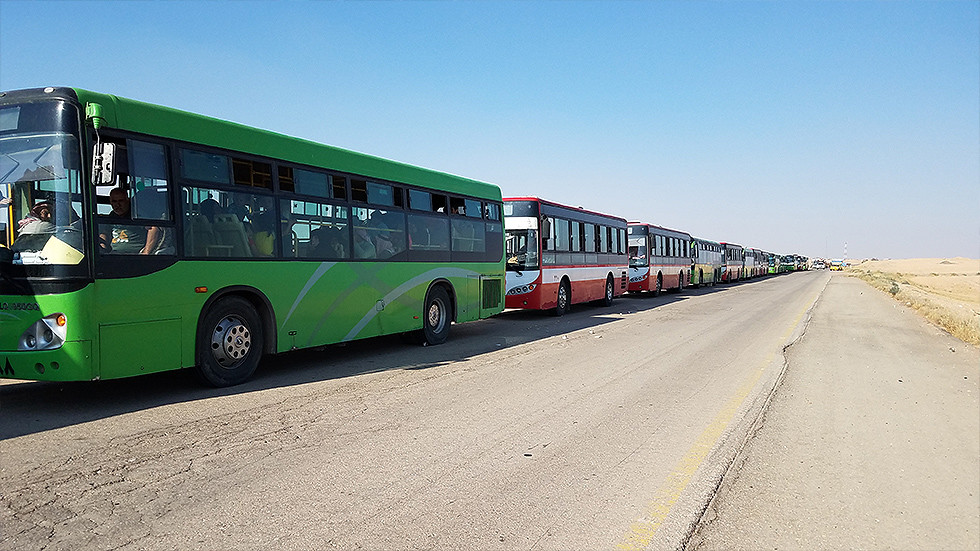
Convoy of buses carrying displaced Syrians from Rukban camp to refugee shelters in government-secured Homs. © Eva Bartlett
By Eva Bartlett | RT | June 19, 2019
Syria and Russia have been evacuating civilians from yet another region starved by its Western-backed terrorists. But Western corporate media ignore this and instead continue spinning nightmarish war propaganda on Syria.
Predictably, copy-paste Syrian reports emanate from Western governments and corporate media feign concern for civilians in Idlib while negating to mention that the Idlib governorate is an Al-Qaeda hotbed.
Back in Syria again, over the ‘Eid holidays, I spoke with residents about life in Damascus now, and highlighted the peace which exists – having been absent for many years prior when terrorists’ mortars rained down on the city.
But I was also interested in highlighting another issue: the evacuation of southeastern Syria’s Rukban Camp which has been under way for months; civilians have been plucked from starvation and intolerable conditions, and delivered to safety with access to food and medical care.
In February, Russia and Syria set up humanitarian corridors to start evacuating civilians to safe areas where they could receive medical treatment and resettle in their home areas or elsewhere.
In June, 2019, I travelled to a point where I could interview evacuees of the Rukban, the unbearable camp near the US-occupied Al-Tanf base.
United States of hypocrisy occupies & places blame on others
Rukban also lies on the border with Jordan. Over the years, it has become a hell on earth, with residents starving due to a lack of accessible food. In November 2018, there were around 50,000 refugees in the camp.
Most Western reporting on the situation in Rukban has blamed Syria and Russia for the scarcity of food in the camp. Surprisingly, a June 2018 article by US think tank the Century Foundation highlighted US control over the camp and surrounding areas.
“The Tanf–Rukban zone is patrolled by Coalition forces and their chosen Syrian partner, Maghawir al-Thawra… Also present are the remnants of a formerly Pentagon-backed group called the Qaryatein Martyr Battalions and three factions formerly linked to the CIA’s covert war in Syria: the Army of the Eastern Lions, the Martyr Ahmed al-Abdo Forces, and the Shaam Liberation Army.”
The US stymied aid to Rukban, and was then only willing to provide security for aid convoys to a point 10 kilometres (6.2 miles) away from the camp, according to the UN’s own Emergency Relief Coordinator, Mark Lowcock.
So, by US administration logic, convoys should have dropped their Rukban-specific aid in areas controlled by terrorist groups and just hoped for the best.
Even if the US intentions were good, experience has shown that when terrorist groups occupying an area have access to aid, they keep it for themselves, civilians don’t see it unless they pay a high price.
When eastern areas of Aleppo were liberated in December 2016, even Reuters had to report that civilians blamed so-called ‘rebels’ for hoarding food they desperately needed.
When Madaya, heavily propagandized about in early 2016, was restored to safety in 2017, I travelled there and spoke to residents who again solely blamed terrorists for their starvation. Same in eastern Ghouta, where residents spoke of starvation and executions, by terrorists.
Russian Foreign Minister Sergey Lavrov noted that if Americans at al-Tanf could get supplies from Iraq and Jordan, they could have also brought in humanitarian aid for Rukban civilians, were they actually so concerned.
Unsurprisingly, in Syria’s and Russia’s eyes, the US is holding civilians in Rukban hostage. This became more apparent when America refused to shut down the camp, quite clearly preferring to have a raison d’être for continuing their illegal occupation of southeastern Syria.
Even the Middle East director for the UN High Commissioner for Refugees (UNHCR), Amin Awad, said that civilians in Rukban were being held against their will, as “human shields”“deprived of basic services,”according to Sputnik News.
Awad pointed the finger at traders in the camp bearing responsibility for the suffering of civilians in Rukban, but civilians I spoke to also included America in their blame.
Rukban’s displaced speak out
On a stretch of road between the Rukban camp and the Homs refugee centre they were headed to on June 12, I met some of the roughly 900 Syrians evacuated that day on 18 buses. Another convoy of trucks carried their tattered personal belongings.
I approached many with questions about life in the camp, moving from bus to bus to speak with them.
An old woman sitting on the floor of one bus said she’d been in the camp for four years, that everything was expensive and they were hungry all the time. She gave the example of being charged 1,000 Syrian pounds (around US$2) for five potatoes.

© Eva Bartlett
Mahmoud Saleh, a young man from Homs governorate, told me he’d fled home five years ago. When I asked who was in control in Rukban, he replied without hesitation: “The Americans.”
An older man from Palmyra, four years in the camp, spoke of “armed gangs,” paid in US dollars, being the only ones able to eat properly.
“The armed gangs were living while the rest of the people were dead. Those who wanted fruit had to pay in US dollars. The armed groups were the only ones who could do so.”
I asked about access to medical care.
“Medical services! There is no medicine at all.” He pointed to a young woman behind him who he said had lost two babies because she couldn’t get a C-section.
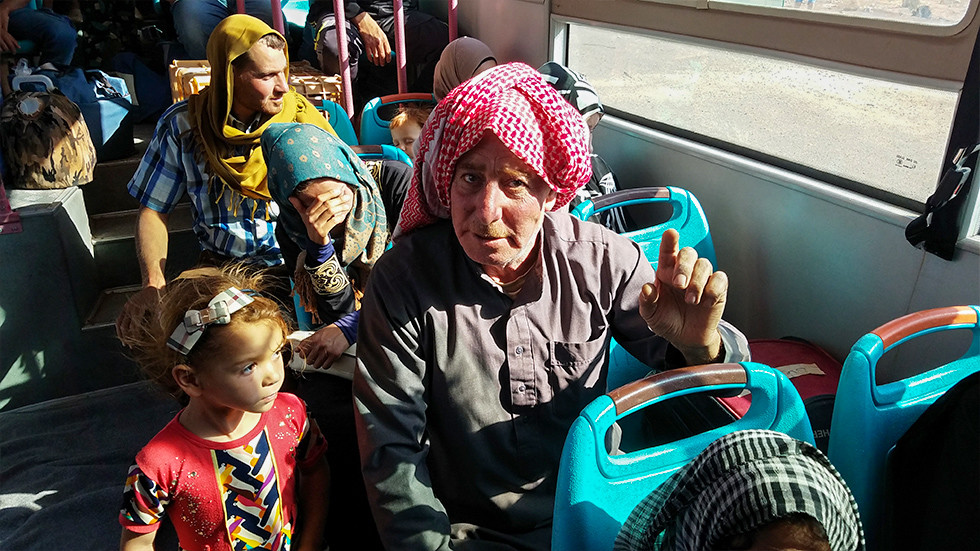
Older man from Palmyra, in Rukban four years, spoke of “armed gangs” paid in US dollars being the only ones able to eat properly. © Eva Bartlett
In another bus, a shepherd who had spent three years in Rukban blamed “terrorists” for not being able to leave. He also blamed the US. “Those controlling Tanf wouldn’t let us leave, the Americans wouldn’t let us leave.”
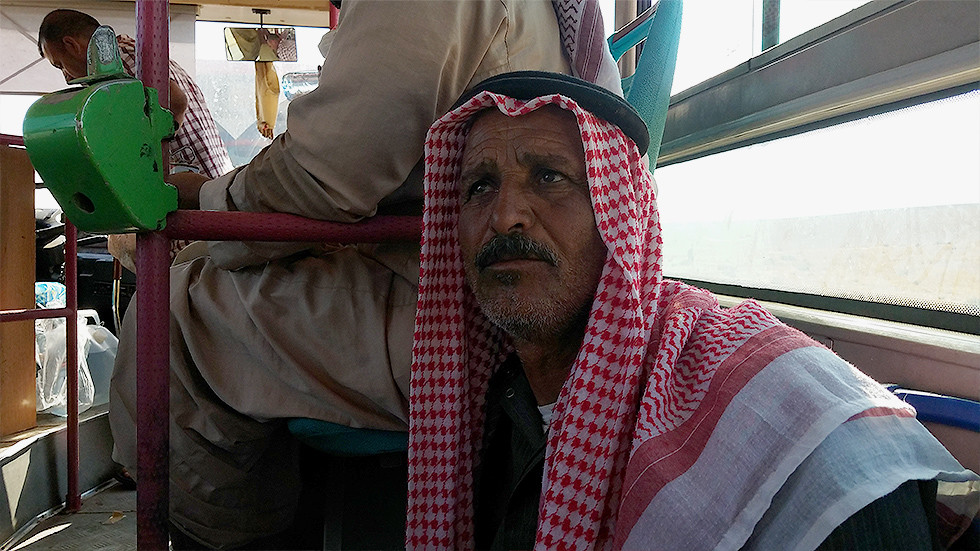
Shepherd who spent 3 years in Rukban © Eva Bartlett
Many others who I spoke to said they had wanted to leave before but believed the fearmongering from terrorists who told them they would be “slaughtered by the regime,” a claim floated in corporate media when Aleppo was being liberated.
The Russian Reconciliation Centre reports that some Rukban residents had to pay as much as US$1000 to “militants controlled by the US side” in order to leave.
As of June 13, Russia’s Ministry of Defence reports that 14,347 people, mostly children and women, have been evacuated from Rukban since February 23.
International media & their dubious sources
As evacuations of civilians from Rukban have unfolded, any Western corporate media that bothers to report on them has spun them as ‘forced displacement’ to ‘regime areas’ where civilians will be ‘imprisoned and tortured.’
Yeah, Syria and Russia are simply hell-bent on finding any way to torture Syrian civilians, to the extent that they will waste considerable amounts of money and time to do so, or at least, that’s what corporate media would have you believe.
And just as Western corporate media relied on the words of “media activists” and “unnamed sources” in their war propaganda prior to and during the liberation of eastern Aleppo and eastern Ghouta, hostile media are again relying on such sources for reporting on Rukban.
Canada’s Globe and Mail went as far as to cite the utterly non-credible, Qatar-based, Syrian Network for Human Rights in a recent article claiming that thousands of Syrians who have returned home have been arrested.
As journalist Max Blumenthal humorously pointed out in his investigation into this Qatar-influenced body, “citing the Syrian Network for Human Rights as an independent and credible source is the journalistic equivalent of sourcing statistics on head trauma to a research front created by the National Football League, or turning to tobacco industry lobbyists for information on the connection between smoking and lung cancer.”
Contrasting the claims, Syrian authorities have stated that UN representatives have permission to visit the refugee centres. The Russian Reconciliation Centre stated that UN bodies, including the UNHCR, visited the shelters.
As of June 16, the Russian Reconciliation Centre reports that “1,299,977 IDPs have returned back to their homes” in Syria since September 30, 2015, and that since July 2018, “175 medical and 863 educational organizations have been recovered.”
Those are some odd statistics given that Western media and politicians would have us believe that the Syrian and Russian governments are terrorizing civilians and gleefully destroying infrastructure in Syria.
Or perhaps what Western media, governments, and lobby groups are spouting is just more, unoriginal, war propaganda.
Eva Bartlett is a freelance journalist and rights activist with extensive experience in the Gaza Strip and Syria. Her writings can be found on her blog, In Gaza.
Ecuador: Galapagos Islands Will Now Serve US Military as Airfield
teleSUR | June 12, 2019
Ecuador’s right-wing government has agreed for the United States (U.S.) to use the airport of San Cristobal, in the Galapagos Islands, as an airfield for U.S. air force and navy Pacific ocean operations, according to the Minister of Defense Oswaldo Jarrin.
“Galapagos is Ecuador’s natural aircraft carrier because it ensures permanence, replenishment, interception facilities and is 1,000 kilometers from our coasts,” he assured, explaining that now U.S. military planes will also have access to it based on “cooperation” agreements signed under Lenin Moreno’s administration to “fight drug trafficking.”
On September 2018, a Lockheed P-3 Orion intelligence-gathering plane from the U.S. Customs and Border Protection agency began to operate from Ecuador. While a Boeing 707 aircraft from the U.S. air force, carrying a long-range radar surveillance and control center (AWAC), will now also be “patrolling” the Pacific. Both operations are reminiscent of those made by the U.S. government from the Base in Manta from 1999 to 2009.
“A base means permanence, there will be no permanence of anyone, the P3 and Awac will meet periods no longer than a week,” Jarrin argued. Yet he himself said on Aug. 27, 2018, that “the important thing is to recognize that everything that the base did in its time, can now be done by just one plane, because of the advance of technology.”
Despite the technicalities of such “cooperation” any presence of foreign armies in Ecuadorean territory is unconstitutional. According to article five of the 2008 Constitution, Ecuador declares itself as a territory of peace, where “the establishment of foreign military bases or foreign installations for military purposes will not be allowed. In addition, it is prohibited to cede national military bases to foreign armed or security forces.”
No, Mr. Minister. Galapagos is not an “aircraft carrier” for the gringos to use. It is an Ecuadorean province, world heritage, patriotic ground.
In what seems like an attempt to appease critics, the defense official, emphasized that the readjustments to the airfield will be paid by the U.S. Yet once again history warns that this is no sort of “assurance.”
In 1942, as the U.S. was just entering World War II both in the Pacific as the western front, another right-wing government in Ecuador allowed the U.S. army and navy to use the Island of Baltra, in the Galapagos, as an airfield. An airstrip was constructed, houses, barracks, movie theaters and dining halls for the armed personnel and families, all paid by the U.S.
However, in 1946 as the U.S. left they bombed and destroyed everything leaving nothing behind for the Ecuadorans.
Okinawa Governor Warns of Civil Unrest if US Doesn’t Give Up Local Marine Base
Sputnik – May 30, 2019
Should the US prolong its military use of Marine Corps Air Station Futenma in the Japanese prefecture of Okinawa, it could see civil unrest in the region, Okinawa Governor Denny Tamaki recently wrote in a letter to US officials.
“If the US continues to use [MCAS Futenma], it may give rise to anti-base protests against all US military bases in Okinawa, or even an overall anti-US movement like what was seen in the past,” Tamaki noted, recalling the turbulent days of the early 1970s when Japanese demonstrators unified under an anti-American stance.
“If that happens, such movements would have a significant impact on the Japan-US Security Arrangements as well as the Japan-US Alliance including operation of Kadena Air Base and White Beach Naval Facility.”
Tamaki further noted in the letter that US Marine air operations should be removed completely from the island, since the US has the capability to handle any possible threats from China or North Korea with its Air Force and Navy.
Most notably, in December 1970, tensions came to a boil in Okinawa after an intoxicated American driver struck an Okinawan pedestrian, triggering one of the largest anti-US demonstrations. That incident, later known as the Koza Riots, saw thousands of Okinawans protest against the American presence on the island.
According to the Japan Times, local residents pulled American drivers from their cars, beat them and set their vehicles ablaze. More than 80 cars were left burning, and dozens of Americans were hospitalized.
Bruce Lieber, a veteran once assigned to the 20th Military Police Company in Okinawa, told the Times that he had been one of the first individuals on the scene. “It was really frightening. The crowd surrounded us, then they flipped our car and set it on fire,” he recalled.
Despite the years since the Koza Riots, tensions have continued to simmer. Locals have repeatedly called for US officials to close down the Futenma base due to environmental concerns, repeated aerial mishaps and violent incidents perpetrated by US servicemembers.
In 2017, a helicopter window from a CH-53E Super Stallion became detached and landed on the sports field of an elementary school, where dozens of students were playing at the time. Sputnik reported that one student suffered a minor injury as a result.
Over the last several years, US and Japanese officials have drawn up various plans to relocate the service’s base to Henoko Bay in the Okinawan city of Nago. However, the project has been repeatedly postponed due to opposition from local officials and residents who want the base removed from the prefecture.
According to Stars & Stripes, the relocation plan was expected to be completed by 2014. Landfill work for the base was recently resumed in December 2018 — a decision which was made before an island-wide referendum saw 70% of Okinawans vote against the relocation.
Updated estimates for the project suggest the base could be completed sometime between 2025 and 2026, if not later, the military website reported.
Taliban insurgents want peace, senior leader says at Moscow talks
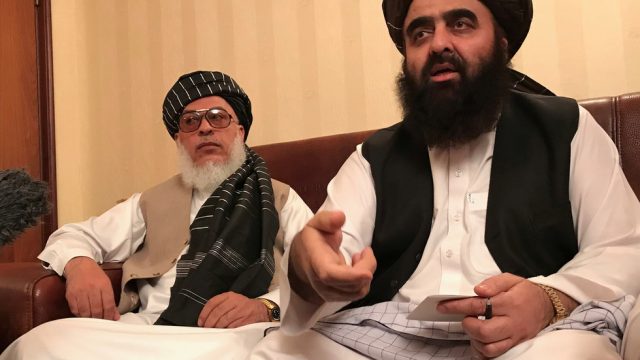
Head of Political Office of the Taliban Sher Mohammad Abbas Stanakzai (L) and member of Political Office of Taliban Shahabuddin Delawar (R) in Moscow, May 28, 2019.
© Reuters / Mikhail Antonov
RT | May 28, 2019
Senior Taliban officials including the group’s top political advisor met with Afghan political figures in Moscow on Tuesday, saying they were committed to peace in Afghanistan.
The statement comes as US-led talks appear to have stalled, AFP said.
Taliban co-founder and political leader Mullah Abdul Ghani Baradar said the insurgents want an end to 18 years of conflict – but would only sign a deal after foreign forces quit Afghanistan.
The Taliban are “really committed to peace, but think the obstacle for peace should be removed first,” Baradar said in a rare televised appearance at the start of the two-day meeting marking 100 years of diplomatic ties between Russia and Afghanistan. “The obstacle is the occupation of Afghanistan, and that should end,” Baradar said.
China Will Not Participate in US-Led Bahrain Conference
Palestine Chronicle | May 27, 2019
Ambassador of the People’s Republic of China to the State of Palestine, Guo Wei, said that his country will not take part in the US-led ‘Peace to Prosperity’ conference, scheduled on June 25-26 in Bahrain’s capital, Manama.
In a meeting with Nabil Shaath, advisor to President Mahmoud Abbas for external affairs and international relations, the ambassador of China said that boycotting the Bahrain conference comes within the framework of a bilateral Russian-Chinese agreement not to participate in it.
The ambassador stressed his country’s position in support of the Palestinian cause and people, including their right to self-determination and the establishment of an independent state of Palestine within the 1967 borders with East Jerusalem as its capital.
For his part, Shaath stressed the Palestinian rejection of the US-led economic workshop set to be held in Bahrain, considering it part of the US so-called ‘deal of the century’.
Shaath briefed the Chinese ambassador on the Palestinian political situation and the serious Israeli violations against the Palestinian people, land, and holy sites in violation of international law and signed agreements, praising China’s role and that of all other friendly countries.
Nasrallah: If It Weren’t for Liberation in 2000, Trump Would Grant South to ‘Israel’

Sayyed Hasan Nasrallah
Sara Taha Moughnieh | Al-Manar | May 26, 2019
Hezbollah Secretary General Sayyed Hasan Nasrallah delivered a speech Saturday 25th of May on the anniversary of Resistance and Liberation day.
Sayyed Nasrallah tackled regional and internal files including the upcoming Bahrain Summit, localizing the Palestinians in Lebanon, strength of the resistance axis, return of the Syrians to their country, and internal files.
His eminence called for a wide participation in Al-Quds day which is held annually on the last Friday of the Holy Month of Ramadan, stressing that this day is of great significance this year because of the efforts being made to put an end to the Palestinian cause, specifically during the upcoming Economic Conference in Bahrain.
He greeted the Palestinian’s united stance to boycott and refuse this conference and praised the Bahraini people, scholars, and political powers’ stances that condemned the country’s decision to be the first to embrace “the deal of the century” which aims at putting an end to the Palestinian cause.
25/May/2000: Resistance and Liberation Day
Sayyed Nasrallah greeted everyone who was part of this victory through sacrificing, staying patient, supporting and aiding.
“We should remember the families of the martyred and injured, Lebanese factions, Security Forces, Army, Palestinian factions and the Syrian Army and keep in mind that Iran and Syria are the ones who stood by our side and they are our companions in victory,” he said.
Hezbollah SG assured that one of the major outcomes of this victory was the “Equation of Strength” in Lebanon because the Israeli enemy had to pull back without any victories or conditions.
“Lebanon was no longer regarded as the weak ring in the Arab/Israel conflict, and today the Israeli enemy states that in Lebanon there is a “strategic or central threat against Israel”, he noted; adding “just like the enemy is aware of this strength, the Lebanese people should be aware of its importance in order to sustain their country’s sovereignty and safety and in order to protect it. This is what forms the Golden Equation “Army, people and Resistance”.”
“If it weren’t for the resistance and liberation in 2000, Trump would’ve granted the south of Lebanon or other parts of it to Israel, just like he did with Al-Quds and the Golan,” Sayyed Nasrallah said, reassuring holding on to “Shabaa Farms, Kfarchouba hills and the Lebanese part of Al-Ghajar village.”
Localization in Lebanon
Concerning localizing immigrants in Lebanon, his eminence said: “we suspect that the economic summit in Bahrain will be opening the door for the localization of immigrants in Lebanon and other countries. The Lebanese agree on refusing localization politically and constitutionally, and the Palestinians as well agree on refusing localization and holding on to their right of return.”
Sayyed Nasrallah called for “a meeting between Lebanese and Palestinian officials to put a joint plan on how to face the danger of localization because the threat is approaching and statements are no longer enough”.
Syrian Refugees’ Return
Hezbollah SG pointed out that “the real reason behind delaying the return of the Syrian refugees in Lebanon to their country is political and it is related to the presidential elections in Syria because the presidency of Bashar Al-Assad will end in 2020 or 2021, and there is an American, Western, and Gulf insistence on keeping the refugees away from their countries until then. There are no humanitarian or security reasons behind postponing the refugees’ return to Syria and claims about that are just rumors.”
Sayyed Nasrallah further stated that “Assad has confirmed to me that he supports the return of everyone to Syria and is ready to offer facilitation, but the obstacle is political. Should Lebanon submit to this political obstacle only because the US, west and Gulf want that?”
Battle against Corruption Files
His eminence stressed Hezbollah’s commitment to fight corruption, reiterating that this needs time and patience, and it is even harder than the battle of liberating the south.
He indicated that the ministers are doing their jobs and have not found corruption in the Ministries of health and sports, and called on everyone who has information or data against these two ministries to propose them so that action would be taken.
On another hand, Sayyed Nasrallah stated that “budgeting discussion has been our priority because it is a major point in the process of fighting corruption and stopping financial waste.”
UK told to give back Chagos Islands in overwhelming UN vote
RT | May 22, 2019
The United Nations has ordered Britain to give up sovereignty over a series of tropical islands in the Indian Ocean, home to a key military base. The decision was approved by a supermajority of member states.
Wednesday’s resolution called on the UK to cede control of the Chagos Islands, which it said were unlawfully annexed from the Republic of Mauritius, then a British colony, in 1965. The General Assembly gave Britain six months to leave.
An extended legal battle over the territory culminated in a ruling last February in the International Court of Justice (ICJ), the top UN body for inter-state disputes. The court ordered Britain to leave Chagos “as rapidly as possible,” but the decision was ignored, prompting Mauritius to turn to the General Assembly for another vote.
The latest resolution was adopted with the overwhelming support of 116 countries, with just four nations joining Britain and the United States in opposition. Seventy-one states either abstained or didn’t cast a vote.
Britain granted Mauritius independence in 1968, but held onto the Chagos archipelago. Between 1967 and 1973, the UK expelled the majority of the Chagos population to make way for a massive military complex on the atoll of Diego Garcia, which is today leased out to the United States.
American and British officials were not pleased with the decision.
“The United Kingdom is disappointed by the results in the General Assembly today,” British UN Ambassador Karen Pierce said in a statement, arguing that the number of abstentions “underscores the fact that states have concerns about the precedent that this resolution is setting.”
Pierce’s American colleague Jonathan Cohen responded in much the same way, saying the island’s “status as a UK territory is essential to … our shared security interests.”
However, Mauritian Prime Minister Pravind Kumar Jugnauth said he was ready to offer the US and UK unhindered access to Diego Garcia, meaning that the two powers are unlikely to give up the base.
UK Chagos Support, an advocacy group, was somewhat critical of the move, insisting that “no decisions over the future of the islands should be taken without input from the Chagossian [people] themselves.”
Erdogan must honor his promise to return occupied Syrian territory
Turkish army pullout will bring peace to Northern Syria
By Firas Samuri | Aletho News | May 22, 2019
In mid-January 2018, the Turkish General Staff announced the beginning of Olive Branch Operation. The goal was to oust the Kurds from the outskirts of Afrin, as well as to create a buffer zone along the Syrian-Turkish border.
These steps were sharply criticized by the world community, but Ankara hastened to declare that the presence of its troops in Syria was temporary. Erdogan promised to return these territories to Syrians. Indeed, the fighting stopped on March 20 2018, after capturing Afrin when several hundred Kurds were killed and wounded. However, now it looks like Turkey is not going to leave the occupied territory.
Kurdistan 24 TV channel recently published information that Ankara is building a concrete wall around the city of Afrin to isolate it from its surroundings. “Sources on the ground in Afrin see this as another step of Turkey’s annexation of Afrin into its borders,” said Mutlu Çiviroğlu, a Syria and Kurdish affairs analyst. Though several locals support Turkish activity, it doesn’t bring peace and stability to the region. Just remember the events of the last year.
First of all, let’s notice the terrorist attacks in Afrin that have been carried out against the Turkish Forces and Free Syrian Army (FSA) units. Among the biggest attacks, the car bomb explosion in front of Ahrar al-Sharqiya headquarters is often mentioned. An investigation was initiated, but the responsible parties were never found. That demonstrates the support of the residents for the Kurdistan Workers’ Party.
Moreover, since the beginning of the Turkish occupation, the humanitarian situation in northern Syria has deteriorated significantly. The main reason is the closure of medical and educational facilities whose activities, for some reason, didn’t suit the local pro-Turkish administration. On demand of the Turks, some of them were converted to the military headquarters.
Return of the northern regions under the control of the Syrian government undoubtedly will lead to the reopening of the health centers, hospitals, and schools. Consequently, more Syrian children will be able to obtain an education, and older people will receive appropriate medical treatment.
The districts of Damascus that have been completely liberated from Hayat Tahrir al-Sham militants and now are being speedily reconstructed by the Syrian government serve as a good example. Thus, in February 2019, the provincial departments of education reported on the restoration of 57 schools, another eight are still being reconstructed. The same situation takes place in other parts of Syria.
The reopening of the Police stations and reactivation of other security services will help reduce arms and drug trafficking, as well as limit the supply of weapons to terrorists in the neighbouring province of Idlib. Such actions will lead to a de-escalation of tensions in the region.
Currently, the key reason for hostilities in the region is the ongoing extremist provocations. Ankara ignores such incidents as these radicals are fighting against Kurds. The militants are opposed to President Assad, but after the withdrawal of the Turkish troops, Damascus will be able to establish a dialogue with FSA, as has happened in southern Syria. There the Syrian government managed to persuade the militants to lay down weapons and then amnestied them.
At the same time, we should not forget about the fate of Kurds. If the north of Syria remains under Turkish control, thousands of locals will become refugees and won’t get back to their homes, fearing constant repression by the Turkish authorities. According to the United Nations High Commissioner for Refugees, more than 100,000 people have already left the region before the Turkish invasion.
Therefore, the return of the areas occupied by the Turkish Army to the control of the Syrian government is an essential step towards restoring sovereignty and territorial integrity of Syria. It contributes a lot to the strengthening of peace and stability, both in the north of the country and in the region as a whole.
Palestinian cabinet not consulted on US-led Bahrain summit, PM says
Press TV – May 20, 2019
Palestinian Prime Minister Mohammad Shtayyeh says his government has not been consulted about an economic conference that the United States will hold in Bahrain next month.
The White House announced on Sunday that the first part of President Donald Trump’s so-called “peace plan,” which is spearheaded by his son-in-law Jared Kushner, will be unveiled in Bahrain’s capital, Manama.
The US will host the economic conference on June 25 and 26 to purportedly encourage investment in the West Bank, and the Gaza Strip.
“The cabinet wasn’t consulted about the reported workshop, neither over the content, nor the outcome, nor timing,” Shtayyed told Palestinian ministers in the presence of reporters on Monday.
Relations between the Palestinian Authority and the US took an unprecedented dip in late 2017, when Washington recognized Jerusalem al-Quds as Israel’s “capital.”
The Trump administration has said that its secret plan, which has been dismissed by Palestinian authorities even before being unveiled, would require compromise by both sides.
‘We don’t trade our political rights’
The Palestinian Authority is facing steep aid cuts. Since being shunned by Palestinians, Trump’s administration has slashed hundreds of millions of dollars to humanitarian organizations.
“The financial crisis the Palestinian Authority is living through today is a result of the financial war that is being launched against us in order to win political concessions,” Shtayyeh said.
“We do not submit to blackmail and we don’t trade our political rights for money,” he added.
Palestinians want the West Bank as part of a future independent Palestinian state with East Jerusalem al-Quds as its capital. However, Israel insist on maintaining the occupation of Palestinian territories.
‘High treason’
Also reacting to news of the upcoming conference, Bahrain’s main opposition group, the al-Wefaq National Islamic Society, has described the US “deal of the century” as a plan to sell Jerusalem al-Quds and Palestine, slamming it as “high treason,” the Arabic-language Lualua television network reported.
The group criticized the ruling Al Khalifah regime for hosting the conference, saying that is a departure from all national, Islamic and humanitarian principles.
Al-Wefaq further said the Bahraini people are opposed to the “desecration” of their country and efforts for converting it into a “station” to sign a new version of the Balfour Declaration – the document that led to Israel’s creation.
The group noted that the Al Khalifah regime’s move to host the “disastrous project” is no surprise, adding Manama’s recent rapprochement with the Israeli regime comes as it “lacks popular legitimacy” and seeks international support in an attempt to sustain its legitimacy.
Al-Wefaq called on all Bahrains and “free governments” to reject the initiative and stop the “dangerous development” from proceeding.
Jerusalem Cable Car Project Passes Over Objections from Many Quarters
Political interests drive tourism plan that would blight historic city’s skyline and bypass Palestinians
By Jonathan Cook • The National • May 14, 2019
East Jerusalem has received new impetus from the rise of the Israeli far right and Washington’s decision to move its embassy to the city. But if completed, critics say, the long-running proposal would contribute to erasing the visibility of Palestinians in the city they hope to make their capital.
Planning for the $55 million tourism project continues despite unifying archaeologists, architects, Palestinians, and a tiny community of Jews against it – in a sign of Israel’s ever-growing confidence in making unilateral moves in occupied parts of Jerusalem.
Critics say the cable car will help hide the local Palestinian population from the roughly 3 million tourists who visit Jerusalem each year, turning the city into a “Disneyland” focused on promoting Israeli interests.
“The advantage for Israel is that visitors can be prevented from having any dealings with Palestinians,” said Aviv Tartasky, a researcher with Ir Amim, an Israeli organisation that campaigns for equal rights in Jerusalem.
“The local population will be largely erased from the experience of visiting Jerusalem. Tourists will pass over Palestinian residents, via the cable car, and then pass under them via tunnels.”
Israel’s Ministry of Tourism dismissed the criticism. In a statement to The National, the ministry said the cable car project was “a significant milestone in the promotion of Jerusalem and the strengthening of its status as a world tourism capital”.
Settler-run tours
The cable car, the largest project of its type undertaken by Israel, could be completed as early as in two years, its destination the slopes in occupied East Jerusalem just below the Old City, next to Al Aqsa mosque and the Dome of the Rock. Some 72 cabins have the capacity to ferry up to 3,000 visitors an hour above mainly Palestinian homes.
Tourists will be channelled from the cable car into a visitor centre run by Jewish settlers in the heart of the crowded Palestinian neighbourhood of Silwan. They will be led by settler-approved guides underground, through tunnels under Palestinian homes to the foot of the Western Wall.
Blueprints show that visitors will be able to shop in the tunnels, bypassing local Palestinian traders in the Old City market who have long depended on tourism. Israeli officials accelerated the project by bypassing routine planning procedures, even though urban planning specialists warn that it will damage the Jerusalem skyline and archaeological sites revealing the origins of modern civilisation.
Equally important, critics say, the Benjamin Netanyahu government and settler groups view the cable car as helping block any possibility of a Palestinian state emerging with East Jerusalem as its capital. They have been emboldened by President Donald Trump’s 2017 decision to transfer the US embassy from Tel Aviv to Jerusalem.
“It should set off alarm bells that a huge state project like this is being intertwined with a private settler organisation, physically forcing visitors to go through its visitor centre, channelling them into its attractions and activities,” Mr Tartasky said.
He said the cable car was one of the ways Israel was connecting disparate settler compounds in the Palestinian neighbourhoods of occupied Jerusalem.
“It will physically strengthen these settler areas, and mean their organisations have an even greater influence on Israeli authorities.”
Encircling Al-Aqsa
The project has been forcefully promoted by the Israeli tourism ministry, headed by Yariv Levin, an ally of Mr Netanyahu, and Jerusalem’s mayor, Moshe Lion. Tenders will be issued as soon as the National Planning Council approves the project, which is expected to be a formality.
In violation of international law, Israel has treated East Jerusalem as annexed territory since it occupied the city in 1967. More than 200,000 Jewish settlers have moved there over subsequent decades
Hanna Swaid, a Palestinian planning specialist and former member of the Israeli parliament, said the cable car was illegal because international law allows major changes in occupied territory only out of military necessity or for the benefit of the population under occupation.
“Even in its own planning justifications, the Israeli authorities are clear the cable car is designed only for the benefit of tourists, Israeli developers and the settler groups overseeing it, not the local Palestinian population. In fact, it will serve to actively harm Palestinians in Jerusalem,” Mr Swaid said.
“It will parachute tourists to Jewish sites like the Western Wall, and marginalise Muslim and Christian sites,” he added.
Palestinians are concerned that the cable car will serve to tighten Israel’s control over access to the Al Aqsa mosque compound, the highly sensitive holy site in the Old City. For decades Israeli authorities have moved to weaken the control of Islamic religious authorities, the Waqf, on Al Aqsa, contributing to repeated clashes at the site.
Jews believe the mosque is built over the ruins of a major Jewish temple. The Western Wall, which supports the mosque compound, was originally a retaining wall of the long-lost temple.
“The cable car looks suspiciously like another means for encircling Al Aqsa, for laying siege to it,” Mr Swaid said.
Tunnels under Palestinians
According to official plans, dozens of cabins will run hourly along a 1.5-kilometre route from West Jerusalem, inside Israel’s recognised borders, to the occupied Palestinian neighbourhood of Silwan, just outside the Old City walls and in the shadow of Al Aqsa.
Tourists will disembark in Silwan into a large visitor centre, the Kedem compound, to be run by a settler organisation called Elad that has close ties with the Israeli government.
The Kedem centre is the latest venture in the City of David complex, an archaeological site that the settlers of Elad have been using for more than two decades as a base to seize control of the Palestinian neighbourhood.
Visitors will be taken on tours to explore Jerusalem, moving through ancient sewage tunnels that run under Palestinian homes and reach to walls of Al Aqsa.
Additional plans will eventually see the cable car alight at other sites in East Jerusalem. Among them are the Mount of Olives, which includes an ancient Jewish cemetery; the Church of Gethsemane, at the reputed site where Judas betrayed Jesus; and the Pool of Siloam, a bathing area referred to in the Old and New Testaments.
Yonatan Mizrahi, the director of Emek Shaveh, a group of Israeli archaeologists opposed to the misuse of archaeology and tourism by Israel, said: “The purpose is to offer tourists a one-dimensional narrative about Jerusalem and its history. They should see all layers of the city’s rich history. Instead they will hear only the parts that relate to Jewish history.”
Mr Mizrahi has been among those leading the criticism of the project. “No other historic city in the world has built a cable car – and for very good reason,” he said.
Jerusalem ‘not Disneyland’
In March about 30 international architects – some of whom have worked on projects in Jerusalem – wrote to Mr Netanyahu urging him not to pursue what they called short-term interests.
“The project is being promoted by powerful interest groups who put tourism and political agendas above responsibility for safeguarding Jerusalem’s cultural treasures,” the letter said.
The letter followed a statement by 70 Israeli archaeologists, architects and public figures against the cable car in November, when the project was sped up. They said: “Jerusalem is not Disneyland, and its landscape and heritage are not for sale.”
A French firm, Safege, which worked on the initial feasibility study, pulled out in 2015, reportedly under pressure from the French government over concerns that the project violated international law.
In an apparent bid to ensure the project would go through, the previous Netanyahu government changed planning laws to remove the cable car from local and regional oversight. It also ensured the public could not submit objections.
Instead the scheme is being treated as a “national infrastructure” project, similar to a new railway line or gas pipeline. The National Planning Council offered a curtailed period for organisations to lodge reservations that ended on March 31.
Mr Swaid, who is the director of the Arab Centre for Alternative Planning, drew up a list of reservations on behalf of the Supreme Religious Council of Muslims in Israel.
Other critical comments were submitted by lawyers for the Silwan neighbourhood, the archaeologists of Emek Shaveh, the planning group Bimkom, a Palestinian merchant association in the Old City, and a tour guides group.
The Karaites, a small Jewish sect whose ancient cemetery lies in the path of the cable car, in the Biblical Hinnom Valley, said the project showed “contemptuous disregard for the dignity of the deceased and the Karaite community in general”.
Benjamin Kedar, a former chairman of the Israel Antiquities Authority, lodged a protest too.
Loss of all privacy
One of the Silwan homes in the path of the cable car belongs to the Karameh family. The cabins may pass only four metres above the flat roof where toddlers play and the family of 20 hang their washing. Support columns for the cable car may end up being driven into the family’s garden, one of the few green spots in Silwan.
“Nowhere in Israel do cable cars travel over houses, let alone a few metres above,” said Mr Mizrahi. “It seems clear why in this case. Because the houses belong to Palestinians.”
Samer Karameh, a 24-year-old lorry driver, said everyone in Silwan was opposed to the cable car, as it would be helping settler groups like Elad trying to take over their neighbourhood. But he was shocked to learn that it would pass so close to his house.
“We’ll lose all privacy. We won’t be able to open the windows without being seen by thousands of strangers. And it can’t be safe to have these cars travelling just over the heads of our children,” Mr Karameh said.
“We know we won’t be the beneficiaries,” he added. “The authorities won’t give us a permit to build anything here, so all the business will go to the settlers.”
Talks with US in Doha stumble over troop withdrawal timetable: Afghan Taliban
Press TV – May 6, 2019
The Taliban militant group says peace talks with the US — which have been underway in Qatar for months — have stalled over the key issue of a timetable for American and other foreign troops to pull out of Afghanistan, a longtime Taliban demand.
A Taliban political spokesman, Suhail Shaheen, told the AFP on Sunday that the two sides have so far failed to hammer out their differences on how to put their draft agreement on the withdrawal timetable into action.
The two sides are trying “to narrow the differences and have an agreement on a timetable which is acceptable to both sides,” but “that has not been achieved so far.”
He also explained that nothing would move forward “in principle” until America announced a withdrawal timetable.
“If we are not able to finalize it in this round, then … peace would be far away rather than being closer,” Shaheen added.
Since last year, sixth rounds of talks have been held in Doha between the militant group and US special envoy to Afghanistan Zalmay Khalilzad and his delegation of about two dozen officials in the hope of ending an American war in Afghanistan that has dragged on for over 17 years.
The latest round began on May 1, and it is not clear if the talks were to continue Monday, which marks the first day of the holy Muslim month of Ramadan.
The negotiations have so far excluded Afghan officials. The Taliban refuse to hold talks with the government in Kabul, which the militant group views as illegitimate and a US puppet.
In February, Khalilzad claimed progress in the talks, saying that a deal was within reach by July.
Khalilzad has repeatedly said that for things to progress, the Taliban must ensure Afghanistan is never again used as a terrorist safe haven, implement a ceasefire, and speak to Afghan representatives.
The Taliban have said they will not do anything until the US announces a withdrawal timeline.
Earlier this week, the group’s spokesman Zabihullah Mujahid called on the US to end the use of force in Afghanistan instead of putting pressure on the militant group to cease fire.
“Instead of such fantasies, he [Khalilzad] should drive the idea home [to the US] about ending the use of force and incurring further human and financial losses for the decaying Kabul administration,” he added.
The US embassy in Kabul did not immediately comment on the Taliban’s latest statement.
The Taliban’s five-year rule over at least three quarters of Afghanistan came to an end following the 2001 US-led invasion, but 17 years on, Washington — having failed to end the Taliban’s militancy campaign — is seeking truce with the militants.
Observers say the militant group is now negotiating from a position of strength as it has managed to strengthen its grip over the past three years, with the government in Kabul controlling just 56 percent of the country, down from 72 percent in 2015, according to a US government report released last year.
The Taliban have even continued to carry out daily attacks on Afghan security forces amid the negotiations.
Last week, thousands of tribal elders and other figures held a rare grand assembly — known as Loya Jirga — in Kabul to express their views about a peace deal with Taliban.
At the end of that meeting, Afghan President Ashraf Ghani offered Taliban a truce deal.
The militants were, however, quick to reject the offer and launched attacks on a police station in northern Afghanistan, leaving over a dozen people dead there on Sunday.
Featured Video

Trita Parsi: Israel Set a Trap for Total War in the Region
or go to
Aletho News Archives – Video-Images
Book Review
Why the War on Conspiracy Theories Is Bad Public Policy
By Kevin Barrett • Unz Review • February 1, 2019
 A Review of Conspiracy Theories and Other Dangerous Ideas by Cass Sunstein (based on an earlier paper co-authored with Adrian Vermeule); In Defense of Troublemakers: The Power of Dissent in Life and Business by Charlan Nemeth; and Conspiracy Theories and the People Who Believe Them, edited by Joseph E. Uscinski
On January 25 2018 YouTube unleashed the latest salvo in the war on conspiracy theories, saying “we’ll begin reducing recommendations of borderline content and content that could misinform users in harmful ways—such as videos promoting a phony miracle cure for a serious illness, claiming the earth is flat, or making blatantly false claims about historic events like 9/11.”
At first glance that sounds reasonable. Nobody wants YouTube or anyone else to recommend bad information. And almost everyone agrees that phony miracle cures, flat earthism, and blatantly false claims about 9/11 and other historical events are undesirable.
But if we stop and seriously consider those words, we notice a couple of problems. First, the word “recommend” is not just misleading but mendacious. YouTube obviously doesn’t really recommend anything. When it says it does, it is lying. … continue
Blog Roll
 Aletho News
- Trita Parsi: Israel Set a Trap for Total War in the Region
- Trump’s Iran war is on an Israeli leash
- Saudi oil boss issues global supply warning
- Riyadh Says Its Oil System Is Intact. The Numbers Say Otherwise.
- Trump and Netanyahu Want to “Finish the Job” on Iran
- US ‘one-sided dictation’ not Iran’s beliefs makes rational talks impossible: Baghaei
- Iran’s Next Strike May Not Explode. It Could Shut You Down /Col Doug Macgregor
- Iran: US political targets legitimate if assassinations return
- Iraq shuts key border crossing with Iran under US pressure: Report
- Undersea Internet cables could be targeted in retaliation for attacks on Iran: IRGC deputy chief
- If Americans Knew
- The Israel Lobby’s Changing Fortunes
- AIPAC has become such a political liability that it’s shifting to a more “nimble” approach to buying politicians
- At least 160 Israeli settler attacks in 2 weeks
- Will Gaza’s Ancient Christian Community Disappear Forever?
- Israel’s vision of regional security rests on keeping Arab states weak
- Heidi Levine recounts how Palestinian youths helped save her in settler attack
- DAILY UPDATE: Latest essential news on Palestine, Israel, & region
- Trump’s Intensifying Sabotage of the ICC, for Israel’s Sake
- Israeli military detain US and UK volunteers in West Bank including Democratic NY politician Brad Lander
- Americans at National Conservatism Conference held in Israel this year criticize Israel
- No Tricks Zone
- E-Cars Reduce CO2 Emissions By Only 41% Compared To Internal Combustion Engine Vehicles
- Predictions Made By Renowned Climate Professor Over Past Decades Have Been Proven To Be Poor
- New Study Suggests Large Regions Of The Pacific Ocean Have Been Cooling For The Last 80 Years
- Germany’s Green Energy Debacle: High Energy Costs Force Kahla Porzellan to Close After 182 Years!
- New Study: 50 Years Of The Most Aggressive ‘Net Zero’ Policies Can Only Affect The Global Climate By 0.03°C
- US September “Heat” Was No Record…Many Records Set Decades Ago
- Latest European Green Energy Debacle; Portugal’s Largest Flagship Solar Park Insolvent!
- Green Energy Debacle: German Expert Professor Fritz Vahrenholt Warns Of Severe Economic And Social Consequences
- Two More Paleo Reconstructions Affirm Meters-Higher Sea Levels Across Ireland, Brazil 7000-6000 Years Ago
- New Study: Earth And Venus Surface Warmth Largely Explained By Convection And Lapse Rate, Not CO2 Or Radiation

