Druze Gather in Israeli-Occupied Golan Heights to Mark Support for Assad
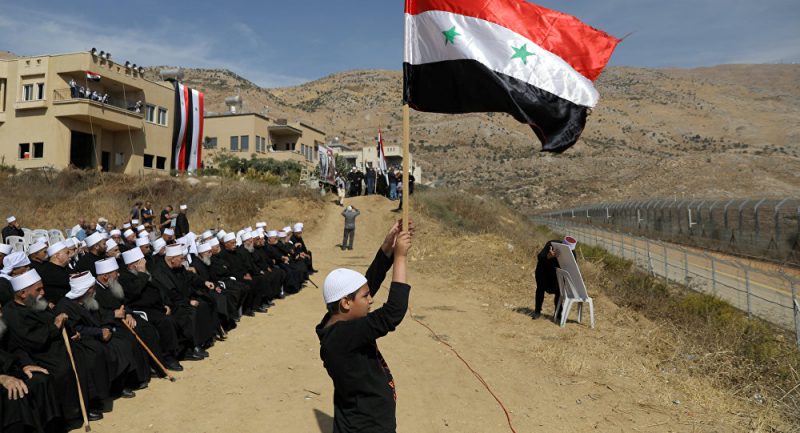
© REUTERS / Ammar Awad
Sputnik – 06.10.2018
Gathering along a fence separating them from the Syrian-controlled side of the Golan Heights, Druze commemorated the anniversary of the start of the 1973 Arab Israeli War while celebrating Syria’s successes in its recent war against the terrorists.
Carrying Syrian flags, portraits of President Bashar Assad, binoculars and megaphones, the Druze community in the village of Massade chanted loyalty to the Syrian government, with troops and civilians on the other side of the border shouting and waving back.
Local resident Emil Masoud told Reuters that the rally was meant to “celebrate the final stages of the war… and to celebrate with our people in Syria the final stage of victory.”
The village of Massade, part of Syria’s Quneitra District, has been under Israeli occupation since the Arab-Israeli War of 1967.
Israel occupied 1,200 square kilometers of the 1,800 square-kilometer Golan Heights during the Six-Day War, and formally annexed it in 1981. The UN Security Council condemned the decision and called the move to impose Israeli “laws, jurisdiction and administration” over the territory “null and void and without international legal effect.”
During the conflict in Syria, much of southern Syria, including the Syrian-controlled portion of the Golan Heights, was occupied by Islamist militants, including Daesh (ISIS), a terrorist group outlawed in Russia and many other countries. This summer, Syrian forces won back control of their southern border areas from the terrorists.
Last week, Syrian Foreign Minister Walid Muallem called on the international community to compel Israel to abide by UN Security Council resolutions, including the one on the Golan Heights, and stressed Damascus’ determination to fully liberate the Golan Heights, “just as we liberated southern Syria from terrorists.”
Jerusalem: Israel settlers occupy buildings near Al-Aqsa Mosque
MEMO | October 4, 2018
 Israeli settlers have occupied two Palestinian buildings near Al-Aqsa Mosque in occupied East Jerusalem.
In the early hours of this morning, Israeli settlers stormed a building in the Muslim Quarter of the Old City. According to Wafa, the “settlers moved into the building owned by the Joudeh family, which was used as a clinic” in the Aqbat Darwish area, near Al-Aqsa Mosque.
This was the second building in Jerusalem to be taken over in the past two days. Yesterday settlers occupied a building in the Wadi Hilweh area of Silwan, situated just outside the walls of the Old City and below Al-Aqsa Mosque.
This is not the first time these areas have been targeted by illegal Israeli settlers, with Silwan in particular repeatedly facing attempts to drive Palestinian inhabitants from their homes. The “City of David” national park – a tourist site and archaeological dig run by right-wing settler group City of David Foundation (also known as Elad) – is situated in Batan Al-Hawa in Silwan and is frequently used as justification for such illegal activity.
In July, the Israeli Knesset advanced a new law that would allow residential construction in the “City of David” national park. According to a report by Haaretz, “the minutes of the [Elad] committee’s previous meeting in January made it clear that Elad and its leader, David Beeri, are behind the bill, which is designed to promote construction at the site.”
In August a “heritage centre” was opened in the park, with the inauguration attended by senior Israeli and US figures. A Palestinian resident of Silwan, Yakoub Al-Rajabi, explained that: “We know that this was a well-orchestrated plan to force us to leave […] And if we stay, it will paralyse us and isolate us in our homes”.
Since 2002, 700 Palestinians have been facing eviction from their land in Batan Al-Hawa. Their land was transferred to the Benvenisti Trust when Israel’s Justice Ministry issued title deeds to the organisation for the land in question. The trust is controlled by Ateret Cohanim, a right-wing organisation that encourages Jewish Israelis to settle illegally in Palestinian neighbourhoods of Jerusalem.
In June, Israel admitted that its decision to evict the Palestinians of Batan Al-Hawa was “flawed” and that it had not properly investigated the nature of the trust, or the Ottoman-era law that applies to the case. Despite the admission, a number of families have already been evicted from Batan Al-Hawa or are embroiled in court battles to save their homes.
Other areas of Jerusalem are also targeted for illegal Israeli settlement. According to statistics from the Jerusalem Institute, as of 2015 there were some 211,000 Jewish Israelis living in occupied East Jerusalem, amounting to 40 per cent of all inhabitants in these neighbourhoods. The statistics also demonstrate that the number of Israelis living in illegal Jerusalem settlements has grown consistently since the city was occupied in 1967.
READ ALSO: Israel settlers flood Khan Al-Ahmar with waste water
Showdown at Tanf
Sic Semper Tyrannus | October 3, 2018
The reconciliation process initiated by the Russians in Syria has saved countless lives of soldiers, civilians and even jihadists. It also preserved SAA fighting strength, brought a lot of Syrian territory back under the control of Damascus. It brought former jihadists back into the fight on the side of the SAA. This process may appear to be tedious and without the glorious satisfaction of annihilating jihadis in a costly series of rapid offensives, but I firmly believe the reconciliation process is the right way for Syria. This strategy is now being brought to bear at Tanf.
The first evidence of this was the mid-September agreement for the removal of the US trained and backed al-Qaryatayn Martyrs Brigade and 5,000 civilians from the Rukban refugee camp to the Euphrates Shield-held area in northern Aleppo. This was the work of the Russian Reconciliation Center. More recently, tribal leaders from Damascus have met tribal leaders at the refugee camp to discuss their situation. A list of refugees wanting to engage in the reconciliation process is being prepared. Many of those not reconciling with Damascus will be shipped north to join the al-Qaryatayn Martyrs Brigade and their families. The camp evacuations are already underway. Next week the Russians will escort a UN aid convoy into the Rukban Refugee Camp.
Although the US has apparently acquiesced to the Russian plan to depopulate the Rukban Refugee Camp, I believe Russia has cleverly outmaneuvered the US. The SAA is steadily destroying the remaining jihadis on the al-Safa plateau. I believe the US forces at Tanf will soon be left alone without jihadis to control, or even any remaining jihadis to fight. The “fighting ISIS” rationale will disappear and the real reason for remaining at Tanf will become clear. At Israel’s behest, we are blocking the Teheran-Baghdad-Damascus highway.
TTG
https://southfront.org/us-backed-militant-group-in-al-tanaf-accepts-evacuation-agreement-report/
How the tentacles of the US military are strangling the planet
By Vijay Prashad | Asia Times | October 3, 2018
In June this year in Itoman, a city in Okinawa prefecture, Japan, a 14-year-old girl named Rinko Sagara read out of a poem based on her great-grandmother’s experience of World War II. Rinko’s great-grandmother reminded her of the cruelty of war. She had seen her friends shot in front of her. It was ugly.
Okinawa, a small island on the edge of southern Japan, saw its share of war from April to June 1945. “The blue skies were obscured by the iron rain,” wrote Rinko Sagara, channeling the memories of her great-grandmother. The roar of the bombs overpowered the haunting melody from the sanshin, Okinawa’s snakeskin-covered three-string guitar. “Cherish each day,” the poem goes, “for our future is just an extension of this moment. Now is our future.”
This week, the people of Okinawa elected Denny Tamaki of the Liberal Party as the governor of the prefecture. Tamaki’s mother is an Okinawan, while his father – whom he does not know – was a US soldier. Tamaki, like former governor Takeshi Onaga, opposes the US military bases on Okinawa. Onaga wanted the presence of the US military removed from the island, a position that Tamaki seems to endorse.
The United States has more than 50,000 troops in Japan as well as a very large contingent of ships and aircraft. Seventy percent of the US bases in Japan are on Okinawa island. Almost everyone in Okinawa wants the US military to go. Rape by American soldiers – including of young children – has long angered the Okinawans. Terrible environmental pollution – including the harsh noise from US military aircraft – rankles people. It was not difficult for Tamaki to run on an anti-US-base platform. It is the most basic demand of his constituents.
But the Japanese government does not accept the democratic views of the Okinawan people. Discrimination against the Okinawans plays a role here, but more fundamentally there is a lack of regard for the wishes of ordinary people when it comes to a US military base.
In 2009, Yukio Hatoyama led the Democratic Party to victory in national elections on a wide-ranging platform that included shifting Japanese foreign policy from its US orientation to a more balanced approach with the rest of Asia. As prime minister, Hatoyama called for the United States and Japan to have a “close and equal” relationship, which meant that Japan would no longer be ordered around by Washington.
The test case for Hatoyama was the relocation of the Futenma Marine Corps Air Base to a less populated section of Okinawa. His party wanted all the US bases to be removed from the island.
Pressure on the Japanese state from Washington was intense. Hatoyama could not deliver on his promise. He resigned his post. It was impossible to go against US military policy and to rebalance Japan’s relationship with the rest of Asia. Japan, but more properly Okinawa, is in effect a US aircraft carrier.
Japan’s prostituted daughter
Hatoyama could not move an agenda at the national level; likewise, local politicians and activists have struggled to move an agenda in Okinawa. Tamaki’s predecessor Takeshi Onaga – who died in August – could not get rid of the US bases in Okinawa.
Yamashiro Hiroji, head of the Okinawa Peace Action Center, and his comrades regularly protest against the bases and in particular the transfer of the Futenma base. In October 2016, Hiroji was arrested when he cut a barbed-wire fence at the base. He was held in prison for five months and not allowed to see his family. In June 2017, Hiroji went before the United Nations Human Rights Council to say, “The government of Japan dispatched a large police force in Okinawa to oppress and violently remove civilians.” Protest is illegal. The Japanese forces are acting here on behalf of the US government.
Suzuyo Takazato, head of the organization Okinawa Women Act Against Military Violence, has called Okinawa “Japan’s prostituted daughter.” This is a stark characterization. Takazato’s group was formed in 1995 as part of the protest against the rape of a 12-year-old girl by three US servicemen based in Okinawa.
For decades now, Okinawans have complained about the creation of enclaves of their island that operate as places for the recreation of American soldiers. Photographer Mao Ishikawa has portrayed these places, the segregated bars where only US soldiers are allowed to go and meet Okinawan women (her book Red Flower: The Women of Okinawa collects many of these pictures from the 1970s).
There have been at least 120 reported rapes since 1972, the “tip of the iceberg,” says Takazato. Every year there is at least one incident that captures the imagination of the people – a terrible act of violence, a rape or a murder.
What the people want is for the bases to close, since they see the bases as the reason for these acts of violence. It is not enough to call for justice after the incidents; it is necessary, they say, to remove the cause of the incidents.
The Futenma base is to be relocated to Henoko in Nago City, Okinawa. A referendum in 1997 allowed the residents of Nago to vote against a base. A massive demonstration in 2004 reiterated their view, and it was this demonstration that halted construction of the new base in 2005.
Susumu Inamine, former mayor of Nago, is opposed to the construction of any base in his city; he lost a re-election bid this year to Taketoyo Toguchi, who did not raise the base issue, by a slim margin. Everyone knows that if there were a new referendum in Nago over a base, it would be roundly defeated. But democracy is meaningless when it comes to the US military base.
Fort Trump
The US military has a staggering 883 military bases in 183 countries. In contrast, Russia has 10 such bases – eight of them in the former USSR. China has one overseas military base. There is no country with a military footprint that replicates that of the United States. The bases in Japan are only a small part of the massive infrastructure that allows the US military to be hours away from armed action against any part of the planet.
There is no proposal to downsize the US military footprint. In fact, there are only plans to increase it. The United States has long sought to build a base in Poland, whose government now courts the White House with the proposal that it be named “Fort Trump.”
Currently, there are US-NATO military bases in Germany, Hungary and Bulgaria, with US-NATO troops deployments in Estonia, Latvia and Lithuania. The United States has increased its military presence in the Black Sea and in the Baltic Sea.
Attempts to deny Russia access to its only two warm-water ports in Sevastopol, Crimea, and Latakia, Syria, pushed Moscow to defend them with military interventions. A US base in Poland, on the doorstep of Belarus, would rattle the Russians as much as they were rattled by Ukraine’s pledge to join the North Atlantic Treaty Organization and by the war in Syria.
These US-NATO bases provide instability and insecurity rather than peace. Tensions abound around them. Threats emanate from their presence.
A world without bases
In mid-November in Dublin, a coalition of organizations from around the world will hold the First International Conference Against US/NATO Military Bases. This conference is part of the newly formed Global Campaign Against US/NATO Military Bases.
The view of the organizers is that “none of us can stop this madness alone.” By “madness,” they refer to the belligerence of the bases and the wars that come as a result of them.
A decade ago, a US Central Intelligence Agency operative offered me the old chestnut, “If you have a hammer, then everything looks like a nail.” What this means is that the expansion of the US military – and its covert infrastructure – provides the incentive for the US political leadership to treat every conflict as a potential war. Diplomacy goes out of the window. Regional structures to manage conflict – such as the African Union and the Shanghai Cooperation Organization – are disregarded. The US hammer comes down hard on nails from one end of Asia to the other end of the Americas.
The poem by Rinko Sagara ends with an evocative line: “Now is our future.” But it is, sadly, not so. The future will need to be produced – a future that disentangles the massive global infrastructure of war erected by the United States and NATO.
It is to be hoped that the future will be made in Dublin and not in Warsaw; in Okinawa and not in Washington.
This article was produced by Globetrotter, a project of the Independent Media Institute, which provided it to Asia Times.
UK to keep forces in Germany after Brexit, plans to expand presence outside borders
Press TV – October 1, 2018
British Defense Secretary Gavin Williamson says UK forces stationed in Germany will continue to stay in the country after Britain’s pending exit from the European Union (EU).
“We are increasing our British points of presence across the world,” Williamson told the Telegraph on Sunday as he announced the UK’s new military strategy in the Arctic. “We will not be closing our facilities in Germany, and instead use them to forward base the Army.”
There are 185 British Army personnel and 60 Ministry of Defense (MoD) staff currently based in the 45-square mile Sennelager Training Area in near the western city of Paderborn.
The UK and the US-led NATO military alliance have been using Sennelager as an expansive live firing training area over the past years.
The personnel would continue to occupy the adjacent Athlone Barracks for housing and schooling, the MoD said in a statement.
The British army would also keep control over the Ayrshire Barracks in Mönchengladbach, which can house around 2,000 military vehicles. They will also maintain a presence at the German Wulfen Defence Munitions Storage Facility, which holds operational ammunition.
According to the MoD statement, British military personnel will also stay in Germany to support NATO’s other critical infrastructure and assets such as the combined river crossing unit based in Minden.
Williamson also announced that that London was planning to send around 800 troops to Norway as a warning shot to Russia.
The decision was part of the UK’s plan to step up its military presence in the Arctic region in order to address concerns about growing Russian aggression “in our back yard,” he said.
The UK Royal Navy and its Norwegian counterpart have already purchased a large fleet of US-made P-8 Poseidon surveillance aircraft to stop what they call Russia’s growing submarine activity near their territorial waters.
“We see Russian submarine activity very close to the level that it was at the Cold War, and it’s right that we start responding to that,” Williamson said.
Anti-US base candidate wins Okinawa governor elections
RT | September 30, 2018
A staunch opponent of the planned relocation of a US military base within Okinawa Island, where the issue sparked major public protests, has beaten a government-backed competitor in the local governor elections.
Denny Tamaki, a former opposition lawmaker and the son of a US marine, has got a win against Atsushi Sakima, the former mayor of a local city of Ginowan, who was backed by Prime Minister Shinzo Abe’s ruling Liberal Democratic Party. The vote was largely determined by the issue of the relocation of the US Marine Corps Air Station Futenma, which has been a source of controversy for the locals over the years.
Tamaki vowed to continue fighting against relocation of the US base from the crowded town of Ginowan to the less populated coastal region of Nago, which would put corals and dugongs, the endangered marine mammals, at risk, according to environmental activists. He also pledged to follow the steps of the former Okinawa governor Takeshi Onaga, who had been an outspoken opponent of the relocation until his death in August that prompted early gubernatorial elections.
His major rival in the four-person race, Sakima, also supported the closure of the existing Futenma base but did not clarify his stance on the issue of relocation. Tamaki, meanwhile, vowed to continue fighting for the base to be relocated off the island.
Tamaki’s victory is considered to be a blow to Abe’s plans as the prime minister is pushing for the controversial base relocation plan despite vehement opposition from the locals, the Japanese media report. Okinawa, which amounts to less than one percent of the Japanese total land area, hosts about a half of the 50,000 American troops in Japan.
The US presence on the island has long been a source of discontent for the locals. Okinawans have raised concerns about machinery mishaps, noise, sexual assaults against Japanese women, and even some deadly incidents – all of which triggered massive protests. Onaga also repeatedly clashed with the government over the relocation issue in particular.
In 2015, he revoked an approval for the construction works issued by his predecessor. His decision was overruled by the central government, which went ahead with the project. In August, the local government retracted the permission again. Since then, the work has been suspended.
Following Onaga’s death in August, 70,000 people protested the Japanese government’s plan to relocate the US air base. Participants also held a one-minute silence to pay respect to the late governor.
Bolivia: Morales Seeks New Relationship With Chile After Ruling
teleSUR | September 29, 2018
Bolivia’s President Evo Morales hopes to start a “new era” in his nation’s relationship with Chile once the International Court of Justice rules on Bolivia’s demand for sea access on Monday.
The new age will take “advantage of our potentialities, promoting integration for the well being of our peoples,” Morales said. “It’s necessary to cure injuries from the past.”
After a years-long process, the court will decide whether the Chilean government must negotiate a sea exit for Bolivia. La Paz issued the demand in April 2013.
Morales said he values peaceful solutions for international disputes, based on international law.
“Bolivia will never give up in its cause, that’s why the Bolivian people will gather on October 1 without divisions, without difference around our three-color flag, our wiphala and our sea claim flag,” he said. “Our reunion with the sea is not only possible, but inevitable.”
He also asked the people of Chile to understand the demand shouldn’t be considered an “unfriendly act,” but rather an opportunity.
Bolivia demanded the court declare Chile must negotiate an exit for the Pacific Ocean, based on diplomatic evidence it has previously agreed to do so.
Chile is denying any negotiation based on a 1904 treaty between both countries, giving up 120,000 square kilometers of territory, including 400 shore kilometers, to Chile.
The treaty was a result of the War of the Pacific, in which Bolivia and Peru fought against Chile between 1879 and 1883.
The UN’s International Court of Justice is legally binding but it has no means to enforce its rulings over the states.
Syrian FM Accuses Israel of Supporting Terrorists in Country’s South
Sputnik – 30.09.2018
UNITED NATIONS – Israel supported terrorist groups in southern Syria through “direct military intervention” and repeated attacks against the Arab republic, Syrian Foreign Minister Walid Muallem said on Saturday.
“Israel even supported terrorist groups that operated in southern Syria protecting them through direct military intervention and launching repeated attacks on Syrian territories,” Muallem said, addressing the 73rd UN General Assembly.
During his speech, he also reiterated Damascus’ determination to fully liberate the Israel-occupied Golan Heights up to the line of June 4, 1967, “just as we liberated southern Syria from terrorists.”
Muallem called on the international community to compel Israel to abide by UN Security Council resolutions, including the one on the Golan Heights.
The diplomat also urged the international community to “help the Palestinian people establish their own independent state with Jerusalem as its capital and facilitate the return of Palestinian refugees to their land.”
He also characterized as null and void Israel’s “racist” nation state law and the US decision to relocate its embassy from Tel Aviv to Jerusalem.
Israel took control of the Golan Heights during the Six-Day War of 1967, while the Israeli parliament later announced that the territory belonged to Israel. However, the United Nations urged Israel to leave the land. Some of the territory was later returned to Syria.
Moscow Warns Tel Aviv against Potential Strikes On Lebanon

Russian Foreign Minister Sergey Lavrov
Al-Manar | September 29, 2018
Russia warns the Zionist entity against any potential strikes on Lebanon, Russian Foreign Minister Sergey Lavrov said on Friday, stressing that this would be a gross violation of international law.
“This would certainly be a gross violation of international law and we would be very much against such any action,” Lavrov said.
“We warn against any violation of the [UN] Security Council resolutions, and attack and actually even the use of Lebanese air space is a violation of the resolutions of the UN Security Council,” the diplomat stressed.
Iraq not allowing Turkish troops back to Bashiqa: Report
Press TV – September 23, 2018
Iraq has refused to allow Turkish troops back into the Arab country following a leave from their bases, a government-affiliated think tank in Baghdad has reported.
According to Al-Nahrain Center for Strategic Studies, the move is in line with the Iraqi government’s efforts to put an end to Turkish military presence in the country.
The measure had been adopted over the previous months, withholding visas to the Turkish forces who sought to return to Iraq, Iraqi News website reported on Sunday.
Watheq al-Hashemi, director of the center, said the decision had helped reduce the number of Turkish troops significantly.
“The government’s stance of not allowing Turkish soldiers to return will end the Turkish military presence in Bashiqa without any diplomatic or military friction,” he said.
The Bashiqa camp, al-Hashemi said, is totally cordoned by Iraqi troops and Turkey cannot carry out any plans without the knowledge of Iraqi troops.
Turkey has been conducting air raids against areas in northern Iraq, which serve as safe havens for the Kurdistan Workers’ Party (PKK) militants. The militants have been fighting a deadly separatist war against Ankara.
In 2014, Turkey sent troops to Bashiqa in northern Iraq under the banner of fighting the Daesh terror group which was defeated in the country late last year.
Baghdad has repeatedly called on Ankara to pull out its forces but Turkey says they will stay as long as the PKK threat persists.
The decision was made during a meeting of the Iraqi Ministerial Council for National Security chaired by Prime Minister Haider al-Abadi. The meeting also instructed the Foreign Ministry to “take the necessary measures to document the Turkish violations of Iraqi airspace to the United Nations.”
Featured Video

Trita Parsi: Israel Set a Trap for Total War in the Region
or go to
Aletho News Archives – Video-Images
Book Review
Why the War on Conspiracy Theories Is Bad Public Policy
By Kevin Barrett • Unz Review • February 1, 2019
 A Review of Conspiracy Theories and Other Dangerous Ideas by Cass Sunstein (based on an earlier paper co-authored with Adrian Vermeule); In Defense of Troublemakers: The Power of Dissent in Life and Business by Charlan Nemeth; and Conspiracy Theories and the People Who Believe Them, edited by Joseph E. Uscinski
On January 25 2018 YouTube unleashed the latest salvo in the war on conspiracy theories, saying “we’ll begin reducing recommendations of borderline content and content that could misinform users in harmful ways—such as videos promoting a phony miracle cure for a serious illness, claiming the earth is flat, or making blatantly false claims about historic events like 9/11.”
At first glance that sounds reasonable. Nobody wants YouTube or anyone else to recommend bad information. And almost everyone agrees that phony miracle cures, flat earthism, and blatantly false claims about 9/11 and other historical events are undesirable.
But if we stop and seriously consider those words, we notice a couple of problems. First, the word “recommend” is not just misleading but mendacious. YouTube obviously doesn’t really recommend anything. When it says it does, it is lying. … continue
Blog Roll
 Aletho News
- Putin’s key remarks on peace talks and Europe’s ‘schizophrenia’
- Trita Parsi: Israel Set a Trap for Total War in the Region
- Trump’s Iran war is on an Israeli leash
- Saudi oil boss issues global supply warning
- Riyadh Says Its Oil System Is Intact. The Numbers Say Otherwise.
- Trump and Netanyahu Want to “Finish the Job” on Iran
- US ‘one-sided dictation’ not Iran’s beliefs makes rational talks impossible: Baghaei
- Iran’s Next Strike May Not Explode. It Could Shut You Down /Col Doug Macgregor
- Iran: US political targets legitimate if assassinations return
- Iraq shuts key border crossing with Iran under US pressure: Report
- If Americans Knew
- DAILY UPDATE: Latest essential news on Palestine, Israel, & region
- The Israel Lobby’s Changing Fortunes
- AIPAC has become such a political liability that it’s shifting to a more “nimble” approach to buying politicians
- At least 160 Israeli settler attacks in 2 weeks
- Will Gaza’s Ancient Christian Community Disappear Forever?
- Israel’s vision of regional security rests on keeping Arab states weak
- Heidi Levine recounts how Palestinian youths helped save her in settler attack
- DAILY UPDATE: Latest essential news on Palestine, Israel, & region
- Trump’s Intensifying Sabotage of the ICC, for Israel’s Sake
- Israeli military detain US and UK volunteers in West Bank including Democratic NY politician Brad Lander
- No Tricks Zone
- E-Cars Reduce CO2 Emissions By Only 41% Compared To Internal Combustion Engine Vehicles
- Predictions Made By Renowned Climate Professor Over Past Decades Have Been Proven To Be Poor
- New Study Suggests Large Regions Of The Pacific Ocean Have Been Cooling For The Last 80 Years
- Germany’s Green Energy Debacle: High Energy Costs Force Kahla Porzellan to Close After 182 Years!
- New Study: 50 Years Of The Most Aggressive ‘Net Zero’ Policies Can Only Affect The Global Climate By 0.03°C
- US September “Heat” Was No Record…Many Records Set Decades Ago
- Latest European Green Energy Debacle; Portugal’s Largest Flagship Solar Park Insolvent!
- Green Energy Debacle: German Expert Professor Fritz Vahrenholt Warns Of Severe Economic And Social Consequences
- Two More Paleo Reconstructions Affirm Meters-Higher Sea Levels Across Ireland, Brazil 7000-6000 Years Ago
- New Study: Earth And Venus Surface Warmth Largely Explained By Convection And Lapse Rate, Not CO2 Or Radiation

