The FBI Hand Behind Russia-gate
By Ray McGovern | Consortium News | January 11, 2018
Russia-gate is becoming FBI-gate, thanks to the official release of unguarded text messages between loose-lipped FBI counterintelligence official Peter Strzok and his garrulous girlfriend, FBI lawyer Lisa Page. (Ten illustrative texts from their exchange appear at the end of this article.)
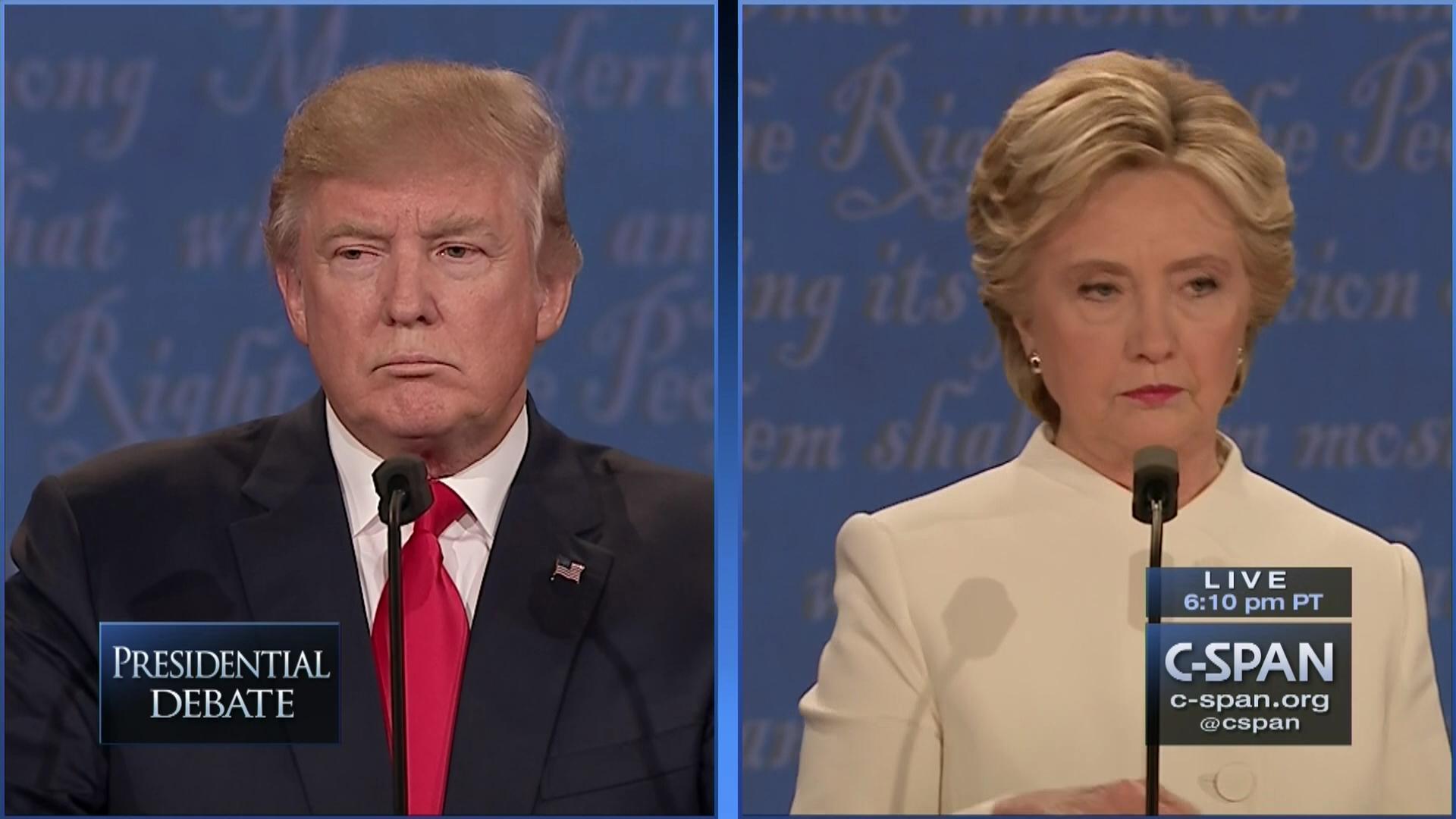
Donald Trump and Hillary Clinton in their third debate,
as Clinton called Trump Vladimir Putin’s “puppet.”
Despite his former job as chief of the FBI’s counterintelligence section, Strzok had the naive notion that texting on FBI phones could not be traced. Strzok must have slept through “Security 101.” Or perhaps he was busy texting during that class. Girlfriend Page cannot be happy at being misled by his assurance that using office phones would be a secure way to conduct their affair(s).
It would have been unfortunate enough for Strzok and Page to have their adolescent-sounding texts merely exposed, revealing the reckless abandon of star-crossed lovers hiding (they thought) secrets from cuckolded spouses, office colleagues, and the rest of us. However, for the never-Trump plotters in the FBI, the official release of just a fraction (375) of almost 10,000 messages does incalculably more damage than that.
We suddenly have documentary proof that key elements of the U.S. intelligence community were trying to short-circuit the U.S. democratic process. And that puts in a new and dark context the year-long promotion of Russia-gate. It now appears that it was not the Russians trying to rig the outcome of the U.S. election, but leading officials of the U.S. intelligence community, shadowy characters sometimes called the Deep State.
More of the Strzok-Page texting dialogue is expected to be released. And the Department of Justice Inspector General reportedly has additional damaging texts from others on the team that Special Counsel Robert Mueller selected to help him investigate Russia-gate.
Besides forcing the removal of Strzok and Page, the text exposures also sounded the death knell for the career of FBI Deputy Director Andrew McCabe, in whose office some of the plotting took place and who has already announced his plans to retire soon.
But the main casualty is the FBI’s 18-month campaign to sabotage candidate-and-now-President Donald Trump by using the Obama administration’s Russia-gate intelligence “assessment,” electronic surveillance of dubious legality, and a salacious dossier that could never pass the smell test, while at the same time using equally dubious techniques to immunize Hillary Clinton and her closest advisers from crimes that include lying to the FBI and endangering secrets.
Ironically, the Strzok-Page texts provide something that the Russia-gate investigation has been sorely lacking: first-hand evidence of both corrupt intent and action. After months of breathless searching for “evidence” of Russian-Trump collusion designed to put Trump in the White House, what now exists is actual evidence that senior officials of the Obama administration colluded to keep Trump out of the White House – proof of what old-time gumshoes used to call “means, motive and opportunity.”
Even more unfortunately for Russia-gate enthusiasts, the FBI lovers’ correspondence provides factual evidence exposing much of the made-up “Resistance” narrative – the contrived storyline that The New York Times and much of the rest of the U.S. mainstream media deemed fit to print with little skepticism and few if any caveats, a scenario about brilliantly devious Russians that not only lacks actual evidence – relying on unverified hearsay and rumor – but doesn’t make sense on its face.
The Russia-gate narrative always hinged on the preposterous notion that Russian President Vladimir Putin foresaw years ago what no American political analyst considered even possible, the political ascendancy of Donald Trump. According to the narrative, the fortune-telling Putin then risked creating even worse tensions with a nuclear-armed America that would – by all odds – have been led by a vengeful President Hillary Clinton.
Besides this wildly improbable storyline, there were flat denials from WikiLeaks, which distributed the supposedly “hacked” Democratic emails, that the information came from Russia – and there was the curious inability of the National Security Agency to use its immense powers to supply any technical evidence to support the Russia-hack scenario.
The Trump Shock
But the shock of Trump’s election and the decision of many never-Trumpers to cast their lot with the Resistance led to a situation in which any prudent skepticism or demand for evidence was swept aside.
So, on Jan. 6, 2017, President Obama’s Director of National Intelligence James Clapper released an evidence-free report that he said was compiled by “hand-picked” analysts from the CIA, FBI and NSA, offering an “assessment” that Russia and President Putin were behind the release of the Democratic emails in a plot to help Trump win the presidency.
Despite the extraordinary gravity of the charge, even New York Times correspondent Scott Shane noted that proof was lacking. He wrote at the time: “What is missing from the [the Jan. 6] public report is what many Americans most eagerly anticipated: hard evidence to back up the agencies’ claims that the Russian government engineered the election attack. … Instead, the message from the agencies essentially amounts to ‘trust us.’”
But the “assessment” served a useful purpose for the never-Trumpers: it applied an official imprimatur on the case for delegitimizing Trump’s election and even raised the long-shot hope that the Electoral College might reverse the outcome and possibly install a compromise candidate, such as former Secretary of State Colin Powell, in the White House. Though the Powell ploy fizzled, the hope of somehow removing Trump from office continued to bubble, fueled by the growing hysteria around Russia-gate.
Virtually all skepticism about the evidence-free “assessment” was banned. For months, the Times and other newspapers of record repeated the lie that all 17 U.S. intelligence agencies had concurred in the conclusion about the Russian “hack.” Even when that falsehood was belatedly acknowledged, the major news outlets just shifted the phrasing slightly to say that U.S. intelligence agencies had reached the Russian “hack” conclusion. Shane’s blunt initial recognition about the lack of proof disappeared from the mainstream media’s approved narrative of Russia-gate.
Doubts about the Russian “hack” or dissident suggestions that what we were witnessing was a “soft coup” were scoffed at by leading media commentators. Other warnings from veteran U.S. intelligence professionals about the weaknesses of the Russia-gate narrative and the danger of letting politicized intelligence overturn a constitutional election were also brushed aside in pursuit of the goal of removing Trump from the White House.
It didn’t even seem to matter when new Russia-gate disclosures conflicted with the original narrative that Putin had somehow set Trump up as a Manchurian candidate. All normal journalistic skepticism was jettisoned. It was as if the Russia-gate advocates started with the conclusion that Trump must go and then made the facts fit into that mold, but anyone who noted the violations of normal investigative procedures was dismissed as a “Trump enabler” or a “Moscow stooge.”
The Text Evidence
But then came the FBI text messages, providing documentary evivdence that key FBI officials involved in the Russia-gate investigation were indeed deeply biased and out to get Trump, adding hard proof to Trump’s longstanding lament that he was the subject of a “witch hunt.”
Justified or not, Trump’s feeling of vindication could hardly be more dangerous — particularly at a time when the most urgent need is to drain some testosterone from the self-styled Stable-Genius-in-Chief and his martinet generals.
On the home front, Trump, his wealthy friends, and like-thinkers in Congress may now feel they have an even wider carte blanche to visit untold misery on the poor, the widow, the stranger and other vulnerable humans. That was always an underlying danger of the Resistance’s strategy to seize on whatever weapons were available – no matter how reckless or unfair – to “get Trump.”
Beyond that, Russia-gate has become so central to the Washington establishment’s storyline that there appears to be no room for second-thoughts or turning back. The momentum is such that some Democrats and the media never-Trumpers can’t stop stoking the smoke of Russia-gate and holding out hope against hope that it will somehow justify Trump’s impeachment.
Yet, the sordid process of using legal/investigative means to settle political scores further compromises the principle of the “rule of law” and integrity of journalism in the eyes of many Americans. After a year of Russia-gate, the “rule of law” and “pursuit of truth” appear to have been reduced to high-falutin’ phrases for political score-setttling, a process besmirched by Republicans in earlier pursuits of Democrats and now appearing to be a bipartisan method for punishing political rivals regardless of the lack of evidence.
Strzok and Page
Peter Strzok (pronounced “struck”) has an interesting pedigree with multiple tasks regarding both Mrs. Clinton and Mr. Trump. As the FBI’s chief of counterespionage during the investigation into then-Secretary of State Hillary Clinton’s unauthorized use of a personal email server for classified information, Strzok reportedly changed the words “grossly negligent” (which could have triggered legal prosecution) to the far less serious “extremely careless” in FBI Director James Comey’s depiction of Clinton’s actions. This semantic shift cleared the way for Comey to conclude just 20 days before the Democratic National Convention began in July 2016, that “no reasonable prosecutor” would bring charges against Mrs. Clinton.
Then, as Deputy Assistant Director of the Counterintelligence Division, Strzok led the FBI’s investigation into alleged Russian interference in the U.S. election of 2016. It is a safe bet that he took a strong hand in hand-picking the FBI contingent of analysts that joined “hand-picked” counterparts from CIA and NSA in preparing the evidence-free, Jan. 6, 2017 assessment accusing Russian President Vladimir Putin of interfering in the election of 2016. (Although accepted in Establishment groupthink as revealed truth, that poor excuse for analysis reflected the apogee of intelligence politicization — rivaled only by the fraudulent intelligence on “weapons of mass destruction“ in Iraq 15 years ago.)
In June and July 2017 Strzok was the top FBI official working on Special Counsel Robert Mueller’s investigation into possible links between the Trump campaign and Russia, but was taken off that job when the Justice Department IG learned of the Strzok-Page text-message exchange and told Mueller.
There is no little irony in the fact that what did in the FBI sweathearts was their visceral disdain for Mr. Trump, their cheerleading-cum-kid-gloves treatment of Mrs. Clinton and her associates, their 1950-ish, James Clapperesque attitude toward Russians as “almost genetically driven” to evil, and their (Strzok/Page) elitist conviction that they know far better what is good for the country than regular American citizens, including those “deplorables” whom Clinton said made up half of Trump’s supporters.
But Strzok/Page had no idea that their hubris, elitism and scheming would be revealed in so tangible a way. Worst of all for them, the very thing that Strzok, in particular, worked so hard to achieve — the sabotaging of Trump and immunization of Mrs. Clinton and her closest advisers is now coming apart at the seams.
Congress: Oversee? or Overlook?
At this point, the $64 question is whether the various congressional oversight committees will remain ensconced in their customarily cozy role as “overlook” committees, or whether they will have the courage to attempt to carry out their Constitutional duty. The latter course would mean confronting a powerful Deep State and its large toolbox of well-practiced retaliatory techniques, including J. Edgar Hoover-style blackmail on steroids, enabled by electronic surveillance of just about everything and everyone. Yes, today’s technology permits blanket collection, and “Collect Everything” has become the motto.
Sen. Chuck Schumer, D-New York, with almost four decades of membership in the House and Senate, openly warned incoming President Trump in January 2017 against criticizing the U.S. intelligence community because U.S. intelligence officials have “six ways from Sunday to get back at you” if you are “dumb” enough to take them on.
Thanks to the almost 10,000 text messages between Strzok and Page, only a small fraction of which were given to Congress four weeks ago, there is now real evidentiary meat on the bones of the suspicions that there indeed was a “deep-state coup” to “correct” the outcome of the 2016 election. We now know that the supposedly apolitical FBI officials had huge political axes to grind. The Strzok-Page exchanges drip with disdain for Trump and those deemed his smelly deplorable supporters. In one text message, Strzok expressed visceral contempt for those working-class Trump voters, writing on Aug. 26, 2016, “Just went to a southern Virginia Walmart. I could SMELL the Trump support. … it’s scary real down here.”
The texts even show Strzok warning of the need for an “insurance policy” to thwart Trump on the off-chance that his poll numbers closed in on those of Mrs. Clinton.
An Aug. 6, 2016 text message, for example, shows Page giving her knight in shining armor strong affirmation: “Maybe you’re meant to stay where you are because you’re meant to protect the country from that menace [Trump].” That text to Strzok includes a link to a David Brooks column in The New York Times, in which Brooks concludes with the clarion call: “There comes a time when neutrality and laying low become dishonorable. If you’re not in revolt, you’re in cahoots. When this period and your name are mentioned, decades hence, your grandkids will look away in shame.”
Another text message shows that other senior government officials – alarmed at the possibility of a Trump presidency – joined the discussion. In an apparent reference to an August 2016 meeting with FBI Deputy Director Andrew McCabe, Strzok wrote to Page on Aug. 15, 2016, “I want to believe the path you threw out for consideration in Andy’s office — that there’s no way he [Trump] gets elected — but I’m afraid we can’t take that risk.” Strzok added, “It’s like an insurance policy in the unlikely event that you die before you’re 40.”
Insurance Policy?
Senate Judiciary Committee chair Chuck Grassley, R-Iowa, says he will ask Strzok to explain the “insurance policy” when he calls him to testify. What seems already clear is that the celebrated “Steele Dossier” was part of the “insurance,” as was the evidence-less legend that Russia hacked the DNC’s and Clinton campaign chairman John Podesta’s emails and gave them to WikiLeaks.
If congressional investigators have been paying attention, they already know what former weapons inspector Scott Ritter shared with Veteran intelligence Professionals for Sanity (VIPS) colleagues this week; namely, that Fusion GPS’s Glenn Simpson, who commissioned the Russia dossier using Democratic Party money, said he reached out to Steele after June 17, just three days before Steele’s first report was published, drawing on seven sources.
“There is a snowball’s chance in hell that this is raw intelligence gathered by Steele; rather he seems to have drawn on a single ‘trusted intermediary’ to gather unsubstantiated rumor already in existence.”
Another VIPS colleague, Phil Giraldi, writing out of his own experience in private sector consulting, added: “The fact that you do not control your sources frequently means that they will feed you what they think you want to hear. Since they are only doing it for money, the more lurid the details the better, as it increases the apparent value of the information. The private security firm in turn, which is also doing it for the money, will pass on the stories and even embroider them to keep the client happy and to encourage him to come back for more. When I read the Steele dossier it looked awfully familiar to me, like the scores of similar reports I had seen which combined bullshit with enough credible information to make the whole product look respectable.”
It is now widely known that the Democrats ponied up the “insurance premiums,” so to speak, for former British intelligence officer Christopher Steele’s “dossier” of lurid — but largely unproven — “intelligence” on Trump and the Russians. If, as many have concluded, the dossier was used to help justify a FISA warrant to snoop on the Trump campaign, those involved will be in deep kimchi, if congressional overseers do their job.
How, you might ask, could Strzok and associates undertake these extra-legal steps with such blithe disregard for the possible consequences should they be caught? The answer is easy; Mrs. Clinton was a shoo-in, remember? This was just extra insurance with no expectation of any “death benefit” ever coming into play — save for Trump’s electoral demise in November 2016. The attitude seemed to be that, if abuse of the FISA law should eventually be discovered — there would be little interest in a serious investigation by the editors of The New York Times and other anti-Trump publications and whatever troubles remained could be handled by President Hillary Clinton.
Sen. Lindsey Graham, R-South Carolina, who chairs the Judiciary Subcommittee of Judiciary on Crime and Terrorism, joined Sen. Grassley in signing the letter referring Christopher Steele to the Justice Department to investigate what appear to be false statements about the dossier. In signing, Graham noted the “many stop signs the Department of Justice ignored in its use of the dossier.” The signature of committee ranking member Sen. Dianne Feinstein, D-California, however, was missing — an early sign that a highly partisan battle royale is in the offing. On Tuesday, Feinstein unilaterally released a voluminous transcript of Glenn Simpson’s earlier testimony and, as though on cue, Establishment pundits portrayed Steele as a good source and Fusion GPS’s Glenn Simpson as a victim.
The Donnybrook is now underway; the outcome uncertain.
+++++++++++++
Sample text messages between Peter Strzok and Lisa Page, released to Congress and the media on December 13, 2016
++++++++++++++
03/04/2016
Strzok – God Hillary should win. 100,000,000-0.
Page – I know
++++++++++++
04/02/2016
Page – So look, you say we text on that phone when we talk about Hillary because it can’t be traced, you were just venting, bc you feel bad that you’re gone so much but that can’t be helped right now.
++++++++++
07/08/2016
Strzok – And meanwhile, we have Black Lives Matter protestors, right now, chanting “no justice no peace” around DoJ and the White House…
Page – That’s awful.
+++++++++
07/14/2016
Page – Have you read this? It’s really frightening. For Whites Sensing Decline, Donald Trump Unleashes Words of Resistance http://NYTI/ms/29WCu5!
Strzok – I have not. But I think it’s clear he’s capturing all the white, poor voters who the mainstream republicans abandoned in all but name in the quest for the almighty $$$
Page – Yeah, it’s not good.
Strzok – Poll Finds Emails Weighing on Hillary Clinton, Now Tied With Donald Trump http://nyti.ms/29RV5gf
Page – It is
+++++++++++++
07/26/2016
Strzok – And hey. Congrats on a woman nominated for President in a major party! About damn time! Many many more returns of the day!!
Page – That’s cute. Thanks
++++++++++
08/06/2016
Page – Jesus. You should read this. And Trump should go f himself. Moment in Convention Glare Shakes Up Khans American Life http://nyti.ms/2aHulE0
Strzok – God that’s a great article. Thanks for sharing. And F TRUMP.
++++++++
08/06/2016
Page – And maybe you’re meant to stay where you are because you’re meant to protect the country from that menace. To that end comma, read this:
Page – Trump Enablers Will Finally Have to Take A Stand http://nyti.ms/2aFakry
Strzok – Thanks. It’s absolutely true that we’re both very fortunate. And of course I’ll try and approach it that way. I just know it will be tough at times. I can protect our country at many levels, not sure if that helps
++++++++++++
08/09/2016
Page – He’s not ever going to become president, right? Right?!
Strzok – OMG did you hear what Trump just said?
+++++++++++
08/26/2016
Strzok – Just went to a southern Virginia Walmart. I could SMELL the Trump support…
Page – Yep. Out to lunch with (redacted) We both hate everyone and everything.
Page – Just riffing on the hot mess that is our country.
Strzok – Yeah…it’s scary real down here
+++++++++
10/20/2016
Strzok: I am riled up. Trump is a f***ing idiot, is unable to provide a coherent answer.
Strzok – I CAN’T PULL AWAY, WHAT THE F**K HAPPENED TO OUR COUNTRY (redacted)??!?!
Page– I don’t know. But we’ll get it back. We’re America. We rock.
Strzok– Donald just said “bad hombres”
Strzok– Trump just said what the FBI did is disgraceful.
END
Ray McGovern works with Tell the Word, a publishing arm of the ecumenical Church of the Saviour in inner-city Washington. He was an Army and CIA intelligence analyst for 30 years; prepared and briefed the President’s Daily Brief for Nixon, Ford, and Reagan; and is co-founder of Veteran Intelligence Professionals for Sanity (VIPS).
NATO’s Fraudulent War on Behalf of Women
By George Szamuely | CounterPunch | January 9, 2018
In a recent Guardian article titled “Why NATO Must Defend Women’s Rights,” NATO Secretary-General Jens Soltenberg and Hollywood movie star Angelina Jolie assert that “NATO has the responsibility and opportunity to be a leading protector of women’s rights.” NATO, moreover, “can become the global military leader in how to prevent and respond to sexual violence in conflict.” The two vowed to identify “ways in which NATO can strengthen its contribution to women’s protection and participation in all aspects of conflict-prevention and resolution.”
The pairing of a NATO bureaucrat and a famous movie actress may at first glance appear odd. However, this partnership has been long in the making. Some years ago, NATO, always on the lookout for a reason to justify its continued existence, not to mention its perpetual expansion, came up with a new raison d’être: It would be the global champion of women. “Achieving gender equality is our collective task. And NATO is doing its part,” said Mari Skåre, the NATO Secretary General’s Special Representative for Women, Peace and Security, in 2013. In March 2016, on International Women’s Day, NATO held a so-called “Barbershop Conference” on gender equality. Stoltenberg took the opportunity to declare that gender equality was a frightfully important issue for NATO because “NATO is a values-based organization and none of the Alliance’s fundamental values—individual liberties, democracy, human rights and the rule of law—work without equality.” Diversity was a source of strength. “We learned in Afghanistan and in the Balkans that by integrating gender within our operations, we make a tangible difference to the lives of women and children,” Stoltenberg explained. He stressed that NATO is proud of its record in embedding gender perspectives within its work. Last November, Stoltenberg was at it again: “Empowering women is not just the right thing to do, it’s the smart thing to do: it makes countries safer and more stable. NATO is determined to make a difference.”
NATO has indeed made a difference but not through empowering women. When it isn’t bombing, killing, blowing up bridges and buildings, destroying wedding receptions, empowering jihadis, triggering refugee flows and ruining the lives of countless women, NATO holds unctuous press briefings, organizes self-congratulatory conferences and publishes articles such as the one by Stoltenberg/Jolie seeking to present a gargantuan 29-state military coalition as a do-gooder charity helping out the needy.
This is where Angelina Jolie comes in. Jolie is a goodwill ambassador of the United Nations High Commissioner for Refugees (UNHCR) and, in that capacity, wanders around the world berating the “international community” for not doing enough to address humanitarian crises. Her take on these crises is invariably the same as that of NATO. “It is important that we intervene in a timely fashion,” she once explained, “diplomatically if we can, with force if we must.” In October 2011, following seven months of relentless NATO bombing, Jolie rushed to Libya and excitedly hailed the Libyan “revolution”:
I’m… here on behalf of the Libyan people to show them solidarity. I think this revolution on behalf of human rights, which is what I feel these people really have been doing and what they have pushed for, and to help them to implement these new laws and help them with the future of their country.
Sometimes it’s breathless enthusiasm for “revolution,” sometimes it’s tearful pleading for plain, old-fashioned “humanitarian intervention”—Angelina Jolie is nothing if not consistent in her advocacy for Western use of force. When it comes to Syria, Jolie has declared that “some form of intervention is absolutely necessary.” She sneered at the U.N. Security Council permanent members that stood in the way of intervention. “I feel very strongly that the use of a veto when you have financial interests in the country should be questioned and the use of a veto against humanitarian intervention should be questioned,” she said in an interview. Jolie was of course simply echoing the blustery words of the Obama administration. Recall Susan Rice’s tirade following Russia’s and China’s veto of a February 2012 Security Council resolution calling for Bashar al Assad to step aside and for the Syrian army to return to its barracks. Rice, then U.S. permanent representative at the U.N., called the vetoes “disgusting and shameful.” The countries “that have blocked potentially the last effort to resolve this peacefully…will have any future blood spill on their hands.”
This kind of attack on the veto-wielding Security Council members has become a staple of the humanitarian intervention crowd. For example, former French President François Hollande told the U.N. General Assembly in September 2013 that when mass atrocities were taking place, U.N. Security Council permanent members must give up their veto powers:
The U.N. has a responsibility to take action. And whenever our organization proves to be powerless, it’s peace that pays the price. That’s why I am proposing that a code of good conduct be defined by the permanent members of the Security Council, and that in the event of a mass crime they can decide to collectively renounce their veto powers.
Taking action, of course, means taking military action. It never means, say, the lifting of sanctions so that food, oil, medical supplies could get through. To the contrary, if military action is ruled out, the humanitarians immediately resort to demanding the tightening of sanctions. Interventionists such as Hollande, Rice, et al., never explain why it is necessary for U.N. permanent members to give up their veto if the right course of action is so self-evident. The unstated assumption obviously is that any reluctance to sanction the use of force must be motivated by moral failings such as greed, selfishness, political ambition or lack of compassion.
The heartlessness of the so-called international community was the message of the 2011 film she wrote and directed about the 1992-95 war in Bosnia, In the Land of Blood and Honey. The film, she said, points a “finger at the international community, which should have intervened in the Bosnian war was much sooner.” She proudly boasted that among the experts she consulted in making the film were Richard Holbrooke and Wesley Clark, two figures who played prominent roles in the devastation of Bosnia and Kosovo. The film, predictably, features villainous Serbs persecuting innocent Muslims. Asked whether her film should have been a little more balanced, Jolie replied “The fact is that the war was not balanced. I could not make a film where it’s 50-50. It’s inaccurate to what happened.” This is standard NATO stuff, particularly the part about NATO’s military intervention as having finally brought peace to Bosnia.
Jolie is useful to NATO not only because she can be relied on to echo the military alliance’s self-justifying rationales for its favored solution to any problem, namely, the threat to use force. Jolie’s is the glamorous face of NATO’s revamped PR campaign. NATO would have us believe that it’s not only bringing enlightenment to backward societies but also to us, NATO member-state citizens, by informing us about something of which we had hitherto been apparently unaware: sexual violence occurs during wartime. The obvious remedy—doing everything possible to avoid war—is not one that either NATO or Jolie favors. NATO can’t very well be expected to advocate itself out of existence. In NATOspeak you threaten and defend military action even as you bemoan in lachrymose terms its predictable consequences, namely, war crimes, including sexual crimes.
In April 2014, Jolie traipsed around the Balkans with British Foreign Secretary William Hague, visiting the Srebrenica memorial center in Potocari, Bosnia. During the visit, Jolie stated, “The use of rape as a weapon of war is one of the most harrowing and savage of these crimes against civilians. This is rape so brutal, with such extreme violence, that it is even hard to talk about it.” Hague and Jolie jointly launched a campaign called Preventing Sexual Violence in Conflict Initiative, the goal of which was “to address the culture of impunity, ensure more perpetrators are brought to justice and ensure better support for survivors. We’re campaigning to raise awareness, rally global action, promote international coherence and increase the political will and capacity of states to do more.”
Hague earnestly explained, “I started this campaign with Angelina Jolie because foreign policy has got to be about more than just dealing with urgent crises—it has to be about improving the condition of humanity.” Then Hague warmed to his theme: “Tens of thousands of women, girls and men were raped during the war in Bosnia. We are visiting to draw the world’s attention to their search for justice, and to call for global action to end the use of rape as a weapon of war once and for all.” In a BBC interview Hague claimed that sexual violence in conflict was “one of the great mass crimes of the 20th century and the 21st century…. If anything, this is getting worse—war zone rape as a weapon of war, used systematically and deliberately against civilian populations.”
Hague was of course British foreign secretary during NATO’s 2011 Libyan bombing campaign. It hardly needs to be said that NATO did nothing to help Libya’s women. To the contrary: Thousands of women lost their lives as a direct result of NATO and Hague’s humanitarian bombs. NATO destroyed government, law and public order, institutions that before its intervention had protected the women of Libya from sexual crimes. Most striking of all, NATO helped deliver perhaps millions of women into the hands of ISIS. Here is an account of the record of ISIS rule in Libya from Human Rights Watch (a reliably pro-interventionist outfit) in its 2017 country report on Libya: “In the first half of 2016, fighters loyal to ISIS controlled the central coastal town of Sirte and subjected residents to a rigid interpretation of Sharia law that included public floggings, amputation of limbs, and public lynchings, often leaving the victims’ corpses on display.”
Not to worry: In June 2014, Hague and Jolie co-hosted in London a grand three-day Global Summit to End Sexual Violence. Participants included Secretary of State John Kerry and U.N. Secretary-General Ban Ki-moon. According to one report, the summit cost £5.2 million to host. The food bill alone was more than £299,000, while total expenditure on taxis, hotels and transport reached £576,000. Jolie declared:
We need to shatter that culture of impunity and make justice the norm, not the exception, for these crimes. We need political will, replicated across the world, and we need to treat this subject as a priority. We need to see real commitment and go after the worst perpetrators, to fund proper protection for vulnerable people, and to step in to help the worst-affected countries. We need all armies, peacekeeping troops and police forces to have prevention of sexual violence in conflict as part of their training.
Punishing the perpetrators of sexual violence sounds laudable enough. The trouble is that NATO’s record of making incendiary charges and then failing to back them up with serious evidence is not one that inspires confidence. During the Bosnian war, for example, the media reported obsessively on the use of rape as an instrument of war. In 1992, Dame Ann Warburton’s European parliamentary delegation estimated that 20,000 rapes had already taken place in Bosnia. In January 1993, Newsweek carried a lengthy cover-story charging Serbs with the rape of as many as 50,000 women, mostly Muslim, as part of “deliberate programs to impregnate Muslim women with unwanted Serb babies.”
Systematic research on the subject however resulted in findings that were insufficiently dramatic to make it into the papers. On Jan. 29, 1994, the U.N. secretary-general issued a report on rapes in the former Yugoslavia, including Bosnia and Croatia, based on a study by the U.N. Commission of Experts. The report found “126 victims, 113 incidents, 252 alleged perpetrators, 73 witnesses.” The report also stated “some of the rape cases” were “clearly the result of individual or small-group conduct without evidence of command responsibility. Others may be part of an overall pattern. Because of a variety of factors, such a pattern may lead to a conclusion that a systematic rape policy existed, but this remains to be proved.”
Allegations of mass rape were a key component of NATO’s propaganda campaign during the 1999 bombing of Yugoslavia. British Foreign Secretary Robin Cook regaled the public with lurid tales of Serbs forcing women “to endure ‘systematic rape’ at an army camp at Djakovica.” Clare Short, Britain’s international development secretary, added that the rapes were “deliberately performed in front of children, fathers and brothers.” The British Foreign Office followed up with claims of having discovered three more rape camps: “Refugees reported orchestrated rapes at Globocica, Urosevac and an unidentified point on the Kosovo-Albania border.” Subsequently, when it was too late to matter, the media sheepishly admitted that the rape-camp stories, like most of NATO’s allegations, were a fabrication. The Washington Post reported that “Western accusations that there were Serb-run rape camps in the cities of Djakovica and Pec, and poorly sourced allegations in some publications that the Serbs were engaging in the mutilation of the living and the dead—including castration and decapitation—all proved to be false.” Even Human Rights Watch’s Fred Abrahams, who had worked as an investigator for the International Criminal Tribunal for the Former Yugoslavia, admitted in testimony that he had found no evidence to support the incendiary rape-camp allegations.
Still, NATO remained undeterred. During NATO’s next campaign, the one directed against Libya, rape stories made their appearance within days of the launch of the first bombs. Susan Rice, the U.S. Permanent Representative at the U.N., informed the Security Council that Libya’s leader, Muammar Qaddafi, was supplying his troops with Viagra in order to help them commit mass rape. Though Rice offered no evidence to support her claims, her charge was sufficient for the International Criminal Court prosecutor, Luis Moreno-Ocampo, to announce that he had “information to confirm that it was a policy in Libya to rape those who were against the Government. Rape is a new aspect of the repression.” Moreno-Ocampo even accepted as confirmed Rice’s Viagra story: “We are finding some elements confirming this issue of acquisition of Viagra-type of medicaments to show a policy. They were buying containers with products to enhance the possibility to rape, and we are getting the information in detail confirming the policy.”
In the end, predictably enough, NATO’s rape allegations turned out to have been made up out of whole cloth. Donatella Rovera, a senior crisis response adviser for Amnesty International, reported that the organization had “not found any evidence or a single victim of rape or a doctor who knew about somebody being raped.” Rovera also dismissed the Viagra story. She said that “rebels dealing with the foreign media in Benghazi started showing journalists packets of Viagra, claiming they came from burned-out tanks, though it is unclear why the packets were not charred.”
Though one allegation after another has proved to be false, NATO will continue to make them, seizing on whatever is the hot-button issue of the moment. NATO does nothing for women and does nothing to stop sexual crimes, whether in NATO member-states or anywhere else in the world. What NATO does do well, thanks to its multimillion dollar sophisticated PR machinery, is seizing on highly emotional issues such as rape and turning them into justifications for bigger budgets, more weaponry, more expansion, more deployments in more countries and, in the end, military action.
 George Szamuely, PhD, author of Bombs for Peace: NATO’s Humanitarian War on Yugoslavia, is Senior Research Fellow at the Global Policy Institute of London Metropolitan University.
Wired’s Fake-News Suggests Russia Plotting to Cut Trans-Atlantic Internet Cables
By Robert BRIDGE | Strategic Culture Foundation | 10.01.2018
Well, that didn’t take long. Just five days into 2018, and the American fake news industry is already up and running, churning out tasteless whoppers faster than Burger King.
Wired magazine has joined the greasy ranks of other Western mythmakers now fueling a black wave of anti-Russia hysteria by mass-producing never-ending unsubstantiated claims and outright lies against the Kremlin.
The article begins with a doomsday scenario involving some “terrorist organization or nefarious nation” making the reckless decision to cut the undersea fiber optic cables that connect people across the world. So out of all the numerous diabolical groups that now populate the planet, who did Wired nominate as the most likely to pull off such a wanton act of sabotage? Yes, you got it. Putin’s Russia.
The obvious question for any rational thinking person is: Why would Russia do such a thing? Because, according to Wired, the Russian Navy has been “repeatedly caught snooping near the cables” that run along the entire expanse of the North Atlantic Ocean. Wired conveniently fails to remind its readers, however, that any country with a naval force would be forced to pass these lines on numerous occasions in the course of its travels. But acknowledging as much would be putting facts before fiction, and of course we can’t have that.
So where does Wired get its information regarding these latest nefarious plans on the part of Russia? From yet another purveyor of Russian fake news – arguably second only to the Washington Post – the New York Times.
“Russian submarines and spy ships are aggressively operating near the vital undersea cables that carry almost all global Internet communications, raising concerns among some American military and intelligence officials that the Russians might be planning to attack those lines in times of tension or conflict,” the Times breathlessly reported back in 2015.
However, just like the fake news of ‘Russia hacking the 2016 US presidential elections,’ don’t expect any evidence to support the claims. In fact, the Times admits as much in the third paragraph.
“While there is no evidence yet of any cable cutting, the concern is part of a growing wariness among senior American and allied military and intelligence officials over the accelerated activity by Russian armed forces around the globe.”
Well, now we’re getting somewhere. What really seems to be annoying the Americans is not some sort of outlandish attack on the Internet by Russia, but the fact that the Russian military is now a force to reckon with.
It is also worth noting that the Times article appeared just one month after Vladimir Putin committed the Russian military in September 2015 to fighting against Islamic State forces in Syria – following a formal request by Syrian President Bashar Assad. Some might call that curious timing.
So what exactly would Russia stand to gain from cutting these undersea cables? Absolutely nothing. In fact, as even Wired was gracious enough to admit – albeit buried far at sea in its hit piece – is that any cutting of the cables would be more injurious to Russia than most other countries.
“… Russia’s epic hypothetical cable attack would primarily harm its own people,” according to a Telegeography senior analyst Jonathan Hjembo, as quoted by the magazine. “It would hurt the Russians perhaps even more than it would hurt [Americans]. They’re far more dependent on international networks than we are, because so much of our content is stored locally.”
In fact, Wired was forced to admit that the greatest threat to the undersea cables is not Russia, the bogeyman of nearly every Western publication in circulation, but fishermen and scavengers.
Wired retold the story of one elderly woman who accidentally cut through an underground cable “while scavenging for copper,” cutting off Armenia’s entire internet access, leaving the country offline for five hours.
Yet despite those admissions, and the absolute lack of any incentive on the part of Russia to commit such an act of folly, Wired bowed out of its story with a parting shot at “Putin’s Russia” anyways.
“There have also been no ruptures attributed to Russian aggression. It appears that Putin has largely left the undersea cables alone, at least for now.”
Clearly, as this ridiculously flimsy article illustrates, without any shame, there will be no pause in the anti-Russia propaganda mudslinging in the New Year.
Surrounded by Neocons
They are all the news that fits
By Philip Giraldi • Unz Review • January 9, 2018
Award winning journalist James Risen has recently described in some detail his sometimes painful relationship with The New York Times. His lengthy account is well worth reading as it demonstrates how successive editors of the paper frequently cooperated with the government to suppress stories on torture and illegal activity while also self-censoring to make sure that nothing outside the framework provided by the “war on terror” should be seriously discussed. It became a faithful lap dog for an American role as global hegemon, promoting government half-truths and suppressing information that it knew to be true but which would embarrass the administration in power, be they Democrats or Republicans.
If one were to obtain a similar insider account of goings-on at the other national “newspaper of record”, The Washington Post, it is quite likely that comparable trimming of the narrative also took place. To be sure, the Post is worse than the Times, characterized by heavily editorializing in its news coverage without necessarily tipping off the reader when “facts” end and speculation begins. In both publications, stories about Iran or Russia routinely begin with an assertion that Moscow interfered in the 2016 U.S. election and that Iran is the aggressor in the Middle East, contentions that have not been demonstrated and can easily be challenged. Both publications also have endorsed every American war since 2001, including Iraq, Libya and the current mess in Syria, one indication of the quality of their reporting and analysis.
A recent op-ed in the Times by Bret Stephens is a perfect example of warmongering mischief wrapped in faux expert testimony to make it palatable. Stephens is the resident neocon at the Times. He was brought over from the Wall Street Journal when it was determined that his neocon colleague David Brooks had become overly squishy, while the resident “conservative” Russ Douthat had proven to be a bit too cautious and even rational to please the increasingly hawkish senior editors.
Stephens’ article, entitled Finding the Way Forward on Iran sparkles with throwaway gems like “Tehran’s hyperaggressive foreign policy in the wake of the 2015 nuclear deal” and “Real democracies don’t live in fear of their own people” and even “it’s not too soon to start rethinking the way we think about Iran.” Or try “A better way of describing Iran’s dictatorship is as a kleptotheocracy, driven by impulses that are by turns doctrinal and venal.”
Bret has been a hardliner on Iran for years. Early on in this op-ed he makes very clear that he wants it to be dealt with forcibly because it has “centrifuges, ballistic missiles, enriched uranium [and] fund[s] Hezbollah, assist Bashar al-Assad, arm[s] the Houthis, [and] imprison[s] the occasional British or American citizen.” He describes how Iran is a very corrupt place run by religious leaders and Revolutionary Guards and proposes that their corruption be exposed so that the Iranian people can take note and rise up in anger. And if exposure doesn’t work, they should be hammered with sanctions. He does not explain why sanctions, which disproportionately hurt the people he expects to rise up, will bring about any real change.
Stephens cites two of his buddies Ken Weinstein of the Hudson Institute and Mark Dubowitz of the Foundation for the Defense of Democracies (FDD), who are apparently experts on how to squeeze Iran. Weinstein prefers exposing the misdeeds of the Mullahs to anger the Iranian people while Dubowitz prefers punitive sanctions “for corruption.”
The article does not reveal that Weinstein and Dubowitz are long time critics of Iran, are part of the Israel Lobby and just happen to be Jewish, as is Stephens. The Hudson Institute and the FDD are leading neocon and pro-Israel fronts. So my question becomes, “Why Iran?” The often-heard Israeli complaint about its being unfairly picked on could reasonably be turned on its head in asking the same about Iran. In fact, Iran compares favorably with Israel. It has no nuclear weapons, it does not support any of the Sunni terrorist groups that are chopping heads, and it has not disenfranchised hundreds of thousands of people that it rules over. The fact is that Iran is being targeted because Israel sees it as its prime enemy in the region and has corrupted many “opinion makers” in the U.S., to include Stephens, to hammer home that point. To be sure, Iran is a very corrupt place run by people who should not be running a hot dog stand, but the same applies to the United States and Israel. And there are lots of places that are not being targeted like Iran that are far worse, including good friend and ally of both Jerusalem and Washington, Saudi Arabia.
Oddly enough Stephens, Weinstein and Dubowitz do not get into any of that back story, presumably because it would be unseemly. And, of course and unfortunately, the New York Times opinion page is not unique. An interesting recent podcast interview by Politico‘s Chief International Affairs correspondent Susan Glasser with leading neoconservatives Eliot Cohen and Max Boot, is typical of how the media selectively shapes a narrative to suit its own biases. Glasser, Cohen and Boot are all part of the establishment foreign policy consensus in the U.S. and therefore both hate and fail to understand the Trump phenomenon. Both Cohen and Booth were vociferous founding members of the #NeverTrump foreign policy resistance movement.
Boot describes the new regime’s foreign policy as “kowtow[ing] to dictators and undermin[ing] American support for freedom and democracy around the world,” typical neocon leitmotifs. Glasser appears to be in love with her interviewees and hurls softball after softball. She describes Boot as “fantastic” and Cohen receives the epithet “The Great.” The interview itself is remarkably devoid of any serious discussion of foreign policy and is essentially a sustained assault on Trump while also implicitly supporting hardline national security positions. Cohen fulminates about “a very serious Russian attack on the core of our political system. I mean, I don’t know how you get more reckless and dangerous than that,” while Boot asks what “has to be done” about Iran.
Pompous ass Cohen, who interjected in the interview that “and you know, Max and I are both intellectuals,” notably very publicly refused to have any part in a Trump foreign policy team during the campaign but later when The Donald was actually elected suggested that the new regime might approach him with humility to offer a senior position and he just might condescend to join them. They did not do so, and he wrote an angry commentary on their refusal.
Hating Trump is one thing, but I would bet that if the question of a hardline policy vis-à-vis Russia or the Jerusalem Embassy move had come up Cohen and Boot would have expressed delight. The irony is that Trump is in fact pursuing a basically neocon foreign policy which the two men would normally support, but they appear to be making room for Trump haters in the policy formulation process to push the national security consensus even farther to the right. Indeed, in another article by Boot at Foreign Policy he writes “I applaud Trump’s decisions to provide Ukraine with arms to defend itself from Russian aggression, to recognize Jerusalem as the capital of Israel, to send additional U.S. troops to Afghanistan, and to accelerate former President Barack Obama’s strategy for fighting the Islamic State.” Cohen meanwhile applauds the embassy move, though he warns that Trump’s success in so doing might embolden him to do something reckless over North Korea.
Perhaps one should not be astonished that leading neocons appearing in the mainstream media will continue to have their eyes on the ball and seek for more aggressive engagement in places like Iran and Russia. The media should be faulted because it rarely publishes any contrary viewpoint and it also consistently fails to give any space to the considerable downside to the agitprop. It must be reassuring for many Americans to know that the Center for Disease Control and Prevention (CDC) is preparing itself to deal with the aftermath of a nuclear attack on the United States and it will be sharing information on the appropriate preparations with the American people. There will be a public session on how to prepare for a nuclear explosion on January 16th.
CDC experts will consider “planning and preparation efforts” for such a strike. “While a nuclear detonation is unlikely, it would have devastating results and there would be limited time to take critical protection steps,” the Center elaborated in its press release on the event.
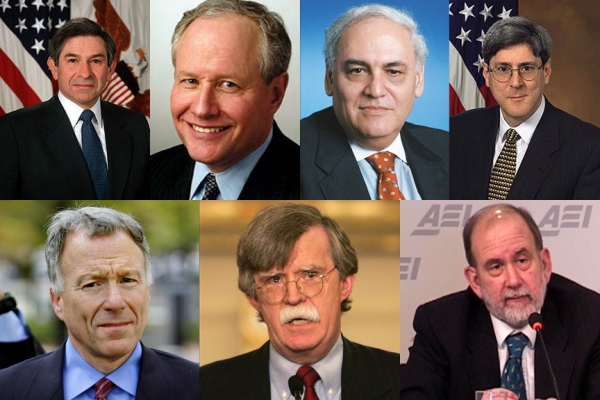
That the United States should be preparing for a possible nuclear future can in part be attributed to recent commentary by the “like, really smart” and “very stable genius” who is the nation’s chief executive, but the fuel being poured on the fire for war is from the very same neocons who are featured in the mainstream media as all-purpose experts and have succeeded in selling the snake oil about America’s proper role as aggressor-in-chief for the entire world. It would be an unparalleled delight to be able to open a newspaper and not see Bret Stephens, Eliot Cohen, Max Boot or even the redoubtable Bill Kristol grinning back from the editorial page, but I suppose I am only dreaming.
Philip M. Giraldi, Ph.D., is Executive Director of the Council for the National Interest, a 501(c)3 tax deductible educational foundation that seeks a more interests-based U.S. foreign policy in the Middle East. Website is http://www.councilforthenationalinterest.org, address is P.O. Box 2157, Purcellville VA 20134 and its email is inform@cnionline.org.
Scientific American, Global Warming & Iran
Penny For Your Thoughts | January 8, 2018
Today there are claims being made that the Iran Protests are Due to “Global Warming”- Seriously, this is the absolute baloney, garbage, nonsense that is being put forth as the reason for these protests.
Scientific American no less. Wild speculation at it’s most crazeeeee….
“Barbara Slavin, director of the Future of Iran Initiative at the Atlantic Council.
She said the role of climate change on the protests is “massive” and under-reported by the media.
This exact same claim was made regarding Syria, by self proclaimed authority figures and regurgitated by agenda pushing 5 eyes msm and alt media. Though it was later clarified that the scientific evidence for the Syrian claim was so thin as to be considered tenuous. Tenous: lacking a sound basis, as reasoning; unsubstantiated; weak: Yah, tenuous sounds exactly right!
Another AGW Lie Bites the Dust:“Climate Change Fuelled Syrian War”
“There is no sound evidence that global climate change was a factor in sparking the Syrian civil war,” said University of Sussex Professor Jan Selby, one of the study’s co-authors, in a statement.
“It is extraordinary that this claim has been so widely accepted when the scientific evidence is so thin.”
A lack of evidence never stops liars from lying. Same spin, different destabilization campaign.
English Translation of Udo Ulfkotte’s “Bought Journalists” Suppressed?

Cover of the English language edition of Udo Ulfkotte’s book
By James Tracy | OffGuardian | January 8, 2108
The English translation of German journalist Udo Ulfkotte’s best-selling book, Gekaufte Journalisten (Bought Journalists) appears to have been suppressed throughout North America and Europe.
On May 15, 2017 Next Revelation Press, an imprint of US-Canadian-based publisher Tayen Lane, released the English version of Bought Journalists, under the title, Journalists for Hire: How the CIA Buys the News.
Tayen Lane has since removed any reference to the title from its website. Correspondingly Amazon.com indicates the title is “currently unavailable,” with opportunities to purchase from independent sellers offering used copies for no less than $1309.09.[note from OffG- we also checked on Amazon UK, as of January 7 2018 the book is unavailable there too]
The book’s subject matter and unexplained disappearance from the marketplace suggest how powerful forces are seeking to prevent its circulation.
Gekaufte Journalisten was almost completely ignored by mainstream German news media following its release in 2014. “No German mainstream journalist is allowed to report about [my] book,” Ulfkotte observed:
Otherwise he or she will be sacked. So we have a bestseller now that no German journalist is allowed to write or talk about.{1]
Along these lines, publication of the English translation was repeatedly delayed. When this author contacted Ulfkotte in early December 2015 to inquire on the book’s pending translation, he responded,
Please find the link to the English edition here http://www.tayenlane.com/bought-journalists
The above address, once providing the book’s description and anticipated publication date, now leads to an empty page.[2] Tayen Lane has not responded to emails or telephone calls requesting an explanation for the title’s disappearance.
When a book publisher determines that it has acquired a politically volatile or otherwise “troublesome” title it may embark on a process recognized in the industry as “privishing.” “Privishing is a portmanteau meaning to privately publish, as opposed to true publishing that is open to the public,” writes investigative journalist Gerald Colby.
It is usually employed in the following context: “We privished the book so that it sank without a trace.” The mechanism used is simple: cut off the book’s life-support system by reducing the initial print run so that the book “cannot price profitably according to any conceivable formula,” refuse to do reprints, drastically slash the book’s advertising budget, and all but cancel the promotional tour.”[3]
Privishing often takes place without the author knowing, simply because it involves breach of contract and potential liability.
Tayen Lane will likely not face any legal challenge in this instance, however. Ulfkotte died of a heart attack on January 13, 2017, at age 56.[4]
Udo Ulfkotte was a prominent European journalist, social scientist, and immigration reform activist. Upon writing Gekaufte Journalisten and becoming one of the most significant media industry and deep state whistleblowers in recent history, Ulfkotte complained of repeated home searches by German state police and expressed fear for his own life. He also admitted previous health complications stemming from witnessing a 1988 poisoned gas attack in Iraqi Kurdistan.
Ulfkotte’s testimony of how intelligence agencies figure centrally in Western journalism is especially compelling because he for many years functioned in the higher echelons of mainstream newsworkers.
The German journalist explains how he was recruited during the 1980s to work in espionage. This began through an invitation proffered by his graduate school advisor for an all-expense-paid trip to attend a two-week seminar on the Cold War conflict in Bonn.
After Ulfkotte obtained his doctorate he was given a job as a reporter at “the leading conservative German newspaper, the Frankfurter Allgemeine Zeitung, oddly appointed despite no journalistic training and hundreds of other applicants.
Serving as a correspondent throughout the Middle East, Ulfkotte eventually became acquainted with agents from the CIA, German intelligence agency Bundesnachrichtendienst (BND), Britain’s MI6, and Israel’s Mossad, all of whom valued his ability to travel freely in countries largely closed to the West.
His editors readily collaborated in such intelligence gathering operations,”[5] for which journalist possess “non-official cover” by virtue of their profession.
“Non-official cover” occurs when a journalist is essentially working for the CIA, but it’s not in an official capacity,” Ulfkotte explains.
This allows both parties to reap the rewards of the partnership, while at the same time giving both sides plausible deniability. The CIA will find young journalists and mentor them. Suddenly doors will open up, rewards will be given, and before you know it, you owe your entire career to them. That’s essentially how it works.[6]
He likewise ruefully admits to
publishing articles under my own name written by agents of the CIA and other intelligence services, especially the German secret service.[7]
Ulfkotte’s insider knowledge of the relationship between mainstream media and the intelligence community has special relevance in terms of informing the CIA’s antipathy toward Wikileaks, as well as the media campaign centering on the Trump administration’s alleged “ties to Russia,” while also lending credence to Trump’s frequent claims of the US media’s political biases and deep state ties. Indeed, Ulfkotte “Tweeted” about these very subjects just two days before he passed.
Ulfkotte’s explosive revelations still have the potential to further intensify the much-deserved scrutiny corporate news media presently face. In a society that pays more than lip service to freedom of thought and expression Journalists for Hire would be required reading for college students—and particularly those studying in journalism programs intending to seek employment in the media industries.
In fact, journalism professors, some of whom have migrated to the academy following long careers at renowned news outlets, possess similar insider knowledge of the relationships Ulfkotte readily explains. As both journalists and educators they have a twofold burden of responsibility. This is the case more so than ever because the entire professional and intellectual enterprise they are engaged in (and one directly linked to the nation’s accelerating civic deterioration) has been made a farce.
Journalists for Hire’s suppression suggests how Ulfkotte’s posthumous censors refuse for this important examination and cleansing to proceed.
Notes
[1] Ralph Lopez, “Editor of Major German Newspaper Says He Planted Stories for CIA,” Reader Supported News, February 1, 2015.
[2] Udo Ulfkotte to James Tracy, email correspondence, December 6, 2015. In author’s possession.
[3] Gerard Colby, “The Price of Liberty,” in Into the Buzzsaw: Leading Journalists Expose the Myth of a Free Press, Kristina Borjesson, ed., Amherst NY: Prometheus Books, 2002, 15-16.
[4] Former US military intelligence officer L. Fletcher Prouty relates a similar experience of how publication of his book, The Secret Team: The CIA and Its Allies in Control of the United States and the World, was greeted in 1972. “Then one day a business associate in Seattle called to tell me that the bookstore next to his office building had had a window full of books the day before, and none the day of his call. They claimed they had never had the book. I called other associates around the country. I got the same story from all over the country. The paperback had vanished. At the same time I learned that Mr. Ballantine had sold his company. I traveled to New York to visit the new ‘Ballantine Books’ president. He professed to know nothing about me, and my book … The campaign to to kill the book was nationwide and worldwide. It was removed from the Library of Congress and from College libraries as letters I received attested all too frequently.” Prouty, The Secret Team: The CIA and Its Allies in Control of the United States and the World, New York: SkyHorse Publishing, 2008, xii.
[5] Ronald L. Ray, “Reporter Admits Most Media Work for CIA, MI6, Mossad,” American Free Press, October 26, 2014. See also Tyler Durden, “German Journalist Blows Whistle on How CIA Controls the Media,” Zerohedge, October 9, 2014; Udo Ulfkotte, “German Politicians Are US Puppets,” Center for Research on Globalization, November 9., 2014.
[6] Durden, op. cit.
[7] Lopez, op. cit.
Did BBC team responsible for faked footage of Syrian chemical attack travel under terrorist protection?
By Catte | OffGuardian | January 6, 2018
Most of our readers are now more than familiar with the bizarre events surrounding the BBC Panorama program Saving Syria’s Children. We’ve already returned to this story several times. The possibility that this program presented faked footage of a non-existent chemical attack by government troops on a school in Syria has been meticulously documented by independent researcher Robert Stuart over several years.
But a further twist to the story seems to show that the crew who filmed this questionable footage were being escorted and protected during their sojourn in Syria, by members of a jihadist terrorist group affiliated to Jabhat al-Nusra, al-Qaeda and ISIS.
The evidence, on the face of it, seems damning.
Ten minutes, 18 seconds into the program (which can be seen here) the film crew record a car journey, with the two British doctors featured in the program, to “see what medical care is available for children closer to where the fighting is”. At one point the journalist Ian Pannell can be heard in voice over saying:
Western journalists have been targeted in Syria, so I have to travel with my own security. The doctors are able to be more low key and take their own vehicles.
As he speaks we see Pannell himself, presumably filmed by his cameraman Darren Conway, in a car, part of a convoy, accompanied by armed men. We also see the hood of one of the cars in the convoy several times and pretty clearly. It has a logo on it. This is it:

The inset on the right is the logo of Ahrar-al-Sham.
In case you’re wondering, this is the same Ahrar-al-Sham identified by a Human Rights Watch report in October 2013 as participants in the killing of women and children (see “You Can Still See Their Blood” – Executions, Indiscriminate Shootings, and Hostage Taking by Opposition Forces in Latakia Countryside.). The report details the slaughter of nearly 200 civilians “including 57 women and at least 18 children and 14 elderly men” by opposition forces including Ahrar al-Sham on August 4 2013.
It was just 19 days after this massacre – on August 23 – that Ian Pannell and cameraman Darren Conway (now an OBE) apparently decided Ahrar-al-Sham were the go-to ’security’ guys for them. The documentary further shows Pannell, Conway and their chums being waved through ISIS road blocks without a hitch. This is the same ISIS who – allegedly – had declared war on all westerners and were prone to cutting off their heads (though in 2013 this hadn’t become the media meme it later became). Our boys are apparently welcome deep in ISIS territory, with no worries about repercussions.
This is probably explained by the fact Ahrar-al-Sham, according to Stanford University’s Mapping Militant Program, “worked with the Islamic State (IS) until January 2014″.
But maybe the contact with terrorists was fleeting and almost accidental? Well, below are two images that tell a story. The top one is a screencap from Saving Syria’s Children. The man outlined in red is the “Fixer/Translator” for the program, Mughira Al-Sharif, and he is shown driving Pannell’s convoy car (Pannell himself can be seen second from right next to the window in the back). Mughira is seen again in the bottom image in a photograph taken the same day and shared on Instagram. Also with him in this pic, and looking remarkably chummy, are two members of the Ahrar-al-Sham security detail who can be seen in Pannell’s car. Mughira described these men in his Instagram post as ‘friends’. That post was subsequently deleted.

(Above) Fixer/Translator Mughira Al-Sharif driving Ian Pannell’s convoy saloon car in Saving Syria’s Children. Pannell is second from right. (Below) Al Sharif poses with two of the Ahrar al-Sham men in an Instagram post of the same day, describing them as “friends”. The post was subsequently deleted.
Let’s be clear – these “friends’ of Mughira’s could well have taken part in the recent slaughter discussed above, and must, at very least, be assumed to support the mass murder of innocent people. And this man Mughira is employed by Pannell as his guide and helper in making their documentary.
Why are a supposedly distinguished and professional BBC journalist and his crew working with allies of ISIS? Why are they using them as their ‘security’? Why are they comfortable tooling round Syria in a car festooned with jihadist logos? Why did they end up producing a documentary using highly questionable footage to promote UK intervention against the elected government of Syria?
Did neither they nor their employers at the BBC realise what they were doing?
Or did they know and think it was just dandy?
When is the BBC – and Ian Pannell and Darren Conway(OBE) – going to answer these and the many other questions hanging over this program and their credibility?
Beijing responds to report of secret aid to North Korea with two words
‘Fake news’
Asia Times | January 3, 2018
An unverified report that Beijing was negotiating a secret deal with Pyongyang, published on Tuesday by the Washington Free Beacon, and syndicated by the Washington Times newspaper, has not gained much traction beyond that spattering of conservative American news outlets, garnering only a healthy dose of skepticism.
Not surprisingly, China was also not interested.
Chinese foreign ministry spokesperson Geng Shuang responded Wednesday to a Chinese-language question on the report with two words – in English.
“Fake news,” Geng was quoted as saying in the official transcript of Wednesday’s regular press breifing. Next question, please.
The “top secret” document published in the report was purported to be from “a person who once had ties to the Chinese intelligence and security communities,” whatever that means, but the author also said he could not independently verify the document.
The question we posed yesterday is whether conservative media’s reporting of the document as newsworthy will pique Trump’s interest, regardless of its veracity. If the report was true, it makes Trump look like he was played like a fiddle, so he might be careful not to draw attention.
We might also see if the US president buys the “fake news” line — which he uses exclusively to lambast hostile liberal media — when it is used against conservative media supportive of his administration.
Storm Eleanor’s “100 MPH Winds” – Fake News From The Telegraph

By Paul Homewood | Not A Lot Of People Know That | January 3, 2018
Storm Eleanor has lashed the UK with violent storm-force winds of up to 100mph, leaving thousands of homes without power and hitting transport links.
Gusts of 100mph were recorded at Great Dun Fell in Cumbria at 1am.
Wow! Hurricane force winds, as has been reported elsewhere.
Only one slight problem though. Great Dun Fell is the second highest mountain in England’s Pennines , and the weather station is sat at the very top, at an altitude of 847m.
Even then, mean wind speeds only reached 75 mph.
At nearby Warcop, just seven miles away and at an altitude of 224m, wind speed never got above 29 mph, a “strong breeze” on the Beaufort Scale.
This all comes from a Press Association report, which in turn appears to have been fed by the Met Office.
Why the Met Office should decide to deliberately mislead the public is anybody’s guess.
The Telegraph goes on to mention that 77mph gusts were recorded in High Bradfield, South Yorkshire.
I live 5 miles away from High Bradfield, and it was no more than a bit windy. So it won’t come as any surprise that High Bradfield is also a high altitude site, high up in the Peak District at 395m.
The nearest site with up to date data, according to the Met Office, is Watnall, 32 miles away in Nottinghamshire.
There wind speeds only reached 24 mph, a “Fresh Breeze” on the Beaufort Scale.
Even in Southern Scotland, the area worst affected in Britain, where the Met Office reported gusts of 72 mph high up on exposed cliffs above the Solway near Dundrennan, the mean wind speed peaked at 54 mph, still only a “Strong Gale”.
The headline claim that Storm Eleanor has lashed the UK with violent storm-force winds of up to 100mph is quite fraudulent.
Word of the Day…

By Mark Doran | January 3, 2018
If there’s one thing that the West’s state-corporate media loves to report, it’s public protest within a non-compliant country — people demonstrating against a government that has refused to roll over in the face of US aggression and greed.
If you’re in the habit of examining these media reports, you’ll often find that there’s a particular word which gets used a lot.
Here are a few highly topical examples; see if you can work out which word it is…
Iranians protesting the country’s strained economy gathered in Tehran and another major city on Friday, for the second day of spontaneous, unsanctioned demonstrations […] (US, Associated Press, via Washington Post, 29 Dec 2017)
A wave of spontaneous protests over Iran’s weak economy swept into Tehran on Saturday, with college students and others chanting against the government… (UK, Associated Press, via Mail Online, 30 Dec 2017)
Unauthorized, spontaneous protests engulfed Iran’s major cities for a third straight day on Saturday as what started out as demonstrations over rising prices seem to have taken a decidedly anti-government tone. (Slate.com, 30 Dec 2017)
Pro-government Iranians rallied in Tehran Saturday following spontaneous angry protests in the capital and other major cities. (US, Fox News with Associated Press, 30 Dec 2017)
A relatively small protest on Thursday in Mashhad, Iran’s second largest city . . . unexpectedly gave impetus to a wave of spontaneous protests spreading across provinces. (UK, Guardian, 31 Dec 2017)
Protests seem to be spontaneous and lack a clear leader. (Australia, ABC Radio Australia, 1 Jan 2018)
Yes: the Word of the Day is spontaneous.
As far as our state-corporate media and its ubiquitous anti-journalism are concerned, this is one of the most fascinating adjectives we ever see. Let’s take a moment to examine its use…
For a start, how would anyone really know — and so quickly, too! — that these foreign protests, these far-away demonstrations were all ‘spontaneous’? Are thousands of protestors across Iran currently in touch with hundreds of Western journalists — and constantly insisting on the utter spontaneity of everything they do?
No, they aren’t. And even if they were, why would anyone with any sense believe they were telling the truth?
The reality is, of course, that ‘spontaneous’ is a propaganda word, purely manipulative. It’s there to achieve three different but related aims — every one of which serves the imperialist agendas of the Western elites.
First, it helps to create the encouraging impression of an Official Enemy in Deep Trouble. If the media unites in painting a given set of protests as ‘spontaneous‘, then the illusion can be manufactured that ‘the population as a whole‘ is ‘angrily turning against‘ the obstructive government that the West is so selfishly anxious to see removed. ‘Clearly, this vile regime is tottering! Stay focused, everyone! Our corporations will be gang-raping the place in no time!‘
Secondly, ‘spontaneous’ protests are by far the best kind when it comes to ‘justifying’ illegal and destructive ‘intervention’ in a non-compliant country. How ‘desperate‘ an oppressed population must be if it ‘takes to the streets’ in ‘spontaneous protests’! How ‘close to the edge‘ those people must feel to be ‘finally overcoming their fear‘ and ‘actually calling for change‘! ‘Those people can’t take much more of this! For God’s sake, we have to do something! How about we try more economic warfare — plus humanitarian bombing? Agreed…?‘
Thirdly, it’s a word that’s designed to take the most important thought of all … and drive it far away from everyone’s mind. For what, ultimately, the word ‘spontaneous‘ says is: ‘Do not for a moment consider the probability that this is happening as part of a carefully co-ordinated and externally funded regime-change operation. Don’t even think about it! It’s all just SPONTANEOUS, d’you hear!‘
And if you won’t listen to me, pay attention to Nikki Haley, the Novelty Talking Insect currently doubling as the Trump Administration’s ‘Ambassador to the United Nations’…
See…?
For the rest — and just in case anyone still refuses to believe how indispensable a weapon is the word ‘spontaneous’ in the armoury of the modern journalist-impersonator — note how and when the imprimatur is withheld.
On the one hand, when a Western media trusty encounters what might be a public demonstration of support for an Official Enemy, ‘spontaneity’ will be specifically denied — sometimes even before you can say Nick Jack Robinson…
Then, on the other hand, there’s what happens when people in the Proudly Democratic West decide to protest about the actions or policies of their own governing elites. For, if a protest or demonstration is happening whose scale and importance cannot altogether be denied by our state-corporate media, the word ‘spontaneous’ simply won’t be in evidence: it would be too legitimating…
How the West is misusing an image to represent the Iranian protests

By Paul Antonopoulos – Fort Russ News – January 2, 2018
TEHRAN – The above image has become synonymous with the Iranian protests that have engulfed most regions of Iran for the past week. However, there remains one problem…. The original image has nothing to do with the current protests at all.
The original photo shows a woman with a hijab on a stick in a defiant moment as she challenges the law that makes it compulsory for women to wear a hijab in Iran.
However this was taken before the current protests even began. Although the Islamic Republic forces women to wear the hijab, its slow liberalization is seen, especially with Tehran announcing just days before protests began that they will no longer enforce the law in this regard.
However, despite the current protests being about economic reform and a clampdown on corruption, Western war enablers, particularly so-called activists and Western media, have widely been spreading this image as a symbol for a struggle against the regime that only exists in their own mind and not in the general consensus of Iranians, nor the majority of those protesting.
As Israeli geopolitical expert Michael A. Horowitz acknowledges, “The only thing this new “symbol,” [the image] largely imposed from the outside [the West], does represent is some form of “wishful thinking” from outside observers on what they’d want the current protest movement to be.
Western war hawks, activists and media alike are all trying to portray the Iranian protests as one for regime-change, but this remains only a small segment of the current protesters. However, no amount of Western “wishful thinking” as Horowitz correctly asserts, will change the fact that the majority of women currently protesting come from conservative segments of Iran.
It has been found that Saudi Arabia has tweeted more about the Iranian protests then people within Iran has themselves, with around three-quarters of all tweets about the protests coming from outside of the Islamic Republic.
Therefore, it can be seen that the great pushers for the protests are mostly coming from outside of the country. Another attempted colored revolution that will fail just as imperialists had in Venezuela last year.
Featured Video
BRITAIN’S WARNING: PREPARE FOR WAR
or go to
Aletho News Archives – Video-Images
From the Archive
How Ukraine Tortured and Slaughtered Donbass
By Kit Klarenberg | Al Mayadeen | July 11, 2024
Almost immediately after the proxy war erupted, ISIS-tier footage of the torture and murder of Russians in Ukrainian custody emerged.
On July 6th, the New York Times published an astonishing investigation: In Ukraine, Killings of Surrendering Russians Divide an American-Led Unit. The article documents in grim detail how Chosen Company, an international volunteer battalion for Kiev, routinely executes Russian prisoners of war. It is the very first mainstream admission that this practice – a brazen breach of the Geneva Conventions, and a grave war crime – is widespread among Ukraine’s fighters, both foreign and homegrown. … continue
Blog Roll
 Aletho News
- Israel Demolishes Home Of Lebanese Journalist Whose Viral Film Exposed Pager Attack
- Record Oil, Empty Tanks: The UAE’s Miracle Recovery
- Burnham tackles Britain’s poverty with aggression in Yemen
- Peace in Ukraine: the easy way – or the hard way
- Trump & the Rrrrussians
- US taxpayer money laundered back through Ukraine – Musk
- Before COVID, an NIH lab chief proposed making a SARS-like bat virus more infectious
- Gates, Bourla on Trial in Netherlands Accused of ‘Great Reset’ Scheme at Vaccine Injury Hearing
- BRITAIN’S WARNING: PREPARE FOR WAR
- “Historic Russia”: The Land Putin Will Not Give Back
- If Americans Knew
- DAILY UPDATE: Latest essential news on Palestine, Israel, & region
- Damning report shows the media must confront its failures on Gaza
- BBC senior broadcaster speaks out on Gaza coverage
- Netanyahu vows vast West Bank invasion in response to 20-minute skirmish that left 2 Israeli soldiers and 2 Palestinian fighters dead
- Tied up and tortured: Israel using US-made electroshock weapons on Palestinian detainees
- The outsourced risk: how newsrooms rely on Gaza’s freelancers without protecting them
- Gaza bakeries forced to shut as Israel blocks flour shipments
- Gaza’s breast cancer patients face a deadly wait for treatment amid Israel’s genocide
- DAILY UPDATE: Latest essential news on Palestine, Israel, & region
- The Israel Lobby’s Changing Fortunes
- No Tricks Zone
- Two New Studies Find Thwaites Glacier Melt Cannot Be Driven By Human Activity Or A Warming Ocean
- E-Cars Reduce CO2 Emissions By Only 41% Compared To Internal Combustion Engine Vehicles
- Predictions Made By Renowned Climate Professor Over Past Decades Have Been Proven To Be Poor
- New Study Suggests Large Regions Of The Pacific Ocean Have Been Cooling For The Last 80 Years
- Germany’s Green Energy Debacle: High Energy Costs Force Kahla Porzellan to Close After 182 Years!
- New Study: 50 Years Of The Most Aggressive ‘Net Zero’ Policies Can Only Affect The Global Climate By 0.03°C
- US September “Heat” Was No Record…Many Records Set Decades Ago
- Latest European Green Energy Debacle; Portugal’s Largest Flagship Solar Park Insolvent!
- Green Energy Debacle: German Expert Professor Fritz Vahrenholt Warns Of Severe Economic And Social Consequences
- Two More Paleo Reconstructions Affirm Meters-Higher Sea Levels Across Ireland, Brazil 7000-6000 Years Ago

