Russia-gate’s Totalitarian Style
By Robert Parry | Consortium News | September 2, 2017
It is a basic rule from Journalism 101 that when an allegation is in serious doubt – or hasn’t been established as fact – you should convey that uncertainty to your reader by using words like “alleged” or “purportedly.” But The New York Times and pretty much the entire U.S. news media have abandoned that principle in their avid pursuit of Russia-gate.
When Russia is the target of an article, the Times typically casts aside all uncertainty about Russia’s guilt, a pattern that we’ve seen in the Times in earlier sloppy reporting about other “enemy” countries, such as Iraq or Syria, as well Russia’s involvement in Ukraine’s civil war. Again and again, the Times regurgitates highly tendentious claims by the U.S. government as undeniable truth.
So, despite the lack of publicly provided evidence that the Russian government did “hack” Democratic emails and slip them to WikiLeaks to damage Hillary Clinton and help Donald Trump, the Times continues to treat those allegations as flat fact.
For a while, the Times also repeated the false claim that “all 17 U.S. intelligence agencies” concurred in the Russia-did-it conclusion, a lie that was used to intimidate and silence skeptics of the thinly sourced Russia-gate reports issued by President Obama’s intelligence chiefs.
Only after two of those chiefs – Director of National Intelligence James Clapper and CIA Director John Brennan – admitted that the key Jan. 6 report was produced by what Clapper called “hand-picked” analysts from just three agencies, the Times was forced to run an embarrassing correction retracting the “17 agencies” canard.
But the Times then switched its phrasing to a claim that Russian guilt was a “consensus” of the U.S. intelligence community, a misleading formulation that still suggests that all 17 agencies were onboard without actually saying so – all the better to fool the Times readers.
The Times seems to have forgotten what one of its own journalists observed immediately after reading the Jan. 6 report. Scott Shane wrote: “What is missing from the public report is what many Americans most eagerly anticipated: hard evidence to back up the agencies’ claims that the Russian government engineered the election attack. … Instead, the message from the agencies essentially amounts to ‘trust us.’”
However, if that was the calculation of Obama’s intelligence chiefs – that proof would not be required – they got that right, since the Times and pretty much every other major U.S. news outlet has chosen to trust, not verify, on Russia-gate.
Dropping the Attribution
In story after story, the Times doesn’t even bother to attribute the claims of Russian guilt. That guilt is just presented as flat fact even though the Russian government denies it and WikiLeaks founder Julian Assange says he did not get the emails from Russia or any other government.
Of course, it is possible the Russian government is lying and that some cut-outs were used to hide from Assange the real source of the emails. But the point is that we don’t know the truth and neither does The New York Times – and likely neither does the U.S. government (although it talks boldly about its “high confidence” in the evidence-lite conclusions of those “hand-picked” analysts).
And, the Times continues with this pattern of asserting as certain what is both in dispute and lacking in verifiable evidence. In a front-page Russia-gate story on Saturday, the Times treats Russian guilt as flat fact again. The online version of the story carried the headline: “Russian Election Hacking Efforts, Wider Than Previously Known, Draw Little Scrutiny.”
The Times’ article opens with an alarmist lede about voters in heavily Democratic Durham, North Carolina, encountering problems with computer rolls:
“Susan Greenhalgh, a troubleshooter at a nonpartisan election monitoring group, knew that the company that provided Durham’s software, VR Systems, had been penetrated by Russian hackers months before. ‘It felt like tampering, or some kind of cyberattack,’ Ms. Greenhalgh said about the voting troubles in Durham.”
The Times reported that Greenhalgh “knew” this supposed fact because she heard it on “a CNN report.”
If you read deeper into the story, you learn that “local officials blamed human error and software malfunctions — and no clear-cut evidence of digital sabotage has emerged, much less a Russian role in it.” But the Times clearly doesn’t buy that explanation, adding:
“After a presidential campaign scarred by Russian meddling, local, state and federal agencies have conducted little of the type of digital forensic investigation required to assess the impact, if any, on voting in at least 21 states whose election systems were targeted by Russian hackers, according to interviews with nearly two dozen national security and state officials and election technology specialists.”
But was the 2016 campaign really “scarred by Russian meddling”? For instance, the “fake news” hysteria of last fall was actually traced to young entrepreneurs who were exploiting the gullibility of Donald Trump’s supporters to get lots of “clicks” and thus make more ad revenue. The stories didn’t trace back to the Russian government. (Even the Times discovered that reality although it apparently has since been forgotten.)
‘Undermining’ American Democracy
The Jan. 6 report by those “hand-picked” analysts from CIA, FBI and the National Security Agency did tack on a seven-page appendix from 2012 that accused Russia’s RT network of seeking to undermine U.S. democracy. But the complaints were bizarre if not laughable, including the charge that RT covered the Occupy Wall Street protests, reported on the dangers of “fracking,” and allowed third-party presidential candidates to state their views after they were excluded from the two-party debate between Republican Mitt Romney and Democrat Barack Obama.
That such silly examples of “undermining” American democracy were even cited in the Jan. 6 report should have been an alarm bell to any professional journalist that the report was a classic case of biased analysis if not outright propaganda. But the report was issued amid the frenzy over the incoming Trump presidency when Democrats – and much of the mainstream media – were enlisting in the #Resistance. The Jan. 6 report was viewed as a crucial weapon to take out Trump, so skepticism was suppressed.
Because of that – and with Trump continuing to alarm many Americans with his erratic temperament and his coy encouragement of white nationalism – the flimsy Russian “hacking” case has firmed up into a not-to-be-questioned groupthink, as the Times story on Saturday makes clear:
“The assaults on the vast back-end election apparatus [i.e. voting rolls] … have received far less attention than other aspects of the Russian interference, such as the hacking of Democratic emails and spreading of false or damaging information about Mrs. Clinton. Yet the hacking of electoral systems was more extensive than previously disclosed, The New York Times found.”
In other words, even though there has been no solid proof of this “Russian interference” – either the “hacking of Democratic emails” or the “spreading of false or damaging information about Mrs. Clinton” – the Times reports those allegations as flat fact before extending the suspicions into the supposed “hacking of electoral systems” despite the lack of supporting evidence and in the face of counter-explanations from local officials. As far as the Times is concerned, the problem couldn’t be that some volunteer poll worker screwed up the software. No, it must be the dirty work of Russia! Russia! Russia!
The Times asserts that “Russian efforts to compromise American election systems … include combing through voter databases, scanning for vulnerabilities or seeking to alter data, which have been identified in multiple states.” Again, the Times does not apply words like “alleged”; it is just flat fact.
Uncertainty Acknowledged
Yet, oddly, the quote used to back up this key accusation acknowledges how little is actually known. The Times cites Michael Daniel, the cybersecurity coordinator in the Obama White House, as saying:
“We don’t know if any of the [computer] problems were an accident, or the random problems you get with computer systems, or whether it was a local hacker, or actual malfeasance by a sovereign nation-state. … If you really want to know what happened, you’d have to do a lot of forensics, a lot of research and investigation, and you may not find out even then.’”
Which is exactly the point: as far as we know from the public record, no U.S. government forensics have been done on the Russian “hacking” allegations, period. Regarding the “hack” of the Democratic National Committee’s emails, the FBI did not secure the computers for examination but instead relied on the checkered reputation of a private outfit called Crowdstrike, which based much of its conclusion on the fact that Russian lettering and a reference to a famous Russian spy were inserted into the metadata. Why the supposedly crack Russian government hackers would be so sloppy has never been explained. It also could not be excluded that these insertions were done deliberately to incriminate the Russians.
Without skepticism, the Times accepts that there is some secret U.S. government information that should bolster the public’s confidence about Russian guilt, but none of that evidence is spelled out, other than ironically to say what the Russians weren’t doing.
The Times cited the Jan. 6 report’s determination that “The Russians shied away from measures that might alter the ‘tallying’ of votes, … a conclusion drawn from American spying and intercepts of Russian officials’ communications and an analysis by the Department of Homeland Security, according to the current and former government officials.”
But this seems to be the one U.S. government conclusion that the Times doubts, i.e., a finding of Russian innocence on the question of altering the vote count.
Again accepting as flat fact all the other U.S. government claims about Russia, the Times writes: “Apart from the Russian influence campaign intended to undermine Mrs. Clinton and other Democratic officials, the impact of the quieter Russian hacking efforts at the state and county level has not been widely studied.”
There’s, of course, another rule from Journalism 101: that when there is a serious accusation, the accused is afforded a meaningful chance to dispute the allegation, but the Times lengthy article ignores that principle, too. The Russian government and WikiLeaks do not get a shot at knocking down the various allegations and suspicions.
Deep-seated Bias
The reality is that the Times has engaged in a long pattern of anti-Russia prejudice going back a number of years but escalating dramatically since 2013 when prominent neoconservatives began to target Russia as an obstacle to their agendas of “regime change” in Syria and “bomb-bomb-bombing” Iran.
By September 2013, the neocons were targeting Ukraine as what neocon National Endowment for Democracy president Carl Gershman deemed the “biggest prize” and an important step toward an even bigger prize, neutralizing or ousting Russian President Vladimir Putin.
When neocon U.S. officials, such as Assistant Secretary of State Victoria Nuland and Sen. John McCain, encouraged a coup that overthrew Ukraine’s elected President Viktor Yanukovych, the Times served as a cheerleader for the coup-makers even though the violence was spearheaded by neo-Nazis and extreme Ukrainian nationalists.
When ethnic Russians in eastern Ukraine and Crimea resisted the Feb. 22, 2014 coup, the Times collaborated with the State Department in presenting this rejection of an unconstitutional transfer of power as a “Russian invasion.”
For instance, on April 21, 2014, the Times led its print editions with an investigative story using photos provided by the coup regime and the State Department to supposedly show that fighters inside Ukraine had previously been photographed inside Russia, except that the two key photographs were both taken inside Ukraine, forcing the Times to run a half-hearted retraction two days later.
Here is the tortured way the Times treated that embarrassing lapse in its journalistic standards: “A packet of American briefing materials … asserts that the photograph was taken in Russia. The same men are also shown in photographs taken in Ukraine. Their appearance in both photographs was presented as evidence of Russian involvement in eastern Ukraine.
“The packet was later provided by American officials to The New York Times, which included that description of the group photograph in an article and caption that was published on Monday. The dispute over the group photograph cast a cloud over one particularly vivid and highly publicized piece of evidence.”
In other words, U.S. officials hand-fed the Times this “scoop” on a Russian “invasion” and the Times swallowed it whole. But the Times never seems to learn any lessons from its credulous approach to whatever the U.S. government provides. You might have thought that the Times’ disgraceful performance in pushing the Iraq-WMD story in 2002 would have given the newspaper pause, but its ideological biases apparently win out every time.
Two Birds, One Stone
In the case of the Russian “hacking” stories, the anti-Russia bias is compounded by an anti-Trump bias, a two-fer that has overwhelmed all notions of journalistic principles not only at the Times but at other mainstream news outlets and many liberal/progressive ones which want desperately to see Trump impeached and view Russia-gate as the pathway to that outcome.
So, while there was almost no skepticism about the Jan. 6 report by those “hand-picked” analysts – even though the report amounts only to a series of “we assess” this and “we assess” that, i.e,, their opinions, not facts – there has been a bubbling media campaign to discredit a July 24 memo by the Veteran Intelligence Professionals for Sanity.
The memo, signed by 17 members of the group including former NSA technical director for world geopolitical and military analysis William Binney, challenged the technological possibility of Russian hackers extracting data over the Internet at the speed reflected in one of the posted documents.
After The Nation published an article by Patrick Lawrence about the VIPS memo (a story that we re-posted at Consortiumnews.com ), editor Katrina vanden Heuvel came under intense pressure inside the liberal magazine to somehow repudiate its findings and restore the Russia-gate groupthink.
Outside pressure also came from a number of mainstream sources, including Washington Post blogger Eric Wemple, who interviewed Nation columnist Katha Pollitt about the inside anger over Lawrence’s story and its citation by Trump defenders, a development which upset Pollitt: “These are our friends now? The Washington Times, Breitbart, Seth Rich truthers and Donald Trump Jr.? Give me a break. It’s very upsetting to me. It’s embarrassing.”
However, in old-fashioned journalism, our reporting was intended to inform the American people and indeed the world as fully and fairly as possible. We had no control over how the information would play out in the public domain. If our information was seized upon by one group or another, so be it. It was the truthfulness of the information that was important, not who cited it.
A Strange Attack
But clearly inside The Nation, Pollitt and others were upset that the VIPS memo had undercut the Russia-gate groupthink. So, in response to this pressure, vanden Heuvel solicited an attack on the VIPS memo by several dissident members of VIPS and she topped Lawrence’s article with a lengthy editor’s note.
Strangely, this solicited attack on the VIPS memo cites as its “first” point that the Jan. 6 intelligence report did not explicitly use the word “hack,” but rather “cyber operation,” adding: “This could mean via the network, the cloud, computers, remote hacking, or direct data removal.”
That uncertainty about how the emails were extracted supposedly undercut the VIPS argument that the download speeds prohibited the possibility of a “hack,” but this pretense that the phrase “cyber operation” isn’t referring to a “hack” amounts to a disingenuous word game. After all, senior U.S. intelligence officials, including former FBI Director James Comey, have stated under oath and in interviews with major news outlets that they were referring to a “hack.”
These officials also have cited the Crowdstrike analysis of the DNC “hack” as support for their analysis, and Clinton campaign chairman John Podesta has described how he was the victim of a “spear-phishing” scam that allowed his emails to be hacked.
After all these months of articles about the Russian “hack,” it seems a bit late to suddenly pretend no one was referring to a “hack” – only after some seasoned experts concluded that a “hack” was not feasible. Despite the latest attacks, the authors of the VIPS memo, including former NSA technology official Binney, stand by their findings.
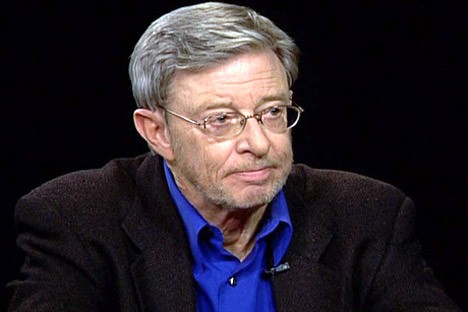
Russia scholar Stephen Cohen.
However, when the cause is to demonize Russia and/or to unseat Trump, apparently any sleight of hand or McCarthyistic smear is permissible.
In Post blogger Wemple’s article about The Nation’s decision to undercut the VIPS memo, he includes some nasty asides against Russia scholar Stephen Cohen, who happens to be Katrina vanden Heuvel’s husband.
In a snide tone, Wemple describes Cohen as providing “The soft-glove treatment of Russian President Vladimir Putin,” calling it Cohen’s “specialty.”
Wemple also repeats the canard about “a consensus finding of the U.S. intelligence community” when we have known for some time that the Jan. 6 report was the work of those “hand-picked” analysts from three agencies, not a National Intelligence Estimate that would reflect the consensus view of all 17 agencies and include dissents.
What is playing out here – both at The New York Times and across the American media landscape – is a totalitarian-style approach toward any challenge to the groupthink on Russia-gate.
Even though the Obama administration’s intelligence chiefs presented no public evidence to support their “assessments,” anyone who questions their certainty can expect to be smeared and ridiculed. We must all treat unverified opinions as flat fact.
Investigative reporter Robert Parry broke many of the Iran-Contra stories for The Associated Press and Newsweek in the 1980s. You can buy his latest book, America’s Stolen Narrative, either in print here or as an e-book (from Amazon and barnesandnoble.com).
How Media Obscure US/Saudi Responsibility for Killing Yemeni Civilians
By Ben Norton | FAIR | August 31, 2107
A coalition of Saudi Arabia, the United States, the United Kingdom and the United Arab Emirates, with minor support from several other Middle Eastern nations, has relentlessly bombed Yemen since March 2015. This August, the coalition ramped up the ferocity of its airstrikes, killing dozens of civilians.
On August 23, the US/Saudi coalition bombed a hotel near Yemen’s capital Sanaa, killing 41 people, 33 of whom—80 percent—were civilians, according to the United Nations.
Then on August 25, the coalition bombed homes in Sanaa, massacring a dozen civilians, including eight members of the same family.
Major Western media outlets have, however, obscured the responsibility Saudi Arabia, and its US and European supporters, bear for launching these airstrikes.
There are no other parties presently bombing Yemen, so media cannot feign ignorance as to who is responsible for the attacks. But reports on the bloody US/Saudi coalition airstrikes were nonetheless rife with ambiguous and downright misleading language.

It seems worth mentioning that the airstrike was
supported by the same government that supports NPR.
“Dozens of People Killed as Airstrike Hits Hotel Near Yemen’s Capital,” wrote NPR (8/23/17), in a masterwork of euphemism. Apparently dozens of Yemenis mysteriously died of unknown causes at the exact moment a generic, unaffiliated airstrike hit the hotel. NPR only indirectly mentioned, in the story’s fifth paragraph, that the “Saudi-led coalition” was “blamed” for the attack.
AFP‘s news wire (8/23/17), which was republished by Yahoo, the Daily Mail and Breitbart, used the headline “Air Raids on Outskirts of Yemen Capital Kill ‘at least 30,’” again obscuring who was responsible for those air raids. France 24 (8/23/17) ran the wire with the headline “Air Raids on Yemen Capital Kill Dozens.”
The BBC (8/23/17) wrote, “Yemen War: Air Strike on Hotel Outside Sanaa ‘Leaves 30 Dead.’” “Dozens Killed in Airstrike on Yemeni Hotel,” the Guardian headline (8/23/17) read.
The London-based Middle East Eye (8/23/17) was just as ambiguous, with “Yemen Air Attack Destroys Hotel, Killing at Least 35 People,” as was Qatar-owned Al Jazeera (8/23/17), with “Air Raid in Yemen Kills at Least 35 people” and the Turkish TRT World (8/24/17), which wrote, “At Least 60 people Killed in Airstrikes on Hotel in Yemen.”
Whose airstrike was it? What party was responsible? This remains unknown to those who only glanced at the headlines—that is to say, to most readers.
The 29-month war has killed thousands of Yemeni civilians, with tens of thousands more injured and millions facing famine. And the United Nations has repeatedly reported that the US/Saudi coalition is responsible for a majority of the civilian casualties.
Even when Saudi Arabia’s guilt is acknowledged by media, the crucial role of the US is typically ignored (FAIR.org, 8/31/15, 10/14/16, 2/27/17). Readers miss out on crucial context that is needed to understand the war, and their governments’ contributions to it: Saudi Arabia is flying US-made planes, full of fuel provided by the US Air Force, dropping US- and UK-made bombs, with intelligence and assistance from American and British military officials.
Non-Yemeni ‘Yemeni Airstrikes’

Neither the headline nor the accompanying story mention who conducted
the airstrike—though the photo caption refers to the “Saudi-led airstrike.”
Two days later, reports were just as obfuscatory, and even used the term “Yemeni airstrike,” to refer to an airstrike that was carried out by non-Yemenis.
“Yemen Airstrike Kills 12, Including Six Children: Rescuers,” Reuters reported on August 25. This brief two-paragraph wire did not once mention the US/Saudi coalition was responsible.
“After Yemeni Airstrike, Little Girl Is Family’s Only Survivor,” the international news agency wrote the next day (8/26/17). This Reuters piece noted that the “Saudi-led coalition” was “blamed,” though even that language seems designed to deflect; blamers can be wrong, after all.
Major newspapers were similarly misleading. “Young Yemeni Girl Is Sole Survivor After Airstrike Topples Her Home,” the New York Times (8/26/17) reported. The lead provided no further information: “An airstrike toppled their apartment building.” In fact, it was not until the seventh paragraph, after three large photos, that the Times finally conceded, “A Saudi Arabia–led coalition took responsibility for the airstrike a day after the attack, citing a ‘technical mistake.’” The Times did not once mention American or British support for the coalition.
Al Jazeera (8/25/17) likewise used the headline “Children Among Dead in Latest Attack on Yemen Civilians.” And TRT World (8/26/17) reported, “Yemen Airstrike Kills 12, Including Six Children.”
Even when Saudi Arabia admitted responsibility for killing Yemeni civilians, media watered down the language. “Saudi-Led Force Admits Strike in Yemen’s Capital Hit Civilians,” Reuters (8/26/17) headlined its news wire. Note the airstrike hit civilians, not killed them.
The attack was also reduced to a mere “mistake.” Larger context was not provided: namely that more than one-third of US/Saudi coalition airstrikes have hit civilian areas, and that there is a growing body of evidence that the coalition has intentionally targeted civilian infrastructure in Yemen.
Not all media were equally misleading; some were more forthright. AP‘s news wire (8/23/17), which was republished by the Chicago Tribune, New York Daily News, Houston Chronicle and San Francisco Chronicle, used a headline that told readers who was responsible for the deadly attack: “Saudi-Led Airstrikes Hit Yemen Hotel, Killing at Least 41.”
The Washington Post was similarly direct, with its reports “Saudi-Led Coalition Airstrike Kills Dozens in Yemen Ahead of Major Rally” (8/23/17) and “Saudi-Led Airstrikes Kill 14 Civilians in Yemen’s Capital” (8/25/17).
The Art of Obfuscation
To justify this ambiguity in reporting, media might claim it is sometimes not immediately clear who launched the airstrikes. But, again, there are no other parties flying warplanes in Yemen.
Yemeni Houthi-Saleh forces, who govern the north of the country and roughly 80 percent of the population, have not been bombing their country. Moreover, the US/Saudi coalition has imposed an air blockade on the impoverished country since March 2015 (another significant fact that is rarely reported by corporate media).
In Syria, where numerous rival countries have been launching airstrikes, it is understandable that media may sometimes have to exercise caution before apportioning blame. But this is not the case with Yemen.
In the 29-month war in Yemen, there is one party that has been responsible for thousands of air raids: the Saudi air force, as part of a coalition with the US, the UK and the UAE.
Yet Yemen is not an isolated case of this ambiguity. Media frequently obfuscate and downplay the culpability for bombing when the US and its allies are responsible.
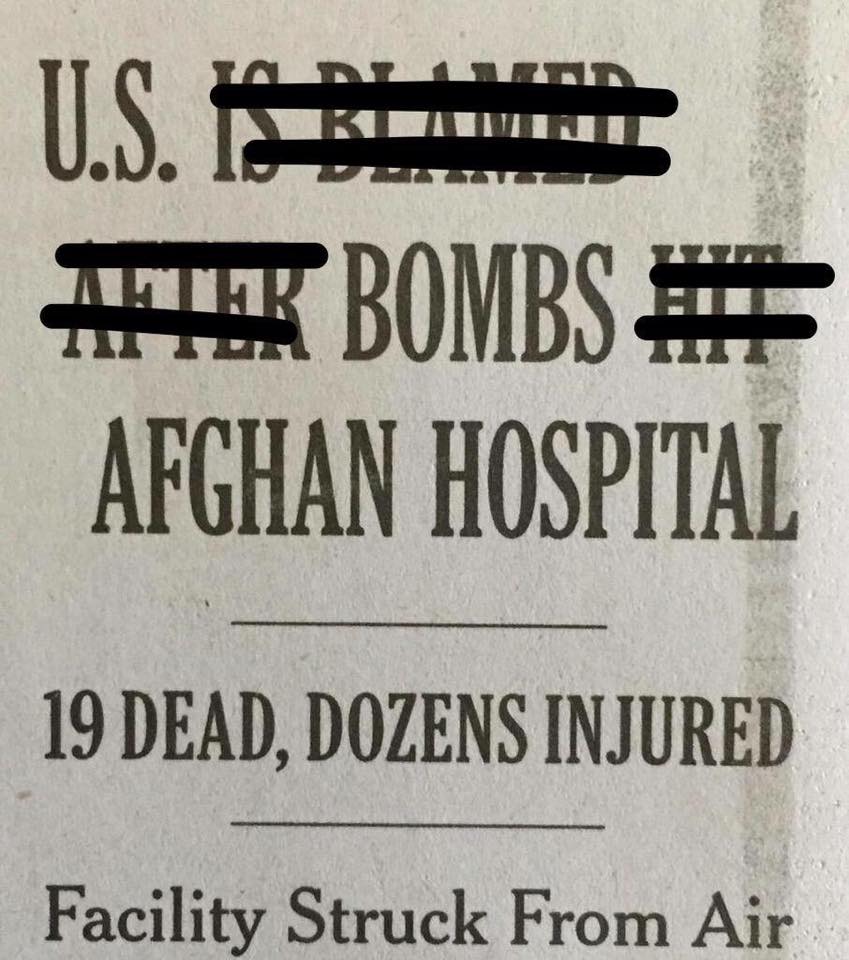
NYT headline (10/3/15) improved by Twitter user @OneKade
When the US bombed a hospital in Kunduz, Afghanistan, in October 2015, killing dozens of civilians, media scrambled to craft almost laughable euphemisms. FAIR (10/5/15) documented at the time how news outlets used circuitous headlines like “US Is Blamed After Bombs Hit Afghan Hospital.” Also seen in the August 23 NPR report cited above, this brand of misleading, ambiguous rhetoric is the “officer-involved shooting” of war reporting.
On the other hand, the responsibility of US enemies for killing civilians is rarely if ever obscured.
It is instructive to compare Western media coverage of Yemen to that of Syria, where attacks are “Assad bombing” (Fox News, 2/15/17), “Assad airstrikes” (Breitbart, 4/28/16), “Assad regime airstrikes” (Times of Israel, 10/16/12; Australian, 8/18/15), “regime airstrikes” (NBC, 8/19/16) or “regime bombing” (Daily Caller, 8/17/15).
Media have even written of a “pro-Assad drone” that was “displaying hostile intent,” and thus just had to be shot down by the US (Guardian, 6/20/17; Independent, 6/20/17; The Hill, 6/20/17), as if the robot were personally a fan of the Syrian leader.
The phrases “Salman bombing,” “Salman airstrikes” or “Saudi regime airstrikes” are, however, nowhere to be found in reports on Yemen.
Downplaying the Key US Role
Media calling US/Saudi coalition attacks “Yemeni airstrikes” is at best misleading, and at worst flat-out false. Yet this language also has a political effect: It obscures the character of the war. This framing is part of the “civil war” trope media have propagated for two-and-a-half years.
When Yemen is discussed, it is virtually always through the lens of a “civil war.” As FAIR (7/25/17) has detailed before, this exceedingly widespread myth, which has permeated media discourse, denies the extent to which the conflict is actually a foreign war on Yemen, led by Saudi Arabia, the UAE and their US and European sponsors.
Even the term “Saudi-led” coalition is misleading. The New York Times editorial board (8/17/16) acknowledged, in a little-noted editorial on Yemen, “Experts say the coalition would be grounded if Washington withheld its support.”
That is to say, if the US wanted the war in Yemen to end, it would end overnight. The “Saudi-led” coalition is only led by Saudi Arabia in name.
Surprisingly, in the midst of intensified coalition attacks, the New York Times published another rare editorial on Yemen on August 25. In the piece, dramatically titled “The Slaughter of Children in Yemen,” the editorial board forcefully warned of exactly what critics have been saying for 29 months:
The Saudi coalition—and its American enablers, who provide military equipment, aerial refueling and targeting—simply cannot be allowed to continue killing civilians and destroying what little is left of Yemen. That is why it is imperative to publicly identify the unconscionable slaughter of innocents for what it is, and to hope that this will shame Saudi Arabia and its American backers to search for a humane end to Yemen’s hell.
Reporters at the Times and elsewhere should heed this call to demonstrate journalistic responsibility by clearly conveying their governments’ responsibility for the slaughter in Yemen—not just in editorials, but in news articles, every time.
Tillerson Approves Nearly $60Mln in Funding to Fight Propaganda – State Dept
Sputnik – 01.09.2017
WASHINGTON – US Secretary of State Rex Tillerson has approved spending nearly $60 million on countering terrorist propaganda and state-sponsored disinformation, a State Department official has confirmed to Sputnik.
A US news outlet, Politico, reported in August that Tillerson was resisting the Department’s officials who wanted to spend $80 million on anti-propaganda efforts, including on countering Russia’s alleged disinformation campaign.
“Last week, after significant consultations within the State Department… Secretary Tillerson approved the release of one source of funding, and approved the request for another,” the official said, referring to $19.8 million in extra funding to target Islamist propaganda and another request for a transfer of $40 million from the Pentagon.
The official stressed that Tillerson’s decisions came after a realignment of programs by the Global Engagement Center (GEC) to match national security priorities and make sure that this funding would be used effectively “to counter the messaging of international terrorist groups and state-sponsored disinformation.”
The Global Engagement Center is an interagency entity, housed at the State Department, tasked with coordinating US counterterrorism messaging to foreign audiences. It was created in March 2016 to counter messaging from the Islamic State terrorist group (banned in Russia).
But former President Barack Obama last December signed the fiscal year 2017 National Defense Authorization Act, which expanded the center’s mandate, allowing it to counter messages from state actors like Russia and China.
Russia has denied meddling in last year’s election in the United States, and the Kremlin insists that it does not interfere in the internal affairs of other countries.
More Misleading Russia-gate Propaganda
By Robert Parry | Consortium News | August 29, 2017
There is an inherent danger of news organizations getting infected by “confirmation bias” when they want something to be true so badly that even if the evidence goes in the opposite direction they twist the revelation to fit their narrative. Such is how The Washington Post, The New York Times and their followers in the mainstream media are reacting to newly released emails that actually show Donald Trump’s team having little or no influence in Moscow.
On Tuesday, for instance, the Times published a front-page article designed to advance the Russia-gate narrative, stating: “A business associate of President Trump promised in 2015 to engineer a real estate deal with the aid of the president of Russia, Vladimir V. Putin, that he said would help Mr. Trump win the presidency.”
Wow, that sounds pretty devastating! The Times is finally tying together the loose and scattered threads of the Russia-influencing-the-U.S.-election story. Here you have a supposed business deal in which Putin was to help Trump both make money and get elected. That is surely how a casual reader or a Russia-gate true believer would read it – and was meant to read it. But the lede is misleading.
The reality, as you would find out if you read further into the story, is that the boast from Felix Sater that somehow the construction of a Trump Tower in Moscow would demonstrate Trump’s international business prowess and thus help his election was meaningless. What the incident really shows is that the Trump organization had little or no pull in Russia as Putin’s government apparently didn’t lift a finger to salvage this stillborn building project.
But highlighting that reality would not serve the Times’ endless promotion of Russia-gate. So, this counter-evidence gets buried deep in the story, after a reprise of the “scandal” and the Times hyping the significance of Sater’s emails from 2015 and early 2016. For good measure, the Times includes a brief and dishonest summary of the Ukraine crisis.
The Times reported: “Mr. Sater, a Russian immigrant, said he had lined up financing for the Trump Tower deal with VTB Bank, a Russian bank that was under American sanctions for involvement in Moscow’s efforts to undermine democracy in Ukraine. In another email, Mr. Sater envisioned a ribbon-cutting ceremony in Moscow. ‘I will get Putin on this program and we will get Donald elected,’ Mr. Sater wrote.”
But the idea that Russia acted “to undermine democracy in Ukraine” is another example of the Times’ descent into outright propaganda. The reality is that the U.S. government supported – and indeed encouraged – a coup on Feb. 22, 2014, that overthrew the democratically elected Ukrainian President Viktor Yanukovych even after he offered to move up scheduled elections so he could be voted out of office through a democratic process.
After Yanukovych’s violent ouster and after the coup regime dispatched military forces to crush resistance among anti-coup, mostly ethnic Russian Ukrainians in the east, Russia provided help to prevent their destruction from an assault spearheaded by neo-Nazis and other extreme Ukrainian nationalists. But that reality would not fit the Times’ preferred Ukraine narrative, so it gets summarized as Moscow trying “to undermine democracy in Ukraine.”
Empty Boasts
However, leaving aside the Times’ propagandistic approach to Ukraine, there is this more immediate point about Russia-gate: none of Sater’s boastful claims proved true and this incident really underscored the lack of useful connections between Trump’s people and the Kremlin. One of Trump’s lawyers, Michael Cohen, even used a general press email address in a plea for assistance from Putin’s personal spokesman.
Deeper in the story, the Times admits these inconvenient facts: “There is no evidence in the emails that Mr. Sater delivered on his promises, and one email suggests that Mr. Sater overstated his Russian ties. In January 2016, Mr. Cohen wrote to Mr. Putin’s spokesman, Dmitri S. Peskov, asking for help restarting the Trump Tower project, which had stalled. But Mr. Sater did not appear to have Mr. Peskov’s direct email, and instead wrote to a general inbox for press inquiries.”
The Times added: “The project never got government permits or financing, and died weeks later. … The emails obtained by The Times make no mention of Russian efforts to damage Hillary Clinton’s campaign or the hacking of Democrats’ emails.”
In other words, the Russia-gate narrative – that somehow Putin foresaw Trump’s election (although almost no one else did) and sought to curry favor with the future U.S. president by lining Trump’s pockets with lucrative real estate deals while doing whatever he could to help Trump win – is knocked down by these new disclosures, not supported by them.
Instead of clearing the way for Trump to construct the building and thus – in Sater’s view – boost Trump’s election chances, Putin and his government wouldn’t even approve permits or assist in the financing.
And, this failed building project was not the first Trump proposal in Russia to fall apart. A couple of years earlier, a Moscow hotel plan died apparently because Trump would not – or could not – put up adequate financing for his share, overvaluing the magic of the Trump brand. But one would think that if the Kremlin were grooming Trump to be its Manchurian candidate and take over the U.S. government, money would have been no obstacle.
Along the same lines, there’s the relative pittance that RT paid Gen. Michael Flynn to speak at the TV network’s tenth anniversary in Moscow in December 2015. The amount totaled $45,386 with Flynn netting $33,750 after his speakers’ bureau took its cut. Democrats and the U.S. mainstream media treated this fact as important evidence of Russia buying influence in the Trump campaign and White House, since Flynn was both a campaign adviser and briefly national security adviser.
But the actual evidence suggests something quite different. Besides Flynn’s relatively modest speaking fee, it turned out that RT negotiated Flynn’s rate downward, a fact that The Washington Post buried deep inside an article on Flynn’s Russia-connected payments. The Post wrote, “RT balked at paying Flynn’s original asking price. ‘Sorry it took us longer to get back to you but the problem is that the speaking fee is a bit too high and exceeds our budget at the moment,’ Alina Mikhaleva, RT’s head of marketing, wrote a Flynn associate about a month before the event.”
Yet, if Putin were splurging to induce Americans near Trump to betray their country, it makes no sense that Putin’s supposed flunkies at RT would be quibbling with Flynn over a relatively modest speaking fee; they’d be falling over themselves to pay him more.
So, what the evidence really indicates is that Putin, like almost everybody else in the world, didn’t anticipate Trump’s ascendance to the White House, at least not in the time frame of these events – and thus was doing nothing to buy influence with his entourage or boost his election chances by helping him construct a glittering Trump Tower in Moscow.
But that recognition of reality would undermine the much beloved story of Putin-Trump collusion, so the key facts and the clear logic are downplayed or ignored – all the better to deceive Americans who are dependent on the Times, the Post and the mainstream media.
Investigative reporter Robert Parry broke many of the Iran-Contra stories for The Associated Press and Newsweek in the 1980s.
Making stuff up on Twitter is the new ‘journalism’ — and we deserve it
By Danielle Ryan | RT | August 30, 2017
On Monday, The Guardian published a story which should have surprised no one: Information pushed aggressively on Twitter by anti-Trump conspiracy theorist duo Louise Mensch and Claude Taylor came from a hoaxer who duped Taylor in an email.
Taylor, a former White House staffer under Bill Clinton, tweeted out “fake details of criminal inquiries” related to Donald Trump which did not exist and were “invented” by a hoaxer claiming to work for the New York attorney general.
Mensch, a former conservative member of parliament in the UK and now a self-styled journalist, helped Taylor to spread the information on Twitter, while also claiming to have separate sources to back it up.
Conning the con artists
Among the details provided by the hoaxer was a false allegation that Trump’s inactive model agency in New York is being investigated for sex trafficking. The Guardian reports the hoaxer fed information to Taylor by email, acting out of frustration over the “dissemination of fake news” by Taylor and Mensch.
According to the hoaxer, Taylor did not try to verify her identity and did “no vetting whatsoever” to confirm her information was correct. Nor did he try to seek confirmation from a second source, a standard practice in journalism. Instead, the hoaxer claims Taylor “asked leading questions to support his various theories” and asked her to verify his suspicions.
When approached by The Guardian, Taylor, whose Twitter handle ironically remains @TrueFactsStated, admitted he was duped, tweeting: “As a ‘citizen journalist’ I acknowledge my error and do apologize.”
Mensch, for her part, has doubled down. She posted a rebuttal to The Guardian report, claiming she has her own sources (who she claims to know personally) and insisted she did not base her reporting on any interactions with the hoaxer in question. She claims the allegation that Trump’s model agency is being investigated for sex trafficking is “entirely true,” and ongoing.
La La land
Writing for FAIR, Adam Johnson laid out a series of outlandish and unsubstantiated claims Mensch has made on Twitter. Among other things, Mensch believes Russia is controlling the public WiFi networks in her neighborhood, that Anthony Weiner’s latest sexting scandal was a setup by a Russian hacker and that Vladimir Putin had something to do with the March 22 terror attack in London. She also believes misspelled hashtags on Twitter are Russian “active measures,” that the Kremlin funded riots in Ferguson, and that Steve Bannon may get the death penalty for espionage. Finally, thanks to The Guardian’s reporting exposing the hoax Taylor fell for, Mensch now apparently believes the newspaper is a front for the Russian FSB.
Mensch often claims to have “sources” to back up her random claims, but I imagine any legitimate source in their right mind would steer well clear of Mensch given the reputation she has garnered for peddling absolute nonsense.
Taylor is almost as bad. He hasn’t gained quite the notoriety of Mensch, but has been touted as a legitimate source of information on Trump by many, including a raging Keith Olbermann.
If Mensch and Taylor were just a pair of random trolls on Twitter, they wouldn’t be much of a problem. Their fantastical claims would remain irrelevant and would be kept to the confines of Twitter’s loony bin.
But Mensch and Taylor sadly are not irrelevant. Between them they boast nearly half a million followers on Twitter. Mensch has been propped up by mainstream media and praised by some high-profile figures, including former Democratic National Committee head Donna Brazile and Harvard law professor Laurence Tribe. She has appeared as a guest on US political talk shows and has even been given op-ed space in the New York Times.
Thankfully, Mensch’s star has started to fade, and she has gradually been called out by numerous publications for her lunacy. Slate called her a “paranoid bard” who has created a “cottage industry of conspiracies.” A piece in the National Review lamented her “bastardized relationship with reality.” Commentary Magazine wrote that she has “a habit of seeing Russians behind every darkened corner” — and BuzzFeed called her out for branding innocent people as Russian agents.
My personal favorite, though, is the Daily Beast article about Twitter’s “conspiracy queen” which quotes a Republican political consultant calling Mensch “unbelievably toxic” and a former intelligence officer calling her “batshit crazy” and a “fruit loop of the highest order.”
Mensch is a fanatical tweeter. Since I opened her profile little over an hour ago, there have been 38 new tweets and retweets posted. Consider this: Mensch, a woman now widely panned for spreading totally unverified information, has been verified by a blue tick on Twitter — but the social media platform has refused to verify Julian Assange — a man who has distributed millions of authentic, consequential documents and broken countless legitimate stories through WikiLeaks.
Rot from the top
The rise in prominence of conspiracy theorists like Mensch and Taylor speaks volumes about today’s political climate and the state of journalism.
Legitimized by the mainstream, Taylor and Mensch built a massive following of loyal supporters who will not abandon them for anything. As I type, their devoted fans are tweeting them support and thanking them for their hard work.
This is pure and utter madness. But the fish rots from the head down.
Mensch and Taylor benefit greatly from the lowering of standards across the entire media industry. The problem is not simply that anyone can wake up and post wild claims on the internet. That has always been the case.
The problem is that through unbridled sensationalism, naked bias, a focus on speed over accuracy, less emphasis on basic fact-checking, an increased willingness to rely on anonymous government sources and a need to attract readers with the most clickbait-y headlines — the news media has helped create an appetite for exactly what Taylor, Mensch and their ilk provide: Unadulterated nonsense. What’s more, when people believe (rightly) that they can’t trust the real media, they go looking for alternatives and fall victim to charlatans and opportunists.
A good example of how the media has helped in this regard comes from a Washington Post story published last year claiming that Russia hacked the US power grid through a facility in Vermont. The Post later had to backtrack on the story, which turned out to be untrue. It was later revealed the newspaper did not even contact that Vermont utilities in question to confirm the information. The fact that it was light on evidence and sourcing didn’t matter. The story had everything the public wanted and everything the Post wanted to give the public: sensational, scary and highly click-worthy claims about Russia.
Today’s political and media climate encourages rabid devotion to one’s cause over debate, balance, and self-restraint. It is not simply enough to dislike Donald Trump and oppose him politically. You must hate him with a fiery passion and denounce him from the rooftops with a guttural scream. You must believe he kicks puppies and eats babies for breakfast. You must find the pundit that hates him the most, latch onto their wagon and pledge allegiance for the rest of time.
The case of Taylor and the hoaxer goes to show just how easily many people will believe a story if they desperately want to believe it. This is not a phenomenon of the left or right. If a story appears to confirm for a group what they think they already know, they will eat it up, no questions asked.
Taylor was no exception – literally. A hoaxer mailed him false information, and because he wanted to believe it, he asked no questions.
He didn’t try to verify it. He didn’t try to find a second source. He didn’t even try to confirm the identity of the woman feeding him this information. He broke every rule in the book because he so badly wanted the information to be true.
This is the kind of “journalism” Taylor and Mensch’s followers are signing up for. But if the “real” media makes no effort to take a long hard look in the mirror, then this is exactly the kind of replacement they deserve.
Read more:
Inflating the Russian Threat
By Jonathan Marshall | Consortium News | August 28, 2017
Readers of the New York Times have more to sweat about than hot summer weather in the Big Apple. The paper’s chief military correspondent, Michael Gordon — co-author of the infamous 2002 story about Saddam Hussein’s “quest for A-bomb parts” — has all but warned that war in Europe could break out at any minute with the mighty Russian army.
“Russia is preparing to send as many as 100,000 troops to the eastern edge of NATO territory at the end of the summer,” he reported last month with Eric Schmitt. Sounding like speechwriters for Sen. John McCain, they called the long-planned military exercises with Belarus — known as “Zapad” (Russian for “west”) — “one of the biggest steps yet in the military buildup undertaken by President Vladimir V. Putin and an exercise in intimidation that recalls the most ominous days of the Cold War.”
Gordon and Schmitt added that this latest and greatest example of “Mr. Putin’s saber-rattling,” represents “the first time since the collapse of the Soviet Union that so much offensive power has been concentrated in a single command.”
Many other Western news organizations have echoed this story, albeit with less alarmist rhetoric. NBC News warned that “another military challenge may be on the horizon” as “thousands of Russian troops and tanks are preparing to take part in what may be the country’s largest military exercise since the Cold War.”
Reciting the same talking points almost verbatim, the London Guardian reported days ago that “Russia is preparing to mount what could be one of its biggest military exercises since the Cold War.” Like the Times, it cited estimates by “Western officials and analysts” that “up to 100,000 military personnel and logistical support could participate” in the war games next month.
Meanwhile, the Defense Minister of Estonia predicted that “Russia may use large-scale military exercises to move thousands of troops permanently into Belarus later this year in a warning to NATO.” Two Polish military officials speculated darkly that “Having created such a military build-up under the pretext of such exercise, Russia could launch a limited or provocative military hybrid operation to see what happens and further test the waters on NATO’s eastern flank, or in Ukraine, where the Russo-Ukrainian conflict remains in full swing.”
The Missing Context
The average reader would never know that U.S. and NATO forces themselves engaged this summer in “their largest military exercises since the end of the Cold War,” to quote NPR. Nor would they know that NATO collectively spends 12 times more than Russia on its military, or that its European members alone field nearly 75 percent more military personnel than Russia.
And only the most attentive reader, reaching the bottom of the long New York Times story, would have learned that “Russian officials have told NATO that the maneuvers will be far smaller than Western officials are anticipating and will involve fewer than 13,000 troops.”
The anti-Putin director of the Centre for Strategic and Foreign Policy Studies in Minsk points out that only 3,000 Russian military personnel will take part in the exercises in Belarus from September 14 to September 20. “Based on these figures, the military drills are practically the same as the previous Zapad-2013,” he said.
He also noted that Belarus has invited no fewer than 80 international observers to calm fears:
“In addition to the accredited military attaches of Western embassies, special delegations from the UN, the International Red Cross . . . and NATO will be invited. This, by the way, is the first time when NATO observers are invited to such exercises. Separately, Belarus arranged for the presence of delegations from Sweden, Norway and Estonia.”
NATO has complained — possibly with justification — that Russia and Belarus have not fully complied with their obligations under the Vienna Document of 2011 to provide detailed briefings, progress reports, and opportunities to interview soldiers about the exercise.
NATO and Russia undertook after the Cold War to provide greater transparency about their military exercises to minimize the threat of conflict. In recent years, particularly following the Ukraine crisis, growing political tensions have put a strain on such cooperative measures.
A number of reasonable analysts warn that Russia may sidestep its reporting obligations by dividing its exercises into smaller units, below the threshold of 13,000 personnel that gives members of the Organization for Security and Co-operation in Europe the right to observe.
‘Probably Exaggerated’
For example, Russia claimed that its Western exercises four years ago kept just within that threshold. But two experts writing for the conservative Jamestown Foundation in Washington, D.C. argued that “if one takes a broader view of what elements constituted a part of the Zapad 2013 exercise, then the total participants number approximately 22,000 men, of which 13,000 exercised on Belarusian territory and more than 9,500 on Russian territory.”
The Guardian quotes an expert on Russia’s military as saying of Zapad-17, “you can’t trust what the Russians say. One hundred thousand is probably exaggerated but 18,000 is absolutely realistic.”
Even if true, such numbers hardly support viewing the upcoming exercises as an “ominous” threat to the West. A British expert, remarking on the “mythology” that often accompanies such events, noted that “Much of the Western coverage said that the 2009 exercise ended with a simulated nuclear attack on Warsaw, Poland, even though there is no evidence at all from unclassified sources to suggest this was the case.”
Michael Kofman, a fellow at the Woodrow Wilson Center’s Kennan Institute, has debunked many of the unfounded estimates of Zapad-17’s size and potential threat to Europe.
“The Russian Ministry of Defense itself likely hopes Western media will report exaggerated figures,” he says. “Such headlines help validate the scale and success of the exercise to national leadership in Moscow. In this respect, the entire affair is an exercise in co-dependency and is self-affirming.”
Russia unquestionably wants to impress NATO with its military capabilities, Kofman acknowledges, but that’s for deterrence.
“Throughout the exercise, Russian armed forces will try to signal that they have the ability to impose substantial costs on a technologically advanced adversary, i.e. the United States,” he writes. “Russian thinking is founded on the belief that its military can raise costs for the West such that they will grossly outweigh the potential gains for sustaining hostilities, particularly if the fight is over Belarus.”
Threat Inflation Nothing New
The steady drumbeat of warnings about Russian military capabilities and intentions recalls the perennial use of “threat inflation” since the earliest days of the Cold War to sell bigger military budgets and a permanent warfare state.

Former NATO Commander Philip M. Breedlove
One of the acknowledged masters of threat inflation was NATO Supreme Commander Gen. Philip Breedlove. Hacked emails exposed his undercover campaign to “leverage, cajole, convince or coerce the U.S. to react” to Russia during the Obama years.
Two years ago, the West German news magazine Der Spiegel, ran a lengthy article on Breedlove’s reckless disregard for facts. Following the Minsk ceasefire agreement, at a time of relative quiet in Ukraine between government and pro-Russian forces, Breedlove held an inflammatory press conference to announce that Vladimir Putin had sent Russian armed forces with “well over a thousand combat vehicles, . . . some of their most sophisticated air defense, battalions of artillery” to Eastern Ukraine. The military situation he warned was “getting worse every day.”
German political leaders and intelligence officials were “stunned,” according to the magazine. Their information didn’t match his claims at all.
The same thing had happened soon after the start of the Ukraine crisis in early 2014, triggered by an anti-Russia coup that ousted President Viktor Yanukovych. Breedlove warned of an imminent invasion by 40,000 Russian troops massed on the border — when intelligence officials from other NATO member states had ruled out such an invasion and put the total number of Russian troops at about half that number.
“For months,” the magazine observed, “Breedlove has been commenting on Russian activities in eastern Ukraine, speaking of troop advances on the border, the amassing of munitions and alleged columns of Russian tanks. Over and over again, Breedlove’s numbers have been significantly higher than those in the possession of America’s NATO allies in Europe. As such, he is playing directly into the hands of the hardliners in the US Congress and in NATO.”
Russian troop advances . . . the massing of forces . . . it all sounds familiar. Sure enough, although now retired, Breedlove was one of the first to sound the alarm this year about the Zapad exercise, telling a Senate hearing that it could involve as many as 200,000 troops.
Two years ago, members of the German government condemned Breedlove’s warnings as “dangerous propaganda.” They told Der Spiegel, “The West can’t counter Russian propaganda with its own propaganda, ‘rather it must use arguments that are worthy of a constitutional state.’”
The same stricture should surely apply today, as unsupported rhetoric foments unnecessary and dangerous military tensions between the world’s two nuclear superpowers.
BBC Claim Climate Change Is Cutting Crop Yields In Africa
By Paul Homewood | Not A Lot Of People Know That | August 23, 2017

http://www.bbc.co.uk/programmes/b091s7zl
More lies from the BBC Today programme.
At about 44 minutes in, a fairly sensible report from Kenya about improving agriculture methods is introduced with this shameless comment:
Climate change is cutting crop yields [in Africa]
The data from the UN FAOSTAT shows the opposite to be true:


http://www.fao.org/faostat/en/#compare
In Kenya itself, the value of agricultural production has been at record high levels for the last two years:

Of course, these drastic increases in agricultural productivity are due to a number of factors, and trying to unravel a climate signal is well nigh impossible. Not that that will stop grant addicted climate scientists making up their own fake evidence.
One is entitled to wonder why the BBC thought it appropriate to even make the comment they did, instead of giving their listeners the actual facts?
First tanker crosses northern sea route without ice breaker (Because it is one anyway!)
By Paul Homewood | Not A Lot Of People Know That | August 25, 2017
A commercial LNG tanker has sailed across the colder, northern route from Europe to Asia without the protection of an ice-breaker for the first time.
The specially-built ship completed the crossing in just six-and-a-half days setting a new record, according to the tanker’s Russian owners.
The 300-metre-long Sovcomflot ship, the Christophe de Margerie, was carrying gas from Norway to South Korea.
Rising Arctic temperatures are boosting commercial shipping across this route.
There is only one slight problem – the newly built tanker is actually an icebreaker itself, as Matt McGrath goes on to elaborate:
The Christophe de Margerie is the world’s first and, at present, only ice-breaking LNG carrier.
The ship, which features a lightweight steel reinforced hull, is the largest commercial ship to receive Arc7 certification, which means it is capable of travelling through ice up to 2.1m thick.
On this trip it was able to keep up an average speed of 14 knots despite sailing through ice that was over one metre thick in places.
Popular Science has more details on the project to build another 15 of these icebreaking tankers:
There’s a lucrative shipping route between Europe and Asia that has the potential to cut thousands of miles and months of time off the trip. The only catch: it’s covered with thick, ship-sinking Arctic ice.
Heavy ice blocks the Arctic route from December to July, more than half the year. Even with icebreaking escort ships, few merchant vessels run it.
Now, Daewoo Shipbuilding and Marine Engineering is building the world’s first icebreaker tankers–16 of them–to carry liquid natural gas (LNG) through the route year-round. LNG tankers today have to be escorted by icebreaking ships that clear the way through the Northern Sea Route.
The Yamal LNG project, run by companies in Russia, France, and China, proposes drilling more than 200 wells in the Arctic to produce 16.5 million tons of LNG per year, supported by Daewoo’s first 16 Arc7 tankers. Year-round, Yamal LNG will ship LNG from the project’s Sabetta port in Russia’s Yamal Peninsula westward to Europe, South America, India, China, and South Korea. For the warmer half of the year, it’ll also ship east from Sabetta to Japan and South Korea.
As Russia leans more heavily on fuel exports and the prices for them drip lower and lower, a dormant 17th-century Russian ambition is coming back to life: to open the Arctic year-round.
http://www.popsci.com/worlds-first-ice-breaking-tanker-ships-open-arctic-route#page-2
French oil company Total, who are involved in the Yamal project also have this:
To transport Liquefied Natural Gas from Yamal LNG, which is located in the Arctic and constitutes one of the world’s biggest LNG projects, Total and its partners have designed a new type of ship: an LNG ice-breaker. This innovative solution allows large shipments of LNG to be transported efficiently and at a steady pace throughout the year and without the assistance of ice-breakers. The ship, which is 300 metres long and has a capacity of 172,600 m3, can sail in temperatures that fall as low as -52°C and in ice thickness up to 2.1 metres. Between December 2016 and 2019, 15 LNG ice-breakers will be commissioned. In this article, we delve into this technological microcosm.
The tankers are certified as Arc7, which is the Russian system of classifying ice breakers and ice strengthened ships. The classification goes up to Arc9 for the strongest ships.
So the fact that the Christophe de Margerie has just made this trip has nothing at all to do with global warming.
It is however a reminder that the French, along with Russia and China, will carry on developing oil and gas reserves, regardless of whatever was agreed at Paris.
The Lies on Afghanistan
By Matthew Hoh | CounterPunch | August 21, 2017
There has never been progress by the U.S. military in Afghanistan, unless you are asking the U.S. military contractors or the Afghan drug barons, of whom an extremely large share are our allies in the Afghan government, militias and security forces, there has only been suffering and destruction. American politicians, pundits and generals will speak about “progress” made by the 70,000 American troops put into Afghanistan by President Obama beginning in 2009, along with an additional 30,000 European troops and 100,000 private contractors, however the hard and awful true reality is that the war in Afghanistan has only escalated since 2009, never stabilizing or deescalating; the Taliban has increased in strength by tens of thousands, despite tens of thousands of casualties and prisoners; and American and Afghan casualties have continued to grow every year of the conflict, with U.S. casualties declining only when U.S. forces began to withdraw in mass numbers from parts of Afghanistan in 2011, while Afghan security forces and civilians have experienced record casualties every year since those numbers began to be kept by the UN.
Similarly, any progress in reconstructing or developing Afghanistan has been found to be near [non] existent despite the more than $100 billion spent by the United States on such efforts by the Special Inspector General for Afghan Reconstruction (SIGAR). $100 billion, by the way, is more money than was spent on the Marshall Plan when that post-WWII reconstruction plan is put into inflation adjusted dollars. Oft repeated claims, such as millions of Afghan school girls going to school, millions of Afghans having access to improved health care and Afghan life expectancy dramatically increasing, and the construction of an Afghan job building economy have been exposed as nothing more than public relations lies. Often displayed as modern Potemkin Villages to visiting journalists and congressional delegations and utilized to justify continued budgets for the Pentagon and USAID, and, so, to allow for more killing, like America’s reconstruction program in Iraq, the reconstruction program in Afghanistan has proven to be a failure and its supposed achievements shown to be virtually non-existent, as documented by multiple investigations by SIGAR, as well as by investigators and researchers from organizations such as the UN, EU, IMF, World Bank, etc.
Tonight, the American people will hear again the great lie about the progress the American military once made in Afghanistan after “the Afghan Surge”, just as we often hear the lie about how the American military had “won” in Iraq. In Iraq it was a political compromise that brought about a cessation of hostilities for a few short years and it was the collapse of the political balance that had been struck that led to the return to the violence of the last several years. In Afghanistan there has never even been an attempt at such a political solution and all the Afghan people have seen in the last eight years, every year, has been a worsening of the violence.
Americans will also hear tonight how the U.S. military has done great things for the Afghan people. You would be hard pressed to find many Afghans outside of the incredibly corrupt and illegitimate government, a better definition of a kleptocracy you will not find, that the U.S. keeps in power with its soldiers and $35 billion a year, who would agree with the statements of the American politicians, the American generals and the pundits, the latter of which are mostly funded, directly or indirectly, by the military companies. It is important to remember that for three straight elections in Afghanistan the United States government has supported shockingly fraudulent elections, allowing American soldiers to kill and die while presidential and parliamentary elections were brazenly stolen. It is also important to remember that many members of the Afghan government are themselves warlords and drug barons, many of them guilty of some of the worst human rights abuses and war crimes, the same abuses of which the Taliban are guilty, while the current Ghani government, and the previous Karzai government, have allowed egregious crimes to continue against women, including laws that allow men to legally rape their wives.
Whatever President Trump announces tonight about Afghanistan, a decision he teased on Twitter, as if the announcement were a new retail product launch or television show episode, as opposed to the somber and painful reality of war, we can be assured the lies about American progress in Afghanistan will continue, the lies about America’s commitment to human rights and democratic values will continue, the profits of the military companies and drug barons will also continue, and of course the suffering of the Afghan people will surely continue.
Matthew Hoh is a member of the advisory boards of Expose Facts, Veterans For Peace and World Beyond War. In 2009 he resigned his position with the State Department in Afghanistan in protest of the escalation of the Afghan War by the Obama Administration. He previously had been in Iraq with a State Department team and with the U.S. Marines. He is a Senior Fellow with the Center for International Policy.
Russia-gate’s Evidentiary Void
By Robert Parry | Consortium News | August 18, 2017
The New York Times’ unrelenting anti-Russia bias would be almost comical if the possible outcome were not a nuclear conflagration and maybe the end of life on planet Earth.
A classic example of the Times’ one-sided coverage was a front-page article on Thursday expressing the wistful hope that a Ukrainian hacker whose malware was linked to the release of Democratic National Committee (DNC) emails in 2016 could somehow “blow the whistle on Russian hacking.”
Though full of airy suspicions and often reading like a conspiracy theory, the article by Andrew E. Kramer and Andrew Higgins contained one important admission (buried deep inside the “jump” on page A8 in my print edition), a startling revelation especially for those Americans who have accepted the Russia-did-it groupthink as an established fact.
The article quoted Jeffrey Carr, the author of a book on cyber-warfare, referring to a different reality: that the Russia-gate “certainties” blaming the DNC “hack” on Russia’s GRU military intelligence service or Russia’s FSB security agency lack a solid evidentiary foundation.
“There is not now and never has been a single piece of technical evidence produced that connects the malware used in the DNC attack to the GRU, FSB or any agency of the Russian government,” Carr said.
Yet, before that remarkable admission had a chance to sink into the brains of Times’ readers whose thinking has been fattened up on a steady diet of treating the “Russian hack” as flat fact, Times’ editors quickly added that “United States intelligence agencies, however, have been unequivocal in pointing a finger at Russia.”
The Times’ rebuke toward any doubts about Russia-gate was inserted after Carr’s remark although the Times had already declared several times on page 1 that there was really no doubt about Russia’s guilt.
“American intelligence agencies have determined Russian hackers were behind the electronic break-in of the Democratic national Committee,” the Times reported, followed by the assertion that the hacker’s “malware apparently did” get used by Moscow and then another reminder that “Washington is convinced [that the hacking operation] was orchestrated by Moscow.”
By repeating the same point on the inside page, the Times editors seemed to be saying that any deviant views on this subject must be slapped down promptly and decisively.
A Flimsy Assessment
But that gets us back to the problem with the Jan. 6 “Intelligence Community Assessment,” which — contrary to repeated Times’ claims — was not the “consensus” view of all 17 U.S. intelligence agencies, but rather the work of a small group of “hand-picked” analysts from three agencies: the Central Intelligence Agency, Federal Bureau of Investigation and National Security Agency. And, they operated under the watchful eye of President Obama’s political appointees, CIA Director John Brennan and Director of National Intelligence James Clapper, who was the one who called them “hand-picked.”
Those analysts presented no real evidence to support their assessment, which they acknowledged was not a determination of fact, but rather what amounted to their best guess based on what they perceived to be Russian motives and capabilities.
The Jan. 6 assessment admitted as much, saying its “judgments are not intended to imply that we have proof that shows something to be a fact. Assessments are based on collected information, which is often incomplete or fragmentary, as well as logic, argumentation, and precedents.”
Much of the unclassified version of the report lambasted Russia’s international TV network RT for such offenses as hosting a 2012 presidential debate for third-party candidates excluded from the Republican-Democratic debate, covering the Occupy Wall Street protests, and reporting on dangers from “fracking.” The assessment described those editorial decisions as assaults on American democracy.
But rather than acknowledge the thinness of the Jan. 6 report, the Times – like other mainstream news outlets – treated it as gospel and pretended that it represented a “consensus” of all 17 intelligence agencies even though it clearly never did. (Belatedly, the Times slipped in a correction to that falsehood in one article although continuing to use similar language in subsequent stories so an unsuspecting Times reader would not be aware of how shaky the Russia-gate foundation is.)
Russian President Vladimir Putin and WikiLeaks founder Julian Assange have denied repeatedly that the Russian government was the source of the two batches of Democratic emails released via WikiLeaks in 2016, a point that the Times also frequently fails to acknowledge. (This is not to say that Putin and Assange are telling the truth, but it is a journalistic principle to include relevant denials from parties facing accusations.)
Conspiracy Mongering
The rest of Thursday’s Times article veered from the incomprehensible to the bizarre, as the Times reported that the hacker, known only as “Profexer,” is cooperating with F.B.I. agents inside Ukraine.
Yet, the reliance on Ukraine to provide evidence against Russia defies any objective investigative standards. The Ukrainian government is fiercely anti-Russian and views itself as engaged in an “information war” with Putin and his government.
Ukraine’s SBU security service also has been implicated in possible torture, according to United Nations investigators who were denied access to Ukrainian government detention facilities housing ethnic Russian Ukrainians who resisted the violent coup in February 2014, which was spearheaded by neo-Nazis and other extreme nationalists and overthrew elected President Viktor Yanukovych.
The SBU also has been the driving force behind the supposedly “Dutch-led” investigation into the July 17, 2014 shooting down of Malaysia Airlines Flight 17. That inquiry has ignored evidence that a rogue Ukrainian force may have been responsible – not even addressing a Dutch/NATO intelligence report stating that all anti-aircraft missile batteries in eastern Ukraine on that day were under the control of the Ukrainian military – and instead tried to pin the atrocity on Russia, albeit with no suspects yet charged.
In Thursday’s article, the Times unintentionally reveals how fuzzy the case against “Fancy Bear” and “Cozy Bear” – the two alleged Russian government hacking operations – is.
The Times reports: “Rather than training, arming and deploying hackers to carry out a specific mission like just another military unit, Fancy Bear and its twin Cozy Bear have operated more as centers for organization and financing; much of the hard work like coding is outsourced to private and often crime-tainted vendors.”
Further, under the dramatic subhead – “A Bear’s Lair” – the Times reported that no such lair may exist: “Tracking the bear to its lair … has so far proved impossible, not least because many experts believe that no such single place exists.”
Lacking Witnesses
The Times’ article also noted the “absence of reliable witnesses” to resolve the mystery – so to the rescue came the “reliable” regime in Kiev, or as the Times wrote: “emerging from Ukraine is a sharper picture of what the United States believes is a Russian government hacking group.”
The Times then cited various cases of exposed Ukrainian government emails, again blaming the Russians albeit without any real evidence.
The Times suggested some connection between the alleged Russian hackers and a mistaken report on Russia’s Channel 1 about a Ukrainian election, which the Times claimed “inadvertently implicated the government authorities in Moscow.”
The Times’ “proof” in this case was that some hacker dummied a phony Internet page to look like an official Ukrainian election graphic showing a victory by ultra-right candidate, Dmytro Yarosh, when in fact Yarosh polled less than 1 percent. The hacker supposedly sent this “spoof” graphic to Channel 1, which used it.
But such an embarrassing error, which would have no effect on the actual election results, suggests an effort to discredit Channel 1 rather than evidence of a cooperative relationship between the mysterious hacker and the Russian station. The Times, however, made this example a cornerstone in its case against the Russians.
Meanwhile, the Times offered its readers almost no cautionary advice that – in the case of Russia-gate – Ukraine would have every motive to send U.S. investigators in directions harmful to Russia, much as happened with the MH-17 investigation.
So, we can expect that whatever “evidence” Ukraine “uncovers” will be accepted as gospel truth by the Times and much of the U.S. government – and anyone who dares ask inconvenient questions about its reliability will be deemed a “Kremlin stooge” spreading “Russian propaganda.”
Investigative reporter Robert Parry broke many of the Iran-Contra stories for The Associated Press and Newsweek in the 1980s.
Correcting Eva Golinger and Jeremy Scahill on Venezuela
By Stansfield Smith | Dissident Voice | August 18, 2017
As the class struggle heated up in Venezuela this year, fueled by interventionist threats by the pro-US Organization of American States (OAS) bloc, many former supporters of the Bolivarian revolution have remained sitting on the fence. Fed up with these fair-weather friends and their critiques which recycle corporate news propaganda, some defenders of Venezuela such as Shamus Cooke, Greg Wilpert, Maria Paez Victor, have come with articles clarifying the stakes and calling the so-called “left” to account.
Among the disaffected is Venezuelan-American lawyer Eva Golinger, the author of The Chávez Code: Cracking US Intervention in Venezuela and self-described friend and advisor to Hugo Chávez.
The day after Trump threatened to militarily intervene in Venezuela, Jeremy Scahill posted his interview with Eva Golinger on The Intercept, one reinforcing some corporate press distortions of Venezuela under President Maduro. Golinger hardly goes as far in this anti-Maduro campaign as Scahill, who more clearly fits what Shamus Cooke characterized as “the intellectually lazy ‘pox on both houses’ approach that has long-infected the U.S. left.”
To her credit, Golinger does emphasize the real class issue ignored by “pox on both your houses” liberals like Scahill: Washington’s and the Venezuelan right-wing’s goal is to crush the heart and backbone of the Chavista revolution, “the grassroots, the social movements, the workers, the community organizers, the people who are actually the ones trying, struggling to hold on to anything that’s left of this movement that they have been building and empowering themselves with now over the past fifteen years or so.”
And, counter to claims of Maduro “authoritarianism,” she correctly notes in her recent article:
Imagine if protestors were to use lethal weapons against security forces in the U.S., even killing some of them. In Venezuela, the anti-government protestors have even burned innocent bystanders to death because they suspected them of being ‘chavistas’. Were that to happen in the U.S., the repression and forceful action by the state would far exceed the leniency exercised by the Venezuelan government in the face of these deadly demonstrations.
Yet within her valuable analysis, and precisely because of her valuable analysis, both in the interview and in her article Golinger makes some statements that require correction.
(a) Golinger writes: “The demonstrations arose from the massive discontent throughout the country as food shortages, lack of access to medications, skyrocketing inflation and erosion of democratic institutions have intensified since Maduro won office by a slim margin in 2013.”
In fact, the violent demonstrations arose as part of a coordinated effort by OAS General Secretary Luis Almagro, the US government, and the right wing MUD opposition to generate a chaos in the streets that demanded OAS “humanitarian intervention’ to restore order and displace the Maduro government. While there is massive discontent due to food and medication shortages and inflation, those most affected by this, the working classes and poor, are not the ones participating in the anti-government protests.
(b) Golinger defends Attorney General Luisa Ortega, [“the judicial maneuvering by the country’s highest court to silence critics should cease.”] who was eventually removed by unanimous vote of the Constituent Assembly after recommendation by the Supreme Court. The issue was not simply being a critic; Ortega had failed to prosecute violent protesters and their financial backers, and lied to the public.
(c) Golinger writes: “A growing number of Venezuelans who supported Hugo Chávez and his policies have distanced themselves from his successor, dismayed by the country’s turn from a once vibrant participatory democracy towards a closed one-party state, intolerant of critics.”
She, as with other fair-weather friends, sees a divide between the Maduro and Chavez eras, when, in fact, the fundamental problems of oil dependence, corruption, bureaucracy existed throughout this period, in part overshadowed by Chavez’ charisma and high oil prices.
That the majority of opposition MUD parties are participating in the coming October regional elections clearly proves Venezuela is not a “one-party state, intolerant of critics.”
(d) She writes: “President Maduro’s convening of a constituent assembly to rewrite the nation’s constitution has been vehemently rejected by the opposition and has caused severe internal rifts within his own movement.”
Events have shown “severe internal rifts” to be false. The July 30 vote was a major victory for the Chavistas and a major defeat for the right wing. Now the violence has mostly ended and opposition parties say they will participate in the upcoming elections.
(e) Scahill dishonestly claimed the July 30 vote for the Constituent Assembly “was held after an order issued by Maduro. Why that was necessary was baffling even to former supporters of Chavez, as the Bolivarian movement has often celebrated its constitution as a revolutionary and meticulous document. For many seasoned observers, the whole affair reeked of an effort to consolidate power.”
Scahill’s “seasoned observers” is a euphemism for “professional corporate media propagandists.”
To clarify, Venezuela’s constitution Article 348 states:
The initiative for calling a National Constituent Assembly may emanate from the President of the Republic sitting with the Cabinet of Ministers; from the National Assembly by a two-thirds vote of its members; from the Municipal Councils in open session, by a two-thirds vote of their members; and from 15% of the voters registered with the Civil and Electoral Registry.
In other words, rather than being an act that violated the constitution, a little fact-checking would show Maduro’s action followed the constitution to the letter.
(f) Scahill claims: “The vote for the assembly was boycotted by many Venezuelans and when the official results were announced, it was clear that the tally had been tampered with.”
Like the claims of “no doubt” Russia interfered with the US election, Scahill’s “it was clear” comes with no evidence attached.
Golinger, who is not as hostile as Scahill, still says: “There’s a lot of indication that it wasn’t a free and fair vote — that the tallies are not accurate.” But she likewise gives no evidence for this “indication”.
In fact, international election observers have vouched for the validity of the vote, and the agreement of opposition parties to run in the upcoming regional elections implies they accept the integrity of the National Electoral Council.
(g) Golinger says the government chose the candidates for the Constituent Assembly, so it would have won regardless of how many voted. In fact, people were free to nominate anyone, and in the end, there were 6120 candidates for 545 seats. She does not mention that Chavista candidates won for the simple reason that the opposition boycotted the Assembly election, having planned to have overthrown Maduro by then.
(h) Scahill asserts: “Maduro’s forces have also conducted raids to arrest opposition figures and both government forces and opposition forces have been involved in lethal actions during protests. It must be pointed out that Maduro controls the country’s military and intelligence forces and those far outgun all of the combined masses of government opponents.”
Is he actually surprised that a country has armed forces that can outgun the civilian population? Scahill does not mention that army and police members have also been charged with killing opposition protesters.
(i) Golinger makes a series of misleading statements comparing the present Constituent Assembly process to the one that took place under Chavez. The Chavez one “was put to a vote after he was elected, to whether or not people actually wanted to proceed. More than 70 percent of those participating said yes. Then they elected the members. Then it was done in this extremely open, transparent way. You know, there were drafts of the constitution passed around and discussed in communities. And then it was put to another vote to actually ratify it by the people on a national level. So I mean, we’re missing almost all of those steps this time around and it lasted four months, it had a mandate of four months. And it wasn’t all-supreme, that it could be a legislator and an executor and an enforcer, which is what we’re seeing now.”
No mention that the Chavez era turnout to convoke an Assembly brought out 37.8% of the population (92% voted yes, not 70%). This July 30 voter turnout was higher, 41.5%. No mention that now, just as before, proposed changes to the constitution must be made public, discussed and voted on by national referendum. No mention that the present Assembly is all-supreme — even over Maduro — unlike the previous Assembly, because this is what the present constitution states, not the case before.
Article 349:
The President of the Republic shall not have the power to object to the new Constitution. The existing constituted authorities shall not be permitted to obstruct the Constituent Assembly in any way.
It is hard to believe Eva Golinger does not know this. She claims the present process is a “major rupture” from the Chavez era, when, in fact, the government and Constituent Assembly are simply following the Chavez 1999 constitution.
(j) She says: “I wish that they hadn’t moved forward with this rewriting of the constitution and creating this sort of supra government, because it does make it more difficult to find a solution to the crisis.”
We see that the opposite is the case. The vote for the Constituent Assembly has made it easier to find a solution.
Maduro did not act in an authoritarian manner. He did not quell the violent protests by declaring a national emergency and resorting to police and military repression. He did not use death squads, or torture, jail and exile the opposition. Instead he called for a Constituent Assembly, and with the mass show of support in the election, the violence has died down, and most of the opposition has returned to the electoral field.
We should call this for what it is: a humanitarian example for other governments when faced with social unrest.
With the July 30 Assembly vote, the US, the OAS Almagro bloc, and the opposition MUD have suffered a serious defeat, as even the hostile New York Times has noted. This gives the progressive forces an opening to resolve the serious problems the country faces. The extent it will make use of this opportunity to break out of the unresolved social, political and economic conflicts of the last few years remains to be seen.
Stansfield Smith, Chicago ALBA Solidarity, is a long time Latin America solidarity activist, and presently puts out the AFGJ Venezuela Weekly.
Featured Video
Piers Corbyn on religion of climate change
or go to
Aletho News Archives – Video-Images
New Documentary
“Inside Gaza” wins best documentary at Montreal’s Cinemania film festival
Palestine Information Center – November 16, 2026
MONTREAL – The documentary “Inside Gaza,” which chronicles the experiences of Palestinian journalists working with Agence France-Presse (AFP) while covering the Israeli war on the Gaza Strip, won the Best Documentary Award at the 32nd Cinemania International Francophone Film Festival held in Montreal, Canada.
Directed by Helene Lam Trong, the 72-minute film follows the daily lives of four AFP journalists who bear witness to the difficulties of reporting in a war-torn territory largely closed off to international media.
The film is compiled from material produced by the team on the ground, as well as from interviews conducted after they left.
The film also won the People’s Choice Award at the festival on Saturday. … continue
Blog Roll
 Aletho News
- Austria seeks to strip former foreign minister of citizenship over Russia ties
- “Inside Gaza” wins best documentary at Montreal’s Cinemania film festival
- Activists block German munitions plant over arms exports to ‘Israel’
- The Nasser Hospital attack and Israel’s relentless lies
- Could it be satan? No, Huckabee, just the Americans you work for
- AIPAC and more: Network of pro-Israel influence in US Congress
- Putin aide reveals Moscow’s stance on Europe at peace talks
- Imran Khan warns Pakistani judges he may die in prison
- IOF used Amazon facial recognition to track millions of Palestinians
- More EU Citizens Face Sanctions For Criticizing The Ukraine Proxy War
- If Americans Knew
- An error has occurred; the feed is probably down. Try again later.
- No Tricks Zone
- Argentina’s Perito Moreno Glacier Joins Antarctica and Arctic In Defying Doomsday Melt Claims
- New Study: Barents Sea Temperatures Were Warmer And Sea Ice Less Extensive In The 1700s Than Today
- German Authorities Start Initiative To Evaluate Public Register For Climate “Disinformation” Spreaders!
- Zonal Asymmetry of Temperature Change in the Antarctic Circumpolar Current
- New Study: The Net Fossil Fuel Contribution To Rising Atmospheric CO2 Has Been Zero For 500 Years
- Germany’s Green Energy Transition Becoming Increasingly Expensive…Another 6 Trillion Euros!
- Sudden Stratospheric Warming, Powerful El Niño Combination May Lead To Extreme Europe Cold, Energy Crisis!
- Two New Studies Find Thwaites Glacier Melt Cannot Be Driven By Human Activity Or A Warming Ocean
- E-Cars Reduce CO2 Emissions By Only 41% Compared To Internal Combustion Engine Vehicles
- Predictions Made By Renowned Climate Professor Over Past Decades Have Been Proven To Be Poor

