Lessons In Woke “Science”: Covid-19 And Climate
By Francis Menton | Manhattan Contrarian | April 11, 2021
Over time, I have had many posts on the scientific method, most recently in January 2021 here. You posit a falsifiable hypothesis. Then you collect and examine the evidence. If the evidence contradicts your hypothesis you must abandon it and move on. Really, that’s the whole thing.
Then there is woke “science,” most visible these days in the arenas of response to the Covid-19 virus and of climate change. Here the principles are a little different. In woke “science” there is no falsifiable hypothesis. In place of that, we have the official orthodox consensus view. The official orthodox consensus view has been arrived at by all the smartest people, because it just seems like it must be right. The official orthodox consensus view must not be contradicted, particularly by the little people like you. Based on the official orthodox consensus view, those in power can take away all your freedom (Covid) and/or transform the entire economy (climate). After all, it’s the “science.”
But what if evidence seems to contradict the official orthodox consensus view? I’m sorry, but as I said the official orthodox consensus view must not be contradicted. Today’s news brings a couple of extreme examples of that, one on the virus front, and the other relating to climate. Both of these are from Europe, so you may not have seen them.
On the virus front, we consider the case of Germany. For some reason, Germany has been relatively lightly hit by the virus, at least so far. According to the latest from Worldometers, Germany has had 940 deaths per million population to date. This compares, for example to 2,593 deaths per million in Czechia (worst of all countries), 1,864 in the UK, and 1,732 in the U.S. But starting in about mid-March, Germany has seen a renewed “surge” of cases. Why? Some might say that the virus is just going to get you sooner or later. But on March 23 German Chancellor Angela Merkel announced a new three-week “lockdown” of the strictest variety, which included the forced closing of most stores from April 1 – 5. And with that three-week period about to expire, the website No Tricks Zone reports today that even further extensions are under consideration:
The German government is looking to impose even stricter lockdown measures. Liberty has been suspended indefinitely in Europe.
The problem here is that if the proposition that lockdowns work were a falsifiable hypothesis, it would have been falsified by now. The most striking data come from here in the U.S., where strict lockdown states like New York (2642 deaths per million as of today), New Jersey (2800), Illinois (1878) and Michigan (1759) continue to get shown up by wide open places like Florida (1584) and Texas (1705). Try to find any actual data for the efficacy of lockdowns, and you can’t. That is, except for their efficacy in generating an unemployment rate of 13% in New York City versus 4.8% in Florida.
But Germany, like the blue U.S. states, operates by the alternative principles of woke “science.” After all, data or no data, all the smartest people know that lockdowns must work. No Tricks Zone reports today on a news conference that took place on Friday (April 9) in Germany. An independent journalist named Boris Reitschuster got a chance to pose a question to Oliver Ewald, a spokesman for the German Ministry of Health. Here is the question (translation from NTZ ):
Herr Ewald, [a journalist] at the WZ wrote in a report that the German government has no proof of the effectiveness of lockdowns. So my question is: what scientific studies do you have? Thank you.”
And here is the initial response, plus some further back and forth:
Ewald: Herr Reitschuster, you know that as a fundamental rule, we do not assess comments from journalists, and so here I will stick to that.”
Reitschuster: There’s a misunderstanding, Herr Ewald, I only brought up a quote and then followed it up with a stand-alone question, and this question has nothing to do with the quote. I’ll gladly repeat the question once again; what scientific study…”
Ewald: When you read one sentence from this comment here and request an assessment without, so to speak, providing further context or basis, I can’t say anything on that.”
Reitschuster: Completely without the sentence, for the third time, what scientific study does the German government have? Thank you.”
Ewald: I’ve said what I have to say say on that!”
NTZ comments: “We all know there is no study that supports lockdowns, and so spokesman Ewald is clearly trapped.” However, you should expect the lockdown to continue in Germany.
Over to the subject of climate change. As you may have read, last week brought record-breaking cold to much of Europe which, given that we are well into April, caused substantial damage to crops in their early stages of Spring growth. Actually, it’s likely that you didn’t read about that at all. That’s because the U.S. mainstream media mostly only report on record warmth, not record cold. As an example, I can’t find any mention of the subject of Europe’s cold snap in the New York Times (although I do find an article in the Washington Post ).
But, particularly given the extensive crop damage, let alone the readership personally experiencing the bitter cold temperatures, the European press can’t avoid reporting on the subject. Doesn’t this extreme cold kind of undermine the official orthodox consensus view that the climate is rapidly getting warmer?
Here is the story from France’s Le Figaro, April 9 (my translation):
A bout of severe frost struck numerous crops this week in France. Temperatures plummeted, in some places, below 0 degrees C (32 F) at a speed never seen since 1947 for the month of April.
Quick, somebody needs to explain how that is consistent with “global warming.” Le Figaro calls in one Thierry Castel, identified as a “climatology researcher.” Here’s his explanation:
This is well linked [to global warming]. The differences in temperatures between the polar zones and the mid-latitudes are decreasing. That process modulates the undulations of the jet stream (the fast winds over the North Atlantic that play a big role in atmospheric circulation). Because of that, we are faced with the descent of cold Arctic air, and the more important northward movement of warm air.
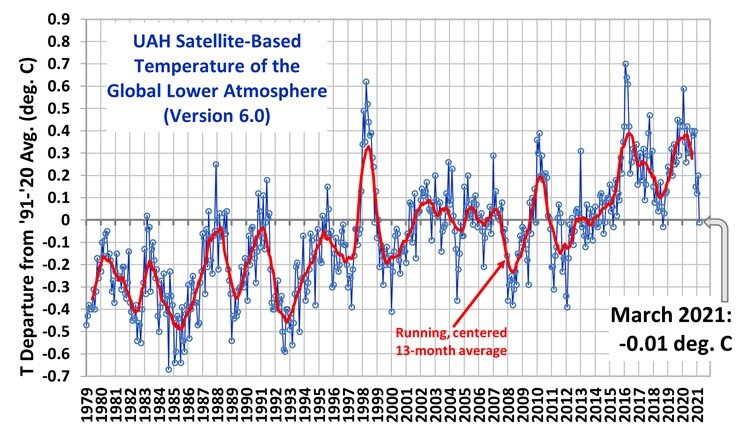
Sure, Thierry. Meanwhile, the UAH guys report another substantial drop in world atmospheric temperature in March 2021. The global temperature anomaly for the month is -0.01 deg C (as against the 30 year average of 1991-2020). That brings us back down to about the same temperature we had back in 1988. Needless to say, Le Figaro was way too polite to confront M. Castel with this information.
Here is the latest UAH chart of global temperatures, going back to 1979:
‘Our focus was to get Trump out of office’: CNN technical director admits network is ‘PROPAGANDA’
RT | April 13, 2021
An undercover video released by Project Veritas shows CNN technical director Charlie Chester revealing how the network purposefully painted Joe Biden in a positive light to get Donald Trump out of office.
In a conversation with a Project Veritas journalist, Chester can be seen on video admitting CNN worked to make Trump look “unfit for office,” while simultaneously portraying Biden as healthy to combat fears the 78-year-old was not up to holding the presidency.
“Look what we did, we [CNN] got Trump out. I am 100% going to say it, and I 100% believe that if it wasn’t for CNN, I don’t know that Trump would have got voted out…I came to CNN because I wanted to be a part of that,” Chester says in the video.
He also detailed bringing in “medical people” to tell a story that was “all speculation” about Trump’s hand shaking.
“We were creating a story there that we didn’t know anything about. That’s what – I think that’s propaganda,” he said.
Chester revealed the opposite was done for Biden during the 2020 presidential race.
“We would always show shots of him [Biden] jogging and that [he’s] healthy, you know, and him in aviator shades. Like you paint him as a young geriatric,” he said, saying the strategy was a “deflection” of his age and numerous public gaffes.
CNN ran numerous stories about Trump’s health during the presidential race, including one from Brian Stelter with a headline reading: ‘It’s now up to journalists to get to the truth about Trump’s health’.
Another from outspoken Trump critic Jim Acosta in October read: ‘Trump’s doctors paint a rosy – but vague – picture of his health during Covid-19 treatment’.
The CNN employee also claimed his network’s strategy as it moves away from Covid-19 coverage is to shift to a focus on climate change.
“It’s going to be our [CNN’s] focus. Like our focus was to get Trump out of office, right? Without saying it, that’s what it was, right? So, our next thing is going to be climate change awareness,” he said.
Chester added he doesn’t specifically know what that coverage looks like, but it will likely include fear-mongering videos of “the effects it’s having on the economy,” as well as “decline in ice” and “weather warming.”
Chester revealed the person deciding all of this slanted coverage is CNN head Jeff Zucker.
The network had not reacted to the video at the time of this article’s publication. However, a source close to CNN told Mediaite Chester was targeted through the dating app Tinder, which included the detail that he worked for the channel.
CNN Raises Eyebrows After Using Images of Ukrainian Tanks While Bashing Russia’s ‘War Preparations’
By Andrei Dergalin – Sputnik – 13.04.2021
Russian Foreign Ministry spokeswoman Maria Zakharova has delivered a sharp rebuke to CNN after the media outlet used a picture of Ukrainian tanks to illustrate an article about Russia’s purported war preparations.
“Dear CNN TV channel and its staff. We realize that you have no time for fact-checking, since you’re so immersed in ideological struggle for the triumph of liberalism,” she wrote in a Facebook post. “But to present Ukrainian tanks at a Ukrainian train station, with Ukrainian train carriages in the background, as Russia’s preparations for war is a bit too much.”
She also snarkily suggested that perhaps CNN correspondents in Moscow should devote more time to their professional duties rather than focus on participating in public life in Russia.
The CNN’s article in question was related to Ukrainian President Volodymyr Zelensky’s recent visit to Donbass, and featured a video depicting Ukrainian tanks on train carriages while the narrator speaks about a “dramatic buildup of Russian forces near the Ukrainian border” and about the emergence of cellphone footage of “military hardware being transported by rail”.
The video fragment with the tanks appeared strikingly similar to a video that emerged on social media earlier this month, which a number of uploaders described as Ukrainian tanks being shipped to Donbass.
The situation in Ukraine’s restive eastern Donbass region has deteriorated in the past few weeks, with Donetsk and Lugansk regional authorities and militia forces reporting an escalation of shelling attacks, bombings and sniper fire by Ukrainian forces.
Meanwhile, the US blamed Russia for allegedly stoking tensions in the region, and threatened to to respond to Russian “aggression”.
The armed conflict in eastern Ukraine broke out in 2014, shortly after the triumph of the Euromaidan coup in Kiev, when residents of the Donbass region refused to submit to the new authorities.


Ukraine’s colors visible no less
Inventing Pretexts to Bash Russia
By Stephen Lendman | April 9, 2021
Establishment media provide press agent services for US imperial interests.
Russia bashing again surfaced in support of political nobody, convicted embezzler Navalny.
Along with grand theft of millions of dollars for self-enrichment, he’s unindicted but guilty of sedition, serving as a CIA/NED asset, and operating as an unregistered US foreign agent — a nation waging war on Russia by other means that could turn hot by accident or intent.
Navalny got off easily. Instead of longterm imprisonment for betraying his country and grand theft, he was sentenced to 2.8 years imprisonment.
He’s interned in central Russia about 80 miles from Moscow.
According to the lying machine NYT, his imprisonment “poses a lethal risk to his health (sic).”
Calling him Putin’s “preeminent political opponent” reinvented reality, a Times specialty.
So is serial lying. Last summer en route to Moscow, he fell ill from a metabolic disorder, what Russian doctors diagnosed when treating and stabilizing him.
No “poisoning with a military nerve agent” occurred, no “assassination attempt,” no attempt to harm him in any way.
Just the opposite! Russian doctors saved him from what may have been severe hypoglycemia, or insulin shock, a serious health risk for anyone with diabetes like Navalny.
Nearly a week ago, he began hunger-striking over alleged failure by prison authorities to provide medical treatment sought.
On Monday, prison doctors diagnosed a respiratory ailment. In response, he was moved to an infirmary for treatment.
If poisoned by a military grade nerve agent, he’d have died in minutes.
If Russia wanted him dead, he’d have been eliminated long ago.
Despite his criminality and overall unacceptable action, Moscow respects the rule of law — polar opposite how the US-dominated West operates, waging endless wars on humanity at home and abroad.
Navalny fully recovered, returned to Moscow voluntarily, was arrested for violating terms of his suspended sentence, and is paying the price.
He warrants no leniency, sympathy, or support for his criminality.
Establishment media backing is all about inventing any pretext to bash Russia and Vladimir Putin personally — a preeminent world leader in stark contract to his unindicted Western counterparts for crimes of war, against humanity, and other criminality too serious to ignore.
Turning reality on its head like the Times, WaPo falsely claimed Navalny is being “slowly killed” by Russia (sic).
His temperature is slightly elevated at 100.5. He’s coughing, and may be suffering from a respiratory illness.
Saying he’ll continue hunger-striking despite being ill makes him responsible if his condition worsens.
Former US political prisoner Maria Butina visited Navalny’s prison ward with an RT camera crew, saying the following:
“I’m tired of the complaining. He is in one of the best penal colonies in Russia.”
His treatment is polar opposite Butina’s horrific ordeal — imprisoned and brutally mistreated for being a Russian national in police state USA at the wrong time.
US dirty war on Russia by other means takes many forms — including politicized arrests, imprisonments, and brutal mistreatment under harsh gulag conditions.
Arrested by the FBI in July 2018, Butina was detained without bond and falsely charged with operating as an unregistered Russian agent — a bald-faced Big Lie.
At the time, Russian Foreign Ministry spokeswoman Maria Zakharova denounced her arrest, detention, and mistreatment, calling it part of (a US) campaign to “stoke Russophobic hysteria.”
Despite innocent of bogus charges against her and posing no flight risk, she was denied bail, largely held in suffocating solitary confinement, and given no proper medical care – aiming to break her will by gross mistreatment.
Numerous other Russian nationals languish unjustly in Washington’s gulag longterm — guilty of nothing but their “wrong” nationality.
A Final Comment
Last October, Russia’s OPCW representative Alexander Shuglin said the following:
Despite unjustifiable demands by Russophobic Western officials, Moscow “does not owe anything to anybody” in response to groundless accusations of poisoning Navalny, adding:
“We do not need to explain ourselves to (Western officials) and we are not going to.”
“Until we receive documents, materials, samples, physical evidence that – as alleged by those accusing us – proving that a toxic agent was found in Alexei Navalny’s tests, until they sit down at the negotiating table with us for an engaged expert-level dialogue, we will treat everything that is going on in the context of this incident as a vociferous propaganda campaign of lies, or, simply, a low-grade provocation.”
To the present day, Russia never received information it requested from Berlin where Navalny was treated —nothing in cahoots with US dark forces to unacceptably bash Russia, part of their long war by other means.
No COVID Vaccine Required: The Case For Ivermectin
Written by thesaqproject | February 21, 2021

We would not need a COVID19 vaccine if there is already a safe and effective treatment. Imagine that: No lockdowns, no masks, no destruction of jobs and livelihoods. Are there treatments for Covid-19 that are safe, cheap, and effective?
The Case for Ivermectin is Part 1 of an investigative series exploring the ever increasing fight against censorship, health freedom, and the medical professionals and researchers who dare to question the official narrative.
Please SHARE, DOWNLOAD, and FOLLOW @TheSAQproject on the following platforms:
IG – www.instagram.com/thesaqproject
TELEGRAM – t.me/TheSAQproject
GAB – gab.com/TheSAQproject
MeWe – mewe.com/i/thesaqproject
BitChute – www.bitchute.com/channel/the-saq-project/
Alex Salmond declines to blame Russia for Salisbury incident
Press TV – April 7, 2021
The leader of the pro-independence Alba Party, Alex Salmond, has steadfastly refused to toe the British government’s line on the alleged poisoning of a Russian double agent in England in 2018.
Former Russian military intelligence officer, Segei Skripal, who betrayed his country by working for the UK’s MI6, was allegedly poisoned, alongside his daughter Yulia, with what the British government says was the Novichok nerve agent.
The alleged attack took place in the medieval cathedral city of Salisbury on March 04, 2018. Both Skripal and his daughter survived the alleged attack.
Speaking to BBC Good Morning Scotland on April 07, Salmond refused no less than four times to blame Russia for the alleged attack.
Faced by Salmond’s defiance, the show’s presenter, Gary Robertson, tried to undermine the former First Minister’s position by pointing out that he produces a show for the Russian TV network RT.
But Salmond hit back by saying: “I produce, along with Tasmina Ahmed-Sheikh, a program for Slainte Media which is then broadcast on the RT platform, as they’re perfectly entitled to do”.
“I can tell you from personal experience – I don’t know what your experience at the BBC is – not a single word of editorial instruction or even suggestion has been made to me from anyone at RT and the program stands on its own merits”, the former leader of the Scottish National Party (SNP) added.
Salmond and fellow Alba Party candidate Ahmed -Sheikh (who is a former SNP MP), host “The Alex Salmond Show” each week on RT.
On another subject, Salmond suggested that evidence of Russian interference in recent US elections was “very slight”.
Salmond’s position on these sensitive issues will alarm the British establishment which has identified Russia as an “active threat” to UK national security in its newly-released Integrated Review of Security, Defense, Development and Foreign Policy.
Both the Alba Party and the SNP are committed to closing down the headquarters of the Royal Navy in Scotland.
The Faslane naval base, formally called Her Majesty’s Naval Base, Clyde, hosts the UK’s nuclear weapons capability.
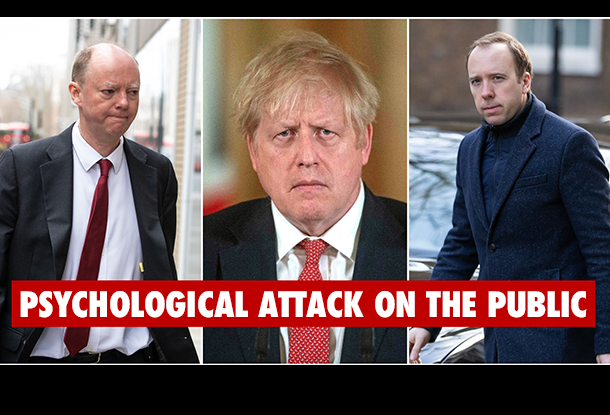
SAGE Document Reveals ‘Covert’ Propaganda to Scare British Into Staying Home in Lockdown
21st Century Wire | April 6, 2021
Once again, the UK government has been shown to have used ‘covert tactics’ in order to scare UK residents into staying at home for lockdown by increasing the ‘perceived threat’ of COVID’ rather than genuine science-backed risk assessment data, and also used ‘hard-hitting emotional messages’ designed to cower the public into complying with the government’s arbitrary diktats.
Due to the heightened level of public outrage, mainstream media outlets are finally being forced to admit what they have been systematically covering-up now for 12 months – that Government have been involved in active psychological and information warfare measures against their own population.
In a document presented to the UK government’s ‘SAGE’ confab, a scientific group meant to advise government on pandemic policies, it was revealed how technocrats sought to increase the ‘perceived threat’ of COVID-19 using aggressive psychological ‘hard-hitting emotional messages’ in order to brainwash the public into compliance.
Upon hearing the official admission, some psychology professionals have turned their sights on Downing Street, accusing bureaucrats of using “covert psychological strategies” in order to hype-up the threat of the virus, and offering no context as to the actual risk posed to the general public.
Government officials are accused of creating ‘a state of heightened anxiety’ which led to many people becoming ‘too frightened to attend hospital’.
This rebuke of the government’s active measures is given further credence by the fact that the majority of hospital beds in the UK remained largely empty in 2020, especially during the first few months of the ‘pandemic.’ This is especially relevant because it was at this same time when the government and mainstream media were relentlessly pushing out the idea that health services were ‘under threat’ of being overrun by Covid, only it never happened.
As a result of the government’s fear campaign, along with the overall throttling of the NHS, there have been an estimated 4.66 million people left waiting many months to begin even routine treatment, as well as thousands of pre-cancer screening appoints abandoned or pushed back – all because of the constant ramping-up of the fear of Covid.
The question still remains: will cabinet ministers be held to account for this unprecedented over-reach of state power?
The Mail Online reports…
Experts fear Britons have been the subject of an experiment in the use of tactics which operate ‘below their level of awareness,’ it was said.
They have now made a formal complaint to an organisation which will rule on whether Government advisers are guilty of a breach of ethics.
Downing street denies this, claiming it simply presented the facts.
Complainants point to a document handed to the Scientific Advisory Group for Emergencies last March, when the pandemic began to rapidly grow in Britain.
The paper, written by Scientific Pandemic Influenza Group on Behaviours, said: ‘A substantial number of people still do not feel sufficiently personally threatened; it could be that they are reassured by the low death rate in their demographic group, although levels of concern may be rising.
‘The perceived level of personal threat needs to be increased among those who are complacent, using hard-hitting emotional messaging. To be effective this must also empower people by making clear the actions they can take to reduce the threat.’
The document, seen by the Telegraph, allegedly then gave 14 options for improving compliance including ‘use media to increase sense of personal threat’, which they said would be highly effective but runs the risk of ‘negative’ side effects.
SAGE members have since claimed the British public have been ‘subjected to an unevaluated psychological experiment without being told that is what’s happening.’
They added that SPI-B reports are often not ‘challenged’ by SAGE because many of those involved are ‘not very well equipped to evaluate it.’
‘When someone from SPI-B is saying we need to ramp up the fear and keep it ramped up – there wasn’t much questioning of that at the beginning and most of the questioning came from external sources, not from within.’
SPI-B is described as providing behavioural science advice aimed at anticipating and helping people adhere to interventions that are recommended by medical or epidemiological experts.
(…) Last November, Sir Patrick Vallance admitted he had ‘regrets’ over frightening people with a doomsday dossier that forecasted as many as 4,000 Covid-19 deaths a day over winter and was used to justify a second national lockdown.
Number 10’s top scientific adviser made the comments alongside Professor Chris Whitty, England’s chief medical officer, after the pair were hauled before MPs to defend SAGE’s modelling that also predicted hospitals would be overrun with virus patients by the end of this month.
During the grilling by members of the House of Commons Science and Technology Committee, Labour MP Graham Stringer asked Sir Patrick if he believed he had frightened people with the bleak deaths data presented during Saturday night’s press briefing.
The Chief Scientific Adviser said: ‘I hope not and that’s certainly not the aim… I think I positioned that as a scenario from a couple of weeks ago, based on an assumption to try and get a new reasonable worst-case scenario. And if that didn’t come across then I regret that.
Australian-British received Israeli training for spying in Iran, analyst affirms
Press TV – April 3, 2021
A political commentator has shed light on the case of Kylie Moore-Gilbert, an Australian-British citizen who served a prison sentence over espionage charges in Iran, highlighting US media’s dishonesty in intentional concealing of the truth about Tehran’s assertion that the academic lecturer had passed a special training course under Israel’s direct supervision for her spying mission in the country.
Tim Anderson, the director of the Center for Counter Hegemonic Studies (CCHS) in Australia, said in an article published on the center’s website on Friday that the American news mogul Rupert Murdoch’s media outlet had spread misinformation over the convicted Israeli spy, Gilbert, who returned home to Australia from an Iranian jail late last year.
The media outlet claimed that Gilbert had been held in a “hellhole” in Iran for no reason at all.
The British-Australian academic was freed from Tehran’s Evin prison in November after serving about two years of her 10-year jail term.
Iranian media reported that Gilbert had passed a two-year special training course in Israeli occupied territories for her spying mission and she had became fluent in Persian during the course and got prepared to perform espionage activities inside Iran.
Anderson said he had provided Murdoch journalist Stephen Rice with evidence that Gilbert had engaged in Israeli “leadership training” for her spying mission in Iran through a fellowship offer in the Ein Prat Israeli leadership academy at the Alon Shvut settlement, one of many illegal settlements in the occupied West Bank.
Anderson added that Gilbert had received a scholarship for the course from Tikvah Fund, an institution committed to supporting the intellectual, religious, and political leaders of the Jewish people.
As cited by the CCHS’s website, Anderson said, “Stephen Rice was either too lazy or too dishonest” to look at the links he had sent him, and that Rice had mentioned in one Israeli article that the linked article said nothing about “leadership” or “training” and those words were an “invention” by Anderson.
“Murdoch’s Megaphone @riceyontheroad was either too lazy or dishonest to recognize Israeli sources backing Iran’s assertion that @KMooreGilbert took Israeli leadership training in a militarized colony at the heart of Palestine’s occupied West Bank,” Anderson also said in a tweet.
Anderson also underlined that Rice pretended Gilbert’s Israeli “leadership training” did not exist and he misled his readers.
“This willful ignorance and distortion of facts allows the Murdoch stable to keep representing the US backed regional wars in Palestine, Afghanistan, Iraq, Libya, Lebanon, Syria and Yemen as humanitarian exercises,” he noted.
Gilbert traveled to different Iranian cities as part of her mission and gathered information.
Unaware that she was being watched by Iranian intelligence forces, the woman went to religious and tourist places in order to make her sojourn in Iran look normal.
She later tried to get in touch with some figures and targets to obtain economic and military information about Iran as well as the anti-Israel resistance front, but she was arrested in September 2018.
Following legal and judicial proceedings, the spy was sentenced to 10 years in prison for acting against Iran’s national security through her intelligence cooperation with the Israeli regime.
The Lockdowners Have Their Own Conspiracy Theories
By Phillip W. Magness | AIER | April 2, 2021
A bizarre Covid-19 conspiracy theory appears to have taken root among the epidemiologists and public health officials who still support lockdowns. According to their claims, the UK government’s pandemic response was secretly captured at some point in the fall of 2020 by lockdown critics including Great Barrington Declaration co-author Sunetra Gupta, her Oxford colleague Carl Heneghan, and Sweden’s state epidemiologist Anders Tegnell.
Seizing on an article in the Times of London, supporters of this theory allege that Gupta and her colleagues convinced UK Prime Minister Boris Johnson and Chancellor Rishi Sunak to abandon a so-called “circuit breaker” lockdown during an audience in late September. Had the UK gone back into lockdown around the beginning of October instead of a month later – proponents of this theory maintain – it would have avoided its disastrous second wave over the fall and winter months.
Even the basic narrative flies in the face of empirical reality. In November 2020 and again in January 2021, the UK went through two successive rounds of draconian lockdowns of the exact type that Gupta and her colleagues advised against. Championed by Johnson as a way to avert the second wave, these policies utterly failed at their stated purpose. On November 5th, the date the second lockdown took effect, the UK’s death toll stood at 48,000. Over the next four months, three of them spent under recurring lockdowns, the UK’s fatality numbers exploded to over 120,000.
Equally telling, the timing of the UK’s fall/winter wave almost perfectly matched that of Sweden, which remained open throughout the same period – except the UK’s results under lockdowns were visibly worse. As a growing body of scientific literature attests, lockdowns did practically nothing to contain the pandemic. Instead, the performance of this policy shows no discernible advantage over states and countries that opted against suspending the basic operations of daily life, and in many cases lockdown countries actually did worse than those that remained open.
Still, proponents of the newest UK conspiracy theory hold that something very different would have happened if only Johnson had enacted an earlier lockdown around the beginning of October instead of November 5th. Its underlying narrative has gained an unusually intense following among public health activists and pundits in the UK.
Deepti Gurdasani, an epidemiologist at Queen Mary University in London and a principal organizer of the pro-lockdown John Snow Memorandum, has aggressively promoted the alleged wresting of pandemic policy away from the lockdowners as an explanation for why the UK’s second and third lockdowns failed. As early as December, Gurdasani blasted Downing Street for supposedly listening to the “dangerous ideology” of Gupta, Heneghan, and Tegnell, which “has cost thousands of lives” and sought to replicate the “dangerous” Swedish strategy. Never mind that Sweden, without lockdowns, has a much lower deaths-per-million residents total (1,303 as of April 1st) than the UK (1,890) under three harsh lockdowns.
The same narrative has become a favorite of Devi Sridhar, an anthropologist and Snow Memorandum co-signer who frequently appears in the UK media to advocate the fringe “Zero Covid” strategy (the same one that claims we need more lockdowns to prevent future lockdowns, apparently unaware of the contradiction that entails). Attempting to explain why her own lockdown approach did not work, Sridhar wrote on January 5th that “Chancellor Sunak invited Heneghan, Gupta & Tegnell to advise on strategy. That says it all.”
Other variants of the same conspiracy theory permeate the UK’s pundit ranks. Far-left Guardian columnist Owen Jones repeated it in a December column targeting Sunak and the scientists for allegedly delaying the lockdowns until it was “too late to bring coronavirus rates down to anywhere near the level needed to suppress the virus.”
A little over a month later, Sam Bowman, a right-leaning self-described “neoliberal,” penned an almost identical argument to Jones in the same newspaper, writing “Sunak was reported as having been the decisive voice in government against an autumn lockdown that might have brought cases low enough to make things like test-and-trace viable,” all because of “Sunetra Gupta, Carl Heneghan and Anders Tegnell being invited to speak via Zoom at Downing Street.”
Note that none of these commentators are even willing to consider the possibility that lockdowns do not deliver on their promises, or that Britain’s dismal performance under the policies they advocated is a direct testament to their failure as public health measures. The validity of lockdowns has become an axiom to them, and the only conceivable reason they do not work must be some form of malfeasance preventing them from working the way the epidemiology models claim they should. Sunak and the three dissenting scientists accordingly became a natural scapegoat for Britain’s dismal public health performance over the winter months.
Is there even a kernel of truth behind the lockdowner’s UK conspiracy theory? Gupta, Heneghan, and Tegnell did meet with Downing Street via Zoom on September 20th to voice their opposition to lockdowns in general – a position they have consistently held throughout the pandemic. Unfortunately, as Gupta has explained and as the next four months repeatedly demonstrated, the Prime Minister largely ignored their advice.
The conspiracists’ alleged “smoking gun” is a series of minutes from the UK government’s SAGE advisory committee on September 21st, which included a “circuit-breaker lockdown” among a “short-list” of policies “that should be considered” in response to rising Covid-19 cases. Apparently in their minds, being “considered” equates to adoption, and the fact that Johnson did not lock down the very next day is proof that the dissenting scientists had wrested the reins of the UK’s pandemic policy from those who advocated lockdowns, delaying the necessary response until November 5th after which it was too late.
There are multiple immediate problems with this narrative. First off, Wales tried a “circuit breaker” lockdown that almost exactly followed the proposal being considered by the SAGE committee, announcing it on October 19 and implementing it a few days later. Although it had a lead of almost two weeks before the rest of Britain went into lockdown in November, Wales’s per capita case numbers followed the same trajectory as the rest of the country, including the sharp spike in late December and early January. Far from working as intended, Wales’s “circuit breaker” lockdown only slightly shifted the timing of this pattern. Its maximum daily peak of 87 cases per 100,000 residents nearly matched England’s peak of 96, and its curve for Covid-19 fatalities followed the same pattern as the rest of Britain.
Equally telling, a number of the conspiracy theory adherents themselves were singing a very different tune when these events were unfolding. Gurdasani, Sridhar, and other lockdown advocates of the John Snow Memorandum crowd want you to believe that they were patiently counseling the government to adopt an early lockdown between the end of September and mid-October, only to see their advice deflected by Downing Street due to the interference of Gupta and the other dissenting scientists. The record reveals a very different story.
On September 24, only three days after the SAGE meeting minutes, an interesting editorial appeared in the leading British medical journal. Written by Karl Friston, a frequent collaborator with Gurdasani and fellow John Snow Memorandum organizer, the editorial advocated a “third way beyond lockdown or herd immunity” premised on implementing a contact tracing regime over the next few weeks. Far from raising alarms about the immediate need for another lockdown, Friston attempted to assure calm.
“We have already developed a substantial population immunity (around 8% in the UK) and our physical distancing policies remain adaptive and effective,” he explained, arguing that a contact tracing regime could synergistically harness and augment their effectiveness. As far as the fall case surge went, he predicted a comparatively mild trajectory: “When one models what is likely to happen…in terms of viral spread and our responses to it—a plausible worst-case scenario is a peak in daily deaths in the tens (e.g., 50 to 60) not hundreds, in November.” As it happens, the UK topped 400 deaths per day during the November lockdown, and surged to 1,200 deaths per day at the peak of the January lockdown.
Just over two months later, Friston joined Gurdasani and several other Snow Memorandum signers in an letter to the Lancet that blamed the UK’s second wave on failing to heed pro-lockdown advice that they now claimed as their own, even as it conflicted with their public messaging from September that downplayed the very same recommendation. Writing in hindsight and with a liberal amount of revisionism, they recast themselves as proponents of an earlier lockdown all along: “On Sept 21, 2020, the Scientific Advisory Group for Emergencies (SAGE) advised the UK Government to institute a circuit breaker in England to suppress the epidemic. Instead, the government opted for several weeks of ineffective local tiered restrictions, and cases continued to rise exponentially.”
A similar messaging came from the “Independent SAGE” group – a private organization of scientists who now generally support the lockdown approach, but also spent the early fall advocating less-restrictive measures that would supposedly avoid another lockdown. On September 20th, the same day that Gupta and the other scientists met with Downing Street, the Independent SAGE group (not to be confused with the official SAGE group despite their shared name) released a 10-point plan “to avoid a national lockdown.”
The scheme warned of a point “when the situation is so far out of control that the only possible response will be a second national lockdown,” but advised “we can only avoid it if we take urgent action” as recommended by the group. They sought a variety of restaurant restrictions limited to outdoor dining, plus the same testing and contact tracing programs espoused by Friston. Six months later, Independent SAGE member Kit Yates is now faulting the anti-lockdown scientists for Johnson’s failure to implement a policy last September that his own group purported to oppose and sought to forestall.
Indeed, what we see when we look to the words of these lockdowner scientists and pundits is nothing short of a conscious attempt to rewrite their own positions from the time period when the conspiracy theory that they’ve now adopted was allegedly playing out. As I documented last fall, the overwhelming media narrative from late September and early October explicitly deflected attention away from the prospect of a second lockdown. Scientists such as Gupta, Heneghan, and the Great Barrington Declaration (GBD) signers, they vigorously maintained, were arguing with a “strawman” of renewed lockdowns that nobody was seriously proposing or considering anymore.
A typical version of this narrative appeared inWired UKon October 7th as part of a media attack on the GBD. “The kind of lockdown that the Great Barrington Declaration seems to be railing against hasn’t been in place in the UK since mid-June,” argued the magazine’s science editor Matt Reynolds. Even in UK cities that were under local restrictions, “pubs, restaurants and schools are still open and it’s hard to find people who are advocating for a return to the lockdown we saw in March.” Reynolds continued: “When the Great Barrington Declaration authors declare their opposition to lockdowns, they are quite literally arguing with the past.”
Similar messages appeared throughout the UK media at the time, each insisting that lockdowns were no longer on the table. On October 11th, Guardian columnist Sonia Sodha wrote “The [Great Barrington] declaration sets itself up against a straw proposal that nobody is arguing for – a full-scale national lockdown until a vaccine is made available.” By October 30th, Sodha was already contradicting herself and revising her own history, tweeting “Wish we’d had a circuit breaker lockdown when SAGE first recommended it.” By mid-December, she was touting the conspiracy theory about Gupta, Heneghan, and Tegnell’s Zoom meeting with Downing Street. More recently, she’s become an advocate of de-platforming the same scientists from British media channels for their anti-lockdown heresies.
Sridhar’s own navigation of the lockdown question followed a similar course. Although she now chastises opponents of the “circuit breaker” lockdown proposal from the events of September 20-21 and faults them for Britain’s second wave, Sridhar wrote a bizarre op-ed in the Guardian on October 10th purporting to oppose “continual lockdowns.” Much like the Zero Covid messaging she would later adopt, its argument is confused and self-contradictory, meandering from touting the model of Taiwan, which never locked down, to New Zealand, which continues to use aggressive lockdowns to suppress even the slightest outbreak. But it also sought to signal her opposition to the specter of renewed lockdowns, which could be avoided – she insisted – by adopting less-stringent localized restrictions and an extensive contact tracing regime.
Sridhar would doubtless insist that her own re-adoption of lockdown advocacy about a month later arose from a failure to heed her earlier advice, as opposed to a more fundamental error with the lockdown approach. Even then, it’s difficult to square her mid-October position with her newfound claim to have recognized the wisdom of a national lockdown some 2 to 3 weeks earlier than the October 10th op-ed, only to see it derailed by the scientists who spoke to Downing Street. Like the Independent SAGE group’s September 20th manifesto, Sridhar was either far less attached to a second lockdown at that point in time than she now insists, or she was engaging in deception about her intentions.
The most astounding attempt at revisionism, however, came from Gurdasani – the Snow Memorandum organizer who has since tried to scapegoat the UK’s Covid failures on Gupta, Heneghan, and Tegnell over the September Zoom conference. She now depicts herself as an early lockdown advocate whose advice from September was shoved aside and ignored. Yet as late as October 26, Gurdasani was still pushing the same “lockdowns are a strawman” line that had dominated the previous month of UK media coverage.
Writing for the Byline Times, a London-based blog that has pushed multiple unhinged conspiracy theories of its own about the Great Barrington Declaration, Gurdasani described lockdowns as “a strawman that the science is not only not advocating for, but very keen to avoid.”
Gurdasani was in the middle of a publicity campaign for the John Snow Memorandum at the time, its own language having been carefully crafted to present its recommendations as a strategy “to prevent future lockdowns” by relying on nondescript localized “restrictions” and a contact tracing regime. As Gurdasani and another Snow Memorandum signer told the Byline Times’ readership, “Unfortunately, the proponents of herd immunity have had a huge impact on responses to the pandemic, effectively creating the lockdown strawman,” insisting that this presented a “dangerous false dichotomy.”
With Gurdasani stressing that she was keen to avoid future lockdowns – a “strawman” in her own words – as late as October 26th, one begins to wonder how she could have supported the very same “strawman” over a month earlier on September 20th, the date on which the dissenting scientists allegedly wrested control of the UK’s pandemic response. Perhaps the lockdowners’ latest conspiracy theory has another as of yet undisclosed twist to it, this one involving a time machine.
The Vaccine Passport Propaganda Template
By Adam Dick | Ron Paul Institute | March 30, 2021
With reports that President Joe Biden’s administration is planning for imposing a vaccine passport mandate in America, expect to see in the media a deluge of vaccine passport propaganda. What will that propaganda look like? A template illustrating several elements you can expect to see in the propaganda push was provided several weeks ago in a CNN interview.
In the first week of March, host Fareed Zakaria and his guest Arthur Caplan provided at CNN a textbook example of how to present vaccine passport propaganda to the American people. Let’s look at some of the major elements of the propaganda template as demonstrated by Zakaria and Caplan.
1) Include some short expression that the idea of vaccine passports can be troubling, but make sure to only bring this up superficially. This is accomplished in the CNN segment by starting with a clip from a short scene from the movie Casablanca. In the clip, a policeman asks to see a man’s “papers,” the man says he does not have them, and the policeman responds, “in that case we’ll have to ask you to come along.” Not shown is the remainder of the scene in which the accosted man, after presenting apparently expired papers, attempts to flee only to be gunned down. Not showing the full scene demonstrates the care demanded in the propaganda to not allow any depiction of potential dire consequences from imposing vaccine passports.
2) Frame the imposing of a vaccine passport mandate as something that is both inevitable and threatens only minimal, if any, harm. Zakaria accomplishes this task with the first sentence he utters to begin the media segment. Zakaria states: “From Casablanca to today, a demand to produce personal documents can be uncomfortable, but, post-pandemic, it’s something we’ll all likely have to get more and more comfortable with.” Masterfully, Zakaria, in addition to minimizing the problems with passports as just causing discomfort, asserts that even that discomfort with time will disappear, suggesting objecting to vaccine passports is just an irrational or silly reaction.
3) Bring on a guest who, despite his description making him sound like someone who would be looking out for the interests of people concerned about vaccine passports, pretty much says that vaccine passports are the best thing since sliced bread. In the CNN interview the guest performing this role is Arthur Caplan, who Zakaria introduces as a “medical ethicist” and “professor at NYU.” A medical ethicist will surely provide some warning about dangers from vaccine passports, right? Yes, in many cases. But, Caplan is not that sort of medical ethicists. He is the one picked to be interviewed in a media segment designed to promote acceptance of vaccine passports.
4) Reiterate that vaccine passports are inevitable, and that people should support them. Zakaria hits the nail on the head with this, presenting this first question to his guest: “So explain why you think, basically, that this is the future and we should be comfortable with it.”
5) Declare that vaccine passports must be imposed on the American people because of coronavirus. Caplan accomplishes this task in his first words in the media segment. He states: “Well, I’m sure that the future holds vaccine passports for us, partly to protect against the spread of Covid.” Of course, as coronavirus has turned out not to be a major danger to most people, imposing a vaccine passport mandate to counter it makes no more sense than doing it to counter any other of many diseases. But, this is not a topic to be brought up when selling people on vaccine passports. Fearmongering, no matter how ridiculously unjustified, is the name of the game. This is the fraudulent message people are encouraged to act on without much critical thought: Coronavirus is gonna kill us all unless we take the shots and show our papers!
6) Say that mandating vaccine passports is really no big deal because of some other supposedly very similar restriction to which some people are already subjected. Caplan states: “And, you know, it’s not a new idea, we have it for yellow fever; there are about more than a dozen countries that say you can’t come in if you haven’t been vaccinated against yellow fever, and many others require you to show proof of vaccination if you transit through those countries.” Are the yellow fever-related requirements justified? Caplan does not say more than that, because these somewhat similar restrictions exist someplace, the mandating of vaccine passports in America is fine. That’s medical ethicist reasoning? Anyway, the yellow fever stuff, because most Americans have no experience with or knowledge of it, is a fine example for the propaganda. Few watchers of the segment will have any basis for questioning the current practice that is used to justify the new desired mandate. One big difference, though, jumps out on further consideration. Caplan explains that the yellow fever requirements apply for just coming to several countries. In contrast, Zakaria early in the interview says the vaccine passports that will, he claims, inevitably be imposed on Americans will be required for people “to get on an airplane, to go to a concert, or to go back to work.” The vaccine passport mandate is, thus, much more troublesome for most Americans than yellow-fever-related requirements for entry into a few countries that most Americans never visit. But, the point is to quickly present the example as if it provides conclusive support no matter how far that representation is from the truth.
7) Dismiss as insignificant people’s concerns about being required, in order to go about their daily activities, to present a vaccine passport and to take a vaccine, or, really, an experimental coronavirus vaccine that is not even a vaccine under the normal meaning of the term. Assert instead that the only danger to freedom could be something theoretical that could be additionally required in the future. Here is how Zakaria puts it in a question to Caplan: “What about the concerns that many people have about privacy, about the privacy of their health data, that, you know, is there a slippery slope here — ‘OK, I’m comfortable telling you whether or not I have Covid, but does that mean it becomes OK to ask about other things?’” Of course, many people are justifiably wary of being pressured to take the shots and then having their mandated vaccine passport used to track them as they go about their daily activities. That is why this media segment and others like it are being presented, after all.
8) Dismiss any concern that vaccine passports can in fact harm freedom. Instead, describe people as benefiting from and gaining freedom by their being mandated to take experimental coronavirus vaccines and present vaccination passports in order to go about their daily activities. Oh yeah, and keep quiet about all the mass surveillance facilitated by a vaccine passport program, the vaccinations-based caste system resulting from the mandate that will make people who do not take the shots suffer, and how the vaccine passport program can be expanded to advance many additional types of control over people. Here is how Caplan puts it: “With a Covid certification, you’re going to gain freedom, you’re going to gain mobility, and I’m going to suggest that you’re probably going to be able to get certain jobs.” Talk about turning things on their head. The mandate really means that people who do not comply will be barred from the mobility they already have and fired from their jobs. Freedom is supported by rejecting the mandate, not by supporting it.
9) Insist that the vaccine passport mandate is fine because it will be applied equally to all people. This is something Zakaria and Caplan spend a long time talking about in the CNN segment. Come on guys, something bad does not become good because it is applied to the maximum number of people, irrespective of their race, sex, or whatever. We are dealing with a mandate here, not giving everyone a serving of his favorite dessert.
10) Declare that a vaccine passport mandate helps encourage people to take the shots. (Unlike the other nine elements of the vaccine passport mandate propaganda template, this one is likely true. Threats can yield compliance. Still, the threats could deter some people from taking the experimental coronavirus vaccine shots. It sure makes you wonder about shots’ supposed safety when an extreme, and unprecedented, act of force is employed to ensure people take the shots.) States Caplan in the interview: “It also gives you an incentive to overcome vaccine hesitancy. Some people are not sure still whether they want to do the vaccine, but if you promise them more mobility, more ability to get a job, more ability to get travel, that’s a very powerful incentive to actually achieve fuller vaccination.” What Caplan is really talking about is coercion. He is saying that people who would otherwise refuse taking the shots will be forced to do so by the vaccine passport mandate severely restricting their activities and even depriving them of the ability to earn an income so long as they do not give in to the demand they take the shots. All this authoritarianism is dressed up in deceptive language. “Vaccine hesitancy” is substituted for “vaccine refusal” to disguise that the vaccine passport mandate is about stopping people from exercising free choice. “Incentive” is substituted for “coercive technique.”
Watch Zakaria and Caplan’s interview here:
Hopefully, many people will see through the deception and be able to prevent the implementation of the vaccine passport mandate Zakaria, Caplan, and others are promoting in the media.
Copyright © 2021 by RonPaul Institute
They’re Not Even Trying to Make Sense Now
By Patrick Armstrong | Strategic Culture Foundation | March 31, 2021
The US intelligence community published a report on 10 March, widely reported in the US free speech news media, on foreign interference in the US election (how many oxymorons so far?). The report establishes a new level of idiocy on the long-running “Russiagate” nonsense.
The idiocy began when Trump, campaigning, remarked that it would be better to get along with Russia than not. A sentiment that would not have surprised Presidents Eisenhower, Kennedy, Nixon, Reagan or any of the others who recognised that, like it or not, Moscow was a fact. A fact that had to be dealt with, talked to, negotiated with so as to produce the best possible result. Why? Well, apart from the diplomatic reality that it is better to get on with your neighbours, the fact that the USSR/Russia was a nuclear power that could obliterate the USA was adequate reason to keep communications alive. If relations could be improved, all earlier US Presidents would agree, so much the better. But for Trump – the outsider – to dare to say so was an outrage. Or more accurately, a hook on which to hang enough simulated outrage to cost him the election. Then, upsetting all expectations, he won. Immediately pussy hat protests, blather about tax returns, Electoral College speculations, 25th Amendment, psychiatrists opining unfitness (COVFEFE: Bizarre Trump Behavior Raises More Mental Health Questions): an entire industry was created to get Trump out, or, if he couldn’t be got out, then at least prevented from doing any of the things he campaigned on. All the swamp creatures were mobilised. The most enduring of these efforts was the Russia allegation. A Special Counsel was created to investigate Russia, Trump and the election. Leaks from this and other investigations fuelled outrage and talk shows.
One of the indications that the story was actually an information operation and not based on fact was its imprecision. Was Trump merely too friendly with Putin, or was he his puppet? Was Trump just a fool to think that relations with Russia could be improved, or was he following instructions? In short, was he a dupe or a traitor? How exactly had Russia interfered in the election and to what effect? Had a few voters been influenced or had the result been completely determined by Moscow? In short was Moscow running the USA or just trying to? Proponents of these crackpot theories never quite specified what they were talking about – it was all suggestion, innuendo, rumours and promises of future devastating revelations. Some of the highlights of the campaign: Keith Olberman shouting Russian scum! Morgan Freeman solemnly intoning that we were at war, and, night after night, Rachel Maddow spewing conspiracies. Some media headlines: Opinion: Here are 18 reasons Trump could be a Russian asset. Trump is ‘owned by Putin’ and has been ‘laundering money’ for Russians, claims MSNBC’s Donny Deutsch. Mueller’s Report Shows All The Ways Russia Interfered In 2016 Presidential Election. A media firestorm as Trump seems to side with Putin over US intelligence. Trump and Putin, closer than ever. All signs point the same way: Vladimir Putin has compromising information on Donald Trump. And so on. Four years of non-stop nonsense promising, tomorrow, or the next day, the final revelation that would disgrace Trump and rid the country of him forever: my personal favourite is this mashup of TV hairstyles telling us that the walls were closing in. Information war. Propaganda. Fake news.
All this despite the fact that the story as presented simply made no sense at all. As I pointed out in December 2017, if Moscow had wanted to nobble Clinton, it had far more potent weapons at its disposal than a too-late revelation of finagling inside the DNC.
And it wasn’t just TV talking heads; the US intelligence community participated. There were two laughable “intelligence assessments”. The DHS/FBI report of 29 December 2016 carried this stunning disclaimer:
This report is provided “as is” for informational purposes only. The Department of Homeland Security (DHS) does not provide any warranties of any kind regarding any information contained within.
The DNI report of 6 January 2017 devoted nearly half its space to a four-year-old rant about RT and admitted that the one Agency that would really know had only “moderate confidence”. In short: ignore the first report, and don’t take the second one seriously. Were people inside these organisations trying to tell us it was all phoney? No matter, the anti-Trump conspiracy shrieked out the reports immediately.
One by one, it fell apart. Mueller, despite the prayer candles, came up with nothing. The “Dirty Dossier” was a fraud. The impeachment for something that Biden actually did failed. These dates should be remembered – Crowdstrike CEO Shawn Henry told the House committee that he had no evidence on 5 December 2017; this classified testimony was not made public until 7 May 2020. Simply put: the key allegation, the trigger for all the excitement and investigations that followed, was a lie, many people knew it was a lie, the lie was kept secret for 884 days. But the lie served its purpose.
There were no investigations of this fraud, only pseudo investigations that went nowhere. When the Republicans had a majority on the House of Representatives there were serious investigations but the testimonies – like Henry’s – were kept secret because they were “classified”. When the Democrats gained control, there were continual boasts that the evidence of collusion was overwhelming, but nothing happened either. Trump’s first Attorney General recused himself and the investigation was conducted by the conspirators. His second Attorney General promised much, set up a Special Counsel, but nothing happened. Well, not quite nothing: a junior conspirator had his knuckles rapped for faking a FISA warrant. In short, the Deep State ran the clock out: the swamp drained Trump.
Ran it out quite successfully too: relations with Russia got worse and Trump himself was hamstrung. His orders were ignored everywhere: on investigating the conspiracy and on removing troops; here’s an insider telling us that the Pentagon ignored his orders on Afghanistan. He was stonewalled on Syria: “We were always playing shell games to not make clear to our leadership how many troops we had there.” The “most powerful man in the world” was blocked on almost every initiative and the long false Russia connection story was a powerful weapon in the conspiracy to impede his attempts to change course.
In 2021 Trump left office and there was no need to mention any of it again. But here’s where it gets really stupid. In December 2020, the NYT solemnly told us: Russian Hackers Broke Into Federal Agencies, U.S. Officials Suspect: In one of the most sophisticated and perhaps largest hacks in more than five years, email systems were breached at the Treasury and Commerce Departments. Other breaches are under investigation. At the same time we were equally solemnly told by US officials “The November 3rd election was the most secure in American history”.
In short, we are supposed to believe that
in 2016 the Russian hacked nothing but the election
and in 2020 they hacked everything but the election.
How stupid do they think we are? Even stupider evidently. Instead of retiring the Trump/Russia/collusion/interference nonsense when it had achieved its purpose, the Intelligence Community Assessment on Foreign Threats to the 2020 US Federal Elections takes us right back down the rabbit hole. I haven’t read it and certainly don’t intend to (see oxymoron above), but Matt Taibbi has and eviscerates it here; he’s read far enough to have mined this gem “Judgments are not intended to imply that we have proof that shows something to be a fact”. (Is this a hint from insiders that it’s all fake?) The report claims that Putin authorised, and various Russian government entities conducted, a campaign to denigrate Biden. Specifically by using Ukrainian sources to talk about corruption of Biden and his son Hunter; despite the video of Biden boasting about firing the investigator, we’re assured that this is all disinformation. And the consumers of the NYT and CNN will believe what they were told. Or, actually, will believe what they weren’t told: the media kept quiet. (Now that’s interference and interference that actually might have changed votes.) The report goes on to say that China did something or other and Iran, Hezbollah, Cuba and Venezuela also chipped in. But fortunately no foreign actor did anything to affect the technical part of the election.
The US security organs expect us to believe,
giving no proof,
that there was lots of malign activity
which had no effect on the election whatsoever.
Which is telling us they think we’re even stupider. Russia swung the election four years ago but forgot how to this time? Putin’s attempt to keep Trump in was blocked by security measures adopted when his tool was President? This time Putin wanted Biden in? Russia’s efforts on behalf of Trump were countered by China’s on behalf of Biden and Iran’s interference broke the tie? But then, information operations don’t have to make sense, they just have to create an impression: Russia, China, Iran and Venezuela do bad things to good people.
Oh, and the latest is that Moscow cultivated Trump for over 40 years, Imagine that: in 1980 they were so perceptive as to see the future importance of a property developer; who’ve they got lined up in the wings now? And Rachel Maddow is back at the old stand pushing some conspiracy theory about Trump, Putin and COVID. I guess it’s not yet time to put away the tinfoil hats.
As I have said before, English needs a whole new set of words for the concept “stupid”: the old ones just don’t have the power any more.
Featured Video

When Israel Is Mighty
or go to
Aletho News Archives – Video-Images
From the Archives
US murdering 1 million Iraqis is democracy, Iran giving yogurt to Iraq is “domination”
By Ali Salaam | American Herald Tribune | July 31, 2017
The New York Times, owned by the Zionist Jewish supremacist Ochs-Sulzberger family, has no problem with Iraqi suffering as long as Iran is not the one behind it.
The Iraq War was a genocide of the Iraqi people by Zionist supremacists in the Bush administration. Over 1 million innocent people were killed based on a lie. American soldiers died in an Israeli war and now an average of 22 soldiers commit suicide every day because their consciences cannot cope with the fact they committed crimes in an illegal war that served no purpose other than to benefit Israel, not America.
Benjamin Netanyahu, Prime Minister of the Zionist regime, once said “We are benefiting from one thing, and that is the attack on the Twin Towers and Pentagon, and the American struggle in Iraq.”
Paul Wolfowitz had his sights on Iraq since his time in the first Bush administration. Former Israeli official and Bush administration official Richard Perle had his eyes on Iraq since at least his authorship of the Clean Break white paper. The Zionist regime had their eyes on Iraq since the 1980s when strategist Oded Yinon wrote his white paper in support of dividing the Arab-Muslim world along ethnic and sectarian lines. The global Zionist lobby has had their eyes on Iraq since Theodor Herzl stated that Eretz Israel’s true borders go from the Nile River in Egypt to the Euphrates River in Iraq. … continue
Blog Roll
 Aletho News
- MEP blasts ‘Euro-Gestapo’ for lecturing Russia on democracy
- Syria May Send Troops to Saudi Arabia Amid War with Ansar Allah
- UK whines about losing billions to ‘Putin tax’
- Baghaei to Rubio: Distorted narratives cannot erase US record of broken commitments
- Houthis Don’t Have to Conquer Saudi Arabia to Make It Pay
- MOE: Nearly 22,000 Students and Education Workers Killed
- Guterres in Islamabad: Genocide, cowardice, and the cage of Imran Khan
- Johnson, Marandi say Yemen holds upper hand over Saudi Arabia
- False flags won’t save aggressors, Iran FM spokesman says
- The Makkah Pact Enters Into Force: The End of American Dominance or Its New Form?
- If Americans Knew
- Israel puts Gaza’s sick, injured, newborn in peril – Daily Update
- Report claimed Mark Levin used by Israeli government to influence Trump
- Over 2,000 Gazans have died awaiting medical evacuation amid Israel’s continued siege
- How a U.S. Diplomat Suppressed and Altered Reports Critical of Israel
- 5 Palestinians Die from Israeli Strikes in Gaza as Relentless Attacks Continue
- Report: Ceasefire Slows Killing but Leaves Devastation Intact
- Country Music Singer Zach Bryan Breaks Attendance Record at Robert Kraft’s Gillette Stadium While Wearing ‘Free Palestine’ Shirt for Second Night in a Row
- Three years of death and devastation: Israel’s war on Gaza in pictures
- Why Hamas believed the status quo was more dangerous than its 7 October gamble
- Debunking Israel’s latest list of ‘terrorist’ journalists in Gaza
- No Tricks Zone
- New Study: 50 Years Of The Most Aggressive ‘Net Zero’ Policies Can Only Affect The Global Climate By 0.03°C
- US September “Heat” Was No Record…Many Records Set Decades Ago
- Latest European Green Energy Debacle; Portugal’s Largest Flagship Solar Park Insolvent!
- Green Energy Debacle: German Expert Professor Fritz Vahrenholt Warns Of Severe Economic And Social Consequences
- Two More Paleo Reconstructions Affirm Meters-Higher Sea Levels Across Ireland, Brazil 7000-6000 Years Ago
- New Study: Earth And Venus Surface Warmth Largely Explained By Convection And Lapse Rate, Not CO2 Or Radiation
- 2025 Nature Paper Claiming Worsening Global Drought Gets RETRACTED …Heavily Flawed
- New Study: ‘Global Drought Shows No Detectable Recent Acceleration Under Climate Warming’
- Economic Masterminds: German Socialists Suggest Taxing Productivity Gains Stemming From Using AI
- The South China Sea Has Not Been Cooperating With The Climate Change Narrative

