The Ups and Downs of Rebuilding Aleppo, Mosul
Veterans Today | June 23, 2018
Aleppo and Mosul, cities that endured some of the worst urban warfare in the 21st century, have quite different liberation stories, but they are alike in the way media treated them with oblivion once the post-war struggle began.
Both the Syrian city of Aleppo and Iraq’s Mosul found themselves gripped in fierce battles in late 2016. Syrian forces were trying to liberate the eastern part of Aleppo from militant groups to end the mortar shelling, which was killing civilians in the western half, and to begin rebuilding the war-ravaged districts of the city. An ambitious Russia-backed effort to evacuate civilians from the warzone set up humanitarian corridors. It was the US-backed Iraqi battle for Mosul, however, that captured the Western media’s favor as a heroic struggle to liberate civilians from Islamic State (IS, ISIS/ISIL), while the war in Aleppo was presented in a markedly different light.
‘Bombing kitten sanctuaries’ in Aleppo
It’s no secret that the mainstream media coverage of eastern Aleppo’s liberation – more often termed as the “siege” or the “fall of Aleppo” in the West – focused exclusively on alleged atrocities of the Syrian Army rather than the full picture. Reports tugged at the emotional strings of the viewers, describing children’s hospitals, schools and blood banks destroyed in the government bombing. However, they failed to mention that the former schools and hospitals often housed militant mortars, while the “last hospital in Aleppo” was destroyed multiple times as MSM readily cited militant-linked sources without verifying them.
But perhaps the most absurd of the stories spun by the media during the battle was the “bombing” of the cat sanctuary in the city. The home for orphaned felines, which was run by Mohammad Alaa Aljaleel, who was referred to as an “ambulance driver” and “the Catman of Aleppo,” was repeatedly brought into the spotlight, highlighting the hardships of the rebel-held parts of the city. In November 2016, the Catman reported that the facility was “bombed,” and several cats and a dog, aptly named Hope, were killed. The incident was squarely pinned on President Bashar Assad’s air forces and Russia. The next alleged attack on the sanctuary came with the MSM’s weapon of choice – chlorine – according to the owner, who was eventually safely evacuated from Aleppo.
home of Ernesto cats, will close !! now also they bombarded with chlorine. We go away with our cats and Dog .😔#HouseOfCatsErnestoinAleppopic.twitter.com/5cZ0pfh3CB
— The Aleppo CatMan (@theAleppoCatman) November 18, 2016
The man eventually settled in the militant-held western countryside of Aleppo, opening a new kitten sanctuary. The feline facility, sadly, has not received much media attention ever since. As the battle for Aleppo ended, the media largely lost its interest in the city, forgetting about the civilians who are now working hard to rebuild a peaceful life.
Hushed strikes on Mosul
The chaotic battle for Mosul, where IS terrorists ruthlessly used civilians as human shields amid relentless US-led coalition bombing, was no less of a tragic story of suffering, but the absence of evacuations for civilians made the city warfare particularly extreme. When it came to coverage, however, the MSM mostly picked military advances while the toll of the fighting was covered in a hushed and infrequent manner.
While footage and photos of the city, taken by a few real reporters on the ground, showed the vast destruction and carnage, no widespread outrage was to be seen in the aftermath of mass civilian casualties reported. Warnings from international human rights groups, including the UN bodies, which highlighted the dire refugee situation and apparent disregard for “collateral damage” by the coalition, were also left largely unaired.
But as the battle ended and the city was pronounced liberated from IS, the story of Mosul’s struggles was seemingly cut short in the media once and for all.
But what happened next?
The battle for Aleppo ended in the very end of 2016, and the city has been vigorously striving to get back to peaceful life ever since. The cafés have reopened, the World Cup is broadcasted, and people are celebrating holidays – of several different religions – in peace.
Latin Parish of St Francis marking the feast day of St Anthony of Padua #Aleppo#Syriapic.twitter.com/npHOKtn9nU
— G (@SyrianLionesss) June 14, 2018
Syrian football fans are watching the 2018 FIFA World Cup. During the match in the sports bars there is no free one. Most support the Russian team.#Syria#Aleppo#Rusia2018#FifaWorldCup18#FifaWorldCup2018#SoccerAid#Syrian#FIFA#SportWithoutPolitics#2018FIFAWorldCuppic.twitter.com/xDWj0Vtk9i
— RealNewsfromAleppo (@RealNewsAleppo) June 20, 2018
The Old City’s Sheraton Hotel, which was turned into a Syrian Army barracks during the battle, was restored to its former glory and is open for guests.
Sheraton #Aleppopic.twitter.com/Tx6VSQhIJ4
— maytham (@maytham956) June 13, 2018
The city is rebuilding, roads have been long cleared of rubble, and they are getting new asphalt.
Restoration work has started on the Old Markets in #Aleppo#Syriapic.twitter.com/xz5zzq82qa
— maytham (@maytham956) June 5, 2018
Now why is it that Syria’s Aleppo is of no mainstream media interest when it is rising again with its citizens cleaning and rebuilding their city after the defeat of ISIS and Al-Qaeda jihadists? 🤔
(Photos via @NamanTarcha) pic.twitter.com/O1csFbe90f— Sarah Abdallah (@sahouraxo) March 28, 2018
Mosul, which was liberated nearly a year ago, presents a more chilling picture. The authorities still haven’t managed to collect the dead – militants, civilians and those who fought against IS.
Last week, Mosul was visited by Hollywood superstar and Special Envoy of the High Commissioner for Refugees (UNHCR) Angelina Jolie, who found the “worst devastation” there that she has seen in her 17 years representing the UN watchdog. The streets of Mosul’s Old City are still laying in ruins, and the stench of decomposing corpses is still in the air.
“There are bodies in this rubble that stay here and you can smell the bodies and some of them have family members that are here and they are unable to move them,” Jolie said, walking the streets where the “liberators” made the last push against IS terrorists.
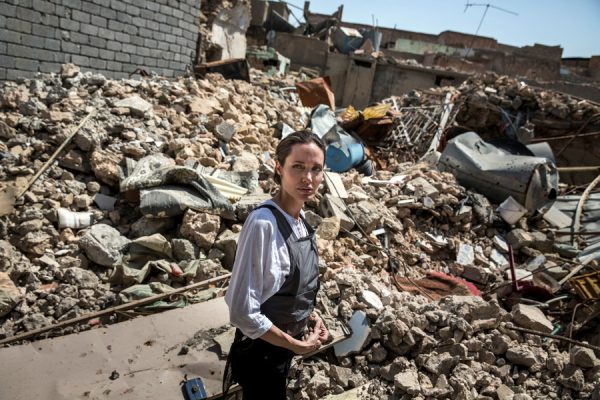
UNHCR Special Envoy Angelina Jolie visits the Old City in West Mosul, Iraq June 16, 2018. © UNHCR / Andrew McConnell
Surely, life is picking up in Mosul, yet at a very slow pace, with destruction seen in the background of every photo.
A photo worth a thousand words ❤#EidAlFitr in #Mosul#Iraq#BackToLifepic.twitter.com/5hZyPgToau
— ICRC Iraq (@ICRC_IQ) June 19, 2018

Iraqi workers repair a building in Mosul on March 15, 2018. © Ahmad Al-Rubaye / AFP
Restoring hope & heritage
Historical sites in both cities sustained massive damage during the fighting. An iconic landmark of Mosul, the Grand al-Nuri Mosque, was blown up by IS militants a month before the city was recaptured by the coalition. The monument was effectively reduced to rubble, and, nearly a year after, it remains in the same state – showing only signs of further deterioration and weathering.
The destroyed Grand al-Nuri Mosque is seen in the Old City of Mosul on January 17, 2018. © Ari Jalal / Reuters
Aleppo Citadel, on the other hand, not only endured the battle for the city, but it actually played one of the key roles in it, serving as a stronghold for Syria’s defenders once again. While the monument was damaged during the fighting, restoration – and demining – works were launched almost immediately after the city’s liberation. Now it’s open for everyone again.
Syrian children from the St. Francis Church summer camp enjoy an exploratory trip to Syria’s historic Citadel in Aleppo, free of terrorism.
You won’t be seeing these smiling faces on any mainstream media outlets because it doesn’t advance their agenda against Syria. pic.twitter.com/X3nrDoH0TH
— Sarah Abdallah (@sahouraxo) June 7, 2018
#Aleppo Citadel is back open for Syrian and Foreign Tourists. Fee to enter in US $ equivalent?
Foreign Tourists = $1.16
Syrian Visitors = $0.17
Syrian Soldiers = $0.12
Families of Martyrs = Free https://t.co/gMyRsQ3Rtupic.twitter.com/gZwLg4CCFG— EHSANI2 (@EHSANI22) June 20, 2018
Another iconic landmark of the city – the Umayyad Great Mosque – was less lucky and sustained way more serious damage, getting pierced with shrapnel and having one of its minarets toppled. While more work needs to be done, it looks way better now – and it actually serves its purpose.
Trump-Putin summit should be welcomed, not feared
By Neil Clark | RT | June 22, 2018
The news that Donald Trump and Vladimir Putin are preparing to meet in Europe next month has been causing consternation among those keen to keep the temperature of the new ‘Cold War’ close to freezing point.
But these voices should be ignored, as a summit is just what is needed at the present time.
“Meeting jaw to jaw is better than war,” Winston Churchill famously observed. Which sane person, desirous of world peace, could possibly disagree with the sentiment?
Yet, it seems that some people in the corridors of power in the West and in neocon think-tanks are seriously alarmed by the prospect of the presidents of the US and Russia getting together for a tete-a-tete and possibly defusing current tensions.
The London Times has cited Whitehall sources who told the paper how worried they were about a Trump-Putin get-together. “It would be a highly negative thing to do,” one unnamed insider said. “Everyone is perturbed by what is going on, and is fearing for the future of the [Atlantic] alliance,” said another.
Meanwhile, in the New Yorker, Susan B. Glasser informs us that many Russia ‘experts’ are worried that Putin “is intent upon securing major concessions from Trump.” She also cites George W. Bush’s former ambassador to Russia, Alexander Vershbow, who lambasted the idea of a meeting as a “bonding session with another dictator.”
“Get ready for another lavish televised love-fest, this time between Trump and Putin,” warns Anne Applebaum. The Washington Post columnist fears there will be a ‘trade.’ “We stop holding military exercises in Europe. In exchange, we allow Russia to keep Crimea.”
“Also,” she adds, “we will throw in Alaska.”
If we go back to the early 1970s, we’d find Applebaum’s predecessors equally concerned that President Nixon – another Republican president loathed by liberals – was keen on a rapprochement with the Soviet Union. In fact, a review of the diplomatic moves made by Nixon and the opposition he faced from uber-hawks inside America is highly instructive.
On May 22, 1972, Nixon became the first serving US president to set foot inside the Kremlin. Four days later, the president and his Soviet counterpart Leonid Brezhnev signed SALT 1 (the Strategic Arms Limitation Talks), described by Jeremy Isaacs and Taylor Downing in their book ‘Cold War’ as “an event of considerable significance.”
“After 25 years of hostility, the Soviet Union and the United States had agreed to curb spiraling arms-race costs, and reduce the risks of nuclear war,” they wrote.
Who couldn’t be happy about this? Senator Henry Jackson – aka the ‘Senator from Boeing’ – for one. As the New York Times explained in 1988.
SALT 1 was an executive agreement, not a treaty, so it could not be blocked by the Senate. “So Jackson pushed through a resolution that set stiff terms for any future treaties, demanding, among other things, that they produce rough numerical equality,” it wrote.
Jackson also opposed the agreement on Security and Cooperation in Europe, signed in Helsinki on August 1, 1975, commonly regarded as ‘detente’s high point.’
“As if to symbolize this new spirit of goodwill, the American Apollo and the Soviet Soyuz spacecraft docked together in outer space, 140 miles above Earth. For two days, the astronauts of rival systems carried out joint experiments while orbiting Earth. Detente had replaced decades of confrontation,” note Isaacs and Downing.
And remember, all this had happened under Republican presidents (Nixon and Ford).
Fast forward to today, and it’s the disciples of ‘Scoop’ Jackson who once again seem terrified that a meeting between Trump and Putin will lead to a new ‘spirit of goodwill’ between East and West.
That would never do, as Russia must always be regarded as the enemy – unless of course it does absolutely everything the West demands of it.
Trump and Putin could be a re-run of Nixon and Brezhnev. They could start to talk about arms limitation. They could start to talk about new security and co-operation arrangements. They could embrace each other warmly and declare that the US and Russia would never go to war with each other.
Of course, if such positive moves were made, people across the world would be delighted, as they were in 1972 and 1975. But defense industry lobbyists won’t be.
In ’Fog,’ a 1969 episode of the classic UK television series ‘The Avengers,’ members of the world disarmament committee meet in London, and are bumped off one by one by a mysterious ‘Gaslight Ghoul.’ We’re led to believe that the guilty party is an old-fashioned, politically incorrect ‘Empire loyalist’ Sir Geoffrey Armstrong but in fact (Plot Spoiler Alert), it’s the more ‘progressive’ Mark Travers. And his motive? He has an armaments business. He profits from wars and conflicts. That’s why the very idea of the great powers co-operating is anathema to him.
Mark is able to ‘disguise’ himself as a good guy because he doesn’t espouse the reactionary ‘Colonel Blimp’ views of Sir Geoffrey. Sound familiar?
Any US presidents who have worked for arms limitation and better relations with the Kremlin have faced fierce opposition, even if they’ve been former hawks themselves.
In 1975, Ronald Reagan opposed Helsinki, saying “All Americans should be against it.” He stepped up the arms race when he became president in 1981 and referred to the Soviet Union as ‘the evil empire.’ But in 1984, at the time when the pop group Frankie Goes to Hollywood were warning us of the dangers of nuclear Armageddon with their smash hit ‘Two Tribes,’ Reagan changed course quite dramatically. The president’s ambitious goal was a world without nuclear weapons. The hawks in the US and Britain were alarmed over this volte face. On November 19, 1985 Reagan met new Soviet leader Mikhail Gorbachev for the first time.
“They got on famously – even better when alone together,” Isaacs and Downing record. Just over two years later, the two men signed a historic arms-control agreement in the White House.
But it could have been even more extensive. At the Reykjavik summit in October 1986, Reagan said he was willing to eliminate all nuclear weapons within 10 years. The Star Wars (SDI) defense programme proved the sticking point – but in Downing Street there was enormous relief that a deal was not struck – wedded to concerns that nuclear disarmament might still happen at a future date.
“My own reaction when I heard how far the Americans had been prepared to go was as if there had been an earthquake beneath my feet,” British Prime Minister Margaret Thatcher later wrote. “I supported the idea of a 50-percent direction in strategic ballistic missiles over five years, but the president’s proposals to eliminate them all together after 10 years was a different matter… Somehow I had to get the Americans back onto the firm ground of a credible policy of nuclear deterrence. I arranged to fly to the United States to see President Reagan.”
The ‘Iron Lady’ went to Camp David and persuaded Reagan to take what she saw as a firmer line. A statement was released which declared: “The president reaffirmed the United States’ intention to proceed with its strategic modernization program, including Trident. He also confirmed his full support for the arrangements made to modernize Britain’s independent nuclear deterrent, with Trident.”
“I had reason to be well pleased,” wrote Thatcher.
Then, as now, it was Britain urging the US to maintain a tough stance towards Moscow. That’s worth remembering whenever you hear someone say that London always acts as Washington’s poodle – because sometimes it’s the UK government that’s the more hawkish.
Thatcher believed that Europe would have been ‘dangerously exposed’ if Reagan’s disarmament plans had been accepted. Today, we hear similar fears being expressed over a Trump-Putin summit. The future of NATO, we’re told, could be threatened. Yet significantly, NATO chief Jens Stoltenberg is not among the voices articulating this concern. Speaking in London this week, the former Norwegian PM dismissed fears that a meeting between Trump and Putin would undermine Western security.
“To meet President Putin is not in any way contradictory to NATO policies… Several NATO leaders have met Putin… We do not want a new Cold War. We do not want a new arms race. We want to talk to Russia,” Stoltenberg said.
The NATO chief’s diplomatic statements are a blow to those who don’t want any meaningful dialogue between East and West. But they will be welcomed by all those who want to see the US and its allies move towards a new era of detente with Moscow, which could only be for the benefit of the entire world.
Raised eyebrows as Madeleine Albright & Bana Alabed to be honored for ‘defending freedom’
RT | June 20, 2018
The pro-NATO Atlantic Council think tank is set to honor former US Secretary of State Madeleine Albright and Syrian child activist Bana Alabed at its Freedom Awards this week.
The Freedom Awards honor individuals who “defend and advance the cause of freedom around the world” and will be hosted in Berlin later this week — but the nominations have caused quite a few puzzled reactions online.
According to the Atlantic Council website, Albright will be recognized for her “championing of global democracy” and as an exemplar of “the power of diplomacy in achieving solutions to the most pressing challenges facing our world.”
Albright seems like an odd choice, however, given she is known around the world for defending US sanctions on Iraq which caused the deaths of more than half a million Iraqi children.
When asked in an infamous 1996 interview if she thought the sanctions were “worth” the price — the price being hundreds of thousands of dead children — Albright replied almost without hesitation, that “the price is worth it.”
Alongside Albright will be a 9-year-old Twitter activist who is no stranger to controversy herself. Numerous Syrian and international commentators have argued that Syrian opposition icon Bana Alabed has been exploited by her parents and others as a propaganda tool for a pro-war agenda.
Bana began tweeting pro-US intervention messages on Twitter when she was just seven years old. Her tweets were written in perfect English and often incendiary. On one occasion, Bana’s Twitter account posted that it was “better to start 3rd world war instead of letting Russia & assad commit #HolocaustAleppo.”
Despite the controversy surrounding her account and accusations of child exploitation, Alabed will be honored by the Atlantic Council for her “use of social media to bring global attention to the plight of children in rebel-held areas of Syria.”
But maybe the Atlantic Council’s choice of nominees for its Freedom Awards shouldn’t be so surprising. In 2016, the think tank chose to bestow the award on the Syrian Civil Defence, also known as the White Helmets – a controversial outfit which bills itself as a first-responders group in the Syrian war, but operates exclusively in militant-held areas and has been accused of links to terrorist groups, including Al Qaeda.
Analyst Suggests US Can No Longer Use UNHRC to Justify Global Military Ops
Sputnik – 22.06.2018
The United States can no longer use the United Nations Human Rights Council (UNHRC) to justify its military interventions around the globe, now that it has withdrawn from the world body, US Ron Paul Institute for Peace and Prosperity Executive Director Daniel McAdams told Sputnik on Thursday.
“Human rights as an issue is often a cover for foreign interventionism. The US used ‘human rights’ as an excuse to destroy Libya and to launch a seven year proxy war in Syria,” McAdams said. “In fact, it was the UN Human Rights Council that first put the wheels of the US-led attack in Libya in motion.”
McAdams recounted how in the days leading up to NATO’s intervention in Libya, non-governmental organizations petitioned the UN Human Rights Council to demand action in response to alleged atrocities being committed by then-Libyan leader Moammar Gaddafi. As a result, the issue was then taken up by the Security Council, which adopted Resolution 1973, a measure that paved the way for NATO’s airstrikes in Libya. Several of the NGOs’ allegations — which formed the basis for NATO’s intervention — later turned out to be false.
“The human rights abuses that Libyans have suffered since their ‘liberation’ far outweigh any they suffered under the rule of Gaddafi,” McAdams said.
On Tuesday, US Ambassador to the United Nations Nikki Haley announced that the United States decided to suspend its membership in the UNHRC. Haley denounced the organization as hypocritical, saying it was biased against Israel and protected countries that abused human rights, such as Cuba, the Democratic Republic of Congo, China and Venezuela.
“The UN Human Rights Council, like most of the UN, has long ago strayed away from its original purpose,” McAdams said. “When you have notorious human rights abusers like Saudi Arabia — and the US among others — playing a prominent role in determining human rights abuses in other countries, the whole exercise becomes a farce.”
McAdams went on to say that the US withdrawal from the UNHRC would “hopefully reduce” its importance and restrain its ability to be used as a forum to promote conflict.
“The UN’s adopting the ‘Responsibility to Protect’ (R2P) doctrine in 2006 has been an unmitigated disaster. The UN was founded as a body of sovereign states seeking to work together as such to eliminate war,” he said. “The destruction of national sovereignty caused by the R2P doctrine means that countries with aggressive foreign policies can use the UN as a fig leaf as a cover. The result is more war, not less. And that is what we are already seeing.”
The US decision to quit the council comes a month after the UNHRC decided to form an independent mechanism to investigate the Israeli Defense Forces’ killings of more than 100 Palestinian protesters along the border with the Gaza Strip since March. Palestinians in Gaza have been staging protests along the border to demand the right to return to their homes now inside Israel. The UNHRC has said that the killings could be considered war crimes and need to be investigated.
According to UNHRC President Vojislav Suc, the UN General Assembly will now decide on a candidate to replace the United States on the Council, which consists of 47 members elected directly by the General Assembly.
Prior to its withdrawal, the United States’ mandate in the UNHRC was expected to last till the end of 2019. It was the country’s second three-year term, after which the US did not have the right to be re-elected.
The Parallel Universe of BBC Panorama
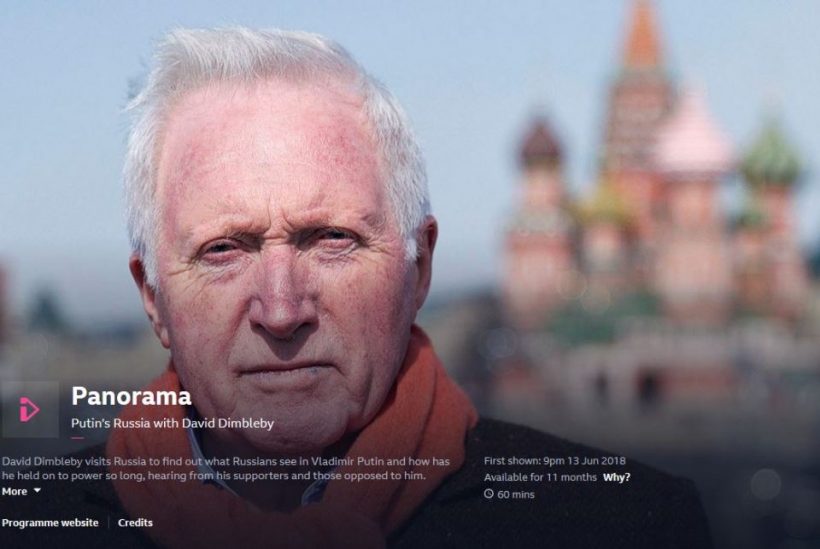
By Kit | OffGuardian | June 21, 2018
The BBC flag-ship documentary series “Panorama” has long been a stalwart of state-funded television propaganda. They can always be relied upon to tell us what we’re supposed to think. In 2013, just days before the Commons vote on military intervention in Syria, BBC aired “Panorama: Saving Syria’s Children”, a shambolic piece of fiction designed to outrage the public into war.
Robert Stuart has done truly exceptional work in deconstructing the fakery and propaganda on which the BBC sees fit to spend taxpayer’s money.
In just the last year they’ve had two documentaries about North Korea being evil (“North Korea’s Secret Slave Camps” and “North Korea’s Nuclear Trump Card”).
And it’s not just foreign “enemies” that end up in Panorama’s crosshairs either – it’s also domestic ones.
In 2015, just a few days before Jeremy Corbyn’s first Labour leadership victory, the BBC aired “Panorama: Jeremy Corbyn – Labour’s Earthquake”, a documentary which prompted Corbyn’s team to file an official complaint, labelling it a “hatchet job”.
Then in 2016, on the eve of Corbyns second (larger) Labour leadership victory, the BBC aired “Panorama: Labour – Is the Party over?”, a documentary full of doom and gloom, featuring anecdotes about abuse, and various (predictable) Blairite MPs bemoaning the “unelectability” of their leader.
In the 2017 General Election, Jeremy Corbyn’s resurgent Labour defied the polls, the pundits and the BBC to knock-off the Tory majority and come within 2% of winning. Could the BBC’s, and Panorama’s, relentlessly negative slanted coverage be responsible for keeping Corbyn out of No.10? It would be foolish to deny the possibility.
And there, neatly demonstrated in those three paragraphs, you see the value and purpose of state-sponsored propaganda. Panorama is the spirit of the BBC, a pretense of faux objectivity, shrouded in cuddly familiarity, employed exclusively and decisively against anything the establishment sees as a threat.
*
Enter Vladimir Putin
The folks at Panorama LOVE Putin, or at least love to hate him. In the last two years there have been no less than five (five!) episodes devoted to the man, and indeed the myth.
January 2016 brought us “Putin’s Secret Riches”, January 2017 “Trump: The Kremlin Candidate”, March of this year brought us two inside a week, “Putin: The New Tsar” and “Taking On Putin!”. As the titles suggest, none of them were especially objective or open-minded. That’s not in the BBC’s remit.
The most recent Putin-hit piece aired just last week – in the run up to the World Cup – its rather more mundane title simply: “Putin’s Russia with David Dimbleby”. The documentary, for want of a better word, opens on David Dimbleby wandering through a Moscow market looking at sigh Russian nesting dolls, and it doesn’t get less predictable from there on in.
A long time ago, I was taught you construct an argument in three steps – “Statement, Evidence, Conclusion”. Instead Panorama opted to go for the unorthodox “Conclusion, Anecdote, Stock Footage of Nesting Dolls” approach.
 The first problem, and perhaps the biggest, is David’s hat… but it never really goes up-hill from there.
The second problem, is the smugness. Forget the factual inaccuracies re: the Russian economy, forget the totally evidence-free assertions, and just focus on the smugness.
The smugness of an English man who went to Charterhouse School, and then on to Oxford, is possibly one of the most toxic things in the world. So much evil has been done by men who are taught their own effortless superiority. Blood has been spilled by such men, oceans of it, evils done beyond imagining, all with a soft chuckle and clear conscience, because they come from a system that tells them their very existence MAKES them RIGHT. They do the “right thing” as a matter of course because of who they are and what they think. They are right, and the vast swamps of Other are wrong, and that’s just the way it is.
These are the people who spread the British Empire over a quarter of the globe, all the time telling themselves that they were doing the savages a favour by giving them civilisation. The same men, the same minds, in suits that change with time and with methods that shift with the ages, have run the country for centuries… and run the BBC since its inception. Men who believe morality is a function of their very existence. A path that rises up to meet their feet.
This is the British version of what the Americans call “exceptionalism”. It’s less brash, and less obvious, but no less poisonous for that.
The worst actions of mankind flow from minds who never question their own moral position, and this documentary can be counted as small, septic, addition to that list.
And so we begin…
I’ve come to see how Putin has managed to hold on to power for so long, and what the Russians see in the Putin that We, in the West, don’t.
Dimbleby’s introduction is immediately partisan and dishonest – referring to “we” in the West as if there is a consensus, when clearly that is not the case, is a variation on the argumentum ad populum, the argument to common knowledge. “Everybody knows that”, or “We all agree on this”. It is deceptive language, being used to paint a false picture.
Likewise, saying Putin “held on” to power for so long, makes it seem like his Presidency was an act of force, when all the evidence is to the contrary. Dimbleby says so himself just a few minutes later.
(SIDEBAR: When Dimbleby says “so long”, he means 18 years. The classic mainstream media trick of ignoring Medvedev’s term as president is employed here. As is every other, long discredited, anti-Putin rhetorical device.)
In a democracy if you failed to deliver on your economic promises, if you surrounded yourself with cronies, and if you used the law to oppress opposition, well you’d be thrown out on your ear… but this is Russia, and they do things differently here.
Dimbleby lays out, in one broad stroke, that Russia is backwards, and silly, and he’s going to come along and point out to us sensible Westerners just how they went wrong.
Leaving aside the hypocrisy (this is, let’s be honest, a pretty accurate summary of what every single British government has done since Margaret Thatcher), it’s also simply insulting. I find it insulting, and I’m British. If I was Russian and heard that? I would vomit blood.
It’s sickening… and we’re only 2 minutes in.
*
David on… the Russian Birthrate
Our first port of call on David’s whistle-stop tour of everything that’s shit about Russia is the birth rate. He tells us that it fell sharply in the years following the collapse of the USSR, and this is true, he doesn’t say WHY this happened. As a matter of policy this programme avoids, at all costs, mentioning what Russia was like in the 1990s.
Anyway, when Putin came to power the birth rate was declining, and what did he do about this? Well, in a masterstroke, decided to encourage people to have babies.

Mrs Cherenkova’s medals
How? Well by increasing state benefits to mothers with more than 2 children, and further increasing them for families with more than 3 children. Families with multiple children are also entitled to free school meals, tax breaks and get discounts on family holidays. Medvedev also introduced a medal in 2008 – “The Order of Glorious Motherhood” – for mothers with 7 or more children, based on the “Mother Heroine” medal from World War 2.
(SIDEBAR: It’s worth noting here that we, in lovely hugs-and-flowers Britain with our nice fluffy democracy, DON’T have free school meals… for anyone. At all. Ever. The government that proposed this bill was not “thrown out on their ear”, but DID have to spend £1.4 BILLION pounds bribing a minority party to vote it through.)
The measures worked, and under Putin/Medvedev the birthrate has increased almost every year since 2000. In 2011 the birthrate moved ahead of the death rate for the first time since 1992, and Russia’s population started growing.
Now, if this is all sounding very sensible and not at all bad to you, then well done for paying attention.
It’s here the film reaches its first hurdle… and goes into it face first. Russia is supposed to be backwards and Putin is supposed to be a brutal corrupt dictator with no concern for the country he runs… but the facts on the ground don’t jive with this at all, at least in the birthrate example. Not only did he try to improve his country, but he did via perfectly reasonable methods, and they worked.
The film makers decide to simply leave an ellipsis on this one, just a long pause that’s obviously designed to make us ruminate on how bad Russia is, but it doesn’t really work. Partly because it doesn’t make any sense, but mostly because – for some reason – David thinks the best way to hammer this point home is show us the Cherenkovas. A very happy family with lots of healthy children. He refers to them as “Putin’s ideal family”, as if the term itself is insulting.
Mrs Cherenkova proudly displays her medals for motherhood in a leather case, explaining she wears them on public holidays. The family sing as they sit down for dinner, talk about the Church and how life has improved under Putin compared to the 1990s. (David, staying true to his brief, doesn’t ask how bad things were in the 1990s. In 58 minutes it’s not mentioned once.)
*
David on… the Russian Orthodox Church
The Cherenkovas praying as they sit down to dinner provides a neat segue for David to discuss something really terrible – the growing influence of the Russian Orthodox Church.
You see, the ROC was suppressed under Communism, which was bad, and now it’s not… which is apparently, also bad. I don’t fully understand the point David is trying to make, but that’s OK since I’m pretty sure he doesn’t either.
We are presented with a Bishop, who tells us that it’s now easier for the Church to interface with the state than it was during the 1990s. We don’t know what he means by that, because he’s cut off and David never asks.
The implication, backed by stock footage of Putin lighting candles in a church and David’s narration about “conservative values”, is that Russia is becoming a kind of quasi-theocracy. It’s never stated out-loud, because the position is so ridiculous as to be indefensible, but it is quite clearly the implication.
*
David on… Russian Opinion Polls
Curious to see “how widely [the Cherenkovas’] views are shared”, David goes in search of a broad opinion, but meets an apparent problem:
It’s all very well to say “I’ve come to Russia to find out what the Russians really think”, but it’s not actually that easy in a country where the press, radio and television are all strictly controlled by an authoritarian government.
1) He hasn’t gone there to find out what Russians think. He knows what Russians “really think”. He’s there to tell US why THEY are wrong. He’s there, at our expense, to make sure we hate who we’re told to hate.
2) The press, radio and television are not all “strictly controlled”, that’s a lie, and he knows it’s a lie because he proves it himself less than 10 minutes later.
But that’s beside the point. How does David get around the problem of finding out what Russian’s “really think” under such an authoritarian regime? Well, he goes to the one of the biggest public opinion polling companies in Russia, the Levada Centre.
The irony of rambling on about Russia’s repressive controlling government as you take a gentle stroll down to the partly-American funded NGO, just minutes from Red Square, is apparently lost on David.
Imagine, if you can, a Russian-funded “polling centre” operating within walking distance of Westminster or Pennsylvania Avenue. That not only calls the government-run polls inaccurate, but claims that the CIA forces people to vote and that the President is corrupt.
It would never be allowed to happen, but in “authoritarian” Russia, with its “strictly controlled” media, this is the current reality.
In the Levada Centre (Russia’s only “independent” polling centre), David finds out that around 80% of Russian’s support Putin as President. Which everyone in the world already knew.
The fact the “independent” Levada’s centre polls almost perfectly align with the apparently unreliable government polls doesn’t cause anyone to question their assertions about corruption or dishonesty. It’s one of the many inconvenient truths the Panorama team feel the need to brush over as quickly as possible.
When the head of the Levada Centre claims a President with an 80% approval rating had to “force” people to vote, David doesn’t ask why, or state that it doesn’t make any sense. No, he just makes concerned faces at the camera.
They discuss the “annexation” of Crimea as Russia “taking back” what is theirs, with no reference to the polls that show huge Crimean support for the move, going all the way back to 1992, including those done by both the American and German governments.
*
David on… Propaganda
From Crimea it’s a steady flow to “propaganda” – theirs, not ours – Dimbleby narrates in solemn tones:
For most Russians, state-run television remains the main source of television news.”
… blithely passing over that this statement is being made on a state-run television station, that is the main source of television news for most people in Britain.
He goes from Russian domestic television to RT, saying they are “accused of spreading conspiracy theories”, he doesn’t say who accuses them, or ask his audience to consider the possible reason behind such accusations. He doesn’t even throw the weight of conviction behind it enough to make a declarative statement. No, just sends out the little accusation, evidence free and with no reply or counter, and hopes the implication does its job.
He interviews a British anchor for RT, who says that they aren’t told what to say, and he’s “answerable to no one but his own conscience”. To which David replies, “And that’s clear is it?” The anchor explains the structure of RT, but David isn’t listening. He’s too busy making a documentary demonising a designated “enemy” for a state-funded broadcaster.
He doesn’t pose the same questions about his own conscience.
It’s always worth remembering that the BBC, formerly the British Broadcasting Corporation, is not “independent”, even though they’ve spent decades pretending otherwise. We’re encouraged to think of the BBC as a friendly presence, our shared “Auntie Beeb”, cosy and reassuring and honest. It’s none of those things, it’s a state backed broadcaster with a history of launching pro-government, pro-war propaganda, for which it never faces censure or punishment. It’s a much a less “friendly auntie”, more a threatening “big brother”.
With truly Orwellian posters intimidating us into paying for it.
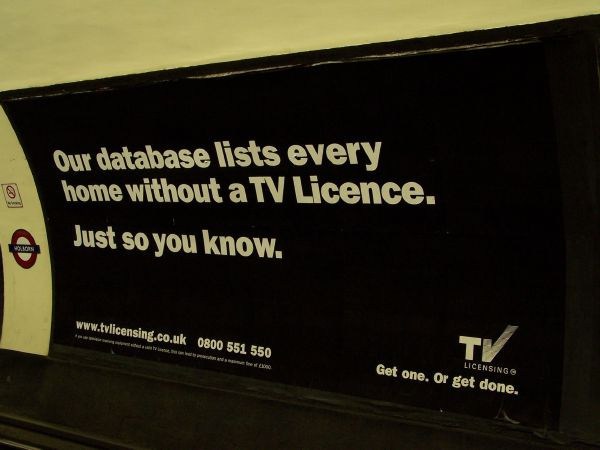
Imagine this poster was in cyrillic and about RT.
That Dimbleby can stand under the banner of one of the biggest state-funded media organizations in the world, and pontificate about “media control” from an “authoritarian government” demands levels of cognitive dissonance few would think possible. It’s marvelously without irony.
*
Next David seeks out a human rights lawyer to discuss Russia’s legal system. David tells us that Russian judges convict in 99% of cases. This is apparently shockingly high. It does sound high, but deliberately left without context to make it seem worse than it is.
Firstly, the 99% refers only to Judge cases. Jury trials are relatively new to Russian law – in fact Putin, in one of his desperate power grabs, introduced them nationwide in 2003 – and they have a conviction rate of roughly 80%, right in line with the UK’s own courts.
A high conviction rate is not unheard of, especially in systems that run “special procedure court hearings”, a slightly complex system of what amounts to plea bargaining.
Japan runs a similar system and has a conviction rate of nearly 100%, as does Israel. The US federal courts had a conviction rate of 93% in 2012. Will we be seeing documentaries about that? No.
I’m not a lawyer, I’m in no position to launch a full defense of the Russian legal system – for all I know it is corrupt and/or unfair. But there’s no evidence in this film that shows it to be the case, outside of some anecdotal evidence from one lawyer.
Then they move on to Putin’s “online crackdown”.
Apparently Russia is starting to try to censor the internet. How? We don’t know, they don’t tell us. They cite no laws and name no Acts. It is just anecdote after anecdote. There’s no body to any part of it. We’re told Putin wants more control of the internet, as if this is shockingly tyrannical and when Dimbleby says there is…
… a crackdown on what the security services call “online extremism”.
He thinks his scare quotes show some desperately dystopian alternative universe, but doesn’t seem to know, or at least acknowledge, that WE call it that too, or that our very own dear Theresa May called for a “crackdown in online extremism” in a speech just last year.
Or that she put having an entirely government controlled internet in her manifesto last year.
Or that she passed an act in 2016 which Edward Snowden described as:
The most extreme surveillance in the history of western democracy.
Is Panorama asking questions about that? Of course not.
Does the BBC call our government authoritarian? Not once.
Instead they offer just a talking-head, making a scary statement that “thousands” of innocent Russians could be in prison, with again no evidence to back it up at all.
When you actually dig into the numbers they tell a completely different story.
The New York Post, not known for its pro-Russia bias, reported that 233 Russians were convicted of “hate speech” in 2015, “most of them for online activity.”
Meanwhile, in happy bunny funland Britain, 2015 saw 857 people arrested for “offensive” tweets or Facebook posts… in London alone.
It sounds like we’re more “authoritarian” than the Russians on the internet front at least. A fact which takes maybe 30 seconds of research to find.
*
David on… Russia’s Controlled Media
Next David goes to Echo of Moscow Radio to talk to one of the completely non-existent members of the independent media in Russia. She claims that the entire country is actually run by the KGB. As per usual, she produces no evidence for this statement, she just says it. But that’s good enough for David who asks her to “explain how the KGB dominates society”, underlining that the KGB and MI6 are not at all similar:
Explain to our UK viewers, who might think of the KGB as just like our MI5 or MI6… how the KGB dominates society?”
Got that everyone? There’s their spies, and our spies, and they are completely different. This attitude was ridiculous enough to be used as satire in Blackadder, but now is being seriously repeated by one the BBC’s most respected personalities.
Her “explanation” involves simply repeating the same sentiment she already expressed, only in slightly different words, and David is too polite to press for more, or too lazy to be bothered, or too smug to notice. It’s really getting hard to say at this point.
(SIDEBAR: Of course one of the most prominent ways that MI6 and the KGB differ is that the KGB doesn’t exist anymore, whereas MI6 are very much still going.)
It’s at this point the documentary seems to realise the rather confusing contradiction of its own existence. They are there to talk about how autocratic and terrible Russia is, and yet they seem to talk to human rights lawyers, anti-government television hosts and the head of anti-Putin radio stations. If Putin has all dissidents and protestors locked up and/or murdered… how do these people exist?
They get around this in one, short sentence:
By allowing a few independent outlets, a few dissident voices, Putin can claim freedom of expression.
Brilliant logic. Unfailing reason. Yes there’s SOME freedom of speech, but only so Putin can say there’s freedom of speech, it’s not REAL freedom of expression.
It just looks like it.
Much like that old expression:
“If it looks like a duck, swims like a duck and quacks like a duck, then it’s not really a duck because Putin doesn’t allow ducks. He’s just letting that duck exist so he can pretend he’s got a duck.”
*
The Russian Orthodox Church seems to be a real bugbear of David’s, because fresh from announcing that “there IS free-speech in Russia, it just doesn’t count”, David goes back to talk to a member of the Church… and asks him if he approves of the lack of free speech in Russia. David narrates:
When it comes to political repression, the one place not to look for support is the Orthodox Church.”
This sentence implies we’re about to hear a Church spokesman defending political repression… which is not the case. Instead we see the same bemused Bishop as before, being asked:
You know there’s a lot of criticism of Putin’s encroachment on human rights: People in prison for speaking out against the state, internet communications closed down, the state spying on people’s communications, do you approve of all that?”
Note he’s asking “do you approve of…”, not “is this the case…”. Leading questions predicated upon unproven assumptions have no place in honest discourse… but if you took them out the documentary there would only be 3 or 4 minutes of stock footage of nesting dolls and onion domes.
The bishop, who seems slightly perturbed by the rudeness of the question, evidently wasn’t provided with a script because he doesn’t launch into a fascistic diatribe about values, or verbal attacks on traitors and dissidents… he simply says:
This is your point of view, and we do not always agree. With all due respect.
You can see his Russian politeness straining, but not breaking. And that’s it.
So much for Russia the conservative theocracy.
*
David on… Russians’ Right to Protest
The documentary just gets less coherent and more confusing from here on in. The facts they present never align with the spin they try to put on them. They point out eminently reasonable realities of Russian life, with a weight of sinister implication that defies all reason. (In the trade, we refer to this maneuver as “The Harding”).
The perfect example is the story of a women’s rights campaigner Alena Popova, protesting about the allegations of sexual harassment made against the Russian MP Leonid Slutsky.
We see her standing outside the State Duma with cardboard cut-out of Slutsky. I don’t read Russian, but I can’t imagine the slogans on the cut-out are especially complimentary. She is briefly detained by the police who ask her who she is and what she’s doing… she explains and is released. Then she returns to the Duma, and does her protest unmolested.
All this seems perfectly fine, despite David’s chuntering narration.
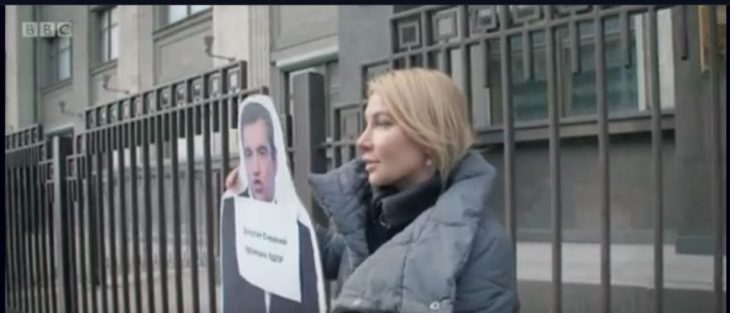
This is just one example of brutal oppression of dissent, ever present in Putin’s Russia.
Alena is standing literally right outside the door of the parliament building, with a cut-out of Slutsky covered in protest slogans. She requires no permit to do this under Russian law, which states that solo protests are allowed anywhere at any time without a permit. You do need permission to hold group protests.
By way of comparison, let’s imagine Alena were British, not Russian: If she attempted the same exact protest in the UK… she would not be allowed to. At all. Ever.
Firstly, you would never get to stand within inches of the doors of Parliament without getting halted by armed police. Secondly, you’re not allowed to protest in Parliament Square – even alone – without getting prior permission. This law was passed by Blair’s government in 2006, in order to shift anti-war protester Brian Haw.
At one point a young man approaches David and Alena and asks what’s going on, David’s voice-over claims the young man works for state security, and intones the words with foreboding. We have no way of knowing if this is true, if it even matters. I’m fairly sure a Russian camera crew standing outside the Houses of Parliament would attract the attention of special branch. He asks them two questions and then leaves.
Later, there’s a counter-protest. Four people appear with signs in support of Slutsky. David claims they’re there to cause trouble for Alena, and even implies they are working for the state. A claim which is rather shot-down when the counter-protest group – who support the government – are escorted away by the police because they don’t have permission for their group protest.
The pro-government protesters are gone, the anti-government protester remains. David doesn’t see this as, in any way, challenging his position on government oppression of dissent. He asks Alena:
If they control protest, if they’re against protest, why do they let it happen at all?”
A fantastic question, the only really cogent thing he’s said for the last half an hour. She replies:
Because we have a constitution.”
(SIDEBAR: Britain, of course, has no written constitution at all.)
*
David on… Russian Paranoia
The next episode in this bizarre saga opens with the director of the Levada Centre claiming the Kremlin is “paranoid” about a revolution, referencing the 2012 protests (the aborted “Snow Revolution”). To which David adds some rather incongruous narration:
Putin prepares to go to almost any lengths to prevent a popular uprising against him.”
He never says what these “lengths” are. In fact, we have no idea what the Russian government has done to prevent a Revolution. If anything. But breaking away from the specific facts, which the documentary forces us to do, maybe we should ask a simple question.
Why would the Russian government be paranoid about revolution?
Maybe we should look at other countries that have had “revolutions” recently for an answer to this question.
Ukraine is a disaster. Libya is possibly the only country in the world worse off than Ukraine and the only reason Syria isn’t just as bad those two is that Russia stepped in to help. David talks about revolutions as if they are organic, almost accidental, occurrences. But we all know that’s not true, we’ve all seen “Colour Revolutions” be fomented by the Western powers to overthrow governments that the USA has deemed to not have “American interests” at heart.
“Revolutions”, in recent years, are Imperial acts of aggression carried out by proxy armies with the aim of removing an “enemy” of the West. And they have left nothing in their wake but blood and destruction. The Kremlin has every right to be concerned about possible Western attempts at a coup against their government. Such a move could destroy everything they have built.
Do you think a Western-backed coup government will keep up free school meals and medals for motherhood? Do they have a constitutional right to protest in Libya right now? How about the birthrate vs death rate in Syria, is that going up?
Shouldn’t all governments fear revolution and hope for stability?
How would David feel about a revolution in Britain? Would it be welcomed? Would Theresa May like seeing violent unrest in the streets of London? Or being replaced by a Russian-backed, unelected leader?
Despite the chaos that has been left in the wake of “revolutions” the world over in recent years, the documentary gives no credence to Russian fears. Russia is never “afraid”, and always “paranoid”.
David talks to an Sergei Markov, a “political consultant who has worked with Putin”. We have no way of knowing if this is true, and this being Panorama taking it in faith is an unearned act of trust, but let’s assume that they’re telling the truth.
Markov highlights that Russia has good reason to fear Western aggression. Pointing out, reasonably enough, that no Russian soldier has ever set foot on British soil in the name of conquest, whereas Britain has invaded Russia every several times since the 19th Century:
Now, you are preparing to invade Russian territory again, to establish your control of Russian political, social and economic constitution, for us it is absolutely clear.”
We are encouraged to see Markov as a crazy-eyed lunatic, and David’s response is to laugh in his face:
You don’t seriously think an invasion of Russia is planned by the West? I mean, you’ll have me laughing in a moment.”
 A rather patronising rebuttal, that would hold more water if Russia weren’t practically encircled by NATO airbases. Or if the US hadn’t unilaterally withdrawn from the Anti-Ballistic Missile Treaty in 2002. Or if they hadn’t positioned their missile defense shield in Eastern Europe under clearly false pretences, granting them theoretical first-strike capability.
David doesn’t mention these facts.
Just as he doesn’t go into any recent history of Western military interventions. How America has, in the last 20 years alone, carried out coups in Venezuela, Ukraine and Honduras. Or how, when covert means did not work, they simply declared all out war in Afghanistan, Iraq and Libya.
Any impartial viewing of world history – especially recent history – would explain every country in the world having a fear of falling into NATO’s crosshairs.
Rather than acknowledging this, the documentary remains resolutely in its own little world. Insisting, in the face of all evidence to the contrary, that Russia has nothing to fear from the West.
*
David on… Russia’s “Orchestrated” Democracy
Fresh from telling us that Putin’s Russia is a “paranoid place”, where the leader with 80% approval is constantly worried about revolution and is prepared to go any lengths to stop it – even so far as having laws regulating protests that are almost identical to our own – David goes to talk to all the young people about their views on Putin.
They all like him, apparently:
One of the most fascinating aspects of today’s Russia, is that the under 25s, who might be expected to rebel, are Putin’s strongest supporters.
He’s talking to a group called Set (Russian for Network), a collection of “young artists, writers and designers” who consider Putin a role-model. David asks them a series of questions.
What do you like about Putin?
One of the young men says that before Putin it was “uncomfortable”, even “shameful”, to be associated with Russia. David doesn’t ask a follow-up question, putting paid to his earlier claims about wanting to know what Russians “really think” and staying true to the programme’s aim of never, ever mentioning the 1990s. Instead he skips back to leading questions based on false assumptions:
You feel happy with one person controlling the whole country?
We don’t know what they say to that, because it cuts off before anyone answers.
Do you agree that he’s quite ruthless when it comes to opposition?
They say they don’t agree. In fact they say quite the opposite. Which cues in a snide narration:
This generation of Russians are internet savvy, globally connected, but they prefer Putin’s authoritarian rule to democracy.
None of the people on camera ever express this opinion. Which makes this one of the most egregious lies in the whole 58 minutes. To appreciate what a statement that is, you really need to watch the film.

None of these young people “prefer authoritarianism to democracy”, they make it quite clear – in their opinion, they live in a democracy. Is there an effort to understand their position? None whatsoever. Instead we get treated to the head of the Levada Centre (again), this time dismissing all the young people who like Putin as being either stupid or brainwashed:
They are very different to Western youth, their minds were formed at the same time Putin’s regime was established, and for them the rhetoric of a great power is a very important part of their collective identity.
This is, as far as we know, another unsupported statement. Not one of the half-dozen young people David talked to said anything about Russia being a great power. Not one thing. They talked about Putin personally being relatable and they talked about improving conditions from the Yeltsin era.
When confronted with Dimbleby asking yet another offensively phrased question…
People in Britain look at Russia and say “this is a powerful autocrat who stops opposition, prevents anyone, if necessary puts them in jail to stop them opposing him” is that not how you see it?
… one young man, far from claiming to “prefer authoritarian rule” or praising the “rhetoric of a great power”, launches into a defense of Russian democracy. Pointing out the sheer number of different political parties (48), and that they had 8 different Presidential candidates running against Putin.
David isn’t listening. He’s nailed his colours to the mast on this one, Russia isn’t a democracy. It doesn’t matter how popular the leader is. It doesn’t matter how many elections they have, how many candidates are on the ballots, or how much public support they have. Russia is NOT a democracy, because David says so.
The film even references Navalny as “Putin’s biggest political opponent”, without mentioning that his party has ZERO seats in the Duma, and that he polls at less than 2% public support. Dimbleby doesn’t know these numbers, because his “researchers” either didn’t look them up, or pretended not to know them. Instead David solemnly declares:
Putin had him convicted of fraud.
Not “he was found guilty”, no, “Putin HAD him convicted”. Is there evidence produced that shows Navalny was framed? Nope. Is there evidence produced that shows any corruption on behalf of the judiciary? None. Is there any mention of Navalny being a right-wing ultra-nationalist who referred to Caucasians as “cockroaches”? Not even a little.
“Russia isn’t a democracy”, and “Putin’s main political opponent” is an unpopular convicted criminal with a history of racism, who was forbidden by the constitution from running in a Presidential election in which he would have come ninth.
Cut to:- Skyline of Moscow. Night. Synthy music plays, and the David lets fly with this beauty:
As many autocrats have shown, just holding an election doesn’t make a democracy.”
Boom. Just as a free press doesn’t mean Russia has freedom of expression, elections don’t mean they are a democracy. The documentary is slowly becoming less an attack on Putin and Russia, than an attack on the English language, and indeed logic itself.
David doesn’t tell us what DOES make a democracy, but it certainly isn’t elections. Following this logic, of course, you could have a democracy without elections. And if that sounds absurd, then remember that Margaret Thatcher praised Pinochet for bringing “democratic order” to Chile.
Elections that return the “wrong” result? They aren’t democratic. Rounding up dissidents in soccer stadiums and gunning them down? That is democratic.
“Democracy” means whatever the establishment wants it to mean.
Putin uses carefully orchestrated elections to legitimise his rule.”
Who “orchestrates” the elections? How do they do it? How does David know this? We’re not told. We’re now 40 minutes in, and we’ve yet to have any single accusation or anecdote backed up with anything even approaching evidence. We’re not even provided basic logical reason.
Perhaps more pressing is: Why would a President with 80% popularity NEED to “orchestrate” elections?
They never explain.
*
David on… Russia’s “small” economy
David’s next port-of-call on his tour of Bizzarro World is the Russian economy. Having been told that the Russian economy is “struggling” we get some more stock footage – this time of factories and oil wells – with David narrating:
Russia is one of the largest countries on Earth, with a population of 144 million, but its economy is much smaller – not even two-thirds the size of Britain, and even smaller than Italy.”
There’s a lot to unpack here.
First, it’s absolutely hilarious that dear little David can’t even bring himself to acknowledge the simple fact that Russia is not “one of the largest countries on Earth”, it is the largest. It’s nearly double the size of China. It’s European portion is the largest country in Europe, its Asian portion is the largest country in Asia and if you cut it evenly in half the two new countries would still be 4th and 5th largest countries in the world.
Russia is very big.
Nobody would ever dispute that, so why not just say it? It goes to show the pettiness of the mindset behind this programme. They simply cannot give Russia any credit, even so far as acknowledging its size.
Second, the language is again very deceptive. When he says “much smaller than Britain” and “EVEN smaller than Italy”, he’s painting a picture of small economy. He doesn’t mention that the UK has the 4th largest economy in the world, and Italy the 7th. Russia is 10th, just behind Canada. He also doesn’t mention that those figures don’t include the economy of Crimea, which the World Bank refuses to count as Russian.
Nobody would seriously claim that the 10th biggest economy in the world is “small”.
David sits down with Russia’s former deputy-Prime Minister Arkady Dvorkovich who says, when asked about the size of Russia’s economy:
If you look at other European economies, they have a long tradition of private entrepreneurship, we started this tradition only in the 1990s and need to accumulate experience.”
It’s a fair point, considering they’ve only been capitalist for 28 years or so, the 10th biggest economy in the world isn’t bad at all. David is unmoved. We don’t see his answer to that point, I would suggest because he couldn’t make one.
Instead he changes the subject, in voice-over, to corruption. Calling it a “tradition” in Russia.
He talks to Vladimir Pozner, a member of the allegedly “strictly controlled” Russian media, who apparently feels free to say corruption is endemic, giving yet more anecdotal evidence. This time about entirely hypothetical traffic policeman being bribed. A (strictly controlled?) anti-corruption campaigner points at a flat and says a politician lives there and shouldn’t be able to afford it. And David mentions an (unnamed) survey which ranks Russia 135th in the world in terms of corruption.
Thus is it established that Russia has a terrible corruption problem.
At this point the documentary devolves into a series of complete lies. Not mistakes, not exaggerations, lies. Lies so simple and so easy to refute with only a few google searches, that we’ll just go ahead and work through them one at a time:
Corruption is widespread, according to one survey it’s one of the worst countries in the world – it ranks 135 out of 180.”
He’s almost certainly referring to the famous “corruption perception index”, which is NOT a measure of corruption, but a measure of how corrupt some (unnamed) people THINK something MIGHT BE. It is a nonsense stat, discussed in more detail here.
“Russia has one of the most unequal economies in the world…. 20 million people live in poverty.”
This is technically true, there are 20 million people living under the poverty line in Russia, or 13.8% of the population. Before the sanctions it was less than 12%.
In the US, there are 45 million people living under the poverty line, or 13.8% of the population.
In the UK, there are 14 million people living under the poverty line, or 20.6% of the population.
Of course, where these numbers differ is that Russia’s number is coming down from 35%, and ours is going up. The makers of this programme know this, because the numbers were published on the BBC’s own website.
Putin’s failure to diversify the economy means that half the Russian budget comes from oil and gas, so when the price of oil fell after the annexation of Crimea, Russia was plunged into crisis.”
The price of oil did not “fall”, it was deliberately sabotaged by the gulf monarchies flooding the market. This was done to try to hurt the Russian economy, we can tell David knows this because he references the “annexation of Crimea” as the cause, he just doesn’t explain the details.
Putin’s aggressive foreign policy, along with the West’s sanctions, made the situation worse.”
Putin’s foreign policy – “aggressive” or otherwise – has no bearing on the Russian economy. This is all about the sanctions. Sanctions imposed by the West are not any reflection on the economic competence of the Russian government, especially when they are put in place over entirely false accusations, such as the Skripal poisoning or “hacking” the US Presidential election.
It is one of the oldest tricks in the US Imperial playbook, create a pretext for action against a country which they see as an “enemy”. Use this pretext to sanction a country with the aim of crippling their economy, and then use the fact the economy is struggling to criticise the government of the target country. The US has been doing it to Cuba and North Korea for decades, to Venezuela for years and Russia since 2014.
The deliberate destruction of their economy by powers beyond their control has no bearing on the competence or corruption of the Russian government.
In fact, by any standards, the Russian government under both Putin and Medvedev has been exceptionally competent.
- Since 2000, Russian national debt has reduced from 92.1% of GDP to 12.5%. But for the sanctions, it would be less than 10%.
- Since 1999, Russian unemployment has fallen from over 15% to less than 5%.
- Since 2000, inflation has dropped from nearly 30% to less than 3%. It’s already recovered from the increases resulting from sanctions.
- Since 2000, Russian GDP has risen from $195bn to $1283bn. Prior to the sanctions, it was over $2230bn.
- Since 1998, Russia’s balance of trade has increased from -$203mn, to +$15.3bn. Prior to the sanctions it was over $20bn.
- Since 2000, Russia’s average wage has increased from ~2000 rubles/month, to over 44,000 RUB/m. It carried on increasing in spite of sanctions.
… this list could go on and on.

Russian GDP under Yeltsin, Putin and Medvedev
Russia’s economy – under both Putin and Medvedev – has gone largely in the right direction.Of course, part of that is that there was only one direction to go.
All of this comes back to the 1990s. When Russia, as a country, was possibly within only months of ceasing to exist, collapsing into Balkanisation and chaos.

Average salary in Russia since 1998
Putin’s government prevented that, and turned things around for ordinary Russians in a quasi-miraculous fashion. That is why 80% of Russians support the man.
It’s the most basic rule of governance, but its one we in the West are encouraged to ignore – the first priority of government is to make the country better. Do that, and the people will support you.
To discuss the Russian economy, or the living standards of Russian people, or popularity of Putin, without acknowledging these facts, is just incredibly dishonest. Sickeningly so.
*
Conclusion
This is a bad documentary. It’s not simply ethically bankrupt, it’s also badly made. It’s badly paced, badly edited and incoherent. It’s so dedicated to its agenda that it sacrifices all else.
There is a relentless war being waged here, not just at the BBC and not just against Russia, but throughout the Western world… and against reality itself.
Consider the implications of this situation: One of the largest media organizations in the world spent license fee-payers money to send a man half-way around the globe, to convince their captive audience of tax-payers that elections don’t equal democracy, that independent media doesn’t equal free speech and that a $15bn trade surplus means your economy is struggling.
It recycles lies that have become terribly dull to refute, so must be simply exhausting to repeat. It routinely accidentally steps on its own argument, realises it has done so, and then performs logical gymnastics to try to prove it knows what it’s talking about. It makes no sense, and you can tell that they know it.
The list of contradictions and unanswered questions goes on and on, creating a world that cannot exist under the laws of reason. We’re told that Putin is popular, but that people are forced to vote for him. We’re told by Russian independent media organizations, critical of the government, that Russia has no independent media organizations critical of the government, and we’re told by a protester standing right outside the Russian parliament, that protests are practically illegal.
All of this irrationality combines to put together a patchwork-Picasso portrait of “Vladimir Putin”, the corrupt communist idealist, KGB hardliner and devout christian ideologue, who forces all the devoted members of his cult of personality to vote for him in elections he rigs anyway. A man who stole all the money he also spent on rebuilding Russia’s military, schools and hospitals, is best-buddies with all the oligarchs he sent to jail for tax evasion, and who – despite the size of the country – has “only” got the 10th biggest economy in the world.
It’s a documentary made by people at war with themselves, unable to understand that their delusions are absurd and incomprehensible to those of us struggling to live a reality-based life.
There’s desperation in this film, a hysterical repetition of proven lies and shrill fake news, screamed out by people who feel they’re losing control of the narrative.
They don’t know what they think except that Russia is bad and Putin is worse, they don’t know why they think it except that they’ve got to because they were told to, and they’re aghast. Unable to understand why no one’s listening when they’re making so much sense!
This documentary, like so much of the MSM’s recent output, is a wail of outrage at a world that refuses to listen to their nonsense. As well-reasoned as a toddler’s tantrum, as well sourced as “Trevor from the pub” and as well researched as toilet stall graffiti. A limping, heaving, slime-ridden pile of self-defeating, self-contradictory garbage that has no place in people’s hearts, minds or homes.
And I watched it five times to write this.
I need a shower.
Korean Voices Missing From Major Papers’ Opinions on Singapore Summit

The Washington Post‘s Jennifer Rubin (6/17/18) epitomized the zero-sum takes of US pundits.
By Adam Johnson | FAIR | June 21, 2018
In major-paper opinion coverage of the Singapore summit, the people with the most to lose and gain from the summit, the people whose nation was actually being discussed—Koreans—were almost uniformly ignored.
Three major US papers—the New York Times, Washington Post and Wall Street Journal—had only one Korean-authored op-ed out of 41 opinion pieces on the subject of the Korean peace talks.
The Post had 23 total opinion pieces, the Times had 16 and the Journal four. The only op-ed by a Korean was a pro-summit piece on June 12 by Moon Chung-in, an aide to South Korean President Moon Jae-in. Of the 41 editorials or op-eds only four (9 percent), were broadly positive about the Trump/Kim summit, 29 (70 percent) were negative and eight (21 percent) were mixed or ambiguous. The full list, current as of June 19, is here.
As FAIR noted in May (5/7/18), there’s a huge chasm between how recent peace efforts are being received in ostensible US ally South Korea and how they’re being covered in US media. As we noted at the time, polling shows 88 percent of South Koreans in favor of these efforts, while the person spearheading them, President Moon, holds an 86 percent approval rating. But the bulk of US coverage ranged from snide dismissal to outright opposition (FAIR.org, 6/14/18).
Similarly, a poll taken after the Singapore summit found that 66 percent of South Koreans were pleased with the results, and only 11 percent opposed them. This contrasts sharply with the reaction in US newspapers, which has been overwhelmingly negative in tone, and dominated by NatSec-centered horse race takes over who “won.”
The New York Times published one pro-summit piece, by Victor Cha (6/12/18), and it was a very qualified and conflicted. The Washington Post was mostly negative and skeptical, with three exceptions: predictable partisan cheerleading from reliable Trump apologist Marc Thiessen (6/15/17); a measured “wait and see” take from Michael O’Hanlon, a fellow at the Brookings Institution (6/13/18); and the aforementioned piece by President Moon’s aide. The Wall Street Journal’s commentary was uniformly negative.
The US media’s reaction to the summit is almost a mirror image of that of the South Korean public: 70 percent of major US papers’ opinion columns disapproved of the summit, whereas 66 percent of South Koreans approved. Eleven percent of South Koreans disapproved, whereas only 9 percent of professional opinion-havers at the Times, Post and Journal thought the summit was a good thing.
This raises an important question: Why? What do US pundits know that those with something actually at stake—Koreans—don’t know?

Trump showed “reckless disregard for the security concerns of America’s allies,” argued Kori Schake of the International Institute for Strategic Studies–funded by Boeing, Northrop Grumman and Lockheed Martin (New York Times, 6/15/18)
One factor is that our media system turns to professional “experts” at a small handful of establishment think tanks, and these are often funded by monied interests with a vested interest in particular kinds of policy (Extra!, 7/13). On international questions, this often means the arms industry, who are major funders of think tanks like the Center for Strategic and International Studies (CSIS) and the International Institute for Strategic Studies (IISS). These think tanks produced predictably hawkish putdowns of the summit, such as CSIS’s Sue Mi Terry, who told MSNBC’s Nicolle Wallace, in a rare moment of candor:
A peace treaty is not OK. That should come at the end of the process, because a peace treaty, while it sounds great and could be historic, also undermines the justification of our troops staying South Korea.
The “justification” for troops also happens to be the justification for the weapons systems they come with, namely those of CSIS’s major donors Northrop Grumman, Lockheed Martin and Boeing (FAIR.org, 5/8/17).
Another part of the problem is partisanship. US pundits overwhelmingly view the Kim/Trump summit as a Trump-led or US-directed event, rather than an essential but limited part of a broader peace effort being undertaken by the Koreas themselves. … Full article
Here’s Why Pro-Migrant Protesters Changed US Policy While Anti-War Protesters Didn’t End America’s Recent Wars
By Adam Garrie | EurasiaFuture | June 20, 2018
Donald Trump has just signed an executive order reversing the Clinton era policy of separating children from their illegal migrant parents at the southern border of the United States. While this policy has been in operation since the 1990s, it was only in the last month that it caught the attention of American media and the political class.
Ultimately, the issue is one for the leaders of the US to decide and under immense media and political pressure, the US President has taken the matter into his own hands and changed a policy based entirely on a public pressure campaign rather than his own apparent line of thinking which favours an increasingly tough border policy.
What this proves is that on issues effecting the well being of humans who happen not to be US citizens, public pressure campaigns can in fact get policies changed, especially in an election year. When one thinks that George W. Bush illegally invaded Iraq just over a year before facing re-election while Tony Blair did the same only two short years before facing the UK electorate, it beggars belief that anti-war campaigns have been so ineffective at reversing policies that slaughter millions, destroy entire regions and all the while unleashing the most barbaric forms of terrorism in places where there once was little or none.
Irrespective of one’s views of America’s border policy, even those who believe it to be inhumane must admit that it did not result in the deaths, terrorism and destruction of the US led wars on Yugoslavia, Iraq, Libya and the hybrid war against Syria.
While millions of people marched against the Iraq war throughout the world in 2003, far more than have gone on demonstrations against the controversial child separation policy of the US border authorities, it nevertheless had no effect on US policy in the Middle East. In fact, the amount of wars and number of troops committed across the Middle East by the US and its partners only increased since 2003.
Why then did the anti-war marches fail while the pro-migrant movement accomplished its goal? The reason is simple. While masses of protesters can control the streets and non-corporate air waves, the corporate media in the United States that is willing to take a side on issues like migration is unwilling, unable or not wanting to go up against the pro-war factions of Washington. The same is true even for most so-called independent minded politicians in the US, almost all of whom lose their independent streak when it comes to war, with retired Congressman Dr. Ron Paul, his son Senator Rand Paul and Senator Bernie Sanders being exceptions in the wilderness.
While corporate media is losing viewership at a rapid pace among the wider public and the young in particular, among the policy making class, there is still a tendency to literally view the world through a bubble and refuse to look at non-corporate or non-western originated media for any other purpose than to mock, sneer and at times, attempt to censor.
It is because of this, that the kind of invisible connection between the narrative of mainstream media pundits and politicians can lead to meaningful policy change while this is not the case when it comes to anti-war issues that the mainstream media in the US tends to either ignore or berate (before ignoring).
In this sense, the political-media complex has worked to insure that the issues that are important to the boardrooms of CNN and MSNBC are those which are important to the politicians who can then pressure a reluctant President to change a policy he previously appeared to support.
It is only when politicians begin to take non-corporate western media sources at face value rather than look for conspiracies (aka Russian meddling) which do not exist, that the growing number of people opposed to war might be able to affect policy change. Until then, the anti-war voices of millions will be ignored, while the loud but comparatively quieter thousands of voices raised against America’s border policies will be heeded.
The solution for anti-war protesters is to not give up but to shame the part-time humanitarians who cried at the thought of strangers in a strange land being separated from their families, yet who say nothing when families living in their ancestral homes are separated from one another by the force of a bomb – never to be reunited. If you think that America’s long standing border policy was inhumane but do not feel similar things towards the families America’s military slaughters in their own home – then you do not have a heart after all… but you probably have a high definition television.
U.S. News Media Can’t Talk About Adelson Foreign Policy
By Eli Clifton | LobeLog | June 19, 2018
Over the past month, two mainstream news outlets have done in-depth reporting on the grip that Sheldon Adelson, President Donald Trump’s and the GOP’s biggest donor, holds over U.S. foreign policy in the Middle East. LobeLog has closely followed this important story, so it’s heartening to see The Guardian and CBC highlighting the apparent capture of U.S. foreign-policy decision-making by a billionaire donor.
But there’s a noticeable gap in the coverage of this topic. U.S. news outlets, which routinely “follow the money” when it comes to domestic issues, are almost completely avoiding any reporting on the clear link between Adelson’s campaign contributions and the administration’s pursuit of policies that hew closely to positions espoused by the billionaire casino magnate.
Adelson’s influence over the Trump administration’s foreign policy is hard to overlook. The Las Vegas-based billionaire, and currently the fourteenth wealthiest American, is outspoken about his political views. He has suggested using nuclear weapons against Iran, declared the “purpose of the existence of Palestinians is to destroy Israel,” promoted John Bolton for a senior foreign-policy post, directly lobbied Trump about moving the U.S. embassy from Tel Aviv to Jerusalem. Newt Gingrich, himself a recipient of Adelson’s financial support during his failed 2012 presidential big, said that his benefactor’s “central value” is Israel.
Mainstream Media Coverage
Deep in Adam Entous’s excellent New Yorker feature in this week’s issue, he briefly grapples with Adelson’s influence on U.S. Mideast policy. Entous writes:
No Republican candidate can easily afford to ignore him. Adelson considered Obama an enemy of Israel, and, in the 2012 election, he and his wife, Miriam, contributed at least ninety-three million dollars to groups supporting the G.O.P. Officials in the U.S. and Israel said that they learned from American Jewish leaders that Adelson had vowed to spend “whatever it takes” to prevent Obama from securing a peace agreement while in office.
Entous then returns to the thesis of his article—that Israel, Saudi Arabia and the United Arab Emirates are manipulating Trump’s foreign policy team. But the brief acknowledgement that one donor has leveraged legal political spending to control the foreign policy positions of the Republican Party deserves more attention.
Indeed, there’s ample evidence that Trump, who received $35 million in outside election spending from Adelson and his wife, Miriam, listens to what his biggest campaign supporter has to say.
Before winning the GOP’s nomination, Trump quipped that Adelson was seeking to “mold [Marco Rubio] into the perfect little puppet,” but he quickly came around and echoed Adelson’s hawkish positions on the Israeli-Palestinian peace process and moving the U.S. embassy to Jerusalem after winning the Republican nomination and securing Adelson’s financial backing.
Politico reported that the most threatening line in Trump’s October UN speech—that he would cancel Washington’s participation in the JCPOA if Congress and U.S. allies did not bend to his efforts to renegotiate it—came directly from John Bolton, now Trump’s national security advisor, and with the full weight of Trump’s biggest donor. The hawkish language was not in the original text prepared by Trump’s staff. Politico reported:
The line was added to Trump’s speech after Bolton, despite Kelly’s recent edict [restricting Bolton’s access to Trump], reached the president by phone on Thursday afternoon from Las Vegas, where Bolton was visiting with Republican megadonor Sheldon Adelson. Bolton urged Trump to include a line in his remarks noting that he reserved the right to scrap the agreement entirely, according to two sources familiar with the conversation.
That was the only mention of Adelson’s influence in the article.
The day after Trump’s violation of the Joint Comprehensive Plan of Action (JCPOA) last month, Adelson visited Trump in the White House. The week before, Adelson cut a $30 million check to the Congressional Leadership Fund, a super PAC exclusively dedicated to securing a GOP majority in the House of Representatives. That contribution made Adelson, again, the biggest contributor to the Republican Party in an election cycle.
Politico broke the story of the $30 million contribution but didn’t mention Adelson’s possible foreign policy motivations. In the mainstream news media, only McClatchy’s Peter Stone, reporting on May 14, dedicated an entire article to the obvious influence that the president’s biggest donor appears to hold over U.S. foreign policy. He wrote:
These are heady days for casino billionaire and megadonor Sheldon Adelson.
A passionate and hawkish advocate for Israel with close ties to its prime minister, Benjamin Netanyahu, Adelson was in Jerusalem today for a celebration of the U.S. embassy’s relocation to that city, a longstanding priority for the mogul. Similarly, Adelson had pushed hard for President Donald Trump to pull out of the Iran nuclear deal, which happened last week.
Stone went on to report on Adelson’s White House meeting the day after the JCPOA announcement.
And The New York Times only briefly touched on this issue in a February 23 article on the moving of the U.S. embassy from Tel Aviv to Jerusalem and Adelson’s controversial offer to pay for the new facility:
For years, Mr. Adelson, a Las Vegas casino mogul, has pushed the United States government to move its embassy to Jerusalem, the disputed capital that both Israelis and Palestinians claim as their own. With an estimated net worth of $40 billion, Mr. Adelson donated heavily to Mr. Trump’s campaign and gave $5 million to the committee organizing the president’s inauguration festivities, the largest such contribution ever.
Progressive Media Coverage
Progressive and left-leaning media have been equally silent about the special interest control over U.S. foreign policy decision-making.
Two days after Trump violated the JCPOA, MSNBC’s Chris Hayes devoted more than eight minutes to the $30 million contribution in which his panelists decried the outsized role of money in politics. Two minutes into the segment, they speculated about how much Adelson’s heirs might benefit from estate-tax reductions in the Republican tax bill, suggesting that Adelson’s contribution might be an investment in influencing tax policy in ways that would personally benefit him and his family.
At the end of the segment, with only two minutes remaining, Hayes said:
There’s also a foreign policy component here. The rich donors might have different foreign policy priorities. Sheldon Adelson has very intense foreign policy priorities as relate to Israel. You can imagine people having intense foreign policy priorities as to Brexit or NATO or Ukraine… You get a US foreign policy where you have to wonder what is guiding it.
None of Hayes’s panelists engaged with that explanation and Hayes did not return to it.
Vox’s Matt Yglesias also speculated about Adelson’s desire to reduce the estate tax and concluded:
Throw in the benefits of the other tax cut provisions and Adelson’s interest in maintaining a business-friendly National Labor Relations Board and the investment is very small and sensible. The same goes for even richer people like the Koch brothers, who are planning to spend even larger sums in the midterms.
There’s no actual evidence that Adelson feels particularly strongly about the estate tax. He hasn’t given public remarks about the estate tax, and he hasn’t contributed large sums of money to think tanks with an anti-estate tax agenda. In other words, Hayes and Yglesias are guessing about Adelson’s motives without acknowledging what Adelson publicly talks about as motivating his political and civic engagement.
ThinkProgress, a site for which I used to work, offers another insight into the progressive media landscape’s refusal to acknowledge Adelson’s capture of Washington’s Mideast policy. Adelson’s name hasn’t appeared in a TP headline for over two years. Housed at the Democratic-Party-aligned Center for American Progress, TP doesn’t shy away from writing about certain other right-wing donors. But it hasn’t put the Republican Party’s biggest donor’s name in a headline since five months before the 2016 presidential election.
By comparison, “Koch” has appeared in 20 ThinkProgress headlines in the same two-year span.
Foreign Media Coverage
It’s not as if mainstream, let alone left-wing, journalists and pundits don’t understand what’s happening. Half of the CBC’s May 20 segment is taken up by Wendy Mesley’s interview with Ken Vogel, a money-in-politics reporter for The New York Times.
Mesley: Why is Adelson so driven on these causes, these mostly Israeli causes?
Vogel: Yeah, he is a cause donor. It’s been really his animating political issue behind his donations for some time. People I’ve talked to trace it to his marriage to his wife Miriam Adelson in the early 1990s. Her parents fled the Holocaust, ended up in Israel where she was raised and so far that reason and others he’s really become a leading donor and a leading figure in this hawkish pro-Israel conservative sort of circle that is so influential in American politics.
Later, Vogel added:
I think what [Adelson] does is act as an enforcer. People are scared, to some extent, to cross him because they fear that if they anger him and fall out of favor with him that his funding, not only funding from him will dry up, funding from this larger circle of Jewish-American donors who give a lot of money in Republican politics.
Vogel’s description of Adelson’s influence was succinct and clearly backed up by Adelson’s own statements, his choice of causes and candidates to support, and the policy positions embraced by candidates who owe their political careers to Adelson’s largesse.
But this explanation was delivered to a Canadian television network instead of The New York Times.
Phil Weiss of the Mondoweiss blog writes that acknowledging Adelson’s motives and influence “smacks of assertions of outsize Jewish influence that were a hallmark of murderous, anti-Semitic campaigns in Europe.” Indeed, Weiss is accurate that discussing Adelson’s influence can often feed anti-Semitic tropes with no basis in facts.
If he’s correct, journalists are actively censoring themselves from discussing how an individual donor, whose views are shared by only a small minority of Jewish Americans, is advocating for foreign policy positions that isolate the U.S. from allies, such as those that supported the agreement to curb Iran’s nuclear program, in favor of a hawkish U.S. agenda in the Middle East.
At the bare minimum, news outlets are expected to report on the facts. In this case, the facts are that U.S. foreign policy is starting to look an awful lot like what Sheldon Adelson has encouraged over the past several years.
Perhaps it’s all a coincidence and Adelson is really engaged in a stealth campaign to reduce the estate tax and pass his $40-billion-plus fortune on to his children.
It makes more sense, however, to take the GOP’s biggest donor at his word. Foreign news outlets have done just that. But the U.S. media appears incapable of wrestling with the new role money is playing in steering Washington’s policy abroad.
Western Media Whitewash Yemen Genocide

By Finian CUNNINGHAM | Strategic Culture Foundation | 18.06.2018
With the United Nations warning that millions of civilians could die from violence or starvation from the ongoing military siege of the Yemeni port city of Hodeida, there is no other way to describe what is happening except as “genocide”.
The more than three-year war on Yemen waged by a Western-backed Saudi coalition has been arguably genocidal from the outset, with up to eight million people facing imminent starvation due to the years-long blockade on the Arabian country, as well as from indiscriminate air strikes.
But the latest offensive on the Red Sea city of Hodeida threatens to turn the world’s already worst humanitarian disaster into a mass extermination.
Hodeida is the entry point for 90 per cent of all food and medical aid into Yemen. If the city’s port stops functioning from the military offensive – as UN aid agencies are warning – then an entire country population of more than 20 million will, as a result, be on the brink of death.
The Saudi coalition which includes Emirati forces and foreign mercenaries as well as remnants from the previous regime (which the Western media mendaciously refer to as “government forces”) is fully backed by the US, Britain and France. This coalition says that by taking Hodeida it will hasten the defeat of Houthi rebels. But to use the cutting off of food and other vital aid to civilian populations as a weapon is a blatant war crime. It is absolutely inexcusable.
This past week an emergency session at the UN Security Council made the lily-livered call for the port city to remain open. But it stopped short of demanding an end to the offensive being led by Saudi and Emirati forces against Hodeida, which is the second biggest stronghold for Houthi rebels after the capital Sanaa. The port city’s population of 600,000 is at risk from the heavy fighting underway, including air strikes and naval bombardment, even before food, water and medicines supply is halted.
Since the Security Council meeting was a closed-door session, media reports did not indicate which members of the council voted down the Swedish call for an immediate end to hostilities. However, given that three permanent members of the council, the US, Britain and France, are militarily supporting the Saudi-led offensive on Hodeida, one can assume that these states blocked the call for a cessation.
As the horror of Hodeida unfolds, Western media are reporting with a strained effort to whitewash the criminal role of the American, British and French governments in supporting the offensive. Western media confine their focus narrowly on the humanitarian plight of Hodeida’s inhabitants and the wider Yemeni population. But the media are careful to omit the relevant context, which is that the offensive on Hodeida would not be possible without the crucial military support of Western governments. If the Western public were properly informed, the uproar would be an embarrassing problem for Western governments and their servile news media.
What is notable in the Western media reportage is the ubiquitous descriptor when referring to the Houthi rebels. Invariably, they are described as “Iran-backed”. That label is used to implicitly “justify” the Saudi and Emirati siege of Hodeida “because” the operation is said to be part of a “proxy war against Iran”. The BBC, France 24, CNN, Deutsche Welle, New York Times and Washington Post are among media outlets habitually practicing this misinformation on Yemen.
Both Iran and the Houthis have said that there is no military linkage. Granted, Iran politically and diplomatically supports the Houthis, and the Yemeni population generally, suffering from the war. The Houthis share a common Shia Muslim faith as Iran, but that is a far cry from military involvement. There is no evidence of Iran being militarily involved in Yemen. The claim of a linkage relies heavily on assertion by the Saudis and Emiratis which is peddled uncritically by Western media. Even the US government has shied away from making forthright accusations against Iran supporting the Houthis militarily. Washington’s diffidence is a tacit admission that the allegations are threadbare. Besides, how could a country which is subjected to an illegal Saudi blockade of its land, sea and air routes conceivably receive weapons supplied from Iran?
By contrast, while the Western media repeatedly refer to the Houthis as “Iran-backed”, what the same media repeatedly omit is the descriptor of “American-backed” or “British and French-backed” when referring to the Saudi and Emirati forces that have been pounding Yemen for over three years. Unlike the breathless claims of Iranian linkage to the Houthis, the Western military connection is verified by massive weapons exports, and indeed coy admissions by Western governments, when they are put to it, that they are supplying fuel and logistics to aid and abet the Saudi and Emirati war effort in Yemen.
Last week, the New York Times affected to lament the infernal conditions in Yemen as a “complex war”, as if the conflict is an unfathomable, unstoppable mystery. Why doesn’t the New York Times publish bold editorials bluntly calling for an end to US government complicity in Yemen? Or perhaps that is too “complex” for the Times’ editorial board?
The Washington Post also wrung its hands last week, saying: “The world’s most dire humanitarian crisis may get even worse. Emirati-led [and Saudi] offensive underway against port city of Hodeida, which is controlled by Iran-backed [sic] Houthi rebels.”
In its report, the Post did not mention the fact that air strikes by Saudi and Emirati forces are carried out with American F-15 fighter jets, British Typhoons and French Dassault warplanes. Incongruously, the Post cites US officials claiming that their forces are not “directly involved” in the offensive on the port city. How is that credible when air strikes are being conducted day after day? The Washington Post doesn’t bother to ask further.
In a BBC report last week also lamented the “humanitarian crisis” in Hodeida, there was the usual evidence-free casual labelling of Houthi rebels as “Iran-backed”. But, incredibly, in the entire article (at least in early editions) there was not a single mention of the verifiable fact that the Saudi and Emirati military are supplied with billions-of-dollars-worth of British, American and French weapons.
In the final paragraph of its early edition of the report, the BBC editorializes: “In March 2015, Saudi Arabia and eight other mainly Sunni Muslim Arab states launched a military campaign to restore [exiled president] Hadi’s government after becoming alarmed by the rise of the Houthi group which they see as an Iranian Shia Muslim proxy.”
Note the BBC’s lame and unconvincing implication of Iran. This is a stupendous distortion of the Yemeni conflict by the British state-owned broadcaster which, astoundingly, or perhaps that should be audaciously, completely airbrushes out any mention of how Western governments have fueled the genocidal war on Yemen.
At the end of 2014, the American and Saudi puppet self-styled “president” Mansour Hadi was kicked out by a Yemeni popular revolt led by the Houthis, but not exclusive to these rebels. The Yemeni uprising involved Shia and Sunni. To portray Iran as sponsoring a Shia proxy is a vile distortion which the Saudis and their Western backers have used in order to justify attacking Yemen for the objective of re-installing their puppet, who has been living in exile in the Saudi capital Riyadh. In short, covering up a criminal war of aggression with lies.
In reality, the Yemen war is about Western powers and their Arab despot client regimes trying to reverse a successful popular revolt that aspired to bring a considerably more democratic government to the Arab region’s poorest country, overcoming the decades it languished as a Western, Saudi client kleptocracy.
For over three years, Saudi and Emirati forces, supported with Western warplanes, bombs, missiles, attack helicopters, naval power, and air refueling, as well as targeting logistics, have waged a non-stop bombing campaign on Yemeni civilians. Nothing has been off-limits. Hospitals, schools, markets, mosques, funerals, wedding halls, family homes, farms, water-treatment plants and power utilities, all have been mercilessly obliterated. Even graveyards have been bombed.
Even during the Muslim holy month of Ramadan, the Saudi-led coalition – the supposed custodian of the two holy mosques of Mecca and Medina – has continued to massacre innocents from the air.
Elsewhere in the region, Western politicians and media have mounted hysterical protests against the Syrian government and its Russian ally when they have liberated cities from Western-backed terrorists, accusing Syria and Russia of “war crimes” and “inhuman sieges”. None of these hyperbolic Western media campaigns concerning Syria has ever been substantiated. Recall Aleppo? East Ghouta? The Syrian people have gladly returned to rebuild their lives now in peace under Syrian government protection after the Western terror proxies were routed. Western media claims about Syria have transpired to be outrageous lies, which have been hastily buried by the media as if they were never told in the first place.
Yet in Yemen there is an ongoing, veritable genocidal war fully supported by Western governments. The latest barbarity is the siege of Hodeida with the callous, murderous objective of finally starving a whole population into submitting to the Western, Saudi, Emirati writ for dominating the country. This is Nuremberg-standard capital crimes.
With no exaggeration, Western news media are a Goebbels-like propaganda ministry – par excellence – whose duty is to whitewash genocide conducted by their governments. The barefaced lies and sly omissions being told about Yemen is one more reason among many reasons why the Western media have forfeited any vestige of credibility. They are serving as they usually do – Vietnam, Iraq, Libya, Syria among others – as accomplices in an epic war crime against Yemen.
Photo: Geopolitics Alert
Featured Video

Seyed M. Marandi: US-Iran War Inevitable: Kuwait and Bahrain May Fall
or go to
Aletho News Archives – Video-Images
From the Archives
Oil and the Israel Lobby
Reknowned economist M. Shahid Alam offers this excellent critique of Noam Chomsky’s defective analysis of the relative influence of Oil versus the Israel lobby over US foreign policy: … continue
Blog Roll
 Aletho News
- ICC ignored ‘very well-documented’ NATO crimes – ex-Libyan minister
- SNSC secretary dismisses US response to Iran’s conditions as ‘inadequate’
- Sanaa says Taiz roads open, secure for residents, warns Saudi forces
- Iraqi resistance group urges Saudi leadership to admit defeat, lift Yemen siege
- Trump’s Retreat: How Al-Aqsa Flood Took Down the US Empire
- Israel’s Military Actions in Lebanon Grossly Violate International Law — Lavrov
- Seyed M. Marandi: US-Iran War Inevitable: Kuwait and Bahrain May Fall
- Leaders Condemn Ansarallah Attack on Saudi Arabia While Ignoring Illegal War Against Yemen
- Leaked: Britain’s Covert Iraqi Psyops Network
- Yemeni Armed Forces Warn Airlines Against Using Saudi Airports, Exempt Mecca and Medina
- If Americans Knew
- After Oct 7, IDF policy allowed civilian casualties for even the lowest-ranking targets
- Israel’s Destruction of Southern Lebanon Intensified After the Cease-Fire
- The Last-Minute Decision That Gave Israel Its Name
- The American Conservative: How Trump Made the World Go Nuclear
- Meet the US generals and admirals advancing Israeli policy
- Opinion: Why news organizations should boycott Israel
- The Israeli witch hunt of Sami Abu Shehadeh exposes the lie of the ‘Jewish and democratic’ state
- No state has a ‘right’ to exist – least of all Israel
- Testimonies about Gaza’s civilian death toll expose Israel’s atrocities – Daily Update
- How Israel Conquered the Latin American Right
- No Tricks Zone
- New Study Suggests Large Regions Of The Pacific Ocean Have Been Cooling For The Last 80 Years
- Germany’s Green Energy Debacle: High Energy Costs Force Kahla Porzellan to Close After 182 Years!
- New Study: 50 Years Of The Most Aggressive ‘Net Zero’ Policies Can Only Affect The Global Climate By 0.03°C
- US September “Heat” Was No Record…Many Records Set Decades Ago
- Latest European Green Energy Debacle; Portugal’s Largest Flagship Solar Park Insolvent!
- Green Energy Debacle: German Expert Professor Fritz Vahrenholt Warns Of Severe Economic And Social Consequences
- Two More Paleo Reconstructions Affirm Meters-Higher Sea Levels Across Ireland, Brazil 7000-6000 Years Ago
- New Study: Earth And Venus Surface Warmth Largely Explained By Convection And Lapse Rate, Not CO2 Or Radiation
- 2025 Nature Paper Claiming Worsening Global Drought Gets RETRACTED …Heavily Flawed
- New Study: ‘Global Drought Shows No Detectable Recent Acceleration Under Climate Warming’

