Israel claimed that it intercepted an Iranian drone in Israeli airspace on Saturday, February 10; Iran denied that it had a drone there. Israel then bombed a Syrian airbase, saying it was the command-and-control center from which Iran had launched the drone. The Syrian government shot down an Israeli jet that had bombed the base, and Israel subsequently launched more airstrikes against Syria.
Reuters (2/13/18) described the latter airstrikes as Israel having “retaliated” for the downing of its aircraft. Vice (2/13/18) too characterized them as “retaliatory”; the Los Angeles Times (2/11/18) did the same three times. These word choices wrongly imply that Israel was acting defensively, when it was Israel who fired the first shots in the weekend’s exchanges: These outlets were saying that Israel was “retaliating” against Syria for defending itself against an ongoing Israeli attack.
“Retaliation” is an exculpatory term. To say that a party is “retaliating” is to say that their actions are an understandable response to another party’s provocation. As FAIR’s Rachel Coen and Peter Hart (Extra!, 5–6/02) wrote more than a decade and a half ago, the term “lays responsibility for the cycle of violence at the doorstep of the party being ‘retaliated’ against, since they presumably initiated the conflict.” In this case, casting Syria and Iran as the aggressors rests on the dubious assumption that flying a drone over Israel—if Israel’s charge is accurate—is more aggressive than Israel dropping bombs on Syria.

Painting warplanes carrying out an aggressive bombing raid as victims
It also rests on the flawed assumption that the timeline of hostilities between Israel and the Syrian government began on Friday, February 9. However, despite the Associated Press’s untenable claim (2/10/18) that “Israel has mostly stayed out of the prolonged fighting in Syria,” Israel admits to having bombed the Syrian government and its ally Hezbollah nearly 100 times since the war in Syria began in 2011 (Reuters, 2/6/18). If Brigadier General Amnon Ein Dar, the head of the Israeli Air Force’s Air Division, is to be believed (Ynet, 2/11/18), the Israeli military has “carried out thousands of missions in Syria in the last year alone.”
A Washington Post article (2/10/18) made the similarly dubious assertion that “Israel has largely stood on the sidelines of the Syrian conflict over the past seven years.” In the next paragraph, though, the author acknowledges that “Israel has conducted dozens of covert airstrikes against [the Syrian government-aligned] Hezbollah weapons convoys in Syria,” and the piece goes on, in a spectacular display of self-contradiction, to note that “Israel has carried out a number of significant attacks in Syria in recent months.”
Israel has also supported the Syrian armed opposition for years, the Wall Street Journal (6/18/17) reported, supplying fighters with food, fuel, medical supplies “and money payments to commanders that help pay salaries of fighters and buy ammunition and weapons.” According to the Journal, the Israeli army “is in regular communication with rebel groups,” and Israel “has established a military unit that oversees the support in Syria—a country that it has been in a state of war with for decades—and set aside a specific budget for the aid, said one person familiar with Israeli operation.” There is even reason to believe that Israel has had an alliance with the Al Qaeda affiliate in Syria (Middle East Monitor, 5/26/15; Electronic Intifada, 6/16/15). None of the articles cited here on the February 10 clashes mentioned this important backdrop.
Turning an Occupation Into a ‘Border’
Coverage of these events also failed to correctly describe the status of the Golan Heights, a piece of land that is central to the Israeli/Syrian conflict. Israel occupied the territory in the 1967 war, fought off a Syrian effort to reclaim it in 1973, and illegally annexed it in 1981. Israel has sought to take advantage of the war that has devastated Syria for nearly seven years by, as Matt Broomfield writes in the Electronic Intifada (11/11/16), planning a fivefold increase in the number of Israeli settlers in the Golan, allocating $108 million for 750 new Israeli agricultural projects in the territory, and significantly expanding military forces along the boundary between Syria and the area under Israeli control.
The New York Times (2/10/18) made two references to “the Israeli-held portion of the Golan Heights,” a rather anodyne depiction of territory that is internationally recognized as Syrian, but which Israel seized by force of arms and claimed for itself.
The Washington Post (2/10/18) said that “Israel shares a contentious border with Syria—the Golan Heights.” But the Golan isn’t “a contentious border”; it’s a territory that, despite Israeli claims to the contrary, unambiguously belongs to Syria under international law.
A CNN report (2/11/18) closed by saying that “authorities also accused Syria in November of violating the 1974 ceasefire agreement [with Israel] by “conducting construction work” in the northern part of the Golan Demilitarized Zone.” While it’s unclear which authorities are being referenced, this passage neglects to mention that by late 2015, Israel had built 30 settlements, housing 20,000 settlers, in the Golan, or that a year later it announced plans for 1,600 new homes in the territory, “construction work” that has been roundly condemned by “authorities” like the United Nations.
Moreover, 20,000 Syrians live in the Golan, and many are directly harmed by Israeli policies. According to the United Nations Human Rights Council (UNHRC), Israel’s discriminatory land, housing and development policies in the territory have made it hard for Syrians to get building permits, leading to increasingly overcrowded Syrian towns and villages. The UNHRC also points out that Israel has demolished a Syrian home, and that a number of Syrian homeowners have reportedly received demolition notices.
This larger context of Israel’s Syria policies would have helped news readers make sense of what occurred on February 10, but it was absent. Given that Israel had just launched an airstrike on a Syrian base, has apparently bombed Syria close to 100 times in the past six years, has carried out perhaps 1,000 attacks against it in the last year, has backed an armed insurgency against the Syrian government, and has stolen and illegally colonized Syrian land while oppressing and dispossessing Syrian civilians, it is far more accurate to say that Syria retaliated against Israel on February 10.
February 23, 2018
Posted by aletho |
Deception, Fake News, Mainstream Media, Warmongering | Israel, Middle East, Syria, Zionism |
Leave a comment
Now that I have been nominated again – this time by author Paul Craig Roberts – to be CIA director, I am preparing to hit the ground running.

Ray McGovern
Last time my name was offered in nomination for the position – by The Nation publisher Katrina vanden Heuvel – I did not hold my breath waiting for a call from the White House. Her nomination came in the afterglow of my fortuitous, four-minute debate with then-Defense Secretary Donald Rumsfeld, when I confronted him on his lies about the attack on Iraq, on May 4, 2006 on national TV. Since it was abundantly clear that Rumsfeld and I would not get along, I felt confident I had royally disqualified myself.
This time around, on the off-chance I do get the nod, I have taken the time to prepare the agenda for my first few days as CIA director. Here’s how Day One looks so far:
Get former National Security Agency Technical Director William Binney back to CIA to join me and the “handpicked” CIA analysts who, with other “handpicked” analysts (as described by former National Intelligence Director James Clapper on May 8, 2017) from the FBI and NSA, prepared the so-called Intelligence Community Assessment (ICA) of Jan. 6, 2017. That evidence-impoverished assessment argued the case that Russian President Vladimir Putin ordered his minions “to help President-elect Trump’s election chances when possible by discrediting Secretary Clinton.”
When my predecessor, CIA Director Mike Pompeo invited Binney to his office on Oct. 24, 2017 to discuss cyber-attacks, he told Pompeo that he had been fed a pack of lies on “Russian hacking” and that he could prove it. Why Pompeo left that hanging is puzzling, but I believe this is the kind of low-hanging fruit we should pick pronto.
The low-calorie Jan. 6 ICA was clumsily cobbled together:
“We assess with high confidence that Russian military intelligence … used the Guccifer 2.0 persona and DCLeaks.com to release US victim data obtained in cyber operations publicly and in exclusives to media outlets and relayed material to WikiLeaks.”
Binney and other highly experienced NSA alumni, as well as other members of Veteran Intelligence Professionals for Sanity (VIPS), drawing on their intimate familiarity with how the technical systems and hacking work, have been saying for a year and a half that this CIA/FBI/NSA conclusion is a red herring, so to speak. Last summer, the results of forensic investigation enabled VIPS to apply the principles of physics and the known capacity of the internet to confirm that conclusion.
Oddly, the FBI chose not to do forensics on the so-called “Russian hack” of the Democratic National Committee computers and, by all appearances, neither did the drafters of the ICA.
Again, Binney says that the main conclusions he and his VIPS colleagues reached are based largely on principles of physics – simple ones like fluid dynamics. I want to hear what that’s all about, how that applies to the “Russian hack,” and hear what my own CIA analysts have to say about that.
I will have Binney’s clearances updated to remove any unnecessary barriers to a no-holds-barred discussion at a highly classified level. After which I shall have a transcript prepared, sanitized to protect sources and methods, and promptly released to the media.
Like Sisyphus Up the Media Mountain
At that point things are bound to get very interesting. Far too few people realize that they get a very warped view on such issues from the New York Times. And, no doubt, it would take some time, for the Times and other outlets to get used to some candor from the CIA, instead of the far more common tendentious leaks. In any event, we will try to speak truth to the media – as well as to power.
I happen to share the view of the handful of my predecessor directors who believed we have an important secondary obligation to do what we possibly can to inform/educate the public as well as the rest of the government – especially on such volatile and contentious issues like “Russian hacking.”
What troubles me greatly is that the NYT and other mainstream print and TV media seem to be bloated with the thin gruel-cum-Kool Aid they have been slurping at our CIA trough for a year and a half; and then treating the meager fare consumed as some sort of holy sacrament. That goes in spades for media handling of the celebrated ICA of Jan. 6, 2017 cobbled together by those “handpicked” analysts from CIA, FBI, and NSA. It is, in all candor, an embarrassment to the profession of intelligence analysis and yet, for political reasons, it has attained the status of Holy Writ.
The Paper of (Dubious) Record
I recall the banner headline spanning the top of the entire front page of the NYT on Jan. 7, 2017: “Putin Led Scheme to Aid Trump, Report Says;” and the electronic version headed “Putin Led a Complex Cyberattack Scheme to Aid Trump, Report Finds.” I said to myself sarcastically, “Well there you go! That’s exactly what Mrs. Clinton – not to mention the NY Times, the Washington Post and The Establishment – have been saying for many months.”
Buried in that same edition of the Times was a short paragraph by Scott Shane: “What is missing from the public report is what many Americans most eagerly anticipated: hard evidence to back up the agencies’ claims that the Russian government engineered the election attack. That is a significant omission.”
Omission? No hard evidence? No problem. The publication of the Jan. 6, 2017 assessment got the ball rolling. And Democrats like Adam Schiff (D-Calif.) ranking member of the House Intelligence Committee, were kicking the ball hard down the streets of Washington. On Jan. 25, 2017, I had a chance to confront Schiff personally about the lack of evidence — something that even Obama had acknowledged just before slipping out the door. I think our two-minute conversation speaks volumes.
Now I absolutely look forward to dealing with Adam Schiff from my new position as CIA director. I will ask him to show me the evidence of “Russian hacking” that he said he could not show me on Jan. 25, 2017 – on the chance his evidence includes more than reports from the New York Times.
Sources
Intelligence analysts put great weight, of course, on sources. The authors of the lede, banner-headlined NYT article of Jan. 7, 2017 were Michael D. Shear and David E. Sanger; Sanger has had a particularly checkered career, while always landing on his feet. Despite his record of parroting CIA handouts (or perhaps partly because of it), Sanger is now the NYT’s chief Washington correspondent.
Those whose memories go back more than 15 years may recall his promoting weapons of mass destruction in Iraq as flat fact. In a July 29, 2002 article co-written with Them Shanker, for example, Iraq’s (non-existent) “weapons of mass destruction” appear no fewer than seven times as flat fact.
More instructive still, in May 2005, when first-hand documentary evidence from the now-famous “Downing Street Memorandum” showed that President George W. Bush had decided by early summer 2002 to attack Iraq, the NYT ignored it for six weeks until David Sanger rose to the occasion with a tortured report claiming just the opposite. The title given his article of June 13 2005 was “Prewar British Memo Says War Decision Wasn’t Made.”
Against this peculiar reporting record, I was not inclined to take at face value the Jan. 7, 2017 report he co-authored with Michael D. Shear – “Putin Led a Complex Cyberattack Scheme to Aid Trump, Report Finds.”
Nor am I inclined to take seriously former National Intelligence Director James Clapper’s stated views on the proclivity of Russians to be, well, just really bad people — like it’s in their genes. I plan to avail myself of the opportunity to discover whether intelligence analysts who labored under his “aegis” were infected by his quaint view of the Russians.
I shall ask any of the “handpicked” analysts who specialize in analysis of Russia (and, hopefully, there are at least a few): Do you share Clapper’s view, as he explained it to NBC’s Meet the Press on May 30, 2017, that Russians are “typically, almost genetically driven to co-opt, penetrate, gain favor, whatever”? I truly do not know what to expect by way of reply.
End of Day One
In sum, my priority for Day One is to hear both sides of the story regarding “Russian hacking” with all cards on the table. All cards. That means no questions are out of order, including what, if any, role the “Steele dossier” may have played in the preparation of the Jan. 6, 2017 assessment.
I may decide to seek some independent, disinterested technical input, as well. But it should not take me very long to figure out which of the two interpretations of alleged “Russian hacking” is more straight-up fact-based and unbiased. That done, in the following days I shall brief both the Chair, Devin Nunes (R-Calif.) and ranking member Schiff of the House Intelligence Committee, as well as the Chair and ranking member of its counterpart in the Senate. I will then personally brief the NYT’s David Sanger and follow closely what he and his masters decide to do with the facts I present.
On the chance that the Times and other media might decide to play it straight, and that the “straight” diverges from the prevailing, Clapperesque narrative of Russian perfidy, the various mainstream outlets will face a formidable problem of their own making. Mark Twain put it this way: “It is easier to fool people than it is to convince them they have been fooled.”
And that will probably be enough for Day One.
Ray McGovern works with Tell the Word, a publishing arm of the ecumenical Church of the Savior in inner-city Washington. He served 30 years as an U.S. Army Intelligence and CIA analyst, and in retirement co-founded Veteran Intelligence Professionals for Sanity (VIPS).
February 22, 2018
Posted by aletho |
Fake News, Mainstream Media, Warmongering, Russophobia, Timeless or most popular | CIA, David E. Sanger, New York Times, NSA, United States |
Leave a comment
It seems that ‘the bots’ (especially the ‘Russian bots’) narrative is being used as a kind of defensive mechanism, journalist and human rights activist Mike Raddie told RT amid reports of a massive account purge on Twitter.
A crackdown on bot spam or dissent?
“The whole meme of the bots, especially the ‘Russian bots,’ is actually being used as a kind of defensive mechanism,” said Mike Raddie. “Whenever people criticize the corporate media in the West – we’ve done it with the Guardian – they come back and say, ‘oh, you’re part of a Russian bot army,’ or a typical question is, ‘what’s the weather like in St. Petersburg? Is it snowing in Moscow yet?’ So it’s a very useful meme for corporate journalists to deflect any kind of criticism, especially over hot topics such as Syria, Ukraine – things like this.”
A number of Twitter accounts are said to have been flagged over the past few days, in what many have speculated is part of the company’s efforts to clamp down on the much-touted army of Russian-controlled automated accounts, or “bots.” However, Twitter has yet to elaborate on the reported mass purge, which allegedly also targeted users with right-wing views – raising concerns of political censorship on the popular social media platform. The hashtag #TwitterLockOut began trending on the site shortly after the suspensions.
“If Twitter has begun this campaign of eliminating or blocking people that have different ideas than the company wants to portray or the message that they want to get out, I think it’s very harming to democracy and freedom of speech,” Christian Mancera, a lawyer and 2018 congressional candidate, told RT. “We have to keep every single channel of communication open, and just because a person has a conservative view doesn’t make that person an enemy, or make that person politically incorrect. So I hope that Twitter comes forward and clarifies.”
Although his own outlet’s Twitter account recently received a 12-hour suspension, allegedly for “criticizing a multi-billionaire,” Raddie suggested that most users who get hit with the ban hammer are likely victims of the company’s “crude algorithm,” and not singled out by an actual Twitter employee. However, he said the company’s recent behavior suggests that when Twitter “sees challenges, serious challenges, to the status quo, they’re likely to limit activity or even block accounts or delete accounts.”
Hunting for ‘Russian links’
Dragged in front of the US Senate last year as part of efforts to expose “Russian influence” in the 2016 presidential elections, Twitter initially revealed that it had identified 201 “Russia-linked” accounts operating on its platform. After Sen. Mark Warner (D-Virginia) expressed disappointment in the anticlimactic findings, Twitter raised its figure to 36,746.
As part of its autumn crackdown, Twitter banned an account owned by an African-American political activist from Atlanta – allegedly for her “links” to Russia. “This whole suppression of voices in using this Russian scare tactic is just way too far,” Charlie Peach, who has absolutely no ties to Russia, told RT back in October.
“In my lifetime I’ve never seen anything like this. I don’t remember the McCarthyism era, obviously, because I’m not that old, but my parents talked to me about it and things that were occurring at the time,” Peach told RT. “It ensures that the 1 percent continues to have a narrative and that anyone who opposes that are no longer allowed to speak. You look at CNN, MSNBC ‒ they gave us the Iraq War. This is what they do. The main media houses that run everything are the ones that continue to push the propaganda and make sure we’re shut down.”
In January, the US Senate Intelligence Committee published answers provided by Twitter, Facebook and Google in response to questions concerning Russia’s alleged use of social media to meddle with American democracy. In its written response, Twitter disclosed that it had identified nine accounts as being “potentially linked to Russia that promoted election-related, English-language content.” Of these nine nefarious accounts “potentially linked” to Russia, “the most significant use of advertising was by @RT_com and @RT_America. Those two accounts collectively ran 44 different ad campaigns, accounting for nearly all of the relevant advertising we reviewed,” according to Twitter. Conspicuously absent from Twitter’s written statement was the fact that the American tech giant traveled to Moscow to pitch a proposal for RT to spend huge sums on advertising for the US presidential election – an offer which RT declined.
‘Shadow ban’ controversy
More recently, in January, conservative journalism watchdog Project Veritas released undercover footage of current and former Twitter staff who appear to admit to silencing conservative voices using “shadow bans” – which block a user or their content from reaching a wider audience without their knowledge.
“We’re giving away an awful lot to these companies, but when they come out and publicly say they want to be the public forum for free speech, yet they’re censoring free speech and they are slanting what free speech can or cannot be heard, then there’s a problem,” Project Veritas executive director Russell Verney told RT.
Read more:
February 22, 2018
Posted by aletho |
Civil Liberties, Full Spectrum Dominance, Mainstream Media, Warmongering, Russophobia | Twitter, United States |
Leave a comment
As has been made perfectly clear, Robert Mueller’s “indictment” of 13 Russians and 3 companies is just another hoax.
All Mueller has found is a bait-click commercial marketing scheme that had nothing to do with election interference.
Why is Mueller comfortable bringing a transparently false indictment?
The answer is, as Glenn Greenwald makes clear, that Mueller knows there are large numbers of warmongering politicians and media whores who will seize on the fake indictment as proof that Russia has “committed an act of war equivalent to Pearl Harbor and 9/11.” The fact that what Mueller has indicted is only a bait-click marketing scheme will never be mentioned by politicians and presstitutes shouting the military/security complex’s slogan that “Russia must be punished.”
Greenwald supplies the names of some of these reckless and irresponsible people who are willing to bring on war with their rants: politicians Hillary Clinton, John McCain, Jeanne Shaheen, Jerry Nadler, Marco Rubio—indeed almost all of Congress—Clinton aides such as Philippe Reines and John Podesta, and the legions of presstitutes such as Karen Tumulty, David Frum, Chuck Todd, Tom Friedman—indeed, the entirety of the print and TV media with the exceptions of Tucker Carlson and Pat Buchanan.
When a country armed to the teeth with nuclear weapons and overwhelmed by its own exceptionalism and indispensability has political and media lunatics equating a bait-click commercial marketing scheme with Pearl Harbor, that country is a recipe for the end of the world.
Note: Two presstitutes at Bloomberg, Lauren Etter and Ilya Arkhipov think that filming disadvantaged Americans in order to cast the US in a bad light is the same as interfering in the presidential election, and they think that a Russian food caterer is heading a Russian disinformation campaign.
This shows how utterly stupid the US media is. The entire article is based on nothing, just what some people say they think. Prigozhin’s business is a bait-click marketing scheme. What the utterly dishonest Mueller and the presstitutes are doing is turning a bait-click marketing scheme into an election interfering scheme. The only way this “indictment” could succeed in a court would be if no evidence could be presented, only Mueller’s absurd “indictment.”
Mueller’s “indictment” is not meant to go to court. It is just a propaganda device, and that is how the presstitutes are using it.
As Glenn Greenwald reports, three CNN “journalists” had to resign for their fake news “Russia threat” stories. In actual fact, the entirely of the US print and TV media should have to resign.
February 21, 2018
Posted by aletho |
Deception, Fake News, Mainstream Media, Warmongering, Russophobia, War Crimes | Bloomberg |
Leave a comment
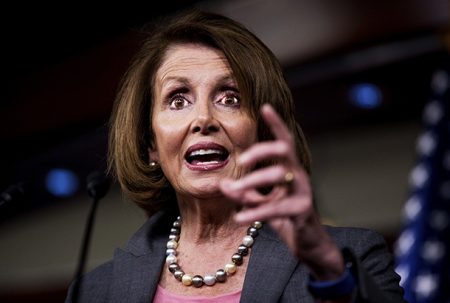
US Democratic leaders have called for more than $300 million in new funding to protect upcoming midterm elections from Russian interference.
Senate minority leader Chuck Schumer (D-N.Y.) and House minority leader Nancy Pelosi demanded a budget boost Wednesday, claiming that the amount is necessary to safeguard November’s elections.
The extra money should go to the FBI, Department of Homeland Security and Election Assistance Commission, they said in a letter to the Republicans.
“We’re not drawing lines in the sand,” Senator Schumer told reporters. “We hope we can get bipartisan support.”
The Democrats’ move was made in the wake of mounting pressure against the administration of US President Donald Trump over possible collusion with Moscow during the 2016 presidential campaign and election.
The president and his associates have been under increased pressure since Friday, when special counsel Robert Mueller released an indictment in the ongoing Russia probe.
The investigation seeks to find out whether the Russian government coordinated with Trump’s aides after the intelligence community’s conclusion that the Kremlin helped with the New York billionaire’s campaign effort ahead of winning the White House, an allegation dismissed both by Moscow and the president.
Democrats are, meanwhile, attempting to persuade the GOP to back the effort.
“There is some support out there, but it has never gotten to the Republican leadership level,” Minnesota Democratic Senator Amy Klobuchar told reporters. “If they want to do this, they could get it done — but instead of just having introduced bills, they’re going to have to take this on and help us.”
In an emailed statement to Politico, a Senate Republican aide asserted that the offer would be “considered.”
“This request will be carefully considered along with the thousands of individual choices and decisions that will have to be weighed and made as a FY2018 omnibus bill is written,” wrote the GOP aide.
According to the spokeswoman for the Republican speaker of the US House of Representative, Paul Ryan, lawmakers will be informed “on ways to protect the 2018 election.”
“We won’t be negotiating the omnibus through the press,” AshLee Strong said.
February 21, 2018
Posted by aletho |
Mainstream Media, Warmongering, Russophobia | Chuck Schumer, DHS, FBI, Nancy Pelosi, United States |
Leave a comment
A Wall Street Journal article by Juan Forero (2/13/18) ran with the headline “Venezuela’s Misery Fuels Migration on Epic Scale.” The subhead stated, “Residents Flee Crumbling Economy in Numbers That Echo Syrians to Europe, Rohingya to Bangladesh.”
Forero’s article quoted a UN official: “By world standards, Colombia is receiving migrants at a pace that now rivals what we saw in the Balkans, in Greece, in Italy in 2015, at the peak of [Europe’s] migrant emergency.” Further on, Forero says, “The influx prompted Colombian officials to travel to Turkey last year to study how authorities were dealing with Syrian war refugees.”
Two enormous problems with the way Forero and his editors have framed this article should immediately stand out:
- Colombia’s population of internally displaced people is about 7 million, and has consistently been neck and neck with Syria’s. According to the UNHCR, as of mid-2016, Colombia is also the Latin American country which has the most number of refugees living outside its borders: over 300,000, mainly in Venezuela and Ecuador. Forero and his editors picked the wrong country to compare with Syria.
- Greece and Italy do not share a border with Syria, nor do the Balkans as they are generally defined. Colombia and Venezuela, by contrast, share a very long border. Forero’s comparison, therefore, excludes states that border Syria. Three of those bordering states—Lebanon, Jordan and Turkey—collectively absorbed 4.4 million Syrian refugees by 2016; five years after war broke out in Syria, Turkey alone took in almost 3 million.
It’s very important to expand on the first point. Colombia is a humanitarian and human rights disaster, and has been for decades, in very large part due to its close alliance with the United States. Thanks to Wikileaks (CounterPunch, 2/23/12), we know that US officials privately acknowledged estimates that hundreds of thousands of people were murdered by right-wing paramilitaries, and that the killings have nearly wiped out some indigenous groups. Those genocidal paramilitaries have worked closely with the Colombian military that Trump Chief of Staff John Kelly praised in 2014 as a “magnificent” US partner. “They’re so appreciative of what we did for them,” raved Kelly.
Praise for Colombia’s government has also come from the liberal end of the US establishment, albeit with much more subtlety than from Kelly. In 2014, a New York Times editorial (9/21/14) stated that “Colombia, Brazil and other Latin American countries should lead an effort to prevent Caracas from representing the region [on the UN Security Council] when it is fast becoming an embarrassment on the continent.” So to Times editors, Colombia is a regional good guy that must lead its neighbors in shunning Venezuela.
Colombia’s current president, Juan Manuel Santos, was minister of Defense from 2006 to 2009. From 2002 to 2008, the Colombian military murdered about 3,000 civilians, passing them off as slain rebels. As human rights lawyer Dan Kovalik explained (Huffington Post, 11/20/14) , the International Criminal Court (ICC) “concluded that these killings were systemic, approved by the highest ranks of the Colombian military, and that they therefore constituted ‘state policy.’” The murders occurred with the greatest frequency between 2004 and 2008, which Kovalik observed “also corresponds with the time in which the US was providing the highest level of military aid to Colombia.”
If Colombian and US officials evade prosecution for all of this, it will be with the help of corporate media—as well as the severe limitations powerful governments impose on international bureaucracies like the ICC. Kovalik remarked:
You might say, no official of the US can be prosecuted by the ICC because the US has refused to ratify the ICC treaty. While this may appear to be true, this did not stop the ICC from prosecuting officials from the Sudan—also not a signatory to the ICC.
The closest Forero came in his article to even hinting at any of these gruesome facts was when he wrote that “Colombia has long had troubles of its own, including integrating former Communist guerrillas from a civil conflict that only ended recently.” The “conflict” has not exactly “ended,” given that 170 leftist political leaders and activists were assassinated in 2017.
Putting aside Forero’s epic distortions by omission regarding Colombia, what about his reporting about migration from Venezuela? He wrote:
Nearly 3 million Venezuelans—a tenth of the population—have left the oil-rich country over the past two decades of leftist rule. Almost half that number—some 1.2 million people—have gone in the past two years, according to Tomás Páez, a Venezuelan immigration expert at Venezuela’s Central University.
In April 2002, Páez signed his name to a quarter-page ad in the Venezuelan newspaper El Nacional that welcomed the dictatorship of Pedro Carmona, then head of Venezuela’s largest business federation, who was installed after a US-backed military coup briefly ousted the late President Hugo Chavez. I’ve written before (ZNet, 1/16/17) about Western outlets—New York Times (11/25/16), Reuters (10/15/14) and Financial Times (8/22/16)—citing Páez without disclosing his anti-democratic record.
The World Bank has compiled data over the years on the numbers of Venezuelan-born people living abroad. The numbers point to far smaller migrations than Páez has estimated:
During the years Chavez was in office (1999–2013), the World Bank’s figures tell us Venezuelans living abroad increased by about 330,000. By 2013, Páez was estimating that about 1.3 million had left—about 1 million more than World Bank estimates. Would journalists ignore data published by the World Bank in favor of estimates by Páez if he were a staunch supporter of the Venezuelan government?
During those 1999–2013 years, the World Bank figures also say that the number of Colombian-born people living in Venezuela grew by 200,000. Forero’s article implies that migration from Colombia to Venezuela ended in the “late 20th century.”
The World Bank has not updated migration data past 2013, but there is no doubt there was a huge increase in migration from Venezuela since its economy entered into a very deep crisis starting in late 2014. (For an overview of the important role of US policy in creating the crisis and now deliberately making it much worse, see my op-ed, “US Policy a Big Factor in Venezuela’s Depression”—Tribune News Service, 2/2/18.)
According to a Colombian university study of Venezuelan migration to Colombia, it averaged about 47,000 per year from 2011–2014, then increased to 80,000 per year in 2015–16.
US government data show migration from Venezuela to the United States increasing from about 7,000 per year before 2013 to 28,000 per year by 2015, including Venezuelans who have entered without authorization.

Numbers in the table can be found here and here.
From 2000 to 2013, the United States was the destination for about 30 percent of Venezuelan-born people who left to live abroad, according to the World Bank figures. If the Colombian university study and US government data are accurate, then the United States has been the destination for about 20 percent of Venezuelan migrants after 2013. That would mean about 140,000 Venezuelans per year were leaving to live abroad by 2016.
That is not remotely comparable to the 5 million Syrians who fled the country in the first five years following the civil war—and that doesn’t include over a million per year who fled their homes inside Syria (the internally displaced).
That Forero would even try to force this comparison into his article speaks volumes. It’s not hard to guess why it was made, given that US has bombed Syria regularly and has had Venezuela’s government in its crosshairs for almost two decades.
February 20, 2018
Posted by aletho |
Deception, Fake News, Mainstream Media, Warmongering | Colombia, Juan Forero, Latin America, Venezuela, Wall Street Journal |
Leave a comment
Leader of Opposition and head of the UK Labour Party Jeremy Corbyn is facing numerous attacks from the Tories, who recalled their Cold War practices to discredit their left-wing opponent, branding him a communist spy.
The scandal was sparked by the allegations made by former Czechoslovak intelligence officer Jan Sarkocy, who claimed that Corbyn supplied sensitive information to the communist government.
The Conservatives were quick to jump on the bandwagon, calling on Corbyn to disclose a file that was opened on him by the East German intelligence agency, the Stasi, when he visited the German Democratic Republic (GDR) in 1980s. For instance, British Prime Minister Theresa May has publicly called on Corbyn to be “accountable for his actions in the past”.
“Where there are allegations of this sort, MPs should be prepared to be open and transparent,” May said.
Tory Minister State for Security and Economic Crime Ben Wallace even alluded to Kim Philby, the ringleader of Cambridge Five, a group of Britons that spied for the Soviet Union during the Cold War, in his tweet about Corbyn.
“Jeremy has been interested in Foreign Policy issues his entire political career ” — Labour MP Louis Haigh, BBC Daily Politics — yup so was Kim Philby”- the tweet read.
Wallace was eventually forced to backtrack by Twitter users, who mocked the logic behind his attack.
“Wasn’t comparing just saying that being interested in Foreign policy isn’t an answer to the allegations being made,” another tweet read.
Junior defense minister Tobias Ellwood, however, did not hold back, telling The Telegraph that the allegations raise “legitimate concerns” about Corbyn’s “patriotism”.
The Conservatives are keen on pushing the story and are planning to invite Sarkocy to testify before the House of Commons’ Foreign Affairs Committee, which is chaired by a senior Tory MP, Tom Tugendhat.
Tugendhat stated that his committee is “planning to look at how nation states undermine democracy and the rule of law”, invoking the tried-and-tested anti-Russian rhetoric to further undermine Corbyn.
“It is Russia and other countries as well that are trying to do it. While we are doing that it may be worth asking people who have actually tried to do this in the past to tell us how they did it,” Tugendhat said.
The scandal comes just as the latest YouGov poll revealed a slight lead that the Labour Party holds over the Conservatives in voting preferences of British citizens.
The new figures show that 41% of Britons are likely to vote Labour, while the Conservatives enjoy the support of 40% of the UK electorate.
However, the scandal is likely to backfire and discredit the Tories themselves, as there is evidence that directly debunks the allegations.
According to the Sun, the Czechoslovak intelligence archives actually reveal that the communist spies never managed to successfully recruit Corbyn.
The Labour leader has confirmed that he indeed met with Sarkocy, who posed as a diplomat during his tenure in London, but staunchly denied supplying any information to the communist spy and dismissed the claims as “ridiculous smears.”
READ MORE:
Labour’s Poll Surge Has Establishment ‘Pundits’ in a Flap
UK Labour Leader Corbyn Refutes Allegations of Being Spy — Spokesman
February 20, 2018
Posted by aletho |
Deception, Fake News, Mainstream Media, Warmongering, Russophobia, Timeless or most popular | Jeremy Corbyn, UK |
Leave a comment
Iran has once again rejected the allegations about the Islamic Republic’s provision of missiles to Yemeni forces, saying such claims are lies and a foolish scenario.
“Iran’s missile program is for defensive and deterrent [purposes] and claims about the dispatch of missiles to Yemen despite the all-out blockade on this country are lies and a foolish scenario designed to exonerate the aggressors,” Iranian Foreign Ministry Spokesman Bahram Qassemi said on Tuesday.
He added that Britain and France have expressed their concern over Iran’s defensive missile program without providing any reason or wise justification.
A group of so-called independent United Nations experts monitoring the sanctions on Yemen reported to the Security Council in January that it had “identified missile remnants, related military equipment and military unmanned aerial vehicles that are of Iranian origin and were brought into Yemen after the imposition of the targeted arms embargo.”
British Foreign Secretary Boris Johnson in a statement on Monday called on Iran to stop taking actions which could lead to further escalation of the Yemeni conflict.
“I call on Iran to cease activity which risks escalating the conflict and to support a political solution to the conflict in Yemen,” Johnson said.
His remarks came on the same day that the French foreign ministry also said in a statement that Paris was concerned about Iran’s ballistic missiles program and its activities in the region, mentioning its support for the Houthis in Yemen.
In reaction to the allegations, Qassemi said the Islamic Republic has designed its defensive missile program based on its military doctrine and valuable experience it obtained during the eight-year war imposed on it by Iraq backed by major global powers in the 1980s.
He added that Iran’s missile program aims to deter any aggression by extremist powers against the country.
“In this clear path that is completely in conformity with international principles, we will never accept other countries’ intervention and regard as irresponsible and suspicious the adoption of such unprincipled stance and strongly reject them,” Qassemi said.
He emphasized that the Yemeni army and people have no need for foreign countries’ weapons, saying the Yemenis’ defense of their country’s dignity with minimum facilities has led to the defeat of aggressors.
The chief commander of Iran’s Islamic Revolution Guards Corps (IRGC) in January dismissed the allegations leveled by the US and its allies about the Islamic Republic’s provision of missiles to Yemeni forces.
“Missiles fired at Saudi Arabia belong to Yemen which have been overhauled and their range have been increased,” Major General Mohammad Ali Jafari said.
Iran’s Parliament Speaker Ali Larijani also said in December that the Islamic Republic is not providing military assistance to Yemen and all claims to this effect are false.
“We are not a country that would deny providing military assistance to anybody,” Larijani said.
Qassemi further called for an immediate end to the sale of European and US arms to Saudi Arabia and other aggressors and warmongers who are killing innocent Yemeni people on a daily basis.
A Saudi Arabian-led coalition launched a war against Yemen in 2015 and has ever since been indiscriminately hitting targets in the country. Yemeni Houthi fighters have been firing missiles in retaliatory attacks against Saudi targets every now and then.
The US State Department in January approved a possible $500-million sale of missile system support services to Saudi Arabia in defiance of global calls for Washington to stop providing Riyadh with military support due to the regime’s war crimes in Yemen.
The potential sale follows a request by Saudi Arabia for continued technical assistance for Patriot Legacy Field Surveillance Program (FSP), the Patriot Advanced Capability 3 (PAC-3) and the Patriot Engineering Services Program (ESP).
During his first trip to Saudi Arabia last year, US President Donald Trump signed a $110 billion arms deal with the Saudis, with options to sell up to $350 billion over a decade.
Iranian Foreign Minister Mohammad Javad Zarif said in December the United States is complicit in Saudi war crimes in Yemen amid Washington’s baseless claim that Tehran is providing supply of ballistic missiles to Yemen’s Houthi Ansarullah movement.
“No amount of alternative facts or alternative evidence covers up US complicity in war crimes,” Zarif said in a post on his official Twitter account.
He added that the US has sold weapons to its allies enabling them to “kill civilians and impose famine,” in reference to Washington’s arms deal with Riyadh in its aggression against Yemen.
February 20, 2018
Posted by aletho |
Fake News, Mainstream Media, Warmongering | France, Iran, Saudi Arabia, UK, United Nations, United States, Yemen |
Leave a comment
Will every critic of our government policies soon be indictable?
It’s hard to know where to begin. Last Friday’s indictment of 13 Russian nationals and three Russian companies by Special Counsel Robert Mueller was detailed in a 37 page document that provided a great deal of specific evidence claiming that a company based in St. Petersburg, starting in 2014, was using social media to assess American attitudes. Using that assessment, the company inter alia allegedly later ran a clandestine operation seeking to influence opinion in the United States regarding the candidates in the 2016 election in which it favored Donald Trump and denigrated Hillary Clinton. The Russians identified by name are all back in Russia and cannot be extradited to the U.S., so the indictment is, to a certain extent, political theater as the accused’s defense will never be heard.
In presenting the document, Rod Rosenstein, Deputy Attorney General, stressed that there was no evidence to suggest that the alleged Russian activity actually changed the result of the 2016 presidential election or that any actual votes were altered or tampered with. Nor was there any direct link to either the Russian government or its officials or to the Donald Trump campaign developed as a result of the nine-month long investigation. There was also lacking any mention in the indictment of the Democratic National Committee, Hillary Clinton and Panetta e-mails, so it is to be presumed that the activity described in the document was unrelated to the WikiLeaks disclosures.
Those of the “okay, there’s smoke but where’s the fire” school of thought immediately noted the significant elephant in the room, namely that the document did not include any suggestion that there had been collusion between Team Trump and Moscow. As that narrative has become the very raison d’etre driving the Mueller investigation, its omission is noteworthy. Meanwhile, those who see more substance in what was revealed by the evidence provided in the indictment and who, for political reasons, would like to see Trump damaged, will surely be encouraged by their belief that the noose is tightening around the president.
Assuming the indictment is accurate, I would agree that the activity of the Internet Research Agency does indeed have some of the hallmarks of a covert action intelligence operation in terms how it used some spying tradecraft to support its organization, targeting and activity. But its employees also displayed considerable amateur behavior, suggesting that they were not professional spies, supporting the argument that it was not a government intelligence operation or an initiative under Kremlin control. And beyond that, so what? Even on a worst-case basis, stirring things up is what intelligence agencies do, and no one is more active in interfering in foreign governments and elections than the United States of America, most notably in Russia for the election of Boris Yeltsin in 1996, which was arranged by Washington, and more recently in Ukraine in 2014. From my own experience I can cite Italy’s 1976 national election in which the CIA went all out to keep the communists out of government. Couriers were discreetly dispatched to the headquarters of all the Italian right wing parties dropping off bags of money for “expenses” while the Italian newspapers were full of articles written by Agency-paid hacks warning of the dangers of communism. And this all went on clandestinely even though Italy was a democracy, an ally and NATO member.
Does that mean that Washington should do nothing in response? No, not at all. Russia, if the indictment is accurate, may have run an influencing operation and gotten caught with its hand in the cookie jar. Or maybe not. And Washington might also actually have information suggesting that Russia is preparing to engage in further interference in the 2018 and 2020 elections, as claimed by the heads of the intelligence agencies, though, as usual, evidence for the claim is lacking. There has to be bilateral, confidential discussion of such activity between Washington and Moscow and a warning given that such behavior will not be tolerated in the future, but only based on irrefutable, solid evidence. The leadership in both countries should be made to understand very clearly that there are more compelling reasons to maintain good bilateral working relations than not.
With that in mind, it is important not to overreact and to base any U.S. response on the actual damage that was inflicted. The indictment suggests that Russia is out to destroy American democracy by promoting “distrust” of government as well as sowing “discord” in the U.S. political system while also encouraging “divisiveness” among the American people. I would suggest in Russia’s defense that the U.S. political system is already doing a good job at self-destructing and the difficult-to-prove accusations being hurled at Moscow are the type one flings when there is not really anything important to say.
I would suggest that Moscow might well want to destroy American democracy but there is no evidence in the indictment to support that hypothesis. I particularly note that the document makes a number of assumptions which appear to be purely speculative for which it provides no evidence. It describes the Russian company Internet Research Agency as “engaged in operations to interfere with elections and political processes.” Its employees were involved in
“interference operations targeting the United States. From in or around 2014 to the present, Defendants knowingly and intentionally conspired with each other (and with persons known and unknown to the Grand Jury) to defraud the United States by impairing, obstructing, and defeating the lawful functions of the government through fraud and deceit for the purpose of interfering with the U.S. political and electoral processes, including the presidential election of 2016.”
The theme of Russian subversion is repeated throughout the indictment without any compelling evidence to explain how Mueller knows what he asserts to be true, suggesting either that the document would have benefited from a good editor or that whoever drafted it was making things up. Internet Research Agency allegedly “conduct[ed] what it called ‘information warfare against the United States of America’ through fictitious U.S. personas on social media platforms and other Internet-based media.” The indictment goes on to assert that
“By in or around May 2014, the ORGANIZATION’s strategy included interfering with the 2016 U.S. presidential election, with the stated goal of ‘spread[ing] distrust towards the candidates and the political system in general’”
with a
“strategic goal to sow discord in the U.S. political system, including the 2016 U.S. presidential election. Defendants posted derogatory information about a number of candidates, and by early to mid-2016, Defendants’ operations included supporting the presidential campaign of then-candidate Donald J. Trump (“Trump Campaign”) and disparaging Hillary Clinton. Defendants made various expenditures to carry out those activities, including buying political advertisements on social media in the name of U.S. persons and entities. Defendants also staged political rallies inside the United States, and while posing as U.S. grassroots entities and U.S. persons, and without revealing their Russian identities and ORGANIZATION affiliation, solicited and compensated real U.S. persons to promote or disparage candidates. Some Defendants, posing as U.S. persons and without revealing their Russian association, communicated with unwitting individuals associated with the Trump Campaign and with other political activists to seek to coordinate political activities.”
Two company associates
“traveled in and around the United States, including stops in Nevada, California, New Mexico, Colorado, Illinois, Michigan, Louisiana, Texas, and New York to gather intelligence. After the trip, [they] exchanged an intelligence report regarding the trip. The conspiracy had as its object the opening of accounts under false names at U.S. financial institutions and a digital payments company in order to receive and send money into and out of the United States to support the ORGANIZATION’s operations in the United States and for self-enrichment. Defendants and their co-conspirators also used the accounts to receive money from real U.S. persons in exchange for posting promotions and advertisements on the ORGANIZATION-controlled social media pages. Defendants and their co-conspirators typically charged certain U.S. merchants and U.S. social media sites between 25 and 50 U.S. dollars per post for promotional content on their popular false U.S. persona accounts, including Being Patriotic, Defend the 2nd, and Blacktivist. All in violation of Title 18, United States Code, Section 1349.”
Note particularly the money laundering and for-profit aspects of the Internet Research scheme, something that would be eschewed if it were an actual intelligence operation. There is some speculation that it all might have been what is referred to as a click-bait commercial marketing scheme set up to make money from advertising fees. Also note how small the entire operation was. It focused on limited social media activity while spending an estimated $1 million on the entire venture, with Facebook admitting to a total of $100,000 in total ad buys, only half of which were before the election. It doesn’t smell like a major foreign government intelligence/influence initiative intended to “overthrow democracy.” And who attended the phony political rallies? How many votes did the whole thing cause to change? Impossible to know, but given a campaign in which billions were spent and both fake and real news were flying in all directions, one would have to assume that the Russian effort was largely a waste of time if it indeed was even as described or serious in the first place.
And apart from the money laundering aspect of the alleged campaign was it even illegal apart from the allegations of possible visa fraud and money laundering? If the Russians involved were getting their financial support from the Moscow government then it would be necessary to register under the Foreign Agents Registration Act (FARA) of 1938, but if not, they would be protected by the Constitution and have the same First Amendment right to express their opinions of Hillary Clinton on blogs and websites while also associating with others politically as do all other residents of the United States. Many of the commenters on this Unz site are foreign and are not required either by law or custom to state where they come from.
And, of course, there is one other thing. There always is. One major media outlet is already suggesting that there could be consequences for American citizens who wittingly or unwittingly helped the Russians, identified in the indictment as “persons known and unknown.” A former federal prosecutor put it another way, saying “While they went to great pains to say they are not indicting any Americans today, if I was an American and I did cooperate with Russians I would be extremely frightened…” Politico speculates that “Now, a legal framework exists for criminal charges against Americans…” and cites a former U.S. district attorney’s observation that “Think of a conspiracy indicting parties ‘known and unknown’ as a Matroyshka doll. There are many more layers to be successively revealed over time.”
Under normal circumstances, an American citizen colluding with a foreign country would have to be convicted of engaging in an illegal conspiracy, which would require being aware that the foreigners were involved in criminal behavior and knowingly aiding them. But today’s overheated atmosphere in Washington is anything but normal. Russia’s two major media outlets that operate in the U.S., Sputnik and RT America, have been forced to register under FARA. Does that mean that the hundreds of American citizens who appeared on their programs prior to the 2016 election to talk about national politics will be next in line for punishment? Stay tuned.
Philip M. Giraldi, Ph.D., is Executive Director of the Council for the National Interest, a 501(c)3 tax deductible educational foundation that seeks a more interests-based U.S. foreign policy in the Middle East. Website is http://www.councilforthenationalinterest.org, address is P.O. Box 2157, Purcellville VA 20134 and its email is inform@cnionline.org.
February 20, 2018
Posted by aletho |
Civil Liberties, Deception, Fake News, Full Spectrum Dominance, Mainstream Media, Warmongering, Russophobia, Timeless or most popular | CIA, Hillary Clinton, United States |
Leave a comment
I confess deep amusement at the enormous reaction of the U.S mainstream press to the 37-page federal grand-jury indictment that special prosecutor (and former FBI Director) Robert Mueller has secured against 13 Russians and three companies or, as the mainstream media puts it, against “Russia.”
Why am I so amused?
One reason is how reporters and editorial boards of the mainstream press are treating the indictment — as solid evidence of guilt. From reading all of the mainstream reporting and commentaries on the indictment, you would think that “Russia” had just been convicted of the heinous crime of “meddling” in a U.S. presidential election.
At the risk of raining on the anti-Russia parade, that’s pure nonsense.
The reason it’s pure nonsense is that that under our form of government, that 37-page grand-jury indictment is evidence of nothing, absolutely nothing.
A grand-jury indictment is nothing more than an accusation. That’s all. It’s not even sworn to. There are no affidavits or other sworn testimony attached to it. It is nothing more than a prosecutor-drafted document that sets forth prosecutorial accusations that a federal grand jury almost always automatically rubber stamps.
Consider this excerpt from the Pattern Jury Charge that every federal judge in the land is required to read to every jury in every criminal case just before the jury adjourns to deliberate the guilt or innocence of the accused:
The indictment brought by the government against the defendant is only an accusation, nothing more. It is not proof of guilt or anything else.
Why do federal judges issue that admonition to every jury in every criminal case? Because the law recognizes that the average American citizen has the same incorrect mindset as the average mainstream reporter and commentator — that a criminal indictment is evidence of guilt. The purpose of the admonition is to correct this misconception before the members of the jury begin deliberating.
Another reason the anti-Russia brouhaha over Mueller’s indictment is so funny is that the mainstream journalists and editorial writers continue to allege that the indictment proves that “Russia” meddled in the presidential election.
Yet, a close reading of the indictment reflects no such thing. Instead, it alleges that 13 Russian individuals and 3 companies bought Facebook ads, participated in political events, and undertook similar nefarious political deeds with the aim of getting Donald Trump, who, unlike his opponent Hillary Clinton, favored establishing normal relations with Russia, elected.
Now, one thing is for sure: Mueller and his well-paid legal team know how to craft a criminal indictment. No one doubts that. Such being the case, the question has to be asked: Why didn’t Mueller craft the indictment in such a way as to allege that those individuals and companies were operating as agents of the Russian government or operating in a conspiracy with the Russian government or at least with some Russian officials?
Now, it might well be that competent and relevant evidence will later establish in a criminal trial that the accused actually did what they are accused of doing. And it might well also establish that the accused were acting as agents of the Russian government or in a conspiracy with the Russian government.
But as of right now, we have a situation where the U.S. special prosecutor and his special prosecutorial team have secured an indictment, which they themselves crafted, which omits any allegation that the accused were acting as agents of the Russian government or as part of a conspiracy with the Russian government.
Mueller and his team have been conducting their investigation for more than a year. If they have evidence that those 13 individuals and 3 companies were acting as agents for the Russian government or in a conspiracy with the Russian government, then why not say it as part of the indictment? It seems to me that the logical inference to be drawn from their leaving out such an accusation is that Mueller and his team have come up with no evidence that the Russian government was involved with those 13 individuals and 3 companies.
Oh, they might believe it. They might be 100 percent convinced of it. But believing it or being convinced of it is a far cry from having relevant and competent evidence of it. The fact that they didn’t allege it in the indictment that they themselves crafted implies that they don’t have any evidence of it.
That, of course, hasn’t stopped the mainstream media from declaring that Mueller’s grand-jury indictment proves that “Russia” was involved in election meddling. To the mainstream media, Russian citizens and Russian companies and the Russian government are all one and the same. If a Russian citizen or a Russian company does it, that means that “Russia” did it.
There is something else important that is worth noting: No courtroom is ever going to see any evidence to support Mueller’s grand-jury indictment anyway. Why? Because he and his team know what the mainstream press doesn’t know: that there is no reasonable possibility that this case will ever come to trial. That’s because there is no reasonable possibility that Russia will agree to extradite any of the people who are charged in the indictment. No trial means no evidence will be presented in a trial. That means that Mueller’s 37-page indictment is nothing more than a nothing-burger.
Another amusing aspect of the anti-Russia brouhaha is the moral condemnation of Russia for daring to interfere with America’s electoral process by buying some ads and participating in some protests.
Why is such moral condemnation amusing? Because interfering with foreign elections is precisely what the Pentagon and the CIA have done ever since the U.S. government was converted into a national-security state after World War II. In fact, intervention into the domestic affairs of other countries has been the core feature of the Pentagon and the CIA since their very beginning.
Don’t believe me? Just read these three articles and you’ll see what I mean:
Russia Isn’t the Only One Meddling in Elections. We Do It, Too
The U.S. Is No Stranger to Interfering in the Elections of Other Countries
The Long History of the U.S. Interfering with Elections Elsewhere
Thus, when the mainstream media talks about how horrible “the Russians” are for intervening in America’s political system, they are, at the same time, implicitly condemning those horrible Americans who have been doing — and who continue to do — the same thing to other countries.
In fact, it must be asked: Why no indictment for U.S. officials who have interfered with the electoral processes in foreign countries, including, say, in Ukraine, where U.S. officials succeeded in one of their storied regime-change operations against a democratically elected regime to enable them to place U.S. missiles on Russia’s border? If it’s criminal for Russians to intervene in America’s political system by buying some Facebook ads, why isn’t also illegal for U.S. officials to intervene in foreign political systems, especially through bribery, coups, invasions, and assassinations, which, it seems to me, are a bit worse than buying some Facebook ads? (The CIA’s anti-democratic coups in Iran in 1953, Guatemala in 1954, and Chile in 1973 might also come to mind.)
By the way, check out this story on Telesur about how a group of Mexican senators publicly endorsed Hillary Clinton for president, wore pro-Clinton t-shirts, and issued pro-Clinton sentiments on Twitter. Moreover, according to the story, “Several Mexican personalities who live in the U.S. and have influence with Latino communities have urged Latinos to participate in large numbers in the Nov. 8 election and to vote for Democratic candidate Hillary Clinton and reject Donald Trump, who has maintained racist rhetoric against Mexicans and immigrants since the beginning of his campaign.”
Now, I don’t wish to get anyone in trouble but the obvious question naturally arises: Why no indictment against them? Could it be because they aren’t Russkies (or communists)?
Robert Mueller’s indictment is just one more piece of pressure being brought against President Trump. As soon as he demonstrates that he has been fully absorbed into the Deep State by declaring, “I hate Russia” and then acting accordingly, the powers-that-be will finally leave him alone.
Unfortunately, Mueller’s indictment failed to estimate how many Americans, most of whom have been educated in U.S. public schools, were influenced by “the Russians” into voting for Donald Trump. (I’m proud to say that those crafty Russkies didn’t induce me to change my vote. Despite their best efforts to induce me to vote for their “Manchurian candidate,” I voted Libertarian anyway.)
One thing is for sure: In the entire anti-Russia brouhaha, U.S. officials should count themselves lucky that hypocrisy is not a criminal offense.
February 19, 2018
Posted by aletho |
Fake News, Mainstream Media, Warmongering, Russophobia, Timeless or most popular | CIA, Hillary Clinton, United States |
Leave a comment
Christopher Steele’s Other Job: He Ran an Info Op Against the United States
Christopher Steele did far more than simply provide an opposition research dossier to the Democratic National Committee, his Job One. As a skilled intelligence officer, Steele ran a full-spectrum information operation against the United States, aided either willingly or unwittingly by the FBI. His second job was the more important one: get his information into the most effective hands to influence the United States in the most significant way.
To understand how effective Steele has been in his op, we need to understand he had two jobs. The first was to create the dossier. The second job was to disseminate the dossier. Steele had to get the information into the most effective hands to influence the United States in the most significant way.
Job One: Create the Dossier
Job One was to create the opposition research. “Oppo” is not a neutral gathering of facts, but a search for negative information that can be used against an opponent. The standards — vetting — vary with the intended use. Some info might be published with documents and verification. Some leads discovered might be planted in hopes a journalist will uncover more “on her own,” creating credibility. Some likely near-falsehoods might be handed out to sleazy media in hopes more legit media will cross report — the New York Times might not initially run a story about a sexual dalliance itself, but it will run a story saying “Buzzfeed reports a sexual dalliance involving…”
Oppo research follows no rules; this is not peer-reviewed stuff that has to pass an ethics board. One goes out with bags of money shouting “Anyone got dirt on our opponent? We’re paying, but only for dirt!” You look for people who didn’t like a deal, people with an axe to grind, the jilted ex-wife, not the happy current one. So to say oppo research might be biased is to miss the point.
You’re not required to look too far under a rock that hides something naughty — stop when you’ve got what you came for. It all depends how the information will be deployed. The less sure you are about the veracity of the information you acquire the more you need that info to be inherently palatable; it has to feel right to the intended audience. The old political joke is you need to find a live boy in bed, or a dead girl, to really smear an opponent with a sex scandal. So if you’re going to run with info that supports what the public already sort of believes, the standards are lower.
What Does the Dossier Say?
Turning to Christopher Steele’s dossier, it looks like he read the same espionage textbook as everyone else. So while it would have been a game-changer had Steele found unambiguous evidence of financial transactions between Trump and the Russian government, that would have required real evidence. Steele’s sources claim money changed hands, but never provide him with proof. On dossier (page 20) one source goes as far as to say no documentary evidence exists.
That means instead of the complex financing scams you might expect out of Trump, the big takeaway from the dossier is the pee tape, sources claiming the Russians have video to blackmail Trump at any moment. The thing reaches almost the level of parody, because not only does the dossier claim Trump likes fetish sex, the fetish sex occurred in the context of an anti-Obama act (Trump supposedly for his pleasure employed prostitutes to urinate on a bed Obama once slept in.) As for other sex parties Trump supposedly participated in, the dossier notes all direct witnesses were “silenced.” You couldn’t do better if you made it all up.
In fact, the thing reads very much like what lay people imagine spies come up with. In real intelligence work, documents showing transactions from cash to commercial paper to gold run through a Cayman Islands’ bank are much more effective than dirty video; the latter can be denied, and may or may not even matter to a public already bored by boasts of pussy grabbing and rawdog sex with porn stars. The former will show up in court as part of a racketeering and tax evasion charge that dead solid perfect sends people to jail. Intelligence officers who pay out sources maintain meticulous receipts; you think their own agencies trust them with bags of cash? And in the dark world, prostitutes don’t need to be “silenced.” They have no credibility in most people’s’ minds to begin with, and a trail of bodies just attracts attention. And unlike Steele’s product, real intel reporting is full of qualifiers, maybes, liklies and so forth, not a laundry list of certainties, because you know your own sources have an agenda. The dossier is also short of the kind of verifiable details of specific dates and places you’d expect. It is a collection of unverifiable assertions by second-hand sources, not evidence. Steele is a smart man, an experienced intelligence officer, who knew exactly what he was writing — a dossier that will read true to the rubes.
So it is not surprising to date there has been no public corroboration of anything in the dossier. If significant parts of the dossier could be proven, there would be grounds for impeachment with no further work needed. At least one fact has been disproven –Trump’s lawyer, Michael Cohen, produced his passport to rebut the dossier’s claim that he had secret meetings in Prague with a Russian official.
Job Two: Run the Info Op, Place the Dossier
Steele excelled at turning his dossier into a full-spectrum information operation, what some might call information warfare. This is what separates his work creating the dossier (which a decent journalist with friends in Russia could have done) from his work infiltrating the dossier into the highest reaches of American government and political society. For that, you need a real pro, an intelligence officer with decades of experience running just that kind of op. You want foreign interference in the 2016 election? Let’s take a closer look at Christopher Steele.
Steele’s skill is revealed by the Nunes and Grassley memos, which show he used the same set of information in the dossier to create a collaboration loop, every intelligence officer’s dream — his own planted information used to surreptitiously confirm itself, right up to the point where the target country’s own intelligence service re-purposed it as evidence in the FISA court.
Steele admits he briefed journalists off-the-record starting in summer and autumn 2016. His most significant hit came when journalist Michael Isikoff broke the story of Trump associate Carter Page’s alleged connections to Russia. Isikoff did not cite the dossier or Steele as sources, and in fact denied they were when questioned.
Isikoff’s story didn’t just push negative information about Trump into the public consciousness. It claimed U.S. intel officials were probing ties between a Trump adviser and the Kremlin, adding credibility; the feds themselves felt the info was worthwhile! Better yet for Steele, Isikoff claimed the information came from a “well-placed Western intelligence source,” suggesting it originated from a third-party and was picked up by Western spies instead of being written by one. Steele also placed articles in the New York Times, Washington Post, New Yorker, Mother Jones, and others.
At the same time, Steele’s info reached influential people like John McCain, who could then pick up a newspaper and believe he was seeing the “secret” info from Steele confirmed independently by an experienced journalist. And how did McCain first learn about Steele’s work? At a conference in Canada, via Andrew Wood, former British Ambassador in Moscow. Where was Wood working at the time? Orbis, Christopher Steele’s research firm.
A copy of the dossier even found its way to the State Department, an organization which normally should have been far removed from U.S. election politics. A contact within State passed information from Clinton associates Sidney Blumenthal and Cody Shearer (both men played also active roles behind in the scenes feeding Clinton dubious information on Libya) to and from Steele. The Grassley memo suggests there was a second Steele document, in addition to the dossier, already shared with State and the FBI but not made public.
The Gold Medal: Become the Source of Someone Else’s Investigation
While seeding his dossier in the media and around Washington, Steele was also meeting in secret with the FBI (he claims he did not inform Fusion GPS, his employer), via an FBI counterintelligence handler in Rome. Steele began feeding the FBI in July 2016 with updates into the fall, apparently in the odd guise of simply a deeply concerned, loyal British subject. “This is something of huge significance, way above party politics,” Steele commented as to his motives.
The FBI, in the process of working Steele, would have likely characterized him as a “source,” technically a “extra-territorial confidential human source.” That meant the dossier’s claims appeared to come from the ex-MI6 officer with the good reputation, not second-hand from who knows who in Russia (the FBI emphasized Steele’s reputation when presenting the dossier to the FISC.) Think of it as a kind of money laundering which, like that process, helped muddy the real source of the goods.
The FBI used the Steele dossier to apply for a FISA court surveillance warrant against Carter Page. The FBI also submitted Isikoff’s story as corroborating evidence, without explaining the article and the dossier were effectively one in the same. In intelligence work, this is known as cross-contamination, an amateur error. The FBI however, according to the Nunes memo, did not tell the FISA court the Steele dossier was funded by the Democratic National Committee as commissioned opposition research, nor did they tell the court the Isikoff article presented as collaborating evidence was in fact based on the same dossier.
Steele reached an agreement with the FBI a few weeks before the election for the bureau to pay him $50,000 to continue his “research,” though the deal is believed to have fallen through after the dossier became public (though an intelligence community source tells The American Conservative Steele did in fact operate as a fully paid FBI asset.) Along the way the FBI also informed Steele of their separate investigation into Trump staffer George Papadopoulos, a violation of security and a possible tainting of Steele’s research going forward.
Gold Medal Plus: Collaborate Your Own Information
The Nunes memo also showed then-associate deputy attorney general Bruce Ohr back-channeled additional material from Steele into the DOJ while working with Deputy Attorney General Sally Yates and her replacement, Rod Rosenstein. Ohr’s wife Nellie worked for Fusion GPS, the firm that commissioned the dossier, on Steele’s project. Ohr’s wife would be especially valuable in that she would be able to clandestinely supply info to corraborate what Steele told the FBI and, via her husband, know to tailor what she passed to the questions DOJ had. The FBI did not disclose the role of Ohr’s wife, who speaks Russian and has previously done contract work for the CIA, to the FISA court.
Ohr’s wife only began work for Fusion GPS in September/October 2016, as the FBI sought the warrant against Page based on the Steele dossier. Ohr’s wife taking a new job with Fusion GPS at that critical juncture screams of the efforts of an experienced intelligence officer looking to create yet another pipeline inside, essentially his own asset.
Steele’s Success, With a Little Help From His Friends
All talk of Russia aside, it is difficult to find evidence of a foreigner who played a more significant role in the election than Christopher Steele. Steele took a dossier paid for by one party and drove it deep into the United States. Steele’s work formed in part the justification for a FISA warrant to spy on a Trump associate, the end game of which has not yet been written.
Steele maneuvered himself from paid opposition researcher to clandestine source for the FBI. Steele then may have planted the spouse of a senior DOJ employee as a second clandestine source to move more information into DOJ. In the intelligence world, that is as good as it gets; via two seemingly independent channels you are controlling the opponent’s information cycle.
Steele further manipulated the American media to have his information amplified and given credibility. By working simultaneously as both an anonymous and a cited source, he got his same info out as if it was coming from multiple places.
There is informed speculation Steele was more than a source for the FBI, and actually may have been tasked and paid to search for specific information, essentially working as a double agent for the FBI and the DNC. Others have raised questions about Steele’s status as “retired” from British intelligence, as the lines among working for MI6, working at MI6, and working with MI6 are often times largely a matter of semantics. Unless Steele wanted to burn all of his contacts within British intelligence, it is highly unlikely he would insert himself into an American presidential campaign without at least informing his old workmates, if not seeking tacit permission (for the record, Steele’s old boss at MI6 calls the dossier credible; an intelligence community source tells The American Conservative Steele shared all of his information with MI6.) It is unclear if the abrupt January 2017 resignation of Robert Hannigan, the head of Britain’s NSA-like Government Communications Headquarters, is related in any way to Steele’s work becoming public.
As for the performance of the DOJ/FBI, we do not have enough information to judge whether they were incompetent, or simply willing partners to what Steele was up to, using him as a handy pretext to open legal surveillance on someone inside the Trump circle (surveillance on Page may have also monitored Steve Bannon.)
How to Steele an Election
The Washington Post characterized Steele as “struggling to navigate dual obligations — to his private clients, who were paying him to help Clinton win, and to a sense of public duty born of his previous life.” The Washington Post has no idea how intelligence officers work. Their job is to befriend and engage the target to carry out the goals of their employer. When they do it right, the public summation is a line like the Post offered; you never even knew you were being used. In the macho world of intelligence, the process is actually described more crudely, having to do with using enough lubrication so the target didn’t even feel a rough thing pushed up a very sensitive place.
Steele played the FBI while the FBI thought they were playing him. Or the other way around, because everyone was looking the other way. Steele ran a classic info op against the United States, getting himself inside the cycle as a clean source. Robert Mueller should be ashamed of himself if he uses any of Steele’s dossier, or any information obtained via that dossier. That’s where our democracy stands at the moment.
February 19, 2018
Posted by aletho |
Deception, Fake News, Mainstream Media, Warmongering, Russophobia, Timeless or most popular | Christopher Steele, DNC, DOJ, FBI, MI6, Mother Jones, New York Times, New Yorker, UK, United States, Washington Post |
Leave a comment
Tagged to the Trump presidency like an insistent limpet, the investigation into Russian interference in the US elections of 2016 provides constant fodder for the unimaginative political animals in the United States. But any diet that remains unvaried is bound to induce illness or nutritional deficiency. Variety is strength.
US politics, and its political culture, distinctly lacks nutritional health. Estranged, polarised, and paranoid, it has ceased being a green house of hope and governance. Little wonder, then, that its politicians see external forces of such character and effect, agents of influence that can alter the destiny of the imperium. Scant regard is paid to a system so putrescent it had to produce a Trump or conjured up the demonic properties of a Steve Bannon. Foreign interference remains, not merely a red herring but a fairly insignificant one.
On Friday, thirteen Russians and three Russian entities were charged by special counsel Robert Mueller for conspiring in interfering with “US political and electoral processes, including the presidential election of 2016.” While there was tooting and trumpeting on the media circuit, the more astute were less impressed. Various intelligence professionals preferred to see the indictments as reflecting “a different level of certainty, confidence and evidence.”
The charges, interestingly enough, omit the issue of hacked Democrat emails (Podesta and the DNC) and computer systems connected with the election itself. They focus, rather, on such housekeeping matters as fraud and identity theft.
The first count, for instance, alleges a conspiracy by the 16 defendants to defraud the United States with the purpose of “impairing, obstructing, and defeating the lawful governmental functions of the United States by dishonest means to enable the Defendants to interfere with US political and electoral processes, including the 2016 US presidential election.”
The defendants supposedly interfered with the administration of the Federal Election Campaign Act by the Federal Election Commission touching on political spending by foreign nationals during elections, the Justice Department’s overseeing of the Foreign Agent Registration Act regarding registering foreign agents working within the US on political matters, and the State Department’s visa program for foreign individuals entering the United States.
Then come charges of wire and bank fraud centred on Richard Pinedo, who operated “Auction Essistance”, an online business ostensibly formed to frustrate standard security safeguards of online payment companies. This, in turn, became the vehicle for purchasing rallies and political ads.
For Andrew Prokop, these “don’t add much to what was already publicly known about exactly how Russians tried to interference with the campaign – and they don’t contain any new allegations about anyone in Trump’s orbit.”
One entity stands out in what must be regarded as the huffing effort of an information war: the kremlobots of the Internet Research Agency, supposedly behind the various rallies, online advertisements and social media agitation. The St. Petersburg based Agency was allegedly charged with a strategy favouring Donald Trump, Bernie Sanders and Jill Stein. Hillary Clinton and Republican contenders such as Marco Rubio and Ted Cruz, were subjects of denigration.
Such a strategy, however, would not be etched in stone. The theme of chaos was central. Trump may well have been favoured, but that hardly prevented the staging of both pro-Trump and anti-Trump rallies in various parts of the country, including New York City. Dysfunction and disorientation, in other words, was exploited.
The genius of the Agency lies in the art of the masquerade, turning the Internet into a medium of dancing stories, narratives and fictions. Fake US personas were supposedly created; identities were stolen to open PayPal and bank accounts. This was politics as theatre.
What is easier to ignore in this fuss is that material, to generate any momentum, must have some pre-existing inspiration. The US political classes are continuing that now established tradition of treating those who vote them in as mugs, fools easily swayed by the next hoax or the next marketable story. This hardly charitable attitude means that changes can be avoided and electoral dissatisfaction ignored. Thank god for the Kremlin.
The nature of the indictment will be exactly what Democrats, in particular, want to hear. Trump is partly right in claiming this to be a “phony excuse for losing the election”, though detractors will naturally remove the first word of that observation. Mueller is certainly convinced that he can make these charges stick.
In of itself, these actions, including the social media campaigns and advertising, were matters of minor significance, even if they did simulate the idea of grand chaos. To suggest that they somehow tipped the balance is self-comfortingly delusional. What these indictments may well inadvertently show is that such Russian operations were a form of revenge for US meddling, notably in Ukraine in 2014. The target of that meddling was the pro-Russian leader, Viktor Yanukovych.
Then comes the actual effect of such indictments, which even hard-nosed analysts admit will be minimal. As the staff at Lawfare (February 16) concede, “None of the defendants indicted Friday for their alleged influence operation against the US political system is likely to ever see the inside of an American courtroom. None is in custody. None is likely to surrender to US authorities. And Vladimir Putin will probably not race to extradite them.” The illusion of busy fury can be all powerful.
Binoy Kampmark was a Commonwealth Scholar at Selwyn College, Cambridge. He lectures at RMIT University, Melbourne and can be reached at: bkampmark@gmail.com.
February 19, 2018
Posted by aletho |
Deception, Fake News, Mainstream Media, Warmongering, Russophobia, Timeless or most popular | United States |
Leave a comment
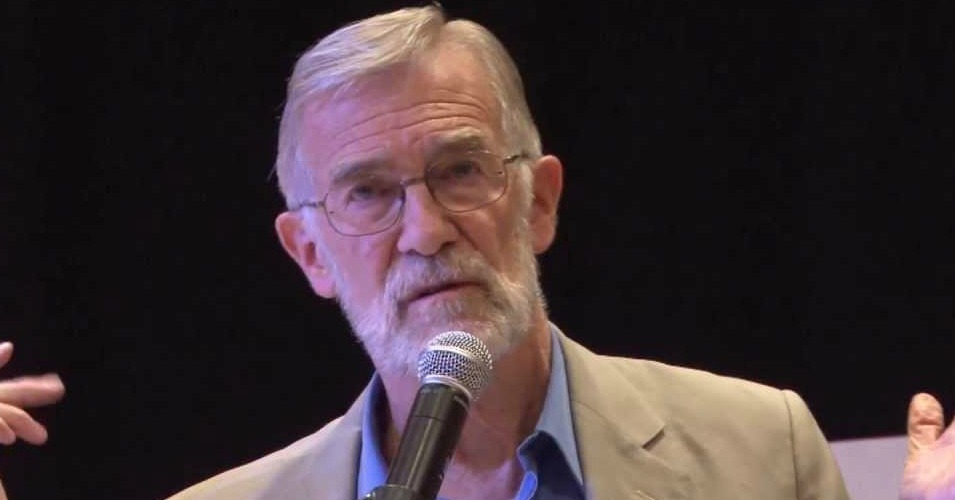

 Aletho News

