Lifting of US Propaganda Ban Gives New Meaning to Old Song
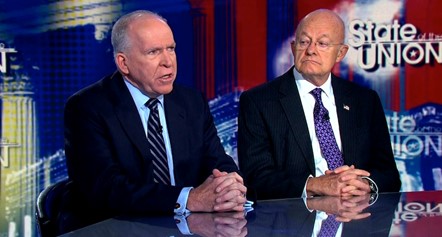
Former Director of National Intelligence James Clapper and former CIA Director John Brennan discuss allegations of Russian influence in presidential elections (CNN Screenshot)
By Whitney Webb – Mint Press News – February 12, 2018
Though its ostensible purpose is to fund the US military over a one year period, the National Defense Authorization Act, better known as the NDAA, has had numerous provisions tucked into it over the years that have targeted American civil liberties. The most well-known of these include allowing the government to wiretap American citizens without a warrant and, even more disturbingly, indefinitely imprison an American citizen without charge in the name of “national security.”
One of the lesser-known provisions that have snuck their way into the NDAA over the years was a small piece of legislation tacked onto the NDAA for fiscal year 2013, signed into law in that same year by then-President Barack Obama. Named “The Smith-Mundt Modernization Act of 2012,” it completely lifted the long-existing ban on the domestic dissemination of US government-produced propaganda.
For decades, the US government had been allowed to produce and disseminate propaganda abroad in order to drum up support for its foreign wars but had been banned from distributing it domestically after the passage of the Smith-Mundt Act of 1948. However, the Modernization Act’s co-authors, Reps. Mac Thornberry (R-TX) and Adam Smith (D-WA, no relation to the Smith of the 1948 act), asserted that removing the domestic ban was necessary in order to combat “al-Qaeda’s and other violent extremists’ influence among populations.”
Thornberry stated that removing the ban was necessary because it had tied “the hands of America’s diplomatic officials, military, and others, by inhibiting our ability to effectively communicate in a credible way.” Yet, given that Thornberry is one of the greatest beneficiaries of weapon manufacturers’ campaign contributions, the real intent — to skeptics at least — seemed more likely related to an effort to ramp up domestic support for US military adventurism abroad following the disastrous invasions of Iraq and Libya.
Five years later, the effects of the lifting of the ban have turned what was once covert manipulation of the media by the government into a transparent “revolving door” between the media and the government. Robbie Martin — documentary filmmaker and media analyst whose documentary series, “A Very Heavy Agenda,” explores the relationships between neoconservative think tanks and media — told MintPress, that this revolving door “has never been more clear than it is right now” as a result of the ban’s absence.
In the age of legal, weaponized propaganda directed at the American people, false narratives have become so commonplace in the mainstream and even alternative media that these falsehoods have essentially become normalized, leading to the era of “fake news” and “alternative facts.”
Those who create such news, regardless of the damage it causes or the demonstrably false nature of its claims, face little to no accountability, as long as those lies are of service to US interests. Meanwhile, media outlets that provide dissenting perspectives are being silenced at an alarming rate.
The effects of lifting the ban examined
Since 2013, newsrooms across the country, of both the mainstream and “alternative” variety, have been notably skewed towards the official government narrative, with few outside a handful of independently-funded media outlets bothering to question those narratives’ veracity. While this has long been a reality for the Western media (see John Pilger’s 2011 documentary “The War You Don’t See”), the use of government-approved narratives and sources from government-funded groups have become much more overt than in years past.
From Syria to Ukraine, US-backed coups and US-driven conflicts have been painted as locally driven movements that desperately need US support in order to “help” the citizens of those countries — even though that “help” has led to the near destruction of those countries and, in the case of Ukraine, an attempted genocide. In these cases, many of the sources were organizations funded directly by the US government or allied governments, such as the White Helmets and Aleppo Media Centre (largely funded by the US and U.K. governments) in the case of Syria, and pro-Kiev journalists with Nazi ties (including Bogdan Boutkevitch, who called for the “extermination” of Ukrainians of Russian descent on live TV) in the case of Ukraine, among other examples. Such glaring conflicts of interests are, however, rarely — if ever — disclosed when referenced in these reports.
More recently, North Korea has been painted as presenting an imminent threat to the United States. Recent reports on this “threat” have been based on classified intelligence reports that claim that North Korea can produce a new nuclear bomb every six or seven weeks, including a recent article from the New York Times. However, those same reports have admitted that this claim is purely speculative, as it is “impossible to verify until experts get beyond the limited access to North Korean facilities that ended years ago.” In other words, the article was based entirely on unverified claims from the US intelligence community that were treated as compelling.
As Martin told MintPress, many of these government-friendly narratives first began at US-funded media organizations overseen by the Broadcasting Board of Governors (BBG) — an extension of the US state department.
Martin noted that US-funded media, like Voice of America (VOA) and Radio Free Europe (RFE), were among the first to use a State Department-influenced narrative aimed at “inflaming hostilities with Russia before it soaked into mainstream reporting.” Of course, now, this narrative — with its origins in the US State Department and US intelligence community — has come to dominate headlines in the corporate media and even some “alternative” media outlets in the wake of the 2016 US election.
This is no coincidence. As Martin noted, “after the ban was lifted, things changed drastically here in the United States,” resulting in what was tantamount to a “propaganda media coup” where the State Department, and other government agencies that had earlier shaped the narrative at the BBG, used their influence on mainstream media outlets to shape those narratives as well.
A key example of this, as Martin pointed out, was the influence of the new think-tank “The Alliance for Securing Democracy,” whose advisory council and staff are loaded with neocons, such as the National Review’s Bill Kristol, and former US intelligence and State Department officials like former CIA Director Michael Morell. The Alliance for Securing Democracy’s Russia-focused offshoot, “Hamilton 68,” is frequently cited by media outlets — mainstream and alternative — as an impartial, reliable tracker of Russian “meddling” efforts on social media.
Martin remarked that he had “never seen a think tank before have such a great influence over the media so quickly,” noting that it “would have been hard to see [such influence on reporters] without the lifting of the ban,” especially given the fact that media organizations that cite Hamilton 68 do not mention its ties to former government officials and neoconservatives.
In addition, using VOA or other BBG-funded media has become much more common than it was prior to the ban, an indication that state-crafted information originally intended for a foreign audience is now being used domestically. Martin noted that this has become particularly common at some “pseudo-alternative” media organizations — i.e., formerly independent media outlets that now enjoy corporate funding. Among these, Martin made the case that VICE News stands out.
After the propaganda ban was lifted, Martin noticed that VICE’s citations of BBG sources “spiked.” He continued:
One of the things I immediately noticed was that they [VICE news ] were so quick to call out other countries’ media outlets, but yet — in every instance I looked up of them citing BBG sources — they never mentioned where the funding came from or what it was and they would very briefly mention it [information from BBG sources] like these were any other media outlets.”
He added that, in many of these cases, journalists at VICE were unaware that references to VOA or other BBG sources appeared in their articles. This was an indication that “there is some editorial staff [at VICE News ] that is putting this in from the top down.”
Furthermore, Martin noted that, soon after the ban was lifted, “VICE’s coverage mirrored the type of coverage that BBG was doing across the world in general,” which in Martin’s view indicated “there was definitely some coordination between the State Department and VICE.” This coordination was also intimated by BBG’s overwhelmingly positive opinion of VICE in their auditing reports, in which the BBG “seemed more excited about VICE than any other media outlet” — especially since VICE was able to use BBG organizations as sources while maintaining its reputation as a “rebel” media outlet.
Martin notes that these troubling trends have been greatly enabled by the lifting of the ban. He opined that the ban was likely lifted “in case someone’s cover [in spreading government propaganda disguised as journalism] was blown,” in which case “it wouldn’t be seen as illegal.” He continued:
For example, if a CIA agent at the Washington Post is directly piping in US government propaganda or a reporter is working the US government to pipe in propaganda, it wouldn’t be seen as a violation of the law. Even though it could have happened before the ban, it’s under more legal protection now.
Under normal circumstances, failing to disclose conflicts of interests of key sources and failing to question government narratives would be considered acts of journalistic malpractice. However, in the age of legal propaganda, this dereliction matters much less. Propaganda is not intended to be factual or impartial — it is intended to serve a specific purpose, namely influencing public opinion in a way that serves US government interests. As Karl Rove, the former advisor and deputy chief of staff to George W. Bush, once said, the US “is an empire now, and when we act, we create our own reality.” This “reality” is defined not by facts but by its service to empire.
Meanwhile, counter-narratives, however fact-based they may be, are simultaneously derided as conspiracy theories or “fake news,” especially if they question or go against government narratives.
The revolving door
Another major consequence of the ban being lifted goes a step further than merely influencing narratives. In recent years, there has been the growing trend of hiring former government officials, including former US intelligence directors and other psyops veterans, in positions once reserved for journalists. In their new capacity as talking heads on mainstream media reports, they repeat the stance of the US intelligence community to millions of Americans, with their statements and views unchallenged.
For instance, last year, CNN hired former Director of National Intelligence James Clapper. Clapper, a key architect of RussiaGate, has committed perjury by lying to Congress and more recently lied about the Trump campaign being wiretapped through a FISA request. He has also made racist, Russophobic comments on national television. Now, however, he is an expert analyst for “the most trusted name in news.” CNN last year also hired Michael Hayden, who is a former Director of both the CIA and the NSA, and former Principal Deputy Director of National Intelligence.
CNN isn’t alone. NBC/MSNBC recently hired former CIA director John Brennan — another key architect of RussiaGate and the man who greenlighted (and lied about) CIA spying on Congress — as a contributor and “senior national security and intelligence analyst.” NBC also employs Jeremy Bash, former CIA and DoD Chief of Staff, as a national security analyst, as well as reporter Ken Dilanian, who is known for his “collaborative relationship” with the CIA.
This “revolving door” doesn’t stop there. After the BBG was restructured by the 2016 NDAA, the “board” for which the organization was named was dissolved, making BBG’s CEO — a presidential appointee — all powerful. BBG’s current CEO is John Lansing, who – prior to taking the top post at the BBG – was the President and Chief Executive Officer of the Cable & Telecommunications Association for Marketing (CTAM), a marketing association comprised of 90 of the top US and Canadian cable companies and television programmers. Lansing’s connection to US cable news companies is just one example of how this revolving door opens both ways.
Media-government coordination out of the shadows
Such collusion between mainstream media and the US government is hardly new. It has only become more overt since the Smith-Mundt ban was lifted.
For instance, the CIA, through Operation Mockingbird, started recruiting mainstream journalists and media outlets as far back as the 1960s in order to covertly influence the American public by disguising propaganda as news. The CIA even worked with top journalism schools to change their curricula in order to produce a new generation of journalists that would better suit the US government’s interests. Yet the CIA effort to manipulate the media was born out of the longstanding view in government that influencing the American public through propaganda was not only useful, but necessary.
Indeed, Edward Bernays, the father of public relations, who also worked closely with the government in the creation and dissemination of propaganda, once wrote:
The conscious and intelligent manipulation of the organized habits and opinions of the masses is an important element in democratic society. Those who manipulate this unseen mechanism of society constitute an invisible government which is the true ruling power of our country.
While this was once an “invisible” phenomenon, it is quickly becoming more obvious. Now, Silicon Valley oligarchs with ties to the US government have bought mainstream and pseudo-alternative media outlets and former CIA directors are given prominent analyst positions on cable news programs. The goal is to manufacture support at home for the US’ numerous conflicts around the world, which are only likely to grow as the Pentagon takes aim at “competing states” like Russia and China in an increasingly desperate protection of American hegemony.
With the propaganda ban now a relic, the once-covert propaganda machine long used to justify war after war is now operating out in the open and out of control.
“Russian Hacking”, a dangerous delusion
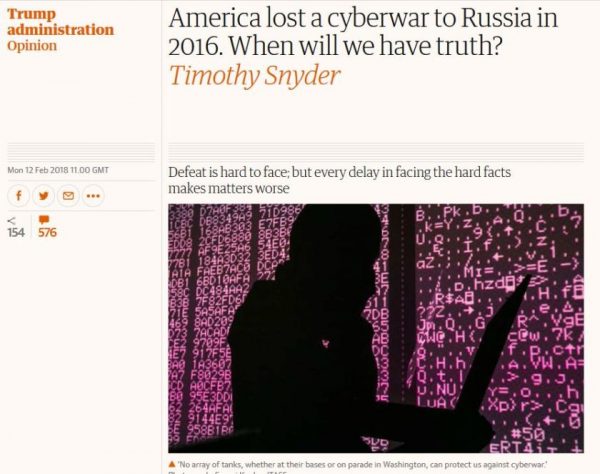
The author is Yale professor. Yes, seriously.
By Kit Knightly | OffGuardian | February 12, 2108
The Guardian published this short opinion piece today, its headline reads:
America lost a cyberwar to Russia in 2016. When will we have truth?
Refuting the stale claims repeated in the headline, and expanded upon in the prose, is but the work of a moment. Hitchens’ razor states that any claim made without evidence, can be dismissed without evidence. A Yale professor should know that. Therefore the refutation of the claim “Russia hacked the election” can be made in three simple words: No, they didn’t.
Job done. I consider the article dealt with. But now we have to deal with the undertone. Now we have deal with why this article is scary.
The scary part of this article isn’t the war-like talk about Russia.
The scary part isn’t that this seemingly delusional man is apparently a professor at one of the most auspicious institutes of learning in the Western world (although, that is cause for some concern).
The scary part isn’t an elitist “academic” sweepingly dismissing the electoral process of his own country, and ignoring the majority will of his countrymen.
No, the scary part is that he really, really means it. This isn’t propaganda, in the old sense of that word. This isn’t misinformation to spread an agenda. This is full-blown delusion. He genuinely believes the Russians are at “cyber war” with America.
To be crystal clear about this – there is literally ZERO evidence to support this. The Mueller investigation is limping along, revealing absolutely nothing (except that the FBI wanted Hillary to win). The Steele dossier is revealed to have been paid for by the DNC.
There is no evidence. And yet he believes.
Russia has become the great, Orwellian “enemy”. The unseen force behind all our ills. Russian trolls are to blame for Brexit (even though they’re not), and Catalonia (again, untrue) and Donald Trump. Russian trolls were even blamed for hacking the winter Olympics.
This is scary. Scary because it demonstrates that the liberal elite of the USA, and its vassal states, have totally lost their minds. They live in a fantasy world, an un-reality. And they will believe anything that is convenient, anything that supports their un-reality, even if it puts them on a path to real war.
That should terrify everybody.
Associated Press Double Standard in Israel-Palestine Reporting
By Kathryn Shihadah and Alison Weir | If Americans Knew | February 8, 2018
More than half the world’s population reads Associated Press content every day.
But a study of news reports so far in 2018 indicates that this trusted news source has been presenting the deaths of Israelis at the hands of Palestinians, and of Palestinians at the hands of Israelis, in two completely different ways.
This pattern may be a factor in how readers perceive the players in this decades-old issue. It is also, quite likely, a factor in how editors all over the U.S., who read AP stories daily, view the conflict.
So far in 2018, eleven Palestinians have been killed and two Israelis.
(Since December 4th, when President Trump announced that the US would recognize Israel as “the capital of Israel,” overturning decades of US policy, 27 Palestinians and 9 Israelis have died.)
In AP’s 2018 news reports, Palestinian deaths have been reported in far shorter news articles than Israeli deaths, averaging 181 words in length vs. 551.
In addition to the number of words, AP’s choice of words, context, and which facts to report and which to omit appears to tell two totally different kinds of stories for Israelis and Palestinians.
Reports on Israeli deaths included statements by high officials condemning the attacks. These were often strongly worded, politically charged statements that conveyed the Israeli narrative: “[Israel will] do everything possible in order to apprehend the despicable murderer”; “There is no justification for terror… This is not the path to peace!” “Hamas praises the killers and PA laws will provide them financial rewards. Look no further to why there is no peace.”
By contrast, these AP reports rarely included statements by Palestinian officials condemning the killing of Palestinians, which would have provided another perspective for readers. For example, Fatah spokesman Osama Qawassmeh released a statement that Israel was guilty of a long list of actions that “contravene international law.”
Another Palestinian official condemned Israel’s “extrajudicial killings” and warned of Israel’s tendency to turn the West Bank into a “scene for escalation and security tension so as to pressure our people and leaders, and divert attention from colonialist expansion in our state.”
Such Palestinian viewpoints, largely accurate and readily available, were never reported in the AP articles on deaths.

A Palestinian boy weeps during the funeral of Hani Wahdan, killed during “clashes.”
Israeli victims are human beings, Palestinian victims are “gunmen” or anonymous
Israeli victims were also personalized in AP reports: one was characterized as “a 29-year-old father of four”; the attempted rescue of another was described: “immense efforts were made to save the man’s life, but his wounds were too severe.”
On the other hand, AP reported Palestinian victims with impersonal, often negative descriptions: “armed protester,” “instigators,” and “protesters who were hurling massive amounts of rocks.”
Nowhere did AP describe efforts to save the victims’ lives, although certainly those efforts were made. Elsewhere there were reports of noteworthy turns of events from the scene. This is unfortunately a common occurrence at the scene of Palestinian injuries and deaths: “Eyewitnesses said Israeli soldiers …. fired gas bombs at the Palestinian ambulances and medics that arrived on the scene.” In another incident, “soldiers refused to allow ambulances and firefighters to enter the area.” These descriptions would have been valuable additions to the AP reports.

Palestinian relatives of 16-year-old Layth Abu Naeem weep during his funeral, Jan 31, 2018. The boy was killed by Israeli soldiers who had invaded his village. (EPA-EFE/ALAA BADARNEH)
To its credit, AP did identify the five Palestinian teenagers killed as “teens” – in the past this has not always been the case, where the youth of Palestinian victims has often not been mentioned.
The actual killings of the Palestinians were often reported passively, e.g. “shot in the head during a stone-throwing confrontation” or “died in the violence.”
In two of the Palestinian deaths, AP reported that the Israeli military “denied using live fire.” The men were still dead, and no questions were asked.
In fact, other sources paint entirely different pictures of the killing of the Palestinians. For example, one young man named Ali was only described by AP as “shot in the head” during a violent riot.
But according to eyewitnesses, as reported elsewhere, a number of armed Israeli settlers had infiltrated a Palestinian town, and Ali was part of a group that were forcing them out of town – at which time Israeli soldiers began firing at the group. Ali was reportedly killed by an army sharp-shooter.
In another incident, Israeli soldiers were searching for the man who had killed a settler a few days earlier. The AP article explains that they found and killed a suspect and then demolished three homes belonging to his extended family.
The article does not reveal that they killed the wrong man. It also does not mention that at least 30 vehicles participated in the invasion of the wrong home, and that soldiers confiscated surveillance videos from stores in the area.
AP headlines give Israeli spin
The headlines of the news reports are tellingly different as well.
In the cases of Israeli deaths, the headlines indicate one innocent party and one guilty party: “Israeli killed in West Bank shooting attack”; “Israeli killed by Palestinian in West Bank stabbing attack.”
On the other hand, most of the Palestinian death headlines suggest two equal parties in conflict: “Palestinian teen killed in clashes”; “2 teens killed in clashes with Israeli army”; “Troops kill Palestinian teen in West Bank clash.”
In one case, “Palestinians say Israeli army kills 19-year-old rock thrower,” the victim was at least acknowledged as an individual, but the situation in which Ahmad’s death occurred was misrepresented. The article claims that he was “shot in the head during a stone-throwing confrontation,” but there is much more to the story.

Israeli forces raid the village of Wadi Burqin. [Mohamad Torokman/Reuters]
According to IMEMC, Ahmad was killed
during a massive military invasion…carried out by twenty-two armored military vehicles, and two bulldozers…the soldiers also shot two other young Palestinian men with live rounds in their legs, and six with rubber-coated steel bullets, in addition to causing dozens to suffer the severe effects of teargas inhalation…soldiers broke into and searched many homes, and used K9 units in searching the properties, causing anxiety attacks among many Palestinians, especially children…
Some of the villagers protested this aggression, and it was in this context that an Israeli soldier shot Ahmad in the head.
In this incident, the Israeli army was searching for the killer of a settler named Rabbi Raziel Shevach, who had been killed three weeks earlier, and AP again recounted this older death. In fact, there was more about the settler’s death, which had already been reported on several times, than about the innocent man killed in the manhunt.
According to AP, “The Israeli military had no immediate comment about the casualty.”
AP stories about Shevach reported that he taught in a religious school in Yitzhar and lived in the outpost of Havat Gilad. None, however, bothered to mention that Yitzhar has long been known as “an extremist bastion” of settler violence against Palestinians, home of the notorious Yitzchak Ginsburgh, and that Havat Gilad is similarly notorious for violence against Palestinians.
The Israeli newspaper Ha’aretz reported in 2014, for example, that close to 100 people had been been involved in “a wave of hate crimes against Palestinians and Israeli Arabs. Most of the culprits are known as far-right activists from the Yitzhar settlement and hilltop outposts north of Ramallah and the south Hebron Hills in the West Bank.” This is just one of many such incidents (see video here).
Such context likely would have been included by AP if it had been about Palestinian violence.
AP omits essential context

Palestinian women attempt to pass the Israeli checkpoint in the West Bank town of Bethlehem, Aug. 12, 2011. (AP Photo/Bernat Armangue)
AP reports often leave out critical facts. For example, its news reports on a Palestinian girl imprisoned by Israel for slapping armed Israeli soldiers, almost always left out or minimized the fact that her anger was triggered by the fact that shortly before the incident, an Israeli soldier had shot her cousin in the face.
Perhaps more significant, essential facts about the greater issue are virtually never included.
Nowhere in these reports does AP tell readers that the U.S. gives Israel over $10 million per day. Without this information, American readers will incorrectly feel this is a foreign issue that has nothing to do with them.
Basic information that would give the reader an understanding of the context of the hostility is absent.
Nowhere in any of the articles does the word “occupation” occur, although the illegal Israeli occupation is a 50-year-old fact of life that affects every aspect of Palestinian life. Omitting the fact that Palestinians are living under Israeli military control leaves readers ignorant of one of the most significant aspects of the conflict.
Nowhere in these reports does AP note that many Palestinian families in the West Bank and Gaza were pushed out by Israel during the 1948 war that created the Jewish state, their properties confiscated by Israel. These refugees have not been allowed to return and reclaim their homes, a violation of international law. This, too, is essential information.

Israelis soldiers arrest Palestinian teen Fawzi Muhammad Al-Juneidi in Jerusalem, Dec. 8, 2017
Nowhere does AP use the word “resistance,” the usual term for people fighting against military occupation. Instead, Palestinians are always “militants,” “gunmen,” “stone throwers,” etc. Americans fighting against the British in the 18th century, French fighting against the German occupation in the 20th century, etc. were resistance forces. So are Palestinians.
The word “settlement” is used 19 times in the AP reports. According to international law these settlements are illegal. However, only once does AP mention this fact, and even here it does so in a somewhat diluted manner: “most of the international community considers settlements illegal.”
Nowhere in these reports does AP inform readers that Israel is steadily stealing Palestinian land and imprisoning Palestinians who object to this. Nowhere do these report that Palestinians have virtually no freedom of movement, that some 70 percent of Palestinian families have had one or more family members serve time in an Israeli prison, that hundreds of Palestinian children are in prison, and that Israel is known for its physical abuse of prisoners.

Maali, daughter of jailed Islamic Jihad spokesman Khader Adnan, stands next to a picture of her father outside Israel’s Ofer prison.
Without these and other critical details, it is impossible for readers to have a clear picture of the basis of the conflict and the context of the deaths.
At the end of one AP article is this statement:
Since 2015, Palestinians have killed over 50 Israelis, two visiting Americans and a British tourist in stabbings and other attacks. Over 260 Palestinians were killed by Israeli forces in that time. Israel says most were attackers and the others died in clashes.
To many editors and readers around the country, this means that 260 guilty Palestinians were killed. “Attackers” are guilty by default (“alleged attackers” might be innocent); people in “clashes” are reckless mobs, confronting soldiers and policemen allegedly working to keep the peace. Readers are left to glean on their own, with next to zero evidence, that these Israeli forces are one of the world’s most powerful militaries putting down protests by an occupied, unarmed population.
Astute, knowledgeable readers might wonder how many of those dead Palestinians were really attackers? How many were cases of mistaken identity? And what about those who actually were attacking heavily armed soldiers and settlers… why were they doing this? Could it be because Israel was stealing their land and had killed, injured, and/or imprisoned hundreds of Palestinian children?
And what about the unarmed protesters so often shot in the head by Israeli soldiers? Did they have families who grieve for them? Children who are now orphans? Widows who will weep and struggle? Parents who will forever miss them? We will never know.

A Palestinian boy in Gaza weeps for dead family members.
How many of those dead Palestinians were children themselves? Answer: Since January 2015, at least 100 Palestinian children and 1 Israeli child have been killed in the hostilities. (Between 2000 and 2014, 2,079 Palestinian children and 133 Israeli children lost their lives.)
In the time it has taken to write this article, sadly another Palestinian has been killed.
The headline for this death, “Israeli troops kill Palestinian suspect in settler’s killing,” refers to Rabbi Raziel Shevach’s death in early January. Apparently this time the Israeli military finally found the person they “suspected of being behind the killing” that they had been pursuing. They stormed the house where he was staying, and shot him dead (this may be referred to as “trial by assassination” or “extrajudicial killing”).
The AP article recalls that Israeli troops had already demolished the suspect’s residence (and those of his extended family), but somehow neglects to mention that they had also killed his cousin, who had done nothing wrong, as well as another innocent man, during the course of the aggressive manhunt.
And once again, the article mostly discusses the death of the Israeli settler (as well as repeating details about the other Israeli death that occurred in 2018), and mentions nothing about the Palestinian who had just been killed. Did he have children? Parents? A wife? And if he actually was “behind the killing,” what had motivated him?
In the very last paragraph of the article, AP finally mentions that “19 Palestinians have been killed in the violence since Trump’s announcement.” In reality, it was Israelis who killed these people, and it was actually 24 Palestinians at that time, seven of them teenagers, plus a small boy who died on the day of the announcement.
The Associated Press claims on its website:
For 170 years, we have been breaking news and covering the world’s biggest stories, always committed to the highest standards of objective, accurate journalism.
It is possible that the time has come for AP to take a good, hard look at its objectivity and accuracy when it comes to reporting in Israel-Palestine.
AP’s system of reporting

AP Bureau Chief Josef Federman speaking on C-Span.
AP’s main bureau for Israel-Palestine is in Israel. Reports from Gaza and the West Bank are phoned in to this bureau, where its editors choose and write the news stories that are sent out.
Many (possibly most) of the journalists in this main bureau are Israeli citizens or have partners who are. Some (possibly most) have served in the Israeli military and/or have relatives that have done so. While this doesn’t guarantee pro-Israel bias (some Israeli journalists for Ha’aretz, for example, are excellent, accurate writers on this issue) it does suggest the possibility of partiality influencing their work, either consciously or unconsciously.
It is essential that AP be transparent about its reporting on this extremely important issue.
Whatever the cause of the distortion that continuously characterizes its reporting on this region (see this 2005 report on AP reporting on deaths), it is critical that AP remedy it. Americans, who give Israel over $10 million per day, need full, accurate, unbiased reporting.
Last-minute updates: Two more Palestinians killed
Sadly, during the final edit of this piece, two more Palestinians were killed.
IMEMC, the International Middle East Media Center, has posted the following:
“Israeli soldiers killed, on Tuesday at night, a young Palestinian man, and injured 110, including 32 who were shot with live ammunition, in Nablus city, in the northern part of the occupied West Bank. The Palestinian Health Ministry has identified the Palestinian as Khaled Waleed Tayeh, 22, from Iraq-Tayeh village, east of Nablus. Khaled succumbed to his wounds, after being shot with a live round in the chest.”

Khaled Waleed Tayeh, 22
AP also reports the story: “Israeli guard kills Palestinian after West Bank stabbing” but fails to report the victim’s name, age, or anything else about him.
A few hours later Israeli guards in front of an Israeli outpost shot dead 19-year-old Hamza Yousef No’man Zama’ra, who had attacked one of the armed guards with a knife, cutting the man’s hand. AP reported the death but again failed to give Hamza’s name, age, or additional information about him.

Hamza Yousef No’man Zama’ra, 19
AP also fails to mention that Israel plans to level dozens of Palestinian schools in the West Bank, that Israeli forces have just detained a 52-year-old Palestinian mother and shot a teenager in the face, and that 54 Palestinian patients in critical need of specialized medical care patients died in 2017 when Israel wouldn’t let them leave Gaza.
Perhaps to to AP editors, these stories are of no importance.
However, for many Americans, most of whom believe in justice, fair play, and human rights, such information might diminish the willingness to give Israel massive amounts of their tax money.
* * *
For a list of all Palestinians and Israelis who have been killed by the other side since 2000, see this timeline.
For 2-minute videos of recent Palestinian victims, go here.
Putin Smeared Himself to Undermine Democrats — MSM Has a New Russiagate Theory
It’s now Russia’s fault Democrats needlessly polarized American society by advancing feeble-minded smears from the Clinton dossier

What can you do when Putin plays 7-dimensional chess
Russia Insider | February 6, 2108
US invaded Iraq in 2003 because Iraq had “weapons of mass destruction”. Except Iraq didn’t have them. Once the lie had served its purpose the US admitted as much, but dodged responsibility by redacting the story: Iraq had been pretending it had WMDs! No way was the US smearing and invading the country based on that smear actually America’s fault.
Well neither is falsely accusing Russia of getting its Manchurian candidate into the White House. Because while KGB doesn’t actually have tons of blackmail material on him Russia pretended it did. Take it over Wall Street Journal :
There is a third possibility, namely that the dossier was part of a Russian espionage disinformation plot targeting both parties and America’s political process. This is what seems most likely to me, having spent much of my 30-year government career, including with the CIA, observing Soviet and then Russian intelligence operations. If there is one thing I have learned, it’s that Vladimir Putin continues in the Soviet tradition of using disinformation and espionage as foreign-policy tools.
…
The pattern of such Russian operations is to sprinkle false information, designed to degrade the enemy’s social and political infrastructure, among true statements that enhance the veracity of the overall report.
Oh those Russkies! While they actually did not do the things the Hillary dossier says, they wanted Americans to believe they did, so of course insane Russiagaters can not be blamed for advancing the lie Russia was actually secretly controlling their President.
So we’ve gone from Russia being responsible for Russiagate to Russia being responsible for Americans falsely believing Russia was responsible for Russiagate.
Also it’s now Russia’s fault Democrats needlessly polarized American society by advancing feeble-minded smears from the Clinton dossier.
Oh well, whatever keeps you from having to take responsibility I guess.

Nice round-about way of admitting the Steele Dossier was idiotic and that advancing it hurt Democrats, however.
Featured Video

Why Hamas Really Attacked Israel on Oct. 7
or go to
Aletho News Archives – Video-Images
From the Archives
Israel: Strategic Ally or Liability?
By Stephen Sniegoski | My Catbird Seat | June 12, 2010
The claim that Israel serves as a valuable ally for the United States is made by both pro-Zionists and much of the anti-war and anti-Zionist Left that is influenced by Noam Chomsky. As a result of the Gaza flotilla massacre, which has caused a world-wide uproar against Israel, the value of Israel to the United States is being publicly questioned in more mainstream foreign policy forums. … continue
Blog Roll
 Aletho News
- Why Hamas Really Attacked Israel on Oct. 7
- Declassified UK exposes British man who fought for ‘Israel’ in Gaza
- West’s death cult in a theater near you
- How the Yandex ‘Russian bots’ lie fell apart
- Burnham’s ‘Russia did Brexit’ ruse crumbles
- Estonia making movies and games to encourage war against Russia
- Four in five new UK jobs taken by foreigners – report
- Here’s what Trump’s latest U-turn really means for Russia and Ukraine
- The Houthis Are Not an Iranian Proxy
- Europe’s Energy Hypocrisy, Russian LNG Profits and US Dependence
- If Americans Knew
- Activists Abused By Israel Return to New Freedom Flotilla Mission
- 60 Minutes won’t tell the full truth about Israeli settler violence
- Nearly 50,000 women, girls killed or severely injured in Gaza since October 2023: UN Women
- ADL is working with AI companies to suppress alleged ‘antisemitism’
- Israeli occupation forces using social media surveillance unit to target hundreds of Palestinians in the West Bank
- Israel’s New – and Terrifying – Security Doctrine
- Israeli Attacks Kill Five in Gaza, Including a four-year-old and a woman
- Air Force Major Who Called for Trump’s Impeachment Held in Solitary Confinement
- It’s a Genocide, I’m Into It’: Seinfeld Mocks Protest over Palestinian Children Killed
- Universities fire dozens amid pressure from Zionist billionaires
- No Tricks Zone
- New Study Suggests Large Regions Of The Pacific Ocean Have Been Cooling For The Last 80 Years
- Germany’s Green Energy Debacle: High Energy Costs Force Kahla Porzellan to Close After 182 Years!
- New Study: 50 Years Of The Most Aggressive ‘Net Zero’ Policies Can Only Affect The Global Climate By 0.03°C
- US September “Heat” Was No Record…Many Records Set Decades Ago
- Latest European Green Energy Debacle; Portugal’s Largest Flagship Solar Park Insolvent!
- Green Energy Debacle: German Expert Professor Fritz Vahrenholt Warns Of Severe Economic And Social Consequences
- Two More Paleo Reconstructions Affirm Meters-Higher Sea Levels Across Ireland, Brazil 7000-6000 Years Ago
- New Study: Earth And Venus Surface Warmth Largely Explained By Convection And Lapse Rate, Not CO2 Or Radiation
- 2025 Nature Paper Claiming Worsening Global Drought Gets RETRACTED …Heavily Flawed
- New Study: ‘Global Drought Shows No Detectable Recent Acceleration Under Climate Warming’

