Who Is James Le Mesurier? – The Former British Army Officer Who Founded The White Helmets
By John Wight | American Herald Tribune | February 6, 2018
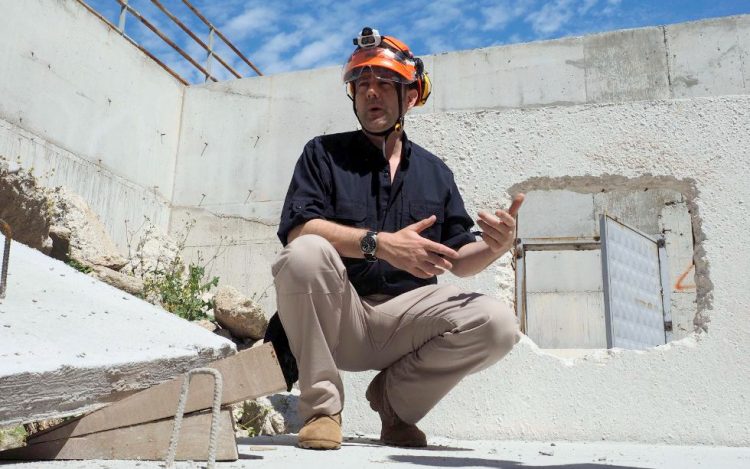
Who is James Le Mesurier, the former British army officer and military contractor who founded the White Helmets, the civil defence organisation which operates exclusively in opposition-held parts of Syria? It is a question more and more people are asking as their role and function comes under increasing scrutiny.
Le Mesurier carries about him the inescapable whiff of Britain’s malign legacy and history of dirty wars, waged in Kenya, Aden, Ireland, Iraq, Libya, in other words wherever London’s blood-soaked imperialist foot has tread around the world. A product of Britain’s prestigious Royal Military Academy of officer training at Sandhurst, he served in various UK military/NATO military deployments over the past three decades, specifically Bosnia, Kosovo, Iraq and Lebanon.
In a short bio describing Le Mesurier’s work with the White Helmets, we are informed, “In addition to the White Helmets in Syria, Mayday is active in Mogadishu, developing the city’s emergency services network, and exploring the development of similar community-based resilience initiatives in other fragile and failing states (my emphasis).”
The question of why a given state becomes fragile and failing is of course neither asked nor explored, for doing so would dredge up the subject of imperialism, which for Western ideologues such as Mr Le Mesurier would be akin to a vampire being exposed to daylight.
In a wide ranging 2016 article, former US marine and UN weapons inspector, Scott Ritter, provides a forensic account of Le Mesurier’s background, including the time he spent in and around the murky world of private military contractors, who exist in the cracks of Western military deployments, able to operate beyond the inconvenient glare of public scrutiny and accountability.
Ritter writes:
“the organizational underpinnings of the White Helmets can be sourced to a March 2013 meeting in Istanbul between a retired British military officer, James Le Mesurier—who had experience in the murky world of private security companies and the shadowy confluence between national security and intelligence operations and international organizations—and representatives of the Syrian National Council (SNC) and the Qatari Red Crescent Society. Earlier that month, the SNC was given Syria’s seat in the Arab League at a meeting of the league held in Qatar.”
So here we have a civil defence organisation being established in Syria by an ex-British army officer, a man with a background in the shadowy world of private security, in conjunction with a Syrian opposition group in exile. This civil defence organization, the White Helmets, receives funding from an array of states with a clear agenda of regime change in Syria, evidenced in the material, financial and political support they have given various armed opposition groups involved in the conflict.
In a 2015 speech Le Mesurier provides a précis of the roots of the conflict in Syria, starting with in 2011 a “volunteer uprising against the ruthless dictator, Bashar al-Assad,” before going on the assert that in 2012 the Syrian state turned its weapons on its “own people.”
Glaringly absent from this Manichean narrative is the fact that by 2012 various Salafi-jihadi groups, their ranks filled by thousands of extremists from outwith Syria, were rampaging across the country slaughtering and raping and terrorizing the very “own people” the Syrian army and its allies have been fighting to protect, save and liberate from the clutches of this latter day Khmer Rouge. And lest anyone has forgotten, the Syrian Arab Army is indistinguishable from the Syrian people, considering that its soldiers are drawn from the non-sectarian and multi-religious mosaic that makes up Syrian society.
Returning to Scott Ritter: “In this day of social media, it didn’t take long for photographs and video clips of known White Helmet members, in their distinctive uniform, openly celebrating with Al Nusra fighters in the aftermath of Syrian government defeats, and even carrying weapons, something their status as neutral first responders strictly prohibits.”
From the White Helmets’ own website, the lack of neutrality Ritter asserts is unambiguously expressed with the statement posted on its front page by Raed Saleh, the operational head of the organisation and himself a figure of some controversy. Saleh writes, “the UN Security Council must follow on its demand to stop the barrel bombs, by introducing a ‘no-fly zone’ if necessary.”
The barrel bombs referred to by Saleh, and emphasised by Le Mesurier as emblematic of the brutality of the ‘Assad regime,’ are inarguably indiscriminate and illegal under international law. But if we are judging the merits or demerits of a given side in a given conflict based on the use of indiscriminate weapons alone then regime change in Washington, Tel Aviv and Riyadh is long overdue.
The brutality of the conflict in Syria is a reflection of the monumental stakes involved in the outcome. The conflict is in itself is a crime, but are we seriously suggesting that Libya is better, safer and more stable seven years on from the toppling and murder of its leader Muammar Gaddafi, courtesy of NATO aligning with various Libyan opposition factions, prime among them Islamists, in 2011? And are we seriously arguing that Syria’s fate would not be Libya’s fate in the event of the toppling of Bashar al-Assad? And, too, is anybody able to maintain with a straight face that Bashar al-Assad does not enjoy the solid support of the majority of the Syrian people, who understand that the conflict is not about saving their government but saving their country?
Scott Ritter again:
“the White Helmets function as an effective propaganda arm of the anti-Assad movement…With their training, equipment and logistical sustainment underwritten exclusively by donations from Western governments (primarily the U.S. and U.K.), the White Helmets serve as a virtual echo chamber for American and British politicians and officials.”
Given Le Mesurier’s background, along with the evidence of how the White Helmets operate, it is reasonable to assume that what we have is the cultivation of the very Third Force Washington and London have been extending themselves in trying to locate and sell as the ‘good guys’ since the conflict began, doing so with the objective of enlisting domestic public support for intervention and regime change in Damascus.
Of course, there is always the possibility that Mr Le Mesurier is sincere in his desire to alleviate the undoubted suffering of the Syrian people – though in his case clearly not all the Syrian people, what with White Helmets only functioning and operating in opposition controlled territory, places where neither he nor any Western supporter of the White Helmets would dare set foot, knowing the moment they did they would be abducted, tortured, and brutally murdered.
But if so, if Mr Le Mesurier is sincere, then he is Britain’s answer to Pyle, the idealistic and naïve American interventionist in French-occupied Vietnam created by Graham Greene in his classic novel The Quiet American. To wit:
“He was young and ignorant and silly and he got involved. He had no more of a notion than any of you what the whole affair’s about, and you gave him money and York Harding’s books on the East and said, ‘Go ahead. Win the East for democracy.’ He never saw anything he hadn’t heard in a lecture hall, and his writers and his lecturers made a fool of him.”
Your guide to top anti-Russia think tanks in US & who funds them
By Bryan MacDonald | RT | February 6, 2018
Countering Russia has become a lucrative industry in Washington. In recent years, the think tank business has exploded. But who funds these organizations, who works for them and what are the real agendas at play?
From the start, let’s be clear, the term ‘think tank’ essentially amounts to a more polite way of saying ‘lobby group.’ Bar a few exceptions, they exist to serve – and promote – the agendas of their funders.
However, particularly in the United States, the field has become increasingly shady and disingenuous, with lobbyists being given faux academic titles like ‘Senior Non-Resident Fellow’ and ‘Junior Adjunct Fellow’ and the like. And this smokescreen usually serves to cloud the real goals of these operations.
Think tanks actually originate from the Europe of the Dark Ages. That’s 9th-century France, to be precise. But the modern American movement is modeled on British organizations from around a millennium later, many of which, such as ‘RUSI (1831)’, still exist today. The concept was possibly brought to America by the Scottish-born Andrew Carnegie. And his ‘Carnegie Endowment for International Peace’ (1910) is still going strong.
Yet, the real boom in the ‘think tank’ industry came with the era of globalization. With a 200-percent rise in numbers since 1970. And in recent years, they’ve become more transnational, with foreign states and individuals sponsoring them in order to gain curry favor in Washington.
One country that largely hasn’t bothered playing this game is Russia. Instead, mostly in the foreign policy and defense sectors, Moscow frequently serves as Enemy Number One for many advocacy groups. Here are some prominent outfits in the think tank racket, which focus on hyping up threats from Russia.
- The Atlantic Council
Founded: 1961
What is it? Essentially the academic wing of NATO. The Atlantic Council serves to link people useful to the organization’s agenda across Europe and North America. However, in recent years, its recruitment has increasingly focused on employees who directly attack Russia, especially on social media. Presumably, this is to give them a guaranteed income so they can continue their activities, without needing to worry about paying the bills.
What does it do? Promotes the idea of Russia being an existential threat to Europe and the US, in order to justify NATO’s reason for being.
Who are its people? The Atlantic Council’s list of lobbyists (sorry, ‘Fellows’!) reads like a telephone directory of the Russia bashing world. For instance, Dmitri Alperovitch (of Crowdstrike, which conveniently alleges how Russia hacked the Democratic National Congress) is joined by the perennially- wrong Anders Aslund, who has predicted Russia’s impending collapse on a number of occasions and has, obviously, been off the mark. Then there’s Joe Biden’s “Russia hand,” Michael Carpenter and their recent co-authored Foreign Affairs piece suggests he actually knows very little about the country). Meanwhile, Evelyn Farkas, a fanatical Russophobe who served in Barack Obama’s administration has also found a home here. Another interesting Atlantic Council lobbyist is Eliot Higgins, a “geolocation expert” who has made a career out of spinning tales from the Ukraine and Syrian wars but is, naturally, mostly disinterested in covering Iraq and Yemen, where the US and its allies are involved, but Russia has no particular stake. Lastly, we can’t forget CNN’s Michael Weiss, the self-declared “Russia analyst” who, by all accounts, has never been to Russia and can’t speak Russian.
Who pays for it? The Atlantic Council has quite an eclectic bunch of patrons to serve. NATO itself is a big backer, along with military contractors Saab, Lockheed Martin and the Raytheon Company, all of which naturally benefit from increased tensions with Moscow. The UK Foreign Office also splashes the cash and is joined by the Ukrainian World Congress and the US Department of State. Other sugar daddies include the US military (via separate contributions from the Air Force, Navy, Army and Marine Corps), Northrop Grumman and Boeing.
- The Center for European Policy Analysis (CEPA)
Founded: 2005
What is it? Despite the name, CEPA is based in Washington, not the ‘old continent’, but it does have an outpost in Warsaw. This club specifically focusses on Central and Eastern Europe and promoting the US Army and foreign policy establishment’s agenda there. Or, in its own words, creating a “Central and Eastern Europe with close and enduring ties to the United States.”
screenshot from cepa.org
What does it do? CEPA amounts to a home for media figures who devote their careers to opposing Russia. It whips up tensions, even when they don’t really exist, presumably in order to drum up business for its sponsors, who are heavily drawn from the military industry. For example, it spent last year hyping up the ‘threat’ from Russia’s and Belarus’ joint ‘Zapad’ exercises, even running a sinister-looking countdown clock before the long-planned training commenced.
CEPA grossly overestimated the size of the event, saying it “could be the largest military exercise since the end of the Cold War” and dismissing basically all Moscow’s statements on its actual nature as “disinformation.”
Who are its people? Times of London columnist Edward Lucas has been part of CEPA for years.
Poland chooses Raytheon. Even if the missiles don’t work, America will defend its customers http://t.co/QwqrkCiosD
— Edward Lucas (@edwardlucas) April 21, 2015
The dedicated ‘Cold Warrior’ doesn’t appear to have spent much time in Russia for a long while and still seems to view the country through a prism which is very much rooted in the past. Thus, he’s more-or-less an out-of-touch dinosaur when it comes to Russia expertise. He will soon be joined by Brian Whitmore, who comes on board from RFE/RL and appears to be even more ill-informed than Lucas. His broadcasts for the US state broadcaster led to him being described as the “Lord Haw Haw of Prague,” where has been based for some years. CEPA is a pretty fluid organization and, until recently, Anne Applebaum and Peter Pomerantsev were also on its list of lobbyists. The former is a Polish-American Washington Post columnist who obsessively denigrates Russia and the latter has previously worked with the Atlantic Council’s Michael Weiss, which shows you how small and incestuous the Russia-bashing world is.
Who pays for it? While other think tanks at least try to make their funding look semi-organic, CEPA looks to have zero hang-ups about its role as a mouthpiece for defence contractors. Which is, at least, honest. FireEye, Lockheed Martin, Raytheon, Bell Helicopters and BAE systems pump funds in and they are joined by the US State Department and the Department of Defence. Another notable paymaster is the National Endowment for Democracy – ‘regime change’ experts who are surely interested in CEPA’s remit to also cover Belarus. The US Mission to NATO and NATO’s own Public Diplomacy Division also provide cash.
- German Marshall Fund of the United States
Founded: 1972
What is it? Don’t be fooled by the name, the German Marshall Fund (GMF) is a very American body these days with little input from Berlin. It was founded by a donation from Willy Brandt’s Bonn-government to celebrate the 25th anniversary of the Marshall Plan. Ironically, Brandt is today best remembered as the father of ‘Ostpolitik’, which sought a rapprochement between Germany and Russia.

What does it do? After the fall of the Soviet Union, the GMF transformed into a vehicle promoting US influence in Eastern Europe, with outreaches in Warsaw, Belgrade and Bucharest. However, in the past 12 months, it’s taken a very strange turn. Following the election of US President Donald Trump (ironically a German-American), the lobby group launched the Alliance for Securing Democracy (ASD) project. Its centerpiece is the ‘Hamilton 68 Dashboard’, which seems to classify social media users which reject the US liberal elite’s consensus as “Russian trolls.” The reaction has been highly critical, with even the secretly-funded Russian opposition website Meduza asking “how do you identify ‘pro-Russian amplifiers’ if… themes dovetail with alternative American political views?”
Who are its people? The GMF, especially through its new ASD plaything, has a high-profile bunch of lobbyists. They include Toomas Ilves, an American-raised son of Estonian emigrants who once headed the Estonian desk at erstwhile CIA cut-out Radio Free Europe and eventually became president of Estonia. Also on board is Bill Kristol, known as the ‘architect of the Iraq War’ and former CIA Director Michael Morrell. Former US Ambassador to Russia Michael McFaul, who recently announced he was partially abandoning his Russian scholarship and has “lost interest in maintaining my (sic) ability to speak/write Russian” is another team member.
And sorry that I am not responding in Russian. After being on the travel ban list to your country for 3 years, I have lost interest in maintaining my ability to speak/write Russian. You government seems to really fear me these days. странно и жалько https://t.co/8SRdSEvg5r
— Michael McFaul (@McFaul) January 20, 2018
After serving on Obama’s team, McFaul has re-invented himself as a network TV personality since 2016 with 280,000 Twitter followers, 106,000 of which are fake, according to Twitter audit.
Who pays for it? USAID are big backers, throwing in a seven-figure annual sum. This, of course, raises some questions about US taxpayers essentially funding the Hamilton 68 dashboard, which may be smearing Americans who don’t agree with their government’s policies as Russian agents. The State Department also ponies up capital, as does NATO and Latvia’s Defense Ministry. Other interesting paymasters are George Soros, Airbus and Google. While Boeing and the ubiquitous Raytheon are also involved.
- Institute for the Study of War
Founded: 2007
What is it? This lobby group could as easily be titled ‘The Institute for the Promotion of War’. Unlike the others, it doesn’t consider Russia its primary target, instead preferring to push for more conflict in the Middle East. However, Moscow’s increased influence in that region has brought the Kremlin into its crosshairs.
What does it do? The IFTSOW agitates for more and more American aggression. It supported the Iraq ‘surge’ and has encouraged more involvement in Afghanistan. IFTSOW also focuses on Syria, Libya and Iran. Just last week, one of its lobbyists, Jennifer Cafarella, called for the US military to take Damascus, which would bring Washington into direct conflict with Russia and Iran.
US occupation of Damascus – @TheStudyofWar seems to be calling for the US military to take Damascus and rebuild Syria. This seems the only “realistic” policy that could produce its demand to rid Syria of Assad’s government as well as Iranian and Russian influence. pic.twitter.com/nmSTkSzb5G
— Joshua Landis (@joshua_landis) February 3, 2018
Who are its people? Kimberly Kagan is the brains behind this operation. She’s married to Frederick Kagan, who was involved in the neocon ‘Project for the New American Century’ group along with his brother, Robert Kagan. Which makes Kimberly the sister-in-law of Victoria “f**k the EU” Nuland.
Another lobbyist is Ukrainian Natalia Bugayova, who was involved in Kiev’s 2014 EuroMaidan coup. She previously worked for the Kiev Post, a resolutely anti-Russian newspaper which promotes US interests in Ukraine. However, IFTSOW’s most notorious lobbyist was Elizabeth O’Bagy, who emerged as a ‘Syria expert’ in 2013 and called for American political leaders to send heavy weaponry to Syrian insurgent groups. She claimed to have a PhD from Georgetown University in Washington, DC, but this was fictional and once the media twigged to it, she was dismissed by the IFTSOW. Two weeks later, she was rewarded for her deception by falling up to a job with fanatical Russophobe Senator John McCain. O’Bagy has also collaborated with the Atlantic Council’s Michael Weiss, which is further evidence of how tight-knit the world of US neoconservative advocacy really is.
Who pays for it? Predictably, Raytheon has opened its wallet. Meanwhile, other US military contractors like General Dynamics and DynCorp are also involved. L3, which provides services to the US Department of Defense, Department of Homeland Security, and government intelligence agencies is another backer along with Vencore, CACI and Mantech.
“Nunesburgers” & denial from the MSM while Politico blames Putin
OffGuardian | February 4, 2018
The “Nunes” Memo isn’t political dynamite but it could be the final blow to the whole ridiculous and virtually fact-free Russiagate narrative. It confirms the Steele dossier is a scam, and demonstrates the lies employed to get approval for spying on Trump’s team, it shows the vindictive bias in the establishment towards an elected official.
But, of course, the mainstream media and various paid opinion-makers are not admitting that. In fact there’s a chorus of evasion and distraction and frantic meme-creation right now, from bots spamming talking points, and “#nunesburger” hashtags to avowedly serious opinion pieces claiming it’s all a “half-baked conspiracy theory”… blah… blah…
There’s no shortage of examples of just how eerily lockstep the various strands of the campaign are, but here’s one of the “serious” ones to mull over. Politico’s The Nunes Memo & Putin’s Long Game.
Here’s the text with our annotations:
Ever since the U.S. intelligence community discovered the Russian operation to interfere in the 2016 presidential election and aid President Donald Trump’s victory, some Republicans have been laboring to undermine investigations into the attack and discredit the intelligence agencies that discovered it.
It’s almost touching how, right from the off, they bravely opt to simply ignore the fact that the Russia hack narrative is now probably doomed. Like a first class passenger on the Titanic, deeply in denial, they are sitting, hat slightly askew, sipping tea and admiring the view while the deck beneath them tilts and slides. Don’t think about the facts, Politico readers, think about the mean people who wanted you to know the facts!
Those efforts reached a new crescendo (sic) on Friday, when House Republicans released a partisan memo alleging anti-Trump bias at the FBI with approval from Trump, who declared on Twitter that both the FBI and Department of Justice are corrupt.
Well, first can someone tell them what “crescendo” means? Secondly, isn’t it interesting how the Memo only “alleges” anti-Trump bias, even though it contains and refers to clear proof of same. Contrast with the above claim of certitude about “Russian interference” in the face of no proof whatsoever.
But that turmoil, some were quick to point out, is exactly what Putin wanted all along.
In the nick of time the Titanic passengers have managed to grab something to keep them afloat. A lifebuoy with “Putin” written on it in scary red letters. Reality averted.
“The latest attacks on the FBI and Department of Justice serve no American interests – no party’s, no president’s, only Putin’s,” Sen. John McCain (R-Ariz.) said in a statement Friday. “Our nation’s elected officials, including the president, must stop looking at this investigation through the warped lens of politics and manufacturing partisan sideshows. If we continue to undermine our own rule of law, we are doing Putin’s job for him.”
Someone could tell McCain that the rule of law is undermined by people breaking the law and getting away with it – not by revealing the fact to the public. But they probably wouldn’t dare.
For more than a year, Trump has consistently cast doubt on the assessments of intelligence agencies he now leads, arguing that “the deep state” is stacked against him.
The Memo (which Politico hasn’t yet quoted or linked to) proves Trump was right. But let’s not waste time on details like that.
Facing an investigation that reached into his own administration, and potentially into the Oval Office, the president chose to fire his FBI director, James Comey last May, and since then has repeatedly hinted that he might try to do the same to others.
That may include deputy attorney general Rod Rosenstein, who oversees special Russia counsel Robert Mueller. “You figure that one out,” Trump said when asked Friday if he still had confidence in Rosenstein after reading the memo.
The cumulative effect of it all, intelligence veterans said, was to diminish trust in government institutions—thereby weakening the U.S.
To sum up their point here if we may – it’s not the fact US officials have been caught lying and manipulating and conspiring against elected representatives that diminishes trust in government institutions – it’s the fact people insist on talking about it
“We have to remember what Putin’s goal in this whole endeavor was,” said Ned Price, a former CIA officer and NSC spokesperson under President Barack Obama. “It was at its core to divide the American people and pit us against each other.”
“This is exactly what he had hoped and it has succeeded beyond his wildest expectations,” he said of the memo. “This memo just play right into that… This is exactly what Putin had in mind.”
In some ways this is the most ridiculous thing in the article. Why would any sane person – Putin or anyone else – want America to be more divided, unstable and terrifying than it already is? To the rest of the world, even its supposed friends, America is the psycho next door with the drinking problem, the chainsaw and the cupboard full of illegal firearms. No one wants this guy getting all riled up about anything. Because they don’t want to wake up with their house on fire and their kids dead in the yard.
The memo “is simply an attempt to cast aspersions on the whole investigation,” said Robert Litt, a former general counsel for the Office of the Director of National Intelligence who now works for Morrison and Foerster.
This is rather like saying proving someone guilty of child abuse is an “attempt to cast aspersions” on their parenting. And they still haven’t mentioned or quoted the contents of the Memo.
“To the extent that Putin’s goal is to weaken us an emphasize our internal division, which was certainly one of the conclusions that the intelligence community reached, yes absolutely [he succeeded],” Litt added. “This is increasing partisanship and division and making it more difficult to bring to light what they’re actually doing. … I would’ve thought that there would have been a considerably greater level of bipartisan concern about what the Russians have done.”
Hey – you know another way they could have thwarted that damn Putin? Their intelligence agencies could have not lied and cheated and plotted in the first place.
But for Trump, House Intelligence Committee chairman Devin Nunes and other Republicans, Friday was a day of triumph.
“The Committee has discovered serious violations of the public trust, and the American people have a right to know when officials in crucial institutions are abusing their authority for political purposes,” Nunes wrote on Friday, accompanying the release of the memo his staff drafted.
“I think it’s a disgrace what’s happening in our country,” Trump declared.
Politico focuses on what Nunes said as if the only thing that mattered was the fact he was triumphing over the Dems. They completely avoid even considering the fact the words happen also to be true. Truth is a thing. It happens. It can be measured. Remember when that used to matter? Oh but wait – Politico is about to discuss the contents of the Memo!…
The memo, however, showed little that was new. A dossier compiled by a former British intelligence operative, who was funded in part by Clinton’s campaign, was part of the basis for the investigation, the memo says. But that was already known. And other elements of the investigation were underway independent of the dossier, the memo acknowledged.
… No, false alarm. It looked momentarily as if they were going to discuss the contents of the Memo, but it turns out they don’t need to, because there’s nothing new in it! Nope. Nothing here you haven’t seen before. Move along.
But wait – if the Memo doesn’t matter why did so many people not want it published? Why is it “dividing” anyone? If the Memo doesn’t matter then why is it just what Putin wants?
And if the Memo doesn’t matter and contains nothing new why won’t Politico quote a single line of it? Or even link to it?
And they don’t. Not once in the entire piece. What Politico is saying, with pure Doublethink, is the Memo is completely worthless, useless, empty and boring and a fiendish, cunning plot by Vladimir Putin to divide America and undermine public faith in its institutions. And most of the people who read it will believe these two things with ease. Because being an American Liberal these days requires complete removal of your sense of the ridiculous.
This last bit is interesting though:
Nonetheless, conservative media — including some outlets which were handed the memo before it became public — rejoiced.
Former House Speaker and Trump confidant Newt Gingrich suggested that the memo would ultimately undermine Mueller’s investigation.
“This memo will lead to more releases of more material and it will go on and on,” Gingrich told POLITICO. “We will be shocked at how deep the sickness was. … Why would you think Mueller is anything different? He’s just part of the same mess.”
Are we going to see a Memo war of attrition? Will this signal an avalanche of mutually destructive dirt from all sides? This could be a time for popcorn and a comfy chair.
The World’s Most Dangerous Document Hits the Front Pages…
No it didn’t.

By Jan OBERG | The Transnational | February 2, 2108
The mainstream media are totally irresponsible in their priorities. At the moment of writing, five hours after the world’s most dangerous document was presented, no major Western media has featured it prominently. This means it won’t be. No chance it would go viral. The increasing risk of nuclear war isn’t important.
While people talk about fake, a much larger issue is omission:
What is hidden to you? What world order issues are deliberately down-graded?
What threats to humanity end up at the bottom of page 38 after 10 pages of sports, entertainment and celebrity stories?
Another technique is cover-up, talking about something else such as the ever convenient North Korean “threat” or Russia’s latest evil plot.
It’s not only ignorance. There are media and other power elites who know exactly what to hand out to you and how. And what to fake, omit and cover up instead of covering.
Time to wake up: The dominant Western media are rapidly becoming the largest single obstacles to understanding our world. One proof is this story.
* * *
The Transnational has already posted a few articles about this scary, absurd and anti-ethical document, the Nuclear Posture Review, NPR:
• Huffington Post’s first article based on a leak from January 14, 2018.
• Pentagon advocates nukes against a cyber attack, in the New York Times, January 16, 2018.
• Paul Rogers, Sliding towards nuclear war?
• And in a larger perspective, a world expert on it all – Daniel Ellsberg and his new book, The Doomsday Machine. Confessions of a Nuclear Planner.
* * *
And then tonight happened the Pentagon “rollout” of this formal document on which the U.S. is going to base its nuclear policies in the future.
Watch the whole event here on the Bulletin of the Atomic Scientist.
Watch and listen carefully to how the Pentagon experts explain and rationalize it all, from within their box: So natural as if talking about pleasant everyday affairs.
And take note of the lame, cliquish questions asked by what must be highly selected media people who, it seems, have never read a book about nuclear policies. Don’t challenge a single underlying assumption or point to dangers.
The central words are ‘the safety of the American people’, the capabilities and it’s all held within the weapons technological framework and blurred security environment and deterrence. Not a single, intellectually defensible argument given.
No questioning of the framework – legal, political, ethical, psychological, civilisational…
* * *
This is not only what the leading US psychiatrist of war, Nazi doctors and sect psychology, Robert Jay Lifton calls ‘psychic numbing’.
Or what Yale psychologist Irving Janis in his classical study called ‘groupthink’.
No, seldom has the Theatre of the Absurd of the MIMAC – the Military-industrial MEDIA-Academic Complex – been performed so well.
In a calm and rational manner, we learn how natural it is to perceive, to talk about – and never question – what is in reality directly and fundamentally related to the unthinkable omnicide – destruction of humanity and the world as we know it.
All in the name, of course, of maintaining the US-based, military-dominated post-1945 world order against America’s beloved enemies. What would it do without them? How would it develop new nukes at trillions of dollars if it did not invent enemies all around. Imagine it had a policy of co-operation with the world instead of dominating it?
It’s well known that one of the defining characteristics of terrorism is the targeting, wounding or killing of innocent people, of people who are in no way fighters or otherwise related to the conflict – like children on a school bus, patients at a hospital.
The Nuclear Posture Review is a plea for mega-terrorism, dwarfing ISIS and everybody else.
It’s about the use of nuclear weapons – NUTs meaning Nuclear Use Theory – not for the deterrence business as usual, or MAD – Mutually Assured Destruction.
It is a document that argues in favour of nuclear weapons being usable, for the theory that the US can start, fight and survive a nuclear exchange. In other words, for making the unthinkable not only thinkable but acceptable.
You can’t use nuclear weapons without killing and wounding millions and making life uninhabitable for billions. Every thought about nuclear use is based on a terror philosophy – and practised today only by the United States of America.
The NPR 2018 lowers the psychological threshold and increases the likelihood vastly that nuclear weapons will be used in the future.
This kind of thinking brings huge dangers to the world. There are lots of vested interests that don’t want you to know.
This document should be condemned – as it would have been throughout the homogenised Western mainstream media had it been Russia or China or some other nuclear weapons state that had presented a similarly perversely dangerous and exceptionalist nuclear-use policy.
There is a simple solution to this nuclear madness: Nuclear abolition. That’s what the world’s huge majority wants and has voted for at the UN.
And if you don’t believe that, let’s try a little experiment in democracy – after all that’s what the US is, isn’t it? Get all the nuclear weapons states to hold free and fair referendums asking their citizens whether they want their own countries defended by nuclear weapons.
For the first time in human history. Then we take the struggle for nuclear abolition from there…
When is there Going to be Accountability for US Wars and Aggression?
US makes new claims of WMD in Syria
By Rick Sterling | Dissident Voice | February 3, 2018
It’s WMD all over again.
Anonymous “US officials” are once again accusing a targeted “regime” of using “chemical weapons” and threatening that the U.S. military may have to “hold it accountable”. Once again, western media is broadcasting these accusations and threats without skepticism or investigation.
The Washington Post story is titled “Trump administration: Syria probably continuing to make, use chemical weapons”. Jane’s Defence Weekly quotes a U.S. official saying “They clearly think they can get away with this …”
Jerusalem Online says “A US official says Syrian President Assad’s forces may be developing new types of chemical weapons, which which could reach as far as the US…”
The Reuters story in the New York Times says “US officials have said the Syrian government may be developing new types of chemical weapons, and President Donald Trump is prepared to consider further military action…. President Bashar al Assad is believed to have secretly kept part of Syria’s chemical weapons stockpile…”
The Washingon Post article concludes with the threat, “If the international community does not take action now . . . we will see more chemical weapons use, not just by Syria but by non-state actors such as ISIS and beyond,” the first official said. “And that use will spread to U.S. shores.”
Based on a review of facts from recent history, it is very likely the story is false and is being broadcast to deceive the public in preparation for new military aggression. Anyone who thinks that politicians don’t consider timing and marketing needs to only recall the statement of a GW Bush official that “from a marketing point of view, you don’t introduce new products in August.” The “product” was the PR campaign to get the American public to accept the invasion of Iraq.
When is there going to be some accountability for the US military industrial complex and their political and media enablers and promoters?
The invasion of Vietnam with over 500 thousand US soldiers was preceded by the phony Gulf of Tonknin incident where a US ship was supposedly attacked by a North Vietnamese vessel. It was untrue and President Johnson knew it. The resolution was passed unanimously (416-0) in the House and only Wayne Morse and Ernest Gruening had the integrity and insight to oppose it in the Senate. Was anyone ever held accountable for the lie that led to over 58 thousand dead US soldiers and millions of dead Vietnamese? No.
The 1991 attack on Iraq and subsequent massacre of Iraqi soldiers and civilians was preceded by the fabricated testimony of the Kuwaiti Ambassador’s daughter pretending to be a nurse who had witnessed Iraqi soldiers stealing incubators and leaving Kuwaiti babies on the floor. Were the marketing officials Hill & Knowlton and politicians such as Tom Lantos who managed this deceit ever held accountable? No.
In 2003 the US launched the invasion of Iraq leading to the death of over a million Iraqis based on the false and fabricated evidence provided by the CIA and uncritically promoted by the mainstream media. For example, Michael Gordon and Thomas Friedman promoted and lauded the invasion at the NYTimes. Were they held to account? No, they carry right on to today.
In 2011 the US led NATO attacks on Libya with the stated purpose to “protect civilians” from massacre. This was explained and encouraged by journalists and pundits such as Nicholas Kristof and Juan Cole. NATO officials bragged about their operation. After the brief western euphoria, it became clear that the campaign was based on lies and the real result was an explosion of extremism, massacres and chaos which continues to today. Accountability? None. One rarely hears about Libya today. Out of sight, out of mind.
In August of 2013 we heard about a massive sarin gas attack on the outskirts of Damascus. Human Rights Watch and others promoting a western attack quickly accused the Syrian government. They asserted that Assad had crossed Obama’s “red line” and the US needed to intervene directly. Subsequent investigations revealed the gas attack was not carried out by the Syrian government. It was perpetrated by a Turkish supported terrorist faction with the goal of pressuring the Obama administration to directly attack Syria. Two Turkish parliamentarians presented evidence of Turkey’s involvement in the transfer of sarin. Some of the best and most time-proven US investigative journalists, including the late Robert Parry and Seymour Hersh, researched and discovered the evidence points to Turkish supported “rebels” not Syria. Despite the factual evidence exposing the “junk heap” of false claims, mainstream media and their followers continue to assert that Assad committed the crime.
In April 2017 it was the same thing: US and allies made accusations which were never proven and ultimately discredited. The UN/OPCW investigation team never visited the scene of the crime. They discovered the curious fact that dozens of victims in multiple locations showed up at hospitals with symptoms of chemical injuries before the attack happened. This is strong evidence of fraud but that investigation was not pursued. With or without awareness of the deceit, Trump ordered missile strikes on a Syrian air base which killed 13 people including four children. Accountability? None.
Recently it has become clear that dark forces in the US government ad military do not intend to stop their efforts to destroy Syria. Despite confusion and contradictory claims in the US administration, a core fact is that the US is training and supplying a sectarian military militia inside northern Syria against the wishes of the Syrian government. The US said they were in Syria to get rid of ISIS but now that ISIS is largely gone, the US military says it is not leaving. On the contrary, the US military helped escort ISIS fighters from Raqqa to al Bukamal and the US is now training ISIS fighters to be reincarnated as yet another anti-Assad “rebel” force.
As always, US aggression needs some measure of political support. To gain that, they need a justification. Thus it’s WMD all over again. Once again. the “bad guys” are using chemical weapons on their own people. Supposedly the Syrian government is incredibly stupid … they just keep on using chemical weapons and giving the US a justification to act as judge, jury and executioner.
Most of the American public is too busy, distracted or overwhelmed with problems to investigate U.S. government claims. Mainstream media, including some alternative media, are failing badly. They are supposed to be holding government to account, critically questioning the assertions, investigating the facts, exposing contradictions and falsehoods. Along with the politicians and government, they have some responsibility for the ongoing wars and aggression. They all should be accountable. When is that going to happen?
Rick Sterling can be contacted at rsterling1@gmail.com.
Mattis Threatens Military Action Over Syria Gas Attack Claims, Then Admits “No Evidence”
By Tyler Durden – Zero Hedge – 02/02/2018
Mattis Threatens Military Action Over Syria Gas Attack Claims, Then Admits “No Evidence”
“I don’t have the evidence,” Mattis said. “What I am saying is that other groups on the ground – NGOs, fighters on the ground – have said that sarin has been used, so we are looking for evidence.”
This week the American public was once again bombarded by fresh headlines alleging the Syrian government under President Bashar al-Assad gassed its own people. And in predictable fashion the usual threat of US military force soon followed.
Except of course rather than “alleging” a chemical incident, all the usual suspects from CNN pundits to State Department bureaucrats to Pentagon officials in typical fashion are opting for the simpler “Assad did it” narrative. State Department spokesperson Heather Nauert stated Thursday, “Russia is making the wrong choice by not exercising its unique influence. To allow the Syria regime to use chemical weapons against its own people is unconscionable. We will pursue accountability.”

The White Helmets published this photo on Thursday, claiming that its “volunteer was suffocated by the chlorine gas attack”. It appears that this is the “NGO” Defense Secretary Jim Mattis referenced on Friday to say “open sources” say Assad is using chemical weapons.
Nauert’s statement was a repeat of talking points from last week’s chemical attack claims, wherein both she and Secretary of State Rex Tillerson ultimately blamed Russia. But like with other recent chemical attack allegations, the claims couldn’t be more vague or poorly sourced, yet was still enough for U.S. officials to issue more direct threats of US military action against Assad.
While addressing the prior East Ghouta incident during a talk on January 23rd, Tillerson let slip that he didn’t actually know much about the supposed earlier January attack at all while still putting blame squarely on Syria and Russia, saying at the time, “Whoever conducted the attacks Russia ultimately bears responsibility for the victims in eastern Ghouta and countless other Syrians targeted with chemical weapons since Russia became involved in Syria.”
This week the “evidence” doesn’t appear to be any clearer or narrowed.
On Friday Defense Secretary Jim Mattis addressed the latest claims, confidently asserting the Syrian government had as a matter of routine used chlorine as a weapon against the remaining pockets of opposition areas of the country – specifically in the Damascus suburb of East Ghouta, but it appears at this point that even Reuters has suddenly found its journalistic skepticism… Yes, actual knowledge on whether or not there was even a chemical attack to begin with is indeed thin enough for Reuters to headline its own report with “Mattis says has no evidence of sarin gas used in Syria, but concerned”.
Mattis, in line with the rest of the administration – especially the State Department – did his best to paint a scenario of the case being all but certain that the Syrian Army has been using chlorine gas to attack civilians, while also suggesting Sarin may have been deployed as well, which could serve as a “red line” triggering US military attack on the Syrian government.
But Mattis was also forced to admit the following, according to Reuters :
Mattis, speaking with reporters, said the Syrian government had repeatedly used chlorine as a weapon. He stressed that the United States did not have evidence of sarin gas use.
“We are even more concerned about the possibility of sarin use, (but) I don’t have the evidence,” Mattis said. “What I am saying is that other groups on the ground – NGOs, fighters on the ground – have said that sarin has been used, so we are looking for evidence.”
And according to CNN, Mattis is now merely going on “open source” information, which essentially means anything from media reports to YouTube to Twitter to mere “opposition sources say…”. CNN reports the following:
“You have all seen how we reacted to that [referencing the April 2017 US airstrike], so they’d be ill advised to go back to violating the chemical convention”… Mattis acknowledged that the US has not seen direct evidence of the use of Sarin gas but pointed to open source reports. “I don’t have the evidence… We are looking for evidence. I don’t have evidence credible or uncredible.”
Like with previous allegations, US government officials are issuing threats of military action based on NGO’s and fighters on the ground.
In this case it once again appears to be the word of the White Helmets, which it seems just about every other week issue new and unverified claims of chemical weapons attacks by the Syrian government. As is now generally well-known the White Helmets are funded by US and UK governments to the tune of many tens of millions of dollars, and have further been frequently filmed and documented cooperating closely with al-Qaeda factions on the ground in Syria.
Indeed the group only operates in areas controlled by al-Qaeda (HTS) and other anti-government insurgents, especially in the locations of recent alleged attacks – Idlib and East Ghouta.
Now that unverified claims of chemical attack incidents in Syria (and their subsequent uncritical amplification by media and politicians) have become routine, the following somewhat obvious observations need to be recalled:
- The Assad government has long been winning the war, what incentive does it have to do the one thing (use CW) that would hasten its demise?
- The US is a party to the conflict, so its claims must be evaluated accordingly.
- The “NGOs and fighters on the ground” (in Mattis’ own words) are an even more direct party to the conflict.
- The only way anti-Assad fighters can survive at this point is by triggering massive US military intervention (by claiming “Assad is gassing his own people!”).
- The greater the momentum of Syria/Russia/Iran forces in defeating jihadists on Syrian territory, the more frequent the claims of chemical attacks become – issued from those very jihadists suffering near certain defeat.
- In the midst of a grinding 7-year long “fog of war” conflict involving constant claims and counterclaims, mere “open source” information means nothing in terms of proof or hard evidence.
- Al-Qaeda administers the locations from which chemical attack allegations are being made.
- US officials stand ready to make use of “chemical attack” claims with or without “evidence credible or uncredible” (in Mattis’ words) anytime further pressure needs to be applied toward Russia or Syria.
- Extraordinary claims demand extraordinary evidence (Iraq WMD anyone?).
For its part, Russia alongside the Syrian government and other regional allies have long accused the US of blindly trusting opposition sources inside Syria concerning claims of chemical weapons attacks, including the April 2017 incident in al-Qaeda controlled (HTS) Idlib, which resulted in the US attacking an airbase in central Syria.
Last October, the US State Department admitted that anti-Assad militant groups operating in Syria, especially in Idlib, possess and have used chemical weapons throughout the war – something which the US government previously said was impossible, as it consistently held the position that only the Assad government could be to blame.
U.S. Media’s Objectivity Questioned Abroad
By Andrew Spannaus | Consortium News | February 2, 2108
Pick up a major newspaper or watch the television news in a European country, and it’s more likely than not you’ll quickly find a reference to the New York Times, the Washington Post, or CNN in reporting about the United States. In the era of Donald Trump, this mainstream media “Triad” continues to set the agenda for many foreign news organizations following events in the U.S., providing them with a viewpoint that is promptly transmitted to their readers and viewers as the authoritative interpretation of what’s going on in America.
A funny thing is starting to happen though: well-known public figures and journalists are beginning to point out the obvious, that these important news outlets no longer look objective. Rather, it seems they see themselves as part of the “resistance” against the President.
In just the past month, this writer has heard radio hosts, political analysts and even diplomatic personnel in Italy and Switzerland couch their public remarks about Trump with the observation that the U.S. mainstream media can no longer be considered objective. This is a notable shift, because even among those who are decidedly anti-Trump, the Triad is increasingly seen as representing the voice of a certain “establishment,” a grouping that does not speak for the majority of the American people.
Across Europe, many follow U.S. politics closely, due to a mix of cultural fascination and the fact that decisions in America continue to have a major impact around the world, of course. People look to the United States as an example and an indicator of economic and social trends, whether they approve of them or not. And in terms of news, they look in particular to the newspapers “of record”, long considered to provide quality and influential reporting and opinions on both domestic and foreign affairs.
Some news organizations take this veneration for the Triad to extreme lengths. In Italy, where I live, the references to the New York Times, the Washington Post and CNN are constant, often presented as key interventions likely to shift the political situation in the U.S. A new revelation in one of those outlets regarding Russiagate, for example, might be considered a game changer, bringing us closer to impeachment.
The concentration on these publications has gotten to the point that it heavily limits the perception of what’s going on in the country. In the past, this distortion was harder to detect; getting direct news meant reading a few major newspapers – often delivered late in the day – without having many points of comparison. Yet now, in the era of the internet, an American abroad can follow whatever news and events he or she wants, without suffering from a limitation on direct sources or the filters of a foreign press organization.
This new situation led me to the following realization some years ago: many foreign news outlets get much of their news from the Triad, rather than from their own direct reporting. Often I could read the Washington Post and the New York Times online, and already know what would be reported to Italians on the major evening news programs.
For journalists it is of course essential to be aware of how the news is reported in the country they are covering; but if one does only that, information becomes limited by what certain outlets report, and also by their editorial line. There appear to be two different kinds of foreign correspondents covering the United States: those who spend their time in New York or Washington and dedicate most of their attention to establishment sources and events, and those who attempt to get a fuller sense of what’s going on outside of those venues as well.
By way of example, consider the difference between a correspondent from the major television networks whose contacts are mostly other journalists and opinion leaders in the principal power centers, and a correspondent who periodically takes trips to other areas of the country.
I saw a positive example recently when a journalist from RSI (Swiss Italian Radio and Television) spent several days in the former steel town of Bethlehem, Pennsylvania; the opinions he gathered from residents of that area gave a different view than the more common interviews of Fifth Avenue shoppers or financial analysts in New York. Everyone’s opinion counts, of course, but if you never get out of the bubble, you tend to miss what’s going on in the rest of society.
This blindness was the dominating characteristic of the 2016 election campaign, when major media outlets around the world failed to recognize the deep currents that led to the strong support for Donald Trump and Bernie Sanders in the primaries, and ultimately carried the former to the White House. The same inability to grasp the depth of the revolt of the voters against the political and financial elites expressed by pro-establishment media outlets was almost automatically transferred abroad, due to the slavish imitation of the Triad by foreign news outlets.
The 2016 presidential election was a jolt to the system. Suddenly everyone was forced to confront the fact that almost all of the respected media and commentators had gotten it wrong, clearly failing to understand how so many could vote for a candidate considered dangerously unprepared and offensive.
Outside of the United States, people were forced to reassess whose news and opinions they could trust, leading to a period of more serious discussion of the economic and social dynamics in the United States and beyond. If half of the voters – combining the support for Gary Johnson, Jill Stein and others with that for Trump – were willing to give their vote to outsiders promising deep changes in the system, then clearly things must not be going as well as the media had been saying.
Never fear, the same media outlets and commentators quickly came up with a new narrative that papered over their previous mistakes: the Russians did it. Thus, in addition to the allegedly racist and ignorant voters outside of urban areas, the fault for Hillary Clinton’s embarrassing loss was pinned on Vladimir Putin. A convenient way to forget the reasons why so many Americans rejected the political establishment.
So rather than a discussion of decades of favoring finance over the real economy, and how “free trade” policies have caused a race to the bottom, the debate focuses on the perils of protectionism, and how important it is to defend globalization. And instead of stigmatizing the disastrous policies of continuous war, we are treated to a steady stream of neocon narratives, including from the numerous representatives of the interventionist camp who have found their way into the Trump administration.
The most recent example of this phenomenon is the sudden return to essentially the same economic narrative heard before the elections. In recent weeks media outlets and experts in Europe have begun to once again sing the praises of the U.S. economy. The stock market is doing great, and unemployment is low, so boom times must be back.
The coverage seems eerily familiar to that during the end of the Obama administration, which of course many people didn’t believe. It’s easy to imagine how Americans who rejected such talk before will react if they don’t see a tangible improvement in their lives in the coming months and years. A low official unemployment rate and modest wage growth is better than the alternative, but far from sufficient to deal with structural problems such as harsh inequality, unstable employment, the lack of social welfare protections and low purchasing power.
The White House is now complicit in this narrative, of course, as Trump wants to believe, and declare, that his policies are making things better. The mainstream media’s obfuscation of the truth should be a lesson to the President, lest he find himself on the wrong end of the revolt before long.
Andrew Spannaus is a journalist and strategic analyst based in Milan, Italy. He is the founder of Transatlantico.info, that provides news and analysis to Italian institutions and businesses.
Featured Video
Why Hamas Really Attacked Israel on Oct. 7
or go to
Aletho News Archives – Video-Images
From the Archives
Israel: Strategic Ally or Liability?
By Stephen Sniegoski | My Catbird Seat | June 12, 2010
The claim that Israel serves as a valuable ally for the United States is made by both pro-Zionists and much of the anti-war and anti-Zionist Left that is influenced by Noam Chomsky. As a result of the Gaza flotilla massacre, which has caused a world-wide uproar against Israel, the value of Israel to the United States is being publicly questioned in more mainstream foreign policy forums. … continue
Blog Roll
 Aletho News
- Why Hamas Really Attacked Israel on Oct. 7
- Declassified UK exposes British man who fought for ‘Israel’ in Gaza
- West’s death cult in a theater near you
- How the Yandex ‘Russian bots’ lie fell apart
- Burnham’s ‘Russia did Brexit’ ruse crumbles
- Estonia making movies and games to encourage war against Russia
- Four in five new UK jobs taken by foreigners – report
- Here’s what Trump’s latest U-turn really means for Russia and Ukraine
- The Houthis Are Not an Iranian Proxy
- Europe’s Energy Hypocrisy, Russian LNG Profits and US Dependence
- If Americans Knew
- Activists Abused By Israel Return to New Freedom Flotilla Mission
- 60 Minutes won’t tell the full truth about Israeli settler violence
- Nearly 50,000 women, girls killed or severely injured in Gaza since October 2023: UN Women
- ADL is working with AI companies to suppress alleged ‘antisemitism’
- Israeli occupation forces using social media surveillance unit to target hundreds of Palestinians in the West Bank
- Israel’s New – and Terrifying – Security Doctrine
- Israeli Attacks Kill Five in Gaza, Including a four-year-old and a woman
- Air Force Major Who Called for Trump’s Impeachment Held in Solitary Confinement
- It’s a Genocide, I’m Into It’: Seinfeld Mocks Protest over Palestinian Children Killed
- Universities fire dozens amid pressure from Zionist billionaires
- No Tricks Zone
- New Study Suggests Large Regions Of The Pacific Ocean Have Been Cooling For The Last 80 Years
- Germany’s Green Energy Debacle: High Energy Costs Force Kahla Porzellan to Close After 182 Years!
- New Study: 50 Years Of The Most Aggressive ‘Net Zero’ Policies Can Only Affect The Global Climate By 0.03°C
- US September “Heat” Was No Record…Many Records Set Decades Ago
- Latest European Green Energy Debacle; Portugal’s Largest Flagship Solar Park Insolvent!
- Green Energy Debacle: German Expert Professor Fritz Vahrenholt Warns Of Severe Economic And Social Consequences
- Two More Paleo Reconstructions Affirm Meters-Higher Sea Levels Across Ireland, Brazil 7000-6000 Years Ago
- New Study: Earth And Venus Surface Warmth Largely Explained By Convection And Lapse Rate, Not CO2 Or Radiation
- 2025 Nature Paper Claiming Worsening Global Drought Gets RETRACTED …Heavily Flawed
- New Study: ‘Global Drought Shows No Detectable Recent Acceleration Under Climate Warming’

