German Political Fairy Tales Feature Ridiculously Russophobic Propaganda
Sputnik – 03.11.2016
On the airwaves of the German radio station Deutschlandfunk, there is a children’s program, “Cockatoo,” which relays news about international affairs to children, including news about Russia. However the quality of coverage leaves much to be desired.
The following message aired on October 19, Sputnik Germany reports.
“Russian President Putin is waging two wars now: in Ukraine and in Syria. German Chancellor Merkel and French President Hollande want to make Putin stop the wars. But it seems like it does not work, because Putin does not observe international rules. He thinks that he should extend Russian influence throughout the world by all means, including wars. German Chancellor Merkel and French President Hollande repeated many times that Putin seriously violates human rights in Syria.”
The radio program goes on to paint a picture of Russian ‘atrocities’ in Syria: “Russian planes are bombing hospitals and UN humanitarian convoys. That is why many Syrians flee to Germany with their families. Russian soldiers are fighting in Ukraine too, despite the agreements.”
Then the German journalists explain to kids why everybody should join together and blame Putin. “We do not know yet how to stop Putin. We can put pressure on him if we stop selling certain goods to Russia. This is called ‘sanctions’. But to do that, all the Europeans have to agree, which has not been done yet.”
According to Sputnik Germany, the author of this message is Deutschlandfunk journalist Marcus Pindur, who is known for his devotion to transatlantic narratives and his enmity for Russia.
Sputnik Germany addressed Deutschlandfunk’s representatives, asking them to comment on their stance on such messages being broadcast in a news program for children. The radio station’s press secretary Eva Sabine Kuntz said that she “does not see in the text any wrong or biased statements which stretch reality.”
It appears that no one in Deutschlandfunk is confused about the fact that Russia’s participation in the attack on the UN humanitarian convoy has not been proved, while a group of independent experts from the group ‘Friends of Syria’ argue that the incident was staged.
Nor is there any evidence of Russia bombing Syrian hospitals. Russian Army General Stuff notified that not a single document or fact proving Moscow’s implication in civilian deaths has been provided.
The same applies to the Ukrainian conflict, in which Russia is not participating.
However not every German media source is sympathetic to Deutschlandfunk’s stance. For example, the analytic website NachDenkSeiten is questioning whether such ‘fairytales’ meet the definition of “incitement of ethnic hatred.”
The German organization “Regular Public Media Conference,” in its turn, commented that “Cockatoo” programs are insidious because kids, unlike adults, are not able to analyze information on such complicated issues as the Syrian and Ukrainian conflicts, and cannot form their own opinion.
When under the veil of an educational program they are brainwashed using taxpayer money, it pushes the envelope too far. Sputnik Germany’s reporter expressed hope that the “Cockatoo” program about Russia was just an unpleasant confusion, and next week they will say something about the USA, for example.
Phony ‘Corruption’ Excuse for Ukraine Coup
By Robert Parry | Consortium News | November 2, 2016
If Ukraine becomes a flashpoint for World War III with Russia, the American people might rue the day that their government pressed for the 2014 overthrow of Ukraine’s allegedly corrupt (though elected) president in favor of a coup regime led by Ukrainian lawmakers who now report amassing, on average, more than $1 million each, much of it as cash.
The New York Times, which served as virtually a press agent for the coup in February 2014, took note of this apparent corruption among the U.S.-favored post-coup officials, albeit deep inside a story that itself was deep inside the newspaper (page A8). The lead angle was a bemused observation that Ukraine’s officialdom lacked faith in the country’s own banks (thus explaining why so much cash).
Yet, Ukraine is a country beset by widespread poverty, made worse by the post-coup neoliberal “reforms” slashing pensions, making old people work longer and reducing heating subsidies for common citizens. The average Ukrainian salary is only $214 a month.
So, an inquiring mind might wonder how – in the face of all that hardship – the post-coup officials did so well for themselves, but Times’ correspondent Andrew E. Kramer treads lightly on the possibility that these officials were at least as corrupt, if not more so, than the elected government that the U.S. helped overthrow. Elected President Viktor Yanukovych had been excoriated for a lavish lifestyle because he had a sauna in his residence.
Kramer’s article on Wednesday tried to explain the bundles of cash as a sign that “many of the lawmakers and officials responsible for inspiring public trust in Ukraine’s economic and banking institutions have little faith that their own wealth would be safe in the country’s banks, according to recently mandated financial disclosures. …
“Prime Minister Volodymyr Groysman, for example, declared over one million dollars in savings in cash — $870,000 and 460,000 euros — apparently shunning Ukraine’s ever-wobbly banking system. The top official in charge of the country’s banks, Valeriya Gontareva, who is responsible for stabilizing the national currency, the hryvnia, maintains most of her money in American dollars — $1.8 million.
“A tally of the declarations filed by most of Parliament’s 450 members compiled by one analyst, Andriy Gerus, found that the lawmakers collectively held $482 million in ‘monetary assets,’ of which $36 million was kept as cold, hard cash. …
“Some politicians seem to have approached the declaration as a sort of amnesty, revealing everything they have earned from decades of crooked dealings, in an effort to come clean. … One minister reported a wine collection with bottles worth thousands of dollars each. Another official declared ownership of a church. Yet another claimed a ticket to outer space with Virgin Galactic. …
“Another theory making the rounds in Kiev — where people generally acknowledge the inventive, venal genius of their politicians — suggests that the public servants are padding their declarations,” so they can hide future bribes within their reported cash holdings and thus offer plausible excuses for luxury cars and expensive jewelry.
Accessing More Money
Ironically, passage of the law requiring the disclosures of what appears to be widespread corruption among Kiev’s officials unlocked millions of euros in new aid money from the European Union that then flowed to the same apparently corrupt officials.
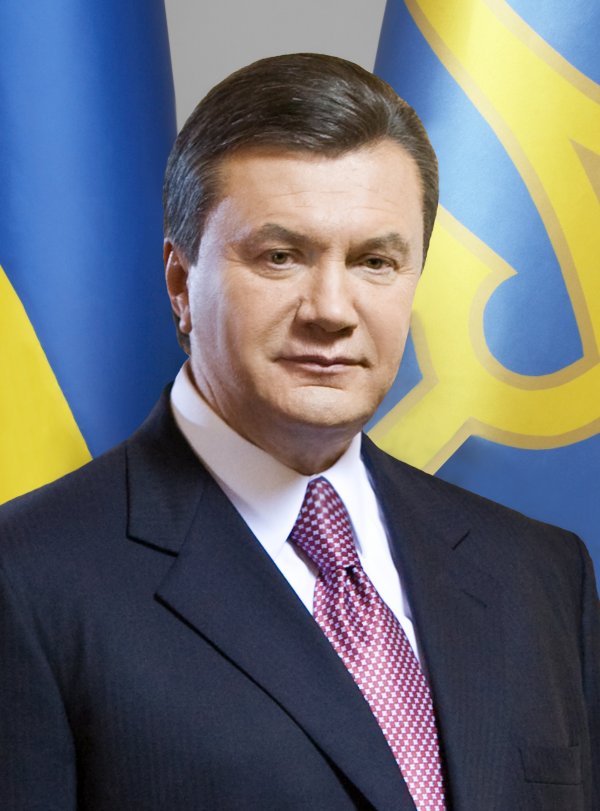
Ousted Ukrainian President Viktor Yanukovych
However, because the Ukraine “regime change” in 2014 was partly orchestrated by U.S. and E.U. officials around the propaganda theme that elected President Yanukovych was corrupt – he had that sauna, after all – the continued corruption in the post-coup regime has been a rarely acknowledged, inconvenient truth. Indeed, some business people operating in Ukraine have complained that the corruption has grown worse since Yanukovych was overthrown.
Yet, only occasionally has that reality been allowed to peek through in the mainstream U.S. media, which prefers to deny that any “coup” occurred, to blame Russia for all of Ukraine’s problems, and to praise the post-coup “reforms” which targeted pensions, heating subsidies and other social programs for average citizens.
One of the rare deviations from the happy talk appeared in The Wall Street Journal on Jan. 1, 2016, observing that “most Ukrainians say the revolution’s promise to replace rule by thieves with the rule of law has fallen short and the government acknowledges that there is still much to be done.”
Actually, the numbers suggested something even worse. More and more Ukrainians rated corruption as a major problem facing the nation, including a majority of 53 percent in September 2015, up from 28 percent in September 2014, according to polls by International Foundation for Electoral Systems.
So, as the hard lives of most Ukrainians got harder, the elites continued to skim off whatever cream was left, including access to billions of dollars in the West’s foreign assistance that has kept the economy afloat.
There was, for instance, the case of Finance Minister Natalie Jaresko, who was regarded by many pundits as the face of Ukraine’s reform before departing last April after losing out in a power struggle.
Yet, Jaresko was hardly a paragon of reform. Prior to getting instant Ukrainian citizenship and becoming Finance Minister in December 2014, she was a former U.S. diplomat who had been entrusted to run a $150 million U.S.-taxpayer-funded program to help jump-start an investment economy in Ukraine and Moldova.
Jaresko’s compensation was capped at $150,000 a year, a salary that many Americans – let alone Ukrainians – would envy, but it was not enough for her. So, she engaged in a variety of maneuvers to evade the cap and enrich herself by claiming millions of dollars in bonuses and fees.
Ultimately, Jaresko was collecting more than $2 million a year after she shifted management of the Western NIS Enterprise Fund (WNISEF) to her own private company, Horizon Capital, and arranged to get lucrative bonuses when selling off investments, even as the overall WNISEF fund was losing money, according to official records.
For instance, Jaresko collected $1.77 million in bonuses in 2013, according to a WNISEF filing with the Internal Revenue Service. In her financial disclosure forms with the Ukrainian government, she reported earning $2.66 million in 2013 and $2.05 million in 2014, thus amassing a sizeable personal fortune while investing U.S. taxpayers’ money supposedly to benefit the Ukrainian people.
It didn’t matter that WNISEF continued to hemorrhage money, shrinking from its original $150 million to $89.8 million in the 2013 tax year, according to the IRS filing. WNISEF reported that the bonuses to Jaresko and other corporate officers were based on “successful” exits from some investments even if the overall fund was losing money.
Though Jaresko’s enrichment schemes were documented by IRS and other official filings, the mainstream U.S. media turned a blind eye to this history, all the better to pretend that Ukraine’s “reform” process was in good hands. [See Consortiumnews.com’s “How Ukraine’s Finance Minister Got Rich.”]
Biden’s Appeal
Worried about the continued corruption, Vice President Joe Biden, who took a personal interest in Ukraine, lectured Ukraine’s parliament on the need to end cronyism.
But Biden had his own Ukraine cronyism problem because three months after the U.S.-backed overthrow of the Yanukovych government Ukraine’s largest private gas firm, Burisma Holdings, appointed his son, Hunter Biden, to its board of directors.
Burisma a shadowy Cyprus-based company also lined up well-connected lobbyists, some with ties to Secretary of State John Kerry, including Kerry’s former Senate chief of staff David Leiter, according to lobbying disclosures.
As Time magazine reported, “Leiter’s involvement in the firm rounds out a power-packed team of politically-connected Americans that also includes a second new board member, Devon Archer, a Democratic bundler and former adviser to John Kerry’s 2004 presidential campaign. Both Archer and Hunter Biden have worked as business partners with Kerry’s son-in-law, Christopher Heinz, the founding partner of Rosemont Capital, a private-equity company.”
According to investigative journalism inside Ukraine, the ownership of Burisma has been traced to Privat Bank, controlled by the thuggish billionaire oligarch Ihor Kolomoysky, who was appointed by the U.S.-backed “reform” regime to be governor of Dnipropetrovsk Oblast, a south-central province of Ukraine (though Kolomoisky was eventually ousted from that post in a power struggle over control of UkrTransNafta, Ukraine’s state-owned oil pipeline operator).
In a speech to Ukraine’s parliament in December 2015, Biden hailed the sacrifice of the 100 or so protesters who died during the Maidan putsch in February 2014, which ousted Yanukovych, referring to the dead by their laudatory name “The Heavenly Hundred.”
But Biden made no heavenly references to the estimated 10,000 people, mostly ethnic Russians, who have been slaughtered in the U.S.-encouraged “Anti-Terror Operation” waged by the coup regime against eastern Ukrainians who resisted Yanukovych’s violent ouster. Nor did Biden take note that some of the Heavenly Hundred were street fighters for neo-Nazi and other far-right nationalist organizations.
But after making his sugary references to The Heavenly Hundred, Biden delivered his bitter medicine, an appeal for the parliament to continue implementing International Monetary Fund “reforms,” including demands that old people work longer into their old age.
Biden said, “For Ukraine to continue to make progress and to keep the support of the international community you have to do more, as well. The big part of moving forward with your IMF program — it requires difficult reforms. And they are difficult.
“Let me say parenthetically here, all the experts from our State Department and all the think tanks, and they come and tell you, that you know what you should do is you should deal with pensions. You should deal with — as if it’s easy to do. Hell, we’re having trouble in America dealing with it. We’re having trouble. To vote to raise the pension age is to write your political obituary in many places.
“Don’t misunderstand that those of us who serve in other democratic institutions don’t understand how hard the conditions are, how difficult it is to cast some of the votes to meet the obligations committed to under the IMF. It requires sacrifices that might not be politically expedient or popular. But they’re critical to putting Ukraine on the path to a future that is economically secure. And I urge you to stay the course as hard as it is. Ukraine needs a budget that’s consistent with your IMF commitments.”
However, as tough as it might have been for Ukraine’s parliament to slash pensions, reduce heating subsidies and force the elderly to work longer, that political sacrifice did not appear to extend to the officials making financial sacrifices themselves.
British Media Wet Their Pants With MI5 Russian Scare Story
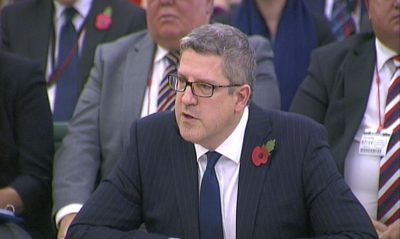
Director-General of security service MI5, Andrew Parker
By Finian CUNNINGHAM | Strategic Culture Foundation | 02.11.2016
The annual festive Halloween holiday is commonly a time for spooky pranks and scare stories. And the British news media delivered – albeit unintentionally it seems. This week several top national newspapers conveyed a stark message from the chief spook at Britain’s secret service, MI5. Andrew Parker, chief of Military Intelligence (Section) 5, warned that Russia was presenting a clear and present danger to the security of the state.
It was The Guardian that first broke the story, with an «exclusive» article on its front page headlined: «MI5 chief warns of growing Russian threat in UK».
With virtually the same headline, the story was replicated in the pages of The Independent, Sun, Daily Mail and Daily Telegraph, among others.
Russia swiftly scorned the British media coverage as fatuous.
However, this was no Halloween prank being played on the British public for kicks. The issue was presented as serious journalism, reporting on a grave matter of national security. The coincidence of the netherworld festival only lends a certain unintended ironical mirth.
More importantly, though, it is one more example of how Western publics are being conditioned by a relentless mental diet of Russophobia. That a host of British newspapers in unison published without question «talking points» from the head of MI5 alleging a threat to national security from Russia is in itself indicative of a «psychological operation». It reflects the abject standard of supposedly independent media in Britain.
The Guardian billed its «exclusive» by saying it was the «first interview given by a serving spy chief». Andrew Parker has been head of Britain’s state security service for the past nine years. Neither he nor his predecessors have ever given such a full-court press briefing.
MI5 was first established in 1909 and serves as Britain’s premier internal state security agency, dealing with counterinsurgency and counter-terrorism. The organization’s MI6 counterpart deals with foreign military intelligence.
The unprecedented public intervention by MI5 this week is again suggestive of a psychological operation.
Moreover, for anyone with a critical faculty, what is bizarre about the latest claims of a Russian «threat» is that despite the gravity and the factual-sounding wording of the headlines, there is a dearth of substance reported to support said claims.
MI5’s Andrew Parker merely makes vague assertions about Russia «pushing foreign policy in increasingly aggressive ways involving propaganda, espionage, subversion and cyber-attacks».
These are the same zero-evidence, breathless assertions that are echoed by American security services and media. The Obama administration citing its own intelligence agencies last month accused Russia of state-sponsored cyber-attacks and interference in the US presidential elections.
Moscow has categorically rejected these insinuations as baseless. Russian foreign minister Sergei Lavrov notes that repeated requests for evidence have been ignored by US authorities. While Russia’s President Vladimir Putin has dismissed allegations of political interference as a cynical «distraction» from real internal American problems.
Another indicator of psychological operation is the way that the alleged Russian threats are packaged as «talking points» which are easily disseminated and regurgitated. After a while, the claims become hackneyed and stale from lack of supporting substance.
The alleged threats which MI5’s Andrew Parker treated the British media and public to have less the ring of truth and more the dull thud of tedium. And yet the British media – like a circus dog – jumped on cue this week to the instruction as if it was something novel and exciting.
How many times have we heard from sundry atlanticist, pro-NATO think tanks warning us about Russian «subversion» or «cyber-attacks» or trying to undermine Western democracies? The level of repetition and coordination of talking-points that we hear from the likes of the Atlantic Council, Center for Strategic and International Studies, the National Endowment for Democracy, NATO, and so on, are reflective of central authorship in state intelligence emanating from the CIA and MI5 / MI6, which in turn feeds into the foreign policy establishments of nominally democratic governments. In short, the Deep State network that transcends Western electoral politics.
Last month at an EU leaders’ summit in Brussels, European Council President Donald Tusk urged the bloc to adopt harsher economic sanctions on Russia, as did the leaders of Germany, Britain and France. Tusk listed a litany of purported Russian malfeasance, including «cyber-attacks, disinformation campaigns, interference in the EU’s political processes» and «trying to weaken the European Union».
Fortunately, Italy, Austria, Spain, Hungary and a number of other European leaders rejected Tusk’s appeal for tougher sanctions on Russia, saying they were counterproductive.
But the point here is that Tusk, supposedly a guiding political light for the EU, sounds more like a hired-hack for the CIA or M15, as ascertained by the trite talking points that he so readily recites about Russian «threats».
The comparison with the briefing given this week to British media by the head of MI5 tends to prove that there is a sinister group-think shared by certain American and European political leaders with unelected Deep State agencies. This relationship as expressed in formulaic Russophobia raises disturbing questions about the true nature of democracy and democratic accountability in Western states. Are the elected leaders following the people’s will or are they following instructions from shadowy agencies whose whole purpose is driven by geopolitical conflict, in particular conflict with Russia?
This perhaps explains why in the US, the Washington establishment and the military-intelligence apparatus appear to be so hostile to Republican presidential candidate Donald Trump. For all his flaws, one thing that can be said to Trump’s credit is that he doesn’t trot out the usual canned talking points manufactured by the Deep State towards demonizing Russia. On that score, he is not a hack, whereas Hillary Clinton has repeatedly toed the Russophobia line.
The Western corporate news media are integral to the political establishment. It is therefore not surprising that senior journalists and editors belonging to media outlets are susceptible to manipulation by state intelligence agencies, either wittingly or unwittingly. Former German newspaper editor Udo Ulfkotte revealed how the CIA infiltrates European journalists to relay the agency’s talking-points to the wider public.
The way that the British media so pliantly provided a platform to the head of M15 this week to disseminate Russophobia is a strong indicator of state-orchestrated propaganda. It speaks of the deplorable lack of independence and genuine public service that the British media conceitedly claim to provide. They are evidently serving as a propaganda device, peddling disinformation whose ultimate logic is to condition the public into accepting hostile policy, and even war with Russia.
That is not journalism. It is flagrant manipulation of public perception on the same level as telling children scary stories about ghouls and ghosts.
But the funny thing is that it is MI5 and all the other spooky agencies of the Western Deep State who are really afraid. What they mean by Russian «propaganda» and «subversion» is that Russian news media are increasingly exposing the systematic deception on numerous world issues that Western media and their intelligence handlers have for too long gotten away with in the pursuit of imperialist interests.
Unable to bear the exposure, Western Deep State creatures are lashing out desperately with scare story upon scare story in order to distract the «children». That’s why Britain’s MI5 came out of its murky swamp of secrecy this week to give a first-ever «exclusive» to the British media. Boo! Boo! Boo! But that power of deception is no longer working.
Admiral Kuznetsov Carrier Group Saved Syria From US Cruise Missile Strikes
Sputnik – 02.11.2016
Moscow’s decision to send a fleet of warships, led by the Admiral Kuznetsov aircraft carrier, to the eastern Mediterranean may have saved the Syrian military from getting bombed by the US, according to military expert Vladimir Evseev.
Speaking at a press conference at the Rossiya Segodnya news agency press center in Moscow, Evseev, the deputy director of Russia’s CIS Institute, pointed out that Washington had only recently considered the possibility of attacking Syrian government forces, using the pretext of a UN report which alleged that Damascus had used chemical weapons.
“We recently lived through a very important milestone which many people did not even notice,” the analyst suggested. “Why was the question raised of the Syrian Army’s alleged use of chemical weapons? The stage was being set for [US] ship-based cruise missile strikes. According to some reports, such a decision was in play… [Western] public opinion was actively being prepared for it.”
But the entry of a major Russian flotilla, led by the Admiral Kuznetsov aircraft carrier, into the Mediterranean may been the essential element needed to cool the Pentagon’s appetites, Evseev added.
“The presence of our ships [between Algeria and Italy] excludes the possible deployment of a similar NATO naval group in the area. Factually, our ships have closed Syria off. The Russian ships did not appear where they are by accident, and eliminated the possibility of launching cruise missiles from that direction.”
The analyst also recalled that earlier, S-300 systems “were deployed in Tartus” with similar goals in mind, given that they are “capable of addressing not only air-based threats, but ballistic targets as well.”
Last week, the contents of a leaked report submitted to the UN Security Council blamed the Syrian government for a chemical attack in Idlib in 2015. Damascus vehemently denied the charges, citing the terrorists’ own regular use of poison gas. Moscow, meanwhile, stressed that more serious evidence would need to be presented before such serious accusations could be leveled.
The US and NATO allies, already engaged in a campaign to demonize Syria and Russia over the fight for Aleppo, used the report to pile on to other charges that Damascus and Moscow were responsible for ‘war crimes’ in their operation to liberate Syria from armed militants and jihadists.
Commenting on the military situation in Syria, Evseev suggested that together with the liberation of Aleppo, the Syrian military and their Russian allies must make it a priority to surround Nusra Front terrorists in Idlib. “The terrorists must be destroyed, but most likely a process of squeezing them out will take place,” he admitted.
If forced to leave Idlib, “the only place for them to go will be Turkey. And here, I would recommend that our Western partners, who currently advise us how to fight in Aleppo, take a moment to think about what will happen to the Idlib militants who end up in Turkey,” the expert noted. “From here, it’s likely that they can then be expected to pay a visit to Europe. This is what Western nations should be thinking about, instead of putting a spoke in the wheel and doing everything possible to interfere in the operation to liberate Aleppo and other Syrian territories.”
As far as the situation in the city of Aleppo is concerned, Evseev stressed that “if we continue to wait and prolong humanitarian pauses, there will be no people left in Aleppo. Without air support, losses are too high. It’s necessary to free the city quickly, and to think less about the West thinks about it.”
Taking a Page from Joe McCarthy
By Robert Parry | Consortium news | November 1, 2016
One trick of the original McCarthyism from the Old Cold War was to take some innocuous or accurate comment from a leader in Moscow — saying something like “poverty is a cruel side of capitalism” or “racism persists in the U.S.” — and to claim that some American reformer who says much the same thing must be a Kremlin tool.
Now, in the New Cold War, we are seeing a similar trend in the way some Democrats and the mainstream U.S. media are citing accurate assessments from Russian President Vladimir Putin and claiming that Republican presidential nominee Donald Trump is somehow in league with Putin for observing the same realities.
A case in point is Tuesday’s editorial in The Washington Post, entitled “The Putin-Trump worldview” (in print) and “Trump and Putin share a frightening worldview” (online). The editorial quotes Putin as “observing that Mr. Trump ‘represents the interests of the sizable part of American society that is tired of the elites that have been in power for decades now … and does not like to see power handed down by inheritance.’”
The Post’s editorial writers then snidely note that “Mr. Putin and Mr. Trump have an uncanny way of echoing each other’s words.”
But that is a classic example of McCarthyistic sophistry. Just because some demonized figure like Putin says something that is undeniably true and an American sees the same facts doesn’t make that American a “Putin puppet” or a “Moscow stooge” or any of the other ugly names now being hurled at people who won’t join in today’s trendy Russia bashing and guilt by association.
Putin is not wrong that many of Trump’s supporters – along with many Americans who backed Sen. Bernie Sanders – are “tired of the elites” that have behaved arrogantly and stupidly for decades. Many Americans also don’t believe that a family’s name should decide who becomes the leader of the United States, whether that be the Bushes or the Clintons.
Indeed, what Putin is saying amounts to almost a truism, yet here is The Washington Post not only suggesting that because Putin is saying something that it must be false but then smearing Trump (or anyone else) who detects the same reality.
Double Standards
The same Post editorial also goes to great lengths to reject any comparisons between the Russian and Syrian government airstrikes on the Syrian neighborhoods of east Aleppo — to root out Al Qaeda-connected jihadists and their supposedly “moderate” rebel allies — and U.S. and Iraqi government airstrikes on the Iraqi city of Mosul under the control of Al Qaeda’s spinoff group, the Islamic State.
Insisting that the two similar operations are nothing alike, the Post’s editors white-out the central role of Al Qaeda in commanding the rebel forces in east Aleppo. While ignoring Al Qaeda’s dominance of those neighborhoods and its terror rocket attacks on civilian areas of west Aleppo, the Post only says, “the rebel forces in Aleppo include Western-backed secular groups who seek only to overturn the blood-drenched Assad regime.”
Note the Post’s characterization that rebel forces “include Western-backed secular groups” rather than an honest admission that those supposedly “secular groups” have served mostly as cut-outs in diverting sophisticated U.S. military weapons, such as TOW missiles, to the jihadist cause, a reality recognized by U.S. military advisers on the ground. [See Consortiumnews.com’s “How the US Armed-up Syrian Jihadists.“]
Many of these supposedly “secular groups” have openly allied themselves with Al Qaeda’s recently rebranded Nusra Front (now called the Syria Conquest Front). This so-called “marbling” of the “moderates” in with the jihadists was one of the sticking points in the failed limited cease-fire in which the Post’s beloved “secular groups” rebuffed Secretary of State John Kerry’s plea that they separate themselves from Al Qaeda.
An intellectually honest newspaper would have at least admitted some of these inconvenient truths, but that is not the modern-day Washington Post with its own “blood-drenched” editors who played a crucial role in rallying support behind President George W. Bush’s 2003 invasion of Iraq under false pretenses.
The Post and its editors have on their hands the blood of hundreds of thousands of Iraqis who died as a result of that illegal aggressive war, but those editors have not suffered a whit for their participation in war crimes. Instead, exactly the same senior editorial-page editors – Fred Hiatt and Jackson Diehl – are still there, touted on the newspaper’s masthead, still misleading the Post’s readers.
By contrast, The Wall Street Journal (of all places) did some serious reporting on the key question of “moderate” rebels allied with Al Qaeda. The Journal reported on Sept. 29: “Some of Syria’s largest rebel factions are doubling down on their alliance with an al Qaeda-linked group, despite a U.S. warning to split from the extremists or risk being targeted in airstrikes. The rebel gambit is complicating American counterterrorism efforts in the country at a time the U.S. is contemplating cooperation with Russia to fight extremist groups.”
If even Rupert Murdoch’s Wall Street Journal can acknowledge this important context, why can’t The Washington Post ?
Dangerous Terrain
But the whipping up of a New Cold War with Russia and the demonizing of Vladimir Putin extend beyond The Washington Post to virtually the entire U.S. political/media establishment which has plunged into this dangerous terrain without any more serious thought and analysis than preceded the Iraq invasion, except now the target for “regime change” is nuclear-armed Russia and this adventurism risks the extermination of life on the planet.
Despite these grave dangers, the Democrats and the Clinton campaign have settled on a strategy of exploiting the New McCarthyism of the New Cold War to discredit Trump through “guilt by association” to Putin even though the two men have apparently never met.
Mostly this New McCarthyism has been used to divert attention from developments threatening to Hillary Clinton’s electoral chances, such as the release of embarrassing emails among Democratic insiders hacked from the personal account of Clinton adviser John Podesta and, since last Friday, the statement by FBI Director James Comey that he has reopened the investigation into Clinton’s use of an unsecured email server because of emails found on a computer in the home of Clinton aide Huma Abedin and her estranged husband, Anthony Weiner.
In the first instance, the Clinton campaign sought to redirect attention from the content of the emails, including the text of speeches that Clinton gave to Goldman Sachs and other financial interests, to the assessment of U.S. intelligence agencies that Russia was probably behind the hack.
‘A Witch Hunt’
In the Comey situation, Sen. Harry Reid, D-Nevada, has sought to counter Comey’s stunning announcement last Friday by calling on the FBI director to also disclose whatever the FBI may have discovered about links between Trump’s aides and the Kremlin.
The New York Times reported on Tuesday that Democrats have raised suspicions about Carter Page, an early-on Trump adviser and former Merrill Lynch banker who gave a speech last summer criticizing the United States and other Western nations for a “hypocritical focus on ideas such as democratization, inequality, corruption and regime change” in Russia and other parts of the old Soviet Union.
Page termed Reid’s efforts to transform a political disagreement into a criminal case “a witch hunt,” a phrase familiar from Sen. Joe McCarthy’s Red-scare investigations of the late 1940s and early 1950s into the loyalty of Americans.
Another Trump adviser caught up in the Democrats’ attempts to smear the Trump campaign over alleged ties to Moscow is Roger Stone. The Times reported that Democrats have accused Stone “of being a conduit between the Russian hackers and WikiLeaks,” which published Podesta’s hacked emails, because Stone has said he had contacts with WikiLeaks founder Julian Assange and seemed to anticipate the damaging disclosures, though Stone has denied any prior knowledge.
An irony from this case of “trading places” – with the Democrats now darkly suggesting Republican ties to Moscow rather than the opposite during the McCarthy era – is that Roger Stone was a longtime associate of the late Roy Cohn, who was the controversial counsel on Sen. McCarthy’s Red-hunting investigations.
Stone derided the Democratic attempts to discredit Trump and himself with claims of ties to Moscow as “the new McCarthyism.”
Despite the irony, Stone is not wrong in his assessment. Rarely in American politics since the dark days of Joe McCarthy have so many unsubstantiated accusations of disloyalty been directed at any major political figure as the Democrats have done to Donald Trump.
In the third debate, Clinton even accused Trump of being a Putin “puppet.” If such a remark were made by Joe McCarthy or his Red-baiting ally Richard Nixon, there would have been understandable outrage. But Clinton’s ugly charge passed without controversy.
Though there are plenty of legitimate reasons to oppose the eminently unqualified Donald Trump for President, Hillary Clinton and the Democrats risk setting in motion dangerous international forces with their promiscuous Russia-bashing. Recognizing the terrifying potential of nuclear war, a more responsible course would be to tone down the rhetoric and address the legitimate questions raised by the email issues.
Democracy Now’s Non-Correction on Nuclear Vote
By Sam Husseini | November 1, 2016
Follow up to my piece ‘Democracy Now!’ Gets Nuclear Ban Vote Totally Wrong:
After I posted my piece on Friday, “Democracy Now!” changed the transcript to read:
The United Nations on Thursday voted overwhelmingly to start talks aimed at abolishing all nuclear weapons. The landmark resolution will see the U.N. convene a conference next year to negotiate a legally binding instrument for worldwide nuclear prohibition. The vote was 123-38, with 16 countries abstaining. [Not supporting the measure] were all nine known nuclear states: China, Russia, France, the U.K., India, Pakistan, Israel, North Korea and the United States.
But this is also incorrect. As I noted in my piece, North Korea in fact voted for the proposal. There has apparently been no on-air correction or pseudo-correction — the following program’s headlines made no mention of the vote.
This is no minor matter. What’s needed is a basic acknowledgement and understanding of the role the U.S. government and NATO play in ensuring the continuation of the nuclear weapons threat. “Democracy Now” is unwilling to make that acknowledgement.
Justifying the Saudi Slaughter in Yemen
By Gareth Porter | Consortium News | October 31, 2016
The Obama administration has carried out a deliberately deceptive campaign accusing Iran of covertly sending arms to the Houthis by sea, a claim that Washington cites to help justify the Saudi massive air attack against the Houthis that began last year.
By repeating the accusation over and over, the administration has been largely successful in turning a dubious allegation into accepted fact, even though it is contradicted by evidence that is well-documented on the public record.
Secretary of State John Kerry introduced the new variant of the Obama administration’s familiar theme about Iran’s “nefarious activities” in the region two weeks after Saudi Arabia began its bombing in Yemen on March 26, 2015. Kerry told the PBS NewsHour, “There are obviously supplies that have been coming from Iran,” citing “a number of flights every single week that have been flying in.” Kerry vowed that the United States was “not going to stand by while the region is destabilized.”
Later, the administration began accusing Iran of using fishing boats to smuggle arms to the Houthis. The campaign unfolded in a series of four interceptions of small fishing boats or dhows in or near the Arabian Sea from September 2015 through March 2016. The four interceptions had two things in common: the boats did have illicit weapons alright, but the crews always said the ship was bound for Somalia – not Yemen and the Houthis.
But instead of acknowledging the obvious fact that the weapons were not related to the Iran-Houthi relationship, a U.S. military spokesman put out a statement in all four cases citing a U.S. “assessment” that the ultimate destination of the arms was Houthi-controlled territory in Yemen.
The choice of wording was significant. The intelligence community says that it “assesses” that something is true only when it does not have clear-cut proof on the matter. In the case of the alleged Iranian use of fishing dhows to smuggle arms to the Houthis, the U.S. spokesmen did not cite a single piece of evidence for that “assessment” in any of the four cases. In fact, when asked for some justification for it, the military spokesman refused.
The first fishing dhow was intercepted in the Arabian Sea on Sept. 25, 2015, by a member of a 31-nation coalition called the Combined Maritime Forces patrolling the Arabian Sea and nearby waters for piracy. The coalition ship found the dhow to be carrying 18 Konkurs anti-tank missiles, 71 other anti-tank shells and 54 missile-launchers.
Blaming Iran
The U.S. Navy’s Fifth Fleet later issued a statement that said, “Based on statements from the dhow’s crew the port of origin of the dhow and its illicit weapons cache is believed to be Iran.” It also said the anti-tank missiles were thought to be of Iranian and Russian origin, and that the papers on the ship had indicated that it had been checked by ports and customs officials in Iran’s Sistan and Baluchistan province.
But the crew of the vessel had said that it was bound not for Yemen but for Somalia, as the spokesman for the U.S. Fifth Fleet acknowledged to The Associated Press. A Saudi military spokesman suggested that Iran intended to reroute the arms later from Somalia to Yemen, but offered no evidence.
On Feb. 27, 2016, an Australian ship intercepted a second fishing dhow off the coast of Oman. The Australians found 1,989 AK-47 assault rifles, 100 rocket-propelled grenades and 40 PKM machine guns on board. The Australian Defense Force issued an official statement on the seizure that did not mention Iranian involvement. It said the boat appeared to be “stateless” and that its cache of weapons was “destined for Somalia.” The Australian Defense Force spokesman explained to CNN that the conclusion was based on interviews with crew members.
But a spokesman for U.S. Naval Forces, Central Command, Lt. Ian McConnaughey gave an entirely different political slant to the interception. In an e-mail to NBC News, McConnaughey said. “Based on the dhow’s course, Iran is believed to be its port of origin and the source of the illicit weapon,” he said. McConnaughey said the crew was “assessed” to be Iranian – implying that the crew itself had not indicated that.
McConnaughey acknowledged to NBC and The Telegraph, “According to coalition forces it is believed that the vessel’s destination was in the vicinity of Somalia.” But the CENTCOM spokesman indicated that it didn’t matter; the U.S. was insisting on its narrative about covert Iranian arms to the Houthis.
“[T]he initial U.S. assessment is the weapons’ final destination was likely to be the Houthis in Yemen,” McConnaaughey told NBC and The Telegraph.
When this writer asked McConnaughey by e-mail why the U.S. “assessed” that the weapons were intended for Yemen, despite the evidence to the contrary, he responded, “We are not going to discuss the intelligence and other information that led us to our assessment.”
A Third Shipment
On March 20, a French navy destroyer intercepted a third fishing dhow off the Island of Socotra in the northern Indian Ocean and found several hundred AK-47 assault rifles, machine guns and antitank weapons. The official statement on the seizure from the Combined Maritime Forces stated categorically, “The dhow was spotted heading toward Somalia.” 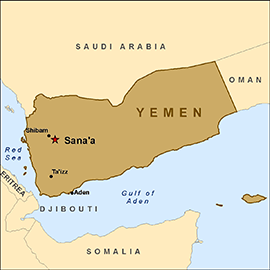
And because the weapons were “deemed to be destined for Somalia,” it explained, they “were seized under the United Nations Security Council mandated arms embargo in accordance with UNSCR 2244(2015).” That Security Council resolution mandates an embargo on Eritrea.
Australia and other states participating in the Combined Maritime Forces were thus challenging the U.S. propaganda line. But again the U.S. military used the news media to reinforce the line about Iran smuggling arms to the Houthis. Commander Kevin Stephens, a spokesman for the Fifth Fleet, told CNN that “according to a U.S. assessment,” Yemen was the “likely destination” of the arms.
A fourth interception – the third in three weeks – occurred on March 28 by a U.S. Navy ship that was not operating as part of Combined Maritime Forces but directly under U.S. Naval Forces Central Command. That allowed the Naval Forces Central Command to issue its own news story on April 4.
In its lead paragraph, the report said the United States “assessed” that the shipment of illicit arms on board the dhow “originated in Iran and was likely bound for Houthi insurgents in Yemen.”
An Earlier Ruse
The Obama administration also had sought to promote the charge that Iran was covertly sending weapons to the Houthis by sea more than two years earlier. In January 2013, the Yemen client government backed by the United States and Saudi Arabia had claimed that its forces had intercepted a ship with a large cargo of weaponry that came from Iran and was on its way to Yemen to deliver them to the Houthis.
The Obama administration supported that charge in briefings to journalists. After the Saudi air war against Yemen began in 2015, the U.S. pushed for a report by an experts group on sanctions against Iran that would give the charge credibility.
But the 2013 claim was soon exposed as a ruse. A Security Council Monitoring Group on Somalia and Eritrea revealed in a June 2013 report that the crewmembers had told diplomats who interviewed them that ship’s cargo of diesel fuel was bound for Somalia, not Yemen. And, since the weapons were hidden under the diesel fuel tanks, the weapons could be accessed only after those tanks had been emptied, in other words after the ship docked in Somalia.
The monitoring group learned from authorities in the Puntland region of Somalia, where most of the smuggled weapons have entered the country, that this was a widely used method of smuggling arms into the country.
Furthermore, the monitoring group determined that the wide range of types of weapons on board the ship, which was intercepted in January 2013, as well as of their original sources indicated that the weapons cache had been assembled by arms merchants. Authorities in Puntland provided data to the monitoring group showing that most of the shipments of weapons into Puntland in the months before January 2013 had come from politically well-connected arms merchants in Yemen.
Some of the fishing boats that were intercepted with illicit arms on board in 2015-16 had Iranian owners. But the monitoring group report reveals that the real reason is the role of such Iranian fishing vessels in illegal fishing in Somali waters. The vast majority of the hundreds of fishing vessels involved in such illegal fishing networks were either Iranian or Yemeni. As many as 300 were believed to be Yemeni-owned, while Iranian-owned 180 of them.
The monitoring group said it was investigating unconfirmed reports that some of those illegal fishing vessels were also being used to carry out arms smuggling and that it had established “other connections between the illegal fishing networks and networks involved in the arms trade and connected to al-Shabaab in northeastern Somalia.”
But the Obama administration has no interest in the considerable evidence gathered by the monitoring group that provides a more credible explanation for the arms found on those four fishing dhows.
Such an explanation isn’t political useful, whereas the accusations of Iranian smuggling of arms to the Houthis fulfilled multiple political and bureaucratic interests, justifying Saudi Arabia’s bloody U.S.-backed air campaign over Yemen and endless Washington alarms about “Iranian aggression.”
Gareth Porter is an independent investigative journalist and winner of the 2012 Gellhorn Prize for journalism. He is the author of the newly published Manufactured Crisis: The Untold Story of the Iran Nuclear Scare.
“Democracy Now!” Gets Nuclear Ban Vote Totally Wrong
By Sam Husseini | October 28, 2016
“Democracy Now” sadly continues its descent, which I’ve alluded to occasionally on twitter. To fully tell this story would require a very long and detailed piece, but the latest chapter of this is worth noting in more than a tweet as it happens. On this morning’s headlines, Amy Goodman claimed:
The United Nations on Thursday voted overwhelmingly to start talks aimed at abolishing all nuclear weapons. The landmark resolution will see the U.N. convene a conference next year to negotiate a legally binding instrument for worldwide nuclear prohibition. The vote was 123-38, with 16 countries abstaining. Voting against were all nine known nuclear states: China, Russia, France, Britain, India, Pakistan, Israel and North Korea as well as the United States. [Note, this is wording as broadcast, the transcript is minorly different.]
In fact, China, India and Pakistan abstained. North Korea actually voted for the resolution. As even the AP correctly reported: “The United States, Russia, Israel, France and the United Kingdom were among the countries voting against the measure.” See country by country breakdown results from International Campaign to Abolish Nuclear Weapons. See excellent map from ILPI. If you’re still skeptical, see actual pic of vote board.
As Ira Helfand — past president of Physicians for Social Responsibility and currently co-president of that group’s global federation, the International Physicians for the Prevention of Nuclear War — noted in Nukes and the U.N.: a Historic Treaty to Ban Nuclear Weapons:
The ‘No’ votes came from the nuclear weapons states, and U.S. allies in NATO, plus Japan, South Korea and Australia, which have treaty ties to the U.S., and consider themselves to be under the protection of the ‘U.S. nuclear umbrella.’
But four nuclear weapons states broke ranks, with China, India and Pakistan abstaining, and North Korea voting in favor of the treaty negotiations. In addition, the Netherlands defied intense pressure from the rest of NATO and abstained, as did Finland, which is not a member of NATO but has close ties with the alliance.
So, what actually happened is that the U.S. and various client states — especially, but not limited to, NATO members — voted against the nuclear weapons ban. China, India and Pakistan abstained — not voted against as “Democracy Now!” claimed. And North Korea actually voted for the resolution — U.S. client state South Korea voted with the U.S. against.
It would be interesting to see how a mistake like this could possibly happen. Icing on the cake is the way it was phrased, even above and beyond the outright falsehoods about China, India, Pakistan and North Korea. Goodman claimed “as well as the United States” — as if the U.S. were an afterthought when it’s obvious that the U.S. government has been leading the effort against the vote. As the German Press Agency reported: “Due to U.S. pressure, 27 of the 28 NATO member states voted against the resolution with the Netherlands abstaining.”
Such errors are likely a consequences of a world view that seems to not fully grasp, or perhaps not want to grasp or communicate, the threat the U.S. government poses to much of humanity in terms of the actual nature of U.S. foreign policy.
RT hits record 4 billion views on YouTube
RT | October 27, 2016
RT’s YouTube channels have surpassed 4 billion views, sustaining RT’s title as the world’s leading news network on YouTube, and widening its lead on mainstream media TV news channels such as CNN and the BBC.
The record-breaking number of views from across RT’s varied news channels including RT, RT Documentary and Ruptly TV, amount to three times the YouTube views that Euronews enjoys and more than seven times those of the BBC’s news channels combined.
“The future of media is inextricably linked to the internet. Once you fall behind in this field, it’s difficult to catch up. From the very beginning RT has focused on developing its digital platforms, and this has been the key to our success,” said RT Editor-in-Chief Margarita Simonyan.
RT has been leading the way in YouTube news delivery since the platform became available in Russia in 2007.
At the time, RT was the first Russian TV channel to embrace the new media concept and by 2011, RT’s content had gained the recognition of YouTube and was awarded the most popular news video of the year.
The award marked the beginning of RT YouTube’s rise to international acclaim; the following year, 2012, the Pew Research Center named RT the top news producer on the platform. By 2013, RT had become the first news channel in the world to hit 1 billion views on YouTube.
“For many years now RT has been an unconditional leader on YouTube, the most popular video-hosting platform in the world. Four billion views is a new milestone, and we are aiming to raise the bar even further,” said Kirill Karnovich-Valua, RT’s Head of Online Projects.
Without doubt, 2016 has been RT’s best year to date. In April it received the People’s Choice award at the prestigious Webby Awards ahead of BBC News, ABC News, NBC Nightly News and the New York Times.
In September, RT took home seven Lovie Awards, the pan-European awards honoring online excellence. And RT finished the year on a high by solidifying its seat at the top with over 4 billion YouTube views.
Aside from its YouTube success, RT broadcasts in six languages, has more than 13 million Facebook fans, 6 million Twitter followers, and a live audience of millions around the globe.
‘Good’ vs ‘Bad’ Bombs: Shocking Commentary of German Newspaper on Middle East
Sputnik – 28.10.2016
One of the largest German newspapers, Das Bild, seriously claimed that there are “good” and “bad” bombs that are being dropped on Middle Eastern countries.
According to the newspaper, the first ones were used in Aleppo by “bad” Putin whose goal is “to level the city with 300,000 residents to the ground in order to increase his personal power and that of his regime.”
The good bombs, as the newspaper claims, are on the contrary used by the US and its allies in the Iraqi city of Mosul. Their motive, according to the article, is “to liberate the city of millions from the terrorist regime of Daesh.”
The author, Julian Reichelt, made every effort to draw things black and white: he repeatedly contrasted the Russians with the Americans and even wrote odd comments in brackets, apparently making sure that the reader is “on the right side.”
“Bombs are clearly better in the hands of those who respect elections, follow laws and are controlled by the free press (for example Obama), than in the hands of despots who react to criticism with violence and oppression and are not accountable to anyone (for example Putin),” the article said.
In his attempt to turn the situation upside down, the author went even further, saying that “American nuclear weapons have always been better than the Russian (Pakistani or Chinese) ones because they have been controlled by politicians who have much more respect for human life and the will of their voters.”
Apparently, the author seems to have forgotten that the US is the country that killed 450,000 innocent people by dropping nuclear bombs on the Japanese cities of Hiroshima and Nagasaki.
In addition to his outstanding comment, the author also mentioned that Russian media, including Sputnik and RT, alongside with respected German experts like Jürgen Todenhöfer, Jakob Augstein and Gabor Steingart always distort reality and publicly spread lies.
Apparently, Mr. Reichelt seems to ignore the fact that his controversial attempts to “demonize” Russia and “idolize” the West do not resemble much of “the truth” either.
Featured Video

Trump asks Iran not to retaliate after he strikes Pickaxe Mountain
or go to
Aletho News Archives – Video-Images
Book Review & Summary
Calling of an Angel: The True Story of Rene Caisse and an Indian Herbal Medicine Called Essiac (1988)
Dr. Gary L. Glum – 30 Q&As – Book Review & Summary
Lies are Unbekoming | October 17, 2026
On June 10, 1975, Dr. Chester Stock, a vice president at Memorial Sloan-Kettering Institute for Cancer Research, wrote to a Canadian nurse named Rene Caisse: “Enclosed are test data in two experiments indicating some regressions in sarcoma 180 of mice treated with Essiac.” The sentence sat in a letter from one of the world’s largest private cancer research centers, concerning an herbal tea an elderly English woman had learned from an Ojibwa medicine man at a northern Ontario mining camp in the 1890s. The tests were terminated the following year after Sloan-Kettering admitted, in sworn affidavit three years later, that they had prepared the injectable solution improperly from the dried material supplied — freezing and thawing the herb rather than boiling it as Rene had instructed. By the time Calling of an Angel was published in 1988, Rene Caisse had been dead for a decade, having treated thousands of cancer patients across fifty-six years in her Bracebridge, Ontario kitchen, never charging a fee, and refusing every offer — from Memorial Sloan-Kettering, the National Cancer Institute, Merck, Parke Davis, and private corporations dangling contracts up to $1 million — to release her formula before the medical establishment admitted her remedy had merit. … continue
Blog Roll
 Aletho News
- Trump asks Iran not to retaliate after he strikes Pickaxe Mountain – w/ Prof. Marandi
- Vice President J.D. Vance’s Deceptive ‘Antiwar’ Campaign Speech
- Iran: Palestinians’ rights must not be compromised in Gaza’s future; US, Israel to blame for Hormuz situation
- Ongoing tales of Syrian chemical weapons
- Moscow blasts UN for ignoring torture of Russian POWs
- Millions of Books Could Have Been Destroyed in Lebanon During Israeli Bombings
- Moscow warns of ‘hunt for Russians’
- Calling of an Angel: The True Story of Rene Caisse and an Indian Herbal Medicine Called Essiac (1988)
- South Korean Assistance to the U.S. in the War with Iran: Between Allied Duty and National Interests
- Pharma- and Gates-Funded GAVI Seeks to Assure Parents
- If Americans Knew
- Israeli soldiers debunk Israel’s talking points
- In West Bank, Israeli settlers are totally out of control – Daily Update
- NPR investigation finds evidence of widespread fraud at mall kiosks tied to Israeli skincare brand
- Tucker Carlson exposes Israeli Lies about the Oct 7th attack, Charlie Kirk, and the U.S.
- Israel has detained thousands of Palestinian children since Oct 7th – over half spent time in solitary, many uncharged
- Israeli Analysis: Is Netanyahu Planning an ‘October Surprise’ Attack Before Israel’s Election?
- Israeli settlers brutally attack Palestinians and Washington Post female photographer, 65
- Words Have Changed, Occupation Continues: The Reality of the Gaza Ceasefire
- Gaza’s child amputees are growing faster than their prosthetics allow
- Israel keeps Palestinians struggling just to survive–Daily Update
- No Tricks Zone
- New Study Suggests Large Regions Of The Pacific Ocean Have Been Cooling For The Last 80 Years
- Germany’s Green Energy Debacle: High Energy Costs Force Kahla Porzellan to Close After 182 Years!
- New Study: 50 Years Of The Most Aggressive ‘Net Zero’ Policies Can Only Affect The Global Climate By 0.03°C
- US September “Heat” Was No Record…Many Records Set Decades Ago
- Latest European Green Energy Debacle; Portugal’s Largest Flagship Solar Park Insolvent!
- Green Energy Debacle: German Expert Professor Fritz Vahrenholt Warns Of Severe Economic And Social Consequences
- Two More Paleo Reconstructions Affirm Meters-Higher Sea Levels Across Ireland, Brazil 7000-6000 Years Ago
- New Study: Earth And Venus Surface Warmth Largely Explained By Convection And Lapse Rate, Not CO2 Or Radiation
- 2025 Nature Paper Claiming Worsening Global Drought Gets RETRACTED …Heavily Flawed
- New Study: ‘Global Drought Shows No Detectable Recent Acceleration Under Climate Warming’

