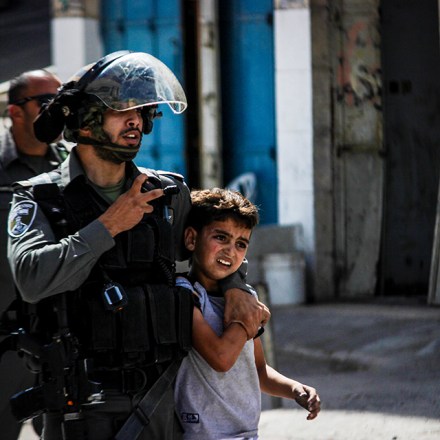
 On a trip to Cuba in May, I had to look twice when an elderly man selling newspapers walked past the restaurant I was eating in. On the front page of one was a huge photograph of an Israeli soldier holding a Palestinian boy by the neck, the boy’s face twisted away from the camera in pain.
The photo said it all: an aggressive, well-built soldier wearing a helmet, bulletproof vest and carrying a machine gun was manhandling a child half his size, not more than 10 years old, dressed in jeans and a t-shirt. Why was I so shocked to see such an image published on the front page of a mainstream newspaper? Because this would be a rare moment in the UK.
Over here, the images that are used to represent almost 50 years of military occupation are of Palestinian youth throwing stones, black-and white-kuffiyeh wrapped around their faces. The Cuban picture portrays the Palestinian as the subject of aggression, the UK image as the perpetrator; just like that, our media helps perpetuate the myth that Palestinians are faceless terrorists predisposed to random outbursts of violence and against whom Israel has every right to defend itself.
A closer look at how the British media has covered the recent escalation of violence in Palestine reveals some worrying trends. For the past year right-wing Israeli groups have entered the Haram Al-Sharif compound daily with their armed escorts, often chanting anti-Arab and anti-Palestinian slogans. This came to a head on 13 September when a group of settlers and the Israeli minister of agriculture Uri Ariel, protected by Israeli soldiers, actually entered the Al-Aqsa mosque shooting tear gas, stun grenades and rubber coated steel bullets at worshippers, injuring Palestinians inside and causing damage to the interior of the mosque.
With this in mind take a look at how these confrontations were described in the Telegraph : “Four Israelis and 23 Palestinians have died in 12 days of bloodshed fuelled in part by Muslim anger over increasing Jewish access to the Al-Aqsa mosque compound in Jerusalem.”
And earlier in the year, Reuters reported that: “Those groups [devout Jews and Israeli nationalists] are at the centre of a creeping shift in Jerusalem: After 900 years, Jews are chipping away at Muslims’ exclusive control of the site, the third holiest in Islam. The shift, which has provoked violence in the past, threatens to open a dangerous new front in the Israel-Palestinian conflict, adding religious enmity to a political struggle in the very heart of the disputed city.”
Not only do these reports reduce the provocation by Israeli settlers and soldiers in the Al-Aqsa mosque to Muslim anger and a failure to compromise over increased Jewish access to the compound, but they make the current protests in Palestine sound as though they are merely a religious dispute. Al-Aqsa is the third holiest site in Islam and holds huge religious significance for Muslims across the world, but Palestinians are also protesting against almost 50 years of military occupation under which their land has constantly been taken away from them.
Since 14 September, 72 Palestinians and 11 Israelis have been killed and over 8,000 Palestinians and 134 Israelis have been injured – yet many reports have picked out and highlighted the knife attacks carried out by Palestinians, using phrases such as “Israel’s knife terror”, describing “knife wielding” Palestinians or “anti-Israeli knife attacks”. The following report published on the BBC answered the question of what is happening between the Israelis and the Palestinians in the following manner:
“There has been a spate of stabbings and gun attacks on Israelis by Palestinians since early October, and one apparent revenge stabbing by an Israeli. The attacks, some of which have been fatal, have struck in Jerusalem and in northern and central Israeli cities and towns, and in the occupied West Bank. Israel has tightened security and clashed with rioting Palestinians, leading to deaths on the Palestinian side. There has also been associated violence in the border area inside the Gaza Strip.”
Note that there is not even a mention of what took place at Al-Aqsa mosque on 13 September. The weapons used by Palestinians are specified but Israel’s excessive use of tear gas, stun grenades, live ammunition and rubber bullets is not included.
The term “Palestinian rioters” (other reports have used “Muslim rioters”) has been widely adopted in the British media; the notion of “rioters” is associated with wild disorder and conjures up very different images than the word “protesters”, which suggests a group of people who are simply asking for their rights. Another common term used in the above quotation and frequently in other articles is “clash”, which implies fighting between two equal forces– Israeli soldiers, part of the fourth largest army in the world, storming the Al-Aqsa mosque and firing tear gas and rubber bullets at Palestinians armed with stones, sticks and knives cannot be described as a “clash”.
Deaths on the Palestinian side are a result of rioting Palestinians, and so somehow justified. This headline from Reuters, this one in the Independent and this one in the Daily Mail all report Palestinian deaths but say they took place after Palestinians attacked Israelis with knives. In contrast, this article from the BBC is typical of how Israeli casualties are reported across the media: “Three Israelis killed in Jerusalem bus attacks.” No justifications or explanations of the deaths in sight.
The BBC casually writes about “associated violence” in the Gaza Strip. Between 13 September and the publication of this article, 12 Palestinians in Gaza have been killed, including 26-year-old Nour Rasmi Mohammed Hassan who was five months pregnant and her three year-old daughter, both of whom were at home when an Israeli airstrike hit their house.
Rather than recognise that their excessive use of force and almost 50 years of occupation – under which Palestinian homes have been demolished, children have been arrested, freedom of movement restricted and Gaza placed under siege – may evoke anger in some Palestinians, Israeli authorities, echoed in news reports, would rather blame Palestinian leaders and the use of social media for “inciting” violence, as seen in this headline: “Israel sentences Islamic leader to jail for incitement”; and this one too: “Is social media driving the current violence?”
In this video, Israeli security forces have planted undercover stone throwers among a group of Palestinians who then turn on one of the Palestinians in the same group before ten Israeli soldiers drag him away (note – excessive use of force). In fact there are numerous videos online that highlight Israeli aggression and incitement of violence towards Palestinians but they are not widely published in the mainstream press. This particularly disturbing video filmed on a mobile phone in Aida refugee camp last week captures an Israeli soldier announcing: “You throw stones and we will hit you with gas until you die – the children, the youth, the old people; you will all die. We won’t leave any of you alive.” This video shows an Israeli soldier running over a Palestinian then preventing paramedics helping him; this one shows settlers throwing stones at Palestinian homes in Hebron.
On 16 October, much media attention was focused on the case of a Palestinian man who dressed up in a press jacket and inflicted moderate wounds on an Israeli soldier in Hebron before being shot dead by another soldier. On the same day, four other Palestinians died, including 36-year-old Shawqi Jamal Jaber Ebeid who succumbed to injuries after sustaining a bullet wound to the head a week before whilst working in a stone factory in Gaza. His story is much harder to find and yet it is part of the media’s job to help give a voice to those who have been deliberately silenced – those like Shawqi Ebeid and his family – and to hold politicians and people in authority to account when they do something wrong; even more so if they commit war crimes. If, however, the media is complicit in silencing those same people, then in some cases we may be looking at political propaganda dressed up as news.
November 7, 2015
Posted by aletho |
Ethnic Cleansing, Racism, Zionism, Mainstream Media, Warmongering, Subjugation - Torture | Gaza, Hebron, Human rights, Israel, Palestine, West Bank, Zionism |
Leave a comment
Like millions of Americans, this past week I was sitting on my couch, drinking a cold beer, watching Game 1 of the World Series – professional baseball’s hallowed championship. Suddenly the satellite feed went out, the screen went dark. Naturally, as FOX Sports scrambled to get their live feed fixed, many of my fellow Americans took to twitter to speculate as to what had caused the outage. I was, sadly, unsurprised to see that the most common joke people were making was that China must have hacked the World Series.
On the one hand, it is understandable given the barrage of propaganda about Chinese hackers as a threat to corporate and national security; seemingly every week there is a new news item highlighting the great red cyber-menace. On the other hand, it is a perfect illustration of the hypocrisy and ignorant arrogance of Americans who, despite being citizens of unquestionably the most aggressive nation when it comes to both cyber espionage and surveillance, see fit to cast China as the real villain. It is a testament to the power of both propaganda and imperial triumphalism that a proposition so disconnected from reality, and bordering on Orwellian Doublethink, is not only accepted, but is ipso facto true.
But there is a deeper political and sociological phenomenon at play here, one that begs further exploration. How is it that despite all the revelations of Edward Snowden regarding US intelligence and military snooping capabilities across the globe, Americans still cannot accept the culpability of their own government and corporate interests – the two work hand in hand – in global cyber-espionage? Even if they explicitly or implicitly know about the NSA, CIA, DIA, and Pentagon programs (among many others), their instinctive reaction is to blame China. Why? The answer lies in the complexity and effectiveness of the anti-China propaganda.
In his landmark book Public Opinion, the renowned writer, commentator, and theoretician of propaganda, Walter Lipmann, defined the term “stereotype” in the modern psychological sense as a “distorted picture or image in a person’s mind, not based on personal experience, but derived culturally.” In other words, the stereotype is an image in our mind’s eye, one that is constructed by outside forces; it is information filtered through a particular societal or cultural framework that then creates a picture of how something is to be understood. Lipmann went further, noting that carefully constructed propaganda could be used to shape stereotypes, thereby allowing the powers that be the ability to construct and manipulate information and narratives.
And this is precisely the phenomenon at work here. By repeating it endlessly, the US political and corporate media establishment have successfully convinced Americans that China is the real threat when it comes to cyberspace, playing on the stereotype of Chinese people in general, and the People’s Republic of China specifically. But, I would argue something far different: rather than seeing China as a threat, perhaps Americans, and westerners generally, should shine a light on what their own countries are doing, thereby gaining a broader perspective on the issue. For China’s moves in this field pale in comparison to those of the US, and are clearly a response to them.
China and the US: Comparing the Rap Sheets
The corporate media is replete with stories of Chinese hacking of US institutions. From alleged Chinese hacking of the University of Virginia employees connected with US government programs directed at China, to the infamous breach of the federal government’s Office of Personnel Management which resulted in the theft of the personal information of more than 20 million Americans, such stories help to construct an image of China as the world’s leading hacker-state. This week it is Chinese hackers targeting health care providers, last year it was stealing the secrets of Westinghouse and US Steel, and literally dozens of other such examples.
The purpose of this article is not to deny the veracity of these reports; I’m not a computer expert, nor do I have access to the information that an expert would need in making a determination. Instead, my purpose here is to show the grossly unbalanced, and utterly dishonest, way in which the issue is presented to Americans especially, and to probe why that might be. For any fair and balanced approach to the issue would present the simple fact that the US is the world leader in cyber-warfare, having actually conducted what are to date the only recorded live uses of cyberweapons.
Take for instance the joint US-Israel developed Stuxnet virus, a pair of highly complex and severely destructive, computer viruses launched at Iran’s nuclear facilities. According to a group of independent legal experts assembled at the request of NATO’s Cooperative Cyber Defense Center of Excellence, the Stuxnet cyberattack was “an act of force.” Their report noted that “Acts that kill or injure persons or destroy or damage objects are unambiguously uses of force [and likely violate international law].”
Indeed, the US and its Israeli partners launched the very first true cyberweapon. As cyber security expert Ralph Langer wrote in Foreign Policy in 2013:
Stuxnet is not really one weapon, but two. The vast majority of the attention has been paid to Stuxnet’s smaller and simpler attack routine — the one that changes the speeds of the rotors in a centrifuge, which is used to enrich uranium. But the second and “forgotten” routine is about an order of magnitude more complex and stealthy. It qualifies as a nightmare for those who understand industrial control system security… The “original” payload… attempted to overpressurize Natanz’s centrifuges by sabotaging the system meant to keep the cascades of centrifuges safe.
Essentially, the US and Israel employed the world’s first cyberweapon without even fully knowing the potentially destructive consequences. As the virus migrated out of the Iranian nuclear facility at Natanz and onto the internet, innumerable variables could have come into play, with the potential for disastrous outcomes.
But of course Stuxnet was not alone. The US and Israel also deployed both the Gauss and Flame viruses, two more sophisticated cyberweapons designed to cause major damage to online infrastructure. The Gauss virus, discovered by Kaspersky labs, one of the world’s most highly respected cyber-security firms, was designed to steal sensitive data such as financial records. According to the US officials who spoke with the Washington Post, the Flame virus was a: massive piece of malware [which] secretly mapped and monitored Iran’s computer networks, sending back a steady stream of intelligence to prepare for a cyberwarfare campaign… “This is about preparing the battlefield for another type of covert action… Cyber-collection against the Iranian program is way further down the road than this.” said one former high-ranking U.S. intelligence official, who added that Flame and Stuxnet were elements of a broader assault that continues today.
Clearly the US and Israel were not merely interested in surveillance and information-gathering, but actually having the ability to manipulate and destroy vital computer infrastructure in Iran. Any reasonable reading of international law should hold that such actions are, in fact, an act of war, though of course war with Iran has not come to pass. But just the very use of such sophisticated weapons, far more elaborate, technical, and dangerous than mere hacking by humans, should call into question the weepy-eyed condemnations of China for its alleged stealing of corporate and government information.
And then of course there is the seemingly endless supply of revelations from Edward Snowden regarding the US surveillance infrastructure, how all-encompassing it truly is, how it is used to manipulate political outcomes, how it is used as a weapon against foreign governments, and much more.
Just to name a few of the countless programs and initiatives of the NSA and the surveillance state designed to capture information for political purposes:
PRISM – allows “The National Security Agency and the FBI [to tap] directly into the central servers of nine leading U.S. internet companies, extracting audio and video chats, photographs, emails, documents, and connection logs.”
BLARNEY – “Gathers up metadata from choke points along the backbone of the internet as part of an ongoing collection program the leverages IC (intelligence community) and commercial partnerships to gain access and exploit foreign intelligence obtained from global networks.”
Boundless Informant – “Details and even maps by country the voluminous amount of information it collects from computer and telephone networks.”
US & UK Target G20 Leaders – “The documents suggest that the operation was sanctioned in principle at a senior level in the government.”
US Spied on EU Offices – “America’s National Security Agency (NSA) not only conducted online surveillance of European citizens, but also appears to have specifically targeted buildings housing European Union institutions… in addition to installing bugs in the building in downtown Washington, DC, the European Union representation’s computer network was also infiltrated.”
But of course, the US has also specifically, and successfully, trained its cyber-espionage and cyber-warfare sights on China itself. Thanks to Snowden, we now know that US intelligence repeatedly hacked into Beijing’s Tsinghua University, China’s top education and research institute. As revealed in the South China Morning Post:
The information also showed that the attacks on Tsinghua University were intensive and concerted efforts. In one single day of January, at least 63 computers and servers in Tsinghua University have been hacked by the NSA… The university is home to one of the mainland’s six major backbone networks, the China Education and Research Network (CERNET) from where internet data from millions of Chinese citizens could be mined. The network was the country’s first internet backbone network and has evolved into the world’s largest national research hub.
But it wasn’t only Tsinghua University that was targeted. Snowden also revealed that Chinese University in Hong Kong was the victim of US hacking; the university is home to the Hong Kong Internet Exchange, the city’s central hub for all internet traffic. In addition, it came out that US intelligence has repeatedly hacked into Chinese mobile phone companies, spied on users, and stolen data, including text messages. These are, of course, only what we know about thus far from the Snowden revelations. The scope of US hacking operations against China is not known, but could be safely assumed to be far-reaching.
In fact, the depth of US hacking and other intelligence operations targeting China, including those taking place inside China itself, has been alluded to repeatedly. The New York Times noted in August 2015 that the Obama administration was cautious about any retaliation against China for the breach of the Office of Personnel Management because “Intelligence officials say that any legal case could result in exposing American intelligence operations inside China — including the placement of thousands of implants in Chinese computer networks to warn of impending attacks.”
It is clear that what we do know about US cyberwar programs and tactics is really only the tip of the iceberg. It is likely that Washington has myriad other China-specific hacking programs and initiatives, including the much discussed attempts to subvert the oft referenced “Great Firewall of China.” Put simply, the US is engaged in the most sophisticated forms of hacking and cyber-subversion, and much of it is directed at China (and Russia and Iran). This should now be beyond question.
Keep this information in mind the next time another story about Chinese hackers attacking US interests runs in the corporate media. While the hack may or may not be true, it is the context within which such actions take place that really needs to be understood.
There is a cyberwar going on, of this there can be no doubt. But who’s got the biggest guns? And who fired the first shot?
November 6, 2015
Posted by aletho |
Deception, Mainstream Media, Warmongering, Timeless or most popular | China, CIA, DIA, Gauss, Iran, Israel, NSA, Stuxnet, United States, Zionism |
Leave a comment
Ever since allegations that Saddam Hussein’s WMD program were “sexed up” to give the UK reason for joining the 2003 US-led invasion of Iraq, the BBC has been “cowed,” a claim that seemed vindicated following last month’s US attack of an Afghan hospital.
On October 3rd, the US carried out a sustained bombing raid on a Medecins Sans Frontiere hospital in Kunduz, Afghanistan. The attacks continued every 15-minutes for over an hour and involved five separate strafing runs. By the time it was over, at least twenty two people had been killed.
According to Counterpunch : “The hospital was deliberately set ablaze by incendiary weapons, and the people inside not incinerated were killed by a spray of bullets and anti-personnel flechettes.”
US officials initially claimed the attacks were an accident. However, this was refuted by MSF, who pointed out that not only were the US fully aware of the precise coordinates of the hospital, but that they had also called the US army during the strike itself begging them to stop, to no avail.
Eventually, as Media Lens has noted, US officials changed their story, claiming that the attack was justified because the Taliban had been using the hospital as a “base” – effectively admitting that it had indeed been deliberately targeted. MSF completely denied that claim as well, and noted that the claim “amounts to an admission of a war crime.”
So why was it that on October 15th, the BBC News at Ten was still claiming that the hospital had been “mistakenly bombed” by the US – a claim disputed by MSF from the start, and which even US officials themselves later admitted was a lie?
To answer this question requires an appreciation of the way in which the BBC has, over many years, been cowed and intimidated into an attitude of almost total subservience towards the foreign policy agenda of Britain and its allies.
Of course, the BBC has always been an instrument of the British state, established by statute in 1928 and run by a governor appointed by the Prime Minister. As Seumas Milne has pointed out: “There is no point in romanticizing a BBC golden age. The corporation was always an establishment institution, deeply embedded in the security state and subject to direct government control in an emergency…[with] around 40 percent of the staff… vetted by MI5.”
Yet within this framework there was, for a time, some degree of freedom to make programs that challenged the status quo.
Particularly irksome to the Conservative government of the 1980s were three in particular – Maggie’s Militant Tendency, a Panorama special on the influence of the far right in the Conservative party; Real Lives, featuring an extended interview with the Irish republican leader Martin McGuinness; and a documentary about a secret British intelligence satellite. The latter program, which was never broadcast, even triggered a raid by Special Branch on the BBC’s Glasgow offices – but, Milne notes, “By [that] time… preparations to sack the director general were far advanced.”
Thatcher installed the “fiercely anti-union” Marmaduke Hussey as BBC Chairman, and, following discussions with Rupert Murdoch, Douglas Hurd and security advisor Victor Rothschild, forced Alasdair Milne (Seumas’s father) to resign as director general. The move had its intended effect.
As Seumas Milne put it: “This was a No 10 coup by any other name – and one from which the BBC has never fully recovered. Once the government had demonstrated it could not only manipulate the license fee to ensure BBC compliance, but summarily dispatch its leadership at barely one remove, what BBC director general or chair would do anything but bend the knee or jump ship?”
Of course, the message still needs reiterating from time to time.
Shortly after the 2003 invasion of Iraq, BBC Radio Four’s Today program broadcast an interview with the journalist Andrew Gilligan in which he claimed that the British government had “sexed up” its notorious ‘intelligence dossier’ on Iraqi weapons, deliberately including information it “probably knew” was untrue.
We now know such claims were entirely correct.
But Alastair Campbell, Prime Minister Tony Blair’s Director of Communications desperately sought blood. An inquiry was launched, with a suitably supine judge appointed to lead it; Lord Hutton was a former Lord Chief Justice of Northern Ireland, who had presided over the system of notorious ‘Diplock courts’ which abolished the right to trial by jury (The Diplock courts had been an innovation of Brigadier Frank Kitson, whose manual on counter-insurgency instructed that “the activities of the legal services have to be tied into the war effort in as discreet a way as possible). Hutton proved himself true to his mentor’s understanding of ‘judicial neutrality’ – and its disposability in matters of war.
During the inquiry, it was revealed that the wording of the dossier had indeed been altered to make a stronger case for war; that Alastair Campbell had requested these changes himself; and that the serious reservations of Intelligence experts about the intelligence presented was indeed known to the government. Nevertheless, Hutton’s conclusions completely exonerated the government, concluding that Gilligan’s accusation of “sexing up” the dossier was “unfounded”, and that the BBC’s editorial and management processes were “defective”.
Effectively, the BBC was being told: yes, what you reported was true; but how dare you broadcast it? The BBC was breaching another of Brigadier Kitson’s principles – that it is not only “legal services” that “have to be tied into the war effort” – but media as well.
The Director-General, Greg Dyke, and the Chairman Gavyn Davies were forced to resign; whilst those who had fabricated evidence in order to justify an illegal war of aggression got off, and continue to get off, scot-free.
The BBC has been cowed ever since. As a report by the Independent on the Hutton inquiry ten years on noted: “Damage was done to the BBC news room, which caught a chill. If this episode had never happened and Dyke had served a full term in charge, then ‘I think their journalism might have been a bit braver,’ he says. ‘I think the place was really shocked by losing the chairman and director general together over one issue.’”
Kevin Marsh, the Today program editor at the time of Gilligan’s broadcast, agreed there had been what the Independent called a “chilling effect on the BBC’s reporting” and noted that the new Deputy Director General Mark Byford, placed in charge of journalism, was “very cautious”.
Threats to funding are another good way the government can keep the BBC’s reporting ‘in line’ (whilst always, of course, maintaining the appearance of ‘hearty debate’). As already noted, Seumas Milne reports that “manipulating the license fee” had been a means of “ensuring compliance” in the 1980s; and so too today. With the ten-year renewal of the BBC’s charter looming, David Cameron remarked to a busload of journalists shortly before this year’s general election that he was “going to close down” the BBC.
“Some people on the bus regarded it as funny” said BBC Political Editor Nick Robinson, “but they generally didn’t work for the BBC. The people who did regarded it as yet another bit of pressure and a sort of sense of ‘don’t forget who’s boss here’…. We didn’t know at the time, of course, that he would carry on [as Prime Minister], but given that that was a possibility, given the timing of charter renewal … it’s quite a thing to say.”
And it bore results. Even the BBC’s so-called ‘attack dog’, John Humphrys of the Today program, has proved himself extraordinarily adept at avoiding the real issues. When he interviewed David Cameron in the days following the murder of thirty eight tourists at the beach resort of Sousse in Tunisia on June 26th of this year, for example, Britain’s destruction of neighboring Libya was not even mentioned. This is despite the fact that Libya had been the origin of just about every other terrorist attack in North Africa since 2011 – from the Al-Amenas attack in Algeria, to the storming of Timbuktu in Mali in 2012, to the growth of Boko Haram in Nigeria, to the Bardo museum attack in Tunisia itself just three months earlier.
Indeed, the day after that interview, the Tunisian authorities revealed that the Sousse attacker had, too, trained in Libya. But that was no surprise. Every serious analyst knows that the massive increase in the capability of the region’s death squads in North Africa is a direct consequence of Cameron’s war on Libya, which effectively handed control of the entire country – along with its arms depots – over to the region’s paramilitaries.
Does John Humphrys honestly not know any of this? Or does he just understand that he is not to raise it? To question the war on Libya is, it seems, completely taboo on today’s BBC.
However, the Cameron interview did produce results. Of the Al-Qaeda splinter group brought to power by British and US destabilization of Iraq and Syria (again, not mentioned by Humphrys), Cameron said: “I wish the BBC would stop calling it Islamic State.” But that is what they call themselves, Humphrys pleaded. “So-called [Islamic State]…would be better,” Cameron replied. The BBC have referred to them as “the group calling themselves Islamic State” ever since.
On the one hand, of course, Cameron’s argument that they are neither Islamic (as understood by the majority of Muslims), nor are they a state is correct. Yet his indignation is hardly consistent. After all, his own organization, the Conservative Party should, by rights, have fallen foul of the Trade Descriptions Act long ago. Genuine conservatism, as its founder Edmund Burke well understood, was about opposition to radical – and especially revolutionary – change, on the grounds that it undermined stability, tradition and social order.
He was vehemently opposed, for example, to the nature of British colonial rule in India for precisely its destructive impact on a civilization he argued demanded respect. No one who believed in such a philosophy could ever support wars of ‘regime change’ such as those wrought on Afghanistan, Iraq or Libya; yet John Baron was the sole Conservative MP to vote against the attack on Libya. Should the BBC, then, not be referring to Cameron’s organization as the “group calling itself the Conservative Party”?
I recently lodged a formal complaint with the BBC about their coverage of Syria. I was not really expecting it to be upheld – after all, guess who was adjudicating the complaint? None other than the BBC itself (being the only broadcaster officially exempt from investigation by Ofcom, the official regulatory body). But their grounds for rejecting my complaint were most revealing.
I had complained about their broadcasting, without comment, of a claim that President Assad had used chemical weapons in the suburbs of Damascus in August 2013 when, I argued, this was far from proven. The UN investigation team had only found that chemical weapons had been used, but had not attributed blame (and had no brief to do so). However, I pointed out, the leader of a previous UN team, Carla Del Ponte, had earlier in the year suggested that it was the Syrian opposition, not the government, that had been using such weapons.
Furthermore, the authors of an independent investigation by scientists at the Massachusetts Institute of Technology had concluded that “We do not claim to know who was actually behind the attack of 21 August in Damascus. But we can say for sure that neither do the people who claim to have clear evidence that it was the Syrian government.”
The BBC’s response was that whilst “You are right to point out that the UN did not establish that the Syrian government was responsible…. Nevertheless a number of governments concluded that the Syrian government was responsible.” Guess which governments? No prizes here – they mention only three: The UK, the US and France; that is, the three leading cheerleaders and patrons of the terrorist war against Syria, who had been desperate for a legal veneer to a bombing raid on that country since 2011, and who therefore had every interest in portraying the Syrian government as the perpetrator; and at least two of whom had very recent ‘form’ in manipulating intelligence for the purposes of justifying war. Yet, for the BBC, their judgments – which had even been opposed by the authors of the study from which they claimed to have derived them – are, apparently, unassailable. It is as if nothing has been learnt from Iraq.
But, of course, the reality is that the BBC has indeed learned their lessons from Iraq – or rather from Hutton – only too well: foreign policy can be ‘debated’ of course: but only in terms of its wisdom. Its ‘intelligence findings’ must never be questioned – and certainly not its noble aims.
Dan Glazebrook is a freelance political writer who has written for RT, Counterpunch, Z magazine, the Morning Star, the Guardian, the New Statesman, the Independent and Middle East Eye, amongst others. His first book “Divide and Ruin: The West’s Imperial Strategy in an Age of Crisis” was published by Liberation Media in October 2013. It featured a collection of articles written from 2009 onwards examining the links between economic collapse, the rise of the BRICS, war on Libya and Syria and ‘austerity’. He is currently researching a book on US-British use of sectarian death squads against independent states and movements from Northern Ireland and Central America in the 1970s and 80s to the Middle East and Africa today.
November 6, 2015
Posted by aletho |
Mainstream Media, Warmongering, Timeless or most popular | BBC, UK |
Leave a comment
Government officials who pushed the Iraq War in 2002-2003 are fond of claiming that they were simply deceived by “bad intelligence,” but the process was not that simple. In reality, there was a mutually reinforcing scheme to flood the U.S. intelligence community with false data and then to pressure the analysts not to show professional skepticism.
In other words, in the capital of the most powerful nation on earth, a system had evolved that was immune to the normal rules of evidence and respect for reality. Propaganda had become the name of the game, a dangerous process that remains in force to this day.
Regarding the Iraq War case, one of the principal culprits fueling this disinformation machine was Iraqi exile Ahmed Chalabi, who died on Nov. 3 at the age of 71 from a heart attack. Chalabi, head of the U.S./neocon-backed Iraqi National Congress (INC), not only pumped intentionally false data into this process but later congratulated his organization as “heroes in error” for rationalizing the invasion of Iraq.
The INC’s principal tactic was to deluge the U.S. intelligence community – and the mainstream media – with “defectors” who provided lurid accounts of the Iraqi government hiding WMD caches and concealing its ties to Al Qaeda terrorists. Because of the welcoming climate for these lies – which were trumpeted by neoconservatives and other influential Washington operatives – there was little or no pushback.
Only after the U.S. invasion and the failure to discover the alleged WMD stockpiles did the U.S. intelligence community reconstruct how the INC’s deceptions had worked. As the CIA and the Senate Intelligence Committee belatedly discovered, some “defectors” had been coached by the INC, which was fabricating a casus belli against Iraq.
In 2006, the Senate Intelligence Committee released a little-noticed study on the role of phony “defectors.” The report revealed not only specific cases of coached Iraqi “defectors” lying to intelligence analysts but a stunning failure of the U.S. political/media system to challenge the lies. The intimidated U.S. intelligence process often worked like a reverse filter, letting the dross of disinformation pass through.
The Iraqi “defectors” and their stories also played into a sophisticated propaganda campaign by neocon pundits and pro-war officials who acted as intellectual shock troops to bully the few U.S. voices of skepticism. With President George W. Bush eager for war with Iraq – and Democrats in Congress fearful of being labeled “soft on terror” – the enforced “group think” led the United States to invade Iraq on March 19, 2003.
According to the Senate report, the official U.S. relationship with these Iraqi exiles dated back to 1991 after President George H.W. Bush had routed Saddam Hussein’s army from Kuwait and wanted to help Hussein’s domestic opponents.
Start of a Complicated Friendship
In May 1991, the CIA approached Ahmed Chalabi, a secular Shiite who had not lived in Iraq since 1956. Chalabi was far from a perfect opposition candidate, however. Beyond his long isolation from his homeland, Chalabi was a fugitive from bank fraud charges in Jordan. Still, in June 1992, the Iraqi exiles held an organizational meeting in Vienna, Austria, out of which came the Iraqi National Congress. Chalabi emerged as the group’s chairman and most visible spokesman.
But Chalabi soon began rubbing CIA officers the wrong way. They complained about the quality of his information, the excessive size of his security detail, his lobbying of Congress, and his resistance to working as a team player. For his part, the smooth-talking Chalabi bristled at the idea that he was a U.S. intelligence asset, preferring to see himself as an independent political leader. Nevertheless, he and his organization were not averse to accepting American money.
With U.S. financial backing, the INC waged a propaganda campaign against Hussein and arranged for “a steady stream of low-ranking walk-ins” to provide intelligence about the Iraqi military, the Senate Intelligence Committee report said.
The INC’s mix of duties – propaganda and intelligence – would create concerns within the CIA as would the issue of Chalabi’s “coziness” with the Shiite government of Iran. The CIA concluded that Chalabi was double-dealing both sides when he falsely informed Iran that the United States wanted Iran’s help in conducting anti-Hussein operations.
“Chalabi passed a fabricated message from the White House to” an Iranian intelligence officer in northern Iraq, the CIA reported. According to one CIA representative, Chalabi used National Security Council stationery for the fabricated letter, a charge that Chalabi denied.
In December 1996, Clinton administration officials decided to terminate the CIA’s relationship with the INC and Chalabi. “There was a breakdown in trust and we never wanted to have anything to do with him anymore,” CIA Director George Tenet told the Senate Intelligence Committee.
However, in 1998, with the congressional passage of the Iraq Liberation Act, the INC was again one of the exile organizations that qualified for U.S. funding. Starting in March 2000, the State Department agreed to grant an INC foundation almost $33 million for several programs, including more propaganda operations and collection of information about alleged war crimes committed by Hussein’s regime.
By March 2001, with George W. Bush in office and already focusing on Iraq, the INC was given greater leeway to pursue its projects, including an Information Collection Program. The INC’s blurred responsibilities on intelligence gathering and propaganda dissemination raised fresh concerns within the State Department. But Bush’s National Security Council intervened against State’s attempts to cut off funding.
The NSC shifted the INC operation to the control of the Defense Department, where neoconservatives wielded more influence. To little avail, CIA officials warned their counterparts at the Defense Intelligence Agency about suspicions that “the INC was penetrated by Iranian and possibly other intelligence services, and that the INC had its own agenda,” the Senate report said.
“You’ve got a real bucket full of worms with the INC and we hope you’re taking the appropriate steps,” the CIA told the DIA.
Media Hype
But the CIA’s warnings did little to stanch the flow of INC propaganda into America’s politics and media. Besides flooding the U.S. intelligence community with waves of propaganda, the INC funneled a steady stream of “defectors” to U.S. news outlets eager for anti-Hussein scoops.
The “defectors” also made the rounds of Congress where members saw a political advantage in citing the INC’s propaganda as a way to talk tough about the Middle East. In turn, conservative and neoconservative think tanks honed their reputations in Washington by staying at the cutting edge of the negative news about Hussein, with “human rights” groups ready to pile on, too, against the Iraqi dictator.
The INC’s information program served the institutional needs and biases of Official Washington. Saddam Hussein was a despised figure anyway, with no influential constituency that would challenge even the most outlandish accusations against him.
When Iraqi government officials were allowed onto American news programs, it was an opportunity for the interviewers to show their tough side, pounding the Iraqis with hostile questions and smirking at the Iraqi denials about WMDs and ties to Al Qaeda.
The rare journalist who tried to be evenhanded would have his or her professionalism questioned. An intelligence analyst who challenged the consensus view that Iraq possessed WMDs could expect to suffer career repercussions. So, it was a win-win for “investigative journalists,” macho pundits, members of Congress – and George W. Bush. A war fever was sweeping the United States and the INC was doing all it could to spread the infection.
Again and again, the INC’s “defectors” supplied primary or secondary intelligence on two key points, Iraq’s supposed rebuilding of its unconventional weapons and its alleged training of non-Iraqi terrorists. Sometimes, these “defectors” would even enter the cloistered world of U.S. intelligence with entrées provided by former U.S. government officials.
For instance, ex-CIA Director James Woolsey referred at least a couple of these Iraqi sources to the Defense Intelligence Agency. Woolsey, who was affiliated with the Center for Strategic and International Studies and other neocon think tanks, had been one of the Reagan administration’s favorite Democrats in the 1980s because he supported a hawkish foreign policy. After Bill Clinton won the White House, Woolsey parlayed his close ties to the neocons into an appointment as CIA director.
In early 1993, Clinton’s foreign policy adviser Samuel “Sandy” Berger explained to one well-placed Democratic official that Woolsey was given the CIA job because the Clinton team felt it owed a favor to the neoconservative New Republic, which had lent Clinton some cachet with the insider crowd of Washington.
Amid that more relaxed post-Cold War mood, the Clinton team viewed the CIA directorship as a kind of a patronage plum that could be handed out as a favor to campaign supporters. But new international challenges soon emerged and Woolsey proved to be an ineffective leader of the intelligence community. After two years, he was replaced.
As the 1990s wore on, the spurned Woolsey grew closer to Washington’s fast-growing neocon movement, which was openly hostile to President Clinton for his perceived softness in asserting U.S. military power, especially against Arab regimes in the Middle East.
On Jan. 26, 1998, the neocon Project for the New American Century sent a letter to Clinton urging the ouster of Saddam Hussein by force if necessary. Woolsey was one of the 18 signers. By early 2001, he also had grown close to the INC, having been hired as co-counsel to represent eight Iraqis, including INC members, who had been detained on immigration charges.
In other words, Woolsey was well-positioned to serve as a conduit for INC “defectors” trying to get their stories to U.S. officials and to the American public.
The ‘Sources’
DIA officials told the Senate Intelligence Committee that Woolsey introduced them to the first in a long line of INC “defectors” who then told the DIA about Hussein’s WMD and his supposed relationship with Islamic terrorists. For his part, Woolsey said he didn’t recall making that referral.
The debriefings of “Source One” – as he was called in the Senate Intelligence Committee report – generated more than 250 intelligence reports. Two of the reports described alleged terrorist training sites in Iraq, where Afghan, Pakistani and Palestinian nationals were allegedly taught military skills at the Salman Pak base, 20 miles south of Baghdad.
“Many Iraqis believe that Saddam Hussein had made an agreement with Usama bin Ladin in order to support his terrorist movement against the U.S.,” Source One claimed, according to the Senate report.
After the 9/11 attacks, information from Source One and other INC-connected “defectors” began surfacing in U.S. press accounts, not only in the right-wing news media, but many mainstream publications and news shows.
In an Oct. 12, 2001, column entitled “What About Iraq?” Washington Post chief foreign correspondent Jim Hoagland cited “accumulating evidence of Iraq’s role in sponsoring the development on its soil of weapons and techniques for international terrorism,” including training at Salman Pak. Hoagland’s sources included Iraqi army “defector” Sabah Khalifa Khodada and another unnamed Iraqi ex-intelligence officer in Turkey. Hoagland also criticized the CIA for not taking seriously a possible Iraqi link to 9/11.
Hoagland’s column was followed by a Page One article in The New York Times, which was headlined “Defectors Cite Iraqi Training for Terrorism.” It relied on Khodada, the second source in Turkey (who was later identified as Abu Zeinab al-Qurairy, a former senior officer in Iraq’s intelligence agency, the Mukhabarat), and a lower-ranking member of Mukhabarat.
This story described 40 to 50 Islamic militants getting training at Salman Pak at any one time, including lessons on how to hijack an airplane without weapons. There were also claims about a German scientist working on biological weapons.
In a Columbia Journalism Review retrospective on press coverage of U.S. intelligence on Iraq, writer Douglas McCollam asked Times correspondent Chris Hedges about the Times article, which he had written in coordination with a PBS Frontline documentary called “Gunning for Saddam,” with correspondent Lowell Bergman.
Explaining the difficulty of checking out defector accounts when they meshed with the interests of the U.S. government, Hedges said, “We tried to vet the defectors and we didn’t get anything out of Washington that said, ‘these guys are full of shit.’”
For his part, Bergman told CJR’s McCollam, “The people involved appeared credible and we had no way of getting into Iraq ourselves.”
The journalistic competition to break anti-Hussein scoops was building, too. Based in Paris, Hedges said he would get periodic calls from Times editors asking that he check out defector stories originating from Chalabi’s operation.
“I thought he was unreliable and corrupt, but just because someone is a sleazebag doesn’t mean he might not know something or that everything he says is wrong,” Hedges said. Hedges described Chalabi as having an “endless stable” of ready sources who could fill in American reporters on any number of Iraq-related topics.
The Salman Pak story would be one of many products from the INC’s propaganda mill that would prove influential in the run-up to the Iraq War but would be knocked down later by U.S. intelligence agencies.
According to the Senate Intelligence Committee’s post-mortem, the DIA stated in June 2006 that it found “no credible reports that non-Iraqis were trained to conduct or support transnational terrorist operations at Salman Pak after 1991.”
Explaining the origins for the bogus tales, the DIA concluded that Operation Desert Storm had brought attention to the training base at Salman Pak, so “fabricators and unestablished sources who reported hearsay or third-hand information created a large volume of human intelligence reporting. This type of reporting surged after September 2001.”
Going with the Flow
However, in the prelude to the Iraq War, U.S. intelligence agencies found it hard to resist the INC’s “defectors” when that would have meant bucking the White House and going against Washington’s conventional wisdom. Rather than take those career chances, many intelligence analysts found it easier to go with the flow.
Referring to the INC’s “Source One,” a U.S. intelligence memorandum in July 2002 hailed the information as “highly credible and includes reports on a wide range of subjects including conventional weapons facilities, denial and deception; communications security; suspected terrorist training locations; illicit trade and smuggling; Saddam’s palaces; the Iraqi prison system; and Iraqi petrochemical plants.”
Only analysts in the State Department’s Bureau of Intelligence and Research were skeptical because they felt Source One was making unfounded assumptions, especially about possible nuclear research sites.
After the invasion of Iraq, U.S. intelligence finally began to recognize the holes in Source One’s stories and spot examples of analysts extrapolating faulty conclusions from his limited first-hand knowledge.
“In early February 2004, in order to resolve … credibility issues with Source One, Intelligence Community elements brought Source One to Iraq,” the Senate Intelligence Committee report said. “When taken to the location Source One had described as the suspect [nuclear] facility, he was unable to identify it.
“According to one intelligence assessment, the ‘subject appeared stunned upon hearing that he was standing on the spot that he reported as the location of the facility, insisted that he had never been to that spot, and wanted to check a map’ …
“Intelligence Community officers confirmed that they were standing on the location he was identifying. … During questioning, Source One acknowledged contact with the INC’s Washington Director [name redacted], but denied that the Washington Director directed Source One to provide any false information. ”
The U.S. intelligence community had mixed reactions to other Iraqi “walk-ins” arranged by the INC. Some were caught in outright deceptions, such as “Source Two” who talked about Iraq supposedly building mobile biological weapons labs.
After catching Source Two in contradictions, the CIA issued a “fabrication notice” in May 2002, deeming him “a fabricator/provocateur” and asserting that he had “been coached by the Iraqi National Congress prior to his meeting with western intelligence services.”
However, the DIA never repudiated the specific reports that had been based on Source Two’s debriefings. So, Source Two continued to be cited in five CIA intelligence assessments and the pivotal National Intelligence Estimate in October 2002, “as corroborating other source reporting about a mobile biological weapons program,” the Senate Intelligence Committee report said.
Source Two was one of four human sources referred to by Secretary of State Colin Powell in his United Nations speech on Feb. 5, 2003. When asked how a “fabricator” could have been used for such an important speech, a CIA analyst who worked on Powell’s speech said, “we lost the thread of concern … as time progressed I don’t think we remembered.”
A CIA supervisor added, “Clearly we had it at one point, we understood, we had concerns about the source, but over time it started getting used again and there really was a loss of corporate awareness that we had a problem with the source.”
Flooding Defectors
Part of the challenge facing U.S. intelligence agencies was the sheer volume of “defectors” shepherded into debriefing rooms by the INC and the appeal of their information to U.S. policymakers.
“Source Five,” for instance, claimed that Osama bin Laden had traveled to Baghdad for direct meetings with Saddam Hussein. “Source Six” claimed that the Iraqi population was “excited” about the prospects of a U.S. invasion to topple Hussein. Plus, the source said Iraqis recognized the need for post-invasion U.S. control.
By early February 2003, as the final invasion plans were underway, U.S. intelligence agencies had progressed up to “Source Eighteen,” who came to epitomize what some analysts still suspected – that the INC was coaching the sources.
As the CIA tried to set up a debriefing of Source Eighteen, another Iraqi exile passed on word to the agency that an INC representative had told Source Eighteen to “deliver the act of a lifetime.” CIA analysts weren’t sure what to make of that piece of news – since Iraqi exiles frequently badmouthed each other – but the value of the warning soon became clear.
U.S. intelligence officers debriefed Source Eighteen the next day and discovered that “Source Eighteen was supposed to have a nuclear engineering background, but was unable to discuss advanced mathematics or physics and described types of ‘nuclear’ reactors that do not exist,” according to the Senate Intelligence Committee report.
“Source Eighteen used the bathroom frequently, particularly when he appeared to be flustered by a line of questioning, suddenly remembering a new piece of information upon his return. During one such incident, Source Eighteen appeared to be reviewing notes,” the report said.
Not surprisingly, the CIA and DIA case officers concluded that Source Eighteen was a fabricator. But the sludge of INC-connected misinformation and disinformation continued to ooze through the U.S. intelligence community and to foul the American intelligence product – in part because there was little pressure from above demanding strict quality controls.
Curve Ball
Other Iraqi exile sources – not directly connected to the INC – also supplied dubious information, including a source for a foreign intelligence agency who earned the code name “Curve Ball.” He contributed important details about Iraq’s alleged mobile facilities for producing agents for biological warfare.
Tyler Drumheller, former chief of the CIA’s European Division, said his office had issued repeated warnings about Curve Ball’s accounts. “Everyone in the chain of command knew exactly what was happening,” Drumheller said. [Los Angeles Times, April 2, 2005]
Despite those objections and the lack of direct U.S. contact with Curve Ball, he earned a rating as “credible” or “very credible,” and his information became a core element of the Bush administration’s case for invading Iraq. Drawings of Curve Ball’s imaginary bio-weapons labs were a central feature of Secretary of State Powell’s presentation to the U.N.
Even after the invasion, U.S. officials continued to promote these claims, portraying the discovery of a couple of trailers used for inflating artillery balloons as “the strongest evidence to date that Iraq was hiding a biological warfare program.” [CIA-DIA report, “Iraqi Mobile Biological Warfare Agent Production Plants,” May 16, 2003]
Finally, on May 26, 2004, a CIA assessment of Curve Ball said “investigations since the war in Iraq and debriefings of the key source indicate he lied about his access to a mobile BW production product.”
The U.S. intelligence community also learned that Curve Ball “had a close relative who had worked for the INC since 1992,” but the CIA could never resolve the question of whether the INC was involved in coaching Curve Ball. One CIA analyst said she doubted a direct INC role because the INC pattern was to “shop their good sources around town, but they weren’t known for sneaking people out of countries into some asylum system.”
Delayed Report
In September 2006, four years after the Bush administration seriously began fanning the flames for war against Iraq, a majority of Senate Intelligence Committee members overrode the objections of the panel’s senior Republicans and issued a report on the INC’s contribution to the U.S. intelligence failures.
The report concluded that the INC fed false information to the intelligence community to convince Washington that Iraq was flouting prohibitions on WMD production. The panel also found that the falsehoods had been “widely distributed in intelligence products prior to the war” and did influence some American perceptions of the WMD threat in Iraq.
But INC disinformation was not solely to blame for the bogus intelligence that permeated the pre-war debate. In Washington, there had been a breakdown of the normal checks and balances that American democracy has traditionally relied on for challenging and eliminating the corrosive effects of false data.
By 2002, that self-correcting mechanism – a skeptical press, congressional oversight, and tough-minded analysts – had collapsed. With very few exceptions, prominent journalists refused to put their careers at risk; intelligence professionals played along with the powers that be; Democratic leaders succumbed to the political pressure to toe the President’s line; and Republicans marched in lockstep with Bush on his way to war.
Because of this systematic failure, the Senate Intelligence Committee concluded four years later that nearly every key assessment of the U.S. intelligence community as expressed in the 2002 National Intelligence Estimate about Iraq’s WMD was wrong:
“Postwar findings do not support the [NIE] judgment that Iraq was reconstituting its nuclear weapons program; … do not support the [NIE] assessment that Iraq’s acquisition of high-strength aluminum tubes was intended for an Iraqi nuclear program; … do not support the [NIE] assessment that Iraq was ‘vigorously trying to procure uranium ore and yellowcake’ from Africa; … do not support the [NIE] assessment that ‘Iraq has biological weapons’ and that ‘all key aspects of Iraq’s offensive biological weapons program are larger and more advanced than before the Gulf war’; … do not support the [NIE] assessment that Iraq possessed, or ever developed, mobile facilities for producing biological warfare agents; … do not support the [NIE] assessments that Iraq ‘has chemical weapons’ or ‘is expanding its chemical industry to support chemical weapons production’; … do not support the [NIE] assessments that Iraq had a developmental program for an Unmanned Aerial Vehicle ‘probably intended to deliver biological agents’ or that an effort to procure U.S. mapping software ‘strongly suggests that Iraq is investigating the use of these UAVs for missions targeting the United States.’”
Today, you can see a similar process as the Obama administration relies on “strategic communications” – a mix of psy-ops, propaganda and P.R. – to advance its strategic goals of “regime change” in Syria, maintenance of an anti-Russian regime in Ukraine, and escalation of hostilities with Russia.
When pivotal events occur – like the Aug. 21, 2013 sarin gas attack outside Damascus, the Feb. 20, 2014 sniper shootings in Kiev, or the July 17, 2014 shoot-down of Malaysia Airlines Flight 17 over eastern Ukraine – the propaganda machine clicks back into gear and the incidents are used to smear U.S. “adversaries” and strengthen U.S. “friends.”
Thus, truth has become the routine casualty of “info-war.” The American people are serially deceived in the name of “national security” and manipulated toward more conflict and military spending. Over the years, this process surely put a crooked smile on the face of Ahmed Chalabi, who proved himself one of its masters.
Investigative reporter Robert Parry broke many of the Iran-Contra stories for The Associated Press and Newsweek in the 1980s. You can buy his latest book, America’s Stolen Narrative, either in print here or as an e-book (from Amazon and barnesandnoble.com).
November 5, 2015
Posted by aletho |
Deception, Mainstream Media, Warmongering, Timeless or most popular | Ahmed Chalabi, Central Intelligence Agency, CIA, George W. Bush, Iraq, Middle East, United States, Zionism |
Leave a comment
“War Is Beautiful” is the ironic title of a beautiful new book of photographs. The subtitle is “The New York Times Pictorial Guide to the Glamour of Armed Conflict.” There’s an asterisk after those words, and it leads to these: “(In which the author explains why he no longer reads The New York Times ).” The author never explains why he read the New York Times to begin with.

The author of this remarkable book, David Shields, has selected color war photographs published on the front page of the New York Times over the last 14 years. He’s organized them by themes, included epigrams with each section, and added a short introduction, plus an afterword by Dave Hickey.
Some of us have long opposed subscribing to or advertising in the New York Times, as even peace groups do. We read occasional articles without paying for them or accepting their worldview. We know that the impact of the Times lies primarily in how it influences television “news” reports.
But what about Times readers? The biggest impact that the paper has on them may not be in the words it chooses and omits, but rather in the images that the words frame. The photographs that Shields has selected and published in a large format, one on each page, are powerful and fantastic, straight out of a thrilling and mythical epic. One could no doubt insert them into the new Star Wars movie without too many people noticing.
The photos are also serene: a sunset on a beach lined with palm trees — actually the Euphrates river; a soldier’s face just visible amid a field of poppies.
We see soldiers policing a swimming pool — perhaps a sight that will someday arrive in the Homeland, as other sights first seen in images from foreign wars already have. We see collective military exercises and training, as at a desert summer camp, full of camaraderie in crises. There’s adventure, sports, and games. A soldier looks pleased by his trick as he holds a dummy head with a helmet on the end of a stick in front of a window to get it shot at.
War seems both a fun summer camp and a serious, solemn, and honorable tradition, as we see photos of elderly veterans, militaristic children, and U.S. flags back Home. Part of the seriousness is the caring and philanthropic work exhibited by photos of soldiers comforting the children they may have just orphaned. We see sacred U.S. troops protecting the people whose land they have been bombing and throwing into turmoil. We see our heroes’ love for their visiting Commander, George W. Bush.
Sometimes war can be awkward or difficult. There’s a bit of regrettable suffering. Occasionally it is tragically intense. But for the most part a rather boring and undignified death about which no one really cares comes to foreigners (outside the United States there are foreigners everywhere ) who are left in the gutter as people walk away.
The war itself, centrally, is a technological wonder bravely brought out of the goodness of our superior hearts to a backward region in which the locals have allowed their very homes to turn to rubble. An empty settlement is illustrated by a photo of a chair in a street. There are water bottles upright on the ground. It looks as though a board meeting just ended.
Still, for all war’s drawbacks, people are mostly happy. They give birth and get married. Troops return home from camp after a good job done. Handsome Marines innocently mingle with civilians. Spouses embrace their camouflaged demigods returned from the struggle. A little American boy, held by his smiling mother, grins gleefully at the grave of his Daddy who died (happily, one must imagine) in Afghanistan.
At least in this selection of powerful images, we do not see people born with gruesome birth defects caused by the poisons of U.S. weapons. We do not see people married at weddings struck by U.S. missiles. We do not see U.S. corpses lying in the gutter. We do not see nonviolent protests of the U.S. occupations. We do not see the torture and death camps. We do not see the trauma of those who live under the bombs. We do not see the terror when the doors are kicked in, the way we would if soldiers — like police — were asked to wear body cameras. We do not see the “MADE IN THE USA” label on the weapons on both sides of a war. We do not see the opportunities for peace that have been studiously avoided. We do not see the U.S. troops participating in their number one cause of death: suicide.
A few of those things may show up now and then in the New York Times, more likely on a page other than the front one. Some of those things you may not want to see with your breakfast cereal. But there can be no question that Shields has captured a portrait of a day in the life of a war propagandist, and that the photographers, editors, and designers involved have done as much to cause the past 14 years of mass dying, suffering, and horror in the Middle East as has any single New York Times reporter or text editor.
October 31, 2015
Posted by aletho |
Mainstream Media, Warmongering, Militarism | David Shields, New York Times, United States |
Leave a comment
Against the background of many complex events occurring in the Middle East, the West continues to accuse the Syrian government on a regular basis of using chemical weapons against its own population.
And this is taking place in spite of the well-known fact that the process of chemical demilitarization of Syria has been actually completed, and all chemical weapons were removed from the country long ago.
It is worth mentioning in this regard that the Organization for the Prohibition of Chemical Weapons (OPCW) has admitted that only one percent of toxic substances removed from Syria remains to be destroyed at a commercial facility in the United States. As for the Syrian chemical weapons production facilities, it has been confirmed that 11 of the 12 sites have already been destroyed, and the remaining one is inaccessible to the government because of the current situation on the ground.
Despite this, our Western partners keep claiming that the Syrian government had initially submitted an incomplete declaration of the existing chemical weapons. However, they forget to mention that Damascus has agreed, as a gesture of goodwill, to establish a special OPCW mission for the verification of its initial declaration, although according to the Chemical Weapons Convention they were not obliged to do so. This mission is still working, and final conclusions have yet to be made.
There is a real concern that, according to available data, Islamic State (IS, formerly ISIS/ISIL) has acquired access to technologies for chemical weapons production, the relevant documentation and production facilities. Reportedly, there have already been numerous chemical weapons attacks by IS militants in both Syria and Iraq. Moreover, there is evidence of them using not only chlorine but “real” chemical weapons – mustard gas and possibly lewisite, the production of which, by the way, requires rather sophisticated technologies.
In these circumstances, it is extremely important that the mandate of the OPCW Fact-Finding Mission in Syria investigating possible use of toxic chemicals be extended to the territory of Iraq. A few weeks ago the Russian side prepared and introduced a UNSC draft resolution for this matter. Unfortunately, despite our repeated and persistent attempts the Security Council so far has failed to respond to those facts, primarily because of the position of our Western partners. In this regard, one can only wonder about the logic of the West, which declares its willingness to combat Islamic State, but at the same time does not bother to raise a finger to prevent this group from developing and using prohibited weapons.
Dr Alexander Yakovenko, Russian Ambassador to the United Kingdom of Great Britain and Northern Ireland, Deputy foreign minister (2005-2011). Follow him on Twitter @Amb_Yakovenko
October 31, 2015
Posted by aletho |
Deception, Mainstream Media, Warmongering, War Crimes | Chemical Weapons, Syria, United States |
Leave a comment
Its latest Big Lie headlined “How 4 Federal Lawyers Paved the Way to Kill Osama bin Laden” – failing to explain how killing a dead man is impossible. Resurrection wasn’t one of his skills, or anyone else’s.
The Times claimed “four administration lawyers developed rationales intend(ing) to overcome any legal obstacles” to killing, not capturing, him.
It ignored its own July 11, 2002 account, headlined “The Death of bin Ladenism,” saying:
“Osama bin Laden is dead. The news first came from sources in Afghanistan and Pakistan almost six months ago: the fugitive died in December (2001 of natural causes) and was buried in the mountains of southeast Afghanistan.”
“Pakistan’s president, Pervez Musharraf, echoed the information. The remnants of Osama’s gang, however, have mostly stayed silent, either to keep Osama’s ghost alive or because they have no means of communication.”
Prophetically, The Times said “bin Laden’s ghost may linger on – perhaps because Washington and Islamabad will find it useful… But the truth is that Osama bin Laden is dead.”
Ignoring its own earlier reporting is longstanding Times practice. Serving imperial interests take precedence. Its May 1, 2011 report contradicted its July 2002 one, headlining “Bin Laden Is Dead, Obama Says.”
An accurate headline would have debunked his phony claim. No one dies twice. Dead men don’t return for a second time around.
Instead of truth and full disclosure, The Times reported the myth about bin Ladin “killed in a firefight with United States forces in Pakistan…”
Its source: Obama, a notorious serial liar, Times earlier reporting on bin Laden’s death proving his Big Lie.
Instead, it called bin Laden’s “demise…a defining moment in the American-led fight against terrorism, a symbolic stroke affirming the relentlessness of the pursuit of those who attacked New York and Washington on Sept. 11, 2001.”
It perpetuated a second myth: that ill and dying bin Laden from a cave in Afghanistan, or Pakistan hospital where he was being treated, somehow managed to outwit the entire US intelligence establishment on that fateful day – ignoring what really happened, history’s greatest ever false flag, the mother of all Big Lies concealing it.
David Ray Griffin’s book, titled “Osama Bin Laden: Dead or Alive” is the seminal work about him, presenting “objective evidence and testimonies.”
It explained CIA monitored messages between him and his associates abruptly ceased after December 13, 2001. On December 26, 2001, a leading Pakistani newspaper reported his death, citing a prominent Taliban official attending his funeral – witnessing his dead body before it was laid to rest.
He was terminally ill with kidney disease and other ailments. On September 10, 2001 (one day before 9/11), CBS News anchor Dan Rather reported his admittance to a Rawalpindi, Pakistan hospital. He had nothing to do with 9/11.
In a late September 2001 interview with Pakistan’s Ummat newspaper, he categorically denied involvement in what happened on that fateful day. Fabricated claims otherwise persist – Big Lies suppressing hard truths.
Evidence Griffin presented showed “people in a position to know” said bin Laden died in December 2001 of natural causes – including then Pakistani President Pervez Musharraf, Pakistani ISI intelligence, then US-installed Afghan president Hamid Karzai, and former FBI assistant counterterrorism head Dale Watson.
Griffin explained claims about “bin Laden’s continued existence (weren’t) backed up by evidence.” Perpetuating the myth about him remaining alive until US special forces allegedly killed him in May 2011 remains one of the many Big Lies of our time – The Times featuring it in its October 28 article, ignoring its own earlier confirmed report about his death.
It repeated a story gotten from unnamed US sources, claiming administration lawyers “worked in intense secrecy,” even keeping then Attorney General Eric Holder out of the loop.
Saying “(t)hey did their own research, wrote memos on highly secure laptops and traded drafts hand-delivered by (so-called) trusted couriers.” An unnamed US officials claimed “clear and ample authority for the use of lethal force under US and international law.”
No such authority exists to assassinate anyone extrajudicially for any reason. Doing so is murder. Bin Laden’s ghost was kept alive to pursue America’s war on terror.
So-called Enemy Number One was used to stoke fear to justify the unjustifiable – naked aggression against one country after another, continuing today, nearly 14 years after bin Laden’s real death. Obama did not kill him!
Stephen Lendman lives in Chicago. He can be reached at lendmanstephen@sbcglobal.net. His new book as editor and contributor is titled “Flashpoint in Ukraine: US Drive for Hegemony Risks WW III.”
October 29, 2015
Posted by aletho |
Deception, Mainstream Media, Warmongering | GWOT, New York Times, Obama, Osama Bin Laden |
Leave a comment

It’s that time of year again – when Britain’s “poppy fascism” dominates public life. Television presenters are perhaps the most conspicuous exponents, whereby the paper facsimile of the little red flower must be donned on all lapels.
Now weeks ahead of the official commemoration day, more and more Britons, including TV personalties, are pinning the poppy in public.
It may seem innocuous, but there is a disturbing authoritarianism to the increasing custom. Those who don’t wear the symbol commemorating Britain’s war dead are liable to be castigated and abused for being “traitors”.
The BBC is a classic example. The publicly owned state broadcaster says that its presenters and reporters have the option of not wearing the red poppy. But in practice such is the peer pressure and jingoistic mood of modern Britain that all BBC staff will have to conform to a personal display of the red floral tribute. Bet on it.
Some brave television figures refuse to go along with the established “norm”. It was Channel 4 news presenter Jon Snow who coined the phrase “poppy fascism” a few years ago when he was publicly berated by BBC journalists and other media outlets for refusing to don the flower during his nightly broadcasts. It remains to be seen if the Channel 4 news anchor will this year cave to public pressure – a pressure which seems to be growing every year.
Ever since 1919, Britain and its Commonwealth states, including Australia, Canada and New Zealand hold Remembrance Day on November 11.
It marks the armistice of the First World War in 1918. The first commemoration was held by Britain’s King George V who wore a red poppy, thus inaugurating a tradition that continues to this day. The delicate flower was commonly seen on the battlefields of Belgium and France and came to symbolise the millions of soldiers killed during the four-year-old war.
Across Britain, Remembrance Day is marked by sombre ceremonies in towns and cities during which poppy wreathes are laid at war memorials. The biggest event is held at the Cenotaph in London’s Whitehall. Queen Elizabeth, Prime Minister David Cameron and other political leaders will be among the chief dignitaries, along with senior members of Britain’s armed forces.
So what, you may ask, is objectionable about Britain’s annual Remembrance?
In its early observance, the event was indeed a momentous mourning for the millions who died in the First World War. It was an occasion to vow “never again” should mankind be plagued with such horror.
However, the massive demonstration of grieving and repudiation of war has since given way to an obscene glorification of war. The danger of such co-option was there from the beginning when King George V led the first Remembrance Day. For the British monarch – whose cousins included Germany’s Kaiser Wilhelm II and other European aristocrats – personified the basic background to the conflict. It was an imperialist squabble that exploded into a conflagration that consumed up to 18 million ordinary civilians among the warring nations.
From the very outset therefore, the British commemoration was an opportune way to rehabilitate the monarch and the state’s ruling class who had largely precipitated the war, along with their European elites.
It is a heinous indictment that only two decades after the end of the First World War, the world would be plunged into an even greater conflagration of the Second World War, which resulted in nearly 80 million dead – more than four-fold more. The subsequent war had its antecedents in the imperialist rivalries of the first. Why a second more terrible war should happen was because the war-making imperialist state apparatus had never been held to account. The British rulers were able to deftly reinvent themselves in the eyes of their public as “victors” instead of being seen, as they should have been, as warmongering villains.
To be fair to honourable exceptions, many genuine anti-war Britons were aware of the disgraceful and dangerous co-option by the ruling class. During the 1920s, a movement began which saw war remembrances conducted with white poppies, instead of the red ones that came to be associated with the official event. White poppies are still worn to this day and that tradition has been reinvigorated by campaign groups like Stop the War Coalition.
Nevertheless, Britain has become a discernibly more jingoistic country in which the red poppy has taken on an Orwellian symbolism. Television presenters are dragooned into wearing it, schools and workplace are expected to display it. It has become a badge of loyalty to the state, and those who decline to wear the poppy are fingered as treacherous or disrespectful to “our troops”.
A major cause of the cultural shift is that Britain has become a more warmongering state over the past 20 years. True, it was always a belligerent state, playing the bulldog role to the more powerful and even more warmongering United States.
But former Prime Minister Tony Blair’s criminal partnership with Washington in invading Afghanistan and Iraq has unleashed a virtual permanent state of war. British troops are still stationed in Afghanistan and will be for at least another year. Blair’s warmongering has been continued by David Cameron who launched NATO strikes on Libya in 2011 and who is moving to deploy British warplanes to bomb Syria – without the consent of the Syrian government.
When Cameron joins Queen Elizabeth in laying wreathes at the Cenotaph in London, they will be followed in their footsteps by former British prime ministers, including Tony Blair. Together, they will be honouring not only the dead of the First World War, but British veterans who took part in all subsequent wars, including the destruction of Iraq, Afghanistan and Libya and countless other colonial wars in Africa, Asia and the Middle East. Britain’s dirty war in Northern Ireland will also be exonerated.
In other words, this is not a solemn regret for the dead or for war.
Not a bit of it. It is the warmongering British capitalist state apparatus indulging in an exercise of sanitising Britain’s history of illegal wars, including its present role in Syria. It deifies the war criminal class, which is then “authorised” to keep repeating its crimes. If that’s not fascism, then what is?
Britain’s official war commemoration is certainly not a fitting tribute to victims of war. Because if it were then there would a commitment to stopping wars. But as history shows, Britain’s warmongering has proliferated over the years. That in turn is because the upper echelons of British class society use war commemorations as a cloak to hide their vile belligerence.
A fitting Remembrance Day would be for British citizens to call for the prosecution of Tony Blair and David Cameron as war criminals.
But when British news channels are falling over themselves to wear red poppies out of unthinking “loyalty” or fear of being labelled traitors – that shows how disturbingly authoritarian and conformist British society has become.
Photo – © Sputnik/ Evgenya Novozhenina
October 28, 2015
Posted by aletho |
Mainstream Media, Warmongering, Militarism, Timeless or most popular, War Crimes | UK |
Leave a comment
If the U.S. is to ever change its foreign policy based on dominance and aggression to a foreign policy based on diplomacy and respect for international law, there needs to be a foundation of realistic assessments. Foreign policy decisions need to be based on reality not fantasy and propaganda.
Unfortunately, dysfunction, deception and propaganda extend across the spectrum from Congressional Republicans to Hillary Clinton to the White House to Bernie Sanders. The following are recent examples:
Benghazi Hearings in Congress ignore important issues to focus on superficial
Congress recently held hearings on what happened in Benghazi Libya leading up to the death of Ambassador Stevens. The hearings focussed on what former Secy of State Clinton knew, when she knew it and whether she should have ordered more security. Before that, millions were spent exploring the email home server issue.
Meanwhile the root cause of Stevens’ death and consequences of the US/NATO overthrow of the Gaddafi government have been ignored. The hearings were silent on the deaths of tens of thousands of Libyans, the eruption and expansion of terrorism within Libya and beyond and the massive numbers of refugees fleeing across the Meditarranean. Instead of evaluating the consequences of “regime change” in Libya, Congressional members focused on cheap political advantage. Mainstream media said nothing about the shallowness of the hearings; they were happy to report on political maneuvering and whether or not Clinton would lose her temper or be able to get “above the fray”.
Points which would have been informative to explore include:
- Were the claims of imminent ‘massacre’ in Benghazi exaggerated and largely false? These claims paved the way to the UN Security Council resolution and NATO imposed No Fly Zone. Was it a fake emergency?
- Who authorized the transition from “protecting civilians” to a campaign of attack and Libyan government overthrow? UN Security Council members China and Russia both say there were deceived and that the US and NATO violated the UN Security Council resolution.
Politicians and much of the media have portrayed Gaddafi as “crazy” for many years. For readers interested in a reality check, see the short video of Gaddafi’s speech to the Arab League in 2008 as he points out the contradictions of acknowledging Israel on the 1967 boundary, as he warns the Arab League leaders of plots and coups, and as he says “we might be next” (for assassination). For a concise contrast of Libya before and after the NATO backed invasion see this article aptly titled “From Africa’s wealthiest democracy under Gaddafi to Terrorist Haven after US Intervention”.
Clinton advocates No Fly Zone for Syria despite U.S. military opposition and Turkey turning against it.
U.S. military leadership has generally opposed the “no fly zone” idea. They have made clear that a “no fly zone” begins with military attacks on anti-aircraft positions and is an act of war. They have underscored that imposing such a zone in Syria would be vastly more difficult than in Libya where there were no sophisticated anti-aircraft installations. Even then it took seven months of intense bombing to overthrow the Tripoli government. The risks in Syria would be huge with a significant chance of international war. The idea is reckless and irresponsible for the following reasons:
- The areas are controlled by armed opposition groups, predominately Jabhat al Nusra (Al Qaeda). Very few civilians remain in the areas proposed for NFZ in Syria. Most have fled to areas under Syrian government control, especially around Latakia and Tartous. Other have gone to Turkey. The proposal is basically to make US and NATO the air force for Al Qaeda. Amazing.
- If it was imposed, the No Fly Zone would more likely become an “intense conflict zone” rather than a “safe zone” as promoted by interventionists. It would bring USA and NATO directly into the conflict which is what the proponents want.
- There already exists a “safe zone”. It’s called the Turkish border.
Of crucial importance, the second Turkish Parliamentary elections are this coming Sunday November 1. Polls indicate the ruling “Justice and Develpment Party” (AKP) will probably lose majority control of the parliament. It’s possible they will lose power altogether. Either way, this will put a stop to the schemes for an all powerful Turkish President (Erdogan) and continuation of the war on Syria. All three non-AKP parties in Turkey oppose the current policies supporting war and terrorism in Syria.
Clinton’s NFZ proposal is opportunistic and out of step with reality in Syria and Turkey.
White House continues anti-Assad lies as they are further exposed in Turkey
The White House must know very well that Assad government forces did NOT carry out a chemical weapons attack on the outskirts of Damascus in August 2013. They must be acutely aware of this because they could not get the U.S. Intelligence to agree with the statement that Assad was behind the atrocity back in Fall 2013. Instead of the usual “U.S. Intelligence assesses with high confidence …..” they had to substitute the “US Government assesses …..” Although rarely remarked or noted in mainstream media, this was a significant deviation.
Despite this, and the investigations of the most acclaimed US investigative journalists (Seymour Hersh, Robert Parry, Gareth Porter, Russel Baker) which all point to the Assad government NOT being responsible, just a couple weeks ago the White House spokesman asserted the Assad government “used chemical weapons against his own people”.
Meanwhile last week in Turkey two deputies of the social democratic party CHP held a press conference to expose the evidence of Turkish involvement in shipping sarin to Syria and the refusal of the Erdogan government to pursue the investigation or charge the culprits.
This evidence, including wire taps, supports the conclusions of Hersh and others, that the chemical weapons used in Damascus on August 21, 2013 were supplied by Turkey to armed “rebels”. This further exposes the fact free propaganda that “Assad used chemical weapons on his own people”. Politicians and mainstream media outlets such as PBS Frontline just keep repeating it.
Bernie Sanders joins the absurd propaganda campaign against Venezuela and former leader Hugo Chavez
As recently reported at Venezuelanalysis, Bernie Sanders referred to former Venezuelan President Hugo Chavez as a “dead communist dictator”. It’s nonsense, just like the White House claim that Venezuela is a “threat to US national interests”. It’s sad that Sanders is following that path. Chavez was a socialist not communist; he was a member and leader of the United Socialist Party of Venezuela. Between 1998 and 2013 Chavez and the PUSV competed in elections seventeen times. They won every time except once. Elections in Venezuela are vastly more free and fair than elections in the US. They have high turnout, they have very active and hard campaigning, there is a paper trail to verify the accuracy of the electronic voting, over 50% of the electronic votes are matched to the paper votes to confirm the accuracy of the vote counting.
National Lawyers Guild and Task Force on the Americas (and others) have sent many delegations to Venezuela. They have observed conditions including the voting process. National Lawyers Guild’s statement on the 2013 election concluded the Venezuelan elections were “well organized, fair and transparent”. They added: “The U.S. would do well to incorporate some of the security checks and practices that are routine in Venezuela to improve both the level of participation and the credibility of our elections,” said NLG attorney Robin Alexander.
So why in the world is Bernie Sanders promoting false propaganda that Chavez was a “communist dictator”?
Task Force on the Americas, based in the SF Bay Area, has written a letter to the Sanders campaign asking him to review and correct his inaccurate statement.
Conclusion
There is profound need for dramatic changes in U.S. foreign policy. Given that over 55% of the discretionary budget of the U.S. goes to the military, it’s likely that positive changes in domestic policy will depend on changes in foreign policy. The starting point has to be realistic assessments of conditions in other countries, sincere examinations of the consequences of past actions and a genuine commitment to abiding by international law. As we can see from the above examples, there is a long way to go.
Rick Sterling is a retired engineer and co-founder of Syria Solidarity Movement. He can be emailed at: rsterling1@gmail.com.
October 28, 2015
Posted by aletho |
Deception, Mainstream Media, Warmongering, Militarism, Timeless or most popular, War Crimes | Benghazi, Bernie Sanders, Hillary Clinton, NATO, United States |
Leave a comment
These are the last moments of 17-year-old Hebron schoolgirl Dania Irsheid, as described by witnesses: Raising her hands above her head, terrified by the shouts of Israeli police, Dania cried out, “I don’t have a knife.” Immediately, one shot hit the ground between her legs; then a hail of bullets followed, and she fell.
A video shows her lying motionless, her white headscarf stained with blood, as police mill about but make no attempt to assist her. The terrible scene took place at a checkpoint near Hebron’s Ibrahimi Mosque on Sunday.
Her death merited a brief and anonymous mention in The New York Times. Far into a story about the changing tactics of Palestinian Authority security forces, we find this single sentence: “Elsewhere in the West Bank, an Israeli police officer fatally shot a 17-year-old Palestinian girl who tried to stab him, The Associated Press reported.”
Witnesses at the scene said she had no knife and had already passed through two metal detectors and revolving doors before opening her book bag for inspection at the mosque site. Israeli police, however, released a statement saying she was a “female Arab terrorist” and had been “neutralized.”
The Times says nothing of these contradictions, and it has maintained a resounding silence over other Palestinian deaths, including the shooting of two Hebron schoolboys who were killed last week, also in disturbing and disputed circumstances. (See TimesWarp 10-21-15).
On the other hand, the newspaper has taken pains to draw readers’ attention to an alleged stabbing attack on an Israeli citizen, which left the victim “moderately wounded” and resulted in the death of one Palestinian and the arrest of another.
The story appeared online five days ago, on Oct. 22, and was still present on the Middle East page through most of today’s online edition (it disappeared only after this post came out) under the headline “Jewish Man Stabbed in Israel by Palestinians as Violence Continues.” The article, touted so tenaciously on the Times website, is a mere 270 words and sketchily reported, but it outlasted other breaking news from the region with unusual longevity.
The death of Dania Irsheid merited no headline in the Times while the “moderate wounding” of an Israeli man was repeatedly flagged for online viewers. It is clear from this (and many other choices they make) that the newspaper’s editors have an agenda of their own, one that is inconsistent with accepted journalistic standards.
Israel is to be the perennial victim. Palestinians are to be the aggressors. Any deviation from this narrative causes dissonance at the Times.
Thus we find no stories about the harried and fearful lives of Palestinians in Hebron, even though the situation cries out for a close look at their ordeal. (Some 16 Palestinians have been killed in the city since the beginning of this month, out of 44 in the West Bank overall and 17 in Gaza, according to the International Middle East Media Center). Nor do we find any serious examination of the brutal occupation and colonization of Palestine that fuels the resistance.
We do, however, find a Times story about youthful Palestinian attackers inspired by social media, and we find an article focused on Palestinian songs with a nationalistic and sometimes violent bent. Both these articles appeared in print on page 1, and both conveniently fit the portrait of Palestinians as aggressors.
When evidence to the contrary cannot be ignored (as in the arson deaths of three Palestinian family members this summer), the Times turns to damage control. Thus, we have the newspaper attempting to undermine video evidence that shows Israeli security forces making false accusations or killing Palestinians who pose no threat.
This was the purpose of a story with the disingenuous headline, “Conflicting Accounts of Jerusalem Strife Surround a Wounded Arab Boy.” The point of this article is not what it purports to be, an examination of two different narratives, but an effort to debunk videos and witness accounts challenging the statements of Israeli security forces.
The Times devotes 1,600 words to telling us that Palestinian Authority president Mahmoud Abba and others got it wrong when they said Ahmad Manasra, 13, caught on video as he lay bleeding in Jerusalem, had been killed. He had only been wounded, the Times notes, and he is now being cared for in hospital.
The Times (and Israeli officials) are using this error to claim that Palestinian testimonies cannot be trusted. Some video evidence of Israeli misconduct is irrefutable, however, and monitoring groups outside of Palestine have vouched for them, calling for an end to the use of excessive force and extrajudicial executions.
Moreover, the video of Ahmad is shocking in its revelations of Israeli settler brutality even though the boy eventually survived. And beyond this, the Times story itself makes a significant error in claiming that the boy is shown in hospital being “spoon-fed by a nurse.”
In fact, it was an attorney, Tareq Barghout, who held the spoon, as the man later testified. Barghout also said Ahmad was shackled to the bed and suffered constant verbal abuse from hospital staff. The Times story, however, included none of this information.
Israeli officials made much of the error over Ahmad’s survival, with Prime Minister Benjamin Netanyahu calling it “the new big lie,” and the Times obligingly followed suit. The overblown story is consistent with Times efforts to support the Israeli narrative and to discredit the testimony of Palestinians.
Meanwhile, three more died in Hebron on Monday, and the Times has once again failed to take notice. Palestinian deaths are—at best—footnotes in the newspaper of record while Israeli injuries are headlines. This is the unspoken but evident policy at The New York Times.
Follow @TimesWarp on Twitter
October 28, 2015
Posted by aletho |
Deception, Ethnic Cleansing, Racism, Zionism, Mainstream Media, Warmongering | Human rights, Israeli settlement, New York Times, Palestine, Zionism |
Leave a comment
Turkey would seem to have every element that makes the heart of an idealistic Western journo go pitty-pat:
Democracy under attack, journalists getting detained and beaten up, fascism on the march, moderate, middle-class protesters getting shredded by Islamic suicide bombers with alleged government connivance, rampant skullduggery in the run-up to a crucial election on November 1, Turkish government backing ISIL and murdering Kurds in northern Iraq, the overall horror presided over by a sinister supervillain from a palace with the size and aesthetic of an Atlantic City casino…
… add to that brave, eloquent and, most importantly, English-speaking local journalists desperate to get the word out.
Whaddya get today with a Google search for Turkey?
Turkey ‘shoot out with ISIS’ leaves police and suspects dead via the Beeb, with the Guardian, Reuters, ABC News & USA Today running the same story.
This action, I suspect, was a PR op meant to deflect attention from Turkey’s “soft on ISIL” rep, solidified by the fact that one of the suicide bombers who been able to perpetrate the horror at the Ankara train station thanks to zero security provided by the Turkish police was the member of a “well-known” ISIL cell, “well known” because the cell had also harbored his brother, the suicide bomber who had killed 32 Kurdish activists at Suruc on July 20.
What else did the Western media give us?
A couple stemwinders on Erdogan’s coalition options if the AKP doesn’t win an absolute majority on November 1;
And some joshing about Turkey playing with the idea of postponing daylight savings to avoid confusion on election day.
Inside Turkey, the “slaughter the usual suspects” ISIL story didn’t even make the top 3 at Hurriyet Daily News. Readers continued their love affair with the account of the bizarre musings of a pro-Erdogan pundit in Canada:
A pro-Justice and Development Party (AKP) columnist has claimed that Turkish President Recep Tayyip Erdoğan would be the ‘caliph,’ or leader of Sunni Muslims in the world, under the much-anticipated presidential system.
Yeni Akit columnist Abdurrahman Dilipak said the rooms of the controversial presidential palace would be reserved for the representatives from nations under the caliphate, adding that Turkey’s caliphate had never been abolished.
“If Tayyip Erdoğan shifts to a presidential system, he will probably assign advisors from the regions under the caliphate and open representative agencies of all Islam Union nations in that 1,005-room [the presidential palace]…
Meanwhile, here’s some stories that showed up on Twitter in the last three days:
On Sept.2 #Turkey‘s @todayszamancom reported on gov’t plans to seize critical media. It happened today http://www.todayszaman.com/anasayfa_govt-plans-to-seize-critical-media-group-ahead-of-election_398081.html …
UNBELIEVABLE: There is not even a court judgement ordering a seizure of major conglomorate that owns TVs & newspaper. Sheer banditry.
The judge at Ankara 5th Penal Court of Peace, a year old court dubbed by #Erdogan as special project, orders seizure of #Turkey media group.
Those tweets courtesy of Abdullah Bozkurt @abdbozkurt , a Zaman journalist. Follow him! Retweet him!
Here’s some interesting items I tweeted courtesy of Today’s Zaman (follow me! retweet me! @chinahand):
RTÜK may cancel contracts with stream providers over censorship http://www.todayszaman.com/national_rtuk-may-cancel-contracts-with-stream-providers-over-censorship_402290.html …
Only 25 percent believe ISIL responsible for Ankara bombings, survey reveals http://www.todayszaman.com/national_only-25-percent-believe-isil-responsible-for-ankara-bombings-survey-reveals_402175.html …
ISIL members housed in state-owned guesthouses, CHP deputy claims http://www.todayszaman.com/national_isil-members-housed-in-state-owned-guesthouses-chp-deputy-claims_402368.html …
CHP has secret Oslo documents that Kılıçdaroğlu claimed to have seen http://www.todayszaman.com/national_chp-has-secret-oslo-documents-that-kilicdaroglu-claimed-to-have-seen_402377.html … (this concerns rumors of a secret deal between Erdogan and Kurdish militants)
Bombs sent to ISIL by truck being exploded in Turkey now, says former deputy http://www.todayszaman.com/national_bombs-sent-to-isil-by-truck-being-exploded-in-turkey-now-says-former-deputy_402387.html …
And that’s in addition to the big bang/disappointing squib…
CHP deputies: gov’t rejects probe into Turkey’s role in Syrian chemical attack
http://www.todayszaman.com/diplomacy_turkey-says-new-wave-of-syrian-refugees-will-head-for-europe_402329.html …
That’s the allegation by opposition lawmakers that they have a dossier documenting Turkey’s organization of the notorious 2014 sarin gas attack at Ghouta, Syria, as a false flag operation, organized with the purpose of drawing the US into direct military action against Assad.
The US was ready to go to war over this incident, in which 1300 people died. That’s four times as many people as died in the MH17 shootdown. Even applying the “brown on the ground” casualty discount rate vs. air travelers, many of whom if not all were Western and middle class, the US intervention angle—and the corroboration the report apparently provides to Seymour Hersh’s story —would seem to make it newsworthy.
But zip in the United States. CounterPunch ran my story, basically a stub post blockquoting the Today’s Zaman report; five days later it’s still the top hit when you google “Turkey Syria Sarin”.
There are a multitude of excuses for not running with the various stories concerning Erdogan/AKP/deep state work coming out of Turkey.
The stories are coming out courtesy of the CHP, an opposition party hoping for a big day on November 1 that will force the AKP to abandon single-party rule and enter a coalition with it; and they are running in Today’s Zaman, which is associated with the Gulen movement, once a BFF and now arch-enemy of Erdogan. So there’s that whole election/grudge/bias/mudflinging angle.
But that’s a story in itself. The AKP refused to enter into a coalition with the CHP after the last general election, in July 2015, preferring a hung parliament and betting on the possibility that “somehow” it would reverse its slide into unpopularity in order to do better on November 1 and preserve its one-party rule. “Somehow” looks a lot like a terror/repression/suppression campaign against the AKP’s opponents, including bombing of opposition demonstrations, burning down opposition political offices, beating up of journalists, censoring and shutdown of undesirable media outlets…
Even if journos have decided to ignore their liberal bleeding heart leanings and get in touch with their cynical realpolitik side, there are still good Turkey stories out there to be covered.
There’s that story about Turkish consulates showering fake travel documents on Uyghurs to travel to Turkey, and maybe on to Syria to live in and fight from a rumored Uyghur militant colony near Idlib in Syria. Zero interest; fortunately for posterity, I blogged the stuffing out of that one.
There’s another interesting story line, about the refugee crisis, the biggest, most heartwrenchingesque thing going, from Hurriyet Daily News, the other big prestige Turkish daily with an English edition and international reach:
Turkey must make sure EU keeps promises – DIPLOMACY
The “promises” relate to the long-stalled accession negotiations between the EU and Turkey. The think tank expert says:
We have had a sudden revitalization in the process, and this is linked to the Syrian crisis and the influx of refugees to the EU…A new effort had to be made; some sweeteners had to be offered to Turkey. So we have some proposals from the EU to convince Turkey of a more cooperative approach.”
The “sweetener” discussions opened with an offer of Euro 3 billion from the EU.
Read any exploration in the Western press of the interesting possibility that there might be more to the outflow of refugees than a seemingly spontaneous hive-mind conclusion that there’s no going back to Syria—and the sudden incapacity of Turkey’s relief and border control apparatus might have something to do with Turkey’s demand for a haven/No Fly Zone for the in northern Syria for refugees and/or militants looking for some rest and recuperation… or else?
Didn’t think so.
Well, Today’s Zaman had this:
Turkey says new wave of Syrian refugees will head for Europe
It contains the quote, “Prime Minister Ahmet Davutoğlu said Turkey should not be expected to turn itself into a ‘concentration camp’ for refugees,” and goes on to say:
President Recep Tayyip Erdogan said on Thursday there were “strong indications” a new wave of migration was starting from Aleppo and renewed calls for a “safe zone” in Syria to protect civilians, an idea that has won little international backing.
Kinda screams “refugee flows as TK weapon” doesn’t it? But *crickets*
As I said on Twitter, somebody is doing their job on Turkish news, and doing it well.
Too bad “somebody” is not “journalists”, instead it’s a collective term for diplos and lobbyists inside and outside Turkey doing their best to keep a lid on the story of a US ally, European neighbor, and NATO member whose democracy is threatening to come apart at the seams.
I will resist stepping into the rhetorical minefield of “Is Turkey worse than China.” But I am willing to say “Western reporting on Turkey is worse than Western reporting on China.”
October 27, 2015
Posted by aletho |
Deception, Mainstream Media, Warmongering | Syria, Turkiye |
Leave a comment

 Aletho News
