Why did Kyiv invade the Donbass region? To that question you might respond quizzically: who did WHAT? Everyone knows it was Russia that invaded Ukraine, right?
Not only that, but Russia isn’t going to stop in Crimea and Eastern Ukraine. We all know of Putin’s aggressive territorial ambitions. He wants to recreate the Soviet Union, right?
If you have no personal knowledge of these facts, you can take it from President Barack Obama. Recently he issued a warning at the June 7 summit of the G7. He admonished the world to “stay vigilant and stay focused on the importance of upholding the principles of territorial integrity” regarding Ukraine.
Obama explained that Putin is “in pursuit of a wrong-headed desire to recreate the glories of the Soviet empire.”
However, the president failed to disclose how he knows that Putin has territorial conquest on the agenda. Putin denies it. How do we know who’s right?
The rhetoric of Obama about Ukraine reminds me of the commonly-accepted version of the 2008 war between Russia and Georgia. Reportage then was replete with unsubstantiated allegations, too. Typical headlines exclaimed “Russia Invades Georgia.” Territorial expansion was in the news. President Mikheil Saakashvili was out in front bemoaning the tragedy that was inflicted upon his country.
That’s what set me comparing the ongoing Ukrainian crisis with what happened in Georgia. Despite the assertive headlines, Georgia was another case where reliable facts were hard to find. There were a lot of confident allegations, but few hard facts on the Georgian side of the story.
It came down to a question of who shot first. The Russian counter-version of the story claimed the Georgians started the conflict and that Russia was merely being reactive. The Russian argument was greeted with quite a lot of disbelief.
Later, however, a multinational EU fact-finding mission issued a report that blamed Georgia for the war. A Spiegel Online headline proclaimed, “EU Investigators Debunk Saakashvili’s Lies.” The Russia-Invades-Georgia story was a highly successful fabrication.
Now in Ukraine the question is not who shot first. It’s who invaded who. If we take Obama’s word for it, the headline would be “Russia Invades Eastern Ukraine.”
But I think there’s another side to the story. What is it? It is that maybe Kyiv invaded Donbass, the area in which thousands of Ukrainians have died in horrific battles.
You see, if you think about it, there are two Ukraines. To justify that statement let me paraphrase a Clintonism: it depends on what the meaning of the word Ukraine is. There is a “former Ukraine.” That’s the country that existed before the Maidan uprisings. It was territorially whole, constitutional, and not beset by bloody internal war.
Now there is the new Ukraine, the Ukraine created by the Maidanists. Many observers, like Obama, automatically equate the borders of the new Ukraine with those of the former Ukraine. But that equivalence does not seem to be rooted in reality.
The notion that the new Ukraine is entitled to all the territory of the former Ukraine is quite tenuous. There was no constitutional transfer from the former to the new. Instead, an armed junta took over in Kyiv by force. It chased the democratically-elected president Yanukovych out of the country under threats of death. And it nullified the democratically-instituted constitution.
A so-called interim government was put in place by the junta. It ruled from February 27, 2014 until June 7, 2014 when President Petro Poroshenko assumed office following a democratic election. In the meantime, however, two areas of former Ukraine, Donbass and Crimea, declined to become parts of the new Ukraine. The new Ukraine never had controlled those territories, and the majority of the inhabitants wanted no part of the new Ukraine.
I find it is hard for many people to wrap their minds around the foregoing explanation. The media drumbeat has constantly sounded out the Kyiv-centric version of things. Most casual observers have accepted it as gospel. Passions run high among those immersed in the news reports.
So it might be helpful to strip away the polarized positions that many have taken regarding Ukraine. To sidestep those entrenched views, let’s explore the relevant issues with a hypothetical parallel:
Just say that in Spain there is a revolution whereby people who feel antagonistically toward Catalonians take over by force in Madrid. They throw out the Spanish constitution. There is no legal continuity of government. The junta immediately advances threats that diminish the cultural and linguistic heritage and practices of Catalonians.
In response the Catalonians take charge of their own territory. That region was never under control of the junta. What in the world would broadly legitimize a junta’s claim of a right to control Catalonia?
And what just person would not condemn the junta if it invaded Catalonia, causing thousands of deaths and much economic destruction?
Of course the situation in Ukraine is much more complicated due to the Soviet background, differing World War II related sentiments and legends, and a long-running and well-crafted demonization of Putin in the press. But the principle seems the same to me. The hypothetical Catalonian scenario is the reality of Ukraine today. All of it. Donbass is the real Catalonia.
What this adds up to is that Kyiv indeed invaded Donbass.
All the flap about Russia sending troops and weapons into Eastern Ukraine has things backwards. What’s being called Eastern Ukraine in the press is in reality Donbass. Russia actively denies that it has supported Donbass with military personnel and equipment. I don’t know whether it has or not.
But isn’t whatever Russia might be doing really a moot point? The real issue is that Kyiv invaded Donbass. That’s the source of all the death and destruction. Once again, Russia didn’t shoot first. It was just made the villain by a skillful campaign based on fabrications.
Unfortunately, world attention has been diverted from Kyiv’s transgressions and the horror they have wreaked. It’s been redirected to the reported Russian aggression. I’ve documented in my book Ukraine in the Crosshairs how those allegations are not fact based.
I think it is very important to question why the press, the US, NATO, and the EU have so contorted their depiction of the Ukrainian crisis. Their actions have worked to the detriment of the Ukrainian people.
Ostensibly, the Maidanists claimed from the start to be seeking greater democracy and closer ties to Europe. The junta argued that a proposed EU association agreement was the key. Not everyone agreed. And that divisive issue spawned the internal conflict that precipitated the great Ukrainian crisis.
Look at what’s happened in the junta’s wake:
–Before the escalation of the Maidan protests, there was no threat of a Russian invasion, there were no fighting “separatists,” there was no war in Donbass. Ukraine was whole.
–Sanctions were not causing ruinous economic damage to many countries. Relations between the US and Russia were not in dangerous disarray.
–There were no war-torn Donbass cities, towns, and villages. Thousands of now deceased Ukrainians were still alive.
–And the opportunity for replacing the unpopular leader Yanukovych through a democratic election was on the immediate horizon. Change was in the offing without any need for war.
Take a good look at what’s transpired and tell me what tangible benefit has accrued to the Ukrainian people. The Maidanists set out to improve the population’s lot. But things have gotten worse. Much worse.
It is difficult to imagine why anyone would believe that association with the EU will undo all the damage that conflict has caused. Claims it will help seem illusory. In the end, the horrors inflicted upon Ukrainians by the junta were totally unnecessary, ineffectual, and counterproductive.
What on earth are the motives of the people and governments that promoted and supported all this needless death and destruction?
William Dunkerley is author of Ukraine in the Crosshairs. He is a media business analyst, principal of William Dunkerley Publishing Consultants, and a Senior Fellow at the American University in Moscow.
In a rare rebuke to his bullying, Israeli Prime Minister Benjamin Netanyahu failed to stop the United States and five other world powers from reaching an agreement to constrain but not eliminate Iran’s nuclear program. Yet, Netanyahu still is dominating how the U.S. public and congressional debate is being framed, with Iran accused of regional “aggression” in four countries.
On Tuesday, a recurring theme on U.S. news broadcasts, such as Andrea Mitchell’s MSNBC program, was that any lifting of economic sanctions against Iran will give it more money to engage in trouble-making in the Middle East with references to four nations – Iraq, Syria, Lebanon and Yemen – a central theme in Netanyahu’s speech on March 3 to a joint session of the U.S. Congress.
To repeated standing ovations from U.S. senators and congressmen, Netanyahu declared: “In the Middle East, Iran now dominates four Arab capitals, Baghdad, Damascus, Beirut and Sanaa. And if Iran’s aggression is left unchecked, more will surely follow. So, at a time when many hope that Iran will join the community of nations, Iran is busy gobbling up the nations. We must all stand together to stop Iran’s march of conquest, subjugation and terror.”
Netanyahu’s reference to “Iran’s aggression,” which is now becoming a conventional-wisdom talking point in Official Washington, was curious since Iran has not invaded another country for centuries. In 1980, Saddam Hussein’s Iraq – at the urging of Saudi Arabia – invaded Iran. But Iran has not invaded any of the four countries that Netanyahu cited.
One of Netanyahu’s citations of Arab cities supposedly conquered by Iran was particularly strange: Baghdad, which is the capital of Iraq where the U.S. military invaded in 2003 to overthrow Saddam Hussein and his Sunni-dominated government, on Netanyahu’s recommendation. In other words, Iraq was conquered not by Iranian “aggression” but by U.S. aggression with the support of Israel.
After the Iraq invasion, President George W. Bush installed a Shiite-dominated government which then developed friendly ties to Iran’s Shiite government. So, whatever influence Iran has in Baghdad is the result of a U.S. invasion that Netanyahu personally encouraged.
More recently, Iran has helped the embattled Iraqi government in its struggle against the murderous Islamic State militants who seized large swaths of Iraqi territory last summer. Indeed, Iraqi officials have credited Iran with playing a crucial role in blunting the Islamic State, the terrorists whom President Barack Obama has identified as one of the top security threats facing the United States.
So, in the current Iraqi fight against the head-chopping Islamic State, Iran and the United States are on the same side. Yet, Netanyahu calls Iran’s help “aggression” – and American talking heads repeat that refrain.
Netanyahu also cited Damascus, where Iran has aided the Syrian government in its struggle against the Islamic State and Al-Qaeda’s Nusra Front. That means that Iran is assisting the internationally recognized government of Syria hold off two major terrorist organizations. By contrast, Israel and Saudi Arabia have provided direct and indirect help at least to Nusra. [See Consortiumnews.com’s “Did Money Seal Israel-Saudi Alliance?”]
The Israeli prime minister also mentioned Beirut, Lebanon, and Sanaa, Yemen, but those were rather bizarre references, too, since Lebanon is governed by a multi-ethnic arrangement that includes a number of religious and political factions. Hezbollah is one and it has close ties to Iran, but it is stretching the truth to say that Iran “dominates” Beirut or Lebanon.
Similarly, in Sanaa, the Houthis, a Shiite-related sect, have taken control of Yemen’s capital and have reportedly received some help from Iran, but the Houthis deny those reports and are clearly far from under Iranian control. The Houthis also have vowed to work with the Americans to carry on the fight against Yemen’s Al-Qaeda affiliate, which has benefitted from a brutal Saudi bombing campaign against Houthi targets, an act of real aggression that has killed hundreds of civilians and provoked a humanitarian crisis.
Indeed, Iran and these various Shiite-linked movements have been among the most effective in battling Al-Qaeda and the Islamic State, while Israel’s Saudi friends have been repeatedly linked to funding and supporting these Sunni terrorist organizations.
So, there is little truth and much exaggeration to Netanyahu’s depiction of what is going on in the Middle East. Yet, the U.S. mainstream media mindlessly reprises Netanyahu’s falsehood about Iran “gobbling up” nations.
~
Investigative reporter Robert Parry broke many of the Iran-Contra stories for The Associated Press and Newsweek in the 1980s. You can buy his latest book, America’s Stolen Narrative, either in print here or as an e-book (from Amazon and barnesandnoble.com).
Once upon a time CIA Stations overseas received what was referred to as an “Operating Directive” which prioritized intelligence targets for the upcoming year based on their importance vis-à-vis national security. Prior to the collapse of the Soviet Union, penetrating Moscow and preventing the KGB’s repaying the favor in kind loomed large as Russia and its allies represented the only genuine threat that could in fact destroy much of the United States. Today’s Russia retains much of that military capability but somehow the perception that you have to deal with what is important first has been lost on our policymakers, possibly due to a false impression inside the beltway that Moscow no longer matters.
A working relationship with Moscow that seeks to mitigate potential areas of conflict is not just important, it is essential. Russian willingness to cooperate with the west in key areas to include the Middle East is highly desirable in and of itself but the bottom line continues to be Moscow’s capability to go nuclear against Washington if it is backed into a corner. Unfortunately, U.S. administrations since Bill Clinton have done their best to do just that, placing Russia on the defensive by encroaching on its legitimate sphere of influence through the expansion of NATO. Washington’s meddling has also led to interfering in Russia’s domestic politics as part of a misguided policy of “democracy building” as well as second guessing its judiciary and imposing sanctions through the Sergei Magnitsky Rule of Law Accountability Act of 2012. The damage to relations has been aggravated by the ill-advised commentary from American politicians on the make, including Senator John McCain’s dismissal of Russia as “a gas station masquerading as a country.”
One should legitimately be concerned over Russian President Vladimir Putin’s inflicting damage on his country’s fledgling democracy through fraud, corruption, media clampdowns and exploitation of a malleable legal system. One might also object to exactly how Russia asserted its interests using force against neighboring states Georgia and Ukraine. But that does not change the bottom line, which continues to be that functional relations between Moscow and Washington are a sine qua non. Russia’s domestic politics are none of our business and the alleged grievances of Georgia and Ukraine are undeniably a lot less purely attributable to Russian actions than the White House and Congress would have us believe, with U.S. interference in both countries clearly a major contributing factor to the resulting instability.
Assuming that one accepts that lessening bilateral tension over the Ukraine is a desirable objective, the White House might soon have a good opportunity to demonstrate that it is willing to deal fairly with the Russian leadership in Moscow. The Dutch Government’s Safety Board will in October make public its long awaited report detailing its assessment of last year’s downing of Malaysia Airlines flight MH-17 over Ukraine. The investigation was conducted with the cooperation of the Ukrainian and Malaysian authorities, but did not include a thorough survey of the crash site, which was and still is considered too dangerous. According to leaks of its conclusions, the report will admit that there is no conclusive evidence regarding who is responsible for the shoot down but it will nevertheless make a circumstantial case that the pro-Russian separatists are the most likely suspects in spite of the fact that there is no hard technical or intelligence related evidence supporting that judgment. Blaming the separatists will, by implication, also blame Moscow.
At this point, the United States, which together with other interested parties has been reviewing a copy of the report in draft, does not intend to present its own findings but will instead go along with the Dutch conclusions. Among former intelligence, military and Foreign Service officers there has been considerable discussion of the significance of Washington’s standing on the sidelines regarding the findings. To be sure, there are a number of rumors and allegations circulating relating to what is actually known or not know about the shoot down.
According to some sources, the U.S. intelligence community disagrees over the likelihood of the alleged Russian role and has suggested as much privately to the Dutch. Some analysts who have looked at all the considerable body of information that has been collected relating to the downing actually believe that the most likely candidate might well be the then governor of the Dnipropetrovsk Oblast Ihor Kolomoisky, an oligarch billionaire who is an Israeli-Ukrainian dual national. Kolomoisky is known to employ Israeli mercenaries as advisers and has personally organized and paid for militias fighting the Russian separatists. He would have been strongly motivated to create an incident that could plausibly be blamed on the Russians or their surrogates and he had the means to do so. The government in Kiev acting independently also had the resources and motive to shoot down the plane and blame it on Moscow.
The dominant narrative that is still circulating widely suggests that either a direct or enabling Russian role is a given based on the claimed origin of the Buk missile, technical analysis of the plume and trajectory, and the military units that were known to be in place or moving at the time. And there was also the apparent separatist bragging on communications intercepts about shooting down a transport plane. This was the explanation that surfaced shortly after the downing, that was heavily promoted by the Ukrainian government and the media and that has been much favored by the international punditry ever since.
The third option of how to explain the shoot down is, of course, the Dutch approach: we think it was the Russians but we can’t prove it. That is an easy choice to make as it really says nothing, which is possibly why it is being favored by the White House.
But if it is actually true that there has been considerable dissent on the findings, the tacit acceptance of a possibly unreliable and essentially unsustainable report by the White House will have significant impact on relations with Russia. It constitutes a disturbing rejection of possibly accurate intelligence analysis in favor of a politically safe alternative explanation. It recalls the politicization of intelligence that included Robert Gates’ Soviet assessments of the 1980s, John McLaughlin’s tergiversation regarding Iraq, and, most recently, Michael Morell’s over the top hyping of the threat posed by political Islam. It is a return to a Manichean view of the world as “them” and “us” with the implication that intelligence professionals are willing to restrain their dissent on an important issue if it serves to advance the current war of words with Russia.
To be sure, deep sixing intelligence assessments that contradict policies that the White House is intent on pursuing anyway buys congenial access to the President and his advisers but it comes at the cost of diminishing the ability of the intelligence community to provide objective and reliable information in a timely fashion, which is at least in theory why it exists at all. Producing honest intelligence will, on the contrary, strengthen both the reputations and credibility of all involved.
If Russia is indeed to blame for the airplane shoot down it should be held accountable, but it is up to the U.S. government to put its cards on the table and be clear about what it does and does not know. The original claims that Russia was involved were based on snap judgments based on bits of information that had been obtained immediately after the event, little of which has been subsequently corroborated through either satellite imagery or electronic and signal intercepts. Since that time the German BND intelligence service has expressed its doubts that the missile used in the shoot down could have been supplied by Russia and has also claimed that photos provided by the Ukrainian government as part of the investigation had been “doctored.” There have also been reports regarding a Ukrainian fighter plane being in the area of the airliner as well as the nearby presence of Ukrainian ground to air missile units. Reported conversations among separatist claiming credit were eventually determined to be composite fakes produced by the Ukrainian intelligence services. Presumably U.S. intelligence has also taken a long and hard look at all the evidence or lack thereof but it is being quiet regarding what it has determined.
It is important to get this right because the potential damage goes far beyond the role of intelligence or even who might have been responsible for the downing of an airliner one year ago. As the relationship with Russia is of critical importance and should be regarded as the number one national security issue for the United States, it is essential that the Dutch conclusions be aggressively challenged if there is even the slightest possibility that Russia is blameless.
One does not have to be a fan of Vladimir Putin to appreciate that the nearly continuous efforts being promoted within mostly neoconservative circles to both delegitimize and confront him and his regime do not serve any conceivable American national interest. In an Independence Day phone call to President Obama, President Putin called for a working relationship with the United States based on “equality and respect,” which should, under the circumstances, be a given. Americans have been lied into intervention and war more than once over the past fifteen years and it should be clear to all that any contrived crisis based on an erroneous conclusion regarding a shot down airliner that develops into an armed conflict with Russia will have unimaginable consequences. A skeptical American public and international community must demand that any MH-17 report should reflect a full assessment, to include any dissent from its conclusions registered by the United States intelligence community. Any information at variance with the conventional view, particularly anything that suggests that there might be other interested parties who had both the means and compelling interest to shoot down a civilian airliner, must become a part of the discussion.
The corporate media in both the UK and US are attempting to portray the Iranian desire to have the arms embargo lifted, as a new and extraneous demand that could torpedo the nuclear deal. This is an entirely false portrayal.
The issue has been included in the talks since, quite literally, the very first Iranian position document. And there is a reason for that. It is absolutely part and parcel of the issue and in no way extraneous to it. If there were any real journalists employed by the corporate media, that is obvious right on the face of UN Security Council Resolution 1747 of 2007 which imposed the arms embargo. The sole and exclusive reason given for the arms embargo is Iran’s nuclear enrichment programme. And it specifically states that, once the nuclear proliferation issue is resolved, the embargo will be lifted.
(b) that it shall terminate the measures specified in paragraphs 3, 4, 5, 6, 7
and 12 of resolution 1737 (2006) as well as in paragraphs 2, 4, 5, 6 and 7 above as
soon as it determines, following receipt of the report referred to in paragraph 12
above, that Iran has fully complied with its obligations under the relevant
resolutions of the Security Council and met the requirements of the IAEA Board of
Governors, as confirmed by the IAEA Board;
It is the United States, not Iran, which is introducing extraneous factors, banging on about Yemen, Iran and Hezbollah, which are nowhere mentioned in the Security Council Resolutions.
The way this is being reported in the media is the exact opposite of the truth. The United States is attempting to welch on a deal which was not only open, but forms the very text of the security council resolution. None of the BBC’s highly paid analysts, reporters, or guest commenters is capable of noting this basic fact.
Turns out the United States and the Islamic State, ISIS, are de facto allies of Saudi Arabia and its alliance of dictator states, all bent on exterminating Yemeni Houthis and pretty much any other Yemeni in the neighborhood. This Yemenicide started in earnest in March 2015. After years of US drone strikes proved too slow and ineffective at wiping out people in the poorest country in the Arab world, it was time to expand the arsenal of war crimes. Rarely, in discussions of Yemen, does one hear much about the violations of international law that have reduced the country to its present war-torn and devastated condition.
Failing to acknowledge a foreign policy disaster in Yemen, the Obama administration has chosen instead to trash international law by supporting the criminal, aggressive war that Saudi Arabia’s coalition of police states launched on Yemen on March 26. Now, despite more than three months of Saudi-American terror bombing, the Houthis remain in control of northwest Yemen, their tribal homeland, as well as much of the southeast of Yemen, having overthrown the internationally-installed puppet government, later “elected” without any opponents, of President Abd Rhabbuh Mansur Hadi.
President Obama praised Hadi as his “successful” partner in attacking terrorists, by which Obama meant he was grateful to Hadi for not objecting to the US drone attacks against his own people. Hadi’s legitimacy always depended on foreign puppeteers, and it still does. Having resigned as president, fled the capital, and rescinded his resignation, Hadi fled again, to Saudi Arabia the day before the Saudi blitz began. The official story is that Hadi requested the undeclared Saudi attack on his own country. Hadi remains in the Saudi capital of Riyadh, free to go nowhere while he pretends to head a government-in-exile that is the presently desired fiction of his captor-protectors.
On July 8, from Riyadh, Hadi reportedly proposed a ceasefire in Yemen to start before the month of Ramadan ends July 17. On July 1, UN Secretary-General Ban Ki-moon had called for a “humanitarian halt” in combat “until the end of the holy month of Ramadan.” So far, Hadi’s Saudi controllers have used the muslim holy month to rain increased terror on populated areas of Yemen, killing hundreds of civilians and Houthi fighters, with no accurate count available. July 7 saw the highest death toll in Yemen since the Saudi bombing campaign began. This bland-seeming coverage of the carnage by Reuters is riddled by propaganda deceits:
The United Nations has been pushing for a halt to air raids and intensified fighting that began on March 26. More than 3,000 people have been killed since then as the Arab coalition tries stop the Houthis spreading across the country from the north.
The Iran-allied Shi’ite Houthis say they are rebelling against a corrupt government, while local fighters say they are defending their homes from Houthi incursions. Sunni Saudi Arabia says it is bombing the Houthis to protect the Yemeni state.
The Reuters perspective represents the mainstream consensus, which also typically includes some of the same threads of deceit as these:
“The UN has been pushing …” No, it hasn’t. The UN as a body has done little to protect the Yemenis, but the Security Council has done less for a country in which civil war has spanned generations. Security Council resolutions are determinedly “evenhanded” in their equal treatment of aggressors and victims. In June 2015, after two months of Saudi bombing, the Security Council expressed its “full support” for an impossibility: “a peaceful, inclusive, orderly and Yemeni-led political transition process that meets the legitimate demands and aspirations of the Yemeni people.”
“pushing for a halt to air raids …” No, it hasn’t. The air raids are being carried out by the nine UN member states in the Saudi Coalition, including Security Council member Jordan. The US, a permanent Security Council member, has supported the aerial war crime campaign with logistics, in-flight refueling of bombers, intelligence, air-sea rescue, and naval support for the blockade (which is also an act of war).
“intensified fighting that began on March 26 …” Intensified fighting began long before March 26. Yemen’s civil war has waxed and waned over several decades. What began March 26 was the war crime nexus of bombing civilian targets by the nine-member Saudi Coalition that includes Egypt, Morocco, Jordan, Sudan, UAE, Kuwait, Bahrain, and Qatar. The Houthi rebellion is more than a decade old and gained intensity in the fall of 2014. The Houthis drove out the Yemeni government and now control the western half of the country, where most of the population lived and most of the bombing takes place.
“the Arab coalition tries to stop the Houthis spreading across the country from the north …”Reuters is just wrong on this. The Houthi spread was a fact, and the “Arab coalition” failed in an ill-conceived campaign. Faced with an army advancing on the ground, the “Arab coalition” has not deployed ground troops. Without serious objection from the international community, the “Arab coalition” attacks military forces in another country with which they are not at war, as well as terror-bombing that country’s civilians with US-made cluster bombs.
As for spreading “from the north,” that is at best wrong, if not duplicitous. Saudi Arabia has declared the northernmost province of Yemen, Saada, a military zone in which every civilian is a presumed combatant. This is the same bloodthirsty policy that leads the US to count every drone victim as a combatant until proven otherwise. This is the same moral numbness that led the US to establish free fire zones in Viet-Nam, where every living thing was deemed an enemy. This is total war as waged by the powerful, at a distance, against the weak and almost defenseless. This is as bad as any Nazi onslaught of World War II.
The absurdity of the Reuters characterization is illustrated by another UN Security Council position in support of a “political solution to Yemen’s crisis in accordance with the Gulf Cooperation Council Initiative.” The Gulf Cooperation Council is an oxymoron, in that it includes six of the seven Arab states (not Iraq) on the Persian Gulf who allied determinedly NOT to cooperate with the other Persian Gulf state, Iran. Further, the Security Council absurdly supports the “Gulf Cooperation Council Initiative” when five of the six Gulf Council members (not Oman) are busily bombing Yemen in violation of international law.
“The Iran-allied Shi’ite Houthis …” There is no evidence of an alliance between Iran and the Houthis, certainly not in any sense equivalent to the overt alliances waging undeclared war on Yemen. The Houthis are Shi’ite muslims, and Iran has almost surely supported them to some extent, but most claims of Iranian involvement in the current fighting are patently over-stated and lack supporting evidence. Reuters here is parroting Arab, American, and Israeli propaganda about the “threat” from Iran.
“say they are rebelling against a corrupt government …” Who says? Reuters doesn’t say. This is specious journalism. Yemen has a long history of corrupt government, but perhaps the Hadi government allowing US troops to wage war on Yemeni territory, killing Yemenis at will, raised the corruption bar to a new level.
“local fighters say they are defending their homes …” is worse than specious journalism, it’s pretty much a lie since the main opposition to the Houthis comprises forces loyal to Hadi, as well as cohorts of both Al Qaeda and ISIS.
“Sunni Saudi Arabia says it is bombing the Houthis to protect the Yemeni state” would be a laugh line were it not such a dark lie. Saudi bombing is destroying the Yemeni state in order to “save” it. The Saudis may be “protecting” the Hadi government, but only in the sense that the Mafia provides protection in a protection racket. The Saudis have longstanding territorial conflicts with the Houthis along the northwest Saudi-Yemeni border. And the Saudis are acting as if they believe their own demonizing propaganda about Iran. Saudi Arabia is more likely bombing the Houthis because they are defenseless and Saudi Arabia doesn’t dare bomb Iran.
Nobody seems to care about Yemen, not even The New Yorker
The widespread, bland disinterest in the unending victimization of Yemenis facing unrelenting, daily crimes against humanity is hardly unique to obtuse observers like Reuters. The New Yorker, which eventually distinguished itself in opposition to the horrors of Vietnam, last published a piece on Yemen on May 1 (according to a site search). That piece conveys the American denial of its own terrorism with a tone of mild distaste suitable to Eustace Tilley, whose monocled default opinion is to blame the victim, as Robin Wright wrote little more than a month after the Saudi-American bombardment began:
The current Houthi rebellion – the seventh – is only the latest. The Houthi clan are Zaydi Muslims, who make up about a third of Yemen’s twenty-six million people. A once powerful people from the rugged northern highlands, they ruled an imamate for a millennium and deeply resented their reduced influence under [former President] Saleh [now a Houthi ally]. Between 2004 and 2010, they fought six other wars against his government….
The quarter-century experiment in uniting Yemen has definitively failed. There is no military solution, and there are unlikely to be any winners out of such a multilayered conflict, whatever the territorial gains….
Last week, the United States dispatched the aircraft carrier U.S.S. Teddy Roosevelt to supplement seven American warships off the Yemen coast. Washington strongly supports a political solution to the conflict in Yemen, but without interested players the risks of unintended consequences increase.
Rhetorically the US may support a “political solution” (to its own liking) and gullible reporters may accept that as some sort of reality. The reality on the ground (and on the water) is that the US supports and participates in endless terror bombing and a naval blockade. That is to say, the US supports and participates in the war crimes that are leading toward mass starvation and human devastation, what the discreet Ban Ki-moon refers to as a “humanitarian crisis” or a “catastrophe,” as if there were no agency causing it.
An editorial July 7 in The New York Times takes the same concerned-but-oblivious-to-the-genocidal-actors tone that reinforces the general pretense that no one is responsible:
Yemen has now been added to the United Nations’ list of most severe humanitarian emergencies, along with South Sudan, Syria and Iraq. It is a tragic distinction, highlighting the peril to 80 percent of the country’s 25 million citizens. The international community, including the United States, is not doing enough to push for an immediate cease-fire in the war that is ravaging the country to make it possible to deliver aid.
Yemen, a poor country, was deeply unstable even before a coalition, led by Saudi Arabia and backed by the United States, started bombing the Houthi rebel movement in late March. Last week, Ban Ki-moon, the United Nations secretary general, declared the situation a “catastrophe.”
Is it possible to commit a long string of war crimes in self-defense?
Having tiptoed up to the edge of US war crimes, the Times retreated. The rest of the editorial comprises little more than helpless hand-wringing, without even hinting at the most effective way to save Yemeni lives: stop the bombing. That means you, “Saudi Arabia … backed by the United States.” Like most of the rest of the world, the Times settled for asking for a reasonable-sounding impossibility, which it then undercut with another wisp of Saudi reality:
What is needed is a permanent political solution that will ensure the Houthis, who have some legitimate grievances and are unlikely to give up, get a significant role in any new government. Negotiations should be started without preconditions. But Saudi Arabia and its allies have appeared intent on forcing the Houthis to surrender, no matter what the cost to civilians and Yemen’s cities and villages.
Well, “Saudi Arabia and its allies” includes the US and others. The Times needs to look in the mirror without flinching. Saudi Arabia and its allies need to stop their bombing.
Ironically, they are not bombing Al Qaeda or ISIS forces in Yemen with anything like the same intensity they’re bombing Yemenis. In fact, Al Qaeda and ISIS are supplementing Saudi-American bombing with their own terror-bombing of Yemenis. For whatever reason, if there is one, the Saudi-American aerial genocide against Yeminis is making most of Yemen a much safer haven for terrorists. Yet this lunatic policy continues without serious opposition apparent anywhere. Who decided that Yemen should be treated as if it were the Haiti of the Arab world?
If any of the umpteen candidates for president of the United States has said anything humane, useful, or even dimly relevant about Yemen, it is hard to find (and I have found nothing). And nowhere have I found any call to establish the appropriate International War Crimes Tribunal to judge the illegality of the multiple, heinous predations of the United States, Saudi Arabia, and their sundry allies, all members in good standing of the world peacekeeping authority.
New York City underwater? Gas over $9 a gallon? A carton of milk costs almost $13? Welcome to June 12, 2015. Or at least that was the wildly-inaccurate version of 2015 predicted by ABC News exactly seven years ago. Appearing on Good Morning America in 2008, Bob Woodruff hyped Earth 2100, a special that pushed apocalyptic predictions of the then-futuristic 2015.The segment included supposedly prophetic videos, such as a teenager declaring, “It’s June 8th, 2015. One carton of milk is $12.99.” (On the actual June 8, 2015, a gallon of milk cost, on average, $3.39.) Another clip featured this prediction for the current year: “Gas reached over $9 a gallon.” (In reality, gas costs an average of $2.75.)
The Dutch investigation into the shoot-down of Malaysia Airlines Flight 17 over eastern Ukraine last July has failed to uncover conclusive proof of precisely who was responsible for the deaths of the 298 passengers and crew but is expected to point suspicions toward the ethnic Russian rebels, fitting with the West’s long-running anti-Russian propaganda campaign.
A source who has been briefed on the outlines of the investigation said some U.S. intelligence analysts have reached a contrary conclusion and place the blame on “rogue” elements of the Ukrainian government operating out of a circle of hard-liners around one of Ukraine’s oligarchs. Yet, according to this source, the U.S. analysts will demur on the Dutch findings, letting them stand without public challenge.
Throughout the Ukraine crisis, propaganda and “information warfare” have overridden any honest presentation of reality – and the mystery around the MH-17 disaster has now slipped into that haze of charge and counter-charge. Many investigative journalists, including myself, have been rebuffed in repeated efforts to get verifiable proof about the case or even informational briefings.
In that sense, the MH-17 case stands as an outlier to the usual openness that surrounds inquiries into airline disasters. The Obama administration’s behavior has been particularly curious, with its rush to judgment five days after the July 17, 2014 shoot-down, citing sketchy social media posts to implicate the ethnic Russian rebels and indirectly the Russian government but then refusing requests for updates.
But why the later secrecy? If Director of National Intelligence James Clapper decided that unverified information about the shoot-down could be released five days after the event, why would his office then decide to keep the U.S. public in the dark as more definitive data became available?
Over the past 11 months, the DNI’s office has offered no updates on the initial assessment, with a DNI spokeswoman even making the absurd claim that U.S. intelligence had made no refinements of its understanding about the tragedy since July 22, 2014.
I’m told that the reason for the DNI’s reversal from openness to secrecy was that U.S. intelligence analysts found no evidence that the Russian government had given the rebels sophisticated anti-aircraft missiles capable of downing an aircraft at 33,000 feet, the altitude of MH-17, and that an examination of U.S. satellite and electronic intelligence instead implicated extremists linked to Ukraine’s U.S.-backed regime, although not to Kiev’s political leadership.
At that point, admitting to an erroneous rush to judgment would have embarrassed the administration and undermined the “public diplomacy” campaign around the MH-17 case. By blaming Russia and its President Vladimir Putin last summer, the Obama administration whipped Europe into an anti-Russian frenzy and helped win the European Union’s support for economic sanctions against Russia. Keeping Putin on the defensive is a top U.S. priority.
As one senior U.S. government official explained to me, information warfare was the only area in the Ukraine crisis where Washington felt it had an edge over Moscow, which benefited from a host of other advantages, such as geography, economic and cultural ties, and military pressure.
‘False Flags’
It also appears that right-wing Ukrainian political forces, which seized power in the Feb. 22, 2014 coup, have understood the value of propaganda, including “false flag” operations that pin the blame for atrocities on their opponents. One of the most successful may have been the mysterious sniper attacks on Feb. 20, 2014, that slaughtered both police and protesters in Kiev’s Maidan square, with the violence immediately blamed on President Viktor Yanukovych and used to justify his overthrow two days later.
Later independent investigations indicated that extreme right-wing elements seeking Yanukovych’s ouster were more likely responsible. Two European Union officials, Estonia’s Foreign Minister Urmas Paet and European Union foreign affairs chief Catherine Ashton, were revealed discussing in a phone call their suspicions that elements of the protesters were responsible for the shootings.
“So there is a stronger and stronger understanding that behind snipers it was not Yanukovych, it was somebody from the new coalition,” Paet told Ashton, as reported by theUK Guardian. [A worthwhile documentary on this mystery is “Maidan Massacre.”]
Even U.S. officials have faulted the new regime for failing to conduct a diligent investigation to determine who was to blame for the sniper attack. During a rousing anti-Russian speech in Kiev last month, U.S. Ambassador to the United Nations Samantha Power inserted one criticism of the post-coup regime – that “investigations into serious crimes such as the violence in the Maidan and in Odessa [where scores of ethnic Russians were burned alive] have been sluggish, opaque, and marred by serious errors – suggesting not only a lack of competence, but also a lack of will to hold the perpetrators accountable.”
In other words, regarding the Maidan sniper massacre, the Kiev regime wasn’t willing to reveal evidence that might undermine the incident’s use as a valuable propaganda ploy. That attitude has been shared by the mainstream Western media which has sought to glue white hats on the post-coup regime and black hats on the ethnic Russian rebels who supported Yanukovych and have resisted the new power structure.
For instance, since Yanukovych’s ouster nearly 1½ years ago, The New York Times and other mainstream outlets have treated reports about the key role played in the coup regime by neo-Nazis and other far-right nationalists as “Russian propaganda.” However, this week, the Times finally acknowledged the importance of these extremists in Kiev’s military operations. [See Consortiumnews.com’s “Ukraine Merges Nazis and Islamists.”]
A similar propaganda fog has enveloped the MH-17 investigation, with the lead investigators – the Dutch, British, Australians and Ukrainians – all firmly in the pro-Kiev and anti-Moscow camp. (Specialists from the United States, Russia and Malaysia have also been involved in the inquiry.)
Not surprisingly, leaders in Ukraine and Australia, as well, didn’t wait for the investigation to reach a conclusion before placing the blame on Putin. Last October, Australian Prime Minister Tony Abbott used an Australian football term in vowing to “shirtfront” Putin about his supposed guilt in the MH-17 case.
Media Fakery
Keeping the later U.S. intelligence analysis secret also allows for the Putin-did-it propaganda campaigns to go forward in mainstream media outlets and various propaganda fronts. A good example was the Australian “60 Minutes” report in May presenting bogus video evidence supposedly corroborating “Russia-did-it” claims made by British blogger Eliot Higgins.
While the segment appeared to be authoritative – supposedly proving that Putin was responsible for mass murder – a closer examination showed that the program had relied on video fakery to mislead its viewers. The key scene supposedly matching up a video of a getaway Buk anti-aircraft missile battery with landmarks in the rebel-controlled city of Luhansk didn’t match up at all. [See Consortiumnews.com’s “You Be the Judge.”]
After I revealed the fraud by showing how the two scenes were almost entirely different, the Australian show fell back on a claim that one utility pole in the getaway video looked like a utility pole that its reporting team has found in Luhansk. It is perhaps a sign of how crazy the anti-Russian propaganda has gotten that a major news program could feel that it can make such an absurd argument and get away with it.
In a rational world, matching up the two scenes would require all the landmarks to fit, when in this case none of them did. Further, to cite similarities between two utility poles as evidence ignored the fact that most utility poles look alike and there was the additional fact that none of the area around the two utility poles matched at all, including a house behind one that didn’t appear in the scene of the other. [See Consortiumnews.com’s “A Reckless Stand-upper on MH-17.”]
However, as long as the U.S. government’s comprehensive intelligence information on MH-17 is kept secret, such sleights of hand can continue to work. I’m told that the Dutch report is likely to contain similar circumstantial claims, citing such things as the possible angle of the fired missile, to suggest that the ethnic Russian rebels were at fault.
Last October, the Dutch Safety Board’s initial report answered very few questions, beyond confirming that MH-17 apparently was destroyed by “high-velocity objects that penetrated the aircraft from outside.” Other key questions went begging, such as what to make of the Russian military radar purporting to show a Ukrainian SU-25 jetfighter in the area, a claim that the Kiev government denied.
Either the Russian radar showed the presence of a jetfighter “gaining height” as it closed to within three to five kilometers of the passenger plane – as the Russians claimed in a July 21 press conference – or it didn’t. The Kiev authorities insisted that they had no military aircraft in the area at the time.
But the 34-page Dutch report was silent on the jetfighter question, although noting that the investigators had received Air Traffic Control “surveillance data from the Russian Federation.” The report also was silent on the “dog-not-barking” issue of whether the U.S. government had satellite surveillance that revealed exactly where the supposed ground-to-air missile was launched and who may have fired it.
The Obama administration has asserted knowledge about those facts, but the U.S. government has withheld satellite photos and other intelligence information that could presumably corroborate the charge. Curiously, too, the Dutch report said the investigation received “satellite imagery taken in the days after the occurrence.” Obviously, the more relevant images in assessing blame would be aerial photography in the days and hours before the crash.
The Dutch report’s reference to only post-crash satellite photos was also odd because the Russian military released a number of satellite images purporting to show Ukrainian government Buk missile systems north of the eastern Ukrainian city of Donetsk before the attack, including two batteries that purportedly were shifted 50 kilometers south of Donetsk on July 17, the day of the crash, and then removed by July 18.
Russian Lt. Gen. Andrey Kartopolov called on the Ukrainian government to explain the movements of its Buk systems and why Kiev’s Kupol-M19S18 radars, which coordinate the flight of Buk missiles, showed increased activity leading up to the July 17 shoot-down.
The Ukrainian government countered these questions by asserting that it had “evidence that the missile which struck the plane was fired by terrorists, who received arms and specialists from the Russian Federation,” according to Andrey Lysenko, spokesman for Ukraine’s Security Council, using Kiev’s preferred term for the rebels.
Lysenko added: “To disown this tragedy, [Russian officials] are drawing a lot of pictures and maps. We will explore any photos and other plans produced by the Russian side.” But Ukrainian authorities have failed to address the Russian evidence except through broad denials.
Where’s the Intelligence?
On July 29, 2014, amid escalating rhetoric against Russia from U.S. government officials and the Western news media, the Veteran Intelligence Professionals for Sanity called on President Obama to release what evidence the U.S. government had on the shoot-down, including satellite imagery.
“As intelligence professionals we are embarrassed by the unprofessional use of partial intelligence information,” the group wrote. “As Americans, we find ourselves hoping that, if you indeed have more conclusive evidence, you will find a way to make it public without further delay. In charging Russia with being directly or indirectly responsible, Secretary of State John Kerry has been particularly definitive. Not so the evidence. His statements seem premature and bear earmarks of an attempt to ‘poison the jury pool.’”
However, the Obama administration has failed to make public any intelligence information that would back up its earlier suppositions or any new evidence at all. One source told me that U.S. intelligence analysts are afraid to speak out about the information that contradicts the original rush to judgment because of Obama’s aggressive prosecution of whistleblowers.
If the Dutch final report emerges with carefully circumscribed circumstantial evidence implicating the pro-Russian rebels, the nuances will surely be carved away when the report is fed into the existing propaganda machinery. The conventional wisdom about “Russian guilt” will be firmed up.
A sense of how that will go can be seen in a recent New York Timesarticle by David Herszenhorn on June 29:
“Pro-Russian separatist leaders in the eastern Ukrainian region of Luhansk have blocked access to Dutch law enforcement officials pursuing an investigation into the downing of a Malaysian jetliner nearly a year ago, the Netherlands Public Prosecution Office said. …
“The obstruction by separatist officials prompted the investigators, from the Dutch National Police and Ministry of Defense, to cut short their field work in Ukraine without conducting research into cellphone towers and cellular networks in the region, the public prosecution office said. …
“Based on preliminary analysis and intelligence, including from the United States government, the aircraft was widely believed to have been destroyed by a surface-to-air missile fired from territory controlled by Russian-backed separatist forces.”
While the thrust of Herszenhorn’s article made the ethnic Russian rebels look bad – and foreshadows some of the points likely to be featured in the Dutch investigative report – perhaps the most significant word in the story is “preliminary.” While it’s true that the U.S. government’s “preliminary” report on July 22, 2014, implicated the rebels, the more pertinent question – not asked by the Times – is why there has been no refinement of that “preliminary” report.
The Dutch Safety Board issued a brief progress report on July 1 noting that it had submitted a draft of its final report to “accredited representatives of the participating States on … June 2,” giving them 60 days to submit comments before a “definitive final” report is published in October.
Meanwhile, Dutch prosecutors handling the criminal investigation say they have no specific suspects, but lead investigator Fred Westerbeke claims the probe has a number of “persons of interest.” Westerbeke said the criminal probe will likely run through the end of the year or later.
~
Investigative reporter Robert Parry broke many of the Iran-Contra stories for The Associated Press and Newsweek in the 1980s. You can buy his latest book, America’s Stolen Narrative, either in print here or as an e-book (from Amazon and barnesandnoble.com).
A truly disgraceful piece of distortion from the BBC’s Lyse Doucet.
The title of this film is a clear hint of the propaganda to come, based, as ever, on the fatuous ‘two sides’ narrative. There was no ‘war’, only another orchestrated massacre, a campaign of civil terror, in order to maintain Israel’s wicked, illegal siege. From the first minute of this shoddy film, one just wants to urge Doucet: tell the truth, give the context!
Yes, children suffer and die, but why is this happening? Why have so many Palestinians been murdered? Why have over 500 children been slaughtered? Why are an entire population, notably the children, so deeply traumatised? Tell the truth, provide the context!
Israel is the aggressor force. Gaza is the key target. It lies in ruins. Yet, this truly despicable film affects to argue that Sderot is part of the same ‘war zone’.
Continual reference is made to Israel targeting populated areas from where, it’s claimed, Hamas were launching rockets, just part of the loaded message that Hamas are largely responsible for the carnage.
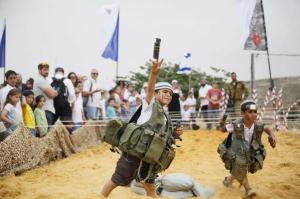
A key section of the film is given over to Hamas fighters, youth camp training and wielding weaponry. But there’s not a single frame of an Israeli soldier, or the mass military operation engaged in the attempted annihilation of Gaza’s people. There’s no questioning, either, of how Israel has socialised so much of its youth to hate and fear Palestinians.
Standing at a Hamas training camp, Doucet laments: “For the outside world it’s hard to comprehend why parents would put children in situations like this.” But there’s no exploration of how Israel as a militarist, occupying state has conditioned so much of its own population to join in the historic oppression and mass murder of Palestinians. Indeed, the word ‘occupation’ is never used.
At one point, Doucet sits with the smiling Gazan kids and asks one of them: ‘Why do you want to be a journalist?’ The child replies in lovely innocence: ‘So I can tell people what’s going on in wars like this one’. If only Doucet could aspire to that same basic aim. One might ask Doucet, in turn: Why do you want to be a stenographer rather than a journalist?
We see more pictures of Gaza’s ruins. Doucet says: “The donors promise a lot. But politics on all sides gets in the way.” This is the extent of her ‘explanation’ of the carnage Israel has caused, the devastation it’s unleashed, its refusal to help rebuild.
Doucet’s grating commentary, over inappropriately lilting music, continues, with affected questions on whether the hate and suspicion can ever be overcome.
A scene of more families coming to settle in Israel’s border locale raises not a word of comment on the nature of Israel’s land appropriation, historic displacement of people and enduring occupation. The indoctrination of Israeli children in defending this is never mentioned, nor is the stark privilege of Israeli kids against the appalling conditions and despair of the children in Gaza. Doucet just smiles and says nothing of the staggering disparities.
I hope the families that Doucet interviewed in Gaza get to see how they’ve been used and exploited in this shabby, deceitful film.
An end credit announces that both Israel and Hamas could be indicted for war crimes, and that: ‘In May and June there were more rounds of rockets fired from Gaza and Israeli airstrikes’, the clear inference, as throughout this deeply-loaded film, that Israel is always ‘responding’ to provocative weaponry.
This is one of the worst examples of ‘two sides’ reportage ever shown. Israel couldn’t have hoped for a greater piece of mitigating hasbara. Doucet’s film is one of the most shameful pieces of ‘war journalism’ ever put out by the BBC.
She doesn’t lack human empathy for the suffering Palestinian kids, such as little Syed, still haunted by the murder of his brother and three cousins on Gaza’s beach. What she lacks, much more profoundly, is a sense of compassionate duty to say why these appalling things happened, and are still happening, to name the principal perpetrators, to be a witness for truth and justice.
Doucet’s film is an abuse of journalism, and, in its pretentious evasions, an abuse of Gaza’s suffering children.
Thomas Friedman, the New York Times op-ed-page representative of the foreign-policy elite, is unhappy with how the overtime Iran nuclear talks are going. He says that President Obama, like his predecessor George W. Bush, hasn’t been tough enough. Obama holds all the cards, but somehow the Ayatollah Ali Khamenei is dictating terms. He writes:
It is stunning to me how well the Iranians, sitting alone on their side of the table, have played a weak hand against the United States, Russia, China, France, Germany and Britain on their side of the table…..
For the past year every time there is a sticking point … it keeps feeling as if it’s always our side looking to accommodate Iran’s needs. I wish we had walked out just once. When you signal to the guy on the other side of the table that you’re not willing to either blow himup or blow him off — to get up and walk away — you reduce yourself to just an equal and get the best bad deal nonviolence can buy. [Emphasis added.]
Friedman glosses over the fact that it is not “him” (foreign minister Javad Zarif?) who would be blown up in a war against Iran. It would be countless ordinary Iranians, who have done nothing to harm the American people. Those same innocent people would be harmed, admittedly in more subtle ways, if the P5+1 “blew off” Iranian negotiators because that would mean no relief from long-standing U.S.-led sanctions that have devastated the Iranian economy, boosting food and medicine prices among other inhumane consequences. Sanctions are acts of war. Would someone remind Friedman of that fact?
Friedman is ever the optimist, however. He believes it is still possible to get at least a “good bad deal,” the chances of a good deal having been blown by Obama’s “empty holster” strategy. It would be a deal “that, while it does not require Iran to dismantle its nuclear enrichment infrastructure, shrinks that infrastructure for the next 10 to 15 years so Iran can’t make a quick breakout to a bomb…. A deal that also gives us a level of transparency to monitor that agreement and gives international inspectors timely intrusive access to anywhere in Iran we suspect covert nuclear activity[.] One that restricts Iran from significantly upgrading its enrichment capacity over the next decade….” (As he notes, it would be deal approved by the Washington Institute for Near East Policy, which he fails to point out is a spin-off think-tank of the chief Israel lobbyist, AIPAC.
Before judging Friedman’s analysis, certain facts must be kept in mind. Iran has never had a program designed to build a nuclear bomb. You wouldn’t know from his column that Iran is a party to the nuclear Non-Proliferation Treaty (NPT), subjecting it to intrusive inspections for many years. During those years the International Atomic Energy Agency has unfailingly certified that Iran has diverted not one uranium atom to military purposes. As Gareth Porter heavily documents in his conveniently ignored book, Manufactured Crisis: The Untold Story of the Iran Nuclear Scare, Iran’s leadership has directed its nuclear research and facilities to the production of electricity and medical isotopes. The so-called evidence against Iran, Porter shows, is little more than the alleged contents of a suspect laptop, which has yet to be presented for independent verification. The nonthreat has been affirmed by U.S. and Israeli intelligence.
A few minutes’ thought will indicate that Iran’s leadership has many reasons not to want nuclear weapons, which Khamenei condemned in a fatwa some time ago. What exactly would Iran do with a bomb? The U.S. government has thousands, and Israel has a few hundred, including submarine-mounted nukes that would be available for a second strike if anyone were crazy enough to launch a first strike against the Jewish State. By the way, unlike Iran, Israel refuses to sign the NPT and thus is subject to no inspections.
In other words, Iran has been framed. Friedman is simply doing the bidding of those who want a U.S. war of aggression against the Islamic Republic — namely, Israel, the Israel Lobby/neoconservative alliance, and Saudi Arabia.
One of the top journalists to report on Palestine-Israel has died.
Donald Neff passed away on May 10 in his hometown of York, Pennsylvania, at the age of 84. The cause of death was heart disease and diabetes.
Neff was a luminous writer and meticulous reporter. From humble beginnings, he had reached the top ranks of American journalism. When he then turned his formidable talents to writing books and articles about Palestine, his contracts with mainstream American publishers dried up, his income plummeted, and his fame faded.
Today, even many activists in the growing Palestine solidarity movement are unaware of Neff’s groundbreaking work. This is unfortunate, since he exposed critical facts about Palestine with unparalleled precision and elegance. Much of the information he uncovered is still significant today.
During his long career, Neff reported on the Vietnam War from Tokyo and Saigon and was TIME magazine bureau chief in Houston, Los Angeles and Jerusalem. One of the first reporters on the scene at the Jonestown Massacre in Guyana, he also covered the Apollo moon landing and reported on the nuclear accident at Three Mile Island (not far from his hometown). In 1980 he won the Overseas Press Club of America’s prestigious Mary Hemingway Award for best magazine reporting from abroad for a 1979 cover story about Colombia’s cocaine network.
Neff was at TIME from 1965-1979. While based in Jerusalem, he exposed an incident that would change the course of his life.
In “Epiphany at Beit Jala,” an in-depth essay written for the November-December 1995 issue of The Link , Neff wrote about this incident and other eye-opening experiences covering the region.
Like most Westerners, Neff had arrived profoundly sympathetic to Israel. However, he wrote, “As my tour extended into years, I could not ignore a disturbing blindness in some of even the most gentle Israelis. They did not seem to see the Palestinians all around them… In general, this was just as well because when most Israelis did notice Palestinians their reaction to them was one of loathing or fear that quickly could escalate into violence.”
Neff’s experiences also revealed a power dynamic between the U.S. and Israel that he found astonishing.
He reported on Secretary of State Henry Kissinger’s frantic attempts to convince Israel to relinquish Egyptian land Israel had acquired through its 1967 war of conquest and had managed to retain through American support during the 1973 “Yom Kippur” war. The U.S. was calling on Israel to return it to Egypt. Israel refused.
“The extent of Israel’s ability to resist U.S. advice,” Neff wrote, “was my first great eye-opener in Israel. I had had little appreciation of the astounding depth and strength of Zionism’s influence in Washington. I was stunned that a country completely beholden to the United States could thumb its nose at Washington.”
Various encounters through the years caused Neff “deep uneasiness” about the views and beliefs of some Israel partisans in the U.S., raising “the question of dual loyalty to a level I had never realized existed.”
A man who had been serving in the U.S. Navy when Israel tried to sink the USS Liberty, killing 34 and injuring over 170 Americans, told Neff that he had been “torn by the dilemma of whether he could actually participate in a U.S. retaliatory attack against Israel.” (This never came.)
Another American Zionist showed Neff his Israeli passport alongside his U.S. one. Neff was taken aback; it had been illegal for Americans to hold dual citizenship. The man proudly informed him that the policy had been changed in 1967 by the Supreme Court, adding with emphasis that the case had been brought by an Israeli and the swing vote was cast by Abe Fortas.
In later researching Fortas, Neff discovered that Fortas was a Zionist and that among his first thoughts when he left the Supreme Court had been to visit Israel. “There was nothing wrong with that,” Neff wrote, “but it did indicate an attachment of such personal importance that he should have recused himself from the dual citizenship case.” This ruling, Neff wrote, “had destroyed a 200-year tradition.”
Neff’s most intense experience, the “epiphany” of his essay title, came in March 1978, when a freelance reporter called to say that she had “heard reports that Israeli troops had just conducted a cruel campaign throughout the West Bank against Palestinian youth. Many Palestinians had suffered broken bones, others had been beaten and some had had their heads shaved.”
When Neff repeated the report to his TIME bureau staff, all Jewish Israelis, they were indignant. The report was obviously false, they said, because “that is what was done to us in the Holocaust.”
Neff decided to check out the facts for himself, taking along a skeptical Jewish American friend who was living in Israel.
“We went into the small hospital and a young Palestinian doctor who spoke English soon appeared. Yes indeed, he said matter-of-factly, he had recently treated a number of students for broken bones. There were 10 cases of broken arms and legs and many of the patients were still there, too seriously injured to leave. He took us to several rooms filled with boys in their mid-teens, an arm or leg, sometimes both, immobile under shining white plaster casts.”
When TIME published Neff’s report, it provoked outrage from both Israeli authorities and American Zionists. The New York Times failed to report on the incident, making it seem for awhile that Neff’s report was inaccurate. It wasn’t until an Israeli official investigated the incident and confirmed Neff’s facts that other journalists finally reported on it.
As a result of his reporting, Neff was made an honorary citizen of Bethlehem.
After Neff returned to the U.S. he eventually decided to leave periodical journalism in order to write books. He signed a contract with Simon & Schuster and wrote the first in what was to be a trilogy about the Israeli-Arab wars of 1956, 1967 and 1973
The Chicago Tribune Book World described it as “A true thriller” and said that the story was “as sobering as it is fascinating…. important and compelling reading.”
The Tribune review, however, was to be among the few exceptions to a pattern later described by Ambassador Andrew Killgore, publisher of the Washington Report on Middle East Affairs.
Books on the Middle East that editors disliked, Killgore noted, would be assigned to “a Zionist reviewer… the reviewer usually is Jewish, never a Muslim and only occasionally a Christian. If none of the facts presented in the book can be refuted, the book’s substance has to be ignored.” Often they would simply go un-reviewed.
Neff’s second book, Warriors for Jerusalem: The Six Days That Changed the Middle East, came out in 1985 and was again praised by experts. Former Undersecretary of State George Ball called it indispensable to anyone who wanted to understand “why we are in such a dangerous mess in the Middle East.”
While the Christian Science Monitor called it “one of the most significant contributions to modern historical literature,” most newspapers ignored it.
American Zionists had long disliked Neff’s work. When his report on the Beit Jala incident came out, even some TIME colleagues had complained. Neff was called an anti-Semite to his face, while others shunned him.
Once again, Neff produced a powerful volume. Archibald B. Roosevelt, Jr., a grandson of President Theodore Roosevelt, a polyglot who spoke 20 languages, and a former CIA officer with considerable expertise in the Middle East, wrote: “As an observer of Middle Eastern affairs for more than four decades, I was impressed by the originality of Neff’s presentation and surprised by his devastating conclusions, assembled from facts previously known to most of us only piecemeal. It is not only a good read, but essential background for serious students of developments in the Middle East today.”
Neff’s next book, on the history of U.S.-Israel relations, was published in 1995 by the Institute for Palestine Studies, headquartered in Lebanon. A second, updated edition was published in 2002.
Neff himself, and many others, considered this his most important book. Fallen Pillars: U.S. Policy Towards Palestine and Israel Since 1945 provides a detailed history of how Zionists overcame the recommendations of U.S. diplomats, the Pentagon, and intelligence agencies to create today’s uniquely special relationship with Israel.
Citing a multitude of memos and official studies, Neff’s opus details U.S. officials’ failed attempts and frequent frustration at a special interest lobby that held more influence over U.S. policies than they did. Already by 1949 “Israeli officials were openly bragging about the power of the Jewish American community to influence U.S. policy.”
Fallen Pillars shows the deep roots of many current issues. “By 1968,” Neff reported, “the CIA was convinced Israel had produced nuclear weapons, or was capable of doing so, and informed President Lyndon Johnson. His response was to order the CIA not to inform any other members of the administration, including Defense Secretary Robert McNamara and Secretary of State Dean Rusk.”
Although, again, scholarly reviewers praised Neff’s book, most mainstream media chose not to review it. An exception was The Washington Post, which assigned it to Tad Szulc, a Jewish American journalist whose primary expertise was Latin America and Eastern Europe. Szulc called Pillars “deeply flawed” and charged Neff with being “more Palestinian than the Palestinians.”
Neff’s final book, Fifty Years of Israel, was published on the 50th anniversary of Israel’s creation. A collection of the “Middle East History” columns Neff wrote for this magazine beginning in 1993, its short, footnoted chapters were based on a detailed handbook compiled daily of events related to Israel and Palestine from 1947 to the end of the 20th century. (See excerpt in sidebar here.)
Long before Google and other Internet search engines made their appearance, Neff’s computerized database was a frequently called upon source of information for authors and journalists. As the Washington Report’s late executive editor, Richard H. Curtiss, noted in his introduction to Fifty Years: “Over the phone I could hear the ‘click, click’ as he entered into his computer—which seemingly always was turned on—the key words that brought up almost instantaneous answers to whatever questions I asked.”
Donald Neff brought honesty, precision, and courage to a topic of world-shaking significance that most top journalists feared or obfuscated. For this, he paid dearly.
Those working to rectify one of the world’s most significant injustices and causes of ongoing tragedy owe deep gratitude to Donald Neff.
I personally am profoundly indebted. I first stumbled across Neff’s books when I visited the Washington Report bookstore in Washington, DC in the spring of 2001. While I had already seen at first-hand Israel’s ferocious treatment of Palestinians, I was largely unaware of Israel’s power in and over the United States. Neff’s work was as enlightening as it was disturbing.
A few years later I had the honor of meeting Donald Neff in person and conducting a long interview with him about his work. (A few minutes from this are on a video If Americans Knew subsequently released.)
I expect that eventually Neff’s books and articles, like those of other journalists who worked to tell Americans about Palestine but were largely erased from public awareness, will be rediscovered, as a new generation intent on justice discovers the power and relevance of his pioneering work.
Neff is survived by his companion of 15 years, Washington Report managing editor Janet McMahon, as well as son Gregory Neff of York; two stepdaughters, Victoria Brett of Northampton, MA, and Abigail Miller of Portland, ME; a granddaughter; and two great-grandsons.
Three Israeli civilians are standing trial for killing a Palestinian teenager in a brutal murder last summer, and The New York Times is on hand to report the details. It is all meant to carry a clear message to readers: that democracy is at work in Israel and the law is on hand to deal out justice.
So we read that Israeli prosecutors are pressing defendants to admit their intent to kill, that the families of defendants and the victim are on hand and that the “cramped courtroom” in Jerusalem is crowded with judges, lawyers and observers.
But for all its detail, this story by Isabel Kershner is missing some crucial context: the fact that Israel runs a blatantly racist system of justice, with strikingly different treatment for Israelis and Palestinians. The present trial—for the murder of 16-year-old Muhammad Abu Khdeir, who was doused with gasoline, beaten and burned in a wooded area a year ago—is far from typical.
In reality, Israeli civilians and security forces rarely stand trial for attacks on Palestinians. A study by the Israeli human rights monitoring organization, Yesh Din, released this May, shows that Palestinian complaints against Israeli civilians lead to indictments only 7.4 percent of the time, and only a third of these (or 2.5 percent of the complaints) result in even partial convictions.
Security forces are also shielded from prosecution. Yesh Din notes that criminal investigations against soldiers are rare and even when they do take place, they are closed without indictments 94 percent of the time. And, Yesh Din states, “In the rare cases that indictments are served, conviction leads to very light sentencing.”
In the Times story Kershner quotes the parents of the victim, who are skeptical of the Israeli justice system. “It is all an act,” the boy’s father says. “They burned Muhammad once. Every day we are burned anew.”
Readers are likely to dismiss his misgivings as rhetoric and prompted by anger and grief. In fact, Palestinians have reason for doubting that they can find justice in Israeli courts.
West Bank settlers, for instance, are tried in civilian courts, while their Palestinian neighbors—even the children—face trial in military courts, which are notorious for their lack of due process and impossibly high conviction rates. As UNICEF noted in an extensive report on the abuse of Palestinian children in Israeli custody: “In no other country are children systematically tried by juvenile military courts that, by definition, fall short of providing the necessary guarantees to ensure respect for their rights.”
Palestinians tried in Israeli military courts are convicted 99.74 percent of the time, according to Israeli Defense Force data. Knowing this, most Palestinians and their lawyers opt for plea bargains and give up even the faintest hope of receiving a fair trial.
None of this appears in Kershner’s story, but the context of Israeli justice as it applies to Palestinians is crucial to understanding what is really happening here. The fact is, Israeli officials know the world is watching this trial, just as it watched events unfold after Abu Khdeir was abducted and killed. We can expect at least the appearance of justice to be on display.
The Times, which has ignored the hundreds of cases that show Israel in a far different light, is ready here to present Israeli prosecutors pressing for justice. Readers will not suspect that the newspaper has failed to inform them of other, less savory, outcomes to Israeli crimes against Palestinians.
We can name a few:
This past April, two years after 16-year-old Samir Awad of the West Bank village of Budrus was killed with three bullets to his back and head, the State Attorney’s Office opted to charge his accused assailant with the minor offense of a “reckless and negligent act using a firearm.” B’Tselem, the Israeli rights organization, called this decision “a new low in Israeli authorities’ disregard for the lives of Palestinians.”
In January Israel closed an investigation into the killing of Musad Badwan Ashak Dan’a, 17, in Hebron, four years after the event, saying there was no evidence available. In fact, the army investigating unit had plentiful evidence, including medical documents and eyewitness accounts.
Israel forces shot and killed Yusef a Shawamreh, 14, in March last year as he collected herbs near the Separation Barrier in the West Bank. Three months later, investigators closed the case, saying there was no breach of military rules involved. Videos of the incident show that the boy and his companions posed no possible threat to the soldiers or Israeli security.
All of these (and dozens of others) were newsworthy items, fit to print in the Times, but the newspaper has preferred to look away. Only Samir Awad’s name appeared briefly in an online Reutersstory that never made it into print; the others received no mention.
Now, however, Israel knows that the world is aware of the Abu Khdeir case, and a trial is in progress. It is likely that the prosecutors and judges will remain on their best behavior throughout the proceedings.
The Times, as well, is ready to present a narrative of Israeli justice at work. We can expect more reports from the Jerusalem courtroom, but readers are unlikely to learn that the trial is a rare event, an aberration in a system of flagrant inequality.
There’s something truly disturbing about the fact that British prime minister David Cameron’s efforts to decide how the media refer to Islamic State are being taken seriously. So seriously, in fact, that 120 MPs have backed the idea that the BBC should not use the name Islamic State and refer to the group by the Arabic acronym “Daesh” instead. Cameron’s argument is that Islamic State is neither Islamic nor a state.
The coverage has implied that the BBC is taking a brave editorial stand and refusing to kowtow to Cameron’s diktat. But there are already signs that the BBC may capitulate. In a statement, the BBC said: “We call the group by the name it uses itself, and regularly review our approach. We also use additional descriptions to help make it clear we are referring to the group as they refer to themselves, such as ‘so-called Islamic State’.”
Let’s put this debate in a little perspective. The Israeli army calls itself the “Israel Defence Forces”, or “IDF” for short. And yet it is not “Israeli” in the sense that it does not respresent all Israelis, especially the fifth of the population who are Palestinian, and it is not a defence force because its primary role is to enforce a belligerent occupation of Palestinians. So according to Cameron’s logic, he and the media should be referring to it as the “Zionist Occupation Forces”. I wonder if he can get 120 MPs to sign up to that idea.
Meanwhile, can we imagine the BBC issuing a statement saying that, though they refer to the Israel Defence Forces by the name they use for themselves, the broadcaster tries when possible to be clearer by using additional descriptions such as “the so-called Israel Defence Forces”?
And while we are on the subject, the world might look a very different place if groups could only call themselves names that reflected their true character. Not least Cameron’s own party would have to abandon its name the “Conservatives”. Since Margaret Thatcher began leading the party in the mid-1970s, there has been nothing “conservative” about the party in the sense that it believes in conserving tradition. At that point it became a party of neoliberal revolution, breaking up British society’s major institutions and implementing changes to allow financial speculators to sell off the family silver.
So let us agree that Cameron can insist on the BBC calling Islamic State “Daesh” when he also insists on the broadcaster referring to the Conservatives as the “Revolutionary Neoliberal Party”.
An Open Letter to Terry Allen, Noam Chomsky, Alexander Cockburn, David Corn, Chris Hayes, George Monbiot, Matthew Rothschild, and Matt Taibbi.
[1]According to several left-leaning critics of the 9/11 Truth Movement, some of its central claims, especially about the destruction of the World Trade Center, show its members to be scientifically challenged. In the opinion of some of these critics, moreover, claims made by members of this movement are sometimes unscientific in the strongest possible sense, implying an acceptance of magic and miracles. … Full article
This site is provided as a research and reference tool. Although we make every reasonable effort to ensure that the information and data provided at this site are useful, accurate, and current, we cannot guarantee that the information and data provided here will be error-free. By using this site, you assume all responsibility for and risk arising from your use of and reliance upon the contents of this site.
This site and the information available through it do not, and are not intended to constitute legal advice. Should you require legal advice, you should consult your own attorney.
Nothing within this site or linked to by this site constitutes investment advice or medical advice.
Materials accessible from or added to this site by third parties, such as comments posted, are strictly the responsibility of the third party who added such materials or made them accessible and we neither endorse nor undertake to control, monitor, edit or assume responsibility for any such third-party material.
The posting of stories, commentaries, reports, documents and links (embedded or otherwise) on this site does not in any way, shape or form, implied or otherwise, necessarily express or suggest endorsement or support of any of such posted material or parts therein.
The word “alleged” is deemed to occur before the word “fraud.” Since the rule of law still applies. To peasants, at least.
Fair Use
This site contains copyrighted material the use of which has not always been specifically authorized by the copyright owner. We are making such material available in our efforts to advance understanding of environmental, political, human rights, economic, democracy, scientific, and social justice issues, etc. We believe this constitutes a ‘fair use’ of any such copyrighted material as provided for in section 107 of the US Copyright Law. In accordance with Title 17 U.S.C. Section 107, the material on this site is distributed without profit to those who have expressed a prior interest in receiving the included information for research and educational purposes. For more info go to: http://www.law.cornell.edu/uscode/17/107.shtml. If you wish to use copyrighted material from this site for purposes of your own that go beyond ‘fair use’, you must obtain permission from the copyright owner.
DMCA Contact
This is information for anyone that wishes to challenge our “fair use” of copyrighted material.
If you are a legal copyright holder or a designated agent for such and you believe that content residing on or accessible through our website infringes a copyright and falls outside the boundaries of “Fair Use”, please send a notice of infringement by contacting atheonews@gmail.com.
We will respond and take necessary action immediately.
If notice is given of an alleged copyright violation we will act expeditiously to remove or disable access to the material(s) in question.
All 3rd party material posted on this website is copyright the respective owners / authors. Aletho News makes no claim of copyright on such material.