Adam Davidson’s Journalistic Corruption: NPR Host Boosts for Wall Street, While Taking Undisclosed Banking Money
By Yasha Levine and Mark Ames • S.H.A.M.E. • August 8, 2012
“I feel like the voice of business journalism is sort of, it’s an authoritative voice of God.”
—Adam Davidson
Adam Davidson is the co-creator and host of the popular economic news radio program Planet Money. On air, Davidson plays the role of an earnest, brainy reporter who’s doing his best to make sense of the complicated, jargon-filled world of finance to report business news in a way that NPR listeners can understand. However, behind the dweeby, faux-naive facade Adam Davidson presents to his listeners, is a shrewd propagandist with a long, consistent history of shilling for powerful and destructive interests—and failing to disclose his financial ties to the companies and industries he reports on.
Over the years, Davidson has boosted for the Iraq War and whitewashed the occupation of Iraq, praised sweatshop labor and “experimenting on the poor,” attacked the idea of regulating Wall Street, parroted libertarian propaganda about the government’s inability to directly create jobs, argued for “squeezing the middle class,” and shamelessly fawned over Wall Street for allegedly blessing Americans with “just about anything that makes you happy.” (Read Adam Davidson’s full S.H.A.M.E. profile.)
While Adam Davidson has recently come under increasing scrutiny for using his NPR platform to promote the narrow interests of the super-wealthy in this country, little attention has thus far been given to Davidson’s corruption—his numerous financial conflicts of interest that seriously undermine his claims to being a journalist, and instead reveal Davidson as a glorified product spokesman for his Wall Street sponsors.

Adam Davidson gained national media recognition as an on-air personality in 2008, after co-producing an episode for This American Life called “The Giant Pool of Money” about the implosion of subprime lending. Although Davidson’s segment was praised for making the murky world of finance easier to understand, his framing of the subprime housing debacle served another purpose: It let Wall Street off the hook for its role in rampant criminal mortgage fraud and predatory lending.
“This was a crisis that was caused by willing participation of every single person. Nobody was coerced,” said Davidson’s co-producer and partner in Planet Money, Alex Blumberg. “And there was fraud. But that was not what caused the crisis. What caused the crisis was something bigger and more systemic that required the involvement of everybody at every step.”
This evasion-by-exaggerating-the-complexity strategy is one that Davidson and Planet Money have deployed often to whitewash and deflect the role of criminality in the housing crisis. Among the show’s fans was Treasury Secretary and former New York Federal Reserve Bank chief Timothy Geithner: “Yeah, they did a good job.”
As a piece of journalism, Davidson’s report on the subprime fraud was a failure bordering on journalistic malpractice. By absolving the role of rampant predatory criminality and spreading blame in a grand false equivalency, Davidson provided a narrative frame that comforted the American Establishment at a time when it badly needed comforting, and was duly rewarded for his services. The mainstream media joined Timothy Geithner in lavishing praise on Davidson’s subprime fraud whitewash, and awarded him and his partner with the prestigious “Peabody Award” while New York University’s Journalism Institute named the segment one of the “Top Ten Works of Journalism of the Decade.”
Thanks to this broad acceptance and praise of Davidson’s whitewash, he was given his own show, which launched just as the entire financial system began to meltdown.
The new show, called Planet Money, was a partnership between NPR and Chicago Public Media’s This American Life, and was molded on Davidson’s successful subprime episode. Not surprisingly, Planet Money was compromised almost from the very start.
In early 2009, just a few months after Planet Money was launched, NPR announced it had secured Ally Bank (formerly GMAC) as the show’s exclusive sponsor. It was an unusual setup for NPR, and unusual (and highly dubious) for anything that called itself journalism, because it meant that a major, troubled financial institution was the only source of money for a news program about finance. At the time that the unusual agreement was signed, Planet Money was the only NPR program underwritten by a single exclusive sponsor. The arrangement raised eyebrows and would have been unthinkable before the crisis—but even by post-crisis funding arrangements, Planet Money’s deal with Ally Bank stood out as such an obvious violation of basic journalism standards that even Ad Age, the advertising industry’s trade publication, was taken aback by the “close alignment of message and news program.”
To understand why Davidson’s arrangement with Ally Bank is so odious, a little background is needed. Ally Bank is a subsidiary of Ally Financial, a giant financial services company formerly known as GMAC. There’s a good reason why GMAC would have wanted to change its name to “Ally Financial” after the financial collapse: The bank is one of the biggest mortgage servicers in the country, and has been one of the very worst offenders in foreclosure fraud and in the very same subprime fraud that Davidson whitewashed as a “blameless” phenomenon. GMAC deserves far more blame—and jail time—than any of the subprime borrowers it fleeced and ruined. Since GMAC collapsed in late 2008, it has received more than $17 billion of taxpayer bailout funds in a series of bailouts. As of August 1, 2012, 74% of Ally Financial was still owned by the U.S. Government. [ 1 ]
At the time Ally signed its sponsorship agreement with Planet Money, the bank was being investigated across the country for foreclosure fraud, robo-signing fraud, and student loan fraud. Even as bad bailed-out banks go, GMAC/Ally is considered one of the worst, most tainted of them all.

GMAC goes from thief to Ally…
Planet Money‘s relationship with Ally is a textbook example of “conflict of interest” of the sort every journalist is taught to shun. The bank had a clear and demonstrable interest in Planet Money‘s coverage of the financial industry, especially issues that affected the bank’s bottom line. As Planet Money‘s sole sponsor at a time when NPR funds were falling, Ally obviously wielded considerable power.
After Davidson sprang a vicious and bizarre smear-attack on Elizabeth Warren in 2009, some NPR listeners started to get wise to Planet Money‘s corruption problem, and made their concerns known. Following months of complaints from readers pointing to the conflict-of-interest and the way Planet Money‘s segments dovetailed with the banking lobby’s own propaganda—and with Ally’s interests—NPR’s Ombudsman was forced to issue a public statement on the Ally-Planet Money relationship. Perhaps not surprisingly, the NPR Ombudsman decided that listeners’ concerns over the conflict-of-interest were “cynical”—as if the problem lay in listeners’ psychology, rather than in Planet Money’s violation of basic journalism ethics. The NPR Ombudsman went further, arguing essentially that if listeners who complained about corruption weren’t cynical, then they were ignorant.
Despite Davidson’s long experience in sales and underwriting for public radio, he claimed he was out of the loop when it came to the deal his own show, Planet Money, cut with its sole sponsor, Ally Bank: “I have nothing to do with the underwriting stuff. We don’t pay any attention to the fact that they are a sponsor. We wouldn’t for a second give them any special treatment — positive or negative.”
And yet, the actual record proves that NPR readers were right to suspect and criticize the arrangement, and that Davidson was wrong in claiming that Planet Money has not consistently pushed a narrative so in synch with Ally Bank and the financial industry that it boggles the mind how he has gotten away with it. Planet Money coverage hasn’t just been friendly to banks and the finance industry in general—some of it has been suspiciously lined up and in synch with specific policy priorities of its exclusive sponsor, Ally Bank.
One example: In 2009, just as Planet Money inked its exclusive sponsorship deal with Ally Bank, Davidson began broadcasting a number of segments critical of the proposed Financial Consumer Protection Agency Act of 2009, questioning the need to regulate consumer financial products like mortgages and credit cards in order to protect people against bank fraud. “Will it work at all?” Davidson asked in one of his fake “gee-whiz” questions. “Is this just one more layer of regulation in a regulatory system that fundamentally broke down?”
In May 2009, in the heat of the banking industry’s massive pushback, Davidson essentially mugged Elizabeth Warren, the chief architect of the financial consumer protection bill, in an interview that took a sharp and bizarre hostile turn early on. Davidson surprised Warren and his own listeners with uncharacteristic personal smears, trying to portray her as a clueless, power-hungry ideologue. Davidson’s attack on Warren was so out-of-line and uncharacteristically hostile that it sparked a torrent of criticism from NPR listeners who couldn’t understand why Davidson or NPR would do such a thing. Keep in mind, this was in the spring of 2009, when unemployment was still shooting through the roof, the future of the economy was in doubt, and talk of a 1930s style Great Depression-2 was still front-and-center.
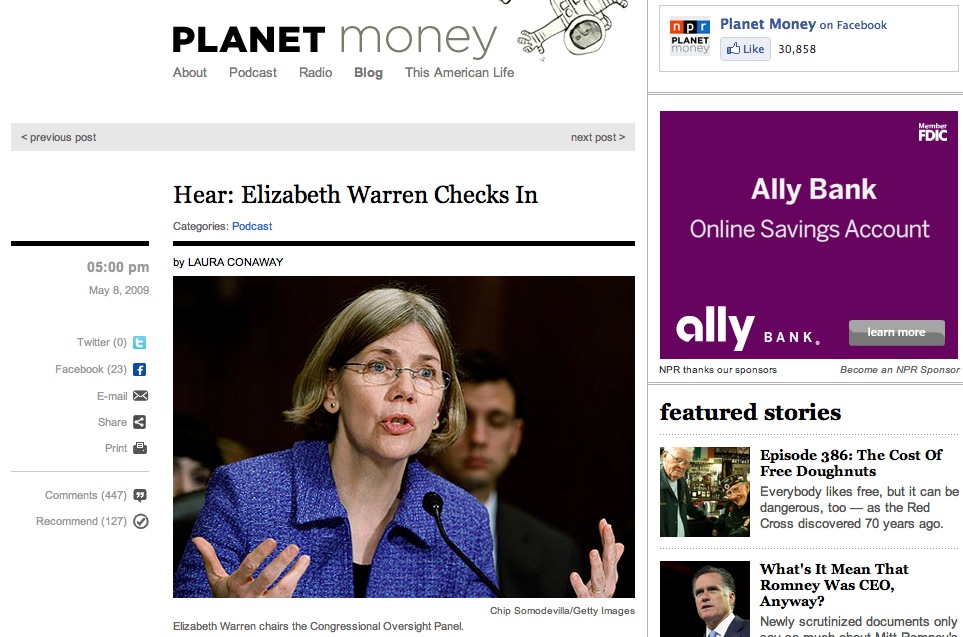
It’s worth going back and listening to the interview to get a sense of just how malevolent Davidson really was, and is. Here’s an excerpt, courtesy of Corrente:
ADAM DAVIDSON: What it feels to me is what you are missing is that — I think we put aside your pet issues. We put them aside. We put them aside until this crisis is over.
ELIZABETH WARREN: The cr– What you’re saying makes no sense. Now come on. [interpolate Davidson sputtering and attempting to interrupt throughout.] It makes no sense. On an emergency basis, on one day, one week, one month, there’s no doubt in my mind we’ve got to step in, we’ve got to make sure we have a functioning banking system. I think I’ve said that like nine times now. Of course we’ve got to have a functioning banking system.
DAVIDSON: Wait a minute. I want to make you go farther. I want to make you madder before I —
ELIZABETH WARREN: No no no. [Davidson snickers] We’re now at what — we’re now seven, eight months into this. And it’s the second part of what you said. We can’t do anything about the American family until this crisis is over? This crisis will not be over until the American family begins to recover. [More Davidson sputtering.] This crisis does not exist independently —
DAVIDSON: That’s your crisis.
ELIZABETH WARREN: No it is not my crisis! That is America’s crisis! If people cannnot pay their credit card bills [Davidson tries to interrupt] if they cannot pay their mortgages —
DAVIDSON: But you are not in the mainstream of views on this issue. You are not —
ELIZABETH WARREN: What, if they can’t pay their credit card bills the banks are gonna do fine? Who are you looking at?
DAVIDSON: The [sputters]–
ELIZABETH WARREN: Who says a bank a bank is going to survive — Who is not worried about the fact that the Bank of America’s default rate has now bumped over 10%? That’s at least the latest data I saw. So the idea that we’re going to somehow fix the banks and then next year or next decade we’re going to start worrying about the American family just doesn’t [Davidson talking over] make any sense.
DAVIDSON: The American families are not — These issues of crucial, the essential need for credit intermediation are as close to accepted principles among every serious thinker on this topic. The view that the American family, that you hold very powerfully, is fully under assault and that there is — and we can get into that — that is not accepted broad wisdom. I talk to a lot a lot a lot of left, right, center, neutral economists [and] you are the only person I’ve talked to in a year of covering this crisis who has a view that we have two equally acute crises: a financial crisis and a household debt crisis that is equally acute in the same kind of way. I literally don’t know who else I can talk to support that view. I literally don’t know anyone other than you who has that view, and you are the person [snicker] who went to Congress to oversee it and you are presenting a very, very narrow view to the American people.
The Columbia Journalism Review described the Planet Money interview as a “disaster” and “really cringeworthy stuff from Davidson,” who was so rude and unprofessional that NPR’s Ombudsman was forced to issue a public apology for his behavior. Davidson’s excuse: he had been traveling for a NPR fundraiser and was “very, very tired.”
What Adam Davidson did not disclose to the public was that at the same time he was smearing Elizabeth Warren and attacking legislation that would protect consumers against the sort of bank fraud that has devastated millions of Americans, Ally Bank, the sole sponsor underwriting Davidson’s Planet Money show and his salary, was simultaneously spending hundreds of thousands lobbying against the Financial the Consumer Protection Agency Act of 2009.
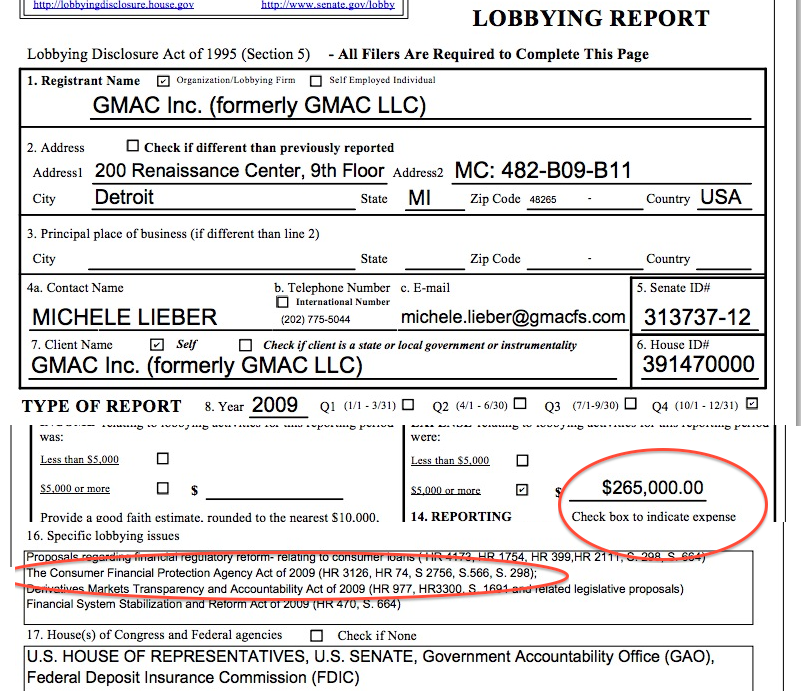
Evidence: Here’s just one of GMAC’s lobbying disclosure forms mentioning the Consumer Financial Protection Agency Act of 2009
Ally Bank is not the only financial company funding Adam Davidson’s career, and filling up his bank accounts.
On top of Ally Bank’s exclusive sponsorship of Planet Money, Davidson earns lucrative speaking fees from banks and financial companies, including J.P. Morgan, Well Fargo, Bank of America and Goldman Sachs—the same companies he covers as a journalist. Davidson is frequently the only journalist/reporter booked to speak at these events; other speakers usually work in finance.
Davidson has yet to disclose his corporate clients and how much they pay him, but here is a partial list of Davidson’s speaking gigs from the last two years compiled from various publicly available sources:
- In April 2011, Davidson was the headlining speaker at the 9th Annual “Women’s World Banking” Microfinance and the Capital Markets Conference. The conference was hosted by J.P. Morgan, but the organization itself is funded by the world’s biggest banks and corporations, including BP, Morgan Stanley, Pfizer, Barclays Capital, VISA, ExxonMobil—just to name a few.
- In 2011, Davidson spoke at another microfinance conference, this once was also funded by Morgan Stanley, Citi, Bank of America, Deutsche Bank and CapitalOne.
- In 2012, Davidson spoke at the 27th Annual Conference for the Treasury & Finance Professional. Sponsors of the event included Bank of America, BlackRock, BNY Mellon, Bloomberg, Citibank, Findelity Investments, Goldman Sachs, J.P. Morgan, Morgan Stanley, Well Fargo and about a dozen of the most powerful financial the largest financial companies in the world.
These speaking fees are a huge unaddressed problem in news media and academia. As explained by Charles Ferguson, director of Inside Job and author of Predator Nation, the problem with speaking fees is that they are “sometimes used to launder or disguise payments . . . for lobbying and policy advocacy.” That is why, for example, Obama’s former economy czar Larry Summers was roundly criticized for taking hundreds of thousands of dollars in speaking fees in 2008 from the same banks he was bailing out in 2009.
Chicago Public Media, which co-owns “Planet Money” through its ownership of “This American Life”, explicitly bars conflicts-of-interest: “WBEZ journalists must uphold the trust of the public by not overlapping individual interests with professional responsibilities. WBEZ journalists may not accept any form of compensation from the individuals, institutions or organizations they cover.”
Neither NPR nor This American Life would comment on S.H.A.M.E.’s investigation into Adam Davidson’s conflicts of interest. We will be seeking to get comment from Davidson’s other employer, The New York Times, about their policy on journalists having conflicts-of-interest.
Notes
See Naked Capitalism’s coverage of GMAC/Ally’s mortgage fraud.
“Murdered” Russian General dispels Syrian rebels’ claims of his death
PanARMENIAN.Net – August 8, 2012
Russia’s Defense Ministry dismissed as “complete lies,” Free Syrian Army claims on Wednesday, August 8 that it had killed a Russian general, RIA Novosti said.
“The goal of broadcasting such statements is not just to cause a sensation, but a clear attempt at a slur toward the Russian Army,” the Defense Ministry press service said in a statement.
Major General Vladimir Kuzheev, whom Syrian rebels earlier claimed to have killed, on Wednesday met with journalists at the Russian Defense Ministry and personally dismissed the reports about his death.
“I want to express thanks to the media for their attention to my person…I want to confirm that I am well and alive, live in Moscow…I realize that this information is a provocation not only against me but against my country,” Kuzheev said.
Al Arabiya broadcast a video earlier on Wednesday in which the Free Syrian Army claimed to have killed General Vladmir Kojaiv and his Syrian translator, and showed what the FSA claimed was his identity card with a photo.
Related articles
- Russia denies death of Russian general in Syria (english.ruvr.ru)
- ‘Killed’ Russian general safe and sound – Interfax (english.ruvr.ru)
- ‘Information about my death provocation’ – general Kuzheyev (english.ruvr.ru)
Good old Israel?
By Georgina Reeves | Palestine: a journal of everyday occupation | August 5, 2012
In his latest piece written for the New York Times, Avraham Burg asks: “Where is the good old Israel?” Assuming he is not being tongue-in-cheek, and there is no suggestion in the rest of the article that he is, he continues to peddle the same old clichés that liberal Zionists are so fond of. Propaganda is a powerful tool, but so is the truth.
He talks of the early days of Israel’s foundation: “It was an age of dreamers and builders who sought to create a new world, one without prejudice, racism or discrimination.” He neglects to mention, though, the Palestinians who remained in what became Israel, and how the new state treated them.
From 1948 until 1966, Palestinians lived under martial law. They required permits issued by the military governor to leave their villages or towns. Palestinians were subject to curfews, administrative detention – detention without charge or trial – and expulsions were common. As Palestinians were concentrated mainly in the Galilee, the Negev and the Triangle, subjecting them to such strict measures of control was simple for the authorities.
Alongside the physical restrictions on Palestinians, the newly-created state of Israel also enacted laws designed to dispossess Palestinians of their land and their rights to their land. The Absentees Property Law aimed to take ownership of property and land belonging to Palestinians. The term “absentee” was carefully applied and targeted Palestinians who had been expelled from their homes during the war of 1948.
This law applied to Palestinians who had been made refugees and were now outside Israel, and also to those who were now in Israel but living as internally displaced persons. Israel calls these Palestinians “present absentees”, an Orwellian state of being which denies them access to their homes, even though many live in the same area and their homes are still standing (unlike the 500-plus towns and villages razed to remove the evidence of Palestinians’ existence on the land for many hundreds of years before).
Burg goes on to say “But something went wrong in the operating system of Jewish democracy. We never gave much thought to the Palestinian Israeli citizens within the Jewish-democratic equation.” But that is just not true. A lot of thought went in to how to treat the non-Jewish citizens of Israel. Even before 1948 the Zionists were planning how to gain as much land with as few Palestinians as possible: for the Zionist plan of the Jewish state to become reality, Arabs had to be removed.
Yossef Weitz, director of the Jewish National Fund played a major role in acquiring land for the Yishuv (pre-1948 Jewish community). He stated: “Transfer does not serve only one aim—to reduce the Arab population—it also serves a second purpose by no means less important, which is to evict land now cultivated by Arabs and to free it for Jewish settlement. The only solution is to transfer the Arabs to neighbouring countries. Not a single village or a single tribe must be let off.”
The Dalet plan was devised during February 1948 by the Haganah – the Jewish paramilitary organisation succeeded by the Israeli Defence Forces upon Israel’s establishment. The plan was simple: the systematic expulsion of the Arab communities. The expulsions were conducted by the Palmach (elite Haganah fighters), the Irgun and the Stern (Lehi) gang. Villages and towns were attacked, depopulated and destroyed.
The men who designed and fought the war of 1948 were the same men who designed and created Israel after that war. Prejudice, racism and discrimination characterise the Israel they built and the Israel that exists today. The truth is there never was a “good old Israel”.
Related articles
- Palestinian voice from Susiya, a Palestinian village that existed before the establishment of the State of Israel (alethonews.wordpress.com)
- Samah Sabawi responds to Liberal Zionists (alethonews.wordpress.com)
Where’s the Outrage: Nobody Seems to Care as America Becomes a Police State
By Dave Lindorff | This Can’t Be Happening | July 31, 2012
Back in 1976, I co-founded, with some Los Angeles colleagues, a feisty little alternative weekly called the L.A. Vanguard. About two months after we launched it, I got tipped off about a program by the local phone companies, Pacific Telephone and GTE, in which they had so-called “Security Departments,” composed of banks of operators, whose sole job was to provide unlisted phone numbers to inquiring government agencies, all without a warrant. As I delved into this story I learned more: these special operators (led in each case by retired FBI officials) were also providing credit information on phone customers on request, and the agencies who had instant access to all this data ranged from local police to the public library.
When we broke the story, it exploded on the Los Angeles media scene. There was a banner headline across the whole top of the Los Angeles Times front page screaming “Unlisted Numbers Given Out.” We at the L.A. Vanguard, to promote our little paper and being guerrilla journalists, announced that we were holding a protest and press conference on the sidewalk in front of the main entrance of the Pacific Telephone building in L.A., at which we’d be handing out copies of our newspaper. We were mobbed by reporters and camera crews from every media organization in the city. It was huge. Pacific Tel’s PR people realized they had to respond and invited everyone inside for an impromptu news conference at which they tried to quell the furor, but they only made it worse by having to admit the scale of the program.
Now I understand that Los Angeles, which is home to more celebrities per square foot than any other place in the world, has a thing about privacy, but this story even went national. It was simply shocking at the time to learn that the phone company would provide police and other government agencies — even the over-due books department of the library! — information about a customer’s sacred unlisted number without even requiring that they first obtain a warrant from a judge.
My investigative exposé led to hearings by the California Public Utilities Commission (PUC), at which the various government agencies were compelled to explain how they used the information they were obtaining from the phone companies and to justify their need for it, and the phone companies were forced to explain why they were so casually releasing the information, and why they were using ratepayers’ money to pay for a special group of operators to provide it. In the end there were restrictions placed by the PUC on the companies and on the number of agencies able to get access to unlisted numbers.
Today, such a story would be seen as quaint. It probably would not even be published in a major newspaper, and I doubt it would even make the first page of the Hollywood Reporter, trade publication for the film industry. Certainly no regulatory agency like the state PUC would bother to hold hearings on it.

The May 29, 1976 front page of the LA Times, picking up a scoop from a local leftist weekly
America has been so degraded as a free society that such intrusive violations of our privacy by a police agency or a librarian are now accepted by most people as normal and to be expected. (Actually, in fairness to librarians, they have emerged lately as some of the last remaining defenders of privacy, often refusing to let nosy police find out what books and videos patrons have been checking out unless served with a warrant.)
I was driving home to Philadelphia from the Catskills yesterday, on I-476, the northern leg of the Pennsylvania Turnpike, and saw a sign warning that speeders were being monitored from the air, and I immediately thought about drones. When I saw such signs in the past on a highway, I would immediately look up at the sky to see if it was cloudy or clear. If it was blue sky, I’d look for a spotter plane, which you could sometimes find. Cloudy meant that the police would not be up there, as they wouldn’t be able to see us drivers. Today it could easily be a small drone that I wouldn’t even notice doing the monitoring, and it would be using radar to tag speeders, so you’d be vulnerable day or night, rain or shine.

Coming to your neighborhood soon: Police spy drones
In fact, I’ve noticed that on the 10-mile southernmost stretch of Rt. 309, a local controlled-access highway that runs from past my house and on down to the outskirts of Philadelphia, the state has installed video cams and radar devices that film and monitor the speed of all traffic going into and out of the city on a round-the-clock basis. We are being monitored at all times. So far the state cops or Department of Transportation have not been issuing speeding tickets with these cameras, but it’s only a matter of time. They already have cameras at major intersections all over Philadelphia and are mailing out automated $100 tickets to people alleged to have run red lights.
How far away are we from the day that local authorities in suburbia will be flying drones around the neighborhood tallying up the number of dandelions in people’s yards, and issuing warnings that they need to apply toxic herbicides to kill them or face a fine? You’re laughing? There are already laws in many communities that can compel people to mow their lawns or to clear out their dandelions or face a stiff fine. What they don’t have yet is a cheap way of monitoring people’s lawn-care proclivities. But it’s coming.
What strikes me as I think back to my big scoop about the California phone companies’ unlisted numbers racket (for which I won a major award from the Los Angeles Press Club!), is how much American citizens, over the intervening 36 years, have come to accept all this spying and invasion of privacy as normal, and perhaps even as desirable.
Of course 9-11 is a big part of this. The trumped up “War” on Terror launched in September 2001 has become a justification for all kinds of spying and other police activity, and not just by federal agencies. Even my little town of Upper Dublin has now has got its own SWAT van stuffed with Pentagon-provided military gear; there’s also a “major incident response unit” van, even bigger, which is also stuffed with military weaponry. Meanwhile, every police car in the village is equipped with an M-16, and we have 40 cops to police a quiet town of 26,000. That’s one cop for each 650 people in a town that hasn’t had a homicide in at least five years, that averages three robberies, 400 property offenses, one arson and 90 “alcohol offenses” a year! I don’t know how much surveillance and monitoring our local police do, but I do know that just driving and walking around town here, I see local cops on patrol more often than I used to when I lived in China, a certified police state.
Last fall, during the height of the Occupy Movement, I spent a little time at the Zuccotti Park encampment in lower Manhattan’s financial district. There were more police there than there were demonstrators on two of my visits. That’s how it looked too in the videos and news reports I saw of some of the OWS street actions. That should be as much of a scandal as was the brutish behavior of those cops, with their clubs, their pepper spray, and their other weapons, all deployed against avowedly non-violent political protesters.
But where is the public outrage at all of this?
I’ll admit that our corporate media have really given up being real sources of news. (Just consider that the lead story on the front page of the Philadelphia Inquirer on Monday was “Romney Strongly Defends Israel,” which surely ranks right up there as the ultimate example of dog-bites-man non-news one can imagine! With that sorry level of news judgement it’s no wonder important stories are going unreported) But how can there have been such public and media outrage back in 1976 simply over a news report that the phone company was providing unlisted number information to police on request, and then today, there is almost no concern even at the prospect of police spy drones hovering over our neighborhoods 24/7 taking photos of our every move, and at reports from agency whistleblowers that the National Security Agency is already monitoring the electronic communications of all Americans?
What has happened to the “Land of the Free and the Home of the Brave”?
Related articles
- Electric eye on America: US set to deploy drones for home use (judgementofamerica.wordpress.com)
NBC Invents War-o-tainment
By David Swanson | War is a Crime | July 29, 2012
 If you’ve watched the Olympics on NBC you’ve probably seen ads promoting a war-o-tainment reality show cohosted by retired U.S. General Wesley Clark, co-starring Todd Palin, and with no apparent role for reality.
The ads brag about the use of real bullets in a way that promoters of the new Batman movie probably wouldn’t try. But the chances that any of the celebrities engaged in “war competition” on NBC’s “Stars Earn Stripes” will be shot and killed is essentially what it was for John Wayne, as he promoted war while dodging it (even if nuclear weapons testing got him in the end).
RootsAction.org and Just Foreign Policy have set up a website at StarsEarnStripes.org to push NBC to show the real cost of war, and to help get them started.
“Stars Earn Stripes” is being produced by the TV “genius” behind Donald Trump’s “Apprentice” and “Sarah Palin’s Alaska.” (Husband Todd Palin is a “Stars Earn Stripes” co-star.) NBC is promoting the show during its Summer Olympics telecast as the next big sporting event. But the sport it’s exhibiting is war.
On “Stars Earn Stripes,” celebrities will pair-up with members of the U.S. military to compete at war-like tasks, including “long-range weapons fire.” Only there won’t be any of the killing or dying.
Our wars kill huge numbers of people, primarily civilians, and often children and the elderly. NBC is not showing this reality on its war-o-tainment show any more than on its news programs. Other nations’ media show the face of war, giving people a very different view of war-making.
NBC news programs have repeatedly used retired generals, pretending independence but getting their pro-war talking points from the Pentagon. See New York Times: Behind TV Analysts, Pentagon’s Hidden Hand and Glenn Greenwald: The Pulizer-Winning Investigation That Dare Not Be Uttered on TV.
In the United States, our tax dollars are spent by the billions each year marketing the idea that war is a sport and associating the military with sporting events. Media companies like NBC are complicit in the propaganda. While 57% of federal discretionary spending goes to the military, weapons makers can’t seem to get enough of our tax dollars. In the spirit of transferring veterans’ care to the realm of private charity, “Stars Earn Stripes” will give prize money each week to “military-based charities” in order to “send a message.”
One of NBC’s corporate parents, General Electric, takes war very seriously, but not as human tragedy — rather, as financial profit. (GE is a big weapons manufacturer.) A retired general hosting a war-o-tainment show is another step in the normalization of permanent war. And consider for a moment who that retired general is. During the 1999 bombing of Yugoslavia commanded by Gen. Wesley Clark, civilians and a TV station were bombed, while cluster bombs and depleted uranium were used. Had Clark done these things for another nation, NBC would probably favor his prosecution and certainly not employ him. See Democracy Now! Confronts Wesley Clark Over His Bombing Of Civilians.
StarsEarnStripes.org is asking NBC to stop treating war as a sport, and to air an in-depth segment showing the reality of civilian victims of recent U.S. wars, on any program, any time in the coming months. We’ve provided some resources to help NBC research and show the reality of war, at http://StarsEarnStripes.org
Israel, US Bent on Brewing Iran Crisis
By Ismail Salami | Palestine Chronicle | July 29, 2012
Tehran – A report published on Sunday in Ha’aretz reveals that US National Security Adviser Tom Donilon has presented Washington’s contingency plans for a possible attack on Iran to Israeli Prime Minister Benjamin Netanyahu once the nuclear negotiations reach an impasse.
However, the report was immediately denied by a top Israeli official who spoke on condition of anonymity. He said, “Nothing in the article is correct. Donilon did not meet the prime minister for dinner, he did not meet him one-on-one, nor did he present operational plans to attack Iran.”
A quick justification for this denial could be that such a contingency plan was not supposed to be publicized and should have remained confidential for as long as necessary.
Still, there is no denial that Washington and Israel are the two sides of a coin and it is manifest that they have in their political wheeling and dealing formed a united front against Iran.
US GOP presidential candidate Mitt Romney has recently paid a visit to Israel to marshal up support of the Israelis on the one hand and express his unswervingly servile commitment to Israel (including his anti-Iran stance) on the other. Dan Senor, a top foreign policy adviser for the GOP presidential candidate, says that Romney would support “Israel’s decision to launch a military strike against Iran to keep that country from achieving nuclear capabilities, but hopes diplomatic and military measures will dissuade Tehran from pursuing its path toward nuclear acquisition.”
Furthermore, he told reporters ahead of the speech, planned for late Sunday near Jerusalem’s Old City, “If Israel has to take action on its own, in order to stop Iran from developing the capability, the governor would respect that decision.”
With a more somber tone, however, Romney himself has repeatedly said that he has a “zero tolerance” policy toward Iran obtaining the capability to build a nuclear weapon.
In the recent past, Washington has frequently threatened Iran with a military strike. The threats, which evidently run counter to all international laws, are generally uttered by a massive number of officials influenced by the powerful Zionist lobby in Washington. A brazen instance of these threats is that Washington may use the 14-ton bunker buster (20ft long, 1ft wide weapon) known as Massive Ordnance Penetrator (MOP), the world’s largest conventional bomb against Iran nuclear sites. Michael Donley, the US Air Force Secretary, said the bomb would be available if necessary.
“We continue to do testing on the bomb to refine its capabilities, and that is ongoing,” he said “We also have the capability to go with existing configuration today.”
In order to justify their illegal threats and sanctions, the US has apparently embarked on a systematic program of fomenting Iranophobia in the US and the rest of the world. In this pernicious Iranophobic campaign, a number of groups and parties including the Tea Party, neocons and AIPAC are actively involved.
By this program, the US is hell bent on distorting the realities of the Islamic Republic as well as brainwashing public opinion in the world into believing that Iran is seeking to build nuclear weapons, and that Iran poses a grave danger to the security of the world. In this smear campaign, Washington also makes use of its allies including Saudi Arabia, Qatar and Israel in the region.
A politically bankrupt politician who does have but little respect in his own country, Romney follows the selfsame Iranophobic campaign, takes an aggressive stand on Iran in Israel where he is falsely emboldened and says Tehran’s leaders are giving the world “no reason to trust them with nuclear material.” He even voiced support for an Israeli decision for military action “to prevent Iran from gaining nuclear capability”.
“Make no mistake: The ayatollahs in Tehran are testing our moral defenses. They want to know who will object, and who will look the other way. My message to the people of Israel and the leaders of Iran is one and the same: I will not look away; and neither will my country.”
These facts aside, the duo have recently started a string of false flag terrorist attacks taking place in different parts of the world. With Washington pointing the finger of blame at Iran, Israel feels more fallaciously entitled to tone up its war rhetoric against the Islamic Republic and make the best of the fabricated ops. In the same line, former UN Ambassador John Bolton has called on the Zionist entity to attack Iran in retaliation for the alleged killing of Israeli tourists in Bulgaria, saying “the time has come for the Jewish state to quit threatening and take action”.
“This is obviously a very dangerous period for Israel with the civil war in Syria, refugees reported going across the border into Lebanon, and Hezbollah well armed with rockets on Israel’s northern border,” Bolton told Fox News’ Greta Van Susteren Thursday night. “So I think if there were ever a time to retaliate, and directly against Iran this time, this is it.”
In the final analysis, one can see that the real threat in the world is being posed and imposed by those warmongers in Washington who will turn the situation to the best of their own interests in the region as well as by Israel who will in the wake of a war against Iran reap the benefits of such aggression if of course they ever outlive such an act of belligerence.
– Dr. Ismail Salami is an Iranian writer, Middle East expert, Iranologist and lexicographer. He writes extensively on the US and Middle East issues.
Related articles
- Smiles and Denials: Official Israeli and Iranian Statements Demonstrate a Double Standard (alethonews.wordpress.com)
Smiles and Denials: Official Israeli and Iranian Statements Demonstrate a Double Standard
By Nima Shirazi | Wide Asleep in America | July 24, 2012
Reacting to the immediate Israeli accusations that Iran was behind the blast that killed Israeli tourists in Burgas, Bulgaria, Foreign Ministry spokesman, Ramin Mehmanparast, insisted, “The Islamic Republic of Iran, which itself is the biggest victim of terrorism, considers any act that endangers the lives of innocent people in order to fulfill illegitimate political objectives as inhumane and strongly condemns it.”
The official IRNA news agency quoted Mehmanparast as saying, “The Zionist regime, which had a direct role in the assassination of our country’s nuclear scientists, is leveling baseless accusations to divert global attention to its own terrorist nature.”
Despite incessant allegations – devoid of evidence, of course – of Iranian culpability, the BBC reports that Bulgarian Prime Minister Boiko Borisov has consistently “declined to back Israeli claims that Iran and the Lebanese militant group Hezbollah played a role.”
A bogus story in the Times of Israel which claimed that Iranian President Mahmoud had gloated over the Burgas bus bombing has been successfully debunked by both myself and BBC Persian correspondent Bahman Kalbasi. Still, it may be illuminating to consider the differences between the actual Iranian response to the terrorist attack in Bulgaria that took the lives of Israeli vacationers and the Israeli response to the multiple murders of Iranian scientists on the streets of Tehran, often when they have been accompanied by members of their family, going to work, or dropping their children off at nursery school.
The targeted killings of Iranian professors and scientists have widely been considered to be the work of Mossad, either on its own or in conjunction with Iranian terrorist organizations. Yet, in response to the murders, the Israeli government has never issued an official denial of responsibility.
On January 11, 2012, the day 32-year-old Mostafa Ahmadi-Roshan was murdered in his car, Israel’s top military spokesman, Brigadier General Yoav Mordechai, posted on his Facebook page: “I don’t know who settled the score with the Iranian scientist, but I certainly am not shedding a tear.”
What possible “score” could be settled by killing a man who works at a nuclear facility that is fully safeguarded and monitored by the IAEA remains a mystery, especially considering that – as a Reuters Special Report affirmed earlier this year – “[t]he United States, European allies and even Israel generally agree on three things about Iran’s nuclear program: Tehran does not have a bomb, has not decided to build one, and is probably years away from having a deliverable nuclear warhead.”
Responding to the murder of Ahmadi-Roshan, married and the father of a young son, Time Magazine quoted a “senior Israel official” who smiled and said, “Yeah, one more. I don’t feel sad for him.”
Confronted with the claim that Israel was responsible for the targeted killing, an anonymous Israeli official told The Washington Post, “It is not our policy to comment on this sort of speculation when it periodically arises.”
During an interview with CNN shortly after Ahmadi-Roshan’s killing, Israeli President Shimon Peres was also asked about Israel’s involvement. He replied dismissively: “Not to the best of my knowledge.”
Meanwhile, Mickey Segal, a former director of the Israeli military’s Iranian intelligence department, said, “Many bad things have been happening to Iran in the recent period. Iran is in a situation where pressure on it is mounting, and the latest assassination joins the pressure that the Iranian regime is facing.”
Ahmadi-Roshan’s murder came the day after IDF Chief Benny Gantz reportedly told a Knesset panel that 2012 would be a “critical year” for Iran, not least of all because of “things that happen to it unnaturally.”
Now imagine if any of these statements had come from Iranian officials about Israel this past week. And think what we’d be hearing if Iran’s Foreign Ministry had yet to issue a statement about the Burgas bombing, with the claim that it is not Iran’s “policy to comment on this sort of speculation.” Still, Iran’s denials are dismissed as yet another instance of devious Persian duplicity, while Israel’s smug silence is simply ignored, or even admired.
Of course, while denial doesn’t mean absolution and silence isn’t necessarily complicity, the double standards of international expectation, obligation, and suspicion when it comes to Israel and Iran remain as stark as ever.
*****
July 25, 2012 – Addressing a United Nations Security Council meeting today, Iran’s U.N. Ambassador Mohammad Khazaee stated, “It’s amazing that just a few minutes after the terrorist attack, Israeli officials announced that Iran was behind it,” adding, “We have never and will not engage in such a despicable attempt on [the lives of] innocent people.”
Khazaee even suggested that Israel itself was behind the bombing. “Such terrorist operation could only be planned and carried out by the same regime whose short history is full of state terrorism operations and assassinations aimed implicating others for narrow political gains,” he said. “I could provide… many examples showing that this regime killed its own citizens and innocent Jewish people during the last couple of decades.”
While such an allegation is surely reactionary and hyperbolic (the result, one can assume, of a frustrating week of unfounded and unsubstantiated accusations), it is nevertheless grounded in the fact that Israel has engaged in false flag operations many times before.
Related articles
- Iranian bomb in Bulgaria: Cui Bono? (alethonews.wordpress.com)
- Why the Buenos Aires Bombing is a False Indicator on Burgas (alethonews.wordpress.com)
Featured Video

Iran’s Next Strike May Not Explode. It Could Shut You Down
or go to
Aletho News Archives – Video-Images
From the Archive
Zionism’s Violent Legacy
By Donald Neff | Washington Report On Middle East Affairs | January 1996
On January 4, 1948, Jewish terrorists drove a truck loaded with explosives into the center of the all Arab city of Jaffa and detonated it, killing 26 and wounding around 100 Palestinian men, women and children.[1] The attack was the work of the Irgun Zvai Leumi – the “National Military Organization,” also known by the Hebrew letters Etzel – the largest Jewish terrorist group in Palestine. The Irgun was headed by Revisionist Zionist Menachem Begin and had been killing and maiming Arabs, Britons and even Jews for the previous ten years in its efforts to establish a Jewish state.
This terror campaign meant that at the core of Revisionist Zionism there existed a philosophical embrace of violence. … continue
Blog Roll
 Aletho News
- Trump’s Iran war is on an Israeli leash
- Saudi oil boss issues global supply warning
- Riyadh Says Its Oil System Is Intact. The Numbers Say Otherwise.
- Trump and Netanyahu Want to “Finish the Job” on Iran
- US ‘one-sided dictation’ not Iran’s beliefs makes rational talks impossible: Baghaei
- Iran’s Next Strike May Not Explode. It Could Shut You Down /Col Doug Macgregor
- Iran: US political targets legitimate if assassinations return
- Iraq shuts key border crossing with Iran under US pressure: Report
- Undersea Internet cables could be targeted in retaliation for attacks on Iran: IRGC deputy chief
- EU sending ‘biased’ observers to interfere in Serbian election – president
- If Americans Knew
- The Israel Lobby’s Changing Fortunes
- AIPAC has become such a political liability that it’s shifting to a more “nimble” approach to buying politicians
- At least 160 Israeli settler attacks in 2 weeks
- Will Gaza’s Ancient Christian Community Disappear Forever?
- Israel’s vision of regional security rests on keeping Arab states weak
- Heidi Levine recounts how Palestinian youths helped save her in settler attack
- DAILY UPDATE: Latest essential news on Palestine, Israel, & region
- Trump’s Intensifying Sabotage of the ICC, for Israel’s Sake
- Israeli military detain US and UK volunteers in West Bank including Democratic NY politician Brad Lander
- Americans at National Conservatism Conference held in Israel this year criticize Israel
- No Tricks Zone
- E-Cars Reduce CO2 Emissions By Only 41% Compared To Internal Combustion Engine Vehicles
- Predictions Made By Renowned Climate Professor Over Past Decades Have Been Proven To Be Poor
- New Study Suggests Large Regions Of The Pacific Ocean Have Been Cooling For The Last 80 Years
- Germany’s Green Energy Debacle: High Energy Costs Force Kahla Porzellan to Close After 182 Years!
- New Study: 50 Years Of The Most Aggressive ‘Net Zero’ Policies Can Only Affect The Global Climate By 0.03°C
- US September “Heat” Was No Record…Many Records Set Decades Ago
- Latest European Green Energy Debacle; Portugal’s Largest Flagship Solar Park Insolvent!
- Green Energy Debacle: German Expert Professor Fritz Vahrenholt Warns Of Severe Economic And Social Consequences
- Two More Paleo Reconstructions Affirm Meters-Higher Sea Levels Across Ireland, Brazil 7000-6000 Years Ago
- New Study: Earth And Venus Surface Warmth Largely Explained By Convection And Lapse Rate, Not CO2 Or Radiation

