US Renews Chevron License as European Refiner Cuts Venezuela Ties over Sanctions
By Lucas Koerner | Venezuelanalysis | October 23, 2019
The US Treasury Department has allowed Chevron to continue its operations in Venezuela for a further 90 days.
One of the few remaining US petroleum companies still in Venezuela, Chevron currently produces around 200,000 barrels per day (bpd) in several joint ventures with Venezuelan state oil company PDVSA. The California-based energy giant had its Treasury-issued sanctions waiver extended on Monday.
The Trump administration imposed an oil embargo in January, barring dealings with Venezuela’s oil sector, including US imports of Veneuzelan crude, which then stood at 586,000 bpd. At the time, Chevron was issued a six-month license to wind down its Venezuela operations, which was renewed in a last-minute late July decision after months of lobbying. Other beneficiaries of the renewal are Haliburton, Schlumberger, GE’s Baker Hughes, and Weatherford International.
The license does not cover sales of diluents to PDVSA, which were outlawed by the Treasury Department in June. Venezuela relies on imports of diluents to blend its heavy crude into exportable grades, as well as produce gasoline and diesel for internal consumption.
Venezuela’s oil production has plummeted over the past two years since the US began imposing economic sanctions. According to OPEC secondary sources, output fell to just 644,000 bpd in September, down from an average of 1.911 and 1.354 million bpd in 2017 and 2018, respectively.
Caracas has scrambled to find new crude buyers, reportedly selling shipments to Russian state energy company Rosneft which then reroutes them to other customers. PDVSA has also moved to convert its heavy petroleum upgraders into blending facilities so as to produce lighter Merey grade crude favored by Asian markets.
In August, Washington upgraded its sanctions regime to a general embargo, prohibiting all US dealings with the Venezuelan state and its associated entities as well as authorizing secondary sanctions against third party actors.
The Trump administration has been reluctant to renew Venezuela operating licences, insisting on the need to deprive the Maduro government of export revenues in the hope of removing it from power. Venezuela depends on oil sales for over ninety percent of its hard currency earnings, which it uses for vital imports of food, medicine, and all classes of inputs.
Despite opting to greenlight Chevron’s operations for three additional months, the Treasury Department moved last week to modify the license of a European refining company prohibiting new purchases of Venezuelan crude.
Jointly owned by PDVSA and Finland’s Neste Oil, Nynas AB operates speciality refineries in Sweden, Germany, and the UK geared mainly towards asphalt production.
Under the terms of the new license, Nynas is authorized to sell Venezuelan oil or petroleum products already in inventory but is barred from making new purchases.
Nynas is one of only two remaining buyers of PDVSA’s lighter, Western-sourced crudes following Washington’s ratcheting up of sanctions this year, which have led most cash-paying customers to cut ties with the Venezuelan state oil firm.
Reuters reports that the move could lead Petrozamora, a Venezuelan-Russian joint venture in the western border state of Zulia, to cut production by 50,000 bpd in order to avoid overflowing oil stocks.
With additional reporting by Ricardo Vaz from Caracas.
Chevron hopes Trump allows it to stay in Venezuela
RT | October 19, 2019, 2019
US oil giant Chevron is hopeful that the Trump administration will extend a waiver allowing the company to continue doing business in Venezuela despite tough US sanctions on the South American country.
“We are a positive presence in Venezuela, and we are hopeful that General License 8C is renewed so that we can continue certain operations in the country for the long-term,” Chevron spokesman Ray Fohr said in a statement, as cited by Reuters.
General License No 8C is a document that authorizes transactions in Venezuela involving its state oil company PDVSA and its entities, according to the US Department of Treasury. Apart from Chevron, four other multinational corporations enjoy the right to continue certain operations in the country, including oil industry firms Halliburton, Schlumberger, Baker Hughes and Weatherford International.
As the document expires on Friday, Chevron, which has been operating in Venezuela for nearly a century, needs an extension to the waiver. The Trump administration is already considering the move, Bloomberg reported on Friday, citing sources. The report said that it is unclear if other companies will be granted a similar 90-day sanctions reprieve, as the Treasury wants to adhere to its “maximum pressure strategy” to further limit Venezuela’s oil production.
US economic warfare against the Bolivarian republic has seen multiple rounds of sanctions, including punitive ones targeting the country’s vital energy sector. Venezuela’s crude production has already neared a historic low of around 600,000 barrels per day, according to S&P Global Platts.
Analysts have recently predicted that a US refusal to extend the waivers for Chevron and other companies mentioned in the General License could further halve the country’s oil output.
“I think you’d see it go certainly to under 300,000 b/d within a month,” said Neil Bhatiya, an associate fellow with the Center for a New American Security, as cited by S&P Global Platts. “The question after that is whether and how fast there is backfilling by Chinese, or, more likely, Russian state firms. It will take a while though, so a Chevron-less Venezuela will probably be in the [sub-300,000 b/d] zone for the remainder of the calendar year.”
Ecuador’s Mobilisation Against Moreno’s Invitation to US and IMF Interference
By Ramona Wadi | Strategic Culture Foundation | October 16, 2019
In Ecuador, the recent indigenous revolt against President Lenin Moreno’s neoliberal policies was instrumental in the repealing of a law which would have terminated fuel subsidies and plunged the most vulnerable into additional deprivation. The Ecuadorean government’s announcement, however, must not be misread as victory. It is the beginning of a long struggle which the people will face as Moreno maintains his commitment to the $4.2 billion loan from the International Monetary Fund, granted as he waived Julian Assange’s right to refuge at the Ecuadorean Embassy in London.
US influence at the IMF must not be underestimated. It owns 17.46 per cent of shares in the institution. Yet under the pretext of the institution being allegedly “governed by and accountable to the 189 countries that make up its near-global membership,” the US has another platform it can monopolise when it comes to foreign intervention tactics. Then, it can substantiate its IMF role with the country’s official foreign policy, as evidenced by US Secretary of State Mike Pompeo’s press statement over Ecuador’s violent repression of the recent protests: “The United States supports President Moreno and the Government of Ecuador’s efforts to institutionalise democratic practices and implement needed economic reforms.” In the words of Andres Arauz, a former Ecuadorean Central Bank official, “what the IMF does in Western hemisphere is US foreign policy.”
To safeguard his complicity with the US and the IMF, Moreno declared a national state of emergency, pitting the police and the military against Ecuador’s civilians. Thousands of protestors were met with state violence and an indigenous leader, Inocencio Tucumbi, was killed by government forces. An official statement brings the injured toll to 554 and 929 people were arrested. CONAIE President Jaime Vargas’s count of injured, killed, detained and disappeared, however, exceeds what has been reported by the government.
In typical dictatorial attitude, Moreno has inflicted several rounds of human rights violations upon the people: targeting the weakest sectors with price hikes due to the removal of subsidies and punishing rebellion with state repression to cement allegiance with the IMF. Within the international arena, where the IMF enjoys its privilege, any talk of preserving human rights is unlikely to make the correlation between Moreno’s violence and his monetary bondage as part of his neoliberal legacy.
The mobilisation at grassroots level by the indigenous communities and the workers is part of a wider historical context in Ecuador’s anti-neoliberal struggle. In the 1980s indigenous communities in Ecuador clamoured for land and cultural rights, while denouncing neoliberalism. The protests brought indigenous communities together as a unified voice and soon mobilised to demand bilingual education and agrarian reform, placing the indigenous at the helm of mass mobilisation. As a result, CONAIE established itself as a political party.
For now, the mobilisation at a national level has forced the government to repeal its initial declaration. According to the UN Representative in Ecuador Arnaud Peral, Moreno’s decree will be replaced by a new draft with the input of indigenous movements and the government, also with the input of the UN and the Catholic Church.
While celebrating this initial victory, caution is required. It is unlikely that the new bill will repudiate the onslaught of repercussions as a result of Moreno coercing Ecuador into IMF allegiance. For the time being, Latin America is indeed in the clutches of right-wing leadership. Yet the people are facing similar struggles and the possibilities for regional unity are endless. This accelerated phase of neoliberal exploitation, in Ecuador and elsewhere, is igniting a movement which is taking the struggle right to its roots – to the people. Moreno will not back down from his policies, yet the people of Ecuador have equally displayed their resilience.
Extinction Rebellion is a carnival for middle classes who love to dress up as activists
By Professor Frank Furedi | RT | October 7, 2019
I know a protest when I see one. Walking around in London today it is evident that the tens of thousands of adults playing at being children are not so much protesting but putting on a performance of protest.
Unlike normal protest the men and women wearing uniforms in London today, are not there to police but to be helpful and assist this very noisy and very colorful performance.
For their part the chanters of apocalyptic slogans and the boisterous participants declaring that they know what’s best for everyone, have rehearsed their role for this mass expensive street theatre. Queuing up to get arrested is all part of this drama. There are even celebrities lurking about to provide a sense of the occasion.
When I encounter a group of middle aged distinguished-looking activists tucking into their lunch, while sitting on the pavement by the Embankment, I am reminded of the kind of street parties that occurred during the Queen’s Jubilee. Talking to these chaps and chapettes, it becomes evident that not only are they having the time of their life, they are also under the impression that their picnic contributes to the saving of the planet. When I put to them my view that ‘this is a self-indulgent carnival of reaction’, they don’t argue back. One of them tells me to go to hell. An elderly lady sneers at me and simply states that ‘I will not have a bad word said against these young people’. As far as she and her companions are concerned, Extinction Rebellion now possesses the kind of moral authority previously associated with the Church and the institutions of the state.
The ease with which Extinction Rebellion has succeeded in occupying the moral high ground has little to do with the quality of their arguments and the strength of their case. In all but name, the political establishments of the western world have given up the attempt to exercise moral authority. The elite no longer upholds the values of their ancestors and is all too aware of its loss of legitimacy. It no longer believes in itself and is evidently prepared to be flagellated by its environmentalist critics. In turn Extinction Rebellion knows that when it instructs its posh friends to jump, their answer is likely to be ‘How High’!
A lot of people on the streets of London and elsewhere are of course really miffed and angry about the way this carnival of reaction has disrupted to their life. In private conversations they murmur and swear at ‘these wastrels’. But as long as the performers enjoy backing of the media, the cultural elites, a significant section of the political establishment, and of course the all-important celebrities, their voice can be safely ignored by the protesters.
Until now participating in a Climate Extinction performance has been a risk-free activity. Unlike real protests which always incur serious risks, this week’s performance is unlikely to cost the performers very much. The cost will be borne by an increasingly fed-up public who was never asked whether or not they wanted their life to be turned upside-down.
Professor Frank Furedi is a sociologist and author. His, ‘How Fear Works: The Culture Of Fear In The Twentieth Century’ is published by Bloomsbury.
Protests over fuel prices escalate in Ecuador, oil facilities seized
Press TV – October 8, 2019
Hundreds of people in Ecuador have clashed with security forces as they marched toward the country’s capital of Quito to protest soaring fuel prices.
Riot police and military forces used tear gas to disperse the protesters on Monday after they blocked roads with burning tires and other barricades in the town of Machachi on the outskirts of Quito.
Chanting anti-government slogans, the protesters also attempted to force their way into the National Legislative Assembly in the capital.
Thousands of indigenous people are due to converge on Quito for a protest on Wednesday.
“More than 20,000 indigenous people will be arriving in Quito,” said Jaime Vargas, the leader of the umbrella indigenous organization CONAIE, which was key to driving then-president Jamil Mahuad from office during an economic crisis in 2000.
The protesters, some armed with sticks and whips, hail from southern Andean provinces and are heading to the capital aboard pick-up trucks and on foot.
Meanwhile, Ecuador’s Ministry of Energy said in a statement on Monday that activities in three oil fields in the Amazon region had been suspended “due to the seizure of the facilities by groups of people outside the operation,” without identifying the groups responsible.
The seizures affected 12 percent of the country’s oil production, or 63,250 barrels of crude per day, according to the ministry statement.
The Latin American country has been rocked by days of mass demonstrations since increases of up to 120 percent in fuel prices came into force on October 3.
President Lenin Moreno scrapped fuel subsidies as part of an agreement with the International Monetary Fund (IMF) to obtain loans despite Ecuador’s high public debt.
The Ecuadorian government says the protests have so far left one civilian dead and 77 injured, the majority of them security forces. A total of 477 people have also been detained.
In a radio and television address on Sunday, Moreno blamed the deterioration in the country’s finances on his predecessor, Rafael Correa, also accusing him of an “attempted coup” and of “using some indigenous groups, taking advantage of their mobilization to plunder and destroy.”
The Ecuadorian president called for dialog with the indigenous community to alleviate their grievances.
“I am committed to a dialog with you, my indigenous brothers, with whom we share so many priorities,” Moreno said in his address. “Let’s talk about how to use our national resources to help those in the greatest need.”
But his plea was met with harsh opposition from Vargas, the indigenous leader.
“We are sick of so much dialog… There have been thousands of calls, thousands and thousands of calls, and until this point, we have not brought out our response,” he said.
Moreno declared a state of emergency in indigenous areas on Thursday, allowing the government to restrict movement and to use the armed forces for maintaining order as well as censoring the press.
If urgent climate action is needed, then let’s #BanPrivateJets

By Mark Jeftovik | Guerrilla Capitalism | October 4, 2019
As the din of climate hysteria grows ever louder, the eco-pious and super-rich call for urgent and drastic action on climate change. Justin Trudeau, still licking his wounds from being outed for his multiple episodes of blackface and brownface, took more heat today as he’s criss-crossing the country ahead of the forthcoming federal election with not one, but two private jets.
As these calls for immediate climate action are accelerating, in fact we’ve seen numerous trial balloons floated from a complicit mainsteam media (or as Canada’a reigning Liberals call it “Approved Media”).
These trial balloons / admonitions include:
- Eating less meat, or no meat, or perhaps eat maggots or eat people, to reduce carbon output.
- Driving less, fewer cars on the road, ban on gas powered vehicles, to reduce carbon output.
- Have less children, or no children, to reduce carbon output.
And of course:
- Fly less. Let’s have fewer planes in the air, to reduce carbon output.
These guidelines are understandably hard sells for Joe Public, as many common people like to eat meat, or need a car to get to-and-from work, and children, as demanding as they can be, eventually grow up and can mow our lawns and do chores around the house.
So if we’re serious about drastic climate action, right now, before the world ends, we need to do something that has maximum bang for the buck, while disrupting as few lives as possible. This way, the rabble masses will see that our leaders and elites are serious and they have the will to take whatever action necessary to make this happen.
#BanPrivateJets
The top 50 countries in the world in terms of private jet ownership have a total fleet of nearly 18,000 jets. According to Statista, private jet ownership is soaring in most developed countries (as wealth inequality accelerates thanks to central bank interventions and 10 years of Cantillon Effects).
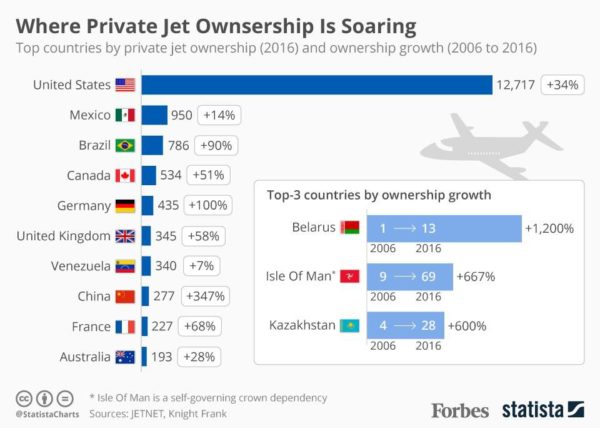
According to The Independent, the most popular private jet is the Cessna Citation XLS, which I believe climate alarmist Leonardo Di Caprio may be boarding in the picture below, having been shunted to the runway via a private helicopter…

A Cessna Citation XLS burns approximately 6,030kg of CO2 per three hour flight.
It’s back-of-the-napkin, but let’s say a typical jet does 4 legs per week, at 3 hour legs. We get:
17,947 jets X 6,030 kg CO2/flight X 4 flights/week X 52 weeks = 22,509,845,280 kilograms of Co2.
Over 22 billion kilos of C02. Per year.
Of course, that estimate of 4 legs per week could be low. Elon Musk has a private jet that logged 150,000 miles in 2018. Enough to circle the globe 6 times.
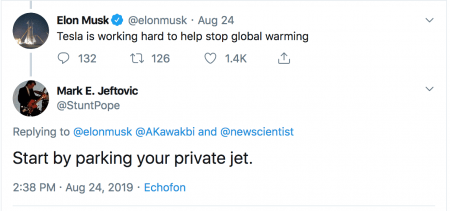
But if we banned private jets, with immediate effect, no exceptions, very few working class and middle class people would be affected. In fact even upper class, lower-tier wealthy would be relatively unscathed. It would only affect the tiny sliver at the top of the wealth pyramid, the same ones who seem most vociferously adamant on drastic climate action now and who could best afford to make alternate arrangements for attending climate summits or other important events. The annual Davos summit could be held via Skype, for example.
Taking the important step now will set the tone for the coming, rapid and drastic restructuring of every aspect of our lives, and it will be an easier pill to swallow when the elitists driving this change are leading the charge by example. Be the change you wish to see! #BanPrivateJets
My forthcoming book, Unassailable: Defend Your Content Against Deplatform Attacks, Cancel-Culture and Other Online Disasters will be out soon. If you want to be notified when it’s ready, sign up for my mailing list and I’ll let you know (I may even give a copy away for free to everybody on my list).
Heated Climate Change Debates rage on after Climate Action Summit at UNGA

By Sarah Abed | September 26, 2019
The 74th United Nations General Assembly (UNGA) is in full swing in New York this week with discussions and debates ranging from climate change to trade deals and the growing tensions in the Middle East.
A few days prior to the UNGA however, there was a climate strike on September 20th. Participation took place in dozens of cities around the world with the largest being in New York and led by Greta Thunberg a Swedish youth climate activist who began the “Fridays for the Future” movement last year.
On Monday, the UNGA was mostly focused on the Climate Action Summit and for the first time high-level meetings and discussions about Universal Health Care (UHC) were covered in what is considered to be the most significant political meeting on UHC thus far.
The Climate Action Summit was hosted by Secretary General of the United Nations Antonio Guterres who started his speech by saying that nature is angry and we fool ourselves if we think we can fool nature because nature always strikes back and around the world nature is striking back with fury. Young adults and children demanded a response for climate change. A few took the stage including Greta Thunberg who started her first climate strike a year ago. When asked her message to world leaders she passionately began with “my message is we’ll be watching you”… she said we are in the beginning of mass extinction, and all you can talk about is money and economic growth, how dare you”.
Mr. Guterres gave a sense of urgency that we are in a race against time and must do everything in our power to stop the climate from warming before it stops us.
After the Climate Action Summit scientists and researchers have new data to study from the Intergovernmental Panel on Climate Change. The United Nations Environmental Program delegation was in NY for the UNGA and highlighted how governments, citizens, and civil society can take productive action when it comes to the environment, climate and sustainable development goals. UNEP highlights and updates are outlined on their site.
Philipino representatives delivered a statement on behalf of their country on Monday, during a meeting on Universal Health Coverage (UHC) stating that President Rodrigo Duterte passed a UHC law earlier this year that provides free basic services to all.
The Prime Minister of India Narendra Modi said that his nation will be spending $50 billion on water conservation in the new few years, signaling the high importance of water management and he also pledged to more than double India’s non-fossil fuel target to 400 gigawatts.
President Trump stated on Tuesday, that he is “ready, willing and able” to mediate the “complex” Kashmir issue if both Pakistan and India wanted him to get involved.
On Tuesday and Wednesday, a Political Forum on Sustainable Development (HLPF) took place.
Also on Tuesday, Turkish President Recep Tayyip Erdogan spoke about global injustice and highlighted a number of problems which threaten global peace and security saying, “The international community is losing the ability to find lasting solutions to challenges such as terrorism, hunger, misery, climate change” he criticized world powers for failing to take appropriate action to deal with crises around the globe. He also called for world leaders to support his plan for a safe zone to be established in Syria, he said that if the “peace corridor” is extended to the Deir El-Zor-Raqqa area that 3 million Syrian refuges can safely return home.
During his speech President Erdogan held up four maps illustrating Israel’s disregard for borders and its gradual occupation of Palestinian land. He also held up a map showing the safezone he wants to establish in Syria on his southern border. Erdogan likened the suffering of the people of Gaza to that of the holocaust.
President Erdogan also called on UN members to help support Turkey’s efforts to ensure security in Syria’s Idlib. He has mentioned previously that with or without the US’s support he will establish a safe zone on his southern borders to push back US-sponsored and backed Kurdish militias and help Syrian refugees currently living in Turkey return home.
US President Donald Trump led the Global Call to Protect Religious Freedom and introduced initiatives to end religious persecution on Tuesday, as well. During his press conference on Wednesday he proudly proclaimed that he is the first to lead a global call on this matter.
The launch of Hello Global Goals Collaboration took place on Tuesday with Japanese character Hello Kitty in the SDG Media Zone which has been a main feature of the UNGA high-level week conference since 2016. The SDG Media Zone brings together UN Member states, content creators, activists, influencers, media partners and highlights actions and solutions in support of Sustainable Development Goals. The SDG Media Zone offers impactful in-depth interviews, Ted-style talks, panel discussion and advances the 2030 Agenda, using impactful, dynamic, and in-depth conversations with decision makers, etc. Its events are live streamed on UN WebTV and focused on the main themes of the week including climate change, universal healthcare, financing for development and small island developing states.
On Thursday, a dialogue on Financing for Development (FFD) and a meeting on the elimination of nuclear weapons is taking place.
On Friday, the UNGA is holding a meeting to review progress made in addressing the priorities of Small Island Developing States (SIDS) through the implementation of the SIDS Accelerated Modalities of Action (SAMOA) Pathway.
All of this relates to the 2030 UN Agenda, which is a plan of action for people, the planet, and prosperity and is supposedly meant to strength universal peace in larger freedom, however some think this plan has a sinister underlying agenda and should be looked into further.
Sarah Abed is a political analyst with BRICS.
The Climate Scam

Al Gore, vice president during US/NATO bombing of Serbia, finds religion as huckster for global warming. Art by David Dees.
By Richard Hugus | September 19, 2019
September 20, 2019 is a day of public demonstrations to address climate change. The climate change scare has seemed suspicious from the start. Except for exploiting it, the natural environment has never been a concern of the rich and powerful, yet powerful interests are everywhere behind the many organizations hyping the threat of anthropogenic global warming.
This vast theory came to mainstream acceptance far too quickly to be credible. Like so may political initiatives, it was sold to the public through fear — in this case, fear of human extinction in the very near future. No sooner did we hear of the theory than we were told “the science is settled.” At that point, belief in global warming became dogma, and skepticism became heresy. If one voices skepticism, one is called a “denier.” Thus we are not allowed to question. This is the opposite of science. There is no protest against US, Israeli, Saudi, and NATO warmaking in the climate activist platform. In the US, the politics of climate change align with the politics of the Democratic Party, where criminal wars of aggression in Afghanistan, Iraq, Yemen, and Syria, and constant threats against Iran are not discussed. How can you discuss environmental damage and not mention the largest polluter in the world — the Pentagon?
Cory Morningstar at The Wrong Kind of Green has written extensively about oligarch and corporate funding of the climate change juggernaut and its offshoot, the “Green New Deal.” Following is a quote from a recent essay by Cory:
As media hypes the global climate mobilizations in perfect synchronicity with a tsunami of “12 years until climate apocalypse” news articles saturating our collective psyches, global climate emergency declarations announced by states, and all levels of government, are indeed soaring. As this series has demonstrated, and as confirmed by the July 4, 2019, high-level roundtable (“Emerging from Emergency – Urgency as a Catalyst for Action and Regeneration”) this feat has been a high-level orchestrated endeavour. Indeed, the stakes could not be higher. Late-stage capitalism is faltering with economic growth in freefall. The climate mobilizations beget the declarations, beget the policy, beget the budgets, beget the finance.
The policy and legislation are instrumental to unlocking the public funds for so-called “climate infrastructure” projects (predominantly in the Global South). Infrastructure and technologies that will be paid by the citizenry, to be owned by the billionaires. We must never lose sight that the terrifying news regarding our rapidly deteriorating natural world is real, but the reason for the media saturation (spectacle) has nothing to do with protecting the natural world nor the climate – and everything to do with rebooting global economic growth and saving the capitalist system itself. Consider the Global Optimist meme shared by We Mean Business: “People are desperate for something to happen.” The message is this: No one can save you but us. Accept our solutions, or die. Another world is possible, but only if that world is designed by the ruling classes that maintain and expand current power structure. One could call this psychological manipulation, or hegemonic coercion.
This is the gentle transition into the new age of neo-feudalism. Social engineering and behavioural change campaigns have been employed to make hierarchical class invisible, in real time.
The environmental NGOs comprising the non-profit industrial complex exist as corporate front groups. They insulate, protect, and assist in the expansion of existing power structures that facilitate capitalism.
Below is an excerpt from a 2011 interview of Bill McKibben, founder of 350.org. Watch McKibben quibble and lie about his funding by the Rockefellers. 350.org is a major sponsor of the great climate change protest scheduled for September 20.
Friends, we’re being had.
Source: http://www.richardhugus.com/pages/articles/Climate_scam.html
Iran, Pakistan sign new agreement on major gas project: Report
Press TV – September 17, 2019
A major deal for exports of gas from Iran to Pakistan has been revised after several years of uncertainty surrounding the project, shows a report in the Pakistani media.
The Express Tribune said in a Monday report that national gas companies from Iran and Pakistan had inked an agreement to revise the terms of an old deal meant for exports of gas from Iran which had been supposed to be implemented by 2015.
The deal had stalled mainly because Pakistan was unable to construct a pipeline through its territory to transfer the Iranian gas to the port of Karachi. Islamabad was also unwilling to pay compensation for its delay, saying it had been caused by sanctions imposed on Iran.
The report said the Inter State Gas Systems (ISGS) of Pakistan and the National Iranian Gas Company (NIGC) had agreed to allow Pakistan to finish construction of the pipeline in its territory until 2024.
It cited sources as saying that Iran would not sue Pakistan for a fresh delay beyond 2024 unlike the previous contract under which Iran had threatened Islamabad with legal action. There was no comment on the report from the Iranian officials.
It said the two companies would seek to devise solutions for completion of the project which would enable Pakistan to import 750 million cubic feet of gas per day from Iran.
Based on the terms of the previous deal, Pakistan had been supposed to complete its section of the gas pipeline within 22 months after construction activities for the project kicked off in March 2013.
However, Pakistan later backtracked from the commitment and officials said that sanctions imposed on Iran had made it impossible for the country to build the 1,600-kilometer pipeline.
Iran has almost completed its sides of the pipeline which starts from installations of the South Pars gas field located on the Persian Gulf port of Asaluyeh and runs 1,172 kilometers through two provinces to reach the Pakistani border.
Featured Video
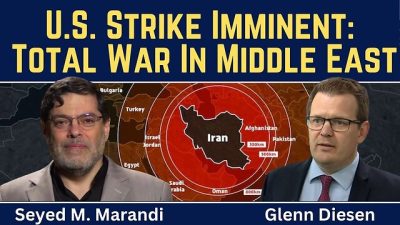
Seyed M. Marandi: Toward Total War in the Middle East
or go to
Aletho News Archives – Video-Images
From the Archives
The Geopolitics behind the War in Yemen (I)
By Mahdi Darius NAZEMROAYA | Strategic Culture Foundation | 30.03.2015
The United States and the Kingdom of Saudi Arabia became very uneasy when the Yemenese or Yemenite movement of the Houthi or Ansarallah (meaning the supporters of God in Arabic) gained control of Yemen’s capital, Sanaa/Sana, in September 2014. The US-supported Yemenite President Abd-Rabbuh Manṣour Al-Hadi was humiliatingly forced to share power with the Houthis and the coalition of northern Yemenese tribes that had helped them enter Sana. Al-Hadi declared that negotiations for a Yemeni national unity government would take place and his allies the US and Saudi Arabia tried to use a new national dialogue and mediated talks to co-opt and pacify the Houthis.
The truth has been turned on its head about the war in Yemen. The war and ousting of President Abd-Rabbuh Manṣour Al-Hadi in Yemen are not the results of «Houthi coup» in Yemen. It is the opposite. Al-Hadi was ousted, because with Saudi and US support he tried to backtrack on the power sharing agreements he had made and return Yemen to authoritarian rule. The ousting of President Al-Hadi by the Houthis and their political allies was an unexpected reaction to the takeover Al-Hadi was planning with Washington and the House of Saudi. … continue
Blog Roll
 Aletho News
- Pakistan-Iran talks secure LNG shipment to Islamabad through Hormuz
- Black Sea grain crisis puts global wheat supplies under pressure
- IRGC air defenses destroy another US MQ-1 drone over Strait of Hormuz
- Imran Khan’s entire immediate family detained in Pakistan ahead of mass protest demanding his release
- EU nation detains former presidential frontrunner
- Leaked: Britain’s Sham Conviction Of Hashim Thaci
- Seyed M. Marandi: U.S. Strike Imminent – Toward Total War in the Middle East
- Russia Voted Under Fire. Washington Is Loading the Tankers.
- 12 Things Your Oncologist Was Trained Not to Tell You
- Anthrax Attacks Paved Way for COVID-Era ‘Junk Drugs and Vaccines’
- If Americans Knew
- Israeli Attacks in Gaza Kill at Least Seven Palestinians Over Three Days, including Woman and Child
- Trump’s militarization of Washington DC as he pursues Israel’s war against Iran
- Why Israel Fears This Searing New Documentary
- Huckabee aide solicited cash gifts from Israelis
- This isn’t sci-fi, AI is already killing people
- ‘The Most Brutal Thing’: Investigation Reveals Execution of Elderly Woman in Rafah
- Inside Israel’s ‘soft’ ethnic cleansing plan for Gaza through the eyes of its victims
- New online database tracks pro-Israel political donations in the United States
- Israeli president pardons soldier convicted for killing wounded Palestinian
- Singer Ed Sheeran says his ‘heart broken’ by Gaza devastation, addresses Macklemore controversy
- No Tricks Zone
- 2025 Nature Paper Claiming Worsening Global Drought Gets RETRACTED …Heavily Flawed
- New Study: ‘Global Drought Shows No Detectable Recent Acceleration Under Climate Warming’
- Economic Masterminds: German Socialists Suggest Taxing Productivity Gains Stemming From Using AI
- The South China Sea Has Not Been Cooperating With The Climate Change Narrative
- Energy Crisis: Germany Enters Heating Season With Historically Low Gas Reserve Fill Levels
- New Study: The Antarctic Ice Sheet Gained Mass From 2020-2024 Due To Staggering Snow And Ice Accumulation
- Study: Ocean Heating Rates From Thousands Of Years Ago ‘Dwarf’ Modern Ocean Heating Rates
- Climate Extremists Target, Attack Large-Scale Power Grid Infrastructure In Germany!
- New Study: Antarctic Ice Melt Has Contributed Less Than 1 Centimeter To Sea Level Rise In The Last 30 Years
- Fear Of Debate: Alarmist German Climate Scientist Calls On Mainstream Media To Discredit Skeptic Voices
 Aletho News