Prepare for war – NATO chief
RT | January 15, 2025
NATO Secretary-General Mark Rutte has called on members of the US-led military bloc to adopt a “wartime mindset” and significantly increase defense spending, citing supposed threats from Russia and other nations.
The bloc’s “future security is at stake,” Rutte claimed in his opening remarks at a meeting of the Military Committee in Chiefs of Defense in Brussels on Wednesday. He accused Russia, China, North Korea, and Iran of attempting to “weaken our democracies and chip away at our freedom.”
“To prevent war, we need to prepare for it. It is time to shift to a wartime mindset,” Rutte asserted, urging NATO states to fund “more and better defense capabilities.”
Rutte noted that while NATO members have increased defense investments and intensified military exercises these efforts are “not sufficient to deal with the dangers coming our way in the next four to five years.”
Rutte also prioritized backing Ukraine to “change the trajectory of the war,” in a tacit recognition of Kiev’s reversals on the conflict front line.
Moscow has repeatedly denied assertions that it represents a threat to any NATO member states and has instead accused the US-led bloc of waging a proxy war against Russia and encroaching on its territory.
Last month, President Vladimir Putin said that practically all NATO states are currently at war with Russia. Foreign Minister Sergey Lavrov also noted on Tuesday that history appears to be repeating itself, suggesting that there were “obvious parallels” between Moscow’s current confrontation with NATO and the attempts of Napoleon Bonaparte and Adolf Hitler to take over Russia after subjugating dozens of European countries.
On Tuesday, Rutte announced that NATO would bolster its presence in the Baltic Sea – a strategic area for Russian naval operations and energy exports – by launching a new mission under the pretext of protecting undersea infrastructure.
The NATO chief revealed that this presence will involve frigates, maritime patrol aircraft, and a “small fleet of naval drones” that are expected to provide “enhanced surveillance and deterrence.”
The announcement follows an incident involving a Cook Islands-registered oil tanker, the Eagle S, which allegedly damaged the Estlink 2 power cable connecting Finland and Estonia last month. The EU has warned that it could impose sanctions on Moscow over what EU foreign policy chief Kaja Kallas has described as the “deliberate destruction of Europe’s critical infrastructure” using a “shadow fleet” of tankers, which supposedly includes the Eagle S.
While the tanker has been detained by Finnish authorities, no conclusive evidence has been presented regarding its involvement in the alleged sabotage.
Moscow has not commented on the incident.
Without job opportunities in their homeland, Colombians are recruited by Kiev
By Lucas Leiroz | Strategic Culture Foundation | January 14, 2025
NATO’s proxy war against Russia through Ukraine has shown significant changes in various aspects, particularly regarding the participation of foreign mercenaries. While, at the start of the war, the flow of fighters was predominantly composed of individuals from Europe and the United States, a notable shift occurred throughout 2024, with a considerable increase in mercenaries from Latin America, especially Colombia. The driving factor behind this growing presence of Latin American fighters is not ideological, but rather economic, with many of these soldiers seeking a way to survive financially abroad, considering the extreme poverty in their home countries.
Colombia, one of the nations most affected by economic inequality in Latin America, serves as an example to understand this reality. With a large portion of the population living below the poverty line, many Colombians see themselves with few viable alternatives to improve their financial situation. For many Colombians, military service appears to be one of the few legal options that guarantees some level of financial stability, albeit modest. However, with scarce job opportunities and a struggling economy that fails to offer appealing alternatives, the chance to participate in the war in Ukraine, where mercenaries’ payments can be much higher, becomes attractive to many ex-soldiers who were previously trained in the Colombian armed forces.
The situation in Ukraine, however, does not turn out to be a “simple battlefield” for these mercenaries, as it might have seemed initially. When the first foreign fighters arrived, particularly Europeans and Americans, many saw the war as an opportunity to test their skills or even to partake in an “adventure.” However, as the conflict intensified, it became clear that the reality of the Ukrainian battlefield was far more brutal than many had imagined. Modern warfare, with its predominant use of heavy artillery, airstrikes, and large-scale exhausting confrontations, is an environment unfamiliar to soldiers who, like many Colombians – as well as Brazilians and other Latin soldier – were used to urban combat and guerrilla warfare, where the use of light weapons at short distances is common.
The transition to this type of combat, where air superiority and the constant use of long-range artillery are key determinants, shocked many of these mercenaries, turning their participation in the war into a true nightmare. The lack of air support, the difficulty of evacuation, and the constant presence of well-equipped and well-trained Russian forces in various directions made the combat experience far more dangerous than expected. Many of these mercenaries, especially those with little experience in high-intensity combat, ended up becoming easy targets. The losses are immense, and, according to some reports, a large portion of the Colombian mercenaries sent to Ukraine did not survive.
Despite the rising casualties, the Ukrainian government has tried to mask the difficulties faced by foreign mercenaries, disguising the losses and the lack of effectiveness of these fighters. However, the reality on the ground is far less favorable. The mercenaries have failed to change the game in Ukraine’s favor, and the promised financial gains for participating in the conflict seem to have been an illusion for many. The harsh conditions of combat, the human losses, and the lack of concrete results make the situation for the mercenaries, particularly the Latin Americans, increasingly bitter.
The loss of life among Colombian mercenaries, who represented a significant portion of the foreign fighters, reflects not only the failure of the strategies adopted by the West but also the human costs of this war as a whole. While political and military elites in Western countries remain distant from the suffering on the battlefield, the reality for mercenaries is a direct confrontation with death, often without prior reconnaissance or appropriate support.
And the problems go beyond that. For Colombia, a country already marked by decades of internal conflict, this new generation of mercenaries, who, if they survive, may return to their homeland radicalized and experienced in combat, could become a real ticking time bomb. In the same vein, recent news has emerged about pro-Ukrainian Colombian mercenaries being arrested in Venezuela for a conspiracy to assassinate Nicolás Maduro. In practice, the surviving mercenaries will likely become professional criminals, willing to serve Western interests for money anywhere in the world – especially in their home region.
From all perspectives, the involvement of Latin American mercenaries in Ukraine is a human, social, and economic tragedy. It is urgent to develop efficient mechanisms to prevent ordinary people from Global South countries from accepting to participate in foreign wars defending the interests of hostile powers.
You can follow Lucas on X (formerly Twitter) and Telegram.
What will a “European Armenia” bring?
By Erkin Oncan | Strategic Culture Foundation | January 14, 2025
The Armenian government has approved a draft law to initiate the country’s accession process to the European Union (EU). This proposal will be discussed in parliament before being put to a referendum.
European Parliament rapporteur Miriam Lexmann celebrated this development, stating, “I wholeheartedly welcome the Armenian government’s decision to begin the EU accession process.”
However, the Russian side has reacted negatively to this decision. Kremlin spokesperson Dmitry Peskov declared that Armenia cannot simultaneously be a member of both the EU and the Eurasian Economic Union (EAEU).
Russian Deputy Prime Minister Alexey Overchuk also commented, “We interpret this as the beginning of Armenia’s withdrawal from the Eurasian Economic Union. The Russian Federation will shape its economic policy toward Armenia accordingly,” comparing EU membership to “purchasing a ticket for the Titanic.”
Armenia’s Journey Towards Europe
Armenia and the EU have a long history of interaction.
In 1996, Armenia signed a Partnership and Cooperation Agreement with the EU, and in 2001 it became a member of the Council of Europe. Moreover, Armenia has benefited from the TACIS program, a European Commission initiative that provided technical assistance to former Soviet states to adapt to market-oriented economic systems.
In 2004, Armenia strengthened its ties with the EU under the European Neighbourhood Policy (ENP), joined the Eastern Partnership initiative in 2009, and, despite joining the Eurasian Economic Union in 2013, approved the Comprehensive and Enhanced Partnership Agreement (CEPA) with the EU in 2017. In 2018, the Velvet Revolution brought Nikol Pashinyan to power, accelerating democratic reforms.
Armenia has now become the seventh former Soviet country to initiate European integration. This political shift mirrors the tug-of-war between the EU and EAEU, as well as NATO and the Collective Security Treaty Organization (CSTO).
Can Armenia Join the EU?
Although Armenia is not geographically part of Europe, like Georgia, it strives to align itself with “European values and cooperation processes.” From a European perspective, Armenia’s significance stems not from its adherence to these values but from its geographic proximity to Russia and Iran.
EU membership is a challenging and lengthy process—a path that only three former Soviet states (Estonia, Latvia, and Lithuania) have successfully completed. Other countries like Ukraine, Moldova, and Georgia have long been politically shaped by their EU aspirations, experiencing intense internal conflicts between pro-Russian and pro-EU factions, often tied to so-called “color revolutions.” These parallels suggest that Armenia’s membership process could also stretch over many years. Furthermore, Armenia’s economic ties with Russia present significant challenges.
According to data from the Armenian Statistical Committee covering January-April 2024, trade between Armenia and Russia increased 3.1 times, while trade with EU countries decreased by 24.3%. During this period, Armenia’s trade volume with Russia reached $6.3 billion, whereas its trade volume with the EU was $695.5 million—making trade with Russia nearly nine times greater than that with the EU. Military ties between Armenia and Russia also remain a major topic of public debate.
For Armenia to fully “Europeanize,” it must entirely overhaul its economic system. However, the insistence of both the EU and Pashinyan’s administration on this path could lead to a deep economic crisis and political instability. This might result in Armenia entering the EU as a weakened state, perceived as a burden by EU leadership.
The EU’s primary objective appears to be not Armenia’s full membership but the continuation of the accession process, using it to advance strategic interests. A “European” Armenia would serve as a geopolitical defeat for Russia.
Broader Implications
Discussions around Armenia’s regional and international dynamics are often shaped in Turkey by nationalist narratives sown by imperialist forces, perpetuating historical prejudices that undermine solidarity among neighboring peoples. However, developments in Armenia carry significant clues about the future of the broader region.
Erkin Öncan, Turkish journalist focusing on war zones and social movements around the world.
Twitter: https://twitter.com/erknoncn Telegram: https://t.me/erknoncn
Why NATO’s Plan to Conscript Ukraine’s Youth Will Likely Fail
By Professor Glenn Diesen | January 14, 2025
NATO continues to pressure Ukraine to lower its conscription age to 18 as the huge casualties by Ukraine have resulted in a lack of manpower. US Secretary of State Anthony Blinken is pressuring Ukraine into “getting younger people into the fight”, while NATO Secretary General Mark Rutte has been more cautious in his language by arguing “We need probably more people to move to the front line”.[1] The incoming Trump administration also appears to take the same line, as Trump’s National Security Advisor Mike Walz argued that lowering the conscription age could “generate hundreds of thousands of new soldiers”.[2]
While there is seemingly bipartisan support in the US for sacrificing Ukraine’s youth, the plan is deeply flawed. The Ukrainians are overwhelmingly in favour of immediate negotiations, the Ukrainian government resists the pressure from NATO, and there is very little chance that the new recruits will significantly improve the situation.
Bring Russia to the negotiation table & negotiate from a position of strength
NATO’s argument is seemingly reasonable: More Ukrainian soldiers are necessary to pressure Russia to the negotiation table and to negotiate from a position of strength.
The need to pressure Russia to the negotiation table is based on lies, as Russia has been open to negotiations over the past three years. NATO has rejected negotiations and even basic diplomacy with Russia for three years that may have prevented escalation and possibly led to peace. Russia contacted Ukraine already on the first day after the Russian invasion, to negotiate a peace agreement based on putting an end to NATO expansion. President Zelensky confirmed on 25 February 2022: “Today we heard from Moscow that they still want to talk. They want to talk about Ukraine’s neutral status”.[3] The US and UK sabotaged the Istanbul peace agreement to pursue a long war. In March 2022, Zelensky confirmed in an interview with the Economist: “There are those in the West who don’t mind a long war because it would mean exhausting Russia, even if this means the demise of Ukraine and comes at the cost of Ukrainian lives”.[4] By rejecting any diplomacy and negotiations, NATO made it a war of attrition as Russia was left with the dilemma of either continuing the fight or capitulating.
The need to negotiate from a position of strength is a reasonable objective, yet there are reasons to doubt NATO’s sincerity. Is NATO attempting to strengthen Ukraine’s position in negotiations or to keep the war going? On 27 February 2022, the same day that Russia and Ukraine announced peace talks, the EU approved 450 million Euros in military aid to Ukraine, which reduced the incentives for Kiev to negotiate with Moscow.[5] The consistent argument has been that Ukraine must negotiate from a position of strength, yet it has been three years of intensive war and NATO countries still react with panic as Trump prepares to start negotiations to end the war.
Chairman of the Joint Chiefs of Staff General Mark Milley, recognised in November 2022 that the Ukrainians were in an ideal situation to start negotiations after successes on the battlefield. Milley recognised that a military victory was impossible to achieve and that this was therefore the optimal time to negotiate.[6] Fearing that its long war would end, the Biden administration quickly intervened and Milley had to walk back his comments.
What will NATO and Ukraine achieve with their strengthened position at the negotiation table? Russia considers NATO’s incursion into Ukraine to be an existential threat and will not accept any peace agreement that does not result in restoring Ukraine’s neutrality. Both the Israeli and Turkish mediators during the peace negotiations in 2022 recognised that Russia was prepared to compromise on anything, besides the issue of NATO expansion. NATO’s continuous promise of membership for Ukraine in the military bloc after the war is over has made a peaceful settlement impossible and thus cemented the conditions for a long war. Strengthening Ukraine’s army will not soften Russia’s position.
What is the likely outcome?
Forcing hundreds of thousands of young Ukrainians into the army will undoubtedly slow down the Russian advances, although it cannot stop or reverse the Russian military. The Ukrainian army has been exhausted, and a new army cannot simply be built from scratch. The losses on the battlefield and lies from their government have diminished morale, which will not be improved by sending less experienced young men into a battlefield dominated by Russia.
Trump will likely be able to pressure Zelensky to lower the conscription age, yet this will be incredibly unpopular among the Ukrainian population. The overwhelming majority of Ukrainians want negotiations to start immediately, not to sacrifice their youth in a lost war. Newsweek reports that “Over 6 million Ukrainians of conscription age haven’t complied with legislation introduced last year to boost dwindling troop numbers fighting Russia”. The public wants an end to the war, not to send their teenagers to die.
Conscription of Ukraine’s youth will cause great social upheaval in a society that is already fed up with watching their men being snatched from the streets and thrown into vans by “recruiters”. These young men are also important for the workforce to keep the economy going, which will be lost if they are conscripted or go into hiding. Once the war is finally over, these young men are indispensable to rebuilding Ukraine which is already facing a demographic crisis.
Ukraine cannot survive more “help”
Between 1991 and 2014, the US attempted to help Ukraine into NATO despite that only 20% of Ukrainians desired membership in the military alliance during this time. In 2014, NATO helped Ukrainians topple their government in an unconstitutional coup without majority support from Ukrainians. Rather than implementing the Minsk peace agreement, NATO helped Ukraine build a large army so it could instead change realities on the ground. When 73% of Ukrainians voted for Zelensky’s peace platform in 2019, NATO helped Ukraine avoid “capitulation” by pressuring Zelensky to reverse his position. In 2021, NATO helped Ukraine by refusing to give any security guarantees to Russia, even as Biden and Stoltenberg recognised that Russia would invade without security guarantees. In 2022, the US and UK helped Ukraine by pressuring Kiev to abandon a peace agreement in which the Russians committed to pulling troops back in return for neutrality. Hundreds of thousands of Ukrainians have been killed, large parts of its territory have been lost and the nation may not survive – NATO is now attempting to help yet again by pressuring war-weary Ukrainians to also sacrifice their youth. Irrespective of any new soldiers entering the war, the position of Ukraine will only continue to get worse.
If NATO really wants to help Ukraine and strengthen its position at the negotiation table, NATO should offer Russia what it wants the most – a pan-European security agreement based on indivisible security that replaces the zero-sum bloc politics. This is the best option for the West, Russia and Ukraine.
[1] A. Medhani, ‘White House pressing Ukraine to draft 18-year-olds so it has enough troops to battle Russia’, AP News, 28 November 2024.
[2] B. Gaddy, ‘Rep. Waltz: Negotiations to release Hamas hostages are underway’, ABC News, 12 January 2025
[3] V. Zelensky, ‘Address by the President to Ukrainians at the end of the first day of Russia’s attacks’, President of Ukraine: Official website, 25 February 2022.
[4] The Economist. ‘Volodymyr Zelensky on why Ukraine must defeat Putin’ The Economist, 27 March 2022.
[5] J. Deutsch and L. Pronina, ‘EU Approves 450 Million Euros of Arms Supplies for Ukraine’, Bloomberg, 27 February 2022.
[6] O. Libermann, ‘Top US general argues Ukraine may be in a position of strength to negotiate Russian withdrawal’, CNN, 16 November 2022.
Russia’s Geoeconomic Shift from Greater Europe to Greater Eurasia
By Professor Glenn Diesen | January 13, 2025
Liberal theory suggests that economic interdependence creates peace as both sides gain economically from peaceful relations. However, liberal theory is deeply flawed as it assumes states prioritise absolute gain (both sides gain, and it does not matter who gains the most). Due to the security competition in the international system, states must focus on relative gain (who gains more). As Friedrich List recognised: “As long as the division of the human race into independent nations exists, political economy will as often be at variance with cosmopolitan principles”.[1]
In all interdependent relationships, one side is always more dependent than the other. Asymmetrical interdependence empowers the less dependent state to set favourable economic conditions and obtain political concessions from a more dependent one. For example, the EU and Moldova are interdependent, but the asymmetrical interdependence results in the EU preserving its autonomy and gaining influence.
The “balance of dependence” refers to a geoeconomic understanding of the realist balance of power. In an asymmetrical interdependent partnership, the more powerful and less reliant side can extract political power. The more dependent side therefore has systemic incentives to restore a balance of dependence by enhancing strategic autonomy and diversifying economic partnerships to reduce reliance on the more powerful actor.
Geoeconomic rivalry entails competing for power by skewing the symmetry within interdependent economic partnerships to enhance both influence and autonomy. In other words, to make oneself less reliant on others while increasing the dependence by others. Diversifying economic partnerships can reduce one’s own reliance on a state or region, while asserting control over strategic markets diminishes the capacity of other states to diversify and lessen their dependence.
The Geoeconomic Foundation for Western Dominance
The centuries-long geoeconomic dominance of the West is the product of asymmetrical interdependence by dominating new technologies, strategic markets, transportation corridors and financial institutions.
Following the disintegration of the Mongol Empire, the land-based transportation corridors of the ancient Silk Road that had fuelled trade and growth vanished. Subsequently, Western maritime powers rose to prominence from the early 1500s by asserting control over the main maritime transportation corridors and establishing “Trading-Post empires”. Leading naval powers, such as Britain, have therefore historically been more inclined towards free trade as they had more to gain and risked less by controlling the trade routes. The maritime strategies of Alfred Thayer Mahan in the late 1800s were founded on this strategic reasoning, as controlling the oceans and Eurasian continent from the periphery laid the basis for US military and economic power.
The advancements in the Industrial Revolution created an even more favourable balance of dependence in favour of the West. Adam Smith noted that the discovery of America and the East Indies were the “two greatest and most important events recorded in the history of mankind”.[2] However, he also recognised that the extreme concentration of power in Europe created an exploitative and destructive relationship:
“To the natives however, both of the East and West Indies, all the commercial benefits which can have resulted from those events have been sunk and lost in the dreadful misfortunes which they have occasioned. These misfortunes, however, seem to have arisen rather from accident than from anything in the nature of those events themselves. At the particular time when these discoveries were made, the superiority of force happened to be so great on the side of the Europeans that they were enabled to commit with impunity every sort of injustice in those remote countries”.[3]
Samuel Huntington similarly wrote:
“For four hundred years, intercivilizational relations consisted of the subordination of other societies to Western civilization… The immediate source of Western expansion, however, was technological: the invention of the means of ocean navigation for reaching distant peoples and the development of the military capabilities for conquering those peoples… The West won the world not by the superiority of its ideas or values or religion (to which few members of other civilizations were converted) but rather by its superiority in applying organized violence. Westerners often forget this fact; non-Westerners never do”.[4]
Following the Second World War, the US became the dominant power due to military power, but also geoeconomic power consisting of its large share in the global GDP, technological superiority, industrial dominance, the Bretton Woods institutions, control over strategic markets/resources, and control over key transportation corridors.
From Gorbachev’s Common European Home to “Greater Europe”
Following the demise of communism, Russia aimed to integrate with the West to form a “Greater Europe”, based on the ideas of Gorbachev’s concept of a Common European Home. Economic development and prosperity required integration with the West as the main economic centre in the international system.
However, the Americans and Europeans had no incentives to accept a Greater Europe. The West aimed to construct a new Europe without Russia, which required reviving bloc politics. The ultimatum to Russia was to either accept a subordinated position as the permanent apprentice of the West or be isolated and thus become economically underdeveloped and irrelevant. The West supported only European institutions such as NATO and the EU that incrementally augmented the collective bargaining power of the West to maximise asymmetrical interdependence with Russia. Making Russia obey the European institutions where Russia does not have a seat at the table is possible under extreme asymmetrical interdependence. Cooperation then entails unilateral concessions and Russia would have to accept decisions by the West.
The alienation of Russia would not matter if it kept getting weaker. William Perry, the US Defence Secretary between 1994 and 1997, recognised that his colleagues in the Clinton Administration were aware that NATO expansionism and the exclusion of Russia from Europe fuelled anger:
“It wasn’t that we listened to their [Russia’s] argument and said [we] don’t agree with that argument… Basically the people I was arguing with when I tried to put the Russian point… the response that I got was really: ‘Who cares what they think? They’re a third-rate power.’ And of course that point of view got across to the Russians as well. That was when we started sliding down that path”.[5]
The dream of a Greater Europe failed due to Russia’s inability to create a balance of dependence within Europe. Moscow’s Greater Europe initiative aimed to obtain a proportional representation at the European table. Instead, the unfavourably asymmetrical partnerships with the West that followed enabled Western unilateralism veiled as multilateralism, in which the West could maximise both its autonomy and influence.
“Cooperation” was subsequently conceptualised by the West within a teacher-student/subject-object format, in which the West would be a “socialiser” and Russia would have to accept unilateral concessions. Russia’s decline would be managed as expanding the EU and NATO sphere of influence in the east gradually diminished the role of Russia in Europe. “European integration” became a zero-sum geostrategic project, and states in the shared neighbourhood were presented with a “civilizational choice” of aligning either with Russia or the West.
Moscow’s “Greater Europe” project was always destined to fail. The “leaning-to-one-side” policy by Yeltsin was not rewarded and reciprocated by the West, rather it made Russia vulnerable and exposed. Russia neglected its partners in the east, which deprived Russia of the bargaining power required to negotiate a more favourable format for Europe. Brzezinski noted that cooperation with the West was “Russia’s only choice – even if tactical”, and it “provided the West with a strategic opportunity. It created the preconditions for the progressive geopolitical expansion of the Western community deeper and deeper into Eurasia”.[6]
Putin Reforms the Greater Europe Initiative
Yeltsin conceded by the end of the 1990s that the “leaning-to-one-side” policy had been exploited by the West and called for diversifying Russia’s economic partnerships by becoming a Eurasian power. However, there were no powers in the East with the intentions or capabilities to challenge Western dominance. Putin attempted to revive the Greater Europe Initiative by ending the era of unilateral concessions and instead strengthening Russia’s negotiation power. Russia would not integrate into the West through unilateral concession, but integrate with the West as an equal.
Moscow began to embrace economic statecraft as the principal tool for restoring Russian power, and pursue incremental integration with the West. Re-nationalising energy resources ensured that the strategic industries of Russia worked in the interest of the state rather than oligarchs, who were courted by the West and tended to use these industries to impose their control on the state. However, the West resisted energy dependence on Russia as it risked creating more symmetry in relations and even giving Russia a voice in Europe. The narrative of the Russian “energy-weapon” was born as Europeans were told to reduce all dependence on Russia as the requirement for a more obedient Kremlin.
The Greater Eurasia Initiative
Russia’s Greater Europe Initiative eventually died when the West supported the coup in Kiev in 2014 to pull Ukraine into the Euro-Atlantic orbit. By making Ukraine a frontline instead of a bridge, it was evident that any incremental integration with Europe had been a utopian dream. Furthermore, the anti-Russian sanctions made it necessary for Russia to diversify its economic connectivity. Rather than seeking to resolve the Ukraine crisis by implementing the Minsk peace agreement, NATO began to build a Ukrainian army to change realities on the ground. Russia began to prepare for a future clash by making its economy sanctions-proof.
With the rise of Asia, Russia found a solution. Russia began to diversify away from excessive reliance on the West and embrace the new Greater Eurasia Initiative. Instead of being isolated at the periphery of Europe, Russia acquired economic strength and influence by developing new strategic industries, transportation corridors and international financial institutions in cooperation with countries in the East. While Russia is met with hostility in the stagnant West, it was embraced in the more dynamic East. Not only have the ambitions of Gorbachev’s Common European Home been abandoned, but the 300-year-long Western-centric policy since Peter the Great has also ended.
A strategic partnership with China is indispensable to construct a Greater Eurasia. Yet, Russia has learned the lessons from the failure of Greater Europe by avoiding excessive dependence on an economically stronger China. The asymmetrical interdependence that emerges in the framework of such a partnership enables China to extract political concessions, which would make it untenable for Russia in the long term. Moscow seeks a balance of dependence in its strategic partnership with Beijing, which entails diversifying economic partnerships across Greater Eurasia. As China does not seek a hegemonic role in Greater Eurasia, it has welcomed Russia’s efforts to diversify its economic partnerships.
Under the Greater Europe Initiative, the Europeans had access to cheap Russian energy and enjoyed a huge Russian market for exports of manufactured goods. Furthermore, Russia’s geoeconomic strategy to integrate with the West resulted in preferential treatment for Western corporations. Under Greater Eurasia, Europe will undergo deindustrialization as the cheap Russian energy and market opportunities go to Asia, which also enhances the competitiveness of Asia vis-a-vis Europe. The Europeans continue setting their own house on fire with reckless sanctions, in the hope that it will also hurt the Russian economy. However, while Europe cannot diversify away from Russia, Russia can diversify away from Europe.
Ideally, Europe would be one of Russia’s many economic partners in the Greater Eurasia Initiative. The revival of militarised dividing lines on the European continent makes the Europeans excessively reliant on the US and Russia becomes too dependent on China. Therefore, there are strong systemic incentives to restore some economic connectivity between the Europeans and Russians after the Ukraine War, although it will be within a Greater Eurasian format as Greater Europe can no longer be revived.
[1] List, F. 1827. Outlines of American Political Economy, in a Series of Letters. Samuel Parker, Philadelphia.
[2] A. Smith, An Inquiry into the nature and causes of the Wealth of Nations, Edinburgh: Adam and Charles Black, 1863, p.282
[3] J. Borger, ‘Russian hostility ‘partly caused by west’, claims former US defence head’, The Guardian, 9 March 2016.
[4] S.P. Huntington, The Clash of Civilizations and the Remaking of World Order, New York, Simon and Schuster, 1996, p.51.
[5] Ibid.
[6] Z. Brzezinski. The Choice: Global Domination or Global Leadership. Basic Books, New York. 2009. P. 102.
The article is based on excerpts from my previous article with the same title: Glenn Diesen, ‘Russia, China and the “Balance of Dependence” in Greater Eurasia’, Valdai Dicussion Club, March 2017
Ukraine attempted drone strike on Russian gas supply to NATO states – Moscow
RT | January 13, 2025
Ukraine has launched an unsuccessful drone attack on Russian energy infrastructure which delivers natural gas to Türkiye , the Defense Ministry in Moscow reported on Monday.
The attempted sabotage took place on Saturday and involved nine kamikaze drones, which Ukrainian forces launched at the Russkaya gas compressor station near the village of Gaikodzor in Russia’s Krasnodar Region, according to a statement from the ministry.
The site is crucial for the operation of the TurkStream pipeline, which delivers natural gas from Russia to Türkiye under the Black Sea. Several nations in southern Europe, including EU member Hungary, use the Turkish route to receive supplies. Kiev’s attack was “aimed at stopping the supply of gas to European nations” through the neutral intermediary, the Russian Defense Ministry stated.
The Ukrainian attack against the Russkaya station was largely thwarted, the military added. One fixed-wing drone crashed close to a gas meter and caused minor damage, which was swiftly fixed by the facility’s personnel, it said. The incident caused no interruption in supplies, the statement stressed.
Kiev has refused to renew a transit contract with Russia which expired at the start of this year, and which had involved Russian gas being supplied to EU countries through Ukrainian territory. Slovakia, one of the nations affected by the decision, has accused Ukraine of causing an energy crisis.
Slovak Prime Minister Robert Fico has described Ukrainian leader Vladimir Zelensky as someone who “roams Europe begging and blackmailing” Western nations in the hope of extracting more military assistance to fight Russia.
Zelensky previously accused Fico of striking “shady deals” with Moscow and of undermining the EU’s “unity” in the confrontation with Russia. He also claimed the Slovak secret services should investigate Fico for corruption.
The TurkStream pipeline was launched in January 2020 and has an annual capacity of 31.5 billion cubic meters. Its underwater section extends for around 930km, while the Russkaya station serves as the point of exit on Russian soil. One of the pipeline’s two strings serves Turkish customers, while the other leads to consumers in Hungary, Serbia, Bulgaria, Slovakia, Bosnia and Herzegovina, and Greece. Russian officials have accused Kiev of attempts to sabotage the energy link on multiple occasions in recent years.
Hungary brands attempted strike on Russian gas pipeline an attack on its sovereignty
RT | January 13, 2025
Budapest considers any attempts to sabotage its energy supply as undermining its national sovereignty, Hungarian Foreign Minister Peter Szijjarto said on Monday, reacting to reports from Russia that Kiev had tried to disable the TurkStream pipeline with kamikaze drones.
According to the Russian military, Kiev used nine unmanned aircraft to target the Russkaya gas compressor station near the village of Gaikodzor in Russia’s Krasnodar Region last Saturday. The facility pumps natural gas under the Black Sea to Türkiye. Some of the fuel then goes to consumers in the EU.
The pipeline “is indispensable for the supply of natural gas” to Hungary and has been operating reliably for years, Szijjarto stated in a post on Facebook on Monday.
“We expect everyone to respect the safety and operability of this transport route,” he added.
Hungary’s relationship with Ukraine has become strained, as Budapest opposed Kiev’s demands for increasing military assistance in its conflict against Russia. The Hungarian government went against the predominant policy in the West, which called for Kiev to be supported for “as long as it takes” to defeat Moscow.
The approach has failed to alter the course of the Ukraine conflict, Budapest has pointed out. However, EU member states have inflicted economic damage on themselves by trying to punish Moscow with sanctions, as they lost access to the Russian market and the country’s raw materials.
Last year, Kiev refused to renew a multiyear contract with Russia, which allowed the transit of gas through its territory to Eastern Europe. Consumer nations criticized the decision, accusing the Ukrainian government of causing an energy crisis for its political goals.
“Ukraine is trying to join the EU as a candidate, it has once again put the European economy in a more difficult position with its latest decision,” Szijjarto said last week, commenting on the situation.
The Ukrainian Foreign Ministry has said it is willing to take Hungary’s place in the EU, accusing Budapest of “strengthening” Russia with its policies.
Anti-Russian sanctions killing German companies – chancellor candidate
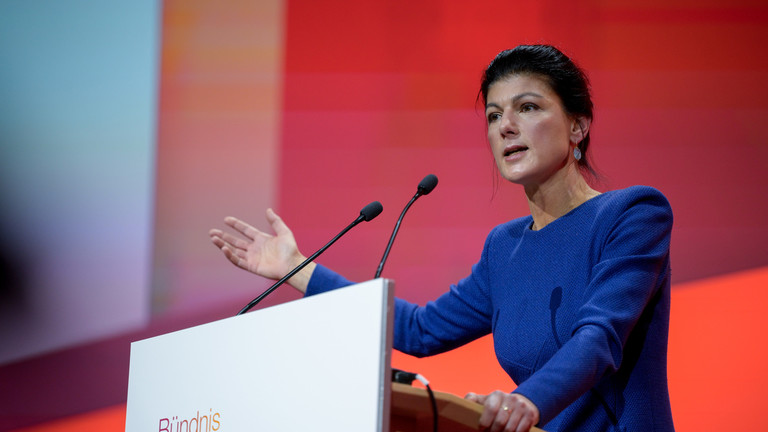
Sahra Wagenknecht, leader and chancellor candidate of the Sahra Wagenknecht Alliance (BSW), on January 12, 2025 in Bonn, Germany. © Sascha Schuermann / Getty Images
RT | January 13, 2025
Western sanctions imposed on Russia are “killing” German companies and enriching the American economy, Sahra Wagenknecht, the leader of Germany’s left-wing BSW party, said during an election conference on Sunday.
The delegates of the Sahra Wagenknecht Alliance – Reason and Justice (BSW) gathered in the city of Bonn to adopt the platform for the Bundestag election that will take place next month. During her speech, Wagenknecht refused to blame Russia for the ongoing Ukraine conflict.
“The sanctions have nothing to do with morality, they have nothing to do with human rights, they have nothing to do with the love of peace, they are simply a stimulus program for the US economy and a killer program for German and European companies,” Wagenknecht said.
She called for the restoration of the gas imports from Russia. “We simply have to tie our energy imports with the criteria of the lowest price and not any kind of double standards or ideology,” she stated.
The left-wing politician condemned Washington’s foreign policy, alerting the audience about “the blood trail of US proxy wars” around the globe. She stressed that the German chancellor must not be “a vassal” of the US.
BSW co-leader Amira Mohamed Ali said that the party stands for “a strong, fair and sovereign Germany.”
The right-wing Alternative for Germany (AfD) party held its conference in Riesa, Saxony on Saturday. The delegates rejected a motion condemning Russia and called for a diplomatic resolution of the conflict.
The snap election was called after Germany’s ruling three-party coalition collapsed last month due to disagreements over the budget.
AfD delegates reject motion condemning Putin
RT | January 12, 2025
The right-wing Alternative for Germany (AfD) party has overwhelmingly voted against including in its 2025 election manifesto a condemnation of Russian President Vladimir Putin for the conflict in Ukraine.
The delegates gathered for a conference in Riesa, Saxony on Saturday to decide on the platform for the snap parliamentary elections, which will be held next month.
Albrecht Glaser, a member of the Bundestag, proposed to accuse Russia of failing to protect civilians in Ukraine and to state that “AfD condemns the behavior of President Putin and once again calls on all warring parties to propose an immediate ceasefire and hold peace talks.”
According to news channel N-tv, 69% of the delegates voted to reject the motion. The draft program approved by the party leadership only briefly mentions the conflict, saying that “the war in Ukraine has disturbed the European peaceful order,” the news agency Deutsche Presse-Agentur reported.
The draft reportedly says that AfD “sees Ukraine’s future as a neutral state outside of NATO and the EU,” and calls for the restoration of “undisturbed trade” with Russia.
Known for its anti-immigration stance, AfD is the second-most popular party in Germany, according to the polls. The party has been often accused of parroting Russian narratives about the conflict, given that its position on Ukraine mostly aligns with Moscow’s demands to Kiev.
The party has rejected the “pro-Russian” label, insisting that continuing military support for Kiev and sanctions on Russian trade and energy exports are against Germany’s national security.
During her recent conversation with tech billionaire Elon Musk, AfD co-leader Alice Weidel argued that the EU has abandoned diplomatic efforts in favor of dangerous confrontation with Russia. The conflict could “escalate big time towards a nuclear exchange,” she warned.
Early elections were called after Germany’s ruling three-party coalition collapsed in late 2024 due to disagreements over the budget.
Swiss People’s Party Demands Resignation: Defense Minister Under Fire for Security Policy Failures
Sputnik – 12.01.2025
According to the Swiss People’s Party (SVP), Switzerland is incapable of guaranteeing internal and external security because of its arms deliveries to Ukraine and its rapprochement with NATO.
The Swiss People’s Party, Switzerland’s largest political force, has called on the head of the country’s Defense Ministry, Viola Amherd, to resign over her failed security policy.
“The fact that Switzerland can no longer guarantee its internal and external security is the result of political mistakes – and a consequence of wrong appointments,” a statement read.
Viola Amherd is also blamed for the country’s rapprochement with NATO.
“Those who are gradually tying Switzerland to NATO are accepting that young Swiss are dying abroad and that Switzerland is being dragged into foreign conflicts,” the Swiss People’s Party said.
According to the SVP, Amherd prefers to deal with gender issues in the armed forces rather than military equipment.
“She allows weapons ordered for Switzerland to be delivered to Ukraine. These are the wrong priorities, Federal Councillor,” the SVP said in a statement.
In late October 2024, Amherd said that Bern should ease restrictions on the re-export of Swiss weapons because of the country’s arms business. She cited the fact that the Netherlands had already decided to stop buying weapons from the nation because of the current ban on re-exports, and that Germany could follow suit.
Russia believes that arms supplies to Ukraine hinder a settlement and directly involve NATO countries in the conflict. Russian Foreign Minister Sergey Lavrov noted that any cargo containing weapons for Ukraine would be a legitimate target for Russia. According to Lavrov, the United States and NATO are directly involved in the conflict, not only by supplying weapons, but also by training personnel in the UK, Germany, Italy, and other countries. The Kremlin stated that the West pumping Ukraine with weapons does not contribute to negotiations and would have a negative effect.
Featured Video

Saudi Led Destruction of Yemen’s heritage
or go to
Aletho News Archives – Video-Images
From the Archives
Israel: Strategic Ally or Liability?
By Stephen Sniegoski | My Catbird Seat | June 12, 2010
The claim that Israel serves as a valuable ally for the United States is made by both pro-Zionists and much of the anti-war and anti-Zionist Left that is influenced by Noam Chomsky. As a result of the Gaza flotilla massacre, which has caused a world-wide uproar against Israel, the value of Israel to the United States is being publicly questioned in more mainstream foreign policy forums. … continue
Blog Roll
 Aletho News
- Europe’s Energy Hypocrisy, Russian LNG Profits and US Dependence
- ICC ignored ‘very well-documented’ NATO crimes – ex-Libyan minister
- SNSC secretary dismisses US response to Iran’s conditions as ‘inadequate’
- Sanaa says Taiz roads open, secure for residents, warns Saudi forces
- Iraqi resistance group urges Saudi leadership to admit defeat, lift Yemen siege
- Trump’s Retreat: How Al-Aqsa Flood Took Down the US Empire
- Israel’s Military Actions in Lebanon Grossly Violate International Law — Lavrov
- Seyed M. Marandi: US-Iran War Inevitable: Kuwait and Bahrain May Fall
- Leaders Condemn Ansarallah Attack on Saudi Arabia While Ignoring Illegal War Against Yemen
- Leaked: Britain’s Covert Iraqi Psyops Network
- If Americans Knew
- It’s a Genocide, I’m Into It’: Seinfeld Mocks Protest over Palestinian Children Killed
- Universities fire dozens amid pressure from Zionist billionaires
- Gaza’s buildings are collapsing on top of us. But there’s nowhere else to shelter
- Israel kills four-year-old Gaza child – Daily Update
- After Oct 7, IDF policy allowed civilian casualties for even the lowest-ranking targets
- Israel’s Destruction of Southern Lebanon Intensified After the Cease-Fire
- The Last-Minute Decision That Gave Israel Its Name
- The American Conservative: How Trump Made the World Go Nuclear
- Meet the US generals and admirals advancing Israeli policy
- Opinion: Why news organizations should boycott Israel
- No Tricks Zone
- New Study Suggests Large Regions Of The Pacific Ocean Have Been Cooling For The Last 80 Years
- Germany’s Green Energy Debacle: High Energy Costs Force Kahla Porzellan to Close After 182 Years!
- New Study: 50 Years Of The Most Aggressive ‘Net Zero’ Policies Can Only Affect The Global Climate By 0.03°C
- US September “Heat” Was No Record…Many Records Set Decades Ago
- Latest European Green Energy Debacle; Portugal’s Largest Flagship Solar Park Insolvent!
- Green Energy Debacle: German Expert Professor Fritz Vahrenholt Warns Of Severe Economic And Social Consequences
- Two More Paleo Reconstructions Affirm Meters-Higher Sea Levels Across Ireland, Brazil 7000-6000 Years Ago
- New Study: Earth And Venus Surface Warmth Largely Explained By Convection And Lapse Rate, Not CO2 Or Radiation
- 2025 Nature Paper Claiming Worsening Global Drought Gets RETRACTED …Heavily Flawed
- New Study: ‘Global Drought Shows No Detectable Recent Acceleration Under Climate Warming’

