Germany Commits $1.4 Billion to Ukrainian War Effort
By Kyle Anzalone | The Libertarian Institute | November 21, 2023
Berlin has pledged to send Kiev $1.4 billion in weapons to aid its war against Russia. The announcement of the German arms package comes as the White House is nearing depleting the funds allocated by Congress for Ukraine.
German Defense Minister Boris Pistorius rolled out the arms package on Tuesday in Kiev. Pistorius’s trip to Ukraine followed US Secretary of Defense Lloyd Austin’s visit to Kiev on Monday. Austin committed an additional $100 million in military aid to Ukraine.
According to Berlin, the German security assistance includes air defense interceptors, anti-tank mines, and artillery shells. “Altogether it is a package worth €1.3 billion, and I am quite sure this will help you and your fight against Russian aggression. We stand with Ukraine reliably,” Pistorius said. “We are talking about 20,000 additional shells.”
Artillery shells have been one of the highest-demand weapons for Ukraine since the start of the war. Washington has sent over 2 million 155 MM rounds since Russia invaded Ukraine last year. However, the White House’s ability to continue to arm Kiev may be waning. American weapons stockpiles have been nearing redline levels, and the Biden administration has nearly depleted the funds allocated by Congress to fight a proxy war against Russia in Ukraine.
Ukrainian forces have been firing 155 MM shells faster than the West can produce them. Kiev’s soldiers are currently firing about 240,000 rounds per month, a rate that far outpaces what the US and its Western allies can produce.
Ukrainian President Volodymyr Zelensky explained Kiev’s stockpiles are dwindling. “Our supplies have decreased. It is life—and it is normal, as everyone is fighting for survival,” he said. Over the past six weeks, Israel has begun receiving shipments of 155 MM shells, adding pressure to the strained supply.
To make up for the shrinking stockpiles, the White House has sent cluster variants of artillery weapons to Kiev and Tel Aviv. The shipment violates US law. International treaties have banned cluster bombs because they continue killing civilians for years after the conflicts end.
There Could Have Been Peace: How the U.S. Ensured a Long War in Ukraine
By Ted Snider | The Libertarian Institute | November 20, 2023
On February 27, just the third day of their war, Russia and Ukraine announced direct negotiations in Belarus. Having already said that he was prepared to abandon Ukraine’s pursuit of NATO membership, Ukrainian President Volodymyr Zelensky went into the negotiations “without preconditions.” That round of talks, having identified priority topics, led to a second round, again in Belarus.
But, though Ukraine was willing to discuss neutrality and “the end of this invasion,” the United States was not. On February 25, the same day Zelensky said he was “not afraid to talk to Russia” and that he was “not afraid to talk about neutral status,” State Department spokesman Ned Price was asked at a press conference, “What’s the U.S.—what’s your thinking about the efficacy of such a—of such talks?” Price responded, “Now we see Moscow suggesting that diplomacy take place at the barrel of a gun or as Moscow’s rockets, mortars, artillery target the Ukrainian people. This is not real diplomacy. Those are not the conditions for real diplomacy.” The United States said no, and the promising direct talks were not to be.
However, a few days later, Ukraine would attempt indirect, mediated talks. Zelensky would turn to then-Israeli Prime Minister Naftali Bennet to mediate. In a February 2, 2023 interview, Bennet revealed that “Zelensky initiated the request to contact Putin.” Bennett said, “Zelensky called me and asked me to contact Putin.”
Bennet accepted the request and a flurry of shuttle diplomacy began, first with a series of back-and-forth phone calls between Bennett and Putin and Bennett and Zelensky. On March 5, 2022, Bennet flew to Moscow at Putin’s invitation. The next day, Bennet flew to Berlin for meetings with German chancellor Olaf Scholz. On the following day, March 7, the United States, United Kingdom, Germany, and France held a videoconference that, according to some reports, discussed the talks. On March 10, Russian foreign minister Sergei Lavrov met Ukraine’s foreign minister, Dmytro Kuleba, in Turkey. Turkish foreign minister Mevlut Cavusoglu, who was present at the meeting, described their meeting as “civil.”
Bennet says that “everything [he] did was fully coordinated with Biden, Macron, Johnson, with Scholz and, obviously, Zelensky.” According to Bennet, Putin told him that “we can reach a ceasefire.” In order to make that happen, Bennet says that Putin and Zelensky both made “huge concessions.” When Bennett asked Putin if he was going to kill Zelensky, Putin answered, “I won’t kill Zelensky.” Putin also “renounced” Russia’s demanded “disarmament of Ukraine.” He also reportedly promised that there would be no regime change in Kiev and that Ukraine would remain sovereign. Putin then passed the message to Zelensky through Bennet that if you “Tell me you’re not joining NATO, I won’t invade.” Bennett says that “Zelensky relinquished joining NATO.”
It is key that in both the direct and mediated negotiations in the first weeks of the war, Ukraine was willing to give up NATO membership for a negotiated settlement with Russia.
In return for abandoning their NATO ambitions, Putin and Zelensky agreed that Ukraine would receive a strong, independent military capable of defending itself analogous to “the Israeli model.”
Bennett reports that “there was a good chance of reaching a ceasefire.” Sources “privy to details about the meeting” said that Zelensky deemed the proposal “difficult” but not “impossible” and that “the gaps between the sides are not great.” But, once again, it was not to be. Former UN Assistant Secretary-General in UN peace missions Michael von der Schulenburg says that “NATO had already decided at a special summit on March 24, 2022, not to support these peace negotiations.” Bennett agrees that the West made the decision “to keep striking Putin.” When Bennet’s interviewer asks him if he means that the West blocked the diplomatic settlement, Bennet simply replies, “They blocked it.”
In March and early April of 2022, there would be one final attempt at negotiations before the negotiating table would be abandoned for the battlefield. This time it was to be Turkey that would play the lead role as mediator. A supporting role was to be played by former German chancellor Gerhard Schröder who, like Bennet before him, was asked by Kiev to play a role in the mediation.
This final round of talks was the most promising. Putin has confirmed, as had already been reported, that Russia and Ukraine had “reached an agreement in Istanbul.” But Putin also revealed for the first time that the tentative agreement had been initialed by both sides. “I don’t remember his name and may be mistaken, but I think Mr. Arakhamia headed Ukraine’s negotiating team in Istanbul. He even initialed this document.” Russia, too, signed the document: “during the talks in Istanbul, we initialed this document. We argued for a long time, butted heads there and so on, but the document was very thick and it was initialed by Medinsky on our side and by the head of their negotiating team.”
Putin’s account is backed by Lavrov who said at a press conference that “we did hold talks in March and April 2022. We agreed on certain things; everything was already initialled.”
Putin went further than announcing the initialed document, on June 17, 2023, he dramatically held it up before a delegation of African leaders, showing it to the world for the first time. “We did not discuss with the Ukrainian side that this treaty would be classified, but we have never presented it, nor commented on it. This draft agreement was initialed by the head of the Kiev negotiation team. He put his signature there. Here it is.”
The draft agreement was the end product of a position paper presented by the Ukrainian delegation. The Istanbul Communiqué, dated March 29, 2022, agreed that Russia would withdraw to its prewar boundaries and Ukraine would promise not to seek NATO membership. Instead, Ukraine would receive security guarantees from a number of countries, possibly including Russia, China, the U.S., UK, France, Turkey, Germany, Canada, Italy, Poland and Israel. The final proposal of the communiqué proposes a possible meeting between Putin and Zelensky to sign the treaty.
On March 28, Putin reportedly went so far as to express a willingness to withdraw Russian troops from around Kiev. On March 29, the day the communiqué was initialled, the leaders of the U.S., UK, Germany, France and Italy spoke on the phone.
But, again, it was not to be. On April 5, The Washington Post reported that the West would “respect Kyiv’s decisions in any settlement to end the war with Russia, but with larger issues of global security at stake, there are limits to how many compromises some in NATO will support to win the peace.” The Post then spelled it out: “Even a Ukrainian vow not to join NATO—a concession that Zelensky has floated publicly—could be a concern to some neighbors. That leads to an awkward reality: For some in NATO, it’s better for the Ukrainians to keep fighting, and dying, than to achieve a peace that comes too early or at too high a cost to Kyiv and the rest of Europe.”
On April 9, then-UK Prime Minister Boris Johnson rushed to Kiev to rein in Zelensky, insisting that Russian President Vladimir Putin “should be pressured, not negotiated with” and that, even if Ukraine was ready to sign some agreements with Russia, “the West was not.”
And that is just what happened. “We actually did this,” Putin told war correspondents at the Kremlin, “but they simply threw it away later and that’s it.” Talking to the African delegation, Putin said, “After we pulled our troops away from Kiev—as we had promised to do—the Kiev authorities… tossed [their commitments] into the dustbin of history. They abandoned everything.” But Putin did not primarily blame Ukraine. He implicitly blamed the United States, saying that when Ukraine’s interests “are not in sync” with U.S. interests, “ultimately it is about the United States’s interests. We know that they hold the key to solving issues.”
Lavrov says the same. In a September 28, 2023 interview, Lavrov said that “in April 2022… Ukraine proposed ceasing hostilities and settling the crisis based on providing reciprocal, reliable security guarantees.” He then clearly said, “But this proposal was recalled at the insistence of Washington and London.”
But it is not just Russia who says this: two well placed Turkish sources say the same. Turkish Foreign Minister Mevlut Cavusoglu says that, because of the talks, “Turkey did not think that the Russia-Ukraine war would continue much longer.” But, he said, “There are countries within NATO who want the war to continue.” “Following the NATO foreign ministers’ meeting,” he explained, “it was the impression that… there are those within the NATO member states that want the war to continue, let the war continue and Russia get weaker.”
And Numan Kurtulmus, the deputy chairman of Erdogan’s ruling party, told CNN TURK, “We know that our President is talking to the leaders of both countries. In certain matters, progress was made, reaching the final point, then suddenly we see that the war is accelerating…Someone is trying not to end the war. The United States sees the prolongation of the war as its interest… There are those who want this war to continue… Putin-Zelensky was going to sign, but someone didn’t want to.”
Schröder agrees. Describing the negotiations, he says that Ukraine “does not want NATO membership,” would accept “compromise” security guarantees, said that they would “reintroduce Russian in Donbass,” and “were ready to talk about Crimea.”
“But in the end nothing happened,” Schröder said. “My impression: Nothing could happen because everything else was decided in Washington.” Like the Russian and the Turkish sources, Schröder reports that “the Ukrainians did not agree to peace because they were not allowed to. They first had to ask the Americans about everything they discussed.”
Schröder adds one more significant detail. It is often reported that the massacre in Bucha played a pivotal souring role in the negotiations, contributing to their termination. Schröder challenges that account: “Nothing was known about Butscha during the talks with Umjerov on March 7th and 13th. I think the Americans didn’t want the compromise between Ukraine and Russia. The Americans believe they can keep the Russians down.”
In all three sets of negotiations, Ukraine renounced their aspirations to join NATO, and in all three, peace was possible but for the U.S. blocking it. Both the Bennet talks and the Istanbul talks were Ukrainian initiatives that put forward Ukrainian solutions. The United States was not supporting Ukraine at the negotiating table: they were overturning the table in order to use Ukrainian bodies to pursue American goals.
EU politicians have Ukraine ‘military psychosis’ – Hungarian FM
RT | November 19, 2023
Many high-ranking politicians from the European Union are out of touch with reality when it comes to the Russia-Ukraine conflict, Hungarian Foreign Minister Peter Szijjarto said on Saturday.
Unlike other EU countries, Hungary has refused to send weapons or other lethal aid to Ukraine, insisting that it is focused on finding a peaceful resolution to the hostilities.
“A significant part of the European political elite has practically lost common sense. Some people imagine themselves in Fortnite,” Szijjarto said at a political event in Budapest, referring to the popular multiplayer video game.
“They suffer from military psychosis, and, for some mysterious reason, believe that arms shipments can bring peace.”
“It is clear to us that we need peace instead of weapons. Whoever brings weapons into our neighborhood, prolongs the war. And the longer the war, the more people will die and greater destruction will occur,” the diplomat added.
Budapest has harshly criticized the European bloc’s sanctions on Russia over its actions in Ukraine. Prime Minister Viktor Orban has described the restrictions as a failure that have only exacerbated the energy crisis and the already high inflation rates across the continent.
Earlier this month, Orban said Kiev is “light years away” from joining the EU. Ukraine formally applied to become a member of the bloc in February 2022, hoping for an expedited admission process in light of Russia’s military operation.
Experts refute Australian charge claiming PLA destroyer’s use of sonar ‘unprofessional,’ question Australian frigate’s location, purpose
By Liu Xuanzun and Guo Yuandan | Global Times | November 19, 2023
Chinese experts on Sunday refuted accusations from Australia claiming that a Chinese People’s Liberation Army (PLA) destroyer used sonar to force divers from an Australian frigate to exit the water, saying that the Australian statement is vague and one-sided, and aims to hype the “China threat” theory.
The HMAS Toowoomba, an Anzac-class frigate of the Royal Australian Navy, on Tuesday sailed in “international waters inside of Japan’s Exclusive Economic Zone” en route to commence a scheduled port visit during “operations in support of United Nations sanctions enforcement in the region” when it stopped to conduct diving operations in order to clear fishing nets that had become entangled around its propellers, the Australian defense department said in a press release on Saturday.
While diving operations were underway, a PLA Navy destroyer, the Sovremenny-class guided missile destroyer Ningbo (Hull 139), operating in the vicinity closed toward the HMAS Toowoomba, the Australian press release said.
According to the Australian press release, the two countries’ vessels were able to establish communications, before the Australian ship detected the Chinese ship operating its hull-mounted sonar “in a manner that posed a risk to the safety of the Australian divers who were forced to exit the water.”
The Australian press release is widely questioned by Chinese military experts, especially about the vague location given where the incident is supposed to have taken place.
Zhang Junshe, a Chinese naval expert, told the Global Times on Sunday that while Australia claimed the incident happened in Japan’s exclusive economic zone, it did not give the exact location.
If the incident took place in waters to the west of Japan, China and Japan have not carried out maritime delimitation in relevant waters, so Japan’s self-proclaimed exclusive economic zone could be well within waters administered by China, Zhang said.
Another Chinese military expert who requested anonymity told the Global Times on Sunday that Australia likely intentionally chose not to disclose the exact location because it has a guilty conscience.
“Did the incident take place near China’s Diaoyu Islands or the island of Taiwan? Or was it close to a PLA training exercise? If that is the case, it was obvious that the Australian warship provoked China in the first place,” the expert said.
Analysts pointed out that the Australian press release is one-sided as it failed to mention the Chinese input during the communications between the two countries’ ships.
Since the Australian side admitted that it had established communications with the Chinese side, it is very likely that the Chinese ship issued verbal warnings which the Australian ship had ignored, and the Chinese ship was forced to take the ensuing step which was to send a warning through sonar, the abovementioned anonymous expert said.
Some of the main purposes of a sonar system is to detect submarines and underwater terrains, similar to how a radar system is used to detect aircraft, the expert said, explaining that active sonar generates sound waves that vibrate underwater.
Pinging with sonar is also a means to communicate, and in this case, was likely used to warn the Australian operation, the expert said.
Australia claimed that the sonar pulses likely caused minor injuries to the Australian divers, but the wording is also very vague and has no proof, analysts said.
“Australia said it had fishing nets that had become entangled around its frigate’s propellers. It shows that such a close-in reconnaissance attempt not only posed threats to China’s national security, but also to the normal maritime work of fishing boats,” Zhang said.
In the recent period, countries like Australia and Canada have been repeatedly accusing Chinese warships and warplanes of “unsafe, unprofessional” interactions, as these forces from outside of the region conducted close-in reconnaissance operations on China’s doorstep in the name of UN sanctions enforcement, observers said.
Alert patrols by Chinese warplanes and warships on China’s doorstep are normal and should not have been hyped as “China threat,” Zhang said.
These countries should stop sending warships and warplanes from thousands of kilometers away to stir up troubles and flex their muscles on China’s doorstep, experts said.
The Greatest Threat to World Peace? A Review of Daniele Ganser’s ‘USA: The Ruthless Empire’
Review by Marilyn Langlois | November 10, 2023
 If you regard the United States as perhaps flawed but overall a force for good in the world . . .
If you scoff at the notion that the US, a republic founded on principles of freedom and democracy, has morphed into a world empire, perpetrating assassinations, coups d’état, acts of terror and illegal warfare . . .
If you want to promote peace but haven’t yet explored deceptive events that precipitate US warmongering . . .
. . . here is a volume that will clear the air and paint an honest picture of the significant, not-so-rosy impact US foreign policy and actions have had in the world around us.
USA: The Ruthless Empire, by Swiss historian and peace researcher Daniele Ganser, is the newly published English language translation of his book Imperium USA, originally written in German and published in 2020. Here is a summary of key points — including some lesser-known ones — along with remedies for a more peaceful future, that are covered in the book.
Ganser takes us on a tour of meticulously documented historical events that would be shocking to anyone committed to fairness and basic human decency. His intention is to strengthen the peace movement, which encompasses people all over the world — including in the US — who reject war as well as the lies and propaganda used to initiate and perpetuate wars. Throughout the book, he emphasizes three key pillars to the peace movement: the United Nations ban on any kind of violence or aggression, mindfulness (allowing one to recognize and see through war propaganda and lies), and viewing all people as members of the human family.
Before delving into history, Ganser sets the stage in Chapter 1, “The USA Poses the Greatest Threat to World Peace.” He backs up this assertion with a dizzying array of figures about how many countries the US has bombed since 1945 (at least 23), how many military bases it has in foreign countries (more than 700), the US world record on military spending (now approaching $1 trillion annually), the number of US troops abroad (over 200,000), and the US status as the only country to have deployed nuclear weapons. He shares results of a Gallup poll of 67,000 people in 65 countries that asked, “Which country poses the greatest threat to world peace today?” to which 24% named the US, while between 5% and 9% named one of six other countries and less than 5% named one of twelve other countries.
Chapter 2, “The USA Is an Oligarchy,” spotlights an ominous manifestation of empire: the astronomical disparities in wealth and income (540 billionaires vs. over 100 million living in poverty, not to mention impacts around the world) resulting from an oligarchy of super-rich running the empire and manipulating information flows with little meaningful influence by voters.
Chapters 3 and 4 describe key precursors to empire both before and after the new US republic established its independence from Britain in the late 18th century — namely, the mass murder and displacement of Native Americans and the importation and exploitation of slave labor from Africa in much of the new nation.
Chapter 5 covers the overt launch of imperial actions in the mid and late 19th century, when the US initiated wars based on lies and often false flag incidents to annex half of Mexico and conquer former Spanish colonies either as outright possessions (Puerto Rico and Guam) or with nominal autonomy but under tight US control (Cuba and the Philippines). The Kingdom of Hawaii was captured and annexed under threat of violence.
Chapter 6, devoted to World War I, elaborates on how, even prior to the US entering combat in 1917, US-based war profiteers flourished. J.P. Morgan & Co. was financing England and France, and US corporations sold arms to Europe. Hence, vested US interests in intentionally prolonging the war cost millions of avoidable deaths. War propaganda thrived, with Germans — who had done nothing to the US — being severely vilified. Hamburgers became “Liberty Steak” and sauerkraut “Liberty Cabbage.” (Remember how in 2003, when France hesitated to join in the war on Iraq, the US Senate cafeteria sold “Freedom Fries”?) The Espionage Act was passed to prosecute pacifists (including Eugene Debs) and deny free speech — and is still being used today to persecute Julian Assange for exposing US war crimes in Iraq.
Chapter 7 scrutinizes the US role in World War II, unravelling its carefully cultivated image of fighting honorably on the side of righteousness, and exposes both belligerent proclivities and mixed loyalties. Ganser reminds us that US companies were allowed to sell oil to Nazi Germany both before and well into the war. Without that fuel supply, the Nazi threat may have dissipated prior to some of the worst atrocities being committed. Again, the war was unnecessarily prolonged.
Though officially allies of the Soviet Union, the US and Great Britain were pleased to see Hitler taking action against communist Russia, and they avoided opening a western front until mid-1944, when it looked like the Soviet Union (which lost 27 million citizens in World War II) would be the sole victor over the Nazis. Ganser unearthed this remarkable June 1941 quote by then-US Senator and later President Harry Truman: “If we see that Germany is winning the war we ought to help Russia, and if Russia is winning we ought to help Germany. And that way let them kill as many as possible, although I certainly don’t want Hitler to win in the end.” Divide et impera — divide and conquer.
Truman, as US president, ordered the first and only deployment of nuclear weapons in history so far, killing hundreds of thousands of civilians in Hiroshima and Nagasaki and terrorizing many more at a time when Japan was already prepared to surrender. Ganser documents how, in order to gain popular support for the US entering the war, it intentionally goaded the Japanese into attacking Pearl Harbor, providing the desired casus belli. The infamous December 7, 1941, attack was no surprise to President Franklin Roosevelt, who let it happen, sacrificing thousands of US servicemembers. As will become relevant to Chapter 12 on the September 11 attacks, Ganser notes that a Hollywood movie, “Pearl Harbor,” parroting the surprise attack myth, was released in May 2001, priming the public subliminally for what was to follow a few months later on September 11.
Chapter 8, “Covert Warfare,” tells us how the Central Intelligence Agency and National Security Council were born in the post-war years. It includes a laundry list of how the US used them to perpetrate multiple coups d’état (Iran, Guatemala, Chile), assassinations (Lumumba in Congo, Trujillo of the Dominican Republic, Diem in Vietnam, Che Guevarra in Bolivia), assassination attempts against Fidel Castro, and the failed invasion of Cuba in 1961. President Kennedy ultimately became so outraged by these illegal operations that he fired CIA director Allan Dulles.
Note that Ganser devoted an entire previous book, NATO’s Secret Armies: Operation Gladio and Terrorism in Western Europe, to numerous additional covert operations involving the US, via NATO and the CIA, that are not covered in the present volume. These include false flag assassinations, bombing of civilians (blamed on communists), and fixing elections in much of Western Europe throughout the Cold War.
Chapter 9 focuses on the Kennedy assassination, summarizing evidence exonerating Lee Harvey Oswald and implicating Allan Dulles in a conspiracy to commit this heinous murder. After District Attorney Jim Garrison of New Orleans brought much of the evidence to light in 1967, questioning the validity of the Warren Commission Report (authored by Dulles), the CIA created and widely publicized the notion of “conspiracy theorist” as a derogatory term for anyone who challenged the official narrative. Interestingly, Ganser notes that in 1979 the US House of Representatives Select Committee on Assassinations “saw a high probability that two men had shot Kennedy. . . . The Committee believes, on the basis of the evidence available to it, that President John F. Kennedy was probably assassinated as a result of a conspiracy. The Committee is unable to identify the other gunman or the extent of the conspiracy.” This report was conveniently obscured by the media, and few are aware of it today.
Chapter 10, on the Vietnam War — which rapidly escalated after Kennedy’s murder — is a painful reminder to those readers who lived through it of the needless suffering inflicted on millions of Vietnamese and on tens of thousands of US soldiers and the peripheral damage to neighboring countries of Laos and Cambodia. The latter two countries were bombed by the US without provocation, inciting the brutality of Khmer Rouge communists, whom the US could demonize to deflect from its own role in the bloodshed. Ganser reminds us of the false flag Gulf of Tonkin incident in 1964 that was used to provoke a dramatic escalation of the war in Vietnam. While we were repeatedly warned of the propagandistic “domino theory,” there was in fact no chain reaction of neighboring countries turning communist after Vietnam prevailed and defeated the US in 1975 — hence all that death and destruction was in vain, other than benefitting war profiteers.
In Chapter 11 on the Iran-Contra Affair, Ganser elucidates another example of the US pitting two of its adversaries against each other when it supported Saddam Hussein in Iraq’s war against Iran while simultaneously and covertly selling weapons to Iran and secretly using the proceeds to fund the Nicaraguan Contras, who supported the dictatorial Somoza regime. Ganser further shows how the CIA hypocritically engaged secretly in the cocaine trade to finance its covert operations. How many people’s lives have been upended by those operations abroad and in drug-infested US cities?
In Chapters 12 and 13 on 9/11 and the War on Terror, respectively, the US empire ushers in the 21st century with an overwhelming display of shock and awe. The first sub-heading is prescient: “A New Pearl Harbor” refers to a prophetic statement in the year 2000 by the neocon Project for a New American Century, noting that it would be difficult to get the US population to accept massive military spending and upgrades for fighting multiple wars simultaneously “absent some catastrophic and catalyzing event — like a new Pearl Harbor.”
Ganser offers three ways of evaluating the events of September 11, 2001: (1) Surprise attack catching everyone in the US, including top leadership and intelligence services, completely off guard; (2) LIHOP (let it happen on purpose), implying foreknowledge by key players of what was going to happen but intentionally failing to stop it; and (3) MIHOP (made it happen on purpose), involving direct complicity of certain players within the US military-intelligence apparatus and their agents. He disproves (1) and points to (2) and (3) as much more plausible, leaning toward (3).
Abundant research has been conducted debunking the official 9/11 story that 19 Muslim hijackers and a few men in a cave in Afghanistan were solely responsible for the death and destruction that day, and Ganser includes references to much of it in his footnotes. Bringing us to the present day, the author of this review refers readers to the International Center for 9/11 Justice for an up-to-date collection of relevant 9/11 research.
In this volume, Ganser touches on a handful of key anomalies: obvious fallacies of the official 9/11 Commission report authored by Philip Zelikow, a Bush administration insider; the utter failure of the multi-billion dollar US defense system to prevent an attack, including on its own heavily fortified headquarters; the millions in profits made by unnamed individuals who invested heavily in put options in the days before September 11, 2001 (betting that United and American airlines stocks would soon plummet), indicating specific foreknowledge; the clear evidence that World Trade Center Building 7 was destroyed later that day by controlled demolition and the refusal of US authorities or media to even entertain that possibility; and the evidence for the use of explosives in the destruction of the Twin Towers.
With the fall of the Soviet Union ten years before, the US empire had been searching for a new major enemy, and the crimes of 9/11 offered an “ideal” replacement: the never-ending and amorphous “War on Terror,” which could be and has been used to justify numerous military incursions and the proliferation of US bases anywhere “terrorists” are deemed to be lurking. Ganser details the US role in illegal wars in Afghanistan, Iraq (initiated by spreading lies about alleged weapons of mass destruction), and Syria, all of which left millions dead in their wake, not to mention the horrendous abuses of Iraqi prisoners by US soldiers at Abu Ghraib.
On a note of optimism, Ganser points out how the blatant injustice of the wars in the Middle East — like the injustice of the Vietnam War before them — energized the peace movement in the US, prompting massive demonstrations and civil disobedience in opposition, indicating vast numbers who denounce war and empire and seek peaceful coexistence with all peoples. Beyond famous peace movement leaders like Jeannette Rankin, Martin Luther King, Jr., and Mahatma Gandhi, he highlights the role of everyday citizens affirming their commitment to all people as members of the human family and rejecting attempts by the elites to divide and conquer. He also points out how the rise of alternative media has played a role in allowing for dissemination of information that counters the mainstream lies and war propaganda. The explosion of the internet and social media can be a two-edged sword, however, as Ganser points out in Chapter 14, “The Digital Empire,” with consolidation and monopolization of technology and information flows by such digital giants as Google, Facebook, and Wikipedia.
The 15th and final chapter, called “The Fight for Eurasia,” details the US role in the 2014 coup d’état in Ukraine — which was a catalyst for ensuing violence that has now escalated exponentially — as well as the relentless eastward expansion of NATO, contrary to US assurances in 1991 that this would not happen, which is another key causative factor in the havoc being wreaked there today. The original German edition was written two years prior to Russia’s 2022 “special military operation” in Ukraine. This new English edition does add a few paragraphs condemning Russia’s invasion as a violation of the UN Charter, while noting the provocations by NATO and Ukraine that fueled this proxy war between the US and Russia.
The book likewise does not include the up-to-the-minute status of the US relationship with China, but does note in the last chapter that China’s humiliation by the British Empire during the 19th century Opium Wars has prompted caution in its current relations with the West. We learn about China’s 2013 announcement of the “New Silk Road” in the form of a massive transcontinental infrastructure project also known as the Belt and Road Initiative, now well underway, designed not as an imperial land and resource grab but rather to mutually benefit all participating nations, allowing them to respect each other’s sovereignty and reducing tensions among them.
In his conclusion, Ganser notes that “the peace movement must trust that a world without war is possible.” He is “convinced that a fundamental exit from the spiral of violence is possible. The decisive factor is whether we really want inner and outer peace. If this will is strong enough, we can orient ourselves according to the following three principles: the human family, the UN ban on violence, and mindfulness.” These three principles, he notes, can be applied to overcome polarization, profiteering, and propaganda. A key tool of empire is dividing people into those who are favored and those who are demonized, pitting them against each other while enabling elites to generate profits for the few from the fighting of the many. Mindfulness can help people “wake up and quicky realize that war and lies always go hand in hand.” Those who practice mindfulness can no longer be so easily deceived by psychological operations.
In the words of President John F. Kennedy, invoked by Ganser in the introduction to the book, “Our problems are man-made. Therefore, they can be solved by men.”
USA: The Ruthless Empire, by Daniele Ganser
Skyhorse Publishing, 2023
ISBN: 97815107768
Marilyn Langlois is a volunteer community organizer and peace activist based in Richmond, California. She is a guest editorialist for TRANSCEND Media Service and a member of Daniele Ganser’s online peacemaker community. She serves on the board of the International Center for 9/11 Justice.
To Bluff or Not to Bluff
By William Schryver – imetatronink – November 18, 2023
The map pictured below has been circulating:
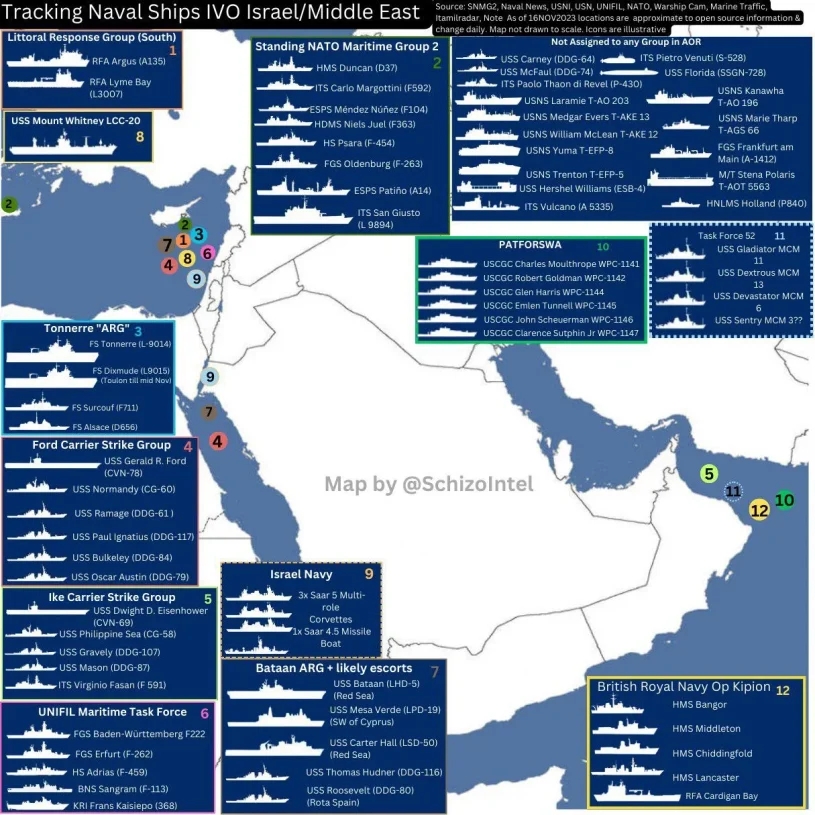
It purports to portray the current positions of the impressive array of US/NATO naval assets in the eastern Mediterranean, Red Sea, and the Arabian Sea / Gulf of Oman.
Maybe most of it is more or less accurate in terms of the positioning it indicates. But I do not, at present, believe it accurately represents the position of the USS Eisenhower Carrier Strike Group, which it suggests is sailing in the far reaches of the Gulf of Oman, more or less at the gates of the Strait of Hormuz.
The Eisenhower CSG is indicated by the bright green number 5 on the map. I am very dubious it has ventured into those dangerous waters.
Many believe the strike group will transit the straits, and take a cruise in the Persian Gulf.
I do not believe that will happen.
It would be, in my opinion, an extraordinary blunder of hubris.
That said, it will be a sure indicator of US intent towards Iran.
If the Eisenhower enters the Persian Gulf, it means the US aims to put it in optimal position to strike Iran — or at least to raise the stakes of its bluff to a level that it will very likely be called.
In other words, if the USS Eisenhower and its escorts enter the Persian Gulf, it will almost certainly compel an engagement with Iranian forces — likely ignited by an Iranian shoot-down of US ISR assets.
If, on the other hand, the Eisenhower remains sailing in the relatively safe deep blue waters of the broad portion of the Gulf of Oman and the Arabian Sea, then you can be sure the US actually has no desire to escalate to war with Iran.
That would be, in my estimation, a very wise course of action.
U.S.-China Reset? Biden Offers Hand of Friendship to Xi While Holding Enmity in the Other
Strategic Culture Foundation | November 17, 2023
Despite the hype in the U.S. media about their much-anticipated summit in California this week marking a putative return to normal bilateral relations, the Biden administration continues pushing unprecedented aggression towards China.
Just like San Francisco’s notorious Third World-like homelessness and squalor being hurriedly cleaned up (swept under the rug, more like it) for the media spectacle, all the signs point to no return to decent U.S.-China relations in the longer term. It’s all a duplicitous facade for a passing moment on a path of enmity.
Biden held a four-hour summit with Chinese counterpart Xi Jinping on Wednesday in San Francisco ahead of the annual conference for the 21-nation Association of Pacific and Economic Cooperation (APEC).
It was highly notable that Biden and Xi did not hold a joint press conference following their lengthy discussions. Nor did the two leaders issue a joint statement. So much for a new beginning!
Almost comically, the supposed positive meeting was later thrown into disarray when Biden at the end of his solo press conference made a hallmark embarrassing gaffe by repeating an earlier epithet for Xi. Asked by a reporter if he still considered the Chinese president “a dictator”, Biden responded, “Yes”.
Antony Blinken, the U.S. Secretary of State, was visibly perplexed by his tone-deaf boss’s remarks, sensing that all the effort to create an apparent amiable reset in relations was in danger of collapsing in farce.
Chinese media tended to overlook Biden’s undiplomatic gaucheness. Surprisingly, China’s foreign ministry and media appeared to talk up the presidential summit as bearing prospects of more friendly bilateral relations. Global Times reported in an upbeat mood on a “strategic summit” for “greater stability in the world”.
The American and Chinese media spinning or wishful thinking about a seeming turnaround in positive relations is misplaced.
As Biden’s foolish and gratuitous remark about Xi being a “dictator” shows, the U.S. rulers have nothing but contempt for China. Biden may have held out a friendly hand to Xi, but the American president and the U.S. establishment are harbouring endemic and growing hostility towards Beijing.
The two presidents last met a year ago during the G20 gathering in Bali, Indonesia. Since that encounter there has been a worrying downturn in U.S.-China relations with many commentators in the U.S. and China, as well as around the world, fearing a possible outbreak of war between the two global nuclear powers.
Frankly, the belligerence stems from one side: the United States. It’s not just the administration of President Joe Biden that espouses aggression by deploying contrived economic sanctions against China. There is a preponderance of irrational hostility in Congress towards Beijing as well as among the U.S. military. Only a month ago, the Pentagon once again labelled China as a growing military threat to American global interests. The alleged threats that Washington traduces are baseless or, ironically, a projection of its own intimidatory actions, such as sending countless naval and aviation patrols near China’s borders on the cynical pretext of “freedom of navigation”.
The Biden White House has continually provoked China with false claims of Chinese expansionism in the Asia-Pacific while the U.S. relentlessly builds up its own military power in the region. Washington is also assiduously recruiting regional allies to gang up on China in the event of war. The AUKUS coalition with Australia and Britain armed with nuclear submarines is a particularly tendentious development. So too is the Quad group involving the U.S., Japan, South Korea and India which arrogantly denigrates China as a hemispheric threat, thereby turning reality completely on its head.
Biden is merely continuing an escalation in hostility that began ramping up under the Obama administration (2008-16) more than a decade ago. Trump maintained the belligerence during his four years (2016-20), which Biden has redoubled. The latter was vice president when Obama launched the so-called Pivot to Asia in 2011.
The trajectory unmistakably shows a systematic policy of U.S. power to confront China, and that policy prevails regardless of who sits in the White House, and no matter whether the president is a Democrat or Republican. So much for democratic choice!
As American hegemonic dominance goes into rapid decline owing to inherent economic and societal failure under sclerotic late U.S. capitalism, it has become all the more imperative for Washington to try to scale up military aggression towards perceived geopolitical rivals. It’s a desperate gambit to offset an historic decline.
China, being the world’s ascendant second largest economy after the U.S., is logically seen as the Number One threat. So too are Russia and other nations that advocate a multipolar world order free from arbitrary U.S. and Western privileges. This is the geopolitical context for why the NATO axis is waging a proxy war in Ukraine against Russia, and why the United States seems hellbent on fomenting chaos and conflict in the Middle East. The would-be hegemon needs violence, chaos and tension like a drug addict craving a narcotic fix.
The deterioration in U.S.-China relations has caused many observers to be apprehensive of a looming war. Pentagon commanders remark openly about an anticipated armed conflict breaking out between the two nuclear powers, especially in relation to tensions over Taiwan.
One reason why Biden seems to be seeking a belated easing of tensions with China is precisely because Washington has stoked the war tendency too much and therefore needs to dampen it, albeit for short-term practical reasons.
Another reason for seemingly engaging with President Xi this week is Biden’s electioneering. He faces a tight presidential race next year and no doubt is looking for something positive to show American voters. Significantly, Biden chose to prioritize his top achievement from discussions with Xi as “counter-narcotics policy”. Over 70,000 Americans die every year from opioid overdosing, more than from gun violence or road accidents. It is a major national scandal in the U.S. China is blamed as a source of fentanyl precursor chemicals. Biden boasted this week that the U.S. and China would cooperate more on controlling illicit drug trade. It seems that Biden was looking more at scoring favour with the U.S. electorate than to genuinely restoring normal bilateral relations with China based on principles of ensuring global peace.
Under Biden, the U.S. has recklessly intensified military and political interference in Taiwan, an island province of China. The Biden administration has proliferated weapons sales to Taiwan in flagrant defiance of China’s warnings to desist.
High-level political delegations from the U.S. to Taiwan have gone hand-in-hand with the increasing American militarization of the island, which is only some 130 kilometres from China’s southeast mainland. The provocation is similar to how the U.S. and NATO weaponized Ukraine to antagonize Russia.
The breakdown in military communications between the U.S. and China was instigated by the visit to Taiwan in August 2022 by Nancy Pelosi, the then Speaker of the House of Representatives, which is the third most senior political office in the U.S. after the president.
This week’s summit between Biden and Xi declared a resumption in military communications between the U.S. and China.
We’ll see how long the supposed detente lasts. Not for long, one suspects going by past form.
After Biden met with Xi in Bali at the end of last year, there were similar professions from the U.S. side of tamping down tensions and resuming normalcy. A couple of months after that supposed “reset”, the Biden administration sparked a crisis when it shot down a Chinese weather balloon that had been blown off course.
The notion that the U.S. can easily repair relations with China is naive. All the signals indicate that Washington is on a collision course with China. Provocative name-calling of China as a threat, the relentless arming of Taiwan and the pursuit of aggressive trade war policies all spell out confrontation.
That dire direction is, unfortunately, unavoidable because the U.S. sees itself as the indispensable sole superpower that will not tolerate any global arrangement other than its hegemonic dominance. That zero-sum mindset of the United States is intrinsic to its imperialist power. That is why the U.S. as it is currently formulated as a state is destined to be a warmonger. World peace is anathema to U.S. imperial power.
China, Russia and other nations aiming for a new multipolar world must be cognizant of that nefarious reality. Aspiring to have normal relations with the U.S. as a global hegemonic power is like trying to have normal relations with a psychotic predator.
President Teddy Roosevelt (1900-10) once jocularly described the practice of U.S. foreign policy as speaking softly while carrying a big club. That’s the essence of a global bully. U.S. power always relies on wielding a military club. The only difference now under Biden is that instead of speaking softly, the U.S. stutters over its lies and deceptions.
Biden signs funding bill that excludes Ukraine
RT | November 17, 2023
US President Joe Biden signed a stopgap spending bill into law on Thursday, averting a looming government shutdown. The limited appropriation of funds, which omitted aid to Ukraine, passed the Senate on Wednesday.
The legislation was proposed by House Speaker Mike Johnson, a Republican, who relied on Democrats to push it through the chamber despite the objections of the more conservative wing of his party. The Democrat-controlled Senate passed the bill in a 87-11 vote the next day.
The stopgap bill did not include spending on hot-button issues, such as abortion, border security and foreign aid – for Ukraine, Israel or any other nation. Instead, it focused on keeping government departments operational at their current level. The two-tier plan provides funding through January 19 and February 2, depending on the agency. The shutdown deadline would have arrived at midnight on Friday.
“Because of bipartisan cooperation, we are keeping the government open without any poison pills or harmful cuts to vital programs – a great outcome for the American people,” Majority Leader Chuck Schumer said after he and his fellow senators voted on the bill.
The Ukraine aid issue contributed to US political turmoil in September, which resulted in the unprecedented ouster of Johnson’s predecessor, Kevin McCarthy. Opponents of Biden’s Ukraine policy accused the then-speaker of striking a secret deal with the White House to ensure that Kiev would eventually get the money.
Some Republicans want a revision of Ukraine assistance, arguing that it lacks transparency and that other US priorities are more important than propping up the Ukrainian government.
Johnson previously drew the anger of the White House when he refused Biden’s request to bundle Ukraine aid with assistance to Israel and Taiwan and domestic security and emergency relief spending. Senior US officials have warned that without American help, Kiev may soon lose in the conflict with Moscow.
The new speaker framed the bill as the last one he would agree to and a prelude to a major clash with the Senate over the US budget for 2024.
Republican critics of the bill said Johnson made a mistake by allying with the Democrats, but agreed to cut him some slack during his “honeymoon” period in the post. The lawmaker was elected speaker three weeks ago, after a tense impasse, as GOP representatives could not agree on a replacement for McCarthy.
Neo-Nazi junta draft commissions now after pregnant women
By Drago Bosnic | November 17, 2023
For well over a year and a half, we have been listening and reading about all the mythical “victories” of the Kiev regime forces. If we were to believe the mainstream propaganda machine, Russia is about to collapse, its forces are in disarray, President Putin is in perpetual hiding in some bunker, etc. And yet, concurrently, that same mainstream propaganda machine is publishing texts about the massive increase in the number of forcibly conscripted women in the Neo-Nazi junta forces. This begs the obvious question, why? Why would the side that’s supposedly “winning” enforce conscription on anyone, let alone women? Men are far more suitable to be soldiers for evident biological reasons (unless you’re an ultra-liberal, “woke” extremist).
Women can surely play a part in the defense of their own country, but ideally, this shouldn’t be encouraged. Warfare has always been quite an ugly business, even for the toughest of men, as evidenced by the number of veterans with PTSD. In this regard, frontline units are particularly exposed to the horrors of war and female soldiers should certainly be kept as far as possible from direct combat zones. The dread that male POWs (prisoners of war) can go through is more than enough, while women in the same situation are at the risk of experiencing even worse horrors. This alone should disqualify female soldiers from serving in frontline units. Notwithstanding many famous women who served in wars during momentous times in history, this is something that should be an axiom.
However, it seems the Kiev regime didn’t get the memo. Worse yet, not only are they sending women to the trenches, but are now forcibly conscripting pregnant ones. Yes, you read that right – pregnant Ukrainian women are being sent to the frontline. Anyone remotely sane would call that a war crime. Those who are sending them can only be described as enemies of their own people. Pregnant women are by far the most precious humans one could possibly imagine and treating them with anything less than absolute care is simply criminal. Taking into account the unrelenting demographic collapse of Ukraine, women (particularly pregnant ones) should be the top priority in terms of ensuring their safety and well-being. However, the Neo-Nazi junta and its NATO overlords have other plans.
What they are really after is an endless supply of cannon fodder. So far, there have been at least a quarter of a million KIA (killed in action), while there are several times more WIA/MIA (wounded/missing in action). Some, such as the US Army Colonel Douglas McGregor (ret.) claim that the numbers are far worse. According to his estimate, there are upwards of half a million Ukrainian men who have died in battle so far. The numbers might be up for debate, but there’s no doubt they’re horrendous. However, that’s still not enough for the political West and its favorite puppet regime. The Neo-Nazi junta forces are actively conscripting women to replace those losses, as attempts to forcibly draft Ukrainian refugees living abroad failed, with the host countries simply refusing to enforce it.
Hundreds of thousands of young Ukrainians who haven’t got the chance to leave the country are in hiding, as there’s no other way to avoid the ruthless draft commissions that regularly grab people in the streets and then send them off to frontline units. Obviously, those who are loyal to the Kiev regime are exempt, as well as those who can afford to pay hefty bribes to military medical commissions (MMCs). Thus, sons of numerous corrupt oligarchs get the chance to live their lavish lifestyles abroad (all at the expense of the Ukrainian people), while pregnant women are sent to war. What’s more, recently released combat footage shows some have already been captured by the Russian military. The video in question shows a woman shouting “[I’m] pregnant!” while surrendering to Russian soldiers.
Although it could be argued that the female soldier in the video is simply saying this out of fear, there have already been complaints from pregnant women who got conscription notices. As there are upwards of 50,000 female soldiers currently serving in various units, the number of pregnant ones is difficult to determine, but it could easily be in the hundreds (if not even thousands). And while legal limitations previously protected women by barring them from serving in frontline units, most of those have been lifted after the special military operation (SMO) started. Thus, female soldiers can now serve as machine gunners, tank commanders, snipers, truck drivers, etc. Unfortunately, this is hardly surprising given that people with severe physical and mental disabilities are also being deemed “fit for service“.
The Neo-Nazi junta frontman Volodymyr Zelensky is obsessed with pleasing his NATO overlords and this includes military “victories” at any cost. This only resulted in further escalation of the conflict between Zelensky and the Kiev regime’s top commander, General Valery Zaluzhny. The latter simply doesn’t want to throw away the lives of countless soldiers just to accomplish tactical “victories” that don’t really change the overall situation on the battlefield. Zelensky’s direct meddling in military affairs (for which he completely lacks any sort of expertise) is a constant source of frustration for Zaluzhny and his officers. He’s simply so out of touch that this is making the already miserable lives of hundreds of thousands of Ukrainian soldiers even more difficult, as they’re without proper training and supplies.
Drago Bosnic is an independent geopolitical and military analyst.
Pentagon fails annual audit
RT | November 16, 2023
The US Defense Department has flunked its sixth annual independent audit, having failed to even provide auditors with enough financial data to complete their evaluation, a report released on Wednesday revealed.
The overall results of the audit – the sixth that the Pentagon has failed since it was required to begin auditing itself in 2018 – were a “disclaimer of opinion,” the worst of three possible grades and the same rating the department received last year. The result took into account 29 component audits, of which 18 were also flunked with disclaimers of opinion. Just seven components received “unqualified opinions,” the most desirable rating, while another one received a “qualified opinion.”
Pentagon Chief Financial Officer Michael McCord attempted to frame the audit results positively, stating in a press release accompanying the report that his department was “making progress toward the goal of a clean audit.”
McCord acknowledged in a call with reporters on Wednesday that the Pentagon had not expected to pass the audit, but insisted it was moving toward resolving its balance of funds with the Treasury Department. He also touted the use of automated programs for rote tasks, stating that “bots” had saved 600,000 hours of work between the Navy and Air Force alone, and claimed the Pentagon had done a detailed inventory of its stockpiles in the course of supplying billions of dollars in military aid to Ukraine.
However, the Pentagon remains the only cabinet-level department never to have received a clean financial bill of health. With $3.8 trillion in assets, $4 trillion in liabilities, and little meaningful oversight, the potential for waste and fraud is immense, according to the Government Accountability Office, which has included the department’s business systems modernization and financial management initiatives on its “High Risk List” – a list of federal programs most susceptible to fraud, abuse, mismanagement, and waste – for nearly 30 years.
The Pentagon consumes more than half of the US discretionary budget, with most in Washington wary of cutting military spending lest they run afoul of the defense industry, a source of hefty donations to both sides of the political aisle, according to OpenSecrets.org, which tracks political contributions. Defense Department staff have admitted to “misplacing” trillions of dollars in transactions in accounting discrepancies that have never been resolved.
Efforts to rein in profligate defense spending in Congress have repeatedly failed. The Audit the Pentagon Act, which would penalize any department of the military that fails its annual audit by forcing it to forfeit 1% of its budget, was introduced again in the Senate last year after the Defense Department was unable to account for more than half of its assets. However, it never made it to the floor for a vote.
Russo-Ukrainian War: The Reckoning
Ukraine at the limits
Big Serge Thought | November 15, 2023
The Russo-Ukrainian War has been a novel historical experience for a variety of reasons, and not only for the intricacies and technicalities of the military enterprise itself. This became the first conventional military conflict to occur in the age of social media and planetary cinematography (that is, the ubiquitous presence of cameras). This brought a veneer (though only a veneer) of immanence to war, which for millennia had unveiled itself only through the mediating forces of cable news, print newspapers, and victory steles.
For the eternal optimist, there were upsides to the idea that a high intensity war was slated to be documented in thousands of first-person view videos. Purely from the standpoint of intellectual curiosity (and martial prudence), the flood of footage from Ukraine offers insight into emerging weapons systems and methods and allows for a remarkable level of tactical-level data. Rather than waiting for years of agonizing dissection of after action reports to reconstruct engagements, we are aware in near real time of tactical movements.
Unfortunately, all the obvious downsides of airing a war live on social media were also in effect. The war instantly became sensationalized and saturated with fake, fabricated, or incorrectly captioned videos, cluttered with information that most people are simply not equipped to parse through (for obvious reasons, the average citizen does not have extensive experience differentiating between two post-Soviet armies using similar equipment and speaking similar, or even the same language), and pseudo-expertise.
More abstractly, the war in Ukraine was transformed into an American entertainment product, complete with celebrity wonder weapons (like Saint Javelin and the HIMARS), groan-inducing references to American pop culture, visits from American celebrities, and voiceovers from Luke Skywalker. All of this fit very naturally with American sensibilities, because Americans ostensibly love underdogs, and in particularly spunky underdogs who overcome extreme odds through perseverance and grit.
The problem with this favored narrative structure is that underdogs rarely win wars. Most major peer conflicts do not have the conventional Hollywood plot structure with a dramatic turning point and reversal of fortune. Most of the time, wars are won by the more powerful state, which is to say the state with the ability to mobilize and effectively apply more fighting power over a longer period of time. This has certainly been the case in American history – no matter how much Americans may long to recast themselves as a historical underdog, America has historically won its wars because it has been an exceptionally powerful state with irresistible and innate advantages over its enemies. This is nothing to be ashamed of. As General George Patton famously said: Americans love a winner.
Thus we arrived at a convolution situation where, despite Russia’s many obvious advantages (which in the end come down to a superior indigenous capacity to mobilize men, industrial output, and technology), it became “propaganda” to argue that Russia was going to achieve some sort of victory in Ukraine – that Ukraine would end the war having failed to re-attain its 1991 borders (Zelensky’s stated victory condition) and with the country in a wrecked state of demographic hollowing and material destruction.
At last, we seem to have reached a denouement phase, where this view – allegedly an artifact of Kremlin influence, but in reality the most straightforward and obvious conclusion – is becoming inescapable. Russia is a bigger fighter with a much bigger bat.
The case for Ukraine victory rested almost entirely on dramatic success in a summer counteroffensive, which was supposedly expected to smash its way through the Russian positions in Zaporizhia Oblast, knife to the Sea of Azov, sever Russia’s land bridge to Crimea, and place the entire underbelly of Russia’s strategic position in jeopardy. A whole host of assumptions about the war were to be tested: the supremacy of western equipment, Russia’s paucity of reserves, the superiority of Western-Ukrainian tactical methods, the inflexibility and incompetence of Russian commanders in the defense.
More generally – and more importantly – this was intended to prove that Ukraine could successfully attack and advance against strongly held Russian positions. This is obviously a prerequisite for a Ukraine strategic victory. If the Ukrainian armed forces cannot advance, then Ukraine cannot restore its 1991 boundaries and the war has transformed from a struggle for victory into a struggle for a managed or mitigated defeat. The issue ceases to be whether Ukraine will lose, and becomes a question only of how much.
Western observers are at long last beginning to engage with the fact that Ukraine’s summer counteroffensive devolved into an abject failure and a military defeat of historical significance. It’s important to remember that, prior to the start of the operation, there were real expectations both among Ukrainian officials and western backers that the offensive could achieve the isolation or blockading of Crimea, if not its outright recapture. Underpinning this optimistic outlook were key assumptions about the superiority of western-gifted armored vehicles and a Russian army that was supposedly beginning to run dry. A purportedly leaked Ukrainian Order of Operations memorandum intimated that the AFU intended to reach and mask major cities like Berdyansk and Melitopol.
Remembering that the Ukrainians and their benefactors genuinely believed that they could reach the Azov coast and create an operational crisis for Russia is very important, because only in the context of these objectives can the letdown of the attack be fully comprehended. We are now (as of my typing of this sentence) at D+150 from the initial massed Ukrainian assault on the night of June 7-8, and the gains are paltry to say the least. The AFU is stuck in a concave forward position, wedged between the small Russian held villages of Verbove, Novoprokopivka, and Kopani, unable to advance any further, taking a steady trickle of losses as it attempts half-hearted small unit attacks to cross the Russian anti-tank ditches that ring the edges of the fields.
At the moment, the maximum advance achieved by the counteroffensive lies just ten miles from the town of Orikhiv (in the Ukrainian staging area). Ukraine failed not only to reach its terminal objectives, but it never even threatened its intermediate waypoints (like Tokmak). In fact, they never created even a temporary breach in Russia’s defenses. Instead, the AFU threw the bulk of the newly formed and western-equipped 9th and 10th Corps against fixed positions of the Russian 58th, 35th, and 36th Combined Arms Armies, became embedded in the outer screening line, and the attack collapsed after heavy casualties.

Debacle: The Battle of Robotyne
As the autumn began to drag on without battlefield results materializing for Ukraine, the process of finger pointing began with remarkable predictability. Three distinct lines of thought emerged, with observers in the west blaming a supposed Ukrainian inability to implement western tactics, some Ukrainian parties countering that western armor was too slow to arrive, which gave the Russian army time to fortify its positions, and others arguing that the problem was that the west failed to provide the necessary aircraft and strike systems.
I think that all of this rather misses the point – or rather, all of these factors are merely tangential to the point. The various Ukrainian and western figures pointing fingers at each other are rather like the proverbial blind men describing an elephant. All of these complaints – insufficient training, slow delivery timetables, shortages of air and strike assets – merely reflect the larger problem of attempting to assemble on an improvised basis an entirely new army with a hodgepodge of mismatched foreign systems, in a country with dwindling demographic and industrial assets.
All that aside, the internecine quarreling in the Ukrainian camp obscures the importance of tactical factors and ignores the highly active role that the Russian armed forces played in spoiling Ukraine’s great attack. While the dissection of the battle is likely to continue for many years, a litany of tactical reasons for Ukrainian defeat can already be enumerated as follows:
- The failure of the AFU to achieve strategic surprise. Notwithstanding an ostentatious OPSEC effort and attempted feint operations on the Belgorod border, around Bakhmut, Staromaiorske, and elsewhere, it was readily apparent to all involved that the point of the main Ukrainian effort would be towards the Azov littoral, and specifically the Orikhiv-Tokmak axis. Ukraine attacked precisely where they were expected to.
- The danger of staging and approach in the 21st century. The AFU had to congregate assets under exposure to Russian ISR and strike assets, which repeatedly subjected Ukrainian rear areas (like Orikhiv, where ammunition dumps and reserves were repeatedly struck) to Russian fire, and allowed the Russians to routinely take deploying Ukrainian battlegroups under fire while they were still in their marching columns.
- Inability (or unwillingness) to commit sufficient mass to force a decision. The density of the Russian ISR-Fires nexus incentivized the AFU to disperse its forces. While this can reduce losses, it also meant that Ukrainian combat power was introduced in a piecemeal trickle which simply lacked the mass to ever seriously threaten the Russian position. The operation largely devolved into company-level attacks which were clearly inadequate for the task.
- Inadequacy of Ukrainian fires and suppression. A fairly self-evident and all-encompassing capabilities gap, with the AFU facing a shortage of tubes and artillery shells (forcing HIMARS into a tactical role as an artillery substitute), and lacking sufficient air defense and electronic warfare assets to mitigate the variety of Russian airborne systems, including drones of all types, attack helicopters, and UMPK bombs. The result was a series of under-supported Ukrainian maneuver columns being raked in a firestorm.
- Inadequate combat engineering, which left the AFU vulnerable to a web of Russian minefields that were evidently far more robust than expected.
Taken together, we actually have a fairly straightforward tactical conundrum. The Ukrainians attempted a frontal assault on a fixed defense without either the element of surprise or parity in ranged fires. With the Russian defense fully on alert and Ukrainian staging areas and approach lanes subject to intense Russian fires, the AFU dispersed its forces in an effort to reduce losses, and this all but ensured that the Ukrainians would never have the necessary mass to create a breach. Add it all up, and you get the summer of 2023 – a series of frustrating and fruitless attacks on the exact same sector of the defense, slowly frittering away both the year and Ukraine’s best, last hope.
The failure of Ukraine’s offensive has seismic ramifications for the future conduct of the war. Combat operations always occur in reference to Ukraine’s political objectives, which are – to put it bluntly – ambitious. It’s important to remember that the Kiev regime has maintained from the very beginning that it would not settle for anything less than the 1991 territorial maximum of Ukraine – implying not only the recovery of the territory occupied by Russia after February 2022, but also the subjugation of the separatist polities in Donetsk and Lugansk and the conquest of Russian Crimea.
Ukraine’s war aims have always been defended as reasonable in the west for reasons related to the supposed legal niceties of war, the western illusion that borders are immutable, and the apparent transcendent divinity of Soviet-era administrative boundaries (which after all were the source of the 1991 borders). Regardless of all these matters, what Ukraine’s war aims implied as a practical matter was that Ukraine needed to capture de-facto prewar Russian territory, including four major cities (Donetsk, Lugansk, Sevastopol, and Simferopol). It meant dislodging the Russian Black Sea Fleet from its port somehow. This was an extraordinarily difficult task – far more complicated and more vast than anyone wanted to admit.
The obvious problem, of course, is that given Russia’s superior industrial resources and demographic reservoir, Ukraine’s only viable pathways to victory were either a Russian political collapse, Russian unwillingness to fully commit to the conflict, or the inflicting of some astonishing asymmetric battlefield defeat on the Russian army. The first now clearly seems like a fantasy, with the Russian economy shrugging off western sanctions and the political cohesion of the state completely unperturbed (even by the Wagner coup), and the second hope was dashed the moment Putin announced mobilization in the autumn of 2022. That leaves only the battlefield.
Therefore, the situation becomes very simple. If Ukraine cannot successfully advance on strongly held Russian positions, it cannot win the war according to its own terms. Thus, given the collapse of Ukraine’s summer offensive (and myriad other examples, like the way an ancillary Ukrainian attack banged its head meaninglessly on Bakhmut for months) there is a very simple question to be asked.
Will Ukraine ever get a better opportunity to attempt a strategic offensive? If the answer is no, then it necessarily follows that the war will end with Ukrainian territorial loss.
It seems to be a point of near triviality that 2023 was Ukraine’s best opportunity to attack. NATO had to move heaven and earth to scrape together the attack package. Ukraine will not get a better one. Not only is there simply nothing left in the stable for many NATO members, but assembling a larger mechanized force would require the west to double down on failure. Meanwhile, Ukraine is hemorrhaging viable manpower, due to a combination of high casualties, a flood of emigration as people flee a crumbling state, and endemic corruption which cripples the efficiency of the mobilization apparatus. Add it all up and you get a growing manpower squeeze and looming shortages of munitions and equipment. This is what it looks like when an army is attrited.
At the same time that Ukrainian combat power is declining, Russia’s is climbing. The Russian industrial sector has dramatically increased output despite western sanctions, leading to belated recognition that Russia is not going to conveniently run out of weapons, and indeed is comfortably out-producing the entire western bloc. The Russian state is in the process of radically raising defense expenditures, which will pay further dividends in combat power as time goes on. Meanwhile, on the manpower front, Russian force generation is stable (IE, does not require an expanded mobilization), and the sudden realization that the Russian army does in fact have plenty of reserves left prominent members of the Commentariat arguing with each other on Twitter. The Russian army is now poised to reap the benefits of its investments over the coming year.
The picture is not overly complicated. Ukrainian combat power is in a decline which has little chance of arrest, particularly now that events in the Middle East mean that it no longer has an uncontested claim to western stocks. There are a few things the west can still do to try and prop up Ukrainian capabilities (more on that later), but Meanwhile, Russian combat power is stable and even rising in many arms (note, for example, the steady increase in Russian UMPK drops and FPV drone strikes, and the growing availability of the T90 tank).
Ukraine will not recover its 1991 borders, and is unlikely to recapture any meaningful territories going forward. Thus, language has shifted sharply from references to retaking lost territories to merely freezing the front. None other than Commander in Chief Zaluzhny has admitted that the war is stalemated (an optimistic construction), while some western officials have begun to float the idea that a negotiated settlement (which would necessarily entail acknowledging the loss of Russian-held territories) may be Ukraine’s best path out.
This does not imply that the war is nearing an end. Zelensky continues to be adamantly against negotiations, and there are certainly plenty in the west who support continuing Ukrainian intransigence, but I think rather they are all missing the point.
There is only one way to end a war unilaterally, and that is by winning. It may very well be that the window to negotiate is over, and that Russia is ramping up its spending and expanding its ground and aerospace forces because it intends to use them to attempt a decisive victory on the battlefield.
We will likely see an increasingly vigorous debate in the coming months as to whether or not Kiev ought to negotiate. But the premise of this debate may well be wrong in toto. Maybe neither Kiev nor Washington gets to decide.
The subsidence of Ukraine’s summer offensive corresponds to a phase shift in the war, wherein Ukraine will shift to a full-spectrum strategic defense. Almost perfectly on cue, the Russian army kicked off the next sequence by beginning an operation against the crucial and strongly held Ukrainian stronghold of Avdiivka, in the suburbs of Donetsk.
Avdiivka was already in something of a salient, owing to previous Russian operations which had captured the town of Krasnogorivka, to the north of the city. Over the month of October, Russian forces launched a large assault out of these positions and successfully captured one of the key terrain features in the area – a tall mound of discarded mining byproduct (a spoil heap) which directly overlooks the main railway into Avdiivka, and lies adjacent to the Avdiivka coke plant. As of this writing, the situation looks like so:
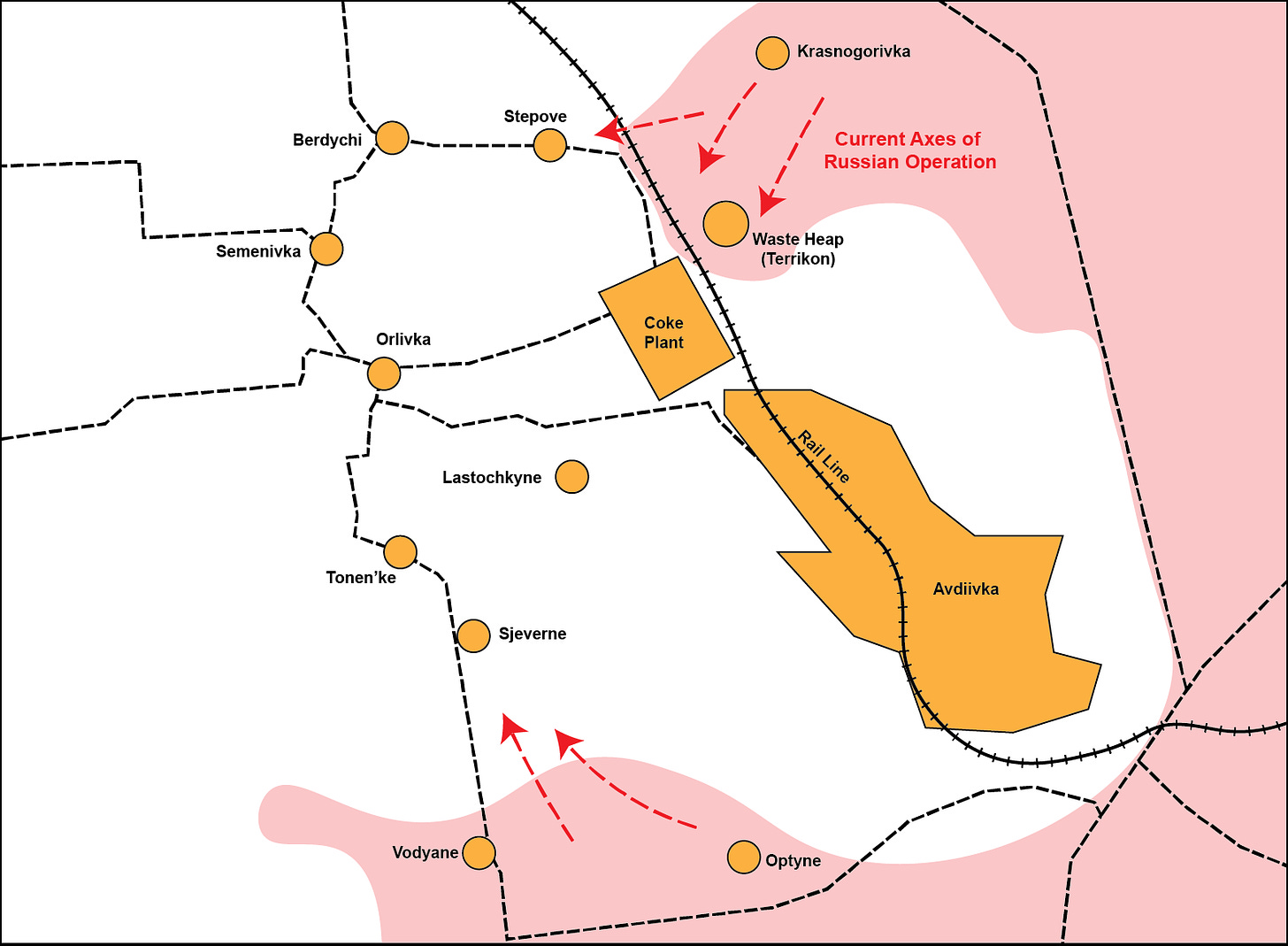
The Avdiivka Battlespace
The Avdiivka operation almost immediately spawned a familiar cycle of dooming and histrionics, with many getting ready to compare the attack to Russia’s failed assault on Ugledar last winter. Despite successful Russian capture of the waste heap (along with positions along the railway), the Ukrainian sphere was pleased, claming that the Russians are suffering catastrophic losses in their assault on Avdiivka. However, I think that this fails to hold water for a few reasons.
First and foremost, the premise itself does not obviously appear to be true. This war is being eagerly documented in real time, which means we can actually check for a sharp increase in Russian losses in the tabulated data. For this, I prefer to check in with War Spotting UA and their Russian equipment loss tracking project. While they have an overtly pro-Ukrainian orientation (they track only Russian and not Ukrainian losses), I think they are more reliable and reasonable than Oryx, and their tracking methodology is certainly more transparent.
A quick note about their data is important. First, it’s incorrect to be overly focused on the precise dates that they ascribe to losses – this is because their logged dates correspond to the date that losses are first photographed, which may or may not be the same day the vehicle is destroyed. When they log a date for a destroyed vehicle, they are logging only the date the picture was taken. It’s thus reasonable to pencil in a few days worth of potential error on the dating of losses. This simply can’t be helped. Furthermore, they – like anyone else – have the capacity to misidentify or accidentally double count vehicles filmed from different angles.
All that is to say, it’s not useful to get too bogged down looking at specific loss clusters and photos, but looking at the trends in their loss tracking is very useful. If Russia was really losing an inordinate amount of equipment in a month-long assault, we would expect to see a spike, or at least a modest level increase in losses.
In fact, that’s not apparent in the loss data. Russia’s overall burn rate from the summer of 2022 until now comes out to approximately 8.4 maneuver assets per day. Yet the losses for the autumn of 2023 (which includes the Avdiivka assault) are actually slightly lower, at 7.3 per day. There are a few batches of losses, which correspond to the aftermath of assaults, but these are not abnormally large – a fact that can be easily checked by referencing the time series of losses. The data shows a modest increase from the summer of this year (6.8 per day) to the autumn (7.3), which corresponds to a shift from a defensive to an attacking posture, but there is simply nothing in the data here that suggests an abnormal elevation in Russian loss rates. Overall, the loss data suggests a high intensity attack, but the losses overall are lower than in other periods where Russia has been on the offensive.
We can apply the same basic analytic framework to personnel losses as well. Mediazona – an anti-Putinist Russian dissident media outlet – has been dutifully tracking Russian casualties via obituaries, funerary announcements, and social media posts. Lo and behold, they – like Warspotting UA – fail to record an inordinate spike in Russian losses through the Autumn thus far.
Now, it would be silly to deny that Russia lost armored vehicles or that attacking does not incur costs. There is a battle being fought, and vehicles are destroyed in battles. That is not the question here. The question is whether the Avdiivka assault has caused an unsustainable or abnormal spike in Russian losses, and quite simply there is nothing in the tracked loss data that would suggest this. Therefore, the argument that Russian forces are being eviscerated at Avdiivka simply does not seem supported by the available information, and so far the tracked daily losses for Autumn are simply lower than the average over the previous year.
Furthermore, fixation on Russian losses can lead one to forget that the Ukrainian forces get badly chewed up as well, and we actually have videos from the Ukrainian 110th Brigade (the main formation anchoring the Avdiivka defense) complaining that they have taken unsustainable losses. All to be expected with a high intensity battle underway. The Russians attacked in force and took proportional losses – but was it worth it?
We need to think about that initial Russian assault in the context of the Avdiivka battlespace. Avdiivka is rather unique in that the entire city and the railway running towards it sit upon an elevated ridge. With the city now enveloped on three sides, remaining Ukrainian logistical lines run along the floor of a wetland basin to the west of the city – the only corridor that remains open. Russia now has a position on the dominating heights that directly overlook the basin, and are in the process of expanding their position along the ridge. In fact, contrary to the claim that the Russian assault collapsed with heavy casualties, the Russians continue to expand their zone of control to the west of the railway, have already breached the outskirts of Stepove, and are pushing into the fortified trench network in southeastern Avdiivka proper.
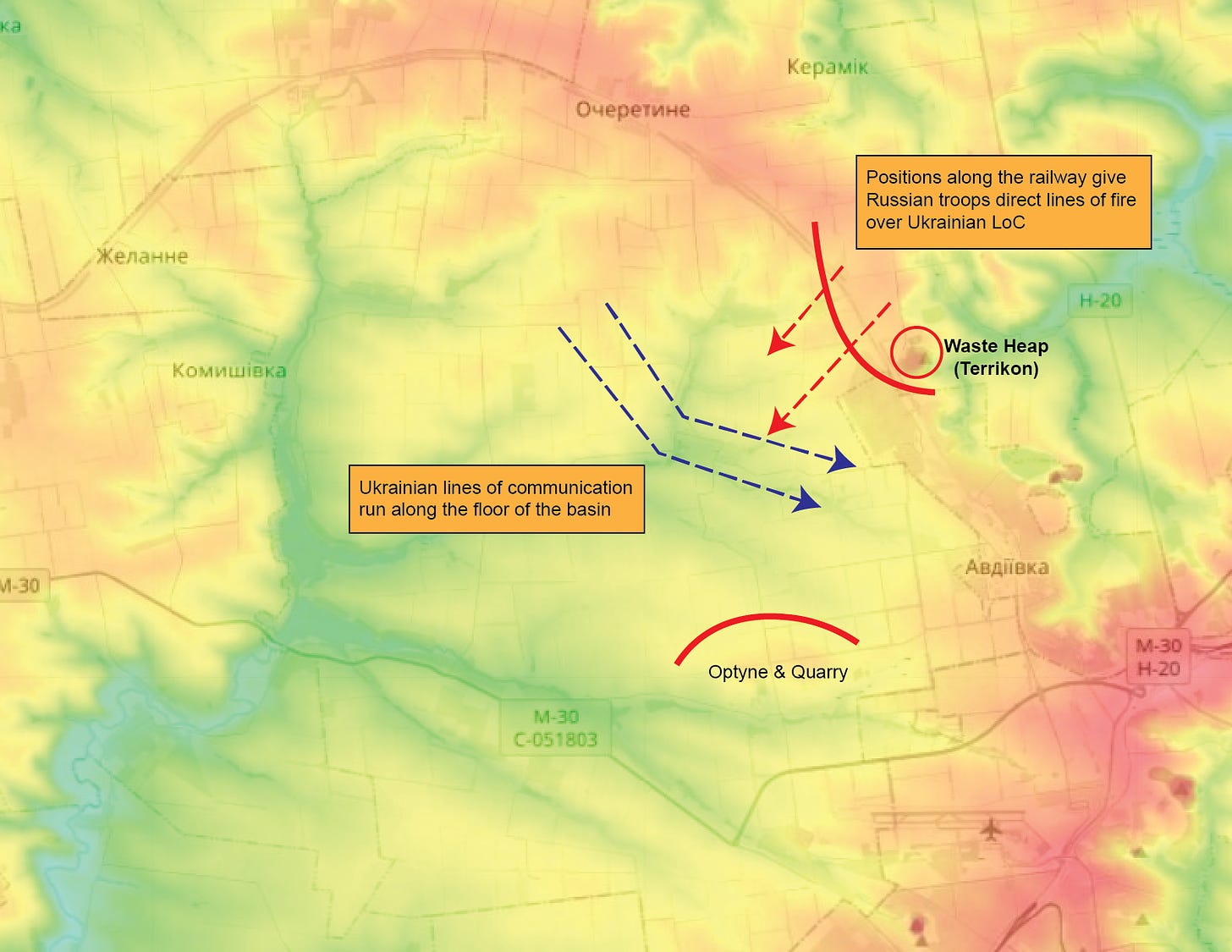
Avdiivka Elevation Map
Now, at this point it’s probably rational to want to compare the situation to Bakhmut, but the AFU forces in Avdiivka are actually in a much more dangerous position. Much was made of so-called “fire control” during the battle for Bakhmut, with some insinuating that Russia could isolate the city simply by firing artillery at the supply arteries. Needless to say, this didn’t quite pan out. Ukraine lost plenty of vehicles on the road in and out of Bakhmut, but the corridor remained open – if dangerous – until the very end. In Avdiivka, however, Russia will have direct ATGM line of sight (rather than spotty artillery overwatch) over the supply corridor on the floor of the basin. This is a much more dangerous situation for the AFU, both because Avdiivka has the unusual feature of a single dominating ridge on the spine of the battlespace, and because the dimensions are smaller – the entire Ukrainian supply corridor here runs along a handful of roads in a 4 kilometer gap.
Clearly, control of the waste heap and the rail line are of paramount importance, so the Russian Army committed a significant assault force to ensure the capture of their key objectives. Attacking the waste heap furthermore required exposing Russian attack columns to perpendicular Ukrainian fire, attacking across well surveilled ground. In short, this entailed many of the tactical problems that plagued the Ukrainians over the summer. Modern ISR-fire linkages make it very difficult to successfully stage and deploy forces without incurring losses.
Unlike the Ukrainians, however, the Russians committed sufficient mass to create an irreversible snowball in the attack on the commanding heights, and Ukrainian fires were inadequate to stymie the assault. Now that they have them, the Russians will recoup losses as the Ukrainians attempt to counterattack – indeed, this has already begun, with UA Warspotting recording a sharp drop in Russian equipment losses over the last three weeks. This establishes the pattern of the operation – a massed assault early to capture keystone positions that put the Russians in control of the battlespace. The Russians successfully forced a decision from the get-go by committing to their attack with a level of violence and force generation that was lacking all summer for the AFU. The juice is worth the squeeze.
More to the point, the Ukrainians clearly know that they are in trouble. They have already begun scrambling premier assets to the area to begin counterattacking against the Russian position on the ridge, and there are already Bradleys and Leopards burning around Avdiivka and in the Ukrainian staging areas in the rear. The same basic problem now exists which proved so insurmountable in the summer: counterattacking Ukrainian forces (staging over ten kilometers in the rear, past Ocheretyne) face long and well-surveilled lines of approach which expose them to Russian standoff fires – the Ukrainian 47th Mechanized Brigade has now already lost armored vehicles both in its staging areas and in failed counterattacks on Russian positions around Stepove.
In the coming weeks, Russian forces will carry their momentum forward into attacks on the axes through Stepove and Sjeverne to the west of the city, leaving the AFU tied to a long and precarious logistical chain on the floor of the basin. One of Ukraine’s longest and most strongly held fortresses now threatens to become an operational trap. I don’t expect Avdiivka to fall in a matter of weeks (barring an unforeseen and unlikely collapse in the Ukrainian defense), but it is now a matter of time and the winter months will likely bring the steady whittling away of the Ukrainian position here.
Sustaining AFU combat power in the city will be particularly difficult, with Ukrainian “mosquito logistics” (referring to their habit of running supply lift with pickup trucks, vans, and other small civilian vehicles) struggling across the floor of a muddy basin under the watchful eye of Russian FPV drones and direct fire. The AFU will be forced to attempt to sustain a brigade-level defense by running small vehicles through a beaten zone. If the Russians successfully capture the coke plant, the game will end much sooner, but the Ukrainians know this and will make the defense of the plant a preeminent priority – but even so, it is only a matter of time, and once Avdiivka falls, the Ukrainians do not have a solid place to anchor their defense until they fall all the way back to the Vocha River. This is a process that should play itself out through the winter.
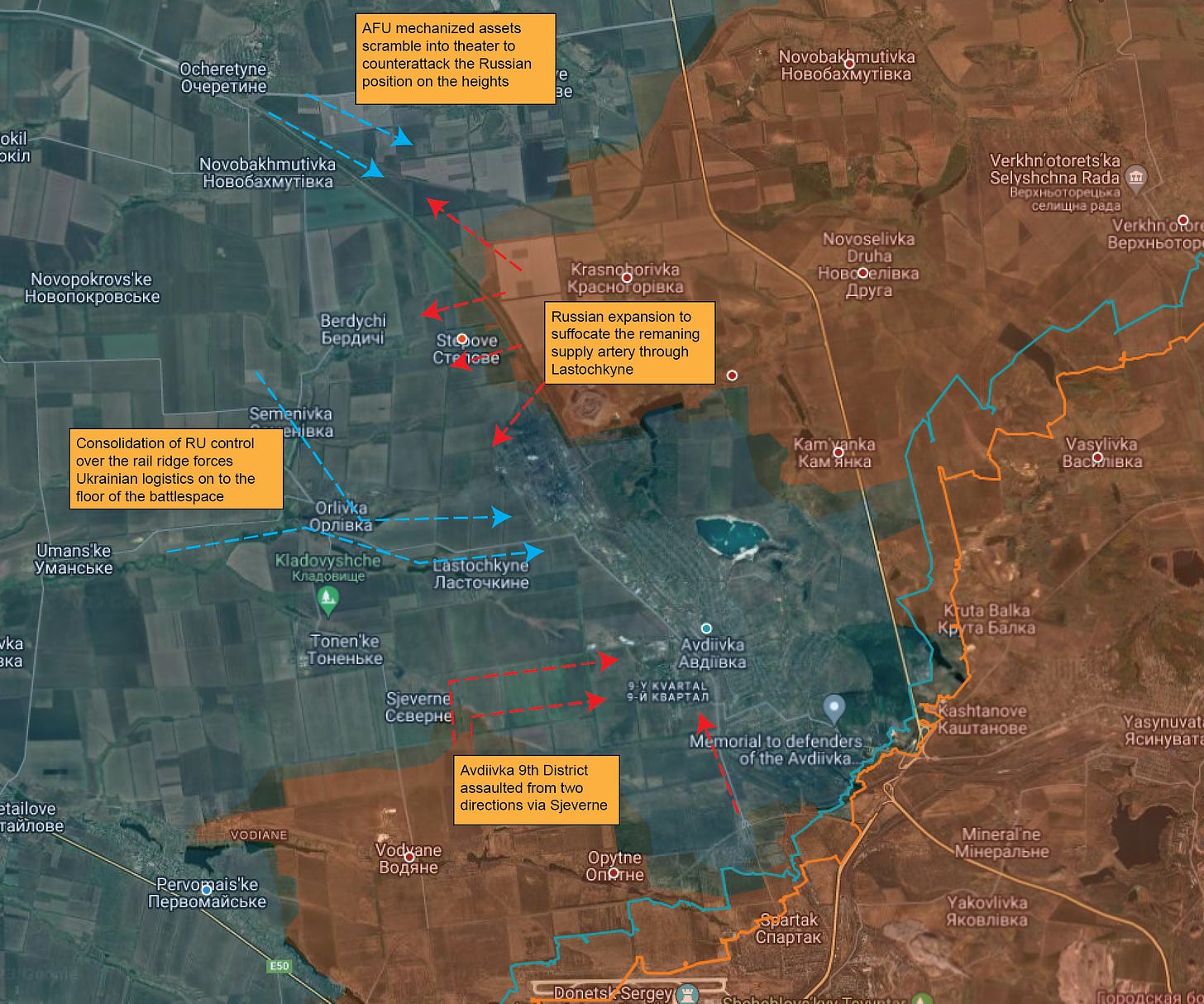
Anticipated future developments around Avdiivka
And that begs the question: if Ukraine could not hold Bakhmut, and time proves that they cannot hold Avdiivka, where can they hold? And if Ukraine cannot successfully attack, what are they fighting for?
A failed defense only counts as a delaying action if you have something to look forward to.
The war in Ukraine is now transitioning to enter its third phase. The first phase, from the onset of hostilities in February 2022 until the autumn of that year, was characterized by a trajectory of exhaustion of indigenous Ukrainian capacity by the operations of the limited initial Russian force. While Russian forces successfully degraded or exhausted many aspects of the prewar Ukrainian war machine – elements like communications, air defense interceptor stocks, and the artillery park – the initial Russian strategy floundered on critical miscalculations concerning both Ukraine’s willingness to fight a long war and NATO readiness to backstop Ukrainian material and provide critical ISR and command & control capabilities.
With the Russians facing with a much larger war than anticipated, and with utterly inadequate force generation for the task, the war took on the character of industrial attrition as it moved into the second phase. This phase was characterized by Russian attempts to shorten and correct the frontline, creating dense fortifications and locking up forces in grinding positional battles. This phase, more generally, was about the Ukrainians attempting to exploit – and the Russians enduring – a period of Ukrainian strategic initiative as Russia moved to a more expansive war footing, expanding armaments production and raisings force generation through mobilization.
In essence, Ukraine faced a dire strategic dilemma from the moment President Putin announced the mobilization of reserves in September, 2022. The Russian decision to mobilize was a de-facto signal that it accepted the new strategic logic of a longer war of industrial attrition – a war in which Russia would enjoy numerous advantages, including a much larger pool of manpower, vastly superior industrial capacity, indigenous production of standoff weaponry, armored vehicles, and shells, an industrial plant beyond the reach of systematic Ukrainian attacks, and strategic autonomy. These, however, are all systemic and long-term advantages. In the shorter term, however, Ukraine enjoyed a brief window of initiative on the ground. This window, however, was squandered with the botched summer assault on Russia’s defenses in the south, and the second phase of the war ends alongside the AFU’s drive on the Azov shore.
And so we come to the third phase, characterized by three important conditions:
- Steadily rising Russian combat power as a result of investments made over the previous year.
- Exhaustion of Ukrainian initiative on the ground and increasing self-cannibalization of AFU assets.
- Strategic exhaustion in NATO.
The first point is relatively trivial to comprehend and has been freely confessed by western and Ukrainian authorities. It is now well understood that sanctions failed to make a meaningful dent in Russian armaments production, and in fact the availability of critical systems is growing rapidly as a result of strategic investments in new and expanded production lines. However, we can enumerate a few examples of this.
One of the key elements of expanding Russian capabilities has been both the qualitative and quantitative improvement in new standoff systems. Russia has successfully launched mass production of the Iranian-derived Shahed/Geran drone, and has an additional factory under construction. Production of the Lancet loitering munition has risen exponentially, and a variety of improved variants are now entering use, with superior guidance, effective range, and swarming capabilities. Russian production of FPV drones has risen significantly, with Ukrainian operators now fearing a snowballing Russian advantage. UMPK guided glider adaptations have been modified to accommodate much of the Russian arsenal of gravity bombs.
All of this speaks to a Russian military with an expanding capacity to fling high explosives in greater numbers and accuracy at AFU personnel, equipment, and installations. Meanwhile, on the ground, tank production continues to rise, with sanctions having little apparent impact on Russian armor availability. In contrast to previous predictions that Russia would begin scraping the bottom of the barrel, pulling ever older tanks out of storage, Russian forces in Ukraine are fielding *newer* tanks, with the T-90 appearing on the battlefield in greater numbers. And, despite repetitive western predictions that a new mobilization wave would be required in the face of supposedly horrific casualties, the Russian defense ministry has confidently said that its manpower reserves are stable, and a Ukrainian military intelligence spokesman recently said that they believe there are over 400,000 Russian troops in the theater (to which can be added the sizeable reserves that remain in Russia).
Meanwhile, Ukrainian forces are likely to become increasingly self-cannibalizing. This occurs on multiple levels, as a motif of a strategically exhausted force. On the strategic level, self-cannibalization occurs when strategic assets are burned off in the name of short term exigencies; on the tactical level, a similar degradative process occurs when formations remain in combat for too long and begin to grind away as they attempt combat tasks for which they are no longer suited.
You’re likely rolling your eyes at that paragraph, and understandably so. It’s heavily jargonized, and I apologize for it. However, we can see a concrete example of what both forms of self-cannibalization (strategic and tactical) look like, from the same unit: the 47th Mechanized Brigade.
The 47th was slated long ago to become one of the premier assets in Ukraine’s counteroffensive. Trained (as best as time allowed) to NATO standards and with privileged access to high-end western equipment like the Leopard 2A6 Tank and the Bradley IFV. This brigade was both meticulously prepared and widely advertised as the deadly tip of the spear for Ukraine. However, a summer of frustrating and failed attacks on Russia’s Zaporizhia line left the brigade with severe losses, degraded combat power, and infighting among the officers.
What followed ought to raise red flags. First, in early October it was reported that the 47th had a new commander, with the change spurred by demands from above that the brigade continue its efforts to attack. The problem was that the 47th had gradually exhausted its attacking potential, and the solution implemented by the new commander was to scrounge the brigade’s rear areas and technical crews for replacement manpower. As the MilitaryLand report reads:
As claimed by soldiers of anti-tank missile unit of Magura in now removed video appeal, the brigade’s command refuse to admit the brigade lost its offensive potential. Instead, command sends mortar crews, snipers, artillery crews, basically all it has available to the front as assault infantry.
This is a classic example of tactical self-cannibalization, wherein a loss in combat power threatens to accelerate as ancillary and technical elements of the unit are burned off in an attempt to compensate for losses. However, the 47th has also been cannibalized on the strategic level. When the Russian assault around Avdiivka began, the Ukrainian response was to pull the 47th out of the Zaporizhia front and scramble it to Avdiivka to counterattack. At this point, the Ukrainian defense there depends on the 110th Brigade, which has been in Avdiivka for nearly a year without relief, and the 47th, which was already degraded from months of continuous offensive operations in the south.
This is strategic cannibalization: taking one of the premier assets in the stable and rushing it, with no rest or refitting whatsoever, directly into combat as a defensive exigency. Thus, you have the 47th Brigade being cannibalized on an internal level (burning itself off as it attempts combat tasks that it is no longer appropriately equipped for) and on a strategic level, with the AFU grinding it down in a positional defense around Avdiivka rather than rotating it out for rest and refit to be earmarked for future offensive operations. A recent report with interviews of 47th personnel painted a dire picture: the brigade had lost over 30% of its personnel over the summer and its howitzers are rationed to a mere 15 shells per day. Russian mortars, they say, have an eight to one advantage.
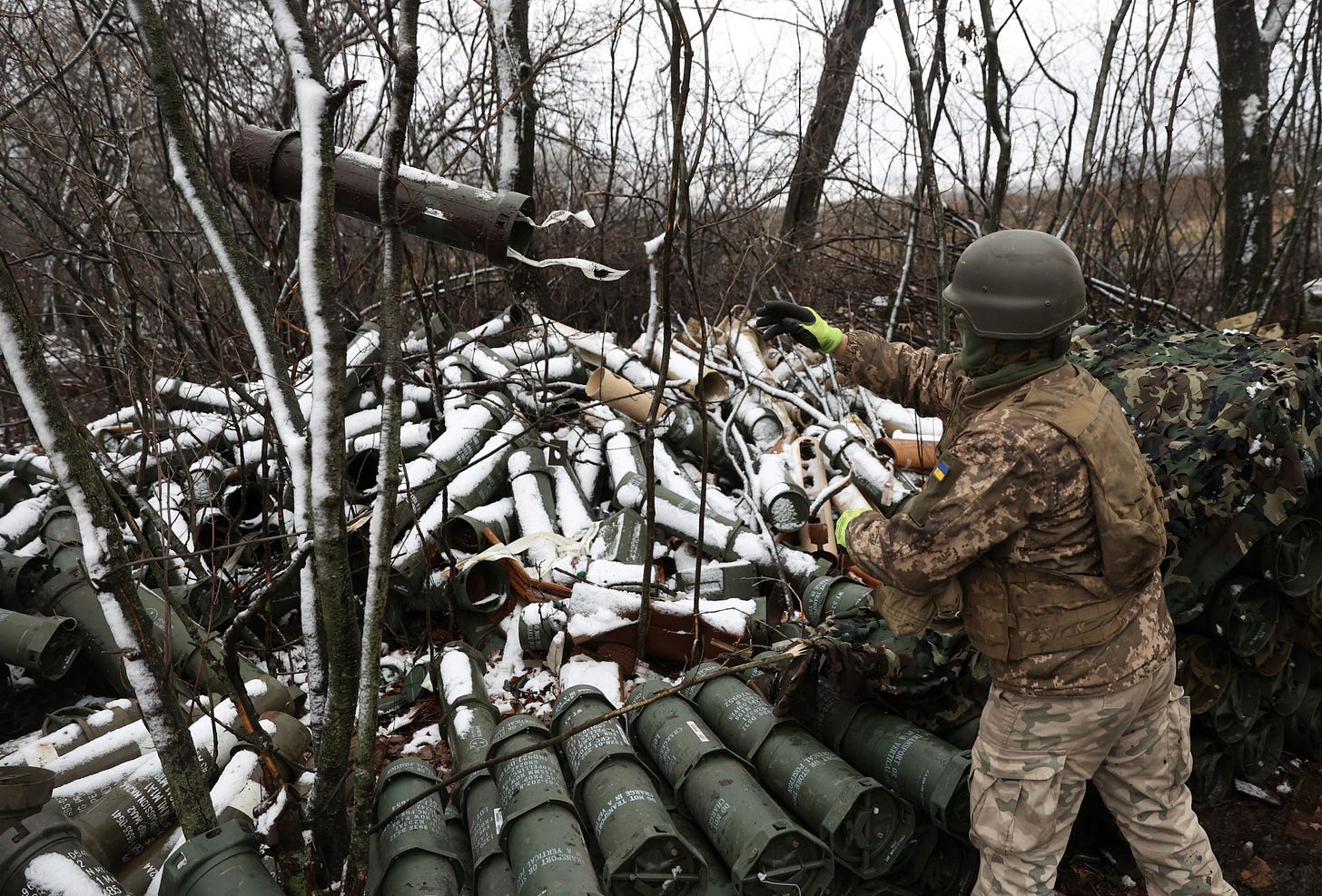
The iconic image of modern war: mountains of discarded shell casings
The situation can be vaguely likened to a person in crisis, who wears themselves down biologically and emotionally through a lack of sleep and stress, while also burning away their assets – selling their car and other critical possessions to pay for immediate necessities like food and medicine. This is an unsustainable way to live, and cannot stave off catastrophe indefinitely.
The Russians are doing everything they can to encourage this process, methodically reactivating grinding attacking operations across the breadth of the front, including not only Avdiivka but also at Bakhmut and Kupyansk, in an intentional pinning program designed to keep Ukrainian assets in combat after being exhausted over the summer. The 47th is emblematic of this – attacking all summer only to immediately be scrambled into defense in the Donbas. As one associate of mine put it, the last thing you want to do after running a marathon is begin a sprint, and this is where the Ukrainians find themselves after losing the strategic initiative in October.
It is not just Ukraine, however, that faces strategic exhaustion. The United States and the NATO bloc find themselves in a similar situation.
The entire American strategy in Ukraine has worked its way into an impasse. The logic of the proxy war lay in assumptions about a cost differential – that the United States could stymie Russia for pennies on the dollar, supplying Ukraine out of its surplus inventories while strangling the Russian economy with sanctions.
Not only have sanctions failed to cripple Russia, but the American approach on the ground has come up bust. Ukraine’s counteroffensive failed spectacularly, and the depleted Ukrainian ground force now must contrive a full-spectrum strategic defense against rising Russian force generation.
The basic strategic quandary for the west, then, is how to get out of a strategic cul-de-sac. NATO has reached the limits of what it can give Ukraine out of surpluses. In regards to artillery shells (the totem item in this war), for example, NATO allies have openly admitted that they have more or less run out, while the United States has been forced to redirect shell deliveries from Ukraine to Israel – a tacit admission that there are not enough on hand for both. Meanwhile, new production of shells is behind schedule in both the United States and Europe.
Facing a massive Russian investment in defense production and the following enormous ramp in Russian capabilities, it’s not clear how the United States can proceed. One possibility is the “all-in” option, which would require industrial restructuring and de-facto economic mobilization, but it’s not clear how this could be achieved given the parlous state of both the western industrial base and its finances.
Indeed, there are unmistakable signs that bringing western arms manufacturing out of its deep freeze will be enormously expensive and logistically challenging. New contracts demonstrate exorbitant cost runup. For example, a recent Rhenmetall order clocked in at $3500 per shell – an astonishing increase when one considers that as recently as 2021 the US Army was able to procure at a mere $820 per shell. No wonder the head of NATO’s Military Committee complained that higher prices are defeating efforts to build up stockpiles. Meanwhile, production is constrained by a lack of skilled workers and machine tools. Going “all in” on Ukraine would require a level of breakneck economic restructuring and mobilization that western populations would likely find intolerable and confusing.
A second option is “freezing” the conflict by pushing Ukraine to negotiate. This has already been broached in public by American and European officials, and was received with mixed reviews. On the whole, this seems rather unlikely. Opportunities to negotiate an end to the conflict were rebuffed on multiple occasions. From the Russian perspective, the west deliberately chose to escalate the conflict and would now want to walk away after Russia answered with its mobilization. It’s not clear then why Putin would be inclined to let Ukraine off the hook now that Russian military investments are beginning to bear fruit, and the Russian army has the real possibility of walking away with the Donbas and more. Even more troubling, however, is Ukrainian intransigence, which seems bound to sacrifice more brave men attempting to prolong Kiev’s fingerhold grip on territories that cannot be held indefinitely.
In essence, the United States (and its European satellites) have four options, none of which are good:
- Commit to an economic mobilization to substantially ramp up material deliveries to Ukraine
- Continue the extant trickle of support to Ukraine and watch it suffer a progressive and slow defeat
- End support for Ukraine and watch it suffer a more rapid and totalizing defeat
- Attempt to freeze the conflict with negotiations
This is a classic formula for strategic paralysis, and the most likely outcome is that the United States will default to its current course of action, supporting Ukraine at a trickle level commensurate with the financial and industrial limits in place, keeping the AFU in the field but ultimately overmatched in myriad dimensions by rising Russian capabilities.
And this, ultimately, brings us back where we started. There is no wonder weapon, no cool trick, no operational contrivance coming to save Ukraine. There is no exhaust port on the Death Star. There’s only the cold calculus of massed fires over time and space. Even Ukraine’s isolated successes only serve to emphasize the enormous disparity in capabilities. For example, when the AFU uses western missiles to attack Russian ships in drydock, this is only possible because Russia has a navy. The Russians, in contrast, have a wide arsenal of anti-ship missiles that they are not using, because Ukraine does not have a navy. While the spectacle of a successful hit on a Russian vessel makes for nice PR, it only reveals the asymmetry in assets and does nothing to ameliorate Ukraine’s fundamental problem, which is the steady attrition and destruction of its ground forces in the Donbas.
As 2024 brings a steady erosion of the Ukrainian position in the Donbas – isolation and liquidation of peripheral fortresses like Adviivka, a double pronged advance on Konstyantinivka, an ever more severe salient around Ugledar as the Russians advance on Kurakhove – Ukraine will find itself in an ever more untenable place, with western partners questioning the logic of funneling limited weapons stocks into a shattered state.
In the third century, during China’s Three Kingdoms era (after the Han Dynasty broke apart into a trifurcated state in the early 200’s), there was a famous general and official named Sima Yi. While not as oft quoted as the better known Sun Tzu, Sima Yi has one pithy aphorism attributed to him which is better than anything in the Art of War. Sima Yi put the essence of warmaking the following way:
In military affairs there are five essential points. If able to attack, you must attack. If not able to attack, you must defend. If not able to defend, you must flee. The remaining two points entail only surrender or death.
Ukraine is working its way down the list. The events of the summer demonstrated that it cannot successfully attack strongly held Russian positions. Events in Avdivvka and elsewhere now test whether they can defend their position in the Donbas against rising Russian force generation. If they fail this test, it will be time to flee, surrender, or die. Such is the way of things when the time for reckoning comes.
Pentagon Quietly Ramps Up Ammo For Israel
By Svetlana Ekimenko – Sputnik – 15.11.2023
With the Palestinian death toll in Gaza reportedly reaching over 11,000, including 4,630 children, the US has been facing pressure over its support for the Israeli campaign. However, the Biden administration has rejected calls for a ceasefire, even as hundreds of thousands of pro-Palestine protesters have taken to the streets across the country.
As Israel continues its operation to eliminate Hamas in the Gaza Strip whatever the costs, the Pentagon has reportedly been tacitly boosting military aid to its biggest non-NATO ally.
Despite publicly voicing concern over the surging civilian death toll in Gaza, Washington is maintaining a “weapons pipeline” to cater to Israel’s military aid requests, reported Bloomberg.
Thus, Israel has asked for over 57,000 155 mm high explosive artillery shells, 20,000 M4A1 rifles, 5,000 PVS-14 night vision devices, 3,000 M141 hand-held bunker-buster munitions, 400 120 mm mortars, and 75 army vehicles, specifically, the Army and Marine Corps’ new Joint Light Tactical Vehicle. Israel has also ostensibly requested 200 armor-piercing Switchblade 600 dive-bombing drones made by AeroVironment Inc., which the US Army does not have in its inventory.
All of this is contained in an internal Defense Department list seen by the outlet. The catalogue of weapons shipped to Israel is reportedly contained in a Pentagon document, “Israel Senior Leader,” dated late October. Some of the weapons are already being delivered, while others are in the process of being provided by the US Defense Department from both American and Europe-based stockpiles, it was added.
The report underscored that the US is ready to acquiesce to Israel’s weapons demands far beyond the provision of Iron Dome interceptors and precision munitions manufactured by Boeing Co. that was publicly announced earlier. Two Iron Dome batteries are currently en route to Israel by sealift.
One tally purportedly revealed that 36,000 rounds of 30 mm cannon ammunition, 1,800 M141 bunker-buster munitions, and close to 3,500 night-vision devices had already been delivered to Israel by late October. Another tally is described as including around 2,000 Hellfire laser-guided missiles produced by Lockheed Martin Corp. These are intended for AH-64 Apache helicopter gunships. Another 36,000 rounds of 30 mm ammunition to be fired by the Apache’s cannon are also on the cited weapons list. A further 312 Tamir missile interceptors have also been donated to Israel by the US.
When asked to comment on the report, a Pentagon spokesman said that it was “leveraging several avenues – from internal stocks to US industry channels – to ensure Israel has the means to defend itself.”
The spokesperson added that Israel was being provided by the US with 155 mm artillery shells, small-diameter bombs, precision-guided munitions, along with “Iron Dome interceptors and medical support equipment.”
Since the start of Israel’s campaign to target Hamas in retaliation for the militant group’s attack on October 7, Washington has staunchly supported Tel Aviv. The Biden administration did make a feeble attempt at shuttle diplomacy, but had nothing to show for it. As the Israel Defense Forces intensified their Gaza operation to eliminate Hamas, global protests have surged over the spiraling Palestinian civilian death toll. Over 11,000 people, many of them children, have already died in the enclave, according to the Gazan Health Ministry.
However, Washington has rejected calls for a ceasefire in hostilities even as hundreds of thousands of pro-Palestine protesters have taken to the streets across the US. Instead, the Biden administration urged for a “humanitarian pause” in Israel’s assault.
The Biden administration has faced censure from non-governmental organizations for its provision of artillery shells, along with other munitions, to Israel. Over 30 such organizations wrote to Defense Secretary Lloyd Austin on Monday to call on him to refrain from sending the 155 mm shells, saying:
“In Gaza, one of the world’s most densely populated places, 155 mm artillery shells are inherently indiscriminate… These munitions are unguided and have a high error radius.”
More than 500 former Biden campaign staffers also urged US President Joe Biden to press for a ceasefire in the besieged Gaza Strip. In their letter published online and signed by former employees of Biden’s 2020 campaign, as well as the Democratic National Committee and state-level Democratic Party organizations, they pointed out, “We were and continue to be horrified by the devastating Hamas attack against Israeli civilians on October 7.” The group of staffers, calling themselves Biden Alumni for Peace and Justice, wrote:
“You must call for a ceasefire, hostage exchange, and de-escalation, and take concrete steps to address the conditions of occupation, apartheid, and ethnic cleansing at the root of the horrific violence we are witnessing now.”
Featured Video

Matt Bracken: US Plans Massive MOAB Strike on Iran?
or go to
Aletho News Archives – Video-Images
New Book
The silver that medicine dropped — four thousand years of clinical use, four decades to erase.
Colloidal Silver — First Edition, 2026, Paperback
Lies are Unbekoming | October 16, 2026
Silver was medicine. Not alternative medicine. Not folk medicine. Medicine. In surgery. In obstetrics. In the burn ward. In water treatment. In the household medicine chest. Every physician before 1938 knew this.
By the 1870s, silver nitrate was standard in surgical wound care across the leading hospitals of Britain, Germany, and the United States. Colloidal silver preparations — Collargol, Argyrol, Protargol — entered European and American practice through the 1890s and early 1900s and became standard antiseptics in military field medicine. By the time Fleming grew his first penicillin mould in 1928, silver was the first-line antimicrobial of the Western pharmacopoeia. The Lancet and the British Medical Journal carried the clinical reports in volume. The practice ran continuously through the Victorian era, the Edwardian era, the First World War, the interwar period. By 1980, almost all of it was gone.
What has not been treated at book length, until now, is how a four-thousand-year clinical record disappeared from mainstream medicine within four decades of the Flexner Report — and what the honest account of silver looks like once that record is reassembled.
Colloidal Silver reconstructs the pre-1938 record from The Lancet, the British Medical Journal, and the primary literature of the era; recovers Robert Becker’s bioelectric framework from the regeneration research the pharmaceutical model buried; and places silver inside a practical terrain-paradigm guide to its current place — in water, on the body, inside the body, and in the chronic conditions where antibiotics have failed. … continue
Blog Roll
 Aletho News
- Inside Bill C-22, Canada’s Patriot Act.
- China’s FM: Palestinian cause is ‘greatest injustice of the century’
- US sympathy for Palestinians surpasses support for Israelis
- Israeli rabbi permits occupiers to steal Palestinian olive harvest in West Bank
- Spanish firm sells Latvia vehicles equipped with Israeli tech despite arms embargo
- Saudi Arabia under fire… Yemen is burning down the House of Saud
- Israeli Spy Pollard stole the files, today’s it’s delivered through official channels
- Why Iran Didn’t Walk Away
- US arms supplied to Ukraine found in war-torn Sudan – Moscow
- The silver that medicine dropped — four thousand years of clinical use, four decades to erase.
- If Americans Knew
- NPR investigation finds evidence of widespread fraud at mall kiosks tied to Israeli skincare brand
- Tucker Carlson exposes Israeli Lies about the Oct 7th attack, Charlie Kirk, and the U.S.
- Israel has detained thousands of Palestinian children since Oct 7th – over half spent time in solitary, many uncharged
- Israeli Analysis: Is Netanyahu Planning an ‘October Surprise’ Attack Before Israel’s Election?
- Israeli settlers brutally attack Palestinians and Washington Post female photographer, 65
- Words Have Changed, Occupation Continues: The Reality of the Gaza Ceasefire
- Gaza’s child amputees are growing faster than their prosthetics allow
- Israel keeps Palestinians struggling just to survive–Daily Update
- Israeli firm used online ads to run vast spy operation, researchers say
- No, the world zionist movement is not an antisemitic conspiracy theory
- No Tricks Zone
- New Study Suggests Large Regions Of The Pacific Ocean Have Been Cooling For The Last 80 Years
- Germany’s Green Energy Debacle: High Energy Costs Force Kahla Porzellan to Close After 182 Years!
- New Study: 50 Years Of The Most Aggressive ‘Net Zero’ Policies Can Only Affect The Global Climate By 0.03°C
- US September “Heat” Was No Record…Many Records Set Decades Ago
- Latest European Green Energy Debacle; Portugal’s Largest Flagship Solar Park Insolvent!
- Green Energy Debacle: German Expert Professor Fritz Vahrenholt Warns Of Severe Economic And Social Consequences
- Two More Paleo Reconstructions Affirm Meters-Higher Sea Levels Across Ireland, Brazil 7000-6000 Years Ago
- New Study: Earth And Venus Surface Warmth Largely Explained By Convection And Lapse Rate, Not CO2 Or Radiation
- 2025 Nature Paper Claiming Worsening Global Drought Gets RETRACTED …Heavily Flawed
- New Study: ‘Global Drought Shows No Detectable Recent Acceleration Under Climate Warming’

