Meet Ukrainian Military’s American Spokesman
Transgendered Sarah Ashton-Cirillo advocates free speech and killing journalists
BY JOHN LEAKE | COURAGEOUS DISCOURSE | SEPTEMBER 20, 2023
As our world gets weirder by the second, it has become ever harder to know if what we are presented with is real. Every time someone sends a report or video that is purportedly a representation of factual reality, I try to evaluate if it’s indeed real or if it’s propaganda, black propaganda, satire, or the creation of a mentally ill person.
This morning I saw a story about an American transgendered woman named Sarah Ashton-Cirillo who claims to be a soldier and an official spokesman of the Ukrainian Territorial Defense Forces. She is in the news because of a publicized spat she is having with Senator JD Vance of Ohio who has made an inquiry to determine is Sarah Ashton-Cirillo really is an official English language spokesman for the Ukrainian TDF. Spoiler Alert: She really is.
Vance became aware of Ashton-Cirillo after he saw a video of the spokesman announcing that journalists who disseminate Russian propaganda will be hunted down and killed. In this video, she proclaims:
Next week, the teeth of the Russian devils will gnash ever harder, and their rabid mouths will foam in uncontrollable frenzy as the world will see a favorite Kremlin propagandist pay for their crimes. This puppet of Putin is only the first. Russia’s war criminal propagandists will all be hunted down and justice will be served.

In response to Senator Vance’s query, Ashton-Cirillo posted yet another video in which she proclaims her support of the First Amendment, but hastens to add that reporting Russian propaganda is not protected by the First Amendment.

Who adjudicates what is Russian propaganda and what is merely critical reporting of the Ukrainian government and its U.S. government supporters?
The question touches on something I have frequently written about on this Substack—namely, the strange rise of ORTHODOXY in recent years. There are, we are told, certain major issues in which the ORTHODOX—that is, official U.S. government and MSM representations—cannot be questioned or criticized. Those who do question these orthodoxies will be censored, censured, or—if Ashton-Cirillo has her way—hunted down and killed.
The top four orthodoxies are what I call the Holy Quadripartitus of Piffle. They are:
1). COVID-19 vaccines are saving mankind. Anyone who questions the safety and efficacy of the vaccines is guilty of heresy.
2). The U.S. proxy war in Ukraine is a sacred mission and no negotiated settlement with Russia shall be countenanced. Anyone who criticizes the Ukrainian and U.S. governments, and any attempt to understand the war from the Russian point of view, is guilty of heresy.
3). Human induced climate change will soon destroy the earth if trillions aren’t spent to overhaul our entire energy policy. Anyone who questions this proposition is guilty of heresy.
4). The concept of biological sex is a mere “construct.” Skilled surgeons and endocrinologists can transform a boy into a girl or vice versa. Anyone who questions this assertion is guilty of heresy.
I reject the Holy Quadripartitus of Piffle as fanatical, obscurantist, mentally ill nonsense.
G7 believes Ukraine conflict will last until end of decade – Bloomberg
RT | September 20, 2023
The Russia-Ukraine conflict may extend for another six to seven years, according to a senior G7 official who spoke with Bloomberg. The official emphasized that Kiev’s allies will confront various challenges as they endeavor to sustain their support for Ukraine.
In an article released on Tuesday, multiple officials, speaking on the condition of anonymity, indicated that the prolonged timeline resulted from Ukraine’s much-heralded counteroffensive progressing slowly, which has led to “tempered expectations.”
Continuing to provide military and financial aid to Kiev for such a long conflict “won’t be easy,” said Czech Foreign Minister Jan Lipavsky. “It’ll put a lot of pressure on societies, on governments, through different elections in Europe,” he added, stressing that there has to be a “midterm strategy of long-term support to Ukraine.”
One top European official informed Bloomberg that even with the support provided, Ukraine will likely grapple with challenges stemming from insufficient Western weapons supplies and the escalating toll of manpower losses.
Regardless of this dire outlook, Kiev and its allies remain opposed to negotiations and are unwilling to accept any resolution that does not include the complete withdrawal of Russian troops from territories Ukraine claims as its own, the officials told the outlet.
Kiev, for its part, has consistently emphasized its unwillingness to make any territorial concessions to Russia as part of potential peace agreements. In an interview with CBS News on Sunday, Ukrainian President Vladimir Zelensky affirmed that despite the counteroffensive’s slow pace, Ukraine remains committed to it regardless of adverse weather conditions or other factors.
Ukraine initiated its offensive in June; however, territorial gains have proven elusive, with heavy casualties being the predominant outcome. According to Russian President Vladimir Putin, Ukraine has incurred substantial losses during this push, including over 71,000 troops, 543 tanks, and nearly 18,000 armored vehicles.
Last year, four former Ukrainian territories – the Donetsk and Lugansk People’s Republics and the Kherson and Zaporozhye Regions – voted to join Moscow after holding public referendums. Kiev and its allies have refused to recognize the votes, while Zelensky has signed a decree banning any negotiations with the current Russian leadership.
Moscow, meanwhile, has repeatedly said that it has not closed the door on negotiations with Kiev but has urged the Ukrainian leadership to recognize the “realities on the ground.”
Azerbaijan, Nagorno-Karabakh Agree on Ceasefire Through Coordination of Russian Peacekeepers – MoD
Sputnik – 20.09.2023
Azerbaijan and representatives of the Armenian population of Nagorno-Karabakh have agreed on a complete cessation of hostilities through the mediation of Russian peacekeepers, the Russian Defense Ministry said on Wednesday.
“Through the mediation of the command of the Russian peacekeeping contingent, an agreement was reached between the Azerbaijani side and representatives of Nagorno-Karabakh on a complete cessation of hostilities. The implementation of these agreements will be carried out in coordination with the command of the Russian peacekeeping contingent,” the ministry said in a statement.
The Russian peacekeeping contingent in Nagorno-Karabakh is in contact with both Yerevan and Baku, discussing the prevention of bloodshed in the region, the Russian Defense Ministry said on Wednesday.
“The command of the Russian peacekeeping contingent is in close contact at the appropriate level with the Azerbaijani and Armenian sides, representatives of Nagorno-Karabakh. The prevention of bloodshed, compliance with the norms of humanitarian law in relation to the civilian population, as well as ensuring the safety of the Russian peacekeeping contingent are discussed,” the ministry said in a statement.
Russian peacekeepers continue to perform their duties in Nagorno-Karabakh in aggravated conditions, the ministry said, adding that 2,261 civilians, including 1,049 children, are currently located in a base camp of peacekeepers in Nagorno-Karabakh.
On Tuesday, Baku announced the launch of “local-level anti-terrorist activities” in Nagorno-Karabakh aimed at “restoring the constitutional order.” It also said Azerbaijani forces only targeted military objects in Nagorno-Karabakh, while Armenian state media reported multiple casualties among civilians as a result of Azerbaijani strikes. Yerevan described the operation as aggression and reiterated that it had no military presence in the disputed region.
In 1923, the region was granted the status of an autonomous area called the Nagorno-Karabakh Autonomous Oblast (NKAO) within the Azerbaijan Soviet Socialist Republic.
In 1988, a movement for reunification with Armenia began in Nagorno-Karabakh. On September 2, 1991, it declared independence from Azerbaijan and changed its name to the Nagorno-Karabakh Republic. From 1992 to 1994, Azerbaijan attempted to regain control over the self-declared republic, resulting in full-scale military hostilities in which up to 30,000 people lost their lives.
In 1994, the parties agreed to a ceasefire, but the status of the republic remained undetermined. In late September 2020, hostilities resumed in Nagorno-Karabakh. On the night of November 10, Azerbaijan and Armenia, with Moscow’s support, reached a comprehensive ceasefire agreement, maintaining their respective positions and exchanging prisoners of war and the bodies of the deceased. Russian peacekeepers were deployed in the region, including the Lachin Corridor.
In 2022 with the mediation of Russia, the United States, and the European Union, Yerevan and Baku began discussing the terms of a future peace agreement. In late May of this year, Armenian Prime Minister Nikol Pashinyan declared that Yerevan was ready to recognize Azerbaijan’s sovereignty within its Soviet-era borders, including Karabakh.
In September 2023, Russian President Vladimir Putin noted that the Armenian leadership had essentially recognized Azerbaijan’s sovereignty over Nagorno-Karabakh. Azerbaijani leader Ilham Aliyev said that Azerbaijan and Armenia could sign a peace agreement by the end of the year if Yerevan did not change its stance.
Lavrov’s claim that America is at war with Russia is no ‘exaggeration’
By Drago Bosnic | September 20, 2023
Since the start of Russia’s special military operation (SMO) against NATO’s crawling encroachment on its borders, the United States has been adamant that it’s “not a party to the conflict” and that it supposedly “doesn’t want escalation with Moscow“. However, time proved both of these statements to be patently false. According to the claims of the Neo-Nazi junta itself, the US controls the targeting of every long-range weapon deployed by the Kiev regime forces. On the other hand, the falsehood of the laughable claim that Washington DC “doesn’t want war” is painfully obvious to anyone remotely familiar with its neverending escalation aimed against Russia.
Russian Foreign Minister Sergei Lavrov is certainly aware of all this, although basic diplomatic etiquette prevented him from stating the obvious in the past. And yet, after well over a year and a half of being exposed to the blatant hypocrisy of the political West, it seems that even the usually reserved Lavrov has stopped holding back, as trying to follow diplomatic protocols when dealing with someone who openly breaks them is simply futile and ultimately self-defeating. Namely, in recent remarks for the press, the Russian Foreign Minister said that the US is waging war against Russia. Strong statement, one might say, but who could possibly refute it given the ongoing events?
Even if we don’t count statements made by top-level US officials, including Defense Secretary Lloyd J. Austin’s admission that Washington DC wants to see a “strategic defeat” inflicted on Russia and President Joe Biden’s Freudian slip that “Putin cannot stay in power“, the evidence that supports Lavrov’s claim is simply overwhelming and we’re seeing it every single day. He also pointed out the fact that the US is not only transferring enormous amounts of so-called “lethal aid” to the Neo-Nazi junta (worth hundreds of billions at this point), but is actually controlling these weapons through direct decision-making while maintaining plausible deniability.
Lavrov himself also reiterated Austin’s admission that this is because the belligerent thalassocracy wants to inflict a “strategic defeat” on Russia. The statements about US belligerence were given while he was speaking on the sidelines of the Eastern Economic Forum on the morning of September 17, where he pointed out that “no matter what it says, it [the US] controls this war, it supplies weapons, munitions, intelligence information, data from satellites, it is pursuing a war against us”. Lavrov also stated that Ukraine is simply being used as a springboard to achieve American strategic goals, as it was being prepared for the ongoing conflict years in advance.
“There is a real plot around the topic of the so-called (peace) negotiations, as well as attempts to turn everything upside down through pseudo diplomacy,” he said just two days prior, adding: “The West has been saying for months that this ‘peace formula’ is the only basis for negotiations. It starts from innocent topics … and then comes to the purpose for which it was concocted – inflicting a strategic defeat on Russia, to restore the borders of Ukraine as they were in 1991, court-martial the Russian leadership, force Russia to pay reparations, and then ‘mercifully’ agree to sign a peace agreement.”
Lavrov made the said comments on September 15, referring to the abortive Saudi-hosted “peace talks” and added that this pattern of double standards and hypocrisy is also used when dealing with most other countries.
“These are exactly the dirty methods that the West uses not only in relation to Ukraine but in many other areas of global politics,” he stated.
The recent direct endorsement US Secretary of State Antony Blinken gave for the Kiev regime’s long-range strikes on targets within Russia is yet another proof of Lavrov’s claims. Namely, during an interview with ABC News on September 10, Blinken stated that it was supposedly “up to Ukraine” whether or not it should target Russia proper with US-made long-range weapons. The idea that the Kiev regime could ever make such a decision on its own is beyond laughable, which means that it’s the belligerent thalassocracy itself that ordered the Neo-Nazi junta to target areas deeper within Russia in order to inflict maximum damage with minimal investment or risk for itself.
Blinken’s statement came only a day after ABC News reported that the US would provide the ATACMS to the Kiev regime. The range of these missiles, while hardly groundbreaking, is enough to jeopardize not only Russian supply lines, but also civilian infrastructure hundreds of kilometers behind the frontlines. And yet, this isn’t the only danger Lavrov pointed out thus far, as back in early June, he warned that nuclear-capable F-16 fighter jets could lead to an uncontrollable escalation that Russia will certainly not tolerate. He stressed that Moscow would be forced to respond militarily, meaning that NATO would also be held directly responsible in that case.
Drago Bosnic is an independent geopolitical and military analyst.
News relating to missiles used or about to be used in Ukraine and about “Russian” ICBMs in North Korea
By Gilbert Doctorow | September 17, 2023
It is widely expected that in the coming week American president Joe Biden will announce the decision to ship American medium range missiles ATACMS to Ukraine. Discussions of this subject have been widespread in both US and European media. The focus has been on the range of missiles and whether their delivery will enable Ukraine to attack across the border into the Russian Federation itself for the purpose of destroying supplies and command centers there. Of course, the issue is complicated by what is meant by RF territory. In the language of the West, all of the Ukrainian territory which has been captured by Russia since 2014 is considered to be fair game for military attack. From the perspective of Russia, any attacks on Crimea, in particular, may be justification for major escalation of the war into a direct fight with the NATO country or countries supplying the given missiles. That said, there is reason to believe that Storm Shadows were used to hit Sevastopol on 13 September, without any sign yet of Russia’s intention to escalate.
The advocates of shipping ATACMSs to Ukraine point out that its range, 190 miles or 300 km, is no greater than that of the Storm Shadow missiles which Britain and France have sent to Ukraine without prompting escalatory actions by Russia. However, that is to overlook the other side of the issue, namely the method of launch. Storm Shadow is an air to ground missile. It is launched from Soviet-era Ukrainian jet fighters which have been especially modified for this purpose. Since the Storm Shadow is devilishly difficult for any air defense system to destroy in flight, the Russians have focused attention on destroying Ukrainian planes that are part of the launch operation. Just this past week, on 11 September a Russian missile attack on the Dolgintsevo air base near Krivoy Rog in the Dnepropetrovsk region of Ukraine destroyed 5 Ukrainian fighters, two MiG-29s and three SU-25s. The MiGs are said to either carry the Storm Shadow or to provide cover for SU-24s which carry them.
The logic of supplying ATCSMs is precisely in the launch mode, not the attack radius of these missiles. They are ground to ground missiles which are launched from mobile platforms similar in principle to the multiple rocket launchers HIMARS. In that sense, they are more difficult to find and destroy than a jet fighter.
In the meantime, in Europe, German Chancellor Scholz has made it plain that he will not approve sending Germany’s long range missiles, the TAURUS, to Kiev until the United States makes a first move by shipping its own missiles. The TAURUS falls into the same launch category as the Storm Shadow; it is sent on its way to target by a jet fighter. Its distinction is only one of distance, at 500 km range. If Ukraine has a fast diminishing or fully destroyed air force, the TAURUS will not be of much use.
*****
Otherwise, over this past week, the interest of major Western media in missiles has focused on what North Korea owns and how it got them. The interest came about as journalists followed the course of North Korean leader Kim Jong Un’s tour of the Russian Far East.
It has occurred to our journalists that North Korea presently possesses ICBMs capable of reaching the North American heartland, and as they pored over the technical characteristics of these missiles they noted that one seems to be very close in design to Soviet era missiles that were once the mainstay of the Russian strategic arsenal. I am speaking of the Korean rebranded Topol-M.
It is not surprising, therefore, that some folks in the States are wondering how is it that the Russians were able to get away with supplying the designs of the Topol-M to Pongyang without the United States raising a hullaballoo.
The answer, my friends, is in the inconvenient fact that those responsible for providing North Korea with production plans and technology for manufacturing the Topol-M were not Russians; they were Ukrainians. This story is discussed in an article on a Russian news portal a couple of days ago. According to the authors, the Ukrainians sold to the North Koreans part of the technology but not all. For example, they held back the secrets of the solid fuel used in this missile, which the Koreans had to develop on their own. Moreover, for the guidance system, the Koreans were assisted or copied a system developed by the Chinese. What this tells us is that if the Koreans should agree with the Kremlin on the purchase of one or another missile-related technology, its integration into their own production will be done by the Koreans themselves. The same may be said of technologies for construction and operation of nuclear powered submarines which the North Koreans are said to be looking for abroad.
*****
Before closing, I use this opportunity to sum up the Russian visit of Comrade Kim after he spent that first day in talks with Vladimir Putin at the Vostochny Cosmodrome about which I wrote earlier in the week. His next stop was Komsomolsk on Amur, where he was shown the Yuri Gagarin factory complex producing Russian military and civilian aircraft, including the “Alligator” multifunctional attack helicopters that have been so effective in the Ukraine war against tanks, armored personnel carriers and other military hardware. The top Russian official with Kim for the day was Minister of Trade and Industry Denis Manturov.
From Komsomolsk, Kim went next to the Knevichi air base in the Amur region, where he was shown the massive turboprop Tupolev Tu-95 and the sleek Tu-160 “White Swan,” both mainstays of the nuclear triad as bombers and missile platforms. Considerable attention was given to an assortment of the most modern fighter jets in the Su family, as well as to MiGs equipped with the hypersonic Kinzhal missile. The Russian hosts were headed by Minister of Defense Shoigu.
Kim’s tour ended in Vladivostok where he was taken aboard the frigate Marshal Shaposhnikov of the Pacific fleet, which is typical of the latest Russian vessels in having an important complement of hypersonic missiles with 1500 km range as well as weaponry for anti-submarine warfare.
When in Vladivostik, Kim visited the Far Eastern Federal University on Russky Island in the Vladivostok harbor, where the Eastern Economic Forum had been held at the start of the week. Kim met with university students. Lastly, there was a typically Russian cultural note to round out Kim’s program: a performance of Swan Lake by the Vladivostok affiliate of the Mariinsky Theater (St Petersburg). I mention parenthetically, that the Russian Federation from coast to coast is looked after culturally by its musical and museum powerhouses: Moscow’s Bolshoi theater maintains a similar performance and training outpost in Kaliningrad.
©Gilbert Doctorow, 2023
Hyping Ukraine Counteroffensive, US Press Chose Propaganda Over Journalism
By Bryce Greene | FAIR | September 15, 2023
It has been clear for some time that US corporate news media have explicitly taken a side on the Ukraine War. This role includes suppressing relevant history of the lead-up to the war (FAIR.org, 3/4/22), attacking people who bring up that history as “conspiracy theorists” (FAIR.org, 5/18/22), accepting official government pronouncements at face value (FAIR.org, 12/2/22) and promoting an overly rosy picture of the conflict in order to boost morale.
For most of the war, most of the US coverage has been as pro-Ukrainian as Ukraine’s own media, now consolidated under the Zelenskyy government (FAIR.org, 5/9/23).
Dire predictions sporadically appeared, but were drowned out by drumbeat coverage portraying a Ukrainian army on the cusp of victory, and the Russian army as incompetent and on the verge of collapse.
Triumphalist rhetoric soared in early 2023, as optimistic talk of a game-changing “spring offensive” dominated Ukraine coverage. Apparently delayed, the Ukrainian counteroffensive launched in June. While even US officials did not believe that it would amount to much, US media papered over these doubts in the runup to the campaign.
Over the last three months, it has become clear that the Ukrainian military operation will not be the game-changer it was sold as; namely, it will not significantly roll back the Russian occupation and obviate the need for a negotiated settlement. Only after this became undeniable did media report on the true costs of war to the Ukrainian people.
Overwhelming optimism
In the runup to the counteroffensive, US media were full of excited conversation about how it would reshape the nature of the conflict. NATO Secretary General Jens Stoltenberg told Radio Free Europe (4/21/23) he was “confident Ukraine will be successful.” Sen. Lindsey Graham assured Politico (5/30/23), “In the coming days, you’re going to see a pretty impressive display of power by the Ukrainians.” Asked for his predictions about Ukraine’s plans, retired Lt. Gen. Ben Hodges told NPR (5/12/23), “I actually expect… they will be quite successful.”
Former CIA Director David Patraeus, author of the overhyped “surge” strategy in Iraq, told CNN (5/23/23):
I personally think that this is going to be really quite successful…. And [the Russians] are going to have to withdraw under pressure of this Ukrainian offensive, the most difficult possible tactical maneuver, and I don’t think they’re going to do well at that.
The Washington Post’s David Ignatius (4/15/23) acknowledged that “hope is not a strategy,” but still insisted that “Ukraine’s will to win—its determination to expel Russian invaders from its territory at whatever cost—might be the X-factor in the decisive season of conflict ahead.”
The New York Times (6/2/23) ran a story praising recruits who signed up for the Ukrainian pushback, even though it “promises to be deadly.” Times columnist Paul Krugman (6/5/23) declared we were witnessing “the moral equivalent of D-Day.” CNN (5/30/23) reported that Ukrainians were “unfazed” as they “gear up for a counteroffensive.”
Cable news was replete with buzz about how the counteroffensive, couched with modifiers like “long-awaited” or “highly anticipated,” could turn the tide in the war. Nightly news shows (e.g., NBC, 6/15/23, 6/16/23) presented audiences with optimistic statements from Ukrainian President Volodymyr Zelenskyy and other figures talking about the imminent success.
Downplaying reality
The Washington Post (4/10/23) noted that pessimistic leaked assessments were “a marked departure from the Biden administration’s public statements about the vitality of Ukraine’s military.”
Despite the soaring rhetoric presented to audiences, Western officials understood that the counteroffensive was all but doomed to fail. This had been known long before the above comments were reported, but media failed to include that fact as prominently as the predictions for success.
On April 10, as part of the Discord leaks story, the Washington Post (4/10/23) reported that top secret documents showed that Ukraine’s drive would fall “well short” of its objectives, due to equipment, ammunition and conscription problems. The document predicted “sustainment shortfalls” and only “modest territorial gains.”
The Post additionally cited anonymous officials who claimed that the documents’ conclusions were corroborated by a classified National Intelligence Council assessment, shown only to a select few in Congress. The Post spoke to a Ukrainian official who “did not dispute the revelations,” and acknowledged that it was “partially true.”
While the Post has yet to publish the documents in full, the leaks and the other sources clearly painted a picture of a potentially disastrous counteroffensive. Fear was so palpable that the Biden administration privately worried about how he could keep up support for the war when the widely hyped offensive sputtered. In the midst of this, Blinken continued to dismiss the idea of a ceasefire, opting instead to pursue further escalating the conflict.
Despite the importance of these facts, they were hardly reported on by the rest of corporate media, and dropped from subsequent war coverage. When the Post (6/14/23) published a long article citing Defense Secretary Lloyd Austin’s cautious optimism about the campaign, it neglected to mention its earlier reporting about the government’s privately gloomier assessments. The documents only started appearing again in the press after thousands were dead, and the campaign’s failure undeniable.
In an honest press, excited comments from politicians and commentators would be published alongside reports about how even our highest-level officials did not believe that the counteroffensive would amount to much. Instead, anticipation was allowed to build while doubts were set to the side.
Too ‘casualty-averse’?
By July, Ukrainian casualties were mounting, and it became clearer and clearer that the counteroffensive would fail to recapture significant amounts of Ukrainian territory. Reporting grew more realistic, and we were given insights into conditions on the ground in Ukraine, as well as what was in the minds of US officials.
According to the Washington Post (8/17/23), US and Ukrainian militaries had conducted war games and had anticipated that an advance would be accompanied by heavy losses. But when the real-world fatalities mounted, the Post reported, “Ukraine chose to stem the losses on the battlefield.”
This caused a rift between the Ukrainians and their Western backers, who were frustrated at Ukrainians’ desire to keep their people alive. A mid-July New York Times article (7/14/23) reported that US officials were privately frustrated that Ukraine had become too afraid of dying to fight effectively. The officials worried that Ukrainian commanders “fear[ed] casualties among their ranks,” and had “reverted to old habits” rather than “pressing harder.”
After noting estimates that 70,000 Ukrainian soldiers had died and as many as 120,000 wounded, the New York Times (8/18/23) reported that “American officials say they fear that Ukraine has become casualty averse.”
Acknowledging failure
After it became undeniable that Ukraine’s military action was going nowhere, a Wall Street Journal report (7/23/23) raised some of the doubts that had been invisible in the press on the offensive’s eve. The report’s opening lines say it all:
When Ukraine launched its big counteroffensive this spring, Western military officials knew Kyiv didn’t have all the training or weapons—from shells to warplanes—that it needed to dislodge Russian forces.
The Journal acknowledged that Western officials simply “hoped Ukrainian courage and resourcefulness would carry the day.”
One Post column (7/26/23) asked, “Was Gen. Mark Milley Right Last Year About the War in Ukraine?” Columnist Jason Willick acknowledged that “Milley’s skepticism about Ukraine’s ability to achieve total victory appears to have been widespread within the Biden administration before the counteroffensive began.”
And when one official told Politico (8/18/23), “Milley had a point,” acknowledging the former military head’s November suggestion for negotiations. The quote was so telling that Politico made it the headline of the article.
Even Rep. Andy Harris (D-Md.), co-chair of the congressional Ukraine Caucus, publicly questioned whether or not the war was “winnable” (Politico, 8/17/23). Speaking on the counteroffensive’s status, he said, “I’ll be blunt, it’s failed.”
Newsweek (8/16/23) reported on a Ukrainian leadership divided over how to handle the “underwhelming” counteroffensive. The Washington Post (8/17/23) reported that the US intelligence community assessed that the offensive would fail to fulfill its key objective of severing the land bridge between Russian-occupied eastern Ukraine and Crimea.
As the triumphalism ebbed, outlets began reporting on scenes that were almost certainly common before the spring push but had gone unpublished. One piece from the Post (8/10/23) outlined a “darken[ed] mood in Ukraine,” in which the nation was “worn out.” The piece acknowledged that “Ukrainian officials and their Western partners hyped up a coming counteroffensive,” but there was “little visible progress.”
The Wall Street Journal (8/1/23) published a devastating piece about the massive number of amputees returning home from the mine-laden battlefield. They reported that between 20,000 and 50,000 Ukrainians had lost one or more limbs as a result of the war—numbers that are comparable to those seen during World War I.
Rather than dwelling on the stalled campaign, the New York Times and other outlets focused on the drone war against Russia, even while acknowledging that the remote strikes were largely an exercise in public relations. The Times (8/25/23) declared that the strikes had “little significant damage to Russia’s overall military might” and were primarily “a message for [Ukraine’s] own people,” citing US officials who noted that they “intended to demonstrate to the Ukrainian public that Kyiv can still strike back.” Looking at the quantity of Times coverage (8/30/23, 8/30/23, 8/23/23, 8/22/23, 8/22/23, 8/21/23, 8/18/23), the drone strikes were apparently aimed at an increasingly war-weary US public as well.
War as desirable outcome
The Army War College’s John Deni (Wall Street Journal, 12/22/21) urged the US to take “a hard-line stance in diplomatic discussions,” because “if Mr. Putin’s forces invade, Russia is likely to suffer long-term, serious and even debilitating strategic costs.”
The fact that US officials pushed for a Ukrainian counteroffensive that all but expected would fail raises an important question: Why would they do this? Sending thousands of young people to be maimed and killed does nothing to advance Ukrainian territorial integrity, and actively hinders the war effort.
The answer has been clear since before the war. Despite the high-minded rhetoric about support for democracy, this has never been the goal of pushing for war in Ukraine. Though it often goes unacknowledged in the US press, policymakers saw a war in Ukraine as a desirable outcome. One 2019 study from the RAND Corporation—a think tank with close ties to the Pentagon—suggested that an effective way to overextend and unbalance Russia would be to increase military support for Ukraine, arguing that this could lead to a Russian invasion.
In December 2021, as Russian President Vladimir Putin began to mass troops at Ukraine’s border while demanding negotiations, John Deni of the Atlantic Council published an op-ed in the Wall Street Journal (12/22/21) headlined “The Strategic Case for Risking War in Ukraine,” which laid out the US logic explicitly: Provoking a war would allow the US to impose sanctions and fight a proxy war that would grind Russia down. Additionally, the anti-Russian sentiment that resulted from a war would strengthen NATO’s resolve.
All of this came to pass as Washington’s stance of non-negotiation successfully provoked a Russian invasion. Even as Ukraine and Russia sat at the negotiation table early in the war, the US made it clear that it wanted the war to continue and escalate. The US’s objective was, in the words of Raytheon boardmember–turned–Defense Secretary Lloyd Austin, “to see Russia weakened.” Despite stated commitments to Ukrainian democracy, US policies have instead severely damaged it.
NATO’s ‘strategic windfall’
In the wake of the stalled counteroffensive, the US interest in sacrificing Ukraine to bleed Russia was put on display again. In July, the Post‘s Ignatius declared that the West shouldn’t be so “gloomy” about Ukraine, since the war had been a “strategic windfall” for NATO and its allies. Echoing two of Deni’s objectives, Ignatius asserted that “the West’s most reckless antagonist has been rocked,” and “NATO has grown much stronger with the additions of Sweden and Finland.”
In the starkest demonstration of the lack of concern for Ukraine or its people, he also wrote that these strategic successes came “at relatively low cost,” adding, in a parenthetical aside, “(other than for the Ukrainians).”
Ignatius is far from alone. Hawkish Sen. Mitt Romney (R–Utah) explained why US funding for the proxy war was “about the best national defense spending I think we’ve ever done”: “We’re losing no lives in Ukraine, and the Ukrainians, they’re fighting heroically against Russia.”
The consensus among policymakers in Washington is to push for endless conflict, no matter how many Ukrainians die in the process. As long as Russia loses men and material, the effect on Ukraine is irrelevant. Ukrainian victory was never the goal.
‘Fears of peace talks’
Polls show that support for increased US involvement in Ukraine is rapidly declining. The recent Republican presidential debate demonstrated clear fractures within the right wing of the US power structure. Politico (8/18/23) reported that some US officials are regretting potential lost opportunities for negotiations. Unfortunately, this minority dissent has yet to affect the dominant consensus.
The failure of the counteroffensive has not caused Washington to rethink its strategy of attempting to bleed Russia. The flow of US military hardware to Ukraine is likely to continue so long as this remains the goal. The Hill (9/5/23) gave the game away about NATO’s commitment to escalation with a piece titled “Fears of Peace Talks With Putin Rise Amid US Squabbling.”
But even within the Biden administration, the Pentagon appears to be at odds with the State Department and National Security Council over the Ukraine conflict. Contrary to what may be expected, the civilian officials like Jake Sullivan, Victoria Nuland and Antony Blinken are taking a harder line on perpetuating this conflict than the professional soldiers in the Pentagon. The media’s sharp change of tone may both signify and fuel the doubts gaining traction within the US political class.
House Republicans Fed Up With Biden’s Ukraine Aid Requests
By Ekaterina Blinova – Sputnik – 18.09.2023
As the US government’s September 30 funding deadline nears, the Biden administration is seeking to ram a $24 billion Ukraine package through the US Congress. Not so fast, say House Republicans.
House Republicans and Democrats have locked horns again over federal budget spending. At midnight on September 30, the US government may shut down unless Congress passes spending legislation.
Each party appears to be trying to capitalize on the urgency of the moment. The White House and Democratic Party want to swiftly pass $44 billion in emergency funding, which includes a $24 billion package for the Kiev regime, requested by President Joe Biden in early August. A lesser amount, $16 billion, has been requested by the White House to replenish FEMA’s depleted Disaster Relief Fund and to cope with the consequences of the wildfires on Maui and in Louisiana, flooding in Vermont, and a major hurricane in Florida.
House Republicans believe that it’s not fair to wrap up domestic aid and aid to Ukraine in one bill and insist that they should be separated.
“This needs to get done. It needs to get done separately. It needs to get done in a bipartisan manner,” GOP Senator Rick Scott told the press.
For his part, Republican House Speaker Kevin McCarthy, who has repeatedly made it clear that he does not want to throw US taxpayer dollars into the black hole of the Ukraine conflict, has proposed a compromise solution: pass a stopgap measure first to give them more time to negotiate on further government funding.
“We’re going to get this done, nobody wins in a government shutdown,” McCarthy told reporters last week.
“I think it does reflect a certain part of American society,” James George Jatras, retired US diplomat and adviser to the US Senate Republican leadership, told Sputnik. “The question is how much of the American establishment does it reflect? And that is very unclear. All the indications I’ve gotten from people with informants inside the government indicate that they still want to win this war and still believe that they are able to do so, but that it’s necessary to freeze the war or to arrange some kind of a phony Minsk-3 kind of ceasefire.”
McCarthy is backed by members of the Republican Main Street Caucus and House Freedom Caucus. The proposed bill would extend the government funding through October 31, impose an almost 8% spending cut on most of the federal agencies (excluding the Pentagon), and, importantly, it would not include additional aid to Ukraine.
The US press reports that supporting Ukraine is becoming “more controversial” among US lawmakers. “I’m a no on any spending for Ukraine, that’s one of my red lines,” Representative Marjorie Taylor Greene of Georgia told the media earlier this month. The House Freedom Caucus shares a similar stance. So does a majority of the US public, who tell pollsters that the United States has already provided Kiev with enough funding.
Ukraine’s botched counteroffensive has added to doubts, along with soaring prices and borrowing costs, economic slowdown, and inflation. An August survey found that 55% of Americans thought lawmakers should not authorize additional funding to support Ukraine.
“There is a growing rift perhaps among the public, who realizes how corrupt the Ukrainian regime is, how much all of this is a waste, how, even to some extent, it’s a danger of a broader war if it continues,” Jatras said.
Still, some Senate Republicans seem to be fine with more military assistance to Kiev. Senator Tom Cotton of Arkansas shared a letter in a post on X (formerly known as Twitter) insisting that not sending weapons to the Kiev regime would “prolong the war and cost lives.” Senators Roger Wicker (R-Miss.), Susan Collins (R-Maine), and Lindsey Graham (R-S.C) share Cotton’s stance.
Having realized that Ukraine’s much-anticipated counteroffensive has failed, the bipartisan establishment is drumming up support for more weapons to Kiev no matter what.
“There is, you might say, a rift in terms of strategy, about how to accomplish the goal of defeating Russia in Ukraine, but there is no rift on that question,” Jatras said. “The establishment is still virtually 100% anti-Russian. They want to blame any failure so far on the Ukrainians, especially this idea that the Ukrainians are casualty-averse and they’re not willing to throw enough men into the meat grinder, and that they need to listen to people from Washington about how to run the war. But nonetheless, the fundamental question of how to proceed in Ukraine, there is no rift.”
“The signals I read are that they realize that this so-called counteroffensive is not going to succeed on its own terms, and they have to switch to a different strategy. And that different strategy is to force Moscow into a disadvantage, a frozen conflict. And they think they can succeed in that and that they’re preparing for a longer-term conflict,” he continued.
Even though the public discontent in the US is growing against funding Kiev, the White House and the “war party” in Congress don’t give “a damn,” according to the expert. The question is to what extent the US elites could push ahead with the unpopular measure as domestic problems continue to mount.
‘Biden’s phase’ of Ukraine war is beginning
BY M. K. BHADRAKUMAR | INDIAN PUNCHLINE | SEPTEMBER 17, 2023
The ground war in Ukraine has run its course, a new phase is beginning. Even diehard supporters of Ukraine in the western media and think tanks are admitting that a military victory over Russia is impossible and a vacation of the territory under Russian control is way beyond Kiev’s capability.
Hence the ingenuity of the Biden Administration to explore Plan B counselling Kiev to be realistic about loss of territory and pragmatically seek dialogue with Moscow. This was the bitter message that US Secretary of State Antony Blinken transmitted to Kiev recently in person.
But President Zelensky’s caustic reaction in a subsequent interview with the Economist magazine is revealing. He hit back that the western leaders still talk the good talk, pledging they will stand with Ukraine “as long as it takes” (Biden mantra), but he, Zelensky, has detected a change of mood among some of his partners: “I have this intuition, reading, hearing and seeing their eyes [when they say] ‘we’ll be always with you.’ But I see that he or she is not here, not with us.”
Zelensky knows that sustaining the western support will be difficult. Yet he hopes that if not Americans, the European Union will at least keep supplying aid, and but may open negotiations over the accession process for Ukraine possibly even at its summit in December. But he also held out a veiled terrorist threat to Europe — warning that it would not be a “good story” for Europe if it were to “drive these people [of Ukraine] into a corner”. So far such ominous threats were muted, originating from low ranking activists of the fascist Bandera fringe.
But Europe has its limits, too. The western stockpiles of weapons are exhausted and Ukraine is a bottomless pit. Importantly, conviction is lacking whether continued supplies would make any difference to the proxy war that is unwinnable. Besides, European economies are in doldrum,’ the recession in Germany may slide into depression, with profound consequences of “deindustrialisation.”
Suffice to say, Zelensky’s visit to the White House in the coming days becomes a defining moment. The Biden Administration is in a sombre mood that the proxy war is hindering a full-throttle Indo-Pacific strategy against China. Yet, during an appearance on ABC’s This Week, Blinken explicitly stated for the first time that the US would not oppose Ukraine using US-supplied longer-range missiles to attack deep inside Russian territory, a move that Moscow has previously called a “red line,” which would make Washington a direct party to the conflict.
The well-known American military historian, strategic thinker and combat veteran Colonel (Retd.) Douglas MacGregor (who served as advisor to the Pentagon during the Trump administration), is prescient when he says that a new “Biden’s phase of the war” is about to begin. That is to say, having run out of ground forces, the locus will now shift to long-range strike weapons like the Storm Shadow, Taurus, ATACMS long-range missiles, etc.
The US is considering sending ATACMS long-range missiles that Ukraine has been asking for a long time with the capability to strike deep inside Russian territory. The most provocative part is that NATO reconnaissance platforms, both manned and unmanned, will be used in such operations, making the US a virtual co-belligerent.
Russia has been exercising restraint in attacking the source of such enemy capabilities but how long such restraint will continue is anybody’s guess. In response to a pointed query about how Washington would see the attacks on Russian territory with American weaponry and technology, Blinken argued that the increasing number of attacks on Russian territory by Ukrainian drones are “about how they’re [Ukrainians] going to defend their territory and how they’re working to take back what’s been seized from them. Our [US] role, the role of dozens of other countries around the world that are supporting them, is to help them do that.”
Russia is not going to accept such a brazen escalation, especially as these advanced weapon systems used to attack Russia are actually manned by NATO personnel — contractors, trained ex-military hands or even serving officers. President Putin told the media on Friday that “we have detected foreign mercenaries and instructors both on the battlefield and in the units where training is carried out. I think yesterday or the day before yesterday someone was captured again.”
The US calculus is that at some point, Russia will be compelled to negotiate and a frozen conflict will ensue where the NATO allies would retain the option to continue with Ukraine’s military build-up and the process leading to its membership of the Atlantic alliance, and allow the Biden Administration to focus on the Indo-Pacific.
However, Russia will not settle for a “frozen conflict” that falls far short of the objectives of demilitarisation and denazification of Ukraine that are the key objectives of its special military operation.
Faced with this new phase of the proxy war, what form the Russian retaliation will take remains to be seen. There could be multiple ways without Russia directly attacking NATO territories or using nuclear weapons (unless the US stages a nuclear attack — of which the chances are zero as of now.)
Already, it is possible to see the potential resumption of military-technical cooperation between Russia and the DPRK (potentially including ICBM technology) as a natural consequence of the aggressive US policy towards Russia and its support for Ukraine — as much as of the current international situation. The point is, today it is with DPRK; tomorrow it could be with Iran, Cuba or Venezuela — what Col. MacGregor calls “horizontal escalation” by Moscow. The situation in Ukraine has become interconnected with the problems of the Korean Peninsula and Taiwan.
Defence Minister Sergey Shoigu said on state television on Wednesday that Russia has “no other options” but to achieve a victory in its special military operation and will continue to make progress with their key mission of mowing down the enemy’s equipment and personnel. This suggests that the attritional war will be further intensified while the overall strategy may shift to achieving total military victory.
The Ukrainian military is desperate for manpower. In the 15-week “counteroffensive” alone, over 71,000 Ukrainian soldiers have been killed. There is talk of Kiev seeking repatriation of its nationals in military age from among the refugees in Europe. On the other hand, in expectation of a prolonged conflict, the mobilisation in Russia is continuing.
Putin disclosed on Friday that 300,000 people have volunteered and signed contracts to join the armed forces and new units are being formed, equipped with advanced types of weapons and equipment, “and some of them are already 85–90 percent equipped.”
The high likelihood is that once the Ukrainian “counteroffensive” peters out in another few weeks as a massive failure, Russian forces may launch a large-scale offensive. Conceivably, Russian forces may even cross Dnieper river and take control of Odessa and the coastline leading to the Romanian border, from where NATO has been mounting attacks on Crimea. Make no mistake, for the Anglo-American axis, encircling Russia in the Black Sea has always remained a top priority.
Watch the excellent interview (below) of Col. Douglas MacGregor by Professor Glenn Diesen at the University of North-Eastern in Norway:
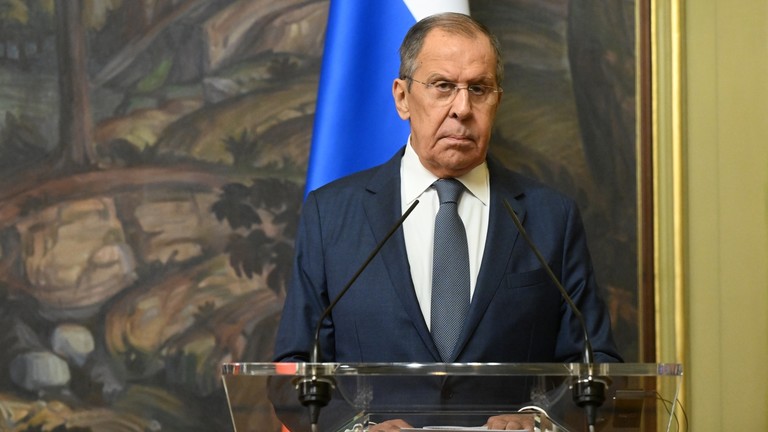
US waging war against Russia – Lavrov
RT | September 17, 2023
Washington’s massive campaign to support Ukraine with arms amounts to a war against Russia, Foreign Minister Sergey Lavrov has said, adding that the US has long groomed Kiev for this very purpose.
In a comment to Russian reporter Pavel Zarubin released on Sunday, Lavrov suggested that rumors about Washington possibly giving the green light to the delivery of Army Tactical Missile Systems (ATACMS), which have a range of up to 300km, were aimed at “shaping public opinion.”
According to the minister, these deliberations would not change the fact that “for many years Ukraine has been groomed to fight with its hands and bodies in order to inflict a strategic defeat on Russia.” Lavrov accused the US of controlling the hostilities between Kiev and Moscow.
“They are sending weapons, ammunition, intelligence, and satellite data. They are waging war against us.”
In recent weeks, several Western media outlets have reported that the administration of US President Joe Biden is edging closer to approving deliveries of the ATACMS, which Kiev has been requesting for several months. The US has been reluctant to approve sending these missile systems, arguing that potential Ukrainian strikes deep into Russia could trigger a major escalation in the conflict.
Ukraine has already received long-range missiles from the UK and France, which, according to local officials, have been used to attack civilian targets and infrastructure in Russia’s Crimean Peninsula and Donbass.
While the US has yet to grant Kiev’s request for ATACMS, it has committed more than $43 billion in military aid to Ukraine since the conflict began, including air defense systems, armored personnel carriers, and M1 Abrams tanks.
Moscow has repeatedly warned the West against supplying Ukraine with arms, saying that doing so will only prolong the conflict but will not change its ultimate outcome.
Hungary explains what might force West to want peace in Ukraine
RT | September 16, 2023
European nations might eventually forgo their support for Kiev’s military efforts in the ongoing conflict with Russia due to their own economic hardships, Hungarian Prime Minister Viktor Orban told nationwide Kossuth Radio on Friday.
The conflict that has lasted for more than a year and a half is affecting the European economy, which “will not be like we want it to be” for as long as it goes on, Orban told the radio’s ‘Good Morning, Hungary!’ show. Yet, “war supporters are in the overwhelming majority” among EU governments, he pointed out.
If there is something that might force European capitals to reconsider their position on the conflict, it is the further deterioration of the economic situation on the continent, the prime minister believes. Most people in Europe already share Hungary’s position on the issue, which is anti-war, he claimed. Economic setbacks could force these people to “exert pressure” on their governments, he added.
“Deterioration of the economic situation in the West will force countries to stand up for peace,” Orban said.
According to the Hungarian prime minister, the outcome of next year’s US presidential elections might also heavily affect the West’s general position on the issue. “There are two possibilities: … the presidential candidates will either support the war or announce the end of the war,” he said.
Orban said he believes that a US president is fairly capable of “putting an end” to the conflict. That does not mean that Europe should just “wait for a fairy to end the war with a magic wand,” he added.
The prime minister criticized the European approach to the conflict so far by saying that “181 billion of European money” has been spent on supporting Kiev but “we have not come any closer to peace.” It is unclear if he referred to dollars or euros.
According to Ukraine Support Tracker data regularly published by Germany’s Kiel Institute for the World Economy, the EU institutions and EU nations together pledged a total of €131.9 billion ($139.8) for Ukraine between January 2022 and July 2023.
The UK, Norway and Switzerland, which are not part of the EU, together pledged an additional €23.31 billion ($24.8 billion) over the same period, bringing the total amount of European commitments to €155.21 billion ($165.66), data provided by the Kiel Institute showed.
Viktor Orban has long maintained that the West was making a mistake by pursuing military confrontation with Russia in Ukraine. He has repeatedly stated that there could be no military solution to the conflict, adding that the US and its allies need to stop arming Kiev and seek peace with Russia instead.
Ukrainian conflict a testing ground for US
By Lucas Leiroz | September 16, 2023
Once again, it seems clear that Ukraine is just one part of America’s ambitious war plans. According to Western media, American experts are “taking notes” of the reality of combat with electronic warfare in Ukraine. The objective is to make the Ukrainian battlefield a “testing ground” for electronic warfare techniques that can serve US interests in other conflicts – such as a possible confrontation with China in the future.
The story was published in an article on the Defense News outlet. Josh Koslov, leader of the US Air Force’s 350th Spectrum Warfare Wing, reported that the US is impressed with the widespread use of means of electronic warfare during hostilities in Ukraine, with both sides showing “agility” and efficiency in carrying out operations. Koslov believes that these skills will be needed by the US in the future, if the country faces a major opponent on the battlefield.
“The agility being displayed by both parties, in the way that they’re executing operations in the spectrum, is awesome (…) Both sides are doing the cat-and-mouse game very, very well (…) In the future, for us, if we do confront a peer, being agile and being rapid is the key to success in the spectrum (…) Not having control of spectrum leads to fatalities, leads to getting killed. And we’ve seen that time and time again in that conflict”, he said.
Although both sides are using this type of technology, the Russians are evidently proving to be more efficient, as can be seen in the results of the special operation. For this reason, Western analysts are evaluating Russia’s performance on the battlefield and believe that Moscow’s electronic skills are one of the main reasons for the Ukrainian failure.
In fact, electronic warfare (also called “spectrum warfare“) is one of the most important topics in contemporary military sciences, even though it is often ignored by some specialists. In current military campaigns, it is essential that the sides involved in hostilities have control over electromagnetic technologies, both for defensive and offensive use.
Given the high use of advanced technology in equipment such as computers, cellphones, radars and radios and guidance systems, a large electromagnetic environment is formed around the battlefields. The side that is most skilled in investigating enemy data through this electromagnetic environment has a huge advantage, both in direct military operations and in intelligence gathering.
Many analysts believe that Russian victories are largely due to Moscow’s high capacity to use the electromagnetic environment to its advantage. Using electronic warfare techniques, the Russian armed forces have been efficient in neutralizing most enemy attacks (mainly diverting Ukrainian drones), in addition to achieving high precision in their strikes. Russian electronic warfare technologies are also vital in destroying the communication lines of Ukrainian troops, having proven to be much more efficient than the entire technical apparatus provided by the West to Kiev.
As head of the electronic warfare wing of the American armed forces, Koslov knows his country’s weaknesses and seeks on the Ukrainian battlefield the knowledge necessary to solve US’ problems. There is a “need” on the part of the US to accelerate the modernization of its spectrum warfare capabilities because the country currently sees the possibility of engaging in direct conflicts in the near future. In this sense, the Defense News’ article reads: “U.S. [spectrum] arsenal atrophied in the years following the Cold War, but officials are reprioritizing in preparation for a fight with Russia in Europe or China in the Indo-Pacific.”
This statement helps answer a series of questions about why the US continues to foment the conflict in Ukraine, even with Kiev on the brink of collapse. In addition to trying to “wear down” the Russians and generate destabilization in the Russian strategic environment, Washington is also observing the enemy, trying to gather data on its advanced war technologies to help overcome its own military weaknesses. In other words, the Pentagon is turning Ukraine into a “testing ground” for improving its own defense forces.
The only reason the US is doing this is because American officials see the start of a new conflict as imminent. Currently, few experts believe that NATO is willing to engage in an open war against Moscow, given the catastrophic effects this would entail. However, a conflict with China seems to be more in line with American plans, as for American strategists Beijing appears to be a “weaker” target, with a greater possibility of US victory in a direct confrontation. For this reason, the US has recently promoted intense militarization of the Asia-Pacific region, increasing local tensions.
So, in practice, the Americans are noticing on the Ukrainian battlefield what they need to improve in their own forces in order to achieve victory in a war they plan to start soon – electronic warfare being one of the main points to be improved. In other words, there is no real concern about Kiev, there is only the strategic use of the conflict to serve American interests while hundreds of thousands of Ukrainians are killed on the frontlines.
Lucas Leiroz, journalist, researcher at the Center for Geostrategic Studies, geopolitical consultant.
Featured Video

John Mearsheimer Talking Iran with Iran
or go to
Aletho News Archives – Video-Images
New Book
The silver that medicine dropped — four thousand years of clinical use, four decades to erase.
Colloidal Silver — First Edition, 2026, Paperback
Lies are Unbekoming | October 16, 2026
Silver was medicine. Not alternative medicine. Not folk medicine. Medicine. In surgery. In obstetrics. In the burn ward. In water treatment. In the household medicine chest. Every physician before 1938 knew this.
By the 1870s, silver nitrate was standard in surgical wound care across the leading hospitals of Britain, Germany, and the United States. Colloidal silver preparations — Collargol, Argyrol, Protargol — entered European and American practice through the 1890s and early 1900s and became standard antiseptics in military field medicine. By the time Fleming grew his first penicillin mould in 1928, silver was the first-line antimicrobial of the Western pharmacopoeia. The Lancet and the British Medical Journal carried the clinical reports in volume. The practice ran continuously through the Victorian era, the Edwardian era, the First World War, the interwar period. By 1980, almost all of it was gone.
What has not been treated at book length, until now, is how a four-thousand-year clinical record disappeared from mainstream medicine within four decades of the Flexner Report — and what the honest account of silver looks like once that record is reassembled.
Colloidal Silver reconstructs the pre-1938 record from The Lancet, the British Medical Journal, and the primary literature of the era; recovers Robert Becker’s bioelectric framework from the regeneration research the pharmaceutical model buried; and places silver inside a practical terrain-paradigm guide to its current place — in water, on the body, inside the body, and in the chronic conditions where antibiotics have failed. … continue
Blog Roll
 Aletho News
- Pharma- and Gates-Funded GAVI Seeks to Assure Parents
- John Mearsheimer Talking Iran with Iran
- Inside Bill C-22, Canada’s Patriot Act.
- China’s FM: Palestinian cause is ‘greatest injustice of the century’
- US sympathy for Palestinians surpasses support for Israelis
- Israeli rabbi permits occupiers to steal Palestinian olive harvest in West Bank
- Spanish firm sells Latvia vehicles equipped with Israeli tech despite arms embargo
- Saudi Arabia under fire… Yemen is burning down the House of Saud
- Israeli Spy Pollard stole the files, today’s it’s delivered through official channels
- Why Iran Didn’t Walk Away
- If Americans Knew
- NPR investigation finds evidence of widespread fraud at mall kiosks tied to Israeli skincare brand
- Tucker Carlson exposes Israeli Lies about the Oct 7th attack, Charlie Kirk, and the U.S.
- Israel has detained thousands of Palestinian children since Oct 7th – over half spent time in solitary, many uncharged
- Israeli Analysis: Is Netanyahu Planning an ‘October Surprise’ Attack Before Israel’s Election?
- Israeli settlers brutally attack Palestinians and Washington Post female photographer, 65
- Words Have Changed, Occupation Continues: The Reality of the Gaza Ceasefire
- Gaza’s child amputees are growing faster than their prosthetics allow
- Israel keeps Palestinians struggling just to survive–Daily Update
- Israeli firm used online ads to run vast spy operation, researchers say
- No, the world zionist movement is not an antisemitic conspiracy theory
- No Tricks Zone
- New Study Suggests Large Regions Of The Pacific Ocean Have Been Cooling For The Last 80 Years
- Germany’s Green Energy Debacle: High Energy Costs Force Kahla Porzellan to Close After 182 Years!
- New Study: 50 Years Of The Most Aggressive ‘Net Zero’ Policies Can Only Affect The Global Climate By 0.03°C
- US September “Heat” Was No Record…Many Records Set Decades Ago
- Latest European Green Energy Debacle; Portugal’s Largest Flagship Solar Park Insolvent!
- Green Energy Debacle: German Expert Professor Fritz Vahrenholt Warns Of Severe Economic And Social Consequences
- Two More Paleo Reconstructions Affirm Meters-Higher Sea Levels Across Ireland, Brazil 7000-6000 Years Ago
- New Study: Earth And Venus Surface Warmth Largely Explained By Convection And Lapse Rate, Not CO2 Or Radiation
- 2025 Nature Paper Claiming Worsening Global Drought Gets RETRACTED …Heavily Flawed
- New Study: ‘Global Drought Shows No Detectable Recent Acceleration Under Climate Warming’

