U.S. Stockpiles $290 Million in NIH-Funded Radiation Sickness Drug
By Michael Nevradakis, Ph.D. | The Defender | October 7, 2022
In what pharmaceutical industry publication Fierce Pharma called “a troubling sign of the times,” the Biden administration this week purchased $290 million in anti-radiation drugs.
In an Oct. 4 press release, the U.S. Department of Health and Human Services’ (HHS) Administration for Strategic Preparedness and Response (ASPR) announced the purchase of Nplate, a drug used to treat acute radiation syndrome.
ASPR — the federal agency tasked with preparing for disasters and public health emergencies — said the purchase was made “as part of long-standing, ongoing efforts to be better prepared to save lives following radiological and nuclear emergencies.”
HHS did not clarify why it bolstered the government’s Nplate stockpile, other than describing it as “part of our ongoing work for preparedness and radiological security.”
Officials downplayed any connection to the Russia-Ukraine conflict, adding that the purchase “was not accelerated by the situation in Ukraine.”
However, two days after the announcement, amid growing tensions related to the conflict between Russia and Ukraine, President Biden said the risk of nuclear “Armageddon” is at its highest since the Cuban Missile Crisis in 1962.
The U.S. government in recent months has made several moves signaling a growing level of nuclear preparedness.
For instance, in late September, the Intelligence Advanced Research Projects Activity launched a new program, — Targeted Evaluation of Ionizing Radiation Exposure — which will investigate methods to detect low doses of ionizing radiation.
According to The Register, the investigation will work to “build a new understanding of the effects of low-dose radiation” through the use of technologies such as artificial intelligence, machine learning, biomarker discovery and analytical biography.
The Ohio State University, the University of Washington, Areté Associates and Signature Science received grants to conduct the research over a three-and-a-half year period. The research will occur at Lawrence Berkeley National Laboratory, Los Alamos National Lab and the Armed Forces Radiobiology Research Institute.
Earlier this summer, New York City authorities raised eyebrows with the release of a 90-second nuclear preparedness public service announcement (PSA), which the New York Times described as “bizarre” and as “well watched,” but “not well received.”
At the time, NPR reported that New York City’s emergency management department “wants residents to be prepared if [a nuclear attack] does occur,” but that the PSA left many of the city’s residents “confused.”
Outside the U.S., countries neighboring Ukraine, such as Poland, reportedly began distributing iodine tablets in response to the threat of nuclear fallout related to the Russia-Ukraine conflict as a result of shelling around the Zaporizhzhia nuclear power plant in Ukraine.
Developed under Project BioShield, with funding from numerous government agencies
Nplate is the trade name for the drug romiplostim, approved by the U.S. Food and Drug Administration (FDA) in January 2021 for the treatment of blood cell injuries that result from acute radiation syndrome.
The drug is an artificial protein that promotes the production of platelets — or blood-clotting cells — in the human body.
The drug first received FDA approval in 2008, for the treatment of immune thrombocytopenia, an autoimmune disorder that causes serious bleeding.
Amgen, the drug’s manufacturer, developed Nplate in conjunction with the Biomedical Advanced Research and Development Authority, or BARDA, under the auspices of Project BioShield, signed into law in July 2004 by then-president George W. Bush.
Project BioShield, which incentivizes private companies to develop vaccines and countermeasures for biological, chemical, nuclear and radiological threats, provided funding for the latest $290 million purchase by the HHS.
BARDA — another arm of HHS — garnered attention in recent years for its extensive deals with COVID-19 vaccine manufacturers and for its promotion of COVID-19 countermeasures.
In 2020, BARDA promised Moderna up to $483 million to “shepherd” its COVID-19 vaccine through the FDA approval process.
The National Institute of Allergy and Infectious Diseases (NIAID) — headed by Dr. Anthony Fauci — also contributed to the development of Nplate.
For instance, during an April 2018 oversight hearing of the House Appropriations Subcommittee on Labor, Health and Human Services, and Education, Fauci described NIAID’s involvement in the development and promotion of “radiation/nuclear countermeasure candidates,” including Nplate, for FDA approval under the Animal Rule.
According to the FDA, Animal Rule regulations “allow for the approval of drugs and licensure of biological products when human efficacy studies are not ethical and field trials to study the effectiveness of drugs or biological products are not feasible.”
In the case of Nplate, drugs.com states that the effectiveness of the drug for the purposes of treating radiation exposure “was only studied in animals, because it could not be studied in people.”
Also according to drugs.com, Nplate also is associated with several serious potential side effects, including the increased risk of a blood clot or stroke, an increased risk of developing blood cancers and “harmful effects on your bone marrow that may result in serious blood cell disorders.”
The site states that it is “unknown” if Nplate will cause harm to unborn babies.
Amgen, based in Thousand Oaks, California, describes itself as “A worldwide pioneer in biotechnology.”
The company’s board of directors includes members from The Aerospace Corporation, the David H. Koch Institute for Integrative Cancer Research, Northrop Grumman, Phillips 66, the University of California and Walmart.
The newly purchased stockpile will remain in vendor-controlled inventory, HHS said.
Michael Nevradakis, Ph.D., is an independent journalist and researcher based in Athens, Greece.
This article was originally published by The Defender — Children’s Health Defense’s News & Views Website under Creative Commons license CC BY-NC-ND 4.0. Please consider subscribing to The Defender or donating to Children’s Health Defense.
Kiev amasses troops on Donbass border – official
Samizdat | October 8, 2022
Kiev has deployed some 40,000 troops to the border with the Lugansk People’s Republic (LPR), which recently became part of Russia, the LPR’s top representative in Moscow, Rodion Miroshnik, has said.
“In the areas where attempts of a breakthrough are being made [by Kiev’s forces], large quantities of manpower and hardware have been concentrated on the Ukrainian side,” Miroshnik said during an appearance on the Soloviev Live program on YouTube on Friday.
According to estimates by the LPR’s forces, “we’re talking about 40,000 men,” the official added.
Kiev’s troops have been gathering to the north and northwest of the LPR, as well as in the area around the town of Krasny Liman in the Donetsk People’s Republic, from where Russian forces withdrew a week ago amid a Ukrainian offensive, Miroshnik added.
On Wednesday, President Vladimir Putin signed into law unification treaties with the Donetsk and Lugansk People’s Republics, as well as Kherson and Zaporozhye Regions, officially making them part of Russia. The four territories overwhelmingly supported the move during referendums in late September.
Russia sent troops into Ukraine on February 24, citing Kiev’s failure to implement the Minsk agreements, designed to give the regions of Donetsk and Lugansk special status within the Ukrainian state. The protocols, brokered by Germany and France, were first signed in 2014. Former Ukrainian President Pyotr Poroshenko has since admitted that Kiev’s main goal was to use the ceasefire to buy time and “create powerful armed forces.”
In February 2022, the Kremlin recognized the Donbass republics as independent states and demanded that Ukraine officially declare itself a neutral country that will never join any Western military bloc. Kiev insists the Russian offensive was completely unprovoked.
Lavrov explains why Russia sees Ukraine as a threat
Samizdat | October 7, 2022
A call by Ukrainian President Vladimir Zelensky for NATO members to deploy nuclear weapons against Russia is a reminder of why Moscow launched military action against his country, Russian Foreign Minister Sergey Lavrov has said.
“Yesterday, Zelensky called on his Western masters to deliver a preemptive nuclear strike on Russia,” Moscow’s top diplomat stated during a media conference on Wednesday.
In doing so, the Ukrainian leader “showed to the entire world the latest proof of the threats that come from the Kiev regime.” Lavrov said Russia’s special military operation had been launched to neutralize those threats.
He dismissed as “laughable” an attempt to downplay Zelensky’s words made by his press secretary, Sergey Nikoforov.
“We all remember how [Zelensky] declared in January Ukraine’s intention to acquire nuclear weapons. Apparently, this idea has long been stuck in his mind,” the Russian minister said.
On Thursday, Zelensky told the Australian Lowy Institute that NATO must carry out preemptive strikes against Russia so that it “knows what to expect” if it uses its nuclear arsenal. He claimed that such action would “eliminate the possibility of Russia using nuclear weapons,” before recalling how he urged other nations to preemptively punish Russia before it launched its military action against his country.
“I once again appeal to the international community, as it was before February 24: Preemptive strikes so that [the Russians] know what will happen to them if they use it, and not the other way around,” he said.
His spokesman then claimed that people interpreting Zelensky’s words as a call for a preemptive nuclear strike were wrong, and that Ukraine would never use such rhetoric.
EU must decide where it stands on Ukraine – Kremlin
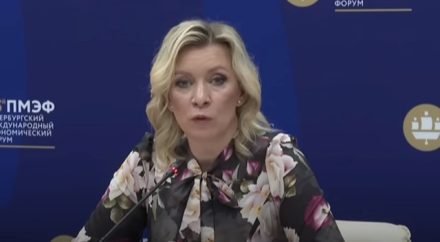
Samizdat – October 6, 2022
The European Union must decide whether it wants the Ukraine conflict to be resolved diplomatically or in a violent manner, Russian Foreign Ministry spokeswoman Maria Zakharova said at a briefing on Thursday.
Asked to comment on Austria’s reported proposal to host de-escalation talks, Zakharova said Moscow could only contemplate such initiatives after the EU figures out what it stands for regarding Ukraine.
“First of all, the EU should make up its mind about itself,” Zakharova said, urging the EU to decide whether it is pursuing a unified foreign policy or if decisions are handled by individual member states.
Russia, she said, has repeatedly heard “contradicting statements” coming from the EU. Zakharova noted that many supposed initiatives had been put forward by member states and were later retracted or never followed-up on because they were not approved by Brussels.
“Secondly, the EU also needs to make up its mind whether they support the talks [on Ukraine], or the battlefield solution, as [EU foreign policy chief Josep] Borrell had put it,” she said.
Zakharova’s comment comes after Borrell signaled on Wednesday that the EU was ready to seek a “diplomatic solution” to the conflict in Ukraine, but vowing that the bloc would continue to provide Kiev with military and financial support while ramping up pressure on Russia through sanctions.
However, in April Borrell issued a much different statement, claiming then that the conflict in Ukraine “will be won on the battlefield.”
Russia sent troops into Ukraine on February 24, citing Kiev’s failure to implement the Minsk agreements, designed to give the regions of Donetsk and Lugansk special status within the Ukrainian state. The protocols, brokered by Germany and France, were first signed in 2014. Former Ukrainian President Pyotr Poroshenko has since admitted that Kiev’s main goal was to use the ceasefire to buy time and “create powerful armed forces.”
During referendums that took place in late September, the two Donbass republics, along with Zaporozhye and Kherson Regions, overwhelmingly voted to join Russia. On Wednesday, Russian President Vladimir Putin signed into law unification treaties with former Ukrainian territories, officially making them part of Russia. Prior to this, the Russian leader vowed to use “all means” necessary to defend the country’s territorial integrity in the face of external threats.
Roger Waters says he’s on Ukrainian ‘kill list’

Samizdat – October 4, 2022
British rock star Roger Waters, a co-founder of Pink Floyd, has allegedly been placed on a Ukrainian “kill list” after speaking out against Western military meddling and calling on Kiev to make peace with Russia.
In an interview with Rolling Stone published on Tuesday, the 79-year-old pushed back against accusations that he’s been repeating Russian talking points about the conflict in Ukraine. “Don’t forget, I’m on a kill list that is supported by the Ukrainian government. I’m on the fu**ing list, and they’ve killed people recently… When they kill you, they write ‘liquidated’ across your picture. Well, I’m one of those fu**ing pictures.”
Waters gave the example of Darya Dugina, the Russian journalist murdered in August after appearing on the Ukrainian Mirotvorets list. As the musician noted, her entry on the list was marked “liquidated” after she was killed in a car-bombing. Others who have questioned or criticized the Kiev regime, such as photojournalists Andrea Rocchelli of Italy and Andrei Stenin of Russia, have also been killed after appearing on the Mirotvorets list. The site lists personal information on its blacklist targets, which also include politicians and NGO activists.
Mirotvorets, or “Peacemaker,” is an independent database of individuals whom anonymous moderators consider to be threats to Ukrainian national security. The site denies being a kill list; rather, it claims to be a source of information for law-enforcement agencies and “special services” about pro-Russian terrorists, separatists and war criminals, among others. It allegedly has links to Ukraine’s Interior Ministry.
Waters stirred backlash earlier this year, when he suggested that US President Joe Biden was a “war criminal” for fueling the Ukraine crisis and sent an open letter to the wife of Ukrainian President Vladimir Zelensky, urging her to help “stop the slaughter” by pushing for a negotiated peace deal with Russia. He later sent an open letter to Russian President Vladimir Putin, asking for guarantees that Russia wouldn’t expand beyond Crimea and the Donbass region.
Pressed by Rolling Stone on why he isn’t supportive of Ukraine’s resistance against Russian forces, Waters said, “Because it’s an unnecessary war, and those people should not be dying. And Russia should not have been encouraged to invade Ukraine.” He also dismissed reports of Russian war crimes in Ukraine as Western propaganda.
Two concerts that Waters had scheduled for next April in Krakow, Poland, may be canceled because of his push for a negotiated peace in Ukraine, the musician said late last month. “Draconian censoring of my work will deny them the opportunity to make up their own minds,” he said of his Polish audiences.
The wide-ranging Mirotvorets kill list also includes Faina Savenkova, a 13-year-old girl in the Lugansk People’s Republic who called for the United Nations to end the fighting that has dragged on in her region since 2014.
Kiev Offers Biden Targeting Control, Seeks Longer Range Weapons
By Kyle Anzalone and Connor Freeman | The Libertarian Institute | October 3, 2022
The Ukrainian government is prepared to give the Joe Biden administration virtual control over its selection of Russian targets. Kiev made the proposal in a bid to receive longer-range weapons from the White House, according to multiple sources speaking with CNN.
Ukrainian President Volodymyr Zelensky will provide a full list of possible targets while allowing the White House to veto any of the potential sites. Kiev is hoping the increased transparency will pave the path to Biden authorizing more weapons transfers. Zelensky made the offer to Washington to alleviate concerns in the Biden administration that new weapons will be used to target Russian territory.
However, Kiev, Washington and Moscow currently have different views on what is Russian versus Ukrainian territory. After a 2014 coup in Ukraine that saw US-backed elements overthrow a democratically elected government, Russia annexed the Crimea peninsula. Last week, Moscow claimed four additional regions of Ukraine as its own.
Russian President Vladimir Putin has vowed to defend all of his country’s territory with the full arsenal at his disposal. The Kremlin stated that it considers its newly added regions as it would the rest of Russia. On Sunday, Secretary of Defense Lloyd Austin acknowledged the possibility that Putin could order a nuclear strike in Ukraine, defending these new regions. The Pentagon chief then vowed Washington would support Kiev’s “efforts” for “as long as it takes” to “take back all of the territories” within its “sovereign borders.”
Concurrently, Moscow claims there has been an increase in Ukrainian attacks within Russia proper, encouraged by NATO. During a recent press conference, Putin publicly noted, for the first time, attempted Ukrainian attacks on Russia’s nuclear power plants.
The US has provided Ukraine with 16 High Mobility Artillery Rocket Systems (HIMARS), and authorized sending over a dozen more to Kiev in an arms package last week. So far, the White House has only sent Ukraine with munitions for HIMARS that can travel 50 miles. Kiev is seeking Army Tactical Missile Systems (ATACMS) surface-to-surface missiles that can fly around 200 miles by the HIMARS. When the Biden administration began providing HIMARS to Ukraine, it was insisted that Kiev had provided “assurances” that these weapons would not be used to target Russian territory. In June, Antiwar.com contacted the State Department to ask if this condition applied to the Crimean Peninsula, a department spokesman replied “Crimea is Ukraine.”
The White House has made clear that they will not recognize the new Russian territories, and NATO has said they will escalate their support for the proxy war.
Russian Foreign Minister Sergei Lavrov has previously said that if the West provides Kiev with longer-range weapons, then the Kremlin would expand its war goals in Ukraine. In July, Lavrov wrote an article claiming NATO was already on the battlefield coordinating attacks on Russian targets using the rocket systems. “NATO instructors and Multiple Launch Rocket Systems aimers are, apparently, already directing the actions of the Ukrainian Armed Forces and nationalist battalions on the ground,” Lavrov said.
In addition to the CIA presence on the ground in Ukraine, NATO commandos from Lithuania, Canada, Britain, and France are also present. Notably, there are several Donald Trump-aligned Republicans in the legislature, including Rep. Mike Waltz (R-FL) eager to “[go] for the kill” and overtly deploy American military advisors to Ukraine. Former US special operators are already on the ground near the contact line, training Kiev’s forces and developing battle plans.
Harry Kazianis wrote in Responsible Statecraft that in multiple war game simulations, Washington sending advanced weapons led to nuclear war.
I have fought more than thirty combat simulations in wargames under my own direction for a private defense contract… In every scenario I tested, the Biden Administration slowly gives Ukraine ever more advanced weapons like ATACMS, F-16s, and other platforms that Russia has consistently warned pose a direct military threat… In fact, in 28 of the thirty scenarios I have run since the war began, some sort of nuclear exchange occurs.
Kazianis does report that in some of the war games, diplomacy, rather than escalation prevailed, and nuclear conflict was averted.
The good news is there is a way out of this crisis — however imperfect it may be. In the two scenarios where nuclear war was averted, direct negotiations led to a ceasefire. The Biden Administration and its NATO allies should be testing Putin’s recent comments about a ceasefire to test his seriousness.
Secretary of State Antony Blinken, America’s top diplomat, has declared Washington’s goal is to see Russia suffer a “strategic defeat” in Ukraine. During the war, he spoke to Lavrov once and for only 25 minutes, they merely discussed a potential bilateral prisoner exchange. Likewise, UK Prime Minister Liz Truss has ruled out diplomacy until Moscow is “defeated.”
Russian hypersonic missiles superior to anything NATO has: Le Figaro
Samizdat – 02.10.2022
Russian hypersonic missile systems are more advanced than anything being fielded by the North Atlantic Alliance today, France’s Le Figaro has reported, echoing sentiments expressed by Russia’s president in a speech last week.
The French newspaper characterized Russia’s hypersonic weaponry as its main strategic asset, capable of flying at incredible speeds and maneuvering while in flight. It pointed specifically to the Avangard hypersonic glide vehicle – a weapon deployable as a part of a multiple independently targetable reentry vehicle (MIRV) payload aboard Russian intercontinental ballistic missiles.
“In this specific area, Russia is indeed one step ahead of its NATO adversaries,” the Gaullist newspaper conceded. The paper added that Russia and China proceeded to develop hypersonic missiles in response to NATO’s efforts to construct a missile defense shield.
“Russia undoubtedly has more modern weapons than the NATO countries. The United States has lagged behind in the field of hypersonic missiles, and Moscow’s nuclear arsenal is being replenished with more powerful and destructive projectiles,” Igor Delanoe, deputy director of the Moscow-based Franco-Russian Observatory, said.
In his speech announcing partial mobilization last month, Vladimir Putin accused Western officials of discussing “the possibility and admissibility of using weapons mass destruction – nuclear weapons – against Russia.”
“I would like to remind those who make such statements regarding Russia that our country has different types of weapons as well, and some of them are more modern than the weapons NATO countries have. In the event of a threat to the territorial integrity of our country and to defend Russia and our people, we will certainly make use of all weapon systems available to us. This is not a bluff,” Putin said.
The Russian president unveiled five new strategic weapons in a speech to lawmakers in 2018, among them the Kinzhal and the Avangard, plus the Poseidon nuclear-powered and nuclear-armed drone submarine, and the 9M730 Burevestnik (‘Petrel’) nuclear-powered, nuclear-armed cruise missile.
The Chinese military also possesses hypersonic weapons. In August, Russian-Indian defense joint venture BrahMos announced that it may create a hypersonic missile by 2027 or 2028. North and South Korea, France, Japan, Australia and India are also researching the cutting-edge class of weaponry.
The Pentagon has tasked US defense contractors with developing at least six hypersonic weapons designs for the Army, Navy, Air Force, and DARPA’s Operational Fires program, but to date none have been fielded. The US military has also pitched laser and dust-firing flak guns meant to defeat Russian and Chinese hypersonics, as well as the use of stratospheric balloons to monitor and track their launch.
Russia got a head start on its hypersonics program thanks to Soviet-era research in the field starting in the early 2000s, after the Bush administration unilaterally scrapped of the Anti-Ballistic Missile Treaty – a 1972 Soviet-US agreement which placed severe limitations on the creation of anti-ballistic missile defenses and intended to stop the arms race.
Russia’s military doctrine forbids nuclear weapons from being used unless the country is targeted by enemy nuclear attack first, or a conventional attack so severe that it is deemed to threaten the existence of the state. The United States does not place such restrictions on its nukes, and “reserves the right to use” them on a preemptive basis, even against non-nuclear armed adversaries.
The Democratic Party, Now the Leading Party of War
By John V. Walsh | The Greanville Post | September 27, 2022
Last May a remarkable column by Stephen Kinzer appeared in the Boston Globe. It was headlined: “Republicans Return To Their Roots As The Antiwar Party.”
More significantly, the subheading ran: “Since the Vietnam era, Americans have come to expect antiwar rhetoric from liberal Democrats. Cancel that.” It began:
“With Americans now engulfed in passion for Ukraine, it wasn’t surprising that President Biden proposed sending $33 billion worth of weaponry and other aid to Ukraine’s beleaguered military. Nor was it surprising that Congress raised the number to $40 billion, or that both the Senate and House of Representatives voted overwhelmingly in favor. Hidden within that lopsided vote, though, was a shocker: Every single “no” vote – 11 in the Senate and 57 in the House – came from a Republican.
“Since the Vietnam era, Americans have come to expect antiwar rhetoric from liberal Democrats. Cancel that. This month’s votes in Washington signal a dramatic role reversal. Suddenly it is conservative Republicans who oppose US involvement in foreign wars.”
Strikingly not only did the “conservative” Democrats vote for the $40 billion that included more weapons of death and destruction for Joe Biden’s cruel proxy war against Russia to the last Ukrainian. All the “progressives” did so, including AOC and The Squad, Bernie Sanders, Ro Khanna, Barbara Lee and all the rest. It was a clean sweep.
Second, this was not a one-off event. There is another vote coming up in the next few weeks for another $13.7 billion for Ukraine with over $7 billion for weapons. What is the response of the 100 Democrats to this request by Biden? The answer came during the September 11 Week Of Action called for by Code Pink and the progressive Peace In Ukraine Coalition reported here as follows:
“In the nation’s capital CODEPINK co-founders Medea Benjamin and Jodie Evans, together with Colonel Ann Wright and other activists, kicked off the Week of Action, going door to door to the offices of the House Congressional Progressive Caucus (CPC), …. While some members of the caucus call for much-needed diplomacy and raise concerns about the risk of nuclear war – either through a miscalculation or an intentional first strike – not one member of the nearly 100-member CPC will commit to voting against more weapons for Ukraine.” (Emphasis, jw)
This was also acknowledged in a very dispiriting interview by The GrayZone with prominent activists after the lobbying effort.
The pro-war mentality among the “progressive” Dem pols is not limited to Biden’s cruel proxy war to the last Ukrainian. It extends to a second proxy war now being ginned up in Taiwan. When Nancy Pelosi recently visited the island to stir up secessionist sentiment, not a single progressive Democrat in Congress made so much as a peep of protest. In fact Rep. Ro Khanna, Co-chair of Bernie Sanders’s 2020 Presidential campaign boosted it in rants on CNN and Twitter.
Both of these proxy wars bring the US into conflict with two other major global nuclear powers. If the progressive pols cannot be against military escalation in cases like this, it is hard to see that they have any claim to be for peace. And yet all too many activists in the progressive antiwar movement are loyal to them. In fact some peace organizations have gone so far as to endorse them for election in 2022, even after their vote for the $40 billion to Ukraine for example here!
Moreover this support for the proxy war in Ukraine shows up among rank and file Democrats as well. By every measure in a recent Ipsos poll taken after 6 months of war, support for intervention in Ukraine was higher among Democrats than among Republicans or Independents. IF the roots of this are partisan in nature, that is deeply disturbing because it means that Democrats will follow warhawks simply because they are Dems. Biden may be a case in point for such misplaced loyalty.
Let me end on a personal note. Working in peace organizations and coalitions, I find many activists who labor mightily for the cause of peace also maintain loyalty to the Democratic Party. And that loyalty extends especially to the “progressive” Democratic politicians. This is most disturbing because on the most important issues of war and peace, these peace activists get nothing in return. And since there is no price to pay for their hawkish votes, these politicians will simply ignore such activists. This is an abusive relationship and ought to be terminated forthwith.
The minimal policy of those who work for peace should be quite simple: no votes for politicians who vote to fund war in Ukraine – no matter the Party. Otherwise those who support war and US unipolarity will continue to ignore those who work for peace.
Western withdrawal of citizens from Russia may be a provocation
This act looks like a threat of attack and could generate responses.
By Lucas Leiroz | September 29, 2022
The US and some other Western countries announced the evacuation of their citizens from the Russian territory. In a context of tensions between Moscow and NATO, this type of attitude sounds like a threat, further worsening the scenario of global security crisis.
The US State Department has asked Russia-based American citizens to leave the country immediately. The appeal was posted on the website of the US Embassy in Russia. The justification for the advice was that Moscow could mobilize citizens who have dual nationality, which is why foreigners based in Russia should flee as quickly as possible, before they are mobilized for combat on Ukrainian soil. The statement also highlights that there are currently a limited number of flights from Russia to other countries, and tickets for the next dates may not be available, so US citizens residing in Russia should hurry to leave.
It is interesting to analyze the communiqué issued by the Embassy when the reality of the mobilization promoted by Russia is not only partial but also absolutely moderate. The call-up of combatants has been promoted in a balanced way, with no urgency for foreign citizens to flee in a hurry to avoid being mobilized. Moscow has shown no interest in forcing foreign nationals with Russian passports to serve in the special military operation, which makes the American narrative weak and unsubstantiated.
However, some other countries also took measures similar to the one of the US. Poland and Bulgaria, for example, called on their citizens to leave Russia immediately. Commenting on the matter, spokespersons for the Polish Foreign Ministry released a note stating: “In case of a drastic deterioration of the security situation, the closure of borders or other unforeseen circumstances, evacuation may prove significantly impeded or even impossible (…) We recommend that the citizens of the Republic of Poland who remain on the territory of the Russian Federation leave its territory using the available commercial and private means”.
Also, Poland’s foreign minister Zbigniew Rau was more explicit in his words and stated that if Russia uses nuclear weapons against Ukraine, NATO’s response will be “devastating”, which is why Polish citizens should leave Russian territory as soon as possible. In fact, his words were just an endorsement of what had already been previously announced by the US National Security Advisor Jake Sullivan, who threatened Moscow by stating that “if Russia crosses this line (the use of nuclear weapons], there will be catastrophic consequences for Russia”, adding that “the United States will respond decisively”.
In fact, evacuating citizens is an elementary measure usually taken by states that are planning some kind of attack or invasion. It is the most direct and simplest way to prevent putting the lives of innocent citizens on enemy soil at risk when a war is breaking out. In this sense, any attempt at a massive withdrawal of Western citizens from Russia sounds like a threat to the Eurasian country at this point, as the Western military alliance has constantly warned of “consequences” against Moscow in the event of an escalation in Ukraine.
The problem is that the situation in Ukraine only tends to escalate because of the attitudes of the western countries themselves, which continue with their provocative military programs against Russia, supporting the neo-Nazi regime in Kiev with lethal weapons and large amounts of money. Moscow has already issued communiqués warning of what it considers a “red line” in the Ukrainian conflict, which is Russia’s sovereign territory. Russian forces are unwilling to tolerate attacks on the Federation’s territory and make it clear that they will respond harshly if such attacks occur.
With the positive result for the integration of the liberated territories into Russia, the new oblasts will become part of the Federation and thus will be under direct protection of Moscow, not being tolerable Ukrainian attacks in these regions. The West, however, insists on not recognizing the referendums and encourages Kiev to attack these regions. This is precisely where an eventual nuclear escalation could happen. Russian military doctrine establishes that nuclear weapons should only be used as a last resort in the event of an existential threat to the Russian state. Moscow may consider Western-funded attacks an existential threat if the targets are within the Federation – including the new territories – which is why there is currently a nuclear danger.
So, it is the West itself that fosters the conditions for a nuclear escalation. And it is also the West that threatens to react to such an escalation by directly attacking Russia and starting a third world war. By evacuating its citizens, the US and its allies are once again provoking and threatening Russia, sending “red alerts” that something is “about to happen”. The objective is to act preemptively and justify a Western response.
In fact, the West seems to be acting in an anti-strategic manner. There no longer seems to be any military realism in the thinking of NATO leaders, who are willing to escalate tensions more and more, even though there are no winners in a possible scenario of world war.
Lucas Leiroz is a researcher in Social Sciences at the Rural Federal University of Rio de Janeiro; geopolitical consultant.
Featured Video

Why the U.S. Should Pull Back From the First Island Chain
or go to
Aletho News Archives – Video-Images
Book Review
‘Why Fauci Must Rot in Prison’: A Tale of Two Diaries
By Jill Erzen | The Defender | October 13, 2026
Dr. Anthony Fauci’s private diary reveals a “mind-numbing” contradiction between what the former top U.S. infectious disease official knew about COVID-19 and what he told the public, senior White House adviser Peter Navarro, Ph.D., said last week on “American Thought Leaders.”
In his new book, “Why Fauci Must Rot in Prison,” due out Oct. 20, Navarro compares Fauci’s private entries to his own pandemic-era diary, and uses what he calls “a tale of two diaries” to argue that Fauci should face criminal prosecution.
“I show, actually, how a prosecution can and should happen … at the state level, most likely,” Navarro said. “He should wind up in prison, and we’ve got the receipts in this book to put him there.”
Navarro said Fauci repeatedly acknowledged important facts in private, then publicly pursued policies that contradicted those facts — with devastating consequences.
“What he says many times privately in his diary is so at odds with both his public behavior and public statements that it’s mind-numbing,” Navarro said.
Navarro examines the lasting damage caused by lockdowns and other pandemic policies, and the ongoing toll of long COVID.
His book also addresses questions about vaccine safety, including why healthy young people faced COVID-19 vaccination mandates despite concerns about myocarditis, and why women were not warned about miscarriage risks linked to the shots. … continue
Blog Roll
 Aletho News
- Jennifer Kavanagh: Why the U.S. Should Pull Back From the First Island Chain
- Yemen denounces international community’s silence on Saudi aggression, siege
- UAE and Saudi Arabia move toward renewed coordination against Sanaa
- How Iran’s two-week retaliatory strikes exposed cracks in US military architecture in Persian Gulf
- The mother of all propaganda: Why the hype over US MOAB strike against Iran is nothing but theater
- Iran says it possesses technology behind US 14-ton GBU bunker-buster
- Trump asks Iran not to retaliate after he strikes Pickaxe Mountain – w/ Prof. Marandi
- Vice President J.D. Vance’s Deceptive ‘Antiwar’ Campaign Speech
- Iran: Palestinians’ rights must not be compromised in Gaza’s future; US, Israel to blame for Hormuz situation
- Ongoing tales of Syrian chemical weapons
- If Americans Knew
- Israeli rabbi permits occupiers to steal Palestinian olive harvest in West Bank
- Netanyahu’s spin on latest settler attack is laughable – Daily Update
- Israeli soldiers debunk Israel’s talking points
- In West Bank, Israeli settlers are totally out of control – Daily Update
- NPR investigation finds evidence of widespread fraud at mall kiosks tied to Israeli skincare brand
- Tucker Carlson exposes Israeli Lies about the Oct 7th attack, Charlie Kirk, and the U.S.
- Israel has detained thousands of Palestinian children since Oct 7th – over half spent time in solitary, many uncharged
- Israeli Analysis: Is Netanyahu Planning an ‘October Surprise’ Attack Before Israel’s Election?
- Israeli settlers brutally attack Palestinians and Washington Post female photographer, 65
- Words Have Changed, Occupation Continues: The Reality of the Gaza Ceasefire
- No Tricks Zone
- Predictions Made By Renowned Climate Proifessor Over Past Decades Have Been Proven To Be Poor
- New Study Suggests Large Regions Of The Pacific Ocean Have Been Cooling For The Last 80 Years
- Germany’s Green Energy Debacle: High Energy Costs Force Kahla Porzellan to Close After 182 Years!
- New Study: 50 Years Of The Most Aggressive ‘Net Zero’ Policies Can Only Affect The Global Climate By 0.03°C
- US September “Heat” Was No Record…Many Records Set Decades Ago
- Latest European Green Energy Debacle; Portugal’s Largest Flagship Solar Park Insolvent!
- Green Energy Debacle: German Expert Professor Fritz Vahrenholt Warns Of Severe Economic And Social Consequences
- Two More Paleo Reconstructions Affirm Meters-Higher Sea Levels Across Ireland, Brazil 7000-6000 Years Ago
- New Study: Earth And Venus Surface Warmth Largely Explained By Convection And Lapse Rate, Not CO2 Or Radiation
- 2025 Nature Paper Claiming Worsening Global Drought Gets RETRACTED …Heavily Flawed

