There’s no debating it: Biden will get billions in new Ukraine aid
By Kelley Beaucar Vlahos | Responsible Statecraft | September 27, 2022
Congress is poised this week to approve an estimated $12 billion in new economic aid and military assistance to Ukraine. But don’t expect a lot of debate or even fanfare because it is being rolled into a stopgap measure to keep the entire federal government operating until December.
Called a continuing resolution, the massive spending bill must be passed by Friday to avoid a shutdown. This was obviously the most convenient way for Biden to push the Ukrainian aid measure through: Majority leader Sen. Chuck Schumer (D-N.Y.) spearheaded its inclusion in the resolution, and, with most members of Congress in favor of the previous aid packages and precious few days for any floor discussion, any critics of the proposal have little or no time to question it.
And plus, who’s going to chance being accused of wanting to “shut down the government” by raising a stink?
According to the most recent reports on Monday night, lawmakers have agreed to include $12 billion — $4.5 billion for weapons and equipment, and $2.7 for military, intelligence, and other defense support, plus another $4.5 billion to keep the Ukrainian government running for another quarter.
Meanwhile, Democrats’ attention seems to be focused elsewhere, on a completely different potential stumbling block: a permitting reform measure by Sen Joe Manchin (D-W.Va.). Nevertheless, the first step is a cloture vote to move the massive bill forward, with the Senate beginning deliberations today.
This new money is on top of the $40 billion approved in May. Since the war began, the U.S. has sent more than $15 billion in weapons and military assistance to Kyiv in its war against invading Russian forces.
But critics say there has been little visible oversight in Washington of the money already spent, whether it is getting to where it needs to go, or being used effectively by the forces that need it.
“Oversight of Ukraine aid is sorely needed,” Julia Gledhill, a defense analyst for the Project on Government Oversight (POGO), tells Responsible Statecraft. “The State and Defense departments are handling billions of dollars in Ukraine funding, but neither have permanent inspectors general in place to investigate and prevent abuse of funds.”
The word is that the Democrats are unified behind the new aid package (recall no Democrat in either the House or Senate voted against the $40 billion measure in May). Republicans, on the other hand represent the potential opposition, with 11 GOP senators and 57 House Republicans dissenting on that same vote.
According to recent reports, Republican complaints of this latest tranche have focused on the fact it was being tied to the CR and the lack of debate.
“I haven’t seen a detailed list of exactly how they want to spend the money,” Sen. Rick Scott (R-Fla.) said on Sept. 19. “I think whatever we do on Ukraine, we ought to be doing it separately from the CR. I think we’ve gotta have a clean CR that goes through Congress.”
In that same CNN article, Sen. Mike Rounds (R-S.D.) said he was “open for discussion” about the Ukraine aid. The House side seems a bit more restive: a recent Politico article quoted Rep. Chip Roy, (R-Texas) balking at what seemed to be rubber stamping aid for Ukraine.
“There’s no limiting principle. So no, count me against throwing more money at Ukraine without having a serious conversation about guns and butter, a serious conversation about why we’re spending it and how it’s in our national security interest,” he said.
But these primary concerns — oversight and debate over whether continuing aid is in the U.S. interest (and whether, when not paired with diplomatic strategy, we might be prolonging the war at Ukraine’s ultimate expense) — will be likely overtaken this week by the bipartisan desire to keep sending aid. This includes party leaders and chairs/ranking members of the prominent Armed Services Committees who believe that new and more weapons will put Ukrainians in a position of strength from which to eventually negotiate.
In fact, folks like Sen. James Inhofe want to give more. “This aid package is insufficient to provide the Ukrainians with what they need to win,” the Republican ranking member of the SASC complained on Twitter in early September.
Politically, however, Biden is smart to get this through now. If Republicans take over the House after the November midterms, they are expected to throw up many more roadblocks against additional Biden/Democratic spending, and that might jeopardize further Ukraine aid. But that’s not set in stone: Establishment institutions like the Republican Policy Committee are clear the assistance to Ukraine must continue. In fact, they tie it to our foreign policy writ large:
“We must leave absolutely no doubt in the minds of Russia’s, China’s, or any other nation’s leaders about U.S. resolve to support sovereignty and self-determination around the globe,” the RPC said in Sept. 12 paper. “Decisive military aid to Ukraine will accomplish this task.”
Responsible Statecraft will update this story as it develops.
US Hard at Work Preparing Taiwan for War with China
By Vladimir Platov – New Eastern Outlook – 26.09.2022
The years leading up to World War I and World War II are often referred to by historians as “diplomatic fever,” because of active mobilization of several powers around the world in both overt and covert alliances. However, such activity was not aimed at preventing conflict, but solely at strengthening their position ahead of the impending war which was their goal all along.
Unfortunately, something similar can be seen in US behavior of late, both in terms of “joining forces” on Washington’s possible European battlefront against Russia, and in the Asia-Pacific region (APAC) in confronting China. US recent policies and actions – on the eve of the Chinese Communist Party Congress – have been characterized by the creation of anti-Chinese blocs, unprecedented large-scale exercises in the APAC and close to Chinese borders, and various provocations.
After a provocative visit to Taiwan by US House of Representatives Speaker Nancy Pelosi in early August, the situation around the island, as well as relations between China and the US in general, escalated. China, which considers the island one of its provinces, condemned the visit, seeing it as support by the United States for Taiwanese separatism.
In the interest of containing China, the White House is provoking tensions around the island of Taiwan, blatantly violating the One China principle, which the Americans once accepted as one of the main conditions for normalizing US-China relations. In pursuing the the anti-China strategy, during August alone four delegations with representatives from the US political establishment at various levels travelled to Taiwan. Apparently in coordination with Washington, a number of European Union political delegations also paid provocative visits to Taiwan and showed support for Beijing’s opponents on the island.
Simultaneously with the political anti-Beijing demarches, immediately after Nancy Pelosi’s visit, Chinese territorial waters in the Taiwan Strait began to be violated more frequently by US naval vessels under the pretext of freedom of navigation. On August 27, for example, two US naval vessels, the missile cruisers USS Antietam and USS Chancellorsville, made a demonstrative and provocative passage through the Taiwan Strait, which the Chinese Foreign Ministry strongly opposed. To thwart any further provocation by the US, China’s Army has been put on high alert, according to Shi Yi, an official of the Eastern Theater Command of the People’s Liberation Army (PLA). On August 28, Taiwan’s Armed Forces recorded the sighting of 23 PLA aircraft and eight PLA ships in sea and airspace near Taiwan.
Chinese Foreign Ministry Spokesperson Zhao Lijian commented on Washington’s provocation on August 29. “US naval vessels flying the flag of freedom of navigation are carrying out a show of force. This is not a commitment to freedom of navigation, but a provocation against it and deliberate harm to peace and stability in the region. The Chinese side again calls on the US to stop emasculating, diluting and perverting the One China principle, strictly respect the sovereignty and territorial integrity of other countries and basic international norms on non-interference in the internal affairs of states, and effectively implement the provisions of the three Chinese-US joint communiqués.”
Continuing to escalate the situation around Taiwan, US authorities in early September announced their intention to sell $1.1 billion worth of weapons and military equipment to Taiwan.
At the same time, the US Senate Committee on Foreign Relations approved a bill on September 14 that would provide for a comprehensive expansion of support to Taiwan, including military support. As well as imposing sanctions on Beijing under the pretext of seeking to preserve stability in the Asia-Pacific region, said the Committee’s senior Republican, Jim Risch, commenting on the vote. In essence, this initiative by US lawmakers seeks to revise US policy towards Taiwan and, by extension, mainland China. The bill would make Taiwan a “major non-NATO ally” of the United States, increasing its military aid (not just defensive but also offensive weapons, including missiles) to $4.5 billion over the next four years, making it the largest recipient after Israel, Egypt and Ukraine. China has already said that, if passed, the new bill would come as a shock to US-China relations. And China’s Ambassador to the US, Qin Gang, told Deputy Secretary of State Wendy Sherman in a meeting on August 23 that Chinese-US relations would be severed if the law went into effect.
Covering up his aggressive policy towards China with the alleged possibility of a Chinese “invasion” of Taiwan, US President Joe Biden assured in an interview with CBS that the US military would stand up to defend Taiwan.
However, by pushing China into military action, the US, Bloomberg estimates, could find itself in a terrible position in the event of a conflict with China within months or even weeks of the outbreak of hostilities. Pentagon arsenals are empty because of significant arms deliveries to Kiev. And China’s Army today is very technically equipped. Defending Taiwan will therefore be very costly, with the United States having to pay a prohibitive price in both personnel and equipment.
The US Navy is now poorly prepared, inferior in numbers to the Chinese, and US naval bases are underprepared, former US Navy Rear Admiral Charles Williams pointed out in an article for The Hill. Furthermore, the US can no longer act on two fronts; against Russia and China at the same time.
The Times also warns that the United States would suffer heavy losses and take years to recover from an open conflict with the PRC, citing analysis by the Washington-based think tank Center for Strategic and International Studies. In particular, its analysts predict that the US will lose a significant portion of its fleet and some 900 combat aircraft defending Taiwan against China.
In confronting China, regional allies are unlikely to help the US, and even Germany, which intends, according to remarks made in early September by Inspector General of the Bundeswehr General Eberhard Zorn, to “increase its military presence in the Indo-Pacific region to contain China.”
Despite these provocative actions by Washington and Taipei’s push for military action, the PRC government has reaffirmed its determination to pursue national reunification with Taiwan. Chinese Foreign Ministry Spokesperson Mao Ning reiterated the other day that the Taiwan issue is strictly an internal Chinese matter and the US has no right to interfere in it.
UK to double military spending amid cost-of-living crisis
Samizdat | September 25, 2022
Britain will boost its military spending considerably in the coming years, Defence Secretary Ben Wallace has revealed, despite the fact the nation is facing an economic crisis stemming from Covid-19 measures and London’s sanctions on Moscow.
In an interview with the Sunday Telegraph published on Sunday, Wallace said the British government will shell out at least £52 billion ($56.5 billion) to shore up the military, which is “actually going to grow.” The plans are in keeping with Prime Minister Liz Truss’ campaign promise to boost defense spending.
According to the official, Britain’s annual defense budget will amount to £100 billion by 2030.
Wallace also took aim at former Chancellor of the Exchequer Rishi Sunak and the Treasury for what he described as a “corporate raid” of the armed forces which started back in the 1990s. He claimed that the Treasury had even tried to “stipulate the size of the Army.”
“My department has been so used to 30 or 40 years of defending against cuts or reconciling cuts with modern fighting, they’re going to have to get used to a completely different culture,” the defence secretary noted.
Wallace expressed confidence, however, that Sunak’s successor in the office, Kwasi Kwarteng, would show more understanding toward the military’s needs.
The defence secretary, who retained his post after Liz Truss defeated Sunak in the race to become prime minister in early September, told journalists that the new leader’s willingness to spend more on the military was one of the key factors for him in deciding which candidate to back for prime minister.
“The reason I supported Liz Truss was that the risks we were prepared to tolerate in the middle of the decade are not risks I want to tolerate any more in light of Russian aggression,” Wallace said.
Addressing world leaders at the UN General Assembly in New York, Truss reiterated her campaign pledge to spend 3% of GDP on defense by 2030.
According to Bloomberg, the new prime minister reversed former PM Boris Johnson’s plans to slash the military by 9,500 personnel.
Commenting on the changes, which are expected to be unveiled by the end of 2022, Downing Street clarified that they were needed to “stand firm against coercion from authoritarian powers like Russia and China.”
The decision comes despite the UK government’s interest payable on debt hitting the highest level on record, as reported by the Office for National Statistics (ONS) earlier this week. Inflation, food, and energy prices have also soared, while the British pound and consumer confidence have hit the lowest levels in decades.
Biden Condemns Nuclear War in Lie-Filled UN Address… But He Is Making Such a War Happen
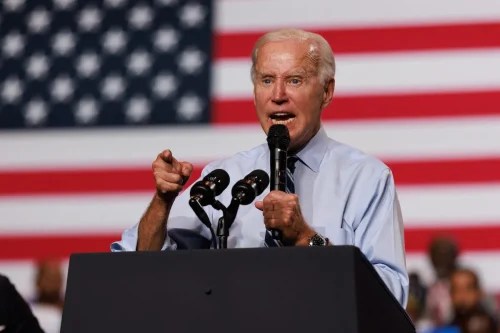
Strategic Culture Foundation | September 23, 2022
If there were any justice, Biden should have been escorted away from the UN podium to a prison cell awaiting prosecution for crimes against peace.
U.S. President Joe Biden’s address to the 77th annual UN general assembly this week was a spectacle of blatant lies and delusions.
Every year, the world is forced to endure American presidents standing before the assembly of 193-member nations proclaiming the presumed virtues of the United States. However, it’s always an occasion of embarrassing delusion and deception uttered with unctuous self-regard.
This year, the leaders of Russia and China didn’t bother attending the event held at UN headquarters in New York. No doubt they have better things to do. And besides who would want to sit through a speech from an American president that is an absurd insult to common intelligence and historical truth?
Biden condemned nuclear war, saying “it cannot be won and must never be fought”. He went on to accuse Russia and China of undermining world peace with nuclear posturing.
Russia is “making irresponsible nuclear threats” and China is “conducting an unprecedented, concerning nuclear build-up without any transparency”.
Biden said the “United States and I as president champion a vision for our world that is grounded in the values of democracy… I reject the use of violence and war to conquer nations or expand borders through bloodshed.”
The calumny is as contemptible as it is astounding coming from Biden, who during his more than 50 years as a senior Washington politician has advocated dozens of U.S. criminal wars of aggression in every part of the globe.
It is particularly sickening that Biden’s UN speech was presented by U.S. media as a “historic mission” to prevent nuclear war.
It is the United States and this president who are recklessly inciting dangerous tensions with nuclear powers Russia and China. World peace is indeed under imminent threat of a global catastrophic war — from the United States in its relentless aggression toward Russia and China.
The Biden administration and its NATO partners are pumping weapons into Ukraine to prolong the conflict in that country on Russia’s western border. That war is the culmination of eight years of deliberate arming of the anti-Russian Kiev regime to act as a spearhead against Russia.
The Neo-Nazi Kiev regime, which was installed by a CIA-backed coup in 2014, has for weeks been shelling the Zaporozhye nuclear power plant in southeast Ukraine with U.S.-supplied artillery. American and British intelligence is guiding their Kiev proxy forces to strike Russian territory with longer-range missiles.
Russian Minister of Defense Sergei Shoigu this week remarked that Russia is at war not merely against Ukraine but against the collective U.S.-led NATO bloc. The implication of this is truly alarming as the Strategic Culture Foundation has stated in previous recent editorials. We are already in a quasi-world war predicament that is on the precipice of escalating into a nuclear confrontation, one that would inevitably destroy the entire planet.
Ukrainian areas under Russian control are due to hold referenda next week which will likely see these separatist areas joining the Russian Federation as Crimea had done in 2014. Thereafter, that will mean NATO forces are directly involved in attacking Russia if they persist in supporting the Kiev regime. There is every indication that Washington and its allies will continue in their madness. Biden has said the U.S. will support Ukraine “for as long as it takes”. As long as what takes? The presumed conquering of Russia, which has been Washington’s strategic objective ever since the dissolution of the Soviet Union in 1991.
Russian President Vladimir Putin this week warned NATO that it faces a stark choice. Referring to the forthcoming referenda and the joining of Donbass regions with the Russian Federation, Putin gave notice that Russia reserves the right to defend itself by all means.
Biden and the Western media turn reality on its head. Putin is accused of threatening nuclear strikes. But it is the United States and its European lackey leaders who have created the abysmal impasse from their importunate weaponizing of Ukraine and repeated refusal to engage with Moscow on negotiating a definitive security arrangement concerning the halting of NATO encroachment on its borders.
Turning to China, there is an analogous situation. The Biden administration like his Republican and Democrat predecessors in the White House is arming the breakaway island territory of Taiwan in a brazen assault on China’s sovereignty and national security. The United States and its NATO partners as well as non-NATO clients Australia and Japan are sailing warships through the Taiwan Strait in a cynical attempt to provoke Beijing.
Earlier this week, Biden for the fourth time announced that the United States would militarily “defend” Taiwan if China were to launch a military invasion. Legally under UN law, Taiwan is an integral part of China, so how can China “invade” itself?
Washington is deliberately inciting Beijing and violating its own U.S. domestic laws that recognize Taiwan as being under China’s sovereignty. Yet Biden has the gall to tell the UN assembly that his nation still upholds the One China Policy. The Americans like to call this “strategic ambiguity”. To other observers, it is simply offensive “strategic duplicity”.
The world would seem to be witnessing a deranged American imperialist power at full throttle. The leader of the globe’s biggest aggressor nation who is inexorably pushing provocations toward Russia and China has the audacity to lecture the rest of the world about peace, security, international law, and democracy — and the danger of nuclear war.
If there were any sanity and justice, Biden should have been escorted away from the UN podium to a prison cell awaiting prosecution for crimes against peace.
Americans, Overcoming Nonstop Propaganda, are Increasingly Not Worried about Russia Defeating Ukraine
By Adam Dick | Ron Paul Institute | September 23, 2022
The propaganda masters at the big money media and the United States government have pulled out all the stops in their effort to stir up Americans to oppose Russia in its war with Ukraine and to support extreme and expensive efforts of the US government to help the Ukraine government’s side in that war. But, as time has worn on, Americans are increasingly saying it is not a big deal to them whether Russia, led by supposed archvillain Vladimir Putin, wins the war or even takes over Ukraine.
The Pew Research Center conducted a poll from September 13 to 18 in which Americans were asked whether they are concerned about the possibility of “Ukraine being defeated and taken over by Russia” — a question Pew also had asked in April 25 to May 1 polling. Looking at the answers in September compared with in May, a big drop in concern about the possibility of “Ukraine being defeated and taken over by Russia” is evident over the four month period.
While in May 55 percent of polled individuals said they were very or extremely worried about that possibility of Russia defeating and taking over Ukraine, by September only 38 percent were. Meanwhile, the percentage of people saying they are not too concerned or not at all concerned about such a result jumped from 16 percent to 26 percent.
The percentage of polled individuals choosing the middle ground answer that they are somewhat concerned grew from 28 percent to 34 percent.
Notably, the poll question asks about concern regarding Russia taking over all of Ukraine as a result of winning the war — an outcome more extreme than most people think is likely. Consider if the poll instead asked if people are concerned about Russia defeating Ukraine and requiring it to stop exercising control of areas of Ukraine with large Russian population majorities and to maintain neutrality in regard to Russia and the North Atlantic Treaty Organization (NATO). Then, surely, concern levels would have registered yet lower.
These poll results demonstrate a major propaganda fail. Given time, many Americans have seen through the lies. They have stopped being had.
Further, a good number of Americans have bristled at the great amount of US government spending undertaken to support the Ukraine government’s war effort. More and more Americans are also likely increasingly disturbed by the high ongoing cost in lives and destruction that such spending has caused and promises to cause in the future by dragging out a war that Russia and Ukraine would probably otherwise have already settled by agreement.
Indeed, the September poll found an increased percentage of individuals declaring the US government has given too much support to Ukraine. The percentage of polled individuals providing this answer rose from 12 percent in May to 20 percent in September. Among Republican and Republican-leaning polled individuals, the view that the US has provided too much support to Ukraine rose from 17 percent in May to 32 percent in September. Should this trend in views continue to progress, constituents’ pressure on American politicians to turn off the Ukraine money spigot can be expected to continue increasing.
Copyright © 2022 by RonPaul Institute.
China warns US about ‘attitude’
Samizdat – September 24, 2022
The US must change its attitude towards China so the two powers can get along on the world stage, Chinese Foreign Minister Wang Yi said during a meeting with his US counterpart, Antony Blinken, in New York on Friday.
“China-US relations are at a critical juncture, and it is urgent for both sides to establish a correct way for the two major countries to get along with each other in a responsible attitude towards the world,” Wang told Blinken, according to a statement from the Chinese Foreign Ministry.
Wang added that by pledging to defend Taiwan, Washington is undermining China’s sovereignty and “sending a very wrong and dangerous signal.”
China considers the self-governing island its territory and opposes any form of foreign diplomatic and military aid to Taipei. “The issue of Taiwan is China’s internal affair, and the US has no right to interfere,” Wang said.
We hope that the US will correct its perception of China … and stop trying to deal with the Chinese from a position of strength.
According to US State Department spokesman Ned Price, Blinken spoke about the need to maintain open lines of communication with Beijing and stressed that Washington is “committed to maintaining peace and stability across the Taiwan Strait, consistent with our longstanding ‘one-China’ policy.”
CNN quoted a senior US official as describing the conversation between Wang and Blinken as “extremely candid, direct, constructive and in-depth.”
Speaking to CBS News last week, President Joe Biden said the US would defend Taiwan in case of a Chinese invasion. However, the White House later clarified that Washington continues to maintain ‘strategic ambiguity’ on the matter.
Last month, China strongly protested the visit of US House of Representatives Speaker Nancy Pelosi to Taiwan, who became the highest-ranking US official to make the trip since the 1990s. Beijing retaliated by launching major military drills around the island.
‘US Lifting Cyprus Arms Embargo Will Fuel Weapons Buildup on Both Sides of Island’
Samizdat – 23.09.2022
The US decision to lift the weapons embargo on the Greek Cypriot administration will spark an arms buildup on the north and south sides of the island, Turkish Cypriot President Ersin Tatar told Sputnik on the sidelines of the UN General Assembly.
The State Department last week lifted all defense trade restrictions on Cyprus after determining it met US legal requirements by denying Russian vessels access to ports and implementing anti-money laundering reforms.
On Saturday, Turkey’s defense ministry, in a statement condemning the move, said Ankara will continue to guarantee the existence, security and serenity of the Turkish Cypriots.
“This will obviously provoke us to ask for further arms from Turkey because we need to protect ourselves,” Tatar said. “It will only amount to arming both the south and the north.”
North Cyprus and Turkey, he added, protested this decision because it will provide more ammunition to Greek Cyprus, which already has plenty of arms.
“The Western world is rewarding Greek Cyprus by lifting this embargo so that they can buy any amount of guns and other artillery from the Americans,” Tatar said.
Lifting the embargo has complicated the situation, he added, and does not help prospects for a solution in Cyprus.
“With increasing tension you don’t have the right environment to be able to talk in a sensible manner to solve the long standing Cyprus problem,” Tatar said.
The Turkish Republic of Northern Cyprus was declared in 1983 with Turkey’s backing, although the island has been de facto divided since 1974. In late June, Cypriot President Nikos Anastasiades expressed his readiness to resume negotiations under UN auspices.
Iraqi girl killed during US military drills

The Cradle | September 22, 2022
A 15-year-old Iraqi girl, Zainab Essam Majed al-Khazali, was killed on 20 September by the gunfire of US army troops as they were conducting military drills on Victoria Base, near Baghdad International Airport.
The Iraqi Security Media Cell (ISMC) announced that it has launched an investigation into the murder, which it initially referred to as a “random shooting.”
Iraq’s security forces, however, said: “The killing of Zainab Essam Majed coincided with the presence of training operations for the American forces … the bullet that was taken out of the girl’s head confirms that it is from one of the weapons used by the American forces in the embassy and airport.”
The head of the Asaib Ahl al-Haq resistance group, Qais al-Khazali, demanded via twitter that “intelligence services present a detailed report to the Iraqi people, explaining … this cowardly incident, and how a military base can exist on Iraqi soil in clear violation of the Iraqi constitution … and sovereignty.”
Khazali also condemned the use of live ammunition in the US training and drill exercises, which he said were carried out in a residential area with a disregard for civilian life.
According to reports, the girl, who bears the same family name as the Asaib Ahl al-Haq leader, is the granddaughter of a member of the organization who was martyred, Majed al-Khazali. Her funeral procession was held the following day.
The killing of Zainab al-Khazali took place near the notorious Abu Ghraib prison camp, which was formerly run by US forces during the years following its invasion and occupation of the country in 2003.
Abu Ghraib was the center of several scandals involving the brutal torture, mistreatment, and murder of dozens of Iraqis by US military personnel.
The illegal US occupation of Iraq, which persists until today, has been responsible for the deaths of at least one million Iraqis.
Khazali was killed just days after the death of Mahsa Amini in Iran, whose passing has been used by western media and political leaders to further their attacks against the Islamic Republic.
During his speech at the UN General Assembly (UNGA), US President Joe Biden blasted Tehran for Amini’s death while in police custody, while at the same time failing to make any mention of Khazali.
Ukraine perfect testing ground for new US weapons – official
Samizdat – September 22, 2022
US defense companies should send their new weapons to Ukraine so they can be tested in actual combat against Russian forces, Kiev’s deputy defense minister, Vladimir Gavrilov, has said.
Gavrilov made the suggestion during a speech before hundreds of American defense industry representatives and military acquisitions personnel at the Future Force Capabilities Conference and Exhibition in Austin, Texas on Wednesday.
“If you have some ideas, or some pilot projects to be tested before mass manufacturing, you can send it to us and we will explain how to do it. And in the end you will get the stamp, proved by the war in Ukraine. You will sell it easy,” he said, as cited by the Military Times.
According to the deputy defense minister, startup companies, including those involved in anti-drone and anti-jamming equipment, have already brought new technologies to the Ukrainian battlefield.
“And they come back with a product that is competitive in the market now because it was tested in a combat zone,” Gavrilov said, without revealing the companies that have worked with Ukraine in this capacity.
His comments were made on the day Russian President Vladimir Putin announced a partial mobilization, which he said is necessary because Russia has been fighting “the entire Western military machine” in Ukraine. Defense Minister Sergey Shoigu later stated that around 300,000 reservists are planned to be called up.
In view of this shift in Russia’s tactics, Kiev will require more counter-drone and electronic warfare technologies, armored vehicles, and long-range anti-tank and precision fire weapons, Gavrilov said.
Ukraine is now almost entirely dependent on weapons supplied by the US, UK, EU, and other nations, according to Shoigu, as most of the Soviet-made hardware it had before the fighting began in late February has been destroyed by Russian forces.
Moscow has long criticized the West for delivering weapons to Kiev, saying it only prolongs the fighting and increases the risk of a direct confrontation between Russia and NATO. “The US, in fact, is teetering on the brink of turning into a party to the conflict” due to its polices, Russian Foreign Minister Sergey Lavrov warned on Wednesday.
US, Canadian War Ships Sail Through Taiwan Strait Shortly After Biden’s Pledge to Go to War with China
By Kyle Anzalone and Connor Freeman | The Libertarian Institute | September 20, 2022
US and Canadian warships sailed through the Taiwan Strait, which China views as its territorial waters, on Tuesday. Since US House Speaker Nancy Pelosi visited Taipei last month, tensions between Washington and Beijing have soared. The transit occurred just days after President Joe Biden pledged to defend Taiwan with military force against China.
Over the Summer, US-Chinese relations deteriorated to a historic low. Pelosi’s high-profile visit to Taipei and the White House approving new weapons sales to the island is viewed by Beijing as the White House abandoning its nearly five-decades long “One China” policy.
The policy states the US will not have a relationship with the government in Taipei and recognizes China and Taiwan as the same country. Under “One China,” Washington has maintained “strategic ambiguity” towards Taiwan. Under that approach, the US does not commit to defending or not defending the island if China attacks.
However, the Biden administration has taken several steps away from the policy, eroding strategic ambiguity. Most recently on 60 Minutes, Biden said the American military would be deployed to Taiwan in the event of a Chinese attack.
When asked by host Scott Pelley if US forces would defend Taiwan, President Biden said, “Yes, if in fact there was an unprecedented attack.”
Pelley followed up by asking, “So unlike Ukraine, to be clear, sir, US forces, US men and women would defend Taiwan in the event of a Chinese invasion?”
The president replied, “Yes.”
This weekend’s remarks were the fourth time Biden pledged to defend Taiwan. Each time, his staff has claimed America’s China policy remains unchanged. “The President has said this before, including in Tokyo earlier this year. He also made clear then that our Taiwan policy hasn’t changed. That remains true,” a White House spokesperson said. On Monday, Kurt Campbell, Biden’s top Asia official, indicated the hawkish remarks upending the decades-long policy were not retracted. Campbell said “I do not believe that it is appropriate to call the remarks that came from the White House today as walking back the president’s remarks,” He continued, “[Biden’s] remarks speak for themselves. I do think our policy has been consistent and is unchanged and will continue.”
Campbell is a former CEO at Center for a New American Security, an arms industry and Pentagon-funded think tank. Last year, Campbell declared the era of “engagement [with Beijing] has come to an end.”
Military activity around Taiwan has continued to escalate since Pelosi’s August visit to Taiwan. The People’s Liberation Army recently conducted its first drone flight crossing the median line. The transit of an American and a Canadian warship through the strait is likely to only heighten tensions. This comes amid major escalations on the Taiwan red line. The Senate Foreign Relations committee recently advanced a piece of legislation that would, inter alia, make the island a de facto “major non-NATO ally” of the United States, accelerate arms sales to Taipei, prepare a “robust sanctions regime” for China, and authorize $6.5 billion in military aid for Taiwan.
Under Biden, US. troops are openly deployed to the island and training local forces for war with the mainland.
UK Culture Minister Claims More Arms to Ukraine Will Cut Energy Bills
Samizdat – 20.09.2022
The UK’s embargo on energy imports has helped send the price of oil and natural gas soaring, with a knock-on effect on the broader inflation rate, now at 10 percent. Businesses face a harsh winter, with almost three-quarters of British pubs saying they will have to shut their doors.
A British cabinet minister has claimed the government’s pledge of £2.3 billion in military aid to Ukraine next year will cut soaring energy bills at home.
Digital, Culture, Media and Sport (DCMS) Secretary Michelle Donelan told Sky News’ Kay Burley on Tuesday morning that arming President Volodymyr Zelensky’s regime was key to reducing “dependence” on Russian energy exports.
“We believe it is fundamentally important that we’re standing up for democracy, that we’re continuing to protect Ukraine in their fight, that we’re standing up for the rest of the world who needs to end their global dependence on Russia, which is one of the factors behind the increasing price in fuel,” Donelan said.
“So this is actually going to help the cost of living of people, not just in the UK, but across the globe as well,” the cabinet minister claimed. “And we hope that other countries will see what we’re doing and follow our example.”
Western sanctions on Russia, including the UK’s embargo on energy imports, have backfired, helping send the price of oil and natural gas soaring to levels five or six times those at the start of 2021. That has had a knock-on effect on the prices of other goods, with general inflation hitting 10 percent.
Household bills have more than doubled as regulator Ofgem has raised its price cap. Businesses, which are not protected by that limit, face a harsh winter, with almost three-quarters of British pubs surveyed saying they expect to have to shut their doors.
Donelan could not clarify how new Chancellor of the Exchequer Kwasi Kwarteng would fund the latest splurge on arms, saying only: “We will outline exactly where that money is coming from.”
New Prime Minister Liz Truss has promised to reverse tax increases made by former chancellor Rishi Sunak — her rival in this summer’s Conservative Party leadership election — to pay for the COVID-19 lockdown furlough scheme and to clear the resulting backlog of cases in the National Health Service (NHS).
The culture secretary rejected the notion that the inflationary crisis would undermine the government’s backing for Kiev’s war on the Donbass republics.
“We are not re-evaluating our support in Ukraine, we are doubling down on our support in Ukraine,” Donelan insisted.
Authorities in the Donetsk and Lugansk Peoples’ Republics, which Russia launched its special military operation to defend, have repeatedly stressed that the West has knowingly been giving Ukrainian troops and neo-Nazi militias heavy artillery and other weapons used to kill civilians.
Ukrainian forces again shelled the centre of Donetsk city on Monday, killing 13 people at a bus stop and shop — including two children, according to Mayor Alexei Kulemzin.
Images from the scene showed human bodies torn to pieces. The DPR mission to the Joint Centre for Control and Coordination (JCCC) said nine shells, of the 155mm calibre fired specifically by NATO-standard howitzers such as the US M777, hit the site of the massacre.
Five more people were killed and six injured in the front-line city on Tuesday when shells hit a theatre where a memorial service was being held for a female officer in the Donetsk People’s Militia.
Featured Video

Why the U.S. Should Pull Back From the First Island Chain
or go to
Aletho News Archives – Video-Images
Book Review
‘Why Fauci Must Rot in Prison’: A Tale of Two Diaries
By Jill Erzen | The Defender | October 13, 2026
Dr. Anthony Fauci’s private diary reveals a “mind-numbing” contradiction between what the former top U.S. infectious disease official knew about COVID-19 and what he told the public, senior White House adviser Peter Navarro, Ph.D., said last week on “American Thought Leaders.”
In his new book, “Why Fauci Must Rot in Prison,” due out Oct. 20, Navarro compares Fauci’s private entries to his own pandemic-era diary, and uses what he calls “a tale of two diaries” to argue that Fauci should face criminal prosecution.
“I show, actually, how a prosecution can and should happen … at the state level, most likely,” Navarro said. “He should wind up in prison, and we’ve got the receipts in this book to put him there.”
Navarro said Fauci repeatedly acknowledged important facts in private, then publicly pursued policies that contradicted those facts — with devastating consequences.
“What he says many times privately in his diary is so at odds with both his public behavior and public statements that it’s mind-numbing,” Navarro said.
Navarro examines the lasting damage caused by lockdowns and other pandemic policies, and the ongoing toll of long COVID.
His book also addresses questions about vaccine safety, including why healthy young people faced COVID-19 vaccination mandates despite concerns about myocarditis, and why women were not warned about miscarriage risks linked to the shots. … continue
Blog Roll
 Aletho News
- Jennifer Kavanagh: Why the U.S. Should Pull Back From the First Island Chain
- Yemen denounces international community’s silence on Saudi aggression, siege
- UAE and Saudi Arabia move toward renewed coordination against Sanaa
- How Iran’s two-week retaliatory strikes exposed cracks in US military architecture in Persian Gulf
- The mother of all propaganda: Why the hype over US MOAB strike against Iran is nothing but theater
- Iran says it possesses technology behind US 14-ton GBU bunker-buster
- Trump asks Iran not to retaliate after he strikes Pickaxe Mountain – w/ Prof. Marandi
- Vice President J.D. Vance’s Deceptive ‘Antiwar’ Campaign Speech
- Iran: Palestinians’ rights must not be compromised in Gaza’s future; US, Israel to blame for Hormuz situation
- Ongoing tales of Syrian chemical weapons
- If Americans Knew
- Israeli rabbi permits occupiers to steal Palestinian olive harvest in West Bank
- Netanyahu’s spin on latest settler attack is laughable – Daily Update
- Israeli soldiers debunk Israel’s talking points
- In West Bank, Israeli settlers are totally out of control – Daily Update
- NPR investigation finds evidence of widespread fraud at mall kiosks tied to Israeli skincare brand
- Tucker Carlson exposes Israeli Lies about the Oct 7th attack, Charlie Kirk, and the U.S.
- Israel has detained thousands of Palestinian children since Oct 7th – over half spent time in solitary, many uncharged
- Israeli Analysis: Is Netanyahu Planning an ‘October Surprise’ Attack Before Israel’s Election?
- Israeli settlers brutally attack Palestinians and Washington Post female photographer, 65
- Words Have Changed, Occupation Continues: The Reality of the Gaza Ceasefire
- No Tricks Zone
- Predictions Made By Renowned Climate Proifessor Over Past Decades Have Been Proven To Be Poor
- New Study Suggests Large Regions Of The Pacific Ocean Have Been Cooling For The Last 80 Years
- Germany’s Green Energy Debacle: High Energy Costs Force Kahla Porzellan to Close After 182 Years!
- New Study: 50 Years Of The Most Aggressive ‘Net Zero’ Policies Can Only Affect The Global Climate By 0.03°C
- US September “Heat” Was No Record…Many Records Set Decades Ago
- Latest European Green Energy Debacle; Portugal’s Largest Flagship Solar Park Insolvent!
- Green Energy Debacle: German Expert Professor Fritz Vahrenholt Warns Of Severe Economic And Social Consequences
- Two More Paleo Reconstructions Affirm Meters-Higher Sea Levels Across Ireland, Brazil 7000-6000 Years Ago
- New Study: Earth And Venus Surface Warmth Largely Explained By Convection And Lapse Rate, Not CO2 Or Radiation
- 2025 Nature Paper Claiming Worsening Global Drought Gets RETRACTED …Heavily Flawed

